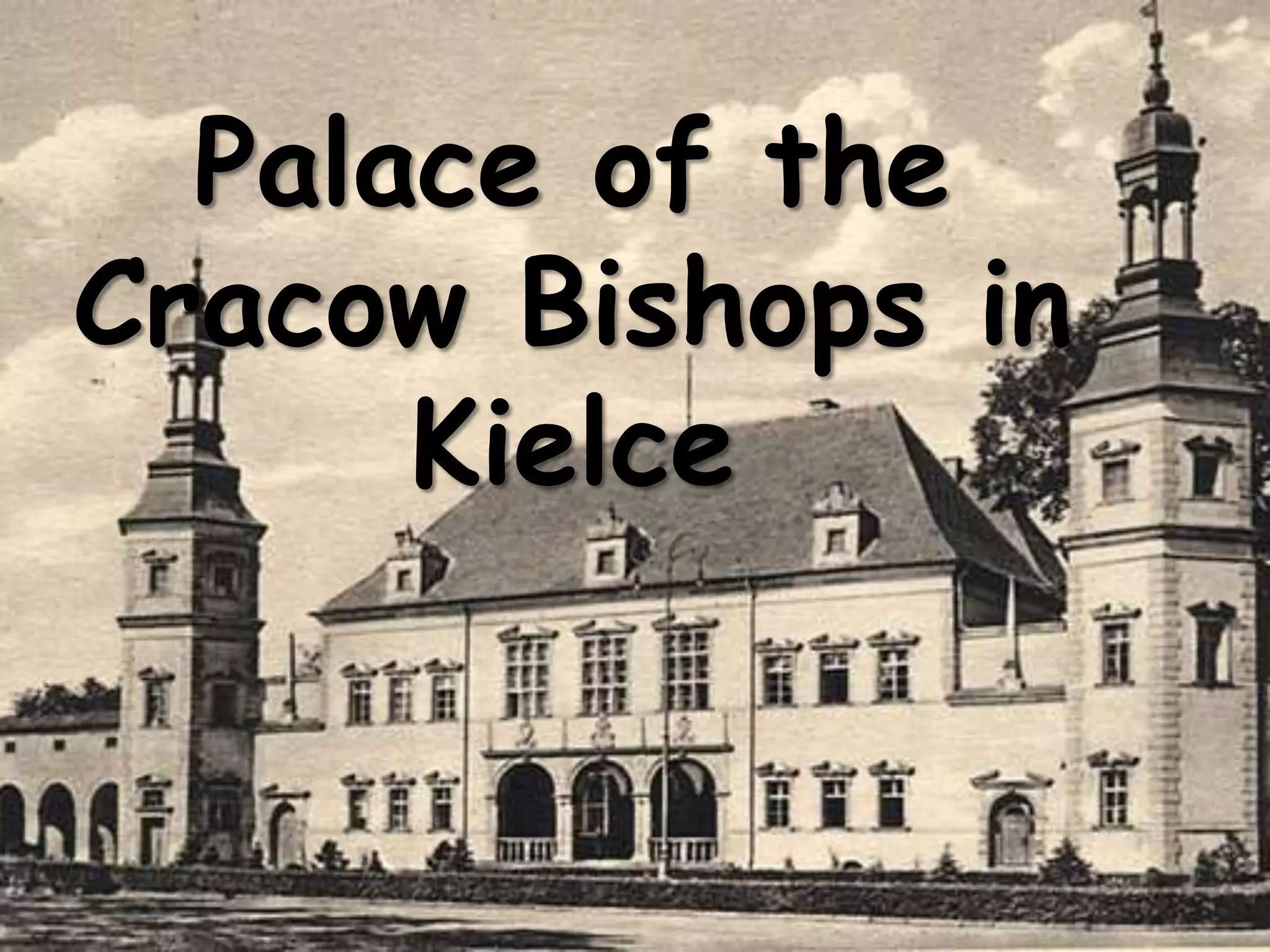
Palace of the
Cracow Bishops in
Kielce
The Palace of the Cracow Bishops in Kielcewas built
in the 17th century as a summer residence of Bishops
of Kraków in Kielce, Poland. The architecture of the
palace constitutes a unique mélange of Polish and
Italian traditions and it reflects political ambitions of
its founder. Currently the palace houses a branch of
the National Museum with an important gallery of
Polish paintings. The residence of the Cracow Bishops
in the city of Kielce was founded by bishop Jakub
Zadzik, Great Crown Chancellor.
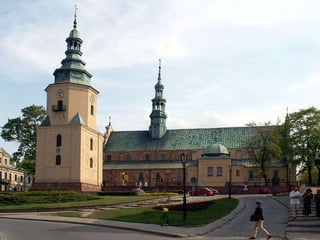
The residence of Cracow bishops in Kielce is called the
palace. It is located on the hill - called Castle Hill.
Cracow bishops palace is sorrounded by the stone
wall. In the wall, up till today, it is possible to see
partly kept tower which is called Powder Tower. It was
being built up with the thought about defensive
functions.
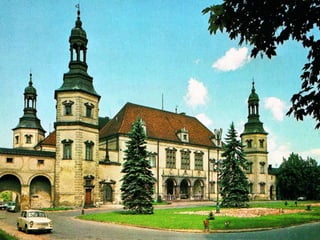
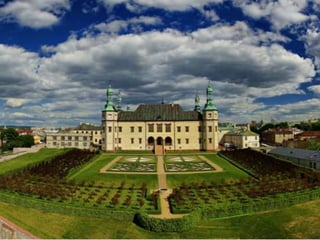
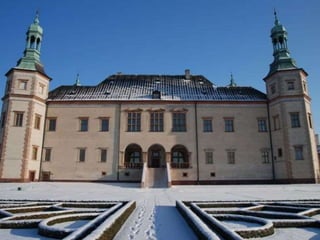
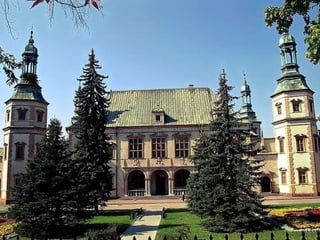
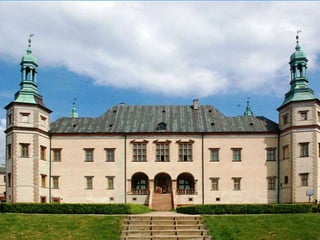
The Palace built on the squared plan, has 2 storeys
and 4 corner towers with 3 storeys. All towers are
identical, hexagonal and crowned with the pretty
helmet, but two front are not adjoining to the lump of
the palace. They are linked with two narrow annexes.
At one time statues of Swedish Members of
Parliament (Oxenstierna and Brache) and Moscow
(Lwow and Szeremetiew) were placed. There with
those Members of Parliament a founder of the castle,
bishop Jakub Zadzik, conducted negotiations.
At the front, on both sides there are one- storey
building extensions. They have L letter shape. On the
back there is a garden, which is confined by the stone
wall with Powder Tower and granary.
All of the historic buildings are well kept. Apart from
mentionend before two gates and part of the stone
wall with north side tower the buildings did not
survive to our times.
It is the only one Polish baroque residence from half
of the 17th century which kept decor of insides.
The Kielce castle was erected in the first half of the
17th century from the initiative of bishop Jakub
Zadzik.
Tourists can admire wonderful episcopal chambers
with furniture, portals, fireplaces, floors and very
beautiful ceilings designed by Tomasz Dolabelli and
the huge collection of paintings among others of
Chełmoński, Wyspiański, Gierymski, Witkiewicz. Every
exhibited item is well described, although it is done a
bit not comfortably - at entering to the given
chamber. In one of the rooms a Sanctuary of J.
Piłsudski was created with the posthumous grimace
and uniform of the Marshal.
Jakub Zadzik - bishop of Cracow from 1635, diplomat, magnate in the
Polish-Lithuanian Commonwealth. Zadzik sponsored the Cracow Bishops'
Palace in Kielce, now a museum.
Central part of the Swietokrzyskie
voivodeship .
It is possible to get there from most of the cities in the
country. The Palace is located on the hill near down
the town. There is the place to park the car near the
palace .
Made by: Martyna Wójcik
III AK
Source: http://zamki.res.pl/kielce.htm

Pałac biskupów

  • 1.
    Palace of the CracowBishops in Kielce
  • 2.
    The Palace ofthe Cracow Bishops in Kielcewas built in the 17th century as a summer residence of Bishops of Kraków in Kielce, Poland. The architecture of the palace constitutes a unique mélange of Polish and Italian traditions and it reflects political ambitions of its founder. Currently the palace houses a branch of the National Museum with an important gallery of Polish paintings. The residence of the Cracow Bishops in the city of Kielce was founded by bishop Jakub Zadzik, Great Crown Chancellor.
  • 3.
    The residence ofCracow bishops in Kielce is called the palace. It is located on the hill - called Castle Hill. Cracow bishops palace is sorrounded by the stone wall. In the wall, up till today, it is possible to see partly kept tower which is called Powder Tower. It was being built up with the thought about defensive functions.
  • 4.
    The Palace builton the squared plan, has 2 storeys and 4 corner towers with 3 storeys. All towers are identical, hexagonal and crowned with the pretty helmet, but two front are not adjoining to the lump of the palace. They are linked with two narrow annexes. At one time statues of Swedish Members of Parliament (Oxenstierna and Brache) and Moscow (Lwow and Szeremetiew) were placed. There with those Members of Parliament a founder of the castle, bishop Jakub Zadzik, conducted negotiations. At the front, on both sides there are one- storey building extensions. They have L letter shape. On the back there is a garden, which is confined by the stone wall with Powder Tower and granary.
  • 5.
    All of thehistoric buildings are well kept. Apart from mentionend before two gates and part of the stone wall with north side tower the buildings did not survive to our times. It is the only one Polish baroque residence from half of the 17th century which kept decor of insides. The Kielce castle was erected in the first half of the 17th century from the initiative of bishop Jakub Zadzik.
  • 6.
    Tourists can admirewonderful episcopal chambers with furniture, portals, fireplaces, floors and very beautiful ceilings designed by Tomasz Dolabelli and the huge collection of paintings among others of Chełmoński, Wyspiański, Gierymski, Witkiewicz. Every exhibited item is well described, although it is done a bit not comfortably - at entering to the given chamber. In one of the rooms a Sanctuary of J. Piłsudski was created with the posthumous grimace and uniform of the Marshal.
  • 11.
    Jakub Zadzik -bishop of Cracow from 1635, diplomat, magnate in the Polish-Lithuanian Commonwealth. Zadzik sponsored the Cracow Bishops' Palace in Kielce, now a museum.
  • 12.
    Central part ofthe Swietokrzyskie voivodeship . It is possible to get there from most of the cities in the country. The Palace is located on the hill near down the town. There is the place to park the car near the palace .
  • 16.
    Made by: MartynaWójcik III AK Source: http://zamki.res.pl/kielce.htm