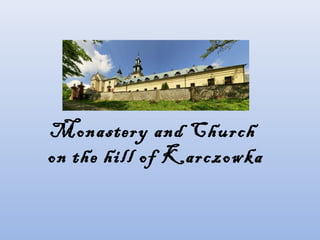
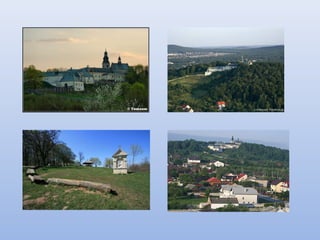
Monastery and Church
on the hill of Karczowka
Karczowka Hill
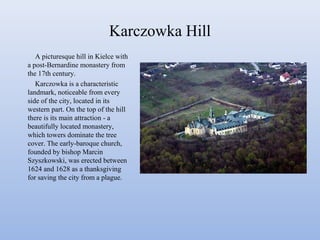
A picturesque hill in Kielce with
a post-Bernardine monastery from
the 17th century.
Karczowka is a characteristic
landmark, noticeable from every
side of the city, located in its
western part. On the top of the hill
there is its main attraction - a
beautifully located monastery,
which towers dominate the tree
cover. The early-baroque church,
founded by bishop Marcin
Szyszkowski, was erected between
1624 and 1628 as a thanksgiving
for saving the city from a plague.
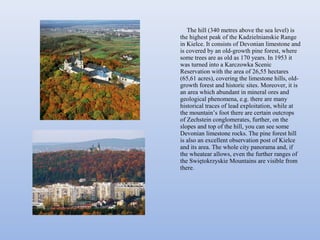
The hill (340 metres above the sea level) is
the highest peak of the Kadzielnianskie Range
in Kielce. It consists of Devonian limestone and
is covered by an old-growth pine forest, where
some trees are as old as 170 years. In 1953 it
was turned into a Karczowka Scenic
Reservation with the area of 26,55 hectares
(65,61 acres), covering the limestone hills, old-
growth forest and historic sites. Moreover, it is
an area which abundant in mineral ores and
geological phenomena, e.g. there are many
historical traces of lead exploitation, while at
the mountain’s foot there are certain outcrops
of Zechstein conglomerates, further, on the
slopes and top of the hill, you can see some
Devonian limestone rocks. The pine forest hill
is also an excellent observation post of Kielce
and its area. The whole city panorama and, if
the wheatear allows, even the further ranges of
the Swiętokrzyskie Mountains are visible from
there.
The whole area of Karczowka, as well as of the adjoining hills – Grabina, Dalnia and
Brusznia is covered with “cracks” which are gradually being overgrown. These are the traces
of prospecting and mining of nests of deposits of lead sulphide – i.e. the silver-bearing galena.
Their discovery lead to the city's rapid development in the 16th and 17th centuries. In the
church chapel at Karczowka one can see a unique statue made out of a single galena block. It
depicts Saint Barbara – the saint patron of miners. Two other statues were made of similar
mineral blocks.
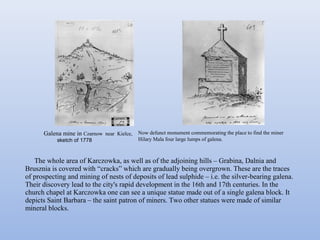
Galena mine in Czarnow near Kielce,
sketch of 1778
Now defunct monument commemorating the place to find the miner
Hilary Mala four large lumps of galena.
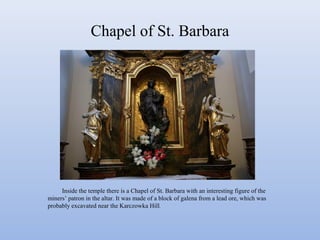
Chapel of St. Barbara
Inside the temple there is a Chapel of St. Barbara with an interesting figure of the
miners’ patron in the altar. It was made of a block of galena from a lead ore, which was
probably excavated near the Karczowka Hill.
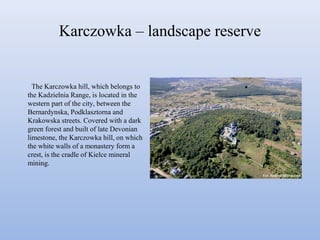
Karczowka – landscape reserve
The Karczowka hill, which belongs to
the Kadzielnia Range, is located in the
western part of the city, between the
Bernardynska, Podklasztorna and
Krakowska streets. Covered with a dark
green forest and built of late Devonian
limestone, the Karczowka hill, on which
the white walls of a monastery form a
crest, is the cradle of Kielce mineral
mining.
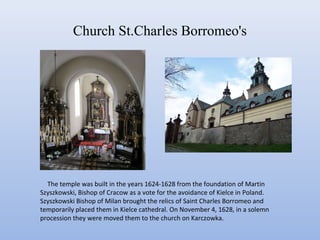
Church St.Charles Borromeo's
The temple was built in the years 1624-1628 from the foundation of Martin
Szyszkowski, Bishop of Cracow as a vote for the avoidance of Kielce in Poland.
Szyszkowski Bishop of Milan brought the relics of Saint Charles Borromeo and
temporarily placed them in Kielce cathedral. On November 4, 1628, in a solemn
procession they were moved them to the church on Karczowka.
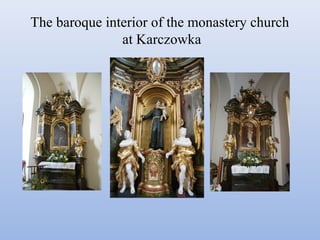
The baroque interior of the monastery church
at Karczowka
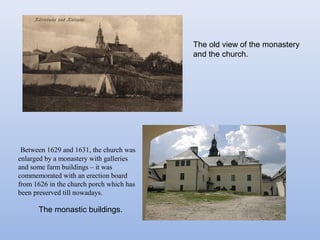
The monastic buildings.
The old view of the monastery
and the church.
Between 1629 and 1631, the church was
enlarged by a monastery with galleries
and some farm buildings – it was
commemorated with an erection board
from 1626 in the church porch which has
been preserved till nowadays.
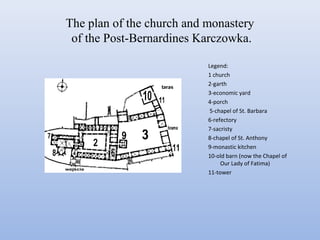
The plan of the church and monastery
of the Post-Bernardines Karczowka.
Legend:
1 church
2-garth
3-economic yard
4-porch
5-chapel of St. Barbara
6-refectory
7-sacristy
8-chapel of St. Anthony
9-monastic kitchen
10-old barn (now the Chapel of
Our Lady of Fatima)
11-tower
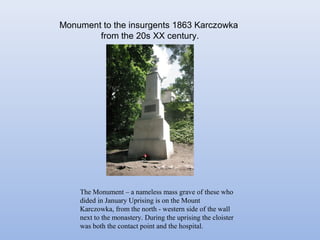
Monument to the insurgents 1863 Karczowka
from the 20s XX century.
The Monument – a nameless mass grave of these who
dided in January Uprising is on the Mount
Karczowka, from the north - western side of the wall
next to the monastery. During the uprising the cloister
was both the contact point and the hospital.
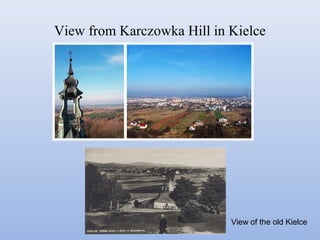
View from Karczowka Hill in Kielce
View of the old Kielce
Made by:
Agnieszka Slusarczyk
IV AK
• http://www.um.kielce.pl/turystyka/zabytki/klasztor-i-kosciol-na-wzgorzu-karczowka/
• http://www.meteo-europ.com/pl/pl/kielce/karczowka-zdjecia.html
• http://www.wrota-swietokrzyskie.pl/407/-/asset_publisher/tvK0/content/karczowka-swiadectwo-gorniczej-
przeszlosci-kielc?redirect=http%3A%2F%2Fwww.wrota-swietokrzyskie.pl%2F407%3Fp_p_id
%3D101_INSTANCE_tvK0%26p_p_lifecycle%3D0%26p_p_state%3Dnormal%26p_p_mode%3Dview
%26p_p_col_id%3Dcolumn-2%26p_p_col_count%3D1
• http://skps.mbz.net.pl/old/skps/karczowka.htm
Source:

Karczówka

  • 1.
    Monastery and Church onthe hill of Karczowka
  • 2.
    Karczowka Hill A picturesquehill in Kielce with a post-Bernardine monastery from the 17th century. Karczowka is a characteristic landmark, noticeable from every side of the city, located in its western part. On the top of the hill there is its main attraction - a beautifully located monastery, which towers dominate the tree cover. The early-baroque church, founded by bishop Marcin Szyszkowski, was erected between 1624 and 1628 as a thanksgiving for saving the city from a plague.
  • 3.
    The hill (340metres above the sea level) is the highest peak of the Kadzielnianskie Range in Kielce. It consists of Devonian limestone and is covered by an old-growth pine forest, where some trees are as old as 170 years. In 1953 it was turned into a Karczowka Scenic Reservation with the area of 26,55 hectares (65,61 acres), covering the limestone hills, old- growth forest and historic sites. Moreover, it is an area which abundant in mineral ores and geological phenomena, e.g. there are many historical traces of lead exploitation, while at the mountain’s foot there are certain outcrops of Zechstein conglomerates, further, on the slopes and top of the hill, you can see some Devonian limestone rocks. The pine forest hill is also an excellent observation post of Kielce and its area. The whole city panorama and, if the wheatear allows, even the further ranges of the Swiętokrzyskie Mountains are visible from there.
  • 4.
    The whole areaof Karczowka, as well as of the adjoining hills – Grabina, Dalnia and Brusznia is covered with “cracks” which are gradually being overgrown. These are the traces of prospecting and mining of nests of deposits of lead sulphide – i.e. the silver-bearing galena. Their discovery lead to the city's rapid development in the 16th and 17th centuries. In the church chapel at Karczowka one can see a unique statue made out of a single galena block. It depicts Saint Barbara – the saint patron of miners. Two other statues were made of similar mineral blocks. Galena mine in Czarnow near Kielce, sketch of 1778 Now defunct monument commemorating the place to find the miner Hilary Mala four large lumps of galena.
  • 5.
    Chapel of St.Barbara Inside the temple there is a Chapel of St. Barbara with an interesting figure of the miners’ patron in the altar. It was made of a block of galena from a lead ore, which was probably excavated near the Karczowka Hill.
  • 6.
    Karczowka – landscapereserve The Karczowka hill, which belongs to the Kadzielnia Range, is located in the western part of the city, between the Bernardynska, Podklasztorna and Krakowska streets. Covered with a dark green forest and built of late Devonian limestone, the Karczowka hill, on which the white walls of a monastery form a crest, is the cradle of Kielce mineral mining.
  • 7.
    Church St.Charles Borromeo's Thetemple was built in the years 1624-1628 from the foundation of Martin Szyszkowski, Bishop of Cracow as a vote for the avoidance of Kielce in Poland. Szyszkowski Bishop of Milan brought the relics of Saint Charles Borromeo and temporarily placed them in Kielce cathedral. On November 4, 1628, in a solemn procession they were moved them to the church on Karczowka.
  • 8.
    The baroque interiorof the monastery church at Karczowka
  • 9.
    The monastic buildings. Theold view of the monastery and the church. Between 1629 and 1631, the church was enlarged by a monastery with galleries and some farm buildings – it was commemorated with an erection board from 1626 in the church porch which has been preserved till nowadays.
  • 10.
    The plan ofthe church and monastery of the Post-Bernardines Karczowka. Legend: 1 church 2-garth 3-economic yard 4-porch 5-chapel of St. Barbara 6-refectory 7-sacristy 8-chapel of St. Anthony 9-monastic kitchen 10-old barn (now the Chapel of Our Lady of Fatima) 11-tower
  • 11.
    Monument to theinsurgents 1863 Karczowka from the 20s XX century. The Monument – a nameless mass grave of these who dided in January Uprising is on the Mount Karczowka, from the north - western side of the wall next to the monastery. During the uprising the cloister was both the contact point and the hospital.
  • 12.
    View from KarczowkaHill in Kielce View of the old Kielce
  • 14.
    Made by: Agnieszka Slusarczyk IVAK • http://www.um.kielce.pl/turystyka/zabytki/klasztor-i-kosciol-na-wzgorzu-karczowka/ • http://www.meteo-europ.com/pl/pl/kielce/karczowka-zdjecia.html • http://www.wrota-swietokrzyskie.pl/407/-/asset_publisher/tvK0/content/karczowka-swiadectwo-gorniczej- przeszlosci-kielc?redirect=http%3A%2F%2Fwww.wrota-swietokrzyskie.pl%2F407%3Fp_p_id %3D101_INSTANCE_tvK0%26p_p_lifecycle%3D0%26p_p_state%3Dnormal%26p_p_mode%3Dview %26p_p_col_id%3Dcolumn-2%26p_p_col_count%3D1 • http://skps.mbz.net.pl/old/skps/karczowka.htm Source: