PARTICIPATORY PROJECT
DEVELOPMENT MANAGEMENT
Public Administration 210: Project Evaluation and Impact Management
Group Members
Ms. Joy Valerie Gigataras
Ms. Phyllis Claire Soldevilla-Jacar
Mr. Andy Pablico
Mr. Robert Montaño
Mr. Ralph Jason Fuentes
Topics Overview
I. Scope and Nature Project
II. Raising Productivity Levels
III. Broadening the Sharing of Project’s Blessing
IV. Democratization of Projects and Social Services
V. Creating More Job Opportunities and Means of Livelihood
VI. Developing the People’s Potential for them to take the
Leading Role in Development
PARTICIPATORY PROJECT DEVELOPMENT MANAGEMENT
Scope and Nature Project
What is the Scope and Nature of the Project?
Project scope is the part of project planning that involves determining
and documenting a list of specific project goals, deliverables, tasks,
costs and deadlines. The documentation of a project's scope is called a
scope statement or terms of reference.
Scope and Nature Project
Why is it important to define the Scope Project?
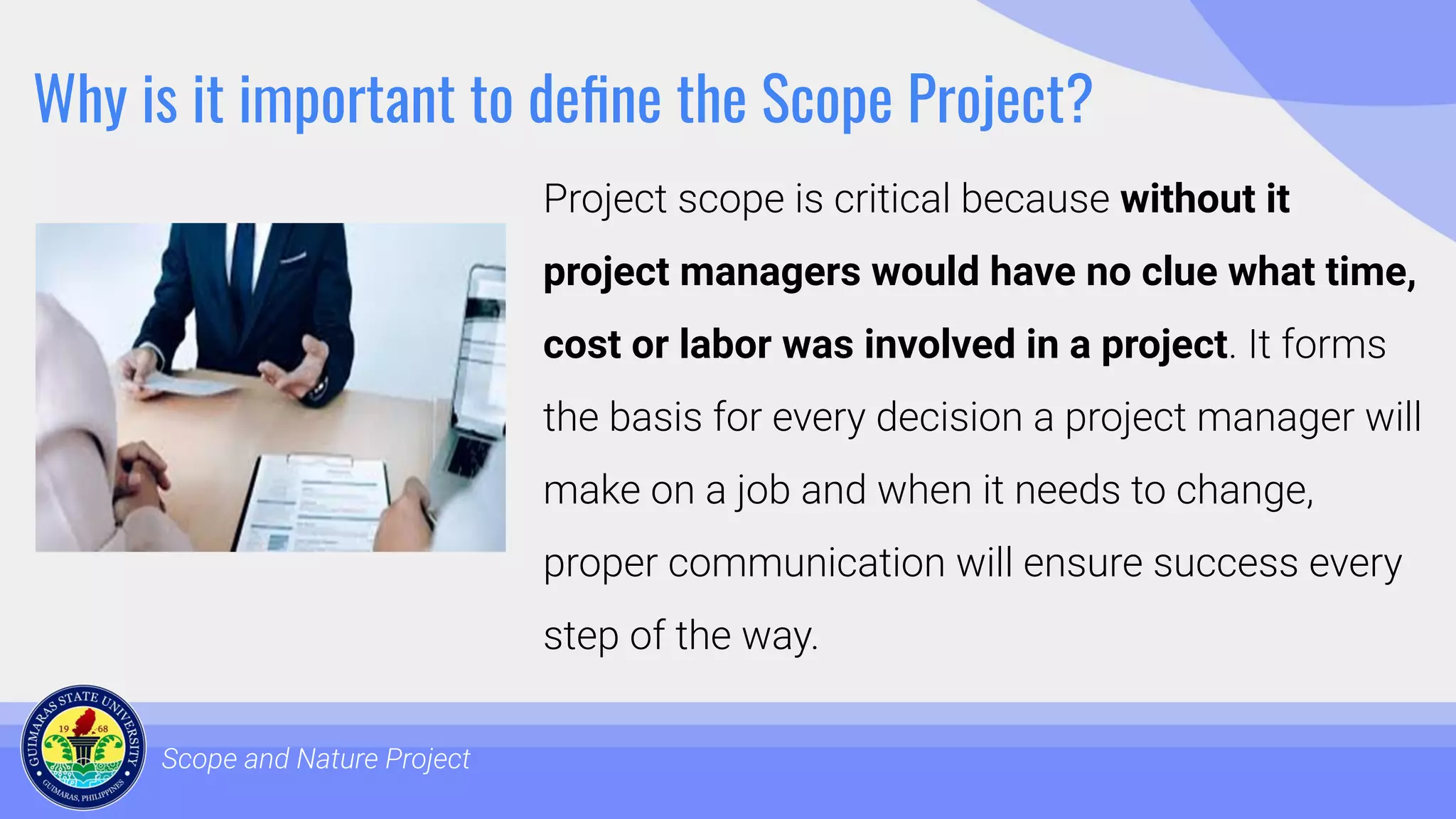
Project scope is critical because without it
project managers would have no clue what time,
cost or labor was involved in a project. It forms
the basis for every decision a project manager will
make on a job and when it needs to change,
proper communication will ensure success every
step of the way.
Scope and Nature Project
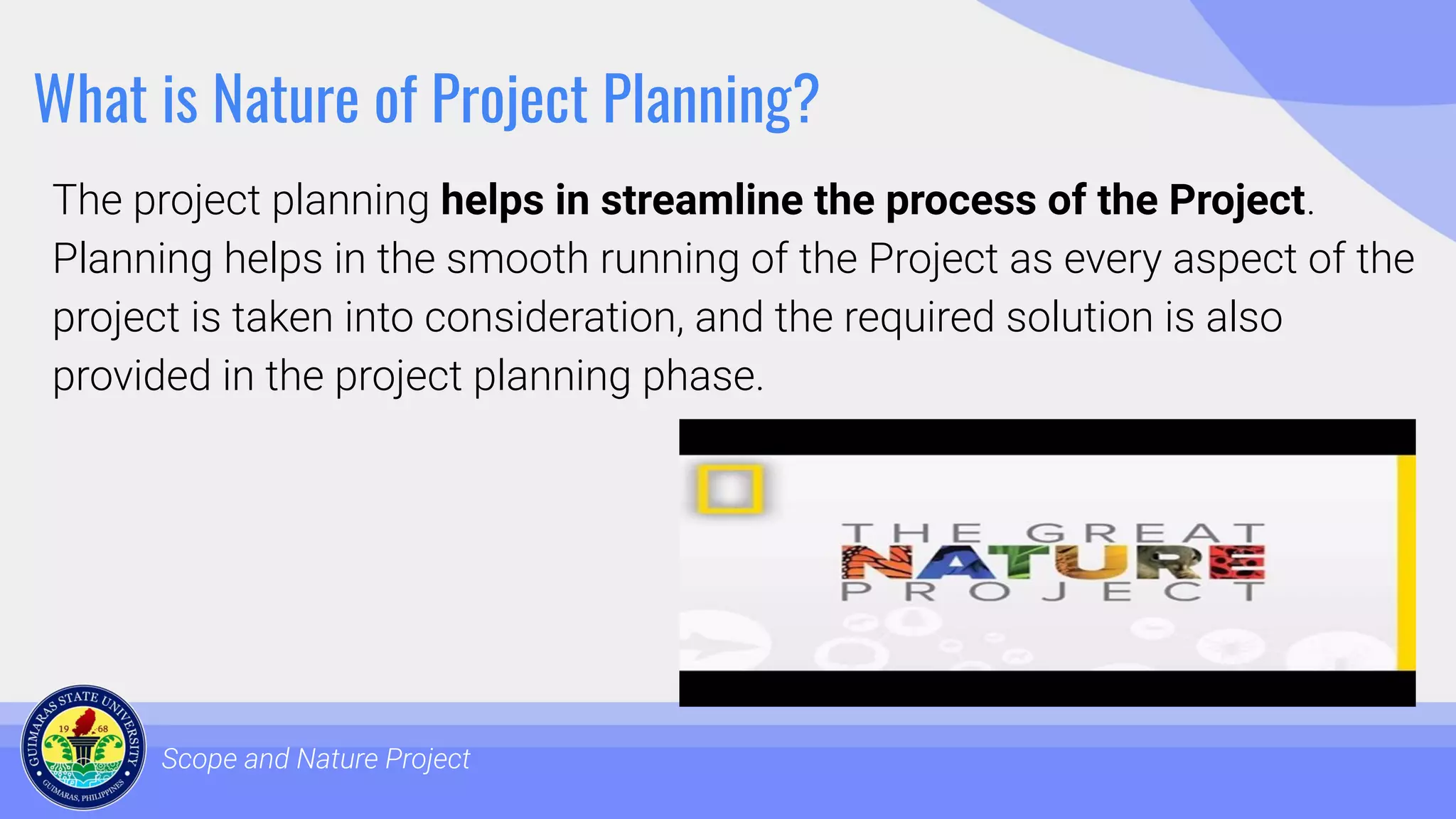
8 Key Steps to
Developing a Project
Scope Statement
1) Understand why the project was
initiated
2) Define the key objectives of the
project
3) Outline the project statement of work
4) Identify major deliverables
5) Select key milestones
6) Identify major constraints
7) List scope exclusions
8) Obtain sign-off
Scope and Nature Project
What is Nature of Project Planning?
The project planning helps in streamline the process of the Project.
Planning helps in the smooth running of the Project as every aspect of the
project is taken into consideration, and the required solution is also
provided in the project planning phase.
Scope and Nature Project
What is the Nature and Scope of Project Management?
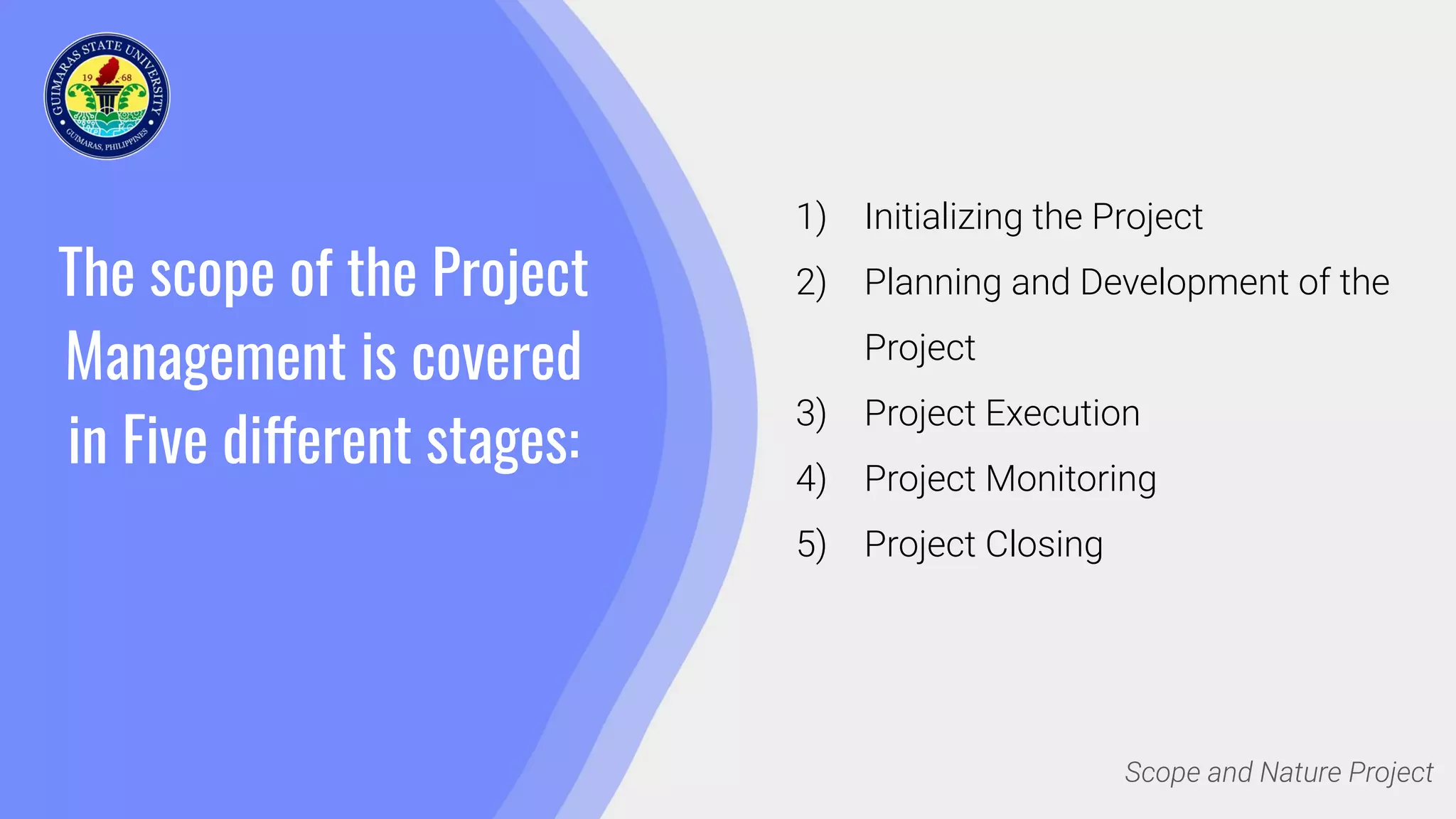
➢ Project Management, in a simple term, it means managing a
project from end to end. It is how a person of authority sets
up and supervises the resources that are available in order to
finish a project they have taken.
➢ The person of authority who supervises the whole project is
called the Project Manager.
➢ The Project Managers uses different techniques,
methodologies, skills, and they have the required knowledge
which will help the Project achieve the objective as per the
criterion which has been agreed upon by all the parties.
Scope and Nature Project
The scope of the Project
Management is covered
in Five different stages:
1) Initializing the Project
2) Planning and Development of the
Project
3) Project Execution
4) Project Monitoring
5) Project Closing
Scope and Nature Project
Five Stages of Project Management
1. Initializing the Project
Scope and Nature Project
➢ The first phase of the project as the name suggests is initializing the Project. A business
case, i.e. the benefits or the reasons to do the project is presented, and then the Project is
defined at the macro level.
➢ The project manager first does the feasibility study in order to know whether the
objective of the project is achievable and thus can be launched. The people concerned
with the Project is required to do the due diligence and give the go-ahead to the Project.
➢ The project manager then prepares a comprehensive document stating the objective of
the Project along with it the project manager should mention the different requirement,
the business case that was presented and the need of this Project in the business.
Five Stages of Project Management
2. Planning and Development of the Project
Scope and Nature Project
➢ After the Project gets a go-ahead, and it is initiated, the project manager moves to
the second phase known as the project planning phase of the project
management.
➢ In this phase, the project manager prepares a roadmap which focuses on
achieving the objective of the project in a systematic way. The project planning
helps in streamline the process of the Project.
➢ Planning helps in the smooth running of the Project as every aspect of the project
is taken into consideration, and the required solution is also provided in the project
planning phase.
Five Stages of Project Management
3. Project Execution
Scope and Nature Project
➢ The actual work on the project happens in this phase. There are many
responsibilities which get done in this phase.
➢ In this phase, a team is developed for the Project; resources are assigned, the
execution of the second phase is done now.
➢ The project manager manages the execution, tracking system for the progress
of the project is set up, the status meetings are done regularly, the project
schedule is updated as and when the planned task is finished as well as the
project planning is modified as per the requirement of the situation during the
execution.
Five Stages of Project Management
4. Project Monitoring
Scope and Nature Project
➢ The third and the fourth phase of the project management go hand in hand
in the process of project management. During this phase the Project is
monitored proactively in order to know whether the project is going as per
the planning, it will also help to know whether the Project is not going over
budget and whether the quality of the Project executed till now is up to
the mark.
➢ These are some of the things that the project manager would be aware of
if the Project is continuously monitored and will help the Project manager
decide the further course of action.
Five Stages of Project Management
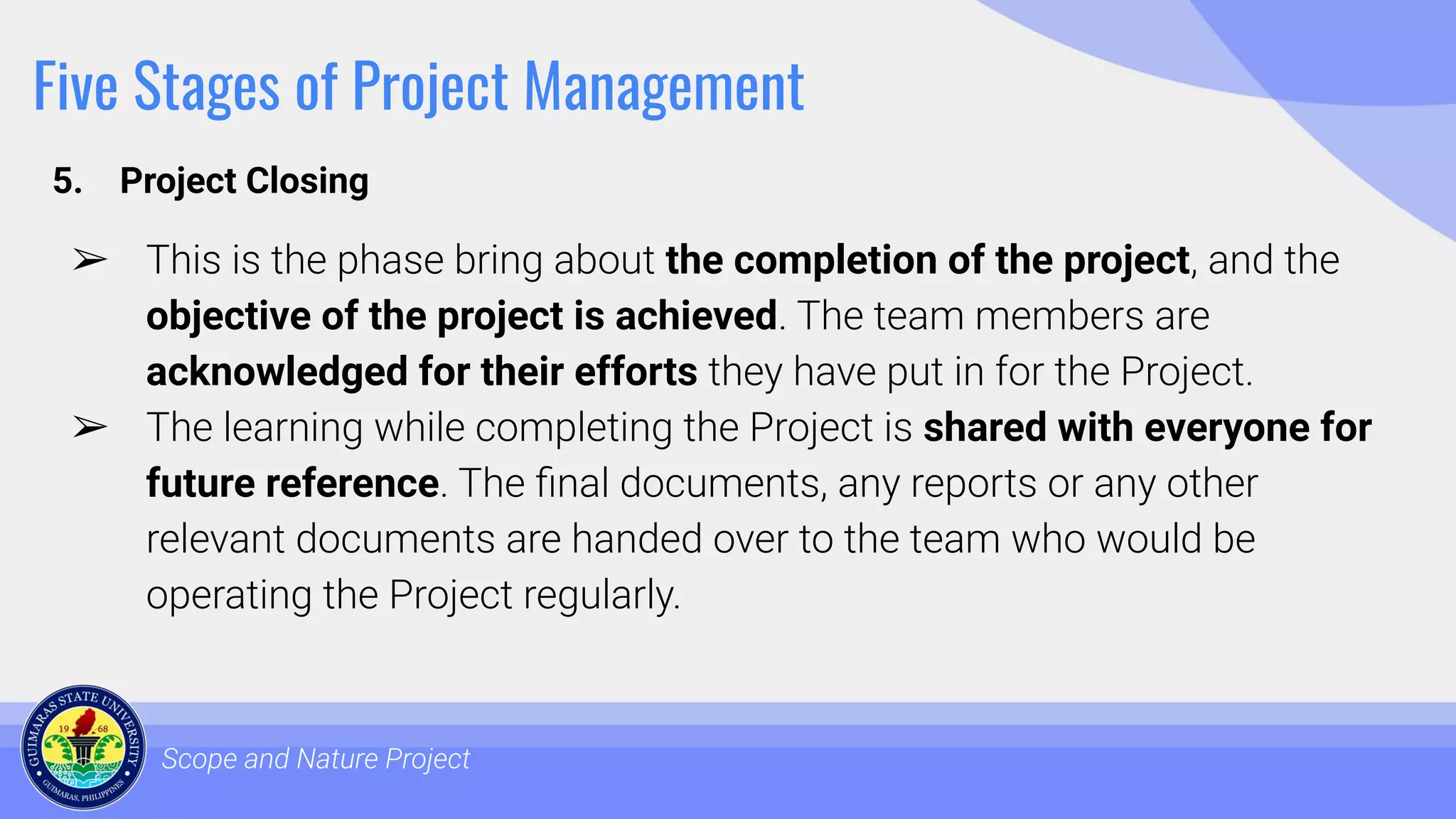
5. Project Closing
Scope and Nature Project
➢ This is the phase bring about the completion of the project, and the
objective of the project is achieved. The team members are
acknowledged for their efforts they have put in for the Project.
➢ The learning while completing the Project is shared with everyone for
future reference. The final documents, any reports or any other
relevant documents are handed over to the team who would be
operating the Project regularly.
5 Characteristics
of a Project
1) Specific
2) Measurable
3) Achievable
4) Relevant
5) Time Bound
Scope and Nature Project
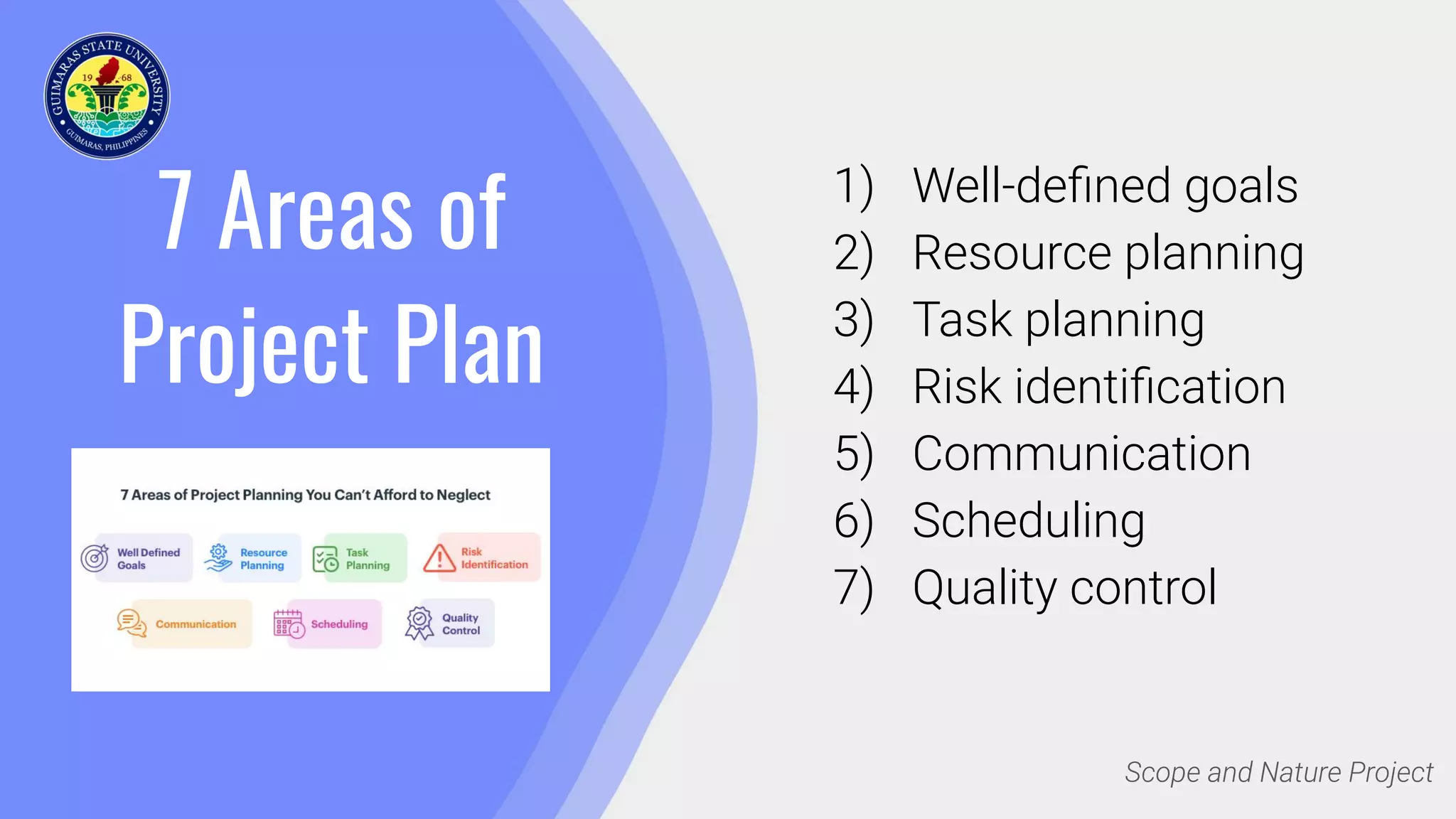
7 Areas of
Project Plan
1) Well-defined goals
2) Resource planning
3) Task planning
4) Risk identification
5) Communication
6) Scheduling
7) Quality control
Scope and Nature Project
PARTICIPATORY PROJECT DEVELOPMENT MANAGEMENT
Raising Productivity Levels
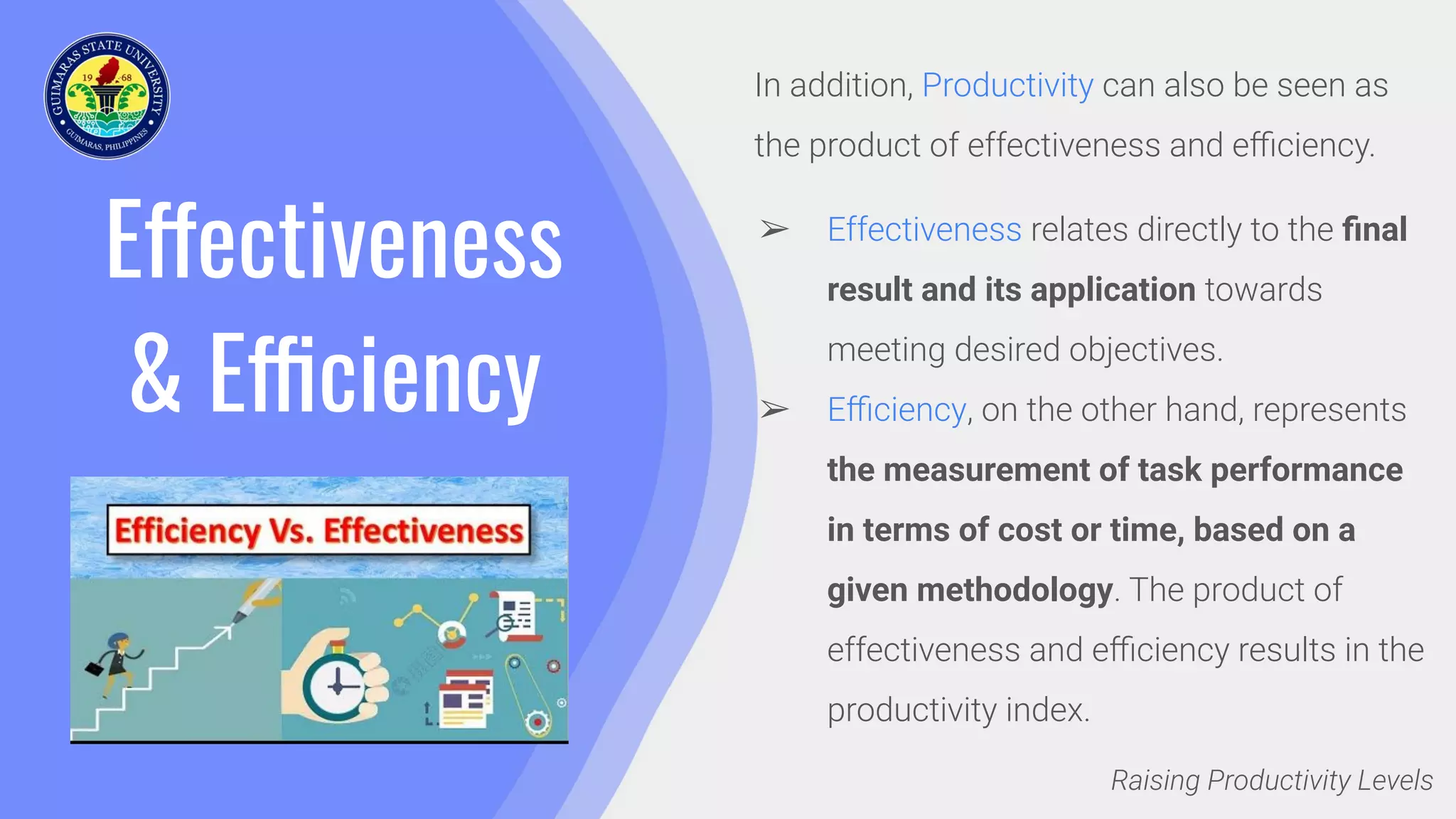
What is
Productivity?
Productivity in project work is
determined by observing the
relationship between final
results and cost or time. That
ratio if consistently measured at
regular intervals. A record of
productivity trends.
Raising Productivity Levels
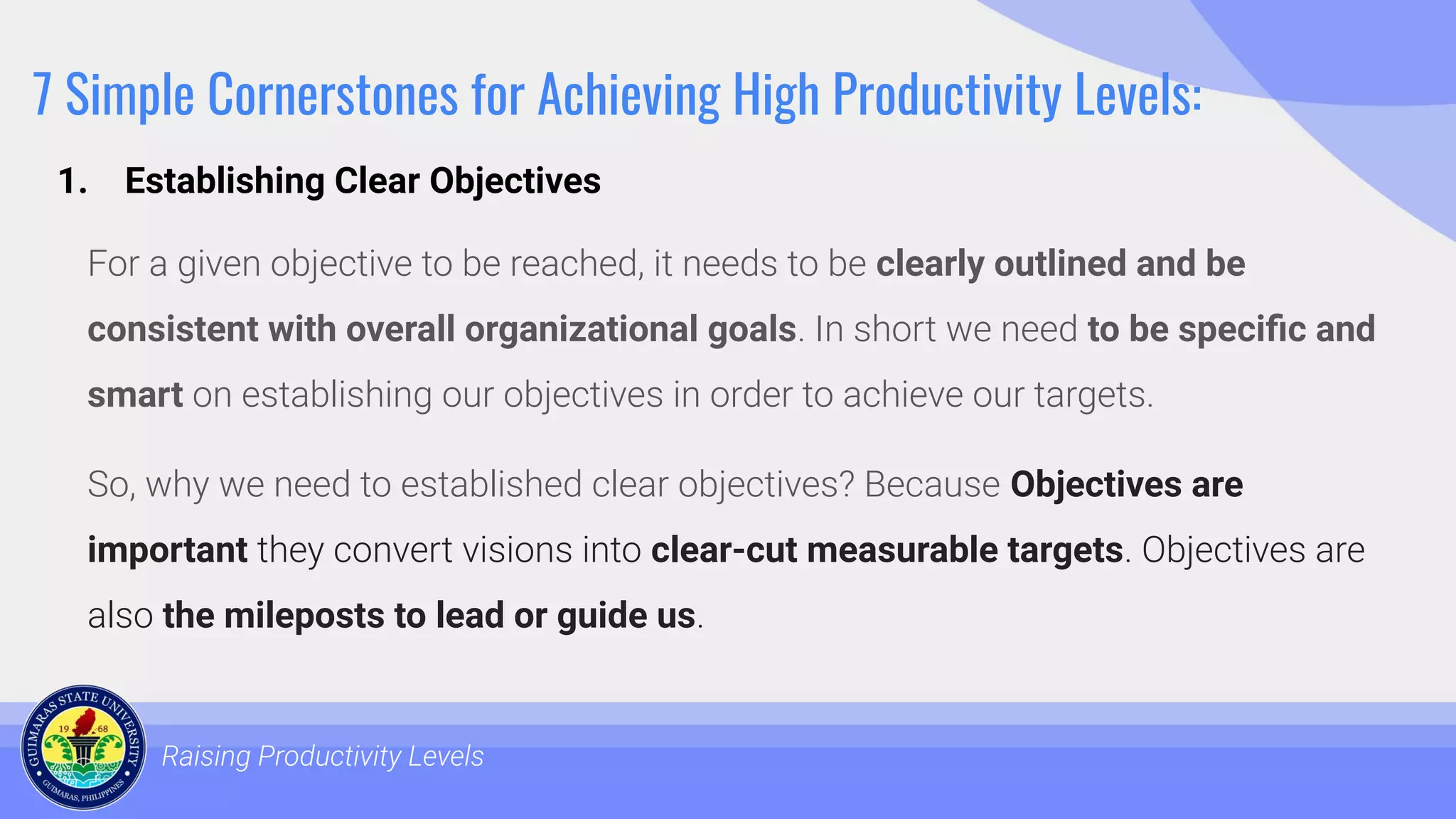
Effectiveness
& Efficiency
In addition, Productivity can also be seen as
the product of effectiveness and efficiency.
➢ Effectiveness relates directly to the final
result and its application towards
meeting desired objectives.
➢ Efficiency, on the other hand, represents
the measurement of task performance
in terms of cost or time, based on a
given methodology. The product of
effectiveness and efficiency results in the
productivity index.
Raising Productivity Levels
7 Simple Cornerstones for Achieving High Productivity Levels:
For a given objective to be reached, it needs to be clearly outlined and be
consistent with overall organizational goals. In short we need to be specific and
smart on establishing our objectives in order to achieve our targets.
So, why we need to established clear objectives? Because Objectives are
important they convert visions into clear-cut measurable targets. Objectives are
also the mileposts to lead or guide us.
Raising Productivity Levels
1. Establishing Clear Objectives
7 Simple Cornerstones for Achieving High Productivity Levels:
In addition, clear objectives motivate employees. Employees become more
enthusiastic and spirited in their work when they know what is expected of them.
Their work is more directed with less wasted time. They get particularly
interested when they learn about the rewards for meeting and exceeding their
objectives. If employees don't have the skills for their jobs, they are inspired to
learn more and find ways to improve their performance.
Raising Productivity Levels
1. Establishing Clear Objectives
7 Simple Cornerstones for Achieving High Productivity Levels:
Establish standards to evaluate performance: Objectives establish standards of
performance. They are measuring sticks to identify the successes and failures of
an organization and its employees. Performance reporting helps managers
identify non-performing areas and to take corrective actions.
Raising Productivity Levels
1. Establishing Clear Objectives
7 Simple Cornerstones for Achieving High Productivity Levels:
The communication process requires line tuning (using the right combination of
written, visual, participative, and didactic approaches) to ensure that the goals are
understood.
Furthermore, one of the key factors that improve team productivity is effective
communication must prevail in a team. Communication helps team members
understand their responsibilities and reduces the chances of confusion within the
team, which can affect overall productivity.
Effective communication is always about understanding the other person.
Effective communication, then, has to be at the center of everything we do.
Raising Productivity Levels
2. Communicate the Objectives Effectively
7 Simple Cornerstones for Achieving High Productivity Levels:
Consensus decision making and joint-planning efforts are required to stimulate
team members to achieve project goals.
Peter Drucker has spoken of lack of clarity in communicating objectives as a
major cause for lagging productivity. He also points out that low levels of
productivity in managerial and engineering functions are more attributable to what
the professional doesn't do than to what is done, thus, the need for involvement in
order to spur the individual on to higher levels of performance.
Raising Productivity Levels
3. Involve those who Perform the Work
7 Simple Cornerstones for Achieving High Productivity Levels:
Let your team members make their own decisions and make
them accountable for their work. This instills a sense of
responsibility in employees regarding work, making them
aware that their decisions can affect the performance of the
entire team. Your trust can help build your team members’
self-esteem.
Raising Productivity Levels
4. Give Ownership to Team Members
7 Simple Cornerstones for Achieving High Productivity Levels:
As a manager, you have to know the knowledge, skill sets,
and talents of teammates to allocate tasks accordingly.
Making each member use their strengths will improve
workplace productivity.
Raising Productivity Levels
5. Identify the Strength, Weakness of Your Team
7 Simple Cornerstones for Achieving High Productivity Levels:
Employees work best when their efforts are appreciated and
they are given incentives. Implement incentive programs in
the form of cash, free vouchers, lunch-outs, paid holidays,
etc., to keep your employees motivated.
Raising Productivity Levels
6. Reward Your Employees
7 Simple Cornerstones for Achieving High Productivity Levels:
Constructive feedback is a robust tool for creating a healthy
environment, boosting productivity and engagement, and
achieving better results. It positively influences
communication, team members’ interaction and teamwork
results in different fields.
Raising Productivity Levels
7. Give Constructive Feedback
7 Simple Cornerstones for Achieving High Productivity Levels:
➢ The importance of feedback in the workplace is hard to overestimate: sharing information
on what can and needs to be improved helps optimize the work process and get things
done in less time.
➢ Feedback is of great help in leadership and communication: it creates a clear picture and
increases transparency.
➢ Feedback plays a crucial role in education and learning by helping adopt new knowledge
sooner and avoid repetitive mistakes.
➢ The same applies to feedback in sports and coaching: it helps learn new skills and get
better results.
➢
Raising Productivity Levels
7. Give Constructive Feedback
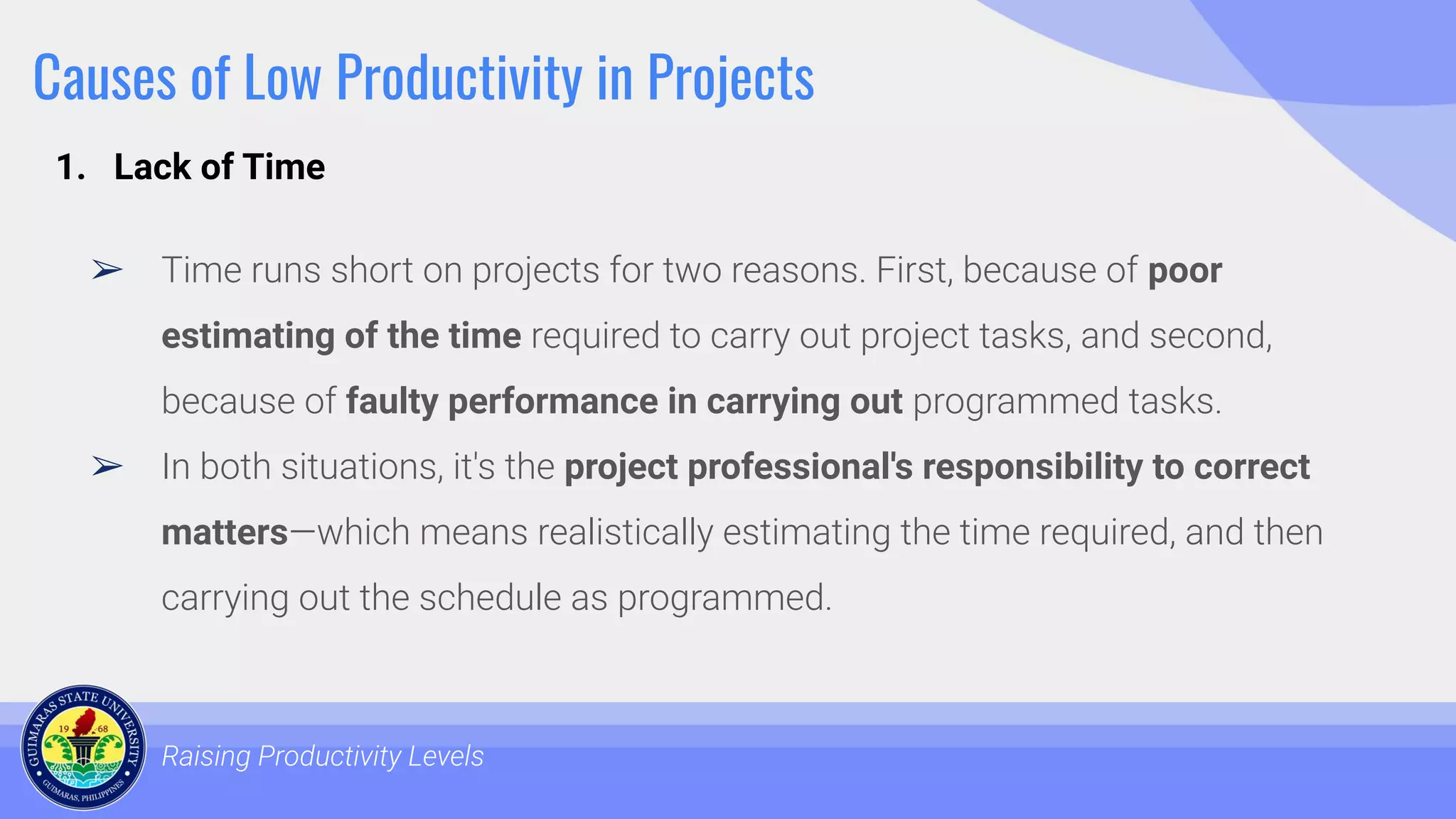
Causes of Low
Productivity in
Projects
Raising Productivity Levels
Causes of Low Productivity in Projects
➢ Time runs short on projects for two reasons. First, because of poor
estimating of the time required to carry out project tasks, and second,
because of faulty performance in carrying out programmed tasks.
➢ In both situations, it's the project professional's responsibility to correct
matters—which means realistically estimating the time required, and then
carrying out the schedule as programmed.
Raising Productivity Levels
1. Lack of Time
Causes of Low Productivity in Projects
➢ The accelerating waves of technological advances make it increasingly
difficult for project personnel to keep up-to-date on technologies. Missing
bits of administrative information also set project productivity back.
➢ Technological data banks, management information systems, and an
information-conscious project team are the solutions to the
lack-of-information syndrome.
Raising Productivity Levels
2. Lack of Information
Causes of Low Productivity in Projects
➢ Good ideas may be scarce due to lack of “gray matter” in the heads of
those who do the thinking, or more commonly, because of a non-creative
atmosphere that provides little stimulus for bright ideas to bloom.
➢ If gray matter is lacking, the solution is to recruit or borrow more qualified
thinkers. If the atmosphere needs changing, then creative techniques like
brainstorming and interchanging professionals with other groups are
appropriate.
Raising Productivity Levels
3. Lack of Ideas
Causes of Low Productivity in Projects
➢ One of the worst errors in project management happens when the wrong
premise is used to outline plans or to make decisions. Lack of upfront
premise screening causes project decisions and plans to be built on sandy
foundations.
➢ Review boards, outside specialists, devil's advocates and creativity
sessions in the beginning of the planning process are ways of offsetting
the incorrect-premise problem.
Raising Productivity Levels
4. Incorrect Premise
Causes of Low Productivity in Projects
➢ All humans are creatures of habit. In project work, some habits work in
favour of meeting projected goals. When those habits involve creativity
and solid methodologies, then the project benefits.
➢ Other habits, that involve repetition of prior practices without questioning
applicability in new situations, have a detrimental effect on project
productivity. Habits need constant questioning to ensure that project goals
are met.
Raising Productivity Levels
5. Bad Habits
Causes of Low Productivity in Projects
➢ “We can't get better results because they won't let us.” (“They” refers to
upper management, the client, the Government, in other words, others).
This attitude places a drain on project productivity.
➢ The opposite stance, on the other hand, boosts productivity: “Let's see
how we can get the job done, in spite of the obstacles.” This upbeat
approach, coupled with solid planning, organization, direction and
control, sets the tone for successful projects.
Raising Productivity Levels
6. Poor Attitude
Causes of Low Productivity in Projects
➢ Other factors cause low productivity on projects, such
as politics, both within and outside of the project arena,
and “force majeure” .Combinations of all those factors
decrease project productivity.
Raising Productivity Levels
6. Poor Attitude
PARTICIPATORY PROJECT DEVELOPMENT MANAGEMENT
Broadening the Sharing of
Project’s Blessings
Essential Elements
of Poverty Targeting
Mechanism
1) Development of Poverty Targeting
Strategy in Relation to Program
Objectives
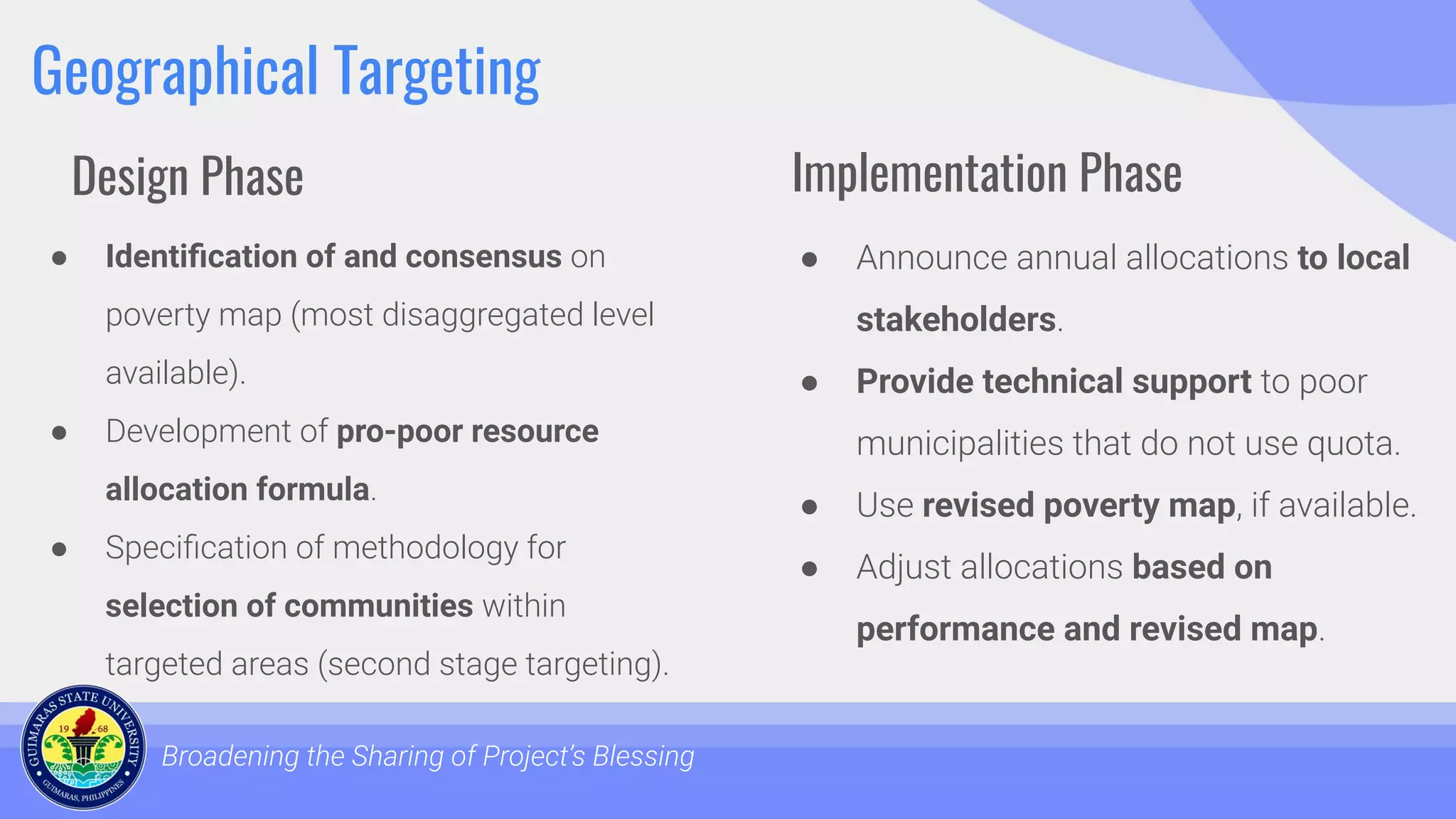
2) Geographical Targeting
3) Menu and Eligibility Criteria
4) Inclusive Processes at Community
Level
5) Monitoring and Evaluation System
Broadening the Sharing of Project’s Blessing
Development of Poverty Targeting Strategy in Relation to Program Objectives
● Clear specification and justification of
target geographical areas.
● Clear specification and justification of
vulnerable and/or poor target
population – should be based on a social
assessment.
● Overall assessment of Government
and/or program preference for targeting
Broadening the Sharing of Project’s Blessing
Overall Poverty Targeting Strategy
● Execute communications strategy of
targeting expectations to all key
stakeholders (parliament, press, sectoral
ministries, civil society)
● Integrate targeting strategy within national
development strategies (Poverty Reduction
Strategy Papers, Millennium Development
Goals)
Design Phase Implementation Phase
Geographical Targeting
● Identification of and consensus on
poverty map (most disaggregated level
available).
● Development of pro-poor resource
allocation formula.
● Specification of methodology for
selection of communities within
targeted areas (second stage targeting).
Broadening the Sharing of Project’s Blessing
● Announce annual allocations to local
stakeholders.
● Provide technical support to poor
municipalities that do not use quota.
● Use revised poverty map, if available.
● Adjust allocations based on
performance and revised map.
Design Phase Implementation Phase
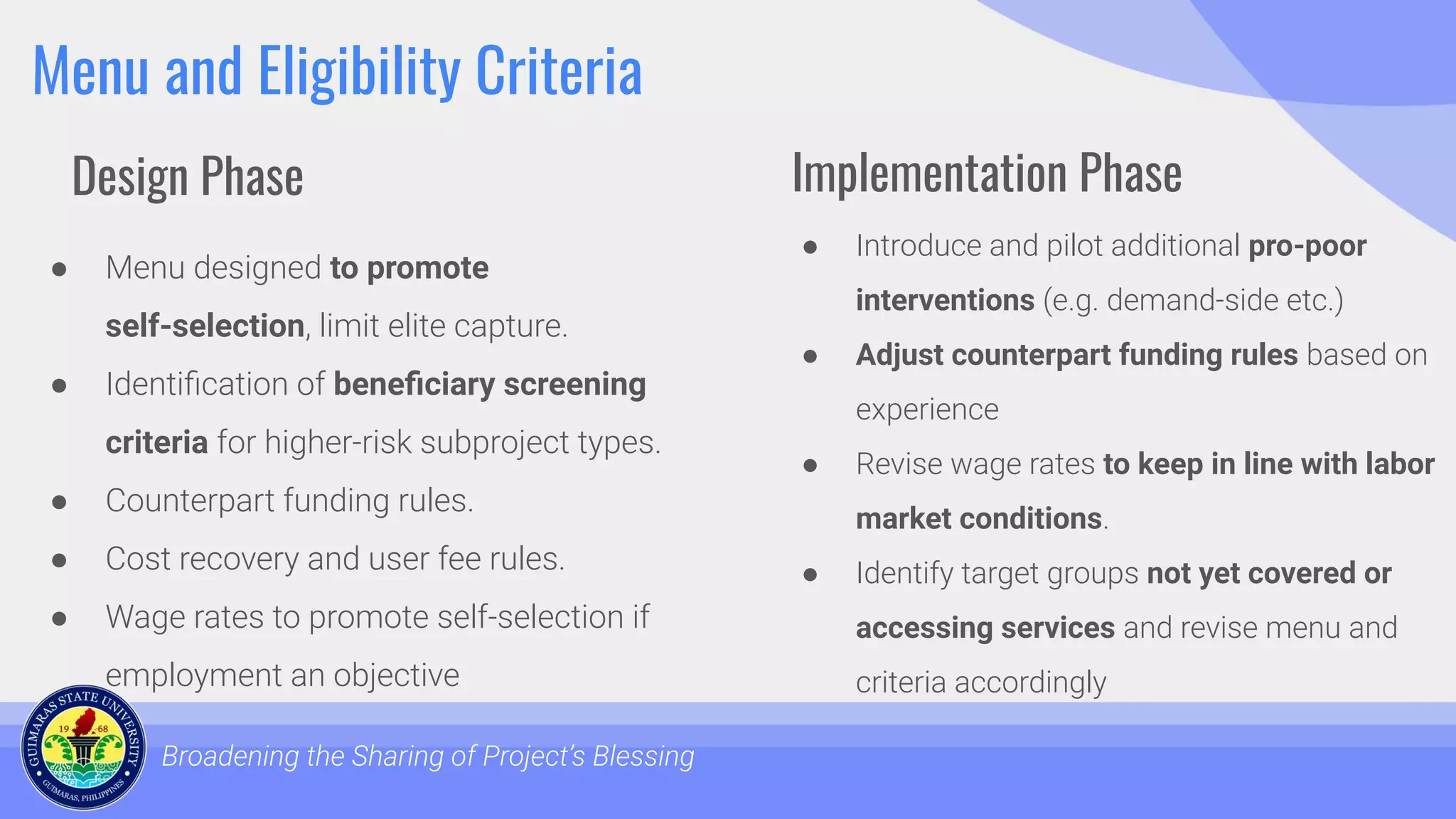
Menu and Eligibility Criteria
● Menu designed to promote
self-selection, limit elite capture.
● Identification of beneficiary screening
criteria for higher-risk subproject types.
● Counterpart funding rules.
● Cost recovery and user fee rules.
● Wage rates to promote self-selection if
employment an objective
Broadening the Sharing of Project’s Blessing
● Introduce and pilot additional pro-poor
interventions (e.g. demand-side etc.)
● Adjust counterpart funding rules based on
experience
● Revise wage rates to keep in line with labor
market conditions.
● Identify target groups not yet covered or
accessing services and revise menu and
criteria accordingly
Design Phase Implementation Phase
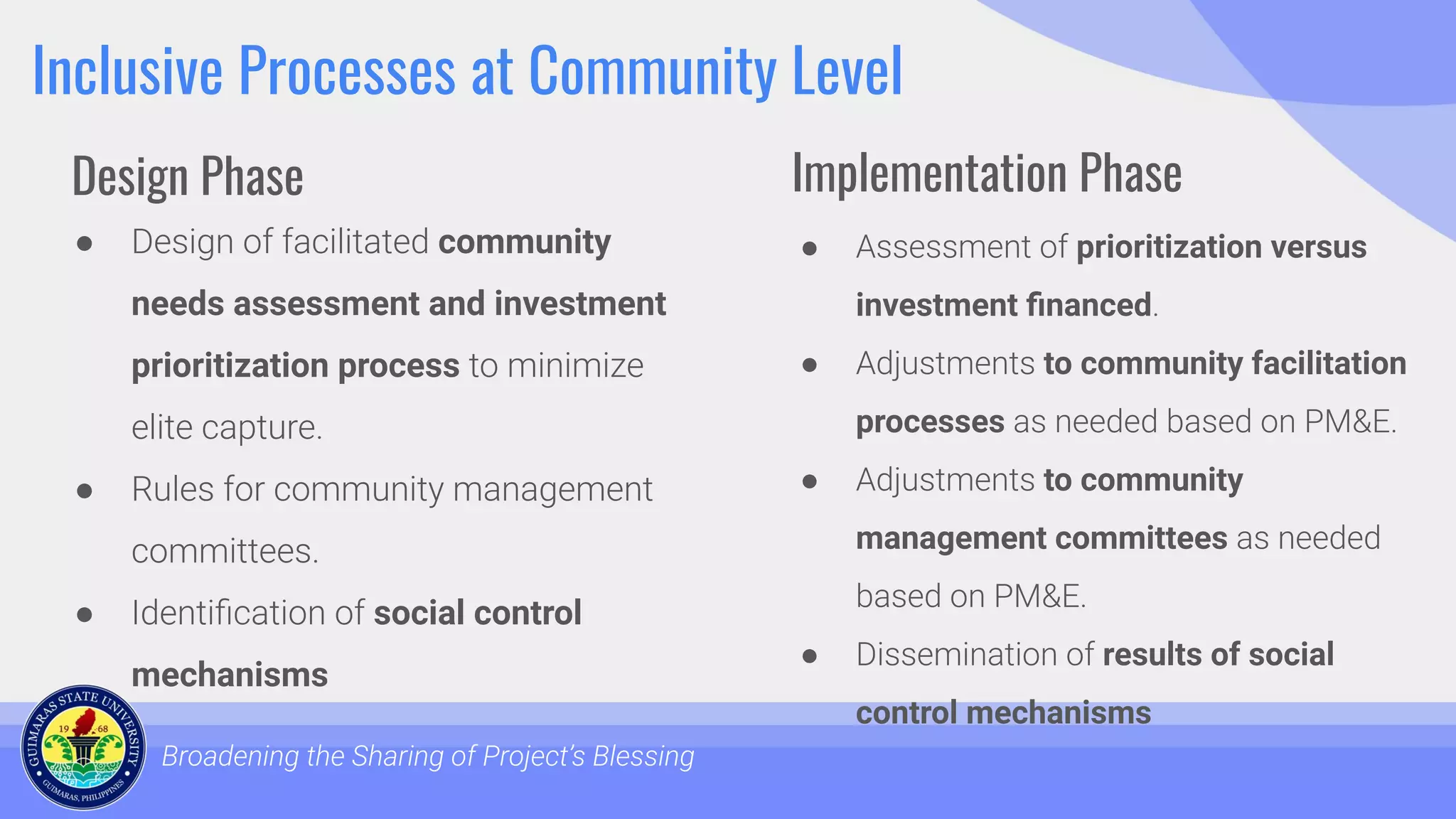
Inclusive Processes at Community Level
● Design of facilitated community
needs assessment and investment
prioritization process to minimize
elite capture.
● Rules for community management
committees.
● Identification of social control
mechanisms
Broadening the Sharing of Project’s Blessing
● Assessment of prioritization versus
investment financed.
● Adjustments to community facilitation
processes as needed based on PM&E.
● Adjustments to community
management committees as needed
based on PM&E.
● Dissemination of results of social
control mechanisms
Design Phase Implementation Phase
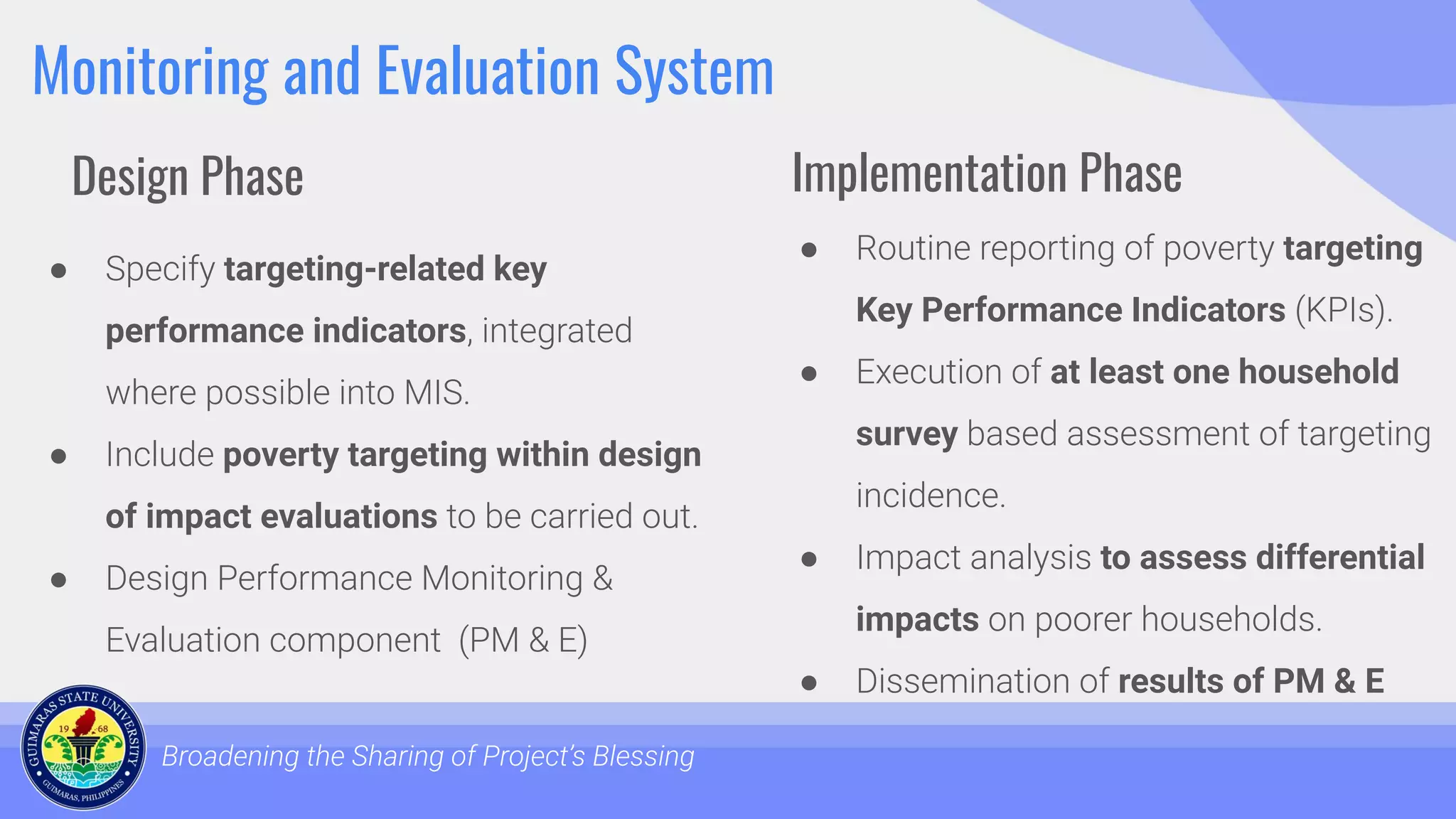
Monitoring and Evaluation System
● Specify targeting-related key
performance indicators, integrated
where possible into MIS.
● Include poverty targeting within design
of impact evaluations to be carried out.
● Design Performance Monitoring &
Evaluation component (PM & E)
Broadening the Sharing of Project’s Blessing
● Routine reporting of poverty targeting
Key Performance Indicators (KPIs).
● Execution of at least one household
survey based assessment of targeting
incidence.
● Impact analysis to assess differential
impacts on poorer households.
● Dissemination of results of PM & E
Design Phase Implementation Phase
PARTICIPATORY PROJECT DEVELOPMENT MANAGEMENT
Democratization of Projects
and Social Services
What is
Democratization?
1) Transition to a more democratic
political regime.
2) Transition from an authoritarian
regime to a full democracy
3) Transition from an authoritarian
political system to a
semi-democracy
4) Transition from a semi-authoritarian
political system to a democratic
political system
Democratization of Projects and Social Services
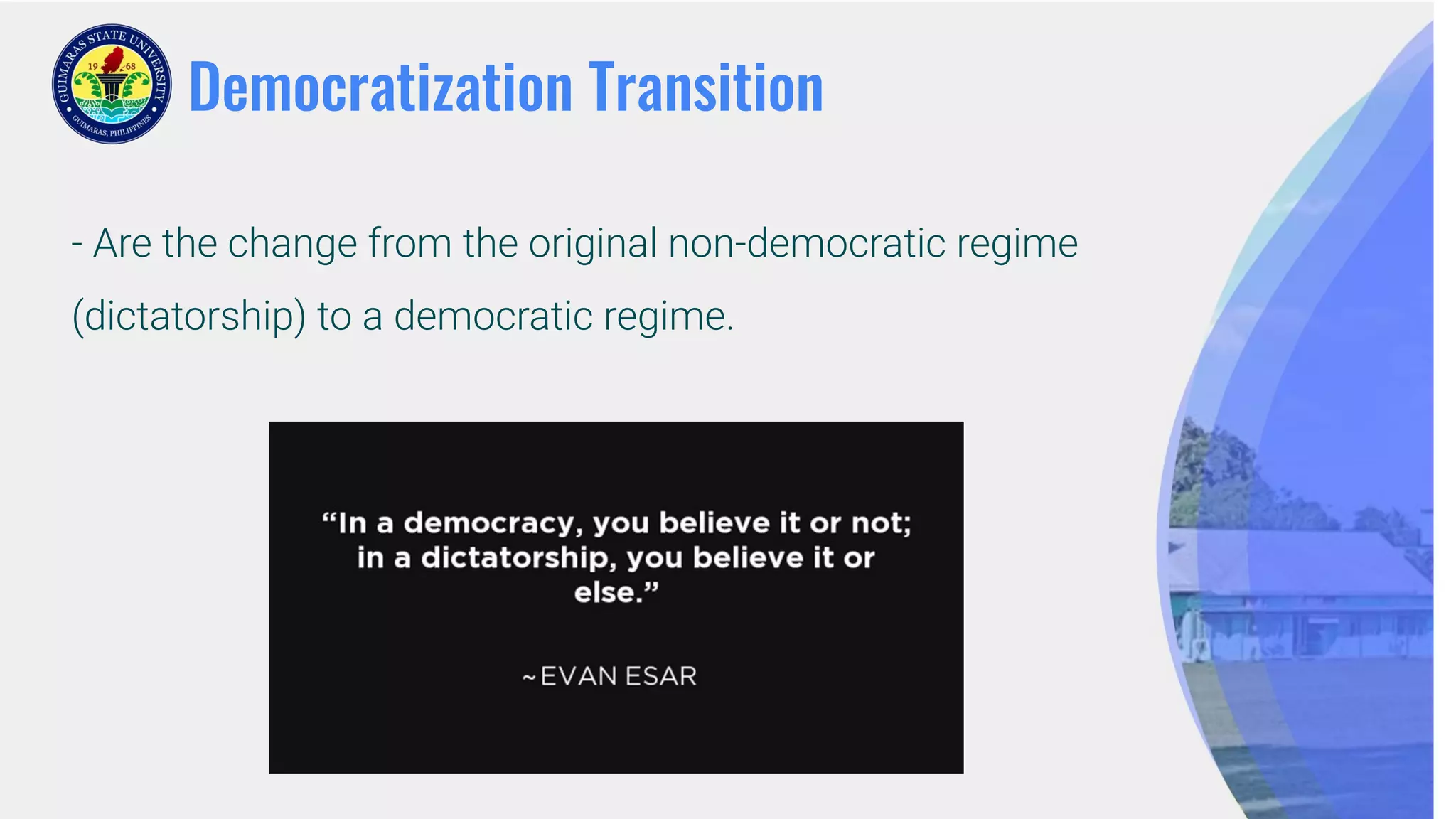
Democratization Transition
- Are the change from the original non-democratic regime
(dictatorship) to a democratic regime.
TYPES OF REGIMES/POLITICAL SYSTEM THAT GAVE WAY TO DEMOCRACY
AUTHORITARIAN
- powers in the hands of a leader or a small elite that is not
responsible and accountable to the people. Rulers are not
chosen by people who have limited political freedoms.
Democratization of Projects and Social Services
TYPES OF REGIMES/POLITICAL SYSTEM THAT GAVE WAY TO DEMOCRACY
AUTHORITARIAN
-Headed by supreme leader wielding great amount of
individual power.
-Military Regime: In early 1990s, about half of 3rd
world
countries were ruled by Military Regime
Democratization of Projects and Social Services
Examples of
Authoritarian
➢ Adolf Hitler (Nazi, Germany)
➢ Francisco Franco (Spain)
➢ Saddam Hussein (Iraq)
➢ Zia-ul Haq (Pakistan)
Democratization of Projects and Social Services
TYPES OF REGIMES/POLITICAL SYSTEM THAT GAVE WAY TO DEMOCRACY
TOTALITARIAN
-Rule by a single party following distinct ideology, TOTAL
control of state/government of almost all aspects of public
and private life, minimal civil/political freedom
Democratization of Projects and Social Services
Examples of
Totalitarian
➢ Joseph Stalin (USSR)
➢ Mao Zedong (China)
➢ Other Communist Regimes
Democratization of Projects and Social Services
TYPES OF REGIMES/POLITICAL SYSTEM THAT GAVE WAY TO DEMOCRACY
POST - TOTALITARIAN
-Regime still trying to control all aspects of public and private
life, follow official ideology, and charismatic leader despite
collapse of foundations of totalitarianism.
Democratization of Projects and Social Services
Examples of Post -
Totalitarian
➢ Vladimir Putin (Russia)
➢ Capitalist China
➢ Other communist and post
communist regimes
Democratization of Projects and Social Services
TYPES OF REGIMES/POLITICAL SYSTEM THAT GAVE WAY TO DEMOCRACY
MONARCHICAL AND SULTANISTIC
-A country that is ruled by a monarch.
-Sultanism is a form of authoritarian government
characterized by the extreme personal presence of the ruler in
all elements of governance
Democratization of Projects and Social Services
Examples of
Monarchical &
Sultanistic
➢ Nepal (2006)
➢ Turkey
➢ Malaysia
➢ Indonesia
Democratization of Projects and Social Services
TYPES OF REGIMES/POLITICAL SYSTEM THAT GAVE WAY TO DEMOCRACY
COLONIAL REGIME - POST COLONIAL STATES
- Is a practice or policy of control by one people or power over
other people or areas, often by establishing colonies and
generally with the aim to economic dominance.
Democratization of Projects and Social Services
Examples of
Colonial Regime -
Post Colonial
States
➢ India
➢ Sri Lanka
➢ Philippines
➢ Ghana
➢ Myanmar
➢ Etc.
Democratization of Projects and Social Services
DEMOCRACY
➢ Greek words: (demos) “people”,
(karatos) “rule”
➢ “rule by the people”, democracy
is a system of government that
not only allows but requires the
participation of the people in
the political process to function
properly.
Democratization of Projects and Social Services
Example of Democracy
The Philippines 1987 constitution, adopted the democracy
(U.S.) system during the Aquino administration, reestablished
a presidential system of government with a bicameral
legislature and an independent judiciary.
Democratization of Projects and Social Services
Department of Public of
Works and Highways
MISSION
To provide and manage quality
infrastructure facilities and services
responsive to needs of the Filipino
people in the pursuit of national
development objectives.
Democratization of Projects and Social Services
VISION
By 2030, DPWH is an effective and
efficient government agency, improving
the life of every Filipino through quality
infrastructure
BUILD, BUILD, BUILD PROGRAM
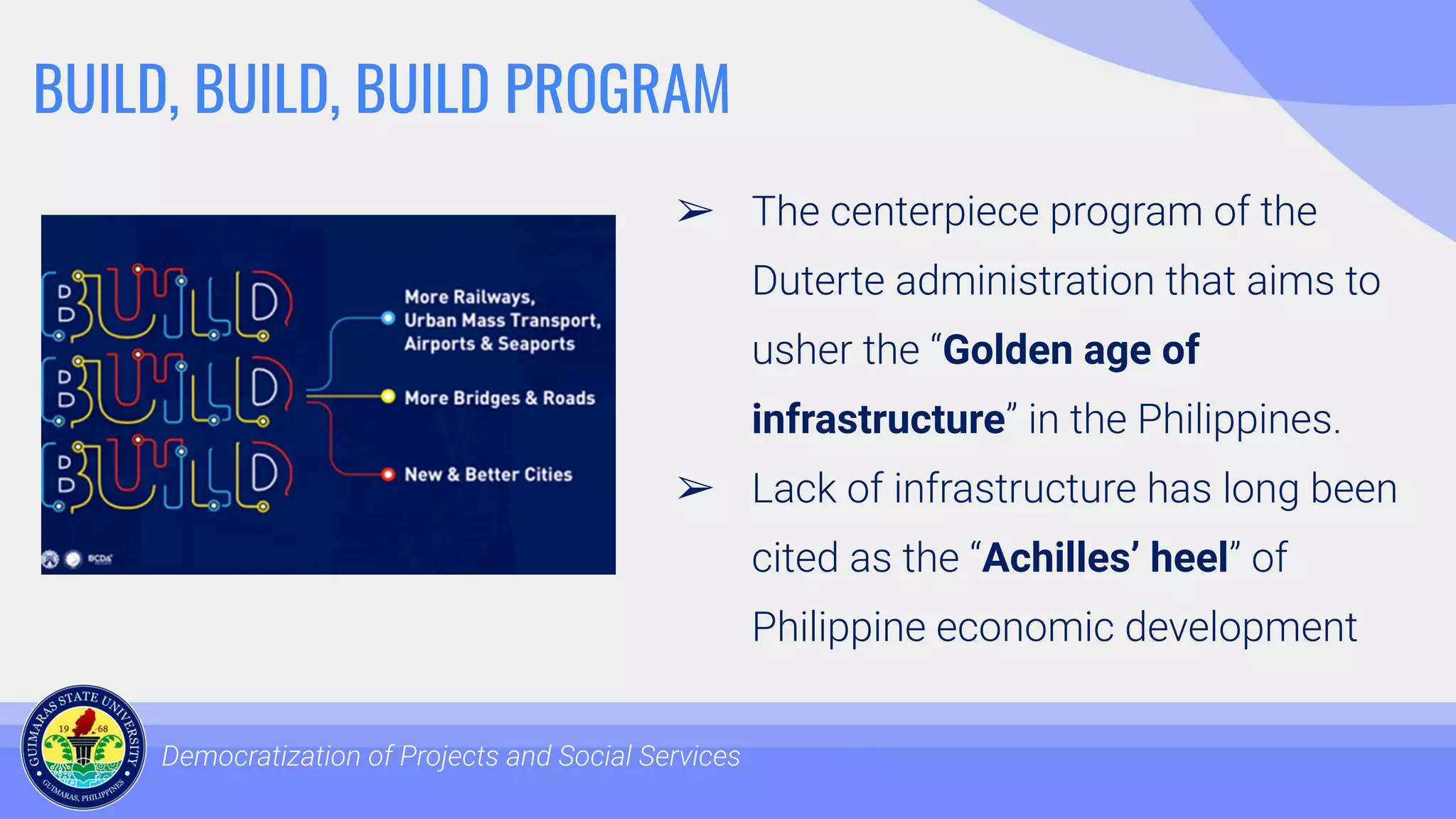
➢ The centerpiece program of the
Duterte administration that aims to
usher the “Golden age of
infrastructure” in the Philippines.
➢ Lack of infrastructure has long been
cited as the “Achilles’ heel” of
Philippine economic development
Democratization of Projects and Social Services
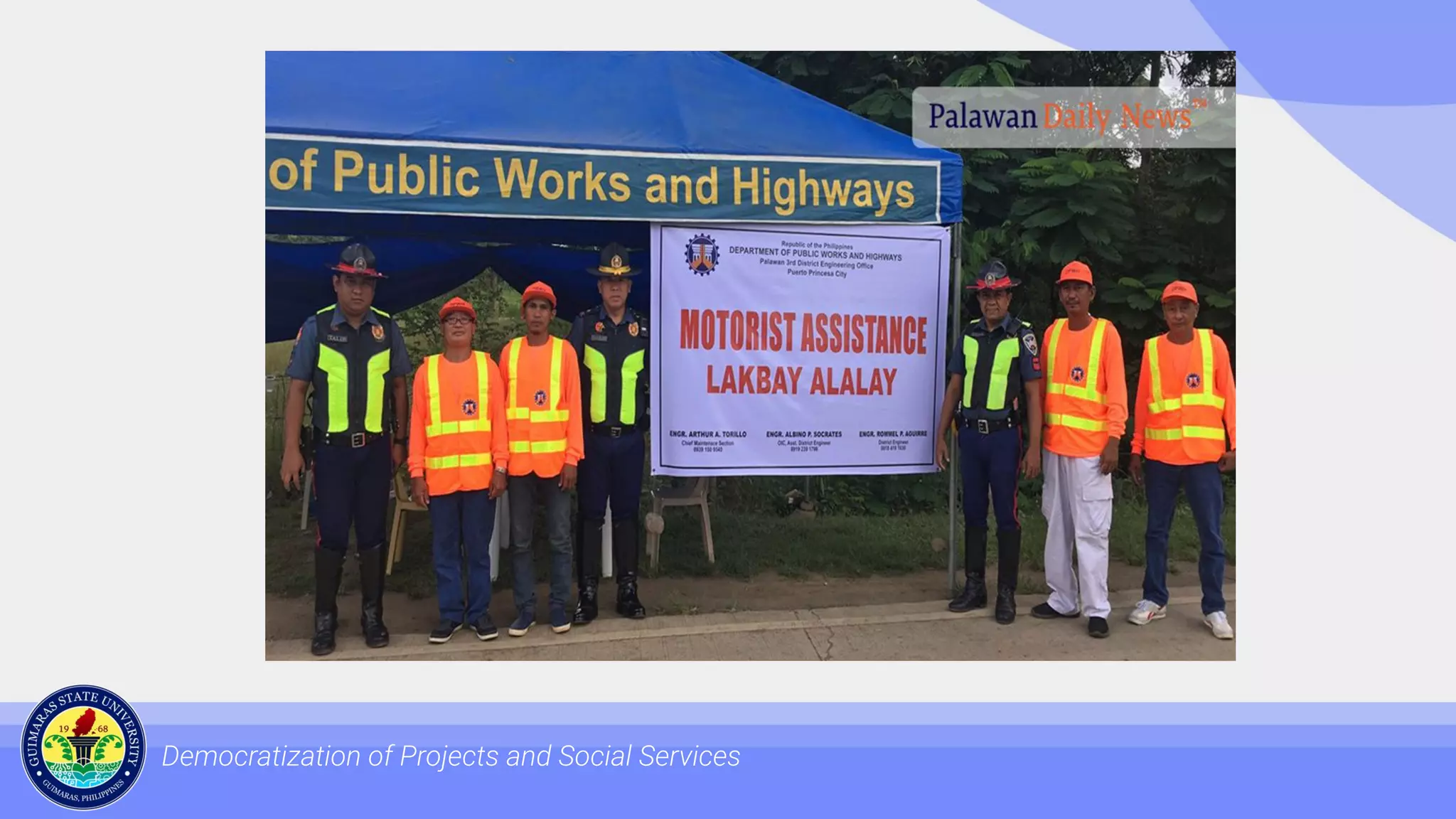
LAKBAY ALALAY
➢ “Lakbay Alalay” is an annual public service program of DPWH nationwide
thru the 16 Regional and 183 District Engineering Offices of providing
immediate assistance to our motorists such as rescuing troubled vehicles,
giving of directions especially to visitors and applying first aid in emergency
situations
Democratization of Projects and Social Services
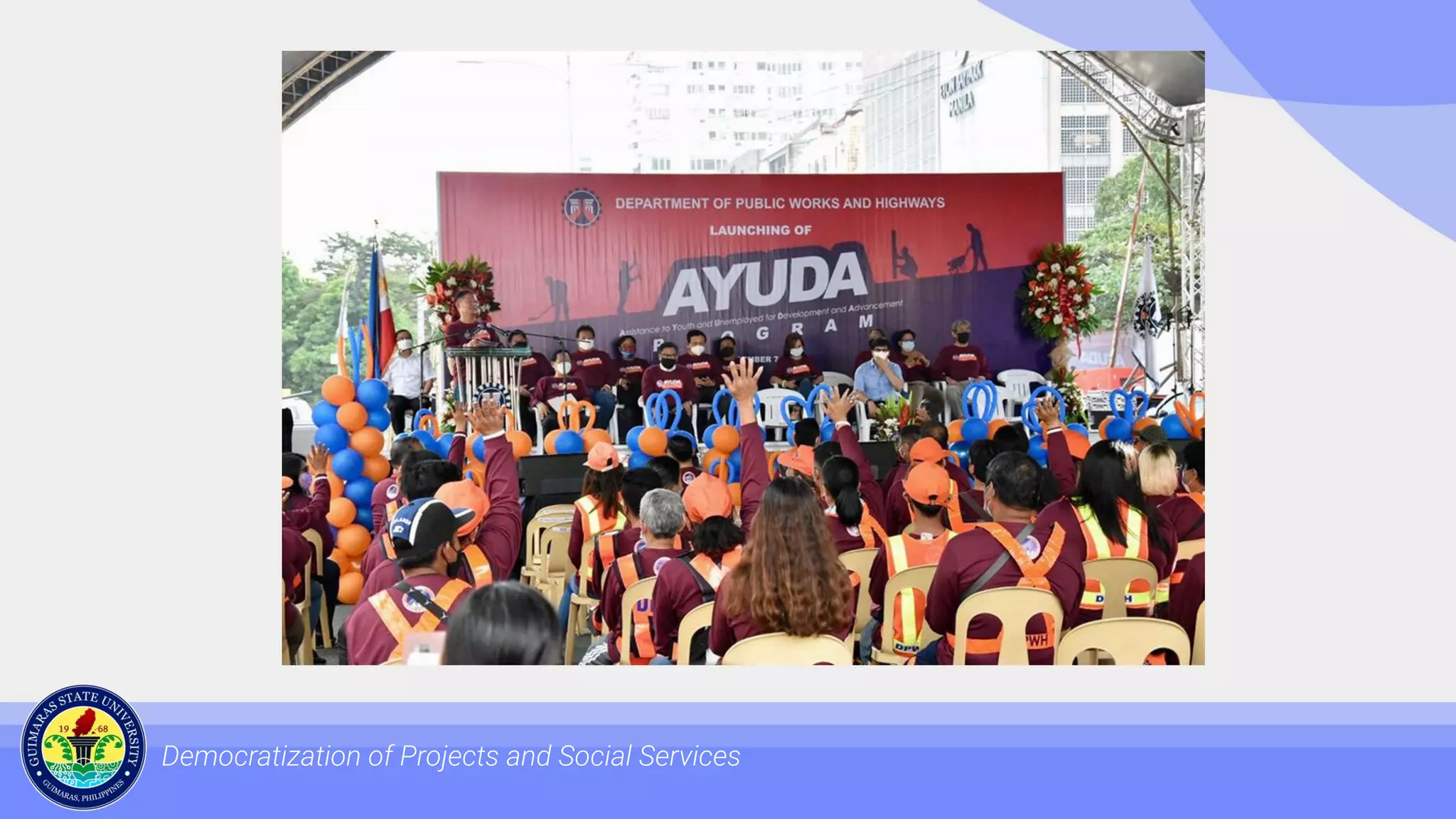
AYUDA PROGRAM
➢ The job description of the beneficiaries of AYUDA program involves
working as street sweepers, street signs cleaners, garbage
collectors, vegetation control and removal of illegally dumped
construction materials, junked items and other obstructions
protruding to the carriageway, shoulder and sidewalk.
Democratization of Projects and Social Services
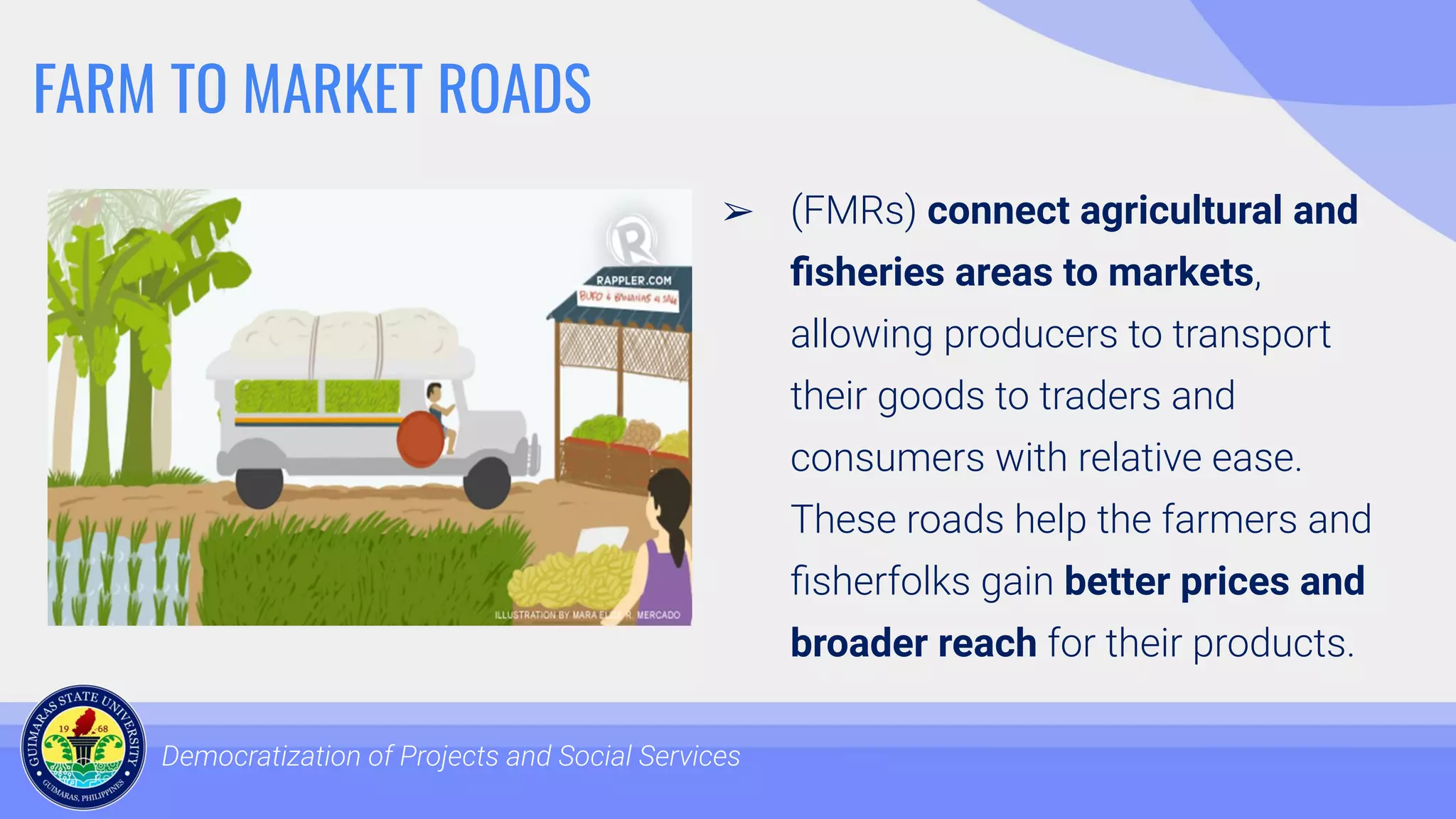
FARM TO MARKET ROADS
Democratization of Projects and Social Services
➢ (FMRs) connect agricultural and
fisheries areas to markets,
allowing producers to transport
their goods to traders and
consumers with relative ease.
These roads help the farmers and
fisherfolks gain better prices and
broader reach for their products.
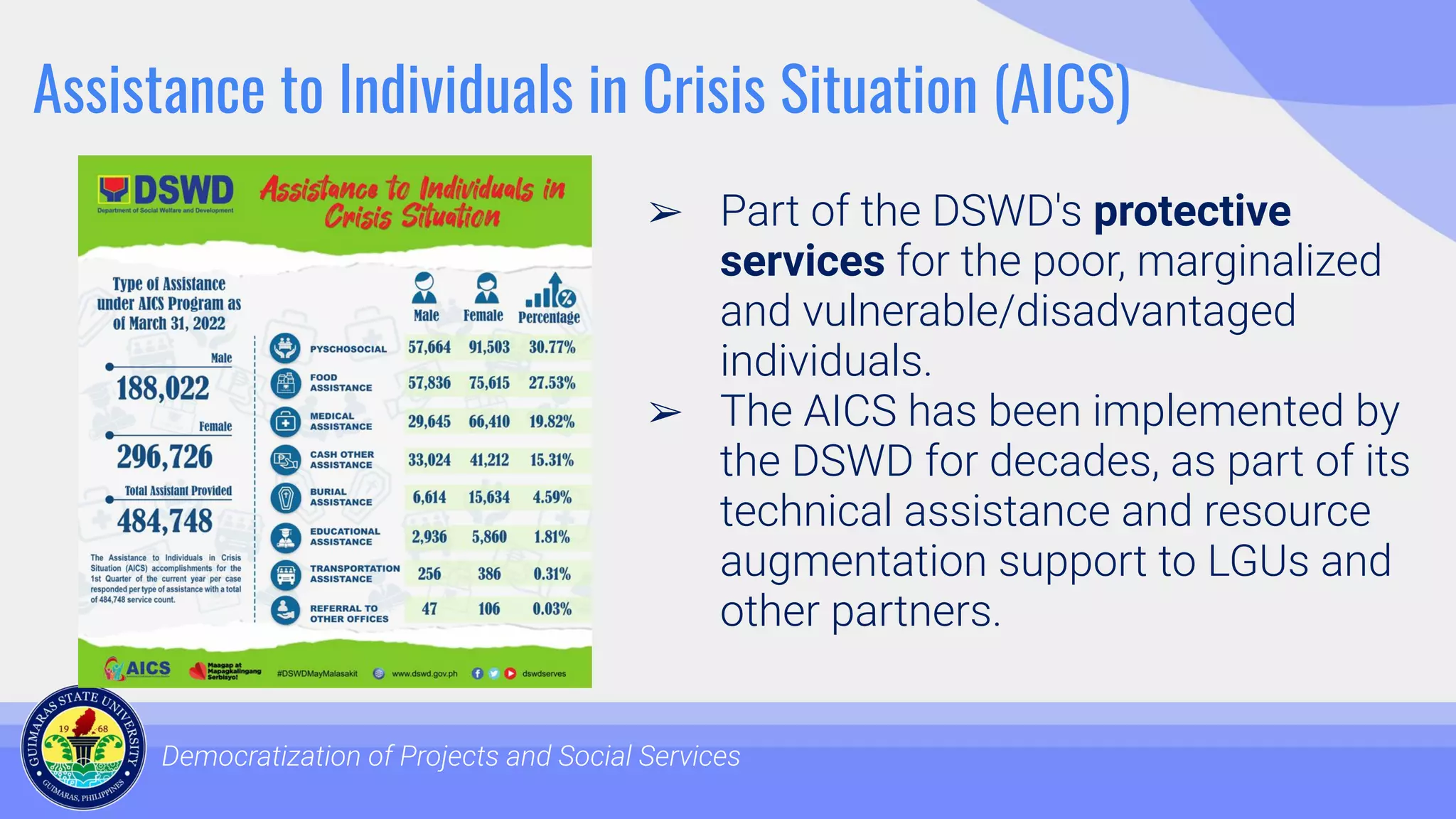
Assistance to Individuals in Crisis Situation (AICS)
Democratization of Projects and Social Services
➢ Part of the DSWD's protective
services for the poor, marginalized
and vulnerable/disadvantaged
individuals.
➢ The AICS has been implemented by
the DSWD for decades, as part of its
technical assistance and resource
augmentation support to LGUs and
other partners.
PARTICIPATORY PROJECT DEVELOPMENT MANAGEMENT
Creating More Job Opportunities
and Means of Livelihood
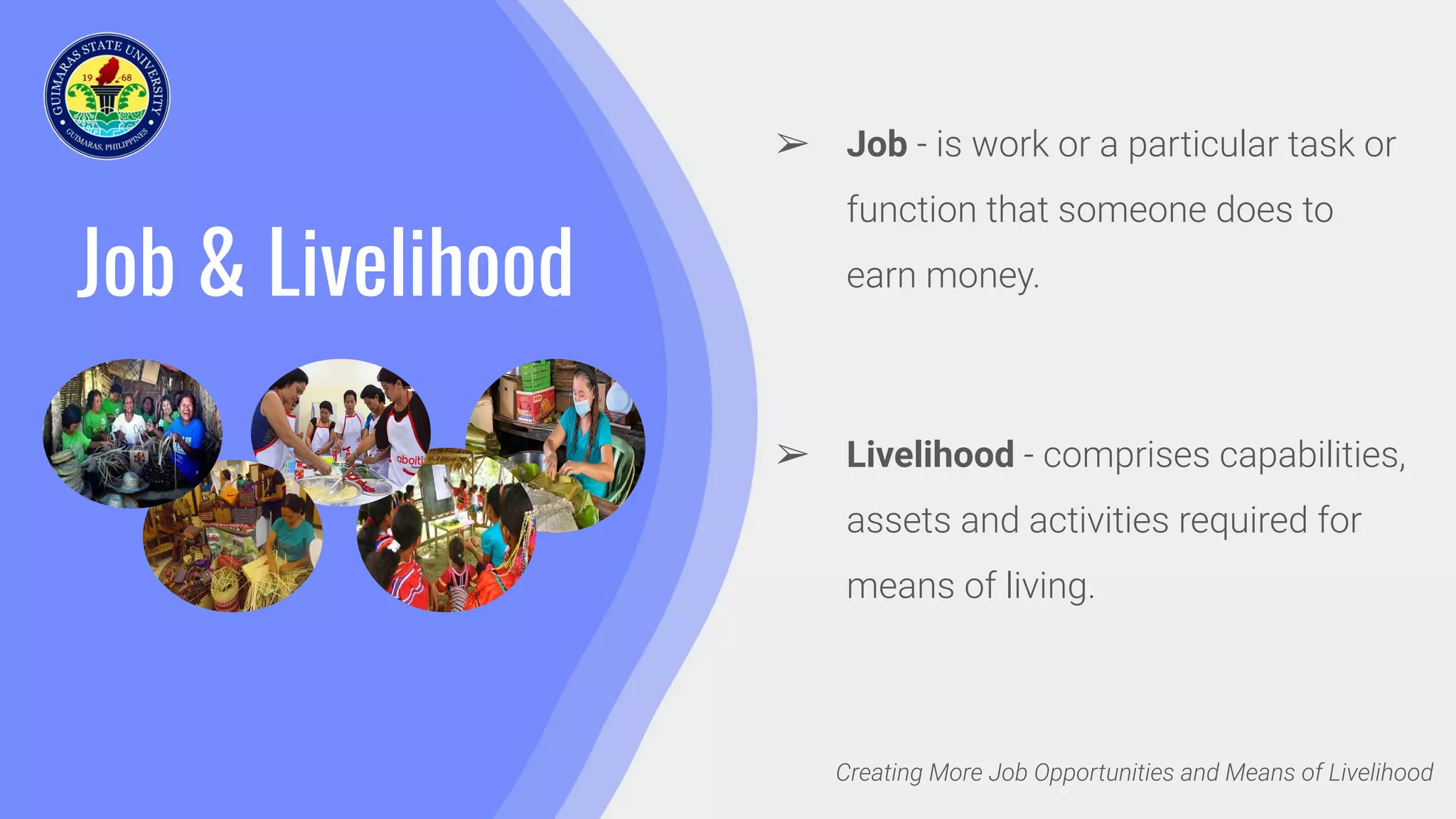
Job & Livelihood
➢ Job - is work or a particular task or
function that someone does to
earn money.
➢ Livelihood - comprises capabilities,
assets and activities required for
means of living.
Creating More Job Opportunities and Means of Livelihood
Effective Local Strategies
to Boost Quality Job
Creation, Employment &
Participation
Policy Principles to Guide Action at the
National and Local Levels
Local Employment and Economic
Development (LEED Programme) By
Organization for Economic Co-operation
and Development (OECD)
Creating More Job Opportunities and Means of Livelihood
➢ a set of policy principles to help
national governments better support
place-based approaches to job
creation can be formulated. They
were developed by the expertise of
the OECD LEED Programme, the ILO,
the World Bank and WAPES
Policy Principles to Guide Action at the National and Local Levels
➢ Make national employment and training policy frameworks more adaptable to
local labour market conditions.
➢ Support partnership approaches within local economies (and in some cases
around specific sectors or value chains) leading to better integrated policies
and more effective and efficient strategies.
➢ Give priority to creating an adaptable labour force that is able to innovate,
progress, and transfer between sectors, hence building local resilience.
Creating More Job Opportunities and Means of Livelihood
Policy Principles to Guide Action at the National and Local Levels
➢ Support labour market transitions throughout the life-cycle by building
comprehensive local career information and well-articulated training to
employment pathways.
➢ Stimulate productivity and innovation by working with employers and trade
unions to better utilise the skills of the existing workforce.
➢ Develop place-based initiatives to support inclusive growth by reducing the
barriers that can exclude people from the labour force over generations,
including youth, women, older workers, people with disabilities and immigrants.
Creating More Job Opportunities and Means of Livelihood
Policy Principles to Guide Action at the National and Local Levels
➢ Ensure that appropriate social protections are available at the local level
especially among the highly disadvantaged.
➢ Invest in social infrastructure and institutions to strengthen networks within
and between local economies, including those which are performing more
highly.
➢ Support the development of the social enterprise sector and innovative
approaches, such as social impact investments.
Creating More Job Opportunities and Means of Livelihood
Policy Principles to Guide Action at the National and Local Levels
➢ Support evidence-based policies by developing comprehensive labour market
information systems, which disaggregate data on jobs and skills to the level of
local labour markets.
Creating More Job Opportunities and Means of Livelihood
https://www.oecd.org/g20/topics/employment-education-and-social-policies
/OECD-LEED-Local-strategies-for-employment-G20.pdf
Towards an Action Plan for
Jobs in the Philippines:
Recommendation & Best
Practices
Employment and Skills Strategies in the
Philippines By Organization for Economic
Co-operation and Development (OECD)
Creating More Job Opportunities and Means of Livelihood
➢ Key recommendations emerging
from a review of local job creation
policies in the Philippines. To better
connect people to jobs, stimulate
more responsive skills development
training at the local level and ensure
that economic development efforts
are better coordinated with
employment programs
Overall Recommendations
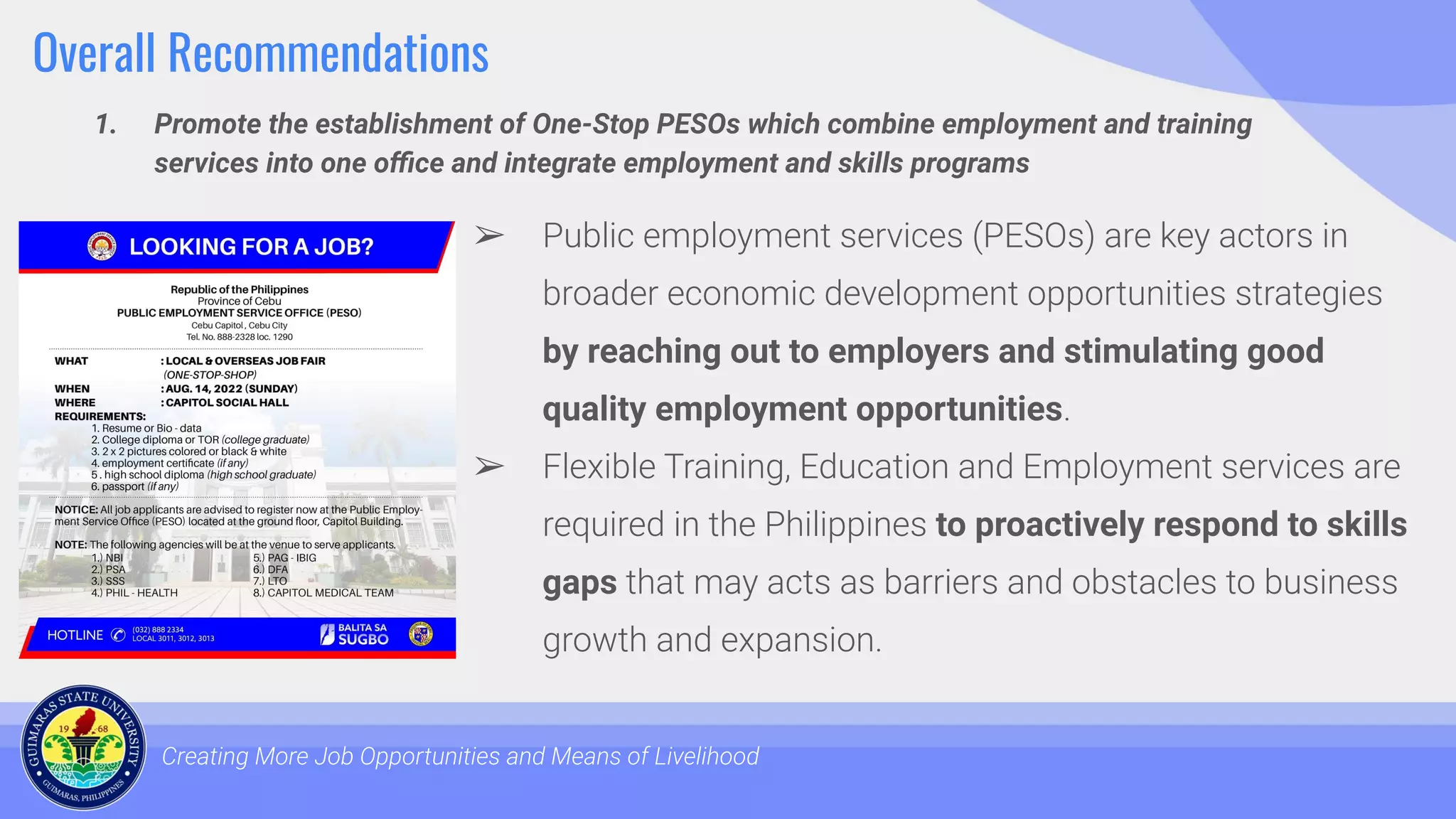
1. Promote the establishment of One-Stop PESOs which combine employment and training
services into one office and integrate employment and skills programs
Creating More Job Opportunities and Means of Livelihood
➢ Public employment services (PESOs) are key actors in
broader economic development opportunities strategies
by reaching out to employers and stimulating good
quality employment opportunities.
➢ Flexible Training, Education and Employment services are
required in the Philippines to proactively respond to skills
gaps that may acts as barriers and obstacles to business
growth and expansion.
Promote the establishment of One-Stop PESOs which combine employment and
training services into one office and integrate employment and skills programs
Creating More Job Opportunities and Means of Livelihood
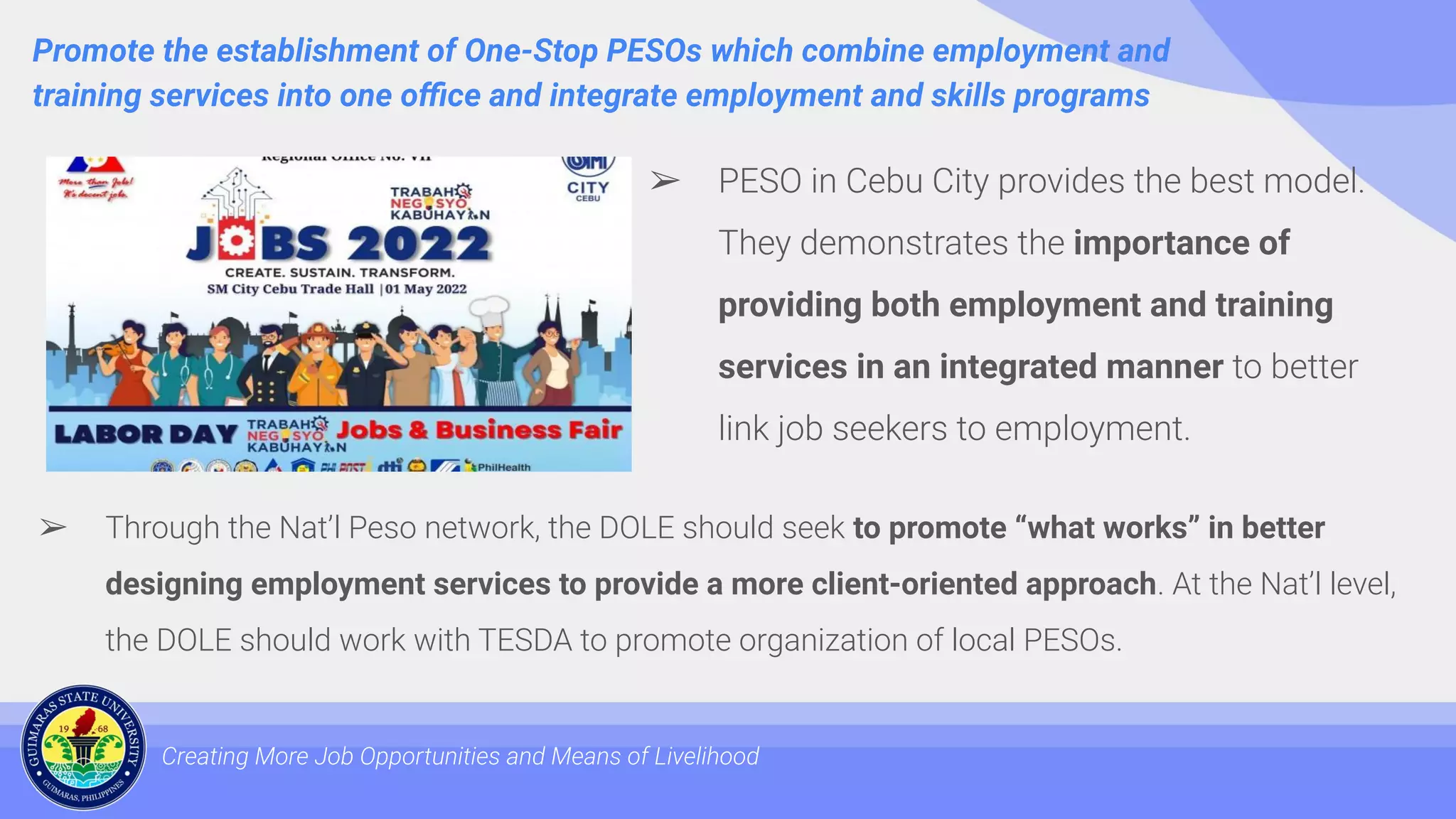
➢ PESO in Cebu City provides the best model.
They demonstrates the importance of
providing both employment and training
services in an integrated manner to better
link job seekers to employment.
➢ Through the Nat’l Peso network, the DOLE should seek to promote “what works” in better
designing employment services to provide a more client-oriented approach. At the Nat’l level,
the DOLE should work with TESDA to promote organization of local PESOs.
Overall Recommendations
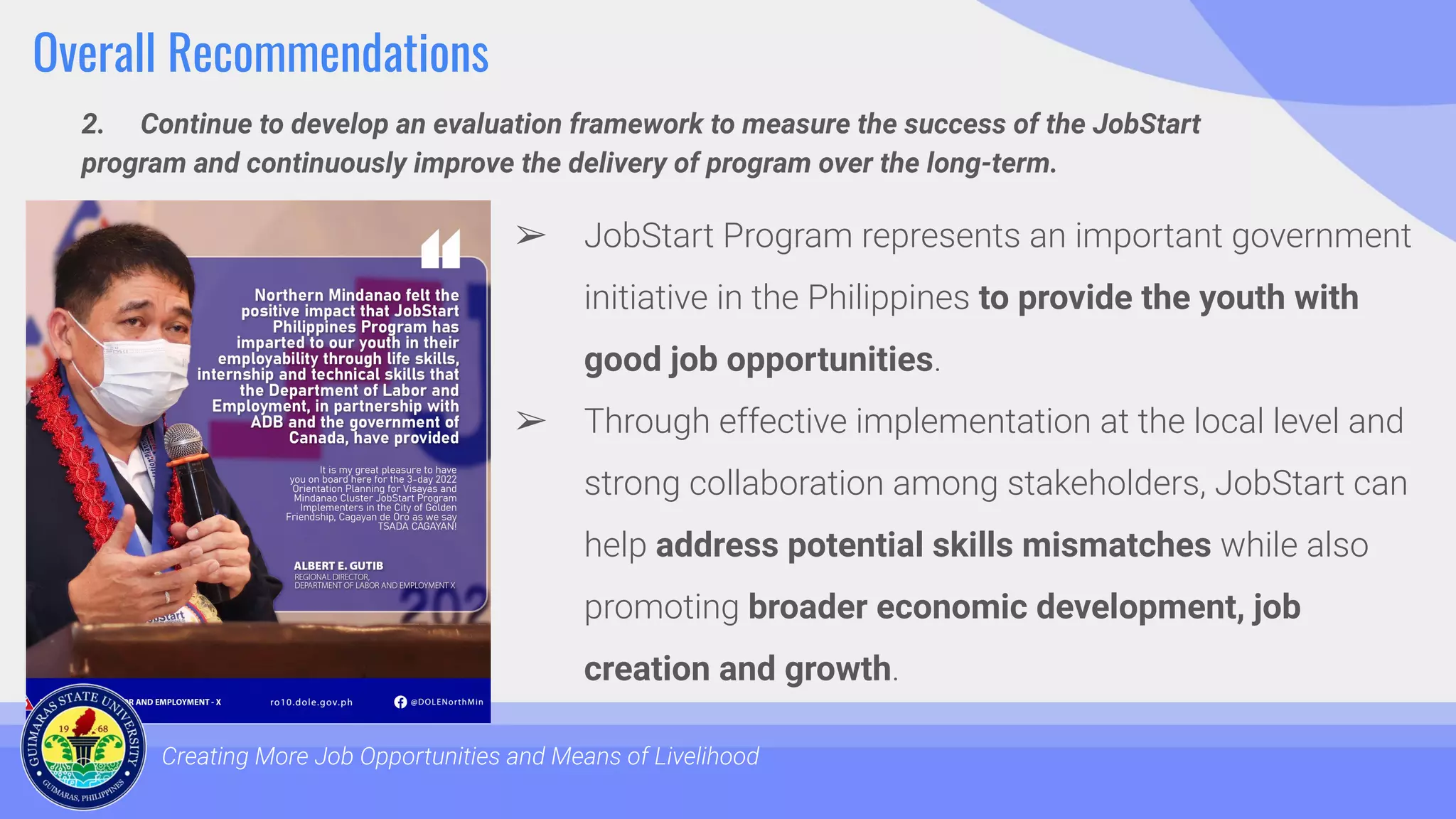
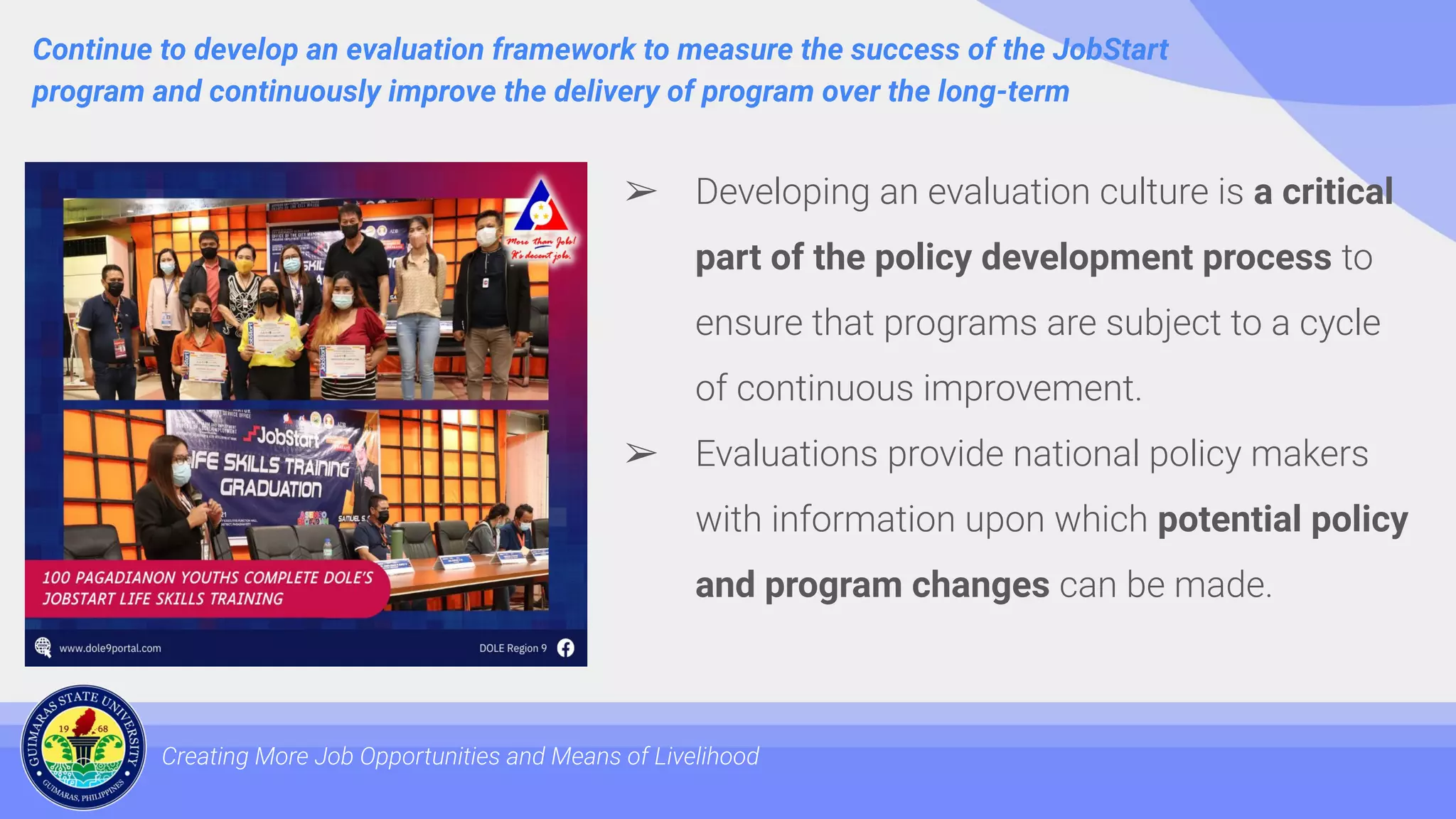
2. Continue to develop an evaluation framework to measure the success of the JobStart
program and continuously improve the delivery of program over the long-term.
Creating More Job Opportunities and Means of Livelihood
➢ JobStart Program represents an important government
initiative in the Philippines to provide the youth with
good job opportunities.
➢ Through effective implementation at the local level and
strong collaboration among stakeholders, JobStart can
help address potential skills mismatches while also
promoting broader economic development, job
creation and growth.
Continue to develop an evaluation framework to measure the success of the JobStart
program and continuously improve the delivery of program over the long-term
Creating More Job Opportunities and Means of Livelihood
➢ Developing an evaluation culture is a critical
part of the policy development process to
ensure that programs are subject to a cycle
of continuous improvement.
➢ Evaluations provide national policy makers
with information upon which potential policy
and program changes can be made.
Overall Recommendations
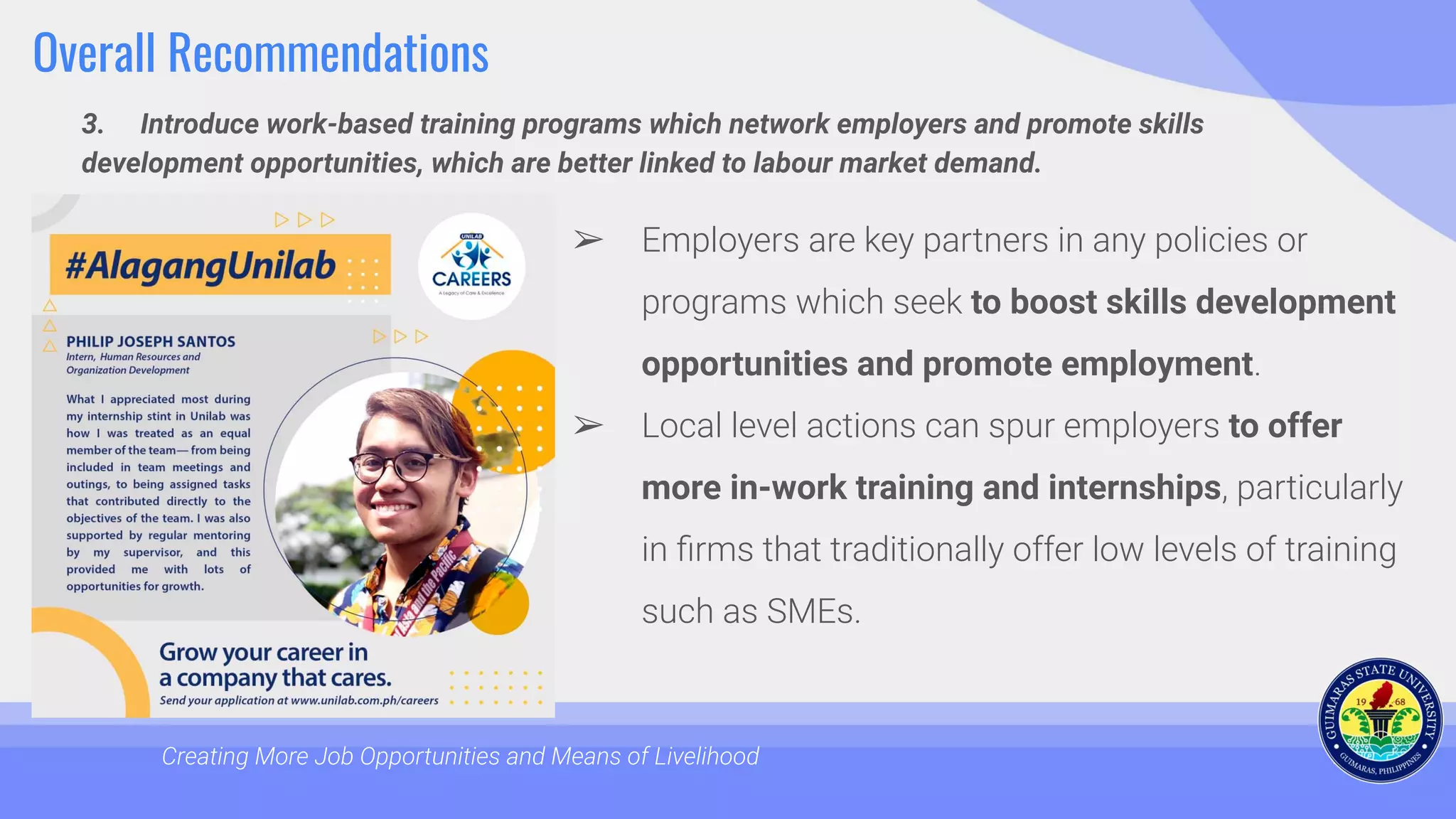
3. Introduce work-based training programs which network employers and promote skills
development opportunities, which are better linked to labour market demand.
Creating More Job Opportunities and Means of Livelihood
➢ Employers are key partners in any policies or
programs which seek to boost skills development
opportunities and promote employment.
➢ Local level actions can spur employers to offer
more in-work training and internships, particularly
in firms that traditionally offer low levels of training
such as SMEs.
Introduce work-based training programs which network employers and promote
skills development opportunities, which are better linked to labour market demand
Creating More Job Opportunities and Means of Livelihood
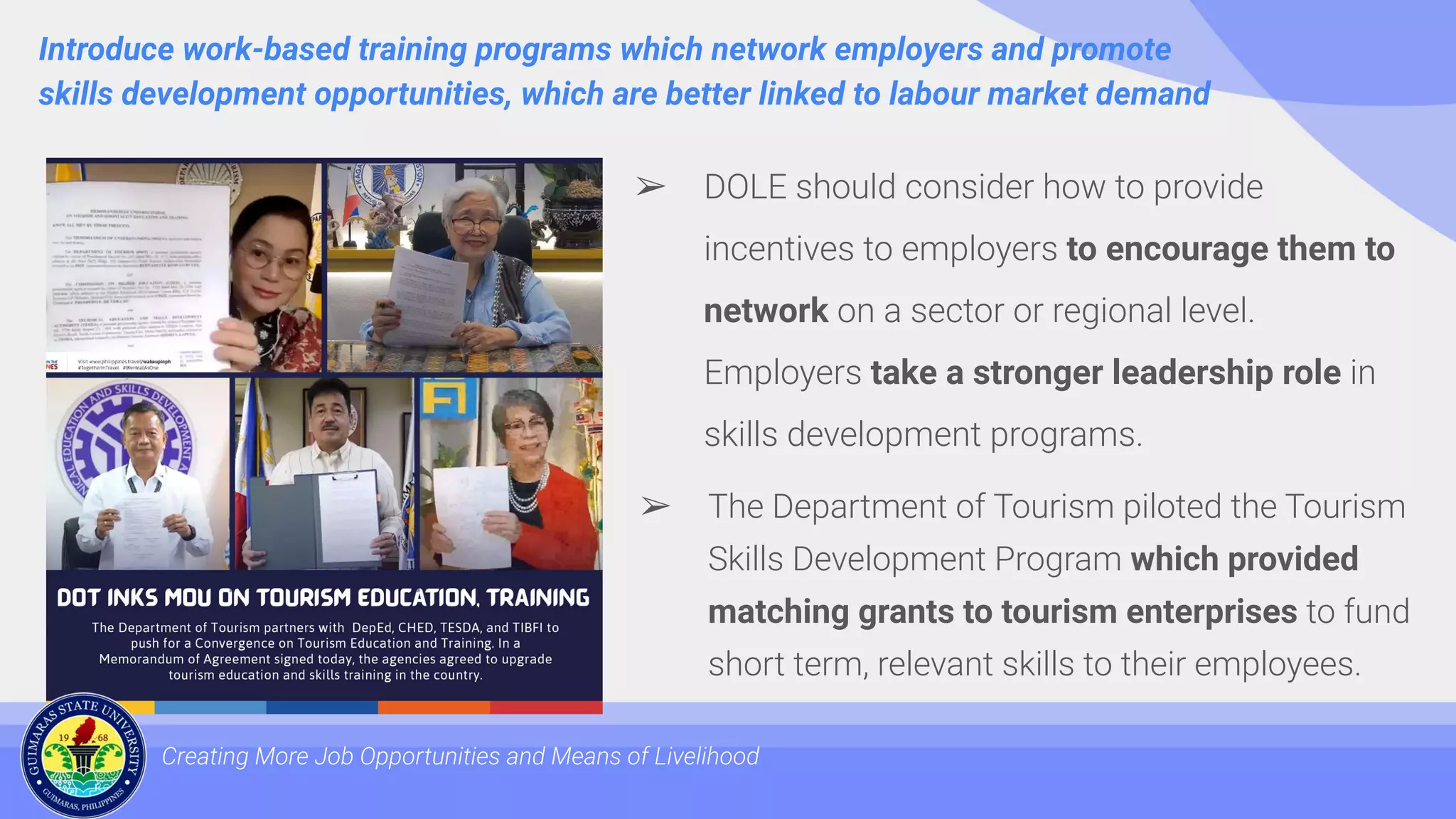
➢ DOLE should consider how to provide
incentives to employers to encourage them to
network on a sector or regional level.
Employers take a stronger leadership role in
skills development programs.
➢ The Department of Tourism piloted the Tourism
Skills Development Program which provided
matching grants to tourism enterprises to fund
short term, relevant skills to their employees.
Creating More Job Opportunities and Means of Livelihood
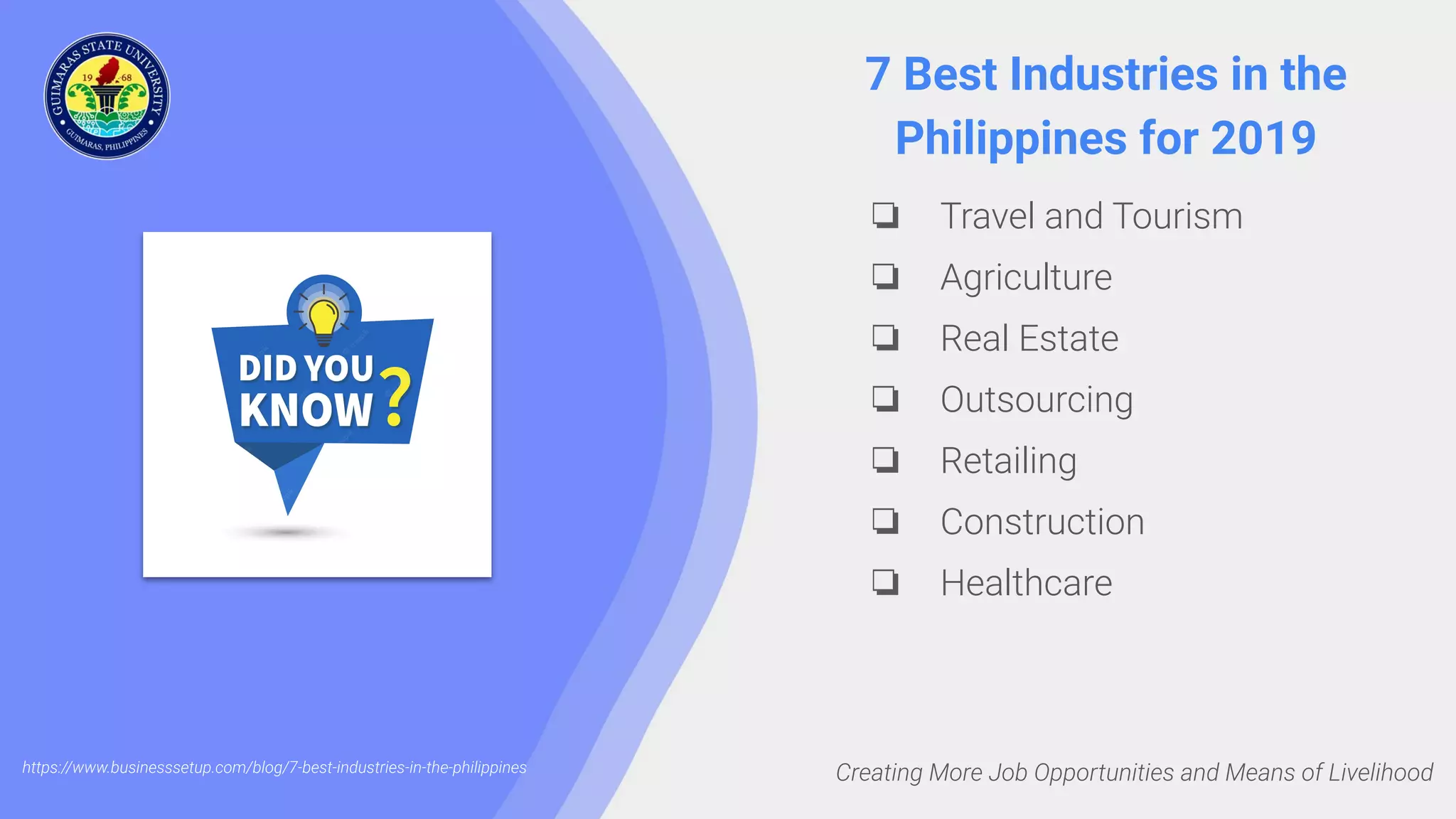
7 Best Industries in the
Philippines for 2019
❏ Travel and Tourism
❏ Agriculture
❏ Real Estate
❏ Outsourcing
❏ Retailing
❏ Construction
❏ Healthcare
https://www.businesssetup.com/blog/7-best-industries-in-the-philippines
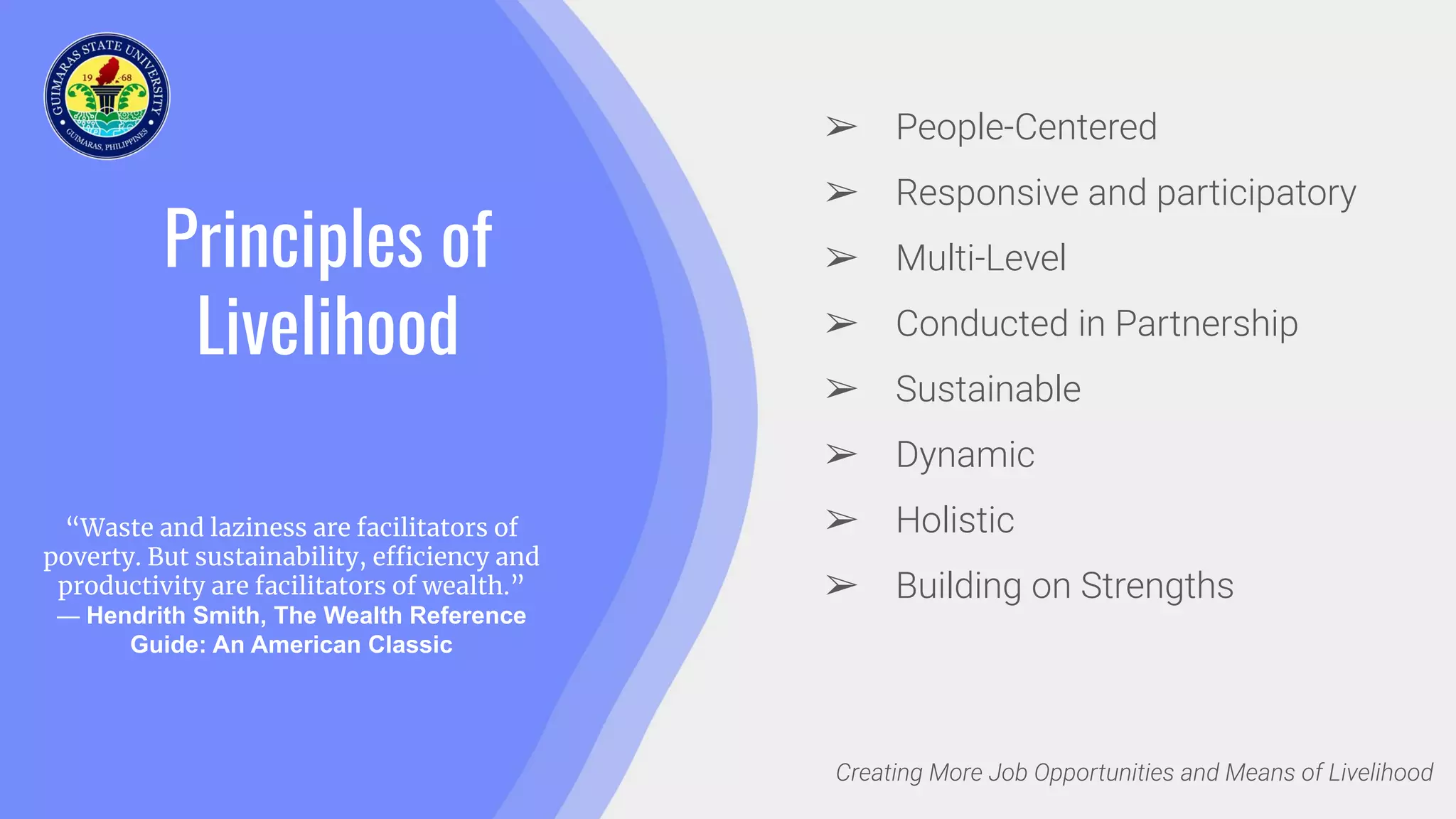
Principles of
Livelihood
“Waste and laziness are facilitators of
poverty. But sustainability, efficiency and
productivity are facilitators of wealth.”
― Hendrith Smith, The Wealth Reference
Guide: An American Classic
Creating More Job Opportunities and Means of Livelihood
➢ People-Centered
➢ Responsive and participatory
➢ Multi-Level
➢ Conducted in Partnership
➢ Sustainable
➢ Dynamic
➢ Holistic
➢ Building on Strengths
Identifying the
Key Players
Creating More Job Opportunities and Means of Livelihood
➢ General Public
➢ Government (National & Local)
➢ Civil Society Organizations
➢ Private Sectors
➢ International Financial
Institutions
Sustainable Livelihood
Framework
Creating More Job Opportunities and Means of Livelihood
Five concepts that are crucial for
understanding the linkages within the
framework:
➢ The Vulnerability Context
➢ Livelihood Assets
➢ Policies, Institutions & Processes
➢ Livelihood Strategies
➢ Livelihood Outcomes
“It is not an Investment if it destroys the Planet.”
― Vandana Shiva
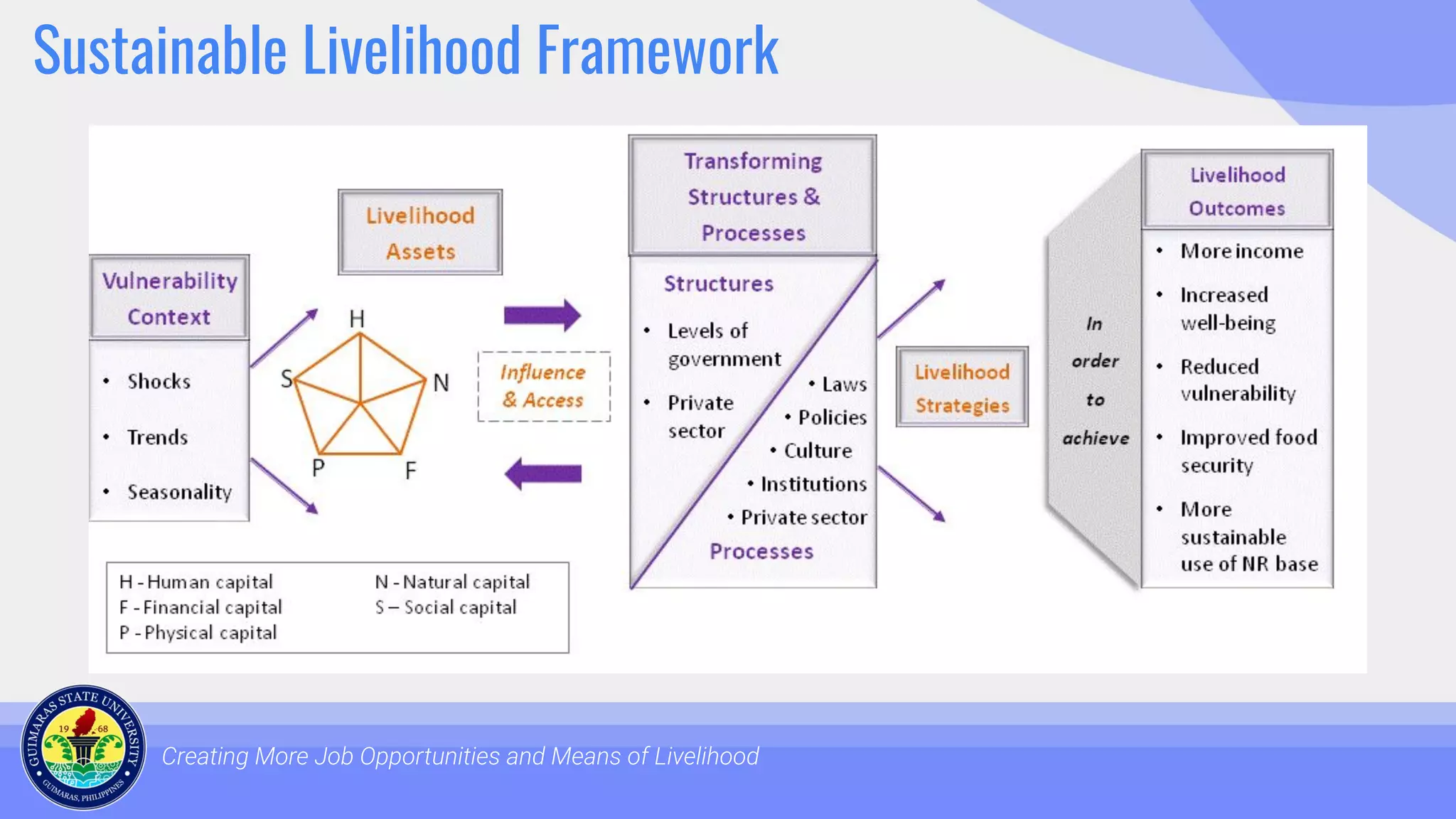
Sustainable Livelihood Framework
Creating More Job Opportunities and Means of Livelihood
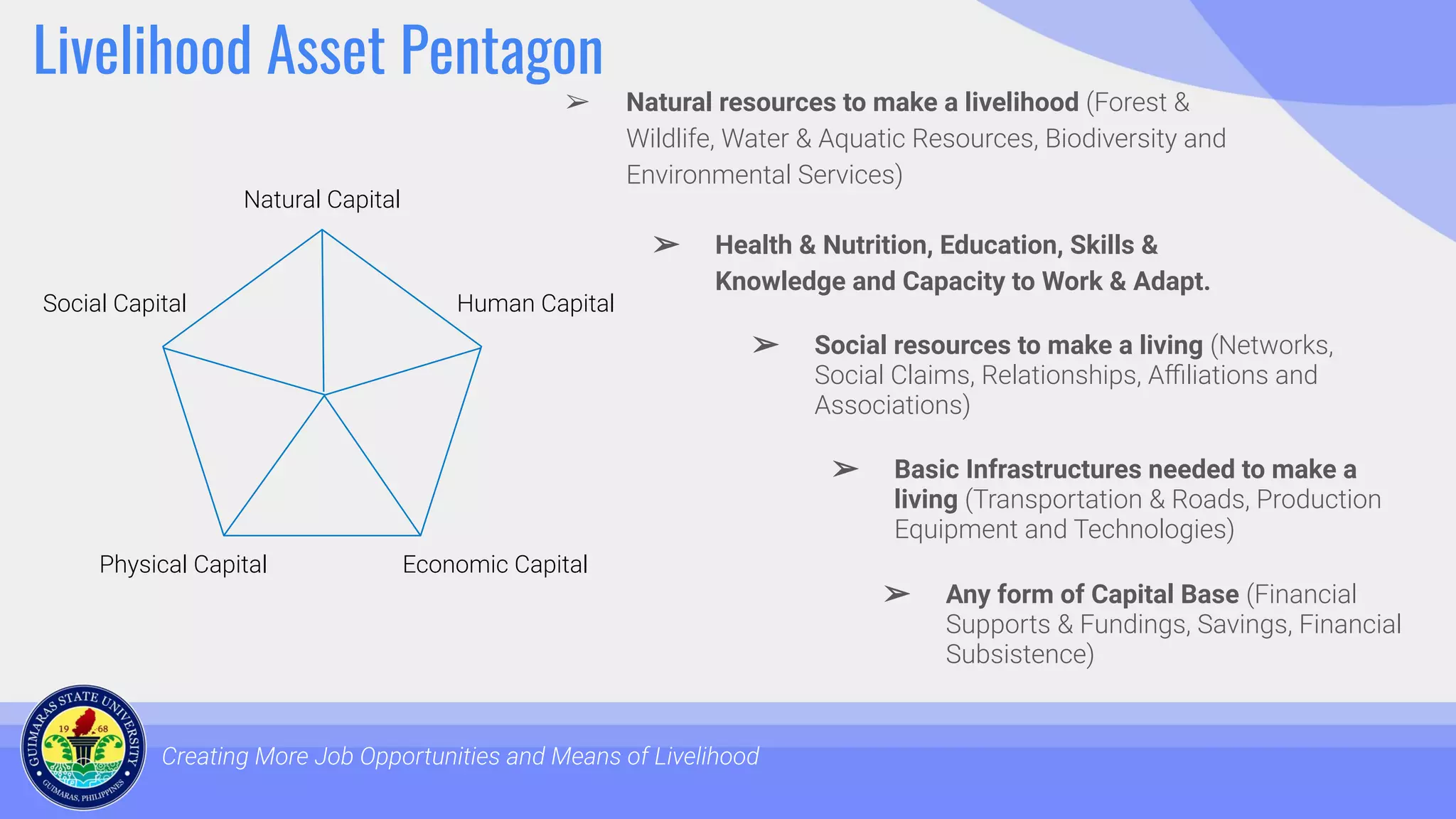
Livelihood Asset Pentagon
Creating More Job Opportunities and Means of Livelihood
Natural Capital
Social Capital Human Capital
Economic Capital
Physical Capital
➢ Natural resources to make a livelihood (Forest &
Wildlife, Water & Aquatic Resources, Biodiversity and
Environmental Services)
➢ Health & Nutrition, Education, Skills &
Knowledge and Capacity to Work & Adapt.
➢ Social resources to make a living (Networks,
Social Claims, Relationships, Affiliations and
Associations)
➢ Basic Infrastructures needed to make a
living (Transportation & Roads, Production
Equipment and Technologies)
➢ Any form of Capital Base (Financial
Supports & Fundings, Savings, Financial
Subsistence)
Livelihood Asset Pentagon
Creating More Job Opportunities and Means of Livelihood
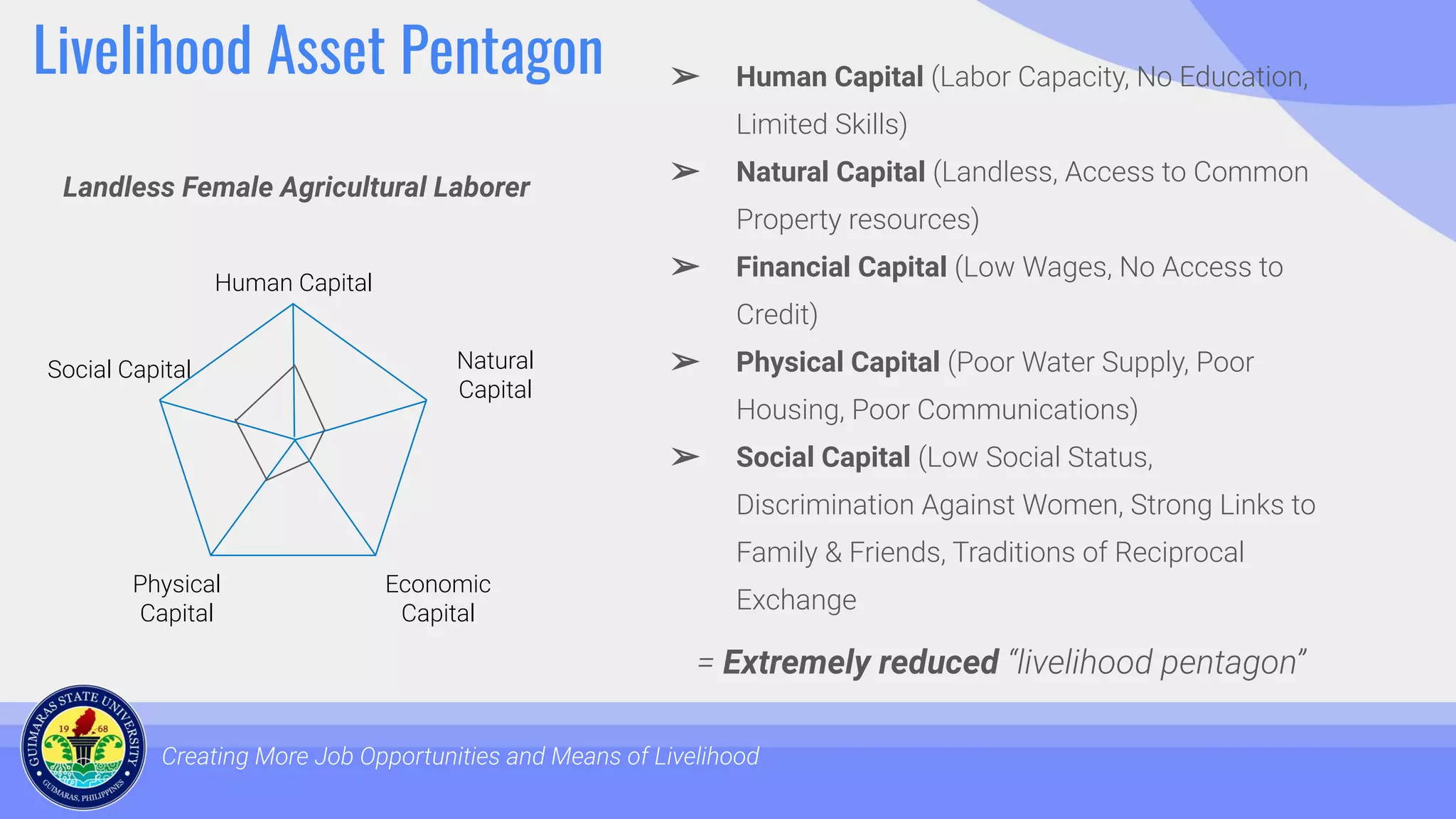
➢ Human Capital (Labor Capacity, No Education,
Limited Skills)
➢ Natural Capital (Landless, Access to Common
Property resources)
➢ Financial Capital (Low Wages, No Access to
Credit)
➢ Physical Capital (Poor Water Supply, Poor
Housing, Poor Communications)
➢ Social Capital (Low Social Status,
Discrimination Against Women, Strong Links to
Family & Friends, Traditions of Reciprocal
Exchange
Social Capital
Human Capital
Economic
Capital
Physical
Capital
Natural
Capital
Landless Female Agricultural Laborer
= Extremely reduced “livelihood pentagon”
Vulnerability
Context
Creating More Job Opportunities and Means of Livelihood
Refers to the external environment in which people
live.
➢ This includes Trends (such as national or
international economic trends, changes in
available technology, political systems),
➢ Shocks (such as illness or death, conflict,
weather), and
➢ Seasonality (of prices, production cycles and
so on).
The vulnerability context is important because the
three factors have a direct impact on the
possibilities that poor people have to earn a living
now and in the future.
Policies,
Institutions &
Processes
Creating More Job Opportunities and Means of Livelihood
An important set of man-made external factors
that influence the range of livelihood options
open to different categories of people. They also
influence access to assets and vulnerability to
shocks.
➢ An enabling policy and institutional
environment makes it easier for people - poor
and less poor -to gain access to assets they
need for their livelihoods.
➢ A disabling policy and institutional
environment may discriminate against the
poor, thus making it difficult for them to get
access to land, livestock, capital and
information.
Livelihood
Strategies
Creating More Job Opportunities and Means of Livelihood
The range and combination of activities
and choices that people make in order to
achieve their livelihood goals.
➢ Combine & Utilize the assets they
can access.
➢ Take account of the Vulnerability
Context.
➢ Supported or Obstructed by the
Policies, Institutions and Processes.
Livelihood
Outcomes
Creating More Job Opportunities and Means of Livelihood
Unsuccessful Outcomes:
➢ Food and income insecurity
➢ High vulnerability to shocks, changes
and/or trends
➢ Loss of assets and impoverishment
Achievable Outcomes:
➢ More sustainable use of Natural Resources
➢ Asset accumulation and High Status
➢ Increased Well-Being
➢ Protected Rights
➢ Recover Dignity
➢ Reduced Vulnerability
➢ Improved Food Security
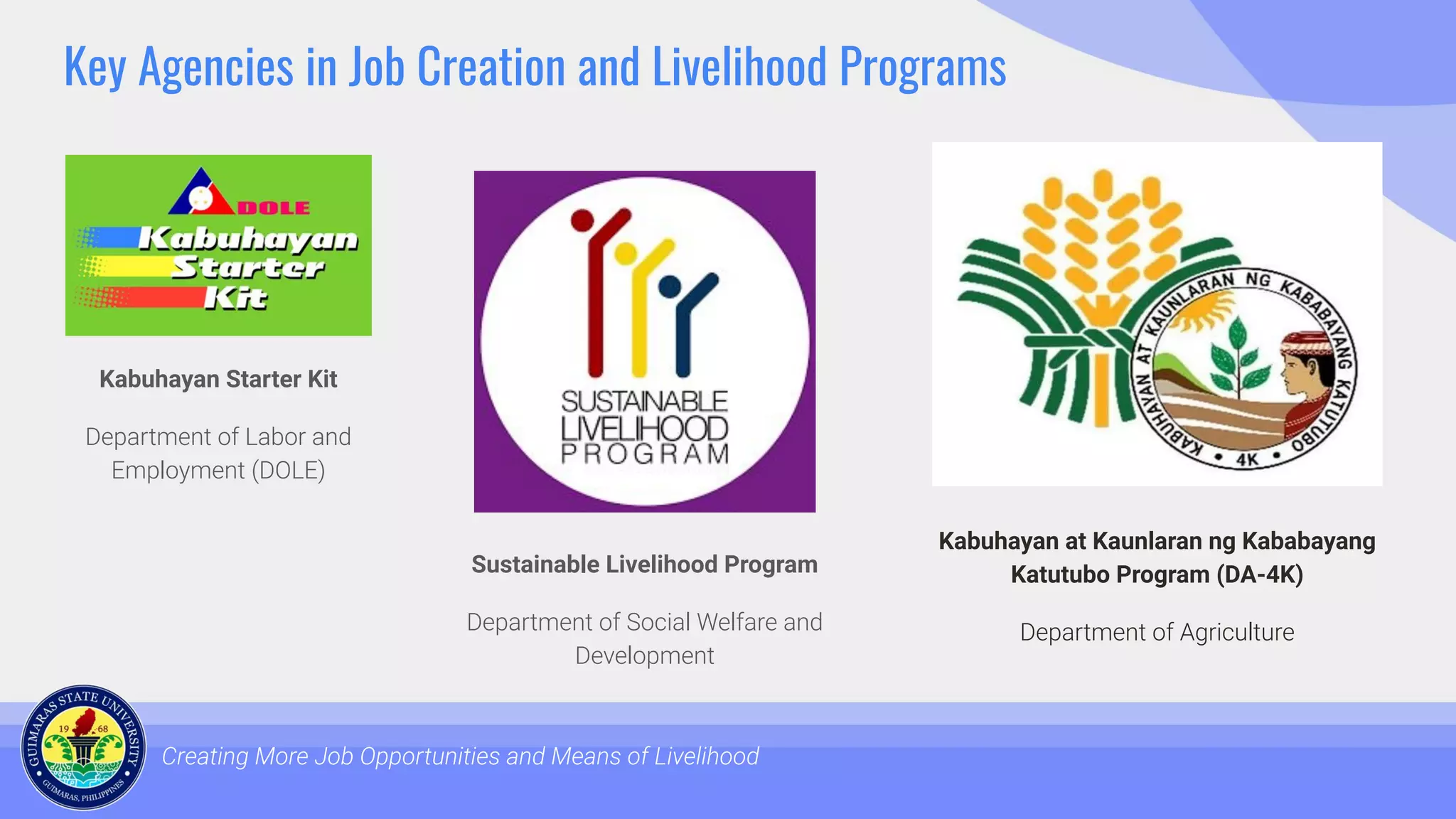
Key Agencies in Job Creation and Livelihood Programs
Kabuhayan Starter Kit
Department of Labor and
Employment (DOLE)
Creating More Job Opportunities and Means of Livelihood
Sustainable Livelihood Program
Department of Social Welfare and
Development
Kabuhayan at Kaunlaran ng Kababayang
Katutubo Program (DA-4K)
Department of Agriculture
Creating More Job Opportunities and Means of Livelihood
“Though one’s occupation for his or her livelihood
involves physical work or menial labour, it is held that the
job carries dignity, compared to the jobs that involve
more intellect than body.”
Thank you for Listening!
PARTICIPATORY PROJECT DEVELOPMENT MANAGEMENT
Developing the People’s Potentials for them to take the
Leading Role in Development
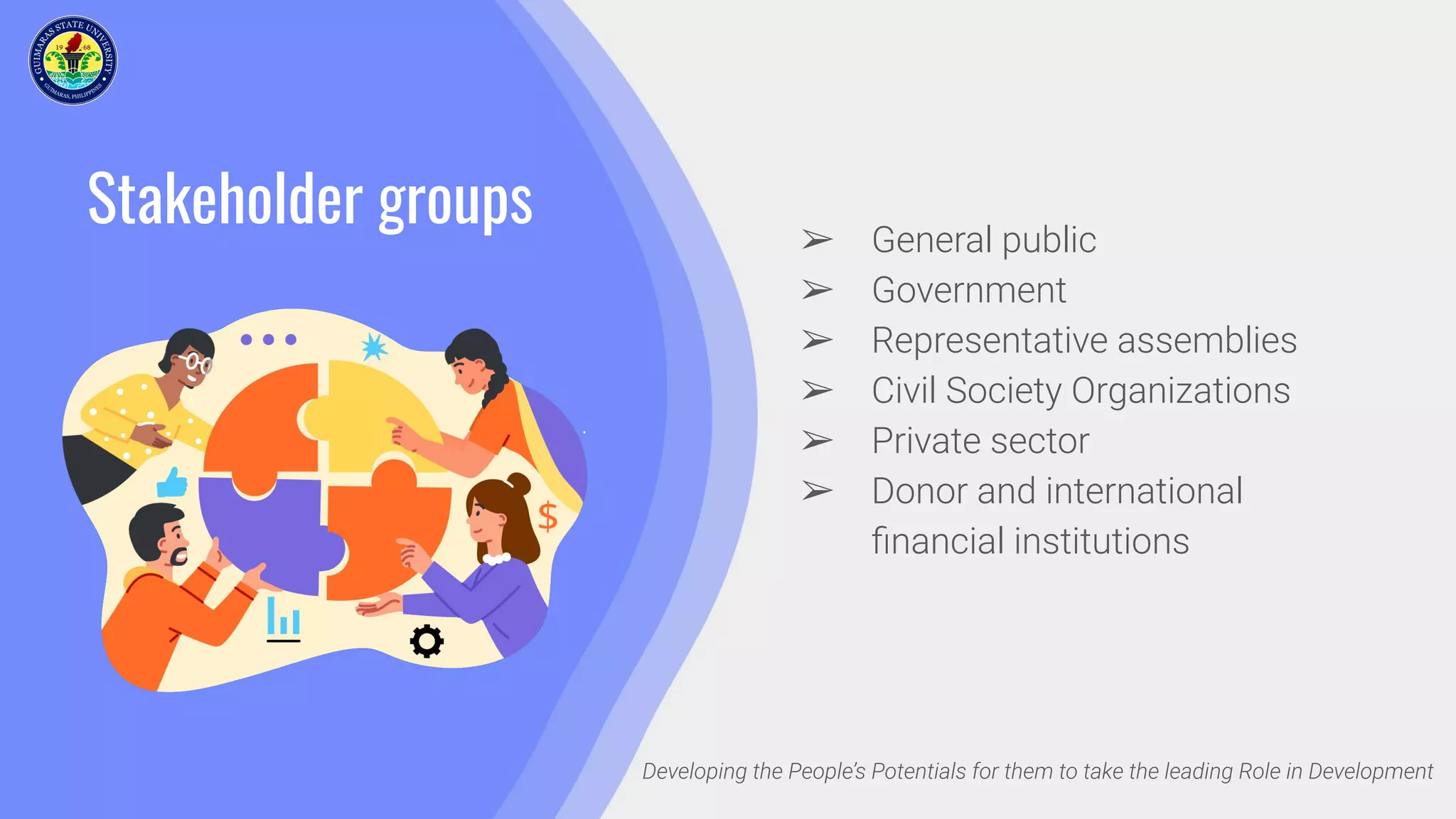
Stakeholder groups ➢ General public
➢ Government
➢ Representative assemblies
➢ Civil Society Organizations
➢ Private sector
➢ Donor and international
financial institutions
Developing the People’s Potentials for them to take the leading Role in Development
People’s Participation in the Governance in Philippines
➢ The Local Government Code of 1991 has provided venues for participation of
civil society organizations (CSOs) in local governance through the various local
bodies at the barangay, municipal, provincial and regional levels.
➢ Achieved through Local Development Councils and creation of loca special
bodies
Developing the People’s Potentials for them to take the leading role in Development
People’s Participation in the Governance in Philippines
Local Government Code of 1991, Section 26
“Duty of National Government Agencies in the Maintenance of Ecological Balance”
“It shall be the duty of every national agency or government-owned or controlled corporation
authorizing or involved in the planning and implementation of any project or program that may
cause pollution, climatic change, depletion of non-renewable resources, loss of crop land,
rengeland, or forest cover, and extinction of animal or plant species, to consult with the local
government units, non-governmental organizations, and other sectors concerned and explain the
goals and objectives of the project or program, its impact upon the people and the community in
terms of environmental or ecological balance, and the measures that will be undertaken to prevent
or minimize the adverse effects thereof”
Developing the People’s Potentials for them to take the leading role in Development
People’s Participation in the Governance in Philippines
Local Government Code of 1991, Section 27
Prior Consultations Required
“No project or program shall be implemented by the government authorities unless the
consultations are complied with and prior approval of the Sanggunian concerned is
obtained. Provided, that occupants in areas where such projects are to be implemented
shall not be evicted unless appropriate relocation sited have been provided in accordance
with the provisions of the Constitution.”
Developing the People’s Potentials for them to take the leading role in Development
People’s Participation in the Governance in Philippines
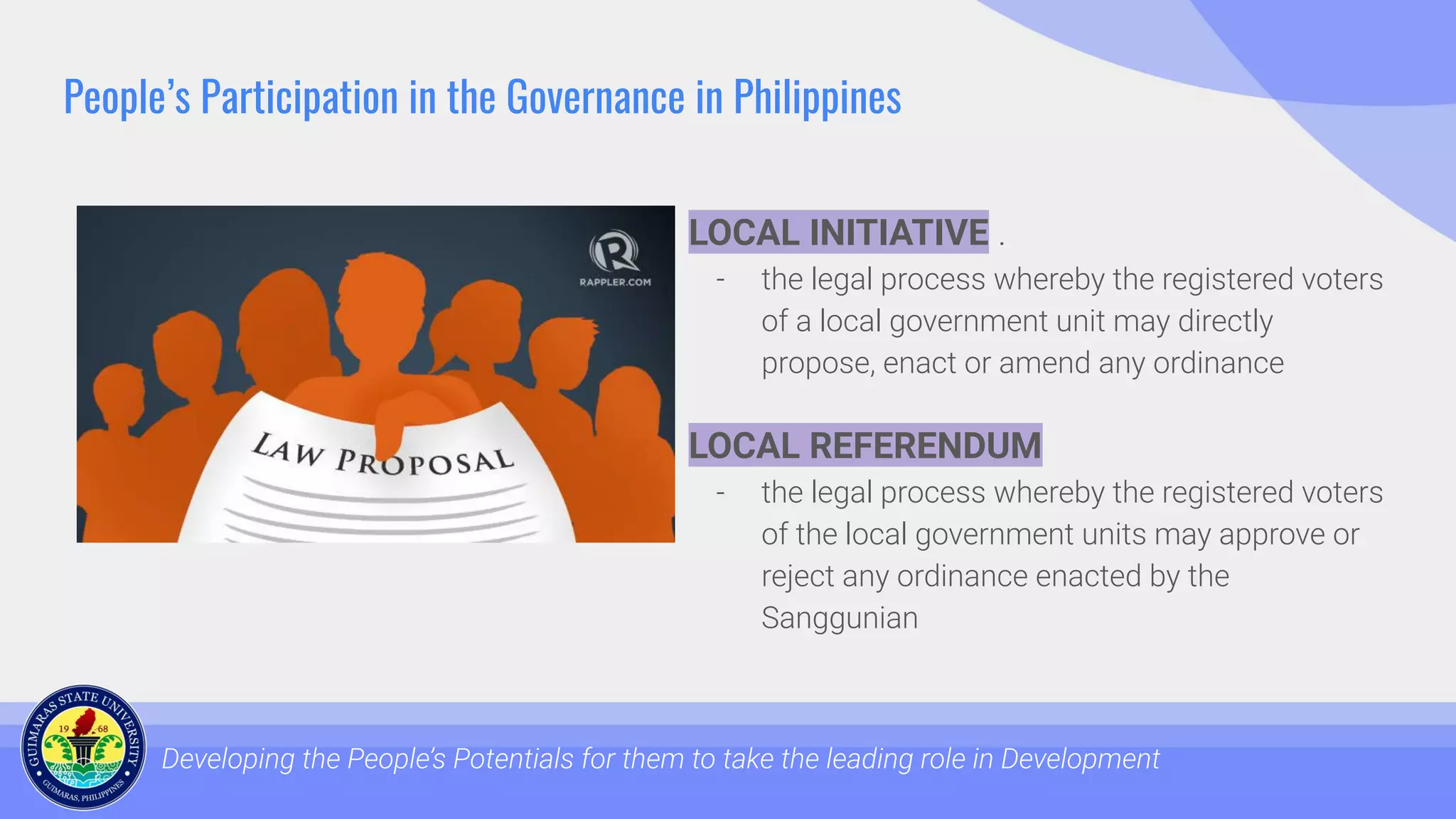
LOCAL INITIATIVE .
- the legal process whereby the registered voters
of a local government unit may directly
propose, enact or amend any ordinance
Developing the People’s Potentials for them to take the leading role in Development
LOCAL REFERENDUM
- the legal process whereby the registered voters
of the local government units may approve or
reject any ordinance enacted by the
Sanggunian
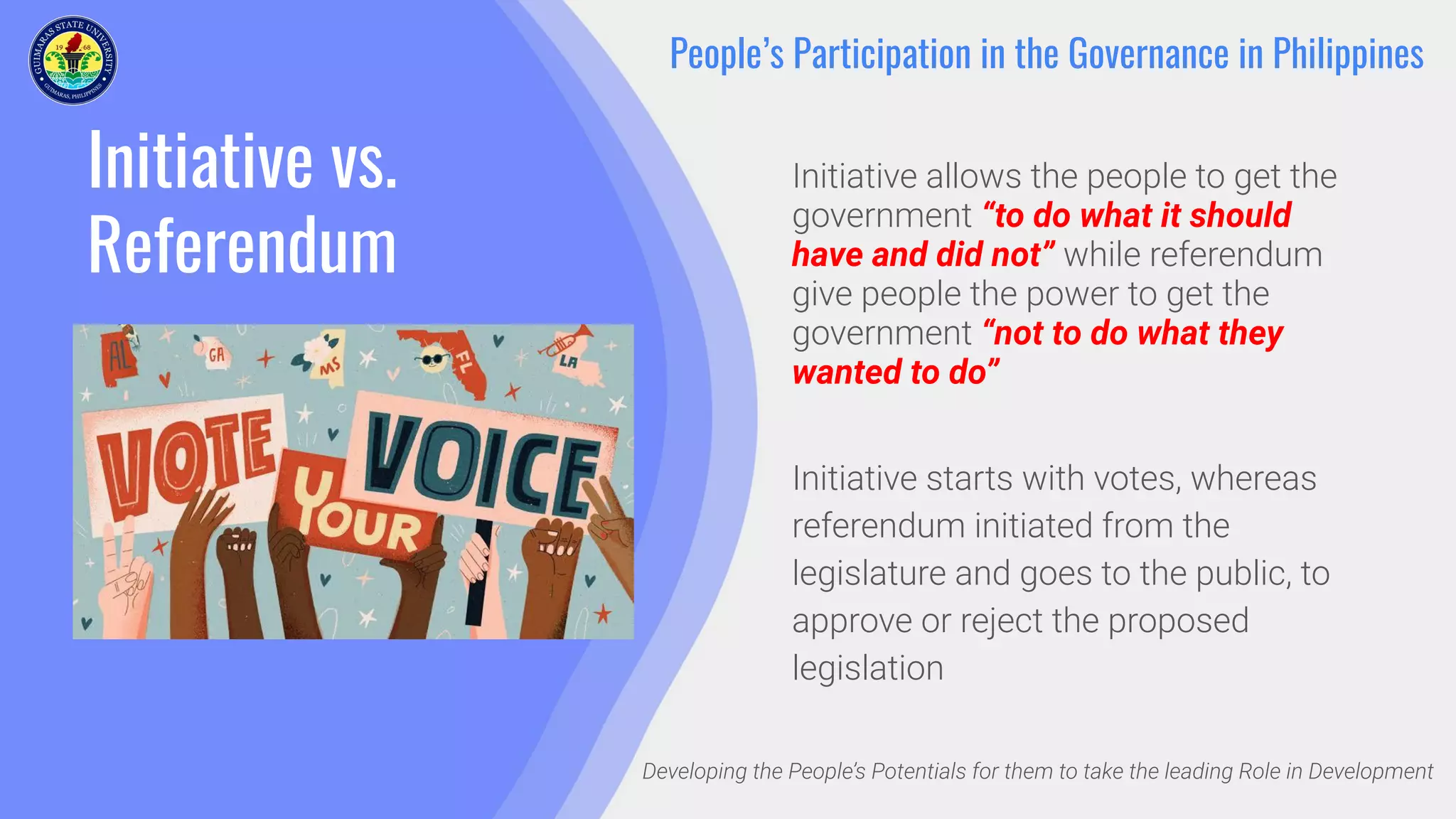
Initiative vs.
Referendum
Initiative allows the people to get the
government “to do what it should
have and did not” while referendum
give people the power to get the
government “not to do what they
wanted to do”
Developing the People’s Potentials for them to take the leading Role in Development
Initiative starts with votes, whereas
referendum initiated from the
legislature and goes to the public, to
approve or reject the proposed
legislation
People’s Participation in the Governance in Philippines
People’s
Participation in
Heritage
Management
towards Cultural
Development
Developing the People’s Potentials for them to take the leading Role in Development
People’s Participation in Heritage Management towards Cultural Development
Developing the People’s Potentials for them to take the leading role in Development
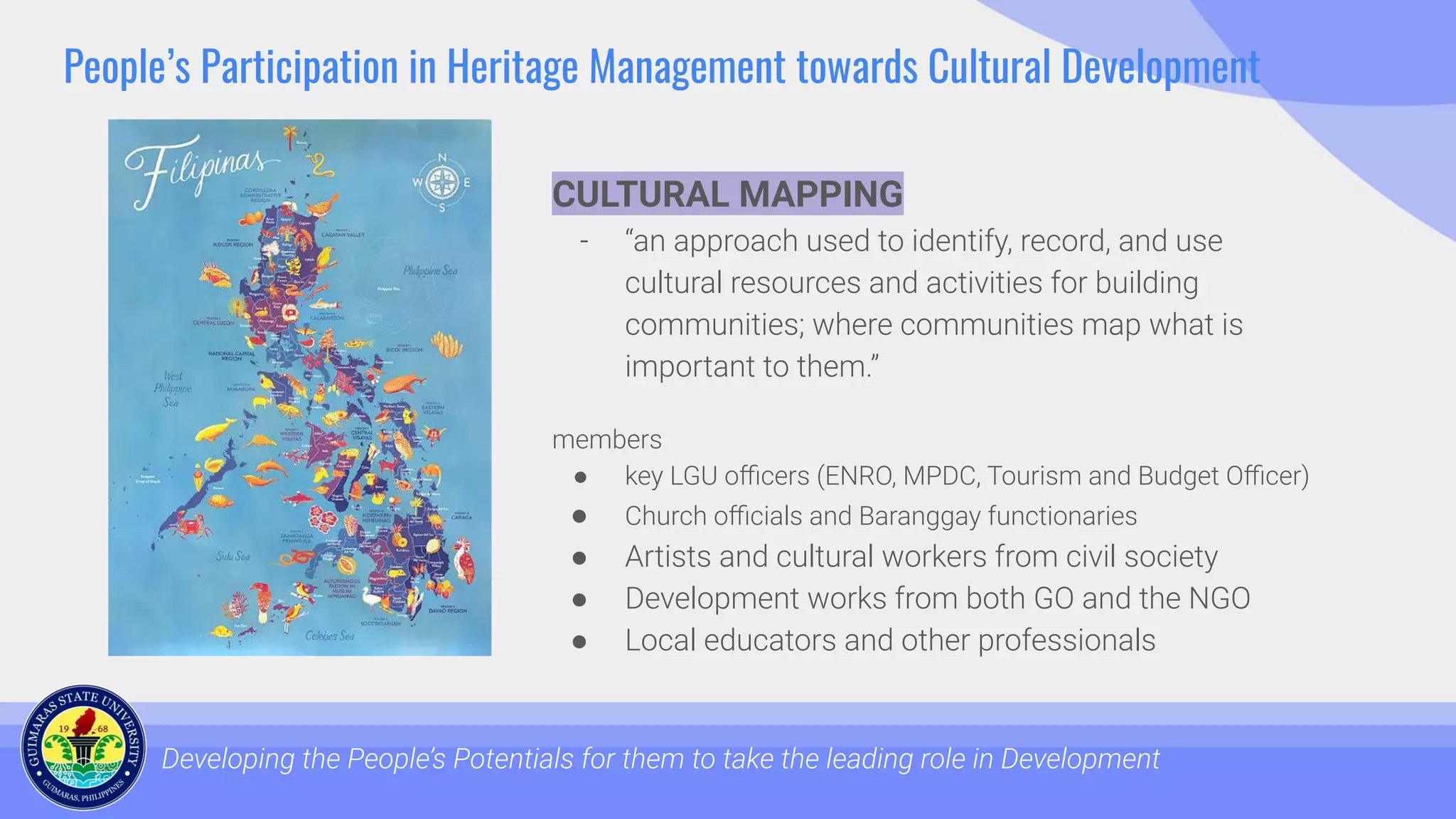
CULTURAL MAPPING
- “an approach used to identify, record, and use
cultural resources and activities for building
communities; where communities map what is
important to them.”
members
● key LGU officers (ENRO, MPDC, Tourism and Budget Officer)
● Church officials and Baranggay functionaries
● Artists and cultural workers from civil society
● Development works from both GO and the NGO
● Local educators and other professionals
People’s Participation in the Construction of Infrastructure
Developing the People’s Potentials for them to take the leading role in Development
Environmental Impact Assessment by DPWH
- A process of evaluating the likely environmental
impacts of a proposed project or development,
taking into account inter-related socio-economic,
cultural and human health impacts, both beneficial
and adverse
People’s Participation in the Construction of Infrastructure
Developing the People’s Potentials for them to take the leading role in Development
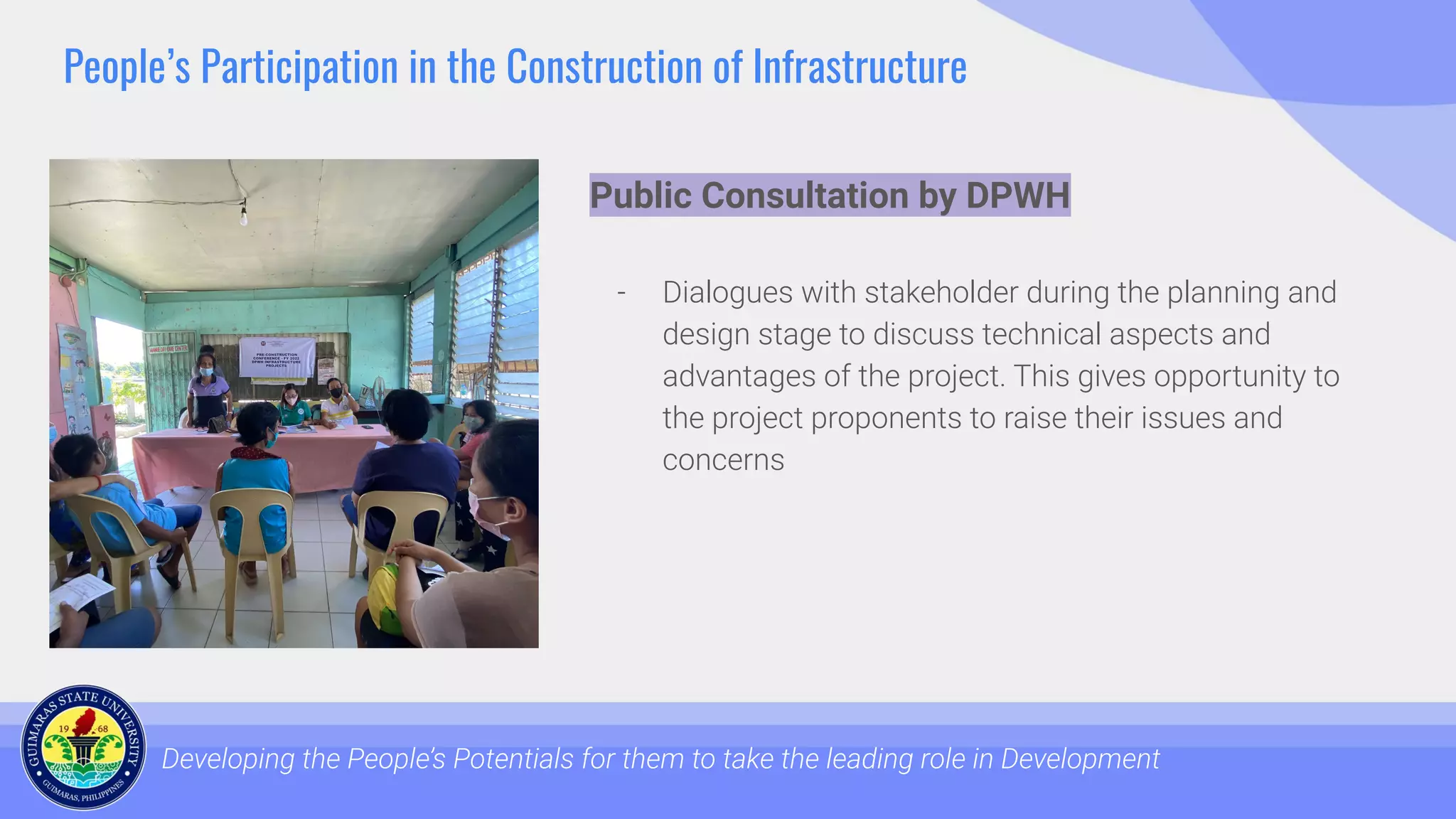
Public Consultation by DPWH
- Dialogues with stakeholder during the planning and
design stage to discuss technical aspects and
advantages of the project. This gives opportunity to
the project proponents to raise their issues and
concerns
People’s Participation in the Construction of Infrastructure
Developing the People’s Potentials for them to take the leading role in Development
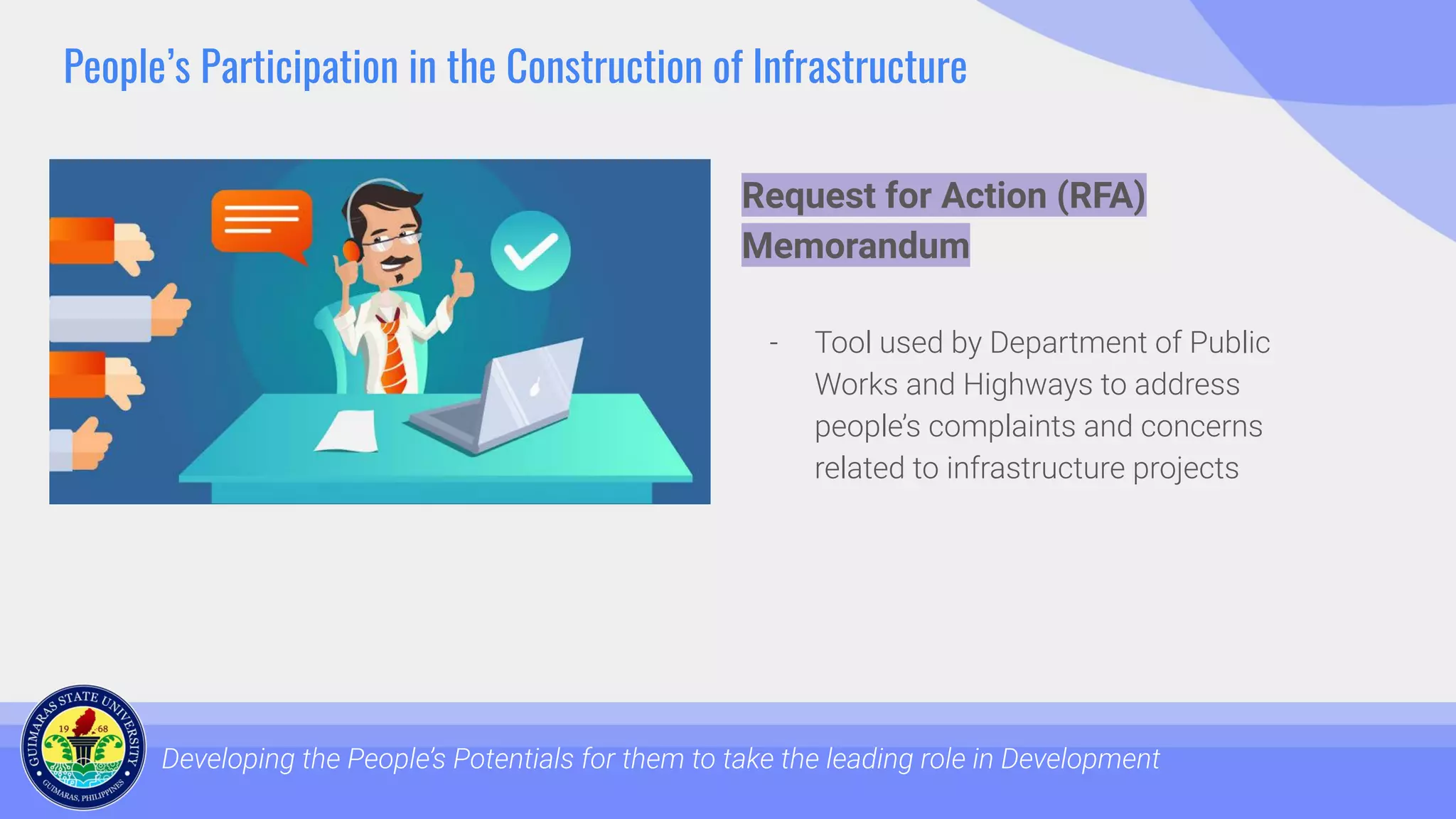
Request for Action (RFA)
Memorandum
- Tool used by Department of Public
Works and Highways to address
people’s complaints and concerns
related to infrastructure projects
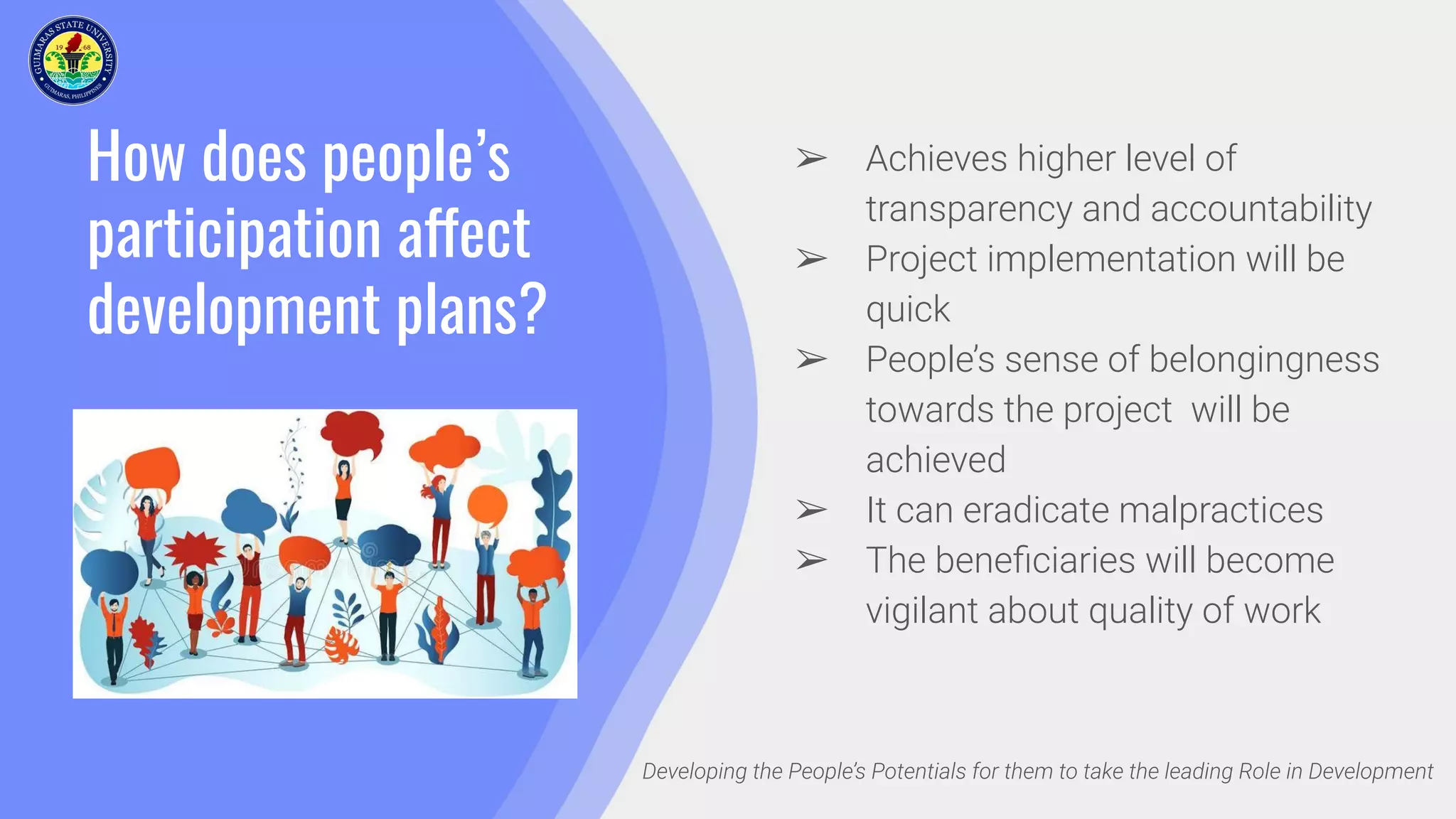
How does people’s
participation affect
development plans?
Developing the People’s Potentials for them to take the leading Role in Development
➢ Achieves higher level of
transparency and accountability
➢ Project implementation will be
quick
➢ People’s sense of belongingness
towards the project will be
achieved
➢ It can eradicate malpractices
➢ The beneficiaries will become
vigilant about quality of work
THANK YOU!
“Community Leadership is the courage,
creativity and capacity to inspire
participation, development, sustainability for
strong communities.”
-Gustav Nossal

PA-210-G1-Participatory Project Development Management.pdf

  • 1.
    PARTICIPATORY PROJECT DEVELOPMENT MANAGEMENT PublicAdministration 210: Project Evaluation and Impact Management Group Members Ms. Joy Valerie Gigataras Ms. Phyllis Claire Soldevilla-Jacar Mr. Andy Pablico Mr. Robert Montaño Mr. Ralph Jason Fuentes
  • 2.
    Topics Overview I. Scopeand Nature Project II. Raising Productivity Levels III. Broadening the Sharing of Project’s Blessing IV. Democratization of Projects and Social Services V. Creating More Job Opportunities and Means of Livelihood VI. Developing the People’s Potential for them to take the Leading Role in Development
  • 3.
    PARTICIPATORY PROJECT DEVELOPMENTMANAGEMENT Scope and Nature Project
  • 4.
    What is theScope and Nature of the Project? Project scope is the part of project planning that involves determining and documenting a list of specific project goals, deliverables, tasks, costs and deadlines. The documentation of a project's scope is called a scope statement or terms of reference. Scope and Nature Project
  • 5.
    Why is itimportant to define the Scope Project? Project scope is critical because without it project managers would have no clue what time, cost or labor was involved in a project. It forms the basis for every decision a project manager will make on a job and when it needs to change, proper communication will ensure success every step of the way. Scope and Nature Project
  • 6.
    8 Key Stepsto Developing a Project Scope Statement 1) Understand why the project was initiated 2) Define the key objectives of the project 3) Outline the project statement of work 4) Identify major deliverables 5) Select key milestones 6) Identify major constraints 7) List scope exclusions 8) Obtain sign-off Scope and Nature Project
  • 7.
    What is Natureof Project Planning? The project planning helps in streamline the process of the Project. Planning helps in the smooth running of the Project as every aspect of the project is taken into consideration, and the required solution is also provided in the project planning phase. Scope and Nature Project
  • 8.
    What is theNature and Scope of Project Management? ➢ Project Management, in a simple term, it means managing a project from end to end. It is how a person of authority sets up and supervises the resources that are available in order to finish a project they have taken. ➢ The person of authority who supervises the whole project is called the Project Manager. ➢ The Project Managers uses different techniques, methodologies, skills, and they have the required knowledge which will help the Project achieve the objective as per the criterion which has been agreed upon by all the parties. Scope and Nature Project
  • 9.
    The scope ofthe Project Management is covered in Five different stages: 1) Initializing the Project 2) Planning and Development of the Project 3) Project Execution 4) Project Monitoring 5) Project Closing Scope and Nature Project
  • 10.
    Five Stages ofProject Management 1. Initializing the Project Scope and Nature Project ➢ The first phase of the project as the name suggests is initializing the Project. A business case, i.e. the benefits or the reasons to do the project is presented, and then the Project is defined at the macro level. ➢ The project manager first does the feasibility study in order to know whether the objective of the project is achievable and thus can be launched. The people concerned with the Project is required to do the due diligence and give the go-ahead to the Project. ➢ The project manager then prepares a comprehensive document stating the objective of the Project along with it the project manager should mention the different requirement, the business case that was presented and the need of this Project in the business.
  • 11.
    Five Stages ofProject Management 2. Planning and Development of the Project Scope and Nature Project ➢ After the Project gets a go-ahead, and it is initiated, the project manager moves to the second phase known as the project planning phase of the project management. ➢ In this phase, the project manager prepares a roadmap which focuses on achieving the objective of the project in a systematic way. The project planning helps in streamline the process of the Project. ➢ Planning helps in the smooth running of the Project as every aspect of the project is taken into consideration, and the required solution is also provided in the project planning phase.
  • 12.
    Five Stages ofProject Management 3. Project Execution Scope and Nature Project ➢ The actual work on the project happens in this phase. There are many responsibilities which get done in this phase. ➢ In this phase, a team is developed for the Project; resources are assigned, the execution of the second phase is done now. ➢ The project manager manages the execution, tracking system for the progress of the project is set up, the status meetings are done regularly, the project schedule is updated as and when the planned task is finished as well as the project planning is modified as per the requirement of the situation during the execution.
  • 13.
    Five Stages ofProject Management 4. Project Monitoring Scope and Nature Project ➢ The third and the fourth phase of the project management go hand in hand in the process of project management. During this phase the Project is monitored proactively in order to know whether the project is going as per the planning, it will also help to know whether the Project is not going over budget and whether the quality of the Project executed till now is up to the mark. ➢ These are some of the things that the project manager would be aware of if the Project is continuously monitored and will help the Project manager decide the further course of action.
  • 14.
    Five Stages ofProject Management 5. Project Closing Scope and Nature Project ➢ This is the phase bring about the completion of the project, and the objective of the project is achieved. The team members are acknowledged for their efforts they have put in for the Project. ➢ The learning while completing the Project is shared with everyone for future reference. The final documents, any reports or any other relevant documents are handed over to the team who would be operating the Project regularly.
  • 15.
    5 Characteristics of aProject 1) Specific 2) Measurable 3) Achievable 4) Relevant 5) Time Bound Scope and Nature Project
  • 16.
    7 Areas of ProjectPlan 1) Well-defined goals 2) Resource planning 3) Task planning 4) Risk identification 5) Communication 6) Scheduling 7) Quality control Scope and Nature Project
  • 17.
    PARTICIPATORY PROJECT DEVELOPMENTMANAGEMENT Raising Productivity Levels
  • 18.
    What is Productivity? Productivity inproject work is determined by observing the relationship between final results and cost or time. That ratio if consistently measured at regular intervals. A record of productivity trends. Raising Productivity Levels
  • 19.
    Effectiveness & Efficiency In addition,Productivity can also be seen as the product of effectiveness and efficiency. ➢ Effectiveness relates directly to the final result and its application towards meeting desired objectives. ➢ Efficiency, on the other hand, represents the measurement of task performance in terms of cost or time, based on a given methodology. The product of effectiveness and efficiency results in the productivity index. Raising Productivity Levels
  • 20.
    7 Simple Cornerstonesfor Achieving High Productivity Levels: For a given objective to be reached, it needs to be clearly outlined and be consistent with overall organizational goals. In short we need to be specific and smart on establishing our objectives in order to achieve our targets. So, why we need to established clear objectives? Because Objectives are important they convert visions into clear-cut measurable targets. Objectives are also the mileposts to lead or guide us. Raising Productivity Levels 1. Establishing Clear Objectives
  • 21.
    7 Simple Cornerstonesfor Achieving High Productivity Levels: In addition, clear objectives motivate employees. Employees become more enthusiastic and spirited in their work when they know what is expected of them. Their work is more directed with less wasted time. They get particularly interested when they learn about the rewards for meeting and exceeding their objectives. If employees don't have the skills for their jobs, they are inspired to learn more and find ways to improve their performance. Raising Productivity Levels 1. Establishing Clear Objectives
  • 22.
    7 Simple Cornerstonesfor Achieving High Productivity Levels: Establish standards to evaluate performance: Objectives establish standards of performance. They are measuring sticks to identify the successes and failures of an organization and its employees. Performance reporting helps managers identify non-performing areas and to take corrective actions. Raising Productivity Levels 1. Establishing Clear Objectives
  • 23.
    7 Simple Cornerstonesfor Achieving High Productivity Levels: The communication process requires line tuning (using the right combination of written, visual, participative, and didactic approaches) to ensure that the goals are understood. Furthermore, one of the key factors that improve team productivity is effective communication must prevail in a team. Communication helps team members understand their responsibilities and reduces the chances of confusion within the team, which can affect overall productivity. Effective communication is always about understanding the other person. Effective communication, then, has to be at the center of everything we do. Raising Productivity Levels 2. Communicate the Objectives Effectively
  • 24.
    7 Simple Cornerstonesfor Achieving High Productivity Levels: Consensus decision making and joint-planning efforts are required to stimulate team members to achieve project goals. Peter Drucker has spoken of lack of clarity in communicating objectives as a major cause for lagging productivity. He also points out that low levels of productivity in managerial and engineering functions are more attributable to what the professional doesn't do than to what is done, thus, the need for involvement in order to spur the individual on to higher levels of performance. Raising Productivity Levels 3. Involve those who Perform the Work
  • 25.
    7 Simple Cornerstonesfor Achieving High Productivity Levels: Let your team members make their own decisions and make them accountable for their work. This instills a sense of responsibility in employees regarding work, making them aware that their decisions can affect the performance of the entire team. Your trust can help build your team members’ self-esteem. Raising Productivity Levels 4. Give Ownership to Team Members
  • 26.
    7 Simple Cornerstonesfor Achieving High Productivity Levels: As a manager, you have to know the knowledge, skill sets, and talents of teammates to allocate tasks accordingly. Making each member use their strengths will improve workplace productivity. Raising Productivity Levels 5. Identify the Strength, Weakness of Your Team
  • 27.
    7 Simple Cornerstonesfor Achieving High Productivity Levels: Employees work best when their efforts are appreciated and they are given incentives. Implement incentive programs in the form of cash, free vouchers, lunch-outs, paid holidays, etc., to keep your employees motivated. Raising Productivity Levels 6. Reward Your Employees
  • 28.
    7 Simple Cornerstonesfor Achieving High Productivity Levels: Constructive feedback is a robust tool for creating a healthy environment, boosting productivity and engagement, and achieving better results. It positively influences communication, team members’ interaction and teamwork results in different fields. Raising Productivity Levels 7. Give Constructive Feedback
  • 29.
    7 Simple Cornerstonesfor Achieving High Productivity Levels: ➢ The importance of feedback in the workplace is hard to overestimate: sharing information on what can and needs to be improved helps optimize the work process and get things done in less time. ➢ Feedback is of great help in leadership and communication: it creates a clear picture and increases transparency. ➢ Feedback plays a crucial role in education and learning by helping adopt new knowledge sooner and avoid repetitive mistakes. ➢ The same applies to feedback in sports and coaching: it helps learn new skills and get better results. ➢ Raising Productivity Levels 7. Give Constructive Feedback
  • 30.
    Causes of Low Productivityin Projects Raising Productivity Levels
  • 31.
    Causes of LowProductivity in Projects ➢ Time runs short on projects for two reasons. First, because of poor estimating of the time required to carry out project tasks, and second, because of faulty performance in carrying out programmed tasks. ➢ In both situations, it's the project professional's responsibility to correct matters—which means realistically estimating the time required, and then carrying out the schedule as programmed. Raising Productivity Levels 1. Lack of Time
  • 32.
    Causes of LowProductivity in Projects ➢ The accelerating waves of technological advances make it increasingly difficult for project personnel to keep up-to-date on technologies. Missing bits of administrative information also set project productivity back. ➢ Technological data banks, management information systems, and an information-conscious project team are the solutions to the lack-of-information syndrome. Raising Productivity Levels 2. Lack of Information
  • 33.
    Causes of LowProductivity in Projects ➢ Good ideas may be scarce due to lack of “gray matter” in the heads of those who do the thinking, or more commonly, because of a non-creative atmosphere that provides little stimulus for bright ideas to bloom. ➢ If gray matter is lacking, the solution is to recruit or borrow more qualified thinkers. If the atmosphere needs changing, then creative techniques like brainstorming and interchanging professionals with other groups are appropriate. Raising Productivity Levels 3. Lack of Ideas
  • 34.
    Causes of LowProductivity in Projects ➢ One of the worst errors in project management happens when the wrong premise is used to outline plans or to make decisions. Lack of upfront premise screening causes project decisions and plans to be built on sandy foundations. ➢ Review boards, outside specialists, devil's advocates and creativity sessions in the beginning of the planning process are ways of offsetting the incorrect-premise problem. Raising Productivity Levels 4. Incorrect Premise
  • 35.
    Causes of LowProductivity in Projects ➢ All humans are creatures of habit. In project work, some habits work in favour of meeting projected goals. When those habits involve creativity and solid methodologies, then the project benefits. ➢ Other habits, that involve repetition of prior practices without questioning applicability in new situations, have a detrimental effect on project productivity. Habits need constant questioning to ensure that project goals are met. Raising Productivity Levels 5. Bad Habits
  • 36.
    Causes of LowProductivity in Projects ➢ “We can't get better results because they won't let us.” (“They” refers to upper management, the client, the Government, in other words, others). This attitude places a drain on project productivity. ➢ The opposite stance, on the other hand, boosts productivity: “Let's see how we can get the job done, in spite of the obstacles.” This upbeat approach, coupled with solid planning, organization, direction and control, sets the tone for successful projects. Raising Productivity Levels 6. Poor Attitude
  • 37.
    Causes of LowProductivity in Projects ➢ Other factors cause low productivity on projects, such as politics, both within and outside of the project arena, and “force majeure” .Combinations of all those factors decrease project productivity. Raising Productivity Levels 6. Poor Attitude
  • 38.
    PARTICIPATORY PROJECT DEVELOPMENTMANAGEMENT Broadening the Sharing of Project’s Blessings
  • 39.
    Essential Elements of PovertyTargeting Mechanism 1) Development of Poverty Targeting Strategy in Relation to Program Objectives 2) Geographical Targeting 3) Menu and Eligibility Criteria 4) Inclusive Processes at Community Level 5) Monitoring and Evaluation System Broadening the Sharing of Project’s Blessing
  • 40.
    Development of PovertyTargeting Strategy in Relation to Program Objectives ● Clear specification and justification of target geographical areas. ● Clear specification and justification of vulnerable and/or poor target population – should be based on a social assessment. ● Overall assessment of Government and/or program preference for targeting Broadening the Sharing of Project’s Blessing Overall Poverty Targeting Strategy ● Execute communications strategy of targeting expectations to all key stakeholders (parliament, press, sectoral ministries, civil society) ● Integrate targeting strategy within national development strategies (Poverty Reduction Strategy Papers, Millennium Development Goals) Design Phase Implementation Phase
  • 41.
    Geographical Targeting ● Identificationof and consensus on poverty map (most disaggregated level available). ● Development of pro-poor resource allocation formula. ● Specification of methodology for selection of communities within targeted areas (second stage targeting). Broadening the Sharing of Project’s Blessing ● Announce annual allocations to local stakeholders. ● Provide technical support to poor municipalities that do not use quota. ● Use revised poverty map, if available. ● Adjust allocations based on performance and revised map. Design Phase Implementation Phase
  • 42.
    Menu and EligibilityCriteria ● Menu designed to promote self-selection, limit elite capture. ● Identification of beneficiary screening criteria for higher-risk subproject types. ● Counterpart funding rules. ● Cost recovery and user fee rules. ● Wage rates to promote self-selection if employment an objective Broadening the Sharing of Project’s Blessing ● Introduce and pilot additional pro-poor interventions (e.g. demand-side etc.) ● Adjust counterpart funding rules based on experience ● Revise wage rates to keep in line with labor market conditions. ● Identify target groups not yet covered or accessing services and revise menu and criteria accordingly Design Phase Implementation Phase
  • 43.
    Inclusive Processes atCommunity Level ● Design of facilitated community needs assessment and investment prioritization process to minimize elite capture. ● Rules for community management committees. ● Identification of social control mechanisms Broadening the Sharing of Project’s Blessing ● Assessment of prioritization versus investment financed. ● Adjustments to community facilitation processes as needed based on PM&E. ● Adjustments to community management committees as needed based on PM&E. ● Dissemination of results of social control mechanisms Design Phase Implementation Phase
  • 44.
    Monitoring and EvaluationSystem ● Specify targeting-related key performance indicators, integrated where possible into MIS. ● Include poverty targeting within design of impact evaluations to be carried out. ● Design Performance Monitoring & Evaluation component (PM & E) Broadening the Sharing of Project’s Blessing ● Routine reporting of poverty targeting Key Performance Indicators (KPIs). ● Execution of at least one household survey based assessment of targeting incidence. ● Impact analysis to assess differential impacts on poorer households. ● Dissemination of results of PM & E Design Phase Implementation Phase
  • 45.
    PARTICIPATORY PROJECT DEVELOPMENTMANAGEMENT Democratization of Projects and Social Services
  • 46.
    What is Democratization? 1) Transitionto a more democratic political regime. 2) Transition from an authoritarian regime to a full democracy 3) Transition from an authoritarian political system to a semi-democracy 4) Transition from a semi-authoritarian political system to a democratic political system Democratization of Projects and Social Services
  • 47.
    Democratization Transition - Arethe change from the original non-democratic regime (dictatorship) to a democratic regime.
  • 48.
    TYPES OF REGIMES/POLITICALSYSTEM THAT GAVE WAY TO DEMOCRACY AUTHORITARIAN - powers in the hands of a leader or a small elite that is not responsible and accountable to the people. Rulers are not chosen by people who have limited political freedoms. Democratization of Projects and Social Services
  • 49.
    TYPES OF REGIMES/POLITICALSYSTEM THAT GAVE WAY TO DEMOCRACY AUTHORITARIAN -Headed by supreme leader wielding great amount of individual power. -Military Regime: In early 1990s, about half of 3rd world countries were ruled by Military Regime Democratization of Projects and Social Services
  • 50.
    Examples of Authoritarian ➢ AdolfHitler (Nazi, Germany) ➢ Francisco Franco (Spain) ➢ Saddam Hussein (Iraq) ➢ Zia-ul Haq (Pakistan) Democratization of Projects and Social Services
  • 51.
    TYPES OF REGIMES/POLITICALSYSTEM THAT GAVE WAY TO DEMOCRACY TOTALITARIAN -Rule by a single party following distinct ideology, TOTAL control of state/government of almost all aspects of public and private life, minimal civil/political freedom Democratization of Projects and Social Services
  • 52.
    Examples of Totalitarian ➢ JosephStalin (USSR) ➢ Mao Zedong (China) ➢ Other Communist Regimes Democratization of Projects and Social Services
  • 53.
    TYPES OF REGIMES/POLITICALSYSTEM THAT GAVE WAY TO DEMOCRACY POST - TOTALITARIAN -Regime still trying to control all aspects of public and private life, follow official ideology, and charismatic leader despite collapse of foundations of totalitarianism. Democratization of Projects and Social Services
  • 54.
    Examples of Post- Totalitarian ➢ Vladimir Putin (Russia) ➢ Capitalist China ➢ Other communist and post communist regimes Democratization of Projects and Social Services
  • 55.
    TYPES OF REGIMES/POLITICALSYSTEM THAT GAVE WAY TO DEMOCRACY MONARCHICAL AND SULTANISTIC -A country that is ruled by a monarch. -Sultanism is a form of authoritarian government characterized by the extreme personal presence of the ruler in all elements of governance Democratization of Projects and Social Services
  • 56.
    Examples of Monarchical & Sultanistic ➢Nepal (2006) ➢ Turkey ➢ Malaysia ➢ Indonesia Democratization of Projects and Social Services
  • 57.
    TYPES OF REGIMES/POLITICALSYSTEM THAT GAVE WAY TO DEMOCRACY COLONIAL REGIME - POST COLONIAL STATES - Is a practice or policy of control by one people or power over other people or areas, often by establishing colonies and generally with the aim to economic dominance. Democratization of Projects and Social Services
  • 58.
    Examples of Colonial Regime- Post Colonial States ➢ India ➢ Sri Lanka ➢ Philippines ➢ Ghana ➢ Myanmar ➢ Etc. Democratization of Projects and Social Services
  • 59.
    DEMOCRACY ➢ Greek words:(demos) “people”, (karatos) “rule” ➢ “rule by the people”, democracy is a system of government that not only allows but requires the participation of the people in the political process to function properly. Democratization of Projects and Social Services
  • 60.
    Example of Democracy ThePhilippines 1987 constitution, adopted the democracy (U.S.) system during the Aquino administration, reestablished a presidential system of government with a bicameral legislature and an independent judiciary. Democratization of Projects and Social Services
  • 61.
    Department of Publicof Works and Highways MISSION To provide and manage quality infrastructure facilities and services responsive to needs of the Filipino people in the pursuit of national development objectives. Democratization of Projects and Social Services VISION By 2030, DPWH is an effective and efficient government agency, improving the life of every Filipino through quality infrastructure
  • 62.
    BUILD, BUILD, BUILDPROGRAM ➢ The centerpiece program of the Duterte administration that aims to usher the “Golden age of infrastructure” in the Philippines. ➢ Lack of infrastructure has long been cited as the “Achilles’ heel” of Philippine economic development Democratization of Projects and Social Services
  • 63.
    Democratization of Projectsand Social Services
  • 64.
    LAKBAY ALALAY ➢ “LakbayAlalay” is an annual public service program of DPWH nationwide thru the 16 Regional and 183 District Engineering Offices of providing immediate assistance to our motorists such as rescuing troubled vehicles, giving of directions especially to visitors and applying first aid in emergency situations Democratization of Projects and Social Services
  • 65.
    Democratization of Projectsand Social Services
  • 66.
    AYUDA PROGRAM ➢ Thejob description of the beneficiaries of AYUDA program involves working as street sweepers, street signs cleaners, garbage collectors, vegetation control and removal of illegally dumped construction materials, junked items and other obstructions protruding to the carriageway, shoulder and sidewalk. Democratization of Projects and Social Services
  • 67.
    Democratization of Projectsand Social Services
  • 68.
    FARM TO MARKETROADS Democratization of Projects and Social Services ➢ (FMRs) connect agricultural and fisheries areas to markets, allowing producers to transport their goods to traders and consumers with relative ease. These roads help the farmers and fisherfolks gain better prices and broader reach for their products.
  • 69.
    Assistance to Individualsin Crisis Situation (AICS) Democratization of Projects and Social Services ➢ Part of the DSWD's protective services for the poor, marginalized and vulnerable/disadvantaged individuals. ➢ The AICS has been implemented by the DSWD for decades, as part of its technical assistance and resource augmentation support to LGUs and other partners.
  • 70.
    PARTICIPATORY PROJECT DEVELOPMENTMANAGEMENT Creating More Job Opportunities and Means of Livelihood
  • 71.
    Job & Livelihood ➢Job - is work or a particular task or function that someone does to earn money. ➢ Livelihood - comprises capabilities, assets and activities required for means of living. Creating More Job Opportunities and Means of Livelihood
  • 72.
    Effective Local Strategies toBoost Quality Job Creation, Employment & Participation Policy Principles to Guide Action at the National and Local Levels Local Employment and Economic Development (LEED Programme) By Organization for Economic Co-operation and Development (OECD) Creating More Job Opportunities and Means of Livelihood ➢ a set of policy principles to help national governments better support place-based approaches to job creation can be formulated. They were developed by the expertise of the OECD LEED Programme, the ILO, the World Bank and WAPES
  • 73.
    Policy Principles toGuide Action at the National and Local Levels ➢ Make national employment and training policy frameworks more adaptable to local labour market conditions. ➢ Support partnership approaches within local economies (and in some cases around specific sectors or value chains) leading to better integrated policies and more effective and efficient strategies. ➢ Give priority to creating an adaptable labour force that is able to innovate, progress, and transfer between sectors, hence building local resilience. Creating More Job Opportunities and Means of Livelihood
  • 74.
    Policy Principles toGuide Action at the National and Local Levels ➢ Support labour market transitions throughout the life-cycle by building comprehensive local career information and well-articulated training to employment pathways. ➢ Stimulate productivity and innovation by working with employers and trade unions to better utilise the skills of the existing workforce. ➢ Develop place-based initiatives to support inclusive growth by reducing the barriers that can exclude people from the labour force over generations, including youth, women, older workers, people with disabilities and immigrants. Creating More Job Opportunities and Means of Livelihood
  • 75.
    Policy Principles toGuide Action at the National and Local Levels ➢ Ensure that appropriate social protections are available at the local level especially among the highly disadvantaged. ➢ Invest in social infrastructure and institutions to strengthen networks within and between local economies, including those which are performing more highly. ➢ Support the development of the social enterprise sector and innovative approaches, such as social impact investments. Creating More Job Opportunities and Means of Livelihood
  • 76.
    Policy Principles toGuide Action at the National and Local Levels ➢ Support evidence-based policies by developing comprehensive labour market information systems, which disaggregate data on jobs and skills to the level of local labour markets. Creating More Job Opportunities and Means of Livelihood https://www.oecd.org/g20/topics/employment-education-and-social-policies /OECD-LEED-Local-strategies-for-employment-G20.pdf
  • 77.
    Towards an ActionPlan for Jobs in the Philippines: Recommendation & Best Practices Employment and Skills Strategies in the Philippines By Organization for Economic Co-operation and Development (OECD) Creating More Job Opportunities and Means of Livelihood ➢ Key recommendations emerging from a review of local job creation policies in the Philippines. To better connect people to jobs, stimulate more responsive skills development training at the local level and ensure that economic development efforts are better coordinated with employment programs
  • 78.
    Overall Recommendations 1. Promotethe establishment of One-Stop PESOs which combine employment and training services into one office and integrate employment and skills programs Creating More Job Opportunities and Means of Livelihood ➢ Public employment services (PESOs) are key actors in broader economic development opportunities strategies by reaching out to employers and stimulating good quality employment opportunities. ➢ Flexible Training, Education and Employment services are required in the Philippines to proactively respond to skills gaps that may acts as barriers and obstacles to business growth and expansion.
  • 79.
    Promote the establishmentof One-Stop PESOs which combine employment and training services into one office and integrate employment and skills programs Creating More Job Opportunities and Means of Livelihood ➢ PESO in Cebu City provides the best model. They demonstrates the importance of providing both employment and training services in an integrated manner to better link job seekers to employment. ➢ Through the Nat’l Peso network, the DOLE should seek to promote “what works” in better designing employment services to provide a more client-oriented approach. At the Nat’l level, the DOLE should work with TESDA to promote organization of local PESOs.
  • 80.
    Overall Recommendations 2. Continueto develop an evaluation framework to measure the success of the JobStart program and continuously improve the delivery of program over the long-term. Creating More Job Opportunities and Means of Livelihood ➢ JobStart Program represents an important government initiative in the Philippines to provide the youth with good job opportunities. ➢ Through effective implementation at the local level and strong collaboration among stakeholders, JobStart can help address potential skills mismatches while also promoting broader economic development, job creation and growth.
  • 81.
    Continue to developan evaluation framework to measure the success of the JobStart program and continuously improve the delivery of program over the long-term Creating More Job Opportunities and Means of Livelihood ➢ Developing an evaluation culture is a critical part of the policy development process to ensure that programs are subject to a cycle of continuous improvement. ➢ Evaluations provide national policy makers with information upon which potential policy and program changes can be made.
  • 82.
    Overall Recommendations 3. Introducework-based training programs which network employers and promote skills development opportunities, which are better linked to labour market demand. Creating More Job Opportunities and Means of Livelihood ➢ Employers are key partners in any policies or programs which seek to boost skills development opportunities and promote employment. ➢ Local level actions can spur employers to offer more in-work training and internships, particularly in firms that traditionally offer low levels of training such as SMEs.
  • 83.
    Introduce work-based trainingprograms which network employers and promote skills development opportunities, which are better linked to labour market demand Creating More Job Opportunities and Means of Livelihood ➢ DOLE should consider how to provide incentives to employers to encourage them to network on a sector or regional level. Employers take a stronger leadership role in skills development programs. ➢ The Department of Tourism piloted the Tourism Skills Development Program which provided matching grants to tourism enterprises to fund short term, relevant skills to their employees.
  • 84.
    Creating More JobOpportunities and Means of Livelihood 7 Best Industries in the Philippines for 2019 ❏ Travel and Tourism ❏ Agriculture ❏ Real Estate ❏ Outsourcing ❏ Retailing ❏ Construction ❏ Healthcare https://www.businesssetup.com/blog/7-best-industries-in-the-philippines
  • 85.
    Principles of Livelihood “Waste andlaziness are facilitators of poverty. But sustainability, efficiency and productivity are facilitators of wealth.” ― Hendrith Smith, The Wealth Reference Guide: An American Classic Creating More Job Opportunities and Means of Livelihood ➢ People-Centered ➢ Responsive and participatory ➢ Multi-Level ➢ Conducted in Partnership ➢ Sustainable ➢ Dynamic ➢ Holistic ➢ Building on Strengths
  • 86.
    Identifying the Key Players CreatingMore Job Opportunities and Means of Livelihood ➢ General Public ➢ Government (National & Local) ➢ Civil Society Organizations ➢ Private Sectors ➢ International Financial Institutions
  • 87.
    Sustainable Livelihood Framework Creating MoreJob Opportunities and Means of Livelihood Five concepts that are crucial for understanding the linkages within the framework: ➢ The Vulnerability Context ➢ Livelihood Assets ➢ Policies, Institutions & Processes ➢ Livelihood Strategies ➢ Livelihood Outcomes “It is not an Investment if it destroys the Planet.” ― Vandana Shiva
  • 88.
    Sustainable Livelihood Framework CreatingMore Job Opportunities and Means of Livelihood
  • 89.
    Livelihood Asset Pentagon CreatingMore Job Opportunities and Means of Livelihood Natural Capital Social Capital Human Capital Economic Capital Physical Capital ➢ Natural resources to make a livelihood (Forest & Wildlife, Water & Aquatic Resources, Biodiversity and Environmental Services) ➢ Health & Nutrition, Education, Skills & Knowledge and Capacity to Work & Adapt. ➢ Social resources to make a living (Networks, Social Claims, Relationships, Affiliations and Associations) ➢ Basic Infrastructures needed to make a living (Transportation & Roads, Production Equipment and Technologies) ➢ Any form of Capital Base (Financial Supports & Fundings, Savings, Financial Subsistence)
  • 90.
    Livelihood Asset Pentagon CreatingMore Job Opportunities and Means of Livelihood ➢ Human Capital (Labor Capacity, No Education, Limited Skills) ➢ Natural Capital (Landless, Access to Common Property resources) ➢ Financial Capital (Low Wages, No Access to Credit) ➢ Physical Capital (Poor Water Supply, Poor Housing, Poor Communications) ➢ Social Capital (Low Social Status, Discrimination Against Women, Strong Links to Family & Friends, Traditions of Reciprocal Exchange Social Capital Human Capital Economic Capital Physical Capital Natural Capital Landless Female Agricultural Laborer = Extremely reduced “livelihood pentagon”
  • 91.
    Vulnerability Context Creating More JobOpportunities and Means of Livelihood Refers to the external environment in which people live. ➢ This includes Trends (such as national or international economic trends, changes in available technology, political systems), ➢ Shocks (such as illness or death, conflict, weather), and ➢ Seasonality (of prices, production cycles and so on). The vulnerability context is important because the three factors have a direct impact on the possibilities that poor people have to earn a living now and in the future.
  • 92.
    Policies, Institutions & Processes Creating MoreJob Opportunities and Means of Livelihood An important set of man-made external factors that influence the range of livelihood options open to different categories of people. They also influence access to assets and vulnerability to shocks. ➢ An enabling policy and institutional environment makes it easier for people - poor and less poor -to gain access to assets they need for their livelihoods. ➢ A disabling policy and institutional environment may discriminate against the poor, thus making it difficult for them to get access to land, livestock, capital and information.
  • 93.
    Livelihood Strategies Creating More JobOpportunities and Means of Livelihood The range and combination of activities and choices that people make in order to achieve their livelihood goals. ➢ Combine & Utilize the assets they can access. ➢ Take account of the Vulnerability Context. ➢ Supported or Obstructed by the Policies, Institutions and Processes.
  • 94.
    Livelihood Outcomes Creating More JobOpportunities and Means of Livelihood Unsuccessful Outcomes: ➢ Food and income insecurity ➢ High vulnerability to shocks, changes and/or trends ➢ Loss of assets and impoverishment Achievable Outcomes: ➢ More sustainable use of Natural Resources ➢ Asset accumulation and High Status ➢ Increased Well-Being ➢ Protected Rights ➢ Recover Dignity ➢ Reduced Vulnerability ➢ Improved Food Security
  • 95.
    Key Agencies inJob Creation and Livelihood Programs Kabuhayan Starter Kit Department of Labor and Employment (DOLE) Creating More Job Opportunities and Means of Livelihood Sustainable Livelihood Program Department of Social Welfare and Development Kabuhayan at Kaunlaran ng Kababayang Katutubo Program (DA-4K) Department of Agriculture
  • 96.
    Creating More JobOpportunities and Means of Livelihood
  • 97.
    Creating More JobOpportunities and Means of Livelihood
  • 98.
    Creating More JobOpportunities and Means of Livelihood
  • 99.
    Creating More JobOpportunities and Means of Livelihood
  • 100.
    “Though one’s occupationfor his or her livelihood involves physical work or menial labour, it is held that the job carries dignity, compared to the jobs that involve more intellect than body.” Thank you for Listening!
  • 101.
    PARTICIPATORY PROJECT DEVELOPMENTMANAGEMENT Developing the People’s Potentials for them to take the Leading Role in Development
  • 102.
    Stakeholder groups ➢General public ➢ Government ➢ Representative assemblies ➢ Civil Society Organizations ➢ Private sector ➢ Donor and international financial institutions Developing the People’s Potentials for them to take the leading Role in Development
  • 103.
    People’s Participation inthe Governance in Philippines ➢ The Local Government Code of 1991 has provided venues for participation of civil society organizations (CSOs) in local governance through the various local bodies at the barangay, municipal, provincial and regional levels. ➢ Achieved through Local Development Councils and creation of loca special bodies Developing the People’s Potentials for them to take the leading role in Development
  • 104.
    People’s Participation inthe Governance in Philippines Local Government Code of 1991, Section 26 “Duty of National Government Agencies in the Maintenance of Ecological Balance” “It shall be the duty of every national agency or government-owned or controlled corporation authorizing or involved in the planning and implementation of any project or program that may cause pollution, climatic change, depletion of non-renewable resources, loss of crop land, rengeland, or forest cover, and extinction of animal or plant species, to consult with the local government units, non-governmental organizations, and other sectors concerned and explain the goals and objectives of the project or program, its impact upon the people and the community in terms of environmental or ecological balance, and the measures that will be undertaken to prevent or minimize the adverse effects thereof” Developing the People’s Potentials for them to take the leading role in Development
  • 105.
    People’s Participation inthe Governance in Philippines Local Government Code of 1991, Section 27 Prior Consultations Required “No project or program shall be implemented by the government authorities unless the consultations are complied with and prior approval of the Sanggunian concerned is obtained. Provided, that occupants in areas where such projects are to be implemented shall not be evicted unless appropriate relocation sited have been provided in accordance with the provisions of the Constitution.” Developing the People’s Potentials for them to take the leading role in Development
  • 106.
    People’s Participation inthe Governance in Philippines LOCAL INITIATIVE . - the legal process whereby the registered voters of a local government unit may directly propose, enact or amend any ordinance Developing the People’s Potentials for them to take the leading role in Development LOCAL REFERENDUM - the legal process whereby the registered voters of the local government units may approve or reject any ordinance enacted by the Sanggunian
  • 107.
    Initiative vs. Referendum Initiative allowsthe people to get the government “to do what it should have and did not” while referendum give people the power to get the government “not to do what they wanted to do” Developing the People’s Potentials for them to take the leading Role in Development Initiative starts with votes, whereas referendum initiated from the legislature and goes to the public, to approve or reject the proposed legislation People’s Participation in the Governance in Philippines
  • 108.
    People’s Participation in Heritage Management towards Cultural Development Developingthe People’s Potentials for them to take the leading Role in Development
  • 109.
    People’s Participation inHeritage Management towards Cultural Development Developing the People’s Potentials for them to take the leading role in Development CULTURAL MAPPING - “an approach used to identify, record, and use cultural resources and activities for building communities; where communities map what is important to them.” members ● key LGU officers (ENRO, MPDC, Tourism and Budget Officer) ● Church officials and Baranggay functionaries ● Artists and cultural workers from civil society ● Development works from both GO and the NGO ● Local educators and other professionals
  • 110.
    People’s Participation inthe Construction of Infrastructure Developing the People’s Potentials for them to take the leading role in Development Environmental Impact Assessment by DPWH - A process of evaluating the likely environmental impacts of a proposed project or development, taking into account inter-related socio-economic, cultural and human health impacts, both beneficial and adverse
  • 111.
    People’s Participation inthe Construction of Infrastructure Developing the People’s Potentials for them to take the leading role in Development Public Consultation by DPWH - Dialogues with stakeholder during the planning and design stage to discuss technical aspects and advantages of the project. This gives opportunity to the project proponents to raise their issues and concerns
  • 112.
    People’s Participation inthe Construction of Infrastructure Developing the People’s Potentials for them to take the leading role in Development Request for Action (RFA) Memorandum - Tool used by Department of Public Works and Highways to address people’s complaints and concerns related to infrastructure projects
  • 113.
    How does people’s participationaffect development plans? Developing the People’s Potentials for them to take the leading Role in Development ➢ Achieves higher level of transparency and accountability ➢ Project implementation will be quick ➢ People’s sense of belongingness towards the project will be achieved ➢ It can eradicate malpractices ➢ The beneficiaries will become vigilant about quality of work
  • 114.
    THANK YOU! “Community Leadershipis the courage, creativity and capacity to inspire participation, development, sustainability for strong communities.” -Gustav Nossal