P7 Waves

General properties
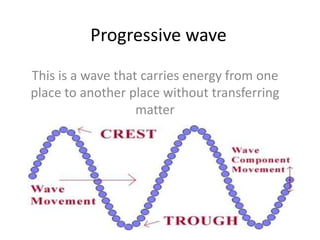
Progressive wave
This is a wave that carries energy from one
place to another place without transferring
                   matter
Transverse waves
 http://www.acoustics.salford.ac.uk/feschools/waves/wavetypes.htm

 Mexican wave / slinky / particles


http://www.science-animations.com/support-files/slinkyc.swf

Spring


http://www.upscale.utoronto.ca/GeneralInterest/Harrison/Flash/ClassMechanics/Trav
elWaves/TravelWaves.html

Travelling wave
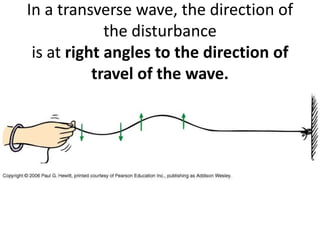
In a transverse wave, the direction of
             the disturbance
 is at right angles to the direction of
           travel of the wave.
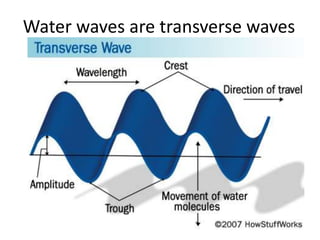
Water waves are transverse waves
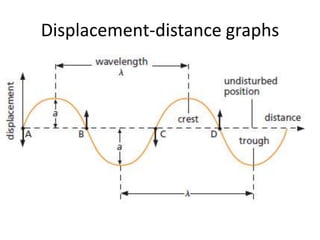
Displacement-distance graphs
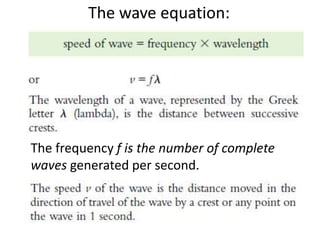
The wave equation:


The frequency f is the number of complete
waves generated per second.
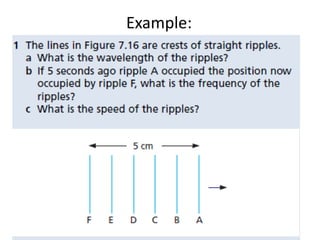
Example:
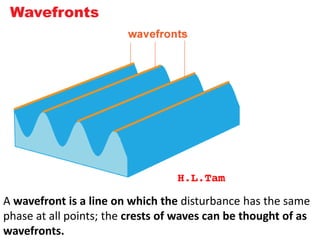
A wavefront is a line on which the disturbance has the same
phase at all points; the crests of waves can be thought of as
wavefronts.
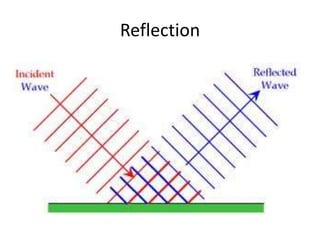
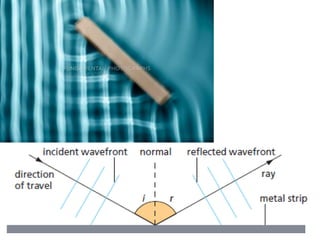
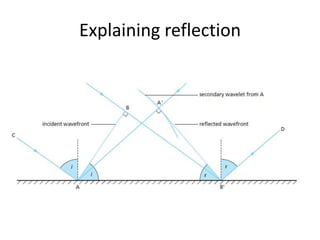
Reflection
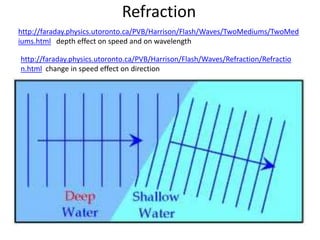
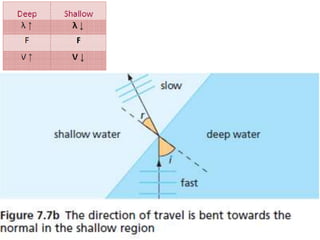
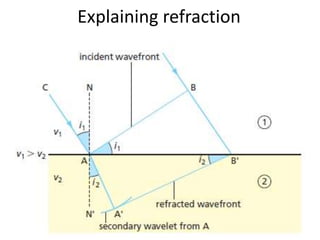
Refraction
http://faraday.physics.utoronto.ca/PVB/Harrison/Flash/Waves/TwoMediums/TwoMed
iums.html depth effect on speed and on wavelength

http://faraday.physics.utoronto.ca/PVB/Harrison/Flash/Waves/Refraction/Refractio
n.html change in speed effect on direction
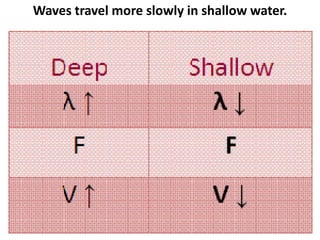
Waves travel more slowly in shallow water.
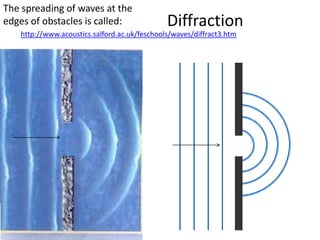
The spreading of waves at the
edges of obstacles is called:                 Diffraction
   http://www.acoustics.salford.ac.uk/feschools/waves/diffract3.htm
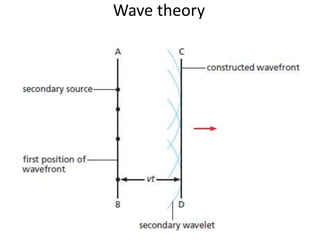
Wave theory
Explaining reflection
Explaining refraction
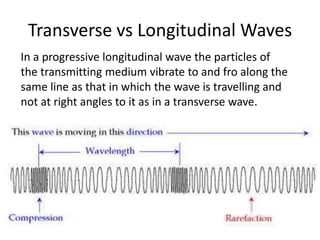
Transverse vs Longitudinal Waves
In a progressive longitudinal wave the particles of
the transmitting medium vibrate to and fro along the
same line as that in which the wave is travelling and
not at right angles to it as in a transverse wave.

P7 waves