1
Deliverable 2:
How to compose a Slidecast
Extended Technical Definition
© Karen Thompson ● Department of English ● University of Idaho
2
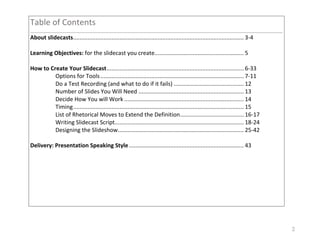
Table&of&Contents&
!
About!slidecasts&...........................................................................................................&3/4&
&
Learning!Objectives:!for&the&slidecast&you&create&........................................................&5&
& !
How!to!Create!Your!Slidecast&......................................................................................&6/33&
& Options&for&Tools&..........................................................................................&7/11&
& Do&a&Test&Recording&(and&what&to&do&if&it&fails)&............................................&12&
& Number&of&Slides&You&Will&Need&..................................................................&13&
& Decide&How&You&will&Work&...........................................................................&14&
& Timing&...........................................................................................................&15&
& List&of&Rhetorical&Moves&to&Extend&the&Definition&........................................&16/17&
& Writing&Slidecast&Script&.................................................................................&18/24&
& Designing&the&Slideshow&...............................................................................&25/42&
&
Delivery:!Presentation!Speaking!Style&........................................................................&43&
& &
&
About Slidecasts:
3
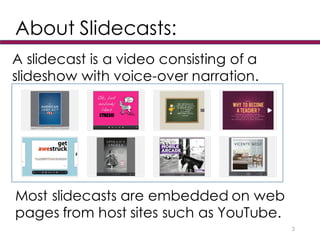
A slidecast is a video consisting of a
slideshow with voice-over narration.
Most slidecasts are embedded on web
pages from host sites such as YouTube.
Slidecasts are used to:
• Promote products or services,
• Provide instructions to users,
• Present test results to project team
members who are at different locations.
• These are just a few of the ways they can
be used.
4
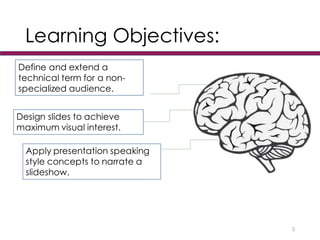
Learning Objectives:
5
Define and extend a
technical term for a non-
specialized audience.
Apply presentation speaking
style concepts to narrate a
slideshow.
Design slides to achieve
maximum visual interest.
How to create your Slidecast.
• You need a microphone, and the one in your
computer will be fine for this project.
• Your slidecast must be hosted on a site that allows
users to play it without having to download the
file.
• You will need to decide how you will create the
slidecast from the following options. Please note
the warnings.
6
Option: PC Users Only
• PowerPoint: create the slideshow, use the PPT
recording feature to add voice-over narration,
save as a movie file, and upload to a host site
such as YouTube or Vimeo.
• MAC users. PPT has a bug in it that will strip your
audio out when saving as a movie file. So, you
can’t use it. There is no solution to-date.
7
Option: Mac Users Only
• Keynote will work the same as PPT for PC users, but
it’s not free ($19.99).
8
Don’t	
  feel	
  like	
  buying	
  
Keynote?	
  See	
  the	
  next	
  
slide	
  for	
  another	
  option	
  
that’s	
  free.
Option: All users.
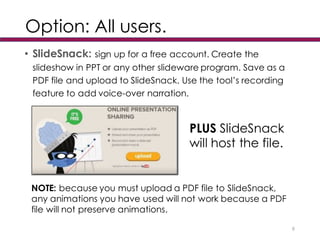
• SlideSnack: sign up for a free account. Create the
slideshow in PPT or any other slideware program. Save as a
PDF file and upload to SlideSnack. Use the tool’s recording
feature to add voice-over narration.
9
PLUS SlideSnack
will host the file.
NOTE: because you must upload a PDF file to SlideSnack,
any animations you have used will not work because a PDF
file will not preserve animations.
Option: All Users
• Strictly speaking, a screen capture tool creates a screencast,
but if you position the capture feature over your slideshow and
position it so you can advance the slides as you record, it will
preserve the animations and work the same as a slidecast.
• I recommend using Screencast-O-Matic (Mac users need to
also download Soundflower to record) or Jing (all users). These
tools also have a means of hosting your file.
• See tools and resources for more information.
10
• Remember, I do not accept video files (mp4, mov, etc.).
• Here’s why. You are practicing how to create and share
these types of files as they are shared in workplace
settings.
• So, if you choose to create a video file on your
computer, be certain it is uploaded to a host site and will
play without a user needing to download the file.
11
Do a test recording.
• First, be certain you completed the technology
check on Orientation Day 1, and are using the
recommended browser for this course. If not, go
there, do that.
• Close all other programs and browser windows to
ensure you have enough memory.
• If the test recording fails, follow the
troubleshooting steps under Tools & Resources.
12
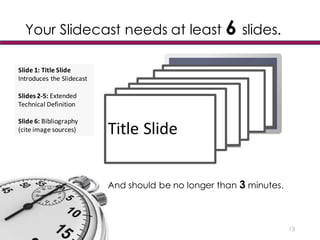
Your Slidecast needs at least 6 slides.
13
Title	
  Slide
And should be no longer than 3 minutes.
Slide	
  1:	
  Title	
  Slide
Introduces	
  the	
  Slidecast
Slides	
  2-­‐5:	
  Extended	
  
Technical	
  Definition	
  
Slide	
  6: Bibliography
(cite	
  image	
  sources)
Decide how to work:
• Some people like to write the slidecast script
first and then design the slides.
• Some prefer to do the slides first and then write
the script.
• Still others create the slides and write the script
at the same time.
Do the process that works best for you.
14
Timing:
• You will be adding voice-over narration to
at least 5 slides (the bibliography is not narrated).
• The voice-over should be no longer than
3 minutes (and may be less).
• As you record the voice-over, keep the
pace per slide about equal.
15
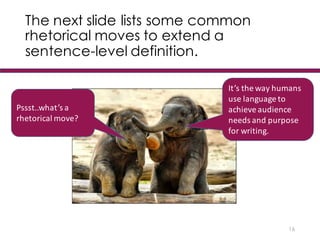
The next slide lists some common
rhetorical moves to extend a
sentence-level definition.
16
It’s	
  the	
  way	
  humans	
  
use	
  language	
  to	
  
achieve	
  audience	
  
needs	
  and	
  purpose	
  
for	
  writing.
Pssst..what’s a	
  
rhetorical	
  move?
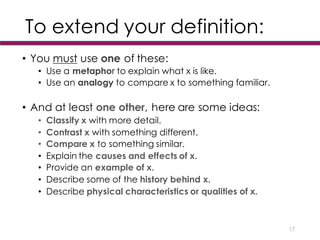
To extend your definition:
• You must use one of these:
• Use a metaphor to explain what x is like.
• Use an analogy to compare x to something familiar.
• And at least one other, here are some ideas:
• Classify x with more detail.
• Contrast x with something different.
• Compare x to something similar.
• Explain the causes and effects of x.
• Provide an example of x.
• Describe some of the history behind x.
• Describe physical characteristics or qualities of x.
17
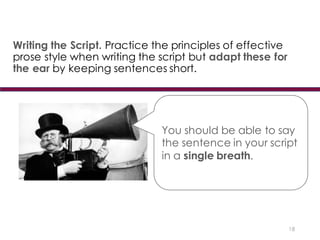
Writing the Script. Practice the principles of effective
prose style when writing the script but adapt these for
the ear by keeping sentences short.
18
You should be able to say
the sentence in your script
in a single breath.
19
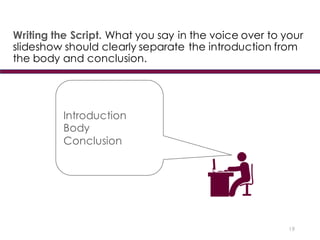
Introduction
Body
Conclusion
Writing the Script. What you say in the voice over to your
slideshow should clearly separate the introduction from
the body and conclusion.
20
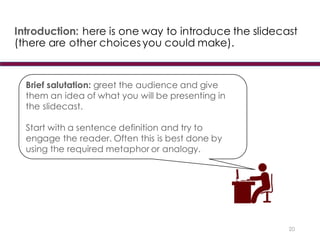
Brief salutation: greet the audience and give
them an idea of what you will be presenting in
the slidecast.
Start with a sentence definition and try to
engage the reader. Often this is best done by
using the required metaphor or analogy.
Introduction: here is one way to introduce the slidecast
(there are other choices you could make).
21
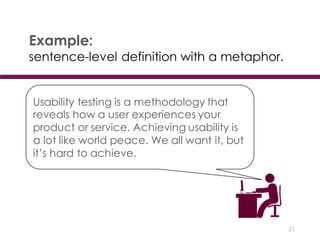
Example:
sentence-level definition with a metaphor.
Usability testing is a methodology that
reveals how a user experiences your
product or service. Achieving usability is
a lot like world peace. We all want it, but
it’s hard to achieve.
22
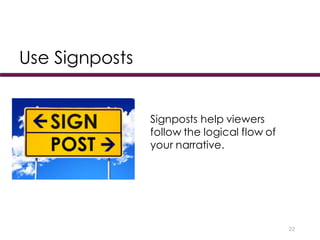
Signposts help viewers
follow the logical flow of
your narrative.
Use Signposts
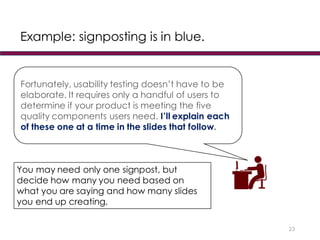
Example: signposting is in blue.
23
Fortunately, usability testing doesn’t have to be
elaborate. It requires only a handful of users to
determine if your product is meeting the five
quality components users need. I’ll explain each
of these one at a time in the slides that follow.
You may need only one signpost, but
decide how many you need based on
what you are saying and how many slides
you end up creating.
Closing
24
Wrap	
  it	
  Up.	
  Have	
  a	
  clear	
  
conclusion.
• Remember	
  to	
  thank	
  audience	
  
for	
  listening.
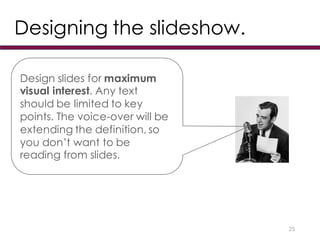
Designing the slideshow.
25
Design slides for maximum
visual interest. Any text
should be limited to key
points. The voice-over will be
extending the definition, so
you don’t want to be
reading from slides.
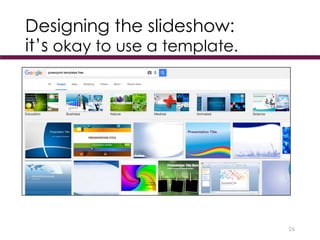
Designing the slideshow:
it’s okay to use a template.
26
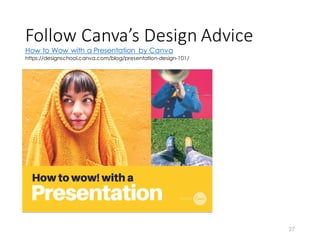
Follow	
  Canva’s	
  Design	
  Advice
27
How to Wow with a Presentation by Canva
https://designschool.canva.com/blog/presentation-design-101/
Be	
  bold.
Keep	
  text	
  short.
28
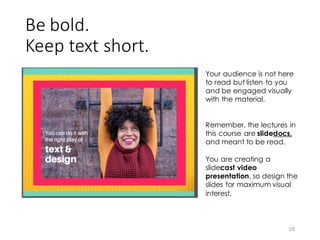
Your audience is not here
to read but listen to you
and be engaged visually
with the material.
Remember, the lectures in
this course are slidedocs,
and meant to be read.
You are creating a
slidecast video
presentation, so design the
slides for maximum visual
interest.
Don’t	
  do	
  this.	
  
29
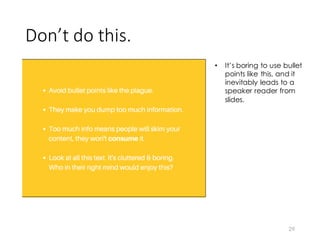
• It’s boring to use bullet
points like this, and it
inevitably leads to a
speaker reader from
slides.
Do	
  this.
30
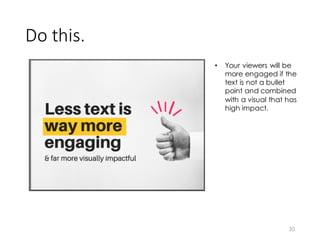
• Your viewers will be
more engaged if the
text is not a bullet
point and combined
with a visual that has
high impact.
Do	
  this.
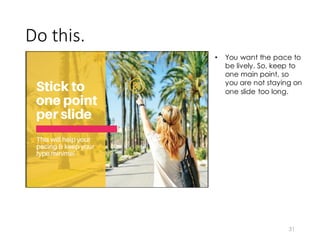
31
• You want the pace to
be lively. So, keep to
one main point, so
you are not staying on
one slide too long.
Size	
  type	
  for	
  maximum	
  impact.
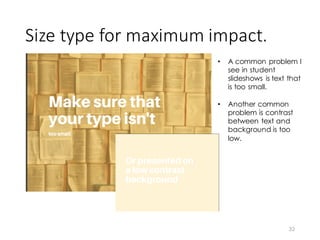
32
• A common problem I
see in student
slideshows is text that
is too small.
• Another common
problem is contrast
between text and
background is too
low.
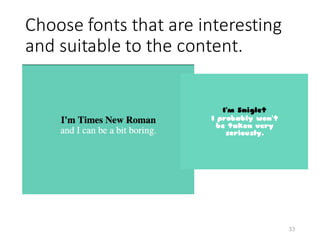
Choose	
  fonts	
  that	
  are	
  interesting	
  
and	
  suitable	
  to	
  the	
  content.
33
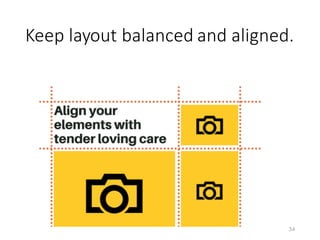
Keep	
  layout	
  balanced	
  and	
  aligned.
34
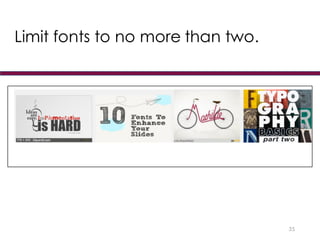
Limit fonts to no more than two.
35
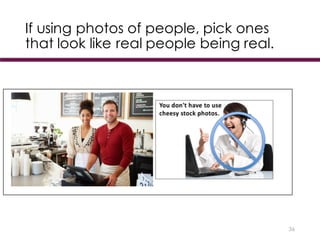
If using photos of people, pick ones
that look like real people being real.
36
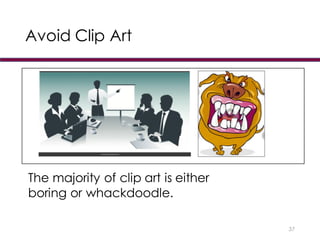
Avoid Clip Art
37
The majority of clip art is either
boring or whackdoodle.
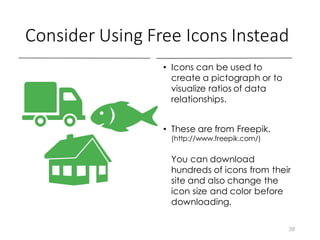
• Icons can be used to
create a pictograph or to
visualize ratios of data
relationships.
• These are from Freepik.
(http://www.freepik.com/)
You can download
hundreds of icons from their
site and also change the
icon size and color before
downloading.
38
Consider	
  Using	
  Free	
  Icons	
  Instead
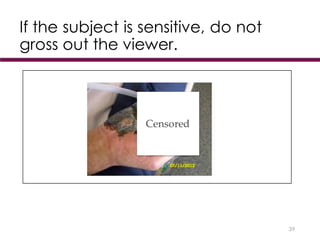
If the subject is sensitive, do not
gross out the viewer.
39
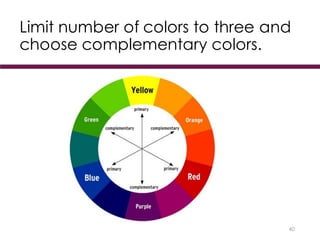
Limit number of colors to three and
choose complementary colors.
40
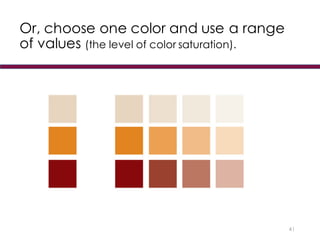
Or, choose one color and use a range
of values (the level of color saturation).
41
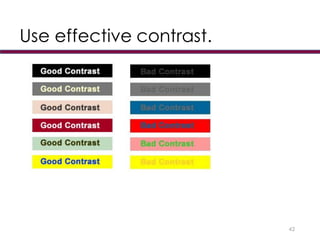
Use effective contrast.
42
Delivery: continue to apply these concepts
when recording your voice-over narration.
43
• Vocal variety: pitch, tone,
volume, and rate.
• Pausing.
• Diction
Exercises to help you improve
your speaking style can be found
under Tools and Resources.

P2lecture3deliverable2composingslidecastexttechdefinitionengl317 160313001414

  • 1.
    1 Deliverable 2: How tocompose a Slidecast Extended Technical Definition © Karen Thompson ● Department of English ● University of Idaho
  • 2.
    2 Table&of&Contents& ! About!slidecasts&...........................................................................................................&3/4& & Learning!Objectives:!for&the&slidecast&you&create&........................................................&5& & ! How!to!Create!Your!Slidecast&......................................................................................&6/33& & Options&for&Tools&..........................................................................................&7/11& &Do&a&Test&Recording&(and&what&to&do&if&it&fails)&............................................&12& & Number&of&Slides&You&Will&Need&..................................................................&13& & Decide&How&You&will&Work&...........................................................................&14& & Timing&...........................................................................................................&15& & List&of&Rhetorical&Moves&to&Extend&the&Definition&........................................&16/17& & Writing&Slidecast&Script&.................................................................................&18/24& & Designing&the&Slideshow&...............................................................................&25/42& & Delivery:!Presentation!Speaking!Style&........................................................................&43& & & &
  • 3.
    About Slidecasts: 3 A slidecastis a video consisting of a slideshow with voice-over narration. Most slidecasts are embedded on web pages from host sites such as YouTube.
  • 4.
    Slidecasts are usedto: • Promote products or services, • Provide instructions to users, • Present test results to project team members who are at different locations. • These are just a few of the ways they can be used. 4
  • 5.
    Learning Objectives: 5 Define andextend a technical term for a non- specialized audience. Apply presentation speaking style concepts to narrate a slideshow. Design slides to achieve maximum visual interest.
  • 6.
    How to createyour Slidecast. • You need a microphone, and the one in your computer will be fine for this project. • Your slidecast must be hosted on a site that allows users to play it without having to download the file. • You will need to decide how you will create the slidecast from the following options. Please note the warnings. 6
  • 7.
    Option: PC UsersOnly • PowerPoint: create the slideshow, use the PPT recording feature to add voice-over narration, save as a movie file, and upload to a host site such as YouTube or Vimeo. • MAC users. PPT has a bug in it that will strip your audio out when saving as a movie file. So, you can’t use it. There is no solution to-date. 7
  • 8.
    Option: Mac UsersOnly • Keynote will work the same as PPT for PC users, but it’s not free ($19.99). 8 Don’t  feel  like  buying   Keynote?  See  the  next   slide  for  another  option   that’s  free.
  • 9.
    Option: All users. •SlideSnack: sign up for a free account. Create the slideshow in PPT or any other slideware program. Save as a PDF file and upload to SlideSnack. Use the tool’s recording feature to add voice-over narration. 9 PLUS SlideSnack will host the file. NOTE: because you must upload a PDF file to SlideSnack, any animations you have used will not work because a PDF file will not preserve animations.
  • 10.
    Option: All Users •Strictly speaking, a screen capture tool creates a screencast, but if you position the capture feature over your slideshow and position it so you can advance the slides as you record, it will preserve the animations and work the same as a slidecast. • I recommend using Screencast-O-Matic (Mac users need to also download Soundflower to record) or Jing (all users). These tools also have a means of hosting your file. • See tools and resources for more information. 10
  • 11.
    • Remember, Ido not accept video files (mp4, mov, etc.). • Here’s why. You are practicing how to create and share these types of files as they are shared in workplace settings. • So, if you choose to create a video file on your computer, be certain it is uploaded to a host site and will play without a user needing to download the file. 11
  • 12.
    Do a testrecording. • First, be certain you completed the technology check on Orientation Day 1, and are using the recommended browser for this course. If not, go there, do that. • Close all other programs and browser windows to ensure you have enough memory. • If the test recording fails, follow the troubleshooting steps under Tools & Resources. 12
  • 13.
    Your Slidecast needsat least 6 slides. 13 Title  Slide And should be no longer than 3 minutes. Slide  1:  Title  Slide Introduces  the  Slidecast Slides  2-­‐5:  Extended   Technical  Definition   Slide  6: Bibliography (cite  image  sources)
  • 14.
    Decide how towork: • Some people like to write the slidecast script first and then design the slides. • Some prefer to do the slides first and then write the script. • Still others create the slides and write the script at the same time. Do the process that works best for you. 14
  • 15.
    Timing: • You willbe adding voice-over narration to at least 5 slides (the bibliography is not narrated). • The voice-over should be no longer than 3 minutes (and may be less). • As you record the voice-over, keep the pace per slide about equal. 15
  • 16.
    The next slidelists some common rhetorical moves to extend a sentence-level definition. 16 It’s  the  way  humans   use  language  to   achieve  audience   needs  and  purpose   for  writing. Pssst..what’s a   rhetorical  move?
  • 17.
    To extend yourdefinition: • You must use one of these: • Use a metaphor to explain what x is like. • Use an analogy to compare x to something familiar. • And at least one other, here are some ideas: • Classify x with more detail. • Contrast x with something different. • Compare x to something similar. • Explain the causes and effects of x. • Provide an example of x. • Describe some of the history behind x. • Describe physical characteristics or qualities of x. 17
  • 18.
    Writing the Script.Practice the principles of effective prose style when writing the script but adapt these for the ear by keeping sentences short. 18 You should be able to say the sentence in your script in a single breath.
  • 19.
    19 Introduction Body Conclusion Writing the Script.What you say in the voice over to your slideshow should clearly separate the introduction from the body and conclusion.
  • 20.
    20 Brief salutation: greetthe audience and give them an idea of what you will be presenting in the slidecast. Start with a sentence definition and try to engage the reader. Often this is best done by using the required metaphor or analogy. Introduction: here is one way to introduce the slidecast (there are other choices you could make).
  • 21.
    21 Example: sentence-level definition witha metaphor. Usability testing is a methodology that reveals how a user experiences your product or service. Achieving usability is a lot like world peace. We all want it, but it’s hard to achieve.
  • 22.
    22 Signposts help viewers followthe logical flow of your narrative. Use Signposts
  • 23.
    Example: signposting isin blue. 23 Fortunately, usability testing doesn’t have to be elaborate. It requires only a handful of users to determine if your product is meeting the five quality components users need. I’ll explain each of these one at a time in the slides that follow. You may need only one signpost, but decide how many you need based on what you are saying and how many slides you end up creating.
  • 24.
    Closing 24 Wrap  it  Up.  Have  a  clear   conclusion. • Remember  to  thank  audience   for  listening.
  • 25.
    Designing the slideshow. 25 Designslides for maximum visual interest. Any text should be limited to key points. The voice-over will be extending the definition, so you don’t want to be reading from slides.
  • 26.
    Designing the slideshow: it’sokay to use a template. 26
  • 27.
    Follow  Canva’s  Design  Advice 27 How to Wow with a Presentation by Canva https://designschool.canva.com/blog/presentation-design-101/
  • 28.
    Be  bold. Keep  text  short. 28 Your audience is not here to read but listen to you and be engaged visually with the material. Remember, the lectures in this course are slidedocs, and meant to be read. You are creating a slidecast video presentation, so design the slides for maximum visual interest.
  • 29.
    Don’t  do  this.   29 • It’s boring to use bullet points like this, and it inevitably leads to a speaker reader from slides.
  • 30.
    Do  this. 30 • Yourviewers will be more engaged if the text is not a bullet point and combined with a visual that has high impact.
  • 31.
    Do  this. 31 • Youwant the pace to be lively. So, keep to one main point, so you are not staying on one slide too long.
  • 32.
    Size  type  for  maximum  impact. 32 • A common problem I see in student slideshows is text that is too small. • Another common problem is contrast between text and background is too low.
  • 33.
    Choose  fonts  that  are  interesting   and  suitable  to  the  content. 33
  • 34.
    Keep  layout  balanced  and  aligned. 34
  • 35.
    Limit fonts tono more than two. 35
  • 36.
    If using photosof people, pick ones that look like real people being real. 36
  • 37.
    Avoid Clip Art 37 Themajority of clip art is either boring or whackdoodle.
  • 38.
    • Icons canbe used to create a pictograph or to visualize ratios of data relationships. • These are from Freepik. (http://www.freepik.com/) You can download hundreds of icons from their site and also change the icon size and color before downloading. 38 Consider  Using  Free  Icons  Instead
  • 39.
    If the subjectis sensitive, do not gross out the viewer. 39
  • 40.
    Limit number ofcolors to three and choose complementary colors. 40
  • 41.
    Or, choose onecolor and use a range of values (the level of color saturation). 41
  • 42.
  • 43.
    Delivery: continue toapply these concepts when recording your voice-over narration. 43 • Vocal variety: pitch, tone, volume, and rate. • Pausing. • Diction Exercises to help you improve your speaking style can be found under Tools and Resources.