ZEN, MONKS AND NUNS  By Trevor  G., Hannah R., and Jeffrey K.
HISTORY BACKGROUND Zen is a branch of Buddhism.  Zen was created in the sixth century by Sakyamunaior the "awakened one" also known as Buddha.  Zen is the type of Buddhism used in Japan.  Zen Buddhism was created in India, and later China, Korea, and Japan. In Japan, Zen Buddhism was only used by people of higher status because of its complex tradition.  The Shinto tradition was native to Japan but the two religions were able to co-exist.
DAILY LIFE A monks daily life starts off in the morning when they get up at 3:30 a.m. After monks got up they would head straight for the dining hall.  Breakfast would being with a chanting sound. While chanting the monks would uncover their food and place it in a straight line towards the head monk.  While eating the monks aren't allowed to talk or make any noise to be able to give thanks for the food no matter how bad the food is.  The extra food is offered to the spirits and then given to the birds. this is called  Saba . Monks were very involved in politics. Often you would find posters for head monks.  The monasteries were used as hospitals and camps during war times.  Every third, sixth and eighth day of every mouth the monks would beg for rice and money.
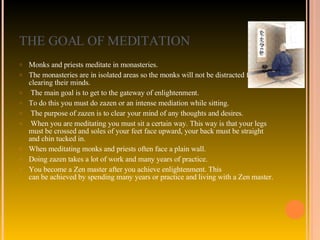
THE GOAL OF MEDITATION Monks and priests meditate in monasteries.  The monasteries are in isolated areas so the monks will not be distracted from clearing their minds. The main goal is to get to the gateway of enlightenment.  To do this you must do zazen or an intense mediation while sitting. The purpose of zazen is to clear your mind of any thoughts and desires. When you are meditating you must sit a certain way. This way is that your legs must be crossed and soles of your feet face upward, your back must be straight and chin tucked in.  When meditating monks and priests often face a plain wall. Doing zazen takes a lot of work and many years of practice.  You become a Zen master after you achieve enlightenment. This can be achieved by spending many years or practice and living with a Zen master.
WHAT HAPPENED IN FEUDAL JAPAN In the tenth century monks became monk warriors. This started by bitter political feuds.  Monks built armies inside monasteries and attacked another enemy monasteries to gain financial resources.  Monastery armies appealed to samurai because it stressed concentration and discipline.
THE EFFECT ZEN BUDDHISM HAD ON JAPANESE CULTURE Zen Buddhism had many effects on Japanese culture.  Such effects include the respect for nature. The monks focus a great deal on respect for nature. In the Shinto religion, which most of Japan believes in now, nature is almost the founder.  In the Shinto religion, they believe that nature gods and goddess called Kami live in exact locations in nature.  Zen Buddhism practices meditation to clear their mind.  During meditation, monks sit down with their legs crossed with the soles of their feet facing upward, back straight, and chin tucked in. During meditation monks face a plain wall.  The practice of zazen helped the samurai because the samurai needed to be practicing to think only about one thing at a time in battle.
CONCLUSION The conclusion to this article is that Zen Buddhism is a complex religion. Monks play a very important role in Zen Buddhism because they do a lot of meditation in the religion everyday. Now, over ninety million people practice this fascinating religion.

P2

  • 1.
    ZEN, MONKS ANDNUNS By Trevor G., Hannah R., and Jeffrey K.
  • 2.
    HISTORY BACKGROUND Zenis a branch of Buddhism. Zen was created in the sixth century by Sakyamunaior the "awakened one" also known as Buddha. Zen is the type of Buddhism used in Japan. Zen Buddhism was created in India, and later China, Korea, and Japan. In Japan, Zen Buddhism was only used by people of higher status because of its complex tradition. The Shinto tradition was native to Japan but the two religions were able to co-exist.
  • 3.
    DAILY LIFE Amonks daily life starts off in the morning when they get up at 3:30 a.m. After monks got up they would head straight for the dining hall. Breakfast would being with a chanting sound. While chanting the monks would uncover their food and place it in a straight line towards the head monk. While eating the monks aren't allowed to talk or make any noise to be able to give thanks for the food no matter how bad the food is. The extra food is offered to the spirits and then given to the birds. this is called Saba . Monks were very involved in politics. Often you would find posters for head monks. The monasteries were used as hospitals and camps during war times. Every third, sixth and eighth day of every mouth the monks would beg for rice and money.
  • 4.
    THE GOAL OFMEDITATION Monks and priests meditate in monasteries. The monasteries are in isolated areas so the monks will not be distracted from clearing their minds. The main goal is to get to the gateway of enlightenment. To do this you must do zazen or an intense mediation while sitting. The purpose of zazen is to clear your mind of any thoughts and desires. When you are meditating you must sit a certain way. This way is that your legs must be crossed and soles of your feet face upward, your back must be straight and chin tucked in. When meditating monks and priests often face a plain wall. Doing zazen takes a lot of work and many years of practice. You become a Zen master after you achieve enlightenment. This can be achieved by spending many years or practice and living with a Zen master.
  • 5.
    WHAT HAPPENED INFEUDAL JAPAN In the tenth century monks became monk warriors. This started by bitter political feuds. Monks built armies inside monasteries and attacked another enemy monasteries to gain financial resources. Monastery armies appealed to samurai because it stressed concentration and discipline.
  • 6.
    THE EFFECT ZENBUDDHISM HAD ON JAPANESE CULTURE Zen Buddhism had many effects on Japanese culture. Such effects include the respect for nature. The monks focus a great deal on respect for nature. In the Shinto religion, which most of Japan believes in now, nature is almost the founder. In the Shinto religion, they believe that nature gods and goddess called Kami live in exact locations in nature. Zen Buddhism practices meditation to clear their mind. During meditation, monks sit down with their legs crossed with the soles of their feet facing upward, back straight, and chin tucked in. During meditation monks face a plain wall. The practice of zazen helped the samurai because the samurai needed to be practicing to think only about one thing at a time in battle.
  • 7.
    CONCLUSION The conclusionto this article is that Zen Buddhism is a complex religion. Monks play a very important role in Zen Buddhism because they do a lot of meditation in the religion everyday. Now, over ninety million people practice this fascinating religion.