Definition (Concepts) of
maternalbehaviour
That behaviour exhibited by mothers towards
their young to aid their survival, growth and
development, both physically and behaviorally.
It is inherited behaviour
Maternal behaviour in mammals (suckling
animals) exhibited by mother toward their
young, including feeding, protection, warming
growth, development and survival.
Parental behaviour exhibited by both male and
female as in pigeons and other birds.
4.
Classifications of Maternal
behaviour
1-According to No.of youngs /
birth
Polytocus Animals
Monotocus Animals
2- According to Nature of youngs:
Precocial young
Altracial young
5.
Classifications of Maternal
behaviour
3- According to Following dams :
Follower Animals
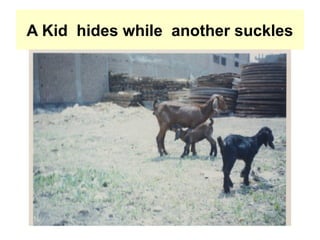
Hider Animals
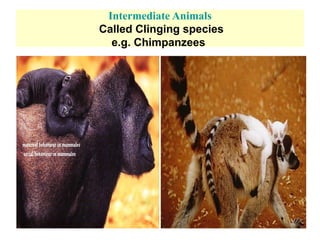
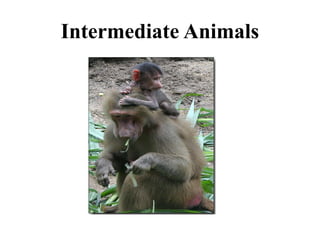
Intermediate Animals
4- According to stage of parturition:
Pre-parturient behaviour
Parturient behaviour
Post-parturient behaviour
6.
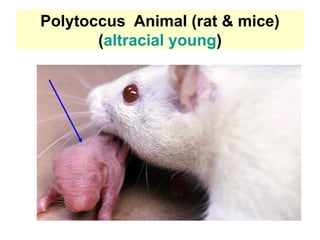
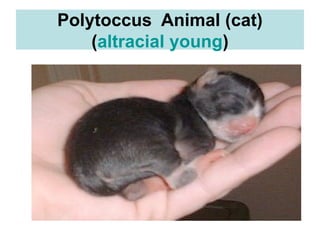
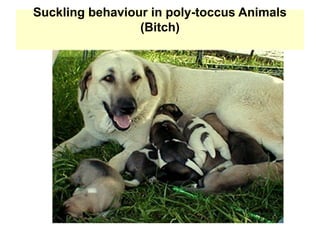
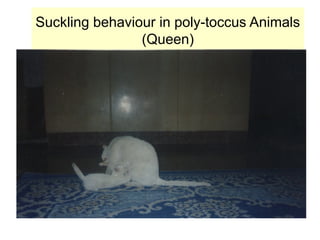
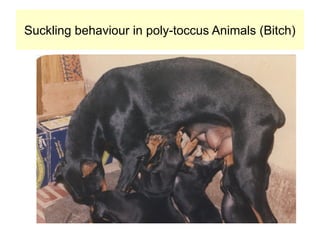
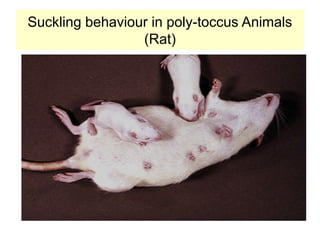
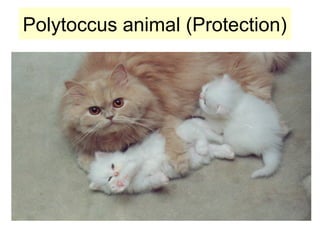
Polytoccus Animals
Mothergive birth to more than one
or two youngs e.g. dog, cat, rate,
mice, hamster.
Characters of their young ( altracial young )
1- immature young
2-helpless at birth
3-sealed eye and
4- Sealed ears until 2-3 weeks
7.
Characters of theiryoung ( altracial young )
5-imobile( crawl around the dam)
6-cannot eliminate them selves
7-cannot regulate their body temp.
8-They have no teeth (smooth gum)
9-hairless
10-depend completely on their dam
in feeding, warmth, protection and
elimination.
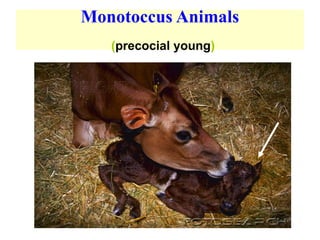
Monotoccus Animals
Mothergive birth to one or two young
e.g. cattle, horses, sheep, goat,
camel.
Characters of their young (precocial young)
relatively mature young
opened eye
opened ears
11.
Characters of theiryoung
(precocial young)
4- can move, and stand
5- can eliminate themselves
6- can regulate their body temp.
7- they have a teeth
8- body covered with hair
9- depend partially on their mother in
feeding and protection.
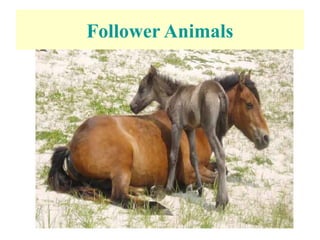
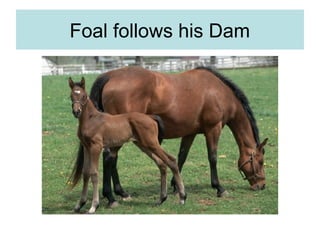
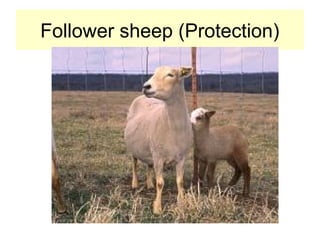
Follower Animals
Youngspent most of time within a
very short distance of the mother to
be more safe
e.g. cattle, sheep, horses
in horse the young follow their
mother until grow older
Pre-parturient behaviour
Restlessness
Signs of pain looking and kicking at the flank (Mare)
In Ewe vicious, pawing to the ground
Vocalization increased
Isolation from the herd to avoid disturbance
Early maternal interest( lamb and calf stealing)
Getting up and lying down
Rolling on the ground (Mare and cats)
Rubbing to any fixed objects
Cessation of rumination (Cow-ewe)
24.
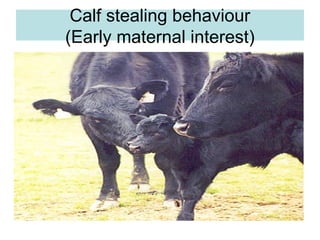
Lamb or calfstealing
It is high maternity
It occurs in group housing animals
as the parturition approached the
pregnant female showing early
maternal interest to the young of
other females that give birth in vicinity
she may care it and this called lamb
stealing
25.
Pre-parturient behaviour inmare
Mares isolate themselves from the
herd mates
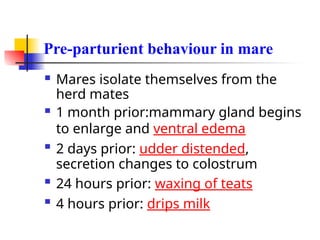
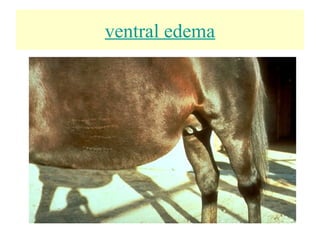
1 month prior:mammary gland begins
to enlarge and ventral edema
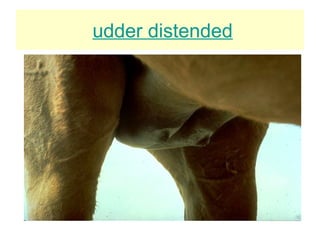
2 days prior: udder distended,
secretion changes to colostrum
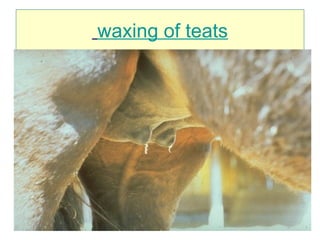
24 hours prior: waxing of teats
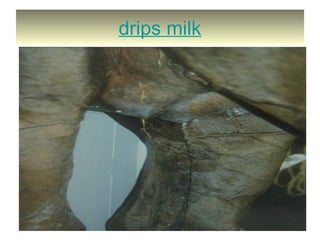
4 hours prior: drips milk
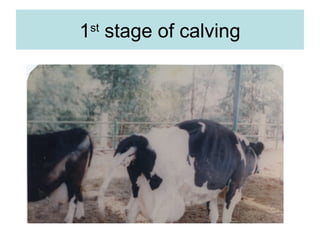
1st
stage ( preliminarystage)
Contraction of the abdominal muscle,
straining and pain
Alternative standing and lying down
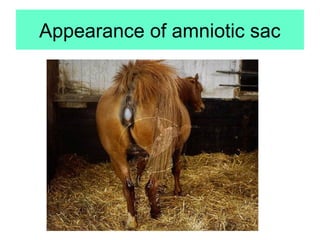
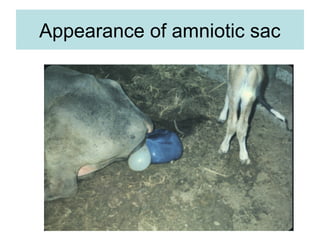
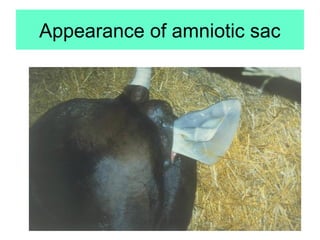
Appearance of water sac
It ends with rapture of the chorio-allantoic
membrane and straw colored fluid
Accompanied by urination and defecation
3rd
stage (after birthstage)
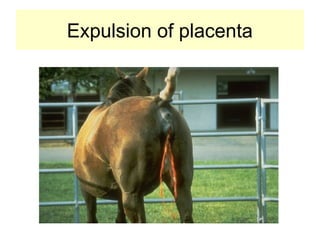
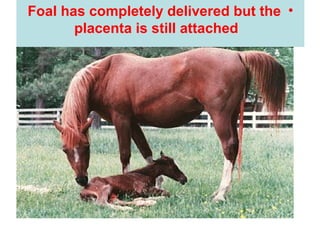
• Expulsion of placenta take 30 min. to six
hours.
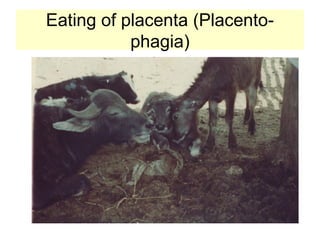
• Eating of placenta called
Placento-phagia.
• Eaten in cow and buffalo
• Mares doubtful
• Not occur in she camel
Behaviour of thedam
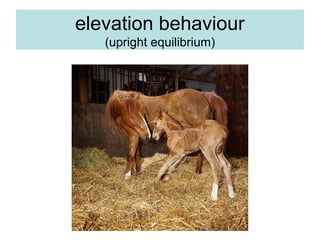
Standing of dam immediately
after birth
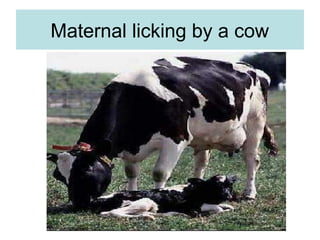
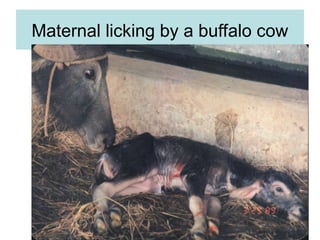
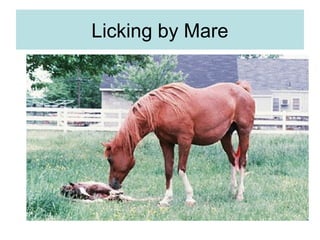
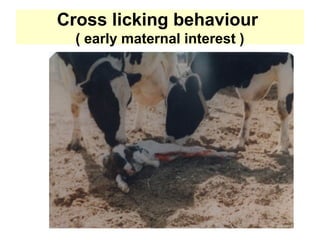
Maternal grooming of newly born
Maternal imprinting and
recognition
Eating placenta (placento-phagia)
49.
Maternal imprinting and
recognition
Rapid, stable, irreversible learning
occur shortly after birth
( immediately) within a period called
critical period or sensitive period .
The young follow its mother and the
mother- young bond is formed
through labeling and recognition.
50.
Maternal grooming ofnewly born
immediately, begins by the head,
body then limbs and hind parts
Functions of licking
1-dryness of young body.
2-removal of fetal fluid from nostril and
mouth to stimulate respiratory center
3-stimulation of cut, blood, lymph
circulation.
51.
Functions of licking(cont.)
4- help to stand.
5- facilitate urination and defecation.
6- increase muscular tone.
7- labeling of young and recognition.
8- aid in the formation of maternal
filial bond.
52.
Licking Behaviour
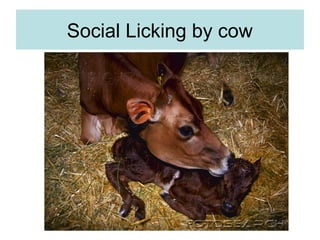
• SocialLicking
1. Promotes maternal-
offspring bond and
social bond among
herd members
2. Directed mainly to
the head and neck
of the calf
• Maternal Licking
1. It is designed to
stimulate calves to
eliminate wastes
(Urination and/ or
defecation)
2. Directed mainly to
the perineum region
of the calf
Eating placenta (placento-phagia)
Functionof Placentophagia :
1
-
Contain hormones as estrogen, progesterone and
prolactine that important for milk yield
2
-
defence against predators by removing the odour
3
-
hygienic measures prevent micro-organism
4
-
affect on maternal immune response as it contain
factors prevent the formation of antibodies
against fetal antigen which might impair
subsequent pregnancies
.
5
-
Recycling of nutrients (Protein and minerals)
60.
Behaviour of theNewly born
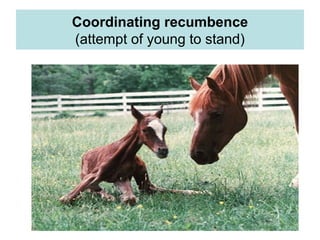
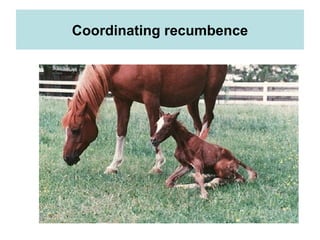
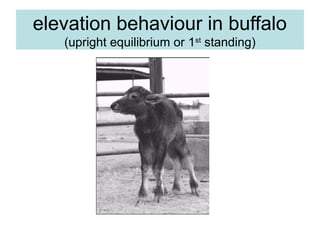
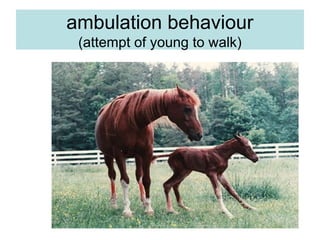
1- Standing behaviour
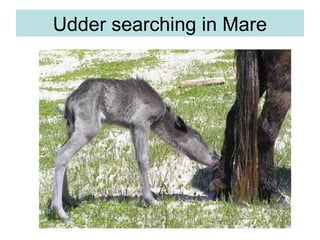
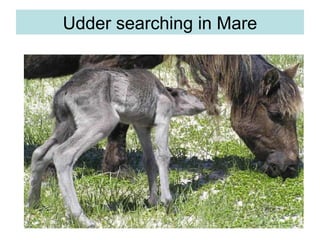
2- Udder searching or Teat seeking
Suckling behaviour
Udder searching orTeat
seeking
Newly born directed to the wrong
parts of the body in the 1st attempts
of suckling
Guides of the calf to find teat may be
1- the pendulus shape of the udder
2- the movement of udder (udder tilting)
3- temperature between thighs
(thigmotaxis)
68.
Udder searching behaviour
The mother also help the calf to find
teats by:
1- rotating her body
2- abduction the hind legs
3- moving forward bringing the udder
closer to the calf
4- licking the perineal region to stimulate
the calf to suckle
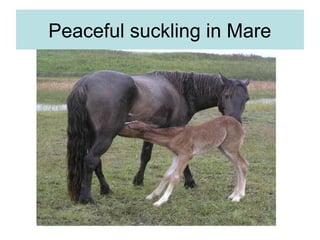
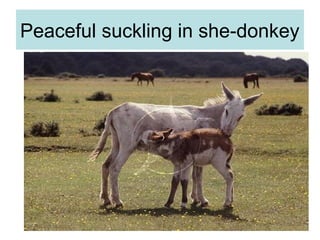
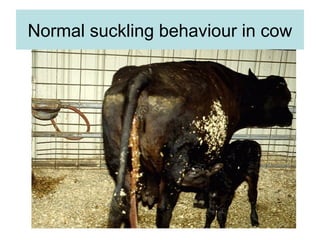
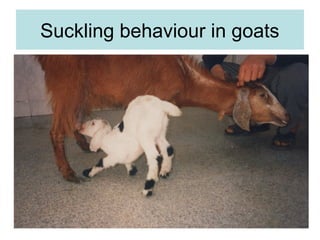
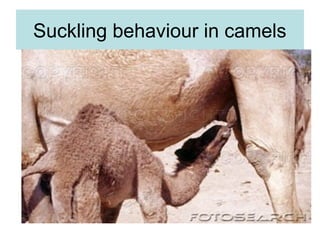
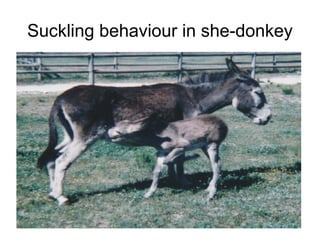
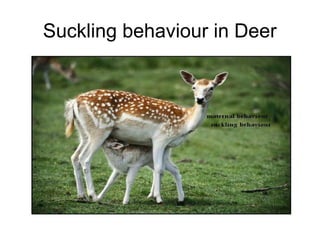
Suckling behaviour
Postureof suckling
Mechanism of suckling
Rate and frequency of suckling
Non-nutritional suckling
Difference between sucking and
suckling behaviour
72.
Posture of suckling
•Typical posture is the young stands
alongside the mother facing caudally
• There is often no teat preferences for front
or hind teats
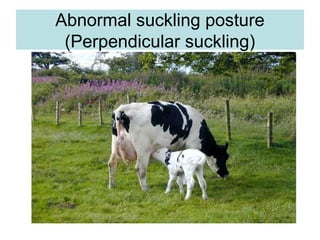
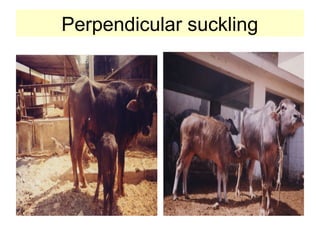
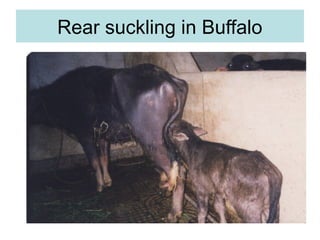
• Abnormal posture may be
– 1- rear suckling
– 2- the calf stay in right angle with mother body
( perpendicular suckling)
73.
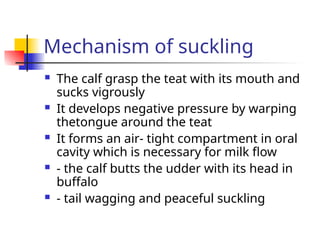
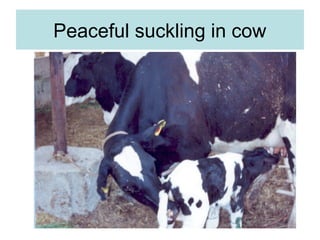
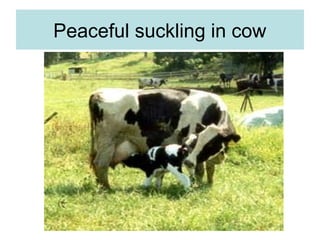
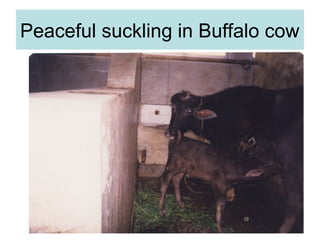
Mechanism of suckling
The calf grasp the teat with its mouth and
sucks vigrously
It develops negative pressure by warping
thetongue around the teat
It forms an air- tight compartment in oral
cavity which is necessary for milk flow
- the calf butts the udder with its head in
buffalo
- tail wagging and peaceful suckling
Pre-parturient behaviour
In dogsand cats
- Licking of genital and abdominal areas 12-24
hours before labour.
- drop in body temp
- squatting posture as in defecation
Scratching of ground
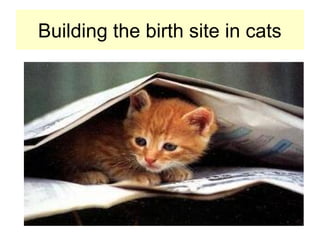
- nest building is not pronounced
- bedding for kittening or whelping is provided by
owner
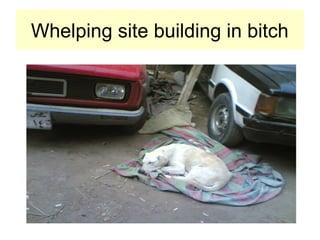
While in dogs it scratch rugs or towels and blanket
In rodents (Rat& mice) &
Rabbits
self Licking of genital and abdominal areas
during the last week of pregnancy.
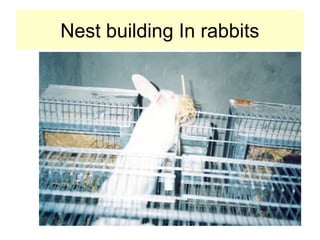
Nest building rabbits (straw nest)
Plucking Hair from body (neck, thigh,
abdomen and back) to build maternal nest
few days before part. to maternal nest
- increase restless, vocalization.
- increase respiratory rate.
Loss Appetite
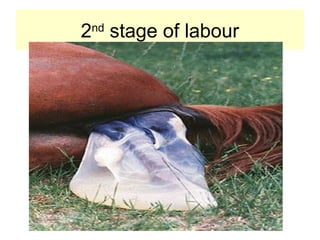
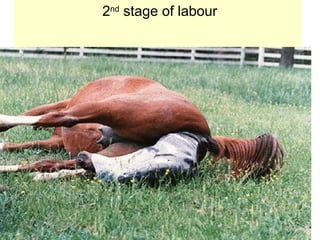
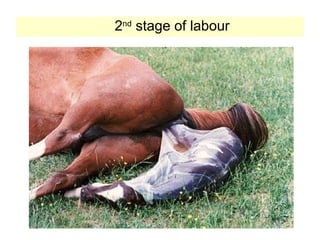
2nd stage
-abdominalcontraction
- the mother consume the fetal
membrane as the fetus passed and
licking them.
92.
3rd stage
-delivering of placenta and readily eaten by
mother
Functions of placentophagia
-keep the nest clean and free from
material which may attract bacteria.
2-Some nutritive value to the mother protein
and water allow her
to stay in nest with her young.
93.
Post-parturient behaviour
Groomingof the young
Nursing- sucking development
Nipple exploratory movement
Retrieving behaviour.
Protection of young
94.
Grooming of theyoung
1st three weeks of life the dam licks
and grooming each new born .
grooming directed to ano-genital
region to stimulate urination and
defecation .
Fecal material consumed by mother
to keep nest clean
1st stage
frombirth to 2.5 weeks (14 to 17 days)
mothers play the major role in nursing,
licking ,nursing and suckling of young
Mother initiates nursing by hovering
over the litter & arousing them to
nursing by licking them
The young nuzzle into fur of mother,
find a teat & nurse
97.
2nd stage
From3 weeks –5 weeks of age
open eye and ears
can leave the nest, recognize and
interact with mother outside the nest
young here initiate suckling
While mother facilitate suckling by
exposure nipple
98.
3rd stage
From5 weeks – weaning
young are able to take food from
other source
nursing initiated and completed by
young
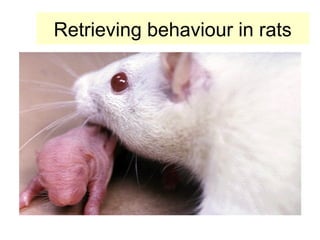
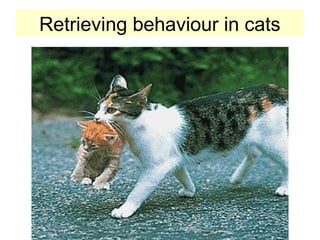
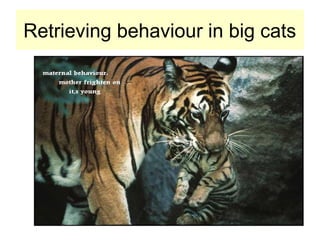
Retrieving behaviour
Stimulifrom young outside nest
female grasping, each young with
incisors at mid dorsal region &
transport them back to the nest
This occur at first week after birth.
Stimuli elicit maternalbehaviour
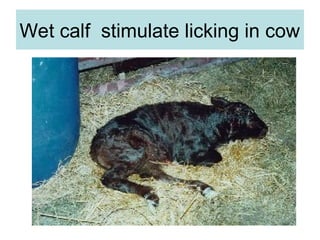
odour and taste: the presence of birth
fluid Stimulate licking
Vocalization (distress calls) mother
distinguish young from calls
altracial inaudible calls while Precocial
audible calls.
Stimuli emanating at suckling :
thermal contact or tactile stimuli
Sniffing & licking them at suckling due to
butting nuzzling by young.
110.
Stimuli elicit maternalbehaviour
Movement : newly born activity
specially during suckling
Vigor or strong newborn stimulate dam
to lick him
● shape of the young (visual stimuli)
●protective response: defence
against predators to protect young.
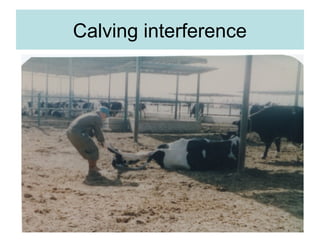
Abnormal maternity
Delayof standing of the dam
Delay of licking the newly born
Cow step on its calf or foal
Eating of placenta
120.
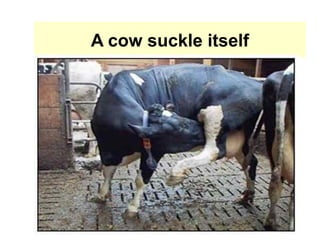
Abnormal maternal
behaviour
Earlymaternal interest
early maternal interest to the young
of other females that give birth in
vicinity she may care it and this called
lamb stealing or calf stealing
Cross licking behaviour
Cow licks alien calf
Abnormal maternal
behaviour
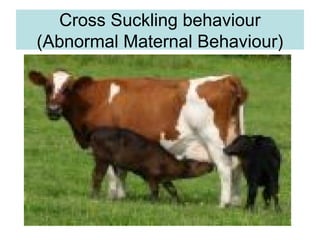
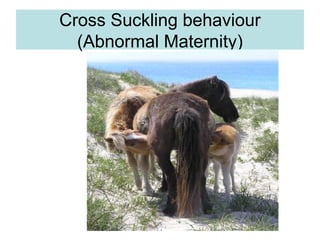
Crosssuckling behaviour
Cross fostering behaviour
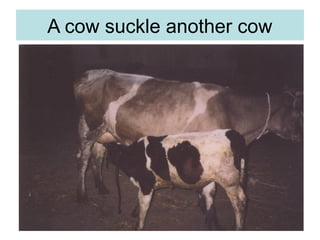
Inter-suckling behaviour
Cow suckle an alien calf
Or A calf suck alien cow (mother)
125.
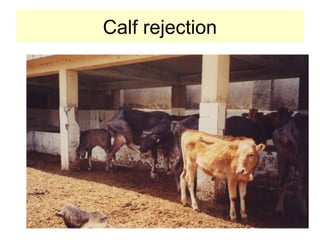
Abnormal maternal
behaviour
Miss-mothering behaviour
Thismay be due to the mother having
suffered a long and difficult birth and not
being able to stand up for suckling. The
calf may also be too weak to suckle. Cases
of mismothering are common with cows
calving in synchrony in intensively
managed maternity groups.