Owls
Edited by Heimo Mikkola
Owls
Edited by Heimo Mikkola
Published in London, United Kingdom
Supporting open minds since 2005
Owls
http://dx.doi.org/10.5772/intechopen.80242
Edited by Heimo Mikkola
Contributors
Isaac Oluseun Adejumo, Hafidzi Mohd Noor, Paula Enríquez, Pedro Ramírez-Santos, José Raúl Vázquez-
Pérez, José Luis Rangel-Salazar, Heimo Juhani Mikkola, Alan Sieradzki
© The Editor(s) and the Author(s) 2020
The rights of the editor(s) and the author(s) have been asserted in accordance with the Copyright,
Designs and Patents Act 1988. All rights to the book as a whole are reserved by INTECHOPEN LIMITED.
The book as a whole (compilation) cannot be reproduced, distributed or used for commercial or
non-commercial purposes without INTECHOPEN LIMITED’s written permission. Enquiries concerning
the use of the book should be directed to INTECHOPEN LIMITED rights and permissions department
(permissions@intechopen.com).
Violations are liable to prosecution under the governing Copyright Law.
Individual chapters of this publication are distributed under the terms of the Creative Commons
Attribution 3.0 Unported License which permits commercial use, distribution and reproduction of
the individual chapters, provided the original author(s) and source publication are appropriately
acknowledged. If so indicated, certain images may not be included under the Creative Commons
license. In such cases users will need to obtain permission from the license holder to reproduce
the material. More details and guidelines concerning content reuse and adaptation can be found at
http://www.intechopen.com/copyright-policy.html.
Notice
Statements and opinions expressed in the chapters are these of the individual contributors and not
necessarily those of the editors or publisher. No responsibility is accepted for the accuracy of
information contained in the published chapters. The publisher assumes no responsibility for any
damage or injury to persons or property arising out of the use of any materials, instructions, methods
or ideas contained in the book.
First published in London, United Kingdom, 2020 by IntechOpen
IntechOpen is the global imprint of INTECHOPEN LIMITED, registered in England and Wales,
registration number: 11086078, 7th floor, 10 Lower Thames Street, London,
EC3R 6AF, United Kingdom
Printed in Croatia
British Library Cataloguing-in-Publication Data
A catalogue record for this book is available from the British Library
Additional hard and PDF copies can be obtained from orders@intechopen.com
Owls
Edited by Heimo Mikkola
p. cm.
Print ISBN 978-1-78984-053-7
Online ISBN 978-1-78984-054-4
eBook (PDF) ISBN 978-1-83880-461-9
Selection of our books indexed in the Book Citation Index
in Web of Science™ Core Collection (BKCI)
Interested in publishing with us?
Contact book.department@intechopen.com
Numbers displayed above are based on latest data collected.
For more information visit www.intechopen.com
4,500+
Open access books available
151
Countries delivered to
12.2%
Contributors from top 500 universities
Our authors are among the
Top 1%
most cited scientists
119,000+
International authors and editors
135M+
Downloads
We are IntechOpen,
the world’s leading publisher of
Open Access books
Built by scientists, for scientists
Meet the editor
Heimo Mikkola received his PhD degree in Applied Zoology and
Limnology from the University of Kuopio, Finland and his thesis
was on Ecological Relationships in European owls.
Partly based on that academic work, he wrote a very popular
book “Owls of Europe” published in 1983 in the UK. Since 1988,
he has been an adjunct Professor of the Eastern Finland Univer-
sity but instead of Finland he has worked mainly abroad for well
over 30 years in Africa (22 years), South America (6 years) and Central and South-
east Asia (4 years) mainly with the African Development Bank and the United Na-
tions. During these years, he has had many opportunities to visit and study owls in
over 130 countries. In many of the countries he undertook public interviews to gain
insight in to how people see the owls and their conservation. Some rarely known
owl beliefs in Central Asia are included in this book. Owl studies often took him to
the best bat biotopes as well, and he started to collect data on bats eaten by owls.
In 2014, he was given the title of “Champion of Owls” in Houston, USA, mainly
because of his six worldwide distributed and translated owl books. Thus far he has
written 220 papers and books on owls, and recently a Japanese edition of his“Owls
of the World” book was published in Tokyo.
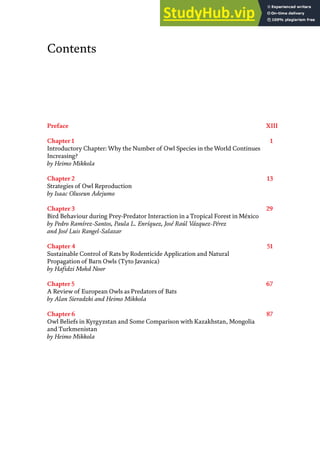
Contents
Preface XIII
Chapter 1 1
Introductory Chapter: Why the Number of Owl Species in the World Continues
Increasing?
by Heimo Mikkola
Chapter 2 13
Strategies of Owl Reproduction
by Isaac Oluseun Adejumo
Chapter 3 29
Bird Behaviour during Prey-Predator Interaction in a Tropical Forest in México
by Pedro Ramírez-Santos, Paula L. Enríquez, José Raúl Vázquez-Pérez
and José Luis Rangel-Salazar
Chapter 4 51
Sustainable Control of Rats by Rodenticide Application and Natural
Propagation of Barn Owls (Tyto Javanica)
by Hafidzi Mohd Noor
Chapter 5 67
A Review of European Owls as Predators of Bats
by Alan Sieradzki and Heimo Mikkola
Chapter 6 87
Owl Beliefs in Kyrgyzstan and Some Comparison with Kazakhstan, Mongolia
and Turkmenistan
by Heimo Mikkola
Preface
Owls have held a special fascination for humans for thousands of years. And owls
are one of the world’s oldest species of Vertebrate. Fossil remains dating back
60 million years have been found and these reveal that owls have changed very little
in that time [1]. Practically every culture has a story to tell about owls. Considering
all these stories together, they form a perplexing composite.
It is a paradox that owls are one of the most beneficial group of birds, but also one of
the least understood [2]. Few other birds or animals have gathered so many different
and contradictory beliefs about them: owls have been both feared and venerated,
despised and admired, considered wise and foolish, associated with witchcraft, medi-
cine, weather, births and deaths – and have even found their way into haute cuisine [3].
Folklore has it that owls are birds of ill omen and that deception is one of their
favourite ploys. Contrary to this, it must be said that the owl has been widely
admired through the ages by deities, scholars, poets and animal lovers in general [4].
Owls have also appeared on artefacts such as Peruvian Moche pottery jugs, North
American Indian pipes and shields, on African masks, and delicate Chinese and
Japanese paintings [5].
With their unearthly nocturnal calls, their humanlike faces and piercing binocular
vision, members of the owl family Strigidae have provoked a deep and universal
response in human beings.
Large, piercing all-seeing eyes. Photo: Courtesy of Johan J. Ingles.
XIV
One purpose of this book is to point the way towards a better understanding on how
owls relate to their environment and how important it is for us to use that environ-
ment more wisely. But conservation success for living creatures, including owls,
depends not only on environmental issues, but also on social and cultural matters.
The value of people’s participation in resolving complex conservation issues has
been rediscovered only lately [6, 7].
I wish to acknowledge the enthusiastic and helpful attitude of the Author Service
Manager Lada Božić - without her efforts this book would never have been
published.
Heimo Mikkola
University of Eastern Finland,
Kuopio Campus, Finland
V
[1] Mikkola H. Owls of the world.
A Photographic Guide. London:
Christopher Helm; 2012
[2] Clark R, Smith DW, Kelso LH.
Working Bibliography of Owls of the
World. Tech. Ser. 1. Washington DC:
National Wildlife Federation; 1978.
319 p
[3] Weinstein K. The owl in art, myth,
and legend. New York, NY: Crescent
Books; 1989. 144 p
[4] Cenzato E, Santopietro F. Owls –
Art, Legend, History. Milan: Arnoldo
Mondadori Editore S.p.A.; 1991. 112 p
[5] Morris D. Owl. London: Reaktion
Books; 2009. 216 p
[6] Raval S. Wheel of life: Perceptions
and concerns of the resident peoples for
Gir National Park in India. Society and
Natural Resources. 1994;4:305-320
[7] Enríquez PL. Abundancia relativa,
uso de hábitat y conocimiento popular
de los Strigiformes en un bosque
húmedo tropical en Costa Rica. Máster
Tesis. Programa Regional en Manejo de
Vida Silvestre. Heredia, Costa Rica, CA:
Universidad Nacional; 1995. 81 p
References
1
Chapter 1
Introductory Chapter: Why the
Number of Owl Species in the
World Continues Increasing?
Heimo Mikkola
1. Introduction
Owls comprise a distinct and easily recognized group of birds. However,
similarities in plumage and morphology, coupled with general lack of knowledge
of the ecology and behaviour of many species, have led to considerable uncer-
tainty regarding species and even generic limits. The internal taxonomy of owls
(Strigiformes) may be in a greater state of flux than in any other family of non-
passerine birds. The meaning of the term‘species’ has gone through many changes,
driven onwards by new methods, the differing priorities of each scientific age
and the varied field of biological research. Four basic species definitions will be
given but there are nowadays at least 26 different definitions. Owls have the lowest
hybridization rate amongst studied bird groups being only about 1%, whilst game
birds are hybridizing over 20% and the swan, geese, and duck group over 40%.
Therefore, the biological species concept (BSC) serves still quite well with owls.
However, all species definitions have been shown to have their limitations. The
BSC shows that species are the real and fundamental units of evolution. The main
problem with the morphological species concept is the question of how different
two groups must be before they can be called separate species. Evolutionary species
concept is very appealing but discovering the precise evolutionary history of organ-
isms is practically impossible. Many owls are so rare that it has not been possible
to get blood samples to examine nucleotide sequences in the cytochrome-b gene.
Molecular data exists this far only for some 175 species, so 100 or more species waits
for official confirmation when new material for DNA-testing becomes available.
The discovery of the DNA code revolutionized taxonomy, but the problem is that
variability in DNA is often not correlated to variability in morphology or reproduc-
tive compatibility. It is obviously unrealistic to assume that we can impose and apply
any single definition on a natural world made restless by evolutionary change.
The number of world owl species has gone up from 109 to 268 between 1972 and
2014. This chapter seeks to answer the question: “Why we are getting so many new
owl species every year?” One of the main reasons for this is that many owls live on
small islands where they develop slight differences from their close relatives on the
nearby mainland. It then becomes a matter of taste as to whether you consider one
of these isolated populations of owls as a distinct species or not. If you are an objec-
tive zoologist you will likely lump the two together as subspecies, but if instead you
are a passionate conservationist you will view the island form as a very rare and full
species that needs urgent protection.
To significant extent these ‘new owls’ have been known to the scientific commu-
nity as subspecies correctly (or erroneously!) declared as such. To a much smaller
Owls
2
degree there are still completely unknown owl species being identified in the tropi-
cal forests. However, only some 15 totally new owl species have been described after
2001. Details will be given on most recent of these new species. What is sure that we
may lose some of the rarest owls very easily if not taking care of the habitat destruc-
tion and climate change. If describing them as new species rather than new subspe-
cies helps our conservation efforts—so be it. With the present rate of habitat loss
and climate change we will soon lose species faster than to describe the new ones.
Although owls comprise a distinct and easily recognized group of birds, simi-
larities in plumage and morphology, coupled with general lack of knowledge of
the ecology and behaviour of many species, have led to considerable uncertainty
regarding species and even generic limits. The internal taxonomy of owls may be in
a greater state of turmoil than in any other family of non-passerine birds.
2. What are ‘species’
The meaning of the term‘species’ has gone through many changes, driven
onwards by new methods, the differing priorities of each scientific age and the
varied field of biological research. The issue of species delimitation has long been
confused with that of species conceptualization, leading to a half century of
controversy concerning both the definition of the species category and methods for
inferring the boundaries and numbers of species. The biggest problem is that cur-
rently many biologists advocate different and at least partially incompatible species
concepts [1]. Mayden [2] listed 22 named species concepts, and now there are even
more alternative definitions (see Appendix 1). This is encouraging biologists to
develop new methods of species delimitation that are not tied to traditional species
concept; species criteria; species delimitation. Therefore, I will present here only
four basic species definitions:
• Biological species concept—a group of actually or potentially interbreeding
populations, which are reproductively, isolated from other such groups
• Morphological species definition—a species is defined by a given set of com-
mon morphological features not shared by other groups
• Evolutionary species concept—a species is defined by its shared evolutionary
history and descent from a common ancestor
• Genotypic cluster definition—a recently introduced definition, which is
essentially a genetic version of the morphological definition. Genetic rather
than morphological gabs identify the distinctions between species.
3. Problems with these definitions
Owls have the lowest hybridization rate amongst studied bird groups being only
about 1%, whilst game birds are hybridizing over 20% and the swan, geese, and
duck group over 40% [3]. Therefore, the biological species concept (BSC) serves still
quite well with owls. However, all species definitions have been shown to have their
limitations. The BSC encapsulates the idea that species are the real and fundamental
units of evolution, while higher taxonomic categories such as genera, families and
orders are more artificial collection made for convenience, though loosely reflecting
3
Introductory Chapter: Why the Number of Owl Species in the World Continues Increasing?
DOI: http://dx.doi.org/10.5772/intechopen.90230
evolutionary relationships. Several authors have called attention to the situations in
which adoption of the BSC leads to the recognition of fewer species taxa than adop-
tion of one of the alternative species concepts, such as the diagnosable version of the
phylogenetic species concept (e.g. [4, 5]). The main problem with the morphological
species concept is the question of how different two groups have to be before they
can be called separate species. Evolutionary species concept is very appealing but
discovering the precise evolutionary history of organisms is practically impossible.
The discovery of the DNA code revolutionized taxonomy, but the problem is that
variability in DNA is often not correlated to variability in morphology or reproduc-
tive compatibility. It is obviously unrealistic to assume that we can impose and apply
any single definition on a natural world made restless by evolutionary change. All
the species concepts seem to have some merits and they are all based on important
biological properties [6]. Unfortunately, distinct species concepts, despite sharing a
common fundamental element, can often lead to different conclusions concerning
which population lineages deserve to be recognized as species.
4. First ‘Owls of the World’
In 1972 I was invited to participate in writing the first ‘Owls of the World’ edited
by John A Burton [7]. That was a team of 15 people and we attempted to write about
and to illustrate every known species of owl. That time it was quite easy to agree
that there some 130–140 species of owls, although same year two East German
scientists came with a revolutionary reduction of owl species to 109 [8, 9]. They
united for instance Barred Owl (Strix varia) and Ural Owl (Strix uralensis) and had
only nine Tytonidae owls (when the number nowadays is 26 or 27 as in Table 1).
They also correctly united Bubo and Ketupa but not Bubo and Nyctea, and included
Ciccaba to Strix and Rhinoptynx to Asio, etc.
5. Handbook of the birds of the world
In the Handbook [10] I was asked to compile a list for the owls, and ended up
in having 205 species in 1999, but König et al. [11] lifted same year the number of
species to 212 (Table 1). To question this‘fabrication’ of new species I wrote already
in 2000 on the subject “Owl Taxonomy—Where have all the “lumpers” gone [12].
6. Taxonomists
Taxonomy is a scientific discipline that has provided the universal naming
and classification system of biodiversity for centuries and continues effectively
Author 1 2 3 4 5 6 7 8 9
Tytonidae 11 10 16 11 26 16 16 26 27
Strigidae 133 120 189 201 224 183 192 223 241
Total 144 130 205 212 250 198 208 249 268
1 = 1940 [17], 2 = 1973 [7], 3 = 1999 [18], 4 = 1999 [11], 5 = 2008 [15], 6 = 2009 [14], 7 = 2011 [19], 8 = 2012 [20]
and 9 = 2013 [21].
Table 1.
Number of owl species in the world from 1940 to 2013.
Owls
4
Figure 1.
Desert Tawny Owl Strix hadorami in Israel. Photo: Courtesy of Amir Ben Dov.
to accommodate new knowledge [13]. However, there is a saying that if there are
two taxonomists in one room, they cannot agree on anything. So, no wonder that
owl taxonomy is still in a state of flux and the number of acceptable species varies
between 200 and 270. In his book ‘Owl’ renowned Oxford based Dr. of Zoology,
Desmond Morris [14] gave a new classification which accepted 198 kinds of owls
as genuine species. But the latest ‘Owls of the World’ König et al. [15] listed already
250 owl species and 29 subspecies which could be considered as new and valid
species. Personally, I found Morris’ list more appealing [16].
7. First ‘Owls of the World—A Photographic Guide’
But then 2010 I was asked to write Owls of the World—A Photographic Guide
[20] with the instructions from my publisher to write about and to illustrate every
known species of owls of the world. So, after König’s [15] 250 species I ended up in
having 249 by expecting that the New Zealand Laughing Owl Sceloglaux albifacies is
extinct as there are no records since the 1930s.
8. Second ‘Owls of the World—A Photographic Guide’
More than 15 new owl species were proposed immediately after the first edition
was printed in 2012. As the book missed so many new species the publisher decided
that there was a need to produce a second edition which I did next year with 268
species [21].
9. Future ‘Owls of the World—A Photographic Guide’
After writing the second edition at least five certainly new species have been
described as Walden’s Scops Owl Otus modestus from the Andaman Islands in the
Indian Ocean [22] and Rinjani Scops Owl Otus jolandae from Lombok island,
Indonesia [23]. Interestingly a thought to be new species as Omani Owl Strix
omanensis from Oman [24] has now been reidentified as Hume’s Owl Strix butleri
first described by A. Hume in 1878 [25] based on a single specimen from Pakistan.
5
Introductory Chapter: Why the Number of Owl Species in the World Continues Increasing?
DOI: http://dx.doi.org/10.5772/intechopen.90230
The other, more familiar species (Figure 1), earlier believed to be Strix butleri, from
Middle East has accordingly been renamed as the Desert Owl or Desert Tawny Owl
S. hadorami [26].
Even Europe got recently a new owl species, when the taxonomy of Cyprus
Scops Owl Otus cyprius (Figure 2) was reprised in 2015 [27]. And Maghreb (Coastal
plains from Morocco to Libya) got its own Tawny Owl as Maghreb Wood Owl Strix
mauritanica first proposed by Robb et al. [24] and confirmed by Isenmann and
Thévenot [28].
Finally, we have now a long waited official confirmation for a new Megascops
from the Sierra Nevada de Santa Marta (Figure 3), Colombia as Megascops gilesi
[29]. In South America there are still likely to be some new owl species in Brazil,
Colombia, Costa Rica, Ecuador, Panama, Peru and Venezuela. It is very promising
that the Neotropical Ornithologists are very active and productive so very soon we
will hear more about these new owl species in South America [30, 31].
Figure 2.
Latest new owl species in Europe: Cyprus Scops Owl Otus cyprius. Photo: Courtesy of Tasso Leventis.
Owls
6
Figure 3.
Santa Marta Screech Owl Megascops gilesi, Colombia. Photo: Courtesy of Jon Hornbuckle.
10. Why so many new owls?
One might ask where all the newly discovered owl species come from. Is it
because of the new genetic research?
Many owls are so rare that it has not been possible to get blood samples to
examine nucleotide sequences in the cytochrome-b gene. Molecular data exists this
far only for some 175 species, so 100 or more species waits for official confirmation
when new material for DNA-testing becomes available.
To significant extent these‘new owls’ have been known to the scientific community
as subspecies erroneously (or correctly?) declared as such. To a much smaller degree
there are still completely unknown owl species being identified in the tropical forests.
However, only 15 ‘new’ owl species have been described after 2001 as shown below:
Number of owls described:
Desmond Morris [14] has presented a very good reasoning why we are getting
so many new owl species every year: “Today authorities vary considerably in their
opinions concerning exactly how many species of owls there are. Some accept as few
as 150, while others list as many as 220 (and as stated above—the latest‘Owls of the
World’ even 268—Authors’ comment). One of the main reasons for this huge dis-
crepancy is that many owls live on small islands where they develop slight differences
from their close relatives on the nearby mainland. It then becomes a matter of taste as
to whether you consider one of these isolated populations of owls as a distinct species
1800 23
1900 173
2000 62
2013 10
2019 5
7
Introductory Chapter: Why the Number of Owl Species in the World Continues Increasing?
DOI: http://dx.doi.org/10.5772/intechopen.90230
or not. For example, there is kind of barn owl that is found on the Andaman Islands in
the Indian Ocean. It is significantly smaller than the mainland form, but because the
two never encounter one another in the wild it is impossible to tell whether, if they
did meet, they would freely interbreed or remain separate. So, one can only guess as
to whether they are genuinely distinct species or not. If you happen to be an objective
zoologist you are likely to lump the two together as races of the same species, but if
instead you are a passionate conservationist you are more likely to view the island
form as a distinct and therefore very rare species that needs urgent protection.
11. So how many owl species we have?
It seems to be impossible to answer that question with our present knowledge
and it may take some time to find a balance between the two extremes as they are
so far apart; i.e., 198 vs. 268. Personally, I find Morris’ number [14] more appealing
than my own [21] but due to ‘political pressure’ I am likely to write third edition of
‘Owls of the World’ with some 275 species! What is sure that we may lose some of
the rarest owls very easily if not taking care of the habitat destruction and climate
change. If describing them as new species rather than new subspecies helps our
conservation efforts—so be it. With the present rate of habitat loss and climate
change we will soon lose species faster than we are able to describe the new ones.
A.Appendix 1. A list of 26 species “Concepts” [32]
1.Agamospecies
Synonyms: Microspecies, paraspecies, pseudospecies, semispecies, quasispecies,
and genomospecies
2.Autapomorphic species (see Phylospecies)
3.Biospecies
Synonyms: Syngen, speciationist species concept
Related concepts: Biological species concept, genetic species, and isolation species
4.Cladospecies
Synonyms: Internodal species concept, Hennigian species concept, Hennigian
convention
5.Cohesion species
Synonyms: Cohesive individual (in part)
6.Compilospecies
Synonyms: None
Related concepts: Introgressive taxa
Owls
8
7.Composite species
Synonyms: Phylospecies (in part), internodal species (in part) and cladospecies (in part)
8.Ecospecies
Synonyms: Ecotypes
Related concepts: Evolutionary species
9.Evolutionary species
Synonyms: Unit of evolution, evolutionary group
Related concepts: Evolutionary significant unit
10. Evolutionary significant unit
Synonyms: Biospecies (in part) and evolutionary species (in part)
11.Genealogical concordance species
Synonyms: Biospecies (in part), cladospecies (in part), and phylospecies (in part)
12.Genic species
Synonyms: None
Related concepts: Genealogical concordance species, genetic species (in part), biospe-
cies (in part), and autapomorphic species (in part)
13.Genetic species
Synonyms: Gentes (sing. Gents)
Related concepts: Biospecies, phenospecies, morphospecies and genomospecies
14.Genotypic cluster
Synonyms: Polythetic species
Related concepts: Agamospecies, biospecies, genetic species, Hennigian species,
morphospecies, non-dimensional species, phenospecies, autapomorphic phylospecies,
successional species, taxonomic species, and genomospecies
15.Hennigian species
Synonyms: Biospecies (in part), cladospecies (in part), phylospecies (in part), and
internodal species
16.Internodal species
Synonyms: Cladospecies and Hennigian species (in part), and phylospecies
9
Introductory Chapter: Why the Number of Owl Species in the World Continues Increasing?
DOI: http://dx.doi.org/10.5772/intechopen.90230
17.Least inclusive taxonomic unit (LITUs)
Synonyms: Evolutionary group (in part), and phylospecies
18.Morphospecies
Synonyms: Classical species, Linnaean species
Related concepts: Linnean species, binoms, phenospecies, monothetic species, mono-
types, and taxonomic species
19.Non-dimensional species
Synonyms: Folk taxonomical kinds
Related concepts: Biospecies, genetic species, morphospecies, paleospecies, succes-
sional species, and taxonomic species
20.Nothospecies
Synonyms: Hybrid species, and reticulate species
Related concepts: Compilospecies, horizontal or lateral genetic transfer
21.Phylospecies and phylogenetic taxon species
Synonyms: Autapomorhic phylospecies, monophyletic phylospecies, minimal mono-
phyletic units, monophyletic species, lineages
Related concepts: Similar to internodal species, cladospecies, composite species, and
least inclusive taxonomic units
22.Phenospecies
Synonyms: Phena (sing. Phenon), operational taxonomic unit
Related concepts: Biospecies, genetic concordance species, morphospecies, non-dimen-
sional species, phylospecies (in part), phenospecies, successional species, taxonomic
species, quasispecies, viral species, and genomospecies (bacterial)
23.Recognition species
Synonyms: Specific mate recognition system
Related concepts: Biospecies
24.Reproductive competition species
Synonyms: Hypermodern species concept, and biospecies (in part)
25.Successional species
Synonyms: Paleospecies, evolutionary species (in part), and chronospecies
Owls
10
26.Taxonomic species
Synonyms: Cynical species concept
Related concepts: Agamospecies, genealogical concordance species, morphospecies,
phenospecies, and phylospecies
Author details
Heimo Mikkola
University of Eastern Finland, Kuopio Campus, Finland
*Address all correspondence to: heimomikkola@yahoo.co.uk
© 2020TheAuthor(s). LicenseeIntechOpen.Thischapterisdistributed undertheterms
of theCreativeCommonsAttributionLicense(http://creativecommons.org/licenses/
by/3.0), whichpermitsunrestricted use, distribution, and reproductioninanymedium,
provided theoriginal work isproperlycited.
11
Introductory Chapter: Why the Number of Owl Species in the World Continues Increasing?
DOI: http://dx.doi.org/10.5772/intechopen.90230
References
[1] De Queiroz K. Species concepts and
species delimitation. Systematic Biology.
2007;56(6):879-886
[2] Mayden RL. A hierarchy of species
concepts: The denouncement in the saga
of the species problem. In: Claridge MF,
Dawah HA, Wilson MR, editors. Species:
The Units of Biodiversity. London:
Chapman and Hall; 1997. pp. 381-423
[3] Mikkola H. Fremde im Dunkeln:
Hybridisierung zwischen verschiedenen
Eulenarten. Kauzbrief. 2005;17:7-14
[4] Crackraft J. Species concepts
and speciation analysis. Current
Ornithology. 1983;1:159-187
[5] Zink RM. Bird species diversity.
Nature. 1996;381:566
[6] De Queiroz K. Different species
problems and their resolution.
BioEssays. 2005;27:1263-1269
[7] Burton JA, editor. Owls of the World.
London: Eurobook Peter Lowe; 1973
[8] Eck S, Busse H. Eulen. Die rezenten
und fossilen formen: Aves, Strigidae.
Wittenberg-Lutherstadt: Die Neue
Brehm-Bücherei; 1973
[9] Eck S. Zur Kenntnis der Eulen. Der
Falke. 1975;22:348-392
[10] Del Hoyo J, Elliott A, Sargatal J,
editors. Handbook of the Birds
of the World. Vol. 5. Barn-owls to
Hummingbirds. Barcelona: Lynx
Edicions; 1999
[11] König C, Weick F, Becking J-H.
Owls: A Guide to the Owls of the World.
New Haven, CT: Yale University Press;
1999
[12] Mikkola H. Owl taxonomy: Where
have all the “lumpers” gone? Tyto.
2000;V(I):7-14
[13] Thomson SA, Pyle RL, Ahyong ST,
Alonso-Zarazaga M, Ammirati J,
Araya JF, et al. Taxonomy based
on science is necessary for global
conservation. PLoS Biology. 2018;16(3):
1-12. DOI: 10.1371/journal.pbio.2005075
[14] Morris D. Owl. London: Reaktion
Books; 2009
[15] König C, Weick F, Becking J-H. Owls
of the World. Second ed. 528 p. London:
Christopher Helm; 2008
[16] Mikkola H. Owl by Desmond Morris
(Reaktion Books Ltd, 2009-216p) A
review by Dr. Heimo Mikkola. Tyto.
2011;XVII(I):13-16
[17] Peters JL. Check-List of Birds of the
World, Museum of Comparative Zoology.
Vol. 4. Cambridge, Massachusetts:
Harvard University Press; 1940
[18] Marks JS, Cannings RJ, Mikkola H.
Family Strigidae (typical owls). In: Del
Hoyo J, Elliott A, Sargatal J, editors.
Handbook of the Birds of theWorld,
Barn-owls to Hummingbirds. Vol. 5.
Barcelona: Lynx Edicions; 1999. pp. 76-151
[19] Clements JF, Schulenber TS, Iliff MJ,
Sullivan BL, Wood CL, Robertson, D.
The Clements Checklist of Birds of
the World: Version 6.6. 2011. Available
from: htpp://www.birds.cornell.edu/
clementschecklist
[20] Mikkola H. Owls of the World.
A Photographic Guide. London:
Christopher Helm; 2012
[21] Mikkola H. Owls of the World. A
Photographic Guide. 2nd ed. London:
Helm Bloomsbury Publishing; 2013.
528 p
[22] Rasmussen PC, Anderton JC. Birds
of South Asia: The Ripley Guide. 2nd
ed. Washington, DC: The Smithsonian
Institution; 2012
Owls
12
[23] Sangster G, King BF, Verbelen P,
Trainor CR. A new owl species of the
genus Otus (Aves: Strigidae) from
Lombok, Indonesia. PLoS ONE.
2013;8(2):1-13. DOI: 10.1371/journal.
pone.0053712
[24] Robb MS, Van den Berg AB,
Constantine M. A new species of
Strix owl from Oman. Dutch Birding.
2013;35:275-310
[25] Hume A. Asio butleri sp. nov. Stray
Feathers. 1878;7:316-318
[26] Robb MS. Omani Owl Strix
butleri—Its taxonomy, distribution,
vocalization, diet, and relationship
to Desert Tawny Owl S. hadorami. In:
World Owl Conference 2017. Portugal:
University of Evora; 2017
[27] Flint P, Whaley D, Kirwan GM,
Charalambides M, Schweizer M,
Wink M. Reprising the taxonomy of
Cyprus Scops Owl Otus (scops) cyprius,
a neglected island endemic. Zootaxa.
2015;4040(3):301-316. DOI: 10.11646/
zootaxa.4040.3.3
[28] Isenmann P, Thévenot M.
Taxonomic status of north African
terrestrial breeding birds. Alauda.
2019;86:117-152
[29] Krabbe NK. A new species of
Megascops (Strigidae) from Sierra
Nevada de Santa Marta, Colombia,
with notes on voices of New World
screech-owls. Ornitologia Colombiana.
2017;16:eA08-eA17
[30] Mikkola, H. Again, a New Owl
Species from Colombia—Santa Marta
Screech Owl. E-Tyto; March 2018:5-10
[31] Enriquez P. Neotropical Owls.
Springer Verlag International AG; 2018.
DOI: 10.1007/978-3-319-57108-9_20
[32] Evolving thoughts. A list of 26
Species “Concepts”. Science 2.0: 1-11;
2006-2019
13
Chapter 2
Strategies of Owl Reproduction
Isaac Oluseun Adejumo
Abstract
Sexual reproduction is important to owls because it affords them the opportu-
nity to transfer genes from parents to the offspring. Owls are usually monogamous,
and the same mates may pair for breeding purposes for several years, although
variations exist from one species to another. Food availability or prey abundance
is an important factor that determines reproduction and the upbringing of young
ones for owls. Although some species usually engage in breeding during the springs,
breeding and raising of chicks usually coincide with the availability of food. Other
factors that play significant roles in determining breeding among owls include pre-
dation risk, agricultural activities, favourable weather, suitable mate and disease,
among others.
Keywords: breeding, gene transfer, fledging, plumage coloration, prey availability,
weather
1. Introduction
Breeding period, that is, the period during which nesting and rearing of off-
spring occurs, is an important period for owls as it is for other animals, because
that is the period for gene transfer. It is the period when genes are transferred
unto the next generation, from parents to offspring. Breeding takes place during
the spring for many species of owls, which has been linked with the availability
of prey. The rearing of the offspring is also timed to coincide with the availability
of prey.
2. Description and habitat of owls
Owls (Strigiformes) have been divided into two families, which are Tytonidae and
Strigidae. Tytonidae are the barn owls, while Strigidae have near-worldwide distribu-
tion [1]. Owls look heavier than they actually are as a result of their dense and soft
plumage. Both female and male owls are usually coloured alike. However, males are
usually smaller than females of the same species (Figure 1).
Owls are nocturnal birds of prey. They feed on prey animals they capture, which
may be consumed whole, if the prey animal is not too big to be swallowed, or it may
be torn into smaller pieces before being consumed. The indigestible parts of the
diet, such as hair, feathers, fur and bones are retrieved from the pellet form through
regurgitation after a few hours of consumption.
Owls
14
Figure 2.
Species of owls. Credits: Chuck Fergus.
Some of the known and well-studied species of owls are the barn owls (Tyto
alba), which are sometimes referred to as ghost owls or monkey-faced owls [2], Ural
owls (Strix uralensis), spotted owls (Strix occidentalis) and tawny owls (Strix aluco).
Barn owls are easily identified by a white or tan underside with black spottiness. The
females tend to be darker than the males which are whiter [2]. However, the females
Figure 1.
Barn owl: lighter colour male (right), female with spottiness (left). Credits: Jason Martin (Source: WEC [2]).
15
Strategies of Owl Reproduction
DOI: http://dx.doi.org/10.5772/intechopen.82425
have more speckling than their mates. They also possess relatively small eyes than
males, while the males seem to be smaller in body size than the females.
Owls are known to feed mostly on small mammals such as mice, voles, shrews,
Microtus sp., Sigmodon hispidus, Rattus rattus, Neofiber alleni, Sylvilagus palustris, as
well as Oryzomys palustris [3–5]. They sometimes also feed on reptiles, amphibians,
birds and large insects.
Owls, especially, barn owls find it convenient to inhabit open areas, such as
grasslands, agricultural fields and marshes. They may be found nesting in hollow
trees or buildings, where human activity is not predominant [2]. Owls do not really
make any nests but inhabit abandoned nests of other birds. Being nocturnal birds,
they either rest mostly during the daylight or roost in quiet and protected areas.
They may be found to defend their immediate nesting areas, but they may not
necessarily defend their foraging areas from other owls [8]. Drawings of different
species of owls are presented in Figure 2.
3. Unique reproductive characteristics of owls
Owls are known to be monogamous. The same mates may stay together for
breeding purposes for several years, although variation may exist from one species
to another [2, 6–10] The sole responsibility of the female owls during breeding is to
lay eggs, incubate and hatch them. It is the responsibility of the male to hunt and
provide food for the mate during breeding. The feeding of the mate starts prior to
the laying of eggs and continues till about 2 weeks after the eggs are hatched. At
about 2 weeks after the eggs are hatched, both parents provide for the brood till
they become independent at about 10–12 weeks of age.
4. Factors influencing reproduction among owls
Some of the factors affecting sexual reproduction among owls include:
• food availability;
• weather;
• plumage colouration;
• predation risk;
• age;
• disease;
• mate availability;
• habitat quality;
• agricultural practices;
• placement of nest boxes.
Owls
16
4.1 Food availability
Availability of prey is an important consideration in owl breeding because
it affects body condition of the birds. Hence, it could be considered as the most
important factor influencing breeding among owls. Availability of prey animals
does not only affect body condition of the bird, but it also affects survival of both
the parents and the offspring. Availability of food is determined by other factors
such as habitat, climate and agricultural activities [3–5, 11–13].
The reproductive success of barn owls was shown to increase with the proportion
of voles in the diet, while it was decreased with an increase in the proportion of mice
in their diet. Voles seem to have some advantages over mice as a favourite potential
prey of owls [4, 14]. Voles are three times the weight of mice [15, 16]. An owl may have
to expend three times energy to capture a vole on capturing the equivalent weight of
mice. It is logical that it would rather go for a vole than three mice. Availability of voles
has been positively correlated with successful reproduction among owls as well as the
number of offspring produced [17]. Also, clutch size and juvenile survival have been
positively correlated with availability of vole densities [18, 19].
4.2 Weather
During cold temperatures and snow, food or energy requirement for owls
increases because of the need for body temperature regulation [7]. The nutrients
that could have been channelled for breeding purposes will definitely first be
channelled towards survival, unless there is enough to meet both needs. Also,
during these cold temperatures, prey may be scarce and difficult to find owing
to obstruction. One would have thought that the effect of the cold temperatures
would not be so felt by owls because of their plumage, but it has been reported
that owl plumage does not provide as much insulation for the body as would have
been expected [20]. Also, owls are known to have less fat reserves, through which
they would have confronted the harsh weather situation [22]. In a nutshell, harsh
weather, especially cold temperature, is an important factor that limits owl breed-
ing through availability of prey and increase in nutrient requirement for owls.
Winter has been reported to be responsible for a great variation in reproduction
performance of barn owls [7]. Reproduction was greatly reduced during winter,
resulting in major mortality of potential breeders, interference with prey capture
and limitation on prey accessibility owing to more energy requirement by the owl for
maintenance of its body temperature, required for its survival. In owls, reproductive
success is sometimes higher in the more northern latitudes [7]. Reproduction by the
northern spotted owl (Strix occidentalis caurina) has been shown to be negatively
correlated with winter precipitation, while the reproduction by the California spot-
ted owl (Strix occidentalis occidentalis) was shown to be positively correlated with
rainfall [23, ]. Weather and prey availability have been observed as the most impor-
tant factors influencing breeding among owls [13, 15, 24, 25].
4.3 Plumage colouration
Differences in plumage colouration have been reported to have the tendency
to result in behavioural, physiological and fitness variations, among owls
[26–28]. Plumage colouration has been linked with improved immune response
in owls [29]. It is an important factor that influences the decision of male owls
for selection of mates. Research findings have shown that female owls with more
spottiness produced chicks with improved immune response, and blood-sucking
17
Strategies of Owl Reproduction
DOI: http://dx.doi.org/10.5772/intechopen.82425
flies (Carnus haemapterus) were also found to be reduced in nesting associated
with females with more spottiness [29, 30]. It is natural for male owls to select
females with heavy spottiness, considering factors such as possessing higher
reproductive quality.
Female plumage colouration has been positively linked with parasite resistance
[29]. It has been suggested that heavily spotted female owls are a prediction of
low parasite fecundity. Furthermore, plumage spottiness has been identified as a
heritable trait. The male may choose this trait for breeding as an indicator of female
genetic quality, being a heritable trait that predicts the offspring’s ability to resist
parasites [28].
For male owls, lighter coloured male barn owls have been reported to have lower
reproductive success than reddish-brown males, as well as not feeding the brood
as much as the reddish-brown ones [29]. However, barn owls in the Middle East
have been observed to be lighter coloured than those in temperate regions [31].
Darker owls have been reported to have larger wings and tails as well as consume
lesser Muridae than darker-reddish owls, which were reported to consume more of
Cricetidae [32].
Research findings have reported an increase in the darker coloured tawny owls
in the 2000s, which is suggestive of an adaptation mechanism to global climate
warming. Plumage pigmentation has been suggested to be an essential trait of
organism’s resilience to environmental stress [33, 34]. However, female plumage
colouration has not been linked with body size, hatching date, brood size or number
of offspring produced [34].
4.4 Predation risk
Another important factor influencing breeding and survival of brood among
owls is the occurrence of predation risk. The main predator of owls is diurnal raptor
goshawk, Accipiter gentilis [35]. Predation by diurnal raptors could account for
about 73% of natural tawny owl mortality [36]. A research report revealed that
predation was more biased towards breeding females [35]. Breeders and parents
may be more exposed to predation because they spend more time out of the nest,
hunting to provide for the brood. In years when predation is high, it is logical for
breeders to reduce their vulnerability to predation risk by minimizing the quantity
of food allocated to the chicks [18]. They may reduce food allocation simply by
reducing the breeding rates or by laying smaller clutches. Little wonder then why
it has been reported that in years when predation was low, breeding propensity
was high [18]. It has been noted that owls with small clutches containing 1–2 eggs,
which breed in territories exposed to predation risk, are less likely to complete the
breeding attempt compared to those with larger clutches breeding in less exposed
territories [37, 38].
In some parts of the world, particularly in the UK, goshawks start to display
over territories, nests and building in late March and April. This is at the time
when owls in most cases are already committed to breeding; hence, they may be
threatened not to complete the breeding attempt if they are exposed [39]. It has
been observed that breeding parents as well as those producing more offspring per
breeding attempt are often more vulnerable to predation risk than non-breeding
parents or those producing fewer offspring. It is a common practice for long-
lived parents to reduce their vulnerability in years with high predation risk. They
minimize their vulnerability in three essential ways: (a) by abstaining totally from
reproductive activities [40]; (b) by reducing the number or quality of offspring
produced [41]; or (c) by neglecting the reproductive attempt at an early stage [42].
Owls
18
4.5 Age
Age has been shown to slightly influence sexual preproduction among owls
[43]. Breeding propensity increased slightly as female owls aged, although this was
only observed for parents who had successfully fledged chicks in the previous year.
Female owls who had successfully fledged chicks in the previous year are more
likely to reproduce as they age compared to those that had not fledged chicks [18].
Survival and reproduction rates have been observed to be age dependent [44, 45].
4.6 Diseases
Decline in population size and extinction of many wildlife species are resulting
from emerging infectious diseases [46], and the spread of these diseases has been
noted to be facilitated by the movement of carriers and pathogens arising from
environmental alteration owing to change in climate and human activities [47]. The
threatened species may be pushed to extinction via decline in breeding performance
or as a result of direct mortality [48, 49].
4.7 Mate availability
Since owls undergo sexual reproduction, availability of breeding mates is
very important to breeding and its success. In addition to the availability of
mate is the issue of closeness to the mate. Familiarity among mates has been
observed to improve breeding performance among owls [50]. Breeding dis-
persal, which is a movement between successive breeding sites [51], has been
reported to offer owls the opportunity of avoiding inbreeding among owls, as
well as to enhance breeding performance by moving to a better breeding site or
pairing with a better mate [52–54]. However, dispersal may result in reduced
breeding success as individuals that disperse are not guaranteed of acquiring
better territories or mates [55].
4.8 Habitat quality
Owls are sometimes selective when it comes to location for breeding. Barn owls
have been reported to prefer to breed in nest boxes that are far away from roads
[56]. Breeding in nest boxes close to roads may influence the breeding process as
a result of disturbance as well as traffic accidents [4]. Variations in breeding per-
formance of barn owls in the Middle East have been linked to variations in habitat
features surrounding the nest boxes [57].
4.9 Agricultural practices
Intensive agricultural practices have been observed as one of the reasons for
decline of owls [4], resulting in less grain on the field for small mammals to feed
on which consequently reduces the availability of prey animals for owls. The fewer
availability of ditches and borders available for rodents to exploit is another factor
affecting owls’ population [4].
4.10 Placement of nest boxes
It has been observed that having nest boxes in locations where non-arable
fields exist may limit the availability of prey animals for owls, as would have been
observed in areas with arable crops, which would have enhanced the availability of
19
Strategies of Owl Reproduction
DOI: http://dx.doi.org/10.5772/intechopen.82425
prey animals [58]. It has been suggested that barn owls prefer to breed in areas with
arable fields due to the availability of a variety of owl diet in the microhabitat [32].
5. Courtship and copulation initiation among owls
Courtship involves calling. The male calls to the female for attention, to attract
the female to a suitable nest, although this may vary from one species to another. The
calling may be accompanied with the provision of food, by displaying the prey animals.
Copulation may follow once the female accepts the food (Figure3). In order to initiate
breeding among owls, they call and sing. The song plays two important roles, which are
for claiming the territory and to attract mates, although the male’s song exercise reduces
drastically after pairing [9, 10, 59]. Owls looking for mates may sing endlessly until a
mate is found. The uniqueness of the female’s song over the male’s lies in higher pitch
and clarity. Males of Tengmalm’s owls (Aegolius funereus) are known to utter only a few
phrases of song whenever they bring food for their mates [9, 10, 59]. Copulation among
Figure 3.
Owl pair courtship feeding and copulation, female is attracted by food (left); copulation followed acceptance of
food (right). Credit Ákos Lumnitzer (Lewis [61]).
Figure 4.
Copulation of owls, the female holding the male’s gift in her bill. Source: König, Weick and Becking [10].
Owls
20
owls may take place in rocks, branches or in the nest, with the female carrying the
male’s gift with which she has been‘bribed’ with her bill, as shown in Figure4. Females
may wander from nests to nests but males are noted to be more faithful to territories
[9, 10]. Owls may inhabit different locations for breeding purposes, Tengmalm’s owls,
Northern Hawk owls (Surnia ulula) and Tawny owls may inhabit tree holes, larger open
cavities of tree stumps or natural holes, respectively [9, 10].
6. Laying of eggs
Owls’ eggs are white and oval in shape. Laying of eggs may commence in February
in temperate environment, while it may begin in June, summer or fall in tropical or
subtropical environments. Breeding among owls may commence in late winter in
temperate regions and may begin almost at any time in the tropics, especially towards
the end of the dry season [9, 10, 59]. The female barn owls usually lay between 4 and
6 eggs, while some species may lay between 1 and 2 eggs, although laying of up to
10 eggs in a single nest has been reported. Eggs are laid at interval of between 2 and
3 days and incubation starts with the first egg laid; hence, the eggs are usually hatched
in order in which they are laid. So, the chicks in a single batch are not of the same age
(Figure 5), an age variation of a few days usually exists among the chicks in a single
nest [2]. However, incubation of eggs and hatching among species such as Pygmy owl
(Glaucidium passerinum) may not commence until the last egg is laid [9, 10].
The implication of the age difference is the nature’s unique way of controlling for
food availability. In case of food scarcity, it is expected that the older and stronger
chicks would survive, and hence, the parents would usually have offspring to
continue their generation. However, when food is available, the tendency that all
the chicks would survive is high.
7. Incubation, brood size, hatching and growth rate among owls
The average brood size among barn owls has been estimated to be 4.1, while the
clutch size is 6. Findings have shown that 6 out of 10 breeding pairs of barn owls
Figure 5.
Age difference among barn owl chicks. The one in the middle is the oldest at 14 days old, the one lying down at
the extreme left is the youngest at 4 days old, and there is an egg at the centre that is not hatched yet. Credits:
Jason Martin (Source: WEC [2]).
21
Strategies of Owl Reproduction
DOI: http://dx.doi.org/10.5772/intechopen.82425
have the capacity to produce two broods per year. The owl average clutch size is 2.85
with about 9.3 out of 10 clutches having 2–4 eggs [18]. Incubation among owls takes
about a month. Each chick may reach a fledging stage between 56 and 63 days [2]. A
fledging stage is a stage during which a chick learns how to fly. During the fledging
stage, provision is still made for the chicks by their parents for another few days,
before they eventually become independent to feed themselves.
In general, owls lay between 1 and 13 eggs, depending on the species, although for
most species it is 2–5 eggs [60]. Incubation begins with the first egg being laid. During
incubation, the eggs are rarely left alone. The female develops a brood patch, which is
a sparsely feathered part on the belly, which has higher density of blood vessels than
other parts of the skin. The eggs receive warmth directly from the female owl through
brood patch. The female owl also develops an egg tooth on the beak, which is required
for hatching the eggs [61]. The hatch tooth breaks off after hatching. Fledging age
differs from one species of owl to another. It may be somewhere around 4–5 weeks in
screech owls, 9–10 weeks in great horned species and 7–8 weeks in barn owls [7, 8, 62,
60]. An owl may become sexually mature at about 1 year of age, although some species
may not start breeding until their 2 or 3 year of age. A pair may breed once or twice per
year depending on some important factors influencing breeding success [7, 8, 62].
8. Nutritional requirements of breeding owls
When it comes to reproduction and nutrition, animals may be grouped into two
in terms of the relative period acquisition and expenditure of nutrients: the income
breeders and capital breeders [63]. Income breeders are animals that feed during the
NBO (n = 5) BO (n = 5) U-test p-value
Mass in grams
Total body mass 311.6 ± 5.0 363.3 ± 5.5 0 0.008
Total body mass feathers 2777.2 ± 6.5 329.1 ± 4.9 0 0.008
Fresh body mass 276.7 ± 6.3 315.0 ± 3.7 0 0.008
Body water 164.8 ± 2.0 209.4 ± 3.7 0 0.008
Dry body mass 111.9 ± 4.4 105.6 ± 3.3 6 ns
Body lipid 41.6 ± 3.3 26.2 ± 3..2 2 0.032
Body protein 55.4 ± 0.8 61.6 ± 0.6 0 0.008
Body mineral 14.9 ± 0.4 17.8 ± 0.8 0 0.008
Water/protein 3.0 ± 0.1 3.4 ± 0.1 0 0.008
Fresh mass content in percentage of fresh body mass
Water 59.7 ± 0.7 66.5 ± 1.0 0 0.008
Lipid 14.9 ± 0.9 8.3 ± 1.0 0 0.008
Protein 20.0 ± 0.2 19.6 ± 0.2 4 ns
Mineral 5.4 ± 0.1 5.6 ± 0.2 12 ns
Dry mass content in percentage of dry body mass
Lipid 36.8 ±1.5 24.5 ± 2.3 0 0.008
Protein 49.8 ± 1.3 58.6 ± 2.0 0 0.008
Mineral 13.4 ± 0.4 16.9 ± 0.6 0.016
ns = non-significant.
Source: Durant et al. [67].
Table 1.
Body composition of breeding (BO) and non-breeding barn owls (NBO).
Owls
22
reproductive cycle in order to cover their reproductive expenditure. On the other hand,
capital breeders are those animals that build their body reserves before the commence-
ment of the breeding cycle. Such animals cover their reproductive expenditure from
the stored-up food, eaten before the reproduction starts. Owls are income breeders,
they feed during breeding to cover their reproductive expenditure [64, 65].
No difference has been observed in the body mass of barn owl during the laying
period, which may imply that not all the nutrients stored during pre-laying were
used for egg formation. Tables 1 and 2 show the body content of breeding and non-
breeding owls and egg contents of owls, respectively. In essence, it can be said that
all the essential nutrients required by female owls for egg formation can be obtained
by routine feeding during breeding [66–68], although it is important for minerals to
temporarily accumulate in the bone before the commencement of laying.
Female owls may not require long periods of nutritional preparation before
reproductive attempt is initiated [66]. In fact, a second clutch may be laid
about 2 weeks after the first clutch. A starved female owl was found to return to
laying about 28 days after being subjected to prolonged total food deprivation,
up to a relative body mass loss of 30% [69]. This finding supports the claim that
breeding is not influenced by stored energy or nutrients, neither is it initiated
by reaching an optimum body condition. It may also imply that climatic and
poor body condition of female owls do not have a long-term effect on breeding.
9. Conclusion
Owls are often monogamous with slight variations among species. They are
income breeders, hence do not require special feeding plan prior to breeding or dur-
ing breeding. The nutrient requirement for body condition and egg formation are
usually met through routine feeding. Food availability, predation risk, weather and
availability of sexual mates play important roles in determining sexual reproduction
among owls. A difference of 2 or 3 days exists between the laying of one egg and
Yolk Albumen and shell Total
Mass in grams
Fresh mass 17.60 ± 0.20 4.30 ± 0.10 13.3 ± 0.30
Dry mass 4.10 ± 0.06 1.54 ± 0.02 2.56 ± 0.06
Protein 1.62 ± 0.03 0.49 ± 0.01 1.13 ± 0.03
Lipid 1.00 ± 0.02 1.00 ± 0.02 0.00 ± 0.00
Mineral 1.48 ± 0.04 0.05 ± 0.01 1.43 ± 0.04
Energy in kJ
Protein 27.1 ± 0.50 8.30 ± 0.20 18.80 ± 0.50
Lipid 37.8 ± 0.60 37.5 ± 0.60 0.30 ± 0.10
Total 64.90 ± 0.80 45.8 ± 0.70 19.10 ± 0.50
Energy content in kJ g−1
Dry mass 15.80 ± 0.20 29.80 ± 0.10 7.50 ± 0.10
Fresh mass 3.70 ± 0.10 10.80 ± 0.20 1.40 ± 0.10
Source: Durant et al. [67].
Table 2.
Composition and energy content of barn owl eggs.
23
© 2019TheAuthor(s). LicenseeIntechOpen.Thischapterisdistributed undertheterms
of theCreativeCommonsAttributionLicense(http://creativecommons.org/licenses/
by/3.0), whichpermitsunrestricted use, distribution, and reproductioninanymedium,
provided theoriginal work isproperlycited.
Strategies of Owl Reproduction
DOI: http://dx.doi.org/10.5772/intechopen.82425
the other. The eggs are hatched in the order in which they are laid, after incubation
cycle is complete, which usually takes about 33 days.
Acknowledgements
I appreciate the privilege to re-use the photos and drawings by Jason Martin and
Chuck Fergus, respectively.
Conflict of interest
I have no conflict of interest regarding this contribution.
Author details
Isaac Oluseun Adejumo
Department of Animal Science, Federal University Gashua, Gashua, Nigeria
*Address all correspondence to: smogisaac@gmail.com
24
Owls
[1] Burton JA, editor. Owls of the World.
Dover, NH: Lanager Books; 1984
[2] Martin JS, Raid RN, Branch LC.
WEC 185, one of a series of the
Department of Wildlife Ecology and
Conservation, UF/IFAS Extension.
Original publication date January 2005.
Reviewed December 2017. pp. 1-3. Visit
the EDIS website at http://edis.ifas.ufl.
edu
[3] Lee CH. Barn owl for field rat control
in cocoa. Journal of Tropical Agriculture
and Food Science. 1997;25(1):43-54
[4] Taylor I. Barn Owls: Predatory
Prey Relationships and Conservation.
Cambridge, UK: University Press; 1994;
304p
[5] Roulin A. Covariation between
plumage colour polymorphism and diet
in the barn owl Tyto alba. Oecologia.
2004;146:509-517
[6] Marti CD. Same-nest polygyny in the
barn owl. The Condor. 1990;92:261-263
[7] Marti CD. Barn owl reproduction:
Patterns and variation near the limit of
the species distribution. The Condor.
1994;96:468-484
[8] Colvin BA. Barn owl foraging
behaviour and secondary poisoning
hazard from rodenticide use on farms
[thesis]. Bowling Green, OH: Bowling
Green State University; 1984
[9] König C, Weick F, Becking JH. Owls
of the World. 2nd ed. London:
Christopher Helm;
[10] König C, Weick F, Becking J-H.
Owls of the world. Helm Identification
Guides. 2nd ed. London, UK: A&C
Black Publishers; p. 29
[11] Charter M, Izhaki I, Meyrom K,
Motro Y, Leshem Y. Diets of barn owls
differ in the same agricultural region.
The Wilson Journal of Ornithology.
2009;119:484-485
[12] Wiehn J, Korpimäki E. Food
limitation on brood size: Experimental
evidence in the Eurasian kestrel.
Ecology. 1997;78:2043-2050
[13] Dunn P. Breeding dates and
reproductive performance. In: Moer AP,
Fiedler W, Berthold P, editors. Birds and
Climate Change. Burlington: Academic
Press; 2006. pp. 69-87
[14] Klok C, de Roos AM. Effects of vole
fluctuations on the population dynamics
of the barn owl (Tyto alba). Acta
Biotheorica. 2007;55:227-241
[15] Edut S, Eilam D. Protean
behaviour under barn-owl attack:
Voles alternate between freezing and
fleeing and spiny mice in alternating
patterns. Behavioural Brain Research.
2004;15:207-216
[16] Charter I, Izhaki I, Leshem Y,
Meyrom K, Roulin A. Relationship
between diet and reproductive success
in the Israeli barn owl. Journal of Arid
Environments. 2015;122:59-63
[17] Millon A, Petty SJ, Little B, Gimenez
O, Cornulier T, Lambin X. Dampening
prey cycle overrides the impact of
climate change on predator population
dynamics: A long-term demographic
study on tawny owls. Global Change
Biology. 2014;20:1770-1781
[18] Hoy SR, Millon A, Petty SJ,
Whitfield DP, Lambin X. Food
availability and predation risk, rather
than intrinsic attributes, are the main
factors shaping the reproductive
decisions of a long-lived predator.
Journal of Animal Ecology. 2016;85:
892-902. DOI: 10.1111/1365-2656.12517
[19] Lehikoinen A, Ranta E, Pietiäinen
H, Byholm P, Saurola P, Valkama J, et al.
References
25
Strategies of Owl Reproduction
DOI: http://dx.doi.org/10.5772/intechopen.82425
The impact of climate and cyclic food
abundance on the timing of breeding
and brood size in four boreal owl
species. Oecologia. 2001;165:349-355
[20] Zabel Cynthia J, Salmons Susan
E, Mark B. Demography of the
northern spotted owl. In: Forsman
Eric D, Stephen DS, Raphael Martin G,
Gutiérrez RJ, editors. Coastal Mountains
of Southwestern Oregon. Studies in
Avian Biology. Vol. 17. 1996. pp. 77-82
[21] Johnson WD. The bioenergetics
of the Barn Owl, Tyto alba [M.Sc.
thesis]. Long Beach, CA: University of
California, . 1974
[22] Piechocki R. Fiber die
Winterverluste der Schleiereule (Tyto
alba). Vogelwarte. 1960;20:274-280
[23] LaHaye Willian S, Gutiérrez RJ.
Call douglas R nest-site selection and
reproductive success of California
spotted owls. Wilson Bulletin.
1997;109:42-51
[24] Reif V, Jungell S, Korpimäki E,
Tornberg R, Mykrä S. Numerical
response of common buzzarnds
and predation rate of main and
alternative prey under fluctuating food
conditions. Annales Zoologici Fennici.
2004;41:599-607
[25] Franklin AB, Anderson DR,
Gutiérrez RJ, Burnham KP. Climate,
habitat quality, and fitness in
northern spotted owl populations in
northwestern California. Ecological
Monographs. 2000;70:539-590
[26] Karell P, Brommer JE, Ahola K,
Karstinen T. Brown tawny owls
moult more flight feathers than
grey ones. Journal of Avian Biology.
2013;44:235-244
[27] Da Silva A, Van den Brink V,
Emaresi G, Luzio E, Bize P, Dreiss
A, et al. Melanin-based colour
polymorphism signals aggressive
personality in nest and territory
defence in the tawny owl (Strix aluco).
Behavioural Ecology Sociobiology.
2013;67:1041-1052
[28] Emaresi G, Bize P, Altwegg R,
Henry I, Van den Brink V, Gasparini J,
et al. Melanin-specific life-history
strategies. American Naturalist.
2014;183:269-280
[29] Roulin A, Dijkstra C, Riolsà C,
Ducrest AL. Female- and male-
specific signals of quality in the barn
owl. Journal of Evolutionary Biology.
2001;14:255-266
[30] Roulin A, Jungi TW, Poster H,
Dijkstra C. Female barn owls (Tyto
alba) advertise good genes. Proceedings
of the Royal Society of London B.
2000;267:937-941
[31] Roulin A, Wink M, Salamin N.
Selection in a eumelanic ornament is
stronger in the tropics than in temperate
zones in the worldwide-distributed barn
owl. Journal of Evolutionary Biology.
2009;22:345-354
[32] Charter M, Leshem Y, Meyrom K,
Peleg O, Roulin A. The importance
of micro-habitation of the breeding
of barn owls (Tyto alba). Bird Study.
2012;59:368-371
[33] Roulin A. Melanin-based colour
polymorphism responding to climate
change. Global Change Biology.
2014;20:3344-3350
[34] Grasyte G, Rumbutis S, Dagys M,
Vaitkuviene D, Treinys R. Tawny
owl females of intermediate colours
reproduce better and increase in a local
polymorphic population. Ornis Fennica.
2017;94:33-44
[35] Hoy SR, Petty SJ, Millon A,
Whitfield DP, Marquiss M, Davison M,
et al. Age and sex-selective predation
as moderators of the overall impact of
predation. Journal of Animal Ecology.
2014;84:692-701
Owls
26
[36] Sunde P, Bølstad MS, Desfor KB.
Diurnal exposure as a risk sensitive
behaviour in tawny owls Strix
aluco? Journal of Avian Biology.
2003;34:409-418
[37] Hoogland JL, Cannon KE,
DeBarbieri LM, Manno TG. Selective
predation on Utah prairie dogs. The
American Naturalist. 2006;168:546
[38] Ercit K, Martinez-Novoa A,
Gwynne DT. Egg load decreases
mobility and increases predation risk
in female black-horned tree crickets
(Oecanthus nigricornis). PLoS One.
2014;9(10):e110298. DOI: 10.1371/
journal.pone.0110298
[39] Kenward RE. The Goshawk.
London, UK: T & A D Poyser; 2006
[40] Spaans B, Blijleven H, Popov I.
Dark-bellied Brent geese Branta bernicla
bernicla forego breeding when arctic
foxes Alopex lagopus are present during
nest initiation. Ardea. 1998;86:11-20
[41] Zanette LY, White AF, Allen MC,
Clinchy M. Perceived predation risk
reduces the number of offspring
songbirds produce per year. Science.
2001;334:1398-1401
[42] Chakarov N, Kreuger O.
Mesopredator release by an emergent
superpredator: A natural experiment of
predation in a three-level guild. PLoS
One. 2010;5:e15229
[43] Solonen T. Factors affecting
reproduction in the tawny owl Strix
aluco in southern Finland. Annales
Zoologici Fennici. 2009;46:
302-310
[44] Millon A, Petty SJ, Little B,
Lambin X. Natal conditions alter
age-specific reproduction but not
survival or senescence in a longlived
bird of prey. Journal of Animal Ecology.
2011;80:968-975
[45] Nussey DH, Froy H, Lemaitre JF,
Gaillard JM, Austad SN. Senescence
in natural populations of animals:
Widespread evidence and its
implications for bio-gerontology. Ageing
Research Reviews. 2013;12:214-225
[46] Harvell CD, Mitchell CE, Ward
JR, Altizer S, Dobson AP, et al.
Climate warming and disease risks for
terrestrial and marine biota. Science.
2002;21:2158-2162
[47] Daszak P, Cunningham AA.
Anthropogenic change, biodiversity
loss, and a new agenda for emerging
diseases. The Journal of Parasitology.
2003;89:S37-S41
[48] Kilpatrick AM, LaPointe DA,
Atkinson CT, Woodworth BL, Lease JK,
et al. Effects of chronic avian malaria
(Plasmodium relictum) infection
on reproductive success of Hawaii
Amakihi (Hemignathus virens). Auk.
2006;123:764-774
[49] Deredec A, Courcham F. Sex-
specific associations between
reproduction output and hematozoan
parasites of American kestrels.
Oecologia. 2001;126:193-200
[50] Bradley JS, Wooller RD, Skira IJ,
Serventy DL. The influence of mate
retention and divorce upon reproductive
success in short-tailed shearwaters
Puffinus tenuirostris. Journal of Animal
Ecology. 1990;59:487-496
[51] Greenwood PJ. Mating systems,
philopatry and dispersal in birds
and mammals. Animal Behaviour.
1980;28:1140-1162
[52] Johnson ML, Gaines MS. Evolution
of dispersal: Theoretical models
and empirical tests using birds and
mammals. Annual Review of Ecology
and Systematics. 1990;21:449-480
[53] Blakesley JA, Anderson DR,
Noon BR. Breeding dispersal in the
27
Strategies of Owl Reproduction
DOI: http://dx.doi.org/10.5772/intechopen.82425
California spotted owl. The Condor.
2006;108:71-81
[54] Daniels SJ, Walters JR. Between-
year breeding dispersal in red-
cockaded woodpeckers: Multiple
causes and estimated cost. Ecology.
2000;81:2473-2484
[55] Forero MG, Donázar JA, Blas J,
Hiraldo F. Causes and consequences of
territory change and breeding dispersal
distance in the black kite. Ecology.
1999;80:1298-1310
[56] Martinez JA, Zuberogoitia I.
Habitat preferences and causes of
population decline for barn owls Tyto
alba: A multi-scale approach. Ardeola.
2004;51:303-317
[57] Frey C, Sonnay C, Dreiss A, Roulin
A. Habitat, breeding performance, diet
and individual age in Swiss barn owls
(Tyto alba). Journal für Ornithologie.
2011;152:279-290
[58] Tores M, Yom-Tov Y. The diet of
the barn owl (Tyto alba) in the Negev
Desert. Israel Journal of Zoology.
2003;49:233-236
[59] Duncan James R. Owls of the World:
Their Lives, Behavior and Survival.
Buffalo, New York: Firefly Books; 2003
[60] Fergus Chuck (Anonymous).
Owls. Wildlife Note—8, LDR0103,
Pennsylvania Game Commission. www.
pgc.state.pa.us
[61] Lewis D. Owl Breeding &
Reproduction [Internet] 2015. Available
from: https://www.owlpages.com/owls/
articles.php?i=34 [Accessed: September
21, 2018]
[62] Schulz TA, Yasuda D. Ecology and
Management of the Common Barn Owl
(Tyto alba) in the California Central
Valley. Sacramento, CA: Proc. Raptor
Res. Found. Symp; 1994
[63] Drent RH, Daan S. The prudent
parent: Energetic adjustments in avian
breeding. Ardea. 1980;68:225-252
[64] Korpimäki E, Hakkarainen H.
Fluctuating food supply affects
the clutch size of Tengmalm’s owl
independent of laying date. Oecologia.
1991;85:543-552
[65] Wiebe KL, Bortolotti GR. Egg size
and clutch size in the reproductive
investment of American kestrels.
Journal of Zoology. 1995;237:285-301
[66] Reynolds SJ, Waldron S. Body water
at the onset of egg-laying in the zebra
finch Taeniopygia guttata. Journal of
Avian Biology. 1999;30:1-6
[67] Durant JM, Massemin S, Thouzeau
C, Handrich Y. Body reserves and
nutritional needs during laying
preparation in barn owls. Journal
of Comparative Physiology. B.
2000;170:253-260
[68] Houston DC. Nutritional
constraints on breeding birds. In: Adams
NJ, Slotow RH, editors. In: Proceedings
of the 22nd International Ornithological
Congress in Durban. Birdlife South
Africa, Johannesburg; 1998. pp. 52-66
[69] Handrich Y, Nicolas L, Le Maho Y.
Winter starvation in captive common
barn owls: Physiological states and
reversible limits. Auk. 1993;110:458-469
Chapter 3
Bird Behaviour during
Prey-Predator Interaction in a
Tropical Forest in México
Pedro Ramírez-Santos, Paula L. Enríquez,
José Raúl Vázquez-Pérez and José Luis Rangel-Salazar
Abstract
Birds emit alarm calls, considered as honest signals, because they communi-
cate the presence of a predator or potential threat. We evaluated behavioural
events of birds responding to vocal and visual stimuli of a nocturnal predator
(black-and-white owl Ciccaba nigrolineata) and a diurnal predator (collared
forest falcon Micrastur semitorquatus). We analysed variations in behavioural
events seasonally (reproductive and nonbreeding) and by bird size, as well as
their relationship with the vegetation structure and landscape. The study was
performed during the breeding (March-May) and non-breeding seasons
(February, June and July) of 2016 in Chiapas, Mexico. We used four transects
with different vegetation types and land uses. The most frequent behavioural
response by birds to the vocal stimuli of the black-and-white owl and the
collared forest-falcons was vocal, during the breeding season, and small species
responded the most to the stimuli (p = 0.008) and (p < 0.015), respectively.
We identified two vegetation and two landscape variables associated in 36% of
probability for the prey to respond to black-and-white owl vocal stimuli, three
variables of vegetation and one of the landscape in 37% for the collared forest-
falcon stimuli. Potential prey animals modify the behaviour, which allows them
to detect, evade or confront a predator.
Keywords: signs, Ciccaba nigrolineata, Micrastur semitorquatus, stimuli, mobbing,
environmental variables
1. Introduction
Ecological interactions are the basic components that structure and stabilise
the biological diversity of ecosystems and are important for communication
among individuals [1, 2]. Communication involves the transmission of informa-
tion (signals) from one individual to another [3]. Signals are the exchange of
information from a sender (individuals) that provokes the response of a
receiver; they may be conspecific or hetero-specific [3–5]. There are three types
of signals between individuals: visual, vocal and olfactory. In the case of
prey-predator interaction, visual recognition of a predator relies on previous
experience, while vocal recognition involves learning to detect the presence of
predators [5, 6].
29
Birds make alarm calls that are honest signals (i.e. it implies a benefit to the
sender and/or receiver), and these signals are used to alert the presence of a poten-
tial predator or threat [3, 7, 8]. Predators limit the abundance of their prey
populations [9, 10]. However, prey availability may be a factor regulating the
abundance of predators [11]. Mobbing (i.e. aggregations or harassment [12, 13]) is
considered a behaviour in birds to deal with predators; it is carried out by bird
species at a risk of predation or other potential threats, which are identified visually
or vocally [14, 15]. Mobbing is considered an anti-predator adaptation for survival
and reproduction [16, 17]. In some bird species, the intensity of mobbing varies
temporarily. For example, the mobbing behaviour of the European pied flycatcher
(Ficedula hypoleuca), the American robin (Turdus migratorius) and the house finch
(Haemorhous mexicanus) is more intense during the breeding season because they
defend their territory and share parental care [13, 18–20]. Also, the costs and
benefits of being a participant in mobbing vary according to the size of the bird.
Small species can unite to avoid being attacked since they are often more easily
depredated alone [15, 21]. On the contrary, birds of greater size are more difficult to
depredate [15, 22].
Response behaviours (e.g. attacking, fleeing and vocalising) of prey are
influenced by environmental factors and previous experience of the organism [23].
Most species exhibit aggressive-defensive behaviours such as threatening gestures,
body postures (different body positions of head or wings) and attacks or may show
submission behaviours such as escaping or standing still [23]. One way to evaluate
the different response behaviours of birds is through the playing of pre-recorded
vocalisations and by providing visual stimuli of their potential predators [24]. The
use of vocal and visual stimuli of the predators allows for evaluating the response
behaviour of the potential prey [13, 24].
Prey responds to the risk of depredation by altering its behaviour
(e.g. changes in vigilance or in the search for food) or by avoiding high-risk
areas [25]. These changes in behaviour allow prey to escape approximately 80%
of the time from attempts to be caught by predators [26]. Therefore, prey can
learn and thereby respond to distinct levels of risk and fear of predation
[27, 28]. According to the ‘ecology of fear’ theory, the prey will avoid areas of
predator abundance to reduce the probability of being depredated or will use
suitable sites to rapidly escape [28]. It is important to study the prey-predator
relationships to completely understand such interactions. In this context, the
objectives of this study were to analyse the bird behaviours that respond to
vocal and visual stimuli of a nocturnal raptor, the black-and-white owl, and a
diurnal, the collared forest falcon between seasons, bird sizes and their relation
to the vegetation structure and landscape.
2. Materials and methods
2.1 Study area
The study was carried out in the La Selva El Ocote Biosphere Reserve (REBISO),
located in the northwestern portion of the state of Chiapas (between 16° 450
42″ and
17° 090
00″ North; 93° 540
19″ and 93° 210
20″ West; Figure 1). The reserve covers an
area of 101,288 ha, with elevations ranging from 200 to 1450 m a.s.l. [29]. Emilio
Rabasa Ejido is located in the buffer zone and characterised by a semi-deciduous
forest landscape, secondary vegetation and different land uses such as pasture,
agricultural fields and human settlements [29]. The sampling points covered diverse
types of vegetation and land use.
30
Owls
2.2 Predatory species used as a model
Nine nocturnal species of raptors have been recorded in the La Selva El Ocote
Biosphere Reserve [30]. Three of them (black-and-white owl, Ciccaba nigrolineata;
ferruginous pygmy owl, Glaucidium brasilianum; and spectacled owl, Pulsatrix
perspicillata) include birds in their diet [31–33]. Twenty-five diurnal raptors have
also been recorded [30], of which the collared forest falcon and the barred forest
falcon (M. ruficollis) feed mainly on birds [33, 34]. The predators used as a model in
this study were selected based on their dietary habits (mainly birds) and hunting
Figure 1.
Geographic location of four transects and sampled points in La Selva El Ocote Biosphere Reserve, Chiapas,
Mexico.
31
Bird Behaviour during Prey-Predator Interaction in a Tropical Forest in México
DOI: http://dx.doi.org/10.5772/intechopen.82882
behaviour in the interior of the forest [34]. We selected the black-and-white owl
and the collared forest falcon as the best that met these criteria.
2.3 Description of the predators
The black-and-white owl is a medium-sized owl (average 39 cm) with a wide
distribution in the Neotropical region and apparently stable populations [35]. How-
ever, its populations may be locally declining because of habitat transformation or
fragmentation. This species feeds on small birds such as thrushes (Turdus sp.),
burnished-buff tanager (Tangara cayana), blue-grey tanager (Thraupis episcopus)
and silver-beaked tanager (Ramphocelus carbo) [31, 36].
The collared forest falcon is a medium-size forest hawk (average 55 cm) which
feeds on birds and small mammals [34]. Species of birds reported as its prey include
the crested guan (Penelope purpurascens), the great curassow (Crax rubra), the plain
chachalaca (Ortalis vetula), the spotted wood quail (Odontophorus guttatus), the
keel-billed toucan (Ramphastos sulfuratus), the golden-fronted woodpecker
(Melanerpes aurifrons) and the brown jay (Cyanocorax morio) [34, 37].
2.4 Field methods
In previous surveys during February and August 2015, the ad libitum recording
method was used, which consists of opportunistic observations of behavioural
events, without restrictions on time and observations (of bird species), on a con-
tinuous basis [38, 39]. With this method, behavioural events (short-term
behavioural patterns that can be expressed as frequencies [38]) of some birds were
recorded during the emission of vocal stimuli of the black-and-white owl and the
collared forest falcon calls. Based on these observations and with references from
the literature [22, 40, 41], we obtained an ethogram of the description of species’
behaviour [38] (Table 1). With this ethogram, the birds’ behaviour was classified
into nine categories, which were used as a basis for determining the behaviour
Table 1.
Ethogram of potential prey, in response to vocal and visual stimuli of black-and-white owl and collared forest
falcon.
32
Owls
during the samplings. Low-intensity mobbing was considered by prey birds when
the behaviour of one or more individuals/species changed, mostly due to a vocal
response (except for some records where the birds were observing and/or vocalising
but remained in the place). On the other hand, high-intensity mobbing was consid-
ered from two or more individuals/species and when the recording involved visual,
vocal, search, approach and attack behaviours.
2.5 Sampling design
An independent paired experimental design was used to measure the responses
before and after applying a single treatment (vocal and visual stimulus), using the
organism as its own control. The study was of transversal type, in which we com-
pared the behaviour of different individuals in a determined period [38, 39]. To
register the responses of the birds to the predator stimuli, we established four
transects [42]. Three transects were 4 km long and one was 3.2 km. Sampling points
were established on every route, 400 m apart from each other (n = 38). To deter-
mine temporal variations (monthly and between the breeding and non-breeding
seasons) in the response of potential prey, the sampling period comprised 6 months.
In this study, March, April and May were considered as the reproductive season,
and June, July and February as the non-reproductive season. We created three
categories of bird size: small (10–17 cm), medium (18–21 cm) and large (22–55 cm)
[43–45]. All bird species were considered in the analyses, even migratory species.
These species are exposed to predators that take advantage of the depletion of these
birds [46].
Vegetation and landscape variables were measured in each sampling point and
related to behavioural events [47, 48]. The vegetation variables measured were:
(a) number of logs, (b) number of live trees, (c) percentage of canopy cover,
(d) height of vegetation strata (undergrowth, medium and canopy) and (e) distur-
bance level of vegetation (with a scale of: 0 = absent, 1 = low, 2 = median and
3 = high). The landscape variables were: (a) distance to roads, (b) distance to
dwellings, (c) presence-absence of water sources, (d) presence-absence of open
areas (agricultural area, coffee plantation and pastures), (e) land topography
(top, valley and slope) and (f) slope in degrees [49].
2.6 Sampling
All behaviours were recorded using focal sampling (i.e. observations of an indi-
vidual or a group during a determined time). The observations consisted of 9 min at
the point of sampling, which allows the detection of several behaviour categories
[38, 50]. In addition, we recorded birds performing all behaviours at the time of
sampling [39, 50]. Sampling was done in the morning (05:00 to 09:00 h) and
evening hours (15:30 to 19:30 h). Each sampling session was 9 minutes, starting
with the first 3 minutes in silence to record the presence of any bird species,
followed by 3 minutes with an emitted vocalisation of a predator and 3 minutes in
silence to record any response [51]. Behavioural events of the birds were recorded
during the playing of the vocal stimulus and during the last 3 minutes. The loud-
speaker (Radio Shack Power Horn model) used was carried by a second observer,
who directed it towards the four cardinal points. In each point, we used visual
stimuli [13, 24], which were a plastic owl (morphologically similar to a black-and-
white owl) and two-actual size colour photographs of the collared forest-falcon
stuck together to have a double view. The plastic owl and the printed image were
placed at each sampling point at a height of 6 m above the ground, supported by
two tubes with extension.
33
Bird Behaviour during Prey-Predator Interaction in a Tropical Forest in México
DOI: http://dx.doi.org/10.5772/intechopen.82882
Pre-recorded vocalisations of the black-and-white owl (at four sampling points)
were played during the first 2 h of the morning (05:00 to 07:00) sampling, and at a
random point, a different vocalisation (spectacled owl) was played. This was done
to avoid habituation of the species to the vocal stimulus [8]. After 2 hours of
sampling, the vocalisation of the collared forest-falcon was broadcast, and at one
point, the vocalisation of its conspecific, the barred forest-falcon, was issued
randomly. The evening sampling began with the broadcast of the collared forest-
falcon vocalisation (first 2 hours) and finished with the black-and-white owl
vocalisation.
Vocalisations used as stimulus were obtained from Fonoteca de las Aves de
Chiapas [52] and xeno-canto (http://www.xeno-canto.org/). We used common
vocalisations from three different individuals of each of the black-and-white owl,
the spectacled owl, and the collared and barred forest-falcons, 3 minutes cut with
ADOBE AUDITION CS5.5. ® [53], to avoid pseudo-repetitions [54, 55]. In each
sampling point, we recorded the songs or calls of bird species that answered to the
stimulus. Recordings were made with a SONY recorder model PCM-M10 with a
SONY microphone model ECM-MS907 to identify the bird songs. In addition, a
CANON camera model SX530 HS was used to photograph and record the birds’
behaviour during or after the stimuli.
2.7 Statistical analysis
Generalized linear mixed models (GLMMs) were used to analyse the frequency
variation of the behaviour events, breeding and non-breeding seasons and bird
sizes. Behavioural types, months, seasons and bird size were considered as fixed
effects, while transects and seasons were considered random effects. For the analy-
sis of similarity between months and breeding and non-breeding seasons, we used
the Bray-Curtis index, where 1 means 100% similar and 0 means that there is no
similarity [56]. For this analysis, we used the EstimatesS version 9 and InfoStat/E
version 2007 program, with a link to the program R 3.3.2 [57, 58].
To determine the relationship between vegetation structural variables and land-
scape variables with response behaviours of potential prey, we used the binary
logistic regression model. The response behaviours were the binary-dependent
variables, while vegetation and landscape variables were independent variables.
The variables were selected using a combined method of backward elimination and
forward selection to obtain the best fit model. We used the coefficient of determi-
nation (r2
) to explain the responses of the species in certain sites. The results of the
likelihood ratio test were used to explain the weight of each of the variables in the
model. This analysis was performed with the JMP-SAS 7.0 program [59]. All statis-
tical analyses were considered significant at p ≤ 0.05.
3. Results
3.1 Species that responded to stimuli
A total of 596 vocal stimuli of the black-and-white owl and 512 of the collared
forest falcon were performed across a total of 528.4 km. We recorded 68 bird
species of 12 orders and 28 families, with a total of n = 574 response behaviours
(Appendix 1). Families with the highest number of responses were Ramphastidae
14% (n = 81), Corvidae 13% (n = 74) and Tyrannidae 9.5% (n = 55). Other families
recorded were Tinamidae, Accipitridae and Thamnophilidae. Thirty-eight species
(56%) responded to both predators, but at different frequencies. For example, the
34
Owls
long-tailed manakin (Chiroxiphia linearis) responded six times to the
black-and-white owl and 18 times to the collared forest-falcon. The white-breasted
wood wren (Henicorhina leucosticta) responded 17 times to the black-and-white owl
and seven times to calls from the collared forest-falcon. From the yellow-throated
euphonia (Euphonia hirundinacea), the fan-tailed warbler (Basileuterus
lachrymosus), the red-billed pigeon (Patagioenas flavirostris) and the pale-billed
woodpecker (Campephilus guatemalensis), a single response was obtained to both
predators (Appendix 1).
For the black-and-white owl stimuli, 51 bird species belonging to 10 orders and
25 families responded. Four of these species were migratory (olive-sided flycatcher
(Contopus cooperi), Swainson’s thrush (Catharus ustulatus), magnolia warbler
(Setophaga magnolia) and summer tanager (Piranga rubra). The species with the
highest number of behavioural events was the keel-billed toucan with 13.5%
(n = 37), followed by the white-breasted wood wren with 6% (n = 17) and the
mottled owl (Ciccaba virgata), collared forest-falcon and gartered trogon (Trogon
caligatus), with 5% (n = 14) each. Thirteen bird species were recorded only once
(e.g. yellow-billed cacique, Amblycercus holosericeus; fan-tailed warbler; black-faced
grosbeak, Caryothraustes poliogaster; and yellow-throated euphonia).
The bird responses to the stimuli were individual or of two, three and up to four
individuals of the same or different species. The white-breasted wood wren was the
species with the highest number of individual behavioural events (n = 17), followed
by the bright-rumped attila (Attila spadiceus) and the blue-diademed motmot
(Momotus lessonii) (n = 11). There were 179 events of individual behaviour (from
stay still until to attack); most of the birds only vocalised (129), 16 escaped, 12
vocalised and stayed in one place, 7 stay still (e.g. olive-sided flycatcher, red-
throated ant-tanager (Habia fuscicauda) and white-breasted wood wren), 7 escaped
and vocalised, 5 approached with vocalisations and 3 attacked (i.e. collared forest-
falcon, royal flycatcher (Onychorhynchus coronatus) and green shrike-vireo
(Vireolanius pulchellus).
We obtained 70 response behaviour events with groups of two individuals, of
which in 50 events, the birds only vocalised, 10 escaped (e.g. long-tailed manakin,
boat-billed flycatcher, Megarynchus pitangua and brown jay), 4 stayed in one
place while vocalising, 2 escaped while vocalising, 2 approached while vocalising
and 2 attacked (e.g. yellow-green vireo, Vireo flavoviridis). The species which
showed more responses with two individuals was the keel-billed toucan with the
highest number of behavioural events (n = 20), followed by the brown jay
(Psilorhinus morio) and the black-and-white owl as an intraspecific response (n = 8).
We recorded 18 behavioural events with 3 individuals; 6 escaped (3 from red-legged
honeycreeper, Cyanerpes cyaneus and 3 from green jay, Cyanocorax yncas) and 12
vocalised with 3 events each; red-legged honeycreeper, brown jay, keel-billed tou-
can and masked tityra,Tityra semifasciata. We recorded 12 events of behaviour with
four individuals; all of them were from the keel-billed toucan; 4 escaped while
vocalising, 4 only vocalised and 4 stayed and then vocalised.
There were 12 events recorded of high-intensity mobbing towards black-and-
white owls. The bird species were the mottled owl, keel-billed toucan, collared
forest-falcon, boat-billed flycatcher, bright-rumped attila, royal flycatcher, yellow-
green vireo and green shrike-vireo. We identified seven different behaviours of
potential prey of black-and-white owl. Vocalisation was the most frequent
behavioural response (χ2
6,32 = 53.68, p < 0.001; Figure 2).
Fifty-five bird species of 11 orders and 27 families responded to collared forest-
falcon stimuli. Three of these species were migratory (yellow-green vireo,
Swainson’s thrush and summer tanager). The keel-billed toucan was the species that
had more behaviour events with 14.5% (n = 42), followed by the collared forest
35
Bird Behaviour during Prey-Predator Interaction in a Tropical Forest in México
DOI: http://dx.doi.org/10.5772/intechopen.82882
falcon with 9% (n = 26), the brown jay with 7.5% (n = 22) and the long-tailed
manakin with 6% (n = 18). Twenty species had only one behavioural event (e.g.
fan-tailed warbler, pale-billed woodpecker and ruddy woodcreeper (Dendrocincla
homochroa), bronzed cowbird (Molothrus aeneus) and red-billed pigeon).
The highest number of individual behaviour responses within a species to the
collared forest falcon stimuli was interspecific (n = 20), followed by the gartered
trogon (9), the keel-billed toucan (8), the long-tailed manakin (7) and the social
flycatcher, Myiozetetes similis (7). We recorded 150 events of one individual
response, most of them vocalised (107), 13 escaped, 8 approached vocalising, 6
escaped and vocalised, 6 vocalised and stayed, 5 stay still, e.g. bronzed cowbird,
northern bentbill Oncostoma cinereigulare and citreoline trogon Trogon citreolus), and
3 attacked (i.e. red-throated ant-tanager and social flycatcher). The species that
responded in groups of two individuals and had more behaviour events were the
keel-billed toucan (n = 16) and the green jay (n = 10), with interspecific responses
(collared forest-falcon; n = 8). Sixty-eight events were from 2 individuals, 46
Figure 2.
Frequency of events for each behaviour recorded from potential prey after vocal and visual stimuli of (A) black-
and-white owl and (B) collared forest falcon in La Selva El Ocote, Chiapas, during February-July in 2016.
36
Owls
vocalised, 8 approached and vocalised, 6 escaped and vocalised, 4 stayed and
vocalised, 2 escaped and 2 attacked (i.e. collared forest-falcon).
From groups of three individuals that responded to the collared forest falcon
stimuli, we recorded 54 events, of which 15 vocalised, 15 escaped and vocalised, 9
stayed and vocalised, 6 escaped (e.g. white-tipped dove, Leptotila verreauxi and
brown jay), 6 approached and vocalised (i.e. white-throated magpie-jay, Calocitta
formosa) and 3 were vigil and vocalised. The brown jay had the highest response
events (12), followed by the white-throated magpie-jay (9) and the keel-billed
toucan (9). Three behaviour events were recorded with groups of four individuals;
red-legged honeycreeper, plain chachalaca and keel-billed toucan. In this study, we
observed only one event of escape from a group of five keel-billed toucans
responding to the stimuli of the collared forest-falcon and one of attack from six
white-throated magpie-jays. In addition, we recorded 33 high-intensity mobbing
events. The species recorded with mobbing were the white-throated magpie-jay,
the brown jay, the boat-billed flycatcher and the gartered trogon. Finally, for the
collared forest-falcon, we identified nine behavioural responses, with vocalisation
being the most frequent one (χ2
8,36 = 35.07, p < 0.001; Figure 2).
3.2 Similarity of potential prey regarding the frequency of response behaviours
and months
Similarity analysis showed that potential preys that responded to black-and-
white owl stimuli were 57% similar in March and April (Figure 3). In these months,
the highest number of behaviour events was observed (χ2
5.24 = 10.29, p < 0.001).
However, the highest number of species that responded to black-and-white owl
stimuli was observed in April and May (χ2
5,24 = 5.72, p < 0.002). For the collared
forest-falcon, also in March and April, we observed a higher similarity of
potential preys with 45%, while in April and June, the similarity was 41%
(Figure 3). April showed the highest species richness and February the lowest
(χ2
5,24 = 7.09, p < 0.008). The highest frequency of behavioural events was
observed in April (χ2
5,.24 = 12.06, p < 0.001).
3.3 Frequency of response behaviours of potential preys during reproductive
and non-reproductive seasons
Sixty-eight potential prey species responded to black-and-white owl stimuli
during the entire study, of which 28 were recorded in both seasons (breeding and
Figure 3.
Similarity of potential prey that answered to the vocal and visual stimuli of (A) black-and-white owl and (B)
collared forest falcon between months of 2016, in La Selva El Ocote, Chiapas.
37
Bird Behaviour during Prey-Predator Interaction in a Tropical Forest in México
DOI: http://dx.doi.org/10.5772/intechopen.82882
nonbreeding), with a similarity of 49%. During the breeding season, we observed
the highest species richness and the highest number of behaviour events
(χ2
1, 6 = 8.78, p < 0.041; χ2
1, 6 = 7.34, p = 0.05). For the collared forest-falcon
stimuli, 68 potential prey species responded, and 24 were recorded in both seasons
(BC = 0.508). Species richness was not different between seasons (χ2
1,6 = 3.52,
p ≥ 0.134), but there were more behaviour events during the breeding season
(χ2
1,6 = 7.24, p = 0.05).
3.4 Frequency of behaviour events in relation to the size of potential preys
We observed variations in the size of potential preys according to the response
behaviours obtained from the vocal and visual stimuli of the black-and-white owl
(χ2
2, 12 = 8.29, p = 0.008). Small species (e.g. social flycatcher, summer tanager,
red-crowned ant-tanager Habia rubica, bright-rumped attila and masked tityra)
showed a higher number of responses than larger species (e.g. pale-billed wood-
pecker, pheasant cuckoo Dromococcyx phasianellus, collared aracari Pteroglossus
torquatus). For collared forest-falcon stimuli, the number of behaviour events was
also different between bird sizes (χ2
2, 12 = 6.91, p ≤ 0.015); it was greater in small
species (e.g. royal flycatcher, social flycatcher, boat-billed flycatcher) than in
larger ones.
3.5 Vegetation and landscape variables associated with behaviour events
The occurrence of behaviour events in response to black-and-white owl stimuli
was associated with the habitat variables canopy height and number of live trees; at
the landscape level, the presence or absence of an open area and the presence or
absence of a water source were important factors. These four variables were associ-
ated in 36% of probability that potential prey could respond to the vocal and visual
stimuli of the black-and-white owl (r2
= 0.36, X2
= 15.20, p < 0.004). For example,
Table 2.
Vegetation and landscape variables that influenced a higher probability of recording response behaviours of
birds as potential prey for black-and-white owl and collared forest falcon.
38
Owls
our results indicate that in an open area with surrounding vegetation with a canopy
higher than 14 m, species will be more likely to respond to the stimuli, and they will
also be more likely to respond if there is a lower probability of finding a source of
water or live trees with an understory less than 14 m in height (Table 2). Four
vegetation variables explained a high response event to collared forest falcon stimuli
(r2
= 0.37, X2
= 12.40, p < 0.014). The variables were secondary vegetation, number
of dead trees (stumps and fallen logs), number of live trees (>1 m in diameter) and
lower canopy height (<12 m).
4. Discussion
4.1 Response behaviour
In this study, vocalising (predation risk signal) was the highest response of
potential prey to both predators. Vocalisation involves energy costs and exposure to
predators [60], which vary according to the duration, intensity and acoustic fre-
quency. However, some bird species have developed the ability to transmit vocal
signals more frequently to alert members of the flock about the presence of a
potential threat [61]. Bird species responded more frequently to vocal stimuli than
to visual ones. For example, a bird species’ visual detection of a collared forest
falcon could be more difficult because it lives inside the forest and is morphologi-
cally adapted to hunt inside and at the edges of the forest [33, 62]. Vocal signals or
alarm calls can be an adaptation of the prey birds to communicate to other species
that an avian predator is nearby.
Species that responded most frequently to vocal stimuli belonged to the families
Ramphastidae, Corvidae and Tyrannidae. These species may face potential threats
from predators due to their life history traits such as eating habits (feeding in the
canopy or the interior of the forest). Species of the families Corvidae (green jay,
brown jay and white-throated magpie-jay) and Tyrannidae (boat-billed flycatcher
and dusky-capped flycatcher, Myiarchus tuberculifer) perform most of their activi-
ties in groups, which could make them more evident by increasing encounters with
predators [43]. Members of the Tyrannidae family perform behaviours such as
watching and escaping to avoid being captured by a predator. We recorded attack
behaviour of the royal flycatcher and the social flycatcher and escape behaviour of
the boat-billed flycatcher and the bright-rumped attila. Observations of predator
species’ food habits and optimal foraging show that more abundant prey species are
depredated at a higher rate, because the predator minimises foraging time and
maximises the energy efficiency [63].
Detecting and emitting signals involve costs (the probability of being found and
attacked by a predator) and benefits (increasing survival for the rest of the group)
[64, 65]. However, if fewer birds are watching during foraging, this could increase
the risk of predation [66]. In this study, bird species as potential prey used
vocalisations to help other individuals (in this case escape from the site) or to
transmit to the predator that it is willing to combat, even if the cost of this
action is death.
We obtained 45 responses of escape to the black-and-white owl stimuli and 53
to the collared forest-falcon stimuli. This type of response has also been observed
in the Eurasian blue tit (Cyanistes caeruleus) and the great tit (Parus major) to a
potential threat, consisting of moving between the trees or flying towards the
39
Bird Behaviour during Prey-Predator Interaction in a Tropical Forest in México
DOI: http://dx.doi.org/10.5772/intechopen.82882
canopy. If the predator is on the ground, vertical movement may be the safest
escape option [67]. In this study, the escape of potential prey consisted of
detecting the bird visually, and after the vocal stimuli, the individuals looked
around, some moved to a tree, extended their wings and entered into a
monitoring mode (moving the head from side to side); they finally escaped
among the trees.
The plain chachalaca and the spotted wood quail have been reported to
escape into the vegetation and vocalise, but they can also use the attacking
behaviour by flying near the vegetation to chase the predator [22]. From our
observations in the field, chachalacas, which are noisy by nature, with two or
more individuals in one site, respond to any sound that implies a threat by
increasing their vocalisations. For pigeons (white-tipped dove, red-billed pigeon
and white-winged dove, Zenaida asiatica), we identified events of individuals
escaping, events of vocalisation, and events where one individual approached
and vocalised. Pigeons associated with open areas (i.e. white-winged dove)
apparently escape individually or socially by flying fast. However, they may also
seek shelter when they are alone and/or under pressure from a predator [22].
Pigeons performed the escape behaviour with individual movements among the
vegetation; only the white-winged dove, instead of escaping, approached the
visual stimulus and began to vocalise when it was near. Vocalisations indicate
that pigeons gave notice to their conspecifics of the presence of the predator,
without moving from their shelter.
Woodpeckers responded by moving to the opposite side of the trunk and then
escaped the site [22]. We obtained two behaviour events for the pale-billed wood-
pecker: one escaped and the other only vocalised; in contrast, the lineated wood-
pecker (Dryocopus lineatus) stayed in the place and vocalised, or we only just
heard the vocalisation. Species of the Corvidae family may exhibit escape behav-
iour [22]. However, in this study, six individuals of the white-throated magpie-jay
attacked. They were observed foraging on the top of the trees, at about 20 m from
the stimuli. When they detected the vocalisation of the collared forest-falcon, they
began to vocalise stronger and continuously. They gradually approached until
reaching the horn and the visual stimulus of the predator. In this flock, there was an
individual who was ahead of the others. The other five individuals repeated the
movements of this bird until they identified the visual stimulus and began to attack.
We observed 59 behavioural responses to both predators from brown and green
jays, including events in which they escaped, escaped and vocalised, vocalised or
stayed and vocalised. The behaviour of this family indicates that it frequently has
encounters with predators. If these species were close to the stimuli, they were
the first to respond by increasing the sound of their vocalisations and moving
continuously [22].
Migratory species represented 8% (5) of the total recorded species. Behavioural
studies of migratory birds have shown that numerous species defend the transitory
or tropical habitat, attacking or chasing other bird species [68]. Most of them may
face a greater risk of predation while they are feeding, and it is probably easier for
predators to catch them [69]. The anti-predatory behaviour of these birds is the use
of vocalisations as warnings by prey birds, which are mostly short and sharp alert
calls such as calls of the Swainson’s thrush or the summer tanager [68]. Although we
recorded behavioural events such as stillness (e.g. olive-sided flycatcher n = 1),
escape (e.g. Swainson’s thrush n = 6) and vocalisation (e.g. summer tanager n = 3),
we consider a greater sampling effort to understand the different types of anti-
predation behaviour of migratory species.
Predation is a dynamic mechanism that varies in time and space, in which
predators need preys and preys can influence the presence and distribution of
40
Owls
predators. This principle implies that both prey and predator modify their behav-
iour or morphological features to survive. The result will depend on the specificity
of the prey to the predator or of the predator to the prey and may result in
population coexistence or decline [9]. Another result would be that predator and
prey use search/capture or defence mechanisms, which over time could lead to the
divergence of ecological characteristics [70]. The vocal behaviour of bird species in
the El Ocote forest could be modified over time, implying new mechanisms in the
communication among individuals.
4.2 Similarity of potential prey regarding the frequency of temporal response
behaviours
In March and April, we observed most behavioural events for both preda-
tors. During the breeding season, males emit vocalisations for courtship pur-
poses that make them more apparent to potential predators, although the
benefit of this is to attract their mates or to alienate other males from their
territories [9, 71, 72]. Also, in these months, there could be a greater
availability of food resources, and therefore, most birds breed during this time;
to protect and teach their offspring, they respond to the presence of a predator
[9]. In Emilio Rabasa Ejido, prey species showed variations in their responses,
the site and the moment where it was detected, so that the presence of a
predator influenced foraging decisions of the prey. Species may reduce
foraging time to avoid an attack, perform group observations or control group
size [64].
The predation mechanism can cause variations in dispersal distances of prey
birds during the chicks’ care season. Predation events can create a selective advan-
tage for dispersal [73]. Prey species could acquire, through evolutionary time,
distinct types of ecological niches that are relatively free of predation pressure to
allow their reproduction and survival [70]. Some prey species face a higher risk of
predation than others, for instance at sites that are used by predators [69]. How-
ever, more studies are needed to understand how prey species face risks of preda-
tion during various times and seasons in the year.
4.3 Frequency of response behaviour events in relation to the size of potential
preys
Based on the frequency of reported vocal events, we suggest that smaller species
are at greater risk of predation than large ones. Small-sized bird species may be
easier to capture because they are relatively more abundant than large species.
However, it would be important to also consider the vegetation structure, such as
the height of the trees in which they feed, combined with exposure to predators,
or when species feed in groups [69].
If prey size is similar to their predators, preys would be at a disadvantage
when trying to escape because they may have difficulty locating the canopy and
could easily be followed by a predator [22, 34]. A lower vegetation density influ-
ences which prey can use certain strata of the vegetation. For example, small birds
can more often use medium strata and thin branches to escape [22]. For some
small species, the strategy of staying in groups has an important advantage such as
group young care, social learning for foraging strategies, as well as increased
protection and the increased possibility of escaping from a predator [74]. How-
ever, individual observation levels in large groups tend to decrease [64, 75, 76].
The cost of monitoring increases in individuals with a high probability of being
depredated, such as small species [69]. In this study, small-sized species such as
41
Bird Behaviour during Prey-Predator Interaction in a Tropical Forest in México
DOI: http://dx.doi.org/10.5772/intechopen.82882
the red-throated ant-tanager, the masked tityra and the boat-billed flycatcher
showed behaviours such as monitoring, approaching and vocalising or attacking
the stimulus. This indicates that these species could be depredated by the black-
and-white owl and the collared forest-falcon and responded to the stimuli as a
defence to a threat.
4.4 Vegetation variables and behavioural events
The probability that a prey responded to the stimuli of a predator was
related to the vegetation structure (canopy height and number of live or dead
trees) and the landscape (presence or absence of a water source, open area and
secondary vegetation) in 36 and 37%, respectively. The arboreal vegetation
functions as a shelter for prey against predators, although there are predators
such as Micrastur species that hunt within the forest [34]. In dense vegetation,
medium and large preys could not move quickly, and in the secondary forest,
they would find little protection [22]. In territories with dense vegetation,
small preys, such as the rufous-and-white wren (Thryophilus rufalbus) and
the banded wren (T. pleurostictus), depend on acoustic rather than visual sig-
nals [77].
Birds use sites where they can maximise the diffusion range of their song,
although the energy costs of singing and the warning of their presence to the
predators are neglected [78]. Vocalisations may increase in environments with
dense vegetation, while in open environments, they may decrease. In the first
situation, species could be more exposed to intense predation, since predators use
hearing to locate their prey [25, 28, 77].
Species of the Trogonidae family live in secondary forests and open areas with
scattered trees. They perch in the canopy of the trees and are solitary, although
sometimes they form groups for feeding in fruit trees or during the courtship
season. However, the gartered trogon is widely distributed in southern Mexico
and Central America and tolerates environmental changes. Trogons respond to the
presence of owls by emitting sharp and crisp notes and by slowly raising their
tails [79]. The black-and-white owl as a potential predator is also associated with
secondary forests [45], and vegetation attributes such as canopy height and basal
area of trees [69] might explain vocal recognition by prey. Understanding anti-
predatory behaviour in birds is important to understand how predators influence
ecological systems. Behavioural responses of birds to predation (e.g. stillness,
escaping, vocalising and attacking) could be related to the physical structure
of the environment; in this sense, the landscape type may influence the risk of
predation.
5. Conclusions
Understanding the co-evolution of interacting species is one of the major
challenges in the study of ecological systems. For example, studies on
interactions between prey and predators and competition for resources should be
realized in an ecological time scale comparable to the life of organisms [80].
The ability of birds to use signals is useful for assessing the risk of predation
and provides guidelines for understanding bird behaviour, but it is also important
42
Owls
to study the ecological and evolutionary role of predator detection by prey.
Results suggest that potential preys modify their behaviour depending on the
species, where they are at that moment, the age of individuals, season, climate
and previous experiences with predators, creating a behaviour that permits the
potential prey to detect or evade a predator. One application of our study in the
field of conservation biology and ethology would be to determine connectivity in
increasingly fragmented landscapes and to use the behaviour of prey birds and
their predators as a model to improve our understanding of this prey-predator
mechanism in tropical ecosystems.
Acknowledgements
We thank Carlos Morales and Karla Leal for permissions and logistics during the
field work and people in Emilio Rabasa Ejido who helped us during the field work.
This work was supported by the National Commission of Natural Protected Areas
(CONANP) project PROCER/RFSIPS/27/2015 and ECOSUR. The National Council
for Science and Technology (CONACYT No. 573165/565662) provided a scholarship
for the first author. We would also like to thank Jack Eitniear and Allen Wootton
for helping us with the English revision.
Conflict of interest
The authors declare that they have no conflict of interest.
Compliance of ethical standards
Our study included field auditory and visual detection of 68 bird species in
response to 3-minute playback of predator vocalisations. This methodology was
used only to collect data for the purposes of this study, and we are aware of the
consequences for the reproduction or welfare of the birds. Our research did not
require the approval of any Local Ethics Committee in Chiapas, but rather of the
Ethics Committee for Research of ECOSUR. The study was carried out in accor-
dance with Mexican legislation and the authorizations given by administrative
personnel of the Selva El Ocote Reserve (National Commission of Natural
Protected Areas) and inhabitants of the Emilio Rabasa Ejido. Datasets analysed
during the present study are available upon reasonable request to the
corresponding author.
A. Number of responses of bird species after stimuli (auditory-visual)
of two potential predators
The taxonomic classification is based on the list of the American Ornithologists’
Union (AOU, 2016).
43
Bird Behaviour during Prey-Predator Interaction in a Tropical Forest in México
DOI: http://dx.doi.org/10.5772/intechopen.82882
44
Owls
Author details
Pedro Ramírez-Santos1
, Paula L. Enríquez1,2
*, José Raúl Vázquez-Pérez1
and
José Luis Rangel-Salazar1
1 Department of Biodiversity Conservation, El Colegio de la Frontera Sur, Chiapas,
Mexico
2 Centro de Investigaciones Biológicas del Noroeste, Av. Instituto Politécnico
Nacional 195, La Paz, Baja California Sur, Mexico
*Address all correspondence to: penrique@ecosur.mx
© 2018 The Author(s). Licensee IntechOpen. This chapter is distributed under the terms
of the Creative Commons Attribution License (http://creativecommons.org/licenses/
by/3.0), which permits unrestricted use, distribution, and reproduction in any medium,
provided the original work is properly cited.
45
Bird Behaviour during Prey-Predator Interaction in a Tropical Forest in México
DOI: http://dx.doi.org/10.5772/intechopen.82882
References
[1] Alcock J. Animal Behavior: An
Evolutionary Approach. 6th ed.
Sunderland: Sinauer Press; 1998
[2] Bascompte J, Jordano P, Olensen JM.
Asymmetric coevolutionary networks
facilitate biodiversity maintenance.
Science. 2006;312:431-433. DOI:
10.1126/science.1123412
[3] Breed DM, Moore J. Animal
Behavior. San Diego, California:
Academic Press is an imprint of
Elsevier; 2012
[4] McGregor PK, Dabelsteen T,
Shepherd M, Pedersen SB. The signal
value of matched singing in great tits:
Evidence from interactive playback
experiments. Animal Behaviour. 1992;
43:987-998. DOI: 10.1016/S0003-3472
(06)80012-6
[5] Stegmann U. Animal
Communication Theory: Information
and Influence. Cambridge: Cambridge
University Press; 2013
[6] Blumstein DT, Daniel JC, Griffin AS,
Evans CS. Insular tammar wallabies
(Macropus eugenii) respond to visual but
not acoustic cues from predators.
Behavioral Ecology. 2000;11:528-535.
DOI: 10.1093/beheco/11.5.528
[7] Griffin AS, Savani RS, Hausmanis K,
Lefebvre L. Mixed-species aggregations
in birds: Zenaida doves, Zenaida aurita,
respond to the alarm calls of carib
grackles Quiscalus lugubris. Animal
Behaviour. 2005;70:507-515. DOI:
10.1016/j.anbehav.2004.11.023
[8] Randler C. Red squirrels (Sciurus
vulgaris) respond to alarm calls of
Eurasian jays (Garrulus glandarius).
Ethology. 2006;112:411-446. DOI:
10.1111/j.1439-0310.2006.01191.x
[9] Newton I. Population Limitation in
Birds. London: Academic Press; 1998
[10] MacNally RC. Ecological Versatility
and Community Ecology. New York:
Cambridge University Press; 2009
[11] Jaksic FM, Jiménez JE, Castro SA,
Feinsinger P. Numerical and functional
response of predators to a long-term
decline in mammalian prey at a semi-
arid Neotropical site. Oecologia. 1992;
89:90-101. DOI: 10.1007/BF00319020
[12] Altmann SA. Avian mobbing
behavior and predator recognition.
Condor. 1956;58:241-253
[13] Chandler CR, Rose RK. Comparative
analysis of the effects of visual and
auditory stimuli on avian mobbing
behavior. Journal of Field Ornithology.
1988;59:269-277
[14] Hurd CR. Interspecific attraction to
the mobbing calls of black-capped
chickadees (Parus atricapillus).
Behavioral Ecology and Sociobiology.
1996;38:287-292
[15] Forsman JT, Mönkkönen M.
Responses by breeding birds to
heterospecific song and mobbing call
playbacks under varying predation risk.
Animal Behaviour. 2001;62:1067-1073.
DOI: 10.1006/anbe.2001.1856
[16] Curio E, Ernst U, Vieth W. Cultural
transmission of enemy recognition: One
function of mobbing. Science. 1978;202:
899-901. DOI: 10.1126/science.202.
4370.899
[17] Ostreiher R. Is mobbing altruistic or
selfish behaviour. Animal Behaviour.
2003;66:145-149. DOI: 10.1006/
anbe.2003.2165
[18] Curio E. The functional organization
of antipredator behavior in the Pied
Flycatcher: A study of avian visual
perception. Animal Behaviour. 1975;23:
1-115. DOI: 10.1016/0003-3472(75)
90056-1
46
Owls
[19] Shedd DH. Seasonal variation and
function of mobbing and related
antipredator behaviors of the American
Robin (Turdus migratorius). Auk. 1982;
99:342-346
[20] Shedd DH. Seasonal variation in
mobbing intensity in the black-capped
chickadee. Wilson Bulletin. 1983;95:
343-348
[21] Rytkönen S, Kuokkanen P,
Hukkanen M, Huhtala K. Prey selection
by sparrowhawks Accipiter nisus and
characteristics of vulnerable prey. Ornis
Fennica. 1998;75:77-87
[22] Lima SL. Ecological and
evolutionary perspectives on escape
from predatory attack: A survey of
North American birds. Wilson Bulletin.
1993;105:1-47
[23] Carlson RN. Fisiología de la
conducta. 8nd ed. Madrid: Pearson
Educación; 2006
[24] Douglas SB, Mennill DJ. A review of
acoustic playback techniques for
studying avian vocal duets. Journal of
Field Ornithology. 2010;81:115-129.
DOI: 10.1111/j.1557-9263.2010.00268.x
[25] Laundré WJ, Hernández L, Ripple
WJ. The landscape of fear: Ecological
implications of being afraid. Open
Journal of Ecology. 2010;3:1-7. DOI:
10.2174/1874213001003030001
[26] Longland WS, Price MV. Direct
observations of owls and heteromyid
rodents, can predation risk explain
microhabitat use? Ecology. 1991;72:
2261-2273. DOI: 10.2307/1941576
[27] Brown JS, Laundré JW, Gurung M.
The ecology of fear: Optimal foraging,
game theory, and trophic interactions.
Journal of Mammalogy. 1999;80:385-399
[28] Laundré JW, Hernández L,
Altendorf KB. Wolves, elk, and bison:
Reestablishing the “landscape of fear” in
Yellowstone National Park, USA.
Canadian Journal of Zoology. 2001;79:
1401-1409
[29] CONANP/SEMARNAT. Programa
de manejo de la Reserva de la Biosfera
Selva El Ocote. México: Secretaria de
Medio Ambiente y Recursos Naturales;
2001
[30] Enríquez PL, Rangel-Salazar JL,
Vázquez-Pérez JR, Partida-Lara R. Áreas
prioritarias para la conservación de las
águilas Neotropicales y el zopilote rey en
la Reserva de la Biosfera Selva El Ocote y
su zona de influencia. In: Programa de
Conservación de Especies en Riesgo.
México: Comisión Nacional de Áreas
Naturales Protegidas; 2014
[31] Ibáñez C, Ramo C, Busto B. Notes
on food habits of the black and white
owl. Condor. 1992;94:529-531
[32] Gómez de Silva H, Pérez-Villafaña
M, Santos-Moreno JA. Diet of the
spectacled owl (Pulsatrix perspicillata)
during the rainy season in Northern
Oaxaca, México. Journal of Raptor
Research. 1997;31:385-387
[33] Del Hoyo J, Elliott A, Sargatal J.
Handbook of the Birds of the World:
New World Vultures to Guineafowl.
Barcelona: Lynx Edicions; 1994
[34] Thorstrom RK. Collared forest
falcon. In: Whitacre DF, editor.
Neotropical Birds of Prey: Biology and
Ecology of a Forest Raptor Community.
Ithaca: Cornell University Press; 2012.
pp. 250-264
[35] BirdLife International. Ciccaba
nigrolineata. The IUCN Red List of
Threatened Species 2012: e.
T22689133A40398027. 2012. Available
from: http://www.iucnredlist.org/pdf
link.40398027 [Accessed: 2016-02-10]
[36] Gerhardt RP, González NB,
Gerhardt DM, Flatten CJ. Breeding
47
Bird Behaviour during Prey-Predator Interaction in a Tropical Forest in México
DOI: http://dx.doi.org/10.5772/intechopen.82882
biology and home range of two Ciccaba
owls. Wilson Bulletin. 1994;4:629-639
[37] Stotz DF, Fitzpatrick JW, Parker TA
III, Moskovits DK. Neotropical Birds
Ecology and Conservation. Chicago:
University of Chicago Press; 1996
[38] Martin P, Bateson P. Measuring
Behaviour: An Introductory Guide. 3rd
ed. UK: Cambridge University Press;
2007
[39] López-Rull I. Métodos de medición
de conducta en estudios de fauna
silvestre. In: Martínez-Gómez M, Lucio
RA, Rodríguez-Antolín J, editors.
Biología del Comportamiento:
Aportaciones desde la Fisiología.
México: Universidad Autónoma de
Tlaxcala; 2014. pp. 47-60
[40] Hamilton WJ. Aggressive behavior
in migrant pectoral sandpipers. Condor.
1959;61:161-179
[41] Colwell MA, Landrum SL.
Nonrandom distribution and fine-scale
variation in prey abundance. Condor.
1993;95:94-103
[42] Sutherland WJ, Newton I, Green
RE. Bird Ecology and Conservation.
New York: Oxford University Press;
2004
[43] Howell S, Webb S. A Guide to the
Birds of México and Northern Central
America. California: Oxford; 1995
[44] Dunn JL, Garret K. A Field Guide to
Warblers of North America. New York:
Houghton Mifflin Company; 1997
[45] König C, Weick F, Becking JH.
Owls: A Guide to the Owls of the World.
London: Yale University Press; 1999
[46] Gill FB. Ornithology. 2nd ed. New
York: Freeman; 1995
[47] Hays RL, Summers C, Seitz W.
Estimating Wildlife Habitat Variables.
Washington: USDI Fish and Wildlife
Service; 1981
[48] Mosher JA, Titus K, Fuller MR.
Habitat sampling measurement and
evaluation. In: Pendleton MAB, Cline
WK, Bird MD, editors. Raptor
Management Techniques Manual.
Washington: National Wildlife
Federation; 1987. pp. 91-97
[49] Enríquez PL, Rangel-Salazar JL. The
intensity of habitat use by an owl
assemblage in a Neotropical rain forest.
In: Bildstein KL, Barber DR,
Zimmerman A, editors. Neotropical
Raptors. Orwigsburg, Pennsylvania:
Hawk Mountain Sanctuary; 2007.
pp. 88-99
[50] Davies NB, Krebs JR, West SA. An
Introduction to Behavioural Ecology.
4th ed. UK: Wiley-Blackwell, Oxford;
2012
[51] Johnson RR, Brown BT, Height LT,
Simpson JM. Playback recording as a
special avian censusing technique.
Studies in Avian Biology. 1981;6:68-75
[52] Duncan CD. Fonoteca de las Aves de
Chiapas. Pronatura Chiapas, México;
1993
[53] Adobe Systems Inc. Adobe Audition
Version CS5.5. San Jose, CA: Adobe
Systems Inc.; 2011
[54] McGregor PK. Playback
experiments: Design and analysis. Acta
Ethologica. 2000;3:3-8. DOI: 10.1007/
s102110000023
[55] Kroodsma DE, Byers BE, Goodale E,
Johnson S, Liu WC. Pseudoreplication in
playback experiments, revisited a
decade later. Animal Behaviour. 2001;
61:1029-1033. DOI: 10.1006/
anbe.2000.1676
[56] Pielou EC. The Interpretation of
Ecological Data. New York: Wiley; 1984
48
Owls
[57] Di Rienzo JA, Casanoves F, Balzarini
MG, Gonzalez L, Tablada M, Robledo
CW. InfoStat versión 2017. Argentina:
Grupo InfoStat, FCA, Universidad
Nacional de Córdoba; 2007. Available
from: http://www.infostat.com.ar
[Accessed: 2017-02-20]
[58] Colwell RK. EstimateS: Statistical
estimation of species richness and
shared species from samples. Version 9.
2016. Available from: purl.oclc.org/
estimates [Accessed: 2016-11-26]
[59] Sall J, Lehman A, Creighton L. JMP
Start Statistics. 4th ed. Cary, NC: SAS
Institute Inc.; 2007
[60] Bradbury JW, Vehrencamp SL.
Principles of Animal Communication.
2nd ed. Sunderland: Sinauer Press; 2011
[61] Short LL, Horne JFM. Family
Ramphastidae (Toucans). In: Del Hoyo
J, Elliott A, Sargatal J, editors. Handbook
of the Birds of the World: Jacamars to
Woodpeckers. Barcelona: Lynx
Editions; 2002. pp. 220-272
[62] Martínez-Morales MA. Ficha técnica
de Micrastur semitorquatus. In:
Escalante-Pliego P, editor. Fpichas sobre
las especies de aves incluidas en
Proyecto de Norma Oficial Mexicana.
México: Instituto de Biología, UNAM;
2009
[63] Baack JK, Switzer PV. Alarm calls
affect foraging behavior in eastern
chipmunks (Tamias striatus, Rodentia:
Sciuridae). Ethology. 2000;106:
1057-1066. DOI: 10.1046/
j.1439-0310.2000.00619.x
[64] Lima SL, Dill LM. Behavioral
decisions made under the risk of
predation. Canadian Journal of
Zoology. 1990;68:619-640. DOI:
10.1139/z90-092
[65] Brumm H. Animal Communication
and Noise. Berlin, Heidelberg: Springer
Science & Business Media; 2013
[66] Van der Veen IT. Effects of
predation risk on diurnal mass dynamics
and foraging routines of
yellowhammers (Emberiza citrinella).
Behavioral Ecology. 1999;10:545-551.
DOI: 10.1093/beheco/10.5.545
[67] Slagsvold T, Hušek J, Whittington
JD, Wiebe KL. Antipredator behavior:
Escape flights on a landscape slope.
Behavioral Ecology. 2014;25:378-385
[68] Rappole JH. The Ecology of Migrant
Birds: A Neotropical Perspective.
Washington: Smithsonian Institution
Press; 1995
[69] Gotmark F, Post P. Prey selection by
Sparrowhawks, Accipiter nisus: Relative
predation risk for breeding passerine
birds in relation to their size, ecology and
behaviour. Philosophical Transactions of
the Royal Society of London. Series B,
Biological Sciences. 1996;351:1559-1577.
DOI: 10.1098/rstb.1996.0141
[70] Tokeshi M. Species Coexistence:
Ecological and Evolutionary Perspectives.
Oxford: Blackwell Science; 1999
[71] Laiolo P, Vogueli M, Serrano D,
Tella JL. Song diversity predicts the
viability of fragmented bird
populations. PLoS One. 2008;3:e1822
[72] Brumm HM, Naguib M.
Environmental acoustic and the
evolution of bird song. In: Naguib M,
Zuberbühler K, Clayton NS, Janik VM,
editors. Advances in the Study of
Behavior. Amsterdam: Academic Press;
2009. pp. 1-33
[73] Powell LA, Frasch LL. Can nest
predation and predator type explain
variation in dispersal of adult birds
during the breeding season? Behavioral
Ecology. 2000;11:437-443. DOI:
10.1093/beheco/11.4.437
[74] Krause J, Ruxton G. Living in
Groups. Oxford: Oxford University
Press; 2002
49
Bird Behaviour during Prey-Predator Interaction in a Tropical Forest in México
DOI: http://dx.doi.org/10.5772/intechopen.82882
[75] Elgar MA. Predator vigilance and
group size in mammals and birds: A
critical review of the empirical evidence.
Biological Reviews. 1989;64:13-33
[76] Roberts G. Why individual vigilance
decline as group size increases. Animal
Behaviour. 1996;51:1077-1086. DOI:
10.1006/anbe.1996.0109
[77] Hick KG, Doucet SM, Mennill DJ.
Tropical wrens rely more on acoustic
signals than visual signals for inter- and
intraspecific discrimination. Animal
Behaviour. 2016;118:153-163. DOI:
10.1016/j.anbehav.2016.05.024
[78] Boncoraglio G, Saino N. Habitat
structure and the evolution of bird song:
a meta-analysis of the evidence for the
acoustic adaptation hypothesis.
Functional Ecology. 2007;21:134-142.
DOI: 10.1111/j.1365-2435.2006.01207.x
[79] Johnsgard AP. Trogons and Quetzals
of the World. Washington: Smithsonian
Institution Scholarly Press; 2015
[80] Drossel B, Higgs PG, McKane AJ.
The influence of predator-prey
population dynamics on the long-term
evolution of food web structure. Journal
of Theoretical Biology. 2001;208:91-107.
DOI: 10.1006/jtbi.2000.2203
50
Owls
51
Chapter 4
Sustainable Control of Rats by
Rodenticide Application and
Natural Propagation of Barn Owls
(Tyto Javanica)
Hafidzi Mohd Noor
Abstract
Rat infestation in crops has been dealt with the crudest method of hunting and
trapping to reliance on natural enemies to application of rodenticides and the present
approach of IPM by combining baiting with biological control by a suitable predator.
Sustainability is the key feature where rat pest is kept below the carrying capacity of
the habitat avoiding harming nontarget animals and preserving the environment.
Combining rodenticides with predators calls for a balancing act whereby the latter is
not exposed in as much as possible to intoxication by the former through secondary
poisoning. Long-term exposure to the first-generation anticoagulant rodenticide
(FGAR) has given rise to bait resistance, prompting the formulation of highly toxic
second-generation rodenticides (SGAR) that may overcome resistance in rat but
lead to bioaccumulation of rodenticide residues in the predator leading to lethal or
sublethal effects on the latter, which defeats the purpose. Therefore, the choice of
rodenticides and applications may bring out the desired effects for a sustainable rat
control programme in combination with predators as natural enemies. This paper
reports on a number of studies to achieve sustainable rat control programme by
combining available rodenticide formulations with the natural propagation of barn
owls Tyto javanica in oil palm plantation in Malaysia.
Keywords: sustainable rat control, first-generation and second-generation
anticoagulant rodenticides (FGAR and SGAR), biological control, the barn owl Tyto
javanica, oil palm plantation
1. Introduction
Rat infestation is an age-old problem around the globe. Dealing with rat pest
in crops or plantation posed a long time challenge that has been tackled over the
ages from the crudest method of flushing and hunting [1, 2] to mechanical trap-
ping [3, 4] to translocation of exotic predators or classical biological control [5–12]
to the applications of rodenticides of a certain active ingredient or another as a
stand-alone or in combination with the propagation of a selected predator [13–18].
However, sustainability is the keyword whereby keeping the rat population below
the carrying capacity of the habitat almost indefinitely and at the same time reduces
the potential of harming other animals and the environment as a whole.
Owls
52
In agriculture and plantation where food is overly abundant to the depredators
such as rodent in this case, keeping the rat population low would be particularly
a challenge. Even if a method is improvised whereby huge population of rats is
removed at any one time, the turnover rate is incredible that soon the vacant space
will be reoccupied in no time, bringing the infestation level to where it originally
was. Therefore, to design a sustainable control programme is not straightforward,
and one may have to consider a number of options to get the near optimum result.
In this chapter, conventional methods of baiting rats with rodenticides will be
maintained but in combination with biological control approaches as outlined in the
all too well familiar concept of integrated pest management (IPM).
2. Overview of rat control in Malaysia
In the olden days, rat infestation can be described as a plague, destroying whole
fields of rice crop ready to harvest. The sight of fallen tillers at day break can be a
so heart-rendering sight. Rats seemed to have migrated en masse from someplace
else to take advantage of the ripened rice grains. In the 1900s up to the 1940s as per
documented, hunting parties involving the whole village were organized to flushed
out rats from their burrows and the surrounding areas and actually chasing and
beating them as they showed up [19, 20]. Tens of thousands of rats were systemati-
cally bludgeoned to death in such campaigns. Despite of the decimation in numbers,
there was no guarantee that the population will not be restored or replaced by a
neighbouring colony. However, this gave some assurance and a temporary measure
for a grain harvest of the season later after the Second World War with the advent
of anticoagulant rodenticide; the warfarin became the quick answer to the rat
infestation problem. It has remained in the market for decades since, although other
more potent and toxic compounds found their way into the market. These classes
of rodenticides are fittingly called anticoagulants from their mode of action which
induces perforations of the blood vessels leading to massive loss of blood as a result
of the suppression of the clotting factor in the blood. They eventually took over the
more acute poisons with almost immediate effect upon consumption such as zinc
phosphide. Although the application of the latter has been made unlawful, farmers
are known to still subscribing to it and other unspecified compounds. Applications
of the warfarin or what was eventually labelled as first-generation anticoagulant
rodenticides (FGARs) have led to resistance as a consequence of prolonged expo-
sure of the rat population over an extended period [21, 22]. Over-reliance of the
warfarin has been attributed to the phenomenon of commensal rats in urban areas
as well their agricultural counterparts, developing high tolerance and even complete
resistance to the former [23, 24]. Not only warfarin has been made ineffective; rats
are also not succumbing to other FGARs compounds perhaps by way of cross resis-
tance. These have prompted the chemical companies to develop second-generation
anticoagulant rodenticides with potency or toxicity that may reach 10fold compared
to FGARs. Compounds such as bromadiolone and brodifacoum have been in the
market for a reasonably long time that it is anticipated that rats will eventually over-
come them as a result of long-term exposure. Apart from being highly toxic, which
may expedite the development of resistance, they are also harmful to the other
creatures which may consume the bait or the predators that become exposed to the
compound indirectly by feeding on the prey. Indirect feeding may also involve a
secondary or a top predator consequently causing tertiary poisoning. The residues
of the active ingredient will build up the food pyramid or down the food chain,
accumulating in the tissues and vital organs in the process. The end or top predator
will bear the brunt as the bioaccumulation of the residues has reached a level that is
53
Sustainable Control of Rats by Rodenticide Application and Natural Propagation of Barn Owls…
DOI: http://dx.doi.org/10.5772/intechopen.84561
fatal [25–27]. Another more destructive impact is the sequesterian of the residues
on the eggs through the process of ovulation, leading to lower fecundity, addled
eggs, lower clutch size and smaller less healthy brood [28, 29]. Many raptors in the
temperate regions have become extinct in certain parts of their geographical dis-
tribution in Europe and North America [30]. Therefore, unsustainable rodenticide
application has a huge impact on the wildlife at the end of the food chain [31]. Thus,
to redeem the situation and reclaim our natural ecosystem, a more benign approach
has to be discovered to replace the standard conventional rat baiting method.
3. Biological control of rats in oil palm
Resorting to biological control would be the method of choice as predators
would keep prey population in check. In a natural environment where the ecosys-
tem has reached an equilibrium, the population of prey and predator dynamics
would always be in tandem [32–34]. This would lead to a stable relationship as there
would not be cycles of trough and population crash as a result of over predation.
Such an ideal association may be possible in a natural habitat where the vegetation
and food resources limit the population size. The carrying capacity of the habitat
for any particular prey and in turn predator would always be in keeping with the
availability of resources which is heterogenous for the most part. In a monocropping
situation, there is an overabundance of a particular resource to a handful of con-
sumer species which are best to adapt and exploit the resources. As a consequence
the carrying capacity of these handfuls of species may explode by several folds
compared to the more heterogenous natural habitat. This in turn will bring about
huge crop and economic losses. The predators may be incapacitated to deal with
such high density of prey and may not be able to grow in population size to match
the prey availability [35]. After all food limits not only the population density of the
prey but also the nesting sites and foraging space. Therefore, the lower number of
predators than what the habitat can actually support will only harvest a fraction of
the surplus individuals of prey [36, 37]. This will only sustain an exceptionally high
prey density which translates into high volume of crop damage. Therefore, iden-
tifying a suitable predator for a rat prey would have to take into consideration the
adaptability and the carrying capacity of the habitat of the said predator.
Small mammals such as rodents would be the prey choice for most medium size
predators like civet cats, mongoose, monitor lizards, the more agile snakes and birds
of prey [38–47]. These resident predators casually prey on rats apart from other
invertebrate prey, amphibians, small reptiles and mollusc. The varied prey is suitable
for a forest habitat that is home to a myriad of invertebrates to compensate for the
scarcity of rodents and larger prey which are occasionally present. Some of these ani-
mals also sample roots, tubers, fruits and other plant matter. The diet structure may
not be suitable for candidacy of a biological control agent. The feeding capacity may
not fulfil the criteria for an effective predator of the prey. Furthermore the range of
food of such predators makes them less than ideal to be recruited as a biological con-
trol agent. Snakes and reptiles in particular have a lower food requirement by virtue
of its poikilothermic nature. It may not require as much food to sustain its metabo-
lism. Therefore, they consume less food and remove fewer prey than homeotherms.
4. The role of raptors
Birds of prey or raptors especially eagle are day hunting predator. Although
the diet of eagles may consist of a range of prey, they are predominantly small
Owls
54
mammals such as rodents. However, rats are nocturnal animals, and in terms of
temporal distribution, the prey and predator are not compatible. Therefore, eagles
and the like are out of the question. Having discounting the eagle and allies, the
owls on the contrary are nocturnal birds of prey. They are active from dusk to
dawn, and their eyes and habits are designed for hunting rodents in the cover of
darkness. There are two types of owl: the true owl and the barn owl. In Malaysia
and Indonesia, the two largest oil palm producers in the world, many wildlife have
become adapted to inhabit and forage for food. Owls particularly barn owl has
become a common resident especially where artificial nest boxes are provided. In
those plantations where artificial nest boxes have been established, the barn owl
population has grown considerably to effectively deal with rat infestation, espe-
cially in combination with a suitable rodenticide bait.
5. The barn owl Tyto javanica
The barn owl Tyto alba is believed to have arrived at Peninsular Malaysia from
the island of Java, perhaps at the turn of the century based on the first documented
observation [48]. The first recorded breeding was documented in Johore in 1969
[49]. A vagrant species, the barn owl has a worldwide distribution except for
Antarctica where it is absent as well as the remote atolls in the Pacific. It is associ-
ated to farm and agriculture landscape, where it typically seeks refuge or nest in
barns and other farm buildings. While barn owl is a common sight in the fields and
natural landscape of Europe and North America, it is not common in the agricul-
tural landscape of Malaysia. Rice farmers were not familiar with the owl prior to the
late 1980s, whereby they were first introduced by the Department of Agriculture
as part of the rat control programme in the ricefield in the state of Selangor and
Perak [50]. The infrastructure which largely consists of concrete buildings may not
be suitable as refuge for owls. Therefore, artificial nest boxes were installed which
boost the local owl population. A year after the implementation of the programme,
crop damage as a result of rat activities has dropped considerably from around
10–15% to less than 2% [15]. The damage levels were maintained at that low level
for 5 years straight and gradually increased to around 5% which was attributed to
the dilapidated condition of the nest boxes. They were made of plywood and appar-
ently were not durable and no longer habitable. Not only the lower crop loss was
substantially lower, rat baiting was cut down from eight to just a single round per
season. With only two baiting rounds necessary per year to bring down the base rat
population lower than the carrying capacity of the ricefield habitat, so that the owls
can suppress the population turnover rate, the economic benefits are tremendous.
6. Rat infestation in oil palm
Barn owl programme in the ricefield was actually preceded by a pioneer
programme in the oil palm. Oil palm was first grown in the country in 1917 and
cultivated on a commercial scale in 1950. Unlike in its original home where it
grows naturally, in Malaysia oil palm is a cultivated crop with a high productivity.
The release of the pollinating weevil Elaeidobius kamerunicus on a large scale has
pushed the palm oil production to unprecedented levels. The oil palm fruit bunch
provides nutritious food source for birds and small mammals, particularly squir-
rels and rats. Squirrels particularly the plantain or red-bellied squirrel Callosciurus
notatus and the grey squirrel Callosciurus caniceps are common in oil palm planta-
tion [40, 51]. While the squirrels sample the oil palm fruitlets nibbling away its rich
55
Sustainable Control of Rats by Rodenticide Application and Natural Propagation of Barn Owls…
DOI: http://dx.doi.org/10.5772/intechopen.84561
mesocarp and kernel during the day, rats feed on them at night [52]. In the early
stage, these rodents may visit oil palm plantations especially those that are contigu-
ous with the natural forest to feed and return back to their natural habitat where
they breed and forage. However, with these rodents particularly rat with a high
learning capacity and adaptability, they eventually adopt the oil palm plantation
as home. The first rat species that is known to adapt successfully in the oil palm
plantation is the wood rat Rattus tiomanicus, which originally live in the shrubs and
secondary forest [53]. When they start to nest in the spaces within the bases of the
oil palm fronds, the oil palm plantation is the new adopted home for R. tiomanicus.
Thus, it is now by and large associated with oil palm [54]. With the high availability
of such nutritious food, the carrying capacity of the crop for rat was estimated
at over 350 rats per hectare. In its natural habitat where food is scarce and with
diverse niches which support more species of small mammals, the interspecific
competition is greater [3, 4, 46, 47, 55]. Thus, the population density of
R. tiomanicus can be manyfold higher than its original natural habitat. Losses
attributed to R. tiomanicus and other rat species to a smaller extant can reach
anywhere from 5% up to 30% or even higher in some situations [56].
In areas where oil palm plantation is adjacent to the ricefield, the common rat
species found is the ricefield rat Rattus argentiventer. In that situation R. argentiventer
is the dominant species, but studies have shown that its presence is transient, i.e. up
to 4- or 5-year-old stand only. Other rat species may take over such as
R. rattus diardii, which is common in areas near human habitation or R. tiomanicus.
At any rate, the rat density hovers from 200 to 400 individuals per hectare. Damage is
confined not only to the fruitlets but also to the apical bud at the nursery and young
planting stage [56–59]. At 30–36 months when the young oil palm starts to crop,
while the crowns are low lying, damage can be severe on the fruit bunches. Rats may
also devour the male and female florescence, and they may also feed on the larvae
of the pollinating weevils, reducing the fruit set. Recently invasion by a much larger
species the bandicoot rat Bandicota indica in plantation in the northern state of Perlis
showed that not only do they completely devour the florescence but they also feed
away the base of the outer frond of young palms, killing them in the process [59].
The frequent use of rodenticide which has been the mainstay of rat control in
oil palm has led to some serious implications to the ecosystem. The most direct
consequence is the unintended poisoning of nontarget species especially wildlife.
Since rodenticides are all broad-spectrum, it is fatal to any mammals of birds which
casually consume them. As the rodenticides are presented as baits, they are likely
to be picked up by wildlife including forest rat species which lives near the forest
edge and may undertake daily foraging inside the plantation. Apart from primary
exposure, predators or scavengers can be duly exposed to secondary poisoning
from feeding on prey or carcass that has succumbed to the effects of the roden-
ticide [60–65]. Bioaccumulation of the active ingredients may lead to long-term
sublethal effects or immediate lethal effects [66–69]. Another implication which is
counterproductive is the development of resistance individuals as a result of natural
selection against rodenticide toxicity. It will eventually give rise to a population
which is predominantly resistant, and the susceptible individual will systematically
disappear over time [70, 71]. In such a situation, the rodenticide will be rendered
ineffective, and a more potent rodenticide will have to be synthesised to overcome
the resistant individuals. There is a possibility that resistant individuals will exhibit
cross resistance to a range of other rodenticides of different active ingredients.
In the oil palm plantation, as a result of a long-term application of warfarin, a
first-generation anticoagulant rodenticide has led to many rat populations which
turned resistant, prompting planters to switch to brodifacoum, a second-generation
anticoagulant rodenticide (SGAR) introduced in the early 1980s [72].
Owls
56
7. The use of barn owl for rat control in oil palm
Therefore, biological control using predators is the closest to depict nature.
However, the capacity or predation rate will have to keep with the prey population
density [8, 35]. Predators may act in a numerical fashion, i.e. increase in prey will
bring about increase in predation rate. This can be realised theoretically by higher rate
of hunting and consumption by an increase in predation numbers [73]. This can be
achieved by either increasing production rate or higher immigration rate to take advan-
tage of the higher prey density. Naturally this is difficult to achieve because there is a lag
time for the predator numbers to keep up with the prey population. The consequence is
higher crop damage before the predator can decimate the prey. The other responses of
the predator can be functional, i.e. each individual predator increases its consumption
on that particular prey species [74, 75]. Theoretically this is applicable, but in reality,
the prey species may not be varied which is ideal for a generalist predator which simply
switches prey type based on availability [76]. In a situation of a crop habitat where
there’s only one common species, it is impossible for the predator to modify its diet
unless it immigrate or emigrate depending on the availability of the single prey type.
These are the theoretical consideration when choosing a natural enemy to be recruited
for an effective biological control programme for rats in oil palm [77].
The barn owl seems to be an ideal predator given the circumstances in the oil
palm plantation [78]. It does not build its own nest. Natural potential nesting sites
such as the hole in a trunk is next to impossible to come by. Thus providing artificial
nest boxes which the owl readily occupies boosts numbers to match with the rat
infestation levels. With the huge prey availability, nest boxes not only increase
breeding pair to take up residence and breed; the reproductive level can increase to
take advantage of the food availability. The clutch size that ranges from typically
4 to 7 is dictated by prey availability [10, 66, 78–80]. A clutch size of 10–12 eggs is
documented during peak season of the rat prey. This is apparent particularly in the
ricefield during the land preparation stage after harvesting where the subadult rats
born of the season start to join the aboveground population [81]. They guarantee
a good supply of food for a high brood size or owlet numbers of the season. The
owls have a self-checking mechanism to regulate their population size. In times of
low prey numbers, the clutch size is smaller to sustain most of the chicks. When
food is particularly scarce, the chicks will be subjected to differential survival.
Since the egg hatches asynchronously, i.e. at intervals of 2 to 3 days, the size of the
chicks from the same brood is different. In fact there is a gradation in size or height
of the chick from the largest to the smallest [10, 78]. In unfavourable season only
the larger owlets will get sufficiently fed to grow to fledglings. The smaller ones
will starve to death by virtue of not being able to compete for food with the larger
siblings. Fledging success is typically high in the region of 80% unless owl popula-
tion is subjected to application of highly toxic rodenticide in the environment [66,
78]. There has also been cannibalism, i.e. owlets being killed by the respective
parents, and this behaviour may be triggered by insufficient food. In a way this is a
mechanism that leads to a numerical response of sort.
The high rate of prey removal which is not necessarily translated into prey
consumed is another attribute of the barn owl. The male barn owl which has been
observed to bring prey to the nest may take home more prey than what is necessary to
feed the chicks. In many occasions the carcasses were left to rot in the nest boxes, and
only a fraction of the prey was actually consumed. This is an added advantage as it
increases the kill rate more than the daily food requirement. From casual survey in the
fields, the number of rats removed from the fields by a breeding pair of barn owl is in
the region of 800–1500 rats per breeding season. Thus, by having an optimum density
of nest boxes in the plantation, barn owl can bring down rat numbers substantially.
57
Sustainable Control of Rats by Rodenticide Application and Natural Propagation of Barn Owls…
DOI: http://dx.doi.org/10.5772/intechopen.84561
However, the prolificity of the rat population leads to a high turnover rate which
the owls cannot keep up. Thus, the baseline population of the rat needs to be lowered
by the application of rodenticides. Barn owl in combination with a suitable rodenti-
cide will bring about the desired effect, i.e. sustainable rat management in oil palm.
Barn owl has many of the attributes of owls which make them excellent noctur-
nal predators, features like the binocular vision and the almost complete 360 degree
of the head turn. However, it lacks the feature of the more secretive owl, the typical
owls. The barn owl relies on keen hearing more than eyesight, especially when
hunting in the thickets and forest undergrowth. The differential positioning of the
ear cavity enables the owl to detect its prey with near precision. Thus, the barn owl
can hunt in darkness and rely on the sound made by a potential prey as the cue. The
wing area to body weight ratio is particularly larger than most birds, so that it does
not have to flap harder to create lift causing a lot of air turbulence. The owl only
needs to glide effortlessly and strike at its unsuspecting prey.
The features that make the barn owl close to an ideal predator have prompted
efforts of translocating owls to areas that are not known to have a local resident
population [82]. Several attempts have been made to translocate owls from the
Peninsular Malaysia to Sabah and Sarawak. There has been some spectacular success
in this venture. Even though the oil palm landscape may not be similar with that in
the Peninsular, with varied different species of rats abound, the translocated owls
have established well and been breeding successfully [83]. In Lahad Datu, Sabah,
owl’s translocation programme that started with ten pairs of owl in 2015 has grown
to a population of more than 700 individuals [84, 85].
8. Sustainability of application of biological control using barn owl
Since barn owl is a generalist predator and responds to prey availability by numeri-
cal response, i.e. increasing fecundity or immigration/emigration, the effectiveness as
a natural predator of rats in the long run relies much on the prey/food supply [86, 87].
Since, in many occasions, infestation of rats in oil palm plantation has reached epidemic
levels, the reliability of the owls may not fulfil the control requirement. Therewas an
abundance of prey that only surplus individuals of the aboveground populationwill be
harvested [35]. The infestation statuswill remain above the economic threshold or crop
injury level. Therefore, the application of rodenticide has to be placed in combination
with the barn owl programme.Warfarin as the classical FGAR has been applied in com-
binationwith barn owl propagation since the 1970s and well into the 1980s. Past studies
have assumed warfarin has no apparent effects on barn owl fecundity and population
status.When rat has shown evidence of resistance and plantations gradually or abruptly
switched to SGAR particularly brodifacoum, barn owl population in a number of occa-
sions experience a sharp decline or were completelywiped out [72]. The susceptibility of
owls to the effects of bioaccumulation of SGAR residues in thevital organs and tissues
has rendered the combination of the latter with rodenticide futile [63, 66, 88, 89].
The impact of FGARs may not be apparent in terms of immediate lethal effects.
Studies on sublethal effects measured in terms of lowered nest occupancies, fecun-
dity, lower brood size and lower fledging success have shown that FGARs can have
some long-term effects on the viability of the barn owl population. It may lower the
fitness of the individuals and eventually the population as a whole [90, 91]. A study
investigating the sublethal effects of anticoagulant rodenticides in an oil palm plan-
tation in Pahang, Malaysia, over four breeding seasons has indicated that FGARs
like chlorophacinone lead to lower nest boxes occupancies, significantly lower brood
size and lower fledging rates (Table 1). However, the result from the bromadiolone
(SGAR)-treated area was significantly lower than chlorophacinone in terms of nest
Owls
58
occupancy [92]. Another study in oil palm in Perak suggested that the brood size
and the fledging rate were lower in brodifacoum (SGAR)-treated plot than warfarin
(FGAR)-treated plot which in turn was lower than the untreated plot (Table 2) [66].
Low mean fledging rates of 2.65 and 2.20 in chlorophacinone (FGAR)- and
bromadiolone (SGAR)-treated areas, respectively, suggest that owls are at consider-
able risk in maintaining a stable population. The nestlings were most likely to have
succumbed to the toxic effects during their development stage. Similarly low fledg-
ing rates of 1.52 and 0.50 were recorded in the warfarin- and brodifacoum-treated
plots, respectively. Henny [79] estimated that 1.9–2.2 fledging per breeding pair is
the minimum reproductive rate to maintain a stable barn owl population. Based on
these results, chlorophacinone and warfarin (FGAR) may not differ much com-
pared to bromadiolone and brodifacoum (SGAR) as far as the long-term survival of
owls for a sustainable rat control programme.
Brodifacoum Warfarin Rodenticide free
Clutch size 4.83 ± 1.64 a
3.95 ± 0.68 a
5.43 ± 1.07 a
Brood size 2.06 ± 1.42 a
2.17 ± 0.80 b
4.21 ± 0.12 c
Fledging rates 0.50 ± 0.17 a
1.52 ± 0.73 b
4.40 ± 1.01 c
Values in rows with different letters are significantly different (P < 0.05).
Table 2.
Clutch size, brood size and fledging rates (mean % ± S.E) of barn owls in Perak, Malaysia.
Bromadiolone Chlorophacinone Rodenticide free
Occupancy 37.20 ± 1.14 a
51.79 ± 1.34 bc
83.33 ± 3.60 c
Clutch size 3.56 ± 0.10 a
3.69 ± 0.10 a
4.69 ± 0.11 a
Brood size 3.11 ± 0.06 a
3.38 ± 0.07 a
4.21 ± 0.12 b
Fledging rates 2.20 ± 0.10 a
2.65 ± 0.06 a
3.95 ± 0.07 b
Values in rows with different letters are significantly different (P < 0.05).
Table 1.
Occupancy rates, clutch size, brood size and fledging rates (mean % ± S.E) of barn owls in Pahang, Malaysia.
Brodifacoum Warfarin Rodenticide free
Wing length (cm) 22.15 + 0.23 25.86 + 0.13 26.28 + 0.11*
Weight (g) 554.9 ± 8.72 585.8 ± 6.62 613.3 ± 5.98*
*Wing length and weight of barn owls in rodenticide free area were significantly longer and higher to barn owls
exposed to brodifacoum and warfarin.
Table 4.
Mean wing length of barn owls exposed to brodifacoum (SGAR) and warfarin (FGAR) in Perak, Malaysia.
Bromadiolone Chlorophacinone Rodenticide free
Wing length (cm) 26.02 + 0.22 26.30 + 0.23 28.70 + 0.14*
Weight (g) 544.4 ± 7.05 565.0 ± 8.44 579.9 ± 10.07*
*Wing length and weight of barn owls in rodenticide free area were significantly longer and higher to barns owls
exposed to bromadiolone and chlorophacinone.
Table 3.
Mean wing length of barn owls exposed to bromadiolone (SGAR) and chlorophacinone (FGAR) in Pahang,
Malaysia.
59
Sustainable Control of Rats by Rodenticide Application and Natural Propagation of Barn Owls…
DOI: http://dx.doi.org/10.5772/intechopen.84561
Nestlings in the rodenticide-free plots show the longest wingspan and greatest
body mass compared to the SGAR- and FGAR-treated areas in both Pahang and
Perak (Tables 3 and 4). The reduction in wing length and body mass ranged from
10 to 16% to 7–10% from the sublethal effects of SGAR and 2–8% to 6–10% from
the sublethal effects of FGAR, respectively. There were teratogenic signs in a few
nestlings exposed to brodifacoum as a morphological evidence to support claims of
secondary poisoning. Nestlings raised in rodenticide-free area fledged successfully
upon release into the field, but those from treated areas need another 1 or 2 weeks
before they can take to flight [66].
9. Conclusion
The barn owl is an effective biological control agent on rats. However, its natural
or facilitated rearing by providing nest boxes in combination with rodenticide can
have long-term sublethal effects on the former. The choice of rodenticide is crucial
to sustain owl population in oil palm. SGAR can have a greater implication in terms
of lowered fecundity and morphological impairments. However, the sublethal
effects of FGAR only differ in terms of scale compared to that of SGAR. Therefore,
baiting strategy and botanical-based or biological rodenticide need to be formulated
for a sustainable rodent control with barn owl.
Author details
Hafidzi Mohd Noor
Universiti Putra Malaysia (UPM), Selangor, Malaysia
*Address all correspondence to: hafidzi@upm.edu.my
© 2019TheAuthor(s). LicenseeIntechOpen.Thischapterisdistributed undertheterms
of theCreativeCommonsAttributionLicense(http://creativecommons.org/licenses/
by/3.0), whichpermitsunrestricted use, distribution, and reproductioninanymedium,
provided theoriginal work isproperlycited.
60
Owls
[1] South FW, Birkinshaw F. Progress
report on a campaign against rats in
Krian district. Nov 15, 1924 – March
3, 1925. Malay Agriculture Journal.
1925;13:168
[2] Coleman-Doscas AD, Bird WD. Rat
control in Krian, Perak Malay.
Agricultural Journal. 1934;22:170-176
[3] Wood BJ. Vertebrate pests. In: Corley
RHV, Hardon JJ, Wood BJ, editors. Oil
Palm Research. Amsterdam: Elsevier
Press; 1976. pi-xx, pp. 395-418, p. 532.
(Chapter 28)
[4] Wood BJ. A long term study of Rattus
tiomanicus (miller) populations in an
oil palm plantation in Johore, Malaysia.
I— Study methods and population size
without control. Journal of Applied
Ecology. 1984;21:445-464
[5] De Vos A, Manville RH, Van Gelder
RG. Introduced mammals and their
influence on native biota. Zoologica.
1956;41:163-194
[6] Jackson W B. Pacific island rat
ecology, report of a study made on
Ponape and adjacent islands, 1955-
58(ed. T.I. Storer). Bernice P. Bishop
Museum Bulletin. 1962;255:14-20
[7] Pimentel D. Biology of the Indian
mongoose in Puerto Rico. Journal of
Mammalogy. 1955;36:62
[8] Uchida TA. Observation of the
monitor lizard, Varanus indicus
(Daudin), as a rat control agent on
Ifaluk, Western Caroline Islands.
Bulletin of the World Health
Organization. 1966;35:24
[9] Gibb JA. What determines the number
of small herbivorous mammals. New
Zealand Journal of Ecology. 1981;4:73
[10] Taylor I. Barn Owls: Predator-
Prey Relationships and Conservation.
Cambridge: Cambridge University
Press; 1994. p. 304
[11] Wilson RT, Wolson MP, Durkin
JW. Growth of nestling barn owls
Tyto alba in Central Mali. Ibis.
1987;129:305-318
[12] Abrams PA. The evolution of
predator–prey interactions: Theory and
evidence. Annual Review of Ecology
and Systematics. 2000;31:79-105
[13] Duckett JE. Owls as major predators
of rats in oil palm estates with particular
reference to the Barn owl (Tyto alba).
Planter, Kuala Lumpur. 1976;52:4-15
[14] Lam YM. Reproduction in the
ricefield rat, Rattus argentiventer.
Malayan Nature Journal.
1983;36:249-282
[15] Hafidzi MN, Zulkifli A, Kamaruddin
AA. Barn owl as a biological control
agent of rats in paddy fields. In:
Symposium on Biological Control in
the Tropics. Serdang, Malaysia: Mardi
Training Centre; 1999. pp. 85-88
[16] Noor Hisham H, Hasber S, Suksi
TI, Samsudin A. Integrated approach
and effective control measures of major
pests and diseases in oil palm cultivation
in FELDA-FASSB experiences Seminar
APS Kumpulan Perladangan FELDA.
Jerantut Pahang; 2007. pp. 45-57
[17] Naim M, Umar UJ, Hafidzi MN.
The ranging behaviour of Tyto
alba in oil palm under baiting with
anticoagulant rodenticides, warfarin
and brodifacoum and a biorodenticide
Sarcocystis singaporensis. Pertanika
Journal of Tropical Agricultural Science.
2012;35(2):209-221
[18] Hasber S, Hafidzi MN, Noor
Hisham Hamid DO, Azhar K. Secondary
poisoning in captive barn owls, Tyto
alba javanica from feeding with rats
References
61
Sustainable Control of Rats by Rodenticide Application and Natural Propagation of Barn Owls…
DOI: http://dx.doi.org/10.5772/intechopen.84561
poisoned with Chlorophacinone and
Bromadiolone. Journal of Oil Palm
Research. 2014;26:62-72
[19] Gallagher WJ. Extermination of
rats. Agricultural Bulletin of the Straits
and Federated Malay States. Kuala
Lumpur. 1908;7:92-95
[20] Gallagher WJ. Rats in rice fields.
Agricultural Bulletin of the Straits and
Federated Malay States. 1909;8:422
[21] Boyle CM. Case of apparent
resistant of Rattus norvegicus to
anticoagulant poisons. Nature.
1960;188:517
[22] Greaves JH. Resistant to
anticoagulants in rodents. Pesticide
Science. 1971;2:276-279
[23] Cowan D, Dunsford G, Gill E, Jones
A, Kerins G, Nicoll M. The impact
of resistance on the use of second-
generation anticoagulants against rats
on farms in southern England. Pesticide
Science. 1995;43:83-93
[24] Bailey C, Fisher P, Eason CT.
Assessing anticoagulant resistance in
rats and coagulation effects in birds
using small volume blood samples.
Science for Conservation. 2009;249:1-22
[25] Lund M. Resistance to the second
generation anticoagulant rodenticides.
In: Proceedings of the Eleventh
Vertebrate Pest Conference. Lincoln:
University of Nebraska; 1984
[26] Eason CT, Spurr EB. Review of the
toxicity and impacts of brodifacoum
on non-target wildlife in New Zealand.
New Zealand Journal of Zoology.
1995;22:371-379
[27] Erickson W, Urban D. Potential
Risks of Nine Rodenticides to Birds and
Nontarget Mammals: A Comparative
Approach. Washington, DC, USA:
United States Environmental Protection
Agency, Office of Pesticides Programs
Environmental Fate and Effects
Division; 2004. p. 225
[28] Coueurdassier M, Poirson C, Paul
J, Rieffel D, Michel AT, Reymond D,
et al. The diet of migrant red kites
Milvus milvus during a water vole
Arvicola terrestris outbreak in eastern
France and the associated risk of
secondary poisoning by the rodenticide
bromadiolone. Ibis. 2012;154:136-146
[29] Sheffield S. Owls as Biomonitors of
Environment Contamination. 1997. 2nd
Owl Symposium. Canada: Manitoba;
1997. pp. 383-398
[30] Shore RF, Birks JDS, Afsar A,
Wienburg CL, Kitchener AC. Spatial
and temporal analysis of second-
generation anticoagulant rodenticide
residues in polecats (Mustela putorius)
from throughout their range in Britain,
1992-1999. Environmental Pollution.
2003;122:183-193
[31] Sanchez-barbudo IS, Camarero PR,
Mateo R. Primary and secondary
poisoning by anticoagulant rodenticides
of non-target animals in Spain.
Science of the Total Environment.
2012;420:280-288
[32] Davis DE, Myers K, Hoy JB.
Biological control among vertebrates.
In: Huffakar CB, Messenger PS, editors.
Theory and Practice of Biological
Control. New York: Academic Press;
1976. p. 788
[33] Howard WE. Biological Control of
Vertebrate Pests. In Proc. 3rd Vertebrate
Pest Conf. California: San Francisco;
1967. pp. 137-157
[34] King CM. The relationship
between beech (Nothofagus sp.)
seedfall and populations of mice (Mus
musculus) and the demographic and
dietary responses of stoats (Mustela
erminea) in three New Zealand forests.
The Journal of Animal Ecology.
1983;52:141-166
Owls
62
[35] Erlinge S, Goransson G, Hogstedt G,
Jansson G, Liberg O, Loman J, et al.
Can vertebrate predators regulate
their prey? The American Naturalist.
1984;123:125-133
[36] Errington PL. Factors limiting
higher vertebrate populations. Science.
1956;124:304-307
[37] Ratcliffe F N. Factors involved in
the regulation of mammal and bird
populations. Australian Journal of
Science. 1958;21:79-95
[38] Duckett JE. Barn owls (Tyto
alba)—A proven natural predator of
rats in oil palm. In: Pushparajah E,
Chew PS, editors. The Oil Palm in
Agriculture in the Eighties. Vol. 2. Kuala
Lumpur: Inc. Soc. of Planters; 1982.
pp. 461-473
[39] Duckett JE. The monitor lizard
(Varanus sp) as a predator of rats in oil
palm estates. Planter, Kuala Lumpur.
1986;62:488-492
[40] Hafidzi MN. Plantain squirrel
callosciurus notatus in a plantation
habitat. Pertanika Journal of Tropical
Agricultural Science. 1998;21(1):23-28
[41] Han KJ, Bose S. Some studies on
the mammalian pests in cocoa planted
under coconuts. Planter, Kuala Lumpur.
1981;56:273-283
[42] Jeyarajasingam A. The black-
shouldered kite. Nature Malaysiana.
1984;9(3):12-15
[43] Kamarudin KA, Turizan B, ABD.
RAUB, M. Composition and habits of
rodents pests. Teknologi Pertanian,
MARDI. 1983;4(2):104-107
[44] Lim BL. Snakes as natural predators
of rats in an oil palm estate. Malayan
Nature Journal. 1974;27:114-117
[45] Lim BL. Poisonous Snakes of
the Malay Peninsular. 3rd. ed. Kuala
Lumpur: Malayan Nature Society
Special Publication; 1991
[46] Wood BJ. Biological control
of vertebrates—A review, and an
assessment of prospects for Malaysia.
Journal of Plant Protection in the
Tropics. 1985;2(2):67-79
[47] Wood BJ, Liau SS. A long term
study of Rattus tiomanicus populations
in an oil palm plantation in Johore,
Malaysia. III – Bionomics and natural
regulation. Journal of Applied Ecology.
1984;21:473-495
[48] Lenton GM. Wise owls flourish
among the oil palms. New Scientist.
1983;97:436-437
[49] Smal CM. Research on the use
of barn owls Tyto alba for biological
control of rats in oil palm plantations:
1986-1989. In: Sukaimi J, Zawawi Z,
Paranjothy K, Darus A, Rajanaidu N,
Cheah SC, et al. Proc. Intl. Palm Oil
Dev. Conf. 5-9 September, 1989; Kuala
Lumpur. pp 342-356. 1990
[50] Shamsiah M, Goh NS. The use of
barn owl (Tyto alba) to control ricefield
rats—An experience in Seberang Perak.
MAPPS Newsletter. 1991;15(2):20
[51] Duckett JE. The plantain squirrel in
oil palm plantations. Malayan Nature
Journal. 1982b;36:87-98
[52] Hafidzi MN. Quantitative analysis
for distinguishing rat and squirrel
damage to cocoa pods. Planter.
1993;69:67-72
[53] Harrison JL, Quah SK. The house
and field rats of Malaysia. Bulletin of
the Institute for Medical Research.
1962;12:37
[54] Duckett JE, Karuppiah. A guide to the
planter in utilizing barn owls (Tyto alba)
as an effective biological control in mature
oil palm plantations. In: Sukaimi J, Zawawi
Z, Paranjothy K, Darus A, Rajanaidu N,
63
Sustainable Control of Rats by Rodenticide Application and Natural Propagation of Barn Owls…
DOI: http://dx.doi.org/10.5772/intechopen.84561
Cheah SC, et al. editors. Proceedings of
1989, Proc. Intl. Palm Oil Dev. Conf. 5-9
September, 1989. Kuala Lumpur: Palm Oil
Research Institute of Malaysia; 1990.
pp. 357-372
[55] Wood BJ. In: Heong KL, Lee BS,
Lim TM, Teoh CH, Ibrahim Y, editors.
Progress in the Control of Tropical Field
Rats, Dlm. Proc. Intl. Conf. Pl. Prot.
in Tropics. Hlm. The Malaysian Plant
Protection Society (MAPPS). 1982.
pp. 423-448
[56] Wood BJ, Chung GF. A critical
review of the development of rat control
in Malaysian agriculture since the 1960s.
Crop Protection. 2003;22(3):445
[57] Liau SS. Rat population in oil palm
replants and crop loss assessment. In:
Proceedings of the Third International
Conference on Plant Protection in the
Tropics, Vol. IV—Pest and Disorders
of Plantation Crops, Pest and Disease
Management in Tropical Forest,
Phytophthora diseases in the Tropics;
Genting Highland, Malaysia Plant
Protection Society (MAPPS), Kuala
Lumpur; 1990. pi-iv. pp. 8-18, 281
[58] Liau SS, Chung GF, Sim SC, Ho CT.
Rat species composition and
distribution in Western Malaysian
plantations (with particular reference
to oil palm plantations). In: Proceedings
1991 PORIM International Palm Oil
Conference—Agriculture (Module
1). Kuala Lumpur: Palm Oil research
Institute of Malaysia; 1993. pp. 511-516
[59] Ng KY, Khoo KC. Rodent pests of
oil palm. In: Khoo KC, Lam YM, Teoh
CH, Lim WH, Mohammad BM, editors.
Rodent Pests of Agricultural Crops in
Malaysia. Kuala Lumpur: The Malaysian
Plant Protection Society; 1982. p. 19, 24
[60] Lohr MT. Anticoagulant rodenticide
exposure in an Australian predatory
bird increases with proximity to
developed habitat. Science of the Total
Environment. 2018;643:134-144
[61] Ogilvie SC, Pierce RJ, Wright GRG,
Booth LH, Eason CT. Brodifacoum
residue analysis in water, soil,
invertebrates, and birds after rat
eradication on lady alice island.
New Zealand Journal of Ecology.
1997;22:371-379
[62] Lambert O, Pouliquen H,
Larhantec M, Thorin C, L’hostis.
Exposure of raptors and Waterbirds
to anticoagulant rodenticides
(Difenacoum, Bromadiolone,
Coumatetralyl, Coumafen,
Brodifacoum): Epidemiological survey
in Loire Atlantique (France). Bulletin
of Environmental Contamination and
Toxicology. 2007;79:91-94
[63] Mendenhall VM, Pank LF.
Secondary poisoning of owls by
anticoagulant rodenticides. Wildlife
Social Bulletin. 1980;8(4):311-315
[64] Rattner BA, Horak KE, Lazarus
RS, Eisenreich KM, Meteyer CU, Volker
SF, et al. Assessment of toxicity and
potential risk of the anticoagulant
rodenticide diphacinone using eastern
screech owls (Megascops asio).
Ecotoxicology. 2012;21:832-846
[65] Robertson HA, Colebourne RM,
Nieuwland F. Survival of little spotted
kiwi and other forest birds exposed to
brodifacoum rat poison on red Mercury
Island. Notornis. 1993;40:253-262
[66] Naim M, Hafidzi MN, Kassim A,
Abu J. Growth performance of nestling
barn owls, Tyto alba javanica in rat
baiting area in Malaysia. ARPN Journal
of Agricultural and Biological Sciences.
2010;5(6):1-13
[67] Olsen P, Fuller P, Marples TG.
Pesticide-related eggshell thinning in
Australian raptors. Emu. 1993;93:1-11
[68] Wong YLJ. Screening on suspected
secondary rodenticide poisoning by
determination of coagulation times
in Barn Owls (Tyto alba) in Tanjung
Owls
64
Karang, Selangor. Universiti Putra
Malaysia. Final Year project Of Doctor
of Veterinary Medicine (D.V. M). 2005
[69] Wyllie I. Potential secondary
poisoning of barn owls by rodenticides.
Pesticide Outlook. 1995;6:19-25
[70] Meerburg BG, Van Gent-Pelzer MP,
Schoelitsz B, Van Der Lee TA.
Distribution of anticoagulant
rodenticide resistance in Rattus
norvegicus in the Netherlands according
to Vkorc1 mutations. Pest Management
Science. 2014;70(11):1761-1766
[71] Berny P, Alexandra Estherjens and
Jacob Colin Prescott. Development of
resistance to anticoagulant rodenticides
in rodents. In: Nico W, van den John BE,
Richard EF, Barnett A, Rattner S,
editors. Anticoagulant Rodenticides
and Wildlife. Heidelberg, Germany:
Springer Nature; 2017:259-286.
Emerging Topics in Ecotoxicology Book
Series (ETEP, Volume 5)
[72] Duckett JE. Barn owls (Tyto alba)
and the ‘second generation’ rat baits
utilised in oil palm plantations in
peninsular Malaysia. Planter, Kuala
Lumpur. 1984;60:3-11
[73] Ricklefs RE. Patterns of growth
in birds. II. Growth rate and mode of
development. Ibis. 1973;115:177-201
[74] Jeschke JJ, Kopp M, Tollrian R.
Predator functional responses:
Discriminating between handling and
digesting prey. Ecological Monographs.
2002;72:95-112
[75] Nachman G. A functional response
model of a predator population foraging
in a patchy habitat. Journal of Animal
Ecology. 2006;75:948-958
[76] Hochberg ME, Holt RD. The
uniformity and density of pest
exploitation as guides to success in
biological control. In: Hawkins BA,
Cornell HV, editors. Theoretical
Approaches to Biology Control.
Cambridge: Cambridge University
Press; 1999. pp. 71-88
[77] Van Der Meer J and ENS BJ. Models
of interference and their consequences
for the spatial distribution of ideal
and free predators. Journal of Animal
Ecology. 1997;66:846-858
[78] Lenton GM. The feeding and
breeding ecology of barn owl, Tyto
alba in peninsular Malaysia. Ibis.
1984;126:551-575
[79] Henny CJ. Geographical variations
in mortality rates and production
requirements of the barn owl (Tyto
alba). Bird-Banding. 1969;40:277-290
[80] Otteni LC, Bolen FG, Cotam
C. Predator-prey relationships and
reproduction of the barn owl in
southern Texas. Wilson Bulletin.
1972;84(4):434-448
[81] Hafidzi MN, Naim M, Ahmad
ZAM. Influence of wet and dry seasons
on the breeding of barn owl and its
relation to rat damage. Pertanika Journal
of Tropical Agricultural Science.
2007;30(1):45-50
[82] Fisher J, Lindemayer DB. An
assessment of the published results
of animal relocations. Biological
Conservation. 2000;96:1-11
[83] Hoong HW. The introduction of
barn owl (Tyto alba) to Sabah for rat
control in oil palm plantations. The
Planter. 2000;76(889):251-222
[84] Rizuan CM, Hafidzi MN, Noor
Hisham H, Salim H. Diet preferences
and reproduction of translocated
barn owls Tyto alba javanica in
captivity. Journal of Oil Palm Research.
2017;29(3):333-342
[85] Rizuan CM, Hafidzi MN, Noor
Hisham H, Salim H. Propagation of barn
owls in an oil palm plantation of Sabah:
65
Sustainable Control of Rats by Rodenticide Application and Natural Propagation of Barn Owls…
DOI: http://dx.doi.org/10.5772/intechopen.84561
FGV’s Experience. In: Conference:
9th International Conference on Plant
Protection in the Tropics (9th ICPPT);
3-5 August 2016; At: Hilton Hotel,
Kuching Sarawak, Malaysia. Volume:
9th ICPPT. 2016
[86] Puan CL, Goldizen AW, Zakaria M,
Hafidzi MN, Baxter GS. Absence
of differential predation on rats
by Malaysian barn owls in oil palm
plantations. Journal of Raptor Research.
2011a;45(1):71-78
[87] Puan CL, Goldizen AW, Zakaria M,
Hafidzi MN, Baxter GS. Relationships
among rat numbers, abundance of oil
palm fruit and damage levels to fruit
in an oil palm plantation. Integrative
Zoology. 2011b;6(2):130-139
[88] Durant JM, Handrich Y. Growth
and food requirement flexibility in
captive chicks of the European barn
owl (Tyto alba). Journal of Zoology.
1998;245(02):137-145
[89] Newton I, Willie I, Freestone
P. Rodenticides in British barn
owl. Environmental Pollution.
1990;68:101-117
[90] Askham LR, Poche RM.
Biodeterioration of chlorophacinone in
voles, hawks and an owl. Mammalia.
1992;56:145-150
[91] Belleville MJ. Absorption,
distribution, metabolism and excretion
studies in the rat using 14C-labeled
chlorophacinone. In: Erickson W,
Urban D, editors. Potential Risks
of Nine Rodenticides to Birds and
Nontarget Mammals: A Comparative
Approach. Washington, DC, USA:
United States Environmental Protection
Agency, Office of Pesticides Programs
Environmental Fate and Effects
Division; 2004. p. 225
[92] Salim H. Toxicity and sub-
lethal effects of bromadiolone and
chlorophacinone on barn owls Tyto alba
javanica Gmelin in oil palm plantations
[thesis]. University Putra Malaysia
(unpub.). 2014
67
Chapter 5
A Review of European Owls as
Predators of Bats
Alan Sieradzki and Heimo Mikkola
Abstract
Fossil evidence indicates that owls have been preying on bats from as far back
as the Pleistocene. Overall, bats form quite small portions (i.e. trace to 0.2%) of
the diets (by prey frequency) of European owls. An assessment of dietary studies
and anecdotal accounts reveals that five species of European owls, the Eurasian
scops owl Otus scops, Pygmy owl Glaucidium passerinum, Tengmalm’s owl Aegolius
funereus, little owl Athene noctua and Ural owl Strix uralensis, rarely feed on bats
(with less than 0.1−0.4%) and a further two species, short-eared owl Asio flam-
meus and eagle owl Bubo bubo, may only take bats occasionally, while three species,
long-eared owl Asio otus, barn owl Tyto alba and tawny owl Strix aluco, feed on
bats more frequently. In this study, a total of 19,864 recorded bats have been preyed
upon by these owls, with as many as 48 bat species being identified. Barn and tawny
owls have captured most of this total (47.1 and 41.9%), followed by the long-eared
owl (7.6%), while short-eared and eagle owls take similar amounts of bats (1.1 and
1.7%, respectively). Owl predation on bats deserves future research because it may
help contribute to our knowledge on bat biodiversity and distribution and possibly
identify an additional risk for small populations of endangered bats.
Keywords: European owls, bats, predation
1. Introduction
Bats are the only mammals capable of self-powered flight yet constitute some
20% of all living mammal species, with as many as 110 separate bat species coexist-
ing within the same ecological community, a number that far exceeds that of any
other mammalian group [1, 2]. Bats diversified in the Early Eocene in response
to an increase in prey diversity, and Eocene bat fossils have been found on most
continents leaving the geographic origin a source of debate [1]. Despite their
taxonomic and ecological diversity, modern bats (order: Chiroptera) are almost
exclusively nocturnal. Rydell and Speakman [3] think that predation risk could have
been a significant factor preventing early bats from becoming diurnal. The only
other vertebrates that exploit niches for nocturnal flying predators are the owls and
nightjars. Fossil evidence indicates that owls have been predating on bats from as far
back as the Pleistocene [4, 5]. Since bats are very fast in flight, predation pressure
on bat populations is likely to be a minor cause of mortality. Indeed, in the owl diets
from North America (23,888 prey items) and temperate Europe, plus Iraq, reviewed
by Marti [6], bats did not occur. In later reviews, Mikkola [7] found that bats
accounted for 0.04% of prey items of barn Tyto alba, tawny Strix aluco and long-
eared owls Asio otus in the British Isles (67,405 prey items) with the same percentage
Owls
68
for short-eared Asio flammeus and Tengmalm’s owls Aegolius funereus (15,147 prey
items) in Europe and Finland. For the Eurasian eagle owls Bubo bubo (17,615 prey
items), bats accounted for 0.03% of prey taken in Fennoscandia.
In this paper, we examine the ecological relationships between owls and bats and
see if the larger owl species take larger bats as they tend to do with other prey [8].
2. Methods
We conducted a literature review examining bats as prey in the diets of
European owls. The literature examined was published between 1886 and 2018
and covered the ecological timeframe of the Pleistocene to current day. A total of
1680 publications were examined, and a synthesis of the findings is reported here.
Utmost effort has been made to avoid duplication in the counting of the same bats
mentioned in the review papers and/or multiple papers by the same author. The
collection of the data was limited to Eurasia and one particular case study in North
Africa (short-eared owl—Algeria). Only 8 European owl species had more than 10
bats in their diet studies, namely, barn owl, tawny owl, long-eared owl, short-eared
owl, Eurasian eagle owl, Tengmalm’s owl, Ural owl Strix uralensis and little owl
Athene noctua.
Bat weights are drawn from [9–13] as an average of values given. Species weight
is the average of the species of that family. Owl weights from [14] are an average of
extremes for females and males combined. Our analysis is focused on the frequency
of bats in the diet of owls; we also compare the weights of the bat species to the
weights of the owl species which ate them. We did not assess bats in terms of their
role in the collective biomass of prey taken by the owls.
3. Results
3.1 How owls capture bats
Bats are captured by owls mainly during the periods of emergence or return
from roosts, but owls are in general not well adapted for catching bats [15]. The
relative benefits of capturing substandard individuals are greatest just when a
predator is attacking a species of prey which is typically difficult to capture and
kill [16].
Some authors have indicated that barn owls frequently capture young bats that
are not yet able to fly [17] and that bats seem to be rarely captured in flight [18].
In Vickery Bat Cave, Oklahoma, barn owls were observed using a wholly unique
technique to capture adult Mexican free-tailed bats Tadarida brasiliensis. Appearing
at dusk when the bat flight from the cave was at its height, the owls dropped from a
ledge only 3 m or so above the bats and moved swiftly along with them, often mak-
ing a capture. Each owl appeared to select one bat before starting the chase, and the
bats were caught with ‘unerring precision’. Looney [19] witnessed on one September
evening the capture of seven bats by one or more owls within a 45-minute period.
Another technique witnessed at a different location [20] was when a barn owl
flew into a column of bats head-on from above, stalled, with head up, feet down and
wings spread wide, catching a bat that struck it in the chest. It was assumed that the
bats were not using their echolocation apparatus while flying in such a dense mass.
The owl was observed to make four successful captures using this technique.
Research of Petrželková et al. [15] indicates that barn owls most probably
prefer to prey on volant inexperienced yearling bats which are easier to catch while
69
A Review of European Owls as Predators of Bats
DOI: http://dx.doi.org/10.5772/intechopen.90330
reaching almost adult size. Yearling bats lack flying skills, they are conspicuous
during the emergence, and they often concentrate near the roost during their early
practice flights, making them more vulnerable to owl predation than adults.
Spitzenberger et al. [21] recorded, with an infrared camera and an automatic
registration device, tawny owl attacks on bats entering an attic roost through an
access window. At least 333 Myotis emarginatus bats entered the roost by flying over
or past the owl which attacked 252 times but with only 31 strikes being successful.
During a successful attack, the owl extended its legs, jumped upwards with raised
wings and snatched and killed the entering bat with the talons of the foot, tore it
apart and ate it on the spot or carried it away. The owl killed 5.3% of the maximum
number of female bats roosting in the attic during 12 nights. By restricting its
attacks to the period of late pregnancy, the owl took advantage of the state of high-
est vulnerability of the female bats in this maternity colony.
The observations of [19–21] would suggest that individual owls develop their
own unique techniques for capturing bats on the wing.
Bats also seem able to avoid predation to some extent during their evening emer-
gence and morning return to and from the roost. Güttinger [22] noted that Myotis
myotis changed their emergence exit from a roost to avoid the attacks from tawny
owls. Petrželková and Zukal [23] have shown with the use of a trained barn owl
that Eptesicus serotinus bats are using clustering during emergence as an important
anti-predation strategy although the owl presence did not induce any major changes
in other measured parameters (like onset, end, rate or duration of emergence).
Boratyński [24] made an interesting observation in Poland on how a tawny owl
was attempting to catch a Nyctalus noctula in the air, but the bat‘hid in the preda-
tor’s shadow’ by flying very close behind it and waiting until the owl gave up hunt-
ing. Finally, the bat flew away safely after the owl ceased searching for the lost prey.
Forest-dwelling owls may experience difficulties in capturing any bats that are
present, as bats tend to fly close to the trees, as the study by Russo et al. [25] sug-
gests. This may explain why both the great grey owl Strix nebulosa and the hawk owl
Surnia ulula have so far had no bats in their diet lists; and the extremely well studied
Eurasian Pygmy owl Glaucidium passerinum has so far been recorded preying on
only one Myotis daubentoni and one unidentified Vespertilionidae bat in Finland
[26] and another in Russia [27]. Scherzinger [28] was wondering why Plecotus
auratus is not found in the diet of the Pygmy owl as both species are known to use
old Dendrocopos major holes.
3.2 Owl species and bat diversity
At least 48 bat species have been identified in the diet of eight Eurasian owl
species (Table 1). A total of 19,864 bats have been preyed upon by these owls. The
barn owl has captured 47.1% of all recorded bats in this review, but the tawny owl
comes a close second with almost as high a percentage (41.9%), although its food
samples have been studied much less than those of the barn owl (well over 5 million
prey items). The long-eared owl comes far behind these two with just 7.6%. The
short-eared owl and the eagle owl take similar amounts of bats (1.1 and 1.7% from
this material, respectively). With only trace amounts of bats in their diets (i.e. 0.4
to 0.1%), we still list the little owl, Tengmalm’s owl and Ural owl in Table 1 but the
scops owl only in Table 2.
It has been said that larger owl species take larger prey [8]. This study shows,
however, that all sizes of bats are widely represented in the diet of the studied owls
(Table 1). However, there is a statistically significant correlation in the weight of
eaten bats and the weight of the owl (0.736, p < 0.05). The heaviest owl Bubo bubo
takes bats with an average weight of 21.5 g, while the smallest owl Aegolius funereus
Owls
70
Bat species
andweight in
grams
T.a. S.a. S.u. A.o. A.fl. B.b. A.fu. A.n. Total
Pipistrellus
pygmaeus 5.1
50 50
P. pygmaeus or
P. pipistrellus
5.3
36 36
Pipistrellus
pipistrellus 5.5
661 2415 5 1 10 8 3100
Myotis
mystacinus 6.1
69 205 1 2 8 5 2 292
Myotis brandtii
6.5
16 151 1 168
Pipistrellus
abramus 6.5
1 658 659
Murina huttoni
6.7
1 1
Rhinolophus
hipposideros 6.9
69 135 1 2 207
Pipistrellus
sp. 6.9
145 1 144 7 7 304
Murina
hilgendorfi 7.0
4 4
Pipistrellus
kuhlii 7.3
2146 21 113 12 2292
Hypsugo savii
7.5
16 3 1 20
Asellia tridens
8.0
36 13 3 52
Myotis nattereri
8.3
523 71 13 4 3 1 615
Myotis
emarginatus 8.7
54 46 1 101
Myotis
capaccinii 8.8
36 1 37
Plecotus auritus
9.3
375 228 5 5 3 1 618
Myotis petax 9.5 2 2
Myotis
annectans 9.7
2 2
Barbastella
barbastellus 9.7
50 418 8 476
Plecotus sp. 9.8 45 2 2 49
Rhinopoma
microphyllum
10.0
3 7 10
Pipistrellus
nathusii 10.2
133 22 2 1 158
71
A Review of European Owls as Predators of Bats
DOI: http://dx.doi.org/10.5772/intechopen.90330
Bat species
andweight in
grams
T.a. S.a. S.u. A.o. A.fl. B.b. A.fu. A.n. Total
Myotis
bechsteinii 10.2
38 125 1 4 168
Plecotus
austriacus 10.3
272 11 11 294
Myotis
daubentonii
10.9
115 85 5 18 4 227
Nycteris
thebaica 11.5
3 3
Eptesicus
nilssoni 11.6
17 65 3 2 3 2 92
Miniopterus
schreibersii 11.9
55 39 1 1 97
Myotis sp. 12.1 69 1 2 195 4 271
Rhinolophus
blasii 12.5
3 3
Rhinolophus
euryale 12.9
10 36 6 52
Myotis
dasycneme 13.2
33 16 49
Rhinolophus
sp. 14.6
2 1 3
Rhinolophus
bocharicus 15.1
6 6
Nyctalus leisleri
16.0
24 7 31
Vespertilio
murinus 16.6
119 1725 2 51 3 1900
Vespertilio
sp. 16.8
1 1
Vespertilio
sinensis 17.0
12 12
Rhinolophus
mehelyi 17.6
2 2
Eptesicus
sp. 18.5
1 1
Hesperoptenus
sp. 18.8
1 1
Otonycteris
hemprichii 19.0
56 16 5 77
Eptesicus bottae
20.5
19 13 1 33
Myotis blythii
21.3
199 75 1 41 1 317
Eptesicus
serotinus 23.4
985 281 120 28 1 1415
Owls
72
has taken bats with the average weight of only 8.9 g (Table 3). Bat sizes range from
5.1 g, species like Pipistrellus pygmaeus, to 135 g species like Rousettus aegyptiacus
(Figure1). In the diet of owls, an average of 18.5 species of bats was found: barn owl
40, tawny owl 33, eagle owl 27, long-eared owl 18 and little owl 15 (Table 3). The
remaining three species, short-eared, Tengmalm’s and Ural owls had only eaten five
species, each.
The average and maximum percentages of bats that have been eaten by the most
studied Eurasian owls are shown in Table 2. Bats comprise only a very small part of
an owls’ diet; their percentage share amongst all prey is usually much less than 0.2%
(Table 2). The very low percentage of bats in the food of owls suggests that bats are
normally not a profitable prey item for owls, quite possibly because of the time and
energy needed to capture them.
Bat species
andweight in
grams
T.a. S.a. S.u. A.o. A.fl. B.b. A.fu. A.n. Total
Rhinolophus
ferrumequinum
23.5
135 35 10 180
Taphozous
nudiventris 28.0
37 2 2 3 44
Nyctalus
sp. 28.1
1 1
Nyctalus
noctula 28.3
425 1033 274 19 10 1761
Myotis myotis
32.8
1981 916 1 3 46 2 2949
Tadarida
teniotis 38.0
9 3 1 13
Nyctalus
lasiopterus 40.1
2 1 3
Cynopterus
sphinx 46.0
1 1
Scotophilus
heathi 50.0
1 1
Rousettus
leschenaulti
60.0
1 1
Rousettus
aegyptiacus
135.0
90 4 94
Chiroptera
(unidentified)
191 121 1 114 11 54 3 21 515
Total 9356 8312 12 1510 220 346 22 86 19,864
Percentage of
the total
47.1 41.9 0.1 7.6 1.1 1.7 0.1 0.4 100.0
T.a. = Tyto alba: [29–58], S.a. = Strix aluco: [7, 59–90]; S.u. = Strix uralensis: [61, 91–96]; A.o. = Asio otus: [38,
42, 43, 60, 61, 81, 92, 97–127]; A.fl. = Asio flammeus: [46, 92, 128–133]; B.b. = Bubo bubo: [37, 60, 61, 92,
134–154]; A.fu. = Aegolius funereus: [60, 61, 86, 155–161]; A.n. = Athene noctua: [45, 60, 61, 74, 103, 162–177].
Table 1.
Numerical occurrence of bat species in increasing order of weight and unidentified bats in the diet of the most
studied owl species in Eurasia.
73
A Review of European Owls as Predators of Bats
DOI: http://dx.doi.org/10.5772/intechopen.90330
Owl Average
% of
bats
Sample
size
Author(s)
and area
Maximum
% of bats
Sample
size
Author(s)
and area
Barn owl
(Tyto alba)
0.12 4,023,465 Roulin and
Christe [29]
Europe
26.6 2931 Sommer
et al. [178]
Germany
Tawny
owl (Strix
aluco)
0.07 19,902 Mikkola [7]
Europe
30.5 13,791 Obuch [59]
Slovakia
Ural owl
(Strix
uralensis)
0.06 1739 Jäderholm
[91] Finland
0.3 1983 Rosina and
Shokhrin
[92] Far East,
Russia
Eagle owl
(Bubo
bubo)
0.08 29,277 Jánossy and
Schmidt
[134] Eurasia
5.9 763 Rosina and
Shokhrin
[92] Far East,
Russia
Long-eared
owl (Asio
otus)
0.04 793,309 Birrer [179]
Eurasia
29.3 3561 Tian et al.
[97] Beijing,
China
Short-eared
owl (Asio
flammeus)
0.04 5449 Mikkola [7]
Europe
39.3 516 Djilali
et al. [128]
El Golea,
Algeria
Tengmalm’s
owl
(Aegolius
funereus)
0.04 9698 Mikkola [7]
Finland
0.2 581 Uttendörfer
[60]
Germany
Little owl
(Athene
noctua)
0.01 23,899 Schönn et al.
[180] Europe
2.8 360 Barbu and
Sorescu [162]
Romania
Scops owl
(Otus scops)
0.03 6871 Malle and
Probst [181]
Europe
0.1 2152 Muraoka
[182] Austria
Table 2.
Average and maximum numerical percentages of bats that have been eaten by European owls.
Owl
species
Average
weight
of the
owl
Number
of bats in
the diet
Number
of bat
species
in the
diet
Total
weight of
bats in the
diet
Minimum
weight of
eaten bat
species
Maximum
weight of
eaten bat
species
Average
weight
of all
bats
eaten
Aegolius
funereus
139.5 19 5 169.7 6.1 11.6 8.9
Athene
noctua
166.0 65 15 897.3 5.5 32.8 13.8
Asio otus 310.3 1396 18 17,696.3 5.5 38.0 12.7
Tyto alba 332.5 9165 40 164,934.2 5.1 135.0 18.0
Asio
flammeus
355.5 209 5 2525.7 5.5 28.0 12.1
Strix
aluco
514.3 8191 33 125,874.7 5.5 50.0 15.4
Owls
74
Leading the level of bat consumption is the barn owl, although the absolute
value, compared to other prey, is a very modest 0.12% (Table 2). No other owl
species has taken bats over 0.1% in any large study samples. But the percentage rises
markedly depending on the availability of bats as owls respond to increasing overall
bat abundance in the environment [183]. Small maximum value samples show
that near bat caves or in otherwise bat-rich biotopes, the prey share of bats can be
significantly higher, up to 25–39% (Table 2).
4. Discussion
Contrary to other mammalian orders, bats face a very low risk of predation.
Nocturnality and the capacity to reach remote shelters by active flight offer little
opportunities for diurnal avian and terrestrial mammalian predators [21]. It has
been shown that non-predator and non-accidental mortality of bats (probably
caused by a disease, parasites or starvation) measured inside the fortifications
Figure 1.
An eagle owl has brought to its nest a female Egyptian fruit bat with a baby still sucking when figure was taken
in 2008. Courtesy of Ezra Hadad, Israel.
Owl
species
Average
weight
of the
owl
Number
of bats in
the diet
Number
of bat
species
in the
diet
Total
weight of
bats in the
diet
Minimum
weight of
eaten bat
species
Maximum
weight of
eaten bat
species
Average
weight
of all
bats
eaten
Strix
uralensis
839,5 11 5 134.7 6.1 32.8 12.3
Bubo
bubo
2542.5 292 27 6267.5 5.5 135.0 21.5
Total/
average
19,348 18.5 318,500.1 5.1 135.0 16.5
Table 3.
Numbers and weights of bats eaten by European owls in increasing order of weight. The correlation between
owl weight and average bat prey weight is 0.736 which is significant at the level of p < 0.05. Weights shown
are in g.
75
A Review of European Owls as Predators of Bats
DOI: http://dx.doi.org/10.5772/intechopen.90330
is higher during transitory periods preceding and following the period of deep
hibernation, in which mortality is the lowest [184].
In the Far East, it has been noted that the eagle owl eats more bats during the
autumn and close to the seashore where, most probably, it hunts these bats during
their seasonal spring and autumn migrations along the coast [92].
Bats flying along line landscape elements (forest edges, shore and tree lines) or
in open spaces are more exposed to predation [185].
Although the diet studies are equally numerous, in Europe the short-eared
owl catches many fewer bats than the long-eared owl, likely due in part to its
diurnal activity in open habitat (with fewer bats). However, in Algeria (North
Africa), three short-eared owl pairs had more bats (39% by number and 9.3% by
biomass) in their diet when long-eared owls in the same area preferred rodents
and birds [128].
In the case of the long-eared owl, Garcia et al. [98] concluded that on a geo-
graphical scale, bat abundance does not seem to reflect bat availability for owls,
maybe because hunting strategies for preferred prey such as small rodents are not
well suited for the capture of flying bats. Bats occurred in many long-eared owl
diets across the Mediterranean region, but their contribution remained largely
irrelevant, although some bat aggregations were a locally important food source for
some individual owls during certain periods.
Large barn owl diet samples show well how bats are eaten more in the south than
in the north: In Britain, the frequency of bats was only 0.03% of 66,276 prey [185]
and was 0.03% out of 102,588 prey in Belgium [30] but was 0.06% of 18,768 prey in
the Pyrenees and 0.11% of 10,716 prey in Corsica [30].
Some cave samples for the tawny owl (30.5% bats out of 13,791 prey items)
date back to the second half of the eighteenth century [61]. It is not known if the
climate was more favourable to bats at that time, but they must have been more
abundant. Roulin and Christe [29] have also shown that bat predation by barn owls
has decreased during the last 150 years, due to historical declines in bat populations
during the last century [186]. This decline could be caused by the human impacts
which have affected many bat species. Lesiński [187] showed that in Poland, tawny
owls ate fewer bats in the 1980s, possibly due to the intensive use of toxic pesticides
during those years.
5. Conclusions
Owls prey on bats rarely and opportunistically, although bat aggregations could
be a locally important food source for some species and individual owls during
certain periods. Also, the decrease in the main prey (rodent) abundance can lead
owls to expand their diet and include bats. It has been said that pellet studies could
underestimate or even miss small bats taken by owls [185]. This study shows,
however, that all sizes of bats are widely represented in the diet of the studied
owls. That larger owls tend to take larger bat prey could be useful in archaeological
cave studies when trying to identify the original predator of recovered bone/fossil
remains [188].
We found two main obstacles in the food studies of European owls: first,
several studies did not present complete lists of prey numbers or frequencies
(often bats are combined with shrews, as insectivorous mammals), and sec-
ond, identification skills to name the bat species showed a large variation (in
this material we had 515 unidentified bats). We urge future owl diet studies to
include complete prey lists to provide future reviewers with more accurate bat
occurrence data.
Owls
76
Although the number of bats found in owl pellets can be small, such data col-
lected may represent important faunistic and biodiversity contributions, particu-
larly for rare species. Many bat species still have a ‘data deficient’ conservation label,
and even in the most recent atlas of Bats in many European countries, the data on
distribution of some bat species remains very scarce and incomplete [31].
Acknowledgements
We thank Dr. Risto Tornberg, University of Oulu, Finland, for helping with the
statistics and David H. Johnson, Director of the Global Owl project, for the helpful
editorial comments and input on the project. Jevgeni Shergalin kindly obtained and
translated a few Russian books and papers for this study. We also thank Ezra Hadad
for the kind use of his photograph.
Author details
Alan Sieradzki1
and Heimo Mikkola2
*
1 Global Owl Project
2 University of Eastern Finland, Finland
*Address all correspondence to: heimomikkola@yahoo.co.uk
© 2020TheAuthor(s). LicenseeIntechOpen.Thischapterisdistributed undertheterms
of theCreativeCommonsAttributionLicense(http://creativecommons.org/licenses/
by/3.0), whichpermitsunrestricted use, distribution, and reproductioninanymedium,
provided theoriginal work isproperlycited.
77
A Review of European Owls as Predators of Bats
DOI: http://dx.doi.org/10.5772/intechopen.90330
[1] Simmons NB. An Eocene big bang for
bats. Science. 2005;307:527-528
[2] BatLife-Europe. 2017. Available
from: http://batlife-europe.info/
about-batlife-europe/european-bats/
[3] Rydell J, Speakman JR. Evolution
of nocturnality in bats: Potential
competitors and predators during their
early history. Biological Journal of the
Linnean Society. 1995;54:183-191
[4] Williams EE. Additional notes
on fossil and subfossil bats from
Jamaica. Journal of Mammalogy.
1952;33(2):171-179
[5] Sevilla P, Chaline J. New data on
bat fossils from middle and upper
Pleistocene localities in France. Geobios.
2011;44(2-3):289-297
[6] Marti CD. A review of prey selection
by the long-eared owl. Condor.
1976;78:331-336
[7] Mikkola H. Owls of Europe. Calton:
T. & A.D. Poyser; 1983a
[8] Marti CD. Feeding ecology of four
sympatric owls. Condor. 1974;76:45-61
[9] Pérez-Barbería FJ. Influencia de la
Variacíon Latitudinal en la Contribucíon
de los Murciélagos (Chiroptera) a la
Dieta de la Lechuza Común (Tyto alba).
Ardeola. 1991a;38(1):61-68
[10] Stuart C, Stuart T. Field Guide to
the Mammals of Southern Africa. Cape
Town: Struik Publishers; 1995
[11] Van Den Brink PJ. A Field Guide to
the Mammals of Britain and Europe.
London: Collins; 1973
[12] Lindhe Norberg UM, Norberg RÅ.
Scaling of wingbeat frequency with
body mass in bats and limits to
maximum bat sizes. The Journal of
Experimental Biology. 2012;215:711-722
[13] Wikipedia. 2017. Available from:
http://en.wikipedia.org/wiki/name_bat
[14] Mikkola H, Lamminmäki J. Moult,
Ageing and Sexing of Finnish Owls.
Saarijärven Offset Oy: Saarijärvi; 2014.
Finnish and English
[15] Petrželková KJ, Obuch J, Zukal J.
Does the barn owl (Tyto alba) selectively
predate individual great mouse-
eared bats (Myotis myotis)? Lynx.
2004;35:123-132
[16] Temple SA. Do predators always
capture substandard individuals
disproportionally from prey population?
Ecology. 1987;68:669-674
[17] Glutz von Blotzheim UN, Bauer K.
Handbuch der Vögel Mitteleuropas.
In: Columbiformes-Piciformes.
Vol. 9. Wiesbaden: Akademische
Verlagsgesellschaft; 1980
[18] König C. Schleiereule, Tyto a. alba
Scop., “schlägt” fliegende Fledermäuse.
Beitr Vogelkd. 1961;7:229-233
[19] Looney MW. Predation on bats
by hawks and owls. Bulletin of the
Oklahoma Ornithological Society.
1972;21:1-3
[20] Twente JW. Predation on bats
by hawks and owls. Wilson Bulletin.
1954;66(2):135-136
[21] Spitzenberger F, Engelberger S,
Kugelschafter K. Real time observations
of Strix aluco preying upon a maternity
colony of Myotis emarginatus.
Vespertilio. 2014;17:185-196
[22] Güttinger R. Mausohren leben
gefährlich. Fledermaus-Anzeiger,
Regionalbeilage für die Kantone SG/AI/
AR. 1990
[23] Petrželková KJ, Zukal J. Does a live
barn owl (Tyto alba) affect emergency
References
Owls
78
behaviour of serotine bats (Eptesicus
serotinus)? Acta Chiropterologica.
2003;5(2):177-184
[24] Boratyński J. Observation of the
behaviour of noctule bat Nyctalus
noctula during the escape from a
predator – Tawny owl Strix aluco.
Polish Academy of Sciences Notatki-
Notes. 2011a;2010:47-48. In Polish with
Abstract in English
[25] Russo D, Cistrone L, Jones G.
Emergence time in forest bats: The
influence of canopy closure. Acta
Oecologica. 2007;31:119-126
[26] Kellomäki E. Food of the pygmy owl
Glaucidium passerinum in the breeding
season. Ornis Fennica. 1977;54:1-29
[27] Shepel AI. Birds of Prey and Owls
of the Kama Region near Perm. Irkutsk:
Irkutsk State University; 1992. Only in
Russian
[28] Scherzinger W. Zum Aktionssystem
des Sperlingskauzes (Glaucidium
passerinum, L.). Zoologica.
1970;41(118):1-120
[29] Roulin A, Christe P. Geographic and
temporal variation in the consumption
of bats by European barn owls. Bird
Study. 2013b;60(4):561-569
[30] Libois RM. Etude par analyse du
regime alimentaire de la Chouette
Effraie Tyto alba (Scopoli). Cahiers
d’Ethologie Appliquee. 1984a;4:1-120
[31] Vale-Gončalves HM, Barros P,
Braz L, Cabral JA. The contribution of
the barn owl (Tyto alba) feeding ecology
to confirm bat species occurrence
in North Portugal. Barbastella.
2015a;8(1):1-5
[32] Brown DJ. Seasonal variations in the
prey of some barn owls in Gwynedd.
Bird Study. 1981;28(2):139-146
[33] Cooke D, Nagle A, Smiddy P,
Fairley J, Muircheartaigh IO. The diet of
the barn owl Tyto alba in county Cork
in relation to land use. Biology and
Environment: Proceedings of the Royal
Irish Academy. 1996;96B(2):97-111
[34] Dor M. Examining the diet of the
barn owl. The Nature and the Land.
1947;7(7):337-344
[35] Kubik J, Leniec H, Sitkowski W.
Analysis of the mammal Fauna of the
Lublin Coal Basin based on owl pellets.
Acta Theriologica. 1984;29(13):167-173
[36] Nader I. Animal remains in pellets
of the barn owl, Tyto alba, from the
vicinity of an-Najaf, Iraq. Bulletin of
the Iraq Natural History Museum.
1968;4:1-7
[37] Rockenbauch D. Ergänzungen zur
Nahrungsbiologie einiger Eulenarten.
Anzeiger der Ornithologischen
Gesellschaft in Bayern. 1976;15:78-84
[38] Schmidt E. Vergleich zwischen der
Säugernahrung der Waldohreulen, Asio
otus (L.), in der Ungarischen Tiefebene
und der in Nordeuropa. Lounais-
Hämeen Luonto. 1972;45:1-10
[39] Schmidt E, Štollmann A. Nahrung
der Sleiereule (Tyto alba guttata Brehm,
1831) in Talkessel Turčianska Kotlina
(Slowakei). Zborník Slovenského
Národného Múzea, Prirodné vedy,
Bratislava. 1972;18(1):139-142
[40] Schnurre O, Bethge E.
Ernährungsbiologische Studien an
Schleiereulen (Tyto alba) im Berliner
Raum. Milu. 1973;3(4):476-484
[41] Smal CM. The diet of the barn owl
Tyto alba in southern Ireland, with
reference to a recently introduced prey
species–The Bank Wole Clethrionomys
glareolus. Bird Study. 1987;34:113-125
[42] Alivizatos H, Goutner V. Winter diet
of the barn owl (Tyto alba) and long-
eared owl (Asio otus) in North-Eastern
79
A Review of European Owls as Predators of Bats
DOI: http://dx.doi.org/10.5772/intechopen.90330
Greece: A comparison. Journal of Raptor
Research. 1999;33(2):160-163
[43] Benda P, Andreas M, Kock D,
Lučan RK, Munclinger P, Nova P, et al.
Bats (Mammalia: Chiroptera) of the
eastern Mediterranean. Part 4. Bat fauna
of Syria: Distribution, systematics,
and ecology. Acta Societatis Zoologicae
Bohemicae. 2006;70(1):1-329
[44] Mahmood-ul-Hassan M, Beg MA,
Mushtaq-ul-Hassan M, Mirza HA,
Siddique M. Nesting and diet of the
barn owl (Tyto alba) in Pakistan.
Journal of Raptor Research. 2007;41(2):
122-129
[45] Manganaro A, Ranazzi L, Salvati L.
Diet overlap of barn owl (Tyto alba)
and little owl (Athene noctua) in a
Mediterranean urban area. Buteo.
2001;12:67-70
[46] Mushtaq-Ul-Hassan M, Ghazi RR,
Nisa N-U. Food preference of the short-
eared owl (Asio flammeus) and barn
owl (Tyto alba) at Usta Muhammad,
Baluchistan, Pakistan. Turkish Journal
of Zoology. 2007;31(1):91-94
[47] Pokines JT, Peterhans CK. Barn owl
(Tyto alba) taphonomy in the Negev
Desert, Israel. Israel Journal of Zoology.
1998;44:19-27
[48] Sleeman DP, Kelleher KM. Barn
owl Tyto alba depredating Daubenton’s
bats Myotis daubentoni. Irish Birds.
2008;8:434-435
[49] Tores M, Yom-Tov Y. The diet of
the barn owl Tyto alba in the Negev
desert. Israel Journal of Zoology.
2003;49:233-236
[50] Guerra C, Garcia D,
Alcover JA. Unusual foraging patterns
of the barn owl, Tyto alba (Strigiformes:
Tytonidae), on small islets from
the Pityusic archipelago (Western
Mediterranean Sea). Folia Zoologica.
2014;63(3):180-187
[51] Kvartalnov PV, Poyarkov ND,
Popovkina AB, Dementyev MN.
Barn owl in the south-east of
Azerbaijan. Ekologiya Berkut.
2011;20(1-2):111-114
[52] Pande S, Dahanukar N. Reversed
sexual dimorphism and differential
prey delivery in barn owls (Tyto
alba). Journal of Raptor Research.
2012;46(2):184-189
[53] Samsoor Ali AM,
Santhanakrishnan R. Diet composition
of the barn owl Tyto alba (Aves:
Tytonidae) and spotted owlet Athene
brama (Aves: Strigidae) coexisting
in an urban environment. Podoces.
2012;7(1/2):21-32
[54] Santhanakrishnan R, Mohamed AH,
Ali S, Anbarasan U. Diet variations of
the barn owl Tyto alba (Scopoli, 1769) in
Madurai District, Tamil Nadu, southern
India. Podoces. 2010;5(2):95-103
[55] Obuch J, Danko Š, Noga M. Recent
and subrecent diet of the barn owl (Tyto
alba) in Slovakia. Slovak Raptor Journal.
2016;10:1-50
[56] Obuch J, Benda P. Food of the
barn owl (Tyto alba) in the Eastern
Mediterranean. Slovak Raptor Journal.
2009;3:41-50
[57] Bekker D, Janssen R, Buys J. First
records of predation of grey long-eared
bats (Plecotus austriacus) by the Barn
Owl (Tyto alba) in the Netherlands.
Lutra. 2014;57(1):43-47
[58] Love RA, Webbon C, Glue DE,
Harris S. Changes in the food of Barn
Owls (Tyto alba) between 1974 and 1997.
Mammal Review. 2000;30(2):107-129
[59] Obuch J. The representation of
bats (Chiroptera) in the diet of owls
(Strigiformes) in Slovakia. Vespertilio.
1998;3:65-75. Slovak with abstract in
English
Owls
80
[60] Uttendörfer O. Neue Ergebnisse
über die Ernährung der Greivögel und
Eulen. Stuttgart: Eugen Elmer; 1952
[61] Obuch J. Spatial and temporal
diversity of the diet of the tawny owl
(Strix aluco). Slovak Raptor Journal.
2011a;5:1-120
[62] Gruzdev LV, Likhachec GN.
Contribution to feeding habits of Strix
aluco in the Tula Zaseki. Zoologicheskii
Zhurnal. 1960;39:624-627. Russian with
Abstract in English
[63] März R. “Sammler” Waldkauz. Beitr
Vogelkd. 1954;1(4):7-38
[64] Skuratowicz W. Investigations
on the composition of the food of
the tawny owl (Strix aluco L.) in
the years 1946-1948. The Poznan
Society of Friends of Science,
Department of Mathematical and
Natural Sciences, Biological Section.
1950;12(4):226-236
[65] Adanez VA. Alimentación del
Carabo (Strix aluco L. 1758) en España.
Alytes. 1983;1(1):1-14
[66] Ahlbom B. Kattugglans föda. Fåglar
i Sörmland. 1971;4:59-62
[67] Balčiauskienė L. Analysis of tawny
owl (Strix aluco) food remains as a
tool for long-term monitoring of small
mammals. Acta Zoologica Lituanica.
2005;15(2):85-89
[68] Beven G. The food of tawny owl
in London. London Bird Report.
1964;29:56-72
[69] Beven G. The food of tawny owls
in Surrey. Surrey Bird Report for 1966.
1966;2:32-39
[70] Galeotti P, Morimando F, Violano C.
Feeding ecology of the tawny owls
(Strix aluco) in urban habitats
(northern Italy). Bollettino di Zoologia.
2009;58(2):143-150
[71] Holmberg T. Variationer i
kattugglans (Strix aluco) bytesval.
Fauna and Flora. 1976;71:97-107
[72] Itämies J, Mikkola H. On the diet of
the tawny owl (Strix aluco) in Rauma.
Porin Lintutieteellinen Yhdistys
Vuosikirja. 1972;1:25-26. Finnish with
Summary in English
[73] Julian S, Altringham JD. Bat
predation by a tawny owl. Natura.
1994;119:49-56
[74] Kasprzyk K, Kitowski I,
Czochra K, Krawczyk R. Bats in the
diet of owls from the southern part of
the Lublin region (SE Poland). Myotis.
2004;41-42:75-80
[75] Lesiński G, Gryz J, Kowalski M.
Bat predation by tawny owls Strix aluco
in differently human-transformed
habitats. Italian Journal of Zoology.
2009b;76(4):415-421
[76] Lesiński G, Gryz J, Romanowski J,
OlszewskiA,KowalskiM,Krauze-GryzD,
et al. Small mammals of Kampinos
National Park and its protection zone,
as revealed by analyses of the diet of
tawny owls Strix aluco Linnaeus, 1758.
Fragmenta Faunistica. 2013;56(1):65-81
[77] Lundberg A. Why are the Ural owl
Strix uralensis and the tawny owl S.
aluco parapatric in Scandinavia? Ornis
Scandinavica. 1980;11:116-120
[78] Mikkola H. Lehtopöllöt
ovat yksilöllisiä. Suomenselän
Lintutieteellinen. 1968;3:4-5. Only in
Finnish
[79] Nores C. Comparacion del regimen
alimenticio de Strix aluco y Tyto
alba en la Costa oriental Asturiana.
Revista de la Facultad de Ciencias de la
Universidad de Oviedo, Serie Biología.
1979;20-21:189-194
[80] Ruprecht AL. Bats (Chiroptera)
as constituents of the food of barn
81
A Review of European Owls as Predators of Bats
DOI: http://dx.doi.org/10.5772/intechopen.90330
owls Tyto alba in Poland. Ibis.
1979;121:489-494
[81] Schmidt E, Topal G. Presence of bats
in owl pellets from Hungary. Vertebrata
Hungarica. 1971;12:93-102. Only in
Hungarian
[82] Wendland V. 14jährige
Beobachtungen zur Vermehrung des
Waldkauzes (Strix aluco L.). Journal of
Ornithology. 1972;113(3):276-286
[83] Yalden DW. Dietary separation of
owls in the Peak District. Bird Study.
1985;32:122-131
[84] Gryz J, Krauze-Gryz D. Mammals
in the diet of tawny owl Strix aluco in
western part of Skierniewice Forest
district (Central Poland). Forest
Research Papers. 2017;78(4):297-302
[85] Idouhar-Saadi H, Moulai R,
Souttou K, Baziz-Neffah F, Smai A,
Zenia S, et al. Diet comparison between
fledgling and adult tawny owl Strix
aluco Linné, 1758 (Aves: Strigidae) in
suburban area of El Harrach (Algiers,
Algeria). International Journal of
Zoological Research. 2014;4(4):59-66
[86] Hagen Y. Rovfuglene og Viltpleien.
Oslo: Byldendal Norsk Forlag; 1952
[87] Kowalski M, Lesiński G. The food
of the tawny owl (Strix aluco L.) from
near a bat cave in Poland. Bonner
Zoologische Beiträge. 1990;41:23-26
[88] Schnurre O. Lebensbilder
märkischer Waldkäuze (Strix aluco L.).
Milu. 1961;1:83-124
[89] Cais L. Badania nad skladem
pokarmu kilku gatunków sów. Zeszyty
Naukowe Uniwersytetu im Adama
Mickiewicza w Poznaniu (Biologia).
1963;44:1-21
[90] Twietmeyer S, Angetter L-S,
Böhm N. Fledermäuse in der Nahrung
des Waldkauzes (Strix aluco) und
weitere Nahrungsbestandteile von
zwei Standorten in der Region Trier.
Dendrocopos. 2011;38:12-17
[91] Jäderholm K. Diets of the
Tengmalm’s owl Aegolius funereus and
the Ural owl Strix uralensis in Central
Finland. Ornis Fennica. 1987;64:149-153
[92] Rosina VV, Shokhrin VP. Bats
in the diet of owls from Russian Far
East, southern Sikhote Alin. Hystrix,
the Italian Journal of Mammalogy.
2011b;22(1):205-213
[93] Ahlbom B. Slaguggla, Pärluggla
och Sparvuggla–Något om deras föda i
Gästrikland och Hälsingland. Fåglar i
X-län. 1976;7:17-24
[94] Imaizumi Y. Analysis of ural
owl pellet contents. Zoological
Magazine (Dobutsugaku Zasshi).
1968;77(12):402-404. Japanese with
Abstract in English
[95] Korpimäki E, Sulkava S. Diet
and breeding performance of Ural
owls Strix uralensis under fluctuating
food conditions. Ornis Fennica.
1987;64:57-66
[96] Obuch J, Danko Š, Mihόk J,
Karaska D, Šimák L. Diet of the Ural
owl (Strix uralensis) in Slovakia. Slovak
Raptor Journal. 2013;7:59-71
[97] Tian L, Zhou X, Shi Y,
Guo Y, Bao W. Bats as the main prey of
wintering long-eared owl (Asio otus)
in Beijing: Integrating biodiversity
protection and urban management.
Integrative Zoology. 2015;10:216-226
[98] Garcia AM, Cervera F, Rodrίguez A.
Bat predation by long-eared owls in
Mediterranean and temperate regions
of southern Europe. Journal of Raptor
Research. 2005a;39(4):445-453
[99] Araujo J, Rey JM, Landin A,
Moreno A. Contribucíon al Estudio
del Búho Chico (Asio otus) en España.
Ardeola. 1973;19:397-428
Owls
82
[100] Czarnecki Z. Observations on the
biology of the long-eared owl (Asio otus
L.). The Poznan Society of Friends of
Science, Department of Mathematical
and Natural Sciences, Biological
Section. 1956;18(4):1-41. Polish with
Abstract in English
[101] Fairley JS. Food of long-eared owls
in north-East Ireland. British Birds.
1967;60:130-135
[102] Glue DE, Hammond GJ. Feeding
ecology of the long-eared owl in
Britain and Ireland. Bird Study.
1974;67(9):361-369
[103] Haensel J, Walther HJ. Beitrag
zur Ernährung der Eulen im
Nordharz-Vorland unter besonderer
Berücksichtigung der Insektennahrung.
Beitr Vogelkd. 1966;11(6):345-358
[104] Källander H. Food of the long-
eared owl Asio otus in Sweden. Ornis
Fennica. 1977;54:79-84
[105] Schmidt E. Über die
Winternahrung der Waldohreulen
in der VR Ungarn. Zoologische
Abhandlungen. 1965;27(13):307-317
[106] Schmidt E. Die Ernährung der
Waldohreule (Asio otus) in Europa.
Aquila. 1974;81(1):221-235
[107] Veiga JP. Alimentación y relaciones
troficas entre la lechuza común (Tyto
alba) y el búho Chico (Asio otus) en
la sierra de Guadarrama (España).
Ardeola. 1978;18:118-142
[108] Zimmermann K. Kleinsäuger in
der Beute von Waldohreulen bei Berlin.
Beitr Vogelkd. 1963;9:59-68
[109] Plini P. Primi dati
sull’alimentazione del Gufo comune Asio
otus nel Lazio. Avocetta. 1986;10:41-43
[110] Wendland V. Paralleler Verlauf der
Fortpflanzungsrate bei Waldohreule
(Asio otus) und Mäusebussard (Buteo
buteo). Beitr Vogelkd. 1984;30(1):1-11
[111] Wijnandts H. Ecological energetics
of the long-eared owl (Asio otus). Ardea.
1984;72:1-92
[112] Carrillo J, Nogales M, Delgado G,
Marrero M. Preliminary data for a
comparative study of the feeding habits
of Asio otus canariensis on El Hierro
and gran Canaria, Canary Islands. In:
Meyburg B-U, Chancellor RD, editors.
Raptors in the Modern World. Berlin,
London, Paris: WWGBP; 1989
[113] González AG, Ortί FC. Notas sobre
la variaciόn estacional y geográfica de la
dieta del búho Chico Asio otus. Ardeola.
2001;48(1):75-80
[114] Scott D. The Long-Eared Owl.
London: The Hawk and Owl Trust; 1997
[115] Sharikov AV. Peculiarities of
winter feeding in the long-eared
owl (Asio otus) in settlements of
Stavropol Krai. Zoologicheskii Zhurnal.
2006;85(7):871-877. In Russian with
Abstract in English
[116] Simmi F, Martucci O, ManganaroA,
De Giacomo U, Fanfani A. Dieta del
Gufo Comune Asio otus (Linnaeus, 1758)
nella riserva del Lago di Vigo (VT).
Alula. 1998;5(1-2):140-144
[117] Charter M, Izhaki I, Leshem I,
Roulin A. Diet and breeding success
of long-eared owls in a semi-arid
environment. Journal of Arid
Environments. 2012;85:142-144
[118] Escala C, Alonso D, Mazuelas D,
Mendiburu A, Vilches A, Arizaga J.
Winter diet of long-eared owls Asio otus
in the Ebro valley (NE Iberia). Revista
Catalana d’Ornitologia. 2009;25:49-53
[119] Sergio F, Marchesi L, Pedrini P.
Density, diet and productivity of long-
eared owls Asio otus in the Italian Alps:
The importance of Microtus voles. Bird
Study. 2008;55:321-328
[120] Stolarz P, Lesiński G. The
Bechstein’s bat Myotis bechsteinii as a
83
A Review of European Owls as Predators of Bats
DOI: http://dx.doi.org/10.5772/intechopen.90330
prey of the long-eared owl Asio otus in
western Roztocze. Kulon. 2017;22:142-
145. Polish with summary in English
[121] Stolarz P, Lesiński G, Liszewska E,
Karpińska O. Autumn diet of the long-
eared owl Asio otus in the Mazowiecka
lowland. Kulon. 2017;22:107-116. Polish
with abstract in English
[122] Tulis F, Balaž M, Obuch J, Šotnar K.
Responses of the long-eared owl Asio
otus diet and the numbers of wintering
individuals to changing abundance
of the common vole Microtus arvalis.
Biologia. 2015;70(5):667-673
[123] Hills P, Fairley JS, Smal CM,
Archer P. The diet of the long-eared owl
in Ireland. Irish Birds. 1988;3:581-588
[124] Li X-J, Bao W-D, Sun L-S. Diet of
wintering long-eared owls in Beijing
City. Chinese Journal of Zoology.
2007;42(2):52-55. In Chinese with
Abstract in English
[125] Zimmermann K. Jährliche
Schwankungen in der Ernährung eines
Waldohreulen-Paares zur Brutzeit.
Vogelwelt. 1950;71(1):152-155
[126] Corral JF, Cortés JA,
Gill JM. Contribución al estudio de
la alimentación de Asio otus en el sur
de España. Doñana, Acta Vertebrate.
1979;6:179-190
[127] Standen R. Some observations
by English naturalists on the fauna of
Rathlin Island and Ballycastle district.
Irish Naturalist. 1987;6:173-178
[128] Djilali K, Sekour M, Souttou K,
Abadsa L, Guezoul O, Denys C, et al.
Diet of short-eared owl asio flammeus
(Pontobbidan, 1763) in desert
area at Hassi El Gara (El Golea,
Algeria). Zoology and Ecology.
2016b;26(3):159-165
[129] Aho J. The autumn food of Asio f.
flammeus Pontopp. in the vicinity of the
city of Tampere, South Finland. Annales
Zoologici Fennici. 1964;1:375-376
[130] Glue DE. Prey taken by short-eared
owls at British breeding sites and winter
quarters. Bird Study. 1971;17(1):39-42
[131] Glue DE. Feeding ecology of the
short-eared owl in Britain and Ireland.
Bird Study. 1976;23:70-78
[132] Calvo Macho JM. Alimentación
invernal de la Lechuza Campestre Asio
flammeus en una localidad del Norte de
España. In: Chancellor RD, Meyburg
B-U, Ferrero JJ, editors. Holarctic Birds
of Prey. Berlin, London and Paris:
ADENEX-WWGBP; 1998. pp. 467-474
[133] Jiménez-Perez J, Gomez JA,
Escobar JV, Lacomba I. Estudio de la
alimentación de la Lechuza Campestre
(Asio flammeus) y la Lechuza Común
(Tyto alba) en l’Albufera de Valencia.
Mediterranean Natural. 1989;1:81-88
[134] Jánossy D, Schmidt E. Die Nahrung
des Uhus (Bubo bubo) Regionale und
erdzeitliche Änderungen. Bonner
Zoologische Beiträge. 1970;21:25-51
[135] Bocheński Z. The diet of the
eagle-owl Bubo bubo (L.) in the Pieniny
Mts. Acta Zoologica Cracoviensia.
1960;5(8):1-23. In Polish with Abstract
in English
[136] März R. Der Uhu. Wittenberg
Lutherstadt: A. Ziemsen Verlag; 1958
[137] Wendland V. Aufzeichnungen
über Brutbiologie und Verhalten der
Waldohreule (Asio otus). Journal für
Ornithologie. 1957;98:241-261
[138] Amr ZS, Handal EN, Bibi F,
Najajrah MH, Qumsiyeh MB. Change in
the diet of the Eurasian eagle owl, Bubo
bubo, suggests decline in biodiversity
in Wadi Al Makhrour, Bethlehem
governorate, Palestinian territories.
Slovak Raptor Journal. 2016;10:1-5
Owls
84
[139] Baumgart W. An Horsten des Uhus
(Bubo bubo) in Bulgarien. II. Der Uhu
in Nordostbulgarien (Aves, Strigidae).
Zool. Abhigyan. 1975;33(18):251-275
[140] Bezzel E, Obst J, Wickl K-H. Zur
Ernährung und Nahrungswahl des Uhus
(Bubo bubo). Journal für Ornithologie.
1976;117(2):210-238
[141] Görner M, Knobloch H. Zur
Ernährungssituation des Uhus (Bubo
b. bubo L.) in Thüringen. Archiv für
Naturschutz und Landschaftsforschung,
Berlin. 1977;18(3):161-176
[142] Milchev B, Spassov N. First
evidence for carrion-feeding of Eurasian
eagle owl (Bubo bubo) in Bulgaria. Ornis
Hungarica. 2017;25(1):51-62
[143] Obuch J. Spatial diversity in the diet
of the Eurasian eagle owl Bubo bubo in
Iran. Podoces. 2014;9(1):7-21
[144] Olsson V. Studies on a population
of eagle owls, Bubo bubo (L.),
in Southeast Sweden. Viltrevy.
1979;11(1):1-99
[145] Papageorgiou NK, Vlachos CG,
Bakaloudis DE. Diet and nest site
characteristics of eagle owl (Bubo bubo)
breeding in two different habitats
in North-Eastern Greece. Avocetta.
1993;17:49-54
[146] Piechocki R, Stubbe M,
Uhlenhaut K, Dawka N. Die
Ernährungsökologie des Uhus
Bubo bubo yenisseensis Buturlin in
der Mongolischen Volksrepublik.
Zoologische Jahrbücher Abteilung für
Systematik. 1977;104:539-559
[147] Ramanujam ME. A preliminary
report on the prey of the Eurasian
eagle-owl (Bubo bubo) in and around
Pondicherry. Zoos’ Print Journal.
2001;16(5):487-488
[148] Rockenbauch D. Untergang und
Wiederkehr des Uhus Bubo bubo in
Baden-Würtemberg. Anzeiger der
Ornithologischen Gesellschaft in
Bayern. 1978;17(3):293-328
[149] Sándor AD, Ionescu DT. Diet of
the eagle owl (Bubo bubo) in Braşov,
Romania. North-Western Journal of
Zoology. 2009;5(1):170-178
[150] Simeonov S, Milchev B, Boev Z.
Study of the eagle owl (Bubo bubo (L.))
(Aves: Strigiformes) in the Strandsha
Mountain (Southeast Bulgaria). II. Food
spectrum and trophic specialization. Acta
Zoologica Bulgarica. 1998;50(2/3):87-100
[151] Stubbe M, Batsajchan O,
Lindecke O, Samjaa R, Stubbe A. New
data on feeding ecology of Bubo bubo
and Asio otus (Aves: Strigidae) in
Mongolia. Erforschung biologischer
Ressourcen der Mongolei (Halle/Saale).
2016;13:301-311
[152] Suchý O. A contribution to the
knowledge of the eagle Owl’s (Bubo
bubo) diet in Jesenίky Mountains in
1955-2000. Buteo. 2003;13:31-39
[153] Wickl K-H. Der Uhu (Bubo
bubo) in Bayern. Garmischer Vogelkd.
Berichte. 1979;6:1-47
[154] Thiollay JM. Essai sur les rapaces
du midi de la France, distribution-
écologie. Hibou Grand Duc, Bubo bubo
bubo L. Alauda. 1969;37:15-27
[155] Ahlbom B. Pärlugglans föda i
S-Dalarna. Meddelande i S-Dalarna.
1977;10:16-18
[156] Kellomäki E. Varpuspöllön
(Glaucidium passerinum)
ravintobiologiasta Etelä- ja Keski-
Suomessa 1960-luvulla [M.Sc. thesis].
Finland: University of Turku; 1969.
Only in Finnish
[157] Klaus S, Mikkola H,
Wiesner J. Aktivität und Ernährung des
Rauhfußkauzes Aegolius funereus (L.)
85
A Review of European Owls as Predators of Bats
DOI: http://dx.doi.org/10.5772/intechopen.90330
während der Fortpflanzungsperiode.
Zool. Jb. Syst. 1975;102:485-507
[158] Pokornẏ J. The diet of the
Tengmalm’s owl (Aegolius funereus)
in northbohemian mountain areas
damaged by immissions. Buteo.
2000;11:107-114. Czechish with abstract
in English
[159] Pykal J, Kloubec B. Feeding ecology
of Tengmalm’s owl Aegolius funereus in
Šumava National Park, Czechoslovakia.
In: Meyburg B-U, Chancellor RD,
editors. Raptor Conservation Today.
The Banks, Mountfield: WWGBP. The
Pica Press, Helm International Ltd; 1994
[160] Sulkava P, Sulkava S.
Die nistzeitliche Nahrung des
Rauhfusskauzes Aegolius funereus
in Finland 1958-67. Ornis Fennica.
1971;48:117-124
[161] Zárybnická M, Riegert J, Št’astný K.
The role of Apodemus mice and Microtus
voles in the diet of the Tengmalm’s owl
in Central Europe. Population Ecology.
2013;55:353-361
[162] Barbu P, Sorescu C. Contributions
concernant la nourriture de la Chouette.
Analele Universitatii Bucuresti (Biologie
Animale). 1970;19:67-72
[163] Alivizatos H, Goutner V, Zogaris S.
Contribution to the study of the diet of
four owl species (Aves, Strigiformes)
from mainland and island areas of
Greece. Belgian Journal of Zoology.
2005;135(2):109-118
[164] Alivizatos H, Goutner V,
Athanasiadis A, Poirazidis K.
Comparative temporal prey use by barn
owl (Tyto alba) and little owl (Athene
noctua) in the Evros Delta, northeastern
Greece. Journal of Biological Research.
2006;6:177-186
[165] Ganya IM, Zubkov NI. The Little
Owl (Athene noctua Scopoli) Food at
the Middle Part of Moldavia. Kishinev:
Shtiintsa Press; 1975. pp. 63-72. In
Russian
[166] Hibbert-Ware A. Report of the
Little Owl Food Inquiry 1936-37.
London: H.F. and G. Witherby Ltd.;
1938
[167] Hounsome T, O’Mahony D,
Delahay R. The diet of little owls Athene
noctua in Gloucestershire, England. Bird
Study. 2004;51:282-284
[168] Juillard M. La Chouette chevȇche.
2me éd ed. Prangins: Nos Oiseaux,
Sociétéromande pour l’étude et la
protection des oiseaux; 1985
[169] Obuch J, Krištίn A. Prey
composition of the little owl Athene
noctua in an arid zone (Egypt, Syria,
Iran). Folia Zoologica. 2004;53(1):65-79
[170] Rakhimov II, Pavov YI. Birds of
Prey and Owls of Tatarstan. Kazan:
Tatpoligraf Press; 1999. Only in Russian
[171] Rodriguez MM. Espectro
Alimenticio del Mochuelo común
(Athene noctua) en España. Alytes.
1983;1(1):1-15
[172] Simeonov SD. New data on the
diet of the little owl (Athene noctua
Scop.) in Bulgaria. Bulgarian Academy
of Sciences, Ecology. 1983;11:53-60. In
Russian with Abstract in English
[173] Sosnikhina TM. Practical
importance of the little owl in
semidesert conditions in the south
Armenian SSR. Proceedings of Academy
of Sciences of the Armenian SSR,
Biology and Agricultural Sciences.
1950;3(1):95-100. Only in Russian
[174] Sukhinin AN, Bel’skaya GS,
Zhernov IV. Little owl diet in
Turkmenia. Ornitologiya. 1972;10:216-
227. Only in Russian
Owls
86
[175] Van Nieuwenhuyse D, Génot J-C,
Johnson DH. The Little Owl –
Conservation, Ecology and Behaviour of
Athene Noctua. Cambridge: University
Press; 2008
[176] Charter M, Leshem Y, Izhaki I,
Guershon M, Kiat Y. The diet of the little
owl, Athene noctua, in Israel. Zoology
in the Middle East. 2006;39(1):31-40
[177] Lanszki J. A kuvik (Athene noctua)
táplálek-összetétele egy Somogy
megyei külvárosi élöhelyen. Natura
Somogyiensis. 2006;9:315-324 (Only in
Hungarian)
[178] Sommer RS, Niederle M, Labes R,
Zoller H. Bat predation by the barn owl
Tyto alba in a hibernation site of bats.
Folia Zoologica. 2009;58(1):98-103
[179] Birrer S. Synthesis of 312 studies on
the diet of the long-eared owl Asio otus.
Ardea. 2009;97(4):615-624
[180] Schönn S, Scherzinger W, Exo
K-M, Ille R. Der Steinkauz Athene
Noctua. Wittenberg Lutherstadt: A.
Ziemsen Verlag; 1991
[181] Malle G, Probst R. Die
Zwergohreule (Otus scops) in Österreich.
Klagenfurt amWörthersee: Verlag des
NaturwissenschaftlichenVereins für
Kärnten; 2015
[182] Muraoka Y. Videonanalyse
der Zwergohreule in Unterkärnten:
Auswertung von Infrarotaufnahmen
aus einem Nistkasten. Abt. 20, UAbt.
Naturschutz. Wien: Projektbericht
im Auftrag des Amtes der Kärntner
Landesregierung; 2009
[183] Lesiński G, Ignaczak M, Manias J.
Opportunistic predation on bats by the
tawny owl Strix aluco. Animal Biology.
2009a;59:283-288
[184] Ruczyński I, Ruckzyńska I,
Kasprzyk K. Winter mortality rates
of bats inhabiting man-made shelters
(northern Poland). Acta Theriologica.
2005a;50(2):161-166
[185] Speakman JR. The impact of
predation by birds on bat populations
in the British isles. Mammal Review.
1991;21:123-142
[186] Stebbings RE. Conservation of
European Bats. London: Christopher
Helm; 1988
[187] Lesiński G. Long-term changes
in abundance of bats as revealed by
their frequency in tawny owls’ diet.
Versita Biologia Section Zoology.
2010;65(4):749-753
[188] Andrews P. Owls, Caves and
Fossils. London: Natural History
Museum Publications; 1990
87
Chapter 6
Owl Beliefs in Kyrgyzstan
and Some Comparison with
Kazakhstan, Mongolia and
Turkmenistan
Heimo Mikkola
Abstract
So far the Central Asian owl beliefs have not been well studied. As I have had
opportunities to live and visit some countries regularly since 2009, it became
possible to study owl beliefs mainly in Kyrgyzstan but also comparing some find-
ings with Kazakhstan, Mongolia and Turkmenistan. In Kyrgyzstan, 124 persons
were interviewed in 2010: 82 males and 42 females. Age of respondents varied
from 12 to over 60 and all lived in the capital area of the country. Half of the
respondents listed owls as wise and 43% just as a bird, and nobody saw the owl as
a bird bringing bad luck. On the contrary, 34% believed that owls are helpful and
bring good luck. Kazakhstan shares a Central Asian veneration of owls. Eurasian
eagle owl feathers are used as precious amulets protecting children and livestock
from evil spirits. The main reason why so many Mongolian people hold the owl to
be sacred could be the history that the owl once saved the life of Genghis Khan,
king of kings and supreme Khan of all the Mongols and Kalmyks in Tartary
Empire. For the Turkmens, the little owl is a sacred bird, killing of which would
be a great sin.
Keywords: owl beliefs, Kyrgyzstan, Kazakhstan, Mongolia, Turkmenistan
1. Introduction
The entire area of the Kyrgyz Republic is 200,000 km2
making it roughly five
times the size of Switzerland. The highest mountains reach well over 7000 m (Lenin
7134 m and Pobeda 7439 m). Only 4.5% of the country is covered by forest and
there are three large natural lakes. The Kyrgyz Republic does not have very rich
birdlife, and most birds have large and inaccessible territories. Therefore, it is no
wonder that there are hardly any bird-related organisations and very few bird-
watchers. People are generally not very interested in birds and ignore them just as
they do with many other things and items that do not belong to them. It seems that
hunters are people who still go into the field. They make many observations, but the
information is easily lost as it is not collected or stored. Hunting is not very common
in the Kyrgyzstan, and it is generally restricted to quails, pheasants, partridges,
ducks and pigeons. All other birds are protected including their nests. Luckily
Owls
88
hunters are not normally killing nonhunting species understanding that especially
species mentioned in the Red Data Book should not be hunted.
According to Van der Ven [1] some 400 different bird species have been seen
in the Kyrgyz Republic, these including 10 owl species: common scops owl (Otus
scops), pallid scops owl (Otus brucei), snowy owl (Bubo scandiacus), Eurasian eagle
owl (Bubo bubo), tawny owl (Strix aluco), northern hawk owl (Surnia ulula), little
owl (Athene noctua), Tengmalm’s owl (Aegolius funereus), long-eared owl (Asio otus)
and short-eared owl (Asio flammeus). Lately I have added one more owl, great grey
owl (Strix nebulosa), into this list [2]. The Red Data Book of Kyrgyz Republic [3]
includes two owl species: Eurasian eagle owl and tawny owl (Figure 1) in Status VII,
Least Concern (LC).
2. Methods
By using the Global Owl Project interview form in Russian, 124 persons were
interviewed in 2010: 82 males and 42 females. Age of respondents varied from
12 to over 60 and all lived in the capital area of the country. Rural areas could
have given different results, but then it would have required the interview form
in Kyrgyz or Uzbek languages. Russian language is widely spoken only in the
urban areas.
Figure 1.
Tawny owl (Strix aluco) is a red data bird in Kyrgyzstan. Photo: courtesy of Jeff Martin.
89
Owl Beliefs in Kyrgyzstan and Some Comparison with Kazakhstan, Mongolia and Turkmenistan
DOI: http://dx.doi.org/10.5772/intechopen.88711
3. Results
3.1 General owl knowledge
From the respondents 98% knew that owls are birds, but 2% were not sure.
Around 89% had seen an owl, 7% have not and 4% were not sure; similarly,
73% have heard owls calling, 19% have not and the remaining 8% were not sure.
Interestingly 77% were convinced that there are no owls in their living places, only
18% were sure that there are owls near the places where they live, and 5% were not
sure. This could be a correct situation in the Bishkek city where I never saw an owl
from my rented flats between 2009 and 2011.
3.2 Identification of owl species
Only female respondents (2) stated that they know more than six owl species,
while only one male knew 3–5 species. Almost every third respondent were not
able to identify any owl species: 29% of the females and 30% of the males. These
percentages would indicate that there is no real difference in the owl species identi-
fication skills between females and males.
3.3 Biotopes
Almost all respondents knew that the owls live predominantly in the forest
(97%). Other biotopes were listed as: mountains, 31%; grasslands, 25%; farms,
18%; cities, 10%; and elsewhere, 3%.
3.4 Food
Again, a great majority knew correctly that owls eat rodents and other small
mammals (95%). Other food items got the following percentages: snakes, 31%;
insects, 30%; lizards, 23%; frogs, 20%; fish, 18%; seeds, 16%; birds, 8%; fruits, 3%;
and chicken, 2%. Nobody listed cats or dogs as the owl prey items.
3.5 Breeding
Nesting places of the owls were known as follows: tree holes (89%), other bird
nests (20%), cliff ledges (12%), rooftops in the buildings (10%) and much less
importantly nest boxes (3%) and burrows (2%).
3.6 Attitudes towards owls
Interestingly half of the respondents listed owls as wise, 43% just as a bird and 26%
as creator beings. Nobody saw the owl as a bird bringing bad luck. On the contrary,
34% were convinced that owls are helpful and bring good luck. In addition, respon-
dents gave the following answers: helpful for medicine, 10%; scary, 5%; powerful
spirits, 2%; and 5% were not sure. Unfortunately, people did not explain further the
medicinal value of the owls as that was not specifically asked during the interviews.
3.6.1 What is your attitude about protecting owls?
Despite very positive general attitudes, people were not so convinced that the
owls should be protected. Only 62% felt that owls need protection, 15% would leave
owls without protection, and 23% could not make up their mind in this matter.
Owls
90
3.7 Feelings about owls
3.7.1 How do you feel to talk about owls?
Eighty percent of the respondents stated that it is neutral/indifferent to talk
about owls, none were frightened to do that, and 8% felt happy to talk about owls.
The remaining 12% were not sure which feelings they had.
3.7.2 How do you feel when you hear an owl calling?
More than half of the respondents (56%) felt that it was neutral/indifferent to
hear an owl calling, but 12% were frightened, and 13% were happy. Around 16%
had never heard an owl calling, and 3% were not able to express their feelings.
3.7.3 How do you feel when you see an owl?
Again, over half (51%) felt neutral/indifferent seeing an owl, but 12% were
frightened, and 17% were happy. Around 15% had never seen an owl, and 5% were
not sure about their feelings.
3.7.4 How do you feel when someone tells you stories or legends related to owls?
Well over half (54%) feels neutral/indifferent, nobody feels frightened and 10%
feels happy. Even 27% had never heard any legends or stories on owls, and 9% were
not sure what they should answer.
3.8 Owl classifications
Owl classifications based on the 124 interviews in Kyrgyzstan.
The table above shows the owl classifications made by the male and female
respondents. Interestingly male and female answers are very similar as 65% of both
sexes classified owls as beneficial and 21–24% as important. Only one female and
one male connected owl with bad omen, and 5% of females and males consider
them frightening. One of both sexes was unsure to classify.
3.9 Additional cultural aspects of owls
3.9.1 Have you or do you know someone who has eaten owl meat?
Almost all respondents (95%) were sure that nobody eats owl meat in the Kyrgyz
Republic, but 5% were not sure.
Owls are Female (%) Male (%) Total (%)
Harmless 0 3 2
Not important 3 1 2
Frightening 5 5 5
Important 21 24 22
Bad omen 3 1 2
Beneficial 65 65 65
Unsure to classify 3 1 2
Total 100 100 100
Number of interviews 42 82 124
91
Owl Beliefs in Kyrgyzstan and Some Comparison with Kazakhstan, Mongolia and Turkmenistan
DOI: http://dx.doi.org/10.5772/intechopen.88711
3.9.2 Have you, or somebody you know, used owl eggs for some purpose?
One respondent answered yes, but without any further explanations. Another
was not sure, but 98% were sure that nobody eats owl eggs in Kyrgyzstan.
3.9.3 Have you, or someone you know, used owl feathers, bones or meat?
As far as understood, all respondents were referring to the use of feathers only,
not bones or meat. One third (32%) of both males and females knew people using
the owl feathers (Figure 2) as talisman or head-dress. But well over half (63%) of
the respondents did not know anybody using owl feathers, and 5% were not sure.
It is not known how often owls are killed to get the feathers, especially in the
rural areas. Only one respondent had a friend who had killed an owl. This hunter
made nicely banded bundles of the great grey owl breast feathers and sold those to
his friends as talismans for the cars to protect drivers against traffic accidents. Large
and soft owl feathers are used commonly to decorate traditional folk costumes and
head-dress. Interestingly the Red Data Book [3] recommends breeding eagle owls
in captivity in order to get moulted feathers from live birds without killing them.
Many families in the country have a long tradition in keeping eagles and hunting
falcons at home, so they would know well how to take care of large owls as well.
During my stay in the country between 2009 and 2011, I don’t recall seeing any
owl figurines for sale in the market places, but even the National Museum has an
example of an eagle owl feather talisman, and some NGOs have printed owl calen-
dars which are often seen in the walls of the government offices.
This may be the first time when owl beliefs have been investigated through an
interview study in Central Asia. Owls are not feared but rather ignored.
4. Kazakhstan
Van Orden and Paklina [4, 5] have described how, characteristic to the region
(cf. Kyrgyzstan and Mongolia), owl feathers are used in abundance for decoration.
Typically, tufts of feathers from eagle owls are placed in strategic places such as
Figure 2.
Eagle owl (Bubo bubo) feathers in talisman market. Photo: courtesy of Annegret and Michael Stubbe.
Owls
92
Figure 4.
A young lady with eagle owl protection in her hat. Photo: courtesy of Van Orden and Paklina.
Figure 3.
Little girl with beautifully adorned hat (including eagle owl feathers), Baiga festival, eastern Kazakhstan.
Photo: courtesy of Van Orden and Paklina.
93
Owl Beliefs in Kyrgyzstan and Some Comparison with Kazakhstan, Mongolia and Turkmenistan
DOI: http://dx.doi.org/10.5772/intechopen.88711
Figure 5.
Small boy with cap adorned with eagle owl feathers during a circumcision ritual in eastern Kazakhstan. Photo:
courtesy of Van Orden and Paklina.
Figure 6.
A pretty lady with complicated hat decorated with eagle owl feathers to protect her with sacred powers during
the festivals and ceremonial gatherings. Photo: courtesy of Van Orden and Paklina.
Owls
94
bedrooms and cradles or used as amulets. Hats worn as part of celebrations or fes-
tive gatherings are also decorated with tufts, usually taken from the birds’ breast or
mantle. In local tradition the feathers are thought to be reincarnations of guardian
spirits and endowed with sacred powers (see Figures 3–6).
The use of feathers is described as massive in scale and has, not surprisingly,
resulted in the eradication of eagle owls in large parts of Kazakhstan [5].
However, in recent years local tribes have taken to explore what are described as
“antiquated” power lines where large numbers of owls and other birds of prey are
being electrocuted providing easy access to feathers for ornamental purposes.
In the village of Orlovka, in the east of the country, the authors saw a collection
of 14 steppe eagles (Aquila nipalensis), 4 eastern imperial eagles (Aquila heliaca),
3 golden eagles (Aquila chrysaetos), 6 steppe buzzards (Buteo b. vulpinus), 5 upland
buzzards (Buteo hemilasius), 2 saker falcons (Falco cherrug) and 4 eagle owls. The
village chief told that all these birds had been found beneath power lines between
Orlovka and Ust-Kamenogorsk [5].
This again appears to be only the “tip of the iceberg” given that similar power
lines are still in use all over southern Central Asia.
Electrocuted birds are currently thought to be the main source of feathers used
in traditional wears and amulets as the wildlife protection and conservation con-
cerns are well understood in the modern Kazakhstan [5].
5. Mongolia
In Mongolia, as in many parts of Asia, the owl is considered a protector and
a divine ancestor, who helps to ward off evil spirits, famine and pestilence. One
reason why so many eastern people hold the owl to be sacred could be the history
that the owl once saved the life of Genghis Khan in the thirteenth century. He was
king of kings and supreme Khan of all the Mongols and Kalmyks in Tartary Empire.
It is interesting how differently this famous story can be told:
1.Sir John Mandeville, who in the fourteenth century travelled to the court of
Genghis Khan in central Asia, also recounted how the Great Khan was saved
by an owl: as he and his small army were fleeing from their enemies, his horse
was killed, and he hid under a bush; an owl, alighting upon it, convinced his
pursuers that nobody would seek refuge where the dreaded owl perched [6].
2.The warrior Khan had on this occasion been defeated by the enemy and was
fleeing the battlefield with a small band of trusty followers. At one point he
found shelter under a tree; and on a branch of this tree was perched an owl.
His pursuers caught up with him but did not pause to investigate, because they
did not believe that anyone could be so foolish as to hide beneath a tree on
which such an unlucky bird was sitting. On they rode to continue their search
elsewhere, and in this way, Genghis Khan was saved from certain death by the
providential intervention of an owl [7].
3.Genghis Khan, the twelfth-century Mongol warrior, was once fleeing from a
band of enemies, but was outnumbered and needed a place to hide. Eventually,
he found a thick copse of trees, where he and his men sat silently. Very soon,
an owl appeared and sat on a tree at the edge of the wood. When the opposing
forces saw the bird, they knew that Genghis and his men couldn’t be there
if the owl sat so peacefully. They therefore moved away, and the Mongols
escaped. Genghis Khan then adopted the owl as a good luck charm—from then
95
Owl Beliefs in Kyrgyzstan and Some Comparison with Kazakhstan, Mongolia and Turkmenistan
DOI: http://dx.doi.org/10.5772/intechopen.88711
on, he and his followers wore owl feathers and charms both to protect them-
selves from danger and pay tribute to their special saviour [8].
Annegret and Michael Stubbe kindly sent photos (Figures 2, 7 and 8) from the
market in Bajan-Ölgij, Western Mongolia (the capital of the Kazakhian Almag).
One can see eagle owl wings, legs and feathers in these photos which will be used for
owl talisman (cf. also Kazakhstan and Kyrgyzstan). The feathers of eagle owls and
also great grey and long-eared owls are thought to be reincarnations of guardian
spirits with sacred powers.
Figure 7.
Talisman market in Bajan-Ölgij, Western Mongolia. Photo: courtesy of Annegret and Michael Stubbe.
Figure 8.
Owl feather talismans in the market in Bajan-Ölgij, Western Mongolia. Photo: courtesy of Annegret and
Michael Stubbe.
Owls
96
6. Turkmenistan
Central Asian owl beliefs are still not well studied although I have had oppor-
tunities to live and visit some countries regularly since 2009, though mainly
Kyrgyzstan and Kazakhstan. Neighbouring Turkmens have an interesting belief on
little owl Athene noctua. The local name in Turkmenistan is “bai gush” (rich bird),
and it is a sacred species. To kill this owl is a great sin [9]. Hopefully this belief is
valid also in the wider area of Central Asia.
Author details
Heimo Mikkola
University of Eastern Finland, Finland
*Address all correspondence to: heimomikkola@yahoo.co.uk
© 2019TheAuthor(s). LicenseeIntechOpen.Thischapterisdistributed undertheterms
of theCreativeCommonsAttributionLicense(http://creativecommons.org/licenses/
by/3.0), whichpermitsunrestricted use, distribution, and reproductioninanymedium,
provided theoriginal work isproperlycited.
97
Owl Beliefs in Kyrgyzstan and Some Comparison with Kazakhstan, Mongolia and Turkmenistan
DOI: http://dx.doi.org/10.5772/intechopen.88711
References
[1] Van der Ven J. Looking at Birds in
Kyrgyz Republic Central Asia. Bishkek:
Rarity Ltd; 2002. 180 p
[2] Mikkola H. Most southern great grey
owl. Tyto. 2010;XIII(4):8-9
[3] Red Data Book of Kyrgyz Republic.
State agency on environment protection
and forestry under the Government
of Kyrgyz Republic. 2nd ed. Bishkek;
2006. p. 544
[4] Van Orden C, Paklina NV. Roofvogels
en traditie in zuidelijk Centraal-Azië. De
Takkeling. 2001;9(3):227-234
[5] Van Orden C, Paklina NV. Power-
lines and raptors in East Kazakhstan.
Tyto. 2002;7(2):8
[6] Weinstein K. The Owl in Art, Myth,
and Legend. New York, NY: Crescent
Books; 1989. 144 p
[7] Cenzato E, Santopietro F. Owls—
Art, Legend, History. Milan: Arnoldo
Mondadori Editore S.p.A.; 1991. 112 p
[8] Leach M. The Complete Owl.
London: Chatto & Windus; 1992. 170 p
[9] Shukurov G. Fauna of Vertebrates
of Bolshie Baljhany Mountains (South-
Western Turkmenistan). Ashkhabad:
Publ. House of Academy of Science of
Turkmenian SSR; 1962. 158 p. (only
in Russian. Translation by Jevgeni
Shergalin)
Edited by Heimo Mikkola
Owls are soft-plumaged, short-tailed, big-headed birds that have the most frontally
situated eyes of all birds and they can blink the upper eyelids. This, together with a
broad facial disc, gives owls all the right characteristics to make them attractive in
our eyes. At the same time, some people fear their presence and even their calls, and
there are more myths and beliefs about owls than there are about any other bird.Bats
are often similarly feared as owls, partly because both of them inhabit the night; a
place that is unknown and alien to us. Owls and bats symbolise all that is mysterious
about the night and their complete mastery of the darkness only highlights our own
deficiencies. In this book, we will get to know the relationships between bats and owls.
This book describes the biological control of rats by owls in Malaysia, the prey-predator
interactions in a tropical forest in Mexico, and provides an overview of the breeding
biology of owls. From numerous owl belief and myth studies, described in this book
are those of the lesser known Central Asian countries where owls are often worshipped
for their supernatural powers.
Published in London, UK
© 2020 IntechOpen
© Alexas_Fotos / Pixabay
ISBN 978-1-78984-053-7
ISBN 978-1-83880-461-9

Authors Book- Owls

  • 1.
  • 3.
    Owls Edited by HeimoMikkola Published in London, United Kingdom
  • 5.
  • 6.
    Owls http://dx.doi.org/10.5772/intechopen.80242 Edited by HeimoMikkola Contributors Isaac Oluseun Adejumo, Hafidzi Mohd Noor, Paula Enríquez, Pedro Ramírez-Santos, José Raúl Vázquez- Pérez, José Luis Rangel-Salazar, Heimo Juhani Mikkola, Alan Sieradzki © The Editor(s) and the Author(s) 2020 The rights of the editor(s) and the author(s) have been asserted in accordance with the Copyright, Designs and Patents Act 1988. All rights to the book as a whole are reserved by INTECHOPEN LIMITED. The book as a whole (compilation) cannot be reproduced, distributed or used for commercial or non-commercial purposes without INTECHOPEN LIMITED’s written permission. Enquiries concerning the use of the book should be directed to INTECHOPEN LIMITED rights and permissions department (permissions@intechopen.com). Violations are liable to prosecution under the governing Copyright Law. Individual chapters of this publication are distributed under the terms of the Creative Commons Attribution 3.0 Unported License which permits commercial use, distribution and reproduction of the individual chapters, provided the original author(s) and source publication are appropriately acknowledged. If so indicated, certain images may not be included under the Creative Commons license. In such cases users will need to obtain permission from the license holder to reproduce the material. More details and guidelines concerning content reuse and adaptation can be found at http://www.intechopen.com/copyright-policy.html. Notice Statements and opinions expressed in the chapters are these of the individual contributors and not necessarily those of the editors or publisher. No responsibility is accepted for the accuracy of information contained in the published chapters. The publisher assumes no responsibility for any damage or injury to persons or property arising out of the use of any materials, instructions, methods or ideas contained in the book. First published in London, United Kingdom, 2020 by IntechOpen IntechOpen is the global imprint of INTECHOPEN LIMITED, registered in England and Wales, registration number: 11086078, 7th floor, 10 Lower Thames Street, London, EC3R 6AF, United Kingdom Printed in Croatia British Library Cataloguing-in-Publication Data A catalogue record for this book is available from the British Library Additional hard and PDF copies can be obtained from orders@intechopen.com Owls Edited by Heimo Mikkola p. cm. Print ISBN 978-1-78984-053-7 Online ISBN 978-1-78984-054-4 eBook (PDF) ISBN 978-1-83880-461-9
  • 7.
    Selection of ourbooks indexed in the Book Citation Index in Web of Science™ Core Collection (BKCI) Interested in publishing with us? Contact book.department@intechopen.com Numbers displayed above are based on latest data collected. For more information visit www.intechopen.com 4,500+ Open access books available 151 Countries delivered to 12.2% Contributors from top 500 universities Our authors are among the Top 1% most cited scientists 119,000+ International authors and editors 135M+ Downloads We are IntechOpen, the world’s leading publisher of Open Access books Built by scientists, for scientists
  • 9.
    Meet the editor HeimoMikkola received his PhD degree in Applied Zoology and Limnology from the University of Kuopio, Finland and his thesis was on Ecological Relationships in European owls. Partly based on that academic work, he wrote a very popular book “Owls of Europe” published in 1983 in the UK. Since 1988, he has been an adjunct Professor of the Eastern Finland Univer- sity but instead of Finland he has worked mainly abroad for well over 30 years in Africa (22 years), South America (6 years) and Central and South- east Asia (4 years) mainly with the African Development Bank and the United Na- tions. During these years, he has had many opportunities to visit and study owls in over 130 countries. In many of the countries he undertook public interviews to gain insight in to how people see the owls and their conservation. Some rarely known owl beliefs in Central Asia are included in this book. Owl studies often took him to the best bat biotopes as well, and he started to collect data on bats eaten by owls. In 2014, he was given the title of “Champion of Owls” in Houston, USA, mainly because of his six worldwide distributed and translated owl books. Thus far he has written 220 papers and books on owls, and recently a Japanese edition of his“Owls of the World” book was published in Tokyo.
  • 11.
    Contents Preface XIII Chapter 11 Introductory Chapter: Why the Number of Owl Species in the World Continues Increasing? by Heimo Mikkola Chapter 2 13 Strategies of Owl Reproduction by Isaac Oluseun Adejumo Chapter 3 29 Bird Behaviour during Prey-Predator Interaction in a Tropical Forest in México by Pedro Ramírez-Santos, Paula L. Enríquez, José Raúl Vázquez-Pérez and José Luis Rangel-Salazar Chapter 4 51 Sustainable Control of Rats by Rodenticide Application and Natural Propagation of Barn Owls (Tyto Javanica) by Hafidzi Mohd Noor Chapter 5 67 A Review of European Owls as Predators of Bats by Alan Sieradzki and Heimo Mikkola Chapter 6 87 Owl Beliefs in Kyrgyzstan and Some Comparison with Kazakhstan, Mongolia and Turkmenistan by Heimo Mikkola
  • 13.
    Preface Owls have helda special fascination for humans for thousands of years. And owls are one of the world’s oldest species of Vertebrate. Fossil remains dating back 60 million years have been found and these reveal that owls have changed very little in that time [1]. Practically every culture has a story to tell about owls. Considering all these stories together, they form a perplexing composite. It is a paradox that owls are one of the most beneficial group of birds, but also one of the least understood [2]. Few other birds or animals have gathered so many different and contradictory beliefs about them: owls have been both feared and venerated, despised and admired, considered wise and foolish, associated with witchcraft, medi- cine, weather, births and deaths – and have even found their way into haute cuisine [3]. Folklore has it that owls are birds of ill omen and that deception is one of their favourite ploys. Contrary to this, it must be said that the owl has been widely admired through the ages by deities, scholars, poets and animal lovers in general [4]. Owls have also appeared on artefacts such as Peruvian Moche pottery jugs, North American Indian pipes and shields, on African masks, and delicate Chinese and Japanese paintings [5]. With their unearthly nocturnal calls, their humanlike faces and piercing binocular vision, members of the owl family Strigidae have provoked a deep and universal response in human beings. Large, piercing all-seeing eyes. Photo: Courtesy of Johan J. Ingles.
  • 14.
    XIV One purpose ofthis book is to point the way towards a better understanding on how owls relate to their environment and how important it is for us to use that environ- ment more wisely. But conservation success for living creatures, including owls, depends not only on environmental issues, but also on social and cultural matters. The value of people’s participation in resolving complex conservation issues has been rediscovered only lately [6, 7]. I wish to acknowledge the enthusiastic and helpful attitude of the Author Service Manager Lada Božić - without her efforts this book would never have been published. Heimo Mikkola University of Eastern Finland, Kuopio Campus, Finland
  • 15.
    V [1] Mikkola H.Owls of the world. A Photographic Guide. London: Christopher Helm; 2012 [2] Clark R, Smith DW, Kelso LH. Working Bibliography of Owls of the World. Tech. Ser. 1. Washington DC: National Wildlife Federation; 1978. 319 p [3] Weinstein K. The owl in art, myth, and legend. New York, NY: Crescent Books; 1989. 144 p [4] Cenzato E, Santopietro F. Owls – Art, Legend, History. Milan: Arnoldo Mondadori Editore S.p.A.; 1991. 112 p [5] Morris D. Owl. London: Reaktion Books; 2009. 216 p [6] Raval S. Wheel of life: Perceptions and concerns of the resident peoples for Gir National Park in India. Society and Natural Resources. 1994;4:305-320 [7] Enríquez PL. Abundancia relativa, uso de hábitat y conocimiento popular de los Strigiformes en un bosque húmedo tropical en Costa Rica. Máster Tesis. Programa Regional en Manejo de Vida Silvestre. Heredia, Costa Rica, CA: Universidad Nacional; 1995. 81 p References
  • 17.
    1 Chapter 1 Introductory Chapter:Why the Number of Owl Species in the World Continues Increasing? Heimo Mikkola 1. Introduction Owls comprise a distinct and easily recognized group of birds. However, similarities in plumage and morphology, coupled with general lack of knowledge of the ecology and behaviour of many species, have led to considerable uncer- tainty regarding species and even generic limits. The internal taxonomy of owls (Strigiformes) may be in a greater state of flux than in any other family of non- passerine birds. The meaning of the term‘species’ has gone through many changes, driven onwards by new methods, the differing priorities of each scientific age and the varied field of biological research. Four basic species definitions will be given but there are nowadays at least 26 different definitions. Owls have the lowest hybridization rate amongst studied bird groups being only about 1%, whilst game birds are hybridizing over 20% and the swan, geese, and duck group over 40%. Therefore, the biological species concept (BSC) serves still quite well with owls. However, all species definitions have been shown to have their limitations. The BSC shows that species are the real and fundamental units of evolution. The main problem with the morphological species concept is the question of how different two groups must be before they can be called separate species. Evolutionary species concept is very appealing but discovering the precise evolutionary history of organ- isms is practically impossible. Many owls are so rare that it has not been possible to get blood samples to examine nucleotide sequences in the cytochrome-b gene. Molecular data exists this far only for some 175 species, so 100 or more species waits for official confirmation when new material for DNA-testing becomes available. The discovery of the DNA code revolutionized taxonomy, but the problem is that variability in DNA is often not correlated to variability in morphology or reproduc- tive compatibility. It is obviously unrealistic to assume that we can impose and apply any single definition on a natural world made restless by evolutionary change. The number of world owl species has gone up from 109 to 268 between 1972 and 2014. This chapter seeks to answer the question: “Why we are getting so many new owl species every year?” One of the main reasons for this is that many owls live on small islands where they develop slight differences from their close relatives on the nearby mainland. It then becomes a matter of taste as to whether you consider one of these isolated populations of owls as a distinct species or not. If you are an objec- tive zoologist you will likely lump the two together as subspecies, but if instead you are a passionate conservationist you will view the island form as a very rare and full species that needs urgent protection. To significant extent these ‘new owls’ have been known to the scientific commu- nity as subspecies correctly (or erroneously!) declared as such. To a much smaller
  • 18.
    Owls 2 degree there arestill completely unknown owl species being identified in the tropi- cal forests. However, only some 15 totally new owl species have been described after 2001. Details will be given on most recent of these new species. What is sure that we may lose some of the rarest owls very easily if not taking care of the habitat destruc- tion and climate change. If describing them as new species rather than new subspe- cies helps our conservation efforts—so be it. With the present rate of habitat loss and climate change we will soon lose species faster than to describe the new ones. Although owls comprise a distinct and easily recognized group of birds, simi- larities in plumage and morphology, coupled with general lack of knowledge of the ecology and behaviour of many species, have led to considerable uncertainty regarding species and even generic limits. The internal taxonomy of owls may be in a greater state of turmoil than in any other family of non-passerine birds. 2. What are ‘species’ The meaning of the term‘species’ has gone through many changes, driven onwards by new methods, the differing priorities of each scientific age and the varied field of biological research. The issue of species delimitation has long been confused with that of species conceptualization, leading to a half century of controversy concerning both the definition of the species category and methods for inferring the boundaries and numbers of species. The biggest problem is that cur- rently many biologists advocate different and at least partially incompatible species concepts [1]. Mayden [2] listed 22 named species concepts, and now there are even more alternative definitions (see Appendix 1). This is encouraging biologists to develop new methods of species delimitation that are not tied to traditional species concept; species criteria; species delimitation. Therefore, I will present here only four basic species definitions: • Biological species concept—a group of actually or potentially interbreeding populations, which are reproductively, isolated from other such groups • Morphological species definition—a species is defined by a given set of com- mon morphological features not shared by other groups • Evolutionary species concept—a species is defined by its shared evolutionary history and descent from a common ancestor • Genotypic cluster definition—a recently introduced definition, which is essentially a genetic version of the morphological definition. Genetic rather than morphological gabs identify the distinctions between species. 3. Problems with these definitions Owls have the lowest hybridization rate amongst studied bird groups being only about 1%, whilst game birds are hybridizing over 20% and the swan, geese, and duck group over 40% [3]. Therefore, the biological species concept (BSC) serves still quite well with owls. However, all species definitions have been shown to have their limitations. The BSC encapsulates the idea that species are the real and fundamental units of evolution, while higher taxonomic categories such as genera, families and orders are more artificial collection made for convenience, though loosely reflecting
  • 19.
    3 Introductory Chapter: Whythe Number of Owl Species in the World Continues Increasing? DOI: http://dx.doi.org/10.5772/intechopen.90230 evolutionary relationships. Several authors have called attention to the situations in which adoption of the BSC leads to the recognition of fewer species taxa than adop- tion of one of the alternative species concepts, such as the diagnosable version of the phylogenetic species concept (e.g. [4, 5]). The main problem with the morphological species concept is the question of how different two groups have to be before they can be called separate species. Evolutionary species concept is very appealing but discovering the precise evolutionary history of organisms is practically impossible. The discovery of the DNA code revolutionized taxonomy, but the problem is that variability in DNA is often not correlated to variability in morphology or reproduc- tive compatibility. It is obviously unrealistic to assume that we can impose and apply any single definition on a natural world made restless by evolutionary change. All the species concepts seem to have some merits and they are all based on important biological properties [6]. Unfortunately, distinct species concepts, despite sharing a common fundamental element, can often lead to different conclusions concerning which population lineages deserve to be recognized as species. 4. First ‘Owls of the World’ In 1972 I was invited to participate in writing the first ‘Owls of the World’ edited by John A Burton [7]. That was a team of 15 people and we attempted to write about and to illustrate every known species of owl. That time it was quite easy to agree that there some 130–140 species of owls, although same year two East German scientists came with a revolutionary reduction of owl species to 109 [8, 9]. They united for instance Barred Owl (Strix varia) and Ural Owl (Strix uralensis) and had only nine Tytonidae owls (when the number nowadays is 26 or 27 as in Table 1). They also correctly united Bubo and Ketupa but not Bubo and Nyctea, and included Ciccaba to Strix and Rhinoptynx to Asio, etc. 5. Handbook of the birds of the world In the Handbook [10] I was asked to compile a list for the owls, and ended up in having 205 species in 1999, but König et al. [11] lifted same year the number of species to 212 (Table 1). To question this‘fabrication’ of new species I wrote already in 2000 on the subject “Owl Taxonomy—Where have all the “lumpers” gone [12]. 6. Taxonomists Taxonomy is a scientific discipline that has provided the universal naming and classification system of biodiversity for centuries and continues effectively Author 1 2 3 4 5 6 7 8 9 Tytonidae 11 10 16 11 26 16 16 26 27 Strigidae 133 120 189 201 224 183 192 223 241 Total 144 130 205 212 250 198 208 249 268 1 = 1940 [17], 2 = 1973 [7], 3 = 1999 [18], 4 = 1999 [11], 5 = 2008 [15], 6 = 2009 [14], 7 = 2011 [19], 8 = 2012 [20] and 9 = 2013 [21]. Table 1. Number of owl species in the world from 1940 to 2013.
  • 20.
    Owls 4 Figure 1. Desert TawnyOwl Strix hadorami in Israel. Photo: Courtesy of Amir Ben Dov. to accommodate new knowledge [13]. However, there is a saying that if there are two taxonomists in one room, they cannot agree on anything. So, no wonder that owl taxonomy is still in a state of flux and the number of acceptable species varies between 200 and 270. In his book ‘Owl’ renowned Oxford based Dr. of Zoology, Desmond Morris [14] gave a new classification which accepted 198 kinds of owls as genuine species. But the latest ‘Owls of the World’ König et al. [15] listed already 250 owl species and 29 subspecies which could be considered as new and valid species. Personally, I found Morris’ list more appealing [16]. 7. First ‘Owls of the World—A Photographic Guide’ But then 2010 I was asked to write Owls of the World—A Photographic Guide [20] with the instructions from my publisher to write about and to illustrate every known species of owls of the world. So, after König’s [15] 250 species I ended up in having 249 by expecting that the New Zealand Laughing Owl Sceloglaux albifacies is extinct as there are no records since the 1930s. 8. Second ‘Owls of the World—A Photographic Guide’ More than 15 new owl species were proposed immediately after the first edition was printed in 2012. As the book missed so many new species the publisher decided that there was a need to produce a second edition which I did next year with 268 species [21]. 9. Future ‘Owls of the World—A Photographic Guide’ After writing the second edition at least five certainly new species have been described as Walden’s Scops Owl Otus modestus from the Andaman Islands in the Indian Ocean [22] and Rinjani Scops Owl Otus jolandae from Lombok island, Indonesia [23]. Interestingly a thought to be new species as Omani Owl Strix omanensis from Oman [24] has now been reidentified as Hume’s Owl Strix butleri first described by A. Hume in 1878 [25] based on a single specimen from Pakistan.
  • 21.
    5 Introductory Chapter: Whythe Number of Owl Species in the World Continues Increasing? DOI: http://dx.doi.org/10.5772/intechopen.90230 The other, more familiar species (Figure 1), earlier believed to be Strix butleri, from Middle East has accordingly been renamed as the Desert Owl or Desert Tawny Owl S. hadorami [26]. Even Europe got recently a new owl species, when the taxonomy of Cyprus Scops Owl Otus cyprius (Figure 2) was reprised in 2015 [27]. And Maghreb (Coastal plains from Morocco to Libya) got its own Tawny Owl as Maghreb Wood Owl Strix mauritanica first proposed by Robb et al. [24] and confirmed by Isenmann and Thévenot [28]. Finally, we have now a long waited official confirmation for a new Megascops from the Sierra Nevada de Santa Marta (Figure 3), Colombia as Megascops gilesi [29]. In South America there are still likely to be some new owl species in Brazil, Colombia, Costa Rica, Ecuador, Panama, Peru and Venezuela. It is very promising that the Neotropical Ornithologists are very active and productive so very soon we will hear more about these new owl species in South America [30, 31]. Figure 2. Latest new owl species in Europe: Cyprus Scops Owl Otus cyprius. Photo: Courtesy of Tasso Leventis.
  • 22.
    Owls 6 Figure 3. Santa MartaScreech Owl Megascops gilesi, Colombia. Photo: Courtesy of Jon Hornbuckle. 10. Why so many new owls? One might ask where all the newly discovered owl species come from. Is it because of the new genetic research? Many owls are so rare that it has not been possible to get blood samples to examine nucleotide sequences in the cytochrome-b gene. Molecular data exists this far only for some 175 species, so 100 or more species waits for official confirmation when new material for DNA-testing becomes available. To significant extent these‘new owls’ have been known to the scientific community as subspecies erroneously (or correctly?) declared as such. To a much smaller degree there are still completely unknown owl species being identified in the tropical forests. However, only 15 ‘new’ owl species have been described after 2001 as shown below: Number of owls described: Desmond Morris [14] has presented a very good reasoning why we are getting so many new owl species every year: “Today authorities vary considerably in their opinions concerning exactly how many species of owls there are. Some accept as few as 150, while others list as many as 220 (and as stated above—the latest‘Owls of the World’ even 268—Authors’ comment). One of the main reasons for this huge dis- crepancy is that many owls live on small islands where they develop slight differences from their close relatives on the nearby mainland. It then becomes a matter of taste as to whether you consider one of these isolated populations of owls as a distinct species 1800 23 1900 173 2000 62 2013 10 2019 5
  • 23.
    7 Introductory Chapter: Whythe Number of Owl Species in the World Continues Increasing? DOI: http://dx.doi.org/10.5772/intechopen.90230 or not. For example, there is kind of barn owl that is found on the Andaman Islands in the Indian Ocean. It is significantly smaller than the mainland form, but because the two never encounter one another in the wild it is impossible to tell whether, if they did meet, they would freely interbreed or remain separate. So, one can only guess as to whether they are genuinely distinct species or not. If you happen to be an objective zoologist you are likely to lump the two together as races of the same species, but if instead you are a passionate conservationist you are more likely to view the island form as a distinct and therefore very rare species that needs urgent protection. 11. So how many owl species we have? It seems to be impossible to answer that question with our present knowledge and it may take some time to find a balance between the two extremes as they are so far apart; i.e., 198 vs. 268. Personally, I find Morris’ number [14] more appealing than my own [21] but due to ‘political pressure’ I am likely to write third edition of ‘Owls of the World’ with some 275 species! What is sure that we may lose some of the rarest owls very easily if not taking care of the habitat destruction and climate change. If describing them as new species rather than new subspecies helps our conservation efforts—so be it. With the present rate of habitat loss and climate change we will soon lose species faster than we are able to describe the new ones. A.Appendix 1. A list of 26 species “Concepts” [32] 1.Agamospecies Synonyms: Microspecies, paraspecies, pseudospecies, semispecies, quasispecies, and genomospecies 2.Autapomorphic species (see Phylospecies) 3.Biospecies Synonyms: Syngen, speciationist species concept Related concepts: Biological species concept, genetic species, and isolation species 4.Cladospecies Synonyms: Internodal species concept, Hennigian species concept, Hennigian convention 5.Cohesion species Synonyms: Cohesive individual (in part) 6.Compilospecies Synonyms: None Related concepts: Introgressive taxa
  • 24.
    Owls 8 7.Composite species Synonyms: Phylospecies(in part), internodal species (in part) and cladospecies (in part) 8.Ecospecies Synonyms: Ecotypes Related concepts: Evolutionary species 9.Evolutionary species Synonyms: Unit of evolution, evolutionary group Related concepts: Evolutionary significant unit 10. Evolutionary significant unit Synonyms: Biospecies (in part) and evolutionary species (in part) 11.Genealogical concordance species Synonyms: Biospecies (in part), cladospecies (in part), and phylospecies (in part) 12.Genic species Synonyms: None Related concepts: Genealogical concordance species, genetic species (in part), biospe- cies (in part), and autapomorphic species (in part) 13.Genetic species Synonyms: Gentes (sing. Gents) Related concepts: Biospecies, phenospecies, morphospecies and genomospecies 14.Genotypic cluster Synonyms: Polythetic species Related concepts: Agamospecies, biospecies, genetic species, Hennigian species, morphospecies, non-dimensional species, phenospecies, autapomorphic phylospecies, successional species, taxonomic species, and genomospecies 15.Hennigian species Synonyms: Biospecies (in part), cladospecies (in part), phylospecies (in part), and internodal species 16.Internodal species Synonyms: Cladospecies and Hennigian species (in part), and phylospecies
  • 25.
    9 Introductory Chapter: Whythe Number of Owl Species in the World Continues Increasing? DOI: http://dx.doi.org/10.5772/intechopen.90230 17.Least inclusive taxonomic unit (LITUs) Synonyms: Evolutionary group (in part), and phylospecies 18.Morphospecies Synonyms: Classical species, Linnaean species Related concepts: Linnean species, binoms, phenospecies, monothetic species, mono- types, and taxonomic species 19.Non-dimensional species Synonyms: Folk taxonomical kinds Related concepts: Biospecies, genetic species, morphospecies, paleospecies, succes- sional species, and taxonomic species 20.Nothospecies Synonyms: Hybrid species, and reticulate species Related concepts: Compilospecies, horizontal or lateral genetic transfer 21.Phylospecies and phylogenetic taxon species Synonyms: Autapomorhic phylospecies, monophyletic phylospecies, minimal mono- phyletic units, monophyletic species, lineages Related concepts: Similar to internodal species, cladospecies, composite species, and least inclusive taxonomic units 22.Phenospecies Synonyms: Phena (sing. Phenon), operational taxonomic unit Related concepts: Biospecies, genetic concordance species, morphospecies, non-dimen- sional species, phylospecies (in part), phenospecies, successional species, taxonomic species, quasispecies, viral species, and genomospecies (bacterial) 23.Recognition species Synonyms: Specific mate recognition system Related concepts: Biospecies 24.Reproductive competition species Synonyms: Hypermodern species concept, and biospecies (in part) 25.Successional species Synonyms: Paleospecies, evolutionary species (in part), and chronospecies
  • 26.
    Owls 10 26.Taxonomic species Synonyms: Cynicalspecies concept Related concepts: Agamospecies, genealogical concordance species, morphospecies, phenospecies, and phylospecies Author details Heimo Mikkola University of Eastern Finland, Kuopio Campus, Finland *Address all correspondence to: heimomikkola@yahoo.co.uk © 2020TheAuthor(s). LicenseeIntechOpen.Thischapterisdistributed undertheterms of theCreativeCommonsAttributionLicense(http://creativecommons.org/licenses/ by/3.0), whichpermitsunrestricted use, distribution, and reproductioninanymedium, provided theoriginal work isproperlycited.
  • 27.
    11 Introductory Chapter: Whythe Number of Owl Species in the World Continues Increasing? DOI: http://dx.doi.org/10.5772/intechopen.90230 References [1] De Queiroz K. Species concepts and species delimitation. Systematic Biology. 2007;56(6):879-886 [2] Mayden RL. A hierarchy of species concepts: The denouncement in the saga of the species problem. In: Claridge MF, Dawah HA, Wilson MR, editors. Species: The Units of Biodiversity. London: Chapman and Hall; 1997. pp. 381-423 [3] Mikkola H. Fremde im Dunkeln: Hybridisierung zwischen verschiedenen Eulenarten. Kauzbrief. 2005;17:7-14 [4] Crackraft J. Species concepts and speciation analysis. Current Ornithology. 1983;1:159-187 [5] Zink RM. Bird species diversity. Nature. 1996;381:566 [6] De Queiroz K. Different species problems and their resolution. BioEssays. 2005;27:1263-1269 [7] Burton JA, editor. Owls of the World. London: Eurobook Peter Lowe; 1973 [8] Eck S, Busse H. Eulen. Die rezenten und fossilen formen: Aves, Strigidae. Wittenberg-Lutherstadt: Die Neue Brehm-Bücherei; 1973 [9] Eck S. Zur Kenntnis der Eulen. Der Falke. 1975;22:348-392 [10] Del Hoyo J, Elliott A, Sargatal J, editors. Handbook of the Birds of the World. Vol. 5. Barn-owls to Hummingbirds. Barcelona: Lynx Edicions; 1999 [11] König C, Weick F, Becking J-H. Owls: A Guide to the Owls of the World. New Haven, CT: Yale University Press; 1999 [12] Mikkola H. Owl taxonomy: Where have all the “lumpers” gone? Tyto. 2000;V(I):7-14 [13] Thomson SA, Pyle RL, Ahyong ST, Alonso-Zarazaga M, Ammirati J, Araya JF, et al. Taxonomy based on science is necessary for global conservation. PLoS Biology. 2018;16(3): 1-12. DOI: 10.1371/journal.pbio.2005075 [14] Morris D. Owl. London: Reaktion Books; 2009 [15] König C, Weick F, Becking J-H. Owls of the World. Second ed. 528 p. London: Christopher Helm; 2008 [16] Mikkola H. Owl by Desmond Morris (Reaktion Books Ltd, 2009-216p) A review by Dr. Heimo Mikkola. Tyto. 2011;XVII(I):13-16 [17] Peters JL. Check-List of Birds of the World, Museum of Comparative Zoology. Vol. 4. Cambridge, Massachusetts: Harvard University Press; 1940 [18] Marks JS, Cannings RJ, Mikkola H. Family Strigidae (typical owls). In: Del Hoyo J, Elliott A, Sargatal J, editors. Handbook of the Birds of theWorld, Barn-owls to Hummingbirds. Vol. 5. Barcelona: Lynx Edicions; 1999. pp. 76-151 [19] Clements JF, Schulenber TS, Iliff MJ, Sullivan BL, Wood CL, Robertson, D. The Clements Checklist of Birds of the World: Version 6.6. 2011. Available from: htpp://www.birds.cornell.edu/ clementschecklist [20] Mikkola H. Owls of the World. A Photographic Guide. London: Christopher Helm; 2012 [21] Mikkola H. Owls of the World. A Photographic Guide. 2nd ed. London: Helm Bloomsbury Publishing; 2013. 528 p [22] Rasmussen PC, Anderton JC. Birds of South Asia: The Ripley Guide. 2nd ed. Washington, DC: The Smithsonian Institution; 2012
  • 28.
    Owls 12 [23] Sangster G,King BF, Verbelen P, Trainor CR. A new owl species of the genus Otus (Aves: Strigidae) from Lombok, Indonesia. PLoS ONE. 2013;8(2):1-13. DOI: 10.1371/journal. pone.0053712 [24] Robb MS, Van den Berg AB, Constantine M. A new species of Strix owl from Oman. Dutch Birding. 2013;35:275-310 [25] Hume A. Asio butleri sp. nov. Stray Feathers. 1878;7:316-318 [26] Robb MS. Omani Owl Strix butleri—Its taxonomy, distribution, vocalization, diet, and relationship to Desert Tawny Owl S. hadorami. In: World Owl Conference 2017. Portugal: University of Evora; 2017 [27] Flint P, Whaley D, Kirwan GM, Charalambides M, Schweizer M, Wink M. Reprising the taxonomy of Cyprus Scops Owl Otus (scops) cyprius, a neglected island endemic. Zootaxa. 2015;4040(3):301-316. DOI: 10.11646/ zootaxa.4040.3.3 [28] Isenmann P, Thévenot M. Taxonomic status of north African terrestrial breeding birds. Alauda. 2019;86:117-152 [29] Krabbe NK. A new species of Megascops (Strigidae) from Sierra Nevada de Santa Marta, Colombia, with notes on voices of New World screech-owls. Ornitologia Colombiana. 2017;16:eA08-eA17 [30] Mikkola, H. Again, a New Owl Species from Colombia—Santa Marta Screech Owl. E-Tyto; March 2018:5-10 [31] Enriquez P. Neotropical Owls. Springer Verlag International AG; 2018. DOI: 10.1007/978-3-319-57108-9_20 [32] Evolving thoughts. A list of 26 Species “Concepts”. Science 2.0: 1-11; 2006-2019
  • 29.
    13 Chapter 2 Strategies ofOwl Reproduction Isaac Oluseun Adejumo Abstract Sexual reproduction is important to owls because it affords them the opportu- nity to transfer genes from parents to the offspring. Owls are usually monogamous, and the same mates may pair for breeding purposes for several years, although variations exist from one species to another. Food availability or prey abundance is an important factor that determines reproduction and the upbringing of young ones for owls. Although some species usually engage in breeding during the springs, breeding and raising of chicks usually coincide with the availability of food. Other factors that play significant roles in determining breeding among owls include pre- dation risk, agricultural activities, favourable weather, suitable mate and disease, among others. Keywords: breeding, gene transfer, fledging, plumage coloration, prey availability, weather 1. Introduction Breeding period, that is, the period during which nesting and rearing of off- spring occurs, is an important period for owls as it is for other animals, because that is the period for gene transfer. It is the period when genes are transferred unto the next generation, from parents to offspring. Breeding takes place during the spring for many species of owls, which has been linked with the availability of prey. The rearing of the offspring is also timed to coincide with the availability of prey. 2. Description and habitat of owls Owls (Strigiformes) have been divided into two families, which are Tytonidae and Strigidae. Tytonidae are the barn owls, while Strigidae have near-worldwide distribu- tion [1]. Owls look heavier than they actually are as a result of their dense and soft plumage. Both female and male owls are usually coloured alike. However, males are usually smaller than females of the same species (Figure 1). Owls are nocturnal birds of prey. They feed on prey animals they capture, which may be consumed whole, if the prey animal is not too big to be swallowed, or it may be torn into smaller pieces before being consumed. The indigestible parts of the diet, such as hair, feathers, fur and bones are retrieved from the pellet form through regurgitation after a few hours of consumption.
  • 30.
    Owls 14 Figure 2. Species ofowls. Credits: Chuck Fergus. Some of the known and well-studied species of owls are the barn owls (Tyto alba), which are sometimes referred to as ghost owls or monkey-faced owls [2], Ural owls (Strix uralensis), spotted owls (Strix occidentalis) and tawny owls (Strix aluco). Barn owls are easily identified by a white or tan underside with black spottiness. The females tend to be darker than the males which are whiter [2]. However, the females Figure 1. Barn owl: lighter colour male (right), female with spottiness (left). Credits: Jason Martin (Source: WEC [2]).
  • 31.
    15 Strategies of OwlReproduction DOI: http://dx.doi.org/10.5772/intechopen.82425 have more speckling than their mates. They also possess relatively small eyes than males, while the males seem to be smaller in body size than the females. Owls are known to feed mostly on small mammals such as mice, voles, shrews, Microtus sp., Sigmodon hispidus, Rattus rattus, Neofiber alleni, Sylvilagus palustris, as well as Oryzomys palustris [3–5]. They sometimes also feed on reptiles, amphibians, birds and large insects. Owls, especially, barn owls find it convenient to inhabit open areas, such as grasslands, agricultural fields and marshes. They may be found nesting in hollow trees or buildings, where human activity is not predominant [2]. Owls do not really make any nests but inhabit abandoned nests of other birds. Being nocturnal birds, they either rest mostly during the daylight or roost in quiet and protected areas. They may be found to defend their immediate nesting areas, but they may not necessarily defend their foraging areas from other owls [8]. Drawings of different species of owls are presented in Figure 2. 3. Unique reproductive characteristics of owls Owls are known to be monogamous. The same mates may stay together for breeding purposes for several years, although variation may exist from one species to another [2, 6–10] The sole responsibility of the female owls during breeding is to lay eggs, incubate and hatch them. It is the responsibility of the male to hunt and provide food for the mate during breeding. The feeding of the mate starts prior to the laying of eggs and continues till about 2 weeks after the eggs are hatched. At about 2 weeks after the eggs are hatched, both parents provide for the brood till they become independent at about 10–12 weeks of age. 4. Factors influencing reproduction among owls Some of the factors affecting sexual reproduction among owls include: • food availability; • weather; • plumage colouration; • predation risk; • age; • disease; • mate availability; • habitat quality; • agricultural practices; • placement of nest boxes.
  • 32.
    Owls 16 4.1 Food availability Availabilityof prey is an important consideration in owl breeding because it affects body condition of the birds. Hence, it could be considered as the most important factor influencing breeding among owls. Availability of prey animals does not only affect body condition of the bird, but it also affects survival of both the parents and the offspring. Availability of food is determined by other factors such as habitat, climate and agricultural activities [3–5, 11–13]. The reproductive success of barn owls was shown to increase with the proportion of voles in the diet, while it was decreased with an increase in the proportion of mice in their diet. Voles seem to have some advantages over mice as a favourite potential prey of owls [4, 14]. Voles are three times the weight of mice [15, 16]. An owl may have to expend three times energy to capture a vole on capturing the equivalent weight of mice. It is logical that it would rather go for a vole than three mice. Availability of voles has been positively correlated with successful reproduction among owls as well as the number of offspring produced [17]. Also, clutch size and juvenile survival have been positively correlated with availability of vole densities [18, 19]. 4.2 Weather During cold temperatures and snow, food or energy requirement for owls increases because of the need for body temperature regulation [7]. The nutrients that could have been channelled for breeding purposes will definitely first be channelled towards survival, unless there is enough to meet both needs. Also, during these cold temperatures, prey may be scarce and difficult to find owing to obstruction. One would have thought that the effect of the cold temperatures would not be so felt by owls because of their plumage, but it has been reported that owl plumage does not provide as much insulation for the body as would have been expected [20]. Also, owls are known to have less fat reserves, through which they would have confronted the harsh weather situation [22]. In a nutshell, harsh weather, especially cold temperature, is an important factor that limits owl breed- ing through availability of prey and increase in nutrient requirement for owls. Winter has been reported to be responsible for a great variation in reproduction performance of barn owls [7]. Reproduction was greatly reduced during winter, resulting in major mortality of potential breeders, interference with prey capture and limitation on prey accessibility owing to more energy requirement by the owl for maintenance of its body temperature, required for its survival. In owls, reproductive success is sometimes higher in the more northern latitudes [7]. Reproduction by the northern spotted owl (Strix occidentalis caurina) has been shown to be negatively correlated with winter precipitation, while the reproduction by the California spot- ted owl (Strix occidentalis occidentalis) was shown to be positively correlated with rainfall [23, ]. Weather and prey availability have been observed as the most impor- tant factors influencing breeding among owls [13, 15, 24, 25]. 4.3 Plumage colouration Differences in plumage colouration have been reported to have the tendency to result in behavioural, physiological and fitness variations, among owls [26–28]. Plumage colouration has been linked with improved immune response in owls [29]. It is an important factor that influences the decision of male owls for selection of mates. Research findings have shown that female owls with more spottiness produced chicks with improved immune response, and blood-sucking
  • 33.
    17 Strategies of OwlReproduction DOI: http://dx.doi.org/10.5772/intechopen.82425 flies (Carnus haemapterus) were also found to be reduced in nesting associated with females with more spottiness [29, 30]. It is natural for male owls to select females with heavy spottiness, considering factors such as possessing higher reproductive quality. Female plumage colouration has been positively linked with parasite resistance [29]. It has been suggested that heavily spotted female owls are a prediction of low parasite fecundity. Furthermore, plumage spottiness has been identified as a heritable trait. The male may choose this trait for breeding as an indicator of female genetic quality, being a heritable trait that predicts the offspring’s ability to resist parasites [28]. For male owls, lighter coloured male barn owls have been reported to have lower reproductive success than reddish-brown males, as well as not feeding the brood as much as the reddish-brown ones [29]. However, barn owls in the Middle East have been observed to be lighter coloured than those in temperate regions [31]. Darker owls have been reported to have larger wings and tails as well as consume lesser Muridae than darker-reddish owls, which were reported to consume more of Cricetidae [32]. Research findings have reported an increase in the darker coloured tawny owls in the 2000s, which is suggestive of an adaptation mechanism to global climate warming. Plumage pigmentation has been suggested to be an essential trait of organism’s resilience to environmental stress [33, 34]. However, female plumage colouration has not been linked with body size, hatching date, brood size or number of offspring produced [34]. 4.4 Predation risk Another important factor influencing breeding and survival of brood among owls is the occurrence of predation risk. The main predator of owls is diurnal raptor goshawk, Accipiter gentilis [35]. Predation by diurnal raptors could account for about 73% of natural tawny owl mortality [36]. A research report revealed that predation was more biased towards breeding females [35]. Breeders and parents may be more exposed to predation because they spend more time out of the nest, hunting to provide for the brood. In years when predation is high, it is logical for breeders to reduce their vulnerability to predation risk by minimizing the quantity of food allocated to the chicks [18]. They may reduce food allocation simply by reducing the breeding rates or by laying smaller clutches. Little wonder then why it has been reported that in years when predation was low, breeding propensity was high [18]. It has been noted that owls with small clutches containing 1–2 eggs, which breed in territories exposed to predation risk, are less likely to complete the breeding attempt compared to those with larger clutches breeding in less exposed territories [37, 38]. In some parts of the world, particularly in the UK, goshawks start to display over territories, nests and building in late March and April. This is at the time when owls in most cases are already committed to breeding; hence, they may be threatened not to complete the breeding attempt if they are exposed [39]. It has been observed that breeding parents as well as those producing more offspring per breeding attempt are often more vulnerable to predation risk than non-breeding parents or those producing fewer offspring. It is a common practice for long- lived parents to reduce their vulnerability in years with high predation risk. They minimize their vulnerability in three essential ways: (a) by abstaining totally from reproductive activities [40]; (b) by reducing the number or quality of offspring produced [41]; or (c) by neglecting the reproductive attempt at an early stage [42].
  • 34.
    Owls 18 4.5 Age Age hasbeen shown to slightly influence sexual preproduction among owls [43]. Breeding propensity increased slightly as female owls aged, although this was only observed for parents who had successfully fledged chicks in the previous year. Female owls who had successfully fledged chicks in the previous year are more likely to reproduce as they age compared to those that had not fledged chicks [18]. Survival and reproduction rates have been observed to be age dependent [44, 45]. 4.6 Diseases Decline in population size and extinction of many wildlife species are resulting from emerging infectious diseases [46], and the spread of these diseases has been noted to be facilitated by the movement of carriers and pathogens arising from environmental alteration owing to change in climate and human activities [47]. The threatened species may be pushed to extinction via decline in breeding performance or as a result of direct mortality [48, 49]. 4.7 Mate availability Since owls undergo sexual reproduction, availability of breeding mates is very important to breeding and its success. In addition to the availability of mate is the issue of closeness to the mate. Familiarity among mates has been observed to improve breeding performance among owls [50]. Breeding dis- persal, which is a movement between successive breeding sites [51], has been reported to offer owls the opportunity of avoiding inbreeding among owls, as well as to enhance breeding performance by moving to a better breeding site or pairing with a better mate [52–54]. However, dispersal may result in reduced breeding success as individuals that disperse are not guaranteed of acquiring better territories or mates [55]. 4.8 Habitat quality Owls are sometimes selective when it comes to location for breeding. Barn owls have been reported to prefer to breed in nest boxes that are far away from roads [56]. Breeding in nest boxes close to roads may influence the breeding process as a result of disturbance as well as traffic accidents [4]. Variations in breeding per- formance of barn owls in the Middle East have been linked to variations in habitat features surrounding the nest boxes [57]. 4.9 Agricultural practices Intensive agricultural practices have been observed as one of the reasons for decline of owls [4], resulting in less grain on the field for small mammals to feed on which consequently reduces the availability of prey animals for owls. The fewer availability of ditches and borders available for rodents to exploit is another factor affecting owls’ population [4]. 4.10 Placement of nest boxes It has been observed that having nest boxes in locations where non-arable fields exist may limit the availability of prey animals for owls, as would have been observed in areas with arable crops, which would have enhanced the availability of
  • 35.
    19 Strategies of OwlReproduction DOI: http://dx.doi.org/10.5772/intechopen.82425 prey animals [58]. It has been suggested that barn owls prefer to breed in areas with arable fields due to the availability of a variety of owl diet in the microhabitat [32]. 5. Courtship and copulation initiation among owls Courtship involves calling. The male calls to the female for attention, to attract the female to a suitable nest, although this may vary from one species to another. The calling may be accompanied with the provision of food, by displaying the prey animals. Copulation may follow once the female accepts the food (Figure3). In order to initiate breeding among owls, they call and sing. The song plays two important roles, which are for claiming the territory and to attract mates, although the male’s song exercise reduces drastically after pairing [9, 10, 59]. Owls looking for mates may sing endlessly until a mate is found. The uniqueness of the female’s song over the male’s lies in higher pitch and clarity. Males of Tengmalm’s owls (Aegolius funereus) are known to utter only a few phrases of song whenever they bring food for their mates [9, 10, 59]. Copulation among Figure 3. Owl pair courtship feeding and copulation, female is attracted by food (left); copulation followed acceptance of food (right). Credit Ákos Lumnitzer (Lewis [61]). Figure 4. Copulation of owls, the female holding the male’s gift in her bill. Source: König, Weick and Becking [10].
  • 36.
    Owls 20 owls may takeplace in rocks, branches or in the nest, with the female carrying the male’s gift with which she has been‘bribed’ with her bill, as shown in Figure4. Females may wander from nests to nests but males are noted to be more faithful to territories [9, 10]. Owls may inhabit different locations for breeding purposes, Tengmalm’s owls, Northern Hawk owls (Surnia ulula) and Tawny owls may inhabit tree holes, larger open cavities of tree stumps or natural holes, respectively [9, 10]. 6. Laying of eggs Owls’ eggs are white and oval in shape. Laying of eggs may commence in February in temperate environment, while it may begin in June, summer or fall in tropical or subtropical environments. Breeding among owls may commence in late winter in temperate regions and may begin almost at any time in the tropics, especially towards the end of the dry season [9, 10, 59]. The female barn owls usually lay between 4 and 6 eggs, while some species may lay between 1 and 2 eggs, although laying of up to 10 eggs in a single nest has been reported. Eggs are laid at interval of between 2 and 3 days and incubation starts with the first egg laid; hence, the eggs are usually hatched in order in which they are laid. So, the chicks in a single batch are not of the same age (Figure 5), an age variation of a few days usually exists among the chicks in a single nest [2]. However, incubation of eggs and hatching among species such as Pygmy owl (Glaucidium passerinum) may not commence until the last egg is laid [9, 10]. The implication of the age difference is the nature’s unique way of controlling for food availability. In case of food scarcity, it is expected that the older and stronger chicks would survive, and hence, the parents would usually have offspring to continue their generation. However, when food is available, the tendency that all the chicks would survive is high. 7. Incubation, brood size, hatching and growth rate among owls The average brood size among barn owls has been estimated to be 4.1, while the clutch size is 6. Findings have shown that 6 out of 10 breeding pairs of barn owls Figure 5. Age difference among barn owl chicks. The one in the middle is the oldest at 14 days old, the one lying down at the extreme left is the youngest at 4 days old, and there is an egg at the centre that is not hatched yet. Credits: Jason Martin (Source: WEC [2]).
  • 37.
    21 Strategies of OwlReproduction DOI: http://dx.doi.org/10.5772/intechopen.82425 have the capacity to produce two broods per year. The owl average clutch size is 2.85 with about 9.3 out of 10 clutches having 2–4 eggs [18]. Incubation among owls takes about a month. Each chick may reach a fledging stage between 56 and 63 days [2]. A fledging stage is a stage during which a chick learns how to fly. During the fledging stage, provision is still made for the chicks by their parents for another few days, before they eventually become independent to feed themselves. In general, owls lay between 1 and 13 eggs, depending on the species, although for most species it is 2–5 eggs [60]. Incubation begins with the first egg being laid. During incubation, the eggs are rarely left alone. The female develops a brood patch, which is a sparsely feathered part on the belly, which has higher density of blood vessels than other parts of the skin. The eggs receive warmth directly from the female owl through brood patch. The female owl also develops an egg tooth on the beak, which is required for hatching the eggs [61]. The hatch tooth breaks off after hatching. Fledging age differs from one species of owl to another. It may be somewhere around 4–5 weeks in screech owls, 9–10 weeks in great horned species and 7–8 weeks in barn owls [7, 8, 62, 60]. An owl may become sexually mature at about 1 year of age, although some species may not start breeding until their 2 or 3 year of age. A pair may breed once or twice per year depending on some important factors influencing breeding success [7, 8, 62]. 8. Nutritional requirements of breeding owls When it comes to reproduction and nutrition, animals may be grouped into two in terms of the relative period acquisition and expenditure of nutrients: the income breeders and capital breeders [63]. Income breeders are animals that feed during the NBO (n = 5) BO (n = 5) U-test p-value Mass in grams Total body mass 311.6 ± 5.0 363.3 ± 5.5 0 0.008 Total body mass feathers 2777.2 ± 6.5 329.1 ± 4.9 0 0.008 Fresh body mass 276.7 ± 6.3 315.0 ± 3.7 0 0.008 Body water 164.8 ± 2.0 209.4 ± 3.7 0 0.008 Dry body mass 111.9 ± 4.4 105.6 ± 3.3 6 ns Body lipid 41.6 ± 3.3 26.2 ± 3..2 2 0.032 Body protein 55.4 ± 0.8 61.6 ± 0.6 0 0.008 Body mineral 14.9 ± 0.4 17.8 ± 0.8 0 0.008 Water/protein 3.0 ± 0.1 3.4 ± 0.1 0 0.008 Fresh mass content in percentage of fresh body mass Water 59.7 ± 0.7 66.5 ± 1.0 0 0.008 Lipid 14.9 ± 0.9 8.3 ± 1.0 0 0.008 Protein 20.0 ± 0.2 19.6 ± 0.2 4 ns Mineral 5.4 ± 0.1 5.6 ± 0.2 12 ns Dry mass content in percentage of dry body mass Lipid 36.8 ±1.5 24.5 ± 2.3 0 0.008 Protein 49.8 ± 1.3 58.6 ± 2.0 0 0.008 Mineral 13.4 ± 0.4 16.9 ± 0.6 0.016 ns = non-significant. Source: Durant et al. [67]. Table 1. Body composition of breeding (BO) and non-breeding barn owls (NBO).
  • 38.
    Owls 22 reproductive cycle inorder to cover their reproductive expenditure. On the other hand, capital breeders are those animals that build their body reserves before the commence- ment of the breeding cycle. Such animals cover their reproductive expenditure from the stored-up food, eaten before the reproduction starts. Owls are income breeders, they feed during breeding to cover their reproductive expenditure [64, 65]. No difference has been observed in the body mass of barn owl during the laying period, which may imply that not all the nutrients stored during pre-laying were used for egg formation. Tables 1 and 2 show the body content of breeding and non- breeding owls and egg contents of owls, respectively. In essence, it can be said that all the essential nutrients required by female owls for egg formation can be obtained by routine feeding during breeding [66–68], although it is important for minerals to temporarily accumulate in the bone before the commencement of laying. Female owls may not require long periods of nutritional preparation before reproductive attempt is initiated [66]. In fact, a second clutch may be laid about 2 weeks after the first clutch. A starved female owl was found to return to laying about 28 days after being subjected to prolonged total food deprivation, up to a relative body mass loss of 30% [69]. This finding supports the claim that breeding is not influenced by stored energy or nutrients, neither is it initiated by reaching an optimum body condition. It may also imply that climatic and poor body condition of female owls do not have a long-term effect on breeding. 9. Conclusion Owls are often monogamous with slight variations among species. They are income breeders, hence do not require special feeding plan prior to breeding or dur- ing breeding. The nutrient requirement for body condition and egg formation are usually met through routine feeding. Food availability, predation risk, weather and availability of sexual mates play important roles in determining sexual reproduction among owls. A difference of 2 or 3 days exists between the laying of one egg and Yolk Albumen and shell Total Mass in grams Fresh mass 17.60 ± 0.20 4.30 ± 0.10 13.3 ± 0.30 Dry mass 4.10 ± 0.06 1.54 ± 0.02 2.56 ± 0.06 Protein 1.62 ± 0.03 0.49 ± 0.01 1.13 ± 0.03 Lipid 1.00 ± 0.02 1.00 ± 0.02 0.00 ± 0.00 Mineral 1.48 ± 0.04 0.05 ± 0.01 1.43 ± 0.04 Energy in kJ Protein 27.1 ± 0.50 8.30 ± 0.20 18.80 ± 0.50 Lipid 37.8 ± 0.60 37.5 ± 0.60 0.30 ± 0.10 Total 64.90 ± 0.80 45.8 ± 0.70 19.10 ± 0.50 Energy content in kJ g−1 Dry mass 15.80 ± 0.20 29.80 ± 0.10 7.50 ± 0.10 Fresh mass 3.70 ± 0.10 10.80 ± 0.20 1.40 ± 0.10 Source: Durant et al. [67]. Table 2. Composition and energy content of barn owl eggs.
  • 39.
    23 © 2019TheAuthor(s). LicenseeIntechOpen.Thischapterisdistributedundertheterms of theCreativeCommonsAttributionLicense(http://creativecommons.org/licenses/ by/3.0), whichpermitsunrestricted use, distribution, and reproductioninanymedium, provided theoriginal work isproperlycited. Strategies of Owl Reproduction DOI: http://dx.doi.org/10.5772/intechopen.82425 the other. The eggs are hatched in the order in which they are laid, after incubation cycle is complete, which usually takes about 33 days. Acknowledgements I appreciate the privilege to re-use the photos and drawings by Jason Martin and Chuck Fergus, respectively. Conflict of interest I have no conflict of interest regarding this contribution. Author details Isaac Oluseun Adejumo Department of Animal Science, Federal University Gashua, Gashua, Nigeria *Address all correspondence to: smogisaac@gmail.com
  • 40.
    24 Owls [1] Burton JA,editor. Owls of the World. Dover, NH: Lanager Books; 1984 [2] Martin JS, Raid RN, Branch LC. WEC 185, one of a series of the Department of Wildlife Ecology and Conservation, UF/IFAS Extension. Original publication date January 2005. Reviewed December 2017. pp. 1-3. Visit the EDIS website at http://edis.ifas.ufl. edu [3] Lee CH. Barn owl for field rat control in cocoa. Journal of Tropical Agriculture and Food Science. 1997;25(1):43-54 [4] Taylor I. Barn Owls: Predatory Prey Relationships and Conservation. Cambridge, UK: University Press; 1994; 304p [5] Roulin A. Covariation between plumage colour polymorphism and diet in the barn owl Tyto alba. Oecologia. 2004;146:509-517 [6] Marti CD. Same-nest polygyny in the barn owl. The Condor. 1990;92:261-263 [7] Marti CD. Barn owl reproduction: Patterns and variation near the limit of the species distribution. The Condor. 1994;96:468-484 [8] Colvin BA. Barn owl foraging behaviour and secondary poisoning hazard from rodenticide use on farms [thesis]. Bowling Green, OH: Bowling Green State University; 1984 [9] König C, Weick F, Becking JH. Owls of the World. 2nd ed. London: Christopher Helm; [10] König C, Weick F, Becking J-H. Owls of the world. Helm Identification Guides. 2nd ed. London, UK: A&C Black Publishers; p. 29 [11] Charter M, Izhaki I, Meyrom K, Motro Y, Leshem Y. Diets of barn owls differ in the same agricultural region. The Wilson Journal of Ornithology. 2009;119:484-485 [12] Wiehn J, Korpimäki E. Food limitation on brood size: Experimental evidence in the Eurasian kestrel. Ecology. 1997;78:2043-2050 [13] Dunn P. Breeding dates and reproductive performance. In: Moer AP, Fiedler W, Berthold P, editors. Birds and Climate Change. Burlington: Academic Press; 2006. pp. 69-87 [14] Klok C, de Roos AM. Effects of vole fluctuations on the population dynamics of the barn owl (Tyto alba). Acta Biotheorica. 2007;55:227-241 [15] Edut S, Eilam D. Protean behaviour under barn-owl attack: Voles alternate between freezing and fleeing and spiny mice in alternating patterns. Behavioural Brain Research. 2004;15:207-216 [16] Charter I, Izhaki I, Leshem Y, Meyrom K, Roulin A. Relationship between diet and reproductive success in the Israeli barn owl. Journal of Arid Environments. 2015;122:59-63 [17] Millon A, Petty SJ, Little B, Gimenez O, Cornulier T, Lambin X. Dampening prey cycle overrides the impact of climate change on predator population dynamics: A long-term demographic study on tawny owls. Global Change Biology. 2014;20:1770-1781 [18] Hoy SR, Millon A, Petty SJ, Whitfield DP, Lambin X. Food availability and predation risk, rather than intrinsic attributes, are the main factors shaping the reproductive decisions of a long-lived predator. Journal of Animal Ecology. 2016;85: 892-902. DOI: 10.1111/1365-2656.12517 [19] Lehikoinen A, Ranta E, Pietiäinen H, Byholm P, Saurola P, Valkama J, et al. References
  • 41.
    25 Strategies of OwlReproduction DOI: http://dx.doi.org/10.5772/intechopen.82425 The impact of climate and cyclic food abundance on the timing of breeding and brood size in four boreal owl species. Oecologia. 2001;165:349-355 [20] Zabel Cynthia J, Salmons Susan E, Mark B. Demography of the northern spotted owl. In: Forsman Eric D, Stephen DS, Raphael Martin G, Gutiérrez RJ, editors. Coastal Mountains of Southwestern Oregon. Studies in Avian Biology. Vol. 17. 1996. pp. 77-82 [21] Johnson WD. The bioenergetics of the Barn Owl, Tyto alba [M.Sc. thesis]. Long Beach, CA: University of California, . 1974 [22] Piechocki R. Fiber die Winterverluste der Schleiereule (Tyto alba). Vogelwarte. 1960;20:274-280 [23] LaHaye Willian S, Gutiérrez RJ. Call douglas R nest-site selection and reproductive success of California spotted owls. Wilson Bulletin. 1997;109:42-51 [24] Reif V, Jungell S, Korpimäki E, Tornberg R, Mykrä S. Numerical response of common buzzarnds and predation rate of main and alternative prey under fluctuating food conditions. Annales Zoologici Fennici. 2004;41:599-607 [25] Franklin AB, Anderson DR, Gutiérrez RJ, Burnham KP. Climate, habitat quality, and fitness in northern spotted owl populations in northwestern California. Ecological Monographs. 2000;70:539-590 [26] Karell P, Brommer JE, Ahola K, Karstinen T. Brown tawny owls moult more flight feathers than grey ones. Journal of Avian Biology. 2013;44:235-244 [27] Da Silva A, Van den Brink V, Emaresi G, Luzio E, Bize P, Dreiss A, et al. Melanin-based colour polymorphism signals aggressive personality in nest and territory defence in the tawny owl (Strix aluco). Behavioural Ecology Sociobiology. 2013;67:1041-1052 [28] Emaresi G, Bize P, Altwegg R, Henry I, Van den Brink V, Gasparini J, et al. Melanin-specific life-history strategies. American Naturalist. 2014;183:269-280 [29] Roulin A, Dijkstra C, Riolsà C, Ducrest AL. Female- and male- specific signals of quality in the barn owl. Journal of Evolutionary Biology. 2001;14:255-266 [30] Roulin A, Jungi TW, Poster H, Dijkstra C. Female barn owls (Tyto alba) advertise good genes. Proceedings of the Royal Society of London B. 2000;267:937-941 [31] Roulin A, Wink M, Salamin N. Selection in a eumelanic ornament is stronger in the tropics than in temperate zones in the worldwide-distributed barn owl. Journal of Evolutionary Biology. 2009;22:345-354 [32] Charter M, Leshem Y, Meyrom K, Peleg O, Roulin A. The importance of micro-habitation of the breeding of barn owls (Tyto alba). Bird Study. 2012;59:368-371 [33] Roulin A. Melanin-based colour polymorphism responding to climate change. Global Change Biology. 2014;20:3344-3350 [34] Grasyte G, Rumbutis S, Dagys M, Vaitkuviene D, Treinys R. Tawny owl females of intermediate colours reproduce better and increase in a local polymorphic population. Ornis Fennica. 2017;94:33-44 [35] Hoy SR, Petty SJ, Millon A, Whitfield DP, Marquiss M, Davison M, et al. Age and sex-selective predation as moderators of the overall impact of predation. Journal of Animal Ecology. 2014;84:692-701
  • 42.
    Owls 26 [36] Sunde P,Bølstad MS, Desfor KB. Diurnal exposure as a risk sensitive behaviour in tawny owls Strix aluco? Journal of Avian Biology. 2003;34:409-418 [37] Hoogland JL, Cannon KE, DeBarbieri LM, Manno TG. Selective predation on Utah prairie dogs. The American Naturalist. 2006;168:546 [38] Ercit K, Martinez-Novoa A, Gwynne DT. Egg load decreases mobility and increases predation risk in female black-horned tree crickets (Oecanthus nigricornis). PLoS One. 2014;9(10):e110298. DOI: 10.1371/ journal.pone.0110298 [39] Kenward RE. The Goshawk. London, UK: T & A D Poyser; 2006 [40] Spaans B, Blijleven H, Popov I. Dark-bellied Brent geese Branta bernicla bernicla forego breeding when arctic foxes Alopex lagopus are present during nest initiation. Ardea. 1998;86:11-20 [41] Zanette LY, White AF, Allen MC, Clinchy M. Perceived predation risk reduces the number of offspring songbirds produce per year. Science. 2001;334:1398-1401 [42] Chakarov N, Kreuger O. Mesopredator release by an emergent superpredator: A natural experiment of predation in a three-level guild. PLoS One. 2010;5:e15229 [43] Solonen T. Factors affecting reproduction in the tawny owl Strix aluco in southern Finland. Annales Zoologici Fennici. 2009;46: 302-310 [44] Millon A, Petty SJ, Little B, Lambin X. Natal conditions alter age-specific reproduction but not survival or senescence in a longlived bird of prey. Journal of Animal Ecology. 2011;80:968-975 [45] Nussey DH, Froy H, Lemaitre JF, Gaillard JM, Austad SN. Senescence in natural populations of animals: Widespread evidence and its implications for bio-gerontology. Ageing Research Reviews. 2013;12:214-225 [46] Harvell CD, Mitchell CE, Ward JR, Altizer S, Dobson AP, et al. Climate warming and disease risks for terrestrial and marine biota. Science. 2002;21:2158-2162 [47] Daszak P, Cunningham AA. Anthropogenic change, biodiversity loss, and a new agenda for emerging diseases. The Journal of Parasitology. 2003;89:S37-S41 [48] Kilpatrick AM, LaPointe DA, Atkinson CT, Woodworth BL, Lease JK, et al. Effects of chronic avian malaria (Plasmodium relictum) infection on reproductive success of Hawaii Amakihi (Hemignathus virens). Auk. 2006;123:764-774 [49] Deredec A, Courcham F. Sex- specific associations between reproduction output and hematozoan parasites of American kestrels. Oecologia. 2001;126:193-200 [50] Bradley JS, Wooller RD, Skira IJ, Serventy DL. The influence of mate retention and divorce upon reproductive success in short-tailed shearwaters Puffinus tenuirostris. Journal of Animal Ecology. 1990;59:487-496 [51] Greenwood PJ. Mating systems, philopatry and dispersal in birds and mammals. Animal Behaviour. 1980;28:1140-1162 [52] Johnson ML, Gaines MS. Evolution of dispersal: Theoretical models and empirical tests using birds and mammals. Annual Review of Ecology and Systematics. 1990;21:449-480 [53] Blakesley JA, Anderson DR, Noon BR. Breeding dispersal in the
  • 43.
    27 Strategies of OwlReproduction DOI: http://dx.doi.org/10.5772/intechopen.82425 California spotted owl. The Condor. 2006;108:71-81 [54] Daniels SJ, Walters JR. Between- year breeding dispersal in red- cockaded woodpeckers: Multiple causes and estimated cost. Ecology. 2000;81:2473-2484 [55] Forero MG, Donázar JA, Blas J, Hiraldo F. Causes and consequences of territory change and breeding dispersal distance in the black kite. Ecology. 1999;80:1298-1310 [56] Martinez JA, Zuberogoitia I. Habitat preferences and causes of population decline for barn owls Tyto alba: A multi-scale approach. Ardeola. 2004;51:303-317 [57] Frey C, Sonnay C, Dreiss A, Roulin A. Habitat, breeding performance, diet and individual age in Swiss barn owls (Tyto alba). Journal für Ornithologie. 2011;152:279-290 [58] Tores M, Yom-Tov Y. The diet of the barn owl (Tyto alba) in the Negev Desert. Israel Journal of Zoology. 2003;49:233-236 [59] Duncan James R. Owls of the World: Their Lives, Behavior and Survival. Buffalo, New York: Firefly Books; 2003 [60] Fergus Chuck (Anonymous). Owls. Wildlife Note—8, LDR0103, Pennsylvania Game Commission. www. pgc.state.pa.us [61] Lewis D. Owl Breeding & Reproduction [Internet] 2015. Available from: https://www.owlpages.com/owls/ articles.php?i=34 [Accessed: September 21, 2018] [62] Schulz TA, Yasuda D. Ecology and Management of the Common Barn Owl (Tyto alba) in the California Central Valley. Sacramento, CA: Proc. Raptor Res. Found. Symp; 1994 [63] Drent RH, Daan S. The prudent parent: Energetic adjustments in avian breeding. Ardea. 1980;68:225-252 [64] Korpimäki E, Hakkarainen H. Fluctuating food supply affects the clutch size of Tengmalm’s owl independent of laying date. Oecologia. 1991;85:543-552 [65] Wiebe KL, Bortolotti GR. Egg size and clutch size in the reproductive investment of American kestrels. Journal of Zoology. 1995;237:285-301 [66] Reynolds SJ, Waldron S. Body water at the onset of egg-laying in the zebra finch Taeniopygia guttata. Journal of Avian Biology. 1999;30:1-6 [67] Durant JM, Massemin S, Thouzeau C, Handrich Y. Body reserves and nutritional needs during laying preparation in barn owls. Journal of Comparative Physiology. B. 2000;170:253-260 [68] Houston DC. Nutritional constraints on breeding birds. In: Adams NJ, Slotow RH, editors. In: Proceedings of the 22nd International Ornithological Congress in Durban. Birdlife South Africa, Johannesburg; 1998. pp. 52-66 [69] Handrich Y, Nicolas L, Le Maho Y. Winter starvation in captive common barn owls: Physiological states and reversible limits. Auk. 1993;110:458-469
  • 45.
    Chapter 3 Bird Behaviourduring Prey-Predator Interaction in a Tropical Forest in México Pedro Ramírez-Santos, Paula L. Enríquez, José Raúl Vázquez-Pérez and José Luis Rangel-Salazar Abstract Birds emit alarm calls, considered as honest signals, because they communi- cate the presence of a predator or potential threat. We evaluated behavioural events of birds responding to vocal and visual stimuli of a nocturnal predator (black-and-white owl Ciccaba nigrolineata) and a diurnal predator (collared forest falcon Micrastur semitorquatus). We analysed variations in behavioural events seasonally (reproductive and nonbreeding) and by bird size, as well as their relationship with the vegetation structure and landscape. The study was performed during the breeding (March-May) and non-breeding seasons (February, June and July) of 2016 in Chiapas, Mexico. We used four transects with different vegetation types and land uses. The most frequent behavioural response by birds to the vocal stimuli of the black-and-white owl and the collared forest-falcons was vocal, during the breeding season, and small species responded the most to the stimuli (p = 0.008) and (p < 0.015), respectively. We identified two vegetation and two landscape variables associated in 36% of probability for the prey to respond to black-and-white owl vocal stimuli, three variables of vegetation and one of the landscape in 37% for the collared forest- falcon stimuli. Potential prey animals modify the behaviour, which allows them to detect, evade or confront a predator. Keywords: signs, Ciccaba nigrolineata, Micrastur semitorquatus, stimuli, mobbing, environmental variables 1. Introduction Ecological interactions are the basic components that structure and stabilise the biological diversity of ecosystems and are important for communication among individuals [1, 2]. Communication involves the transmission of informa- tion (signals) from one individual to another [3]. Signals are the exchange of information from a sender (individuals) that provokes the response of a receiver; they may be conspecific or hetero-specific [3–5]. There are three types of signals between individuals: visual, vocal and olfactory. In the case of prey-predator interaction, visual recognition of a predator relies on previous experience, while vocal recognition involves learning to detect the presence of predators [5, 6]. 29
  • 46.
    Birds make alarmcalls that are honest signals (i.e. it implies a benefit to the sender and/or receiver), and these signals are used to alert the presence of a poten- tial predator or threat [3, 7, 8]. Predators limit the abundance of their prey populations [9, 10]. However, prey availability may be a factor regulating the abundance of predators [11]. Mobbing (i.e. aggregations or harassment [12, 13]) is considered a behaviour in birds to deal with predators; it is carried out by bird species at a risk of predation or other potential threats, which are identified visually or vocally [14, 15]. Mobbing is considered an anti-predator adaptation for survival and reproduction [16, 17]. In some bird species, the intensity of mobbing varies temporarily. For example, the mobbing behaviour of the European pied flycatcher (Ficedula hypoleuca), the American robin (Turdus migratorius) and the house finch (Haemorhous mexicanus) is more intense during the breeding season because they defend their territory and share parental care [13, 18–20]. Also, the costs and benefits of being a participant in mobbing vary according to the size of the bird. Small species can unite to avoid being attacked since they are often more easily depredated alone [15, 21]. On the contrary, birds of greater size are more difficult to depredate [15, 22]. Response behaviours (e.g. attacking, fleeing and vocalising) of prey are influenced by environmental factors and previous experience of the organism [23]. Most species exhibit aggressive-defensive behaviours such as threatening gestures, body postures (different body positions of head or wings) and attacks or may show submission behaviours such as escaping or standing still [23]. One way to evaluate the different response behaviours of birds is through the playing of pre-recorded vocalisations and by providing visual stimuli of their potential predators [24]. The use of vocal and visual stimuli of the predators allows for evaluating the response behaviour of the potential prey [13, 24]. Prey responds to the risk of depredation by altering its behaviour (e.g. changes in vigilance or in the search for food) or by avoiding high-risk areas [25]. These changes in behaviour allow prey to escape approximately 80% of the time from attempts to be caught by predators [26]. Therefore, prey can learn and thereby respond to distinct levels of risk and fear of predation [27, 28]. According to the ‘ecology of fear’ theory, the prey will avoid areas of predator abundance to reduce the probability of being depredated or will use suitable sites to rapidly escape [28]. It is important to study the prey-predator relationships to completely understand such interactions. In this context, the objectives of this study were to analyse the bird behaviours that respond to vocal and visual stimuli of a nocturnal raptor, the black-and-white owl, and a diurnal, the collared forest falcon between seasons, bird sizes and their relation to the vegetation structure and landscape. 2. Materials and methods 2.1 Study area The study was carried out in the La Selva El Ocote Biosphere Reserve (REBISO), located in the northwestern portion of the state of Chiapas (between 16° 450 42″ and 17° 090 00″ North; 93° 540 19″ and 93° 210 20″ West; Figure 1). The reserve covers an area of 101,288 ha, with elevations ranging from 200 to 1450 m a.s.l. [29]. Emilio Rabasa Ejido is located in the buffer zone and characterised by a semi-deciduous forest landscape, secondary vegetation and different land uses such as pasture, agricultural fields and human settlements [29]. The sampling points covered diverse types of vegetation and land use. 30 Owls
  • 47.
    2.2 Predatory speciesused as a model Nine nocturnal species of raptors have been recorded in the La Selva El Ocote Biosphere Reserve [30]. Three of them (black-and-white owl, Ciccaba nigrolineata; ferruginous pygmy owl, Glaucidium brasilianum; and spectacled owl, Pulsatrix perspicillata) include birds in their diet [31–33]. Twenty-five diurnal raptors have also been recorded [30], of which the collared forest falcon and the barred forest falcon (M. ruficollis) feed mainly on birds [33, 34]. The predators used as a model in this study were selected based on their dietary habits (mainly birds) and hunting Figure 1. Geographic location of four transects and sampled points in La Selva El Ocote Biosphere Reserve, Chiapas, Mexico. 31 Bird Behaviour during Prey-Predator Interaction in a Tropical Forest in México DOI: http://dx.doi.org/10.5772/intechopen.82882
  • 48.
    behaviour in theinterior of the forest [34]. We selected the black-and-white owl and the collared forest falcon as the best that met these criteria. 2.3 Description of the predators The black-and-white owl is a medium-sized owl (average 39 cm) with a wide distribution in the Neotropical region and apparently stable populations [35]. How- ever, its populations may be locally declining because of habitat transformation or fragmentation. This species feeds on small birds such as thrushes (Turdus sp.), burnished-buff tanager (Tangara cayana), blue-grey tanager (Thraupis episcopus) and silver-beaked tanager (Ramphocelus carbo) [31, 36]. The collared forest falcon is a medium-size forest hawk (average 55 cm) which feeds on birds and small mammals [34]. Species of birds reported as its prey include the crested guan (Penelope purpurascens), the great curassow (Crax rubra), the plain chachalaca (Ortalis vetula), the spotted wood quail (Odontophorus guttatus), the keel-billed toucan (Ramphastos sulfuratus), the golden-fronted woodpecker (Melanerpes aurifrons) and the brown jay (Cyanocorax morio) [34, 37]. 2.4 Field methods In previous surveys during February and August 2015, the ad libitum recording method was used, which consists of opportunistic observations of behavioural events, without restrictions on time and observations (of bird species), on a con- tinuous basis [38, 39]. With this method, behavioural events (short-term behavioural patterns that can be expressed as frequencies [38]) of some birds were recorded during the emission of vocal stimuli of the black-and-white owl and the collared forest falcon calls. Based on these observations and with references from the literature [22, 40, 41], we obtained an ethogram of the description of species’ behaviour [38] (Table 1). With this ethogram, the birds’ behaviour was classified into nine categories, which were used as a basis for determining the behaviour Table 1. Ethogram of potential prey, in response to vocal and visual stimuli of black-and-white owl and collared forest falcon. 32 Owls
  • 49.
    during the samplings.Low-intensity mobbing was considered by prey birds when the behaviour of one or more individuals/species changed, mostly due to a vocal response (except for some records where the birds were observing and/or vocalising but remained in the place). On the other hand, high-intensity mobbing was consid- ered from two or more individuals/species and when the recording involved visual, vocal, search, approach and attack behaviours. 2.5 Sampling design An independent paired experimental design was used to measure the responses before and after applying a single treatment (vocal and visual stimulus), using the organism as its own control. The study was of transversal type, in which we com- pared the behaviour of different individuals in a determined period [38, 39]. To register the responses of the birds to the predator stimuli, we established four transects [42]. Three transects were 4 km long and one was 3.2 km. Sampling points were established on every route, 400 m apart from each other (n = 38). To deter- mine temporal variations (monthly and between the breeding and non-breeding seasons) in the response of potential prey, the sampling period comprised 6 months. In this study, March, April and May were considered as the reproductive season, and June, July and February as the non-reproductive season. We created three categories of bird size: small (10–17 cm), medium (18–21 cm) and large (22–55 cm) [43–45]. All bird species were considered in the analyses, even migratory species. These species are exposed to predators that take advantage of the depletion of these birds [46]. Vegetation and landscape variables were measured in each sampling point and related to behavioural events [47, 48]. The vegetation variables measured were: (a) number of logs, (b) number of live trees, (c) percentage of canopy cover, (d) height of vegetation strata (undergrowth, medium and canopy) and (e) distur- bance level of vegetation (with a scale of: 0 = absent, 1 = low, 2 = median and 3 = high). The landscape variables were: (a) distance to roads, (b) distance to dwellings, (c) presence-absence of water sources, (d) presence-absence of open areas (agricultural area, coffee plantation and pastures), (e) land topography (top, valley and slope) and (f) slope in degrees [49]. 2.6 Sampling All behaviours were recorded using focal sampling (i.e. observations of an indi- vidual or a group during a determined time). The observations consisted of 9 min at the point of sampling, which allows the detection of several behaviour categories [38, 50]. In addition, we recorded birds performing all behaviours at the time of sampling [39, 50]. Sampling was done in the morning (05:00 to 09:00 h) and evening hours (15:30 to 19:30 h). Each sampling session was 9 minutes, starting with the first 3 minutes in silence to record the presence of any bird species, followed by 3 minutes with an emitted vocalisation of a predator and 3 minutes in silence to record any response [51]. Behavioural events of the birds were recorded during the playing of the vocal stimulus and during the last 3 minutes. The loud- speaker (Radio Shack Power Horn model) used was carried by a second observer, who directed it towards the four cardinal points. In each point, we used visual stimuli [13, 24], which were a plastic owl (morphologically similar to a black-and- white owl) and two-actual size colour photographs of the collared forest-falcon stuck together to have a double view. The plastic owl and the printed image were placed at each sampling point at a height of 6 m above the ground, supported by two tubes with extension. 33 Bird Behaviour during Prey-Predator Interaction in a Tropical Forest in México DOI: http://dx.doi.org/10.5772/intechopen.82882
  • 50.
    Pre-recorded vocalisations ofthe black-and-white owl (at four sampling points) were played during the first 2 h of the morning (05:00 to 07:00) sampling, and at a random point, a different vocalisation (spectacled owl) was played. This was done to avoid habituation of the species to the vocal stimulus [8]. After 2 hours of sampling, the vocalisation of the collared forest-falcon was broadcast, and at one point, the vocalisation of its conspecific, the barred forest-falcon, was issued randomly. The evening sampling began with the broadcast of the collared forest- falcon vocalisation (first 2 hours) and finished with the black-and-white owl vocalisation. Vocalisations used as stimulus were obtained from Fonoteca de las Aves de Chiapas [52] and xeno-canto (http://www.xeno-canto.org/). We used common vocalisations from three different individuals of each of the black-and-white owl, the spectacled owl, and the collared and barred forest-falcons, 3 minutes cut with ADOBE AUDITION CS5.5. ® [53], to avoid pseudo-repetitions [54, 55]. In each sampling point, we recorded the songs or calls of bird species that answered to the stimulus. Recordings were made with a SONY recorder model PCM-M10 with a SONY microphone model ECM-MS907 to identify the bird songs. In addition, a CANON camera model SX530 HS was used to photograph and record the birds’ behaviour during or after the stimuli. 2.7 Statistical analysis Generalized linear mixed models (GLMMs) were used to analyse the frequency variation of the behaviour events, breeding and non-breeding seasons and bird sizes. Behavioural types, months, seasons and bird size were considered as fixed effects, while transects and seasons were considered random effects. For the analy- sis of similarity between months and breeding and non-breeding seasons, we used the Bray-Curtis index, where 1 means 100% similar and 0 means that there is no similarity [56]. For this analysis, we used the EstimatesS version 9 and InfoStat/E version 2007 program, with a link to the program R 3.3.2 [57, 58]. To determine the relationship between vegetation structural variables and land- scape variables with response behaviours of potential prey, we used the binary logistic regression model. The response behaviours were the binary-dependent variables, while vegetation and landscape variables were independent variables. The variables were selected using a combined method of backward elimination and forward selection to obtain the best fit model. We used the coefficient of determi- nation (r2 ) to explain the responses of the species in certain sites. The results of the likelihood ratio test were used to explain the weight of each of the variables in the model. This analysis was performed with the JMP-SAS 7.0 program [59]. All statis- tical analyses were considered significant at p ≤ 0.05. 3. Results 3.1 Species that responded to stimuli A total of 596 vocal stimuli of the black-and-white owl and 512 of the collared forest falcon were performed across a total of 528.4 km. We recorded 68 bird species of 12 orders and 28 families, with a total of n = 574 response behaviours (Appendix 1). Families with the highest number of responses were Ramphastidae 14% (n = 81), Corvidae 13% (n = 74) and Tyrannidae 9.5% (n = 55). Other families recorded were Tinamidae, Accipitridae and Thamnophilidae. Thirty-eight species (56%) responded to both predators, but at different frequencies. For example, the 34 Owls
  • 51.
    long-tailed manakin (Chiroxiphialinearis) responded six times to the black-and-white owl and 18 times to the collared forest-falcon. The white-breasted wood wren (Henicorhina leucosticta) responded 17 times to the black-and-white owl and seven times to calls from the collared forest-falcon. From the yellow-throated euphonia (Euphonia hirundinacea), the fan-tailed warbler (Basileuterus lachrymosus), the red-billed pigeon (Patagioenas flavirostris) and the pale-billed woodpecker (Campephilus guatemalensis), a single response was obtained to both predators (Appendix 1). For the black-and-white owl stimuli, 51 bird species belonging to 10 orders and 25 families responded. Four of these species were migratory (olive-sided flycatcher (Contopus cooperi), Swainson’s thrush (Catharus ustulatus), magnolia warbler (Setophaga magnolia) and summer tanager (Piranga rubra). The species with the highest number of behavioural events was the keel-billed toucan with 13.5% (n = 37), followed by the white-breasted wood wren with 6% (n = 17) and the mottled owl (Ciccaba virgata), collared forest-falcon and gartered trogon (Trogon caligatus), with 5% (n = 14) each. Thirteen bird species were recorded only once (e.g. yellow-billed cacique, Amblycercus holosericeus; fan-tailed warbler; black-faced grosbeak, Caryothraustes poliogaster; and yellow-throated euphonia). The bird responses to the stimuli were individual or of two, three and up to four individuals of the same or different species. The white-breasted wood wren was the species with the highest number of individual behavioural events (n = 17), followed by the bright-rumped attila (Attila spadiceus) and the blue-diademed motmot (Momotus lessonii) (n = 11). There were 179 events of individual behaviour (from stay still until to attack); most of the birds only vocalised (129), 16 escaped, 12 vocalised and stayed in one place, 7 stay still (e.g. olive-sided flycatcher, red- throated ant-tanager (Habia fuscicauda) and white-breasted wood wren), 7 escaped and vocalised, 5 approached with vocalisations and 3 attacked (i.e. collared forest- falcon, royal flycatcher (Onychorhynchus coronatus) and green shrike-vireo (Vireolanius pulchellus). We obtained 70 response behaviour events with groups of two individuals, of which in 50 events, the birds only vocalised, 10 escaped (e.g. long-tailed manakin, boat-billed flycatcher, Megarynchus pitangua and brown jay), 4 stayed in one place while vocalising, 2 escaped while vocalising, 2 approached while vocalising and 2 attacked (e.g. yellow-green vireo, Vireo flavoviridis). The species which showed more responses with two individuals was the keel-billed toucan with the highest number of behavioural events (n = 20), followed by the brown jay (Psilorhinus morio) and the black-and-white owl as an intraspecific response (n = 8). We recorded 18 behavioural events with 3 individuals; 6 escaped (3 from red-legged honeycreeper, Cyanerpes cyaneus and 3 from green jay, Cyanocorax yncas) and 12 vocalised with 3 events each; red-legged honeycreeper, brown jay, keel-billed tou- can and masked tityra,Tityra semifasciata. We recorded 12 events of behaviour with four individuals; all of them were from the keel-billed toucan; 4 escaped while vocalising, 4 only vocalised and 4 stayed and then vocalised. There were 12 events recorded of high-intensity mobbing towards black-and- white owls. The bird species were the mottled owl, keel-billed toucan, collared forest-falcon, boat-billed flycatcher, bright-rumped attila, royal flycatcher, yellow- green vireo and green shrike-vireo. We identified seven different behaviours of potential prey of black-and-white owl. Vocalisation was the most frequent behavioural response (χ2 6,32 = 53.68, p < 0.001; Figure 2). Fifty-five bird species of 11 orders and 27 families responded to collared forest- falcon stimuli. Three of these species were migratory (yellow-green vireo, Swainson’s thrush and summer tanager). The keel-billed toucan was the species that had more behaviour events with 14.5% (n = 42), followed by the collared forest 35 Bird Behaviour during Prey-Predator Interaction in a Tropical Forest in México DOI: http://dx.doi.org/10.5772/intechopen.82882
  • 52.
    falcon with 9%(n = 26), the brown jay with 7.5% (n = 22) and the long-tailed manakin with 6% (n = 18). Twenty species had only one behavioural event (e.g. fan-tailed warbler, pale-billed woodpecker and ruddy woodcreeper (Dendrocincla homochroa), bronzed cowbird (Molothrus aeneus) and red-billed pigeon). The highest number of individual behaviour responses within a species to the collared forest falcon stimuli was interspecific (n = 20), followed by the gartered trogon (9), the keel-billed toucan (8), the long-tailed manakin (7) and the social flycatcher, Myiozetetes similis (7). We recorded 150 events of one individual response, most of them vocalised (107), 13 escaped, 8 approached vocalising, 6 escaped and vocalised, 6 vocalised and stayed, 5 stay still, e.g. bronzed cowbird, northern bentbill Oncostoma cinereigulare and citreoline trogon Trogon citreolus), and 3 attacked (i.e. red-throated ant-tanager and social flycatcher). The species that responded in groups of two individuals and had more behaviour events were the keel-billed toucan (n = 16) and the green jay (n = 10), with interspecific responses (collared forest-falcon; n = 8). Sixty-eight events were from 2 individuals, 46 Figure 2. Frequency of events for each behaviour recorded from potential prey after vocal and visual stimuli of (A) black- and-white owl and (B) collared forest falcon in La Selva El Ocote, Chiapas, during February-July in 2016. 36 Owls
  • 53.
    vocalised, 8 approachedand vocalised, 6 escaped and vocalised, 4 stayed and vocalised, 2 escaped and 2 attacked (i.e. collared forest-falcon). From groups of three individuals that responded to the collared forest falcon stimuli, we recorded 54 events, of which 15 vocalised, 15 escaped and vocalised, 9 stayed and vocalised, 6 escaped (e.g. white-tipped dove, Leptotila verreauxi and brown jay), 6 approached and vocalised (i.e. white-throated magpie-jay, Calocitta formosa) and 3 were vigil and vocalised. The brown jay had the highest response events (12), followed by the white-throated magpie-jay (9) and the keel-billed toucan (9). Three behaviour events were recorded with groups of four individuals; red-legged honeycreeper, plain chachalaca and keel-billed toucan. In this study, we observed only one event of escape from a group of five keel-billed toucans responding to the stimuli of the collared forest-falcon and one of attack from six white-throated magpie-jays. In addition, we recorded 33 high-intensity mobbing events. The species recorded with mobbing were the white-throated magpie-jay, the brown jay, the boat-billed flycatcher and the gartered trogon. Finally, for the collared forest-falcon, we identified nine behavioural responses, with vocalisation being the most frequent one (χ2 8,36 = 35.07, p < 0.001; Figure 2). 3.2 Similarity of potential prey regarding the frequency of response behaviours and months Similarity analysis showed that potential preys that responded to black-and- white owl stimuli were 57% similar in March and April (Figure 3). In these months, the highest number of behaviour events was observed (χ2 5.24 = 10.29, p < 0.001). However, the highest number of species that responded to black-and-white owl stimuli was observed in April and May (χ2 5,24 = 5.72, p < 0.002). For the collared forest-falcon, also in March and April, we observed a higher similarity of potential preys with 45%, while in April and June, the similarity was 41% (Figure 3). April showed the highest species richness and February the lowest (χ2 5,24 = 7.09, p < 0.008). The highest frequency of behavioural events was observed in April (χ2 5,.24 = 12.06, p < 0.001). 3.3 Frequency of response behaviours of potential preys during reproductive and non-reproductive seasons Sixty-eight potential prey species responded to black-and-white owl stimuli during the entire study, of which 28 were recorded in both seasons (breeding and Figure 3. Similarity of potential prey that answered to the vocal and visual stimuli of (A) black-and-white owl and (B) collared forest falcon between months of 2016, in La Selva El Ocote, Chiapas. 37 Bird Behaviour during Prey-Predator Interaction in a Tropical Forest in México DOI: http://dx.doi.org/10.5772/intechopen.82882
  • 54.
    nonbreeding), with asimilarity of 49%. During the breeding season, we observed the highest species richness and the highest number of behaviour events (χ2 1, 6 = 8.78, p < 0.041; χ2 1, 6 = 7.34, p = 0.05). For the collared forest-falcon stimuli, 68 potential prey species responded, and 24 were recorded in both seasons (BC = 0.508). Species richness was not different between seasons (χ2 1,6 = 3.52, p ≥ 0.134), but there were more behaviour events during the breeding season (χ2 1,6 = 7.24, p = 0.05). 3.4 Frequency of behaviour events in relation to the size of potential preys We observed variations in the size of potential preys according to the response behaviours obtained from the vocal and visual stimuli of the black-and-white owl (χ2 2, 12 = 8.29, p = 0.008). Small species (e.g. social flycatcher, summer tanager, red-crowned ant-tanager Habia rubica, bright-rumped attila and masked tityra) showed a higher number of responses than larger species (e.g. pale-billed wood- pecker, pheasant cuckoo Dromococcyx phasianellus, collared aracari Pteroglossus torquatus). For collared forest-falcon stimuli, the number of behaviour events was also different between bird sizes (χ2 2, 12 = 6.91, p ≤ 0.015); it was greater in small species (e.g. royal flycatcher, social flycatcher, boat-billed flycatcher) than in larger ones. 3.5 Vegetation and landscape variables associated with behaviour events The occurrence of behaviour events in response to black-and-white owl stimuli was associated with the habitat variables canopy height and number of live trees; at the landscape level, the presence or absence of an open area and the presence or absence of a water source were important factors. These four variables were associ- ated in 36% of probability that potential prey could respond to the vocal and visual stimuli of the black-and-white owl (r2 = 0.36, X2 = 15.20, p < 0.004). For example, Table 2. Vegetation and landscape variables that influenced a higher probability of recording response behaviours of birds as potential prey for black-and-white owl and collared forest falcon. 38 Owls
  • 55.
    our results indicatethat in an open area with surrounding vegetation with a canopy higher than 14 m, species will be more likely to respond to the stimuli, and they will also be more likely to respond if there is a lower probability of finding a source of water or live trees with an understory less than 14 m in height (Table 2). Four vegetation variables explained a high response event to collared forest falcon stimuli (r2 = 0.37, X2 = 12.40, p < 0.014). The variables were secondary vegetation, number of dead trees (stumps and fallen logs), number of live trees (>1 m in diameter) and lower canopy height (<12 m). 4. Discussion 4.1 Response behaviour In this study, vocalising (predation risk signal) was the highest response of potential prey to both predators. Vocalisation involves energy costs and exposure to predators [60], which vary according to the duration, intensity and acoustic fre- quency. However, some bird species have developed the ability to transmit vocal signals more frequently to alert members of the flock about the presence of a potential threat [61]. Bird species responded more frequently to vocal stimuli than to visual ones. For example, a bird species’ visual detection of a collared forest falcon could be more difficult because it lives inside the forest and is morphologi- cally adapted to hunt inside and at the edges of the forest [33, 62]. Vocal signals or alarm calls can be an adaptation of the prey birds to communicate to other species that an avian predator is nearby. Species that responded most frequently to vocal stimuli belonged to the families Ramphastidae, Corvidae and Tyrannidae. These species may face potential threats from predators due to their life history traits such as eating habits (feeding in the canopy or the interior of the forest). Species of the families Corvidae (green jay, brown jay and white-throated magpie-jay) and Tyrannidae (boat-billed flycatcher and dusky-capped flycatcher, Myiarchus tuberculifer) perform most of their activi- ties in groups, which could make them more evident by increasing encounters with predators [43]. Members of the Tyrannidae family perform behaviours such as watching and escaping to avoid being captured by a predator. We recorded attack behaviour of the royal flycatcher and the social flycatcher and escape behaviour of the boat-billed flycatcher and the bright-rumped attila. Observations of predator species’ food habits and optimal foraging show that more abundant prey species are depredated at a higher rate, because the predator minimises foraging time and maximises the energy efficiency [63]. Detecting and emitting signals involve costs (the probability of being found and attacked by a predator) and benefits (increasing survival for the rest of the group) [64, 65]. However, if fewer birds are watching during foraging, this could increase the risk of predation [66]. In this study, bird species as potential prey used vocalisations to help other individuals (in this case escape from the site) or to transmit to the predator that it is willing to combat, even if the cost of this action is death. We obtained 45 responses of escape to the black-and-white owl stimuli and 53 to the collared forest-falcon stimuli. This type of response has also been observed in the Eurasian blue tit (Cyanistes caeruleus) and the great tit (Parus major) to a potential threat, consisting of moving between the trees or flying towards the 39 Bird Behaviour during Prey-Predator Interaction in a Tropical Forest in México DOI: http://dx.doi.org/10.5772/intechopen.82882
  • 56.
    canopy. If thepredator is on the ground, vertical movement may be the safest escape option [67]. In this study, the escape of potential prey consisted of detecting the bird visually, and after the vocal stimuli, the individuals looked around, some moved to a tree, extended their wings and entered into a monitoring mode (moving the head from side to side); they finally escaped among the trees. The plain chachalaca and the spotted wood quail have been reported to escape into the vegetation and vocalise, but they can also use the attacking behaviour by flying near the vegetation to chase the predator [22]. From our observations in the field, chachalacas, which are noisy by nature, with two or more individuals in one site, respond to any sound that implies a threat by increasing their vocalisations. For pigeons (white-tipped dove, red-billed pigeon and white-winged dove, Zenaida asiatica), we identified events of individuals escaping, events of vocalisation, and events where one individual approached and vocalised. Pigeons associated with open areas (i.e. white-winged dove) apparently escape individually or socially by flying fast. However, they may also seek shelter when they are alone and/or under pressure from a predator [22]. Pigeons performed the escape behaviour with individual movements among the vegetation; only the white-winged dove, instead of escaping, approached the visual stimulus and began to vocalise when it was near. Vocalisations indicate that pigeons gave notice to their conspecifics of the presence of the predator, without moving from their shelter. Woodpeckers responded by moving to the opposite side of the trunk and then escaped the site [22]. We obtained two behaviour events for the pale-billed wood- pecker: one escaped and the other only vocalised; in contrast, the lineated wood- pecker (Dryocopus lineatus) stayed in the place and vocalised, or we only just heard the vocalisation. Species of the Corvidae family may exhibit escape behav- iour [22]. However, in this study, six individuals of the white-throated magpie-jay attacked. They were observed foraging on the top of the trees, at about 20 m from the stimuli. When they detected the vocalisation of the collared forest-falcon, they began to vocalise stronger and continuously. They gradually approached until reaching the horn and the visual stimulus of the predator. In this flock, there was an individual who was ahead of the others. The other five individuals repeated the movements of this bird until they identified the visual stimulus and began to attack. We observed 59 behavioural responses to both predators from brown and green jays, including events in which they escaped, escaped and vocalised, vocalised or stayed and vocalised. The behaviour of this family indicates that it frequently has encounters with predators. If these species were close to the stimuli, they were the first to respond by increasing the sound of their vocalisations and moving continuously [22]. Migratory species represented 8% (5) of the total recorded species. Behavioural studies of migratory birds have shown that numerous species defend the transitory or tropical habitat, attacking or chasing other bird species [68]. Most of them may face a greater risk of predation while they are feeding, and it is probably easier for predators to catch them [69]. The anti-predatory behaviour of these birds is the use of vocalisations as warnings by prey birds, which are mostly short and sharp alert calls such as calls of the Swainson’s thrush or the summer tanager [68]. Although we recorded behavioural events such as stillness (e.g. olive-sided flycatcher n = 1), escape (e.g. Swainson’s thrush n = 6) and vocalisation (e.g. summer tanager n = 3), we consider a greater sampling effort to understand the different types of anti- predation behaviour of migratory species. Predation is a dynamic mechanism that varies in time and space, in which predators need preys and preys can influence the presence and distribution of 40 Owls
  • 57.
    predators. This principleimplies that both prey and predator modify their behav- iour or morphological features to survive. The result will depend on the specificity of the prey to the predator or of the predator to the prey and may result in population coexistence or decline [9]. Another result would be that predator and prey use search/capture or defence mechanisms, which over time could lead to the divergence of ecological characteristics [70]. The vocal behaviour of bird species in the El Ocote forest could be modified over time, implying new mechanisms in the communication among individuals. 4.2 Similarity of potential prey regarding the frequency of temporal response behaviours In March and April, we observed most behavioural events for both preda- tors. During the breeding season, males emit vocalisations for courtship pur- poses that make them more apparent to potential predators, although the benefit of this is to attract their mates or to alienate other males from their territories [9, 71, 72]. Also, in these months, there could be a greater availability of food resources, and therefore, most birds breed during this time; to protect and teach their offspring, they respond to the presence of a predator [9]. In Emilio Rabasa Ejido, prey species showed variations in their responses, the site and the moment where it was detected, so that the presence of a predator influenced foraging decisions of the prey. Species may reduce foraging time to avoid an attack, perform group observations or control group size [64]. The predation mechanism can cause variations in dispersal distances of prey birds during the chicks’ care season. Predation events can create a selective advan- tage for dispersal [73]. Prey species could acquire, through evolutionary time, distinct types of ecological niches that are relatively free of predation pressure to allow their reproduction and survival [70]. Some prey species face a higher risk of predation than others, for instance at sites that are used by predators [69]. How- ever, more studies are needed to understand how prey species face risks of preda- tion during various times and seasons in the year. 4.3 Frequency of response behaviour events in relation to the size of potential preys Based on the frequency of reported vocal events, we suggest that smaller species are at greater risk of predation than large ones. Small-sized bird species may be easier to capture because they are relatively more abundant than large species. However, it would be important to also consider the vegetation structure, such as the height of the trees in which they feed, combined with exposure to predators, or when species feed in groups [69]. If prey size is similar to their predators, preys would be at a disadvantage when trying to escape because they may have difficulty locating the canopy and could easily be followed by a predator [22, 34]. A lower vegetation density influ- ences which prey can use certain strata of the vegetation. For example, small birds can more often use medium strata and thin branches to escape [22]. For some small species, the strategy of staying in groups has an important advantage such as group young care, social learning for foraging strategies, as well as increased protection and the increased possibility of escaping from a predator [74]. How- ever, individual observation levels in large groups tend to decrease [64, 75, 76]. The cost of monitoring increases in individuals with a high probability of being depredated, such as small species [69]. In this study, small-sized species such as 41 Bird Behaviour during Prey-Predator Interaction in a Tropical Forest in México DOI: http://dx.doi.org/10.5772/intechopen.82882
  • 58.
    the red-throated ant-tanager,the masked tityra and the boat-billed flycatcher showed behaviours such as monitoring, approaching and vocalising or attacking the stimulus. This indicates that these species could be depredated by the black- and-white owl and the collared forest-falcon and responded to the stimuli as a defence to a threat. 4.4 Vegetation variables and behavioural events The probability that a prey responded to the stimuli of a predator was related to the vegetation structure (canopy height and number of live or dead trees) and the landscape (presence or absence of a water source, open area and secondary vegetation) in 36 and 37%, respectively. The arboreal vegetation functions as a shelter for prey against predators, although there are predators such as Micrastur species that hunt within the forest [34]. In dense vegetation, medium and large preys could not move quickly, and in the secondary forest, they would find little protection [22]. In territories with dense vegetation, small preys, such as the rufous-and-white wren (Thryophilus rufalbus) and the banded wren (T. pleurostictus), depend on acoustic rather than visual sig- nals [77]. Birds use sites where they can maximise the diffusion range of their song, although the energy costs of singing and the warning of their presence to the predators are neglected [78]. Vocalisations may increase in environments with dense vegetation, while in open environments, they may decrease. In the first situation, species could be more exposed to intense predation, since predators use hearing to locate their prey [25, 28, 77]. Species of the Trogonidae family live in secondary forests and open areas with scattered trees. They perch in the canopy of the trees and are solitary, although sometimes they form groups for feeding in fruit trees or during the courtship season. However, the gartered trogon is widely distributed in southern Mexico and Central America and tolerates environmental changes. Trogons respond to the presence of owls by emitting sharp and crisp notes and by slowly raising their tails [79]. The black-and-white owl as a potential predator is also associated with secondary forests [45], and vegetation attributes such as canopy height and basal area of trees [69] might explain vocal recognition by prey. Understanding anti- predatory behaviour in birds is important to understand how predators influence ecological systems. Behavioural responses of birds to predation (e.g. stillness, escaping, vocalising and attacking) could be related to the physical structure of the environment; in this sense, the landscape type may influence the risk of predation. 5. Conclusions Understanding the co-evolution of interacting species is one of the major challenges in the study of ecological systems. For example, studies on interactions between prey and predators and competition for resources should be realized in an ecological time scale comparable to the life of organisms [80]. The ability of birds to use signals is useful for assessing the risk of predation and provides guidelines for understanding bird behaviour, but it is also important 42 Owls
  • 59.
    to study theecological and evolutionary role of predator detection by prey. Results suggest that potential preys modify their behaviour depending on the species, where they are at that moment, the age of individuals, season, climate and previous experiences with predators, creating a behaviour that permits the potential prey to detect or evade a predator. One application of our study in the field of conservation biology and ethology would be to determine connectivity in increasingly fragmented landscapes and to use the behaviour of prey birds and their predators as a model to improve our understanding of this prey-predator mechanism in tropical ecosystems. Acknowledgements We thank Carlos Morales and Karla Leal for permissions and logistics during the field work and people in Emilio Rabasa Ejido who helped us during the field work. This work was supported by the National Commission of Natural Protected Areas (CONANP) project PROCER/RFSIPS/27/2015 and ECOSUR. The National Council for Science and Technology (CONACYT No. 573165/565662) provided a scholarship for the first author. We would also like to thank Jack Eitniear and Allen Wootton for helping us with the English revision. Conflict of interest The authors declare that they have no conflict of interest. Compliance of ethical standards Our study included field auditory and visual detection of 68 bird species in response to 3-minute playback of predator vocalisations. This methodology was used only to collect data for the purposes of this study, and we are aware of the consequences for the reproduction or welfare of the birds. Our research did not require the approval of any Local Ethics Committee in Chiapas, but rather of the Ethics Committee for Research of ECOSUR. The study was carried out in accor- dance with Mexican legislation and the authorizations given by administrative personnel of the Selva El Ocote Reserve (National Commission of Natural Protected Areas) and inhabitants of the Emilio Rabasa Ejido. Datasets analysed during the present study are available upon reasonable request to the corresponding author. A. Number of responses of bird species after stimuli (auditory-visual) of two potential predators The taxonomic classification is based on the list of the American Ornithologists’ Union (AOU, 2016). 43 Bird Behaviour during Prey-Predator Interaction in a Tropical Forest in México DOI: http://dx.doi.org/10.5772/intechopen.82882
  • 60.
  • 61.
    Author details Pedro Ramírez-Santos1 ,Paula L. Enríquez1,2 *, José Raúl Vázquez-Pérez1 and José Luis Rangel-Salazar1 1 Department of Biodiversity Conservation, El Colegio de la Frontera Sur, Chiapas, Mexico 2 Centro de Investigaciones Biológicas del Noroeste, Av. Instituto Politécnico Nacional 195, La Paz, Baja California Sur, Mexico *Address all correspondence to: penrique@ecosur.mx © 2018 The Author(s). Licensee IntechOpen. This chapter is distributed under the terms of the Creative Commons Attribution License (http://creativecommons.org/licenses/ by/3.0), which permits unrestricted use, distribution, and reproduction in any medium, provided the original work is properly cited. 45 Bird Behaviour during Prey-Predator Interaction in a Tropical Forest in México DOI: http://dx.doi.org/10.5772/intechopen.82882
  • 62.
    References [1] Alcock J.Animal Behavior: An Evolutionary Approach. 6th ed. Sunderland: Sinauer Press; 1998 [2] Bascompte J, Jordano P, Olensen JM. Asymmetric coevolutionary networks facilitate biodiversity maintenance. Science. 2006;312:431-433. DOI: 10.1126/science.1123412 [3] Breed DM, Moore J. Animal Behavior. San Diego, California: Academic Press is an imprint of Elsevier; 2012 [4] McGregor PK, Dabelsteen T, Shepherd M, Pedersen SB. The signal value of matched singing in great tits: Evidence from interactive playback experiments. Animal Behaviour. 1992; 43:987-998. DOI: 10.1016/S0003-3472 (06)80012-6 [5] Stegmann U. Animal Communication Theory: Information and Influence. Cambridge: Cambridge University Press; 2013 [6] Blumstein DT, Daniel JC, Griffin AS, Evans CS. Insular tammar wallabies (Macropus eugenii) respond to visual but not acoustic cues from predators. Behavioral Ecology. 2000;11:528-535. DOI: 10.1093/beheco/11.5.528 [7] Griffin AS, Savani RS, Hausmanis K, Lefebvre L. Mixed-species aggregations in birds: Zenaida doves, Zenaida aurita, respond to the alarm calls of carib grackles Quiscalus lugubris. Animal Behaviour. 2005;70:507-515. DOI: 10.1016/j.anbehav.2004.11.023 [8] Randler C. Red squirrels (Sciurus vulgaris) respond to alarm calls of Eurasian jays (Garrulus glandarius). Ethology. 2006;112:411-446. DOI: 10.1111/j.1439-0310.2006.01191.x [9] Newton I. Population Limitation in Birds. London: Academic Press; 1998 [10] MacNally RC. Ecological Versatility and Community Ecology. New York: Cambridge University Press; 2009 [11] Jaksic FM, Jiménez JE, Castro SA, Feinsinger P. Numerical and functional response of predators to a long-term decline in mammalian prey at a semi- arid Neotropical site. Oecologia. 1992; 89:90-101. DOI: 10.1007/BF00319020 [12] Altmann SA. Avian mobbing behavior and predator recognition. Condor. 1956;58:241-253 [13] Chandler CR, Rose RK. Comparative analysis of the effects of visual and auditory stimuli on avian mobbing behavior. Journal of Field Ornithology. 1988;59:269-277 [14] Hurd CR. Interspecific attraction to the mobbing calls of black-capped chickadees (Parus atricapillus). Behavioral Ecology and Sociobiology. 1996;38:287-292 [15] Forsman JT, Mönkkönen M. Responses by breeding birds to heterospecific song and mobbing call playbacks under varying predation risk. Animal Behaviour. 2001;62:1067-1073. DOI: 10.1006/anbe.2001.1856 [16] Curio E, Ernst U, Vieth W. Cultural transmission of enemy recognition: One function of mobbing. Science. 1978;202: 899-901. DOI: 10.1126/science.202. 4370.899 [17] Ostreiher R. Is mobbing altruistic or selfish behaviour. Animal Behaviour. 2003;66:145-149. DOI: 10.1006/ anbe.2003.2165 [18] Curio E. The functional organization of antipredator behavior in the Pied Flycatcher: A study of avian visual perception. Animal Behaviour. 1975;23: 1-115. DOI: 10.1016/0003-3472(75) 90056-1 46 Owls
  • 63.
    [19] Shedd DH.Seasonal variation and function of mobbing and related antipredator behaviors of the American Robin (Turdus migratorius). Auk. 1982; 99:342-346 [20] Shedd DH. Seasonal variation in mobbing intensity in the black-capped chickadee. Wilson Bulletin. 1983;95: 343-348 [21] Rytkönen S, Kuokkanen P, Hukkanen M, Huhtala K. Prey selection by sparrowhawks Accipiter nisus and characteristics of vulnerable prey. Ornis Fennica. 1998;75:77-87 [22] Lima SL. Ecological and evolutionary perspectives on escape from predatory attack: A survey of North American birds. Wilson Bulletin. 1993;105:1-47 [23] Carlson RN. Fisiología de la conducta. 8nd ed. Madrid: Pearson Educación; 2006 [24] Douglas SB, Mennill DJ. A review of acoustic playback techniques for studying avian vocal duets. Journal of Field Ornithology. 2010;81:115-129. DOI: 10.1111/j.1557-9263.2010.00268.x [25] Laundré WJ, Hernández L, Ripple WJ. The landscape of fear: Ecological implications of being afraid. Open Journal of Ecology. 2010;3:1-7. DOI: 10.2174/1874213001003030001 [26] Longland WS, Price MV. Direct observations of owls and heteromyid rodents, can predation risk explain microhabitat use? Ecology. 1991;72: 2261-2273. DOI: 10.2307/1941576 [27] Brown JS, Laundré JW, Gurung M. The ecology of fear: Optimal foraging, game theory, and trophic interactions. Journal of Mammalogy. 1999;80:385-399 [28] Laundré JW, Hernández L, Altendorf KB. Wolves, elk, and bison: Reestablishing the “landscape of fear” in Yellowstone National Park, USA. Canadian Journal of Zoology. 2001;79: 1401-1409 [29] CONANP/SEMARNAT. Programa de manejo de la Reserva de la Biosfera Selva El Ocote. México: Secretaria de Medio Ambiente y Recursos Naturales; 2001 [30] Enríquez PL, Rangel-Salazar JL, Vázquez-Pérez JR, Partida-Lara R. Áreas prioritarias para la conservación de las águilas Neotropicales y el zopilote rey en la Reserva de la Biosfera Selva El Ocote y su zona de influencia. In: Programa de Conservación de Especies en Riesgo. México: Comisión Nacional de Áreas Naturales Protegidas; 2014 [31] Ibáñez C, Ramo C, Busto B. Notes on food habits of the black and white owl. Condor. 1992;94:529-531 [32] Gómez de Silva H, Pérez-Villafaña M, Santos-Moreno JA. Diet of the spectacled owl (Pulsatrix perspicillata) during the rainy season in Northern Oaxaca, México. Journal of Raptor Research. 1997;31:385-387 [33] Del Hoyo J, Elliott A, Sargatal J. Handbook of the Birds of the World: New World Vultures to Guineafowl. Barcelona: Lynx Edicions; 1994 [34] Thorstrom RK. Collared forest falcon. In: Whitacre DF, editor. Neotropical Birds of Prey: Biology and Ecology of a Forest Raptor Community. Ithaca: Cornell University Press; 2012. pp. 250-264 [35] BirdLife International. Ciccaba nigrolineata. The IUCN Red List of Threatened Species 2012: e. T22689133A40398027. 2012. Available from: http://www.iucnredlist.org/pdf link.40398027 [Accessed: 2016-02-10] [36] Gerhardt RP, González NB, Gerhardt DM, Flatten CJ. Breeding 47 Bird Behaviour during Prey-Predator Interaction in a Tropical Forest in México DOI: http://dx.doi.org/10.5772/intechopen.82882
  • 64.
    biology and homerange of two Ciccaba owls. Wilson Bulletin. 1994;4:629-639 [37] Stotz DF, Fitzpatrick JW, Parker TA III, Moskovits DK. Neotropical Birds Ecology and Conservation. Chicago: University of Chicago Press; 1996 [38] Martin P, Bateson P. Measuring Behaviour: An Introductory Guide. 3rd ed. UK: Cambridge University Press; 2007 [39] López-Rull I. Métodos de medición de conducta en estudios de fauna silvestre. In: Martínez-Gómez M, Lucio RA, Rodríguez-Antolín J, editors. Biología del Comportamiento: Aportaciones desde la Fisiología. México: Universidad Autónoma de Tlaxcala; 2014. pp. 47-60 [40] Hamilton WJ. Aggressive behavior in migrant pectoral sandpipers. Condor. 1959;61:161-179 [41] Colwell MA, Landrum SL. Nonrandom distribution and fine-scale variation in prey abundance. Condor. 1993;95:94-103 [42] Sutherland WJ, Newton I, Green RE. Bird Ecology and Conservation. New York: Oxford University Press; 2004 [43] Howell S, Webb S. A Guide to the Birds of México and Northern Central America. California: Oxford; 1995 [44] Dunn JL, Garret K. A Field Guide to Warblers of North America. New York: Houghton Mifflin Company; 1997 [45] König C, Weick F, Becking JH. Owls: A Guide to the Owls of the World. London: Yale University Press; 1999 [46] Gill FB. Ornithology. 2nd ed. New York: Freeman; 1995 [47] Hays RL, Summers C, Seitz W. Estimating Wildlife Habitat Variables. Washington: USDI Fish and Wildlife Service; 1981 [48] Mosher JA, Titus K, Fuller MR. Habitat sampling measurement and evaluation. In: Pendleton MAB, Cline WK, Bird MD, editors. Raptor Management Techniques Manual. Washington: National Wildlife Federation; 1987. pp. 91-97 [49] Enríquez PL, Rangel-Salazar JL. The intensity of habitat use by an owl assemblage in a Neotropical rain forest. In: Bildstein KL, Barber DR, Zimmerman A, editors. Neotropical Raptors. Orwigsburg, Pennsylvania: Hawk Mountain Sanctuary; 2007. pp. 88-99 [50] Davies NB, Krebs JR, West SA. An Introduction to Behavioural Ecology. 4th ed. UK: Wiley-Blackwell, Oxford; 2012 [51] Johnson RR, Brown BT, Height LT, Simpson JM. Playback recording as a special avian censusing technique. Studies in Avian Biology. 1981;6:68-75 [52] Duncan CD. Fonoteca de las Aves de Chiapas. Pronatura Chiapas, México; 1993 [53] Adobe Systems Inc. Adobe Audition Version CS5.5. San Jose, CA: Adobe Systems Inc.; 2011 [54] McGregor PK. Playback experiments: Design and analysis. Acta Ethologica. 2000;3:3-8. DOI: 10.1007/ s102110000023 [55] Kroodsma DE, Byers BE, Goodale E, Johnson S, Liu WC. Pseudoreplication in playback experiments, revisited a decade later. Animal Behaviour. 2001; 61:1029-1033. DOI: 10.1006/ anbe.2000.1676 [56] Pielou EC. The Interpretation of Ecological Data. New York: Wiley; 1984 48 Owls
  • 65.
    [57] Di RienzoJA, Casanoves F, Balzarini MG, Gonzalez L, Tablada M, Robledo CW. InfoStat versión 2017. Argentina: Grupo InfoStat, FCA, Universidad Nacional de Córdoba; 2007. Available from: http://www.infostat.com.ar [Accessed: 2017-02-20] [58] Colwell RK. EstimateS: Statistical estimation of species richness and shared species from samples. Version 9. 2016. Available from: purl.oclc.org/ estimates [Accessed: 2016-11-26] [59] Sall J, Lehman A, Creighton L. JMP Start Statistics. 4th ed. Cary, NC: SAS Institute Inc.; 2007 [60] Bradbury JW, Vehrencamp SL. Principles of Animal Communication. 2nd ed. Sunderland: Sinauer Press; 2011 [61] Short LL, Horne JFM. Family Ramphastidae (Toucans). In: Del Hoyo J, Elliott A, Sargatal J, editors. Handbook of the Birds of the World: Jacamars to Woodpeckers. Barcelona: Lynx Editions; 2002. pp. 220-272 [62] Martínez-Morales MA. Ficha técnica de Micrastur semitorquatus. In: Escalante-Pliego P, editor. Fpichas sobre las especies de aves incluidas en Proyecto de Norma Oficial Mexicana. México: Instituto de Biología, UNAM; 2009 [63] Baack JK, Switzer PV. Alarm calls affect foraging behavior in eastern chipmunks (Tamias striatus, Rodentia: Sciuridae). Ethology. 2000;106: 1057-1066. DOI: 10.1046/ j.1439-0310.2000.00619.x [64] Lima SL, Dill LM. Behavioral decisions made under the risk of predation. Canadian Journal of Zoology. 1990;68:619-640. DOI: 10.1139/z90-092 [65] Brumm H. Animal Communication and Noise. Berlin, Heidelberg: Springer Science & Business Media; 2013 [66] Van der Veen IT. Effects of predation risk on diurnal mass dynamics and foraging routines of yellowhammers (Emberiza citrinella). Behavioral Ecology. 1999;10:545-551. DOI: 10.1093/beheco/10.5.545 [67] Slagsvold T, Hušek J, Whittington JD, Wiebe KL. Antipredator behavior: Escape flights on a landscape slope. Behavioral Ecology. 2014;25:378-385 [68] Rappole JH. The Ecology of Migrant Birds: A Neotropical Perspective. Washington: Smithsonian Institution Press; 1995 [69] Gotmark F, Post P. Prey selection by Sparrowhawks, Accipiter nisus: Relative predation risk for breeding passerine birds in relation to their size, ecology and behaviour. Philosophical Transactions of the Royal Society of London. Series B, Biological Sciences. 1996;351:1559-1577. DOI: 10.1098/rstb.1996.0141 [70] Tokeshi M. Species Coexistence: Ecological and Evolutionary Perspectives. Oxford: Blackwell Science; 1999 [71] Laiolo P, Vogueli M, Serrano D, Tella JL. Song diversity predicts the viability of fragmented bird populations. PLoS One. 2008;3:e1822 [72] Brumm HM, Naguib M. Environmental acoustic and the evolution of bird song. In: Naguib M, Zuberbühler K, Clayton NS, Janik VM, editors. Advances in the Study of Behavior. Amsterdam: Academic Press; 2009. pp. 1-33 [73] Powell LA, Frasch LL. Can nest predation and predator type explain variation in dispersal of adult birds during the breeding season? Behavioral Ecology. 2000;11:437-443. DOI: 10.1093/beheco/11.4.437 [74] Krause J, Ruxton G. Living in Groups. Oxford: Oxford University Press; 2002 49 Bird Behaviour during Prey-Predator Interaction in a Tropical Forest in México DOI: http://dx.doi.org/10.5772/intechopen.82882
  • 66.
    [75] Elgar MA.Predator vigilance and group size in mammals and birds: A critical review of the empirical evidence. Biological Reviews. 1989;64:13-33 [76] Roberts G. Why individual vigilance decline as group size increases. Animal Behaviour. 1996;51:1077-1086. DOI: 10.1006/anbe.1996.0109 [77] Hick KG, Doucet SM, Mennill DJ. Tropical wrens rely more on acoustic signals than visual signals for inter- and intraspecific discrimination. Animal Behaviour. 2016;118:153-163. DOI: 10.1016/j.anbehav.2016.05.024 [78] Boncoraglio G, Saino N. Habitat structure and the evolution of bird song: a meta-analysis of the evidence for the acoustic adaptation hypothesis. Functional Ecology. 2007;21:134-142. DOI: 10.1111/j.1365-2435.2006.01207.x [79] Johnsgard AP. Trogons and Quetzals of the World. Washington: Smithsonian Institution Scholarly Press; 2015 [80] Drossel B, Higgs PG, McKane AJ. The influence of predator-prey population dynamics on the long-term evolution of food web structure. Journal of Theoretical Biology. 2001;208:91-107. DOI: 10.1006/jtbi.2000.2203 50 Owls
  • 67.
    51 Chapter 4 Sustainable Controlof Rats by Rodenticide Application and Natural Propagation of Barn Owls (Tyto Javanica) Hafidzi Mohd Noor Abstract Rat infestation in crops has been dealt with the crudest method of hunting and trapping to reliance on natural enemies to application of rodenticides and the present approach of IPM by combining baiting with biological control by a suitable predator. Sustainability is the key feature where rat pest is kept below the carrying capacity of the habitat avoiding harming nontarget animals and preserving the environment. Combining rodenticides with predators calls for a balancing act whereby the latter is not exposed in as much as possible to intoxication by the former through secondary poisoning. Long-term exposure to the first-generation anticoagulant rodenticide (FGAR) has given rise to bait resistance, prompting the formulation of highly toxic second-generation rodenticides (SGAR) that may overcome resistance in rat but lead to bioaccumulation of rodenticide residues in the predator leading to lethal or sublethal effects on the latter, which defeats the purpose. Therefore, the choice of rodenticides and applications may bring out the desired effects for a sustainable rat control programme in combination with predators as natural enemies. This paper reports on a number of studies to achieve sustainable rat control programme by combining available rodenticide formulations with the natural propagation of barn owls Tyto javanica in oil palm plantation in Malaysia. Keywords: sustainable rat control, first-generation and second-generation anticoagulant rodenticides (FGAR and SGAR), biological control, the barn owl Tyto javanica, oil palm plantation 1. Introduction Rat infestation is an age-old problem around the globe. Dealing with rat pest in crops or plantation posed a long time challenge that has been tackled over the ages from the crudest method of flushing and hunting [1, 2] to mechanical trap- ping [3, 4] to translocation of exotic predators or classical biological control [5–12] to the applications of rodenticides of a certain active ingredient or another as a stand-alone or in combination with the propagation of a selected predator [13–18]. However, sustainability is the keyword whereby keeping the rat population below the carrying capacity of the habitat almost indefinitely and at the same time reduces the potential of harming other animals and the environment as a whole.
  • 68.
    Owls 52 In agriculture andplantation where food is overly abundant to the depredators such as rodent in this case, keeping the rat population low would be particularly a challenge. Even if a method is improvised whereby huge population of rats is removed at any one time, the turnover rate is incredible that soon the vacant space will be reoccupied in no time, bringing the infestation level to where it originally was. Therefore, to design a sustainable control programme is not straightforward, and one may have to consider a number of options to get the near optimum result. In this chapter, conventional methods of baiting rats with rodenticides will be maintained but in combination with biological control approaches as outlined in the all too well familiar concept of integrated pest management (IPM). 2. Overview of rat control in Malaysia In the olden days, rat infestation can be described as a plague, destroying whole fields of rice crop ready to harvest. The sight of fallen tillers at day break can be a so heart-rendering sight. Rats seemed to have migrated en masse from someplace else to take advantage of the ripened rice grains. In the 1900s up to the 1940s as per documented, hunting parties involving the whole village were organized to flushed out rats from their burrows and the surrounding areas and actually chasing and beating them as they showed up [19, 20]. Tens of thousands of rats were systemati- cally bludgeoned to death in such campaigns. Despite of the decimation in numbers, there was no guarantee that the population will not be restored or replaced by a neighbouring colony. However, this gave some assurance and a temporary measure for a grain harvest of the season later after the Second World War with the advent of anticoagulant rodenticide; the warfarin became the quick answer to the rat infestation problem. It has remained in the market for decades since, although other more potent and toxic compounds found their way into the market. These classes of rodenticides are fittingly called anticoagulants from their mode of action which induces perforations of the blood vessels leading to massive loss of blood as a result of the suppression of the clotting factor in the blood. They eventually took over the more acute poisons with almost immediate effect upon consumption such as zinc phosphide. Although the application of the latter has been made unlawful, farmers are known to still subscribing to it and other unspecified compounds. Applications of the warfarin or what was eventually labelled as first-generation anticoagulant rodenticides (FGARs) have led to resistance as a consequence of prolonged expo- sure of the rat population over an extended period [21, 22]. Over-reliance of the warfarin has been attributed to the phenomenon of commensal rats in urban areas as well their agricultural counterparts, developing high tolerance and even complete resistance to the former [23, 24]. Not only warfarin has been made ineffective; rats are also not succumbing to other FGARs compounds perhaps by way of cross resis- tance. These have prompted the chemical companies to develop second-generation anticoagulant rodenticides with potency or toxicity that may reach 10fold compared to FGARs. Compounds such as bromadiolone and brodifacoum have been in the market for a reasonably long time that it is anticipated that rats will eventually over- come them as a result of long-term exposure. Apart from being highly toxic, which may expedite the development of resistance, they are also harmful to the other creatures which may consume the bait or the predators that become exposed to the compound indirectly by feeding on the prey. Indirect feeding may also involve a secondary or a top predator consequently causing tertiary poisoning. The residues of the active ingredient will build up the food pyramid or down the food chain, accumulating in the tissues and vital organs in the process. The end or top predator will bear the brunt as the bioaccumulation of the residues has reached a level that is
  • 69.
    53 Sustainable Control ofRats by Rodenticide Application and Natural Propagation of Barn Owls… DOI: http://dx.doi.org/10.5772/intechopen.84561 fatal [25–27]. Another more destructive impact is the sequesterian of the residues on the eggs through the process of ovulation, leading to lower fecundity, addled eggs, lower clutch size and smaller less healthy brood [28, 29]. Many raptors in the temperate regions have become extinct in certain parts of their geographical dis- tribution in Europe and North America [30]. Therefore, unsustainable rodenticide application has a huge impact on the wildlife at the end of the food chain [31]. Thus, to redeem the situation and reclaim our natural ecosystem, a more benign approach has to be discovered to replace the standard conventional rat baiting method. 3. Biological control of rats in oil palm Resorting to biological control would be the method of choice as predators would keep prey population in check. In a natural environment where the ecosys- tem has reached an equilibrium, the population of prey and predator dynamics would always be in tandem [32–34]. This would lead to a stable relationship as there would not be cycles of trough and population crash as a result of over predation. Such an ideal association may be possible in a natural habitat where the vegetation and food resources limit the population size. The carrying capacity of the habitat for any particular prey and in turn predator would always be in keeping with the availability of resources which is heterogenous for the most part. In a monocropping situation, there is an overabundance of a particular resource to a handful of con- sumer species which are best to adapt and exploit the resources. As a consequence the carrying capacity of these handfuls of species may explode by several folds compared to the more heterogenous natural habitat. This in turn will bring about huge crop and economic losses. The predators may be incapacitated to deal with such high density of prey and may not be able to grow in population size to match the prey availability [35]. After all food limits not only the population density of the prey but also the nesting sites and foraging space. Therefore, the lower number of predators than what the habitat can actually support will only harvest a fraction of the surplus individuals of prey [36, 37]. This will only sustain an exceptionally high prey density which translates into high volume of crop damage. Therefore, iden- tifying a suitable predator for a rat prey would have to take into consideration the adaptability and the carrying capacity of the habitat of the said predator. Small mammals such as rodents would be the prey choice for most medium size predators like civet cats, mongoose, monitor lizards, the more agile snakes and birds of prey [38–47]. These resident predators casually prey on rats apart from other invertebrate prey, amphibians, small reptiles and mollusc. The varied prey is suitable for a forest habitat that is home to a myriad of invertebrates to compensate for the scarcity of rodents and larger prey which are occasionally present. Some of these ani- mals also sample roots, tubers, fruits and other plant matter. The diet structure may not be suitable for candidacy of a biological control agent. The feeding capacity may not fulfil the criteria for an effective predator of the prey. Furthermore the range of food of such predators makes them less than ideal to be recruited as a biological con- trol agent. Snakes and reptiles in particular have a lower food requirement by virtue of its poikilothermic nature. It may not require as much food to sustain its metabo- lism. Therefore, they consume less food and remove fewer prey than homeotherms. 4. The role of raptors Birds of prey or raptors especially eagle are day hunting predator. Although the diet of eagles may consist of a range of prey, they are predominantly small
  • 70.
    Owls 54 mammals such asrodents. However, rats are nocturnal animals, and in terms of temporal distribution, the prey and predator are not compatible. Therefore, eagles and the like are out of the question. Having discounting the eagle and allies, the owls on the contrary are nocturnal birds of prey. They are active from dusk to dawn, and their eyes and habits are designed for hunting rodents in the cover of darkness. There are two types of owl: the true owl and the barn owl. In Malaysia and Indonesia, the two largest oil palm producers in the world, many wildlife have become adapted to inhabit and forage for food. Owls particularly barn owl has become a common resident especially where artificial nest boxes are provided. In those plantations where artificial nest boxes have been established, the barn owl population has grown considerably to effectively deal with rat infestation, espe- cially in combination with a suitable rodenticide bait. 5. The barn owl Tyto javanica The barn owl Tyto alba is believed to have arrived at Peninsular Malaysia from the island of Java, perhaps at the turn of the century based on the first documented observation [48]. The first recorded breeding was documented in Johore in 1969 [49]. A vagrant species, the barn owl has a worldwide distribution except for Antarctica where it is absent as well as the remote atolls in the Pacific. It is associ- ated to farm and agriculture landscape, where it typically seeks refuge or nest in barns and other farm buildings. While barn owl is a common sight in the fields and natural landscape of Europe and North America, it is not common in the agricul- tural landscape of Malaysia. Rice farmers were not familiar with the owl prior to the late 1980s, whereby they were first introduced by the Department of Agriculture as part of the rat control programme in the ricefield in the state of Selangor and Perak [50]. The infrastructure which largely consists of concrete buildings may not be suitable as refuge for owls. Therefore, artificial nest boxes were installed which boost the local owl population. A year after the implementation of the programme, crop damage as a result of rat activities has dropped considerably from around 10–15% to less than 2% [15]. The damage levels were maintained at that low level for 5 years straight and gradually increased to around 5% which was attributed to the dilapidated condition of the nest boxes. They were made of plywood and appar- ently were not durable and no longer habitable. Not only the lower crop loss was substantially lower, rat baiting was cut down from eight to just a single round per season. With only two baiting rounds necessary per year to bring down the base rat population lower than the carrying capacity of the ricefield habitat, so that the owls can suppress the population turnover rate, the economic benefits are tremendous. 6. Rat infestation in oil palm Barn owl programme in the ricefield was actually preceded by a pioneer programme in the oil palm. Oil palm was first grown in the country in 1917 and cultivated on a commercial scale in 1950. Unlike in its original home where it grows naturally, in Malaysia oil palm is a cultivated crop with a high productivity. The release of the pollinating weevil Elaeidobius kamerunicus on a large scale has pushed the palm oil production to unprecedented levels. The oil palm fruit bunch provides nutritious food source for birds and small mammals, particularly squir- rels and rats. Squirrels particularly the plantain or red-bellied squirrel Callosciurus notatus and the grey squirrel Callosciurus caniceps are common in oil palm planta- tion [40, 51]. While the squirrels sample the oil palm fruitlets nibbling away its rich
  • 71.
    55 Sustainable Control ofRats by Rodenticide Application and Natural Propagation of Barn Owls… DOI: http://dx.doi.org/10.5772/intechopen.84561 mesocarp and kernel during the day, rats feed on them at night [52]. In the early stage, these rodents may visit oil palm plantations especially those that are contigu- ous with the natural forest to feed and return back to their natural habitat where they breed and forage. However, with these rodents particularly rat with a high learning capacity and adaptability, they eventually adopt the oil palm plantation as home. The first rat species that is known to adapt successfully in the oil palm plantation is the wood rat Rattus tiomanicus, which originally live in the shrubs and secondary forest [53]. When they start to nest in the spaces within the bases of the oil palm fronds, the oil palm plantation is the new adopted home for R. tiomanicus. Thus, it is now by and large associated with oil palm [54]. With the high availability of such nutritious food, the carrying capacity of the crop for rat was estimated at over 350 rats per hectare. In its natural habitat where food is scarce and with diverse niches which support more species of small mammals, the interspecific competition is greater [3, 4, 46, 47, 55]. Thus, the population density of R. tiomanicus can be manyfold higher than its original natural habitat. Losses attributed to R. tiomanicus and other rat species to a smaller extant can reach anywhere from 5% up to 30% or even higher in some situations [56]. In areas where oil palm plantation is adjacent to the ricefield, the common rat species found is the ricefield rat Rattus argentiventer. In that situation R. argentiventer is the dominant species, but studies have shown that its presence is transient, i.e. up to 4- or 5-year-old stand only. Other rat species may take over such as R. rattus diardii, which is common in areas near human habitation or R. tiomanicus. At any rate, the rat density hovers from 200 to 400 individuals per hectare. Damage is confined not only to the fruitlets but also to the apical bud at the nursery and young planting stage [56–59]. At 30–36 months when the young oil palm starts to crop, while the crowns are low lying, damage can be severe on the fruit bunches. Rats may also devour the male and female florescence, and they may also feed on the larvae of the pollinating weevils, reducing the fruit set. Recently invasion by a much larger species the bandicoot rat Bandicota indica in plantation in the northern state of Perlis showed that not only do they completely devour the florescence but they also feed away the base of the outer frond of young palms, killing them in the process [59]. The frequent use of rodenticide which has been the mainstay of rat control in oil palm has led to some serious implications to the ecosystem. The most direct consequence is the unintended poisoning of nontarget species especially wildlife. Since rodenticides are all broad-spectrum, it is fatal to any mammals of birds which casually consume them. As the rodenticides are presented as baits, they are likely to be picked up by wildlife including forest rat species which lives near the forest edge and may undertake daily foraging inside the plantation. Apart from primary exposure, predators or scavengers can be duly exposed to secondary poisoning from feeding on prey or carcass that has succumbed to the effects of the roden- ticide [60–65]. Bioaccumulation of the active ingredients may lead to long-term sublethal effects or immediate lethal effects [66–69]. Another implication which is counterproductive is the development of resistance individuals as a result of natural selection against rodenticide toxicity. It will eventually give rise to a population which is predominantly resistant, and the susceptible individual will systematically disappear over time [70, 71]. In such a situation, the rodenticide will be rendered ineffective, and a more potent rodenticide will have to be synthesised to overcome the resistant individuals. There is a possibility that resistant individuals will exhibit cross resistance to a range of other rodenticides of different active ingredients. In the oil palm plantation, as a result of a long-term application of warfarin, a first-generation anticoagulant rodenticide has led to many rat populations which turned resistant, prompting planters to switch to brodifacoum, a second-generation anticoagulant rodenticide (SGAR) introduced in the early 1980s [72].
  • 72.
    Owls 56 7. The useof barn owl for rat control in oil palm Therefore, biological control using predators is the closest to depict nature. However, the capacity or predation rate will have to keep with the prey population density [8, 35]. Predators may act in a numerical fashion, i.e. increase in prey will bring about increase in predation rate. This can be realised theoretically by higher rate of hunting and consumption by an increase in predation numbers [73]. This can be achieved by either increasing production rate or higher immigration rate to take advan- tage of the higher prey density. Naturally this is difficult to achieve because there is a lag time for the predator numbers to keep up with the prey population. The consequence is higher crop damage before the predator can decimate the prey. The other responses of the predator can be functional, i.e. each individual predator increases its consumption on that particular prey species [74, 75]. Theoretically this is applicable, but in reality, the prey species may not be varied which is ideal for a generalist predator which simply switches prey type based on availability [76]. In a situation of a crop habitat where there’s only one common species, it is impossible for the predator to modify its diet unless it immigrate or emigrate depending on the availability of the single prey type. These are the theoretical consideration when choosing a natural enemy to be recruited for an effective biological control programme for rats in oil palm [77]. The barn owl seems to be an ideal predator given the circumstances in the oil palm plantation [78]. It does not build its own nest. Natural potential nesting sites such as the hole in a trunk is next to impossible to come by. Thus providing artificial nest boxes which the owl readily occupies boosts numbers to match with the rat infestation levels. With the huge prey availability, nest boxes not only increase breeding pair to take up residence and breed; the reproductive level can increase to take advantage of the food availability. The clutch size that ranges from typically 4 to 7 is dictated by prey availability [10, 66, 78–80]. A clutch size of 10–12 eggs is documented during peak season of the rat prey. This is apparent particularly in the ricefield during the land preparation stage after harvesting where the subadult rats born of the season start to join the aboveground population [81]. They guarantee a good supply of food for a high brood size or owlet numbers of the season. The owls have a self-checking mechanism to regulate their population size. In times of low prey numbers, the clutch size is smaller to sustain most of the chicks. When food is particularly scarce, the chicks will be subjected to differential survival. Since the egg hatches asynchronously, i.e. at intervals of 2 to 3 days, the size of the chicks from the same brood is different. In fact there is a gradation in size or height of the chick from the largest to the smallest [10, 78]. In unfavourable season only the larger owlets will get sufficiently fed to grow to fledglings. The smaller ones will starve to death by virtue of not being able to compete for food with the larger siblings. Fledging success is typically high in the region of 80% unless owl popula- tion is subjected to application of highly toxic rodenticide in the environment [66, 78]. There has also been cannibalism, i.e. owlets being killed by the respective parents, and this behaviour may be triggered by insufficient food. In a way this is a mechanism that leads to a numerical response of sort. The high rate of prey removal which is not necessarily translated into prey consumed is another attribute of the barn owl. The male barn owl which has been observed to bring prey to the nest may take home more prey than what is necessary to feed the chicks. In many occasions the carcasses were left to rot in the nest boxes, and only a fraction of the prey was actually consumed. This is an added advantage as it increases the kill rate more than the daily food requirement. From casual survey in the fields, the number of rats removed from the fields by a breeding pair of barn owl is in the region of 800–1500 rats per breeding season. Thus, by having an optimum density of nest boxes in the plantation, barn owl can bring down rat numbers substantially.
  • 73.
    57 Sustainable Control ofRats by Rodenticide Application and Natural Propagation of Barn Owls… DOI: http://dx.doi.org/10.5772/intechopen.84561 However, the prolificity of the rat population leads to a high turnover rate which the owls cannot keep up. Thus, the baseline population of the rat needs to be lowered by the application of rodenticides. Barn owl in combination with a suitable rodenti- cide will bring about the desired effect, i.e. sustainable rat management in oil palm. Barn owl has many of the attributes of owls which make them excellent noctur- nal predators, features like the binocular vision and the almost complete 360 degree of the head turn. However, it lacks the feature of the more secretive owl, the typical owls. The barn owl relies on keen hearing more than eyesight, especially when hunting in the thickets and forest undergrowth. The differential positioning of the ear cavity enables the owl to detect its prey with near precision. Thus, the barn owl can hunt in darkness and rely on the sound made by a potential prey as the cue. The wing area to body weight ratio is particularly larger than most birds, so that it does not have to flap harder to create lift causing a lot of air turbulence. The owl only needs to glide effortlessly and strike at its unsuspecting prey. The features that make the barn owl close to an ideal predator have prompted efforts of translocating owls to areas that are not known to have a local resident population [82]. Several attempts have been made to translocate owls from the Peninsular Malaysia to Sabah and Sarawak. There has been some spectacular success in this venture. Even though the oil palm landscape may not be similar with that in the Peninsular, with varied different species of rats abound, the translocated owls have established well and been breeding successfully [83]. In Lahad Datu, Sabah, owl’s translocation programme that started with ten pairs of owl in 2015 has grown to a population of more than 700 individuals [84, 85]. 8. Sustainability of application of biological control using barn owl Since barn owl is a generalist predator and responds to prey availability by numeri- cal response, i.e. increasing fecundity or immigration/emigration, the effectiveness as a natural predator of rats in the long run relies much on the prey/food supply [86, 87]. Since, in many occasions, infestation of rats in oil palm plantation has reached epidemic levels, the reliability of the owls may not fulfil the control requirement. Therewas an abundance of prey that only surplus individuals of the aboveground populationwill be harvested [35]. The infestation statuswill remain above the economic threshold or crop injury level. Therefore, the application of rodenticide has to be placed in combination with the barn owl programme.Warfarin as the classical FGAR has been applied in com- binationwith barn owl propagation since the 1970s and well into the 1980s. Past studies have assumed warfarin has no apparent effects on barn owl fecundity and population status.When rat has shown evidence of resistance and plantations gradually or abruptly switched to SGAR particularly brodifacoum, barn owl population in a number of occa- sions experience a sharp decline or were completelywiped out [72]. The susceptibility of owls to the effects of bioaccumulation of SGAR residues in thevital organs and tissues has rendered the combination of the latter with rodenticide futile [63, 66, 88, 89]. The impact of FGARs may not be apparent in terms of immediate lethal effects. Studies on sublethal effects measured in terms of lowered nest occupancies, fecun- dity, lower brood size and lower fledging success have shown that FGARs can have some long-term effects on the viability of the barn owl population. It may lower the fitness of the individuals and eventually the population as a whole [90, 91]. A study investigating the sublethal effects of anticoagulant rodenticides in an oil palm plan- tation in Pahang, Malaysia, over four breeding seasons has indicated that FGARs like chlorophacinone lead to lower nest boxes occupancies, significantly lower brood size and lower fledging rates (Table 1). However, the result from the bromadiolone (SGAR)-treated area was significantly lower than chlorophacinone in terms of nest
  • 74.
    Owls 58 occupancy [92]. Anotherstudy in oil palm in Perak suggested that the brood size and the fledging rate were lower in brodifacoum (SGAR)-treated plot than warfarin (FGAR)-treated plot which in turn was lower than the untreated plot (Table 2) [66]. Low mean fledging rates of 2.65 and 2.20 in chlorophacinone (FGAR)- and bromadiolone (SGAR)-treated areas, respectively, suggest that owls are at consider- able risk in maintaining a stable population. The nestlings were most likely to have succumbed to the toxic effects during their development stage. Similarly low fledg- ing rates of 1.52 and 0.50 were recorded in the warfarin- and brodifacoum-treated plots, respectively. Henny [79] estimated that 1.9–2.2 fledging per breeding pair is the minimum reproductive rate to maintain a stable barn owl population. Based on these results, chlorophacinone and warfarin (FGAR) may not differ much com- pared to bromadiolone and brodifacoum (SGAR) as far as the long-term survival of owls for a sustainable rat control programme. Brodifacoum Warfarin Rodenticide free Clutch size 4.83 ± 1.64 a 3.95 ± 0.68 a 5.43 ± 1.07 a Brood size 2.06 ± 1.42 a 2.17 ± 0.80 b 4.21 ± 0.12 c Fledging rates 0.50 ± 0.17 a 1.52 ± 0.73 b 4.40 ± 1.01 c Values in rows with different letters are significantly different (P < 0.05). Table 2. Clutch size, brood size and fledging rates (mean % ± S.E) of barn owls in Perak, Malaysia. Bromadiolone Chlorophacinone Rodenticide free Occupancy 37.20 ± 1.14 a 51.79 ± 1.34 bc 83.33 ± 3.60 c Clutch size 3.56 ± 0.10 a 3.69 ± 0.10 a 4.69 ± 0.11 a Brood size 3.11 ± 0.06 a 3.38 ± 0.07 a 4.21 ± 0.12 b Fledging rates 2.20 ± 0.10 a 2.65 ± 0.06 a 3.95 ± 0.07 b Values in rows with different letters are significantly different (P < 0.05). Table 1. Occupancy rates, clutch size, brood size and fledging rates (mean % ± S.E) of barn owls in Pahang, Malaysia. Brodifacoum Warfarin Rodenticide free Wing length (cm) 22.15 + 0.23 25.86 + 0.13 26.28 + 0.11* Weight (g) 554.9 ± 8.72 585.8 ± 6.62 613.3 ± 5.98* *Wing length and weight of barn owls in rodenticide free area were significantly longer and higher to barn owls exposed to brodifacoum and warfarin. Table 4. Mean wing length of barn owls exposed to brodifacoum (SGAR) and warfarin (FGAR) in Perak, Malaysia. Bromadiolone Chlorophacinone Rodenticide free Wing length (cm) 26.02 + 0.22 26.30 + 0.23 28.70 + 0.14* Weight (g) 544.4 ± 7.05 565.0 ± 8.44 579.9 ± 10.07* *Wing length and weight of barn owls in rodenticide free area were significantly longer and higher to barns owls exposed to bromadiolone and chlorophacinone. Table 3. Mean wing length of barn owls exposed to bromadiolone (SGAR) and chlorophacinone (FGAR) in Pahang, Malaysia.
  • 75.
    59 Sustainable Control ofRats by Rodenticide Application and Natural Propagation of Barn Owls… DOI: http://dx.doi.org/10.5772/intechopen.84561 Nestlings in the rodenticide-free plots show the longest wingspan and greatest body mass compared to the SGAR- and FGAR-treated areas in both Pahang and Perak (Tables 3 and 4). The reduction in wing length and body mass ranged from 10 to 16% to 7–10% from the sublethal effects of SGAR and 2–8% to 6–10% from the sublethal effects of FGAR, respectively. There were teratogenic signs in a few nestlings exposed to brodifacoum as a morphological evidence to support claims of secondary poisoning. Nestlings raised in rodenticide-free area fledged successfully upon release into the field, but those from treated areas need another 1 or 2 weeks before they can take to flight [66]. 9. Conclusion The barn owl is an effective biological control agent on rats. However, its natural or facilitated rearing by providing nest boxes in combination with rodenticide can have long-term sublethal effects on the former. The choice of rodenticide is crucial to sustain owl population in oil palm. SGAR can have a greater implication in terms of lowered fecundity and morphological impairments. However, the sublethal effects of FGAR only differ in terms of scale compared to that of SGAR. Therefore, baiting strategy and botanical-based or biological rodenticide need to be formulated for a sustainable rodent control with barn owl. Author details Hafidzi Mohd Noor Universiti Putra Malaysia (UPM), Selangor, Malaysia *Address all correspondence to: hafidzi@upm.edu.my © 2019TheAuthor(s). LicenseeIntechOpen.Thischapterisdistributed undertheterms of theCreativeCommonsAttributionLicense(http://creativecommons.org/licenses/ by/3.0), whichpermitsunrestricted use, distribution, and reproductioninanymedium, provided theoriginal work isproperlycited.
  • 76.
    60 Owls [1] South FW,Birkinshaw F. Progress report on a campaign against rats in Krian district. Nov 15, 1924 – March 3, 1925. Malay Agriculture Journal. 1925;13:168 [2] Coleman-Doscas AD, Bird WD. Rat control in Krian, Perak Malay. Agricultural Journal. 1934;22:170-176 [3] Wood BJ. Vertebrate pests. In: Corley RHV, Hardon JJ, Wood BJ, editors. Oil Palm Research. Amsterdam: Elsevier Press; 1976. pi-xx, pp. 395-418, p. 532. (Chapter 28) [4] Wood BJ. A long term study of Rattus tiomanicus (miller) populations in an oil palm plantation in Johore, Malaysia. I— Study methods and population size without control. Journal of Applied Ecology. 1984;21:445-464 [5] De Vos A, Manville RH, Van Gelder RG. Introduced mammals and their influence on native biota. Zoologica. 1956;41:163-194 [6] Jackson W B. Pacific island rat ecology, report of a study made on Ponape and adjacent islands, 1955- 58(ed. T.I. Storer). Bernice P. Bishop Museum Bulletin. 1962;255:14-20 [7] Pimentel D. Biology of the Indian mongoose in Puerto Rico. Journal of Mammalogy. 1955;36:62 [8] Uchida TA. Observation of the monitor lizard, Varanus indicus (Daudin), as a rat control agent on Ifaluk, Western Caroline Islands. Bulletin of the World Health Organization. 1966;35:24 [9] Gibb JA. What determines the number of small herbivorous mammals. New Zealand Journal of Ecology. 1981;4:73 [10] Taylor I. Barn Owls: Predator- Prey Relationships and Conservation. Cambridge: Cambridge University Press; 1994. p. 304 [11] Wilson RT, Wolson MP, Durkin JW. Growth of nestling barn owls Tyto alba in Central Mali. Ibis. 1987;129:305-318 [12] Abrams PA. The evolution of predator–prey interactions: Theory and evidence. Annual Review of Ecology and Systematics. 2000;31:79-105 [13] Duckett JE. Owls as major predators of rats in oil palm estates with particular reference to the Barn owl (Tyto alba). Planter, Kuala Lumpur. 1976;52:4-15 [14] Lam YM. Reproduction in the ricefield rat, Rattus argentiventer. Malayan Nature Journal. 1983;36:249-282 [15] Hafidzi MN, Zulkifli A, Kamaruddin AA. Barn owl as a biological control agent of rats in paddy fields. In: Symposium on Biological Control in the Tropics. Serdang, Malaysia: Mardi Training Centre; 1999. pp. 85-88 [16] Noor Hisham H, Hasber S, Suksi TI, Samsudin A. Integrated approach and effective control measures of major pests and diseases in oil palm cultivation in FELDA-FASSB experiences Seminar APS Kumpulan Perladangan FELDA. Jerantut Pahang; 2007. pp. 45-57 [17] Naim M, Umar UJ, Hafidzi MN. The ranging behaviour of Tyto alba in oil palm under baiting with anticoagulant rodenticides, warfarin and brodifacoum and a biorodenticide Sarcocystis singaporensis. Pertanika Journal of Tropical Agricultural Science. 2012;35(2):209-221 [18] Hasber S, Hafidzi MN, Noor Hisham Hamid DO, Azhar K. Secondary poisoning in captive barn owls, Tyto alba javanica from feeding with rats References
  • 77.
    61 Sustainable Control ofRats by Rodenticide Application and Natural Propagation of Barn Owls… DOI: http://dx.doi.org/10.5772/intechopen.84561 poisoned with Chlorophacinone and Bromadiolone. Journal of Oil Palm Research. 2014;26:62-72 [19] Gallagher WJ. Extermination of rats. Agricultural Bulletin of the Straits and Federated Malay States. Kuala Lumpur. 1908;7:92-95 [20] Gallagher WJ. Rats in rice fields. Agricultural Bulletin of the Straits and Federated Malay States. 1909;8:422 [21] Boyle CM. Case of apparent resistant of Rattus norvegicus to anticoagulant poisons. Nature. 1960;188:517 [22] Greaves JH. Resistant to anticoagulants in rodents. Pesticide Science. 1971;2:276-279 [23] Cowan D, Dunsford G, Gill E, Jones A, Kerins G, Nicoll M. The impact of resistance on the use of second- generation anticoagulants against rats on farms in southern England. Pesticide Science. 1995;43:83-93 [24] Bailey C, Fisher P, Eason CT. Assessing anticoagulant resistance in rats and coagulation effects in birds using small volume blood samples. Science for Conservation. 2009;249:1-22 [25] Lund M. Resistance to the second generation anticoagulant rodenticides. In: Proceedings of the Eleventh Vertebrate Pest Conference. Lincoln: University of Nebraska; 1984 [26] Eason CT, Spurr EB. Review of the toxicity and impacts of brodifacoum on non-target wildlife in New Zealand. New Zealand Journal of Zoology. 1995;22:371-379 [27] Erickson W, Urban D. Potential Risks of Nine Rodenticides to Birds and Nontarget Mammals: A Comparative Approach. Washington, DC, USA: United States Environmental Protection Agency, Office of Pesticides Programs Environmental Fate and Effects Division; 2004. p. 225 [28] Coueurdassier M, Poirson C, Paul J, Rieffel D, Michel AT, Reymond D, et al. The diet of migrant red kites Milvus milvus during a water vole Arvicola terrestris outbreak in eastern France and the associated risk of secondary poisoning by the rodenticide bromadiolone. Ibis. 2012;154:136-146 [29] Sheffield S. Owls as Biomonitors of Environment Contamination. 1997. 2nd Owl Symposium. Canada: Manitoba; 1997. pp. 383-398 [30] Shore RF, Birks JDS, Afsar A, Wienburg CL, Kitchener AC. Spatial and temporal analysis of second- generation anticoagulant rodenticide residues in polecats (Mustela putorius) from throughout their range in Britain, 1992-1999. Environmental Pollution. 2003;122:183-193 [31] Sanchez-barbudo IS, Camarero PR, Mateo R. Primary and secondary poisoning by anticoagulant rodenticides of non-target animals in Spain. Science of the Total Environment. 2012;420:280-288 [32] Davis DE, Myers K, Hoy JB. Biological control among vertebrates. In: Huffakar CB, Messenger PS, editors. Theory and Practice of Biological Control. New York: Academic Press; 1976. p. 788 [33] Howard WE. Biological Control of Vertebrate Pests. In Proc. 3rd Vertebrate Pest Conf. California: San Francisco; 1967. pp. 137-157 [34] King CM. The relationship between beech (Nothofagus sp.) seedfall and populations of mice (Mus musculus) and the demographic and dietary responses of stoats (Mustela erminea) in three New Zealand forests. The Journal of Animal Ecology. 1983;52:141-166
  • 78.
    Owls 62 [35] Erlinge S,Goransson G, Hogstedt G, Jansson G, Liberg O, Loman J, et al. Can vertebrate predators regulate their prey? The American Naturalist. 1984;123:125-133 [36] Errington PL. Factors limiting higher vertebrate populations. Science. 1956;124:304-307 [37] Ratcliffe F N. Factors involved in the regulation of mammal and bird populations. Australian Journal of Science. 1958;21:79-95 [38] Duckett JE. Barn owls (Tyto alba)—A proven natural predator of rats in oil palm. In: Pushparajah E, Chew PS, editors. The Oil Palm in Agriculture in the Eighties. Vol. 2. Kuala Lumpur: Inc. Soc. of Planters; 1982. pp. 461-473 [39] Duckett JE. The monitor lizard (Varanus sp) as a predator of rats in oil palm estates. Planter, Kuala Lumpur. 1986;62:488-492 [40] Hafidzi MN. Plantain squirrel callosciurus notatus in a plantation habitat. Pertanika Journal of Tropical Agricultural Science. 1998;21(1):23-28 [41] Han KJ, Bose S. Some studies on the mammalian pests in cocoa planted under coconuts. Planter, Kuala Lumpur. 1981;56:273-283 [42] Jeyarajasingam A. The black- shouldered kite. Nature Malaysiana. 1984;9(3):12-15 [43] Kamarudin KA, Turizan B, ABD. RAUB, M. Composition and habits of rodents pests. Teknologi Pertanian, MARDI. 1983;4(2):104-107 [44] Lim BL. Snakes as natural predators of rats in an oil palm estate. Malayan Nature Journal. 1974;27:114-117 [45] Lim BL. Poisonous Snakes of the Malay Peninsular. 3rd. ed. Kuala Lumpur: Malayan Nature Society Special Publication; 1991 [46] Wood BJ. Biological control of vertebrates—A review, and an assessment of prospects for Malaysia. Journal of Plant Protection in the Tropics. 1985;2(2):67-79 [47] Wood BJ, Liau SS. A long term study of Rattus tiomanicus populations in an oil palm plantation in Johore, Malaysia. III – Bionomics and natural regulation. Journal of Applied Ecology. 1984;21:473-495 [48] Lenton GM. Wise owls flourish among the oil palms. New Scientist. 1983;97:436-437 [49] Smal CM. Research on the use of barn owls Tyto alba for biological control of rats in oil palm plantations: 1986-1989. In: Sukaimi J, Zawawi Z, Paranjothy K, Darus A, Rajanaidu N, Cheah SC, et al. Proc. Intl. Palm Oil Dev. Conf. 5-9 September, 1989; Kuala Lumpur. pp 342-356. 1990 [50] Shamsiah M, Goh NS. The use of barn owl (Tyto alba) to control ricefield rats—An experience in Seberang Perak. MAPPS Newsletter. 1991;15(2):20 [51] Duckett JE. The plantain squirrel in oil palm plantations. Malayan Nature Journal. 1982b;36:87-98 [52] Hafidzi MN. Quantitative analysis for distinguishing rat and squirrel damage to cocoa pods. Planter. 1993;69:67-72 [53] Harrison JL, Quah SK. The house and field rats of Malaysia. Bulletin of the Institute for Medical Research. 1962;12:37 [54] Duckett JE, Karuppiah. A guide to the planter in utilizing barn owls (Tyto alba) as an effective biological control in mature oil palm plantations. In: Sukaimi J, Zawawi Z, Paranjothy K, Darus A, Rajanaidu N,
  • 79.
    63 Sustainable Control ofRats by Rodenticide Application and Natural Propagation of Barn Owls… DOI: http://dx.doi.org/10.5772/intechopen.84561 Cheah SC, et al. editors. Proceedings of 1989, Proc. Intl. Palm Oil Dev. Conf. 5-9 September, 1989. Kuala Lumpur: Palm Oil Research Institute of Malaysia; 1990. pp. 357-372 [55] Wood BJ. In: Heong KL, Lee BS, Lim TM, Teoh CH, Ibrahim Y, editors. Progress in the Control of Tropical Field Rats, Dlm. Proc. Intl. Conf. Pl. Prot. in Tropics. Hlm. The Malaysian Plant Protection Society (MAPPS). 1982. pp. 423-448 [56] Wood BJ, Chung GF. A critical review of the development of rat control in Malaysian agriculture since the 1960s. Crop Protection. 2003;22(3):445 [57] Liau SS. Rat population in oil palm replants and crop loss assessment. In: Proceedings of the Third International Conference on Plant Protection in the Tropics, Vol. IV—Pest and Disorders of Plantation Crops, Pest and Disease Management in Tropical Forest, Phytophthora diseases in the Tropics; Genting Highland, Malaysia Plant Protection Society (MAPPS), Kuala Lumpur; 1990. pi-iv. pp. 8-18, 281 [58] Liau SS, Chung GF, Sim SC, Ho CT. Rat species composition and distribution in Western Malaysian plantations (with particular reference to oil palm plantations). In: Proceedings 1991 PORIM International Palm Oil Conference—Agriculture (Module 1). Kuala Lumpur: Palm Oil research Institute of Malaysia; 1993. pp. 511-516 [59] Ng KY, Khoo KC. Rodent pests of oil palm. In: Khoo KC, Lam YM, Teoh CH, Lim WH, Mohammad BM, editors. Rodent Pests of Agricultural Crops in Malaysia. Kuala Lumpur: The Malaysian Plant Protection Society; 1982. p. 19, 24 [60] Lohr MT. Anticoagulant rodenticide exposure in an Australian predatory bird increases with proximity to developed habitat. Science of the Total Environment. 2018;643:134-144 [61] Ogilvie SC, Pierce RJ, Wright GRG, Booth LH, Eason CT. Brodifacoum residue analysis in water, soil, invertebrates, and birds after rat eradication on lady alice island. New Zealand Journal of Ecology. 1997;22:371-379 [62] Lambert O, Pouliquen H, Larhantec M, Thorin C, L’hostis. Exposure of raptors and Waterbirds to anticoagulant rodenticides (Difenacoum, Bromadiolone, Coumatetralyl, Coumafen, Brodifacoum): Epidemiological survey in Loire Atlantique (France). Bulletin of Environmental Contamination and Toxicology. 2007;79:91-94 [63] Mendenhall VM, Pank LF. Secondary poisoning of owls by anticoagulant rodenticides. Wildlife Social Bulletin. 1980;8(4):311-315 [64] Rattner BA, Horak KE, Lazarus RS, Eisenreich KM, Meteyer CU, Volker SF, et al. Assessment of toxicity and potential risk of the anticoagulant rodenticide diphacinone using eastern screech owls (Megascops asio). Ecotoxicology. 2012;21:832-846 [65] Robertson HA, Colebourne RM, Nieuwland F. Survival of little spotted kiwi and other forest birds exposed to brodifacoum rat poison on red Mercury Island. Notornis. 1993;40:253-262 [66] Naim M, Hafidzi MN, Kassim A, Abu J. Growth performance of nestling barn owls, Tyto alba javanica in rat baiting area in Malaysia. ARPN Journal of Agricultural and Biological Sciences. 2010;5(6):1-13 [67] Olsen P, Fuller P, Marples TG. Pesticide-related eggshell thinning in Australian raptors. Emu. 1993;93:1-11 [68] Wong YLJ. Screening on suspected secondary rodenticide poisoning by determination of coagulation times in Barn Owls (Tyto alba) in Tanjung
  • 80.
    Owls 64 Karang, Selangor. UniversitiPutra Malaysia. Final Year project Of Doctor of Veterinary Medicine (D.V. M). 2005 [69] Wyllie I. Potential secondary poisoning of barn owls by rodenticides. Pesticide Outlook. 1995;6:19-25 [70] Meerburg BG, Van Gent-Pelzer MP, Schoelitsz B, Van Der Lee TA. Distribution of anticoagulant rodenticide resistance in Rattus norvegicus in the Netherlands according to Vkorc1 mutations. Pest Management Science. 2014;70(11):1761-1766 [71] Berny P, Alexandra Estherjens and Jacob Colin Prescott. Development of resistance to anticoagulant rodenticides in rodents. In: Nico W, van den John BE, Richard EF, Barnett A, Rattner S, editors. Anticoagulant Rodenticides and Wildlife. Heidelberg, Germany: Springer Nature; 2017:259-286. Emerging Topics in Ecotoxicology Book Series (ETEP, Volume 5) [72] Duckett JE. Barn owls (Tyto alba) and the ‘second generation’ rat baits utilised in oil palm plantations in peninsular Malaysia. Planter, Kuala Lumpur. 1984;60:3-11 [73] Ricklefs RE. Patterns of growth in birds. II. Growth rate and mode of development. Ibis. 1973;115:177-201 [74] Jeschke JJ, Kopp M, Tollrian R. Predator functional responses: Discriminating between handling and digesting prey. Ecological Monographs. 2002;72:95-112 [75] Nachman G. A functional response model of a predator population foraging in a patchy habitat. Journal of Animal Ecology. 2006;75:948-958 [76] Hochberg ME, Holt RD. The uniformity and density of pest exploitation as guides to success in biological control. In: Hawkins BA, Cornell HV, editors. Theoretical Approaches to Biology Control. Cambridge: Cambridge University Press; 1999. pp. 71-88 [77] Van Der Meer J and ENS BJ. Models of interference and their consequences for the spatial distribution of ideal and free predators. Journal of Animal Ecology. 1997;66:846-858 [78] Lenton GM. The feeding and breeding ecology of barn owl, Tyto alba in peninsular Malaysia. Ibis. 1984;126:551-575 [79] Henny CJ. Geographical variations in mortality rates and production requirements of the barn owl (Tyto alba). Bird-Banding. 1969;40:277-290 [80] Otteni LC, Bolen FG, Cotam C. Predator-prey relationships and reproduction of the barn owl in southern Texas. Wilson Bulletin. 1972;84(4):434-448 [81] Hafidzi MN, Naim M, Ahmad ZAM. Influence of wet and dry seasons on the breeding of barn owl and its relation to rat damage. Pertanika Journal of Tropical Agricultural Science. 2007;30(1):45-50 [82] Fisher J, Lindemayer DB. An assessment of the published results of animal relocations. Biological Conservation. 2000;96:1-11 [83] Hoong HW. The introduction of barn owl (Tyto alba) to Sabah for rat control in oil palm plantations. The Planter. 2000;76(889):251-222 [84] Rizuan CM, Hafidzi MN, Noor Hisham H, Salim H. Diet preferences and reproduction of translocated barn owls Tyto alba javanica in captivity. Journal of Oil Palm Research. 2017;29(3):333-342 [85] Rizuan CM, Hafidzi MN, Noor Hisham H, Salim H. Propagation of barn owls in an oil palm plantation of Sabah:
  • 81.
    65 Sustainable Control ofRats by Rodenticide Application and Natural Propagation of Barn Owls… DOI: http://dx.doi.org/10.5772/intechopen.84561 FGV’s Experience. In: Conference: 9th International Conference on Plant Protection in the Tropics (9th ICPPT); 3-5 August 2016; At: Hilton Hotel, Kuching Sarawak, Malaysia. Volume: 9th ICPPT. 2016 [86] Puan CL, Goldizen AW, Zakaria M, Hafidzi MN, Baxter GS. Absence of differential predation on rats by Malaysian barn owls in oil palm plantations. Journal of Raptor Research. 2011a;45(1):71-78 [87] Puan CL, Goldizen AW, Zakaria M, Hafidzi MN, Baxter GS. Relationships among rat numbers, abundance of oil palm fruit and damage levels to fruit in an oil palm plantation. Integrative Zoology. 2011b;6(2):130-139 [88] Durant JM, Handrich Y. Growth and food requirement flexibility in captive chicks of the European barn owl (Tyto alba). Journal of Zoology. 1998;245(02):137-145 [89] Newton I, Willie I, Freestone P. Rodenticides in British barn owl. Environmental Pollution. 1990;68:101-117 [90] Askham LR, Poche RM. Biodeterioration of chlorophacinone in voles, hawks and an owl. Mammalia. 1992;56:145-150 [91] Belleville MJ. Absorption, distribution, metabolism and excretion studies in the rat using 14C-labeled chlorophacinone. In: Erickson W, Urban D, editors. Potential Risks of Nine Rodenticides to Birds and Nontarget Mammals: A Comparative Approach. Washington, DC, USA: United States Environmental Protection Agency, Office of Pesticides Programs Environmental Fate and Effects Division; 2004. p. 225 [92] Salim H. Toxicity and sub- lethal effects of bromadiolone and chlorophacinone on barn owls Tyto alba javanica Gmelin in oil palm plantations [thesis]. University Putra Malaysia (unpub.). 2014
  • 83.
    67 Chapter 5 A Reviewof European Owls as Predators of Bats Alan Sieradzki and Heimo Mikkola Abstract Fossil evidence indicates that owls have been preying on bats from as far back as the Pleistocene. Overall, bats form quite small portions (i.e. trace to 0.2%) of the diets (by prey frequency) of European owls. An assessment of dietary studies and anecdotal accounts reveals that five species of European owls, the Eurasian scops owl Otus scops, Pygmy owl Glaucidium passerinum, Tengmalm’s owl Aegolius funereus, little owl Athene noctua and Ural owl Strix uralensis, rarely feed on bats (with less than 0.1−0.4%) and a further two species, short-eared owl Asio flam- meus and eagle owl Bubo bubo, may only take bats occasionally, while three species, long-eared owl Asio otus, barn owl Tyto alba and tawny owl Strix aluco, feed on bats more frequently. In this study, a total of 19,864 recorded bats have been preyed upon by these owls, with as many as 48 bat species being identified. Barn and tawny owls have captured most of this total (47.1 and 41.9%), followed by the long-eared owl (7.6%), while short-eared and eagle owls take similar amounts of bats (1.1 and 1.7%, respectively). Owl predation on bats deserves future research because it may help contribute to our knowledge on bat biodiversity and distribution and possibly identify an additional risk for small populations of endangered bats. Keywords: European owls, bats, predation 1. Introduction Bats are the only mammals capable of self-powered flight yet constitute some 20% of all living mammal species, with as many as 110 separate bat species coexist- ing within the same ecological community, a number that far exceeds that of any other mammalian group [1, 2]. Bats diversified in the Early Eocene in response to an increase in prey diversity, and Eocene bat fossils have been found on most continents leaving the geographic origin a source of debate [1]. Despite their taxonomic and ecological diversity, modern bats (order: Chiroptera) are almost exclusively nocturnal. Rydell and Speakman [3] think that predation risk could have been a significant factor preventing early bats from becoming diurnal. The only other vertebrates that exploit niches for nocturnal flying predators are the owls and nightjars. Fossil evidence indicates that owls have been predating on bats from as far back as the Pleistocene [4, 5]. Since bats are very fast in flight, predation pressure on bat populations is likely to be a minor cause of mortality. Indeed, in the owl diets from North America (23,888 prey items) and temperate Europe, plus Iraq, reviewed by Marti [6], bats did not occur. In later reviews, Mikkola [7] found that bats accounted for 0.04% of prey items of barn Tyto alba, tawny Strix aluco and long- eared owls Asio otus in the British Isles (67,405 prey items) with the same percentage
  • 84.
    Owls 68 for short-eared Asioflammeus and Tengmalm’s owls Aegolius funereus (15,147 prey items) in Europe and Finland. For the Eurasian eagle owls Bubo bubo (17,615 prey items), bats accounted for 0.03% of prey taken in Fennoscandia. In this paper, we examine the ecological relationships between owls and bats and see if the larger owl species take larger bats as they tend to do with other prey [8]. 2. Methods We conducted a literature review examining bats as prey in the diets of European owls. The literature examined was published between 1886 and 2018 and covered the ecological timeframe of the Pleistocene to current day. A total of 1680 publications were examined, and a synthesis of the findings is reported here. Utmost effort has been made to avoid duplication in the counting of the same bats mentioned in the review papers and/or multiple papers by the same author. The collection of the data was limited to Eurasia and one particular case study in North Africa (short-eared owl—Algeria). Only 8 European owl species had more than 10 bats in their diet studies, namely, barn owl, tawny owl, long-eared owl, short-eared owl, Eurasian eagle owl, Tengmalm’s owl, Ural owl Strix uralensis and little owl Athene noctua. Bat weights are drawn from [9–13] as an average of values given. Species weight is the average of the species of that family. Owl weights from [14] are an average of extremes for females and males combined. Our analysis is focused on the frequency of bats in the diet of owls; we also compare the weights of the bat species to the weights of the owl species which ate them. We did not assess bats in terms of their role in the collective biomass of prey taken by the owls. 3. Results 3.1 How owls capture bats Bats are captured by owls mainly during the periods of emergence or return from roosts, but owls are in general not well adapted for catching bats [15]. The relative benefits of capturing substandard individuals are greatest just when a predator is attacking a species of prey which is typically difficult to capture and kill [16]. Some authors have indicated that barn owls frequently capture young bats that are not yet able to fly [17] and that bats seem to be rarely captured in flight [18]. In Vickery Bat Cave, Oklahoma, barn owls were observed using a wholly unique technique to capture adult Mexican free-tailed bats Tadarida brasiliensis. Appearing at dusk when the bat flight from the cave was at its height, the owls dropped from a ledge only 3 m or so above the bats and moved swiftly along with them, often mak- ing a capture. Each owl appeared to select one bat before starting the chase, and the bats were caught with ‘unerring precision’. Looney [19] witnessed on one September evening the capture of seven bats by one or more owls within a 45-minute period. Another technique witnessed at a different location [20] was when a barn owl flew into a column of bats head-on from above, stalled, with head up, feet down and wings spread wide, catching a bat that struck it in the chest. It was assumed that the bats were not using their echolocation apparatus while flying in such a dense mass. The owl was observed to make four successful captures using this technique. Research of Petrželková et al. [15] indicates that barn owls most probably prefer to prey on volant inexperienced yearling bats which are easier to catch while
  • 85.
    69 A Review ofEuropean Owls as Predators of Bats DOI: http://dx.doi.org/10.5772/intechopen.90330 reaching almost adult size. Yearling bats lack flying skills, they are conspicuous during the emergence, and they often concentrate near the roost during their early practice flights, making them more vulnerable to owl predation than adults. Spitzenberger et al. [21] recorded, with an infrared camera and an automatic registration device, tawny owl attacks on bats entering an attic roost through an access window. At least 333 Myotis emarginatus bats entered the roost by flying over or past the owl which attacked 252 times but with only 31 strikes being successful. During a successful attack, the owl extended its legs, jumped upwards with raised wings and snatched and killed the entering bat with the talons of the foot, tore it apart and ate it on the spot or carried it away. The owl killed 5.3% of the maximum number of female bats roosting in the attic during 12 nights. By restricting its attacks to the period of late pregnancy, the owl took advantage of the state of high- est vulnerability of the female bats in this maternity colony. The observations of [19–21] would suggest that individual owls develop their own unique techniques for capturing bats on the wing. Bats also seem able to avoid predation to some extent during their evening emer- gence and morning return to and from the roost. Güttinger [22] noted that Myotis myotis changed their emergence exit from a roost to avoid the attacks from tawny owls. Petrželková and Zukal [23] have shown with the use of a trained barn owl that Eptesicus serotinus bats are using clustering during emergence as an important anti-predation strategy although the owl presence did not induce any major changes in other measured parameters (like onset, end, rate or duration of emergence). Boratyński [24] made an interesting observation in Poland on how a tawny owl was attempting to catch a Nyctalus noctula in the air, but the bat‘hid in the preda- tor’s shadow’ by flying very close behind it and waiting until the owl gave up hunt- ing. Finally, the bat flew away safely after the owl ceased searching for the lost prey. Forest-dwelling owls may experience difficulties in capturing any bats that are present, as bats tend to fly close to the trees, as the study by Russo et al. [25] sug- gests. This may explain why both the great grey owl Strix nebulosa and the hawk owl Surnia ulula have so far had no bats in their diet lists; and the extremely well studied Eurasian Pygmy owl Glaucidium passerinum has so far been recorded preying on only one Myotis daubentoni and one unidentified Vespertilionidae bat in Finland [26] and another in Russia [27]. Scherzinger [28] was wondering why Plecotus auratus is not found in the diet of the Pygmy owl as both species are known to use old Dendrocopos major holes. 3.2 Owl species and bat diversity At least 48 bat species have been identified in the diet of eight Eurasian owl species (Table 1). A total of 19,864 bats have been preyed upon by these owls. The barn owl has captured 47.1% of all recorded bats in this review, but the tawny owl comes a close second with almost as high a percentage (41.9%), although its food samples have been studied much less than those of the barn owl (well over 5 million prey items). The long-eared owl comes far behind these two with just 7.6%. The short-eared owl and the eagle owl take similar amounts of bats (1.1 and 1.7% from this material, respectively). With only trace amounts of bats in their diets (i.e. 0.4 to 0.1%), we still list the little owl, Tengmalm’s owl and Ural owl in Table 1 but the scops owl only in Table 2. It has been said that larger owl species take larger prey [8]. This study shows, however, that all sizes of bats are widely represented in the diet of the studied owls (Table 1). However, there is a statistically significant correlation in the weight of eaten bats and the weight of the owl (0.736, p < 0.05). The heaviest owl Bubo bubo takes bats with an average weight of 21.5 g, while the smallest owl Aegolius funereus
  • 86.
    Owls 70 Bat species andweight in grams T.a.S.a. S.u. A.o. A.fl. B.b. A.fu. A.n. Total Pipistrellus pygmaeus 5.1 50 50 P. pygmaeus or P. pipistrellus 5.3 36 36 Pipistrellus pipistrellus 5.5 661 2415 5 1 10 8 3100 Myotis mystacinus 6.1 69 205 1 2 8 5 2 292 Myotis brandtii 6.5 16 151 1 168 Pipistrellus abramus 6.5 1 658 659 Murina huttoni 6.7 1 1 Rhinolophus hipposideros 6.9 69 135 1 2 207 Pipistrellus sp. 6.9 145 1 144 7 7 304 Murina hilgendorfi 7.0 4 4 Pipistrellus kuhlii 7.3 2146 21 113 12 2292 Hypsugo savii 7.5 16 3 1 20 Asellia tridens 8.0 36 13 3 52 Myotis nattereri 8.3 523 71 13 4 3 1 615 Myotis emarginatus 8.7 54 46 1 101 Myotis capaccinii 8.8 36 1 37 Plecotus auritus 9.3 375 228 5 5 3 1 618 Myotis petax 9.5 2 2 Myotis annectans 9.7 2 2 Barbastella barbastellus 9.7 50 418 8 476 Plecotus sp. 9.8 45 2 2 49 Rhinopoma microphyllum 10.0 3 7 10 Pipistrellus nathusii 10.2 133 22 2 1 158
  • 87.
    71 A Review ofEuropean Owls as Predators of Bats DOI: http://dx.doi.org/10.5772/intechopen.90330 Bat species andweight in grams T.a. S.a. S.u. A.o. A.fl. B.b. A.fu. A.n. Total Myotis bechsteinii 10.2 38 125 1 4 168 Plecotus austriacus 10.3 272 11 11 294 Myotis daubentonii 10.9 115 85 5 18 4 227 Nycteris thebaica 11.5 3 3 Eptesicus nilssoni 11.6 17 65 3 2 3 2 92 Miniopterus schreibersii 11.9 55 39 1 1 97 Myotis sp. 12.1 69 1 2 195 4 271 Rhinolophus blasii 12.5 3 3 Rhinolophus euryale 12.9 10 36 6 52 Myotis dasycneme 13.2 33 16 49 Rhinolophus sp. 14.6 2 1 3 Rhinolophus bocharicus 15.1 6 6 Nyctalus leisleri 16.0 24 7 31 Vespertilio murinus 16.6 119 1725 2 51 3 1900 Vespertilio sp. 16.8 1 1 Vespertilio sinensis 17.0 12 12 Rhinolophus mehelyi 17.6 2 2 Eptesicus sp. 18.5 1 1 Hesperoptenus sp. 18.8 1 1 Otonycteris hemprichii 19.0 56 16 5 77 Eptesicus bottae 20.5 19 13 1 33 Myotis blythii 21.3 199 75 1 41 1 317 Eptesicus serotinus 23.4 985 281 120 28 1 1415
  • 88.
    Owls 72 has taken batswith the average weight of only 8.9 g (Table 3). Bat sizes range from 5.1 g, species like Pipistrellus pygmaeus, to 135 g species like Rousettus aegyptiacus (Figure1). In the diet of owls, an average of 18.5 species of bats was found: barn owl 40, tawny owl 33, eagle owl 27, long-eared owl 18 and little owl 15 (Table 3). The remaining three species, short-eared, Tengmalm’s and Ural owls had only eaten five species, each. The average and maximum percentages of bats that have been eaten by the most studied Eurasian owls are shown in Table 2. Bats comprise only a very small part of an owls’ diet; their percentage share amongst all prey is usually much less than 0.2% (Table 2). The very low percentage of bats in the food of owls suggests that bats are normally not a profitable prey item for owls, quite possibly because of the time and energy needed to capture them. Bat species andweight in grams T.a. S.a. S.u. A.o. A.fl. B.b. A.fu. A.n. Total Rhinolophus ferrumequinum 23.5 135 35 10 180 Taphozous nudiventris 28.0 37 2 2 3 44 Nyctalus sp. 28.1 1 1 Nyctalus noctula 28.3 425 1033 274 19 10 1761 Myotis myotis 32.8 1981 916 1 3 46 2 2949 Tadarida teniotis 38.0 9 3 1 13 Nyctalus lasiopterus 40.1 2 1 3 Cynopterus sphinx 46.0 1 1 Scotophilus heathi 50.0 1 1 Rousettus leschenaulti 60.0 1 1 Rousettus aegyptiacus 135.0 90 4 94 Chiroptera (unidentified) 191 121 1 114 11 54 3 21 515 Total 9356 8312 12 1510 220 346 22 86 19,864 Percentage of the total 47.1 41.9 0.1 7.6 1.1 1.7 0.1 0.4 100.0 T.a. = Tyto alba: [29–58], S.a. = Strix aluco: [7, 59–90]; S.u. = Strix uralensis: [61, 91–96]; A.o. = Asio otus: [38, 42, 43, 60, 61, 81, 92, 97–127]; A.fl. = Asio flammeus: [46, 92, 128–133]; B.b. = Bubo bubo: [37, 60, 61, 92, 134–154]; A.fu. = Aegolius funereus: [60, 61, 86, 155–161]; A.n. = Athene noctua: [45, 60, 61, 74, 103, 162–177]. Table 1. Numerical occurrence of bat species in increasing order of weight and unidentified bats in the diet of the most studied owl species in Eurasia.
  • 89.
    73 A Review ofEuropean Owls as Predators of Bats DOI: http://dx.doi.org/10.5772/intechopen.90330 Owl Average % of bats Sample size Author(s) and area Maximum % of bats Sample size Author(s) and area Barn owl (Tyto alba) 0.12 4,023,465 Roulin and Christe [29] Europe 26.6 2931 Sommer et al. [178] Germany Tawny owl (Strix aluco) 0.07 19,902 Mikkola [7] Europe 30.5 13,791 Obuch [59] Slovakia Ural owl (Strix uralensis) 0.06 1739 Jäderholm [91] Finland 0.3 1983 Rosina and Shokhrin [92] Far East, Russia Eagle owl (Bubo bubo) 0.08 29,277 Jánossy and Schmidt [134] Eurasia 5.9 763 Rosina and Shokhrin [92] Far East, Russia Long-eared owl (Asio otus) 0.04 793,309 Birrer [179] Eurasia 29.3 3561 Tian et al. [97] Beijing, China Short-eared owl (Asio flammeus) 0.04 5449 Mikkola [7] Europe 39.3 516 Djilali et al. [128] El Golea, Algeria Tengmalm’s owl (Aegolius funereus) 0.04 9698 Mikkola [7] Finland 0.2 581 Uttendörfer [60] Germany Little owl (Athene noctua) 0.01 23,899 Schönn et al. [180] Europe 2.8 360 Barbu and Sorescu [162] Romania Scops owl (Otus scops) 0.03 6871 Malle and Probst [181] Europe 0.1 2152 Muraoka [182] Austria Table 2. Average and maximum numerical percentages of bats that have been eaten by European owls. Owl species Average weight of the owl Number of bats in the diet Number of bat species in the diet Total weight of bats in the diet Minimum weight of eaten bat species Maximum weight of eaten bat species Average weight of all bats eaten Aegolius funereus 139.5 19 5 169.7 6.1 11.6 8.9 Athene noctua 166.0 65 15 897.3 5.5 32.8 13.8 Asio otus 310.3 1396 18 17,696.3 5.5 38.0 12.7 Tyto alba 332.5 9165 40 164,934.2 5.1 135.0 18.0 Asio flammeus 355.5 209 5 2525.7 5.5 28.0 12.1 Strix aluco 514.3 8191 33 125,874.7 5.5 50.0 15.4
  • 90.
    Owls 74 Leading the levelof bat consumption is the barn owl, although the absolute value, compared to other prey, is a very modest 0.12% (Table 2). No other owl species has taken bats over 0.1% in any large study samples. But the percentage rises markedly depending on the availability of bats as owls respond to increasing overall bat abundance in the environment [183]. Small maximum value samples show that near bat caves or in otherwise bat-rich biotopes, the prey share of bats can be significantly higher, up to 25–39% (Table 2). 4. Discussion Contrary to other mammalian orders, bats face a very low risk of predation. Nocturnality and the capacity to reach remote shelters by active flight offer little opportunities for diurnal avian and terrestrial mammalian predators [21]. It has been shown that non-predator and non-accidental mortality of bats (probably caused by a disease, parasites or starvation) measured inside the fortifications Figure 1. An eagle owl has brought to its nest a female Egyptian fruit bat with a baby still sucking when figure was taken in 2008. Courtesy of Ezra Hadad, Israel. Owl species Average weight of the owl Number of bats in the diet Number of bat species in the diet Total weight of bats in the diet Minimum weight of eaten bat species Maximum weight of eaten bat species Average weight of all bats eaten Strix uralensis 839,5 11 5 134.7 6.1 32.8 12.3 Bubo bubo 2542.5 292 27 6267.5 5.5 135.0 21.5 Total/ average 19,348 18.5 318,500.1 5.1 135.0 16.5 Table 3. Numbers and weights of bats eaten by European owls in increasing order of weight. The correlation between owl weight and average bat prey weight is 0.736 which is significant at the level of p < 0.05. Weights shown are in g.
  • 91.
    75 A Review ofEuropean Owls as Predators of Bats DOI: http://dx.doi.org/10.5772/intechopen.90330 is higher during transitory periods preceding and following the period of deep hibernation, in which mortality is the lowest [184]. In the Far East, it has been noted that the eagle owl eats more bats during the autumn and close to the seashore where, most probably, it hunts these bats during their seasonal spring and autumn migrations along the coast [92]. Bats flying along line landscape elements (forest edges, shore and tree lines) or in open spaces are more exposed to predation [185]. Although the diet studies are equally numerous, in Europe the short-eared owl catches many fewer bats than the long-eared owl, likely due in part to its diurnal activity in open habitat (with fewer bats). However, in Algeria (North Africa), three short-eared owl pairs had more bats (39% by number and 9.3% by biomass) in their diet when long-eared owls in the same area preferred rodents and birds [128]. In the case of the long-eared owl, Garcia et al. [98] concluded that on a geo- graphical scale, bat abundance does not seem to reflect bat availability for owls, maybe because hunting strategies for preferred prey such as small rodents are not well suited for the capture of flying bats. Bats occurred in many long-eared owl diets across the Mediterranean region, but their contribution remained largely irrelevant, although some bat aggregations were a locally important food source for some individual owls during certain periods. Large barn owl diet samples show well how bats are eaten more in the south than in the north: In Britain, the frequency of bats was only 0.03% of 66,276 prey [185] and was 0.03% out of 102,588 prey in Belgium [30] but was 0.06% of 18,768 prey in the Pyrenees and 0.11% of 10,716 prey in Corsica [30]. Some cave samples for the tawny owl (30.5% bats out of 13,791 prey items) date back to the second half of the eighteenth century [61]. It is not known if the climate was more favourable to bats at that time, but they must have been more abundant. Roulin and Christe [29] have also shown that bat predation by barn owls has decreased during the last 150 years, due to historical declines in bat populations during the last century [186]. This decline could be caused by the human impacts which have affected many bat species. Lesiński [187] showed that in Poland, tawny owls ate fewer bats in the 1980s, possibly due to the intensive use of toxic pesticides during those years. 5. Conclusions Owls prey on bats rarely and opportunistically, although bat aggregations could be a locally important food source for some species and individual owls during certain periods. Also, the decrease in the main prey (rodent) abundance can lead owls to expand their diet and include bats. It has been said that pellet studies could underestimate or even miss small bats taken by owls [185]. This study shows, however, that all sizes of bats are widely represented in the diet of the studied owls. That larger owls tend to take larger bat prey could be useful in archaeological cave studies when trying to identify the original predator of recovered bone/fossil remains [188]. We found two main obstacles in the food studies of European owls: first, several studies did not present complete lists of prey numbers or frequencies (often bats are combined with shrews, as insectivorous mammals), and sec- ond, identification skills to name the bat species showed a large variation (in this material we had 515 unidentified bats). We urge future owl diet studies to include complete prey lists to provide future reviewers with more accurate bat occurrence data.
  • 92.
    Owls 76 Although the numberof bats found in owl pellets can be small, such data col- lected may represent important faunistic and biodiversity contributions, particu- larly for rare species. Many bat species still have a ‘data deficient’ conservation label, and even in the most recent atlas of Bats in many European countries, the data on distribution of some bat species remains very scarce and incomplete [31]. Acknowledgements We thank Dr. Risto Tornberg, University of Oulu, Finland, for helping with the statistics and David H. Johnson, Director of the Global Owl project, for the helpful editorial comments and input on the project. Jevgeni Shergalin kindly obtained and translated a few Russian books and papers for this study. We also thank Ezra Hadad for the kind use of his photograph. Author details Alan Sieradzki1 and Heimo Mikkola2 * 1 Global Owl Project 2 University of Eastern Finland, Finland *Address all correspondence to: heimomikkola@yahoo.co.uk © 2020TheAuthor(s). LicenseeIntechOpen.Thischapterisdistributed undertheterms of theCreativeCommonsAttributionLicense(http://creativecommons.org/licenses/ by/3.0), whichpermitsunrestricted use, distribution, and reproductioninanymedium, provided theoriginal work isproperlycited.
  • 93.
    77 A Review ofEuropean Owls as Predators of Bats DOI: http://dx.doi.org/10.5772/intechopen.90330 [1] Simmons NB. An Eocene big bang for bats. Science. 2005;307:527-528 [2] BatLife-Europe. 2017. Available from: http://batlife-europe.info/ about-batlife-europe/european-bats/ [3] Rydell J, Speakman JR. Evolution of nocturnality in bats: Potential competitors and predators during their early history. Biological Journal of the Linnean Society. 1995;54:183-191 [4] Williams EE. Additional notes on fossil and subfossil bats from Jamaica. Journal of Mammalogy. 1952;33(2):171-179 [5] Sevilla P, Chaline J. New data on bat fossils from middle and upper Pleistocene localities in France. Geobios. 2011;44(2-3):289-297 [6] Marti CD. A review of prey selection by the long-eared owl. Condor. 1976;78:331-336 [7] Mikkola H. Owls of Europe. Calton: T. & A.D. Poyser; 1983a [8] Marti CD. Feeding ecology of four sympatric owls. Condor. 1974;76:45-61 [9] Pérez-Barbería FJ. Influencia de la Variacíon Latitudinal en la Contribucíon de los Murciélagos (Chiroptera) a la Dieta de la Lechuza Común (Tyto alba). Ardeola. 1991a;38(1):61-68 [10] Stuart C, Stuart T. Field Guide to the Mammals of Southern Africa. Cape Town: Struik Publishers; 1995 [11] Van Den Brink PJ. A Field Guide to the Mammals of Britain and Europe. London: Collins; 1973 [12] Lindhe Norberg UM, Norberg RÅ. Scaling of wingbeat frequency with body mass in bats and limits to maximum bat sizes. The Journal of Experimental Biology. 2012;215:711-722 [13] Wikipedia. 2017. Available from: http://en.wikipedia.org/wiki/name_bat [14] Mikkola H, Lamminmäki J. Moult, Ageing and Sexing of Finnish Owls. Saarijärven Offset Oy: Saarijärvi; 2014. Finnish and English [15] Petrželková KJ, Obuch J, Zukal J. Does the barn owl (Tyto alba) selectively predate individual great mouse- eared bats (Myotis myotis)? Lynx. 2004;35:123-132 [16] Temple SA. Do predators always capture substandard individuals disproportionally from prey population? Ecology. 1987;68:669-674 [17] Glutz von Blotzheim UN, Bauer K. Handbuch der Vögel Mitteleuropas. In: Columbiformes-Piciformes. Vol. 9. Wiesbaden: Akademische Verlagsgesellschaft; 1980 [18] König C. Schleiereule, Tyto a. alba Scop., “schlägt” fliegende Fledermäuse. Beitr Vogelkd. 1961;7:229-233 [19] Looney MW. Predation on bats by hawks and owls. Bulletin of the Oklahoma Ornithological Society. 1972;21:1-3 [20] Twente JW. Predation on bats by hawks and owls. Wilson Bulletin. 1954;66(2):135-136 [21] Spitzenberger F, Engelberger S, Kugelschafter K. Real time observations of Strix aluco preying upon a maternity colony of Myotis emarginatus. Vespertilio. 2014;17:185-196 [22] Güttinger R. Mausohren leben gefährlich. Fledermaus-Anzeiger, Regionalbeilage für die Kantone SG/AI/ AR. 1990 [23] Petrželková KJ, Zukal J. Does a live barn owl (Tyto alba) affect emergency References
  • 94.
    Owls 78 behaviour of serotinebats (Eptesicus serotinus)? Acta Chiropterologica. 2003;5(2):177-184 [24] Boratyński J. Observation of the behaviour of noctule bat Nyctalus noctula during the escape from a predator – Tawny owl Strix aluco. Polish Academy of Sciences Notatki- Notes. 2011a;2010:47-48. In Polish with Abstract in English [25] Russo D, Cistrone L, Jones G. Emergence time in forest bats: The influence of canopy closure. Acta Oecologica. 2007;31:119-126 [26] Kellomäki E. Food of the pygmy owl Glaucidium passerinum in the breeding season. Ornis Fennica. 1977;54:1-29 [27] Shepel AI. Birds of Prey and Owls of the Kama Region near Perm. Irkutsk: Irkutsk State University; 1992. Only in Russian [28] Scherzinger W. Zum Aktionssystem des Sperlingskauzes (Glaucidium passerinum, L.). Zoologica. 1970;41(118):1-120 [29] Roulin A, Christe P. Geographic and temporal variation in the consumption of bats by European barn owls. Bird Study. 2013b;60(4):561-569 [30] Libois RM. Etude par analyse du regime alimentaire de la Chouette Effraie Tyto alba (Scopoli). Cahiers d’Ethologie Appliquee. 1984a;4:1-120 [31] Vale-Gončalves HM, Barros P, Braz L, Cabral JA. The contribution of the barn owl (Tyto alba) feeding ecology to confirm bat species occurrence in North Portugal. Barbastella. 2015a;8(1):1-5 [32] Brown DJ. Seasonal variations in the prey of some barn owls in Gwynedd. Bird Study. 1981;28(2):139-146 [33] Cooke D, Nagle A, Smiddy P, Fairley J, Muircheartaigh IO. The diet of the barn owl Tyto alba in county Cork in relation to land use. Biology and Environment: Proceedings of the Royal Irish Academy. 1996;96B(2):97-111 [34] Dor M. Examining the diet of the barn owl. The Nature and the Land. 1947;7(7):337-344 [35] Kubik J, Leniec H, Sitkowski W. Analysis of the mammal Fauna of the Lublin Coal Basin based on owl pellets. Acta Theriologica. 1984;29(13):167-173 [36] Nader I. Animal remains in pellets of the barn owl, Tyto alba, from the vicinity of an-Najaf, Iraq. Bulletin of the Iraq Natural History Museum. 1968;4:1-7 [37] Rockenbauch D. Ergänzungen zur Nahrungsbiologie einiger Eulenarten. Anzeiger der Ornithologischen Gesellschaft in Bayern. 1976;15:78-84 [38] Schmidt E. Vergleich zwischen der Säugernahrung der Waldohreulen, Asio otus (L.), in der Ungarischen Tiefebene und der in Nordeuropa. Lounais- Hämeen Luonto. 1972;45:1-10 [39] Schmidt E, Štollmann A. Nahrung der Sleiereule (Tyto alba guttata Brehm, 1831) in Talkessel Turčianska Kotlina (Slowakei). Zborník Slovenského Národného Múzea, Prirodné vedy, Bratislava. 1972;18(1):139-142 [40] Schnurre O, Bethge E. Ernährungsbiologische Studien an Schleiereulen (Tyto alba) im Berliner Raum. Milu. 1973;3(4):476-484 [41] Smal CM. The diet of the barn owl Tyto alba in southern Ireland, with reference to a recently introduced prey species–The Bank Wole Clethrionomys glareolus. Bird Study. 1987;34:113-125 [42] Alivizatos H, Goutner V. Winter diet of the barn owl (Tyto alba) and long- eared owl (Asio otus) in North-Eastern
  • 95.
    79 A Review ofEuropean Owls as Predators of Bats DOI: http://dx.doi.org/10.5772/intechopen.90330 Greece: A comparison. Journal of Raptor Research. 1999;33(2):160-163 [43] Benda P, Andreas M, Kock D, Lučan RK, Munclinger P, Nova P, et al. Bats (Mammalia: Chiroptera) of the eastern Mediterranean. Part 4. Bat fauna of Syria: Distribution, systematics, and ecology. Acta Societatis Zoologicae Bohemicae. 2006;70(1):1-329 [44] Mahmood-ul-Hassan M, Beg MA, Mushtaq-ul-Hassan M, Mirza HA, Siddique M. Nesting and diet of the barn owl (Tyto alba) in Pakistan. Journal of Raptor Research. 2007;41(2): 122-129 [45] Manganaro A, Ranazzi L, Salvati L. Diet overlap of barn owl (Tyto alba) and little owl (Athene noctua) in a Mediterranean urban area. Buteo. 2001;12:67-70 [46] Mushtaq-Ul-Hassan M, Ghazi RR, Nisa N-U. Food preference of the short- eared owl (Asio flammeus) and barn owl (Tyto alba) at Usta Muhammad, Baluchistan, Pakistan. Turkish Journal of Zoology. 2007;31(1):91-94 [47] Pokines JT, Peterhans CK. Barn owl (Tyto alba) taphonomy in the Negev Desert, Israel. Israel Journal of Zoology. 1998;44:19-27 [48] Sleeman DP, Kelleher KM. Barn owl Tyto alba depredating Daubenton’s bats Myotis daubentoni. Irish Birds. 2008;8:434-435 [49] Tores M, Yom-Tov Y. The diet of the barn owl Tyto alba in the Negev desert. Israel Journal of Zoology. 2003;49:233-236 [50] Guerra C, Garcia D, Alcover JA. Unusual foraging patterns of the barn owl, Tyto alba (Strigiformes: Tytonidae), on small islets from the Pityusic archipelago (Western Mediterranean Sea). Folia Zoologica. 2014;63(3):180-187 [51] Kvartalnov PV, Poyarkov ND, Popovkina AB, Dementyev MN. Barn owl in the south-east of Azerbaijan. Ekologiya Berkut. 2011;20(1-2):111-114 [52] Pande S, Dahanukar N. Reversed sexual dimorphism and differential prey delivery in barn owls (Tyto alba). Journal of Raptor Research. 2012;46(2):184-189 [53] Samsoor Ali AM, Santhanakrishnan R. Diet composition of the barn owl Tyto alba (Aves: Tytonidae) and spotted owlet Athene brama (Aves: Strigidae) coexisting in an urban environment. Podoces. 2012;7(1/2):21-32 [54] Santhanakrishnan R, Mohamed AH, Ali S, Anbarasan U. Diet variations of the barn owl Tyto alba (Scopoli, 1769) in Madurai District, Tamil Nadu, southern India. Podoces. 2010;5(2):95-103 [55] Obuch J, Danko Š, Noga M. Recent and subrecent diet of the barn owl (Tyto alba) in Slovakia. Slovak Raptor Journal. 2016;10:1-50 [56] Obuch J, Benda P. Food of the barn owl (Tyto alba) in the Eastern Mediterranean. Slovak Raptor Journal. 2009;3:41-50 [57] Bekker D, Janssen R, Buys J. First records of predation of grey long-eared bats (Plecotus austriacus) by the Barn Owl (Tyto alba) in the Netherlands. Lutra. 2014;57(1):43-47 [58] Love RA, Webbon C, Glue DE, Harris S. Changes in the food of Barn Owls (Tyto alba) between 1974 and 1997. Mammal Review. 2000;30(2):107-129 [59] Obuch J. The representation of bats (Chiroptera) in the diet of owls (Strigiformes) in Slovakia. Vespertilio. 1998;3:65-75. Slovak with abstract in English
  • 96.
    Owls 80 [60] Uttendörfer O.Neue Ergebnisse über die Ernährung der Greivögel und Eulen. Stuttgart: Eugen Elmer; 1952 [61] Obuch J. Spatial and temporal diversity of the diet of the tawny owl (Strix aluco). Slovak Raptor Journal. 2011a;5:1-120 [62] Gruzdev LV, Likhachec GN. Contribution to feeding habits of Strix aluco in the Tula Zaseki. Zoologicheskii Zhurnal. 1960;39:624-627. Russian with Abstract in English [63] März R. “Sammler” Waldkauz. Beitr Vogelkd. 1954;1(4):7-38 [64] Skuratowicz W. Investigations on the composition of the food of the tawny owl (Strix aluco L.) in the years 1946-1948. The Poznan Society of Friends of Science, Department of Mathematical and Natural Sciences, Biological Section. 1950;12(4):226-236 [65] Adanez VA. Alimentación del Carabo (Strix aluco L. 1758) en España. Alytes. 1983;1(1):1-14 [66] Ahlbom B. Kattugglans föda. Fåglar i Sörmland. 1971;4:59-62 [67] Balčiauskienė L. Analysis of tawny owl (Strix aluco) food remains as a tool for long-term monitoring of small mammals. Acta Zoologica Lituanica. 2005;15(2):85-89 [68] Beven G. The food of tawny owl in London. London Bird Report. 1964;29:56-72 [69] Beven G. The food of tawny owls in Surrey. Surrey Bird Report for 1966. 1966;2:32-39 [70] Galeotti P, Morimando F, Violano C. Feeding ecology of the tawny owls (Strix aluco) in urban habitats (northern Italy). Bollettino di Zoologia. 2009;58(2):143-150 [71] Holmberg T. Variationer i kattugglans (Strix aluco) bytesval. Fauna and Flora. 1976;71:97-107 [72] Itämies J, Mikkola H. On the diet of the tawny owl (Strix aluco) in Rauma. Porin Lintutieteellinen Yhdistys Vuosikirja. 1972;1:25-26. Finnish with Summary in English [73] Julian S, Altringham JD. Bat predation by a tawny owl. Natura. 1994;119:49-56 [74] Kasprzyk K, Kitowski I, Czochra K, Krawczyk R. Bats in the diet of owls from the southern part of the Lublin region (SE Poland). Myotis. 2004;41-42:75-80 [75] Lesiński G, Gryz J, Kowalski M. Bat predation by tawny owls Strix aluco in differently human-transformed habitats. Italian Journal of Zoology. 2009b;76(4):415-421 [76] Lesiński G, Gryz J, Romanowski J, OlszewskiA,KowalskiM,Krauze-GryzD, et al. Small mammals of Kampinos National Park and its protection zone, as revealed by analyses of the diet of tawny owls Strix aluco Linnaeus, 1758. Fragmenta Faunistica. 2013;56(1):65-81 [77] Lundberg A. Why are the Ural owl Strix uralensis and the tawny owl S. aluco parapatric in Scandinavia? Ornis Scandinavica. 1980;11:116-120 [78] Mikkola H. Lehtopöllöt ovat yksilöllisiä. Suomenselän Lintutieteellinen. 1968;3:4-5. Only in Finnish [79] Nores C. Comparacion del regimen alimenticio de Strix aluco y Tyto alba en la Costa oriental Asturiana. Revista de la Facultad de Ciencias de la Universidad de Oviedo, Serie Biología. 1979;20-21:189-194 [80] Ruprecht AL. Bats (Chiroptera) as constituents of the food of barn
  • 97.
    81 A Review ofEuropean Owls as Predators of Bats DOI: http://dx.doi.org/10.5772/intechopen.90330 owls Tyto alba in Poland. Ibis. 1979;121:489-494 [81] Schmidt E, Topal G. Presence of bats in owl pellets from Hungary. Vertebrata Hungarica. 1971;12:93-102. Only in Hungarian [82] Wendland V. 14jährige Beobachtungen zur Vermehrung des Waldkauzes (Strix aluco L.). Journal of Ornithology. 1972;113(3):276-286 [83] Yalden DW. Dietary separation of owls in the Peak District. Bird Study. 1985;32:122-131 [84] Gryz J, Krauze-Gryz D. Mammals in the diet of tawny owl Strix aluco in western part of Skierniewice Forest district (Central Poland). Forest Research Papers. 2017;78(4):297-302 [85] Idouhar-Saadi H, Moulai R, Souttou K, Baziz-Neffah F, Smai A, Zenia S, et al. Diet comparison between fledgling and adult tawny owl Strix aluco Linné, 1758 (Aves: Strigidae) in suburban area of El Harrach (Algiers, Algeria). International Journal of Zoological Research. 2014;4(4):59-66 [86] Hagen Y. Rovfuglene og Viltpleien. Oslo: Byldendal Norsk Forlag; 1952 [87] Kowalski M, Lesiński G. The food of the tawny owl (Strix aluco L.) from near a bat cave in Poland. Bonner Zoologische Beiträge. 1990;41:23-26 [88] Schnurre O. Lebensbilder märkischer Waldkäuze (Strix aluco L.). Milu. 1961;1:83-124 [89] Cais L. Badania nad skladem pokarmu kilku gatunków sów. Zeszyty Naukowe Uniwersytetu im Adama Mickiewicza w Poznaniu (Biologia). 1963;44:1-21 [90] Twietmeyer S, Angetter L-S, Böhm N. Fledermäuse in der Nahrung des Waldkauzes (Strix aluco) und weitere Nahrungsbestandteile von zwei Standorten in der Region Trier. Dendrocopos. 2011;38:12-17 [91] Jäderholm K. Diets of the Tengmalm’s owl Aegolius funereus and the Ural owl Strix uralensis in Central Finland. Ornis Fennica. 1987;64:149-153 [92] Rosina VV, Shokhrin VP. Bats in the diet of owls from Russian Far East, southern Sikhote Alin. Hystrix, the Italian Journal of Mammalogy. 2011b;22(1):205-213 [93] Ahlbom B. Slaguggla, Pärluggla och Sparvuggla–Något om deras föda i Gästrikland och Hälsingland. Fåglar i X-län. 1976;7:17-24 [94] Imaizumi Y. Analysis of ural owl pellet contents. Zoological Magazine (Dobutsugaku Zasshi). 1968;77(12):402-404. Japanese with Abstract in English [95] Korpimäki E, Sulkava S. Diet and breeding performance of Ural owls Strix uralensis under fluctuating food conditions. Ornis Fennica. 1987;64:57-66 [96] Obuch J, Danko Š, Mihόk J, Karaska D, Šimák L. Diet of the Ural owl (Strix uralensis) in Slovakia. Slovak Raptor Journal. 2013;7:59-71 [97] Tian L, Zhou X, Shi Y, Guo Y, Bao W. Bats as the main prey of wintering long-eared owl (Asio otus) in Beijing: Integrating biodiversity protection and urban management. Integrative Zoology. 2015;10:216-226 [98] Garcia AM, Cervera F, Rodrίguez A. Bat predation by long-eared owls in Mediterranean and temperate regions of southern Europe. Journal of Raptor Research. 2005a;39(4):445-453 [99] Araujo J, Rey JM, Landin A, Moreno A. Contribucíon al Estudio del Búho Chico (Asio otus) en España. Ardeola. 1973;19:397-428
  • 98.
    Owls 82 [100] Czarnecki Z.Observations on the biology of the long-eared owl (Asio otus L.). The Poznan Society of Friends of Science, Department of Mathematical and Natural Sciences, Biological Section. 1956;18(4):1-41. Polish with Abstract in English [101] Fairley JS. Food of long-eared owls in north-East Ireland. British Birds. 1967;60:130-135 [102] Glue DE, Hammond GJ. Feeding ecology of the long-eared owl in Britain and Ireland. Bird Study. 1974;67(9):361-369 [103] Haensel J, Walther HJ. Beitrag zur Ernährung der Eulen im Nordharz-Vorland unter besonderer Berücksichtigung der Insektennahrung. Beitr Vogelkd. 1966;11(6):345-358 [104] Källander H. Food of the long- eared owl Asio otus in Sweden. Ornis Fennica. 1977;54:79-84 [105] Schmidt E. Über die Winternahrung der Waldohreulen in der VR Ungarn. Zoologische Abhandlungen. 1965;27(13):307-317 [106] Schmidt E. Die Ernährung der Waldohreule (Asio otus) in Europa. Aquila. 1974;81(1):221-235 [107] Veiga JP. Alimentación y relaciones troficas entre la lechuza común (Tyto alba) y el búho Chico (Asio otus) en la sierra de Guadarrama (España). Ardeola. 1978;18:118-142 [108] Zimmermann K. Kleinsäuger in der Beute von Waldohreulen bei Berlin. Beitr Vogelkd. 1963;9:59-68 [109] Plini P. Primi dati sull’alimentazione del Gufo comune Asio otus nel Lazio. Avocetta. 1986;10:41-43 [110] Wendland V. Paralleler Verlauf der Fortpflanzungsrate bei Waldohreule (Asio otus) und Mäusebussard (Buteo buteo). Beitr Vogelkd. 1984;30(1):1-11 [111] Wijnandts H. Ecological energetics of the long-eared owl (Asio otus). Ardea. 1984;72:1-92 [112] Carrillo J, Nogales M, Delgado G, Marrero M. Preliminary data for a comparative study of the feeding habits of Asio otus canariensis on El Hierro and gran Canaria, Canary Islands. In: Meyburg B-U, Chancellor RD, editors. Raptors in the Modern World. Berlin, London, Paris: WWGBP; 1989 [113] González AG, Ortί FC. Notas sobre la variaciόn estacional y geográfica de la dieta del búho Chico Asio otus. Ardeola. 2001;48(1):75-80 [114] Scott D. The Long-Eared Owl. London: The Hawk and Owl Trust; 1997 [115] Sharikov AV. Peculiarities of winter feeding in the long-eared owl (Asio otus) in settlements of Stavropol Krai. Zoologicheskii Zhurnal. 2006;85(7):871-877. In Russian with Abstract in English [116] Simmi F, Martucci O, ManganaroA, De Giacomo U, Fanfani A. Dieta del Gufo Comune Asio otus (Linnaeus, 1758) nella riserva del Lago di Vigo (VT). Alula. 1998;5(1-2):140-144 [117] Charter M, Izhaki I, Leshem I, Roulin A. Diet and breeding success of long-eared owls in a semi-arid environment. Journal of Arid Environments. 2012;85:142-144 [118] Escala C, Alonso D, Mazuelas D, Mendiburu A, Vilches A, Arizaga J. Winter diet of long-eared owls Asio otus in the Ebro valley (NE Iberia). Revista Catalana d’Ornitologia. 2009;25:49-53 [119] Sergio F, Marchesi L, Pedrini P. Density, diet and productivity of long- eared owls Asio otus in the Italian Alps: The importance of Microtus voles. Bird Study. 2008;55:321-328 [120] Stolarz P, Lesiński G. The Bechstein’s bat Myotis bechsteinii as a
  • 99.
    83 A Review ofEuropean Owls as Predators of Bats DOI: http://dx.doi.org/10.5772/intechopen.90330 prey of the long-eared owl Asio otus in western Roztocze. Kulon. 2017;22:142- 145. Polish with summary in English [121] Stolarz P, Lesiński G, Liszewska E, Karpińska O. Autumn diet of the long- eared owl Asio otus in the Mazowiecka lowland. Kulon. 2017;22:107-116. Polish with abstract in English [122] Tulis F, Balaž M, Obuch J, Šotnar K. Responses of the long-eared owl Asio otus diet and the numbers of wintering individuals to changing abundance of the common vole Microtus arvalis. Biologia. 2015;70(5):667-673 [123] Hills P, Fairley JS, Smal CM, Archer P. The diet of the long-eared owl in Ireland. Irish Birds. 1988;3:581-588 [124] Li X-J, Bao W-D, Sun L-S. Diet of wintering long-eared owls in Beijing City. Chinese Journal of Zoology. 2007;42(2):52-55. In Chinese with Abstract in English [125] Zimmermann K. Jährliche Schwankungen in der Ernährung eines Waldohreulen-Paares zur Brutzeit. Vogelwelt. 1950;71(1):152-155 [126] Corral JF, Cortés JA, Gill JM. Contribución al estudio de la alimentación de Asio otus en el sur de España. Doñana, Acta Vertebrate. 1979;6:179-190 [127] Standen R. Some observations by English naturalists on the fauna of Rathlin Island and Ballycastle district. Irish Naturalist. 1987;6:173-178 [128] Djilali K, Sekour M, Souttou K, Abadsa L, Guezoul O, Denys C, et al. Diet of short-eared owl asio flammeus (Pontobbidan, 1763) in desert area at Hassi El Gara (El Golea, Algeria). Zoology and Ecology. 2016b;26(3):159-165 [129] Aho J. The autumn food of Asio f. flammeus Pontopp. in the vicinity of the city of Tampere, South Finland. Annales Zoologici Fennici. 1964;1:375-376 [130] Glue DE. Prey taken by short-eared owls at British breeding sites and winter quarters. Bird Study. 1971;17(1):39-42 [131] Glue DE. Feeding ecology of the short-eared owl in Britain and Ireland. Bird Study. 1976;23:70-78 [132] Calvo Macho JM. Alimentación invernal de la Lechuza Campestre Asio flammeus en una localidad del Norte de España. In: Chancellor RD, Meyburg B-U, Ferrero JJ, editors. Holarctic Birds of Prey. Berlin, London and Paris: ADENEX-WWGBP; 1998. pp. 467-474 [133] Jiménez-Perez J, Gomez JA, Escobar JV, Lacomba I. Estudio de la alimentación de la Lechuza Campestre (Asio flammeus) y la Lechuza Común (Tyto alba) en l’Albufera de Valencia. Mediterranean Natural. 1989;1:81-88 [134] Jánossy D, Schmidt E. Die Nahrung des Uhus (Bubo bubo) Regionale und erdzeitliche Änderungen. Bonner Zoologische Beiträge. 1970;21:25-51 [135] Bocheński Z. The diet of the eagle-owl Bubo bubo (L.) in the Pieniny Mts. Acta Zoologica Cracoviensia. 1960;5(8):1-23. In Polish with Abstract in English [136] März R. Der Uhu. Wittenberg Lutherstadt: A. Ziemsen Verlag; 1958 [137] Wendland V. Aufzeichnungen über Brutbiologie und Verhalten der Waldohreule (Asio otus). Journal für Ornithologie. 1957;98:241-261 [138] Amr ZS, Handal EN, Bibi F, Najajrah MH, Qumsiyeh MB. Change in the diet of the Eurasian eagle owl, Bubo bubo, suggests decline in biodiversity in Wadi Al Makhrour, Bethlehem governorate, Palestinian territories. Slovak Raptor Journal. 2016;10:1-5
  • 100.
    Owls 84 [139] Baumgart W.An Horsten des Uhus (Bubo bubo) in Bulgarien. II. Der Uhu in Nordostbulgarien (Aves, Strigidae). Zool. Abhigyan. 1975;33(18):251-275 [140] Bezzel E, Obst J, Wickl K-H. Zur Ernährung und Nahrungswahl des Uhus (Bubo bubo). Journal für Ornithologie. 1976;117(2):210-238 [141] Görner M, Knobloch H. Zur Ernährungssituation des Uhus (Bubo b. bubo L.) in Thüringen. Archiv für Naturschutz und Landschaftsforschung, Berlin. 1977;18(3):161-176 [142] Milchev B, Spassov N. First evidence for carrion-feeding of Eurasian eagle owl (Bubo bubo) in Bulgaria. Ornis Hungarica. 2017;25(1):51-62 [143] Obuch J. Spatial diversity in the diet of the Eurasian eagle owl Bubo bubo in Iran. Podoces. 2014;9(1):7-21 [144] Olsson V. Studies on a population of eagle owls, Bubo bubo (L.), in Southeast Sweden. Viltrevy. 1979;11(1):1-99 [145] Papageorgiou NK, Vlachos CG, Bakaloudis DE. Diet and nest site characteristics of eagle owl (Bubo bubo) breeding in two different habitats in North-Eastern Greece. Avocetta. 1993;17:49-54 [146] Piechocki R, Stubbe M, Uhlenhaut K, Dawka N. Die Ernährungsökologie des Uhus Bubo bubo yenisseensis Buturlin in der Mongolischen Volksrepublik. Zoologische Jahrbücher Abteilung für Systematik. 1977;104:539-559 [147] Ramanujam ME. A preliminary report on the prey of the Eurasian eagle-owl (Bubo bubo) in and around Pondicherry. Zoos’ Print Journal. 2001;16(5):487-488 [148] Rockenbauch D. Untergang und Wiederkehr des Uhus Bubo bubo in Baden-Würtemberg. Anzeiger der Ornithologischen Gesellschaft in Bayern. 1978;17(3):293-328 [149] Sándor AD, Ionescu DT. Diet of the eagle owl (Bubo bubo) in Braşov, Romania. North-Western Journal of Zoology. 2009;5(1):170-178 [150] Simeonov S, Milchev B, Boev Z. Study of the eagle owl (Bubo bubo (L.)) (Aves: Strigiformes) in the Strandsha Mountain (Southeast Bulgaria). II. Food spectrum and trophic specialization. Acta Zoologica Bulgarica. 1998;50(2/3):87-100 [151] Stubbe M, Batsajchan O, Lindecke O, Samjaa R, Stubbe A. New data on feeding ecology of Bubo bubo and Asio otus (Aves: Strigidae) in Mongolia. Erforschung biologischer Ressourcen der Mongolei (Halle/Saale). 2016;13:301-311 [152] Suchý O. A contribution to the knowledge of the eagle Owl’s (Bubo bubo) diet in Jesenίky Mountains in 1955-2000. Buteo. 2003;13:31-39 [153] Wickl K-H. Der Uhu (Bubo bubo) in Bayern. Garmischer Vogelkd. Berichte. 1979;6:1-47 [154] Thiollay JM. Essai sur les rapaces du midi de la France, distribution- écologie. Hibou Grand Duc, Bubo bubo bubo L. Alauda. 1969;37:15-27 [155] Ahlbom B. Pärlugglans föda i S-Dalarna. Meddelande i S-Dalarna. 1977;10:16-18 [156] Kellomäki E. Varpuspöllön (Glaucidium passerinum) ravintobiologiasta Etelä- ja Keski- Suomessa 1960-luvulla [M.Sc. thesis]. Finland: University of Turku; 1969. Only in Finnish [157] Klaus S, Mikkola H, Wiesner J. Aktivität und Ernährung des Rauhfußkauzes Aegolius funereus (L.)
  • 101.
    85 A Review ofEuropean Owls as Predators of Bats DOI: http://dx.doi.org/10.5772/intechopen.90330 während der Fortpflanzungsperiode. Zool. Jb. Syst. 1975;102:485-507 [158] Pokornẏ J. The diet of the Tengmalm’s owl (Aegolius funereus) in northbohemian mountain areas damaged by immissions. Buteo. 2000;11:107-114. Czechish with abstract in English [159] Pykal J, Kloubec B. Feeding ecology of Tengmalm’s owl Aegolius funereus in Šumava National Park, Czechoslovakia. In: Meyburg B-U, Chancellor RD, editors. Raptor Conservation Today. The Banks, Mountfield: WWGBP. The Pica Press, Helm International Ltd; 1994 [160] Sulkava P, Sulkava S. Die nistzeitliche Nahrung des Rauhfusskauzes Aegolius funereus in Finland 1958-67. Ornis Fennica. 1971;48:117-124 [161] Zárybnická M, Riegert J, Št’astný K. The role of Apodemus mice and Microtus voles in the diet of the Tengmalm’s owl in Central Europe. Population Ecology. 2013;55:353-361 [162] Barbu P, Sorescu C. Contributions concernant la nourriture de la Chouette. Analele Universitatii Bucuresti (Biologie Animale). 1970;19:67-72 [163] Alivizatos H, Goutner V, Zogaris S. Contribution to the study of the diet of four owl species (Aves, Strigiformes) from mainland and island areas of Greece. Belgian Journal of Zoology. 2005;135(2):109-118 [164] Alivizatos H, Goutner V, Athanasiadis A, Poirazidis K. Comparative temporal prey use by barn owl (Tyto alba) and little owl (Athene noctua) in the Evros Delta, northeastern Greece. Journal of Biological Research. 2006;6:177-186 [165] Ganya IM, Zubkov NI. The Little Owl (Athene noctua Scopoli) Food at the Middle Part of Moldavia. Kishinev: Shtiintsa Press; 1975. pp. 63-72. In Russian [166] Hibbert-Ware A. Report of the Little Owl Food Inquiry 1936-37. London: H.F. and G. Witherby Ltd.; 1938 [167] Hounsome T, O’Mahony D, Delahay R. The diet of little owls Athene noctua in Gloucestershire, England. Bird Study. 2004;51:282-284 [168] Juillard M. La Chouette chevȇche. 2me éd ed. Prangins: Nos Oiseaux, Sociétéromande pour l’étude et la protection des oiseaux; 1985 [169] Obuch J, Krištίn A. Prey composition of the little owl Athene noctua in an arid zone (Egypt, Syria, Iran). Folia Zoologica. 2004;53(1):65-79 [170] Rakhimov II, Pavov YI. Birds of Prey and Owls of Tatarstan. Kazan: Tatpoligraf Press; 1999. Only in Russian [171] Rodriguez MM. Espectro Alimenticio del Mochuelo común (Athene noctua) en España. Alytes. 1983;1(1):1-15 [172] Simeonov SD. New data on the diet of the little owl (Athene noctua Scop.) in Bulgaria. Bulgarian Academy of Sciences, Ecology. 1983;11:53-60. In Russian with Abstract in English [173] Sosnikhina TM. Practical importance of the little owl in semidesert conditions in the south Armenian SSR. Proceedings of Academy of Sciences of the Armenian SSR, Biology and Agricultural Sciences. 1950;3(1):95-100. Only in Russian [174] Sukhinin AN, Bel’skaya GS, Zhernov IV. Little owl diet in Turkmenia. Ornitologiya. 1972;10:216- 227. Only in Russian
  • 102.
    Owls 86 [175] Van NieuwenhuyseD, Génot J-C, Johnson DH. The Little Owl – Conservation, Ecology and Behaviour of Athene Noctua. Cambridge: University Press; 2008 [176] Charter M, Leshem Y, Izhaki I, Guershon M, Kiat Y. The diet of the little owl, Athene noctua, in Israel. Zoology in the Middle East. 2006;39(1):31-40 [177] Lanszki J. A kuvik (Athene noctua) táplálek-összetétele egy Somogy megyei külvárosi élöhelyen. Natura Somogyiensis. 2006;9:315-324 (Only in Hungarian) [178] Sommer RS, Niederle M, Labes R, Zoller H. Bat predation by the barn owl Tyto alba in a hibernation site of bats. Folia Zoologica. 2009;58(1):98-103 [179] Birrer S. Synthesis of 312 studies on the diet of the long-eared owl Asio otus. Ardea. 2009;97(4):615-624 [180] Schönn S, Scherzinger W, Exo K-M, Ille R. Der Steinkauz Athene Noctua. Wittenberg Lutherstadt: A. Ziemsen Verlag; 1991 [181] Malle G, Probst R. Die Zwergohreule (Otus scops) in Österreich. Klagenfurt amWörthersee: Verlag des NaturwissenschaftlichenVereins für Kärnten; 2015 [182] Muraoka Y. Videonanalyse der Zwergohreule in Unterkärnten: Auswertung von Infrarotaufnahmen aus einem Nistkasten. Abt. 20, UAbt. Naturschutz. Wien: Projektbericht im Auftrag des Amtes der Kärntner Landesregierung; 2009 [183] Lesiński G, Ignaczak M, Manias J. Opportunistic predation on bats by the tawny owl Strix aluco. Animal Biology. 2009a;59:283-288 [184] Ruczyński I, Ruckzyńska I, Kasprzyk K. Winter mortality rates of bats inhabiting man-made shelters (northern Poland). Acta Theriologica. 2005a;50(2):161-166 [185] Speakman JR. The impact of predation by birds on bat populations in the British isles. Mammal Review. 1991;21:123-142 [186] Stebbings RE. Conservation of European Bats. London: Christopher Helm; 1988 [187] Lesiński G. Long-term changes in abundance of bats as revealed by their frequency in tawny owls’ diet. Versita Biologia Section Zoology. 2010;65(4):749-753 [188] Andrews P. Owls, Caves and Fossils. London: Natural History Museum Publications; 1990
  • 103.
    87 Chapter 6 Owl Beliefsin Kyrgyzstan and Some Comparison with Kazakhstan, Mongolia and Turkmenistan Heimo Mikkola Abstract So far the Central Asian owl beliefs have not been well studied. As I have had opportunities to live and visit some countries regularly since 2009, it became possible to study owl beliefs mainly in Kyrgyzstan but also comparing some find- ings with Kazakhstan, Mongolia and Turkmenistan. In Kyrgyzstan, 124 persons were interviewed in 2010: 82 males and 42 females. Age of respondents varied from 12 to over 60 and all lived in the capital area of the country. Half of the respondents listed owls as wise and 43% just as a bird, and nobody saw the owl as a bird bringing bad luck. On the contrary, 34% believed that owls are helpful and bring good luck. Kazakhstan shares a Central Asian veneration of owls. Eurasian eagle owl feathers are used as precious amulets protecting children and livestock from evil spirits. The main reason why so many Mongolian people hold the owl to be sacred could be the history that the owl once saved the life of Genghis Khan, king of kings and supreme Khan of all the Mongols and Kalmyks in Tartary Empire. For the Turkmens, the little owl is a sacred bird, killing of which would be a great sin. Keywords: owl beliefs, Kyrgyzstan, Kazakhstan, Mongolia, Turkmenistan 1. Introduction The entire area of the Kyrgyz Republic is 200,000 km2 making it roughly five times the size of Switzerland. The highest mountains reach well over 7000 m (Lenin 7134 m and Pobeda 7439 m). Only 4.5% of the country is covered by forest and there are three large natural lakes. The Kyrgyz Republic does not have very rich birdlife, and most birds have large and inaccessible territories. Therefore, it is no wonder that there are hardly any bird-related organisations and very few bird- watchers. People are generally not very interested in birds and ignore them just as they do with many other things and items that do not belong to them. It seems that hunters are people who still go into the field. They make many observations, but the information is easily lost as it is not collected or stored. Hunting is not very common in the Kyrgyzstan, and it is generally restricted to quails, pheasants, partridges, ducks and pigeons. All other birds are protected including their nests. Luckily
  • 104.
    Owls 88 hunters are notnormally killing nonhunting species understanding that especially species mentioned in the Red Data Book should not be hunted. According to Van der Ven [1] some 400 different bird species have been seen in the Kyrgyz Republic, these including 10 owl species: common scops owl (Otus scops), pallid scops owl (Otus brucei), snowy owl (Bubo scandiacus), Eurasian eagle owl (Bubo bubo), tawny owl (Strix aluco), northern hawk owl (Surnia ulula), little owl (Athene noctua), Tengmalm’s owl (Aegolius funereus), long-eared owl (Asio otus) and short-eared owl (Asio flammeus). Lately I have added one more owl, great grey owl (Strix nebulosa), into this list [2]. The Red Data Book of Kyrgyz Republic [3] includes two owl species: Eurasian eagle owl and tawny owl (Figure 1) in Status VII, Least Concern (LC). 2. Methods By using the Global Owl Project interview form in Russian, 124 persons were interviewed in 2010: 82 males and 42 females. Age of respondents varied from 12 to over 60 and all lived in the capital area of the country. Rural areas could have given different results, but then it would have required the interview form in Kyrgyz or Uzbek languages. Russian language is widely spoken only in the urban areas. Figure 1. Tawny owl (Strix aluco) is a red data bird in Kyrgyzstan. Photo: courtesy of Jeff Martin.
  • 105.
    89 Owl Beliefs inKyrgyzstan and Some Comparison with Kazakhstan, Mongolia and Turkmenistan DOI: http://dx.doi.org/10.5772/intechopen.88711 3. Results 3.1 General owl knowledge From the respondents 98% knew that owls are birds, but 2% were not sure. Around 89% had seen an owl, 7% have not and 4% were not sure; similarly, 73% have heard owls calling, 19% have not and the remaining 8% were not sure. Interestingly 77% were convinced that there are no owls in their living places, only 18% were sure that there are owls near the places where they live, and 5% were not sure. This could be a correct situation in the Bishkek city where I never saw an owl from my rented flats between 2009 and 2011. 3.2 Identification of owl species Only female respondents (2) stated that they know more than six owl species, while only one male knew 3–5 species. Almost every third respondent were not able to identify any owl species: 29% of the females and 30% of the males. These percentages would indicate that there is no real difference in the owl species identi- fication skills between females and males. 3.3 Biotopes Almost all respondents knew that the owls live predominantly in the forest (97%). Other biotopes were listed as: mountains, 31%; grasslands, 25%; farms, 18%; cities, 10%; and elsewhere, 3%. 3.4 Food Again, a great majority knew correctly that owls eat rodents and other small mammals (95%). Other food items got the following percentages: snakes, 31%; insects, 30%; lizards, 23%; frogs, 20%; fish, 18%; seeds, 16%; birds, 8%; fruits, 3%; and chicken, 2%. Nobody listed cats or dogs as the owl prey items. 3.5 Breeding Nesting places of the owls were known as follows: tree holes (89%), other bird nests (20%), cliff ledges (12%), rooftops in the buildings (10%) and much less importantly nest boxes (3%) and burrows (2%). 3.6 Attitudes towards owls Interestingly half of the respondents listed owls as wise, 43% just as a bird and 26% as creator beings. Nobody saw the owl as a bird bringing bad luck. On the contrary, 34% were convinced that owls are helpful and bring good luck. In addition, respon- dents gave the following answers: helpful for medicine, 10%; scary, 5%; powerful spirits, 2%; and 5% were not sure. Unfortunately, people did not explain further the medicinal value of the owls as that was not specifically asked during the interviews. 3.6.1 What is your attitude about protecting owls? Despite very positive general attitudes, people were not so convinced that the owls should be protected. Only 62% felt that owls need protection, 15% would leave owls without protection, and 23% could not make up their mind in this matter.
  • 106.
    Owls 90 3.7 Feelings aboutowls 3.7.1 How do you feel to talk about owls? Eighty percent of the respondents stated that it is neutral/indifferent to talk about owls, none were frightened to do that, and 8% felt happy to talk about owls. The remaining 12% were not sure which feelings they had. 3.7.2 How do you feel when you hear an owl calling? More than half of the respondents (56%) felt that it was neutral/indifferent to hear an owl calling, but 12% were frightened, and 13% were happy. Around 16% had never heard an owl calling, and 3% were not able to express their feelings. 3.7.3 How do you feel when you see an owl? Again, over half (51%) felt neutral/indifferent seeing an owl, but 12% were frightened, and 17% were happy. Around 15% had never seen an owl, and 5% were not sure about their feelings. 3.7.4 How do you feel when someone tells you stories or legends related to owls? Well over half (54%) feels neutral/indifferent, nobody feels frightened and 10% feels happy. Even 27% had never heard any legends or stories on owls, and 9% were not sure what they should answer. 3.8 Owl classifications Owl classifications based on the 124 interviews in Kyrgyzstan. The table above shows the owl classifications made by the male and female respondents. Interestingly male and female answers are very similar as 65% of both sexes classified owls as beneficial and 21–24% as important. Only one female and one male connected owl with bad omen, and 5% of females and males consider them frightening. One of both sexes was unsure to classify. 3.9 Additional cultural aspects of owls 3.9.1 Have you or do you know someone who has eaten owl meat? Almost all respondents (95%) were sure that nobody eats owl meat in the Kyrgyz Republic, but 5% were not sure. Owls are Female (%) Male (%) Total (%) Harmless 0 3 2 Not important 3 1 2 Frightening 5 5 5 Important 21 24 22 Bad omen 3 1 2 Beneficial 65 65 65 Unsure to classify 3 1 2 Total 100 100 100 Number of interviews 42 82 124
  • 107.
    91 Owl Beliefs inKyrgyzstan and Some Comparison with Kazakhstan, Mongolia and Turkmenistan DOI: http://dx.doi.org/10.5772/intechopen.88711 3.9.2 Have you, or somebody you know, used owl eggs for some purpose? One respondent answered yes, but without any further explanations. Another was not sure, but 98% were sure that nobody eats owl eggs in Kyrgyzstan. 3.9.3 Have you, or someone you know, used owl feathers, bones or meat? As far as understood, all respondents were referring to the use of feathers only, not bones or meat. One third (32%) of both males and females knew people using the owl feathers (Figure 2) as talisman or head-dress. But well over half (63%) of the respondents did not know anybody using owl feathers, and 5% were not sure. It is not known how often owls are killed to get the feathers, especially in the rural areas. Only one respondent had a friend who had killed an owl. This hunter made nicely banded bundles of the great grey owl breast feathers and sold those to his friends as talismans for the cars to protect drivers against traffic accidents. Large and soft owl feathers are used commonly to decorate traditional folk costumes and head-dress. Interestingly the Red Data Book [3] recommends breeding eagle owls in captivity in order to get moulted feathers from live birds without killing them. Many families in the country have a long tradition in keeping eagles and hunting falcons at home, so they would know well how to take care of large owls as well. During my stay in the country between 2009 and 2011, I don’t recall seeing any owl figurines for sale in the market places, but even the National Museum has an example of an eagle owl feather talisman, and some NGOs have printed owl calen- dars which are often seen in the walls of the government offices. This may be the first time when owl beliefs have been investigated through an interview study in Central Asia. Owls are not feared but rather ignored. 4. Kazakhstan Van Orden and Paklina [4, 5] have described how, characteristic to the region (cf. Kyrgyzstan and Mongolia), owl feathers are used in abundance for decoration. Typically, tufts of feathers from eagle owls are placed in strategic places such as Figure 2. Eagle owl (Bubo bubo) feathers in talisman market. Photo: courtesy of Annegret and Michael Stubbe.
  • 108.
    Owls 92 Figure 4. A younglady with eagle owl protection in her hat. Photo: courtesy of Van Orden and Paklina. Figure 3. Little girl with beautifully adorned hat (including eagle owl feathers), Baiga festival, eastern Kazakhstan. Photo: courtesy of Van Orden and Paklina.
  • 109.
    93 Owl Beliefs inKyrgyzstan and Some Comparison with Kazakhstan, Mongolia and Turkmenistan DOI: http://dx.doi.org/10.5772/intechopen.88711 Figure 5. Small boy with cap adorned with eagle owl feathers during a circumcision ritual in eastern Kazakhstan. Photo: courtesy of Van Orden and Paklina. Figure 6. A pretty lady with complicated hat decorated with eagle owl feathers to protect her with sacred powers during the festivals and ceremonial gatherings. Photo: courtesy of Van Orden and Paklina.
  • 110.
    Owls 94 bedrooms and cradlesor used as amulets. Hats worn as part of celebrations or fes- tive gatherings are also decorated with tufts, usually taken from the birds’ breast or mantle. In local tradition the feathers are thought to be reincarnations of guardian spirits and endowed with sacred powers (see Figures 3–6). The use of feathers is described as massive in scale and has, not surprisingly, resulted in the eradication of eagle owls in large parts of Kazakhstan [5]. However, in recent years local tribes have taken to explore what are described as “antiquated” power lines where large numbers of owls and other birds of prey are being electrocuted providing easy access to feathers for ornamental purposes. In the village of Orlovka, in the east of the country, the authors saw a collection of 14 steppe eagles (Aquila nipalensis), 4 eastern imperial eagles (Aquila heliaca), 3 golden eagles (Aquila chrysaetos), 6 steppe buzzards (Buteo b. vulpinus), 5 upland buzzards (Buteo hemilasius), 2 saker falcons (Falco cherrug) and 4 eagle owls. The village chief told that all these birds had been found beneath power lines between Orlovka and Ust-Kamenogorsk [5]. This again appears to be only the “tip of the iceberg” given that similar power lines are still in use all over southern Central Asia. Electrocuted birds are currently thought to be the main source of feathers used in traditional wears and amulets as the wildlife protection and conservation con- cerns are well understood in the modern Kazakhstan [5]. 5. Mongolia In Mongolia, as in many parts of Asia, the owl is considered a protector and a divine ancestor, who helps to ward off evil spirits, famine and pestilence. One reason why so many eastern people hold the owl to be sacred could be the history that the owl once saved the life of Genghis Khan in the thirteenth century. He was king of kings and supreme Khan of all the Mongols and Kalmyks in Tartary Empire. It is interesting how differently this famous story can be told: 1.Sir John Mandeville, who in the fourteenth century travelled to the court of Genghis Khan in central Asia, also recounted how the Great Khan was saved by an owl: as he and his small army were fleeing from their enemies, his horse was killed, and he hid under a bush; an owl, alighting upon it, convinced his pursuers that nobody would seek refuge where the dreaded owl perched [6]. 2.The warrior Khan had on this occasion been defeated by the enemy and was fleeing the battlefield with a small band of trusty followers. At one point he found shelter under a tree; and on a branch of this tree was perched an owl. His pursuers caught up with him but did not pause to investigate, because they did not believe that anyone could be so foolish as to hide beneath a tree on which such an unlucky bird was sitting. On they rode to continue their search elsewhere, and in this way, Genghis Khan was saved from certain death by the providential intervention of an owl [7]. 3.Genghis Khan, the twelfth-century Mongol warrior, was once fleeing from a band of enemies, but was outnumbered and needed a place to hide. Eventually, he found a thick copse of trees, where he and his men sat silently. Very soon, an owl appeared and sat on a tree at the edge of the wood. When the opposing forces saw the bird, they knew that Genghis and his men couldn’t be there if the owl sat so peacefully. They therefore moved away, and the Mongols escaped. Genghis Khan then adopted the owl as a good luck charm—from then
  • 111.
    95 Owl Beliefs inKyrgyzstan and Some Comparison with Kazakhstan, Mongolia and Turkmenistan DOI: http://dx.doi.org/10.5772/intechopen.88711 on, he and his followers wore owl feathers and charms both to protect them- selves from danger and pay tribute to their special saviour [8]. Annegret and Michael Stubbe kindly sent photos (Figures 2, 7 and 8) from the market in Bajan-Ölgij, Western Mongolia (the capital of the Kazakhian Almag). One can see eagle owl wings, legs and feathers in these photos which will be used for owl talisman (cf. also Kazakhstan and Kyrgyzstan). The feathers of eagle owls and also great grey and long-eared owls are thought to be reincarnations of guardian spirits with sacred powers. Figure 7. Talisman market in Bajan-Ölgij, Western Mongolia. Photo: courtesy of Annegret and Michael Stubbe. Figure 8. Owl feather talismans in the market in Bajan-Ölgij, Western Mongolia. Photo: courtesy of Annegret and Michael Stubbe.
  • 112.
    Owls 96 6. Turkmenistan Central Asianowl beliefs are still not well studied although I have had oppor- tunities to live and visit some countries regularly since 2009, though mainly Kyrgyzstan and Kazakhstan. Neighbouring Turkmens have an interesting belief on little owl Athene noctua. The local name in Turkmenistan is “bai gush” (rich bird), and it is a sacred species. To kill this owl is a great sin [9]. Hopefully this belief is valid also in the wider area of Central Asia. Author details Heimo Mikkola University of Eastern Finland, Finland *Address all correspondence to: heimomikkola@yahoo.co.uk © 2019TheAuthor(s). LicenseeIntechOpen.Thischapterisdistributed undertheterms of theCreativeCommonsAttributionLicense(http://creativecommons.org/licenses/ by/3.0), whichpermitsunrestricted use, distribution, and reproductioninanymedium, provided theoriginal work isproperlycited.
  • 113.
    97 Owl Beliefs inKyrgyzstan and Some Comparison with Kazakhstan, Mongolia and Turkmenistan DOI: http://dx.doi.org/10.5772/intechopen.88711 References [1] Van der Ven J. Looking at Birds in Kyrgyz Republic Central Asia. Bishkek: Rarity Ltd; 2002. 180 p [2] Mikkola H. Most southern great grey owl. Tyto. 2010;XIII(4):8-9 [3] Red Data Book of Kyrgyz Republic. State agency on environment protection and forestry under the Government of Kyrgyz Republic. 2nd ed. Bishkek; 2006. p. 544 [4] Van Orden C, Paklina NV. Roofvogels en traditie in zuidelijk Centraal-Azië. De Takkeling. 2001;9(3):227-234 [5] Van Orden C, Paklina NV. Power- lines and raptors in East Kazakhstan. Tyto. 2002;7(2):8 [6] Weinstein K. The Owl in Art, Myth, and Legend. New York, NY: Crescent Books; 1989. 144 p [7] Cenzato E, Santopietro F. Owls— Art, Legend, History. Milan: Arnoldo Mondadori Editore S.p.A.; 1991. 112 p [8] Leach M. The Complete Owl. London: Chatto & Windus; 1992. 170 p [9] Shukurov G. Fauna of Vertebrates of Bolshie Baljhany Mountains (South- Western Turkmenistan). Ashkhabad: Publ. House of Academy of Science of Turkmenian SSR; 1962. 158 p. (only in Russian. Translation by Jevgeni Shergalin)
  • 114.
    Edited by HeimoMikkola Owls are soft-plumaged, short-tailed, big-headed birds that have the most frontally situated eyes of all birds and they can blink the upper eyelids. This, together with a broad facial disc, gives owls all the right characteristics to make them attractive in our eyes. At the same time, some people fear their presence and even their calls, and there are more myths and beliefs about owls than there are about any other bird.Bats are often similarly feared as owls, partly because both of them inhabit the night; a place that is unknown and alien to us. Owls and bats symbolise all that is mysterious about the night and their complete mastery of the darkness only highlights our own deficiencies. In this book, we will get to know the relationships between bats and owls. This book describes the biological control of rats by owls in Malaysia, the prey-predator interactions in a tropical forest in Mexico, and provides an overview of the breeding biology of owls. From numerous owl belief and myth studies, described in this book are those of the lesser known Central Asian countries where owls are often worshipped for their supernatural powers. Published in London, UK © 2020 IntechOpen © Alexas_Fotos / Pixabay ISBN 978-1-78984-053-7 ISBN 978-1-83880-461-9