OWASP
Top 10 Web
Vulnerabilities
Desert Code Camp - April 2014
About Me
Chris Holwerda!
Architect and developer for 15+ years in the financial, money
codes, and credit card processing industry.
MasterCard
Enforcing PCI Compliance (Payment Card Industry)
blog: chrisholwerda.com
twitter: @cholwerda
email: therealchrisholwerda@gmail.com
SpeakerRate: http://speakerrate.com/chrisholwerda
!
Security In General
• Security is HARD
• There is no silver bullet
• Hackers will always have the upper hand
• Have an “everyone” is a hacker mentality
• Objective is to minimize risk and losses if breached
What is OWASP?
• Open Web Application Security Project
• Mission: To make software security visible so that organizations
worldwide can make informed decision about true software security
risks
• Open for anyone
• You can sign up to receive OWASP information updates
• You can attend meetings. They have chapters in a most of the
major cities, including Phoenix.
• Website has a lot of resources with examples in multiple
programming languages
Show OWASP website
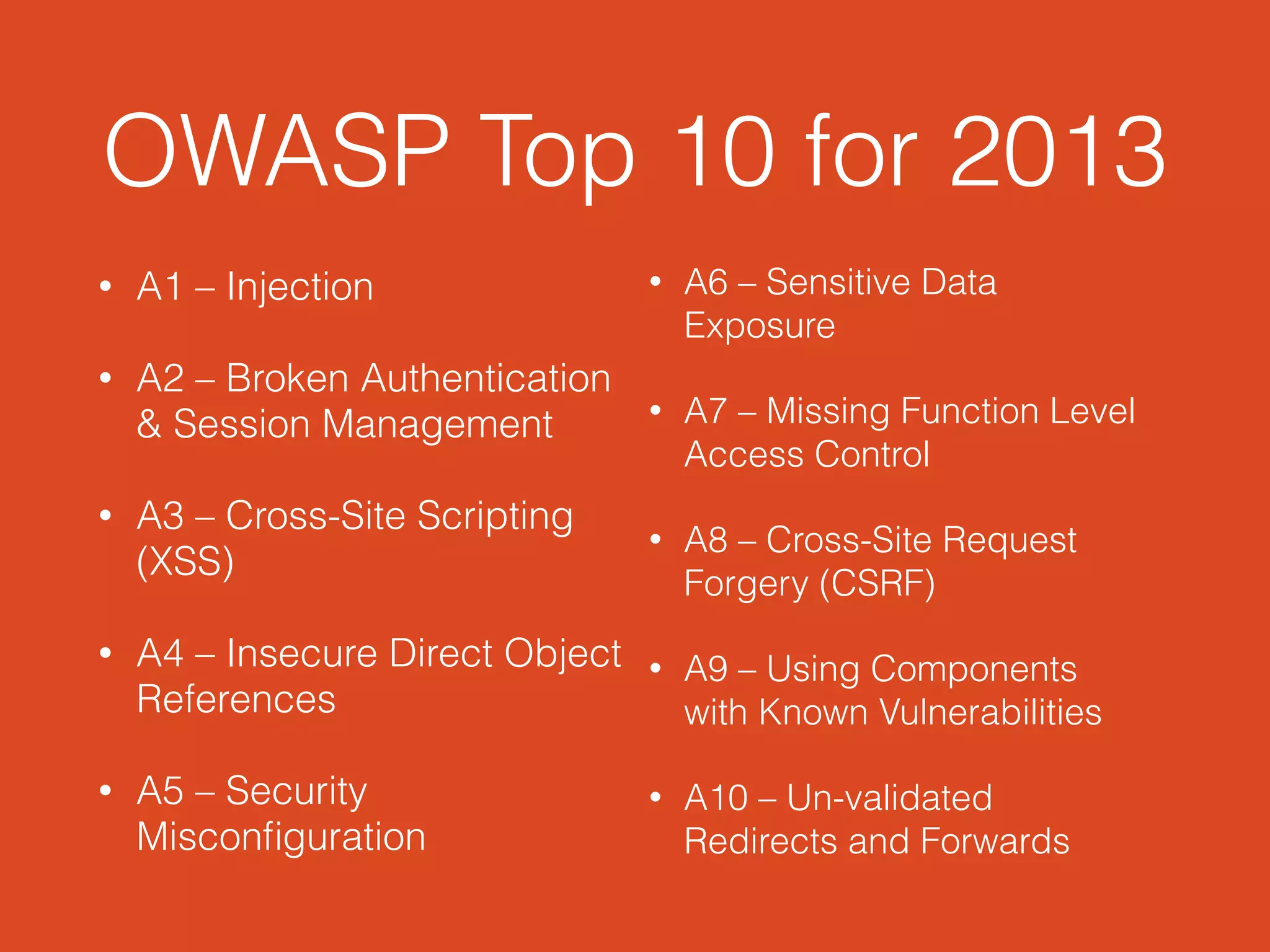
OWASP Top 10 for 2013
• A1 – Injection
• A2 – Broken Authentication
& Session Management
• A3 – Cross-Site Scripting
(XSS)
• A4 – Insecure Direct Object
References
• A5 – Security
Misconfiguration
• A6 – Sensitive Data
Exposure
• A7 – Missing Function Level
Access Control
• A8 – Cross-Site Request
Forgery (CSRF)
• A9 – Using Components
with Known Vulnerabilities
• A10 – Un-validated
Redirects and Forwards
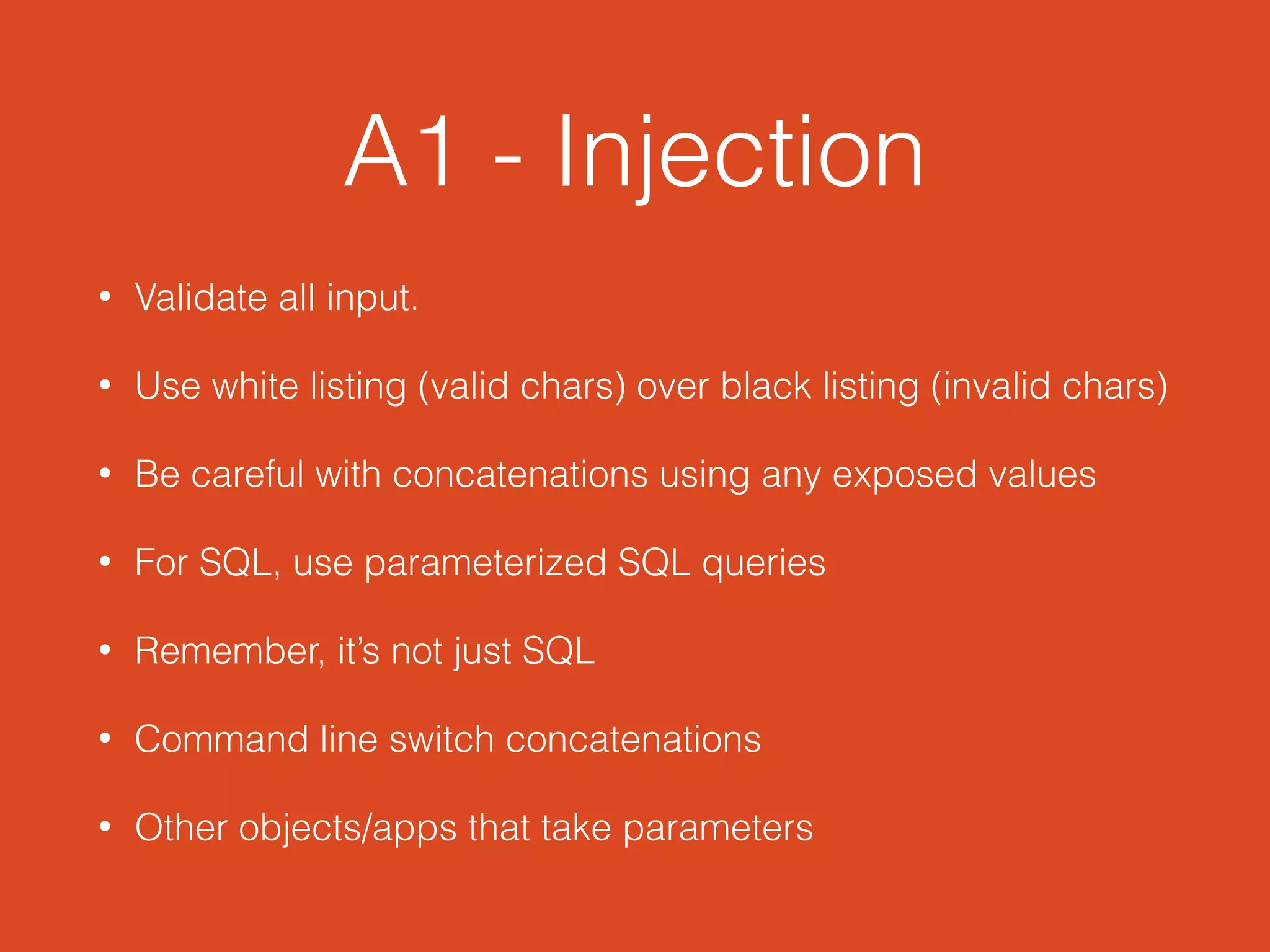
A1 - Injection
• Validate all input.
• Use white listing (valid chars) over black listing (invalid chars)
• Be careful with concatenations using any exposed values
• For SQL, use parameterized SQL queries
• Remember, it’s not just SQL
• Command line switch concatenations
• Other objects/apps that take parameters
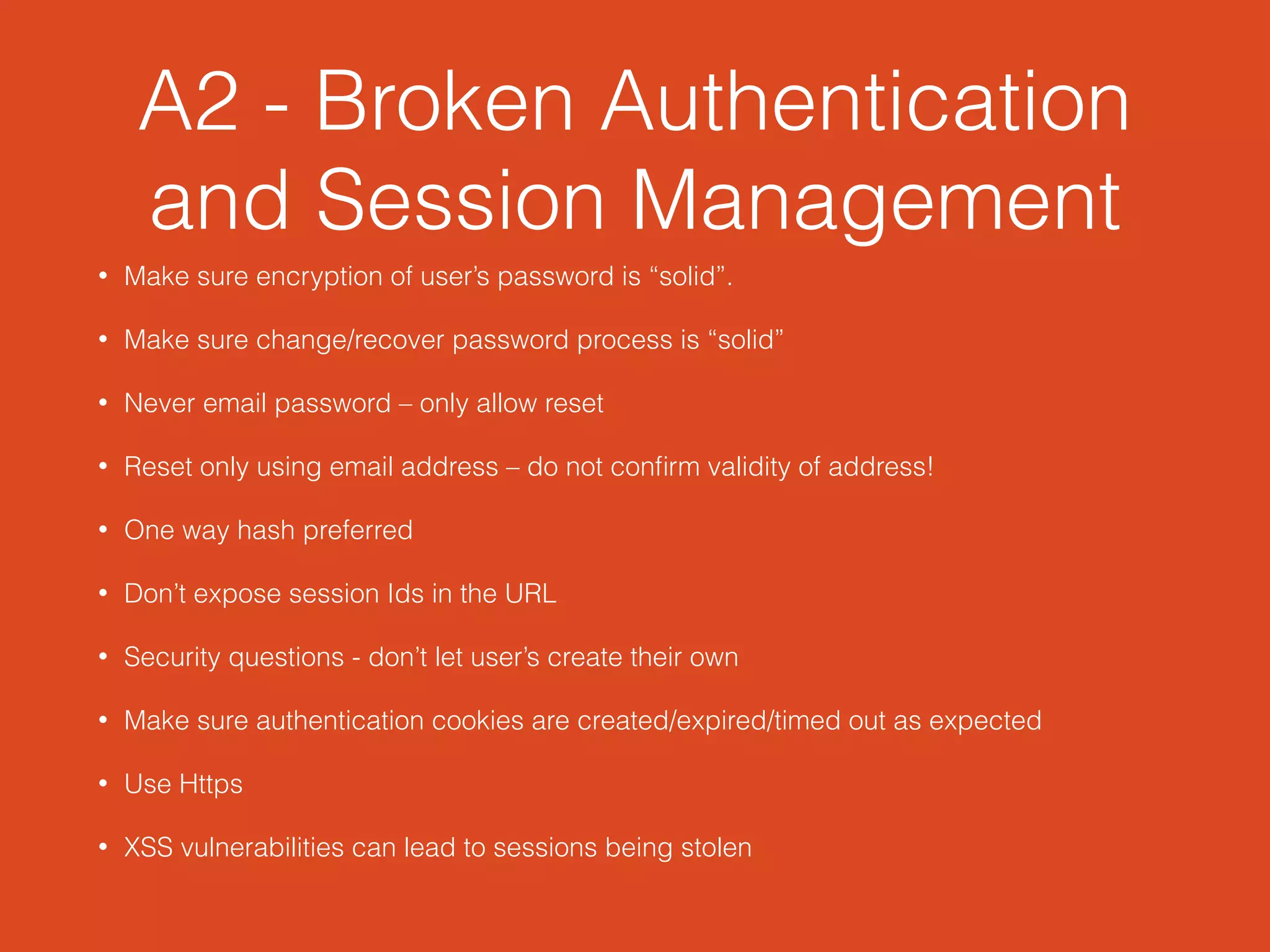
A2 - Broken Authentication
and Session Management
• Make sure encryption of user’s password is “solid”.
• Make sure change/recover password process is “solid”
• Never email password – only allow reset
• Reset only using email address – do not confirm validity of address!
• One way hash preferred
• Don’t expose session Ids in the URL
• Security questions - don’t let user’s create their own
• Make sure authentication cookies are created/expired/timed out as expected
• Use Https
• XSS vulnerabilities can lead to sessions being stolen
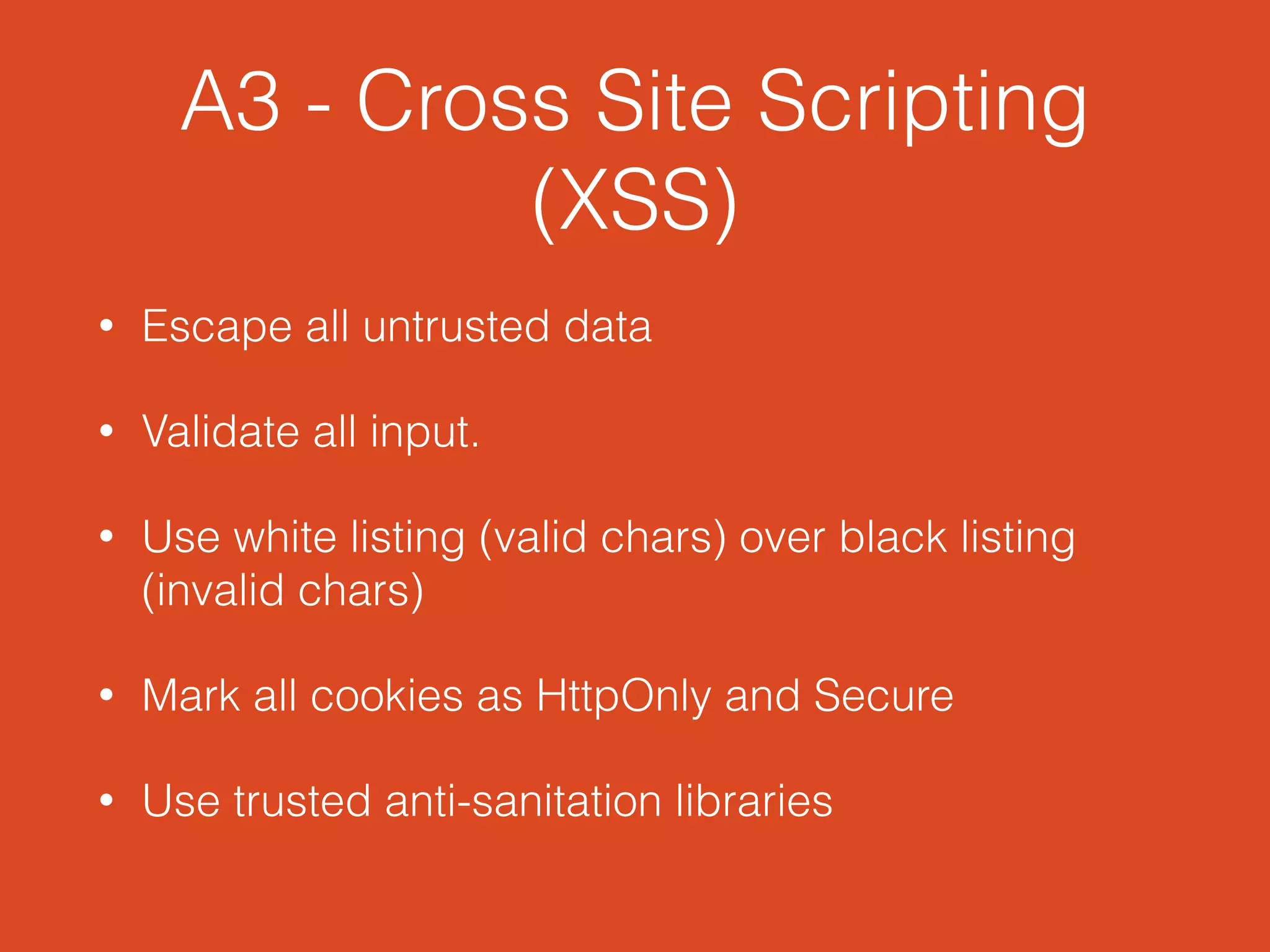
A3 - Cross Site Scripting
(XSS)
• Escape all untrusted data
• Validate all input.
• Use white listing (valid chars) over black listing
(invalid chars)
• Mark all cookies as HttpOnly and Secure
• Use trusted anti-sanitation libraries
A4 - Insecure Direct Object
References
• Authorize the user for every request, verify access
to the item requested
• Use per user or session indirect object references
• Ie: Map grid row with a row Id that maps back to
the actual key in stored in session
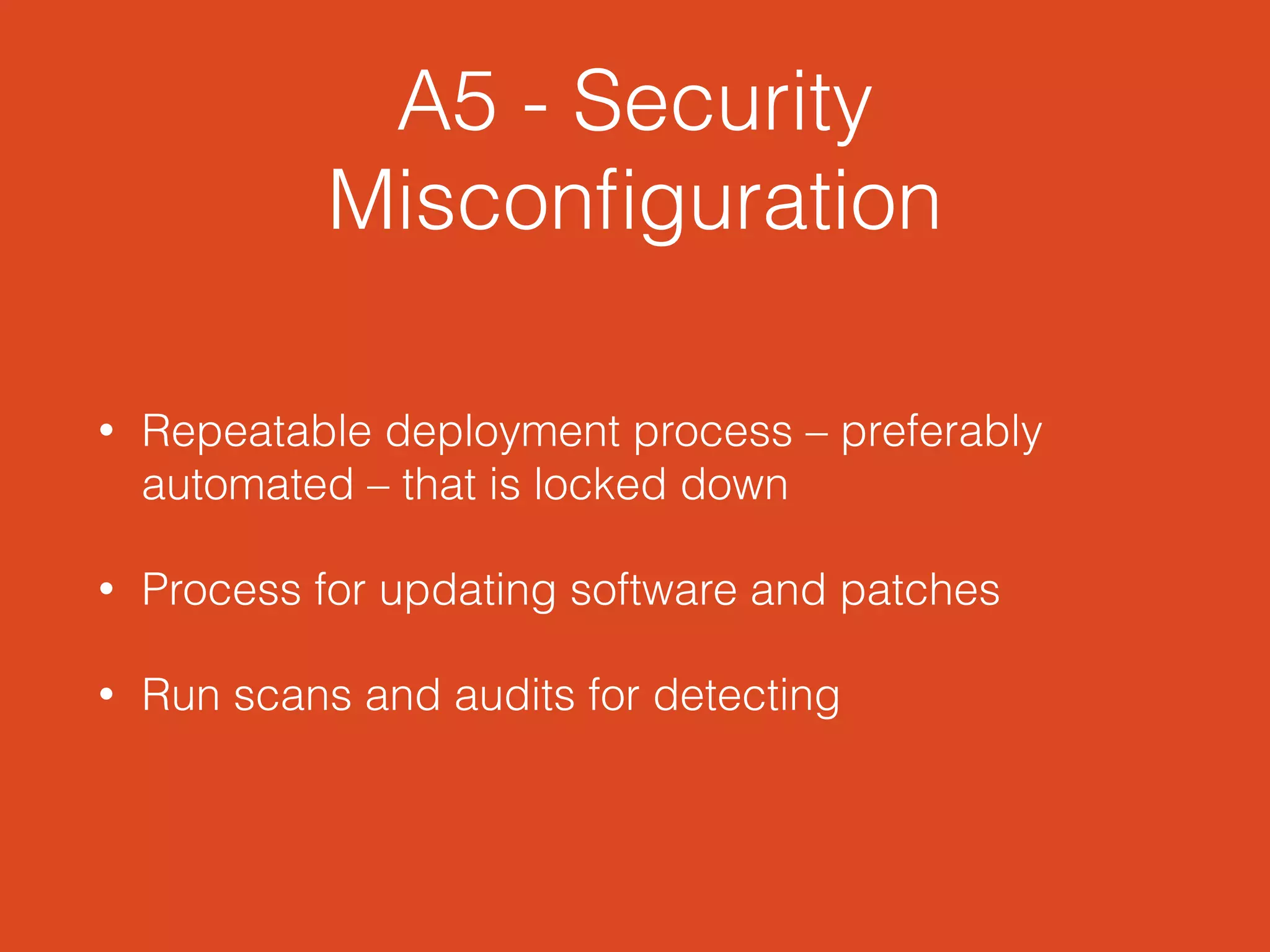
A5 - Security
Misconfiguration
• Repeatable deployment process – preferably
automated – that is locked down
• Process for updating software and patches
• Run scans and audits for detecting
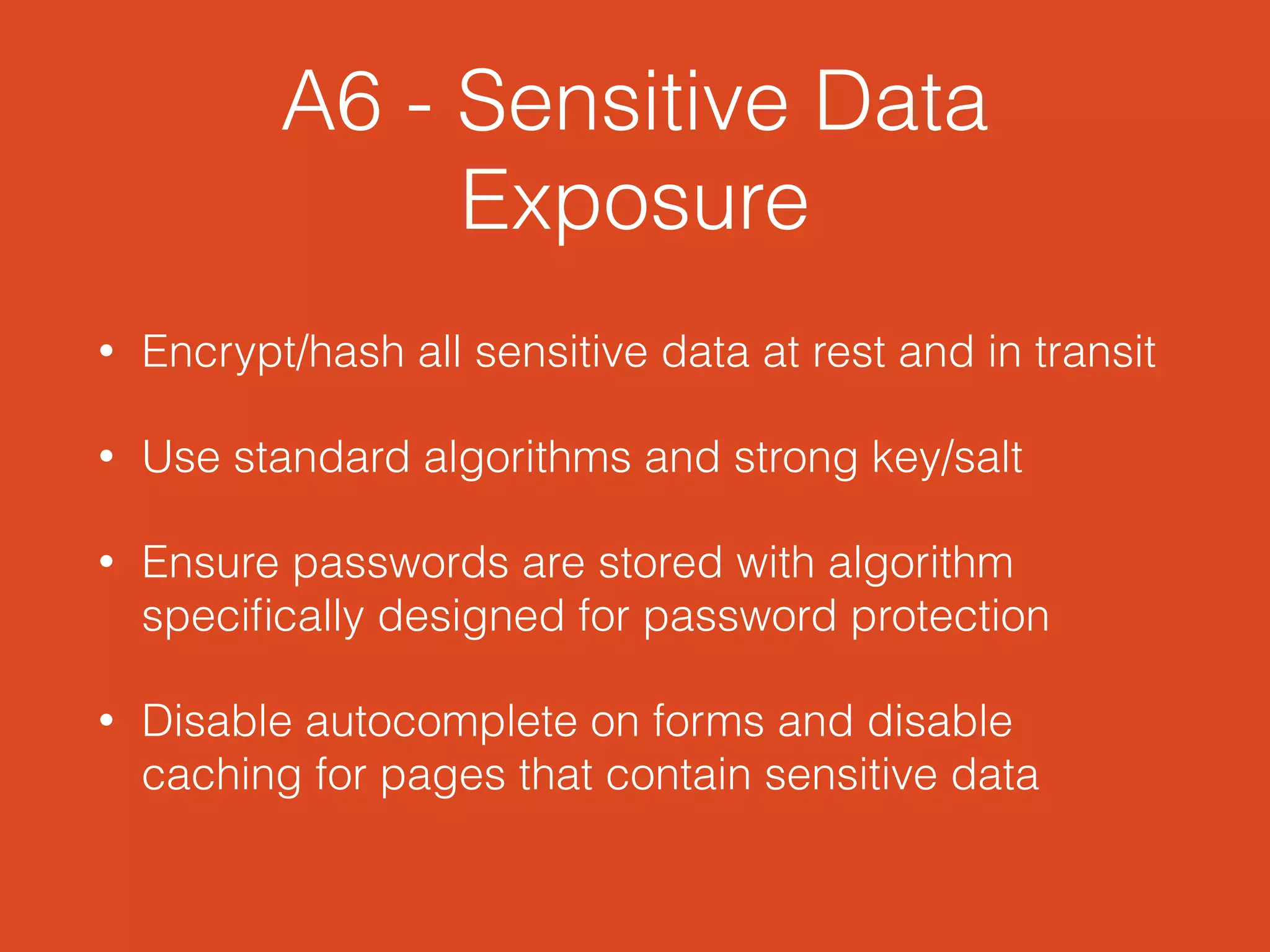
A6 - Sensitive Data
Exposure
• Encrypt/hash all sensitive data at rest and in transit
• Use standard algorithms and strong key/salt
• Ensure passwords are stored with algorithm
specifically designed for password protection
• Disable autocomplete on forms and disable
caching for pages that contain sensitive data
A7 - Missing Function Level
Access Control
• Have an easy to use common consistent
authorization module
• Deny all access by default
• Implement checks in business layer
• Ie: link on website hidden, but user could still enter
in URL and gain access = BAD
• Back to -> authorize every request
A8 - Cross Site Request
Forgery (CSRF)
• Include unpredictable token in each request – at a
minimum, unique per user session
• Preferred is by using a hidden field vs. added to
URL
• There are some tools in .NET to use
• Re-authenticate user or prove they are a user (ie:
use a captcha)
A9 - Using Components with
known vulnerabilities
• Have a process in place to update component
• Monitor the security of the components
• Govern component use
• Add security wrappers around component
A10 - Unvalidated Redirects
and Forwards
• Avoid using redirects and forwards
• Don’t involve user parameters in calculating
destination
• If destination parameters cannot be avoided
• Validate value and that the user is authorized
• Use mapping values instead of actual value
Questions?
Resources
!
OWASP: owasp.org
Pluralsight: Owasp Top 10 course
Troy Hunt Blog: troyhunt.com
!

OWASP Top 10 Web Vulnerabilities from DCC 04/14

  • 1.
  • 2.
    About Me Chris Holwerda! Architectand developer for 15+ years in the financial, money codes, and credit card processing industry. MasterCard Enforcing PCI Compliance (Payment Card Industry) blog: chrisholwerda.com twitter: @cholwerda email: therealchrisholwerda@gmail.com SpeakerRate: http://speakerrate.com/chrisholwerda !
  • 3.
    Security In General •Security is HARD • There is no silver bullet • Hackers will always have the upper hand • Have an “everyone” is a hacker mentality • Objective is to minimize risk and losses if breached
  • 4.
    What is OWASP? •Open Web Application Security Project • Mission: To make software security visible so that organizations worldwide can make informed decision about true software security risks • Open for anyone • You can sign up to receive OWASP information updates • You can attend meetings. They have chapters in a most of the major cities, including Phoenix. • Website has a lot of resources with examples in multiple programming languages
  • 5.
  • 6.
    OWASP Top 10for 2013 • A1 – Injection • A2 – Broken Authentication & Session Management • A3 – Cross-Site Scripting (XSS) • A4 – Insecure Direct Object References • A5 – Security Misconfiguration • A6 – Sensitive Data Exposure • A7 – Missing Function Level Access Control • A8 – Cross-Site Request Forgery (CSRF) • A9 – Using Components with Known Vulnerabilities • A10 – Un-validated Redirects and Forwards
  • 7.
    A1 - Injection •Validate all input. • Use white listing (valid chars) over black listing (invalid chars) • Be careful with concatenations using any exposed values • For SQL, use parameterized SQL queries • Remember, it’s not just SQL • Command line switch concatenations • Other objects/apps that take parameters
  • 8.
    A2 - BrokenAuthentication and Session Management • Make sure encryption of user’s password is “solid”. • Make sure change/recover password process is “solid” • Never email password – only allow reset • Reset only using email address – do not confirm validity of address! • One way hash preferred • Don’t expose session Ids in the URL • Security questions - don’t let user’s create their own • Make sure authentication cookies are created/expired/timed out as expected • Use Https • XSS vulnerabilities can lead to sessions being stolen
  • 9.
    A3 - CrossSite Scripting (XSS) • Escape all untrusted data • Validate all input. • Use white listing (valid chars) over black listing (invalid chars) • Mark all cookies as HttpOnly and Secure • Use trusted anti-sanitation libraries
  • 10.
    A4 - InsecureDirect Object References • Authorize the user for every request, verify access to the item requested • Use per user or session indirect object references • Ie: Map grid row with a row Id that maps back to the actual key in stored in session
  • 11.
    A5 - Security Misconfiguration •Repeatable deployment process – preferably automated – that is locked down • Process for updating software and patches • Run scans and audits for detecting
  • 12.
    A6 - SensitiveData Exposure • Encrypt/hash all sensitive data at rest and in transit • Use standard algorithms and strong key/salt • Ensure passwords are stored with algorithm specifically designed for password protection • Disable autocomplete on forms and disable caching for pages that contain sensitive data
  • 13.
    A7 - MissingFunction Level Access Control • Have an easy to use common consistent authorization module • Deny all access by default • Implement checks in business layer • Ie: link on website hidden, but user could still enter in URL and gain access = BAD • Back to -> authorize every request
  • 14.
    A8 - CrossSite Request Forgery (CSRF) • Include unpredictable token in each request – at a minimum, unique per user session • Preferred is by using a hidden field vs. added to URL • There are some tools in .NET to use • Re-authenticate user or prove they are a user (ie: use a captcha)
  • 15.
    A9 - UsingComponents with known vulnerabilities • Have a process in place to update component • Monitor the security of the components • Govern component use • Add security wrappers around component
  • 16.
    A10 - UnvalidatedRedirects and Forwards • Avoid using redirects and forwards • Don’t involve user parameters in calculating destination • If destination parameters cannot be avoided • Validate value and that the user is authorized • Use mapping values instead of actual value
  • 17.
  • 18.
    Resources ! OWASP: owasp.org Pluralsight: OwaspTop 10 course Troy Hunt Blog: troyhunt.com !