Object
Oriented
Programming
Yeasir Arafat Ratul; Lecturer; Department of CSE
Object-oriented programming (OOP) is a programming paradigm that allows
you to package together data and functionality to modify those data states,
while keeping the details hidden away. As a result, code with OOP design is
reusable, modular, and abstract. This makes it particularly useful when you
create larger programs.
Yeasir Arafat Ratul; Lecturer; Department of CSE
Object Oriented Programming
Class
Yeasir Arafat Ratul; Lecturer; Department of CSE
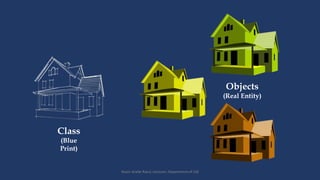
A class is a user-defined data type that we can use in our
program, and it works as an object constructor, or a
"blueprint" for creating objects. It is a way to bind the data
and its associated functions together. Class doesn’t take
any space, objects does.
Class
(Blue
Print)
Objects
(Real Entity)
Yeasir Arafat Ratul; Lecturer; Department of CSE
Objects
Yeasir Arafat Ratul; Lecturer; Department of CSE
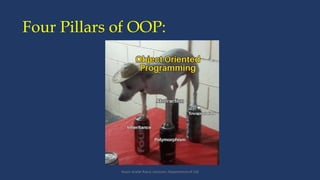
Four Pillars of OOP:
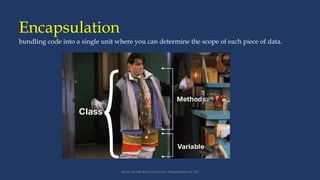
Encapsulation
Yeasir Arafat Ratul; Lecturer; Department of CSE
bundling code into a single unit where you can determine the scope of each piece of data.
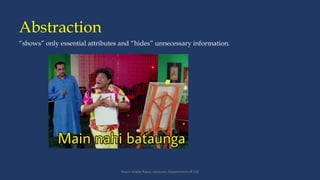
Abstraction
Yeasir Arafat Ratul; Lecturer; Department of CSE
“shows” only essential attributes and “hides” unnecessary information.
Inheritance
Yeasir Arafat Ratul; Lecturer; Department of CSE
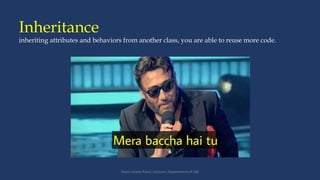
inheriting attributes and behaviors from another class, you are able to reuse more code.
Inheritance
Yeasir Arafat Ratul; Lecturer; Department of CSE
Polymorphism
Yeasir Arafat Ratul; Lecturer; Department of CSE
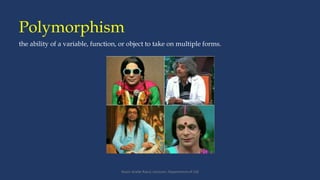
the ability of a variable, function, or object to take on multiple forms.
Thank You
Yeasir Arafat Ratul; Lecturer; Department of CSE

Overview of OOP with Memes.pptx