© Copyright 2017 Pivotal Software, Inc. All rights Reserved. Version 1.0
April 3rd, 2018
Mike Gualtieri - VP, Principal Analyst, Forrester Research
Mike Stolz - Lead Product Manager, Pivotal
Jagdish Mirani - Principal Product Marketing Manager, Pivotal
Overcoming Data Gravity in
Multi-Cloud Enterprise
Architectures
Cover w/ Image
Topics
■  What’s driving multi-cloud?
■  What is the data challenge?
■  How does design thinking change in a
multi-cloud architecture?
■  What are the architectural/imperatives for
multi-cloud?
■  What are some real-world multi-cloud
use cases?
■  Key Pivotal solution components
What’s driving multi-cloud?
Overcoming Data Gravity in Multi-Cloud Enterprise Architectures
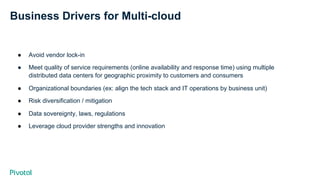
Business Drivers for Multi-cloud
●  Avoid vendor lock-in
●  Meet quality of service requirements (online availability and response time) using multiple
distributed data centers for geographic proximity to customers and consumers
●  Organizational boundaries (ex: align the tech stack and IT operations by business unit)
●  Risk diversification / mitigation
●  Data sovereignty, laws, regulations
●  Leverage cloud provider strengths and innovation
5© 2017 FORRESTER. REPRODUCTION PROHIBITED.
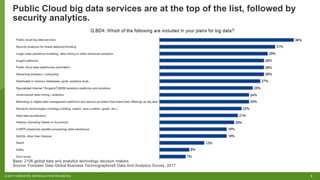
Public Cloud big data services are at the top of the list, followed by
security analytics.
Base: 2106 global data and analytics technology decision makers
Source: Forrester Data Global Business Technographics® Data And Analytics Survey, 2017
What are the Data Challenges?
Overcoming Data Gravity in Multi-Cloud Enterprise Architectures
Data Gravity in the Enterprise
●  New data is being generated in the cloud, outside the walls of the enterprise
●  Data sources are becoming more diverse
●  Network bandwidth and latency
●  Volume of data is still exploding
●  Data distribution vs. consistency
●  Data governance, laws, security, provenance
●  Metadata creation and accumulation
●  Failure states of the system
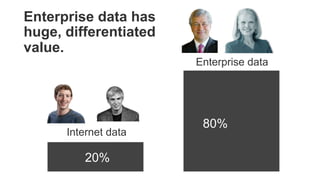
And it’s not all internet data ...
Internet data
Enterprise data
20%
80%
Enterprise data has
huge, differentiated
value.
© 2013 Forrester Research, Inc. Reproduction Prohibited 9
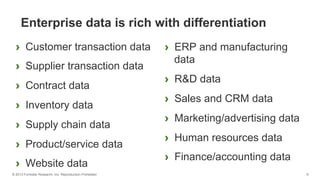
Enterprise data is rich with differentiation
›  Customer transaction data
›  Supplier transaction data
›  Contract data
›  Inventory data
›  Supply chain data
›  Product/service data
›  Website data
›  ERP and manufacturing
data
›  R&D data
›  Sales and CRM data
›  Marketing/advertising data
›  Human resources data
›  Finance/accounting data
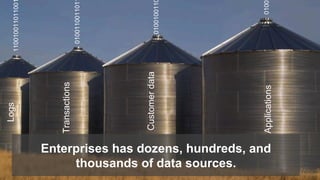
11001001101100
010010011
010011001101
0100
Customerdata
Transactions
Applications
Logs
Enterprises has dozens, hundreds, and
thousands of data sources.
11© 2017 FORRESTER. REPRODUCTION PROHIBITED.
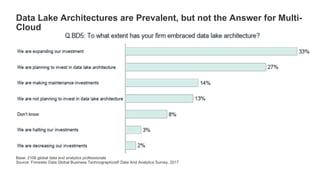
Data Lake Architectures are Prevalent, but not the Answer for Multi-
Cloud
Base: 2106 global data and analytics professionals
Source: Forrester Data Global Business Technographics® Data And Analytics Survey, 2017
12© 2017 FORRESTER. REPRODUCTION PROHIBITED.
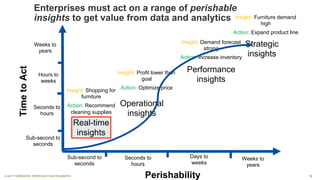
Real-time
insights
Operational
insights
Performance
insights
Strategic
insights
Insight: Shopping for
furniture
Action: Recommend
cleaning supplies
Insight: Profit lower than
goal
Action: Optimize price
Insight: Demand forecast
strong
Action: Increase inventory
Insight: Furniture demand
high
Action: Expand product line
TimetoAct
Perishability
Sub-second to
seconds
Seconds to
hours
Days to
weeks
Weeks to
years
Sub-second to
seconds
Seconds to
hours
Hours to
weeks
Weeks to
years
Enterprises must act on a range of perishable
insights to get value from data and analytics
13© Copyright 2013 Pivotal. All rights reserved. 13© Copyright 2016 Pivotal. All rights reserved.
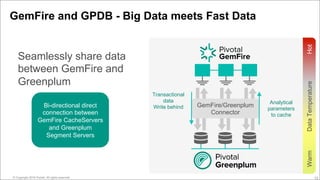
DataTemperatureWarmHot
GemFire/Greenplum
Connector
Transactional
data
Write behind
Analytical
parameters
to cache
GemFire and GPDB - Big Data meets Fast Data
Seamlessly share data
between GemFire and
Greenplum
Bi-directional direct
connection between
GemFire CacheServers
and Greenplum
Segment Servers
How does design thinking change in a multi-
cloud architecture?
Overcoming Data Gravity in Multi-Cloud Enterprise Architectures
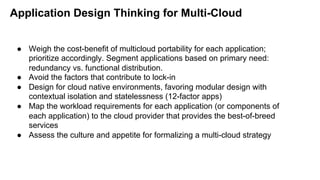
●  Weigh the cost-benefit of multicloud portability for each application;
prioritize accordingly. Segment applications based on primary need:
redundancy vs. functional distribution.
●  Avoid the factors that contribute to lock-in
●  Design for cloud native environments, favoring modular design with
contextual isolation and statelessness (12-factor apps)
●  Map the workload requirements for each application (or components of
each application) to the cloud provider that provides the best-of-breed
services
●  Assess the culture and appetite for formalizing a multi-cloud strategy
Application Design Thinking for Multi-Cloud
What are some real-world multi-cloud use
cases?
Overcoming Data Gravity in Multi-Cloud Enterprise Architectures
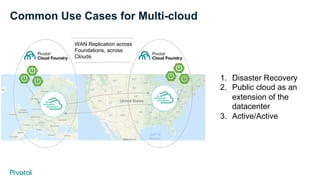
Common Use Cases for Multi-cloud
1.  Disaster Recovery
2.  Public cloud as an
extension of the
datacenter
3.  Active/Active
WAN Replication across
Foundations, across
Clouds
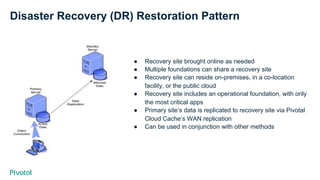
Disaster Recovery (DR) Restoration Pattern
●  Recovery site brought online as needed
●  Multiple foundations can share a recovery site
●  Recovery site can reside on-premises, in a co-location
facility, or the public cloud
●  Recovery site includes an operational foundation, with only
the most critical apps
●  Primary site’s data is replicated to recovery site via Pivotal
Cloud Cache’s WAN replication
●  Can be used in conjunction with other methods
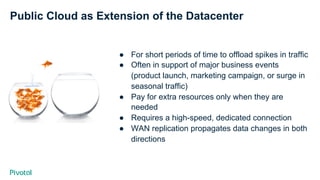
Public Cloud as Extension of the Datacenter
●  For short periods of time to offload spikes in traffic
●  Often in support of major business events
(product launch, marketing campaign, or surge in
seasonal traffic)
●  Pay for extra resources only when they are
needed
●  Requires a high-speed, dedicated connection
●  WAN replication propagates data changes in both
directions
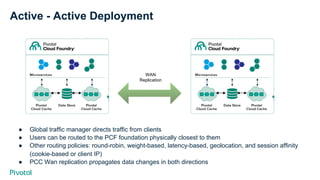
Active - Active Deployment
●  Global traffic manager directs traffic from clients
●  Users can be routed to the PCF foundation physically closest to them
●  Other routing policies: round-robin, weight-based, latency-based, geolocation, and session affinity
(cookie-based or client IP)
●  PCC Wan replication propagates data changes in both directions
WAN
Replication
What are the Architectural Imperatives for
Multi-Cloud?
Overcoming Data Gravity in Multi-Cloud Enterprise Architectures
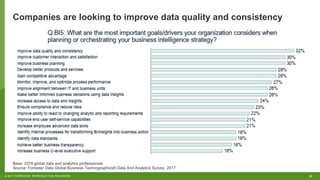
22© 2017 FORRESTER. REPRODUCTION PROHIBITED.
Companies are looking to improve data quality and consistency
Base: 3378 global data and analytics professionals
Source: Forrester Data Global Business Technographics® Data And Analytics Survey, 2017
Conflict Resolution in Active/Active Setup
23
●  PCC automatically detects conflicts and retains the latest
data
○  Local timestamps and conflict detection algorithms
●  Can use custom code for conflict resolution
●  Alternative: design the system to avoid conflicts ...
Design Principles for Active-Active Patterns
●  Exchange pattern
●  Realm manager pattern
●  Follow-the-sun pattern
●  Inventory allocation pattern
●  Apology based computing
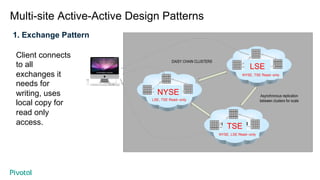
Multi-site Active-Active Design Patterns
1. Exchange Pattern
NYSE
LSE
LSE
TSE
NYSE, TSE Read--only
LSE, TSE Read--only
NYSE, LSE Read--only
Client connects
to all
exchanges it
needs for
writing, uses
local copy for
read only
access.
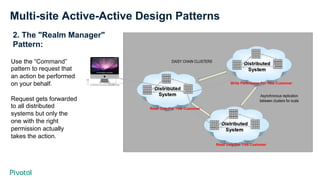
Multi-site Active-Active Design Patterns
2. The "Realm Manager"
Pattern:
Use the “Command”
pattern to request that
an action be performed
on your behalf.
Request gets forwarded
to all distributed
systems but only the
one with the right
permission actually
takes the action.
Read Only For This Customer
Write Permission For This Customer
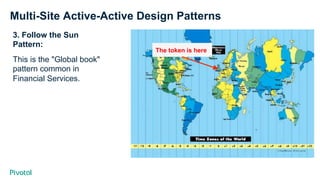
Multi-Site Active-Active Design Patterns
3. Follow the Sun
Pattern:
This is the "Global book"
pattern common in
Financial Services.
The token is here
Multi-Site Active-Active Design Patterns
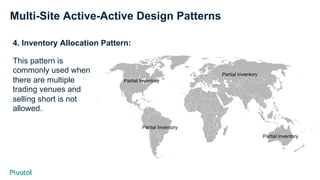
4. Inventory Allocation Pattern:
This pattern is
commonly used when
there are multiple
trading venues and
selling short is not
allowed.
Partial Inventory
Partial Inventory
Partial Inventory
Partial Inventory
Multi-Site Active-Active Design Patterns
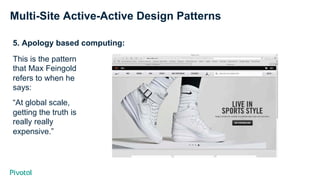
5. Apology based computing:
This is the pattern
that Max Feingold
refers to when he
says:
“At global scale,
getting the truth is
really really
expensive.”
Key Pivotal Solution Components
Overcoming Data Gravity in Multi-Cloud Enterprise Architectures
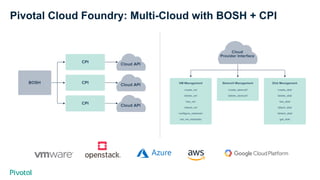
Pivotal Cloud Foundry: Multi-Cloud with BOSH + CPI
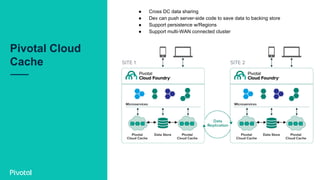
Pivotal Cloud
Cache
●  Cross DC data sharing
●  Dev can push server-side code to save data to backing store
●  Support persistence w/Regions
●  Support multi-WAN connected cluster
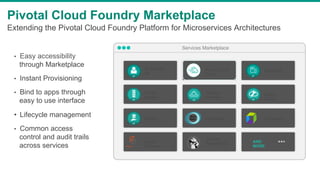
Pivotal Cloud Foundry Marketplace
•  Easy accessibility
through Marketplace
•  Instant Provisioning
•  Bind to apps through
easy to use interface
•  Lifecycle management
•  Common access
control and audit trails
across services
MySQL New Relic
Single Sign-
On
RabbitMQ
Config
Server
Service
Directory
Circuit
Breaker
Signal
Sciences
Crunchy
PostgreSQL AND
MORE
Services Marketplace
Pivotal Cloud
Cache
Dynatrace
Extending the Pivotal Cloud Foundry Platform for Microservices Architectures
Multi-Cloud is Inevitable
●  Enables flexibility and choice
○  Go in with a well considered multicloud strategy and
plan, rather than ad-hoc
●  Map cost-benefit back to business drivers: business
continuity, portability and the absence of lock-in,
opportunistic use case placement and future-proofing, ...
Summary: Assessing Your Choices
●  Option 1: Build directly on top of an IaaS
○  Prepare (cross train) staff on all identified cloud providers
○  Choose native management tools and operational processes for each
cloud
○  Maintain diligence towards avoiding lock-in
●  Option 2: Build on top of a PaaS like Pivotal Cloud Foundry
○  Platform, tools, and methodology that mask the differences between IaaS
○  Continuous and rapid provisioning of apps and services
○  Automated ‘day 2’ operations
© Copyright 2017 Pivotal Software, Inc. All rights Reserved. Version 1.0
April 3rd, 2018
Mike Gualtieri - VP, Principal Analyst, Forrester Research
Mike Stolz - Lead Product Manager, Pivotal
Jagdish Mirani - Principal Product Marketing Manager, Pivotal
Overcoming Data Gravity in
Multi-Cloud Enterprise
Architectures

Overcoming Data Gravity in Multi-Cloud Enterprise Architectures

  • 1.
    © Copyright 2017Pivotal Software, Inc. All rights Reserved. Version 1.0 April 3rd, 2018 Mike Gualtieri - VP, Principal Analyst, Forrester Research Mike Stolz - Lead Product Manager, Pivotal Jagdish Mirani - Principal Product Marketing Manager, Pivotal Overcoming Data Gravity in Multi-Cloud Enterprise Architectures
  • 2.
    Cover w/ Image Topics ■ What’s driving multi-cloud? ■  What is the data challenge? ■  How does design thinking change in a multi-cloud architecture? ■  What are the architectural/imperatives for multi-cloud? ■  What are some real-world multi-cloud use cases? ■  Key Pivotal solution components
  • 3.
    What’s driving multi-cloud? OvercomingData Gravity in Multi-Cloud Enterprise Architectures
  • 4.
    Business Drivers forMulti-cloud ●  Avoid vendor lock-in ●  Meet quality of service requirements (online availability and response time) using multiple distributed data centers for geographic proximity to customers and consumers ●  Organizational boundaries (ex: align the tech stack and IT operations by business unit) ●  Risk diversification / mitigation ●  Data sovereignty, laws, regulations ●  Leverage cloud provider strengths and innovation
  • 5.
    5© 2017 FORRESTER.REPRODUCTION PROHIBITED. Public Cloud big data services are at the top of the list, followed by security analytics. Base: 2106 global data and analytics technology decision makers Source: Forrester Data Global Business Technographics® Data And Analytics Survey, 2017
  • 6.
    What are theData Challenges? Overcoming Data Gravity in Multi-Cloud Enterprise Architectures
  • 7.
    Data Gravity inthe Enterprise ●  New data is being generated in the cloud, outside the walls of the enterprise ●  Data sources are becoming more diverse ●  Network bandwidth and latency ●  Volume of data is still exploding ●  Data distribution vs. consistency ●  Data governance, laws, security, provenance ●  Metadata creation and accumulation ●  Failure states of the system And it’s not all internet data ...
  • 8.
    Internet data Enterprise data 20% 80% Enterprisedata has huge, differentiated value.
  • 9.
    © 2013 ForresterResearch, Inc. Reproduction Prohibited 9 Enterprise data is rich with differentiation ›  Customer transaction data ›  Supplier transaction data ›  Contract data ›  Inventory data ›  Supply chain data ›  Product/service data ›  Website data ›  ERP and manufacturing data ›  R&D data ›  Sales and CRM data ›  Marketing/advertising data ›  Human resources data ›  Finance/accounting data
  • 10.
  • 11.
    11© 2017 FORRESTER.REPRODUCTION PROHIBITED. Data Lake Architectures are Prevalent, but not the Answer for Multi- Cloud Base: 2106 global data and analytics professionals Source: Forrester Data Global Business Technographics® Data And Analytics Survey, 2017
  • 12.
    12© 2017 FORRESTER.REPRODUCTION PROHIBITED. Real-time insights Operational insights Performance insights Strategic insights Insight: Shopping for furniture Action: Recommend cleaning supplies Insight: Profit lower than goal Action: Optimize price Insight: Demand forecast strong Action: Increase inventory Insight: Furniture demand high Action: Expand product line TimetoAct Perishability Sub-second to seconds Seconds to hours Days to weeks Weeks to years Sub-second to seconds Seconds to hours Hours to weeks Weeks to years Enterprises must act on a range of perishable insights to get value from data and analytics
  • 13.
    13© Copyright 2013Pivotal. All rights reserved. 13© Copyright 2016 Pivotal. All rights reserved. DataTemperatureWarmHot GemFire/Greenplum Connector Transactional data Write behind Analytical parameters to cache GemFire and GPDB - Big Data meets Fast Data Seamlessly share data between GemFire and Greenplum Bi-directional direct connection between GemFire CacheServers and Greenplum Segment Servers
  • 14.
    How does designthinking change in a multi- cloud architecture? Overcoming Data Gravity in Multi-Cloud Enterprise Architectures
  • 15.
    ●  Weigh thecost-benefit of multicloud portability for each application; prioritize accordingly. Segment applications based on primary need: redundancy vs. functional distribution. ●  Avoid the factors that contribute to lock-in ●  Design for cloud native environments, favoring modular design with contextual isolation and statelessness (12-factor apps) ●  Map the workload requirements for each application (or components of each application) to the cloud provider that provides the best-of-breed services ●  Assess the culture and appetite for formalizing a multi-cloud strategy Application Design Thinking for Multi-Cloud
  • 16.
    What are somereal-world multi-cloud use cases? Overcoming Data Gravity in Multi-Cloud Enterprise Architectures
  • 17.
    Common Use Casesfor Multi-cloud 1.  Disaster Recovery 2.  Public cloud as an extension of the datacenter 3.  Active/Active WAN Replication across Foundations, across Clouds
  • 18.
    Disaster Recovery (DR)Restoration Pattern ●  Recovery site brought online as needed ●  Multiple foundations can share a recovery site ●  Recovery site can reside on-premises, in a co-location facility, or the public cloud ●  Recovery site includes an operational foundation, with only the most critical apps ●  Primary site’s data is replicated to recovery site via Pivotal Cloud Cache’s WAN replication ●  Can be used in conjunction with other methods
  • 19.
    Public Cloud asExtension of the Datacenter ●  For short periods of time to offload spikes in traffic ●  Often in support of major business events (product launch, marketing campaign, or surge in seasonal traffic) ●  Pay for extra resources only when they are needed ●  Requires a high-speed, dedicated connection ●  WAN replication propagates data changes in both directions
  • 20.
    Active - ActiveDeployment ●  Global traffic manager directs traffic from clients ●  Users can be routed to the PCF foundation physically closest to them ●  Other routing policies: round-robin, weight-based, latency-based, geolocation, and session affinity (cookie-based or client IP) ●  PCC Wan replication propagates data changes in both directions WAN Replication
  • 21.
    What are theArchitectural Imperatives for Multi-Cloud? Overcoming Data Gravity in Multi-Cloud Enterprise Architectures
  • 22.
    22© 2017 FORRESTER.REPRODUCTION PROHIBITED. Companies are looking to improve data quality and consistency Base: 3378 global data and analytics professionals Source: Forrester Data Global Business Technographics® Data And Analytics Survey, 2017
  • 23.
    Conflict Resolution inActive/Active Setup 23 ●  PCC automatically detects conflicts and retains the latest data ○  Local timestamps and conflict detection algorithms ●  Can use custom code for conflict resolution ●  Alternative: design the system to avoid conflicts ...
  • 24.
    Design Principles forActive-Active Patterns ●  Exchange pattern ●  Realm manager pattern ●  Follow-the-sun pattern ●  Inventory allocation pattern ●  Apology based computing
  • 25.
    Multi-site Active-Active DesignPatterns 1. Exchange Pattern NYSE LSE LSE TSE NYSE, TSE Read--only LSE, TSE Read--only NYSE, LSE Read--only Client connects to all exchanges it needs for writing, uses local copy for read only access.
  • 26.
    Multi-site Active-Active DesignPatterns 2. The "Realm Manager" Pattern: Use the “Command” pattern to request that an action be performed on your behalf. Request gets forwarded to all distributed systems but only the one with the right permission actually takes the action. Read Only For This Customer Read Only For This Customer Write Permission For This Customer
  • 27.
    Multi-Site Active-Active DesignPatterns 3. Follow the Sun Pattern: This is the "Global book" pattern common in Financial Services. The token is here
  • 28.
    Multi-Site Active-Active DesignPatterns 4. Inventory Allocation Pattern: This pattern is commonly used when there are multiple trading venues and selling short is not allowed. Partial Inventory Partial Inventory Partial Inventory Partial Inventory
  • 29.
    Multi-Site Active-Active DesignPatterns 5. Apology based computing: This is the pattern that Max Feingold refers to when he says: “At global scale, getting the truth is really really expensive.”
  • 30.
    Key Pivotal SolutionComponents Overcoming Data Gravity in Multi-Cloud Enterprise Architectures
  • 31.
    Pivotal Cloud Foundry:Multi-Cloud with BOSH + CPI
  • 32.
    Pivotal Cloud Cache ●  CrossDC data sharing ●  Dev can push server-side code to save data to backing store ●  Support persistence w/Regions ●  Support multi-WAN connected cluster
  • 33.
    Pivotal Cloud FoundryMarketplace •  Easy accessibility through Marketplace •  Instant Provisioning •  Bind to apps through easy to use interface •  Lifecycle management •  Common access control and audit trails across services MySQL New Relic Single Sign- On RabbitMQ Config Server Service Directory Circuit Breaker Signal Sciences Crunchy PostgreSQL AND MORE Services Marketplace Pivotal Cloud Cache Dynatrace Extending the Pivotal Cloud Foundry Platform for Microservices Architectures
  • 34.
    Multi-Cloud is Inevitable ● Enables flexibility and choice ○  Go in with a well considered multicloud strategy and plan, rather than ad-hoc ●  Map cost-benefit back to business drivers: business continuity, portability and the absence of lock-in, opportunistic use case placement and future-proofing, ...
  • 35.
    Summary: Assessing YourChoices ●  Option 1: Build directly on top of an IaaS ○  Prepare (cross train) staff on all identified cloud providers ○  Choose native management tools and operational processes for each cloud ○  Maintain diligence towards avoiding lock-in ●  Option 2: Build on top of a PaaS like Pivotal Cloud Foundry ○  Platform, tools, and methodology that mask the differences between IaaS ○  Continuous and rapid provisioning of apps and services ○  Automated ‘day 2’ operations
  • 36.
    © Copyright 2017Pivotal Software, Inc. All rights Reserved. Version 1.0 April 3rd, 2018 Mike Gualtieri - VP, Principal Analyst, Forrester Research Mike Stolz - Lead Product Manager, Pivotal Jagdish Mirani - Principal Product Marketing Manager, Pivotal Overcoming Data Gravity in Multi-Cloud Enterprise Architectures