Over 90% of urinary tract infections (UTIs) are caused by Escherichia coli strains. UTIs are 14 times more
common in women than in men. Why do you think this is?
UTIs caused by E. coli are 14 times more common in women than in men because the pH
of a woman's urinary tract is more favorable for the growth of E. coli.
UTIs caused by E. coli are 14 times more common in women than in men because
women have a shorter urethra than men and the proximity of the urethra to the anus is
much closer in women.
UTIs caused by E. coli are 14 times more common in women than in men because the
temperature of urine in men is less than body temperature, which is less favorable for the
growth of E. coli.
UTIs caused by E. coli are 14 times more common in women than in men because E.
coli does not adhere to the man's urethra as well as the woman's.
A man comes to the clinic with an oozing wound he got while preparing dinner. The doctors at the clinic
suspect infection with E. coli and treat him with an antibiotic. The man goes home and his symptoms
improve, so he discontinues the antibiotic. Within a few days he becomes gravely ill with shocklike
symptoms such as fever, hypotension, high heart rate and fatigue/mental confusion. Why did the man
become so sick after taking the antibiotic that was supposed to make him better?
The antibiotic given to the man and the man's own immune response caused the lysis of
the E. coli cells and release of endotoxin (LPS). This caused his secondary symptoms of
endotoxic shock.
The man discontinued his antibiotic and the infection rebounded, causing his symptoms.
The man developed a secondary infection due to his weakened immune system from
fighting the first infection.
The initial E. coli infection was resistant to the antibiotic and the man became more ill.
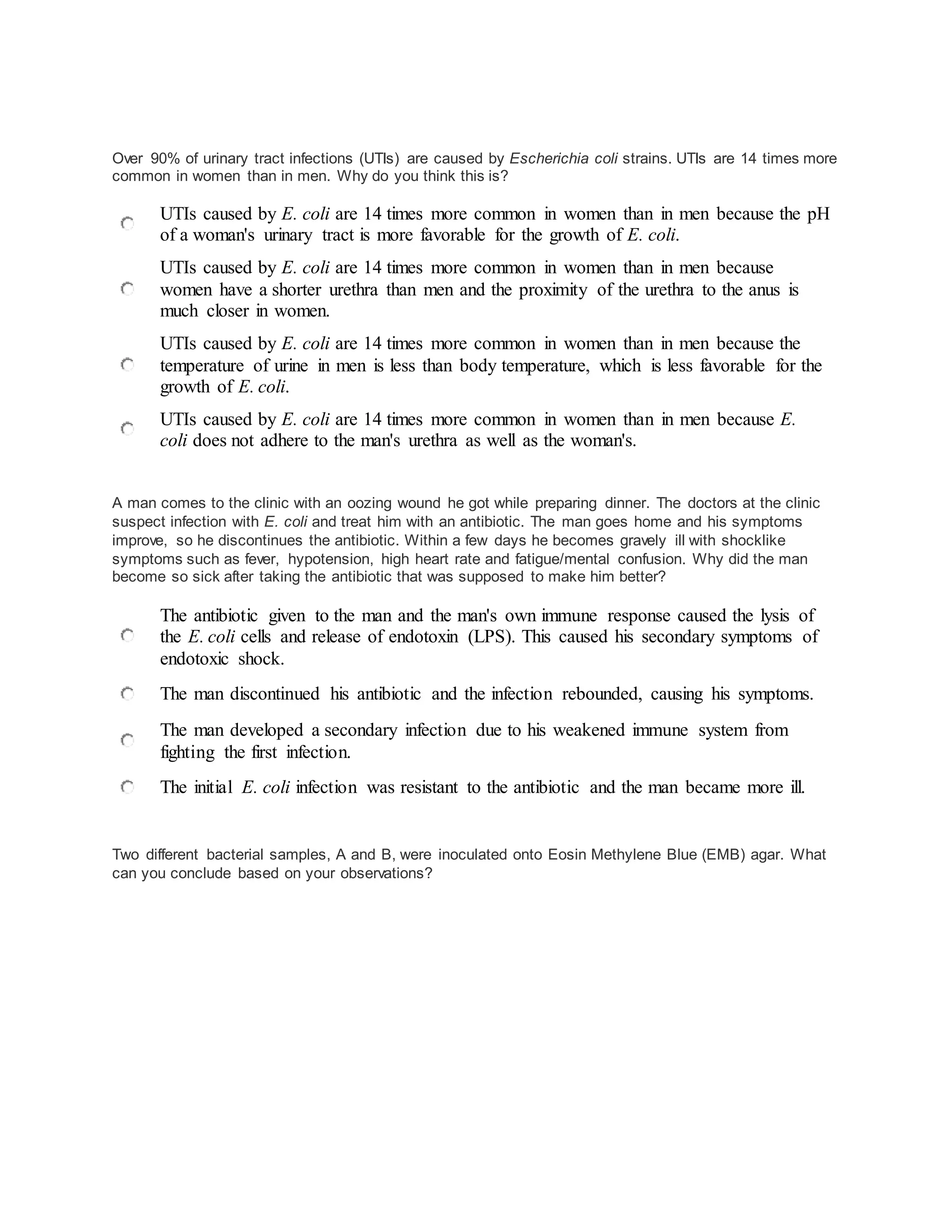
Two different bacterial samples, A and B, were inoculated onto Eosin Methylene Blue (EMB) agar. What
can you conclude based on your observations?
View the image in greater detail.
Based on your observation of the pictured specimens that are growing on the EMB agar plate,
select ALL appropriate conclusions.
Specimen A is able to ferment lactose
Specimen A is unable to ferment lactose
Specimen A is likely to be Escherichia coli (E. coli)
Specimen A is most likely Gram-negative
Specimen B is most likely Gram-negative
Specimen B is able to ferment lactose
Specimen B is unable to ferment lactose
Specimen B produces a base during the fermentation of lactose
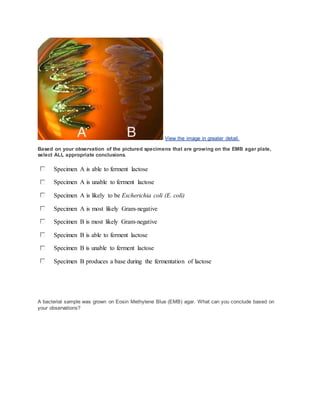
A bacterial sample was grown on Eosin Methylene Blue (EMB) agar. What can you conclude based on
your observations?
View the image in greater detail.
Based on your observation of the pictured specimens that are growing on the EMB agar plate,
select ALL appropriate conclusions.
The bacteria is able to ferment lactose
The bacteria is unable to ferment lactose
The bacteria is likely to be Escherichia coli (E. coli)
The bacteria is most likely Gram-negative
The bacteria is most likely Gram-positive
The bacteria is able to ferment sucrose
The bacteria is unable to ferment sucrose
The bacteria is probably an enteric organism
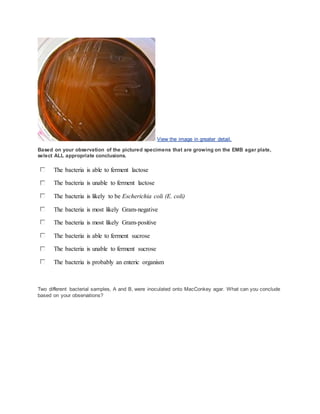
Two different bacterial samples, A and B, were inoculated onto MacConkey agar. What can you conclude
based on your observations?
View the image in greater detail.
Based on your observation of the pictured MacConkey agar plates, select ALL appropriate
conclusions.
Specimen A is able to ferment lactose
Specimen A cannot be Escherichia coli (E. coli)
Specimen A is most likely Gram-negative
Specimen B is most likely Gram-negative
Specimen B is able to ferment lactose
Specimen B is not a pathogen
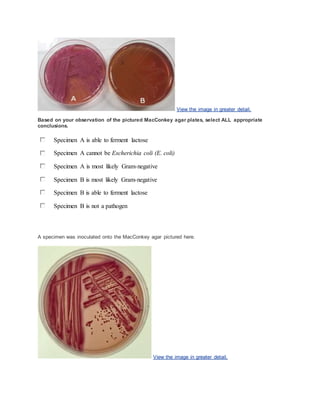
A specimen was inoculated onto the MacConkey agar pictured here.
View the image in greater detail.
Based on your observation of the pictured MacConkey medium, select ALL
appropriate conclusions . (Recall that an observation and a conclusion are different. An
observation is simply what you see; conclusions are statements of what you learned from your
observations.)
The bacterium is most likely Gram-negative
The bacteria grew
The bacteria ferments lactose
The bacteria has a red/pink pigmentation
The bacteria is most likely Gram-positive
The bacterium is unable to ferment sucrose
Glomerulonephritis is an infection that primarily affects the kidney.
True
False
The presence of any bacteria in the urine is indicative of a urinary tract infection.
True
False
Proteus spp. ferment lactose.
True
False
Gram-negative rods are common causes of urinary tract infections.
False
True
Urine eliminated from a healthy individual is normally sterile.
True
False
Assume you plated 0.1 ml of urine on a blood agar plate, and 20 colonies grew. How many colonies
would you expect to grow from the same urine sample on a MacConkey agar plate?
20
200
2
2000
The number of colonies cannot be determined
Assume you plated 0.1 ml of urine on a blood agar plate and discovered that 2 colonies grew. How many
bacteria are present in 1 milliliter of this urine?
2
20
200
Cannot be determined
Too numerous to count
MacConkey agar is used in this lab activity to identify ______________ in a urine sample.
all Gram-positive bacteria
Pseudomonas aeruginosa
all Gram-negative bacteria
Neisseria gonorrhoeae
enteric bacteria
A midstream, clean-catch urine sample should contain bacteria from the urinary tract but NOT the skin.
True
False
Over 90

Over 90

  • 1.
    Over 90% ofurinary tract infections (UTIs) are caused by Escherichia coli strains. UTIs are 14 times more common in women than in men. Why do you think this is? UTIs caused by E. coli are 14 times more common in women than in men because the pH of a woman's urinary tract is more favorable for the growth of E. coli. UTIs caused by E. coli are 14 times more common in women than in men because women have a shorter urethra than men and the proximity of the urethra to the anus is much closer in women. UTIs caused by E. coli are 14 times more common in women than in men because the temperature of urine in men is less than body temperature, which is less favorable for the growth of E. coli. UTIs caused by E. coli are 14 times more common in women than in men because E. coli does not adhere to the man's urethra as well as the woman's. A man comes to the clinic with an oozing wound he got while preparing dinner. The doctors at the clinic suspect infection with E. coli and treat him with an antibiotic. The man goes home and his symptoms improve, so he discontinues the antibiotic. Within a few days he becomes gravely ill with shocklike symptoms such as fever, hypotension, high heart rate and fatigue/mental confusion. Why did the man become so sick after taking the antibiotic that was supposed to make him better? The antibiotic given to the man and the man's own immune response caused the lysis of the E. coli cells and release of endotoxin (LPS). This caused his secondary symptoms of endotoxic shock. The man discontinued his antibiotic and the infection rebounded, causing his symptoms. The man developed a secondary infection due to his weakened immune system from fighting the first infection. The initial E. coli infection was resistant to the antibiotic and the man became more ill. Two different bacterial samples, A and B, were inoculated onto Eosin Methylene Blue (EMB) agar. What can you conclude based on your observations?
  • 2.
    View the imagein greater detail. Based on your observation of the pictured specimens that are growing on the EMB agar plate, select ALL appropriate conclusions. Specimen A is able to ferment lactose Specimen A is unable to ferment lactose Specimen A is likely to be Escherichia coli (E. coli) Specimen A is most likely Gram-negative Specimen B is most likely Gram-negative Specimen B is able to ferment lactose Specimen B is unable to ferment lactose Specimen B produces a base during the fermentation of lactose A bacterial sample was grown on Eosin Methylene Blue (EMB) agar. What can you conclude based on your observations?
  • 3.
    View the imagein greater detail. Based on your observation of the pictured specimens that are growing on the EMB agar plate, select ALL appropriate conclusions. The bacteria is able to ferment lactose The bacteria is unable to ferment lactose The bacteria is likely to be Escherichia coli (E. coli) The bacteria is most likely Gram-negative The bacteria is most likely Gram-positive The bacteria is able to ferment sucrose The bacteria is unable to ferment sucrose The bacteria is probably an enteric organism Two different bacterial samples, A and B, were inoculated onto MacConkey agar. What can you conclude based on your observations?
  • 4.
    View the imagein greater detail. Based on your observation of the pictured MacConkey agar plates, select ALL appropriate conclusions. Specimen A is able to ferment lactose Specimen A cannot be Escherichia coli (E. coli) Specimen A is most likely Gram-negative Specimen B is most likely Gram-negative Specimen B is able to ferment lactose Specimen B is not a pathogen A specimen was inoculated onto the MacConkey agar pictured here. View the image in greater detail.
  • 5.
    Based on yourobservation of the pictured MacConkey medium, select ALL appropriate conclusions . (Recall that an observation and a conclusion are different. An observation is simply what you see; conclusions are statements of what you learned from your observations.) The bacterium is most likely Gram-negative The bacteria grew The bacteria ferments lactose The bacteria has a red/pink pigmentation The bacteria is most likely Gram-positive The bacterium is unable to ferment sucrose Glomerulonephritis is an infection that primarily affects the kidney. True False The presence of any bacteria in the urine is indicative of a urinary tract infection. True False Proteus spp. ferment lactose. True False Gram-negative rods are common causes of urinary tract infections. False True Urine eliminated from a healthy individual is normally sterile. True
  • 6.
    False Assume you plated0.1 ml of urine on a blood agar plate, and 20 colonies grew. How many colonies would you expect to grow from the same urine sample on a MacConkey agar plate? 20 200 2 2000 The number of colonies cannot be determined Assume you plated 0.1 ml of urine on a blood agar plate and discovered that 2 colonies grew. How many bacteria are present in 1 milliliter of this urine? 2 20 200 Cannot be determined Too numerous to count MacConkey agar is used in this lab activity to identify ______________ in a urine sample. all Gram-positive bacteria Pseudomonas aeruginosa all Gram-negative bacteria Neisseria gonorrhoeae enteric bacteria A midstream, clean-catch urine sample should contain bacteria from the urinary tract but NOT the skin. True False