Out-of-Commerce Works and
the Copyright Proposal Directive
Giovanni Maria Riccio
Università di Salerno
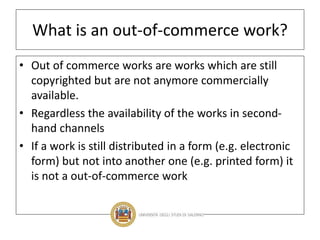
What is an out-of-commerce work?
• Out of commerce works are works which are still
copyrighted but are not anymore commercially
available.
• Regardless the availability of the works in second-
hand channels
• If a work is still distributed in a form (e.g. electronic
form) but not into another one (e.g. printed form) it
is not a out-of-commerce work
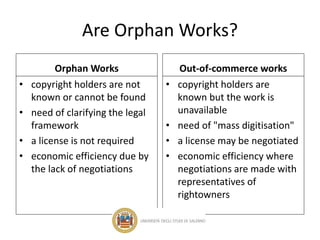
Are Orphan Works?
Orphan Works
• copyright holders are not
known or cannot be found
• need of clarifying the legal
framework
• a license is not required
• economic efficiency due by
the lack of negotiations
Out-of-commerce works
• copyright holders are
known but the work is
unavailable
• need of "mass digitisation"
• a license may be negotiated
• economic efficiency where
negotiations are made with
representatives of
rightowners
Balancing interests
• Financial interests of the copyright holders
(authors/publishers) / interests of the public
and cultural heritage preservation.
• Libraries and archives do not own any
copyright on the works / It is required a
licence agreement with the copyright holders
before digitizing out-of-commerce works
• High transaction costs for licences
High Transactional Costs
• Approximately costs for licences:
€50 and €100 for a single book
€5.70 and €50 for a single poster
€0.70 and €1.70 for a single photograph
€27 for a short amateur film
€10 for mixed collections
• And also time consuming
State of the Art
• Memorandum of Understanding (MoU)
• German Law - added § 13d and 13e to the
Urheberrechtswahrnehmungsgesetz (2014)
• French Law (2012-287 of 1 March 2012)
articles L 134-1/L 134-9 in the CPI
• Polish Law (October 2015) based on the MoU
• New provisions introduced via the
implementation of the EU Directive 2012/28
German Law
• Out-of-commerce works may be digitised if:
 Libraries or archives accessible by the public
 The digitisation is not aimed at commercial purposes
 The work is included in the Register maintained by
the German Patent and Trademark Office (DPMA)
 Right-owners do not opt-out within 6 weeks
The law covers works published in Germany
Not only books
Translations are included
Memorandum of Understanding
• Private agreement signed amongst organisations
representing libraries and copyright holders or collecting
societies
• MoU is sector-specific
• It mentions the Key Principles to be followed to license the
digitisation and making available of out-of-commerce
books or journals
• To be negotiated in the country where the work has been
firstly published /The definition of out-of-commerce work
depends on the national legislation
Proposal for a Directive on Copyright
in the Digital Single Market
• No financial interests but “great cultural, scientific,
educational, historical and entertainment value”
• Purposes: nurturing cultural diversity, educational
purposes, and participation in society (see
Communication from the Commission “Promoting a
fair, efficient and competitive European copyright-
based economy in the Digital Single Market”)
• Extensions to other works and creation of a catalogue
of European films for educational purposes
• Across border dissemination
Article 7
• CMO concludes a licence for OCWs with a cultural
heritage institution
• Cultural heritage institution: means a publicly
accessible library or museum, an archive or a film
or audio heritage institution
• Licence: a) non exclusive b) for non commercial
purposes
• How? a) digitisation, b) distribution, c)
communication to the public or d) making
available OCWs or other subject-matter
permanently in the collection of the institution
ECL
• Extended collective licensing (ECL) or presumptions
of representation
• The licence may may be extended or presumed to
apply to rightholders of the same category as those
covered by the licence who are not represented by
the collective management organisation if:
 CMO is representative of rightholders
 equal treatment is guaranteed
 rightholders may opt-out
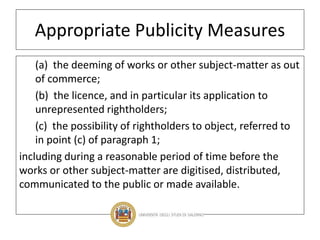
Appropriate Publicity Measures
(a) the deeming of works or other subject-matter as out
of commerce;
(b) the licence, and in particular its application to
unrepresented rightholders;
(c) the possibility of rightholders to object, referred to
in point (c) of paragraph 1;
including during a reasonable period of time before the
works or other subject-matter are digitised, distributed,
communicated to the public or made available.
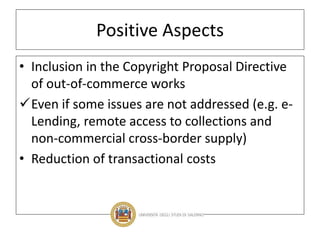
Positive Aspects
• Inclusion in the Copyright Proposal Directive
of out-of-commerce works
Even if some issues are not addressed (e.g. e-
Lending, remote access to collections and
non-commercial cross-border supply)
• Reduction of transactional costs
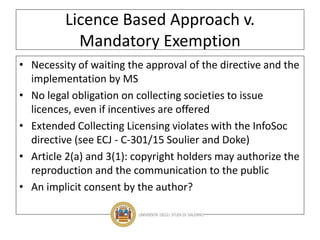
Licence Based Approach v.
Mandatory Exemption
• Necessity of waiting the approval of the directive and the
implementation by MS
• No legal obligation on collecting societies to issue
licences, even if incentives are offered
• Extended Collecting Licensing violates with the InfoSoc
directive (see ECJ - C-301/15 Soulier and Doke)
• Article 2(a) and 3(1): copyright holders may authorize the
reproduction and the communication to the public
• An implicit consent by the author?
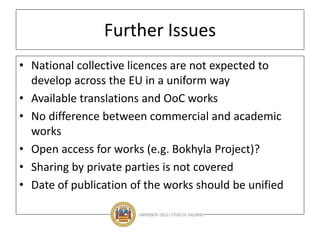
Further Issues
• National collective licences are not expected to
develop across the EU in a uniform way
• Available translations and OoC works
• No difference between commercial and academic
works
• Open access for works (e.g. Bokhyla Project)?
• Sharing by private parties is not covered
• Date of publication of the works should be unified
Thank You
gmriccio@unisa.it
GiovanniMRiccio

Out-of-Commerce Works and the Copyright Proposal Directive

  • 1.
    Out-of-Commerce Works and theCopyright Proposal Directive Giovanni Maria Riccio Università di Salerno
  • 2.
    What is anout-of-commerce work? • Out of commerce works are works which are still copyrighted but are not anymore commercially available. • Regardless the availability of the works in second- hand channels • If a work is still distributed in a form (e.g. electronic form) but not into another one (e.g. printed form) it is not a out-of-commerce work
  • 3.
    Are Orphan Works? OrphanWorks • copyright holders are not known or cannot be found • need of clarifying the legal framework • a license is not required • economic efficiency due by the lack of negotiations Out-of-commerce works • copyright holders are known but the work is unavailable • need of "mass digitisation" • a license may be negotiated • economic efficiency where negotiations are made with representatives of rightowners
  • 4.
    Balancing interests • Financialinterests of the copyright holders (authors/publishers) / interests of the public and cultural heritage preservation. • Libraries and archives do not own any copyright on the works / It is required a licence agreement with the copyright holders before digitizing out-of-commerce works • High transaction costs for licences
  • 5.
    High Transactional Costs •Approximately costs for licences: €50 and €100 for a single book €5.70 and €50 for a single poster €0.70 and €1.70 for a single photograph €27 for a short amateur film €10 for mixed collections • And also time consuming
  • 6.
    State of theArt • Memorandum of Understanding (MoU) • German Law - added § 13d and 13e to the Urheberrechtswahrnehmungsgesetz (2014) • French Law (2012-287 of 1 March 2012) articles L 134-1/L 134-9 in the CPI • Polish Law (October 2015) based on the MoU • New provisions introduced via the implementation of the EU Directive 2012/28
  • 7.
    German Law • Out-of-commerceworks may be digitised if:  Libraries or archives accessible by the public  The digitisation is not aimed at commercial purposes  The work is included in the Register maintained by the German Patent and Trademark Office (DPMA)  Right-owners do not opt-out within 6 weeks The law covers works published in Germany Not only books Translations are included
  • 8.
    Memorandum of Understanding •Private agreement signed amongst organisations representing libraries and copyright holders or collecting societies • MoU is sector-specific • It mentions the Key Principles to be followed to license the digitisation and making available of out-of-commerce books or journals • To be negotiated in the country where the work has been firstly published /The definition of out-of-commerce work depends on the national legislation
  • 9.
    Proposal for aDirective on Copyright in the Digital Single Market • No financial interests but “great cultural, scientific, educational, historical and entertainment value” • Purposes: nurturing cultural diversity, educational purposes, and participation in society (see Communication from the Commission “Promoting a fair, efficient and competitive European copyright- based economy in the Digital Single Market”) • Extensions to other works and creation of a catalogue of European films for educational purposes • Across border dissemination
  • 10.
    Article 7 • CMOconcludes a licence for OCWs with a cultural heritage institution • Cultural heritage institution: means a publicly accessible library or museum, an archive or a film or audio heritage institution • Licence: a) non exclusive b) for non commercial purposes • How? a) digitisation, b) distribution, c) communication to the public or d) making available OCWs or other subject-matter permanently in the collection of the institution
  • 11.
    ECL • Extended collectivelicensing (ECL) or presumptions of representation • The licence may may be extended or presumed to apply to rightholders of the same category as those covered by the licence who are not represented by the collective management organisation if:  CMO is representative of rightholders  equal treatment is guaranteed  rightholders may opt-out
  • 12.
    Appropriate Publicity Measures (a)the deeming of works or other subject-matter as out of commerce; (b) the licence, and in particular its application to unrepresented rightholders; (c) the possibility of rightholders to object, referred to in point (c) of paragraph 1; including during a reasonable period of time before the works or other subject-matter are digitised, distributed, communicated to the public or made available.
  • 13.
    Positive Aspects • Inclusionin the Copyright Proposal Directive of out-of-commerce works Even if some issues are not addressed (e.g. e- Lending, remote access to collections and non-commercial cross-border supply) • Reduction of transactional costs
  • 14.
    Licence Based Approachv. Mandatory Exemption • Necessity of waiting the approval of the directive and the implementation by MS • No legal obligation on collecting societies to issue licences, even if incentives are offered • Extended Collecting Licensing violates with the InfoSoc directive (see ECJ - C-301/15 Soulier and Doke) • Article 2(a) and 3(1): copyright holders may authorize the reproduction and the communication to the public • An implicit consent by the author?
  • 15.
    Further Issues • Nationalcollective licences are not expected to develop across the EU in a uniform way • Available translations and OoC works • No difference between commercial and academic works • Open access for works (e.g. Bokhyla Project)? • Sharing by private parties is not covered • Date of publication of the works should be unified
  • 16.