OURADDICTIONTObeing
Connected
BY: EMILY DUGGAN
FILM 260
FLIPBOOK
WHOHASAdevice?
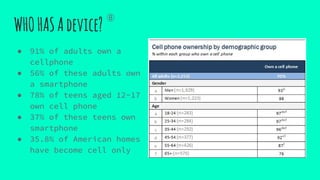
● 91% of adults own a
cellphone
● 56% of these adults own
a smartphone
● 78% of teens aged 12-17
own cell phone
● 37% of these teens own
smartphone
● 35.8% of American homes
have become cell only
⑧
WHYDOWEUSEDevices?
● Canadians use their
smartphones in three key
browsing locations – “On
the Go,” “At Home,” and
“At Work.”
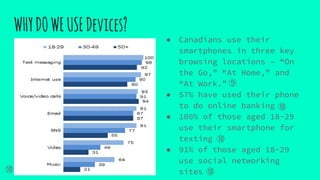
● 57% have used their phone
to do online banking
● 100% of those aged 18-29
use their smartphone for
texting
● 91% of those aged 18-29
use social networking
sites
⑨
⑩
⑩
⑩
⑩
TOPFRUSTRATIONSWITHSMARTPHONES
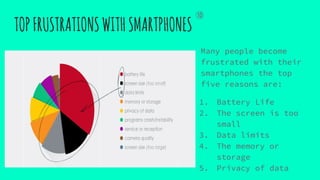
Many people become
frustrated with their
smartphones the top
five reasons are:
1. Battery Life
2. The screen is too
small
3. Data limits
4. The memory or
storage
5. Privacy of data
⑩
WHATDOESouraddictiontobeingconnectedCAUSE?
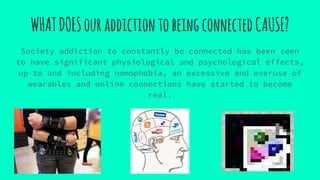
Society addiction to constantly be connected has been seen
to have significant physiological and psychological effects,
up to and including nomophobia, an excessive and overuse of
wearables and online connections have started to become
real.
PSYCHOLOGICALandphysiologicalEFFECTS
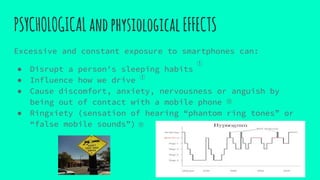
Excessive and constant exposure to smartphones can:
● Disrupt a person's sleeping habits
● Influence how we drive
● Cause discomfort, anxiety, nervousness or anguish by
being out of contact with a mobile phone
● Ringxiety (sensation of hearing “phantom ring tones” or
“false mobile sounds”)
①
⑪
⑪
①
FACEBOOKmakesusunhappy
The more that people used facebook the
less happy the user felt, their
overall satisfaction began to decline.
Envy increases with facebook use as
more time is spent browsing and less
time spent on creating.
Successful sharing activates the
reward centre in the brain
FACEBOOK IS THE SYMPTOM, NOT THE
PROBLEM
⑤
Dependency
● On average we check our phones 150x a DAY
● Our smartphones are indispensable, the device turns to
dependance
● It becomes an extension to our body
● Checking our screens becomes habit and morphs into a
reflex
②
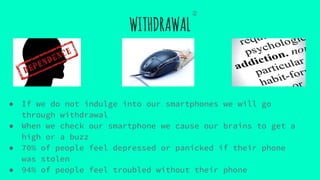
WITHDRAWAL
● If we do not indulge into our smartphones we will go
through withdrawal
● When we check our smartphone we cause our brains to get a
high or a buzz
● 70% of people feel depressed or panicked if their phone
was stolen
● 94% of people feel troubled without their phone
②
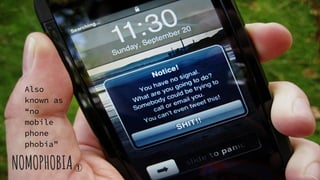
NOMOPHOBIA
Also
known as
“no
mobile
phone
phobia”
①
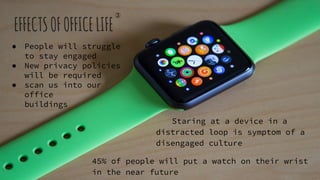
EFFECTSOFOFFICELIFE
Staring at a device in a
distracted loop is symptom of a
disengaged culture
45% of people will put a watch on their wrist
in the near future
● People will struggle
to stay engaged
● New privacy policies
will be required
● scan us into our
office
buildings
③
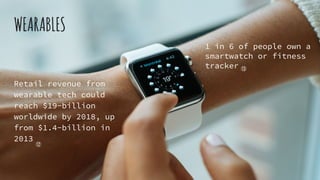
WEARABLES
Retail revenue from
wearable tech could
reach $19-billion
worldwide by 2018, up
from $1.4-billion in
2013
⑫
1 in 6 of people own a
smartwatch or fitness
tracker ⑬
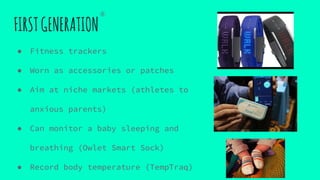
FIRSTGENERATION
● Fitness trackers
● Worn as accessories or patches
● Aim at niche markets (athletes to
anxious parents)
● Can monitor a baby sleeping and
breathing (Owlet Smart Sock)
● Record body temperature (TempTraq)
④
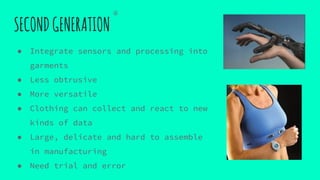
SECONDGENERATION
● Integrate sensors and processing into
garments
● Less obtrusive
● More versatile
● Clothing can collect and react to new
kinds of data
● Large, delicate and hard to assemble
in manufacturing
● Need trial and error
④
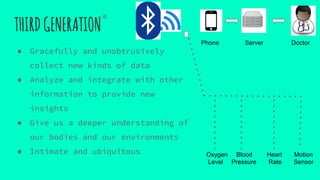
THIRDGENERATION
● Gracefully and unobtrusively
collect new kinds of data
● Analyze and integrate with other
information to provide new
insights
● Give us a deeper understanding of
our bodies and our environments
● Intimate and ubiquitous
④
Oxygen Blood Heart Motion
Level Pressure Rate Sensor
Phone Server Doctor
CYBERATTACKStodevices
50 billion
things are
connected
with the webCyber Attacks include these consequences:
● Identity theft, fraud, extortion
● Stolen hardware, such as laptops or
mobile devices
● Breach of access
● Password sniffing
● System infiltration
● Website defacement
● Private and public Web browser exploits
● Instant messaging abuse
● Intellectual property (IP) theft or
unauthorized access
Vulnerable to cyber attacks can also
include cars and even insulin pumps
⑭
⑥
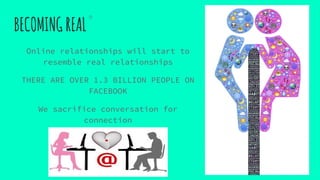
BECOMINGREAL
Online relationships will start to
resemble real relationships
THERE ARE OVER 1.3 BILLION PEOPLE ON
FACEBOOK
We sacrifice conversation for
connection
⑦
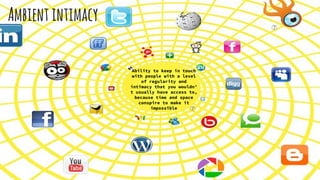
Ambientintimacy
Ability to keep in touch
with people with a level
of regularity and
intimacy that you wouldn’
t usually have access to,
because time and space
conspire to make it
impossible
⑦
⑦
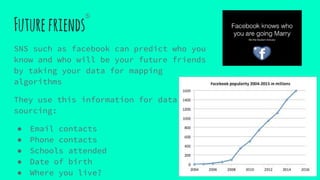
Futurefriends
SNS such as facebook can predict who you
know and who will be your future friends
by taking your data for mapping
algorithms
They use this information for data
sourcing:
● Email contacts
● Phone contacts
● Schools attended
● Date of birth
● Where you live?
⑤
SOCIALSNACKING
Mental representation in lieu of the real thing
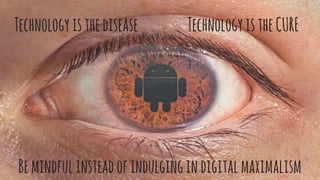
Technologyisthedisease TechnologyistheCURE
Bemindfulinsteadofindulgingindigitalmaximalism
①
REFERENCES
Module Notes
① Fund, Brian. “Why you shouldn't confuse
nomophobia with an actual addiction to smartphones.”
The Switch. Washington Post. 18 May, 2015. Web. 20
May, 2016.
② Margalit, Liraz. “Why We’re Addicted To Our
Smartphones, But Not Our Tablets.” Smashing
Magazine. 04 November, 2015. Web. 20 May, 2016.
③ Cole, Samantha. “How The Apple Watch Will Change
Office Life.” The New Rules of Work. Fast Company.
12 March, 2015. Web. 20 May, 2016.
④ Postel, Virginia. “Why Nobody's Wearing
Wearables.” Bloomberg View. 03 March, 2016. Web. 20
May, 2016.
⑤ Knooikova, Maria. “How Facebook Makes Us
Unhappy,” The New Yorker. 10 September, 2010. Web.
13 May, 2016.
⑥ “Home, hacked home; The internet of things.”
Academic One File. The Economist. 12 July, 2014.
Web. 20 May, 2016.
Outside Sources
⑦ Hansen. Nathaniel. “Ambient Intimacy and The Power of
Socializing Online.” Web Marketing Therapy. 18 January, 2011.
Web. 02 June, 2016.
⑧ Rainie, Lee. “Cell phone ownership hits 91% of adults.” Fact
Tank. Pew research Centre. 06 June, 2013. Web. 30 May, 2016.
“WITH GROWTH COMES CHANGE: THE EVOLVING MOBILE LANDSCAPE IN
2015.” The Canadian Mobile Market. Catalyst. 2015. Web. 31 May,
2016.
⑨ Smith, Aaron. “U.S. Smartphone Use in 2015.” Internet,
Science and Tech. Pew Research Centre. 01 April, 2015. Web. 31
May, 2016.
⑪ Cosco, Amanda R. “Why Toronto is a hotbed of pioneering
wearable technology.” Technology. The Globe and Mail. 15
January, 2015. Web. 01 June, 2016.
⑫Bolton, David. “Ditching smartphones for wearables.”
Wearables. Arc from Applause. 15 October, 2015. Web. 31 May,
2016.
⑬ “Techopedia explains Cyberattack.” Cyberattack. Techopedia.
N.d. Web. 30 May, 2016.
⑭ Bragazzi, Nicole L and Giovanni Del Puente. “A proposal for
including nomophobia in the new DSM-V.” US National Library of
Medicine National Institutes of Health. NCMI. 16 May, 2014.
Web. 31 May, 2016.
All images have been found using Google images with a
search tool for usage rights with the following license
filter; labelled for reuse with modification.

Our addiction to being connected

  • 1.
  • 2.
    WHOHASAdevice? ● 91% ofadults own a cellphone ● 56% of these adults own a smartphone ● 78% of teens aged 12-17 own cell phone ● 37% of these teens own smartphone ● 35.8% of American homes have become cell only ⑧
  • 3.
    WHYDOWEUSEDevices? ● Canadians usetheir smartphones in three key browsing locations – “On the Go,” “At Home,” and “At Work.” ● 57% have used their phone to do online banking ● 100% of those aged 18-29 use their smartphone for texting ● 91% of those aged 18-29 use social networking sites ⑨ ⑩ ⑩ ⑩ ⑩
  • 4.
    TOPFRUSTRATIONSWITHSMARTPHONES Many people become frustratedwith their smartphones the top five reasons are: 1. Battery Life 2. The screen is too small 3. Data limits 4. The memory or storage 5. Privacy of data ⑩
  • 5.
    WHATDOESouraddictiontobeingconnectedCAUSE? Society addiction toconstantly be connected has been seen to have significant physiological and psychological effects, up to and including nomophobia, an excessive and overuse of wearables and online connections have started to become real.
  • 6.
    PSYCHOLOGICALandphysiologicalEFFECTS Excessive and constantexposure to smartphones can: ● Disrupt a person's sleeping habits ● Influence how we drive ● Cause discomfort, anxiety, nervousness or anguish by being out of contact with a mobile phone ● Ringxiety (sensation of hearing “phantom ring tones” or “false mobile sounds”) ① ⑪ ⑪ ①
  • 7.
    FACEBOOKmakesusunhappy The more thatpeople used facebook the less happy the user felt, their overall satisfaction began to decline. Envy increases with facebook use as more time is spent browsing and less time spent on creating. Successful sharing activates the reward centre in the brain FACEBOOK IS THE SYMPTOM, NOT THE PROBLEM ⑤
  • 8.
    Dependency ● On averagewe check our phones 150x a DAY ● Our smartphones are indispensable, the device turns to dependance ● It becomes an extension to our body ● Checking our screens becomes habit and morphs into a reflex ②
  • 9.
    WITHDRAWAL ● If wedo not indulge into our smartphones we will go through withdrawal ● When we check our smartphone we cause our brains to get a high or a buzz ● 70% of people feel depressed or panicked if their phone was stolen ● 94% of people feel troubled without their phone ②
  • 10.
  • 11.
    EFFECTSOFOFFICELIFE Staring at adevice in a distracted loop is symptom of a disengaged culture 45% of people will put a watch on their wrist in the near future ● People will struggle to stay engaged ● New privacy policies will be required ● scan us into our office buildings ③
  • 12.
    WEARABLES Retail revenue from wearabletech could reach $19-billion worldwide by 2018, up from $1.4-billion in 2013 ⑫ 1 in 6 of people own a smartwatch or fitness tracker ⑬
  • 13.
    FIRSTGENERATION ● Fitness trackers ●Worn as accessories or patches ● Aim at niche markets (athletes to anxious parents) ● Can monitor a baby sleeping and breathing (Owlet Smart Sock) ● Record body temperature (TempTraq) ④
  • 14.
    SECONDGENERATION ● Integrate sensorsand processing into garments ● Less obtrusive ● More versatile ● Clothing can collect and react to new kinds of data ● Large, delicate and hard to assemble in manufacturing ● Need trial and error ④
  • 15.
    THIRDGENERATION ● Gracefully andunobtrusively collect new kinds of data ● Analyze and integrate with other information to provide new insights ● Give us a deeper understanding of our bodies and our environments ● Intimate and ubiquitous ④ Oxygen Blood Heart Motion Level Pressure Rate Sensor Phone Server Doctor
  • 16.
    CYBERATTACKStodevices 50 billion things are connected withthe webCyber Attacks include these consequences: ● Identity theft, fraud, extortion ● Stolen hardware, such as laptops or mobile devices ● Breach of access ● Password sniffing ● System infiltration ● Website defacement ● Private and public Web browser exploits ● Instant messaging abuse ● Intellectual property (IP) theft or unauthorized access Vulnerable to cyber attacks can also include cars and even insulin pumps ⑭ ⑥
  • 17.
    BECOMINGREAL Online relationships willstart to resemble real relationships THERE ARE OVER 1.3 BILLION PEOPLE ON FACEBOOK We sacrifice conversation for connection ⑦
  • 18.
    Ambientintimacy Ability to keepin touch with people with a level of regularity and intimacy that you wouldn’ t usually have access to, because time and space conspire to make it impossible ⑦ ⑦
  • 19.
    Futurefriends SNS such asfacebook can predict who you know and who will be your future friends by taking your data for mapping algorithms They use this information for data sourcing: ● Email contacts ● Phone contacts ● Schools attended ● Date of birth ● Where you live? ⑤
  • 20.
  • 21.
  • 22.
    REFERENCES Module Notes ① Fund,Brian. “Why you shouldn't confuse nomophobia with an actual addiction to smartphones.” The Switch. Washington Post. 18 May, 2015. Web. 20 May, 2016. ② Margalit, Liraz. “Why We’re Addicted To Our Smartphones, But Not Our Tablets.” Smashing Magazine. 04 November, 2015. Web. 20 May, 2016. ③ Cole, Samantha. “How The Apple Watch Will Change Office Life.” The New Rules of Work. Fast Company. 12 March, 2015. Web. 20 May, 2016. ④ Postel, Virginia. “Why Nobody's Wearing Wearables.” Bloomberg View. 03 March, 2016. Web. 20 May, 2016. ⑤ Knooikova, Maria. “How Facebook Makes Us Unhappy,” The New Yorker. 10 September, 2010. Web. 13 May, 2016. ⑥ “Home, hacked home; The internet of things.” Academic One File. The Economist. 12 July, 2014. Web. 20 May, 2016. Outside Sources ⑦ Hansen. Nathaniel. “Ambient Intimacy and The Power of Socializing Online.” Web Marketing Therapy. 18 January, 2011. Web. 02 June, 2016. ⑧ Rainie, Lee. “Cell phone ownership hits 91% of adults.” Fact Tank. Pew research Centre. 06 June, 2013. Web. 30 May, 2016. “WITH GROWTH COMES CHANGE: THE EVOLVING MOBILE LANDSCAPE IN 2015.” The Canadian Mobile Market. Catalyst. 2015. Web. 31 May, 2016. ⑨ Smith, Aaron. “U.S. Smartphone Use in 2015.” Internet, Science and Tech. Pew Research Centre. 01 April, 2015. Web. 31 May, 2016. ⑪ Cosco, Amanda R. “Why Toronto is a hotbed of pioneering wearable technology.” Technology. The Globe and Mail. 15 January, 2015. Web. 01 June, 2016. ⑫Bolton, David. “Ditching smartphones for wearables.” Wearables. Arc from Applause. 15 October, 2015. Web. 31 May, 2016. ⑬ “Techopedia explains Cyberattack.” Cyberattack. Techopedia. N.d. Web. 30 May, 2016. ⑭ Bragazzi, Nicole L and Giovanni Del Puente. “A proposal for including nomophobia in the new DSM-V.” US National Library of Medicine National Institutes of Health. NCMI. 16 May, 2014. Web. 31 May, 2016. All images have been found using Google images with a search tool for usage rights with the following license filter; labelled for reuse with modification.