THERE MAY BE
GOOD…
BUT THERE IS ALSO A LOT OF
BAD DUE TO TECHNOLOGY
BY YASMEEN MUFTI
Photo by Sean Macentee via Flickr
https://flic.kr/p/8WnyVB
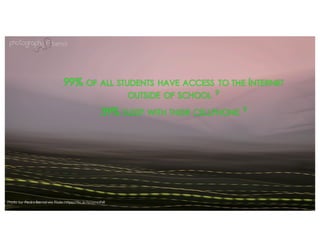
99% OF ALL STUDENTS HAVE ACCESS TO THE INTERNET
OUTSIDE OF SCHOOL 9
39% SLEEP WITH THEIR CELLPHONE 9
Photo by Pedro Bernal via Flickr: https://flic.kr/p/oma9sR
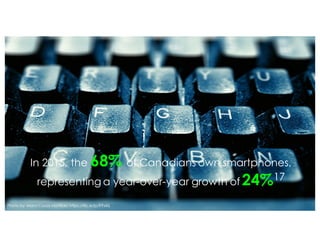
In 2015, the 68% of Canadians own smartphones,
representing a year-over-year growth of 24%17
Photo by Marci Casas via Flickr: https://flic.kr/p/99xKiL
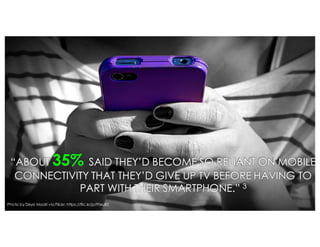
“ABOUT 35% SAID THEY’D BECOME SO RELIANT ON MOBILE
CONNECTIVITY THAT THEY’D GIVE UP TV BEFORE HAVING TO
PART WITH THEIR SMARTPHONE.” 3
Photo by Deysi Madri via Flickr: https://flic.kr/p/9feuBZ
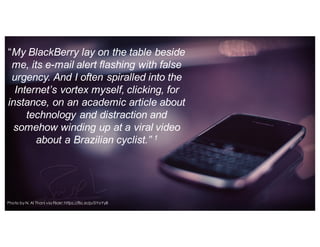
“My  BlackBerry  lay  on  the  table  beside  
me,  its  e-­mail  alert  flashing  with  false  
urgency.  And  I  often  spiralled into  the  
Internet’s  vortex  myself,  clicking,  for  
instance,  on  an  academic  article  about  
technology  and  distraction  and  
somehow  winding  up  at  a  viral  video  
about  a  Brazilian  cyclist.”  1
Photo by N. Al Thani via Flickr: https://flic.kr/p/5YoYy8
SO HOW DOES
THAT AFFECT
US?
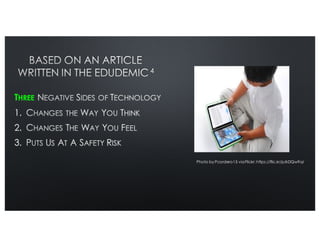
THREE
1.
2.
3.
Photo by Pcordero15 viaFlickr: https://flic.kr/p/kDQw9a/
OUR DEPENDENCY ON
TECHNOLOGY IS CHANGING THE
WAY WE LEARN, THE WAY WE
THINK AND THE WAY WE
REMEMBER LIFE.
Photo by Dorian Top via Flickr: https://flic.kr/p/rsfCnC
1
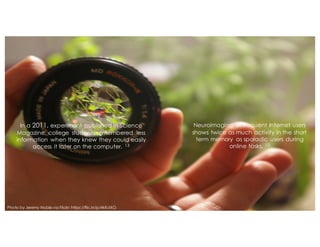
In a 2011, experiment published in Science
Magazine, college students remembered less
information when they knew they could easily
access it later on the computer. 13
Neuroimaging of frequent Internet users
shows twice as much activity in the short
term memory as sporadic users during
online tasks. 12
Photo by Jeremy Noblevia Flickr: https://flic.kr/p/4kKdXG
A REPORT FROM THE UNITED KINGDOM
REVEALED THAT KIDS WHO USE
COMPUTER GAMES AND THEIR HOME
INTERNET FOR MORE THAN FOUR HOURS
DO NOT HAVE THE SAME SENSE OF
WELLBEING AS THOSE WHO USED THAT
TECHNOLOGY FOR LESS THAN AN HOUR.
11
Photo by Northfield Mount Hermon via Flickr: https://flic.kr/p/pDZJug
TECHNOLOGY HAS COMPLETELY REWIRED OUR
BRAINS BY….
Photo by Glaudstone Agra via Flickr: https://flic.kr/p/jzMHeB
7
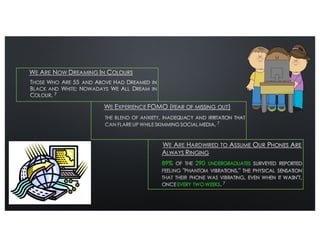
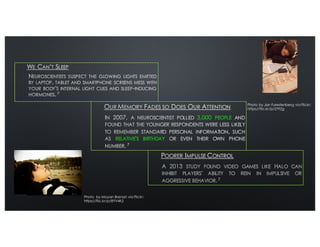
89% 290 UNDERGRADUATES
EVERY TWO WEEKS 7
3,000 PEOPLE
RELATIVE'S BIRTHDAY
7
A 2013 STUDY FOUND VIDEO GAMES LIKE HALO CAN
INHIBIT PLAYERS' ABILITY TO REIN IN IMPULSIVE OR
AGGRESSIVE BEHAVIOR. 7
Photo by Jan Furestenberg via Flickr:
https://flic.kr/p/2Yt2g
Photo by Moyan Brenan via Flickr:
https://flic.kr/p/8YV4K5
2 PEOPLE HAVE BEEN ABLE TO
FREELY VIEW ALL KINDS OF
MEDIA, AND THEREFORE HAVE A
LACK OF EMOTION WHEN THEY
SEE SOMETHING IN REAL LIFE THAT
IS NEGATIVE
Photo by Garadon Charlotte via Flickr: https://flic.kr/p/2bRVk
A study on two groups of sixth
graders found that kids who had no
access to electronic devices for five
days were better at picking up on
emotions and nonverbal cues of
photos of faces than the group that
used their devices during that time. 9
Photo by Federico Galarraga via Flickrhttps://flic.kr/p/bbUesK/
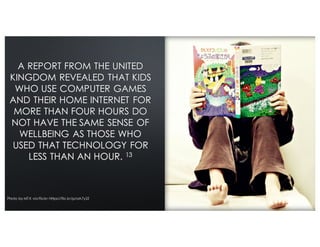
A REPORT FROM THE UNITED
KINGDOM REVEALED THAT KIDS
WHO USE COMPUTER GAMES
AND THEIR HOME INTERNET FOR
MORE THAN FOUR HOURS DO
NOT HAVE THE SAME SENSE OF
WELLBEING AS THOSE WHO
USED THAT TECHNOLOGY FOR
LESS THAN AN HOUR. 13
Photo by MT K via Flickr: https://flic.kr/p/aA7y2Z
“It’s encouraged for more
“unplugged” family interaction in
general and suggested young
children may benefit from “a
designated family hour” of quality
time spent with relatives – without
any television and mobile devices
being involved.” 14
Photo by Kyle via Flickr: https://flic.kr/p/dgeQ1B
3THE WORLD OF TECHNOLOGY HAS
GIVEN PEOPLE THE OPPORTUNITY
TO SHARE THEIR PERSONAL
INFORMATION ONLINE THEREFORE
LEADING TO SAFETY ISSUES
Photo by Elizabeth Lovatt via Flickr: https://flic.kr/p/akWd3z/
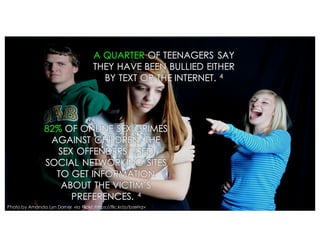
A QUARTER OF TEENAGERS SAY
THEY HAVE BEEN BULLIED EITHER
BY TEXT OR THE INTERNET. 4
82% OF ONLINE SEX CRIMES
AGAINST CHILDREN, THE
SEX OFFENDERS USED
SOCIAL NETWORKING SITES
TO GET INFORMATION
ABOUT THE VICTIM’S
PREFERENCES. 4
Photo by Amanda Lyn Dorner via Flickr: https://flic.kr/p/bzeHqv
• Use an antivirus program
• Secure Wi-Fi router
• Turn off sharing with public users
• Download only trusted files
PROTECT YOURSELF
1. PROTECT YOUR IDENTITY10
• Strong password
• Allow the privacy settings
• Mindful when installing applications
• Limit the information you share
2. PROTECT YOUR CONNECTIONS10
Photo by Skinmatevia Flickr: https://flic.kr/p/8svvkB
OVERALL THE INTERNET
IS NEW, AND PEOPLE
ARE STILL FIGURING OUT
PROPER AND HEALTHY
WAYS OF USING IT
Photo by Mahmoud Metwally via Flickr: https://flic.kr/p/azKxYW
HOWEVER, ITS ALL ABOUT UNDERSTANDING IT
NEGATIVE EFFECTS AND ENSURING THAT YOU DON’T
BECOME SO RELIANTE ON IT THAT…
YOUR MIND CHANGES, YOUR FEELINGS CHANGE AND
YOUR OVERALL SAFETY CHANGES.
Photo by Moyan Brenn via Flickr: https://flic.kr/p/9UViMr
[1] Anderssen, E. (2015, March 29). Digital overload: How we are
seduced by distraction. The Globe and Mail. Retrieved June 4, 2016, from <http://www.theglobeandm ail.com.proxy.queensu.ca/life/relationships/di gital-overload-
how-we-are-seduced- by- distraction/article17725778/?page=all>
[2] Boyd, D. (2014, March 21). Why Snapchat is Valuable: It's All About
Attention. Retrieved from https://www.linkedin.com /pulse/20140321152822-79695780-why-snapchat-is-valuable-it-s-all-about-attenti on
[3] Computer coding coming soon to Nova Scotia curriculum. (2015,
October 21). CBC News. Retrieved June 4, 2016, from http://www.cbc.ca/news/canada/nova-scotia/computer- coding-classroom-1.3281971
[4] DeLoatch, P. (2015, May 2). The Four Negative Sides of Technology. Retrieved June 04,
2016, from http://www.edudemic.com/the-4-negati ve-si de- effects-of-technol ogy/
[5] Eichler, L. (2013, October 4). Sorry to be rude, but my smartphone needs my attention. The
Globe and Mail. Retrieved June 4, 2016, from
http://www.theglobeandm ail.com.proxy.queensu.ca/report-on-business/careers/career-advice/life- at-work/sorry-to-be-rude-but-my-phone-needs-
me/article14706158/
[6] Fung, B. (2015, May 19). Why you shouldn’t confuse ‘nomophobia’ with an actual addiction
to smartphones. The Washington Post. Retrieved June 4, 2016, from https://www.washingt onpost .com/news/the-switch/wp/2015/05/19/why-you-shouldnt-confuse-
nomophobia-with-an-actual-addiction-to-sm artphones/
[7] Hiscott, R. (2014, March 14). 8 Ways Tech Has Completely Rewired Our Brains. Retrieved
June 04, 2016, from http://mashable.com /2014/03/14/tech-brains-neuropl asticity/#iBuFch0u9Eqw
[8] Kaplan, S. (2015, April 1). How the Internet makes you think you’re smarter than you really
are. The Washington Pst. Retrieved June 4, 2016, from https://www.washingt onpost.com /news/morning-mix/w p/2015/04/01/how-the-internet-makes-you-think-youre-
smarter-than-you-really-are/
References
[9] Loney, H. (2014, January 22). Canada’s youth are highly connected, girls face different rules
online: Study. Global News. Retrieved June 4, 2016, from http://globalnew s.ca/news/1098160/canadas-youth-are-
highly-connected-girls-face- different-rules- online-study/
[10] McAfee Security Advice Center. (n.d.). Retrieved June 04, 2016, from
http://home.mcafee.com /advicecenter/?i d=ad_ost_toht pyo
[11] Paton, G. (2012, October 26). Overexposure to technology 'makes children miserable' The
Telegraph. Retrieved June 4, 2016, from
http://www.telegraph.co.uk/education/educationnews/9636862/Overexposure-to-technology-makes- children-
miserable.html#disqus_thread[12] Small, G.W, T.D Moody, P Siddarth, and S.Y Bookheimer. “Your Brain on Google:
Patterns of Cerebral Activation During Internet Searching.” The American Journal of Geriatric Psychiatry : Official
Journal of the American Association for Geriatric Psychiatry. 17.2 (2009): 116-126.
Print.
[13] Sparrow, B, J Liu, and D M. Wegner. “Google Effects on Memory: Cognitive
Consequences of Having Information at Our Fingertips.” Science. 333.6043 (2011): 776-778. Print.
[15] Summers, J. (2015, August 28). Kids And Screen Time: What Does The Research Say?
Retrieved June 04, 2016, from http://www.npr.org/sections/ed/2014/08/28/343735856/kids-and-screen-time-what-does-
the-research-say
[16] Walters, J. (2015, February 2). Tablets and smartphones may affect social and emotional
development, scientists speculate. The Guardian. Retrieved June 4, 2016, from
https://www.theguardian.com /technology/2015/feb/01/t oddl er- brains- research-sm art phones- damage-social-
development
[17] With Growth Comes Changes: The 2015 Canadian Smartphone Market. (n.d.). Retrieved
June 04, 2016, from http://catalyst.ca/2015- canadian-smart phone-market/
References

There Maybe Good

  • 1.
    THERE MAY BE GOOD… BUTTHERE IS ALSO A LOT OF BAD DUE TO TECHNOLOGY BY YASMEEN MUFTI Photo by Sean Macentee via Flickr https://flic.kr/p/8WnyVB
  • 2.
    99% OF ALLSTUDENTS HAVE ACCESS TO THE INTERNET OUTSIDE OF SCHOOL 9 39% SLEEP WITH THEIR CELLPHONE 9 Photo by Pedro Bernal via Flickr: https://flic.kr/p/oma9sR
  • 3.
    In 2015, the68% of Canadians own smartphones, representing a year-over-year growth of 24%17 Photo by Marci Casas via Flickr: https://flic.kr/p/99xKiL
  • 4.
    “ABOUT 35% SAIDTHEY’D BECOME SO RELIANT ON MOBILE CONNECTIVITY THAT THEY’D GIVE UP TV BEFORE HAVING TO PART WITH THEIR SMARTPHONE.” 3 Photo by Deysi Madri via Flickr: https://flic.kr/p/9feuBZ
  • 5.
    “My  BlackBerry  lay on  the  table  beside   me,  its  e-­mail  alert  flashing  with  false   urgency.  And  I  often  spiralled into  the   Internet’s  vortex  myself,  clicking,  for   instance,  on  an  academic  article  about   technology  and  distraction  and   somehow  winding  up  at  a  viral  video   about  a  Brazilian  cyclist.”  1 Photo by N. Al Thani via Flickr: https://flic.kr/p/5YoYy8
  • 6.
    SO HOW DOES THATAFFECT US?
  • 7.
    THREE 1. 2. 3. Photo by Pcordero15viaFlickr: https://flic.kr/p/kDQw9a/
  • 8.
    OUR DEPENDENCY ON TECHNOLOGYIS CHANGING THE WAY WE LEARN, THE WAY WE THINK AND THE WAY WE REMEMBER LIFE. Photo by Dorian Top via Flickr: https://flic.kr/p/rsfCnC 1
  • 9.
    In a 2011,experiment published in Science Magazine, college students remembered less information when they knew they could easily access it later on the computer. 13 Neuroimaging of frequent Internet users shows twice as much activity in the short term memory as sporadic users during online tasks. 12 Photo by Jeremy Noblevia Flickr: https://flic.kr/p/4kKdXG
  • 10.
    A REPORT FROMTHE UNITED KINGDOM REVEALED THAT KIDS WHO USE COMPUTER GAMES AND THEIR HOME INTERNET FOR MORE THAN FOUR HOURS DO NOT HAVE THE SAME SENSE OF WELLBEING AS THOSE WHO USED THAT TECHNOLOGY FOR LESS THAN AN HOUR. 11 Photo by Northfield Mount Hermon via Flickr: https://flic.kr/p/pDZJug
  • 11.
    TECHNOLOGY HAS COMPLETELYREWIRED OUR BRAINS BY…. Photo by Glaudstone Agra via Flickr: https://flic.kr/p/jzMHeB
  • 12.
  • 13.
    3,000 PEOPLE RELATIVE'S BIRTHDAY 7 A2013 STUDY FOUND VIDEO GAMES LIKE HALO CAN INHIBIT PLAYERS' ABILITY TO REIN IN IMPULSIVE OR AGGRESSIVE BEHAVIOR. 7 Photo by Jan Furestenberg via Flickr: https://flic.kr/p/2Yt2g Photo by Moyan Brenan via Flickr: https://flic.kr/p/8YV4K5
  • 14.
    2 PEOPLE HAVEBEEN ABLE TO FREELY VIEW ALL KINDS OF MEDIA, AND THEREFORE HAVE A LACK OF EMOTION WHEN THEY SEE SOMETHING IN REAL LIFE THAT IS NEGATIVE Photo by Garadon Charlotte via Flickr: https://flic.kr/p/2bRVk
  • 15.
    A study ontwo groups of sixth graders found that kids who had no access to electronic devices for five days were better at picking up on emotions and nonverbal cues of photos of faces than the group that used their devices during that time. 9 Photo by Federico Galarraga via Flickrhttps://flic.kr/p/bbUesK/
  • 16.
    A REPORT FROMTHE UNITED KINGDOM REVEALED THAT KIDS WHO USE COMPUTER GAMES AND THEIR HOME INTERNET FOR MORE THAN FOUR HOURS DO NOT HAVE THE SAME SENSE OF WELLBEING AS THOSE WHO USED THAT TECHNOLOGY FOR LESS THAN AN HOUR. 13 Photo by MT K via Flickr: https://flic.kr/p/aA7y2Z
  • 17.
    “It’s encouraged formore “unplugged” family interaction in general and suggested young children may benefit from “a designated family hour” of quality time spent with relatives – without any television and mobile devices being involved.” 14 Photo by Kyle via Flickr: https://flic.kr/p/dgeQ1B
  • 18.
    3THE WORLD OFTECHNOLOGY HAS GIVEN PEOPLE THE OPPORTUNITY TO SHARE THEIR PERSONAL INFORMATION ONLINE THEREFORE LEADING TO SAFETY ISSUES Photo by Elizabeth Lovatt via Flickr: https://flic.kr/p/akWd3z/
  • 19.
    A QUARTER OFTEENAGERS SAY THEY HAVE BEEN BULLIED EITHER BY TEXT OR THE INTERNET. 4 82% OF ONLINE SEX CRIMES AGAINST CHILDREN, THE SEX OFFENDERS USED SOCIAL NETWORKING SITES TO GET INFORMATION ABOUT THE VICTIM’S PREFERENCES. 4 Photo by Amanda Lyn Dorner via Flickr: https://flic.kr/p/bzeHqv
  • 20.
    • Use anantivirus program • Secure Wi-Fi router • Turn off sharing with public users • Download only trusted files PROTECT YOURSELF 1. PROTECT YOUR IDENTITY10 • Strong password • Allow the privacy settings • Mindful when installing applications • Limit the information you share 2. PROTECT YOUR CONNECTIONS10 Photo by Skinmatevia Flickr: https://flic.kr/p/8svvkB
  • 21.
    OVERALL THE INTERNET ISNEW, AND PEOPLE ARE STILL FIGURING OUT PROPER AND HEALTHY WAYS OF USING IT Photo by Mahmoud Metwally via Flickr: https://flic.kr/p/azKxYW
  • 22.
    HOWEVER, ITS ALLABOUT UNDERSTANDING IT NEGATIVE EFFECTS AND ENSURING THAT YOU DON’T BECOME SO RELIANTE ON IT THAT… YOUR MIND CHANGES, YOUR FEELINGS CHANGE AND YOUR OVERALL SAFETY CHANGES. Photo by Moyan Brenn via Flickr: https://flic.kr/p/9UViMr
  • 23.
    [1] Anderssen, E.(2015, March 29). Digital overload: How we are seduced by distraction. The Globe and Mail. Retrieved June 4, 2016, from <http://www.theglobeandm ail.com.proxy.queensu.ca/life/relationships/di gital-overload- how-we-are-seduced- by- distraction/article17725778/?page=all> [2] Boyd, D. (2014, March 21). Why Snapchat is Valuable: It's All About Attention. Retrieved from https://www.linkedin.com /pulse/20140321152822-79695780-why-snapchat-is-valuable-it-s-all-about-attenti on [3] Computer coding coming soon to Nova Scotia curriculum. (2015, October 21). CBC News. Retrieved June 4, 2016, from http://www.cbc.ca/news/canada/nova-scotia/computer- coding-classroom-1.3281971 [4] DeLoatch, P. (2015, May 2). The Four Negative Sides of Technology. Retrieved June 04, 2016, from http://www.edudemic.com/the-4-negati ve-si de- effects-of-technol ogy/ [5] Eichler, L. (2013, October 4). Sorry to be rude, but my smartphone needs my attention. The Globe and Mail. Retrieved June 4, 2016, from http://www.theglobeandm ail.com.proxy.queensu.ca/report-on-business/careers/career-advice/life- at-work/sorry-to-be-rude-but-my-phone-needs- me/article14706158/ [6] Fung, B. (2015, May 19). Why you shouldn’t confuse ‘nomophobia’ with an actual addiction to smartphones. The Washington Post. Retrieved June 4, 2016, from https://www.washingt onpost .com/news/the-switch/wp/2015/05/19/why-you-shouldnt-confuse- nomophobia-with-an-actual-addiction-to-sm artphones/ [7] Hiscott, R. (2014, March 14). 8 Ways Tech Has Completely Rewired Our Brains. Retrieved June 04, 2016, from http://mashable.com /2014/03/14/tech-brains-neuropl asticity/#iBuFch0u9Eqw [8] Kaplan, S. (2015, April 1). How the Internet makes you think you’re smarter than you really are. The Washington Pst. Retrieved June 4, 2016, from https://www.washingt onpost.com /news/morning-mix/w p/2015/04/01/how-the-internet-makes-you-think-youre- smarter-than-you-really-are/ References
  • 24.
    [9] Loney, H.(2014, January 22). Canada’s youth are highly connected, girls face different rules online: Study. Global News. Retrieved June 4, 2016, from http://globalnew s.ca/news/1098160/canadas-youth-are- highly-connected-girls-face- different-rules- online-study/ [10] McAfee Security Advice Center. (n.d.). Retrieved June 04, 2016, from http://home.mcafee.com /advicecenter/?i d=ad_ost_toht pyo [11] Paton, G. (2012, October 26). Overexposure to technology 'makes children miserable' The Telegraph. Retrieved June 4, 2016, from http://www.telegraph.co.uk/education/educationnews/9636862/Overexposure-to-technology-makes- children- miserable.html#disqus_thread[12] Small, G.W, T.D Moody, P Siddarth, and S.Y Bookheimer. “Your Brain on Google: Patterns of Cerebral Activation During Internet Searching.” The American Journal of Geriatric Psychiatry : Official Journal of the American Association for Geriatric Psychiatry. 17.2 (2009): 116-126. Print. [13] Sparrow, B, J Liu, and D M. Wegner. “Google Effects on Memory: Cognitive Consequences of Having Information at Our Fingertips.” Science. 333.6043 (2011): 776-778. Print. [15] Summers, J. (2015, August 28). Kids And Screen Time: What Does The Research Say? Retrieved June 04, 2016, from http://www.npr.org/sections/ed/2014/08/28/343735856/kids-and-screen-time-what-does- the-research-say [16] Walters, J. (2015, February 2). Tablets and smartphones may affect social and emotional development, scientists speculate. The Guardian. Retrieved June 4, 2016, from https://www.theguardian.com /technology/2015/feb/01/t oddl er- brains- research-sm art phones- damage-social- development [17] With Growth Comes Changes: The 2015 Canadian Smartphone Market. (n.d.). Retrieved June 04, 2016, from http://catalyst.ca/2015- canadian-smart phone-market/ References