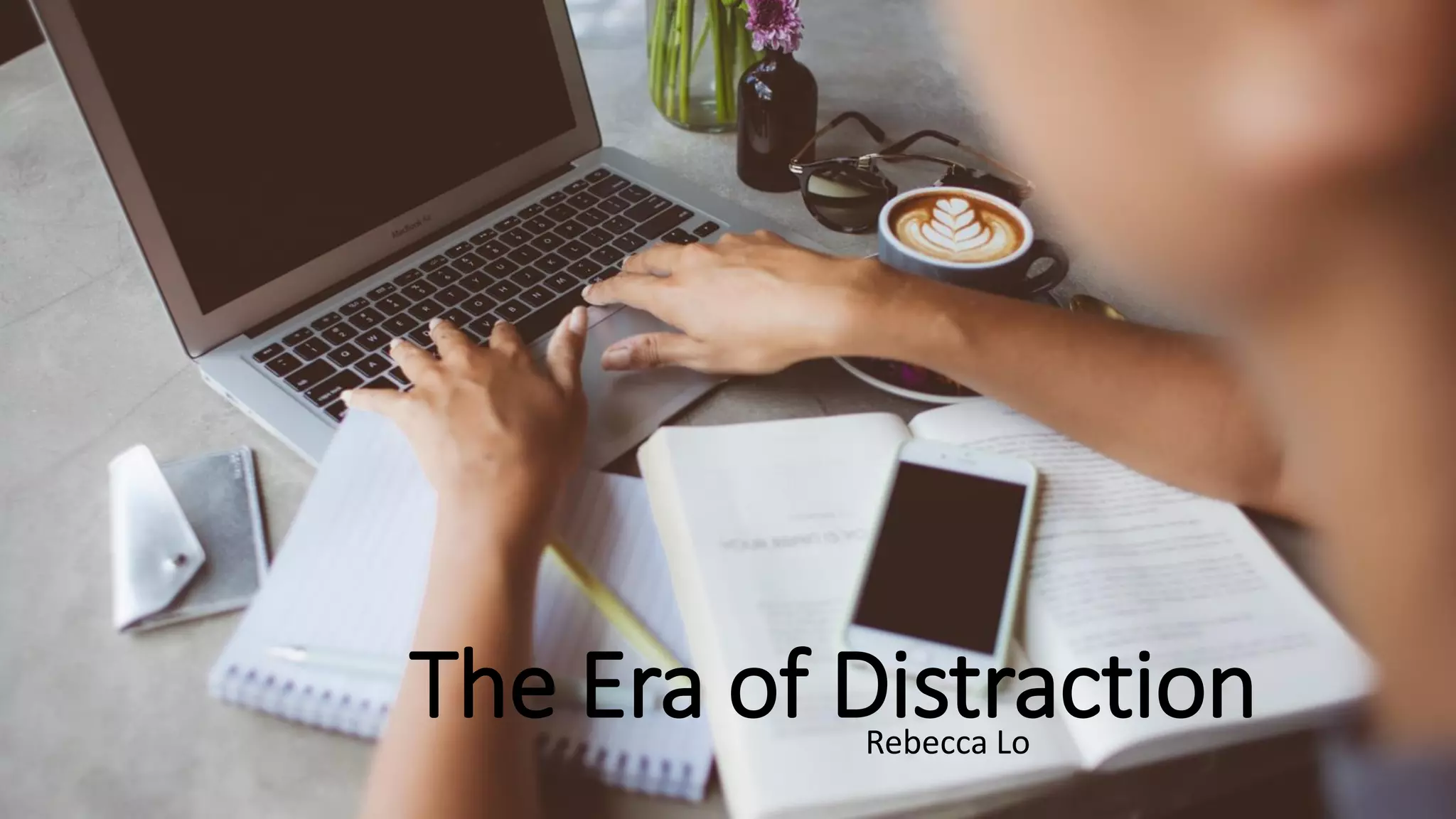
The Era of DistractionRebecca Lo
We live in a time of multicommunicating,
where no one person gets personal
attention for long (Eichler).
Canada is a world leader in online consumption.
Half of the country owns a
smartphone, and they claim to
spend 86% of their time staring
at one screen or another (Anderssen).
“Compulsion Loop”
The brain’s craving for novelty, constant
stimulation, and immediate gratification (Schwartz).
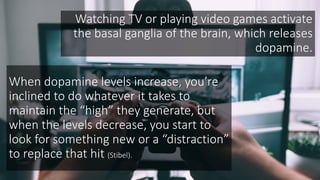
Watching TV or playing video games activate
the basal ganglia of the brain, which releases
dopamine.
When dopamine levels increase, you’re
inclined to do whatever it takes to
maintain the “high” they generate, but
when the levels decrease, you start to
look for something new or a “distraction”
to replace that hit (Stibel).
In order to deal with
the surplus of
information, our
brains form
shortcuts to deal
with it all - scanning,
searching for key
words, scrolling up
and down quickly
(Rosenwald).
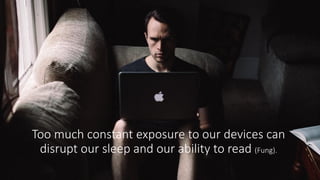
Too much constant exposure to our devices can
disrupt our sleep and our ability to read (Fung).
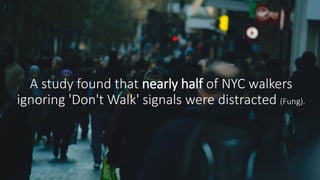
A study found that nearly half of NYC walkers
ignoring 'Don't Walk' signals were distracted (Fung).
A 2014 study in the Journal of Experimental
Psychology found that interruptions as brief as
two to three seconds were enough to double the
number of errors participants made in an
assigned task (Von Pfetten).
Distracted workers are costing
businesses $650 billion per year and
interruptions can take up as much as 6
hours of a day.
For every interruption or distraction,
it can take 23 minutes and 15
seconds to get back to where you
left off (Altrogge).
Humans now have a shorter attention
span than goldfish (McSpadden).
Microsoft found that since the year 2000 the
average attention span dropped from 12
seconds to eight seconds (McSpadden).
We need to shift from multitasking to monotasking.
It is an important ability and a form of self-
awareness (Von Pfetten).
There are apps that allow you to
create scheduled focus times,
block particular websites, or even
block the entire internet (Altrogge).
A well-rested brain is less likely to be
distracted (Stibel).
Sleep properly.
Eat well.
Good nutrition is
important to
brain
functionality (Stibel).
They tend to ramp up production of
norepinephrine and cortisol, which
lead to problems concentrating (Stibel).
Minimize stress
and anger.
Avoid time wasters. Set time limits for
online activity (Stibel).
Schedule breaks.
If you work uninterrupted for too long,
your brain will seek out distractions (Stibel).
Attention is the currency of the
digital age. Spend wisely (Pearce).
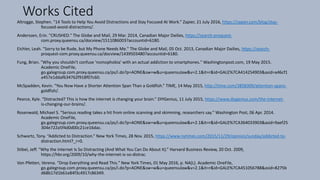
Works Cited
Altrogge, Stephen. “14 Tools to Help You Avoid Distractions and Stay Focused At Work.” Zapier, 21 July 2016, https://zapier.com/blog/stay-
focused-avoid-distractions/.
Anderssen, Erin. "CRUSHED." The Globe and Mail, 29 Mar. 2014, Canadian Major Dailies, https://search-proquest-
com.proxy.queensu.ca/docview/1511086003?accountid=6180.
Eichler, Leah. "Sorry to be Rude, but My Phone Needs Me." The Globe and Mail, 05 Oct. 2013, Canadian Major Dailies, https://search-
proquest-com.proxy.queensu.ca/docview/1439503480?accountid=6180.
Fung, Brian. "Why you shouldn't confuse 'nomophobia' with an actual addiction to smartphones." Washingtonpost.com, 19 May 2015.
Academic OneFile,
go.galegroup.com.proxy.queensu.ca/ps/i.do?p=AONE&sw=w&u=queensulaw&v=2.1&it=r&id=GALE%7CA414254903&asid=a46cf1
a457e1ddaf634762f918f07c60.
McSpadden, Kevin. “You Now Have a Shorter Attention Span Than a Goldfish.” TIME, 14 May 2015, http://time.com/3858309/attention-spans-
goldfish/.
Pearce, Kyle. “Distracted? This is how the internet is changing your brain.” DIYGenius, 11 July 2015, https://www.diygenius.com/the-internet-
is-changing-our-brains/.
Rosenwald, Michael S. "Serious reading takes a hit from online scanning and skimming, researchers say." Washington Post, 06 Apr. 2014.
Academic OneFile,
go.galegroup.com.proxy.queensu.ca/ps/i.do?p=AONE&sw=w&u=queensulaw&v=2.1&it=r&id=GALE%7CA364033903&asid=9aef25
304e722a5f4d0d00c21ce16dac.
Schwartz, Tony. “Addicted to Distraction.” New York Times, 28 Nov. 2015, https://www.nytimes.com/2015/11/29/opinion/sunday/addicted-to-
distraction.html?_r=0.
Stibel, Jeff. “Why the Internet Is So Distracting (And What You Can Do About It).” Harvard Business Review, 20 Oct. 2009,
https://hbr.org/2009/10/why-the-internet-is-so-distrac.
Von Pfetten, Verena. "Drop Everything and Read This." New York Times, 01 May 2016, p. NA(L). Academic OneFile,
go.galegroup.com.proxy.queensu.ca/ps/i.do?p=AONE&sw=w&u=queensulaw&v=2.1&it=r&id=GALE%7CA451056788&asid=8275b
d68b17d1b61e84f3c4917c86349.
All pictures used are under the Creative
Commons license and are from
Unsplash.com. They are listed in order of use.
Juliette Leufke
rawpixel.com
Alex Robert
Aaron Burden
Glenn Carstens-Peters
Markus Spiske
Andrew Neel
Alexander Dimitrov
Timothy Muza
rawpixel.com
Kazuend
William Iven
Sarah Dorweiler
Benjamin Voros
Jay Wennington
Manu Camargo
Steinar Engeland
Carlos Muza
Tim Gouw
Markus Spiske

Era of distraction

  • 1.
    The Era ofDistractionRebecca Lo
  • 2.
    We live ina time of multicommunicating, where no one person gets personal attention for long (Eichler).
  • 3.
    Canada is aworld leader in online consumption. Half of the country owns a smartphone, and they claim to spend 86% of their time staring at one screen or another (Anderssen).
  • 4.
    “Compulsion Loop” The brain’scraving for novelty, constant stimulation, and immediate gratification (Schwartz).
  • 5.
    Watching TV orplaying video games activate the basal ganglia of the brain, which releases dopamine. When dopamine levels increase, you’re inclined to do whatever it takes to maintain the “high” they generate, but when the levels decrease, you start to look for something new or a “distraction” to replace that hit (Stibel).
  • 6.
    In order todeal with the surplus of information, our brains form shortcuts to deal with it all - scanning, searching for key words, scrolling up and down quickly (Rosenwald).
  • 7.
    Too much constantexposure to our devices can disrupt our sleep and our ability to read (Fung).
  • 8.
    A study foundthat nearly half of NYC walkers ignoring 'Don't Walk' signals were distracted (Fung).
  • 9.
    A 2014 studyin the Journal of Experimental Psychology found that interruptions as brief as two to three seconds were enough to double the number of errors participants made in an assigned task (Von Pfetten).
  • 10.
    Distracted workers arecosting businesses $650 billion per year and interruptions can take up as much as 6 hours of a day. For every interruption or distraction, it can take 23 minutes and 15 seconds to get back to where you left off (Altrogge).
  • 11.
    Humans now havea shorter attention span than goldfish (McSpadden).
  • 12.
    Microsoft found thatsince the year 2000 the average attention span dropped from 12 seconds to eight seconds (McSpadden).
  • 13.
    We need toshift from multitasking to monotasking. It is an important ability and a form of self- awareness (Von Pfetten).
  • 14.
    There are appsthat allow you to create scheduled focus times, block particular websites, or even block the entire internet (Altrogge).
  • 15.
    A well-rested brainis less likely to be distracted (Stibel). Sleep properly.
  • 16.
    Eat well. Good nutritionis important to brain functionality (Stibel).
  • 17.
    They tend toramp up production of norepinephrine and cortisol, which lead to problems concentrating (Stibel). Minimize stress and anger.
  • 18.
    Avoid time wasters.Set time limits for online activity (Stibel).
  • 19.
    Schedule breaks. If youwork uninterrupted for too long, your brain will seek out distractions (Stibel).
  • 20.
    Attention is thecurrency of the digital age. Spend wisely (Pearce).
  • 21.
    Works Cited Altrogge, Stephen.“14 Tools to Help You Avoid Distractions and Stay Focused At Work.” Zapier, 21 July 2016, https://zapier.com/blog/stay- focused-avoid-distractions/. Anderssen, Erin. "CRUSHED." The Globe and Mail, 29 Mar. 2014, Canadian Major Dailies, https://search-proquest- com.proxy.queensu.ca/docview/1511086003?accountid=6180. Eichler, Leah. "Sorry to be Rude, but My Phone Needs Me." The Globe and Mail, 05 Oct. 2013, Canadian Major Dailies, https://search- proquest-com.proxy.queensu.ca/docview/1439503480?accountid=6180. Fung, Brian. "Why you shouldn't confuse 'nomophobia' with an actual addiction to smartphones." Washingtonpost.com, 19 May 2015. Academic OneFile, go.galegroup.com.proxy.queensu.ca/ps/i.do?p=AONE&sw=w&u=queensulaw&v=2.1&it=r&id=GALE%7CA414254903&asid=a46cf1 a457e1ddaf634762f918f07c60. McSpadden, Kevin. “You Now Have a Shorter Attention Span Than a Goldfish.” TIME, 14 May 2015, http://time.com/3858309/attention-spans- goldfish/. Pearce, Kyle. “Distracted? This is how the internet is changing your brain.” DIYGenius, 11 July 2015, https://www.diygenius.com/the-internet- is-changing-our-brains/. Rosenwald, Michael S. "Serious reading takes a hit from online scanning and skimming, researchers say." Washington Post, 06 Apr. 2014. Academic OneFile, go.galegroup.com.proxy.queensu.ca/ps/i.do?p=AONE&sw=w&u=queensulaw&v=2.1&it=r&id=GALE%7CA364033903&asid=9aef25 304e722a5f4d0d00c21ce16dac. Schwartz, Tony. “Addicted to Distraction.” New York Times, 28 Nov. 2015, https://www.nytimes.com/2015/11/29/opinion/sunday/addicted-to- distraction.html?_r=0. Stibel, Jeff. “Why the Internet Is So Distracting (And What You Can Do About It).” Harvard Business Review, 20 Oct. 2009, https://hbr.org/2009/10/why-the-internet-is-so-distrac. Von Pfetten, Verena. "Drop Everything and Read This." New York Times, 01 May 2016, p. NA(L). Academic OneFile, go.galegroup.com.proxy.queensu.ca/ps/i.do?p=AONE&sw=w&u=queensulaw&v=2.1&it=r&id=GALE%7CA451056788&asid=8275b d68b17d1b61e84f3c4917c86349.
  • 22.
    All pictures usedare under the Creative Commons license and are from Unsplash.com. They are listed in order of use. Juliette Leufke rawpixel.com Alex Robert Aaron Burden Glenn Carstens-Peters Markus Spiske Andrew Neel Alexander Dimitrov Timothy Muza rawpixel.com Kazuend William Iven Sarah Dorweiler Benjamin Voros Jay Wennington Manu Camargo Steinar Engeland Carlos Muza Tim Gouw Markus Spiske