The Future of Rendering
#GTC16 #OTOY #OctaneRender
OTOY Inc.
April 2016
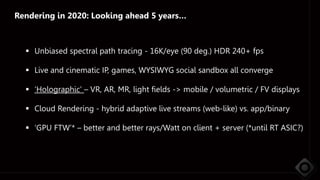
Rendering in 2020: Looking ahead 5 years…
 Unbiased spectral path tracing - 16K/eye (90 deg.) HDR 240+ fps
 Live and cinematic IP, games, WYSIWYG social sandbox all converge
 ‘Holographic’ – VR, AR, MR, light fields -> mobile / volumetric / FV displays
 Cloud Rendering - hybrid adaptive live streams (web-like) vs. app/binary
 ‘GPU FTW’* – better and better rays/Watt on client + server (*until RT ASIC?)
2015 Recap
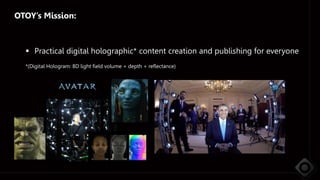
OTOY’s Mission:
 Practical digital holographic* content creation and publishing for everyone
*(Digital Hologram: 8D light field volume + depth + reflectance)
OCTANERENDER AND SPACE STATION 76
3
OCTANERENDER AND SPACE STATION 76
3.X
OCTANERENDER AND SPACE STATION 76
3.0
May 15th
3.0
OXR – Octane Film Buffer
 OXR – a file which stores a snapshot of the Octane film
buffer (it’s a subset of ORBX)
 Links and/or embeds to assets required to resume
rendering are included (not needed w/ ORC)
 All imager/post processing nodes work on film buffer,
not baked in OXR file
 ORC – import or export OXR film buffers. Key
requirement for commercial launch…
3.0
Deep Motion buffers (OXR)
 Deep Motion = multi-light for time/space
 Render @ 24 fps but output 240 frames per sec.
 Huge savings just in frame and scene load times...
 Essential for VR renders where 90 – 120 fps is baseline
– BTW Carmack says 300 fps!
 Can also be used to speed up stereo rendering
3.0
ORC – OctaneRender Cloud
 ORC is deeply integrated in Octane 3.0 and all 3.0
plug-ins going forward
 Cloud render is one a click away within Octane. Each
ORC render can pop open a web page to view
status/result.
 Delta synching – only changed assets are sent to ORC.
Huge savings in bandwidth vs. earlier workflows.
 ORBX/OCS versioning – ORC can roll back to a
previous snapshot sent to ORC.
3.0
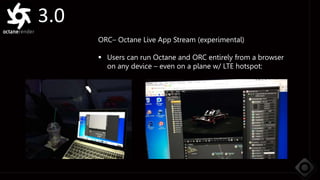
ORC– Octane Live App Stream (experimental)
 Users can run Octane and ORC entirely from a browser
on any device – even on a plane w/ LTE hotspot:
3.0
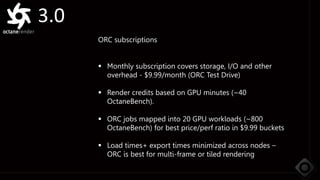
ORC subscriptions
 Monthly subscription covers storage, I/O and other
overhead - $9.99/month (ORC Test Drive)
 Render credits based on GPU minutes (~40
OctaneBench).
 ORC jobs mapped into 20 GPU workloads (~800
OctaneBench) for best price/perf ratio in $9.99 buckets
 Load times+ export times minimized across nodes –
ORC is best for multi-frame or tiled rendering
3.0
ORC – 2016 roadmap
 Aiming for 50% more power per GPU minute once
service scales close to last year RTM numbers
 CPU jobs like OKX compression can run for free while
GPU is rendering next frame
 Adding more regions and many more providers over
the coming months…
 AWS, Azure, SoftLayer and OTOY LA (mini ORC region)
3.0
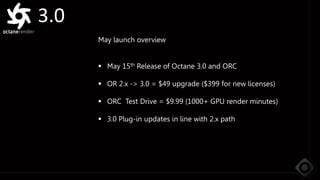
May launch overview
 May 15th Release of Octane 3.0 and ORC
 OR 2.x -> 3.0 = $49 upgrade ($399 for new licenses)
 ORC Test Drive = $9.99 (1000+ GPU render minutes)
 3.0 Plug-in updates in line with 2.x path
What’s next?
OCTANERENDER AND SPACE STATION 76
3.1
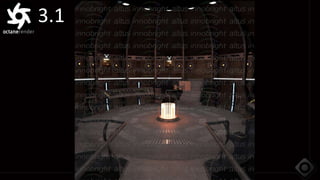
Alpha 3.1 build as of today…
3.1
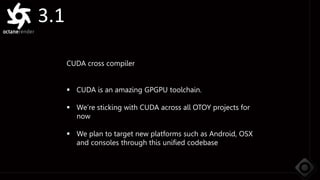
CUDA cross compiler
 CUDA is an amazing GPGPU toolchain.
 We’re sticking with CUDA across all OTOY projects for
now
 We plan to target new platforms such as Android, OSX
and consoles through this unified codebase
3.1
CUDA cross compiler for non-GPUs
 CPU will be first backend we ship in 3.1 alpha – won’t
be fast (20 core Xeon < GK104 )
 thinking about outlier hardware options beyond GPU
and CPU…
 Each new GPU family/device we support requires 2-8
weeks of optimization work – including Pascal (next)
3.1
Octane Shader Compiler
 Part of larger compiler work being done at OTOY
 OSL is subset of Octane’s shader VM
 AOV shaders are in Octane but extensions to OSL are
needed to expose them fully…
 With 3.1 we are introducing API for any shader
language - with OSL. as default
3.1
Octane Shader Compiler
 We are working with NVIDIA on an MDL front end for
the Octane Shader Compiler
 Also exploring GLSL (would love to see shader toy
textures)
 On CPU we support both JIT and VM modes for
shaders to cover all platforms
3.1
ORBX native plug-ins
 Designed to keep Octane 3.1 features growing with
new 1st and 3rd party extensions for long time to come
 Limited only by what Octane C API exposes – but that
is a lot!
 ORBX plug-ins may be pulled in to Octane node
system like LiveDB materials –must be whitelisted.
3.1
ORBX native plug-ins
 ORBX plug-ins can be offered, sold or licensed
through otoy.com alongside OR and DCC plug-ins
 ORBX packager in 3.1 adds crypto, digital signing and
various lossless compression options for all ORBX
node types
 ORBX plug-ins can also be used in ORBX Media Player
3.1
ORBX plug-in ecosystem
 Scripting: looking at V8 plug-in for JS/LLVM script
nodes
 Textures: Substance Designer plug-in being developed
 Physics plug-ins for rigid, soft and fluid dynamics (e.g.
TFD)
3.1
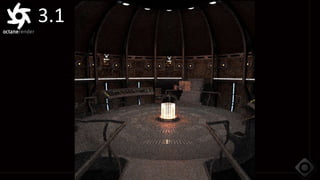
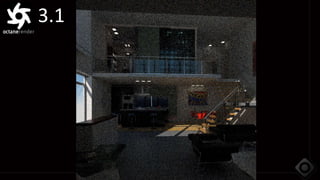
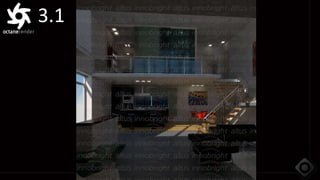
ORBX Denoiser case study
 Atlus ORBX native WIP plug-in
 Hooked into OR film buffer system
 Needs it’s own GPU (3 GB+ VRAM)
 But results are really nice – even at 16 spp!
3.1
3.1
3.1
3.1
3.1
ORBX native plug-ins:
 Shader languages: OSL, MDL, GLSL et al
 Media/3D file handlers: glTF ( in place of FBX), CT
scans for medical data as volumes
 Widgets and UX extensions
 UDIM/PTEX plug-ins (implemented in some apps,
should be supported widely)
3.1
Native skinned meshes and bones
 Optimized character animation inside Octane for
dynamic characters
 Basis for new animated mesh types (other than .abc)
 Exploring glTF instead of FBX as it is more compact
and can also be supported in ORBX media player
3.1
Refinement of 3.0 features:
 New Displacement and Rounded Edges codebase
 Adaptive Sampling
 UX scene tools (proxies for audio, light field volumes,
and scene editing)
 Faster Mesh loading/compiling
What’s next?
OCTANERENDER AND SPACE STATION 76
engine
OctaneEngine
Major expansion of Octane ecosystem 
 OctaneEngine = Octane API refactored as ORBX
module + running as web/socket server
 Foundation for major features beyond 3.1
 Legacy app/plug-in model is starting to hold us back..
 OE will be subscription option in tandem w/ 3.1 box
licenses
OctaneEngine
Zero GPU mode
 Octane plug-ins will no longer require a GPU on local
machine – connect to OE server over LAN (or WAN on
high speed connection).
 Max, Maya and Blender 3.0 plug-ins pushed out until
now so we could include OE API support
 Speed is looking on par w/ local GPU over 1 Gbps
 OSX - MacPro (aging D700s), MacBook (no AMD/NV
GPU) et al.
OctaneEngine
New rental price points for artists, studios and pros
 $19.99/month – same features as Octane
standalone/network slave
 $9.99/month - Octane on up to 2x GPUs. Ideal for
students, smaller studios, or remote second license…
 OE Plug-ins (using new OE API) will be $9.99/month
 OE bundles/suites (e.g. 2, 3 or more plug-ins) priced at
$19.99/month
OctaneEngine
New Enterprise Plans (monthly pricing TBD)
 Network rendering - up to 200 GPUs via certified GPU
appliances w/ 10GE+ networking
 ORC in a box – create a virtual private ORC region
using your GPU appliances. All the features of the ORC
public cloud, but provisioned in your own DC.
 NVIDIA and other partners working on HW
certification path.
OctaneEngine
Asynchronous Render Graph API
 New API allows Octane to build node trees with
asynchronous I/O and queues – similar to ORC but
internalized in Octane node system in future OE
release.
 Simple use case: baking camera -> texture input of
light mapped mesh -> real time OR preview
 API for light field photon cache – could be used for
biased rendering shaders and plug-ins.
OctaneEngine
Collaborative Scene Graph API
 Allows multiple clients to connect to a single
OctaneEngine node and receive a unique viewport for
the current render target
 Changes in the scene graph can be handled by any
connected application through new OE API (under
development)
 Powerful framework for merging app workflows– e.g.
Motion Builder + Max +Nuke + Unreal Engine all
controlling and editing the same scene across LAN
OctaneEngine
WebSocket API
 OctaneEngine exposed as web service via WS/TCP and
UDP. This is coming to ORC down the line…
 Web desktop recreating Octane Standalone UI in
HTML5 –combined with OE web service, means no
need for standalone app.
 Services like Vizor.io and clara.io can tap into Octane
as a web service for live viewports or offline jobs
powered by ORC credits.
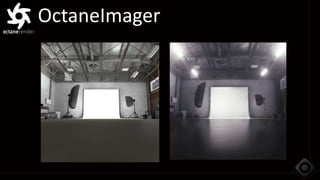
OctaneImager
OctaneImager
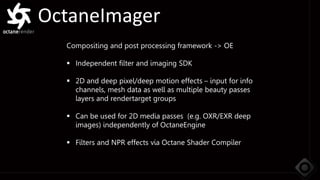
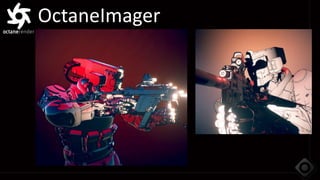
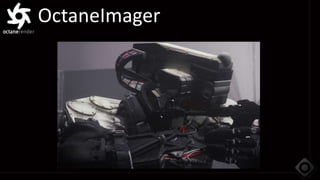
Compositing and post processing framework -> OE
 Independent filter and imaging SDK
 2D and deep pixel/deep motion effects – input for info
channels, mesh data as well as multiple beauty passes
layers and rendertarget groups
 Can be used for 2D media passes (e.g. OXR/EXR deep
images) independently of OctaneEngine
 Filters and NPR effects via Octane Shader Compiler
OctaneImager
OctaneImager
OctaneImager
Brigade - Towards Real Time Path Tracing…
Dynamic noise free rendering in Brigade ( ~3200 OctaneBench )
…vs. single 980 (~1/32 the GPU power @ 100 OctaneBench )…
Brigade - Towards Real Time path tracing at 120+ fps
Octane – Towards Real Time path tracing at highest quality…
OCTANERENDER AND SPACE STATION 76
1, 2, 3 …
2012-2016…
OCTANERENDER AND SPACE STATION 76
4
2017
OCTANERENDER AND SPACE STATION 76
4
+ Brigade 
4
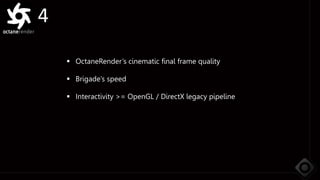
 OctaneRender’s cinematic final frame quality
 Brigade’s speed
 Interactivity >= OpenGL / DirectX legacy pipeline
4
 Octane 4 integrates all of Brigade’s features to date
 Supported in all OE plug-ins – including final releases
of Unity/UE4 and Motion builder plug-ins
 Focus on next gen HW for much better speed
 Deeper APIs for game engines – especially UE4!
4
 Filtering + smart sampling to get noise free PT in real
time
 Mobile + Console backbends e.g. Android/Vulkan,
PSVR and iOS (key to VR/AER)
 Speed ups will be as impactful for offline rendering
 Much faster IES lights, point lights. Etc.
HAIR / FUR
Thank you!

OTOY Presentation - 2016 NVIDIA GPU Technology Conference - April 5 2016

  • 1.
    The Future ofRendering #GTC16 #OTOY #OctaneRender OTOY Inc. April 2016
  • 2.
    Rendering in 2020:Looking ahead 5 years…  Unbiased spectral path tracing - 16K/eye (90 deg.) HDR 240+ fps  Live and cinematic IP, games, WYSIWYG social sandbox all converge  ‘Holographic’ – VR, AR, MR, light fields -> mobile / volumetric / FV displays  Cloud Rendering - hybrid adaptive live streams (web-like) vs. app/binary  ‘GPU FTW’* – better and better rays/Watt on client + server (*until RT ASIC?)
  • 3.
  • 4.
    OTOY’s Mission:  Practicaldigital holographic* content creation and publishing for everyone *(Digital Hologram: 8D light field volume + depth + reflectance)
  • 7.
  • 8.
  • 9.
  • 10.
  • 11.
  • 12.
  • 13.
  • 14.
  • 15.
    OCTANERENDER AND SPACESTATION 76 3.X
  • 16.
    OCTANERENDER AND SPACESTATION 76 3.0 May 15th
  • 17.
    3.0 OXR – OctaneFilm Buffer  OXR – a file which stores a snapshot of the Octane film buffer (it’s a subset of ORBX)  Links and/or embeds to assets required to resume rendering are included (not needed w/ ORC)  All imager/post processing nodes work on film buffer, not baked in OXR file  ORC – import or export OXR film buffers. Key requirement for commercial launch…
  • 18.
    3.0 Deep Motion buffers(OXR)  Deep Motion = multi-light for time/space  Render @ 24 fps but output 240 frames per sec.  Huge savings just in frame and scene load times...  Essential for VR renders where 90 – 120 fps is baseline – BTW Carmack says 300 fps!  Can also be used to speed up stereo rendering
  • 19.
    3.0 ORC – OctaneRenderCloud  ORC is deeply integrated in Octane 3.0 and all 3.0 plug-ins going forward  Cloud render is one a click away within Octane. Each ORC render can pop open a web page to view status/result.  Delta synching – only changed assets are sent to ORC. Huge savings in bandwidth vs. earlier workflows.  ORBX/OCS versioning – ORC can roll back to a previous snapshot sent to ORC.
  • 20.
    3.0 ORC– Octane LiveApp Stream (experimental)  Users can run Octane and ORC entirely from a browser on any device – even on a plane w/ LTE hotspot:
  • 21.
    3.0 ORC subscriptions  Monthlysubscription covers storage, I/O and other overhead - $9.99/month (ORC Test Drive)  Render credits based on GPU minutes (~40 OctaneBench).  ORC jobs mapped into 20 GPU workloads (~800 OctaneBench) for best price/perf ratio in $9.99 buckets  Load times+ export times minimized across nodes – ORC is best for multi-frame or tiled rendering
  • 22.
    3.0 ORC – 2016roadmap  Aiming for 50% more power per GPU minute once service scales close to last year RTM numbers  CPU jobs like OKX compression can run for free while GPU is rendering next frame  Adding more regions and many more providers over the coming months…  AWS, Azure, SoftLayer and OTOY LA (mini ORC region)
  • 23.
    3.0 May launch overview May 15th Release of Octane 3.0 and ORC  OR 2.x -> 3.0 = $49 upgrade ($399 for new licenses)  ORC Test Drive = $9.99 (1000+ GPU render minutes)  3.0 Plug-in updates in line with 2.x path
  • 24.
  • 25.
    OCTANERENDER AND SPACESTATION 76 3.1
  • 26.
    Alpha 3.1 buildas of today…
  • 27.
    3.1 CUDA cross compiler CUDA is an amazing GPGPU toolchain.  We’re sticking with CUDA across all OTOY projects for now  We plan to target new platforms such as Android, OSX and consoles through this unified codebase
  • 28.
    3.1 CUDA cross compilerfor non-GPUs  CPU will be first backend we ship in 3.1 alpha – won’t be fast (20 core Xeon < GK104 )  thinking about outlier hardware options beyond GPU and CPU…  Each new GPU family/device we support requires 2-8 weeks of optimization work – including Pascal (next)
  • 29.
    3.1 Octane Shader Compiler Part of larger compiler work being done at OTOY  OSL is subset of Octane’s shader VM  AOV shaders are in Octane but extensions to OSL are needed to expose them fully…  With 3.1 we are introducing API for any shader language - with OSL. as default
  • 30.
    3.1 Octane Shader Compiler We are working with NVIDIA on an MDL front end for the Octane Shader Compiler  Also exploring GLSL (would love to see shader toy textures)  On CPU we support both JIT and VM modes for shaders to cover all platforms
  • 31.
    3.1 ORBX native plug-ins Designed to keep Octane 3.1 features growing with new 1st and 3rd party extensions for long time to come  Limited only by what Octane C API exposes – but that is a lot!  ORBX plug-ins may be pulled in to Octane node system like LiveDB materials –must be whitelisted.
  • 32.
    3.1 ORBX native plug-ins ORBX plug-ins can be offered, sold or licensed through otoy.com alongside OR and DCC plug-ins  ORBX packager in 3.1 adds crypto, digital signing and various lossless compression options for all ORBX node types  ORBX plug-ins can also be used in ORBX Media Player
  • 33.
    3.1 ORBX plug-in ecosystem Scripting: looking at V8 plug-in for JS/LLVM script nodes  Textures: Substance Designer plug-in being developed  Physics plug-ins for rigid, soft and fluid dynamics (e.g. TFD)
  • 34.
    3.1 ORBX Denoiser casestudy  Atlus ORBX native WIP plug-in  Hooked into OR film buffer system  Needs it’s own GPU (3 GB+ VRAM)  But results are really nice – even at 16 spp!
  • 35.
  • 36.
  • 37.
  • 38.
  • 39.
    3.1 ORBX native plug-ins: Shader languages: OSL, MDL, GLSL et al  Media/3D file handlers: glTF ( in place of FBX), CT scans for medical data as volumes  Widgets and UX extensions  UDIM/PTEX plug-ins (implemented in some apps, should be supported widely)
  • 40.
    3.1 Native skinned meshesand bones  Optimized character animation inside Octane for dynamic characters  Basis for new animated mesh types (other than .abc)  Exploring glTF instead of FBX as it is more compact and can also be supported in ORBX media player
  • 41.
    3.1 Refinement of 3.0features:  New Displacement and Rounded Edges codebase  Adaptive Sampling  UX scene tools (proxies for audio, light field volumes, and scene editing)  Faster Mesh loading/compiling
  • 42.
  • 43.
    OCTANERENDER AND SPACESTATION 76 engine
  • 44.
    OctaneEngine Major expansion ofOctane ecosystem   OctaneEngine = Octane API refactored as ORBX module + running as web/socket server  Foundation for major features beyond 3.1  Legacy app/plug-in model is starting to hold us back..  OE will be subscription option in tandem w/ 3.1 box licenses
  • 45.
    OctaneEngine Zero GPU mode Octane plug-ins will no longer require a GPU on local machine – connect to OE server over LAN (or WAN on high speed connection).  Max, Maya and Blender 3.0 plug-ins pushed out until now so we could include OE API support  Speed is looking on par w/ local GPU over 1 Gbps  OSX - MacPro (aging D700s), MacBook (no AMD/NV GPU) et al.
  • 46.
    OctaneEngine New rental pricepoints for artists, studios and pros  $19.99/month – same features as Octane standalone/network slave  $9.99/month - Octane on up to 2x GPUs. Ideal for students, smaller studios, or remote second license…  OE Plug-ins (using new OE API) will be $9.99/month  OE bundles/suites (e.g. 2, 3 or more plug-ins) priced at $19.99/month
  • 47.
    OctaneEngine New Enterprise Plans(monthly pricing TBD)  Network rendering - up to 200 GPUs via certified GPU appliances w/ 10GE+ networking  ORC in a box – create a virtual private ORC region using your GPU appliances. All the features of the ORC public cloud, but provisioned in your own DC.  NVIDIA and other partners working on HW certification path.
  • 48.
    OctaneEngine Asynchronous Render GraphAPI  New API allows Octane to build node trees with asynchronous I/O and queues – similar to ORC but internalized in Octane node system in future OE release.  Simple use case: baking camera -> texture input of light mapped mesh -> real time OR preview  API for light field photon cache – could be used for biased rendering shaders and plug-ins.
  • 49.
    OctaneEngine Collaborative Scene GraphAPI  Allows multiple clients to connect to a single OctaneEngine node and receive a unique viewport for the current render target  Changes in the scene graph can be handled by any connected application through new OE API (under development)  Powerful framework for merging app workflows– e.g. Motion Builder + Max +Nuke + Unreal Engine all controlling and editing the same scene across LAN
  • 50.
    OctaneEngine WebSocket API  OctaneEngineexposed as web service via WS/TCP and UDP. This is coming to ORC down the line…  Web desktop recreating Octane Standalone UI in HTML5 –combined with OE web service, means no need for standalone app.  Services like Vizor.io and clara.io can tap into Octane as a web service for live viewports or offline jobs powered by ORC credits.
  • 51.
  • 52.
    OctaneImager Compositing and postprocessing framework -> OE  Independent filter and imaging SDK  2D and deep pixel/deep motion effects – input for info channels, mesh data as well as multiple beauty passes layers and rendertarget groups  Can be used for 2D media passes (e.g. OXR/EXR deep images) independently of OctaneEngine  Filters and NPR effects via Octane Shader Compiler
  • 53.
  • 54.
  • 55.
  • 56.
    Brigade - TowardsReal Time Path Tracing…
  • 57.
    Dynamic noise freerendering in Brigade ( ~3200 OctaneBench )
  • 58.
    …vs. single 980(~1/32 the GPU power @ 100 OctaneBench )…
  • 59.
    Brigade - TowardsReal Time path tracing at 120+ fps
  • 60.
    Octane – TowardsReal Time path tracing at highest quality…
  • 61.
    OCTANERENDER AND SPACESTATION 76 1, 2, 3 … 2012-2016…
  • 62.
    OCTANERENDER AND SPACESTATION 76 4 2017
  • 63.
    OCTANERENDER AND SPACESTATION 76 4 + Brigade 
  • 64.
    4  OctaneRender’s cinematicfinal frame quality  Brigade’s speed  Interactivity >= OpenGL / DirectX legacy pipeline
  • 65.
    4  Octane 4integrates all of Brigade’s features to date  Supported in all OE plug-ins – including final releases of Unity/UE4 and Motion builder plug-ins  Focus on next gen HW for much better speed  Deeper APIs for game engines – especially UE4!
  • 66.
    4  Filtering +smart sampling to get noise free PT in real time  Mobile + Console backbends e.g. Android/Vulkan, PSVR and iOS (key to VR/AER)  Speed ups will be as impactful for offline rendering  Much faster IES lights, point lights. Etc.
  • 67.