Othello
Background Notes
THE PLAY
Othello Background
Basic Info
• Othello unlike other Shakespearean
tragedies
• No secondary plot like his other tragedies
• Villain (Iago) is responsible for the
downfall of the tragic hero (Othello)
• Ideas for this play taken from a collection of
tales called Hecatommithi by Giraldi
Cinthio, published in Venice in 1566
Writing of the Play
Othello: This play was
probably written in
1603 or 1604, a little
past the middle of
Shakespeare's career
(he was 40).
Performed at the royal
court
Christmas season of
1604
when command
performances of
entertainments for the
king and courtiers were
customary.
That means it had
probably already been
a success.
Performance
First recorded
performance took
place in 1604 for King
James I; Richard
Burbage,
Shakespeare’s partner
and fellow actor,
played Othello
Main Characters
Othello:
Soldier from North Africa;
Employed as a general by
the city-state of Venice;
Highly respected, but still
an “outsider” because of
his skin color;
Marries Desdemona
Main Characters, cont.
Desdemona
Beautiful and
accomplished young
Venetian woman;
Protected by her father;
She stands for love, trust,
and purity—all that
makes life meaningful
and worth living
Main Characters, cont.
Iago
Soldier who works
with Othello;
Wants to be Othello’s
second in command
but is passed over for
Cassio;
Seeks vicious revenge;
Plots to destroy all that
Othello values
Emilia
Maidservant to Desdemona;
married to Iago;
loyal to Desdemona, but
will tell lies if it will help
her husband
Main Characters, cont.
Cassio
Gentleman soldier,
Not much real experience
Man of ability, loyalty
and grace;
Respects Desdemona and
Othello;
Is NOT a love interest for
Desdemona;
Suffers from a drinking
problem
Brabantio
Father of Desdemona;
Venetian nobleman and
senator
Roderigo
In love with Desdemona;
Listens to Iago’s plan to
get Desdemona away
from Othello;
A fool!
Static & Dynamic Characters
Dynamic Character–
Character changes from
beginning to end
Static Character –
Character does not change
Static & Dynamic Characters
Othello is a strong example of a
DYNAMIC CHARACTER
Courageous Venetian soldier
Well respected
Has reputation as man of honor
Has vicious temper
Becomes enraged with jealousy
Static & Dynamic Characters
Iago is a STATIC CHARACTER
Corrupt character
Hypocritical
Evil
Selfish
Focused throughout the play to destroy
Othello
Foil
FOIL—character who
highlights or emphasizes
certain traits of the main
character by contrasting
them
EX: Emilia is the foil to
Desdemona
EX: Cassio is the foil to Iago
Conflicts, Internal
Othello vs.
Himself
Doesn’t want
to distrust
Desdemona
Insecure
about his
qualities to
enable
Desdemona
to love him
Conflicts, External
Iago vs. Othello
Iago hates Othello
and plots to bring
about his downfall
Iago vs. Cassio
Iago is jealous of
Cassio, and works
to ruin his reputation, as well as separate him from
Othello’s friendship
Irony – 3 Types
Dramatic Irony:
a contradiction between what a character thinks
and what the reader or audience knows to be
true
Situational Irony:
an event occurs that directly contradicts the
expectations of the characters, readers, or
audience
Verbal Irony:
words are used to suggest the opposite of what
is meant (i.e. sarcasm, double-entendre, etc.)
Themes
Destructive nature of
Jealousy
Iago jealous of Cassio’s
position
Othello suspecting
Desdemona’s unfaithfulness
Importance of Honor and
Reputation
Cassio
Desdemona
Being an outsider
Prejudice against Othello
Skin color
– Black & White Imagery
From Africa, not Venice
Warrior rather than
courtier and politician
Unfamiliar with societal
conventions
Dealt mainly with men and
battle, not women and love
Themes
Appearance Versus Reality
“Honest Iago”
Desdemona & Cassio
Loyalty Versus Treachery
The ones Othello believes
are treacherous are actually
loyal
Cassio
Desdemona
Role of Emilia
With her husband
With Desdemona
Motifs
MOTIFS—Major
topics related to theme
Animals
Jealousy
Sight and darkness
The handkerchief
Magic
Evil and the devil
Setting
Act I
Venice
Act II –V
Cyprus
16th
Century
Entire play covers
only a couple of
days
Locations - Venice
A city-state of enormous mercantile wealth,
(wealth from trade)
Venice in Shakespeare's time was a byword for
luxury and culture and was also famous for its
Judicial system
Its trade was partially choked off by the growing
power of the Turkish empire in the 16th century,
which extended into Europe as well as Asia and
Arabia. Hence the importance of Cyprus.
Locations - Cyprus
Island, near Turkey and Syria,
was annexed by Venice in 1489 and conquered
by the Turks in 1571.
Terms & Concepts
MOOR.
In Shakespeare's time, equivalent to "African," with
the expectation that ,such a person would be black.
This was not a negative or derogatory word.
Originally, it meant "native of Mauretania," a country
in north Africa (present day Morocco), but its meaning
had become generalized by the 17th century.
OTTOMAN, OTTOMITES.
These terms (I.3.49, 11.3.170) refer to the Turks.
Brief History of the Moors
In 711 Moors, who are
Muslim, conquered Spain
and ruled until 1492—Queen
Isabella and King Ferdinand
took over and brought
Christianity to Spain
Moors forced to leave Spain
or become Christian; many
left the country and became
Gypsies in Europe and
pirates in the seas near
Europe, Asia & Africa
Elizabethan Attitudes
Play first performed in
1604, when Christian
European tolerance of
Muslims was greatly
strained
Shakespeare created
the character of
Othello as a tragic
hero, not a villain
Othello’s Position & Status
Professional soldier who,
after much battlefield
experience, is currently
employed by Venice as
general of its forces.
He is called "General" or,
sometimes, "Captain."
He holds a high position and
is greatly respected.
Military Terms
ANCIENT
Pronounced “en-sin”
A military rank,
properly of a standard-
bearer (same word as
"ensign").
This is Iago's rank,
which he resents. He is
third in command to
Othello, behind Cassio.
Military Terms
LIEUTENANT.
The rank which Cassio has
just been given, literally
meaning "place-holder."
Second in command to
Othello, he holds Othello's
place in his absence.
Ironically, Othello comes to
believe that Cassio holds
Othello's place in
Desdemona's affections.
Even more ironically, the play
ends with Cassio literally put
into Othello's place as
governor of Cyprus.
SHAKESPEAREAN TRAGEDY
Othello Background
Tragedy
Drama in which the
main character
suffers a disaster
after a serious
struggle
Faces downfall in a
heroic way
Tragic Hero
1. Noble/influential person who
2. Meets with destruction because:
personal flaw (fatal flaw)
Opposition of others
Othello fits this description
3. Harsh punishment (arouses pity in audience)
4. Character gains self-knowledge
5. Catharsis resulting in compassion
Catharsis = cleansing or release of tense emotions
Fatal Flaw
Error, weakness, mistaken judgment or
misstep that causes the downfall of the hero
Also called hamartia from Greek
Hero is not perfect & may make errors from
Ambition
Ignorance
Pride
Jealousy
Gullibility (believes others too easily)
Diagram: Tragic Hero
Self Knowledge
End of story
Disaster/Death/
Loss of PowerSelf Knowledge
Power, Wealth
Beginning of story
Elizabethan Tragic Heroes
The Elizabethan tragic hero
is much more often
responsible for his own
downfall rather than being a
victim of fate
Emphasizes the “waste of
human potential”
Othello is the tragic hero
The Five-Part Dramatic Structure
Act II
Rising Action,
Or Complications
Act I
Exposition, or
Introduction
Act III
Crisis, or Turning
Point
Act IV
Falling
Action
Act V
Resolution, or
Denouement
Soliloquy
Character’s inner
thoughts (truthful)
spoken aloud
No other characters
present
Aside
Character’s inner
thoughts spoken aloud
Other characters are
present
Other characters
cannot hear the spoken
thoughts (even though
the actors can)
Elizabethan Theater
Little to no props used
Minimal scenery
Rarely performed at night
Lighting
Female Parts played by
teenaged boys
Against the law for women
to act
Actors not respected
One step above beggars
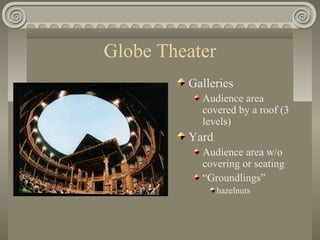
Globe Theater
Galleries
Audience area
covered by a roof (3
levels)
Yard
Audience area w/o
covering or seating
“Groundlings”
hazelnuts
Globe Theater, cont.
Pricing based on
comfort
1 penny (week’s
wages for
apprentice)
5 pence – cushioned
gallery seat
Nobility
generally had
private
performances at
Stage Views
Platform Stage
Raised stage that
projects into the
audience
Stage
Heavens
Pictures of moon, stars,
& zodiac painted on
the underside of the
canopy covering the
stage
Hell
Under the stage
Used for prop storage
Trap door entrance to
main stage
Tiring House
Three-level inner stage
area (background)
Inner stage: (study)
1st
floor
Balcony stage
2nd
floor
Music Gallery
3rd
floor
Also used as a stage
Tiring House, Cont.
Chamber
Curtained area behind
balcony
Bay window stages
Stages on the sides of
the balcony stages
Shakespeare’s Language
Iambic Pentameter
Most common rhythm in
English poetry
Iamb: 2-syllable foot
Foot: unit of rhythm in poetry
and drama
Unstressed, stressed
I.e. today = to DAY
Pentameter: five foot line
Blank verse: unrhymed
Iambic Pentameter
Ways to Understand More Easily
Word Order
Read in sentences
Don’t break at ends of
lines
Archaic Language
Written in 1599
Footnotes
Overall sense
Don’t worry about
every single word
Contractions

Othellobackgroundppt 110517115334-phpapp01

  • 1.
  • 2.
  • 3.
    Basic Info • Othellounlike other Shakespearean tragedies • No secondary plot like his other tragedies • Villain (Iago) is responsible for the downfall of the tragic hero (Othello) • Ideas for this play taken from a collection of tales called Hecatommithi by Giraldi Cinthio, published in Venice in 1566
  • 4.
    Writing of thePlay Othello: This play was probably written in 1603 or 1604, a little past the middle of Shakespeare's career (he was 40). Performed at the royal court Christmas season of 1604 when command performances of entertainments for the king and courtiers were customary. That means it had probably already been a success.
  • 5.
    Performance First recorded performance took placein 1604 for King James I; Richard Burbage, Shakespeare’s partner and fellow actor, played Othello
  • 6.
    Main Characters Othello: Soldier fromNorth Africa; Employed as a general by the city-state of Venice; Highly respected, but still an “outsider” because of his skin color; Marries Desdemona
  • 7.
    Main Characters, cont. Desdemona Beautifuland accomplished young Venetian woman; Protected by her father; She stands for love, trust, and purity—all that makes life meaningful and worth living
  • 8.
    Main Characters, cont. Iago Soldierwho works with Othello; Wants to be Othello’s second in command but is passed over for Cassio; Seeks vicious revenge; Plots to destroy all that Othello values Emilia Maidservant to Desdemona; married to Iago; loyal to Desdemona, but will tell lies if it will help her husband
  • 9.
    Main Characters, cont. Cassio Gentlemansoldier, Not much real experience Man of ability, loyalty and grace; Respects Desdemona and Othello; Is NOT a love interest for Desdemona; Suffers from a drinking problem Brabantio Father of Desdemona; Venetian nobleman and senator Roderigo In love with Desdemona; Listens to Iago’s plan to get Desdemona away from Othello; A fool!
  • 10.
    Static & DynamicCharacters Dynamic Character– Character changes from beginning to end Static Character – Character does not change
  • 11.
    Static & DynamicCharacters Othello is a strong example of a DYNAMIC CHARACTER Courageous Venetian soldier Well respected Has reputation as man of honor Has vicious temper Becomes enraged with jealousy
  • 12.
    Static & DynamicCharacters Iago is a STATIC CHARACTER Corrupt character Hypocritical Evil Selfish Focused throughout the play to destroy Othello
  • 13.
    Foil FOIL—character who highlights oremphasizes certain traits of the main character by contrasting them EX: Emilia is the foil to Desdemona EX: Cassio is the foil to Iago
  • 14.
    Conflicts, Internal Othello vs. Himself Doesn’twant to distrust Desdemona Insecure about his qualities to enable Desdemona to love him
  • 15.
    Conflicts, External Iago vs.Othello Iago hates Othello and plots to bring about his downfall Iago vs. Cassio Iago is jealous of Cassio, and works to ruin his reputation, as well as separate him from Othello’s friendship
  • 16.
    Irony – 3Types Dramatic Irony: a contradiction between what a character thinks and what the reader or audience knows to be true Situational Irony: an event occurs that directly contradicts the expectations of the characters, readers, or audience Verbal Irony: words are used to suggest the opposite of what is meant (i.e. sarcasm, double-entendre, etc.)
  • 17.
    Themes Destructive nature of Jealousy Iagojealous of Cassio’s position Othello suspecting Desdemona’s unfaithfulness Importance of Honor and Reputation Cassio Desdemona Being an outsider Prejudice against Othello Skin color – Black & White Imagery From Africa, not Venice Warrior rather than courtier and politician Unfamiliar with societal conventions Dealt mainly with men and battle, not women and love
  • 18.
    Themes Appearance Versus Reality “HonestIago” Desdemona & Cassio Loyalty Versus Treachery The ones Othello believes are treacherous are actually loyal Cassio Desdemona Role of Emilia With her husband With Desdemona
  • 19.
    Motifs MOTIFS—Major topics related totheme Animals Jealousy Sight and darkness The handkerchief Magic Evil and the devil
  • 20.
    Setting Act I Venice Act II–V Cyprus 16th Century Entire play covers only a couple of days
  • 21.
    Locations - Venice Acity-state of enormous mercantile wealth, (wealth from trade) Venice in Shakespeare's time was a byword for luxury and culture and was also famous for its Judicial system Its trade was partially choked off by the growing power of the Turkish empire in the 16th century, which extended into Europe as well as Asia and Arabia. Hence the importance of Cyprus.
  • 22.
    Locations - Cyprus Island,near Turkey and Syria, was annexed by Venice in 1489 and conquered by the Turks in 1571.
  • 23.
    Terms & Concepts MOOR. InShakespeare's time, equivalent to "African," with the expectation that ,such a person would be black. This was not a negative or derogatory word. Originally, it meant "native of Mauretania," a country in north Africa (present day Morocco), but its meaning had become generalized by the 17th century. OTTOMAN, OTTOMITES. These terms (I.3.49, 11.3.170) refer to the Turks.
  • 24.
    Brief History ofthe Moors In 711 Moors, who are Muslim, conquered Spain and ruled until 1492—Queen Isabella and King Ferdinand took over and brought Christianity to Spain Moors forced to leave Spain or become Christian; many left the country and became Gypsies in Europe and pirates in the seas near Europe, Asia & Africa
  • 25.
    Elizabethan Attitudes Play firstperformed in 1604, when Christian European tolerance of Muslims was greatly strained Shakespeare created the character of Othello as a tragic hero, not a villain
  • 26.
    Othello’s Position &Status Professional soldier who, after much battlefield experience, is currently employed by Venice as general of its forces. He is called "General" or, sometimes, "Captain." He holds a high position and is greatly respected.
  • 27.
    Military Terms ANCIENT Pronounced “en-sin” Amilitary rank, properly of a standard- bearer (same word as "ensign"). This is Iago's rank, which he resents. He is third in command to Othello, behind Cassio.
  • 28.
    Military Terms LIEUTENANT. The rankwhich Cassio has just been given, literally meaning "place-holder." Second in command to Othello, he holds Othello's place in his absence. Ironically, Othello comes to believe that Cassio holds Othello's place in Desdemona's affections. Even more ironically, the play ends with Cassio literally put into Othello's place as governor of Cyprus.
  • 29.
  • 30.
    Tragedy Drama in whichthe main character suffers a disaster after a serious struggle Faces downfall in a heroic way
  • 31.
    Tragic Hero 1. Noble/influentialperson who 2. Meets with destruction because: personal flaw (fatal flaw) Opposition of others Othello fits this description 3. Harsh punishment (arouses pity in audience) 4. Character gains self-knowledge 5. Catharsis resulting in compassion Catharsis = cleansing or release of tense emotions
  • 32.
    Fatal Flaw Error, weakness,mistaken judgment or misstep that causes the downfall of the hero Also called hamartia from Greek Hero is not perfect & may make errors from Ambition Ignorance Pride Jealousy Gullibility (believes others too easily)
  • 33.
    Diagram: Tragic Hero SelfKnowledge End of story Disaster/Death/ Loss of PowerSelf Knowledge Power, Wealth Beginning of story
  • 34.
    Elizabethan Tragic Heroes TheElizabethan tragic hero is much more often responsible for his own downfall rather than being a victim of fate Emphasizes the “waste of human potential” Othello is the tragic hero
  • 35.
    The Five-Part DramaticStructure Act II Rising Action, Or Complications Act I Exposition, or Introduction Act III Crisis, or Turning Point Act IV Falling Action Act V Resolution, or Denouement
  • 36.
  • 37.
    Aside Character’s inner thoughts spokenaloud Other characters are present Other characters cannot hear the spoken thoughts (even though the actors can)
  • 38.
    Elizabethan Theater Little tono props used Minimal scenery Rarely performed at night Lighting Female Parts played by teenaged boys Against the law for women to act Actors not respected One step above beggars
  • 39.
    Globe Theater Galleries Audience area coveredby a roof (3 levels) Yard Audience area w/o covering or seating “Groundlings” hazelnuts
  • 40.
    Globe Theater, cont. Pricingbased on comfort 1 penny (week’s wages for apprentice) 5 pence – cushioned gallery seat Nobility generally had private performances at
  • 41.
    Stage Views Platform Stage Raisedstage that projects into the audience
  • 42.
    Stage Heavens Pictures of moon,stars, & zodiac painted on the underside of the canopy covering the stage Hell Under the stage Used for prop storage Trap door entrance to main stage
  • 43.
    Tiring House Three-level innerstage area (background) Inner stage: (study) 1st floor Balcony stage 2nd floor Music Gallery 3rd floor Also used as a stage
  • 44.
    Tiring House, Cont. Chamber Curtainedarea behind balcony Bay window stages Stages on the sides of the balcony stages
  • 45.
    Shakespeare’s Language Iambic Pentameter Mostcommon rhythm in English poetry Iamb: 2-syllable foot Foot: unit of rhythm in poetry and drama Unstressed, stressed I.e. today = to DAY Pentameter: five foot line Blank verse: unrhymed Iambic Pentameter
  • 46.
    Ways to UnderstandMore Easily Word Order Read in sentences Don’t break at ends of lines Archaic Language Written in 1599 Footnotes Overall sense Don’t worry about every single word Contractions

Editor's Notes

  • #31 Drama in which the main character suffers _____________ after a ___________________ Faces downfall in a _____________ way
  • #33 Error, _______________, mistaken judgment or misstep that causes __________________ of the hero Also called _______________ from Greek Hero is not perfect & may make errors from _______________ _______________ _______________ _______________ _______________ (believes others too easily)