Historical Context
Othello is one of William
Shakespeare’s 10 tragedies,
written around 1604 and often
described by critics as one of his
best.
Like many of his other works, it
is thought to be an adaptation of
an Italian work—Of the
Unfaithfulness of Husbands and
Wives by Giraldi Cinthio.
It is believed that Shakespeare
never traveled to Italy or Cyprus,
the settings for the drama. 2
11/13/18 2
The Moors
• When the Arab
armies swept
across Northern
Africa in the 7th
century, they
found
indigenous
tribespeople
called Berbers.
11/13/18 3
The Moors
• There, they intermarried with
the Spanish. Their descendants
came to be called Moors.
• The name Moor comes from
the Latin Mauri, the name of the
inhabitants of an old Roman
province (now covered by
Morocco and part of Algeria)
11/13/18 4
The Moors
• The Moors reached the height
of their power in Spain and
controlled most of Spain from
711 to 1031.
• By 1212, the Moorish power
was broken in central Spain,
but it would take until 1492 for
the final expulsion from Spain.
11/13/18 5
The Moors
• The Moors were actually one
victory away from crushing the
Europeans, but, like the
Romans, condemned their
future by internal squabbles.
• Some adopted Christianity and
remained (such as Othello), and
were called Moriscos.
11/13/18 6
What do Moors believe?
• Because of their Arab descent,
the Moorish culture is very
structured when it comes to
women. Women in Arab culture
are absolutely, positively not
allowed to commit adultery. To
do so meant instant death.
11/13/18 7
What do the Moors Believe?
• In the European culture of the
time, many women were simply
banished from the town, forced
into prostitution, or killed by
upset men. However, the
chance for survival for women
was much better in a European
culture than the Arab culture.
11/13/18 8
Othello’s Background (for the play)
• Othello is of royal lineage.
He was captured, turned into
a slave by the Spanish and
Italians, then later won his
freedom and became a
tremendous general.
11/13/18 9
Othello’s Background
• Othello knows
nothing but
violence. He has
little formal
education.
Everything he
knows involves the
battlefield.
11/13/18 10
Othello’s Background
• Othello is not simply a Moor,
but a Christian (a Morisco). This
play abounds with imagery of
Christian salvation and
damnation.
• Moriscos were regarded
without much trust by the
Christian community at the time.
11/13/18 11
Othello’s Background
• Moors were treated much
like the Jews who became
new Christians, “regarded
with suspicion as a false
Christian (Hecht 127).
Major Character
• Othello–- a military general from Africa who is now living in
Venice, Italy. He captures the heart of a young nobleman’s
daughter, and later suspects her of infidelity.
Major Character
• Desdemona-- an extremely lovely and naïve girl who weds
Othello. She is loyal to Othello and bewildered by his
accusations.
Major Character
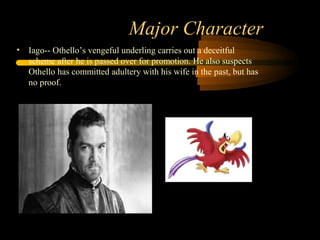
• Iago-- Othello’s vengeful underling carries out a deceitful
scheme after he is passed over for promotion. He also suspects
Othello has committed adultery with his wife in the past, but has
no proof.
Minor Characters
• Cassio—Othello’s lieutenant whom Iago alleges is having an
affair with Desdemona
• Emilia—Iago’s wife and the servant of Desdemona who tries to
defend her mistress
• Bianca—a lady of questionable repute who is manipulated by
Iago.
• Brabantio—Desdemona’s father who is angry that she secretly
eloped
Plot Summary
--Othello beguiles young
Desdemona, and they elope.
--Her father is upset that she kept
her relationship a secret and that
her new husband is a Moor.
--Othello then angers Iago by
passing him over for promotion
and appointing Cassio second in
command.
--Iago vows revenge and hatches a
plot to convince Othello that
Desdemona and Cassio are lovers.
--Othello and his men are sent to
Cyprus to defend the Venetians
from the Turks.
--There Iago arranges to get
Cassio drunk and to lure him into a
fight so that he will lose his job.
--Iago then counsels Cassio to
enlist Desdemona’s help to get his
position restored. However, Iago
secretly hopes to replace Cassio
himself.
--Cassio meets with Desdemona to
plead for her help, and Iago uses
their meeting to suggest to Othello
that the two might be having an
affair.
--Iago torments Othello with
suggestions that his wife is
unfaithful, and promises to provide
“ocular” proof.
--Desdemona is baffled by her
husband’s accusations and denies
she has done anything wrong.
--Iago finally arranges to plant one
of Desdemonas scarves, a gift from
Othello’ s mother, in Cassio’s
lodgings as proof.
--Iago also arranges for Othello to
eavesdrop on a conversation of
Cassio’s that seems to confirm
Othello’s worst fears about
Desdemona.
--Othello calls Desdemona a
whore, and he decides to kill her
even though she still maintains her
innocence and part of him still
loves her.
-- Emilia tells Othello that he was
wrong about Desdemona and that
her own husband Iago is to blame
for the lie.
--Othello realizes his error and
considers suicide saying, “…speak
of one that loved not wisely, but
too well.” Act 5, Scene II, line,
340. 1
Themes
• Questioning the wisdom of
interracial unions
• Iago yells out to Desdemona’s
father, “…an old black ram/ is
tupping your white ewe. Arise,
Arise!” Act 1, Scene I, line 85
• Brabantio questions, “Whether
a maid, so tender, fair, and
happy,/…shunned the
wealthy, curled darlings of our
nation.” Act 1, Scene II, lines
• Despite the fact that
Othello is a well-respected
military leader, there are
clearly derogatory
references to him
throughout the play.
• His resorting to violence to
punish his wife is linked to
his base nature.
• Even Othello is convinced
that his wife’s attachment
to him must be short-lived
because of his race.
Themes
• Exploring the difference
between fact and
appearances
• Brabantio warns, “…if thou hast
eyes to see:/She has deceived
her father and, and may thee.”
Act 1, Scene III, line 286-7
• Othello bemoans, “Her honor is
an essence that’s not seen;/They
have it very oft that have it not./
But for the handkerchief—” Act
IV, Scene I, lines 16-18
• There are many incidents
of deception in the play.
Most of them are
manipulated by Iago, but
even the enemy Turks use
deceptive military
strategies.
• Almost all of the
characters put their trust
in Iago and seek his
counsel, despite the fact
that he is the most
duplicitous of all.
• Othello ultimately
misconstrues the loss of
Desdemona’s handkerchief
as proof of her infidelity.
Themes
• Revealing the ugly
consequences of jealousy
and revenge
• A Duke cautions, “ To
mourn a mischief that is past
and gone/ Is the next way to
draw new mischief on.” Act
I, Scene III, line 201
• Iago refers tells Othello that
jealousy, “…is the green-
eyed monster, which doth
mock/ the meat it feeds on.”
Act 3, Scene III, lines 166-7
• Shakespeare uses
dramatic irony to reveal
to the audience that
Othello’s jealousy is
unfounded.
• Iago doesn’t ever come
out and say directly that
Desdemona is unfaithful,
but Othello’s rage at
being cuckholded makes
it is easy to fuel his
suspicions.
• Othello rants, “I’ll tear
her all to pieces!” Act 3,
Scene III, line 28
Conflicts
• Gender: Othello wants to have control over and certainty
regarding his wife’s sexuality. Iago and others claim that all
women are deceitful whores.
• Race: Othello is insulted repeatedly because he is black. He even
doubts his own attractiveness because he is a Moor.
• Internal conflict: Othello is torn between his love of Desdemona
and his anger at the thought of her as an adulteress.
• Personal ambition/retribution: Iago’s hatred for his superior,
Othello, drives him to unleash evil on Othello, Desdemona,
Cassio, and even his wife Emilia.
References
• 1. Shakespeare, William. The Tragedy of Othello. Ed. X.J. Kennedy. Boston:
Little, Brown & Company, 1987.
• 2. More info available at the Folger library website.
http://www.folger.edu/Content/Discover-Shakespeare/Shakespeares-Works/The-Plays/Othello.cfm
• 3. For more on this and other criticism see
http://www.iupui.edu/~elit/shakes/oth/othref.html
• 4. For text of the article see
http://www.highbeam.com/doc/1G1-138400336.html
• 5. Othello. By William Shakespeare. Dir. Oliver Parker. Perf. Laurence Fishburne,
Kenneth Branagh. 1995. http://www.imdb.com/title/tt0114057/fullcredits#cast
• 6. O by Tim Blake Nelson.
http://www.imdb.com/title/tt0184791/?ref_=fn_al_tt_6
• 7. Othello by Geoffrey Sax.
http://www.imdb.com/title/tt0275577/
• 8. http://www.guardian.co.uk/books/2008/oct/18/mal-peet
• 9. http://en.wikipedia.org/wiki/Mal_Peet

Othello

  • 1.
    Historical Context Othello isone of William Shakespeare’s 10 tragedies, written around 1604 and often described by critics as one of his best. Like many of his other works, it is thought to be an adaptation of an Italian work—Of the Unfaithfulness of Husbands and Wives by Giraldi Cinthio. It is believed that Shakespeare never traveled to Italy or Cyprus, the settings for the drama. 2
  • 2.
    11/13/18 2 The Moors •When the Arab armies swept across Northern Africa in the 7th century, they found indigenous tribespeople called Berbers.
  • 3.
    11/13/18 3 The Moors •There, they intermarried with the Spanish. Their descendants came to be called Moors. • The name Moor comes from the Latin Mauri, the name of the inhabitants of an old Roman province (now covered by Morocco and part of Algeria)
  • 4.
    11/13/18 4 The Moors •The Moors reached the height of their power in Spain and controlled most of Spain from 711 to 1031. • By 1212, the Moorish power was broken in central Spain, but it would take until 1492 for the final expulsion from Spain.
  • 5.
    11/13/18 5 The Moors •The Moors were actually one victory away from crushing the Europeans, but, like the Romans, condemned their future by internal squabbles. • Some adopted Christianity and remained (such as Othello), and were called Moriscos.
  • 6.
    11/13/18 6 What doMoors believe? • Because of their Arab descent, the Moorish culture is very structured when it comes to women. Women in Arab culture are absolutely, positively not allowed to commit adultery. To do so meant instant death.
  • 7.
    11/13/18 7 What dothe Moors Believe? • In the European culture of the time, many women were simply banished from the town, forced into prostitution, or killed by upset men. However, the chance for survival for women was much better in a European culture than the Arab culture.
  • 8.
    11/13/18 8 Othello’s Background(for the play) • Othello is of royal lineage. He was captured, turned into a slave by the Spanish and Italians, then later won his freedom and became a tremendous general.
  • 9.
    11/13/18 9 Othello’s Background •Othello knows nothing but violence. He has little formal education. Everything he knows involves the battlefield.
  • 10.
    11/13/18 10 Othello’s Background •Othello is not simply a Moor, but a Christian (a Morisco). This play abounds with imagery of Christian salvation and damnation. • Moriscos were regarded without much trust by the Christian community at the time.
  • 11.
    11/13/18 11 Othello’s Background •Moors were treated much like the Jews who became new Christians, “regarded with suspicion as a false Christian (Hecht 127).
  • 12.
    Major Character • Othello–-a military general from Africa who is now living in Venice, Italy. He captures the heart of a young nobleman’s daughter, and later suspects her of infidelity.
  • 13.
    Major Character • Desdemona--an extremely lovely and naïve girl who weds Othello. She is loyal to Othello and bewildered by his accusations.
  • 14.
    Major Character • Iago--Othello’s vengeful underling carries out a deceitful scheme after he is passed over for promotion. He also suspects Othello has committed adultery with his wife in the past, but has no proof.
  • 15.
    Minor Characters • Cassio—Othello’slieutenant whom Iago alleges is having an affair with Desdemona • Emilia—Iago’s wife and the servant of Desdemona who tries to defend her mistress • Bianca—a lady of questionable repute who is manipulated by Iago. • Brabantio—Desdemona’s father who is angry that she secretly eloped
  • 16.
    Plot Summary --Othello beguilesyoung Desdemona, and they elope. --Her father is upset that she kept her relationship a secret and that her new husband is a Moor. --Othello then angers Iago by passing him over for promotion and appointing Cassio second in command. --Iago vows revenge and hatches a plot to convince Othello that Desdemona and Cassio are lovers.
  • 17.
    --Othello and hismen are sent to Cyprus to defend the Venetians from the Turks. --There Iago arranges to get Cassio drunk and to lure him into a fight so that he will lose his job. --Iago then counsels Cassio to enlist Desdemona’s help to get his position restored. However, Iago secretly hopes to replace Cassio himself. --Cassio meets with Desdemona to plead for her help, and Iago uses their meeting to suggest to Othello that the two might be having an affair.
  • 18.
    --Iago torments Othellowith suggestions that his wife is unfaithful, and promises to provide “ocular” proof. --Desdemona is baffled by her husband’s accusations and denies she has done anything wrong. --Iago finally arranges to plant one of Desdemonas scarves, a gift from Othello’ s mother, in Cassio’s lodgings as proof. --Iago also arranges for Othello to eavesdrop on a conversation of Cassio’s that seems to confirm Othello’s worst fears about Desdemona.
  • 19.
    --Othello calls Desdemonaa whore, and he decides to kill her even though she still maintains her innocence and part of him still loves her. -- Emilia tells Othello that he was wrong about Desdemona and that her own husband Iago is to blame for the lie. --Othello realizes his error and considers suicide saying, “…speak of one that loved not wisely, but too well.” Act 5, Scene II, line, 340. 1
  • 20.
    Themes • Questioning thewisdom of interracial unions • Iago yells out to Desdemona’s father, “…an old black ram/ is tupping your white ewe. Arise, Arise!” Act 1, Scene I, line 85 • Brabantio questions, “Whether a maid, so tender, fair, and happy,/…shunned the wealthy, curled darlings of our nation.” Act 1, Scene II, lines • Despite the fact that Othello is a well-respected military leader, there are clearly derogatory references to him throughout the play. • His resorting to violence to punish his wife is linked to his base nature. • Even Othello is convinced that his wife’s attachment to him must be short-lived because of his race.
  • 21.
    Themes • Exploring thedifference between fact and appearances • Brabantio warns, “…if thou hast eyes to see:/She has deceived her father and, and may thee.” Act 1, Scene III, line 286-7 • Othello bemoans, “Her honor is an essence that’s not seen;/They have it very oft that have it not./ But for the handkerchief—” Act IV, Scene I, lines 16-18 • There are many incidents of deception in the play. Most of them are manipulated by Iago, but even the enemy Turks use deceptive military strategies. • Almost all of the characters put their trust in Iago and seek his counsel, despite the fact that he is the most duplicitous of all. • Othello ultimately misconstrues the loss of Desdemona’s handkerchief as proof of her infidelity.
  • 22.
    Themes • Revealing theugly consequences of jealousy and revenge • A Duke cautions, “ To mourn a mischief that is past and gone/ Is the next way to draw new mischief on.” Act I, Scene III, line 201 • Iago refers tells Othello that jealousy, “…is the green- eyed monster, which doth mock/ the meat it feeds on.” Act 3, Scene III, lines 166-7 • Shakespeare uses dramatic irony to reveal to the audience that Othello’s jealousy is unfounded. • Iago doesn’t ever come out and say directly that Desdemona is unfaithful, but Othello’s rage at being cuckholded makes it is easy to fuel his suspicions. • Othello rants, “I’ll tear her all to pieces!” Act 3, Scene III, line 28
  • 23.
    Conflicts • Gender: Othellowants to have control over and certainty regarding his wife’s sexuality. Iago and others claim that all women are deceitful whores. • Race: Othello is insulted repeatedly because he is black. He even doubts his own attractiveness because he is a Moor. • Internal conflict: Othello is torn between his love of Desdemona and his anger at the thought of her as an adulteress. • Personal ambition/retribution: Iago’s hatred for his superior, Othello, drives him to unleash evil on Othello, Desdemona, Cassio, and even his wife Emilia.
  • 24.
    References • 1. Shakespeare,William. The Tragedy of Othello. Ed. X.J. Kennedy. Boston: Little, Brown & Company, 1987. • 2. More info available at the Folger library website. http://www.folger.edu/Content/Discover-Shakespeare/Shakespeares-Works/The-Plays/Othello.cfm • 3. For more on this and other criticism see http://www.iupui.edu/~elit/shakes/oth/othref.html • 4. For text of the article see http://www.highbeam.com/doc/1G1-138400336.html • 5. Othello. By William Shakespeare. Dir. Oliver Parker. Perf. Laurence Fishburne, Kenneth Branagh. 1995. http://www.imdb.com/title/tt0114057/fullcredits#cast • 6. O by Tim Blake Nelson. http://www.imdb.com/title/tt0184791/?ref_=fn_al_tt_6 • 7. Othello by Geoffrey Sax. http://www.imdb.com/title/tt0275577/ • 8. http://www.guardian.co.uk/books/2008/oct/18/mal-peet • 9. http://en.wikipedia.org/wiki/Mal_Peet