
Presented By :
Pushp Sambyal
MBA- 2B
“At Nahar,
excellence is always an ongoing journey
never destination”
 Nahar group came into existence in 1949 .
 It was established with initial efforts of three Oswal
brothers Sh.Vidya Sagar Oswal ,Sh. Lachman
Dass& Sh. Rattan Chand Oswal.
 The initial capacity of nahar group was 800 spindles.
 At present it has more than 66200 spindles of
capacity.
 OSWAL WOOLLEN MILLS LTD.
 NAHAR INDUSTRIAL ENTERPRISES LTD.
 NAHAR SPINNING MILLS LTD.
At OWM, Even the Word
“Impossible”
Says
“I’m Possible.”
 It was established in 1949 by Sh. Vidya Sagar
Oswal.
 It is manufacturing all type of blended worsted
yarn, weaving yarn, shawls,garments etc.
 Group turnover is Rs. 2500 Crore.
Export Markets: Argentina ,Brazil ,China, Poland ,Portugal
,U.K ,U.S.A, Turkey, South Africa, Egypt, Israel and
Bangladesh.
 Social upliftment by establishing Jawahar Lal Oswal Public
Charitable Trust and Mohan Dai Oswal Memorial Hospital.
 Mr. Jawahar Lal Oswal Chairman-Cum-Managing Director
 Mr. Amarjeet Singh Director
 Mr. Dinesh Oswal Director
 Mr. Kamal Oswal Director
 Mr. Sandeep Jain Executive Director
 Mr. Dinesh Gogna Executive Director
 Dr. (Mrs.) H.K. Bal Additional Director
 Mr. O.P. Sahni Additional Director
 Mr. K.S. Maini Additional Director
 Dr. Suresh Kumar Additional Director
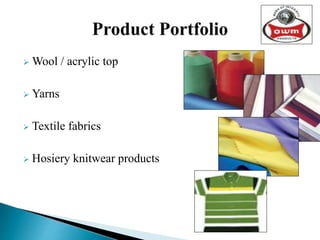
 Wool / acrylic top
 Yarns
 Textile fabrics
 Hosiery knitwear products
 Quality Control
 Human Resource Department
 Finance Department
 Marketing Department
Major competitors in pullovers and cardigans
Casablanca
Pringle (Scotland)
Competitors of woolen/blended worsted yarn
Vardhman Textiles Limited
Jayshree Textiles Limited
Malwa Cotton Mills Limited
Competitors of their denim fabric
Arvind Mills Limited
Aarvee Denims Limited
Raymond Limited
 Good Brand Image.
 Many persons are working here for more than 50 yrs. This
shows commitment of employees towards their org.
 Member of wool mark and ISO 9002.
 Laboratories for testing the quality of the product.
Strengths
 OWM is dependent upon foreign producers for
greasy wool.
 Depend on the third party for sale and the distribution
of the product.
 Fabrication for various companies likes NIKE,
MARKS AND SPENCER, GAP, WILLS, etc.
 Manufacturing of kids garments.
 Mushrooming and upcoming of small hosieries in
Ludhiana.
 Seasonal demand for their major product i.e.
pullovers.
Threats
Ratio Analysis is one of the most powerful tools of
financial analysis. It is used as a device to analyze
and interpret the financial health of an enterprise .
Particulars 2006-2007 in Lac 2007-2008 in Lac 2008-2009 in Lac
Current
Assets
20543.67 30129.28 30422.64
Current
Liabilities
11185.67 9044.30 9897.32
Current
Ratio 1.84 3.33 3.07
Particulars 2006-07 in
Lacs
2007-08 In
Lacs
2008-09 In
Lacs
Quick Assets 9060 17328 17506
Current Liabilities 11185 9044 9897
Quick Ratio 0.81 1.915 1.7688
In the years 2007-08 & 2008-09 ,the company is satisfactorily liquid to fulfill C.L
well in time but it is not satisfactory in the year 2006-07 i.e. 0.81 which is less
than rule of thumb 1:1.
Particulars 2006-07 in Lacs 2007-08in Lacs 2008-09in Lacs
Net profit available 1402 2127 2368
Number of shares 249 249 249
EPS 5.63 8.54 9.51
EPS is increasing in the year 2006-07 to 2008-09 . The major reason is that company s net profit
is increasing every year but the number of shares being the same every year, so the earning per
share is increasing every year.
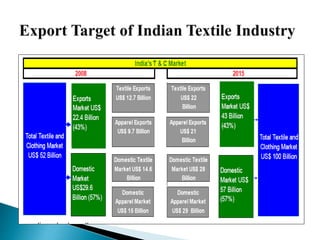
 India textile industry largely depends upon the textile
manufacturing and export.
 India earns about 27% of its total foreign exchange
through textile exports.
 It also contributes around 3% to the GDP of the
country
 It is the second largest employer after the agriculture
sector in both rural and urban areas.
 Textile sector contributes 14% of value addition in
manufacturing sector.
COTTON TEXTILE
MAN -MADE
SILKJUTE
WOOLLEN TEXTILES
2008-09 % Share
Textile Clothing &
Garments
20,219 93%
Undergarments 1,487 6.80%
Home Textile Furnishings 2.16 0.01%
Accessories 0.29 0.001%
Total 21,708.45
Strength
Ludhiana is one of the principal producers of woolen
and acrylic knitwear, apart from it also uses cotton and
blended fiber to produce hosiery, knitwear and various
ready-made garments.
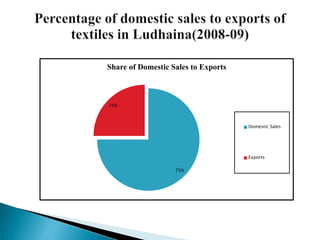
The total output of hosiery products in Ludhiana is
estimated to be around Rs. 8,000 crore in 2008-09 and
the share of domestic sale to exports is to the tune of
75:25 ratio.
The major export markets of Ludhiana today are the
EU, US, Africa,Vietnam & Bangladesh.
Ludhiana accounts for nearly 90 per cent of the
country’s woolen hosiery industry
Ludhiana Textile Industry serves as the backbone of
Indian hosiery industry.
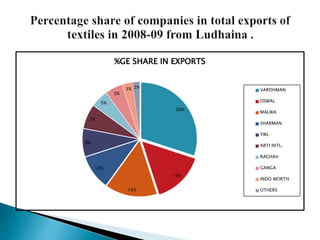
30%
15%
15%
10%
8%
7%
5%
5%
3% 2%
%GE SHARE IN EXPORTS
VARDHMAN
OSWAL
MALWA
SHARMAN
YWL
ARTI INTL.
RAGHAV
GANGA
INDO WORTH
OTHERS
75%
25%
Share of Domestic Sales to Exports
Domestic Sales
Exports
AN ANALYSIS ON EXPORT OF
INDIAN TEXTILE INDUSTRY
WITH SPECIAL REFERENCE TO
LUDHIANA
To analyse the export potential of Ludhiana textile
industry.
To know the factors affecting exports of textiles.
To know the strengths & weakness of textile industry.
RESEARCH METHODOLOGY
Research Design:
Descriptive.
Sampling Technique:
Convenience & snowball sampling.
Universe:
All the exporters of textiles.
Population:
All the exporters of textiles in Ludhiana
Sample Unit:
A single textile company in Ludhiana which is into
export business.
Sample Size:
20 Exporters.
Sample Type:
Area Sampling : Sample area of the study is
Ludhiana
Data collection:
Primary data : Questionnaire.
Secondary data: Journals and websites.
The study is limited to Ludhiana city due to time constraints.
The Sample size has been restricted to 20 due to constraints of
time .
The analysis could have been made much more accurate, if the
project be done in other cities also.
The respondents were busy or for some other reasons, did not
show much attention filing the questionnaire; hence the
chances of biasness could be possible.
To collect valid data a senior authority was needed to fill the
questionnaire. Most of the time they were having important
works to do and questionnaires were filled by other people.
Data Interpretation
&
Analysis
95%
5%
Nature of Company
Manufacturing
Trading Company
MNC
Others
23%
16%
3%
23%
29%
6%
Specification of Export Products
Woollen
Cotton
Fiber
Yarn
Garments
Other
0
20
40
60
80
100
120
1-10% 10-25% 25-50% 50-75% >75%
%age
Export %ge
Export Percentage to Total Sales
%age of Exports
USA, 3.45
Australia, 3.5
S.Africa, 1.55
Europe, 1.85
Others, 4.65
Most Potential Market for Exports
USA
Australia
S.Africa
Europe
Others
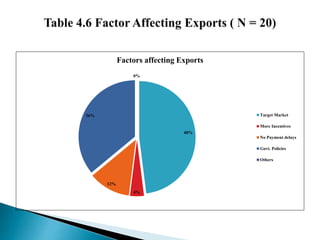
48%
4%
12%
36%
0%
Factors affecting Exports
Target Market
More Incentives
No Payment delays
Govt. Policies
Others
Personnel risk, 2.6
Competition Risk, 1.55
Credit Risk, 2.7
Liquidity Risk, 3.15
Others, 5
Exporters' Risk
Personnel risk
Competition Risk
Credit Risk
Liquidity Risk
Others
12%
53%
12%
6%
17%
0%
Competition faced from differnt countries
Bangladesh
China
Pakistan
Srilanka
Vietnam
Others
15%
6%
21%
35%
23%
0%
Nature of Competition
Skilled Labours
Frieght Charges
Quality
Govt. Policies
Better Infrastructure
Others
2.7
1.9
2.3
3.1
Strength
Low Labour Cost
Abundant raw material
Quality products
Potential domestic & international
market
2.6
3.2
3.5
2.4
3.3
Weakness
Lack of technology
Fragmented industry
Unfavourable laws
Govt. Policies
Infrastructure
65%
30%
5%
Future Potential of textile industry
Growth
Stable
Decline
Most of the export houses in Ludhiana are dealing in
garments, woollen & yarn sector.
Majority of the exporters of Ludhiana find South Africa as
their potential export market followed by European countries .
Strength of the textile industry is abundant raw material and
the Weakness is govt. policies.
China is the major competitor of Indian textile industry.
Government . has to extend validity of promotional schemes to
promote textile exports.
Ludhiana textile industry should explore new markets for exports .
Government should take steps to provide better infrastructure
,technology, innovations & govt. policies to boost textile industry
in near future.
Conclusion
Thank You

Oswal Group ppt

  • 1.
    Presented By : PushpSambyal MBA- 2B
  • 3.
    “At Nahar, excellence isalways an ongoing journey never destination”
  • 4.
     Nahar groupcame into existence in 1949 .  It was established with initial efforts of three Oswal brothers Sh.Vidya Sagar Oswal ,Sh. Lachman Dass& Sh. Rattan Chand Oswal.  The initial capacity of nahar group was 800 spindles.  At present it has more than 66200 spindles of capacity.
  • 5.
     OSWAL WOOLLENMILLS LTD.  NAHAR INDUSTRIAL ENTERPRISES LTD.  NAHAR SPINNING MILLS LTD.
  • 6.
    At OWM, Eventhe Word “Impossible” Says “I’m Possible.”
  • 7.
     It wasestablished in 1949 by Sh. Vidya Sagar Oswal.  It is manufacturing all type of blended worsted yarn, weaving yarn, shawls,garments etc.
  • 8.
     Group turnoveris Rs. 2500 Crore. Export Markets: Argentina ,Brazil ,China, Poland ,Portugal ,U.K ,U.S.A, Turkey, South Africa, Egypt, Israel and Bangladesh.  Social upliftment by establishing Jawahar Lal Oswal Public Charitable Trust and Mohan Dai Oswal Memorial Hospital.
  • 9.
     Mr. JawaharLal Oswal Chairman-Cum-Managing Director  Mr. Amarjeet Singh Director  Mr. Dinesh Oswal Director  Mr. Kamal Oswal Director  Mr. Sandeep Jain Executive Director  Mr. Dinesh Gogna Executive Director  Dr. (Mrs.) H.K. Bal Additional Director  Mr. O.P. Sahni Additional Director  Mr. K.S. Maini Additional Director  Dr. Suresh Kumar Additional Director
  • 10.
     Wool /acrylic top  Yarns  Textile fabrics  Hosiery knitwear products
  • 12.
     Quality Control Human Resource Department  Finance Department  Marketing Department
  • 13.
    Major competitors inpullovers and cardigans Casablanca Pringle (Scotland) Competitors of woolen/blended worsted yarn Vardhman Textiles Limited Jayshree Textiles Limited Malwa Cotton Mills Limited Competitors of their denim fabric Arvind Mills Limited Aarvee Denims Limited Raymond Limited
  • 15.
     Good BrandImage.  Many persons are working here for more than 50 yrs. This shows commitment of employees towards their org.  Member of wool mark and ISO 9002.  Laboratories for testing the quality of the product. Strengths
  • 16.
     OWM isdependent upon foreign producers for greasy wool.  Depend on the third party for sale and the distribution of the product.
  • 17.
     Fabrication forvarious companies likes NIKE, MARKS AND SPENCER, GAP, WILLS, etc.  Manufacturing of kids garments.
  • 18.
     Mushrooming andupcoming of small hosieries in Ludhiana.  Seasonal demand for their major product i.e. pullovers. Threats
  • 19.
    Ratio Analysis isone of the most powerful tools of financial analysis. It is used as a device to analyze and interpret the financial health of an enterprise .
  • 20.
    Particulars 2006-2007 inLac 2007-2008 in Lac 2008-2009 in Lac Current Assets 20543.67 30129.28 30422.64 Current Liabilities 11185.67 9044.30 9897.32 Current Ratio 1.84 3.33 3.07
  • 21.
    Particulars 2006-07 in Lacs 2007-08In Lacs 2008-09 In Lacs Quick Assets 9060 17328 17506 Current Liabilities 11185 9044 9897 Quick Ratio 0.81 1.915 1.7688 In the years 2007-08 & 2008-09 ,the company is satisfactorily liquid to fulfill C.L well in time but it is not satisfactory in the year 2006-07 i.e. 0.81 which is less than rule of thumb 1:1.
  • 22.
    Particulars 2006-07 inLacs 2007-08in Lacs 2008-09in Lacs Net profit available 1402 2127 2368 Number of shares 249 249 249 EPS 5.63 8.54 9.51 EPS is increasing in the year 2006-07 to 2008-09 . The major reason is that company s net profit is increasing every year but the number of shares being the same every year, so the earning per share is increasing every year.
  • 24.
     India textileindustry largely depends upon the textile manufacturing and export.  India earns about 27% of its total foreign exchange through textile exports.  It also contributes around 3% to the GDP of the country
  • 25.
     It isthe second largest employer after the agriculture sector in both rural and urban areas.  Textile sector contributes 14% of value addition in manufacturing sector.
  • 26.
  • 27.
    2008-09 % Share TextileClothing & Garments 20,219 93% Undergarments 1,487 6.80% Home Textile Furnishings 2.16 0.01% Accessories 0.29 0.001% Total 21,708.45
  • 31.
  • 32.
    Ludhiana is oneof the principal producers of woolen and acrylic knitwear, apart from it also uses cotton and blended fiber to produce hosiery, knitwear and various ready-made garments. The total output of hosiery products in Ludhiana is estimated to be around Rs. 8,000 crore in 2008-09 and the share of domestic sale to exports is to the tune of 75:25 ratio.
  • 33.
    The major exportmarkets of Ludhiana today are the EU, US, Africa,Vietnam & Bangladesh. Ludhiana accounts for nearly 90 per cent of the country’s woolen hosiery industry Ludhiana Textile Industry serves as the backbone of Indian hosiery industry.
  • 35.
    30% 15% 15% 10% 8% 7% 5% 5% 3% 2% %GE SHAREIN EXPORTS VARDHMAN OSWAL MALWA SHARMAN YWL ARTI INTL. RAGHAV GANGA INDO WORTH OTHERS
  • 36.
    75% 25% Share of DomesticSales to Exports Domestic Sales Exports
  • 37.
    AN ANALYSIS ONEXPORT OF INDIAN TEXTILE INDUSTRY WITH SPECIAL REFERENCE TO LUDHIANA
  • 38.
    To analyse theexport potential of Ludhiana textile industry. To know the factors affecting exports of textiles. To know the strengths & weakness of textile industry.
  • 39.
  • 40.
    Research Design: Descriptive. Sampling Technique: Convenience& snowball sampling. Universe: All the exporters of textiles. Population: All the exporters of textiles in Ludhiana
  • 41.
    Sample Unit: A singletextile company in Ludhiana which is into export business. Sample Size: 20 Exporters. Sample Type: Area Sampling : Sample area of the study is Ludhiana
  • 42.
    Data collection: Primary data: Questionnaire. Secondary data: Journals and websites.
  • 43.
    The study islimited to Ludhiana city due to time constraints. The Sample size has been restricted to 20 due to constraints of time . The analysis could have been made much more accurate, if the project be done in other cities also. The respondents were busy or for some other reasons, did not show much attention filing the questionnaire; hence the chances of biasness could be possible. To collect valid data a senior authority was needed to fill the questionnaire. Most of the time they were having important works to do and questionnaires were filled by other people.
  • 44.
  • 45.
  • 46.
    23% 16% 3% 23% 29% 6% Specification of ExportProducts Woollen Cotton Fiber Yarn Garments Other
  • 47.
    0 20 40 60 80 100 120 1-10% 10-25% 25-50%50-75% >75% %age Export %ge Export Percentage to Total Sales %age of Exports
  • 48.
    USA, 3.45 Australia, 3.5 S.Africa,1.55 Europe, 1.85 Others, 4.65 Most Potential Market for Exports USA Australia S.Africa Europe Others
  • 49.
    48% 4% 12% 36% 0% Factors affecting Exports TargetMarket More Incentives No Payment delays Govt. Policies Others
  • 50.
    Personnel risk, 2.6 CompetitionRisk, 1.55 Credit Risk, 2.7 Liquidity Risk, 3.15 Others, 5 Exporters' Risk Personnel risk Competition Risk Credit Risk Liquidity Risk Others
  • 51.
    12% 53% 12% 6% 17% 0% Competition faced fromdiffernt countries Bangladesh China Pakistan Srilanka Vietnam Others
  • 52.
    15% 6% 21% 35% 23% 0% Nature of Competition SkilledLabours Frieght Charges Quality Govt. Policies Better Infrastructure Others
  • 53.
    2.7 1.9 2.3 3.1 Strength Low Labour Cost Abundantraw material Quality products Potential domestic & international market
  • 54.
    2.6 3.2 3.5 2.4 3.3 Weakness Lack of technology Fragmentedindustry Unfavourable laws Govt. Policies Infrastructure
  • 55.
    65% 30% 5% Future Potential oftextile industry Growth Stable Decline
  • 56.
    Most of theexport houses in Ludhiana are dealing in garments, woollen & yarn sector. Majority of the exporters of Ludhiana find South Africa as their potential export market followed by European countries . Strength of the textile industry is abundant raw material and the Weakness is govt. policies. China is the major competitor of Indian textile industry.
  • 57.
    Government . hasto extend validity of promotional schemes to promote textile exports. Ludhiana textile industry should explore new markets for exports . Government should take steps to provide better infrastructure ,technology, innovations & govt. policies to boost textile industry in near future.
  • 58.
  • 59.