SUMMER TRAINING PROJECT                                     at  OSWAL WOOLLEN MILLS LTD      Factors Affecting Indian Cotton Textile ExportsPresented By: -AmitChawla - MBA (IB) 				                         Roll No :-94972238258
             Current Scenario  - INDIAN Textile IndustryTextile exports are targeted to reach $50 billion by 2010.$25 billion of which will go to the US , other markets include UAE, UK, Germany, France, Italy, Russia, Canada ,Bangladesh and Japan.Today textile sector accounts for nearly 14% of the total industrial output. Indian Textiles export have almost 30% share in Overall exports from the country.
Current Scenario  - INDIAN Textile Industry  Because of the lifting up of the import restrictions of the multi-fibre arrangement (MFA) since 1st January, 2005 under the World Trade Organization (WTO) Agreement on Textiles and Clothing, the market has become more competitive.
Current Scenario  - INDIAN Textile IndustryTextile industry is undergoing a substantial    re-orientation towards other then clothing segments of textile sector, which is commonly called as technical textiles. The processes in making technical textiles require costly machinery and skilled workers
Segments of Textile IndustryReadymade GarmentsCotton Textiles including Handlooms Man-made TextilesSilk Textiles
Segments of Textile IndustryWoollen TextilesHandicrafts including CarpetsCoirJute
Indian Cotton Textiles  - Key Facts
Textile Exports - Segmentation
Process Description
     Textile Value Chain
INDIA’s  Competitive .vs. Other Nations
OswalWoollen Mills Ltd. @ GlanceGroup turnover is over Rs 2500 croreNo strike/accident situation and no zero staff turnoverBrand names  “ Monte Carlo” & “ Canterburry”     OWM were the proud recipient of the “BEST EXIBITED PRODUCTS ” award from the international wool secretariat
Social upliftment at every level :-JawaharLalOswal Public Charitable TrustMohan Dai Oswal Memorial Hospital
Vision & MissionVision“Success is  the ongoing journey not destination” Mission“Stepping Ahead into realm of New Challenge”
 Board Of DirectorsMr. JawaharLalOswal            Chairman-Cum-Managing Director Mr. Amarjeet Singh                 DirectorMr. DineshOswal		DirectorMr. KamalOswal		Director Mr. Sandeep Jain		Executive Director Mr. DineshGogna                    Executive Director Dr. (Mrs.) H.K. Bal                   Additional Director Mr. O.P. Sahni                           Additional Director Mr. K.S. Maini                           Additional Director Dr. Suresh Kumar                      Additional Director
Organization Structure
OWM Product Portfolio Wool / acrylic topYarnsTextile fabricsHosiery knitwear products
Brands
Export Market:U.S.A. UNITED KINGDOM Germany Russia  Japan  Australia  New Zealand  Holland  Thailand  Hong Kong
 Singapore  Taiwan  South Africa  Canada  Egypt Israel Bangladesh
Various departmentsQuality controlHuman Resource DepartmentFinance DepartmentMarketing DepartmentExport department
SWOT Analysis @ OWMStrengthWeaknessLack of Professionalism.
 Dependence on foreign producers for greasy wool.
 Hierarchy Structure too long.
 3rd party dependence for Sales & Distribution.
Extensive Experience of Promoters
Brand equity of MC, CC & Canterbury.
 Loyal & old Employee base.
 Premium range of Pullovers.ThreatsOpportunitiesBooming Retail Sector
 Foreign players entering Indian Lands as FDI norms are relaxed to 49%.
 Kid Garments Range
 Job-Work / Fabrication fro various Brands.
 Small Hosieries coming up in Ludhiana
 Seasonal demand of Pullovers.
 Temp has been rising these days so winter season is getting shorter YOY.Title  “Factors Affecting Indian Cotton Textile Exports”
ObjectivesTo study the different problems related to cotton textile industry in LudhianaTo study the Government role in cotton textile exportsTo analyze the competition faced by Indian cotton textiles industry in International marketTo study the role of export promotion council in promoting exports.
Research MethodologyResearch DesignDescriptiveData CollectionPrimary -  ScheduleSecondary – Internet , E-Journals, E-Papers
Sampling Plan
Statistical ToolsSimple tabulation of data using tally marks.Calculating the percentage of the responses.Formula used: Percentage= (Number of responses/Total responses)*100Graphical analysis by means of bar graphs, pie chartsAverage method to calculate the average of particular schemes.
Limitations of the StudyThe conceptual framework and research questions have bound the study, keeping it focused, yet simultaneously limiting the method and topic of the research. The recognized limitations of this study deal with the topic, the sample size, and the lack of existing literature. The number of participants, their location, and the quantity and amount of time spent in getting the schedules filled were constraints balanced by the quality of the data gathered.
Limitations of the StudyMany of the respondents were busy in their work so they have not given proper time to answer the questions. Sometime they give false information while answering questions.There might be chances of ambiguities in the analysis of data.
Limitations of the StudyBest efforts were made to consider all important variables of the study. Chances of some of the variable not appearing in the study are also there.Some calculations have to be done with the statistical measures which are the biggest constrained for the research work because only percentage, Mean is being used in the research.
Limitations of the StudyThere was very less of respondents to prove the validity. Among the lot of exporters , only 30 filled the Schedules.Shortage of time & reach is also reason for incomprehensiveness.Many of the concerned persons contacted are very busy in their schedule that they don’t give away their 5 minutes to it. So the sample size remained small.
DATA ANALYSIS & INTERPRETATION
Profile of the Respondents  (Figure 4.1)
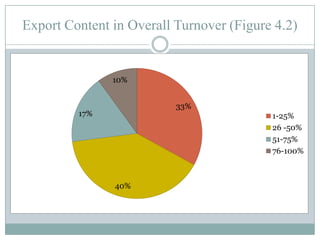
Export Content in Overall Turnover (Figure 4.2)
Raw Material related Issues faced by the Respondents (Figure 4.3)
Labour related issues raised by Respondents (Figure 4.4)
Marketing related issues raised by the Respondents (Figure 4.5)
Response towards Government (Figure 4.6)
Major Competitors to Indian Cotton Textile Industry (Figure 4.7)
Major Hurdles faced in the Trade: - (Figure 4.8)

Summer Internship Pptss

  • 1.
    SUMMER TRAINING PROJECT at OSWAL WOOLLEN MILLS LTD Factors Affecting Indian Cotton Textile ExportsPresented By: -AmitChawla - MBA (IB) Roll No :-94972238258
  • 2.
    Current Scenario - INDIAN Textile IndustryTextile exports are targeted to reach $50 billion by 2010.$25 billion of which will go to the US , other markets include UAE, UK, Germany, France, Italy, Russia, Canada ,Bangladesh and Japan.Today textile sector accounts for nearly 14% of the total industrial output. Indian Textiles export have almost 30% share in Overall exports from the country.
  • 3.
    Current Scenario - INDIAN Textile Industry Because of the lifting up of the import restrictions of the multi-fibre arrangement (MFA) since 1st January, 2005 under the World Trade Organization (WTO) Agreement on Textiles and Clothing, the market has become more competitive.
  • 4.
    Current Scenario - INDIAN Textile IndustryTextile industry is undergoing a substantial re-orientation towards other then clothing segments of textile sector, which is commonly called as technical textiles. The processes in making technical textiles require costly machinery and skilled workers
  • 5.
    Segments of TextileIndustryReadymade GarmentsCotton Textiles including Handlooms Man-made TextilesSilk Textiles
  • 6.
    Segments of TextileIndustryWoollen TextilesHandicrafts including CarpetsCoirJute
  • 7.
  • 8.
    Textile Exports -Segmentation
  • 9.
  • 10.
    Textile Value Chain
  • 11.
    INDIA’s Competitive.vs. Other Nations
  • 12.
    OswalWoollen Mills Ltd.@ GlanceGroup turnover is over Rs 2500 croreNo strike/accident situation and no zero staff turnoverBrand names “ Monte Carlo” & “ Canterburry” OWM were the proud recipient of the “BEST EXIBITED PRODUCTS ” award from the international wool secretariat
  • 13.
    Social upliftment atevery level :-JawaharLalOswal Public Charitable TrustMohan Dai Oswal Memorial Hospital
  • 14.
    Vision & MissionVision“Successis the ongoing journey not destination” Mission“Stepping Ahead into realm of New Challenge”
  • 15.
    Board OfDirectorsMr. JawaharLalOswal Chairman-Cum-Managing Director Mr. Amarjeet Singh DirectorMr. DineshOswal DirectorMr. KamalOswal Director Mr. Sandeep Jain Executive Director Mr. DineshGogna Executive Director Dr. (Mrs.) H.K. Bal Additional Director Mr. O.P. Sahni Additional Director Mr. K.S. Maini Additional Director Dr. Suresh Kumar Additional Director
  • 16.
  • 17.
    OWM Product PortfolioWool / acrylic topYarnsTextile fabricsHosiery knitwear products
  • 18.
  • 19.
    Export Market:U.S.A. UNITEDKINGDOM Germany Russia Japan Australia New Zealand Holland Thailand Hong Kong
  • 20.
    Singapore Taiwan South Africa Canada Egypt Israel Bangladesh
  • 21.
    Various departmentsQuality controlHumanResource DepartmentFinance DepartmentMarketing DepartmentExport department
  • 22.
    SWOT Analysis @OWMStrengthWeaknessLack of Professionalism.
  • 23.
    Dependence onforeign producers for greasy wool.
  • 24.
  • 25.
    3rd partydependence for Sales & Distribution.
  • 26.
  • 27.
    Brand equity ofMC, CC & Canterbury.
  • 28.
    Loyal &old Employee base.
  • 29.
    Premium rangeof Pullovers.ThreatsOpportunitiesBooming Retail Sector
  • 30.
    Foreign playersentering Indian Lands as FDI norms are relaxed to 49%.
  • 31.
  • 32.
    Job-Work /Fabrication fro various Brands.
  • 33.
    Small Hosieriescoming up in Ludhiana
  • 34.
    Seasonal demandof Pullovers.
  • 35.
    Temp hasbeen rising these days so winter season is getting shorter YOY.Title “Factors Affecting Indian Cotton Textile Exports”
  • 36.
    ObjectivesTo study thedifferent problems related to cotton textile industry in LudhianaTo study the Government role in cotton textile exportsTo analyze the competition faced by Indian cotton textiles industry in International marketTo study the role of export promotion council in promoting exports.
  • 37.
    Research MethodologyResearch DesignDescriptiveDataCollectionPrimary - ScheduleSecondary – Internet , E-Journals, E-Papers
  • 38.
  • 39.
    Statistical ToolsSimple tabulationof data using tally marks.Calculating the percentage of the responses.Formula used: Percentage= (Number of responses/Total responses)*100Graphical analysis by means of bar graphs, pie chartsAverage method to calculate the average of particular schemes.
  • 40.
    Limitations of theStudyThe conceptual framework and research questions have bound the study, keeping it focused, yet simultaneously limiting the method and topic of the research. The recognized limitations of this study deal with the topic, the sample size, and the lack of existing literature. The number of participants, their location, and the quantity and amount of time spent in getting the schedules filled were constraints balanced by the quality of the data gathered.
  • 41.
    Limitations of theStudyMany of the respondents were busy in their work so they have not given proper time to answer the questions. Sometime they give false information while answering questions.There might be chances of ambiguities in the analysis of data.
  • 42.
    Limitations of theStudyBest efforts were made to consider all important variables of the study. Chances of some of the variable not appearing in the study are also there.Some calculations have to be done with the statistical measures which are the biggest constrained for the research work because only percentage, Mean is being used in the research.
  • 43.
    Limitations of theStudyThere was very less of respondents to prove the validity. Among the lot of exporters , only 30 filled the Schedules.Shortage of time & reach is also reason for incomprehensiveness.Many of the concerned persons contacted are very busy in their schedule that they don’t give away their 5 minutes to it. So the sample size remained small.
  • 44.
    DATA ANALYSIS &INTERPRETATION
  • 45.
    Profile of theRespondents (Figure 4.1)
  • 46.
    Export Content inOverall Turnover (Figure 4.2)
  • 47.
    Raw Material relatedIssues faced by the Respondents (Figure 4.3)
  • 48.
    Labour related issuesraised by Respondents (Figure 4.4)
  • 49.
    Marketing related issuesraised by the Respondents (Figure 4.5)
  • 50.
  • 51.
    Major Competitors toIndian Cotton Textile Industry (Figure 4.7)
  • 52.
    Major Hurdles facedin the Trade: - (Figure 4.8)