OSGeo Web Mapping Typification:
GeoMajas, Mapbender, MapFish 
and OpenLayers
         Christoph Baudson
                Arnulf Christl
  FOSS4G 2010 – Barcelona
Metaspatial.net


   This presentation is brought to you by:  Metaspatial


When?  Consultation since March 2010

Why?     To leverage your spatial data

What?    Consultation and Implementation of
         - Spatial Data Infrastructures
         - Metadata

How:     Open Source Software and Data
                      with Open Standards
                   and Agile management

                                         http://www.metaspatial.net
                                                            2 / 47
Disclaimer
        All information contained in this presentation has been 
        compiled to the best of our knowledge and presents an ad­
        hoc snapshot of current state of the art web mapping client 
        frameworks and portals.
        Christoph Baudson and Arnulf Christl are deeply involved 
        in developing the Mapbender project since many years.
        For further information and help on how to select the best 
        option for your needs ask your consultant and service 
        provider. 
                                                                 Download as ODP or PDF


A web mapping typification – Christoph Baudson, Arnulf Christl                            3 / 47
Introduction
        This  presentation  differentiates  four  of  the  web  mapping 
        projects  of  OSGeo.  They  can  be  roughly  split  into  four 
        categories although there is a lot of overlap. 
         ● GeoMajas is a self contained, ful fledged Web­GIS

         ● OpenLayers is a JavaScript client library

         ● Mapbender is a geoportal management software

         ● MapFish is a web mapping developer framework 


        All  projects  have  server  side  components  except  for 
        OpenLayers.  Both  MapFish  and  Mapbender  integrate 
        OpenLayers as viewer.


A web mapping typification – Christoph Baudson, Arnulf Christl             4 / 47
On Diversity
   We all know the term in the context of bio­diversity. Mono­
   cultures (the opposite of diversity) are well known to be 
   associated with all kinds of problems and issues. Therefore 
   OSGeo strives for diversity in it's projects. 

   Diversity comes with competition, which is sometimes good 
   and sometimes also has a negative touch. To better 
   understand how the Open Source community works 
   competition is best mixed with cooperation to form the new 
   word coopetition – which can be a great motivation for folks.


A web mapping typification – Christoph Baudson, Arnulf Christl    5 / 47
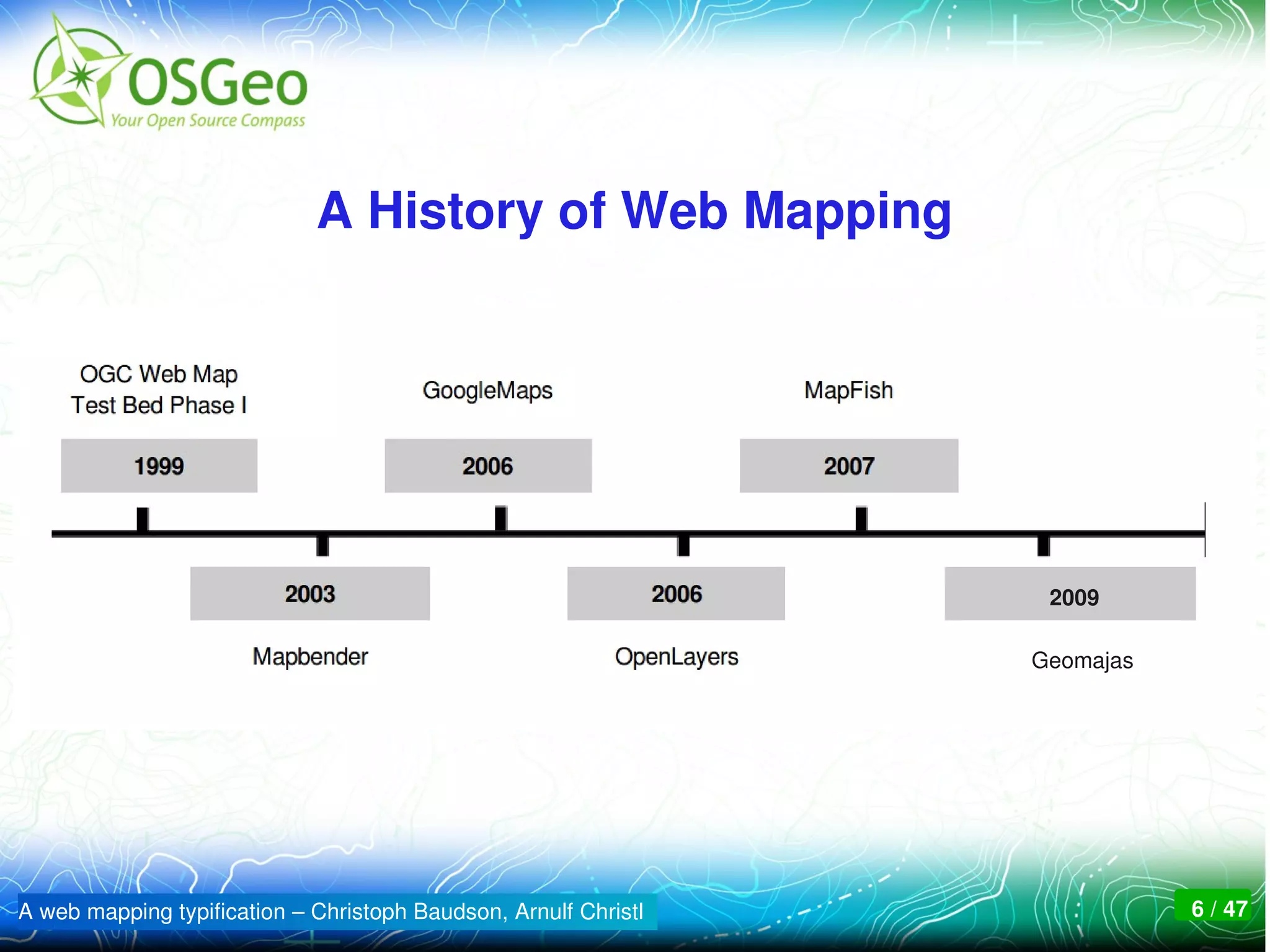
A History of Web Mapping


                                                                  2009

                                                                 Geomajas


A web mapping typification – Christoph Baudson, Arnulf Christl              6 / 47
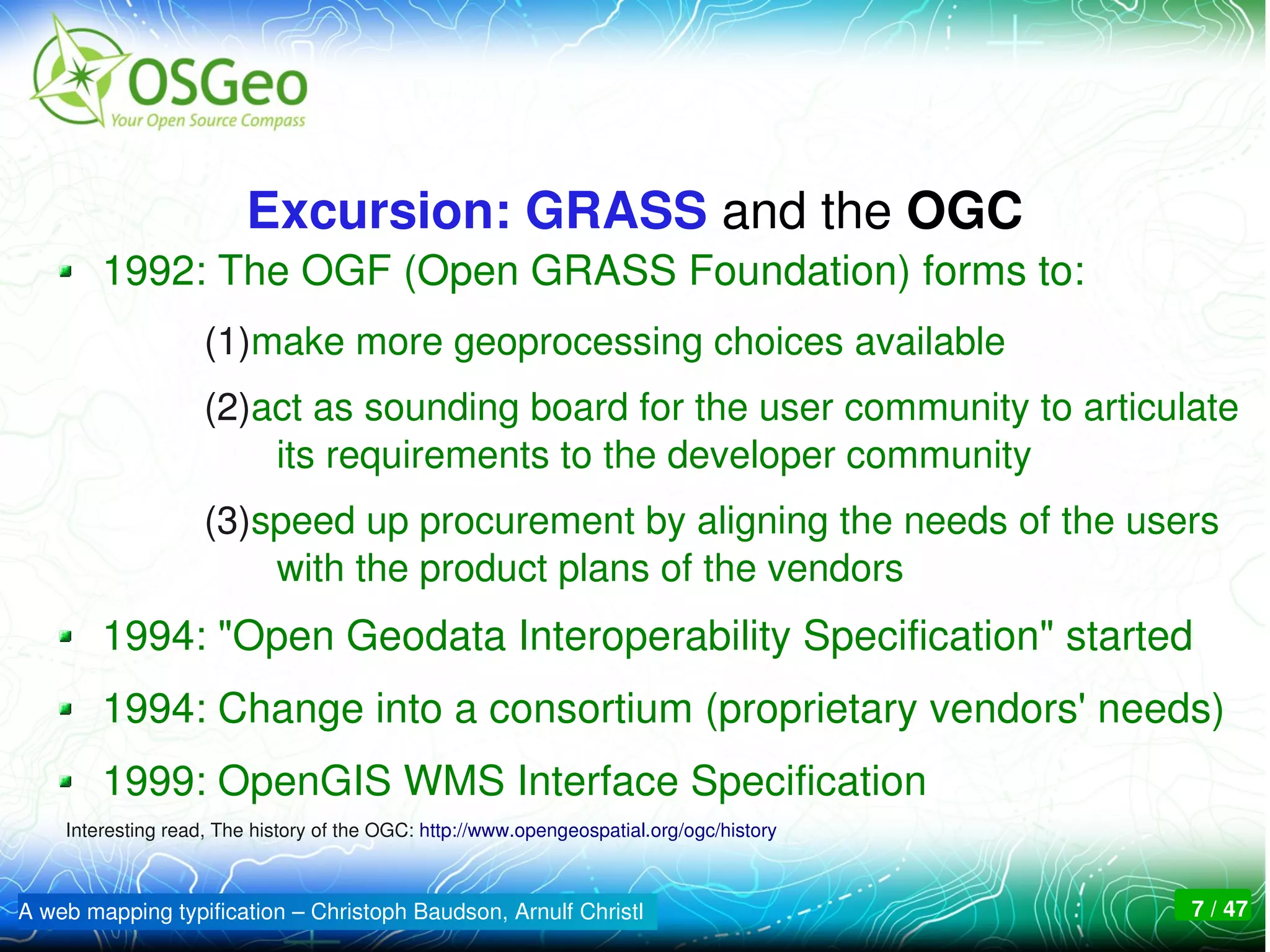
Excursion: GRASS and the OGC
        1992: The OGF (Open GRASS Foundation) forms to:
                    (1)make more geoprocessing choices available 
                    (2)act as sounding board for the user community to articulate 
                        its requirements to the developer community
                    (3)speed up procurement by aligning the needs of the users 
                        with the product plans of the vendors
        1994: "Open Geodata Interoperability Specification" started
        1994: Change into a consortium (proprietary vendors' needs)
        1999: OpenGIS WMS Interface Specification
    Interesting read, The history of the OGC: http://www.opengeospatial.org/ogc/history


A web mapping typification – Christoph Baudson, Arnulf Christl                            7 / 47
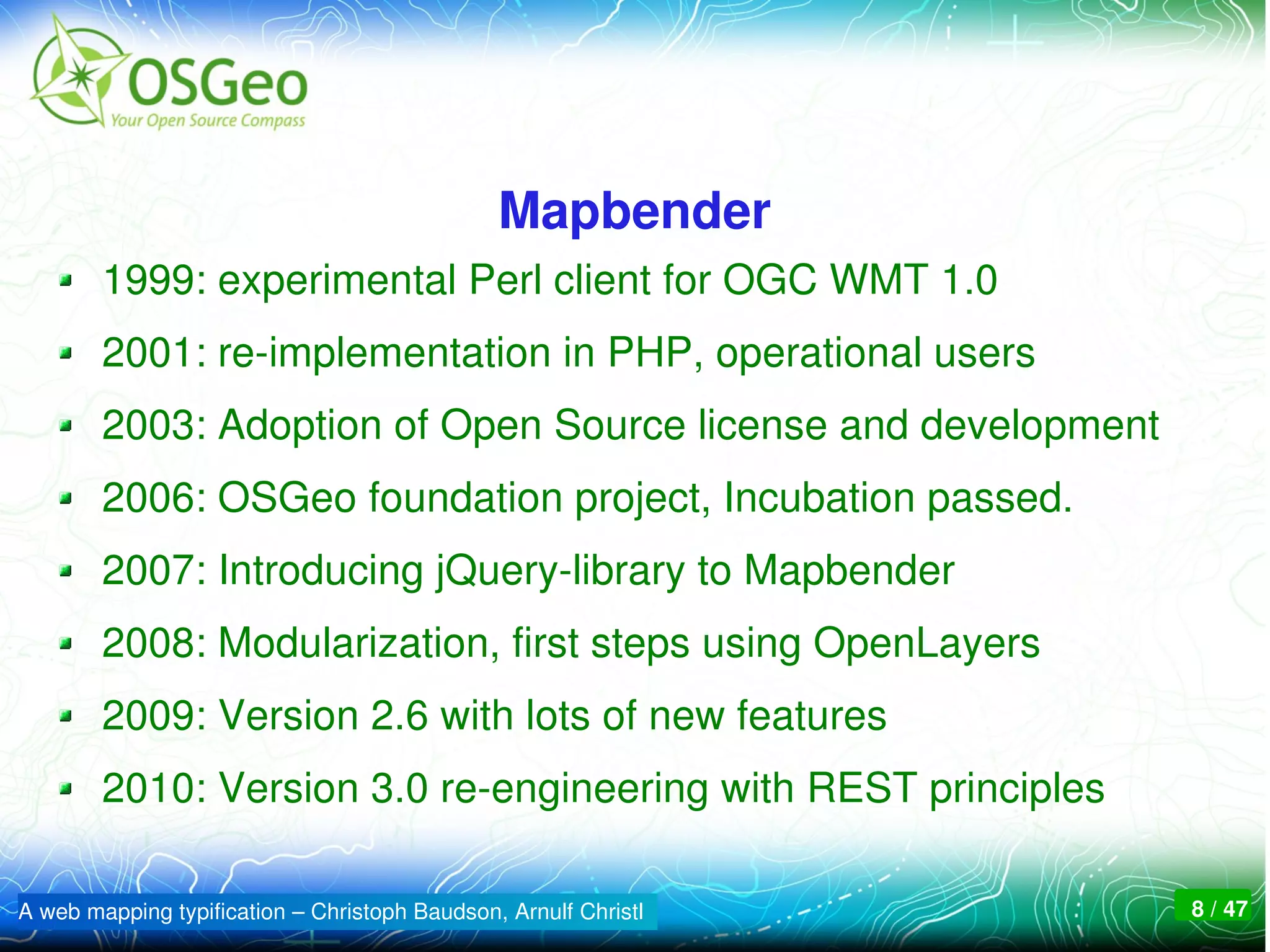
Mapbender
        1999: experimental Perl client for OGC WMT 1.0
        2001: re­implementation in PHP, operational users
        2003: Adoption of Open Source license and development
        2006: OSGeo foundation project, Incubation passed.
        2007: Introducing jQuery­library to Mapbender
        2008: Modularization, first steps using OpenLayers
        2009: Version 2.6 with lots of new features
        2010: Version 3.0 re­engineering with REST principles

A web mapping typification – Christoph Baudson, Arnulf Christl   8 / 47
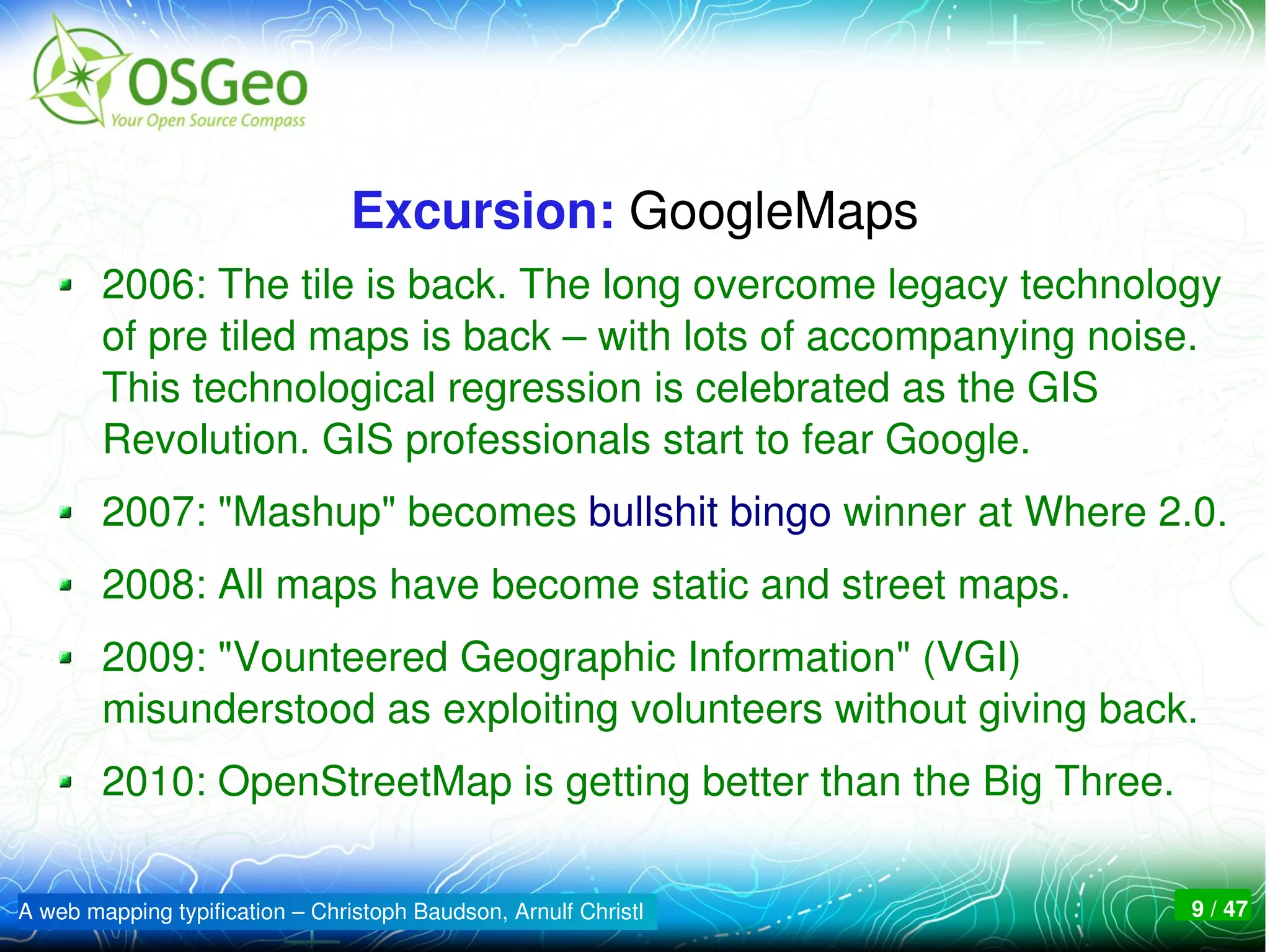
Excursion: GoogleMaps
        2006: The tile is back. The long overcome legacy technology 
        of pre tiled maps is back – with lots of accompanying noise. 
        This technological regression is celebrated as the GIS 
        Revolution. GIS professionals start to fear Google. 
        2007: "Mashup" becomes bullshit bingo winner at Where 2.0.
        2008: All maps have become static and street maps. 
        2009: "Vounteered Geographic Information" (VGI) 
        misunderstood as exploiting volunteers without giving back. 
        2010: OpenStreetMap is getting better than the Big Three.

A web mapping typification – Christoph Baudson, Arnulf Christl      9 / 47
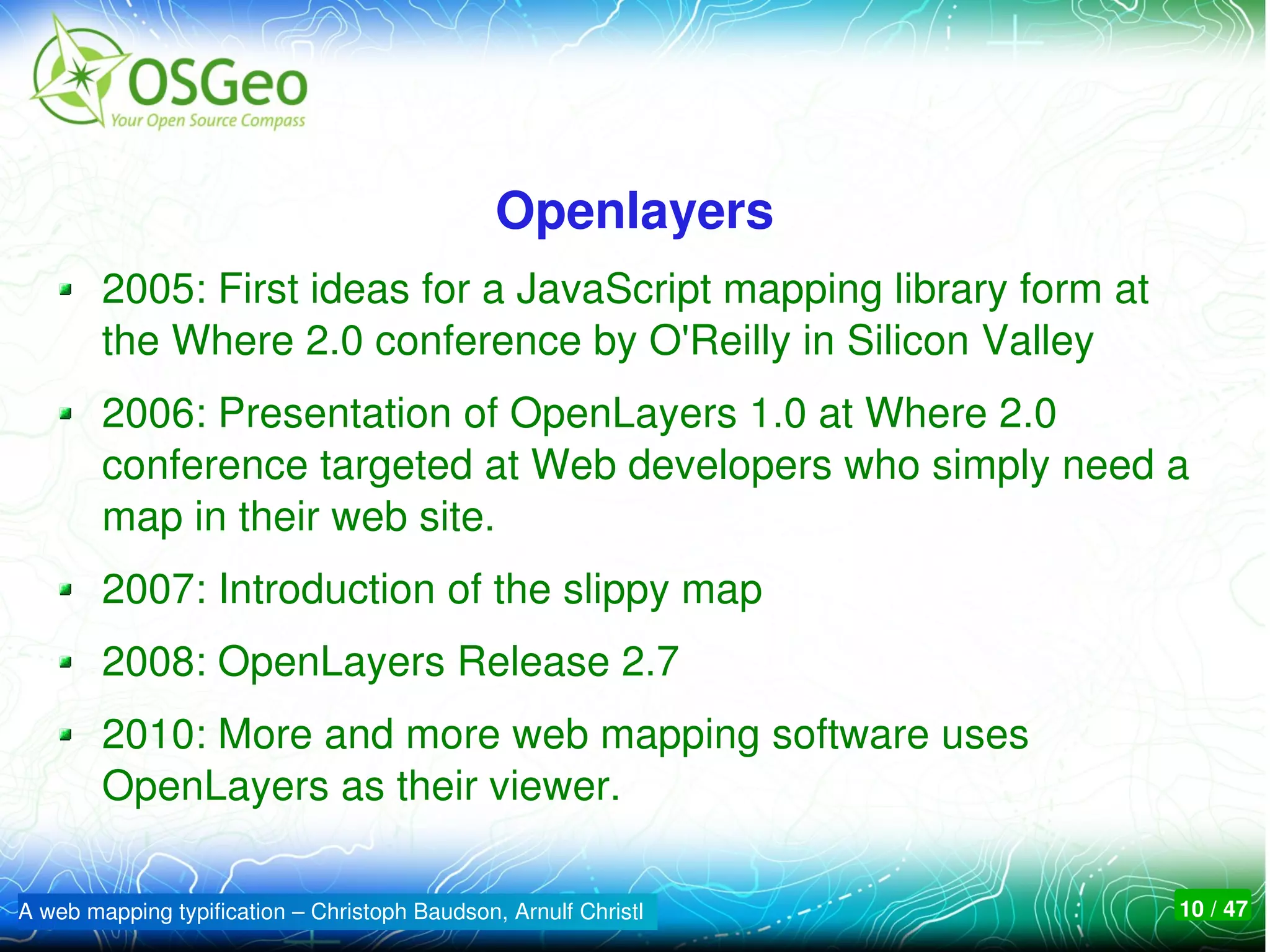
Openlayers
        2005: First ideas for a JavaScript mapping library form at 
        the Where 2.0 conference by O'Reilly in Silicon Valley
        2006: Presentation of OpenLayers 1.0 at Where 2.0 
        conference targeted at Web developers who simply need a 
        map in their web site. 
        2007: Introduction of the slippy map
        2008: OpenLayers Release 2.7
        2010: More and more web mapping software uses 
        OpenLayers as their viewer.

A web mapping typification – Christoph Baudson, Arnulf Christl        10 / 47
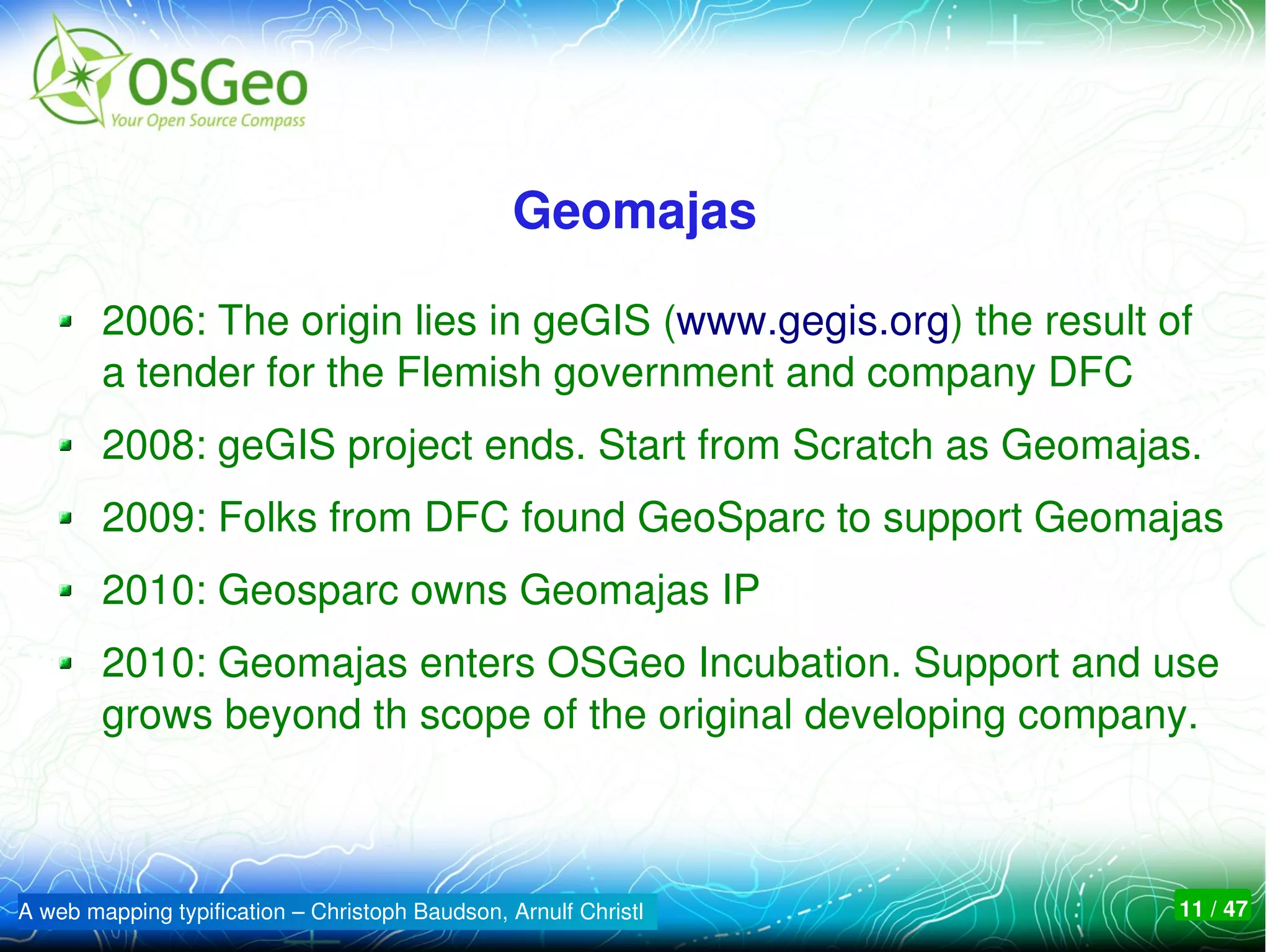
Geomajas

        2006: The origin lies in geGIS (www.gegis.org) the result of 
        a tender for the Flemish government and company DFC
        2008: geGIS project ends. Start from Scratch as Geomajas.
        2009: Folks from DFC found GeoSparc to support Geomajas
        2010: Geosparc owns Geomajas IP
        2010: Geomajas enters OSGeo Incubation. Support and use 
        grows beyond th scope of the original developing company. 


A web mapping typification – Christoph Baudson, Arnulf Christl     11 / 47
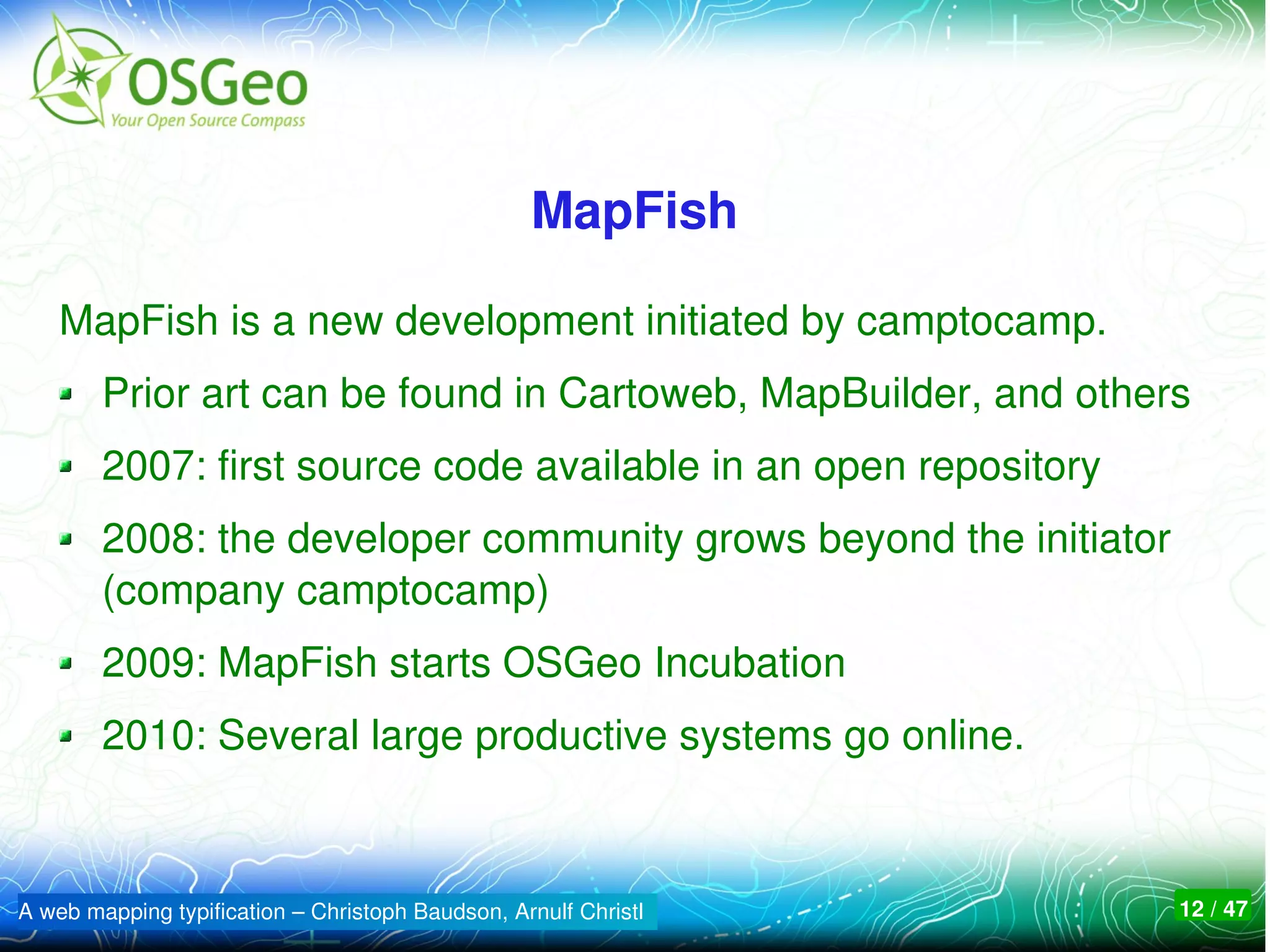
MapFish

    MapFish is a new development initiated by camptocamp.
        Prior art can be found in Cartoweb, MapBuilder, and others
        2007: first source code available in an open repository
        2008: the developer community grows beyond the initiator 
        (company camptocamp)
        2009: MapFish starts OSGeo Incubation 
        2010: Several large productive systems go online. 


A web mapping typification – Christoph Baudson, Arnulf Christl    12 / 47
Excursion: on Tiling

    Tiling pros and cons:
        Tiles are a perfect fit for Internet technology.
        Associated technology is very robust and scalable.
        Every coordinate system and scale level needs it's own set 
        of tiles: This makes data management a real issue. 
        Tiled maps are static.
        Most servers are purposefully not standardized in an open 
        and consensus based process

A web mapping typification – Christoph Baudson, Arnulf Christl   13 / 47
Functionality in all 
                   frameworks is very 
                   similar.

                   Let's take a look at...


A web mapping typification – Christoph Baudson, Arnulf Christl   14 / 47
… the
                                                                 source 
                                                                 code!


A web mapping typification – Christoph Baudson, Arnulf Christl         15 / 47
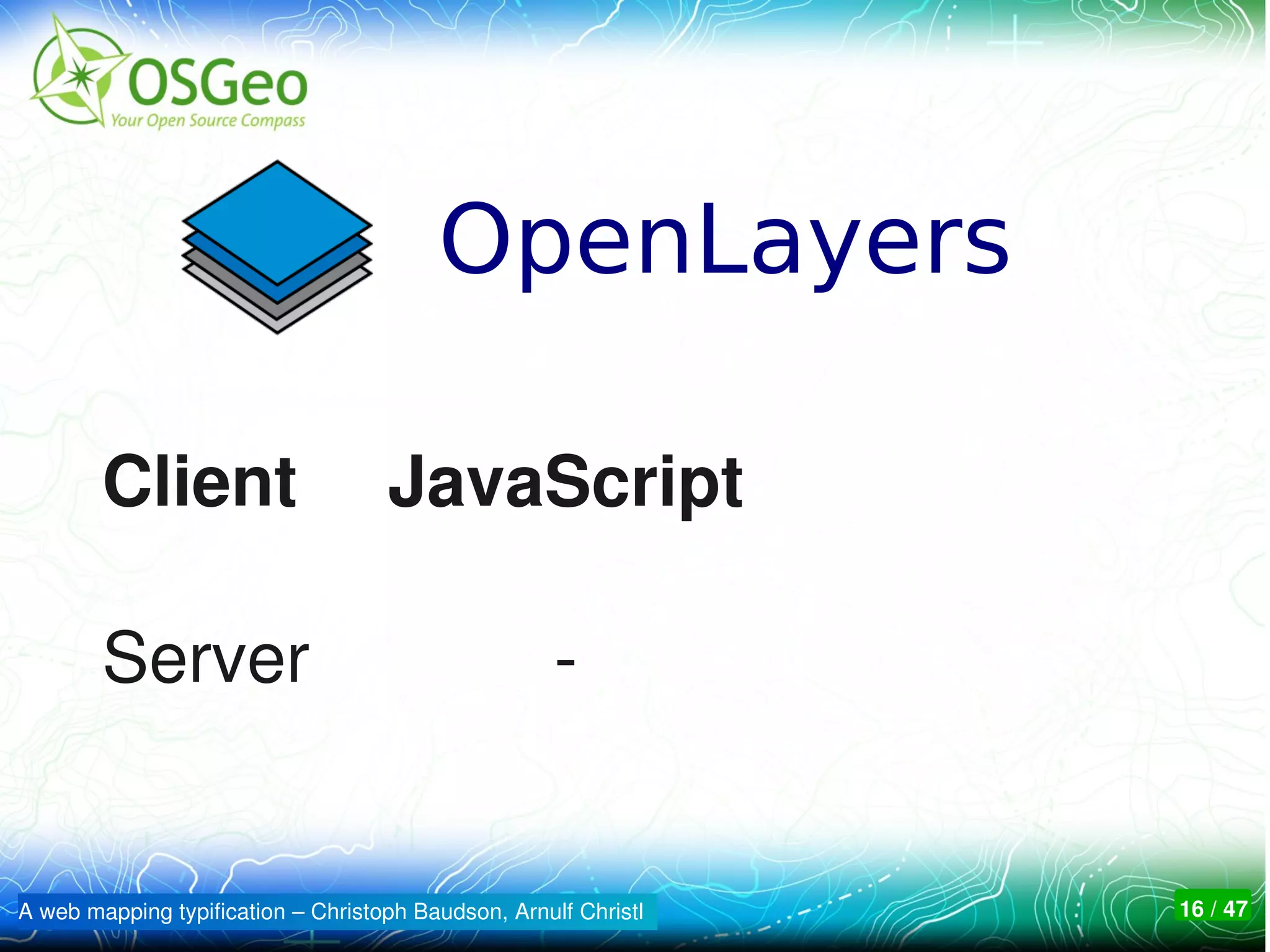
OpenLayers

        Client                      JavaScript

        Server                                       ­


A web mapping typification – Christoph Baudson, Arnulf Christl   16 / 47
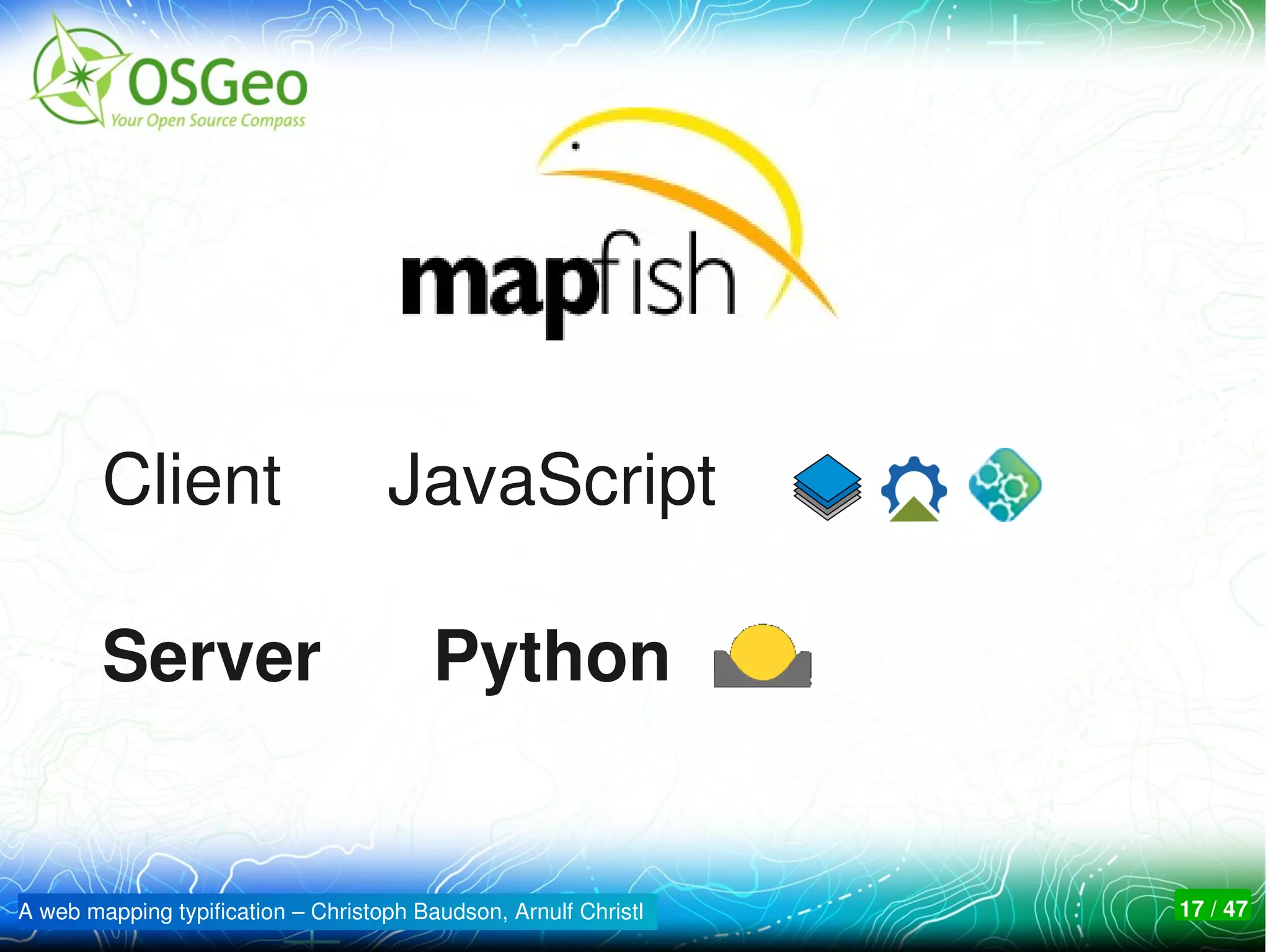
Client                      JavaScript

        Server                           Python


A web mapping typification – Christoph Baudson, Arnulf Christl   17 / 47
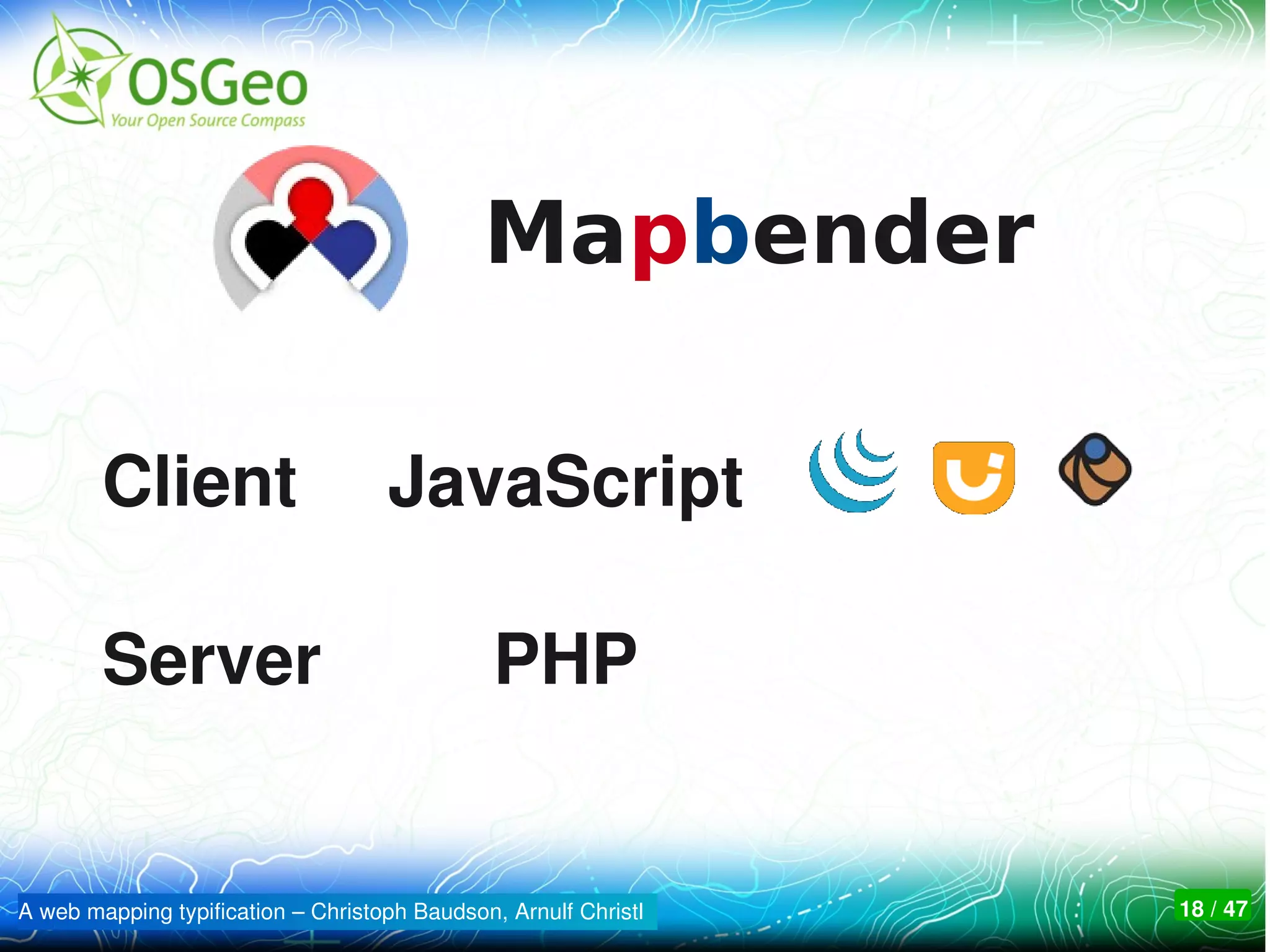
Mapbender

        Client                      JavaScript

        Server                                 PHP


A web mapping typification – Christoph Baudson, Arnulf Christl   18 / 47
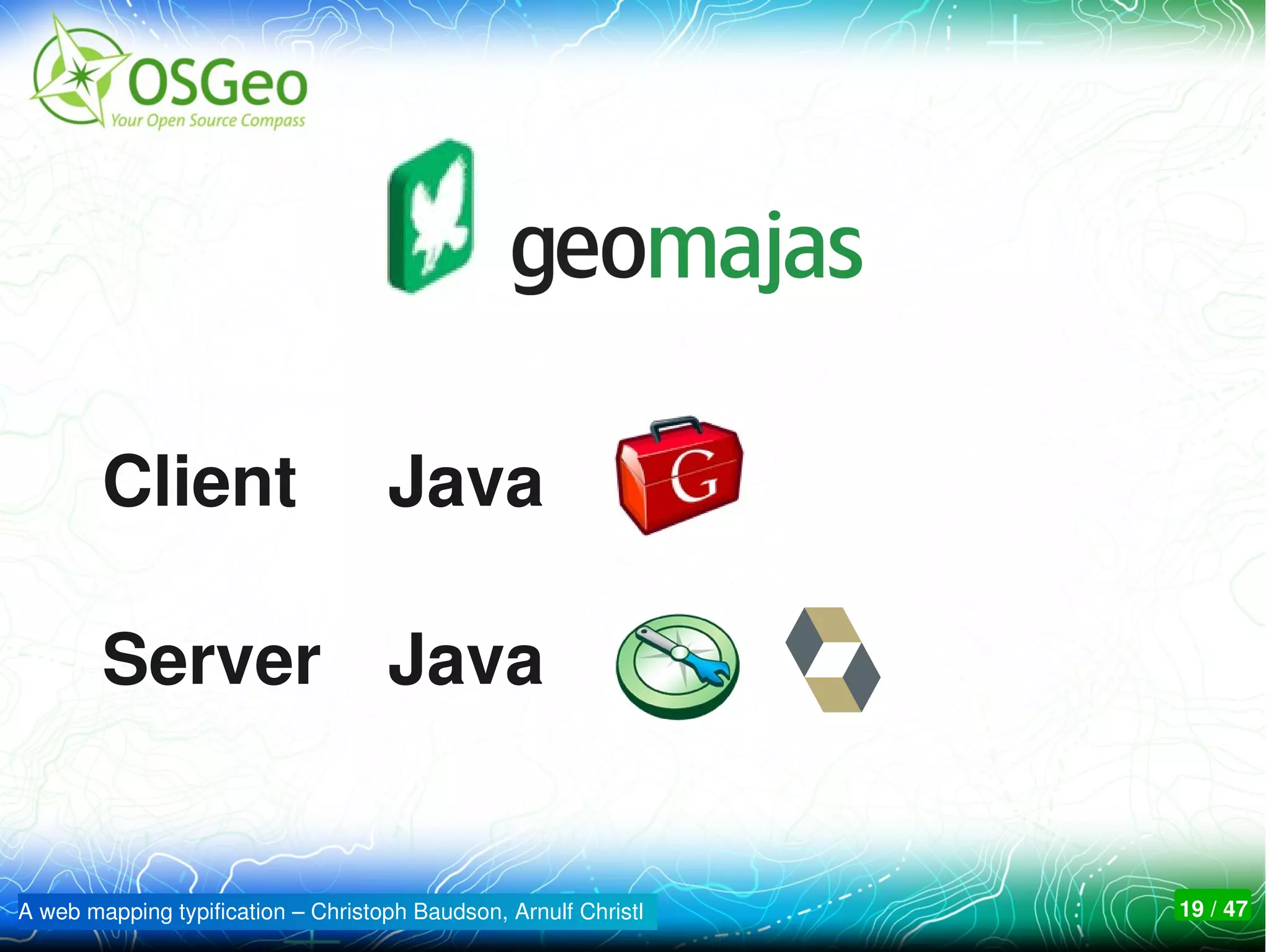
Client                      Java

        Server Java


A web mapping typification – Christoph Baudson, Arnulf Christl   19 / 47
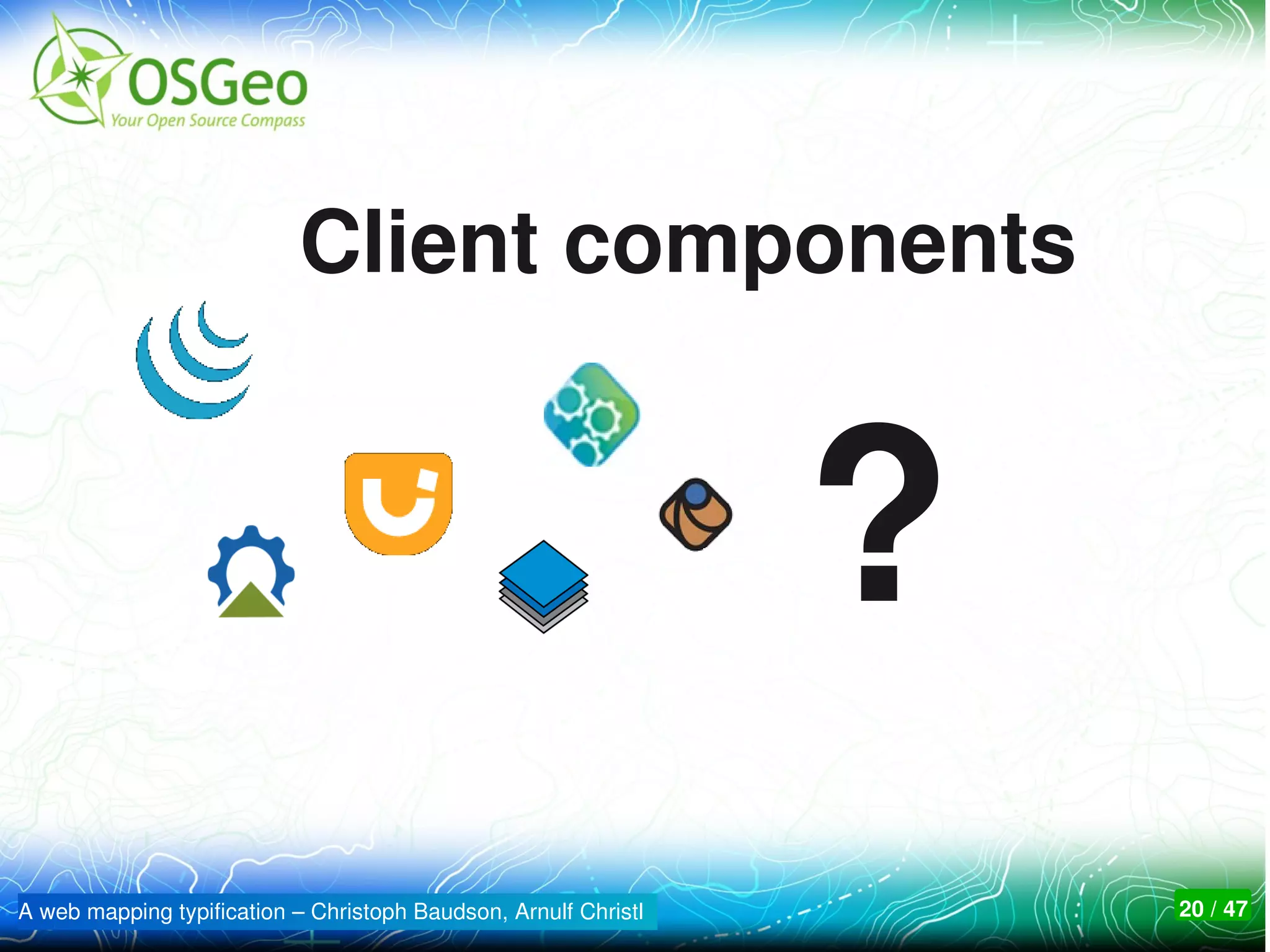
Client components


                                                                 ?
A web mapping typification – Christoph Baudson, Arnulf Christl       20 / 47
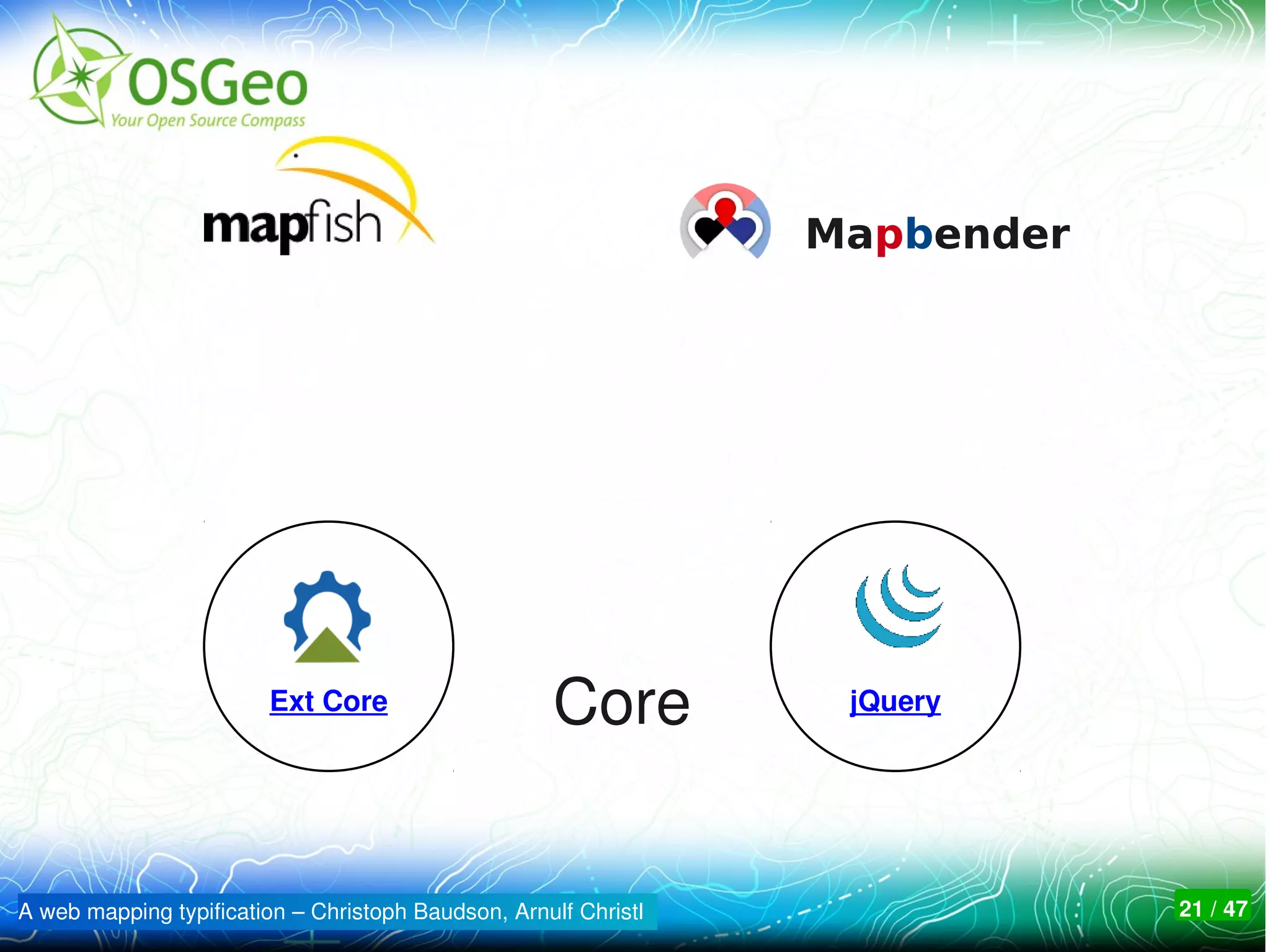
Mapbender


                        Ext Core                     Core         jQuery


A web mapping typification – Christoph Baudson, Arnulf Christl               21 / 47
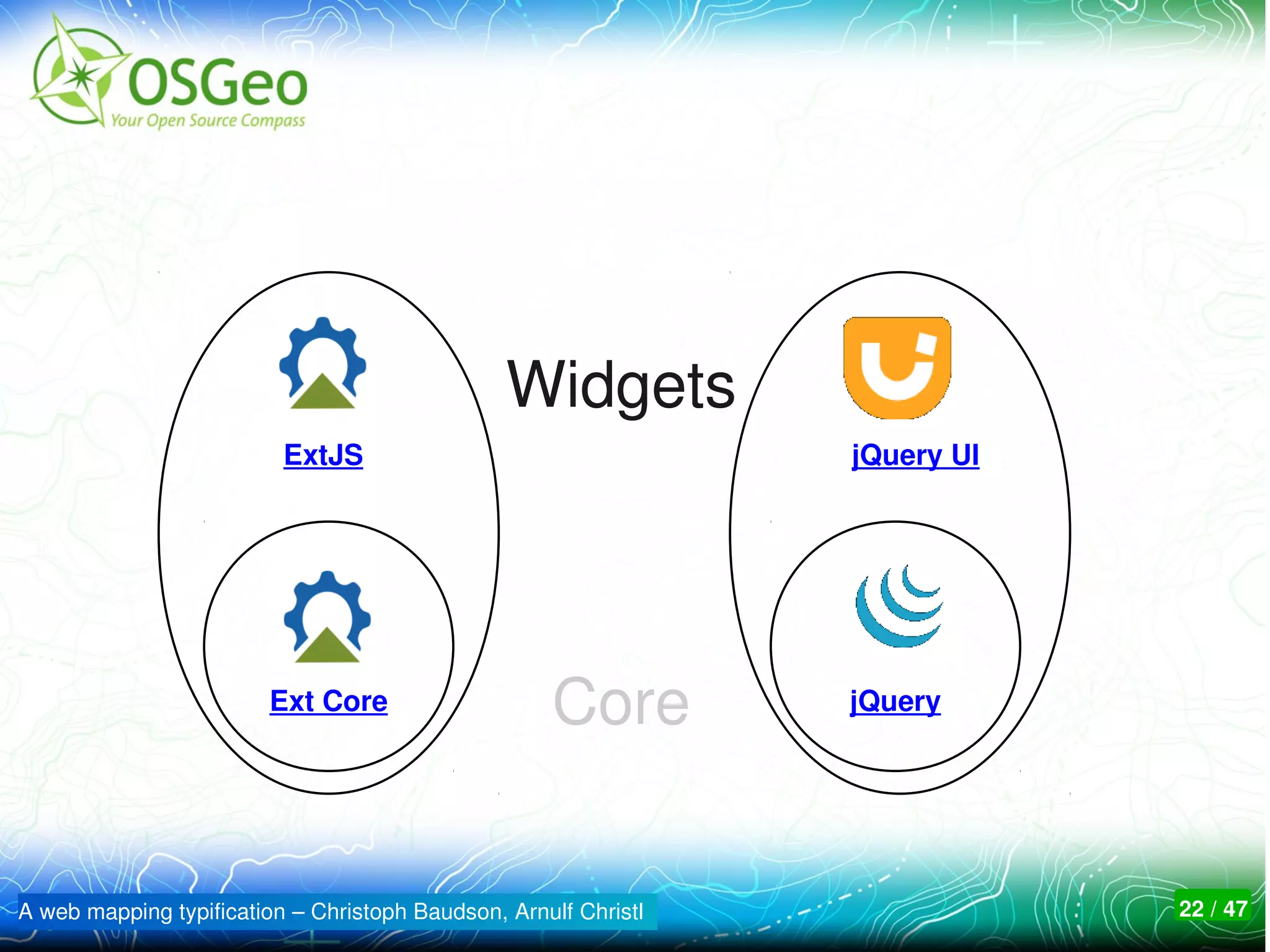
Widgets
                          ExtJS                                  jQuery UI


                        Ext Core                    Core         jQuery


A web mapping typification – Christoph Baudson, Arnulf Christl               22 / 47
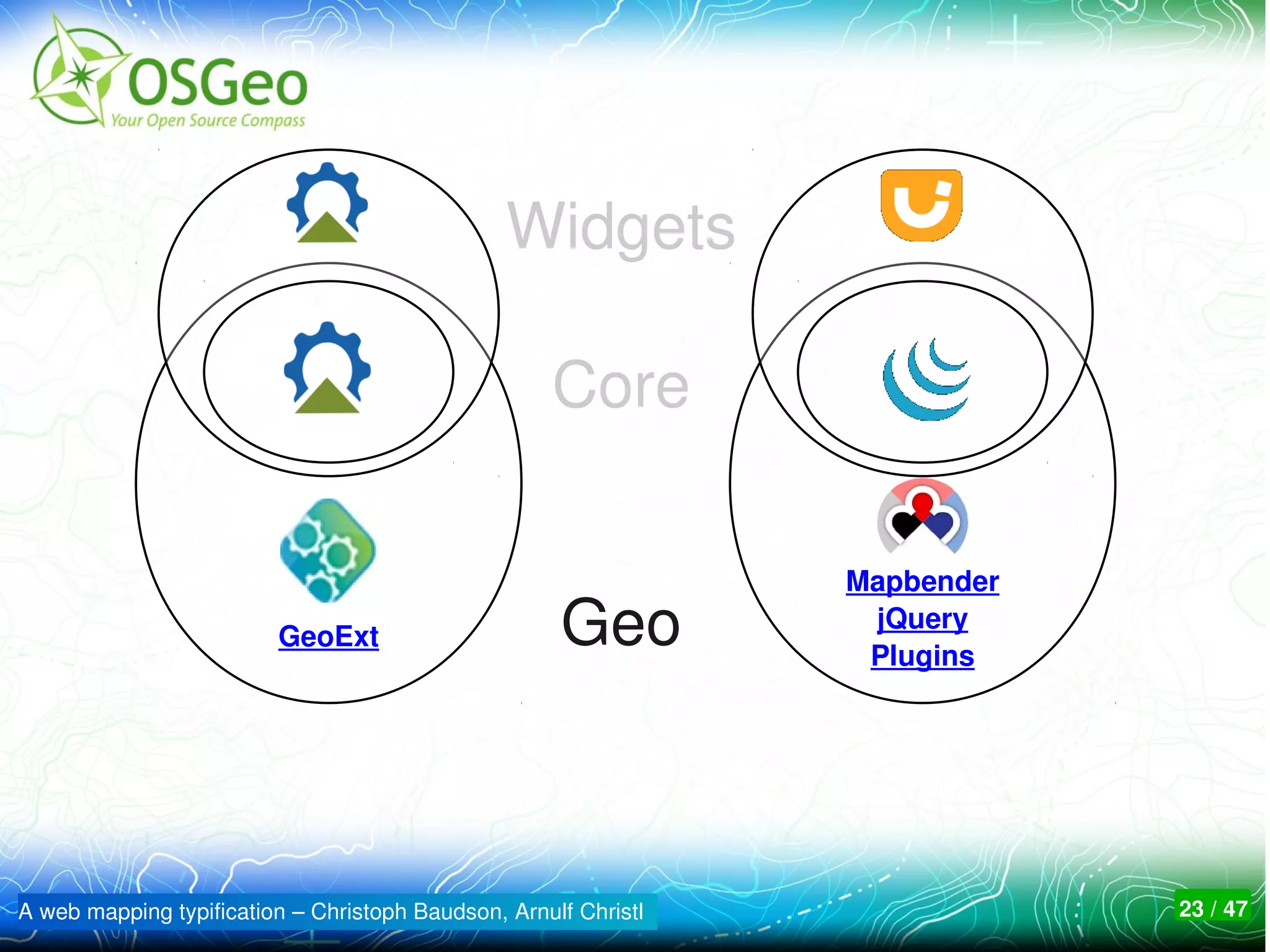
Widgets

                                                    Core

                                                                 Mapbender
                         GeoExt                      Geo          jQuery
                                                                  Plugins


A web mapping typification – Christoph Baudson, Arnulf Christl               23 / 47
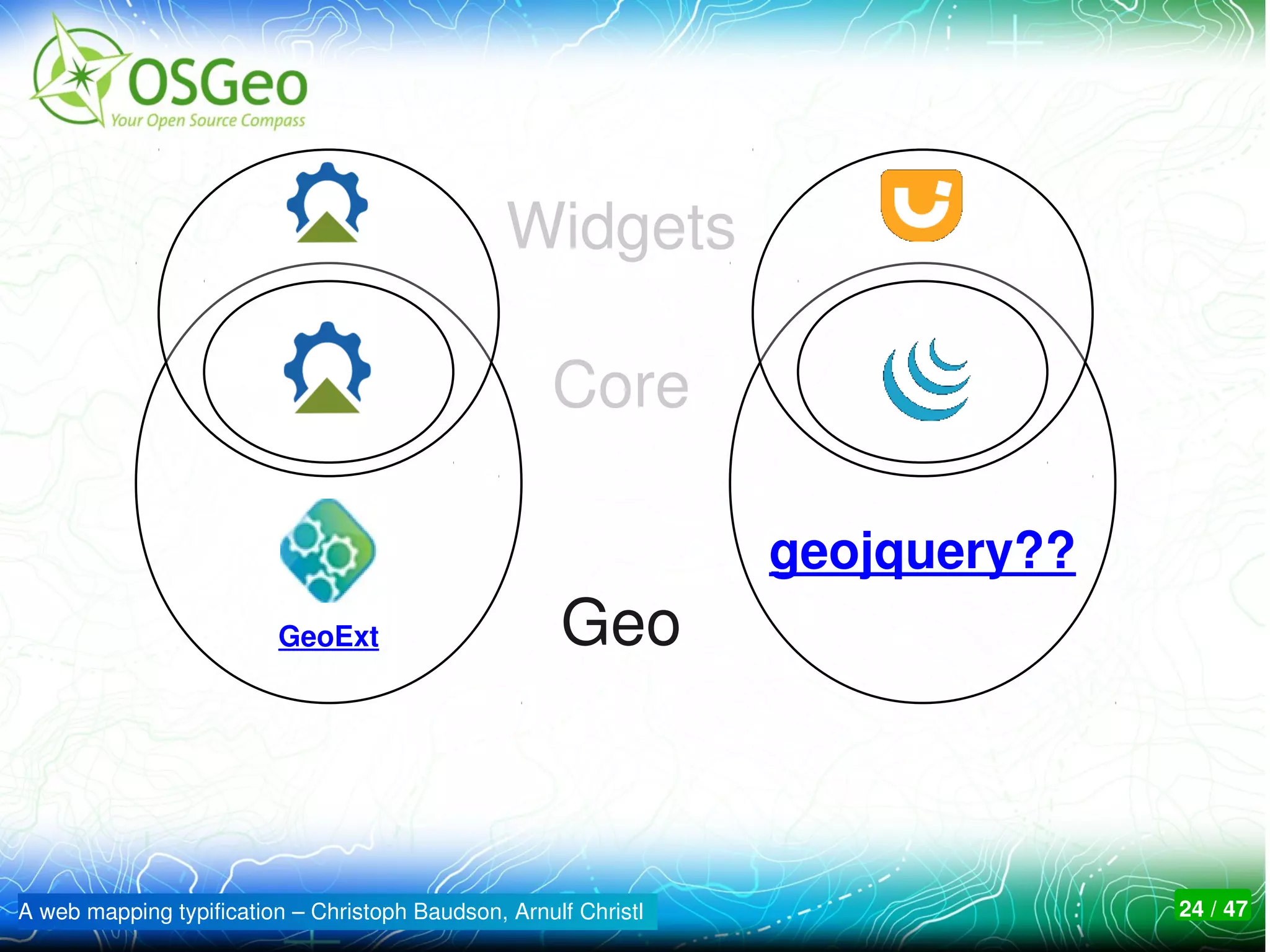
Widgets

                                                    Core

                                                                 geojquery??
                         GeoExt                      Geo


A web mapping typification – Christoph Baudson, Arnulf Christl                 24 / 47
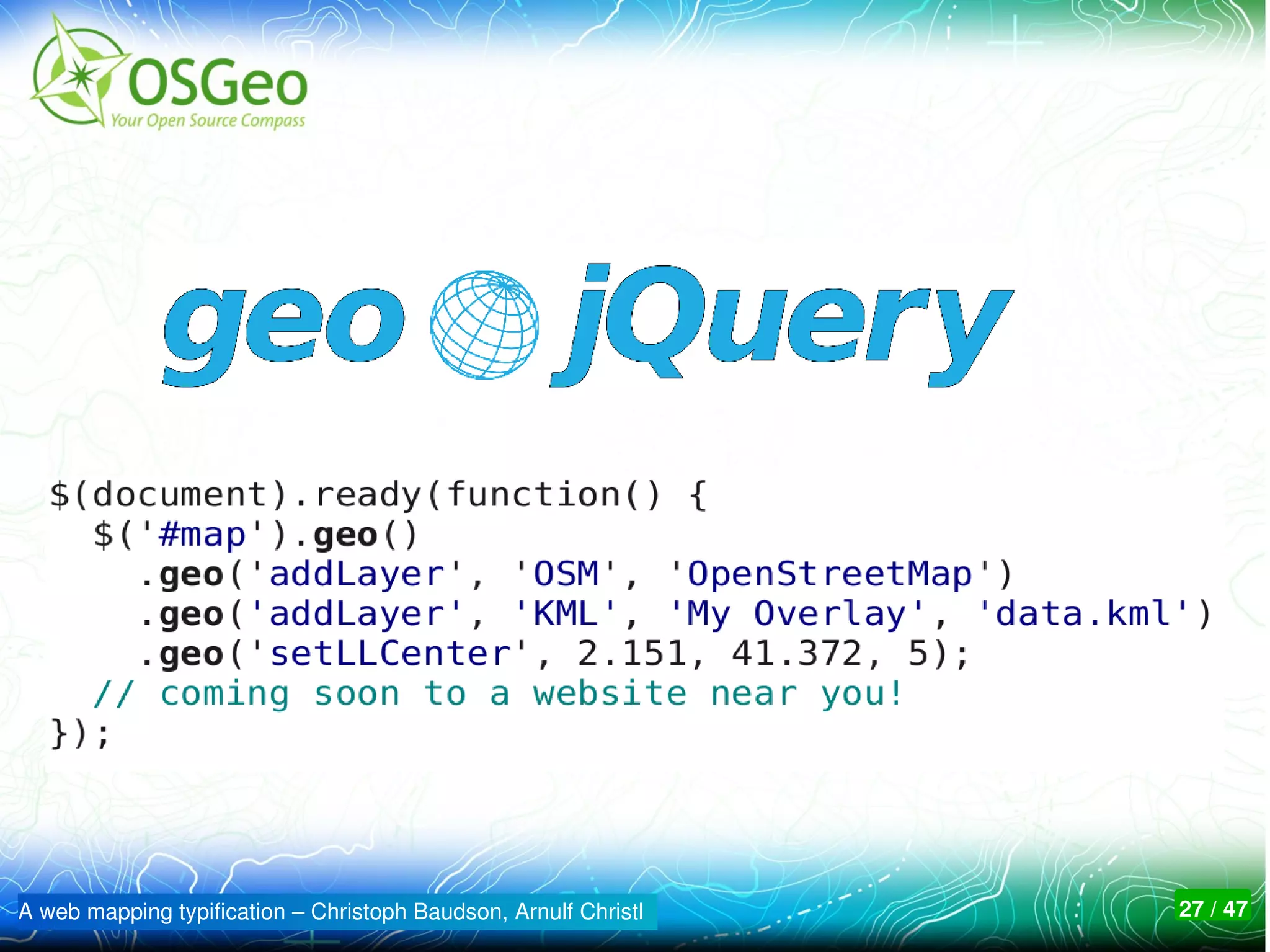
geojquery wants to bring the jQuery 
            way of doing things to web mapping.


A web mapping typification – Christoph Baudson, Arnulf Christl   25 / 47
Mission: Implement a jQuery 
            interface to OpenLayers, provide a 
            rich set of UI widgets.


A web mapping typification – Christoph Baudson, Arnulf Christl   26 / 47
A web mapping typification – Christoph Baudson, Arnulf Christl   27 / 47
Not a GeoExt clone.

            Write less, do more.


A web mapping typification – Christoph Baudson, Arnulf Christl   28 / 47
Join code sprint on Friday:

            http://wiki.osgeo.org/wiki/FOSS4G_2010_Code_Sprint


A web mapping typification – Christoph Baudson, Arnulf Christl   29 / 47
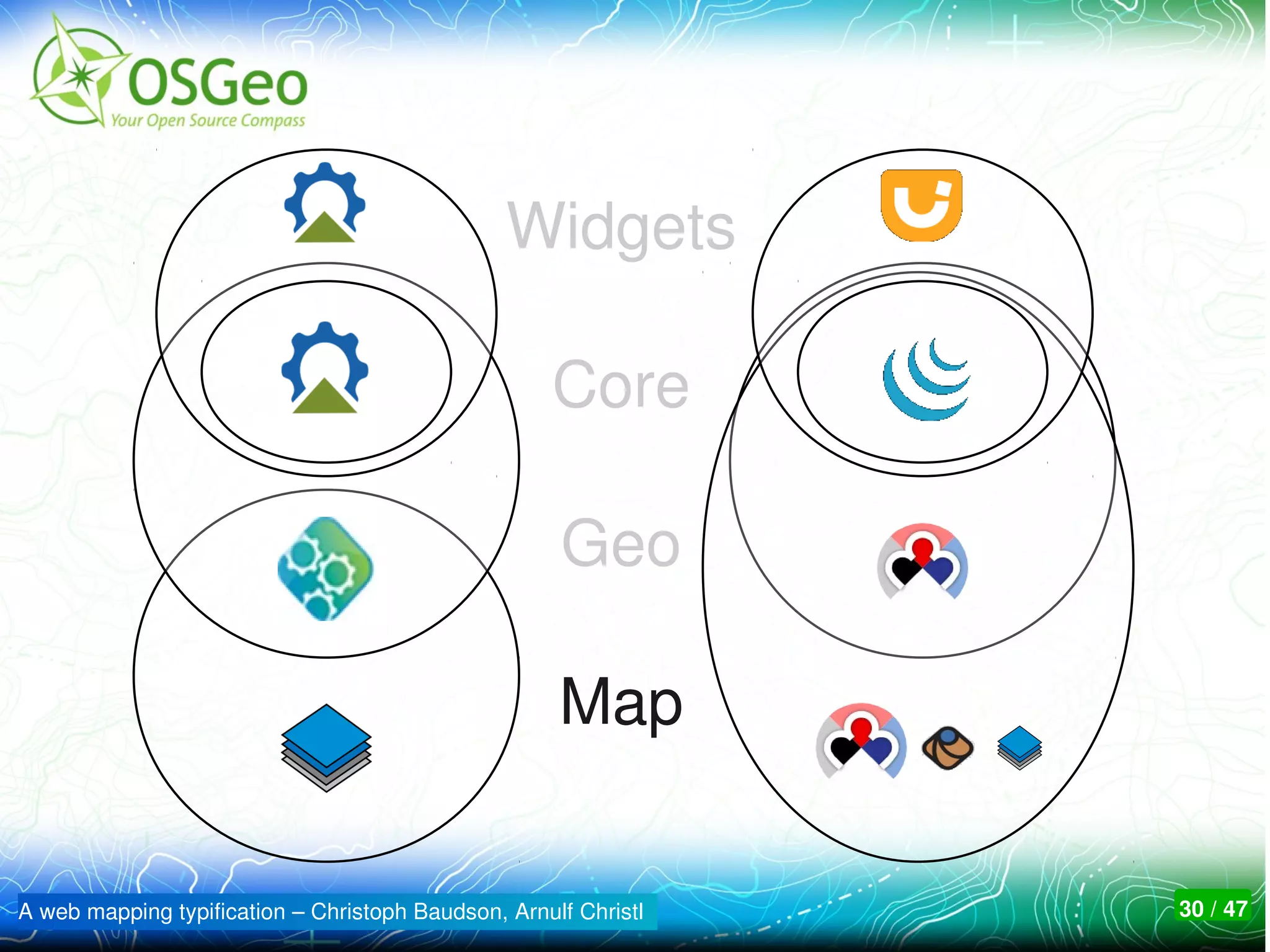
Widgets

                                                    Core

                                                     Geo

                                                     Map


A web mapping typification – Christoph Baudson, Arnulf Christl   30 / 47
ExtJS / jQuery – License


        ExtJS: Dual ("Commercial" and GPLv3)


        jQuery / jQuery UI: Dual (MIT and GPLv3)


A web mapping typification – Christoph Baudson, Arnulf Christl   31 / 47
ExtJS / jQuery – Copyright

        ExtJS: Copyright lies with Ext JS, LLC 


        jQuery: Copyright lies with creator John Resig
        jQuery und jQuery UI: Copyright lies with the team of the  
        jQuery Project
        Thoughts to transfer rights to the non­profit organization 
        Software Freedom Conservancy


A web mapping typification – Christoph Baudson, Arnulf Christl        32 / 47
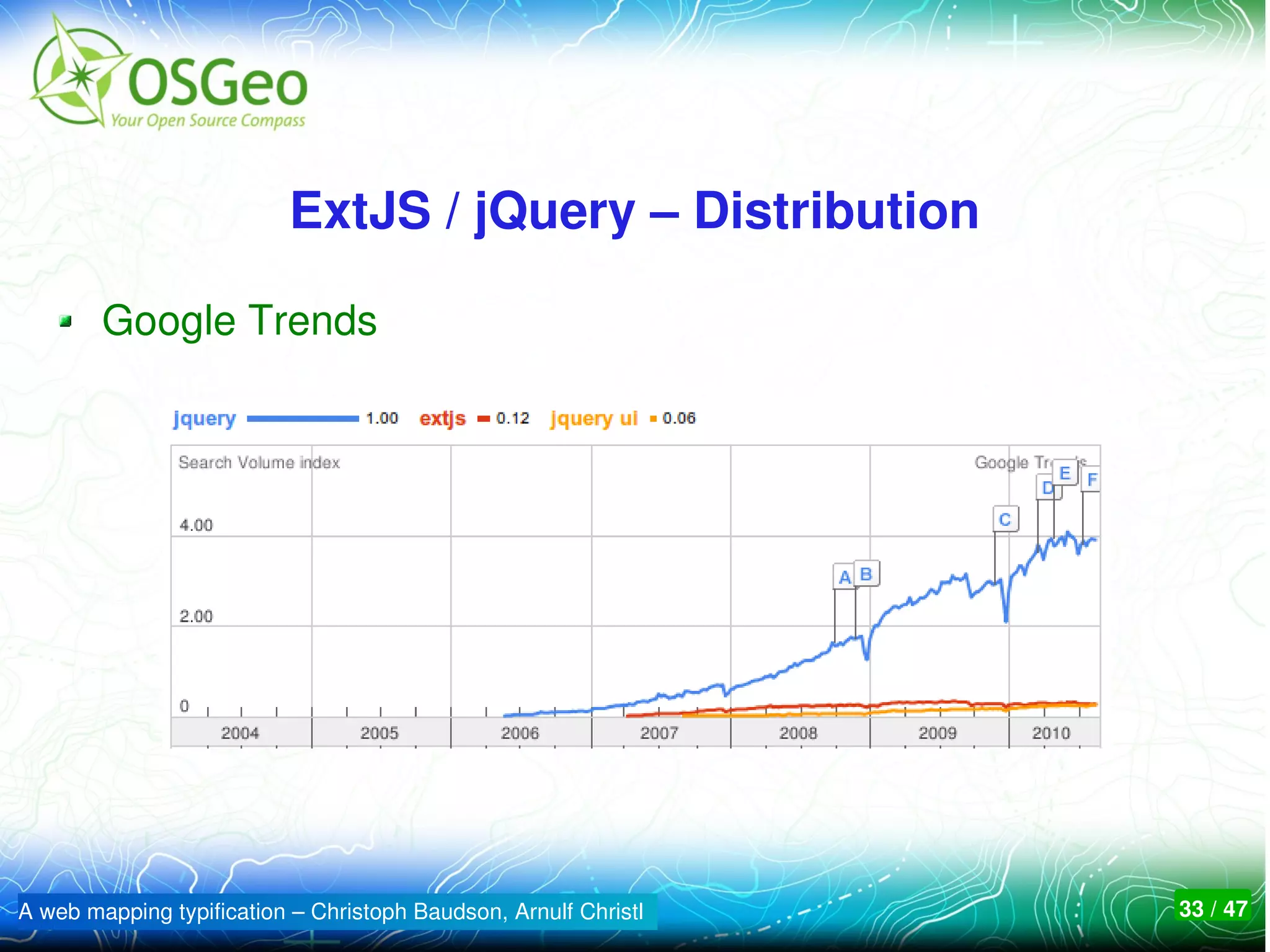
ExtJS / jQuery – Distribution

        Google Trends


A web mapping typification – Christoph Baudson, Arnulf Christl   33 / 47
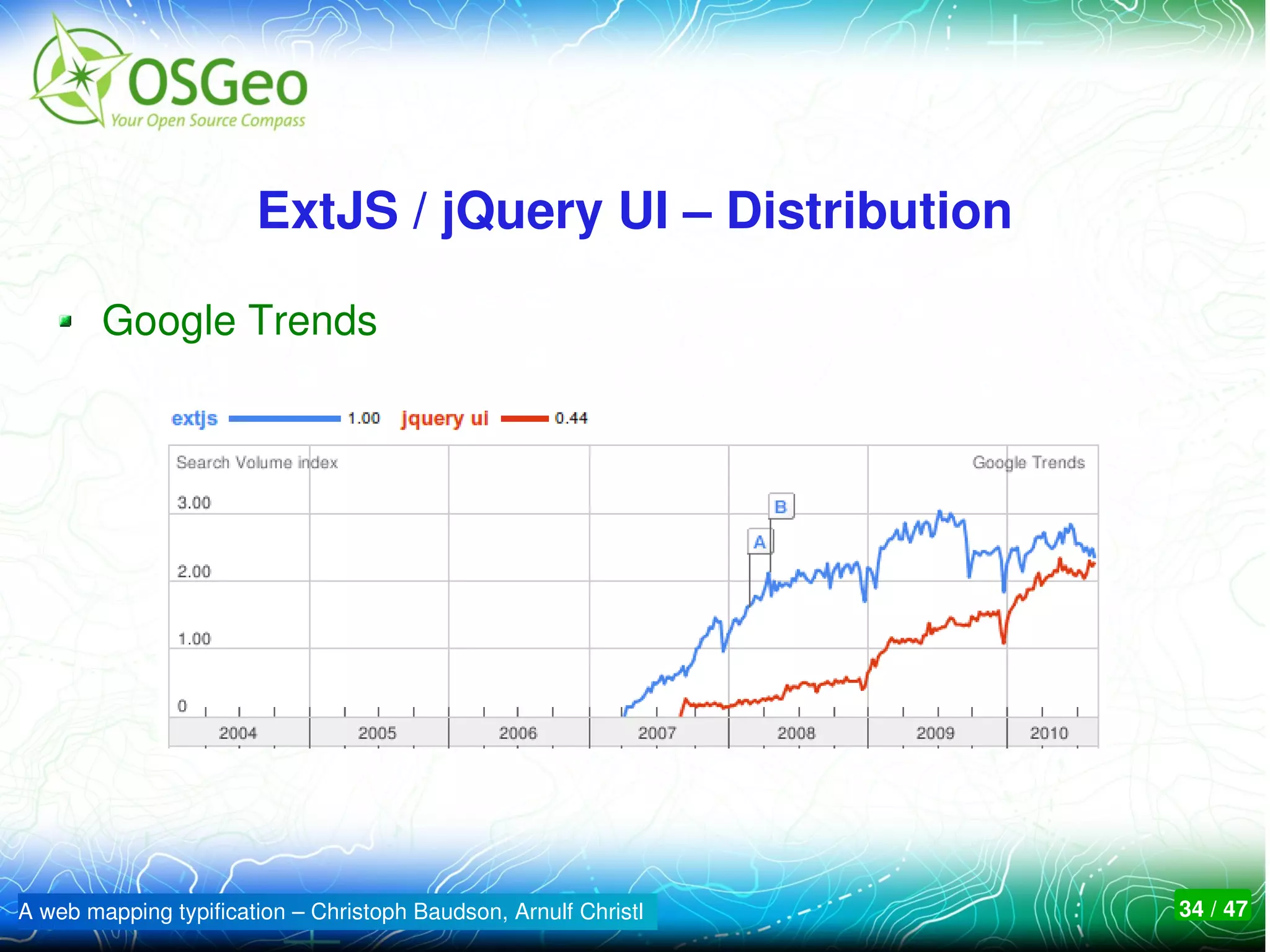
ExtJS / jQuery UI – Distribution

        Google Trends


A web mapping typification – Christoph Baudson, Arnulf Christl   34 / 47
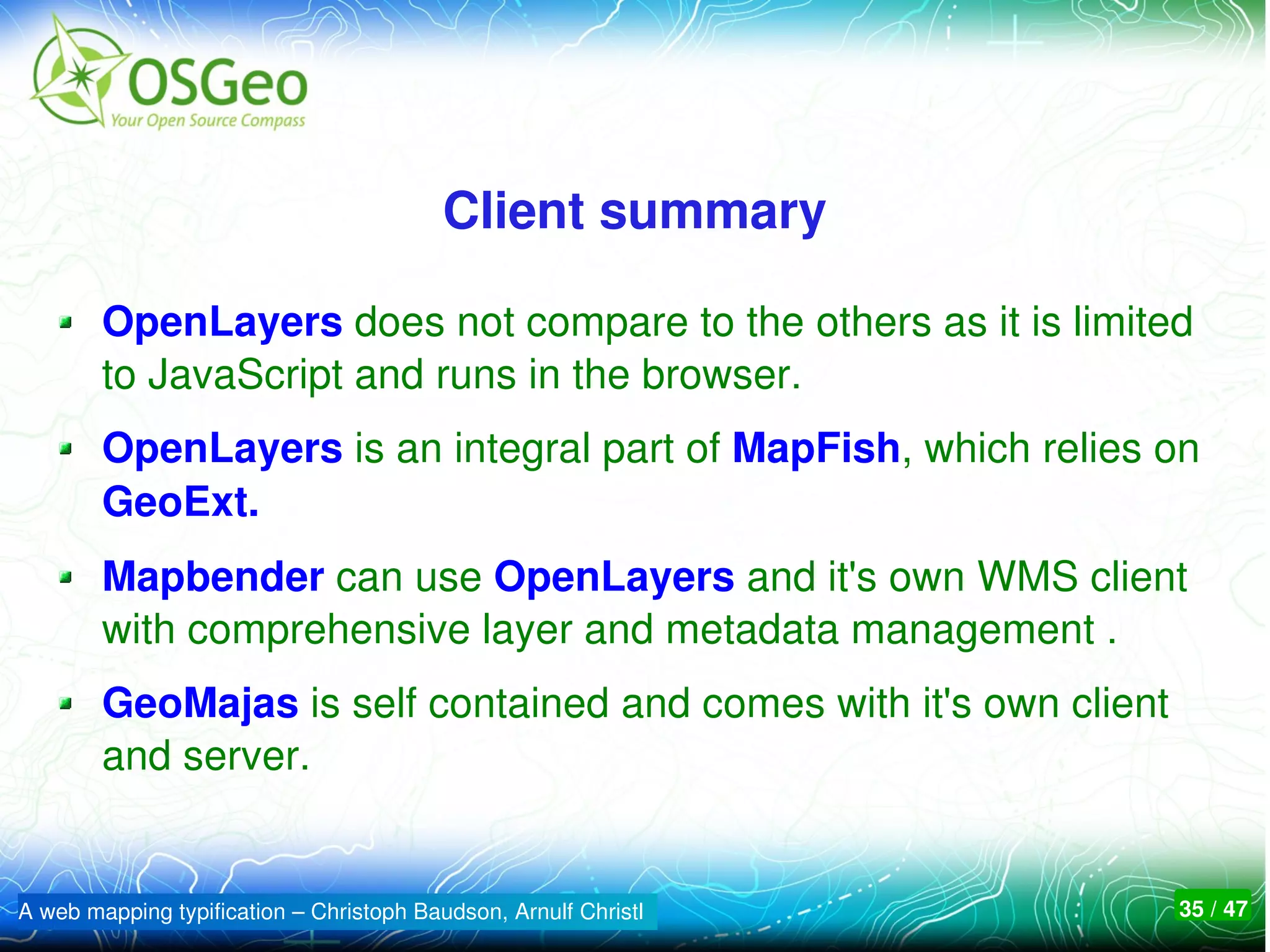
Client summary

        OpenLayers does not compare to the others as it is limited 
        to JavaScript and runs in the browser.
        OpenLayers is an integral part of MapFish, which relies on 
        GeoExt.
        Mapbender can use OpenLayers and it's own WMS client 
        with comprehensive layer and metadata management .
        GeoMajas is self contained and comes with it's own client 
        and server.


A web mapping typification – Christoph Baudson, Arnulf Christl   35 / 47
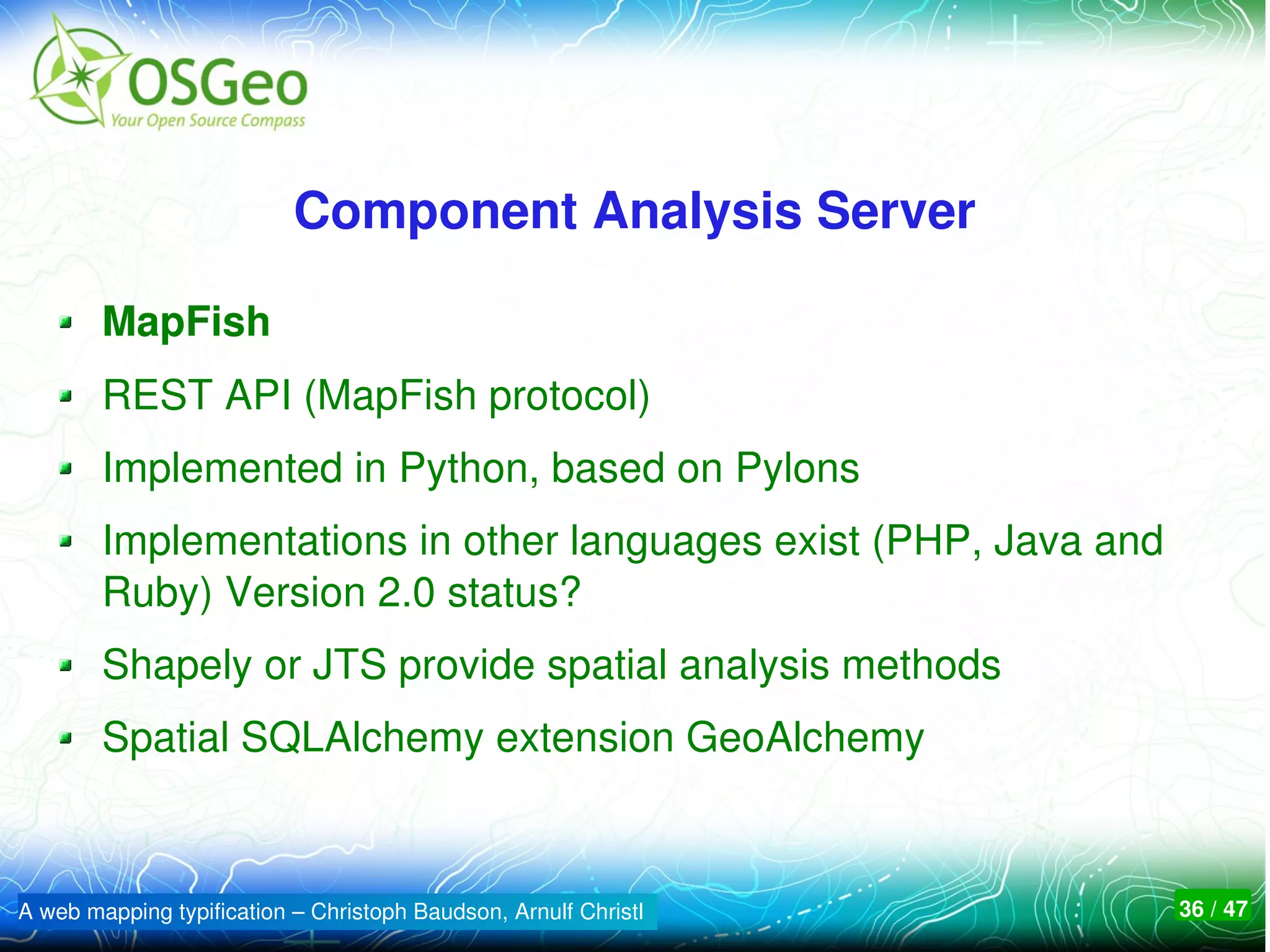
Component Analysis Server

        MapFish
        REST API (MapFish protocol)
        Implemented in Python, based on Pylons
        Implementations in other languages exist (PHP, Java and 
        Ruby) Version 2.0 status?
        Shapely or JTS provide spatial analysis methods
        Spatial SQLAlchemy extension GeoAlchemy 


A web mapping typification – Christoph Baudson, Arnulf Christl     36 / 47
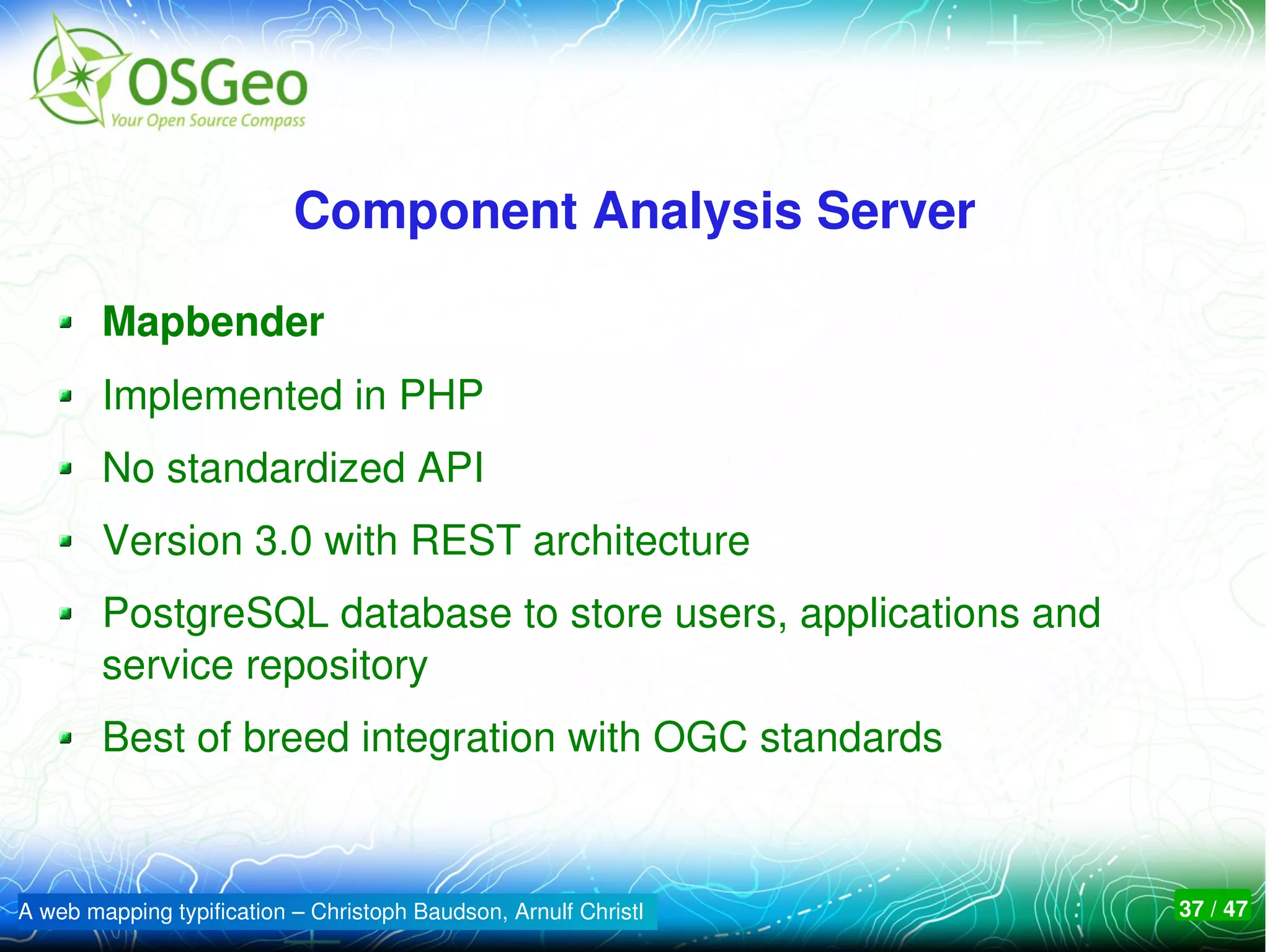
Component Analysis Server

        Mapbender
        Implemented in PHP
        No standardized API
        Version 3.0 with REST architecture
        PostgreSQL database to store users, applications and 
        service repository
        Best of breed integration with OGC standards


A web mapping typification – Christoph Baudson, Arnulf Christl   37 / 47
Component Analysis Server

        GeoMajas
        Documented API (not standardized)
        Strong focus on server side
        Implemented in Java
        GeoTools allows powerful data analysis and manipulation
        Client/Server communication highly integrated
        Maps and clients in one framework


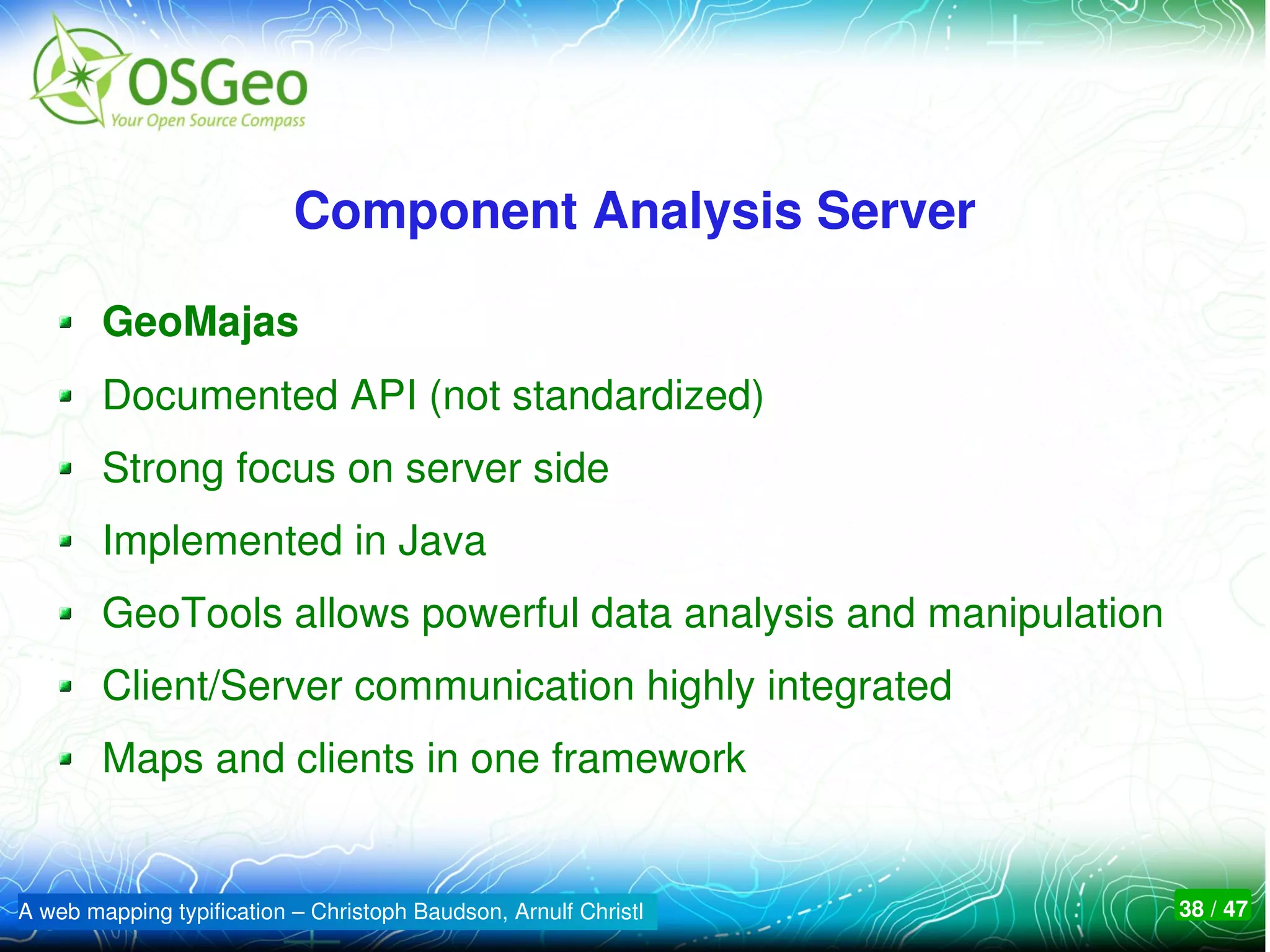
A web mapping typification – Christoph Baudson, Arnulf Christl    38 / 47
Administration

        MapFish: Administration requires source code and config 
        file editing
        Mapbender: Administration via Web based interfaces. 
        GeoMajas: Administration requires source code and config 
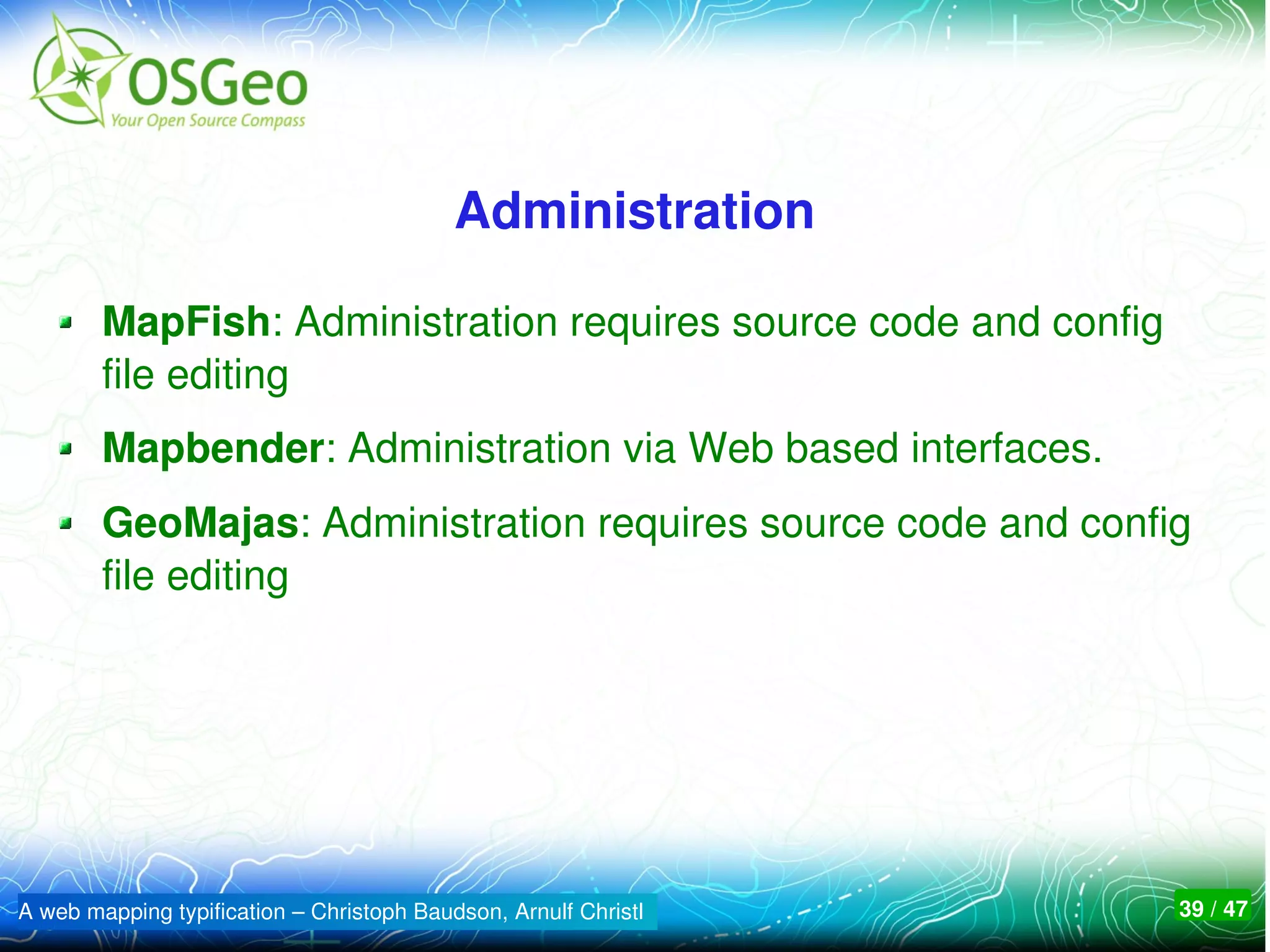
        file editing


A web mapping typification – Christoph Baudson, Arnulf Christl     39 / 47
Database Component

        MapFish: SQLAlchemy (SQLite, Postgres, MySQL, Oracle, 
        MS­SQL, …), GeoAlchemy for spatial databases.
        Mapbender exclusively PostgreSQL, PostGIS for spatial 
        functionality.
        GeoMajas: via Hibernate, spatial databases via GeoTools.


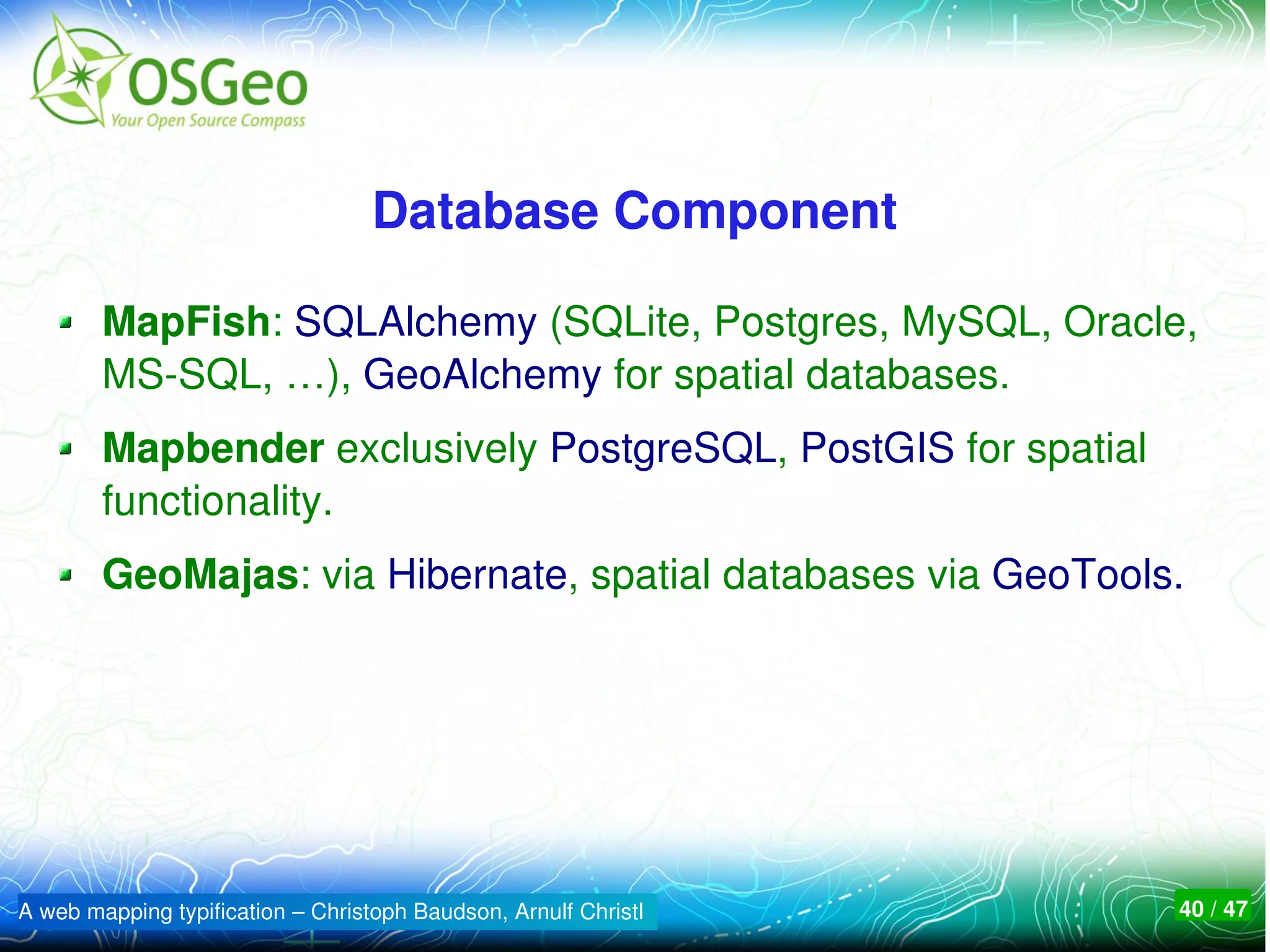
A web mapping typification – Christoph Baudson, Arnulf Christl   40 / 47
License

        OpenLayers: The Clear BSD License


        GeoMajas: AGPL plus other options through vendor


        Mapbender: Dual: GPLv2 and Simplified BSD


        MapFish: GPLv3, except some libraries and modules


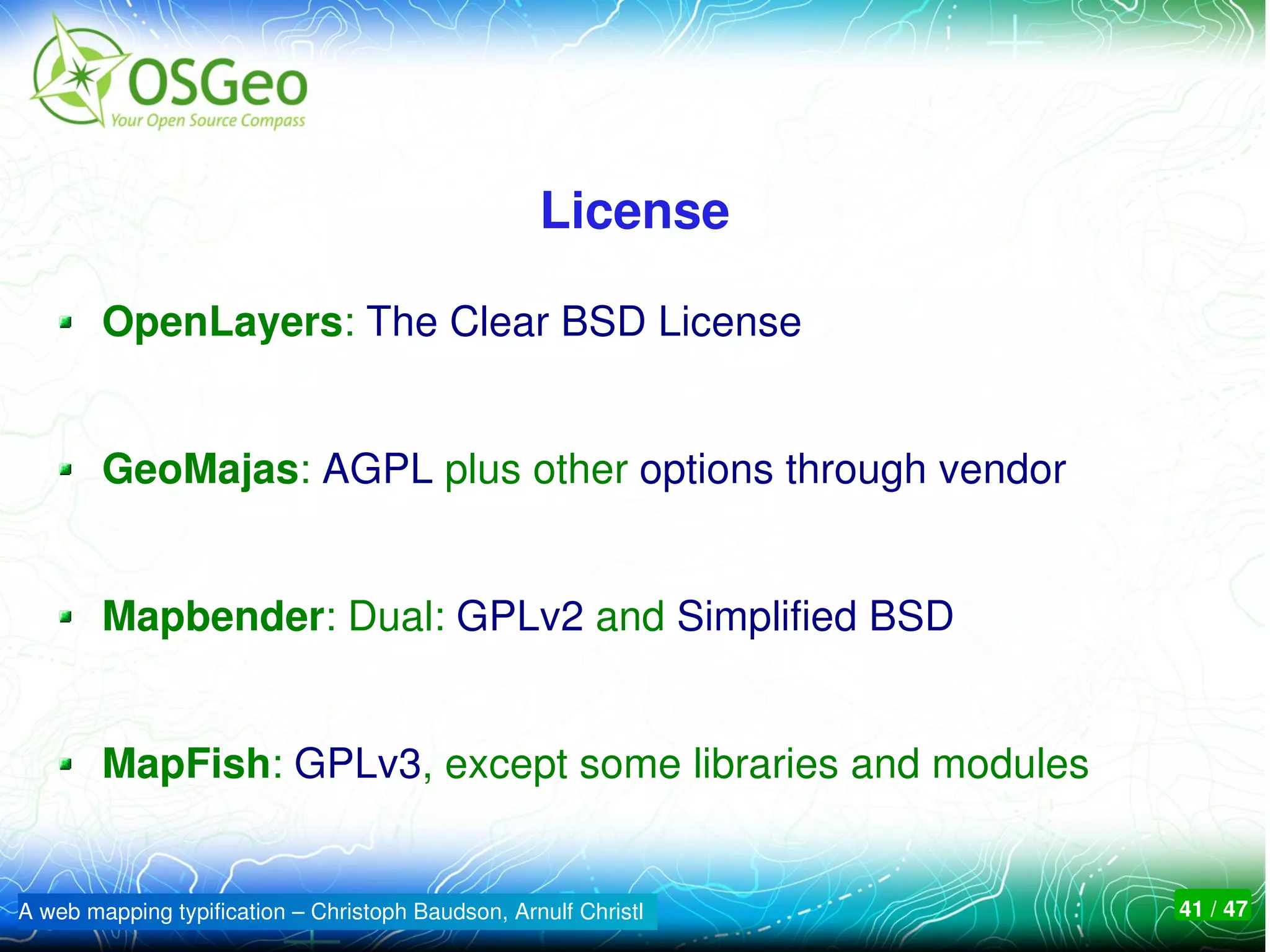
A web mapping typification – Christoph Baudson, Arnulf Christl   41 / 47
Copyright

        Mapbender: OSGeo


        MapFish: Camptocamp, SourcePole, others 


        OpenLayers: OpenLayers contributors


        GeoMajas: Geosparc, Belgium


A web mapping typification – Christoph Baudson, Arnulf Christl   42 / 47
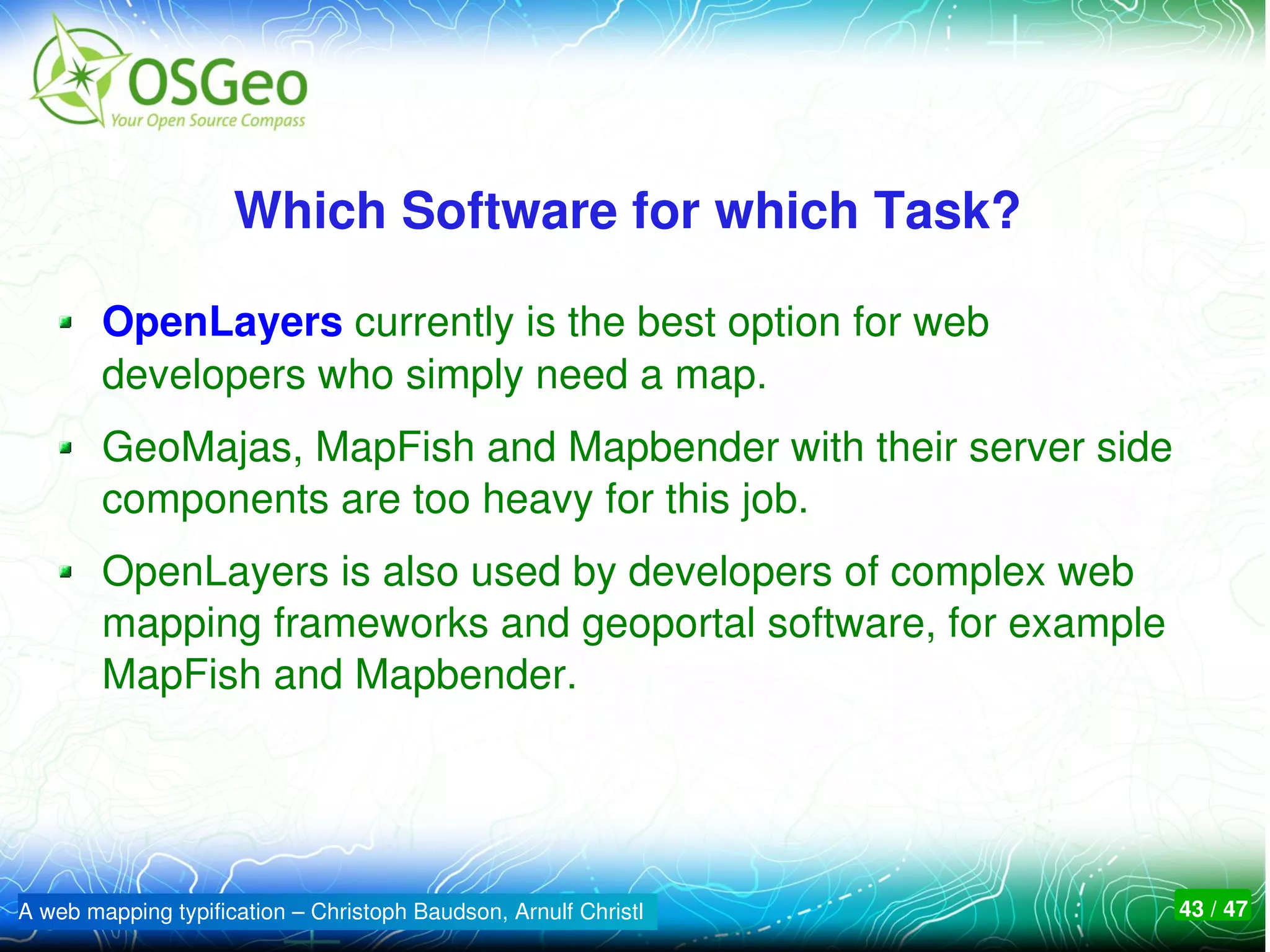
Which Software for which Task? 

        OpenLayers currently is the best option for web 
        developers who simply need a map. 
        GeoMajas, MapFish and Mapbender with their server side 
        components are too heavy for this job.
        OpenLayers is also used by developers of complex web 
        mapping frameworks and geoportal software, for example 
        MapFish and Mapbender.


A web mapping typification – Christoph Baudson, Arnulf Christl    43 / 47
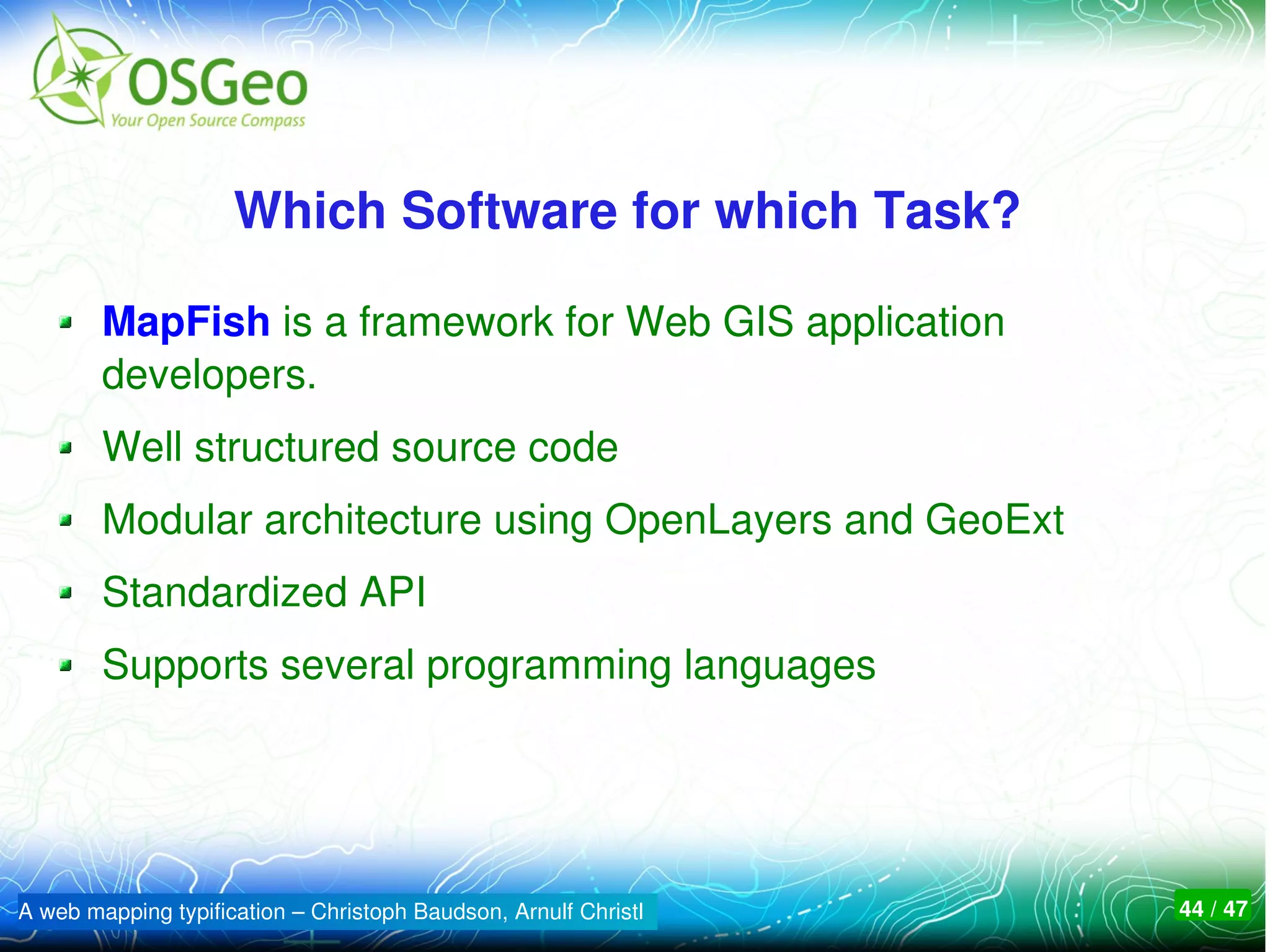
Which Software for which Task? 

        MapFish is a framework for Web GIS application 
        developers.
        Well structured source code
        Modular architecture using OpenLayers and GeoExt
        Standardized API
        Supports several programming languages


A web mapping typification – Christoph Baudson, Arnulf Christl   44 / 47
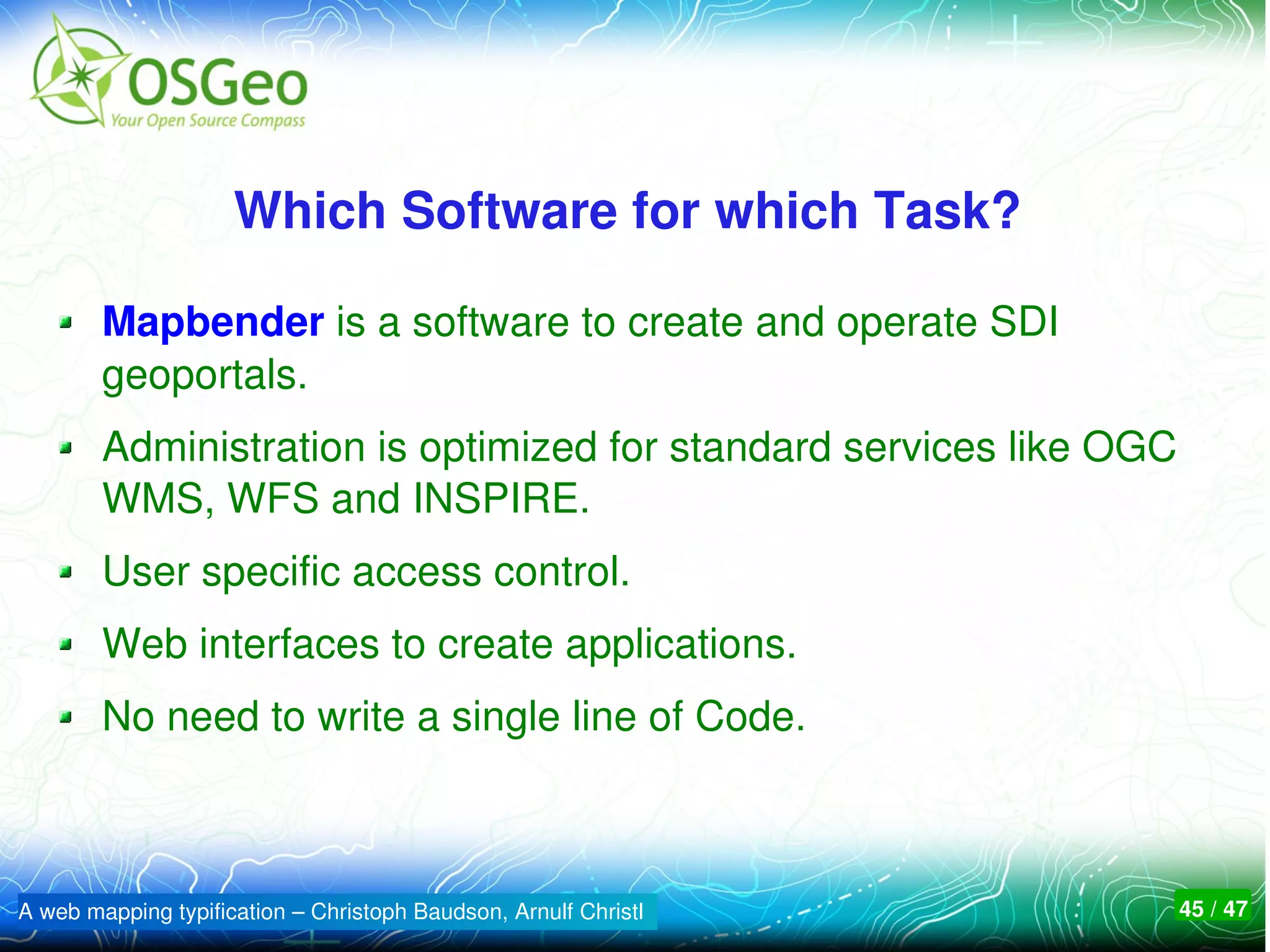
Which Software for which Task? 

        Mapbender is a software to create and operate SDI 
        geoportals.
        Administration is optimized for standard services like OGC 
        WMS, WFS and INSPIRE.
        User specific access control.
        Web interfaces to create applications.
        No need to write a single line of Code.


A web mapping typification – Christoph Baudson, Arnulf Christl    45 / 47
Which Software for which Task? 

        GeoMajas is a self contained out­of­the­box Web GIS 
        solution
        Includes client and server.
        User specific access control.
        Web interfaces to create applications.
        integrates powerful server side algorithms into the web 
        browser.


A web mapping typification – Christoph Baudson, Arnulf Christl     46 / 47
Come to the OSGeo 
    booth and talk to 
    users and developers
                                                                         The international
                                                                      Open Source Conference
                                                                               of the
                                                                        Geospatial Domain
  With friendly support by:
                                                                 Creative Commons Share Alike License 3.0
                                                                 Download as ODP or PDF
              Metaspatial
                                                                 Copyright © 2010:   Christoph Baudson
                                                                                     Arnulf Christl


A web mapping typification – Christoph Baudson, Arnulf Christl                                       47 / 47

OSGeo Web Mapping Software Comparison

  • 1.
    OSGeo Web Mapping Typification: GeoMajas, Mapbender, MapFish  and OpenLayers Christoph Baudson Arnulf Christl FOSS4G 2010 – Barcelona
  • 2.
    Metaspatial.net This presentation is brought to you by:  Metaspatial When?  Consultation since March 2010 Why?  To leverage your spatial data What?  Consultation and Implementation of - Spatial Data Infrastructures - Metadata How:  Open Source Software and Data with Open Standards and Agile management http://www.metaspatial.net 2 / 47
  • 3.
    Disclaimer All information contained in this presentation has been  compiled to the best of our knowledge and presents an ad­ hoc snapshot of current state of the art web mapping client  frameworks and portals. Christoph Baudson and Arnulf Christl are deeply involved  in developing the Mapbender project since many years. For further information and help on how to select the best  option for your needs ask your consultant and service  provider.  Download as ODP or PDF A web mapping typification – Christoph Baudson, Arnulf Christl 3 / 47
  • 4.
    Introduction This  presentation  differentiates  four  of  the  web  mapping  projects  of  OSGeo.  They  can  be  roughly  split  into  four  categories although there is a lot of overlap.  ● GeoMajas is a self contained, ful fledged Web­GIS ● OpenLayers is a JavaScript client library ● Mapbender is a geoportal management software ● MapFish is a web mapping developer framework  All  projects  have  server  side  components  except  for  OpenLayers.  Both  MapFish  and  Mapbender  integrate  OpenLayers as viewer. A web mapping typification – Christoph Baudson, Arnulf Christl 4 / 47
  • 5.
    On Diversity We all know the term in the context of bio­diversity. Mono­ cultures (the opposite of diversity) are well known to be  associated with all kinds of problems and issues. Therefore  OSGeo strives for diversity in it's projects.  Diversity comes with competition, which is sometimes good  and sometimes also has a negative touch. To better  understand how the Open Source community works  competition is best mixed with cooperation to form the new  word coopetition – which can be a great motivation for folks. A web mapping typification – Christoph Baudson, Arnulf Christl 5 / 47
  • 6.
    A History of Web Mapping 2009 Geomajas A web mapping typification – Christoph Baudson, Arnulf Christl 6 / 47
  • 7.
    Excursion: GRASS and the OGC 1992: The OGF (Open GRASS Foundation) forms to: (1)make more geoprocessing choices available  (2)act as sounding board for the user community to articulate  its requirements to the developer community (3)speed up procurement by aligning the needs of the users  with the product plans of the vendors 1994: "Open Geodata Interoperability Specification" started 1994: Change into a consortium (proprietary vendors' needs) 1999: OpenGIS WMS Interface Specification Interesting read, The history of the OGC: http://www.opengeospatial.org/ogc/history A web mapping typification – Christoph Baudson, Arnulf Christl 7 / 47
  • 8.
    Mapbender 1999: experimental Perl client for OGC WMT 1.0 2001: re­implementation in PHP, operational users 2003: Adoption of Open Source license and development 2006: OSGeo foundation project, Incubation passed. 2007: Introducing jQuery­library to Mapbender 2008: Modularization, first steps using OpenLayers 2009: Version 2.6 with lots of new features 2010: Version 3.0 re­engineering with REST principles A web mapping typification – Christoph Baudson, Arnulf Christl 8 / 47
  • 9.
    Excursion: GoogleMaps 2006: The tile is back. The long overcome legacy technology  of pre tiled maps is back – with lots of accompanying noise.  This technological regression is celebrated as the GIS  Revolution. GIS professionals start to fear Google.  2007: "Mashup" becomes bullshit bingo winner at Where 2.0. 2008: All maps have become static and street maps.  2009: "Vounteered Geographic Information" (VGI)  misunderstood as exploiting volunteers without giving back.  2010: OpenStreetMap is getting better than the Big Three. A web mapping typification – Christoph Baudson, Arnulf Christl 9 / 47
  • 10.
    Openlayers 2005: First ideas for a JavaScript mapping library form at  the Where 2.0 conference by O'Reilly in Silicon Valley 2006: Presentation of OpenLayers 1.0 at Where 2.0  conference targeted at Web developers who simply need a  map in their web site.  2007: Introduction of the slippy map 2008: OpenLayers Release 2.7 2010: More and more web mapping software uses  OpenLayers as their viewer. A web mapping typification – Christoph Baudson, Arnulf Christl 10 / 47
  • 11.
    Geomajas 2006: The origin lies in geGIS (www.gegis.org) the result of  a tender for the Flemish government and company DFC 2008: geGIS project ends. Start from Scratch as Geomajas. 2009: Folks from DFC found GeoSparc to support Geomajas 2010: Geosparc owns Geomajas IP 2010: Geomajas enters OSGeo Incubation. Support and use  grows beyond th scope of the original developing company.  A web mapping typification – Christoph Baudson, Arnulf Christl 11 / 47
  • 12.
    MapFish MapFish is a new development initiated by camptocamp. Prior art can be found in Cartoweb, MapBuilder, and others 2007: first source code available in an open repository 2008: the developer community grows beyond the initiator  (company camptocamp) 2009: MapFish starts OSGeo Incubation  2010: Several large productive systems go online.  A web mapping typification – Christoph Baudson, Arnulf Christl 12 / 47
  • 13.
    Excursion: on Tiling Tiling pros and cons: Tiles are a perfect fit for Internet technology. Associated technology is very robust and scalable. Every coordinate system and scale level needs it's own set  of tiles: This makes data management a real issue.  Tiled maps are static. Most servers are purposefully not standardized in an open  and consensus based process A web mapping typification – Christoph Baudson, Arnulf Christl 13 / 47
  • 14.
    Functionality in all  frameworks is very  similar. Let's take a look at... A web mapping typification – Christoph Baudson, Arnulf Christl 14 / 47
  • 15.
    … the source  code! A web mapping typification – Christoph Baudson, Arnulf Christl 15 / 47
  • 16.
    OpenLayers Client JavaScript Server ­ A web mapping typification – Christoph Baudson, Arnulf Christl 16 / 47
  • 17.
    Client JavaScript Server Python A web mapping typification – Christoph Baudson, Arnulf Christl 17 / 47
  • 18.
    Mapbender Client JavaScript Server PHP A web mapping typification – Christoph Baudson, Arnulf Christl 18 / 47
  • 19.
    Client Java Server Java A web mapping typification – Christoph Baudson, Arnulf Christl 19 / 47
  • 20.
    Client components ? A web mapping typification – Christoph Baudson, Arnulf Christl 20 / 47
  • 21.
    Mapbender Ext Core Core jQuery A web mapping typification – Christoph Baudson, Arnulf Christl 21 / 47
  • 22.
    Widgets ExtJS jQuery UI Ext Core Core jQuery A web mapping typification – Christoph Baudson, Arnulf Christl 22 / 47
  • 23.
    Widgets Core Mapbender GeoExt Geo jQuery Plugins A web mapping typification – Christoph Baudson, Arnulf Christl 23 / 47
  • 24.
    Widgets Core geojquery?? GeoExt Geo A web mapping typification – Christoph Baudson, Arnulf Christl 24 / 47
  • 25.
    geojquery wants to bring the jQuery  way of doing things to web mapping. A web mapping typification – Christoph Baudson, Arnulf Christl 25 / 47
  • 26.
    Mission: Implement a jQuery  interface to OpenLayers, provide a  rich set of UI widgets. A web mapping typification – Christoph Baudson, Arnulf Christl 26 / 47
  • 27.
  • 28.
    Not a GeoExt clone. Write less, do more. A web mapping typification – Christoph Baudson, Arnulf Christl 28 / 47
  • 29.
    Join code sprint on Friday: http://wiki.osgeo.org/wiki/FOSS4G_2010_Code_Sprint A web mapping typification – Christoph Baudson, Arnulf Christl 29 / 47
  • 30.
    Widgets Core Geo Map A web mapping typification – Christoph Baudson, Arnulf Christl 30 / 47
  • 31.
    ExtJS / jQuery – License ExtJS: Dual ("Commercial" and GPLv3) jQuery / jQuery UI: Dual (MIT and GPLv3) A web mapping typification – Christoph Baudson, Arnulf Christl 31 / 47
  • 32.
    ExtJS / jQuery – Copyright ExtJS: Copyright lies with Ext JS, LLC  jQuery: Copyright lies with creator John Resig jQuery und jQuery UI: Copyright lies with the team of the   jQuery Project Thoughts to transfer rights to the non­profit organization  Software Freedom Conservancy A web mapping typification – Christoph Baudson, Arnulf Christl 32 / 47
  • 33.
    ExtJS / jQuery – Distribution Google Trends A web mapping typification – Christoph Baudson, Arnulf Christl 33 / 47
  • 34.
    ExtJS / jQuery UI – Distribution Google Trends A web mapping typification – Christoph Baudson, Arnulf Christl 34 / 47
  • 35.
    Client summary OpenLayers does not compare to the others as it is limited  to JavaScript and runs in the browser. OpenLayers is an integral part of MapFish, which relies on  GeoExt. Mapbender can use OpenLayers and it's own WMS client  with comprehensive layer and metadata management . GeoMajas is self contained and comes with it's own client  and server. A web mapping typification – Christoph Baudson, Arnulf Christl 35 / 47
  • 36.
    Component Analysis Server MapFish REST API (MapFish protocol) Implemented in Python, based on Pylons Implementations in other languages exist (PHP, Java and  Ruby) Version 2.0 status? Shapely or JTS provide spatial analysis methods Spatial SQLAlchemy extension GeoAlchemy  A web mapping typification – Christoph Baudson, Arnulf Christl 36 / 47
  • 37.
    Component Analysis Server Mapbender Implemented in PHP No standardized API Version 3.0 with REST architecture PostgreSQL database to store users, applications and  service repository Best of breed integration with OGC standards A web mapping typification – Christoph Baudson, Arnulf Christl 37 / 47
  • 38.
    Component Analysis Server GeoMajas Documented API (not standardized) Strong focus on server side Implemented in Java GeoTools allows powerful data analysis and manipulation Client/Server communication highly integrated Maps and clients in one framework A web mapping typification – Christoph Baudson, Arnulf Christl 38 / 47
  • 39.
    Administration MapFish: Administration requires source code and config  file editing Mapbender: Administration via Web based interfaces.  GeoMajas: Administration requires source code and config  file editing A web mapping typification – Christoph Baudson, Arnulf Christl 39 / 47
  • 40.
    Database Component MapFish: SQLAlchemy (SQLite, Postgres, MySQL, Oracle,  MS­SQL, …), GeoAlchemy for spatial databases. Mapbender exclusively PostgreSQL, PostGIS for spatial  functionality. GeoMajas: via Hibernate, spatial databases via GeoTools. A web mapping typification – Christoph Baudson, Arnulf Christl 40 / 47
  • 41.
    License OpenLayers: The Clear BSD License GeoMajas: AGPL plus other options through vendor Mapbender: Dual: GPLv2 and Simplified BSD MapFish: GPLv3, except some libraries and modules A web mapping typification – Christoph Baudson, Arnulf Christl 41 / 47
  • 42.
    Copyright Mapbender: OSGeo MapFish: Camptocamp, SourcePole, others  OpenLayers: OpenLayers contributors GeoMajas: Geosparc, Belgium A web mapping typification – Christoph Baudson, Arnulf Christl 42 / 47
  • 43.
    Which Software for which Task?  OpenLayers currently is the best option for web  developers who simply need a map.  GeoMajas, MapFish and Mapbender with their server side  components are too heavy for this job. OpenLayers is also used by developers of complex web  mapping frameworks and geoportal software, for example  MapFish and Mapbender. A web mapping typification – Christoph Baudson, Arnulf Christl 43 / 47
  • 44.
    Which Software for which Task?  MapFish is a framework for Web GIS application  developers. Well structured source code Modular architecture using OpenLayers and GeoExt Standardized API Supports several programming languages A web mapping typification – Christoph Baudson, Arnulf Christl 44 / 47
  • 45.
    Which Software for which Task?  Mapbender is a software to create and operate SDI  geoportals. Administration is optimized for standard services like OGC  WMS, WFS and INSPIRE. User specific access control. Web interfaces to create applications. No need to write a single line of Code. A web mapping typification – Christoph Baudson, Arnulf Christl 45 / 47
  • 46.
    Which Software for which Task?  GeoMajas is a self contained out­of­the­box Web GIS  solution Includes client and server. User specific access control. Web interfaces to create applications. integrates powerful server side algorithms into the web  browser. A web mapping typification – Christoph Baudson, Arnulf Christl 46 / 47
  • 47.
    Come to the OSGeo  booth and talk to  users and developers The international Open Source Conference of the Geospatial Domain With friendly support by: Creative Commons Share Alike License 3.0 Download as ODP or PDF Metaspatial Copyright © 2010: Christoph Baudson Arnulf Christl A web mapping typification – Christoph Baudson, Arnulf Christl 47 / 47