Arnulf Christl: metaspatial
Cyprian Celebalo: UN Habitat
Danilo Antonio: UN Habitat
John Gitau: UN Habitat
The Social Tenure Domain Model
STDM-Online
GLTN BRIEFING AND PROGRAMME
2/ 17
CONTENT

Introducing the Author

The Global Land Tool Network

Introduction to STDM

STDM-Online
– Architecture
– Software
– Prototype and Demo Server

Positive Impact of Open Source

Future Development

Conclusions
Arnulf Christl MetaspatialArnulf Christl Metaspatial
Arnulf Christl
...works as Geospatial Systems Architect for diverse
clients inculding the United Nations, World Bank,
Ordnance Survey GB, SIEMENS, Vattenfall and others.
● Director of Metaspatial
● Member of the STDM Advisory Board
● Member of the OGC Architecture Board
● Co-founder and President Emeritus of OSGeo
Metaspatial provides consulting for geospatial data
acquisition, management and information and operates
hosted geospatial data and mapping services.
GLTN BRIEFING AND PROGRAMME
4/ 17
The Global Land Tool Network (GLTN)
The Global Land Tool Network (GLTN) is an alliance global
regional and national partners.
• The main objective is to contribute to poverty alleviation
through land reform, improved land management and security
of tenure.
• UN-Habitat through GLTN works with partners including civil
society organizations, finance institutions, research and
training institutions, donors and professional bodies.
Most developing countries use conventional land administration
systems which cover less than 30 per cent of the country, leaving
up to 70 per cent of citizens looking to informal and/ or customary
approaches for their tenure security.
GLTN BRIEFING AND PROGRAMME
5/ 17
STDM – The Social Tenure Domain Model
The Social Tenure Domain Model (STDM) is a pro poor
land information tool following GLTN's core values and
principles:
●
Pro poor;
●
Equitable;
●
Sustainable;
●
Affordable;
●
Systematically large scale /scalable; and,
●
Gender-sensitive
While taking into consideration:
●
Good governance;
●
Subsidiarity; and,
●
The Continuum of Land Rights.
GLTN BRIEFING AND PROGRAMME
6/ 17
STDM – The Social Tenure Domain Model
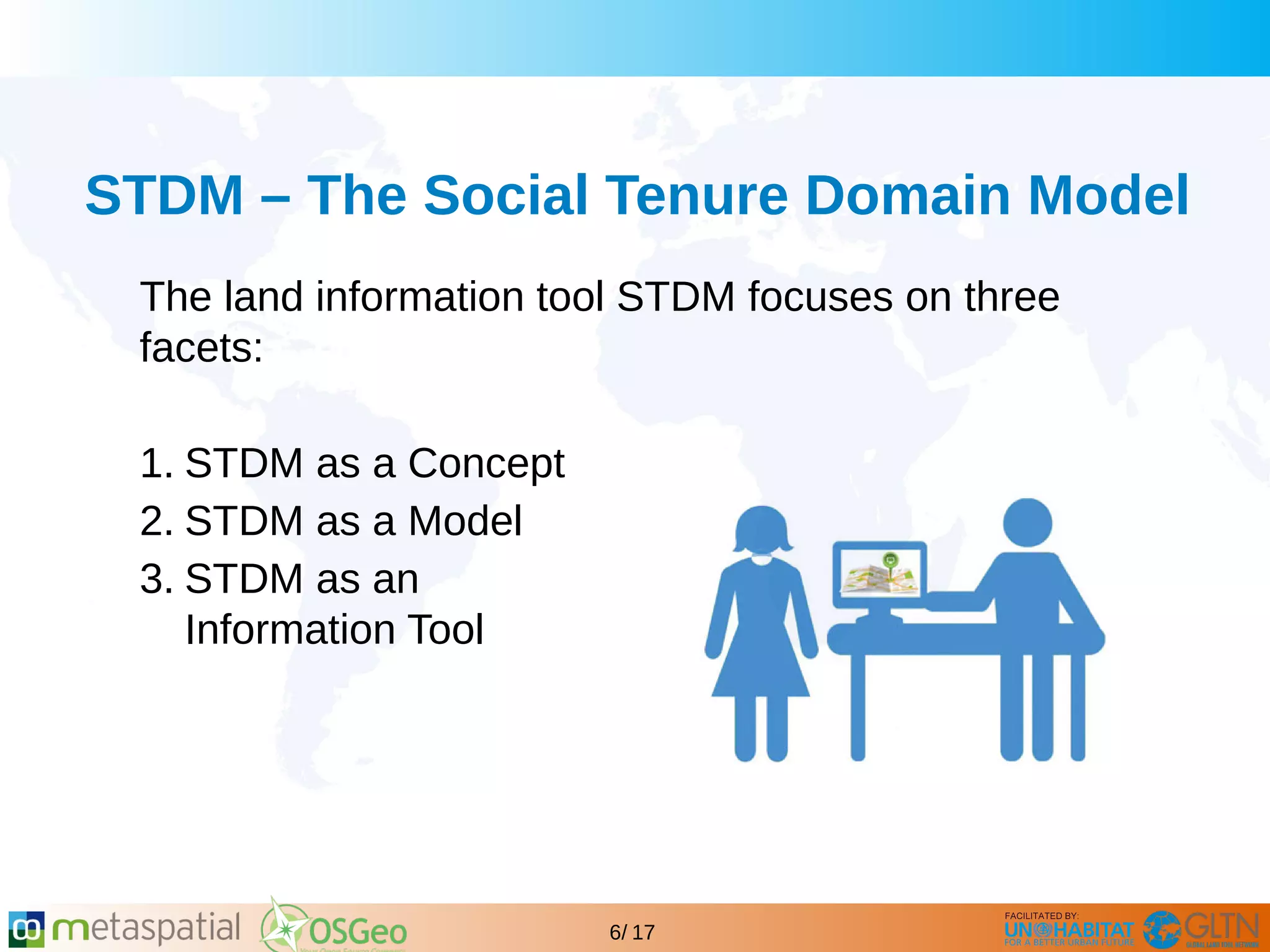
The land information tool STDM focuses on three
facets:
1. STDM as a Concept
2. STDM as a Model
3. STDM as an
Information Tool
GLTN BRIEFING AND PROGRAMME
7/ 17
The STDM Concept
The concept of the Social Tenure Domain Model is to
bridge this gap by providing a standard for
representing ‘people – land’ relationships
independent of the level of formality, legality and
technical accuracy.
Bridging the Gap:
A Complimentary approach to customary and informal tenure.
GLTN BRIEFING AND PROGRAMME
8/ 17
The STDM Model
STDM is a ‘specialization’ of the ISO-approved Land
Administration Domain Model (LADM). LADM
development took place in parallel of the STDM
concept and model development.
Bridging the Gap:
Any form of right, responsibility or restriction in a formal system is
considered as a social tenure relationship in STDM.
GLTN BRIEFING AND PROGRAMME
9/ 17
Software Tools
The future development of STDM is to "Go Online".
The work to get there entails three main aspects:
●
Data and data model
●
Security and privacy
●
Online interfaces
Complementing the Desktop version with STDM Online...
GLTN BRIEFING AND PROGRAMME
10/ 17
Data and Data Model
The data model has to be sturdy and simple and easy
to import and export:
●
Keep aligned with LADM
●
Support OpenStreetMap
●
Stick to Standards
●
Data Licenses
Going Online...
GLTN BRIEFING AND PROGRAMME
11/ 17
Security and Privacy
Exposing the data on the Web requires a highly
secure environment, transparent policies and good
governance.
●
Secure Architecture
●
Open Governance
●
Transparent Terms of Service
Going Online...
GLTN BRIEFING AND PROGRAMME
12 / 14
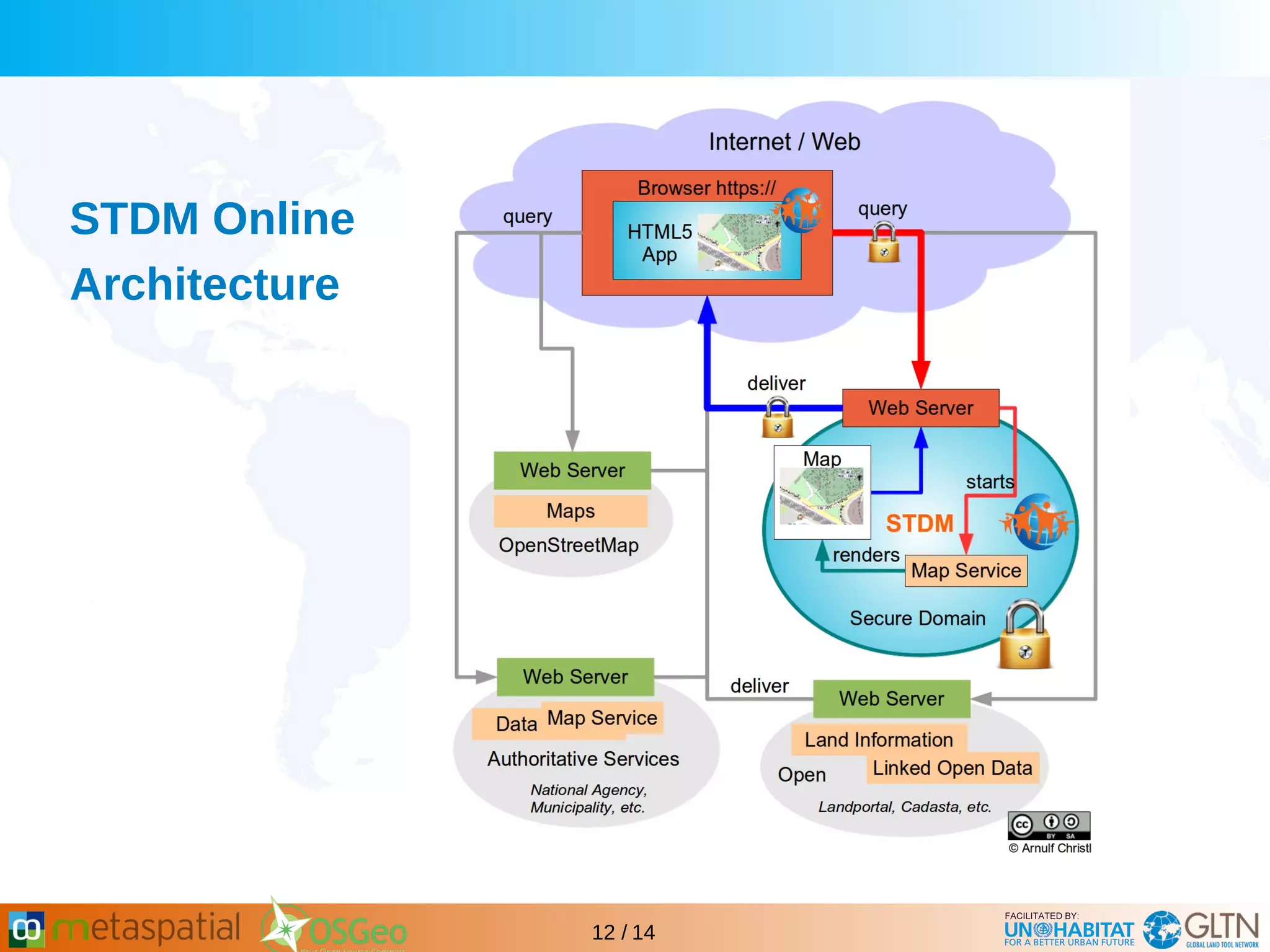
STDM Online
Architecture
GLTN BRIEFING AND PROGRAMME
13/ 17
STDM Online Functionality
State of the Art Open Source technology for reliable
and scalable services. Minimize web traffic with low
tech front end components, implements:
●
Record Household Information
●
Mapping and Digitizing Modules
●
Report Generation Modules
●
Anonymized Open Data Server
GLTN BRIEFING AND PROGRAMME
14 / 14
STDM Software and Standards
The system is based on Open
Source Software components
including (besides others):

Postgres / PostGIS

QGIS MapServer

OpenLayers

GDAL OGR
Open Standards help to keep
the infrastructure open,
including (besides others)

OGC SFS (Data format)

ISO LADM (Data Content)

OGC WMS (map content

OGC GeoPackage (transport)
GLTN BRIEFING AND PROGRAMME
15 / 14
STDM Online Hosting
●
Does not require installation
●
Software can be used as a fully integrated Service with:
●
Security updates
●
Maintenance
●
Updates
●
Backup
●
Export options
●
Service contract
●
Pay per use
●
Scale on demand
GLTN BRIEFING AND PROGRAMME
16/ 17
Conclusions
The Open Source development model has proven to be
the right choice for STDM and STDM Online.

Hosting option reduces up front effort

Flexible and scalable payment options

Customizable and extendible functionality

Transparent and secure service

Broader impact on local change

Easy collaborations
NEED TO KNOW MORE?
Contact the Author: Arnulf Christl
arnulf.christl@metaspatial.net | @sevenspatial
http://www.stdm.gltn.net/
http://metaspatial.net/
http://osgeo.org/

STDM-Online_The-Social-Tenure-Domain-Model-Tool_slides

  • 1.
    Arnulf Christl: metaspatial CyprianCelebalo: UN Habitat Danilo Antonio: UN Habitat John Gitau: UN Habitat The Social Tenure Domain Model STDM-Online
  • 2.
    GLTN BRIEFING ANDPROGRAMME 2/ 17 CONTENT  Introducing the Author  The Global Land Tool Network  Introduction to STDM  STDM-Online – Architecture – Software – Prototype and Demo Server  Positive Impact of Open Source  Future Development  Conclusions
  • 3.
    Arnulf Christl MetaspatialArnulf ChristlMetaspatial Arnulf Christl ...works as Geospatial Systems Architect for diverse clients inculding the United Nations, World Bank, Ordnance Survey GB, SIEMENS, Vattenfall and others. ● Director of Metaspatial ● Member of the STDM Advisory Board ● Member of the OGC Architecture Board ● Co-founder and President Emeritus of OSGeo Metaspatial provides consulting for geospatial data acquisition, management and information and operates hosted geospatial data and mapping services.
  • 4.
    GLTN BRIEFING ANDPROGRAMME 4/ 17 The Global Land Tool Network (GLTN) The Global Land Tool Network (GLTN) is an alliance global regional and national partners. • The main objective is to contribute to poverty alleviation through land reform, improved land management and security of tenure. • UN-Habitat through GLTN works with partners including civil society organizations, finance institutions, research and training institutions, donors and professional bodies. Most developing countries use conventional land administration systems which cover less than 30 per cent of the country, leaving up to 70 per cent of citizens looking to informal and/ or customary approaches for their tenure security.
  • 5.
    GLTN BRIEFING ANDPROGRAMME 5/ 17 STDM – The Social Tenure Domain Model The Social Tenure Domain Model (STDM) is a pro poor land information tool following GLTN's core values and principles: ● Pro poor; ● Equitable; ● Sustainable; ● Affordable; ● Systematically large scale /scalable; and, ● Gender-sensitive While taking into consideration: ● Good governance; ● Subsidiarity; and, ● The Continuum of Land Rights.
  • 6.
    GLTN BRIEFING ANDPROGRAMME 6/ 17 STDM – The Social Tenure Domain Model The land information tool STDM focuses on three facets: 1. STDM as a Concept 2. STDM as a Model 3. STDM as an Information Tool
  • 7.
    GLTN BRIEFING ANDPROGRAMME 7/ 17 The STDM Concept The concept of the Social Tenure Domain Model is to bridge this gap by providing a standard for representing ‘people – land’ relationships independent of the level of formality, legality and technical accuracy. Bridging the Gap: A Complimentary approach to customary and informal tenure.
  • 8.
    GLTN BRIEFING ANDPROGRAMME 8/ 17 The STDM Model STDM is a ‘specialization’ of the ISO-approved Land Administration Domain Model (LADM). LADM development took place in parallel of the STDM concept and model development. Bridging the Gap: Any form of right, responsibility or restriction in a formal system is considered as a social tenure relationship in STDM.
  • 9.
    GLTN BRIEFING ANDPROGRAMME 9/ 17 Software Tools The future development of STDM is to "Go Online". The work to get there entails three main aspects: ● Data and data model ● Security and privacy ● Online interfaces Complementing the Desktop version with STDM Online...
  • 10.
    GLTN BRIEFING ANDPROGRAMME 10/ 17 Data and Data Model The data model has to be sturdy and simple and easy to import and export: ● Keep aligned with LADM ● Support OpenStreetMap ● Stick to Standards ● Data Licenses Going Online...
  • 11.
    GLTN BRIEFING ANDPROGRAMME 11/ 17 Security and Privacy Exposing the data on the Web requires a highly secure environment, transparent policies and good governance. ● Secure Architecture ● Open Governance ● Transparent Terms of Service Going Online...
  • 12.
    GLTN BRIEFING ANDPROGRAMME 12 / 14 STDM Online Architecture
  • 13.
    GLTN BRIEFING ANDPROGRAMME 13/ 17 STDM Online Functionality State of the Art Open Source technology for reliable and scalable services. Minimize web traffic with low tech front end components, implements: ● Record Household Information ● Mapping and Digitizing Modules ● Report Generation Modules ● Anonymized Open Data Server
  • 14.
    GLTN BRIEFING ANDPROGRAMME 14 / 14 STDM Software and Standards The system is based on Open Source Software components including (besides others):  Postgres / PostGIS  QGIS MapServer  OpenLayers  GDAL OGR Open Standards help to keep the infrastructure open, including (besides others)  OGC SFS (Data format)  ISO LADM (Data Content)  OGC WMS (map content  OGC GeoPackage (transport)
  • 15.
    GLTN BRIEFING ANDPROGRAMME 15 / 14 STDM Online Hosting ● Does not require installation ● Software can be used as a fully integrated Service with: ● Security updates ● Maintenance ● Updates ● Backup ● Export options ● Service contract ● Pay per use ● Scale on demand
  • 16.
    GLTN BRIEFING ANDPROGRAMME 16/ 17 Conclusions The Open Source development model has proven to be the right choice for STDM and STDM Online.  Hosting option reduces up front effort  Flexible and scalable payment options  Customizable and extendible functionality  Transparent and secure service  Broader impact on local change  Easy collaborations
  • 17.
    NEED TO KNOWMORE? Contact the Author: Arnulf Christl arnulf.christl@metaspatial.net | @sevenspatial http://www.stdm.gltn.net/ http://metaspatial.net/ http://osgeo.org/