
ZOO-457 Principles of
Parasitology
Dr. Shamaila Irum

ORTHONECTIDA
Lecture # 10
Note: This lecture is with reference to
1. HOST & PARASITE RELATIONSHIP
2. PHYLOGENETIC POSITION

PHYLUM ORTHONECTIDA
 Class: Orthonectida
 Family: Rhopaluridae
 Genera: Rhopalura, Intoshia, Stoecharthrum, Ciliacincta
 Family: Pelmatosphaeridae
 Genus: Pelmatosphaera

ORTHONECTIDA :
 Orthonectid, any of a class (Orthonectid) of rare
wormlike parasites of various marine
invertebrates, including bivalve mollusks
and polychaeta annelids; they are usually included
in the phylum Mesozoic, a group regarded as
intermediate between protozoans (single-celled
animals) and metazoans (multicellular animals) in
organization.

What's in a Name?
 The name Orthonectida means "straight
swimming," but these animals usually swim in a
spiral motion.

 Microscopic and worm like animal and body
length rarely exceed from 300 micrometer .
 Body without organs and consists of an outer
layer of multi-ciliated cells which enclose an
inner mass of eggs and sperm cells.
 In some species the circular and lon­
gitudinal
muscles are present beneath the epidermis.
CHARACTERISTICS :

 Locomotion by cilia.
 Fertilization takes place outside the host.
 Parenchymal cells absent but some ex­
tracellular
matrix present.
 Most species show gonochoristic sexu­
ality.
 Depending on the species of Orthonectida, either
the sexes are separate or both male and female
reproductive organs are present in the same animal.


TAXONOMY :
 The orthonectids were originally described
in 1877 as a class, and placed as an order of
the phylum Mesozoa. Recent study shows
that orthonectids are quite different from
the rhombozoans, the other group in
Mesozoa.

PHYSICAL
CHARACTERISTICS :
 Orthonectida are parasites that live in the tissues of
sea-dwelling invertebrates.
 The body of an adult Orthonectida consists of a jacket
of body cells arranged in rings around an internal mass
 Some of these body cells have hair like fibers and
some do not.
 Contracting muscle cells in the sex organ run in the
lengthwise, circular, and oblique directions.

GEOGRAPHIC RANGE :
 They live in coastal regions , in japan & also
along the coast of united states .

HABITAT :
 They live in tissue of sea dwelling
invertebrates , such as
 Flat worms
 Segmented worms
 Mollusks
 In animals have soft bodies such as
 Sea urchin & sea cucumber .

DIET :
 Orthonectida absorb nutrients within the
host's cells.

ORTHONECTIDANS AND
PEOPLE:
 Orthonectidans have no known
importance to people.

CONSERVATION STATUS :
 Orthonectidans are not threatened or endangered.

PLASMODIUM STAGE
 A plasmodium stage lives in tissues and spaces of gonads
and genitorespiratory bursae of the ophiuroid Amphipholis
squamata.
 It may spread into the aboral side of the central disc,
around the digestive system, and into the arms.
 Developing host ova degenerate, with ultimate castration,
but male gonads usually are unaffected.
 The multinucleate plasmodia are usually male or female
but are sometimes hermaphroditic.

MORULAS
 Some nuclei are vegetative, whereas others are agametes
that divide to form balls of cells called morulas.
 Each morula differentiates into an adult male or female,
with a ciliated somatoderm of jacket cells and numerous
internal cells that become gametes.

BODY FORM
 Monoecious plasmodia that produce both male and female
offspring may represent the fusion of two separate, younger
plasmodia.
 Male ciliated forms are elongated and 90 μm to 130 μm long.
 Constrictions around the body divide it into a conical cap, a
middle portion, and a terminal portion.
 A genital pore, through which sperm escape, is located in one
of the constrictions.
 Jacket cells are arranged in rings around the body; the number
of rings and their arrangement are of taxonomic importance.

TYPES OF FEMALES
 There are two types of females in this species.
 One type is elongated, 235 μm to 260 μm long and 65 μm to
80 μm wide.
 whereas the other is ovoid, 125 μm to 140 μm long and 65
μm to 70 μm wide.
 Otherwise, the two forms are similar to each other and differ
from the male in lacking constrictions that divide the body
into zones.
 The female genital pore is located at about midbody.
 Oocytes are tightly packed in the center of the body.

REPRODUCTION
 Males and females emerge from plasmodia and escape from
the ophiuroid into the sea.
 There, tailed sperm somehow transfer to and penetrate
females, where they fertilize the ova.
 Within 24 hours of fertilization, the zygote has developed into
a multicellular, ciliated larva that is born through its mother’s
genital pore and enters the genital opening of a new host.
 It is not known whether a plasmodium is derived from an
entire ciliated larva or from certain of its cells or whether one
larva can propagate more than one plasmodium.

RELATIONSHIP WITH
HOST & PARASITE :
 Most dicyemids attach themselves loosely to the
lining of a cephalopod kidney by their anterior cilia
 They are easily dislodged and can swim about
freely in their host’s urine.
 The relationship appears to be a commensal one; no
pathogenic
 the membranes could fuse at various points and
form endocytotic vesicles, and “transmembrane”
was suggested by uptake of ferritin.

LIFE CYCLE :

 The Infusoriforms larvae do not have ruffle
membranes
 They derive their nutrients largely or entirely
from their hosts’ urine, whereas Infusoriforms
larvae must live for a period on stored food
molecules.
 Oxygen is very low or absent in a cephalopod’s
urine, so nematogens and rhombogens apparently
are obligate anaerobes.
 The organisms live longer in vitro under nitrogen
.

 Infusoriforms can live anaerobically only until
their glycogen supply is consumed.
 Host is cap-shaped, discoidal, or irregular
depending on the species.
 Hosts may harbor more than one species.

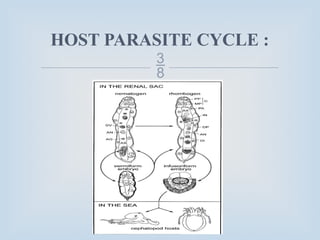
HOST-PARASITE RELATIONSHIPS
 Good ultra structural studies of both dicyemids and orthonectid are available.
 Most dicyemids attach themselves loosely to the lining of a cephalopod
kidney by their anterior cilia.
 They are easily dislodged and can swim about freely in their host’s urine.
 The relationship appears to be a commensal one; no pathogenic
consequences of the infection can be discerned.
 However, a few species have morphological adaptations for gripping renal
cell surfaces, and, on the parasites’ dislodgement, renal tissues show an
eroded appearance.
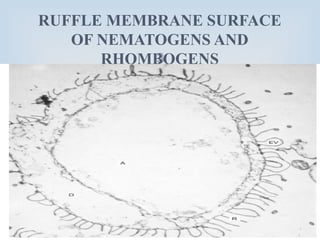
 The ruffle membrane surface of nematogens and rhombogens evidently is an
elaboration to facilitate uptake of nutrients.
 Ridley showed that the membranes could fuse at various points and form
endocytotic vesicles, and “transmembranosis” was suggested by uptake of
ferritin.
 The peripheral cells of infusoriform larvae do not have ruffle membranes but

RUFFLE MEMBRANE SURFACE
OF NEMATOGENS AND
RHOMBOGENS

Nematogens And Rhombogens:
 Clearly, nematogens and rhombogens must derive their nutrients largely or entirely from
their hosts’ urine, whereas infusoriform larvae must live for a period on stored food
molecules.
 Oxygen is very low or absent in a cephalopod’s urine, so nematogens and rhombogens
apparently are obligate anaerobes.
 The organisms live longer in vitro under nitrogen or even in the presence of cyanide than
when maintained in urine under air or in the absence of cyanide.
Infusoriform:
 Infusoriform can live an aerobically only until their glycogen supply is consumed.
Adult Orthonectid:
 Adult orthonectid, on the other hand, require aerobic conditions. Recent studies show that
calottes vary quite a bit among taxa, being cone- or cap-shaped, discoidal, or irregular
depending on the species.
Dicyemid Species
 Hosts may harbor more than one species, and when that happens, the two dicyemid species
usually have different calotte shapes, and based on infrapopulation and community
observations,
 Furuya and co-workers suggest that different dicyemid species cannot co-occur in an
individual host unless they both have the same calotte shape.

HOST PARASITE CYCLE :

PHYLOGENETIC POSITION
 The phylogenetic position of Mesozoa has been a matter of
considerable debate.
 The central issue is whether these parasites are an early divergence
from early metazoans, or are degenerate metazoans.
 Early taxonomists placed them between protozoa and sponges
because of their cilia, small size, and simple cellularity.
 Arguments also have been made for considering dicyemids to be
primitive or degenerate platyhelminthes.
 The ciliated larva is similar to a miracidium in some ways, and the
internal reproduction by agametes in nematogens and rhombogens
parallels similar processes in germinal sacs of digenetic trematodes.

MOLECULAR STUDIES
 Molecular and ultra structural studies provide strong
evidence for the “degenerate” metazoan hypothesis.
 For example, dicyemids contain a peptide sequence
characteristic of super phylum Lophotrochozoa (annelids,
nemertenes, platyhelminthes) that is not found in
superphylum Ecdysozoa (nematodes, arthropods) or in
super phylum Deuterostomia.

ULTRASTRUCTURAL RESEARCH
 Furthermore, ultra structural research reveals cell-to-cell
junctions typical of complex metazoans and not found in
Cnidarians.
 We still do not know the ancestral group, although Furuya
and co-workers suggest that dicyemids may be progenetic
larval forms of parasites that once lived in now-extinct
predatory marine vertebrates such as mosasaurs.

REFRENCES :
 https://www.encyclopedia.com/environment/encyclopedias-
almanacs-transcripts-and-maps/orthonectida-orthonectidans
 https://www.britannica.com/animal/orthonectid
 https://animals.jrank.org/pages/1468/Orthonectidans-
Orthonectida.html
 http://www.biologydiscussion.com/animals-2/mesozoans/
notes-on-mesozoans-with-diagram/32843
 https://wiki.kidzsearch.com/wiki/Orthonectida
 https://link.springer.com/article/10.1007/s13127-015-0246-
2?shared-article-renderer

Orthonectida-Eveything explained about it

  • 1.
  • 2.
     ORTHONECTIDA Lecture # 10 Note:This lecture is with reference to 1. HOST & PARASITE RELATIONSHIP 2. PHYLOGENETIC POSITION
  • 3.
     PHYLUM ORTHONECTIDA  Class:Orthonectida  Family: Rhopaluridae  Genera: Rhopalura, Intoshia, Stoecharthrum, Ciliacincta  Family: Pelmatosphaeridae  Genus: Pelmatosphaera
  • 4.
     ORTHONECTIDA :  Orthonectid,any of a class (Orthonectid) of rare wormlike parasites of various marine invertebrates, including bivalve mollusks and polychaeta annelids; they are usually included in the phylum Mesozoic, a group regarded as intermediate between protozoans (single-celled animals) and metazoans (multicellular animals) in organization.
  • 5.
     What's in aName?  The name Orthonectida means "straight swimming," but these animals usually swim in a spiral motion.
  • 6.
      Microscopic andworm like animal and body length rarely exceed from 300 micrometer .  Body without organs and consists of an outer layer of multi-ciliated cells which enclose an inner mass of eggs and sperm cells.  In some species the circular and lon­ gitudinal muscles are present beneath the epidermis. CHARACTERISTICS :
  • 7.
      Locomotion bycilia.  Fertilization takes place outside the host.  Parenchymal cells absent but some ex­ tracellular matrix present.  Most species show gonochoristic sexu­ ality.  Depending on the species of Orthonectida, either the sexes are separate or both male and female reproductive organs are present in the same animal.
  • 8.
  • 9.
     TAXONOMY :  Theorthonectids were originally described in 1877 as a class, and placed as an order of the phylum Mesozoa. Recent study shows that orthonectids are quite different from the rhombozoans, the other group in Mesozoa.
  • 10.
     PHYSICAL CHARACTERISTICS :  Orthonectidaare parasites that live in the tissues of sea-dwelling invertebrates.  The body of an adult Orthonectida consists of a jacket of body cells arranged in rings around an internal mass  Some of these body cells have hair like fibers and some do not.  Contracting muscle cells in the sex organ run in the lengthwise, circular, and oblique directions.
  • 11.
     GEOGRAPHIC RANGE : They live in coastal regions , in japan & also along the coast of united states .
  • 12.
     HABITAT :  Theylive in tissue of sea dwelling invertebrates , such as  Flat worms  Segmented worms  Mollusks  In animals have soft bodies such as  Sea urchin & sea cucumber .
  • 13.
     DIET :  Orthonectidaabsorb nutrients within the host's cells.
  • 14.
     ORTHONECTIDANS AND PEOPLE:  Orthonectidanshave no known importance to people.
  • 15.
     CONSERVATION STATUS : Orthonectidans are not threatened or endangered.
  • 16.
     PLASMODIUM STAGE  Aplasmodium stage lives in tissues and spaces of gonads and genitorespiratory bursae of the ophiuroid Amphipholis squamata.  It may spread into the aboral side of the central disc, around the digestive system, and into the arms.  Developing host ova degenerate, with ultimate castration, but male gonads usually are unaffected.  The multinucleate plasmodia are usually male or female but are sometimes hermaphroditic.
  • 17.
     MORULAS  Some nucleiare vegetative, whereas others are agametes that divide to form balls of cells called morulas.  Each morula differentiates into an adult male or female, with a ciliated somatoderm of jacket cells and numerous internal cells that become gametes.
  • 18.
     BODY FORM  Monoeciousplasmodia that produce both male and female offspring may represent the fusion of two separate, younger plasmodia.  Male ciliated forms are elongated and 90 μm to 130 μm long.  Constrictions around the body divide it into a conical cap, a middle portion, and a terminal portion.  A genital pore, through which sperm escape, is located in one of the constrictions.  Jacket cells are arranged in rings around the body; the number of rings and their arrangement are of taxonomic importance.
  • 19.
     TYPES OF FEMALES There are two types of females in this species.  One type is elongated, 235 μm to 260 μm long and 65 μm to 80 μm wide.  whereas the other is ovoid, 125 μm to 140 μm long and 65 μm to 70 μm wide.  Otherwise, the two forms are similar to each other and differ from the male in lacking constrictions that divide the body into zones.  The female genital pore is located at about midbody.  Oocytes are tightly packed in the center of the body.
  • 20.
     REPRODUCTION  Males andfemales emerge from plasmodia and escape from the ophiuroid into the sea.  There, tailed sperm somehow transfer to and penetrate females, where they fertilize the ova.  Within 24 hours of fertilization, the zygote has developed into a multicellular, ciliated larva that is born through its mother’s genital pore and enters the genital opening of a new host.  It is not known whether a plasmodium is derived from an entire ciliated larva or from certain of its cells or whether one larva can propagate more than one plasmodium.
  • 21.
     RELATIONSHIP WITH HOST &PARASITE :  Most dicyemids attach themselves loosely to the lining of a cephalopod kidney by their anterior cilia  They are easily dislodged and can swim about freely in their host’s urine.  The relationship appears to be a commensal one; no pathogenic  the membranes could fuse at various points and form endocytotic vesicles, and “transmembrane” was suggested by uptake of ferritin.
  • 22.
  • 23.
      The Infusoriformslarvae do not have ruffle membranes  They derive their nutrients largely or entirely from their hosts’ urine, whereas Infusoriforms larvae must live for a period on stored food molecules.  Oxygen is very low or absent in a cephalopod’s urine, so nematogens and rhombogens apparently are obligate anaerobes.  The organisms live longer in vitro under nitrogen .
  • 24.
      Infusoriforms canlive anaerobically only until their glycogen supply is consumed.  Host is cap-shaped, discoidal, or irregular depending on the species.  Hosts may harbor more than one species.
  • 25.
     HOST-PARASITE RELATIONSHIPS  Goodultra structural studies of both dicyemids and orthonectid are available.  Most dicyemids attach themselves loosely to the lining of a cephalopod kidney by their anterior cilia.  They are easily dislodged and can swim about freely in their host’s urine.  The relationship appears to be a commensal one; no pathogenic consequences of the infection can be discerned.  However, a few species have morphological adaptations for gripping renal cell surfaces, and, on the parasites’ dislodgement, renal tissues show an eroded appearance.  The ruffle membrane surface of nematogens and rhombogens evidently is an elaboration to facilitate uptake of nutrients.  Ridley showed that the membranes could fuse at various points and form endocytotic vesicles, and “transmembranosis” was suggested by uptake of ferritin.  The peripheral cells of infusoriform larvae do not have ruffle membranes but
  • 26.
     RUFFLE MEMBRANE SURFACE OFNEMATOGENS AND RHOMBOGENS
  • 27.
     Nematogens And Rhombogens: Clearly, nematogens and rhombogens must derive their nutrients largely or entirely from their hosts’ urine, whereas infusoriform larvae must live for a period on stored food molecules.  Oxygen is very low or absent in a cephalopod’s urine, so nematogens and rhombogens apparently are obligate anaerobes.  The organisms live longer in vitro under nitrogen or even in the presence of cyanide than when maintained in urine under air or in the absence of cyanide. Infusoriform:  Infusoriform can live an aerobically only until their glycogen supply is consumed. Adult Orthonectid:  Adult orthonectid, on the other hand, require aerobic conditions. Recent studies show that calottes vary quite a bit among taxa, being cone- or cap-shaped, discoidal, or irregular depending on the species. Dicyemid Species  Hosts may harbor more than one species, and when that happens, the two dicyemid species usually have different calotte shapes, and based on infrapopulation and community observations,  Furuya and co-workers suggest that different dicyemid species cannot co-occur in an individual host unless they both have the same calotte shape.
  • 28.
  • 29.
     PHYLOGENETIC POSITION  Thephylogenetic position of Mesozoa has been a matter of considerable debate.  The central issue is whether these parasites are an early divergence from early metazoans, or are degenerate metazoans.  Early taxonomists placed them between protozoa and sponges because of their cilia, small size, and simple cellularity.  Arguments also have been made for considering dicyemids to be primitive or degenerate platyhelminthes.  The ciliated larva is similar to a miracidium in some ways, and the internal reproduction by agametes in nematogens and rhombogens parallels similar processes in germinal sacs of digenetic trematodes.
  • 30.
     MOLECULAR STUDIES  Molecularand ultra structural studies provide strong evidence for the “degenerate” metazoan hypothesis.  For example, dicyemids contain a peptide sequence characteristic of super phylum Lophotrochozoa (annelids, nemertenes, platyhelminthes) that is not found in superphylum Ecdysozoa (nematodes, arthropods) or in super phylum Deuterostomia.
  • 31.
     ULTRASTRUCTURAL RESEARCH  Furthermore,ultra structural research reveals cell-to-cell junctions typical of complex metazoans and not found in Cnidarians.  We still do not know the ancestral group, although Furuya and co-workers suggest that dicyemids may be progenetic larval forms of parasites that once lived in now-extinct predatory marine vertebrates such as mosasaurs.
  • 32.
     REFRENCES :  https://www.encyclopedia.com/environment/encyclopedias- almanacs-transcripts-and-maps/orthonectida-orthonectidans https://www.britannica.com/animal/orthonectid  https://animals.jrank.org/pages/1468/Orthonectidans- Orthonectida.html  http://www.biologydiscussion.com/animals-2/mesozoans/ notes-on-mesozoans-with-diagram/32843  https://wiki.kidzsearch.com/wiki/Orthonectida  https://link.springer.com/article/10.1007/s13127-015-0246- 2?shared-article-renderer