By: Waleed K. O. Jaber
g. 34 , 3rd
Course
UMSA
2013
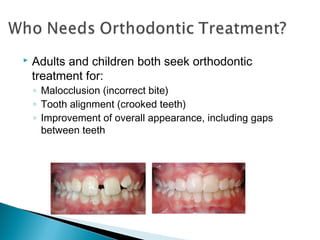
 Adults and children both seek orthodontic
treatment for:
◦ Malocclusion (incorrect bite)
◦ Tooth alignment (crooked teeth)
◦ Improvement of overall appearance, including gaps
between teeth
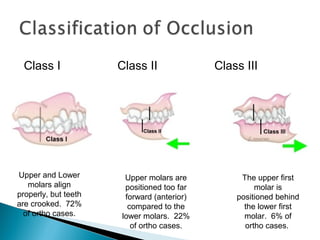
Class I Class II Class III
Upper and Lower
molars align
properly, but teeth
are crooked. 72%
of ortho cases.
Upper molars are
positioned too far
forward (anterior)
compared to the
lower molars. 22%
of ortho cases.
The upper first
molar is
positioned behind
the lower first
molar. 6% of
ortho cases.
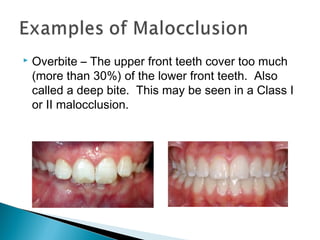
 Overbite – The upper front teeth cover too much
(more than 30%) of the lower front teeth. Also
called a deep bite. This may be seen in a Class I
or II malocclusion.
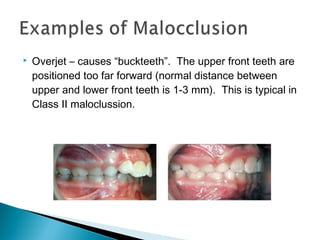
 Overjet – causes “buckteeth”. The upper front teeth are
positioned too far forward (normal distance between
upper and lower front teeth is 1-3 mm). This is typical in
Class II maloclussion.
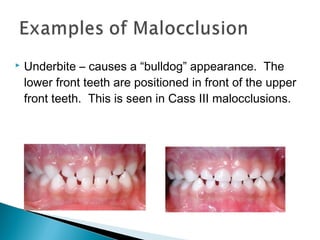
 Underbite – causes a “bulldog” appearance. The
lower front teeth are positioned in front of the upper
front teeth. This is seen in Cass III malocclusions.
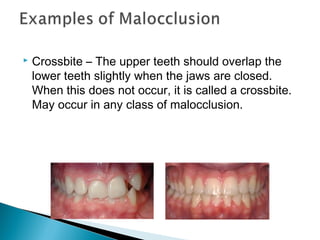
 Crossbite – The upper teeth should overlap the
lower teeth slightly when the jaws are closed.
When this does not occur, it is called a crossbite.
May occur in any class of malocclusion.
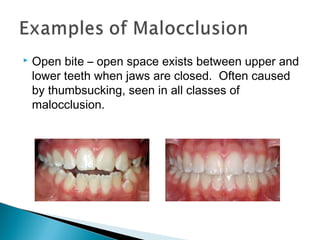
 Open bite – open space exists between upper and
lower teeth when jaws are closed. Often caused
by thumbsucking, seen in all classes of
malocclusion.
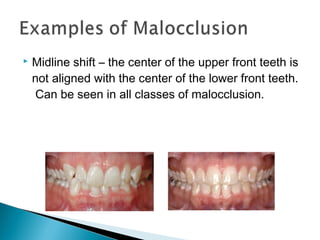
 Midline shift – the center of the upper front teeth is
not aligned with the center of the lower front teeth.
Can be seen in all classes of malocclusion.
 Genetics - You may inherit a small mouth from
mom and large teeth from dad.
 Tooth loss - If a tooth is lost from an injury,
cavities, or gum disease, the remaining teeth may
shift.
 Bad habits such as thumbsucking can shift teeth
or cause them to erupt improperly.
 Malnutrition – Nutritional deficits can restrict the
growth of jaws and teeth.
 The jaws of pre-teens and teens are still growing.
Therefore, it is easier to shift teeth at this stage.
 Sometime, two separate phases of braces are
necessary for treatment.
◦ Phase I – when patients are 6 to 7 years old, to make room for
the permanent teeth to erupt properly
◦ Phase II – at age 12 (or when permanent teeth have erupted) a
second round of braces are applied to straighten teeth and
correct bite.
•It is becoming more common for adults to seekIt is becoming more common for adults to seek
orthodontic treatment. Their treatment may take longer toorthodontic treatment. Their treatment may take longer to
complete.complete.
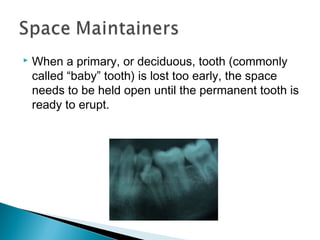
 When a primary, or deciduous, tooth (commonly
called “baby” tooth) is lost too early, the space
needs to be held open until the permanent tooth is
ready to erupt.
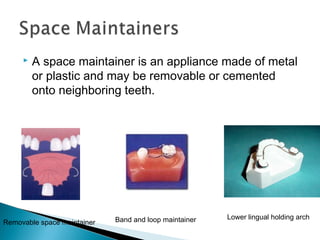
 A space maintainer is an appliance made of metal
or plastic and may be removable or cemented
onto neighboring teeth.
Removable space maintainer Band and loop maintainer Lower lingual holding arch
 An incorrect bite can have long-term effects
including:
◦ Interference with normal growth and development of jaws
◦ Difficulty swallowing
◦ Impaired chewing
◦ Speech defects
◦ Susceptibility to cavities and gum disease
◦ Poor aesthetics
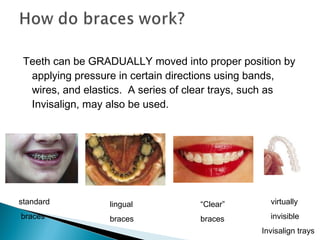
Teeth can be GRADUALLY moved into proper position by
applying pressure in certain directions using bands,
wires, and elastics. A series of clear trays, such as
Invisalign, may also be used.
standard
braces
lingual
braces
“Clear”
braces
virtually
invisible
Invisalign trays
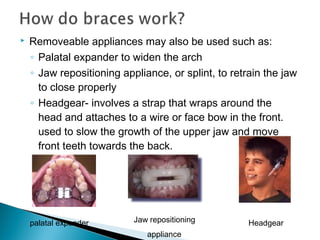
 Removeable appliances may also be used such as:
◦ Palatal expander to widen the arch
◦ Jaw repositioning appliance, or splint, to retrain the jaw
to close properly
◦ Headgear- involves a strap that wraps around the
head and attaches to a wire or face bow in the front.
used to slow the growth of the upper jaw and move
front teeth towards the back.
palatal expander Jaw repositioning
appliance
Headgear
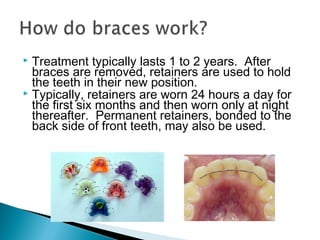
 Treatment typically lasts 1 to 2 years. After
braces are removed, retainers are used to hold
the teeth in their new position.
 Typically, retainers are worn 24 hours a day for
the first six months and then worn only at night
thereafter. Permanent retainers, bonded to the
back side of front teeth, may also be used.
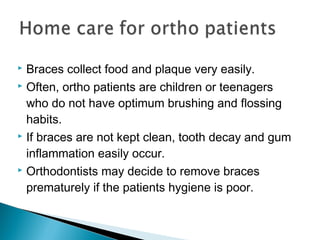
 Braces collect food and plaque very easily.
 Often, ortho patients are children or teenagers
who do not have optimum brushing and flossing
habits.
 If braces are not kept clean, tooth decay and gum
inflammation easily occur.
 Orthodontists may decide to remove braces
prematurely if the patients hygiene is poor.
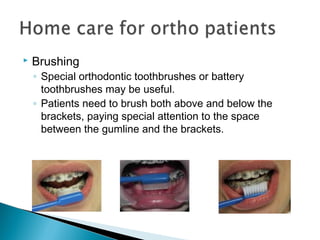
 Brushing
◦ Special orthodontic toothbrushes or battery
toothbrushes may be useful.
◦ Patients need to brush both above and below the
brackets, paying special attention to the space
between the gumline and the brackets.
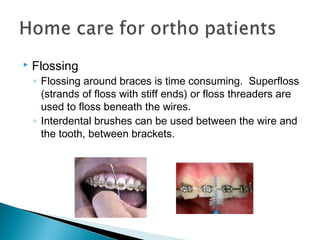
 Flossing
◦ Flossing around braces is time consuming. Superfloss
(strands of floss with stiff ends) or floss threaders are
used to floss beneath the wires.
◦ Interdental brushes can be used between the wire and
the tooth, between brackets.
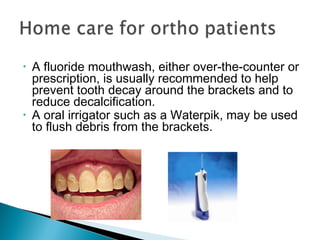
• A fluoride mouthwash, either over-the-counter or
prescription, is usually recommended to help
prevent tooth decay around the brackets and to
reduce decalcification.
• A oral irrigator such as a Waterpik, may be used
to flush debris from the brackets.
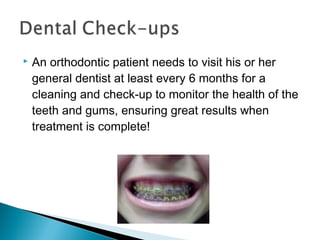
 An orthodontic patient needs to visit his or her
general dentist at least every 6 months for a
cleaning and check-up to monitor the health of the
teeth and gums, ensuring great results when
treatment is complete!

Intro To Orthodontics

  • 1.
    By: Waleed K.O. Jaber g. 34 , 3rd Course UMSA 2013
  • 2.
     Adults andchildren both seek orthodontic treatment for: ◦ Malocclusion (incorrect bite) ◦ Tooth alignment (crooked teeth) ◦ Improvement of overall appearance, including gaps between teeth
  • 3.
    Class I ClassII Class III Upper and Lower molars align properly, but teeth are crooked. 72% of ortho cases. Upper molars are positioned too far forward (anterior) compared to the lower molars. 22% of ortho cases. The upper first molar is positioned behind the lower first molar. 6% of ortho cases.
  • 4.
     Overbite –The upper front teeth cover too much (more than 30%) of the lower front teeth. Also called a deep bite. This may be seen in a Class I or II malocclusion.
  • 5.
     Overjet –causes “buckteeth”. The upper front teeth are positioned too far forward (normal distance between upper and lower front teeth is 1-3 mm). This is typical in Class II maloclussion.
  • 6.
     Underbite –causes a “bulldog” appearance. The lower front teeth are positioned in front of the upper front teeth. This is seen in Cass III malocclusions.
  • 7.
     Crossbite –The upper teeth should overlap the lower teeth slightly when the jaws are closed. When this does not occur, it is called a crossbite. May occur in any class of malocclusion.
  • 8.
     Open bite– open space exists between upper and lower teeth when jaws are closed. Often caused by thumbsucking, seen in all classes of malocclusion.
  • 9.
     Midline shift– the center of the upper front teeth is not aligned with the center of the lower front teeth. Can be seen in all classes of malocclusion.
  • 10.
     Genetics -You may inherit a small mouth from mom and large teeth from dad.  Tooth loss - If a tooth is lost from an injury, cavities, or gum disease, the remaining teeth may shift.  Bad habits such as thumbsucking can shift teeth or cause them to erupt improperly.  Malnutrition – Nutritional deficits can restrict the growth of jaws and teeth.
  • 11.
     The jawsof pre-teens and teens are still growing. Therefore, it is easier to shift teeth at this stage.  Sometime, two separate phases of braces are necessary for treatment. ◦ Phase I – when patients are 6 to 7 years old, to make room for the permanent teeth to erupt properly ◦ Phase II – at age 12 (or when permanent teeth have erupted) a second round of braces are applied to straighten teeth and correct bite. •It is becoming more common for adults to seekIt is becoming more common for adults to seek orthodontic treatment. Their treatment may take longer toorthodontic treatment. Their treatment may take longer to complete.complete.
  • 12.
     When aprimary, or deciduous, tooth (commonly called “baby” tooth) is lost too early, the space needs to be held open until the permanent tooth is ready to erupt.
  • 13.
     A spacemaintainer is an appliance made of metal or plastic and may be removable or cemented onto neighboring teeth. Removable space maintainer Band and loop maintainer Lower lingual holding arch
  • 14.
     An incorrectbite can have long-term effects including: ◦ Interference with normal growth and development of jaws ◦ Difficulty swallowing ◦ Impaired chewing ◦ Speech defects ◦ Susceptibility to cavities and gum disease ◦ Poor aesthetics
  • 15.
    Teeth can beGRADUALLY moved into proper position by applying pressure in certain directions using bands, wires, and elastics. A series of clear trays, such as Invisalign, may also be used. standard braces lingual braces “Clear” braces virtually invisible Invisalign trays
  • 16.
     Removeable appliancesmay also be used such as: ◦ Palatal expander to widen the arch ◦ Jaw repositioning appliance, or splint, to retrain the jaw to close properly ◦ Headgear- involves a strap that wraps around the head and attaches to a wire or face bow in the front. used to slow the growth of the upper jaw and move front teeth towards the back. palatal expander Jaw repositioning appliance Headgear
  • 17.
     Treatment typicallylasts 1 to 2 years. After braces are removed, retainers are used to hold the teeth in their new position.  Typically, retainers are worn 24 hours a day for the first six months and then worn only at night thereafter. Permanent retainers, bonded to the back side of front teeth, may also be used.
  • 18.
     Braces collectfood and plaque very easily.  Often, ortho patients are children or teenagers who do not have optimum brushing and flossing habits.  If braces are not kept clean, tooth decay and gum inflammation easily occur.  Orthodontists may decide to remove braces prematurely if the patients hygiene is poor.
  • 19.
     Brushing ◦ Specialorthodontic toothbrushes or battery toothbrushes may be useful. ◦ Patients need to brush both above and below the brackets, paying special attention to the space between the gumline and the brackets.
  • 20.
     Flossing ◦ Flossingaround braces is time consuming. Superfloss (strands of floss with stiff ends) or floss threaders are used to floss beneath the wires. ◦ Interdental brushes can be used between the wire and the tooth, between brackets.
  • 21.
    • A fluoridemouthwash, either over-the-counter or prescription, is usually recommended to help prevent tooth decay around the brackets and to reduce decalcification. • A oral irrigator such as a Waterpik, may be used to flush debris from the brackets.
  • 22.
     An orthodonticpatient needs to visit his or her general dentist at least every 6 months for a cleaning and check-up to monitor the health of the teeth and gums, ensuring great results when treatment is complete!