Document Number: 91023 www.vishay.com
S-81240-Rev. A, 16-Jun-08 1
Power MOSFET
IRF610, SiHF610
Vishay Siliconix
FEATURES
• Dynamic dV/dt Rating
• Repetitive Avalanche Rated
• Fast Switching
• Ease of Paralleling
• Simple Drive Requirements
• Lead (Pb)-free Available
DESCRIPTION
Third generation Power MOSFETs from Vishay provide the
designer with the best combination of fast switching,
ruggedized device design, low on-resistance and
cost-effectiveness.
The TO-220 package is universally preferred for all
commercial-industrial applications at power dissipation
levels to approximately 50 W. The low thermal resistance
and low package cost of the TO-220 contribute to its wide
acceptance throughout the industry.
Notes
a. Repetitive rating; pulse width limited by maximum junction temperature (see fig. 11).
b. VDD = 50 V, starting TJ = 25 °C, L = 8.8 mH, RG = 25 Ω, IAS = 3.3 A (see fig. 12).
c. ISD ≤ 3.3 A, dI/dt ≤ 70 A/µs, VDD ≤ VDS, TJ ≤ 150 °C.
d. 1.6 mm from case.
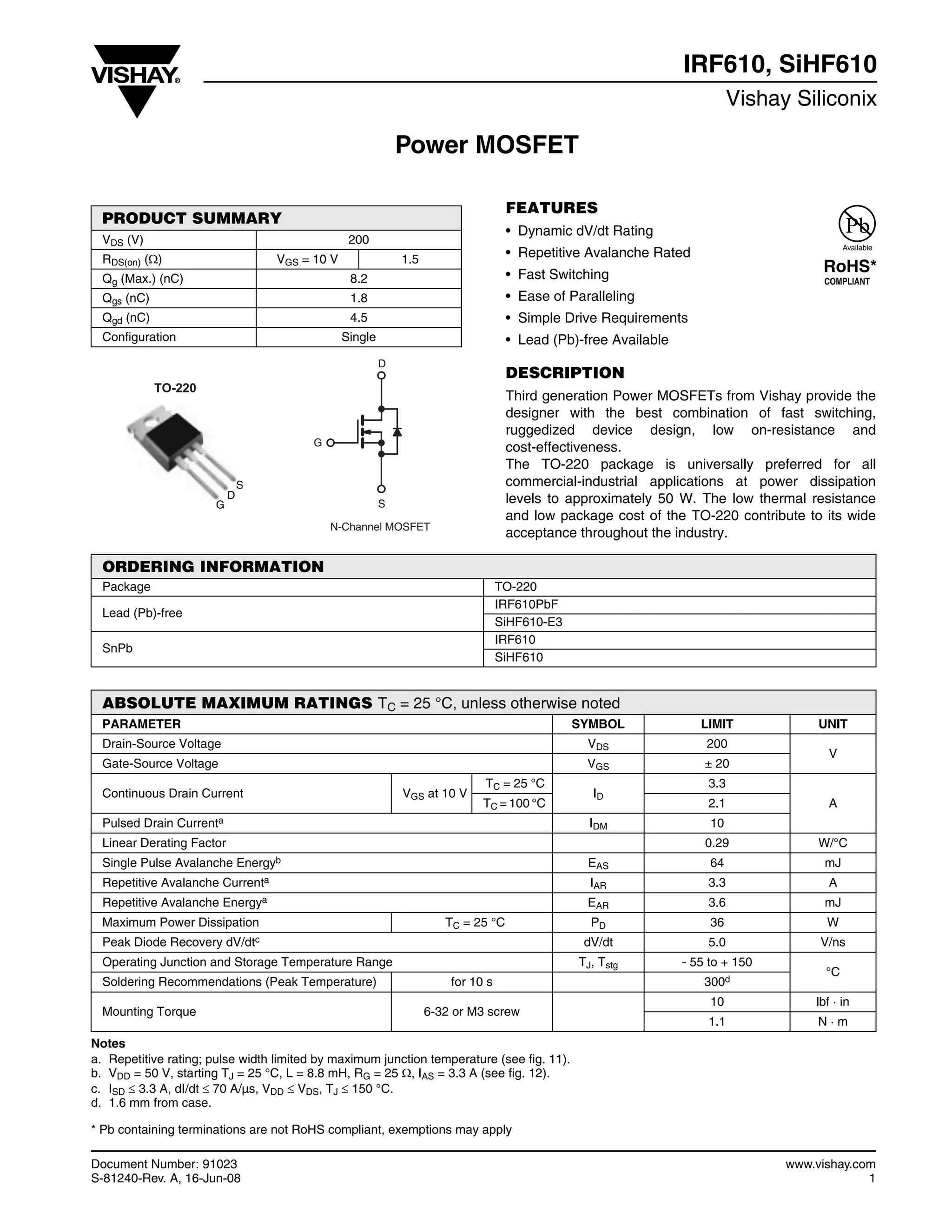
PRODUCT SUMMARY
VDS (V) 200
RDS(on) (Ω) VGS = 10 V 1.5
Qg (Max.) (nC) 8.2
Qgs (nC) 1.8
Qgd (nC) 4.5
Configuration Single
N-Channel MOSFET
G
D
S
TO-220
G
D
S
Available
RoHS*
COMPLIANT
ORDERING INFORMATION
Package TO-220
Lead (Pb)-free
IRF610PbF
SiHF610-E3
SnPb
IRF610
SiHF610
ABSOLUTE MAXIMUM RATINGS TC = 25 °C, unless otherwise noted
PARAMETER SYMBOL LIMIT UNIT
Drain-Source Voltage VDS 200
V
Gate-Source Voltage VGS ± 20
Continuous Drain Current VGS at 10 V
TC = 25 °C
ID
3.3
ATC = 100 °C 2.1
Pulsed Drain Currenta IDM 10
Linear Derating Factor 0.29 W/°C
Single Pulse Avalanche Energyb EAS 64 mJ
Repetitive Avalanche Currenta IAR 3.3 A
Repetitive Avalanche Energya EAR 3.6 mJ
Maximum Power Dissipation TC = 25 °C PD 36 W
Peak Diode Recovery dV/dtc dV/dt 5.0 V/ns
Operating Junction and Storage Temperature Range TJ, Tstg - 55 to + 150
°C
Soldering Recommendations (Peak Temperature) for 10 s 300d
Mounting Torque 6-32 or M3 screw
10 lbf · in
1.1 N · m
* Pb containing terminations are not RoHS compliant, exemptions may apply
www.vishay.com Document Number: 91023
2 S-81240-Rev. A, 16-Jun-08
IRF610, SiHF610
Vishay Siliconix
Notes
a. Repetitive rating; pulse width limited by maximum junction temperature (see fig. 11).
b. Pulse width ≤ 300 µs; duty cycle ≤ 2 %.
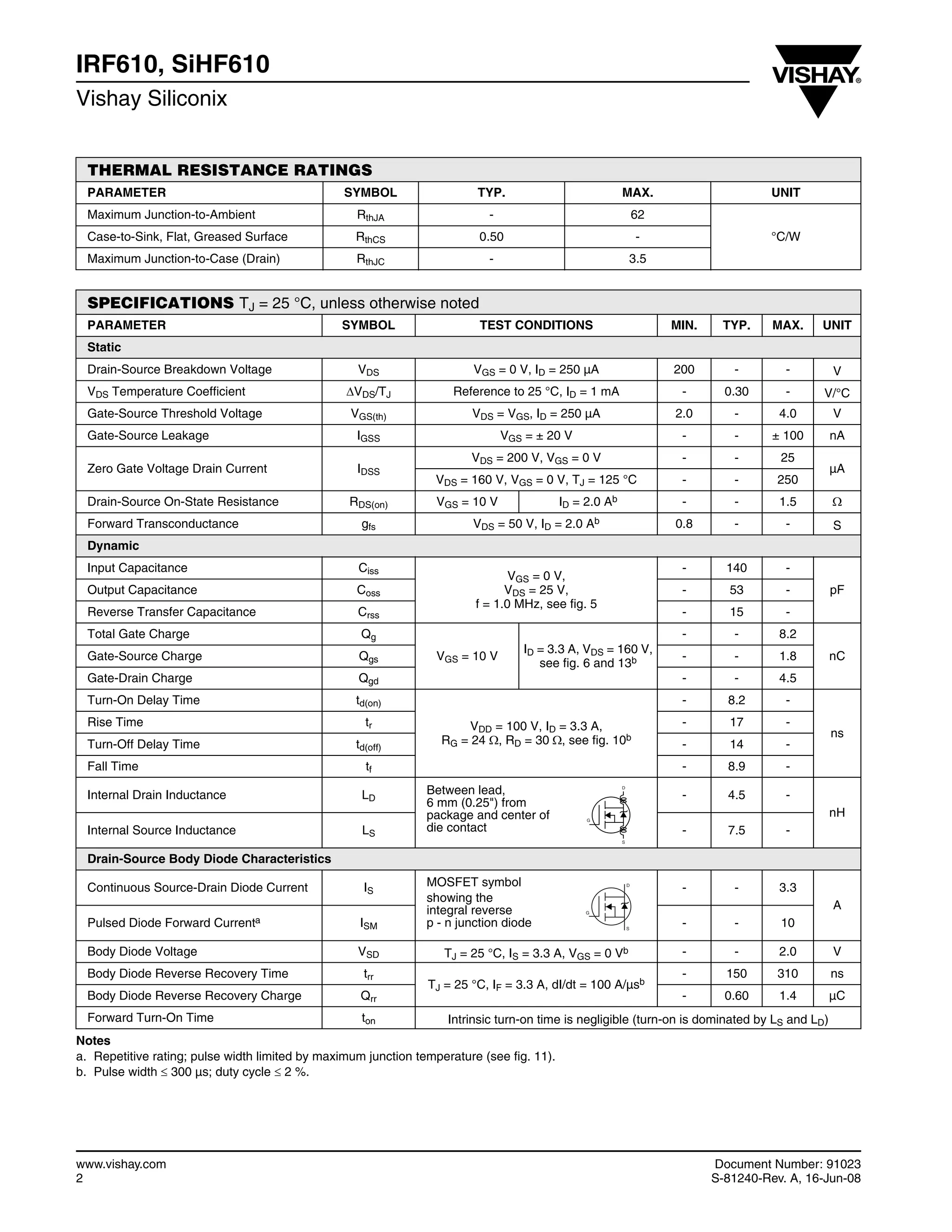
THERMAL RESISTANCE RATINGS
PARAMETER SYMBOL TYP. MAX. UNIT
Maximum Junction-to-Ambient RthJA - 62
°C/WCase-to-Sink, Flat, Greased Surface RthCS 0.50 -
Maximum Junction-to-Case (Drain) RthJC - 3.5
SPECIFICATIONS TJ = 25 °C, unless otherwise noted
PARAMETER SYMBOL TEST CONDITIONS MIN. TYP. MAX. UNIT
Static
Drain-Source Breakdown Voltage VDS VGS = 0 V, ID = 250 µA 200 - - V
VDS Temperature Coefficient ΔVDS/TJ Reference to 25 °C, ID = 1 mA - 0.30 - V/°C
Gate-Source Threshold Voltage VGS(th) VDS = VGS, ID = 250 µA 2.0 - 4.0 V
Gate-Source Leakage IGSS VGS = ± 20 V - - ± 100 nA
Zero Gate Voltage Drain Current IDSS
VDS = 200 V, VGS = 0 V - - 25
µA
VDS = 160 V, VGS = 0 V, TJ = 125 °C - - 250
Drain-Source On-State Resistance RDS(on) VGS = 10 V ID = 2.0 Ab - - 1.5 Ω
Forward Transconductance gfs VDS = 50 V, ID = 2.0 Ab 0.8 - - S
Dynamic
Input Capacitance Ciss
VGS = 0 V,
VDS = 25 V,
f = 1.0 MHz, see fig. 5
- 140 -
pFOutput Capacitance Coss - 53 -
Reverse Transfer Capacitance Crss - 15 -
Total Gate Charge Qg
VGS = 10 V
ID = 3.3 A, VDS = 160 V,
see fig. 6 and 13b
- - 8.2
nCGate-Source Charge Qgs - - 1.8
Gate-Drain Charge Qgd - - 4.5
Turn-On Delay Time td(on)
VDD = 100 V, ID = 3.3 A,
RG = 24 Ω, RD = 30 Ω, see fig. 10b
- 8.2 -
ns
Rise Time tr - 17 -
Turn-Off Delay Time td(off) - 14 -
Fall Time tf - 8.9 -
Internal Drain Inductance LD
Between lead,
6 mm (0.25") from
package and center of
die contact
- 4.5 -
nH
Internal Source Inductance LS - 7.5 -
Drain-Source Body Diode Characteristics
Continuous Source-Drain Diode Current IS
MOSFET symbol
showing the
integral reverse
p - n junction diode
- - 3.3
A
Pulsed Diode Forward Currenta ISM - - 10
Body Diode Voltage VSD TJ = 25 °C, IS = 3.3 A, VGS = 0 Vb - - 2.0 V
Body Diode Reverse Recovery Time trr
TJ = 25 °C, IF = 3.3 A, dI/dt = 100 A/µsb
- 150 310 ns
Body Diode Reverse Recovery Charge Qrr - 0.60 1.4 µC
Forward Turn-On Time ton Intrinsic turn-on time is negligible (turn-on is dominated by LS and LD)
D
S
G
S
D
G
Document Number: 91023 www.vishay.com
S-81240-Rev. A, 16-Jun-08 3
IRF610, SiHF610
Vishay Siliconix
TYPICAL CHARACTERISTICS 25 °C, unless otherwise noted
Fig. 1 - Typical Output Characteristics, TC = 25 °C
Fig. 2 - Typical Output Characteristics, TC = 150 °C
Fig. 3 - Typical Transfer Characteristics
Fig. 4 - Normalized On-Resistance vs. Temperature
www.vishay.com Document Number: 91023
4 S-81240-Rev. A, 16-Jun-08
IRF610, SiHF610
Vishay Siliconix
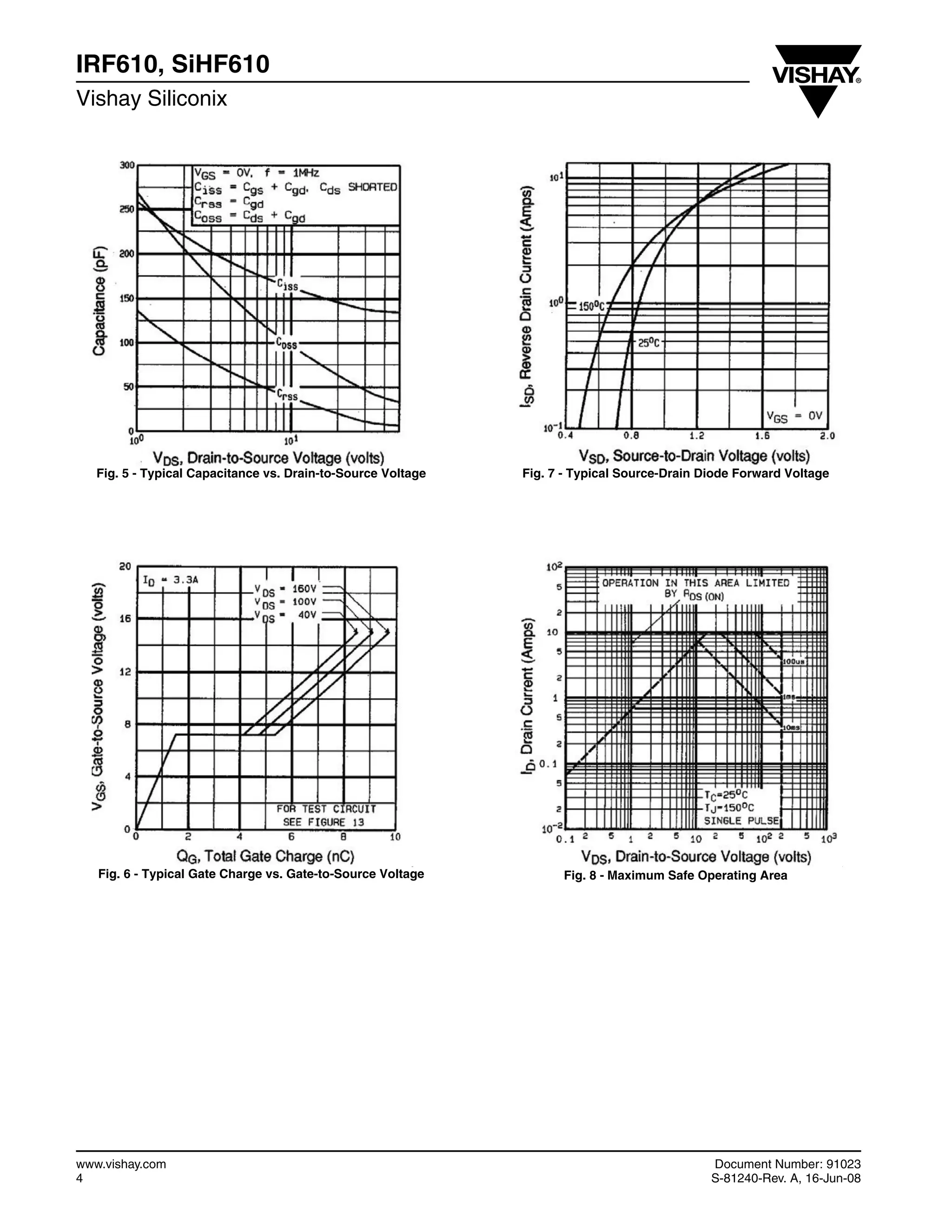
Fig. 5 - Typical Capacitance vs. Drain-to-Source Voltage
Fig. 6 - Typical Gate Charge vs. Gate-to-Source Voltage
Fig. 7 - Typical Source-Drain Diode Forward Voltage
Fig. 8 - Maximum Safe Operating Area
Document Number: 91023 www.vishay.com
S-81240-Rev. A, 16-Jun-08 5
IRF610, SiHF610
Vishay Siliconix
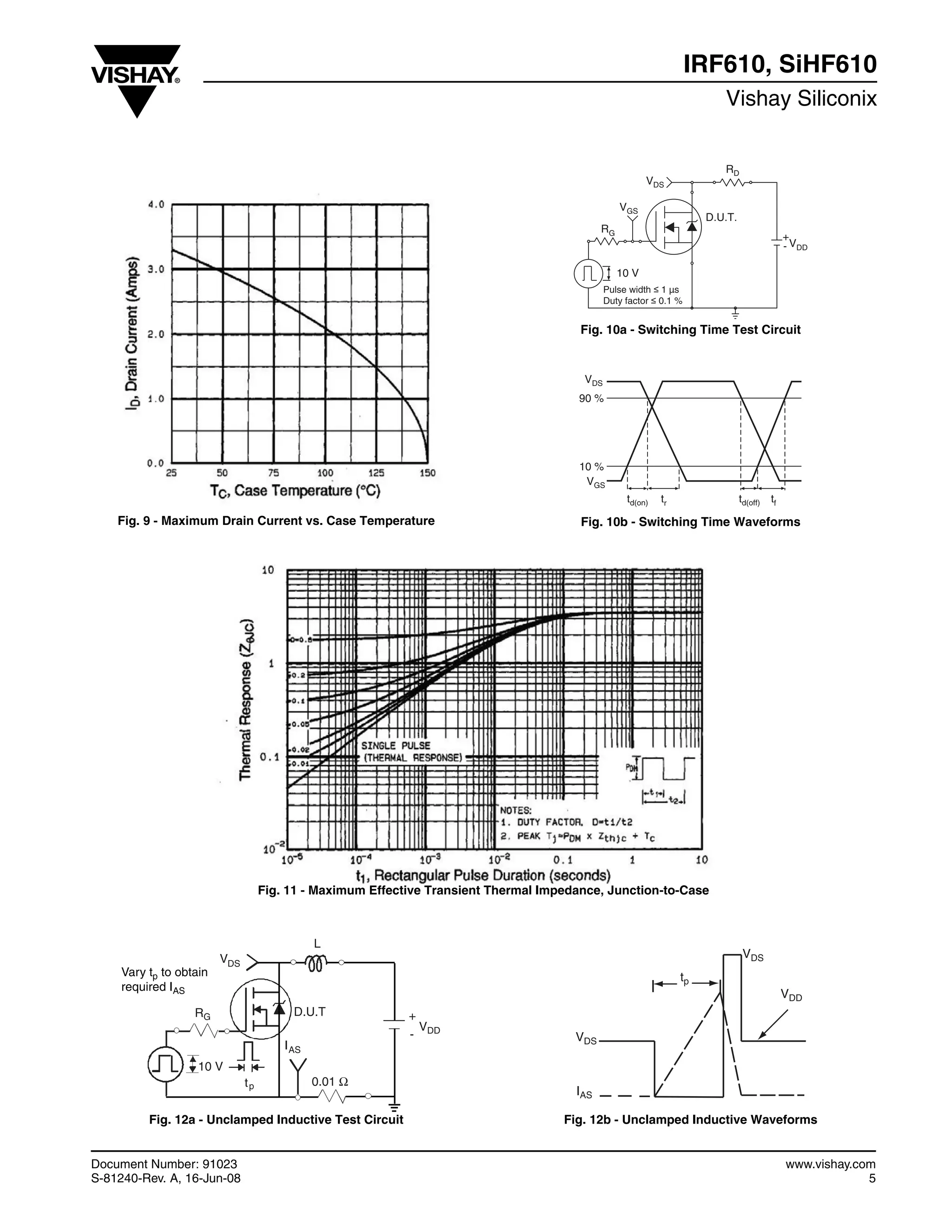
Fig. 9 - Maximum Drain Current vs. Case Temperature
Fig. 10a - Switching Time Test Circuit
Fig. 10b - Switching Time Waveforms
Fig. 11 - Maximum Effective Transient Thermal Impedance, Junction-to-Case
Fig. 12a - Unclamped Inductive Test Circuit Fig. 12b - Unclamped Inductive Waveforms
Pulse width ≤ 1 µs
Duty factor ≤ 0.1 %
RD
VGS
RG
D.U.T.
10 V
+
-
VDS
VDD
VDS
90 %
10 %
VGS
td(on) tr td(off) tf
RG
IAS
0.01 Ωtp
D.U.T
L
VDS
+
-
VDD
10 V
Vary tp to obtain
required IAS
IAS
VDS
VDD
VDS
tp
www.vishay.com Document Number: 91023
6 S-81240-Rev. A, 16-Jun-08
IRF610, SiHF610
Vishay Siliconix
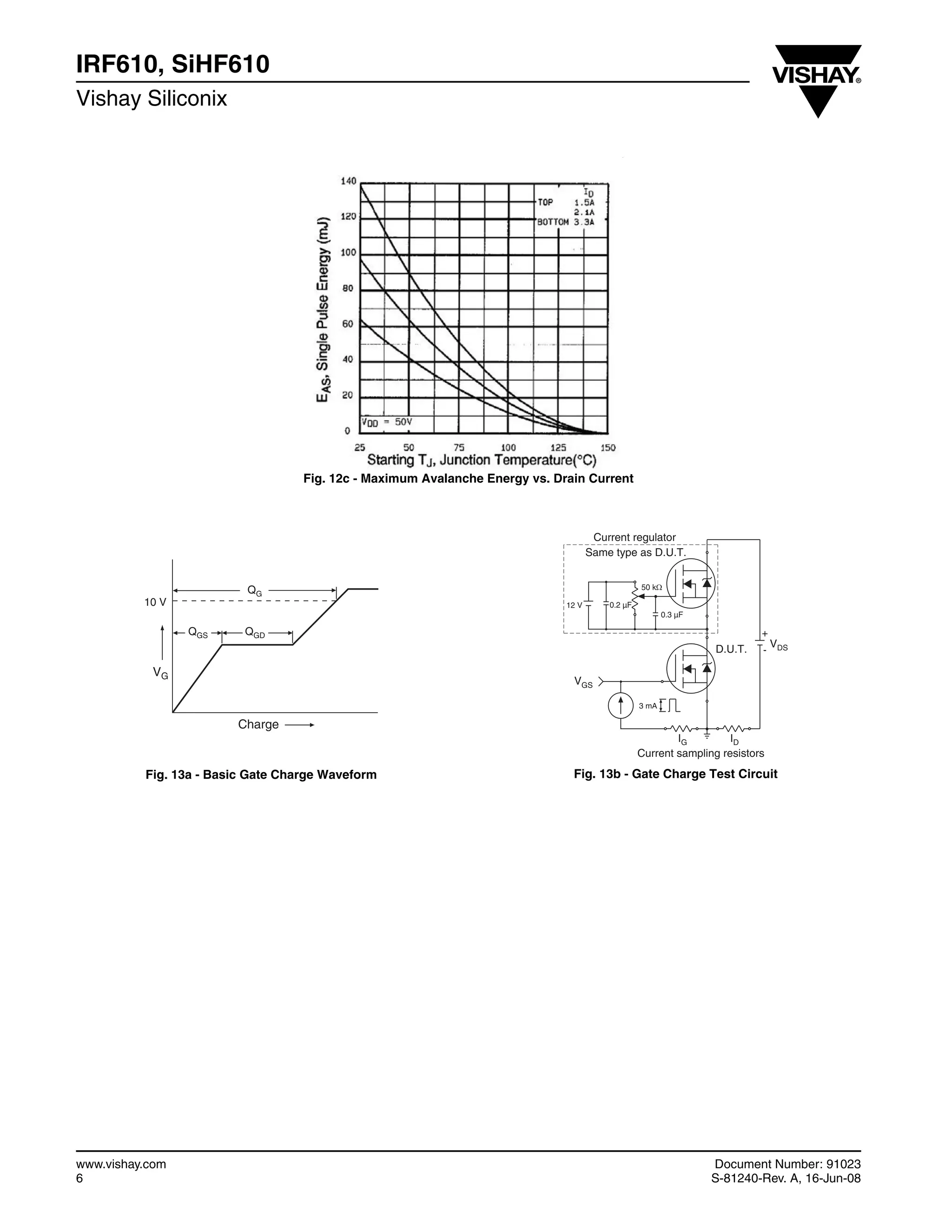
Fig. 12c - Maximum Avalanche Energy vs. Drain Current
Fig. 13a - Basic Gate Charge Waveform Fig. 13b - Gate Charge Test Circuit
QGS QGD
QG
VG
Charge
10 V
D.U.T.
3 mA
VGS
VDS
IG ID
0.3 µF
0.2 µF
50 kΩ
12 V
Current regulator
Current sampling resistors
Same type as D.U.T.
+
-
Document Number: 91023 www.vishay.com
S-81240-Rev. A, 16-Jun-08 7
IRF610, SiHF610
Vishay Siliconix
Fig. 14 - For N-Channel
Vishay Siliconix maintains worldwide manufacturing capability. Products may be manufactured at one of several qualified locations. Reliability data for Silicon
Technology and Package Reliability represent a composite of all qualified locations. For related documents such as package/tape drawings, part marking, and
reliability data, see http://www.vishay.com/ppg?91023.
P.W.
Period
dI/dt
Diode recovery
dV/dt
Ripple ≤ 5 %
Body diode forward drop
Re-applied
voltage
Reverse
recovery
current
Body diode forward
current
VGS = 10 V*
VDD
ISD
Driver gate drive
D.U.T. ISD waveform
D.U.T. VDS waveform
Inductor current
D =
P.W.
Period
+
-
+
+
+-
-
-
* VGS = 5 V for logic level devices
Peak Diode Recovery dV/dt Test Circuit
VDD
• dV/dt controlled by RG
• Driver same type as D.U.T.
• ISD controlled by duty factor "D"
• D.U.T. - device under test
D.U.T.
Circuit layout considerations
• Low stray inductance
• Ground plane
• Low leakage inductance
current transformer
RG
Document Number: 91000 www.vishay.com
Revision: 18-Jul-08 1
Disclaimer
Legal Disclaimer Notice
Vishay
All product specifications and data are subject to change without notice.
Vishay Intertechnology, Inc., its affiliates, agents, and employees, and all persons acting on its or their behalf
(collectively, “Vishay”), disclaim any and all liability for any errors, inaccuracies or incompleteness contained herein
or in any other disclosure relating to any product.
Vishay disclaims any and all liability arising out of the use or application of any product described herein or of any
information provided herein to the maximum extent permitted by law. The product specifications do not expand or
otherwise modify Vishay’s terms and conditions of purchase, including but not limited to the warranty expressed
therein, which apply to these products.
No license, express or implied, by estoppel or otherwise, to any intellectual property rights is granted by this
document or by any conduct of Vishay.
The products shown herein are not designed for use in medical, life-saving, or life-sustaining applications unless
otherwise expressly indicated. Customers using or selling Vishay products not expressly indicated for use in such
applications do so entirely at their own risk and agree to fully indemnify Vishay for any damages arising or resulting
from such use or sale. Please contact authorized Vishay personnel to obtain written terms and conditions regarding
products designed for such applications.
Product names and markings noted herein may be trademarks of their respective owners.

Original N-MOSFET Mosfet IRF610STU IRF610 610 1.8A 200V TO-220 New

  • 1.
    Document Number: 91023www.vishay.com S-81240-Rev. A, 16-Jun-08 1 Power MOSFET IRF610, SiHF610 Vishay Siliconix FEATURES • Dynamic dV/dt Rating • Repetitive Avalanche Rated • Fast Switching • Ease of Paralleling • Simple Drive Requirements • Lead (Pb)-free Available DESCRIPTION Third generation Power MOSFETs from Vishay provide the designer with the best combination of fast switching, ruggedized device design, low on-resistance and cost-effectiveness. The TO-220 package is universally preferred for all commercial-industrial applications at power dissipation levels to approximately 50 W. The low thermal resistance and low package cost of the TO-220 contribute to its wide acceptance throughout the industry. Notes a. Repetitive rating; pulse width limited by maximum junction temperature (see fig. 11). b. VDD = 50 V, starting TJ = 25 °C, L = 8.8 mH, RG = 25 Ω, IAS = 3.3 A (see fig. 12). c. ISD ≤ 3.3 A, dI/dt ≤ 70 A/µs, VDD ≤ VDS, TJ ≤ 150 °C. d. 1.6 mm from case. PRODUCT SUMMARY VDS (V) 200 RDS(on) (Ω) VGS = 10 V 1.5 Qg (Max.) (nC) 8.2 Qgs (nC) 1.8 Qgd (nC) 4.5 Configuration Single N-Channel MOSFET G D S TO-220 G D S Available RoHS* COMPLIANT ORDERING INFORMATION Package TO-220 Lead (Pb)-free IRF610PbF SiHF610-E3 SnPb IRF610 SiHF610 ABSOLUTE MAXIMUM RATINGS TC = 25 °C, unless otherwise noted PARAMETER SYMBOL LIMIT UNIT Drain-Source Voltage VDS 200 V Gate-Source Voltage VGS ± 20 Continuous Drain Current VGS at 10 V TC = 25 °C ID 3.3 ATC = 100 °C 2.1 Pulsed Drain Currenta IDM 10 Linear Derating Factor 0.29 W/°C Single Pulse Avalanche Energyb EAS 64 mJ Repetitive Avalanche Currenta IAR 3.3 A Repetitive Avalanche Energya EAR 3.6 mJ Maximum Power Dissipation TC = 25 °C PD 36 W Peak Diode Recovery dV/dtc dV/dt 5.0 V/ns Operating Junction and Storage Temperature Range TJ, Tstg - 55 to + 150 °C Soldering Recommendations (Peak Temperature) for 10 s 300d Mounting Torque 6-32 or M3 screw 10 lbf · in 1.1 N · m * Pb containing terminations are not RoHS compliant, exemptions may apply
  • 2.
    www.vishay.com Document Number:91023 2 S-81240-Rev. A, 16-Jun-08 IRF610, SiHF610 Vishay Siliconix Notes a. Repetitive rating; pulse width limited by maximum junction temperature (see fig. 11). b. Pulse width ≤ 300 µs; duty cycle ≤ 2 %. THERMAL RESISTANCE RATINGS PARAMETER SYMBOL TYP. MAX. UNIT Maximum Junction-to-Ambient RthJA - 62 °C/WCase-to-Sink, Flat, Greased Surface RthCS 0.50 - Maximum Junction-to-Case (Drain) RthJC - 3.5 SPECIFICATIONS TJ = 25 °C, unless otherwise noted PARAMETER SYMBOL TEST CONDITIONS MIN. TYP. MAX. UNIT Static Drain-Source Breakdown Voltage VDS VGS = 0 V, ID = 250 µA 200 - - V VDS Temperature Coefficient ΔVDS/TJ Reference to 25 °C, ID = 1 mA - 0.30 - V/°C Gate-Source Threshold Voltage VGS(th) VDS = VGS, ID = 250 µA 2.0 - 4.0 V Gate-Source Leakage IGSS VGS = ± 20 V - - ± 100 nA Zero Gate Voltage Drain Current IDSS VDS = 200 V, VGS = 0 V - - 25 µA VDS = 160 V, VGS = 0 V, TJ = 125 °C - - 250 Drain-Source On-State Resistance RDS(on) VGS = 10 V ID = 2.0 Ab - - 1.5 Ω Forward Transconductance gfs VDS = 50 V, ID = 2.0 Ab 0.8 - - S Dynamic Input Capacitance Ciss VGS = 0 V, VDS = 25 V, f = 1.0 MHz, see fig. 5 - 140 - pFOutput Capacitance Coss - 53 - Reverse Transfer Capacitance Crss - 15 - Total Gate Charge Qg VGS = 10 V ID = 3.3 A, VDS = 160 V, see fig. 6 and 13b - - 8.2 nCGate-Source Charge Qgs - - 1.8 Gate-Drain Charge Qgd - - 4.5 Turn-On Delay Time td(on) VDD = 100 V, ID = 3.3 A, RG = 24 Ω, RD = 30 Ω, see fig. 10b - 8.2 - ns Rise Time tr - 17 - Turn-Off Delay Time td(off) - 14 - Fall Time tf - 8.9 - Internal Drain Inductance LD Between lead, 6 mm (0.25") from package and center of die contact - 4.5 - nH Internal Source Inductance LS - 7.5 - Drain-Source Body Diode Characteristics Continuous Source-Drain Diode Current IS MOSFET symbol showing the integral reverse p - n junction diode - - 3.3 A Pulsed Diode Forward Currenta ISM - - 10 Body Diode Voltage VSD TJ = 25 °C, IS = 3.3 A, VGS = 0 Vb - - 2.0 V Body Diode Reverse Recovery Time trr TJ = 25 °C, IF = 3.3 A, dI/dt = 100 A/µsb - 150 310 ns Body Diode Reverse Recovery Charge Qrr - 0.60 1.4 µC Forward Turn-On Time ton Intrinsic turn-on time is negligible (turn-on is dominated by LS and LD) D S G S D G
  • 3.
    Document Number: 91023www.vishay.com S-81240-Rev. A, 16-Jun-08 3 IRF610, SiHF610 Vishay Siliconix TYPICAL CHARACTERISTICS 25 °C, unless otherwise noted Fig. 1 - Typical Output Characteristics, TC = 25 °C Fig. 2 - Typical Output Characteristics, TC = 150 °C Fig. 3 - Typical Transfer Characteristics Fig. 4 - Normalized On-Resistance vs. Temperature
  • 4.
    www.vishay.com Document Number:91023 4 S-81240-Rev. A, 16-Jun-08 IRF610, SiHF610 Vishay Siliconix Fig. 5 - Typical Capacitance vs. Drain-to-Source Voltage Fig. 6 - Typical Gate Charge vs. Gate-to-Source Voltage Fig. 7 - Typical Source-Drain Diode Forward Voltage Fig. 8 - Maximum Safe Operating Area
  • 5.
    Document Number: 91023www.vishay.com S-81240-Rev. A, 16-Jun-08 5 IRF610, SiHF610 Vishay Siliconix Fig. 9 - Maximum Drain Current vs. Case Temperature Fig. 10a - Switching Time Test Circuit Fig. 10b - Switching Time Waveforms Fig. 11 - Maximum Effective Transient Thermal Impedance, Junction-to-Case Fig. 12a - Unclamped Inductive Test Circuit Fig. 12b - Unclamped Inductive Waveforms Pulse width ≤ 1 µs Duty factor ≤ 0.1 % RD VGS RG D.U.T. 10 V + - VDS VDD VDS 90 % 10 % VGS td(on) tr td(off) tf RG IAS 0.01 Ωtp D.U.T L VDS + - VDD 10 V Vary tp to obtain required IAS IAS VDS VDD VDS tp
  • 6.
    www.vishay.com Document Number:91023 6 S-81240-Rev. A, 16-Jun-08 IRF610, SiHF610 Vishay Siliconix Fig. 12c - Maximum Avalanche Energy vs. Drain Current Fig. 13a - Basic Gate Charge Waveform Fig. 13b - Gate Charge Test Circuit QGS QGD QG VG Charge 10 V D.U.T. 3 mA VGS VDS IG ID 0.3 µF 0.2 µF 50 kΩ 12 V Current regulator Current sampling resistors Same type as D.U.T. + -
  • 7.
    Document Number: 91023www.vishay.com S-81240-Rev. A, 16-Jun-08 7 IRF610, SiHF610 Vishay Siliconix Fig. 14 - For N-Channel Vishay Siliconix maintains worldwide manufacturing capability. Products may be manufactured at one of several qualified locations. Reliability data for Silicon Technology and Package Reliability represent a composite of all qualified locations. For related documents such as package/tape drawings, part marking, and reliability data, see http://www.vishay.com/ppg?91023. P.W. Period dI/dt Diode recovery dV/dt Ripple ≤ 5 % Body diode forward drop Re-applied voltage Reverse recovery current Body diode forward current VGS = 10 V* VDD ISD Driver gate drive D.U.T. ISD waveform D.U.T. VDS waveform Inductor current D = P.W. Period + - + + +- - - * VGS = 5 V for logic level devices Peak Diode Recovery dV/dt Test Circuit VDD • dV/dt controlled by RG • Driver same type as D.U.T. • ISD controlled by duty factor "D" • D.U.T. - device under test D.U.T. Circuit layout considerations • Low stray inductance • Ground plane • Low leakage inductance current transformer RG
  • 8.
    Document Number: 91000www.vishay.com Revision: 18-Jul-08 1 Disclaimer Legal Disclaimer Notice Vishay All product specifications and data are subject to change without notice. Vishay Intertechnology, Inc., its affiliates, agents, and employees, and all persons acting on its or their behalf (collectively, “Vishay”), disclaim any and all liability for any errors, inaccuracies or incompleteness contained herein or in any other disclosure relating to any product. Vishay disclaims any and all liability arising out of the use or application of any product described herein or of any information provided herein to the maximum extent permitted by law. The product specifications do not expand or otherwise modify Vishay’s terms and conditions of purchase, including but not limited to the warranty expressed therein, which apply to these products. No license, express or implied, by estoppel or otherwise, to any intellectual property rights is granted by this document or by any conduct of Vishay. The products shown herein are not designed for use in medical, life-saving, or life-sustaining applications unless otherwise expressly indicated. Customers using or selling Vishay products not expressly indicated for use in such applications do so entirely at their own risk and agree to fully indemnify Vishay for any damages arising or resulting from such use or sale. Please contact authorized Vishay personnel to obtain written terms and conditions regarding products designed for such applications. Product names and markings noted herein may be trademarks of their respective owners.