AGRN-522
PRESENTATION
ORICULTURE
An Unexplored Realm of Organic
Farming
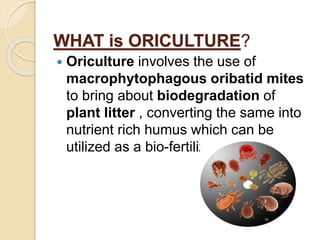
WHAT is ORICULTURE?
 Oriculture involves the use of
macrophytophagous oribatid mites
to bring about biodegradation of
plant litter , converting the same into
nutrient rich humus which can be
utilized as a bio-fertilizer.
HOW ORICULTURE DIFFERS
from OTHER FARMING
SYSTEMS…..
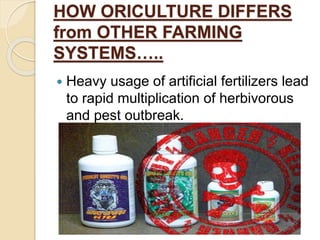
 Heavy usage of artificial fertilizers lead
to rapid multiplication of herbivorous
and pest outbreak.
SYSTEMIC POSITION
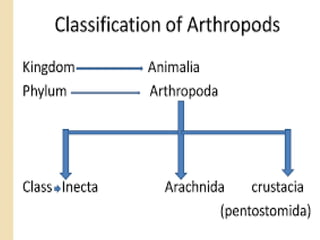
Mites along with ticks come
under the largest
invertebrate phylum
Arthropoda . Like spiders and
scorpions they possess four
pairs of legs , simple or no
eyes ,tracheate respiration
and hence grouped under the
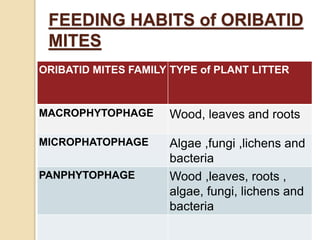
FEEDING HABITS of ORIBATID
MITES
ORIBATID MITES FAMILY TYPE of PLANT LITTER
MACROPHYTOPHAGE Wood, leaves and roots
MICROPHATOPHAGE Algae ,fungi ,lichens and
bacteria
PANPHYTOPHAGE Wood ,leaves, roots ,
algae, fungi, lichens and
bacteria
MACROPHAGOUS ORIBATID
MITES
SUPER FAMILIES-
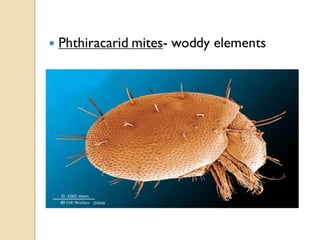
1.Phthiracaroidea prefer woody
2.Nothroidea elements
Hence these mites are known as
“xylophages”
These mites live in burrows and tunnels made
into dead and decaying tissues of higher plants
on which they feed leading to final breakdown of
wood by these mites.
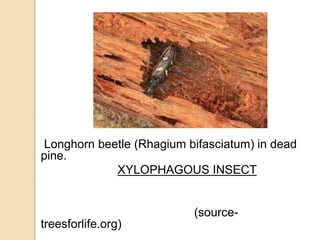
Longhorn beetle (Rhagium bifasciatum) in dead
pine.
XYLOPHAGOUS INSECT
(source-
treesforlife.org)
3.Lahmannoidea prefer leafy
element
hence these mites are known as
“phyllophages”
Hence these mites feed on mesophyll tissue
and harder veins and midrib of leaves leading
to complete skeletonization and complete
break down of leaves.
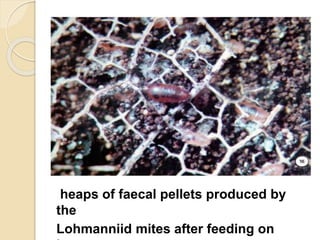
heaps of faecal pellets produced by
the
Lohmanniid mites after feeding on
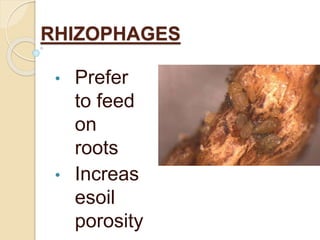
RHIZOPHAGES
• Prefer
to feed
on
roots
• Increas
esoil
porosity
MICROPHAGOUS ORIBATID
MITES
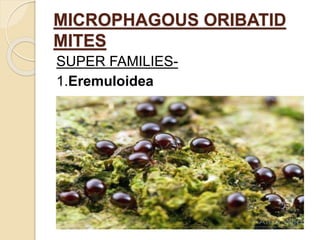
SUPER FAMILIES-
1.Eremuloidea
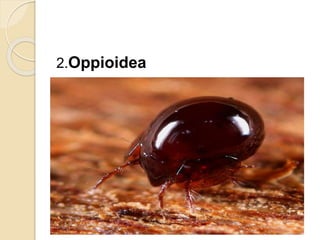
2.Oppioidea
.
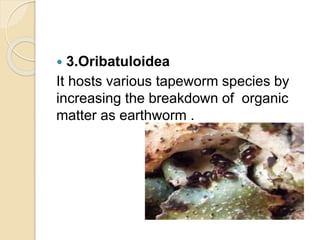
 3.Oribatuloidea
It hosts various tapeworm species by
increasing the breakdown of organic
matter as earthworm .
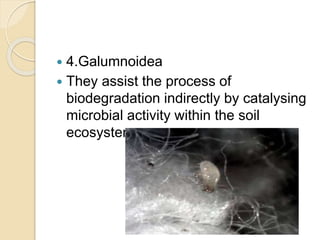
 4.Galumnoidea
 They assist the process of
biodegradation indirectly by catalysing
microbial activity within the soil
ecosystem
PANPHYTOPAGOUS ORIBATID
MITES
SUPER FAMILIES-
1.Epilohmannoidea
2.Nothroidea
3.Eremuloidea
4.Galumnoidea
There mites play a dual role by feeding on
both higher and lower plant depending on
adaptability , thus forming
Panphytophagous category
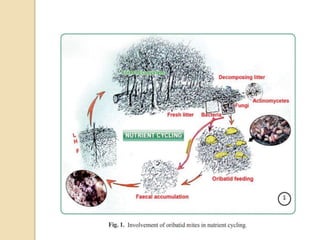
As a result of feeding , all these
different categories of mites
release large amount of faecal
pellets into the surrounding soil .
This readily mixes with the soil
adding to the nutrient pool . Soil
enriched with faecal pellets
provides a highly fertile
environment enhancing
germination of seeds and healthy
growth of roots
FACTORS INFLUENCING
ORIBATID MITES DISTRIBUTION
Oribatid mites are ubiquitous but
flourish well in micro climates dou to
biotic and abiotic influences
ABIOTIC FACTORS-
1.Temperature
2.Moisture
3.Soil depth
BIOTIC FACTOR-
The primary biotic factor affecting is the
oribatid mites is food availability .
ABIOTIC FACTORS-
1.Temperature-
Temperature directly affects
physiological processes like
respiration, ingestion, growth and
survival of mites.
Oribatid mites could survive in
temperatures up to forty-five degree
Celsius
2.Moisture-
Different species and different life
stages within a species have variable
tolerance to moisture . A direct effect of
moisture is its transpiration. It is likely to
be found in upper layers of soil or the
soil that is more tolerant to dessication.
3.Soil depth-
Influences the temperature, moisture,
organic matter quality and pore space.
Small sizes mites are more likely to
predominate deeper into the soils.
Sandy soils containing humus are ideal
for orbatid mites. These well ventilated
soils may make deep vertical migration
of mites more likely.
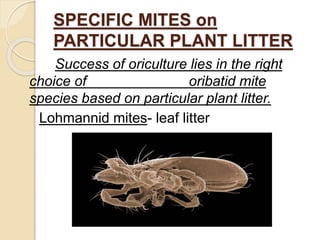
SPECIFIC MITES on
PARTICULAR PLANT LITTER
Success of oriculture lies in the right
choice of oribatid mite
species based on particular plant litter.
Lohmannid mites- leaf litter
Vermiculture Vs. Oriculture
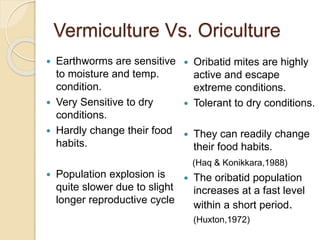
 Earthworms are sensitive
to moisture and temp.
condition.
 Very Sensitive to dry
conditions.
 Hardly change their food
habits.
 Population explosion is
quite slower due to slight
longer reproductive cycle
 Oribatid mites are highly
active and escape
extreme conditions.
 Tolerant to dry conditions.
 They can readily change
their food habits.
(Haq & Konikkara,1988)
 The oribatid population
increases at a fast level
within a short period.
(Huxton,1972)
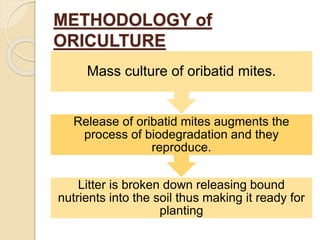
METHODOLOGY of
ORICULTURE
Litter is broken down releasing bound
nutrients into the soil thus making it ready for
planting
Release of oribatid mites augments the
process of biodegradation and they
reproduce.
Mass culture of oribatid mites.
IMPORTANT
A very important thing to be taken care
of is to maintain the soil and litter in
moist condition as oribatid mites are
unable to break down dry litter . As the
litter disappears due to biodegradation
by oribatid mites more litter is added to
maintain the oribatid population so that
repeated release of mites can be
avoided.
MASS CULTURE of ORIBATID
MITES
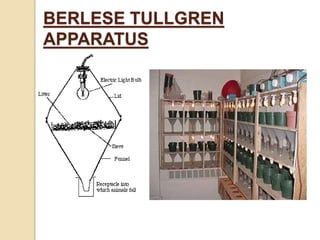
 Soil samples containing litter are
extracted in Berlese and Tullgren
funnel for 72 hrs
 Emerging animals are collected in
collection vials containing powedered
and moistened leaf / wood litter.
 After 24 hrs animals are transferred in
culture vials containing plaster of paris
and charcoal in 4:1 ratio with soaked
wood or leaf.
 10 – 12 live mites are transferred and
they multiply
 These are transferred in earthen pots
containing litter to feed and are
allowed to stand for 2 months
 This can be distributed to farmers to
initiate oriculture
BERLESE TULLGREN
APPARATUS
ADVANTAGES OF
ORICULTURE
 Oribatid mites, which form an
important link in the detritus food chain
act as excellent bio degraders of
plant and other organic litter in soil.
 This is highly beneficial to farmers as
they can utilize oribatid mites to
convert any sort of plant litter into
nutrient rich biofertilizer .
 This minimises the cost of chemical
fertilizers with requires high financial
input there by reducing the cost of
agricultural producton.
 Oriculture does not require any high
tech machinery or expertise hence
can be practiced by ordinary farmers
Advantages (cont.)
 Since different species of oribatid
mites occur in sufficient numbers in all
naturally occurring soil and litter
components , farmers anywhere in the
world can adopt oriculture.
 Oribatid mites undertake vertical and
horizontal migration within the soil
depending on temperature and
moisture conditions , which increase in
soil porosity and aeration.
Advantages (cont.)
 Ecologically speaking , oriculture is a
hundred percent safe method .
Environmental pollution induced by
application of chemical fertilizer cn be
completely avoided if one opts for
oriculture.
Advantages (cont.)
 Oriculture has an amazing prospects
in generating jobs for enterprising
youth .knowledge and availability of
experts in the field may be used to set
up “ORIBATID MITES BREEDING
CENTRES”.Cultured mites can given
to interested youth in collecting ,
identifying and mass culturing of
selected orbatid mites. This will earn a
decent income for the unemployed
youth of our country.
The research work was conducted in
Thrissur district during the period of
2013-2015 and the methodology
adopted are furnished below.
The study involved two experiments
1.1 Standardization of methodology
for oriculture
1.2 Assessing the manurial value of
decomposed litter
ORICULTURE in PRACTICE
1.1.1 COLLECTION of LEAF SAMPLES
Litter samples were collected from
different tree growing areas of Cashew,
Rubber, Jack, Cocoa, Teak and mixed
trees of forest plantation of Thrissur
District. From each area samples were
collected from three locations at the rate
of three samples per location and
covering an area of (30×30)meter
square.
1.1 Standarization of
methodology for oriculture
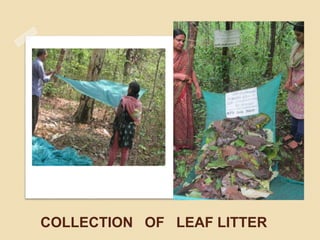
COLLECTION OF LEAF LITTER
 Among these, teak litter was collected
from Palappilly teak plantation, mixed
forest tree litter from Peechi dam area,
and the other litters were from the
College of Horticulture campus.
 The litter trap technique was used for
the collection of leaf litter by speading
a nylon net of area (3m×3m)2 under
the trees in order to collect the fallen
leaves (plate1). It helped to avoid the
interference of other microorganisms
that could be acted upon the litter, if
fallen on the ground
1.1.2 BIOCHEMICAL ANALYSIS of
LITTER SAMPLES
plant litter containing cellulose,
hemicellulose , tannin ,lignin , are
subjected to various tests like Acid
detergent fibre method , neutral
detergent fibre method follin dennis
method ,acid detergent fibre method
respectively.
1.1.3 DETERMINATION of SOIL
MOISTURE and TEMPERATURE.
soil moisture and soil temperature were
recorded twice a day by using a soil
thermometer and soil moisture meter.
1.1.4 IDENTIFICTION OF MITES in
LEAF LITTER
Extraction of mitefrom leaf litter was
done separately by Berlese – tulgren
extractor.
1.1.5 CULTURING and MASS
MULTIPLICATION of ORIBATID MITES
Extracted mites were collected in vials
containing powdered leaf and
moistened leaf litter .
1.2 Assessing manurial value of
decomposed litter
It was reported that the biotic
enrichment was found to be the best
one which registered the highest value
in the release of all nutrients.
CONCLUSION
 “Oriculture” can thus be treated as the
modern method of agriculture with
minimum cost of production and
maximum yield in a most suitable
ecofriendly atmosphere . It acquires
significance as a new technological
approach ,accelerating agricultural
output through effective utilization of
natural resources which can be
practiced in any natural ecosystem .
REFERENCE
• Trends in organic farming
THANK YOU!

Oriculture

  • 1.
  • 2.
    WHAT is ORICULTURE? Oriculture involves the use of macrophytophagous oribatid mites to bring about biodegradation of plant litter , converting the same into nutrient rich humus which can be utilized as a bio-fertilizer.
  • 3.
    HOW ORICULTURE DIFFERS fromOTHER FARMING SYSTEMS…..  Heavy usage of artificial fertilizers lead to rapid multiplication of herbivorous and pest outbreak.
  • 5.
    SYSTEMIC POSITION Mites alongwith ticks come under the largest invertebrate phylum Arthropoda . Like spiders and scorpions they possess four pairs of legs , simple or no eyes ,tracheate respiration and hence grouped under the
  • 7.
    FEEDING HABITS ofORIBATID MITES ORIBATID MITES FAMILY TYPE of PLANT LITTER MACROPHYTOPHAGE Wood, leaves and roots MICROPHATOPHAGE Algae ,fungi ,lichens and bacteria PANPHYTOPHAGE Wood ,leaves, roots , algae, fungi, lichens and bacteria
  • 8.
    MACROPHAGOUS ORIBATID MITES SUPER FAMILIES- 1.Phthiracaroideaprefer woody 2.Nothroidea elements Hence these mites are known as “xylophages” These mites live in burrows and tunnels made into dead and decaying tissues of higher plants on which they feed leading to final breakdown of wood by these mites.
  • 9.
    Longhorn beetle (Rhagiumbifasciatum) in dead pine. XYLOPHAGOUS INSECT (source- treesforlife.org)
  • 10.
    3.Lahmannoidea prefer leafy element hencethese mites are known as “phyllophages” Hence these mites feed on mesophyll tissue and harder veins and midrib of leaves leading to complete skeletonization and complete break down of leaves.
  • 11.
    heaps of faecalpellets produced by the Lohmanniid mites after feeding on
  • 12.
  • 13.
  • 14.
  • 15.
     3.Oribatuloidea It hostsvarious tapeworm species by increasing the breakdown of organic matter as earthworm .
  • 16.
     4.Galumnoidea  Theyassist the process of biodegradation indirectly by catalysing microbial activity within the soil ecosystem
  • 17.
    PANPHYTOPAGOUS ORIBATID MITES SUPER FAMILIES- 1.Epilohmannoidea 2.Nothroidea 3.Eremuloidea 4.Galumnoidea Theremites play a dual role by feeding on both higher and lower plant depending on adaptability , thus forming Panphytophagous category
  • 18.
    As a resultof feeding , all these different categories of mites release large amount of faecal pellets into the surrounding soil . This readily mixes with the soil adding to the nutrient pool . Soil enriched with faecal pellets provides a highly fertile environment enhancing germination of seeds and healthy growth of roots
  • 19.
    FACTORS INFLUENCING ORIBATID MITESDISTRIBUTION Oribatid mites are ubiquitous but flourish well in micro climates dou to biotic and abiotic influences ABIOTIC FACTORS- 1.Temperature 2.Moisture 3.Soil depth
  • 20.
    BIOTIC FACTOR- The primarybiotic factor affecting is the oribatid mites is food availability .
  • 21.
    ABIOTIC FACTORS- 1.Temperature- Temperature directlyaffects physiological processes like respiration, ingestion, growth and survival of mites. Oribatid mites could survive in temperatures up to forty-five degree Celsius
  • 22.
    2.Moisture- Different species anddifferent life stages within a species have variable tolerance to moisture . A direct effect of moisture is its transpiration. It is likely to be found in upper layers of soil or the soil that is more tolerant to dessication.
  • 23.
    3.Soil depth- Influences thetemperature, moisture, organic matter quality and pore space. Small sizes mites are more likely to predominate deeper into the soils. Sandy soils containing humus are ideal for orbatid mites. These well ventilated soils may make deep vertical migration of mites more likely.
  • 24.
    SPECIFIC MITES on PARTICULARPLANT LITTER Success of oriculture lies in the right choice of oribatid mite species based on particular plant litter. Lohmannid mites- leaf litter
  • 26.
    Vermiculture Vs. Oriculture Earthworms are sensitive to moisture and temp. condition.  Very Sensitive to dry conditions.  Hardly change their food habits.  Population explosion is quite slower due to slight longer reproductive cycle  Oribatid mites are highly active and escape extreme conditions.  Tolerant to dry conditions.  They can readily change their food habits. (Haq & Konikkara,1988)  The oribatid population increases at a fast level within a short period. (Huxton,1972)
  • 27.
    METHODOLOGY of ORICULTURE Litter isbroken down releasing bound nutrients into the soil thus making it ready for planting Release of oribatid mites augments the process of biodegradation and they reproduce. Mass culture of oribatid mites.
  • 28.
    IMPORTANT A very importantthing to be taken care of is to maintain the soil and litter in moist condition as oribatid mites are unable to break down dry litter . As the litter disappears due to biodegradation by oribatid mites more litter is added to maintain the oribatid population so that repeated release of mites can be avoided.
  • 29.
    MASS CULTURE ofORIBATID MITES  Soil samples containing litter are extracted in Berlese and Tullgren funnel for 72 hrs  Emerging animals are collected in collection vials containing powedered and moistened leaf / wood litter.  After 24 hrs animals are transferred in culture vials containing plaster of paris and charcoal in 4:1 ratio with soaked wood or leaf.
  • 30.
     10 –12 live mites are transferred and they multiply  These are transferred in earthen pots containing litter to feed and are allowed to stand for 2 months  This can be distributed to farmers to initiate oriculture
  • 31.
  • 32.
    ADVANTAGES OF ORICULTURE  Oribatidmites, which form an important link in the detritus food chain act as excellent bio degraders of plant and other organic litter in soil.  This is highly beneficial to farmers as they can utilize oribatid mites to convert any sort of plant litter into nutrient rich biofertilizer .
  • 33.
     This minimisesthe cost of chemical fertilizers with requires high financial input there by reducing the cost of agricultural producton.  Oriculture does not require any high tech machinery or expertise hence can be practiced by ordinary farmers
  • 34.
    Advantages (cont.)  Sincedifferent species of oribatid mites occur in sufficient numbers in all naturally occurring soil and litter components , farmers anywhere in the world can adopt oriculture.  Oribatid mites undertake vertical and horizontal migration within the soil depending on temperature and moisture conditions , which increase in soil porosity and aeration.
  • 35.
    Advantages (cont.)  Ecologicallyspeaking , oriculture is a hundred percent safe method . Environmental pollution induced by application of chemical fertilizer cn be completely avoided if one opts for oriculture.
  • 36.
    Advantages (cont.)  Oriculturehas an amazing prospects in generating jobs for enterprising youth .knowledge and availability of experts in the field may be used to set up “ORIBATID MITES BREEDING CENTRES”.Cultured mites can given to interested youth in collecting , identifying and mass culturing of selected orbatid mites. This will earn a decent income for the unemployed youth of our country.
  • 37.
    The research workwas conducted in Thrissur district during the period of 2013-2015 and the methodology adopted are furnished below. The study involved two experiments 1.1 Standardization of methodology for oriculture 1.2 Assessing the manurial value of decomposed litter ORICULTURE in PRACTICE
  • 38.
    1.1.1 COLLECTION ofLEAF SAMPLES Litter samples were collected from different tree growing areas of Cashew, Rubber, Jack, Cocoa, Teak and mixed trees of forest plantation of Thrissur District. From each area samples were collected from three locations at the rate of three samples per location and covering an area of (30×30)meter square. 1.1 Standarization of methodology for oriculture
  • 39.
  • 40.
     Among these,teak litter was collected from Palappilly teak plantation, mixed forest tree litter from Peechi dam area, and the other litters were from the College of Horticulture campus.  The litter trap technique was used for the collection of leaf litter by speading a nylon net of area (3m×3m)2 under the trees in order to collect the fallen leaves (plate1). It helped to avoid the interference of other microorganisms that could be acted upon the litter, if fallen on the ground
  • 41.
    1.1.2 BIOCHEMICAL ANALYSISof LITTER SAMPLES plant litter containing cellulose, hemicellulose , tannin ,lignin , are subjected to various tests like Acid detergent fibre method , neutral detergent fibre method follin dennis method ,acid detergent fibre method respectively.
  • 42.
    1.1.3 DETERMINATION ofSOIL MOISTURE and TEMPERATURE. soil moisture and soil temperature were recorded twice a day by using a soil thermometer and soil moisture meter.
  • 43.
    1.1.4 IDENTIFICTION OFMITES in LEAF LITTER Extraction of mitefrom leaf litter was done separately by Berlese – tulgren extractor. 1.1.5 CULTURING and MASS MULTIPLICATION of ORIBATID MITES Extracted mites were collected in vials containing powdered leaf and moistened leaf litter .
  • 44.
    1.2 Assessing manurialvalue of decomposed litter It was reported that the biotic enrichment was found to be the best one which registered the highest value in the release of all nutrients.
  • 45.
    CONCLUSION  “Oriculture” canthus be treated as the modern method of agriculture with minimum cost of production and maximum yield in a most suitable ecofriendly atmosphere . It acquires significance as a new technological approach ,accelerating agricultural output through effective utilization of natural resources which can be practiced in any natural ecosystem .
  • 46.
    REFERENCE • Trends inorganic farming
  • 47.