

 Presented by:

garima jain
somya
bhavani
Introduction
When a new employee joins an organization, he is
completely a stranger to the people, work place and the
work environment.
Orientation can help overcome these problem.
According to michael armstrong : “The process of
receiving and welcoming an employee when he first
joins a company and giving him the basic information
he need to settle down quickly and happily and start
work” .
Objective of induction
 To help the newcomer overcome his natural shyness

and nervousness in meeting new people in a new
environment .
 To develop among the newcomers a sense of belonging
and loyalty to the organization.
 To build up the confidence.
 To faster a close relation between newcomer and old
employee and their supervisors.
Employee Orientation
 Employee orientation is part of a long-term

investment in a new employee. It is an initial process
that provides easy access to basic information,
programs and services, gives clarification and allows
new employees to take an active role in their
organization.
 Introduce new employees to their new environment
 Make new employees feel welcome and comfortable
 Retain a pool of new, capable employees
Benefits
 Establish clear standards that help reduce disputes






and limit liability.
Promote consistent management .
Inform new employees of the company’s policies .
Demonstrate a commitment to equal treatment of
personnel .
Provide protection from claims of discrimination and
sexual harassment .
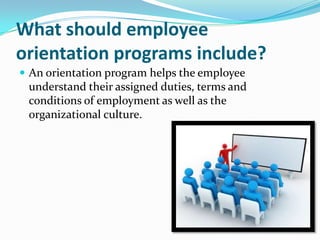
What should employee
orientation programs include?
 An orientation program helps the employee

understand their assigned duties, terms and
conditions of employment as well as the
organizational culture.
Welcome employee to company
 Orientation to business:
 history
 mission statement
 goals and objectives

 organizational structure, e.g. own job description and

relationship of position to other positions
 future plans
Cont.. policies and procedures, for example:
Company
 dress code
 reporting procedures
 smoking restrictions
 expense claims

Legislation
 Safety procedures
 Emergency procedures
 operating telephone system,
 who to call for repairs
Cont..
Explanation of benefit package
 group insurance,
 sick leave,
 holidays
Tour facility and work areas:
 introduce employees
 identify amenities, e.g. washrooms, shower
 explain emergency procedures
 identify safety equipment
Cont..
 Describe job responsibilities and performance

expectations


review job description
 review product standards
 discuss applicable legislation
 provide manuals for operating equipment


Finalize employment documentation
Case study
New Manager Orientation and Assessment for Software Company
Challenge
A North American social networking software company had experienced
significant company growth over a one-year period. To manage their
expanded customer base and increased call volumes, the client enlarged
their workforce by 100%. Although a comprehensive two-week training
program was provided to new front-line employees, no formal corporate
orientation was available to new managers and executives. Orientation
provided was inconsistent between departments and in some instances
non-existent. Over the subsequent two years, the client was challenged
with a management turnover rate of over 50% per year.
Solution
Management employee survey results and feedback from exit interviews
initially identified that a corporate orientation program would greatly
benefit new management employees. To initiate such a program,
Limestone Learning’s managing partners conducted a comprehensive
content analysis and interviews with new management employees to
identify requirements. Focus sessions with all levels of management were
also held to introduce the program objectives, timeline and new-hire
training requirements, gather suggestions for program topics and
increase buy-in to the program. Company executives were included in
each feedback session to show support for the program.
 skills and knowledge questionnaire was developed and sent







to managers prior to attending training to provide the
program included face-to-face training courses, CEO
welcome video, hands-on workshops, company tour and
Assessment developed for the orientation program
included a corporate orientation board game, training
games,
quizzes, group discussions, skill practices and case studies.
Post-program evaluation included on-the-job
observation of the new employees by their managers in
combination with skill questionnaires sent one month and
three months after training was completed to assess the
level of skill transfer and applied learning to the job.
Results
 The Corporate Orientation program was extremely






successful. The program generated a lot of excitement and
support from all levels of management. Feedback from new
managers was extremely positive. They felt valued by
the organization and believed the orientation program
provided them with a solid foundation to succeed on the
on the job, realized a greater degree of employee
satisfaction and experienced a significant decrease in
management turnover and associated costs.
Video
Thank you

Oriantation training program

  • 1.
     Presented by: garimajain somya bhavani
  • 2.
    Introduction When a newemployee joins an organization, he is completely a stranger to the people, work place and the work environment. Orientation can help overcome these problem. According to michael armstrong : “The process of receiving and welcoming an employee when he first joins a company and giving him the basic information he need to settle down quickly and happily and start work” .
  • 3.
    Objective of induction To help the newcomer overcome his natural shyness and nervousness in meeting new people in a new environment .  To develop among the newcomers a sense of belonging and loyalty to the organization.  To build up the confidence.  To faster a close relation between newcomer and old employee and their supervisors.
  • 4.
    Employee Orientation  Employeeorientation is part of a long-term investment in a new employee. It is an initial process that provides easy access to basic information, programs and services, gives clarification and allows new employees to take an active role in their organization.  Introduce new employees to their new environment  Make new employees feel welcome and comfortable  Retain a pool of new, capable employees
  • 5.
    Benefits  Establish clearstandards that help reduce disputes     and limit liability. Promote consistent management . Inform new employees of the company’s policies . Demonstrate a commitment to equal treatment of personnel . Provide protection from claims of discrimination and sexual harassment .
  • 6.
    What should employee orientationprograms include?  An orientation program helps the employee understand their assigned duties, terms and conditions of employment as well as the organizational culture.
  • 7.
    Welcome employee tocompany  Orientation to business:  history  mission statement  goals and objectives  organizational structure, e.g. own job description and relationship of position to other positions  future plans
  • 8.
    Cont.. policies andprocedures, for example: Company  dress code  reporting procedures  smoking restrictions  expense claims Legislation  Safety procedures  Emergency procedures  operating telephone system,  who to call for repairs
  • 9.
    Cont.. Explanation of benefitpackage  group insurance,  sick leave,  holidays Tour facility and work areas:  introduce employees  identify amenities, e.g. washrooms, shower  explain emergency procedures  identify safety equipment
  • 10.
    Cont..  Describe jobresponsibilities and performance expectations  review job description  review product standards  discuss applicable legislation  provide manuals for operating equipment  Finalize employment documentation
  • 11.
    Case study New ManagerOrientation and Assessment for Software Company Challenge A North American social networking software company had experienced significant company growth over a one-year period. To manage their expanded customer base and increased call volumes, the client enlarged their workforce by 100%. Although a comprehensive two-week training program was provided to new front-line employees, no formal corporate orientation was available to new managers and executives. Orientation provided was inconsistent between departments and in some instances non-existent. Over the subsequent two years, the client was challenged with a management turnover rate of over 50% per year.
  • 12.
    Solution Management employee surveyresults and feedback from exit interviews initially identified that a corporate orientation program would greatly benefit new management employees. To initiate such a program, Limestone Learning’s managing partners conducted a comprehensive content analysis and interviews with new management employees to identify requirements. Focus sessions with all levels of management were also held to introduce the program objectives, timeline and new-hire training requirements, gather suggestions for program topics and increase buy-in to the program. Company executives were included in each feedback session to show support for the program.
  • 13.
     skills andknowledge questionnaire was developed and sent      to managers prior to attending training to provide the program included face-to-face training courses, CEO welcome video, hands-on workshops, company tour and Assessment developed for the orientation program included a corporate orientation board game, training games, quizzes, group discussions, skill practices and case studies. Post-program evaluation included on-the-job observation of the new employees by their managers in combination with skill questionnaires sent one month and three months after training was completed to assess the level of skill transfer and applied learning to the job.
  • 14.
    Results  The CorporateOrientation program was extremely     successful. The program generated a lot of excitement and support from all levels of management. Feedback from new managers was extremely positive. They felt valued by the organization and believed the orientation program provided them with a solid foundation to succeed on the on the job, realized a greater degree of employee satisfaction and experienced a significant decrease in management turnover and associated costs.
  • 15.
  • 16.