RIFT VAIIEY UNIVERSITY: Harar Campus
Business management
Organizational Theory and design
chapter one
Introduction
.
What is an Organization?
•The term organization refers to the group of individuals
who come together to perform a set of tasks with the
intent to accomplish the common objectives.
•The organization is based on the concept of synergy,
which means, a group can do more work than an
individual working alone.
Organization is……
Social entities that are goal-directed
Designed as deliberately structured and
coordinated activity systems
Linked to the external environment
Includes large multinational corporations,
family owned businesses as well as nonprofits
Cont.……
•The key element of an organization is not a building or a
set of policies and procedures; organizations are made
up of people and their relationships with one another.
•An organization exists when people interact with one
another to perform essential functions that help attain
goals. An organization cannot exist without interacting with
customers, suppliers, competitors, and other elements of the
external environment.
Importance of Organizations
• Bring together resources to achieve desired
goals and outcomes
• Produce goods and services efficiently
• Facilitate innovation
• Use modern manufacturing and information
technologies
• Adapt to and influence a changing
environment
Organization theory in action.
•The Organizational Theory refers to the set of
interrelated concepts, definitions that explain the
behavior of individuals or groups or subgroups,
who interacts with each other to perform the
activities intended towards the accomplishment of
a common goal.
Cont...
•In other words, the organizational theory studies
the effect of social relationships between the
individuals within the organization along with
their actions on the organization as a whole.
•Also, it studies the effects of internal and external
business environment such as political, legal,
cultural, etc. on the organization.
•Thus, in order to study the relationships between the
individuals working together and their overall effect
on the performance of the organization is well
explained through the organizational theories.
Organization theory is not a collection of facts; it is a
way of thinking about organizations.
Organization theory is a way to see and analyze
organizations more accurately and deeply than one
otherwise could.
Organizational theories
Classical Theory
Scientific Management Theory
Administrative Theory
Bureaucratic Theory
Neo-Classical theory
Modern Theory
Classical Theory
•The Classical Theory is the traditional theory,
wherein more emphasis is on the organization rather
than the employees working therein.
•According to the classical theory, the organization is
considered as a machine and the human beings as
different components/parts of that machine.
Scientific Management Theory
•The Scientific Management Theory is well known
for its application of engineering science at the
production floor or the operating levels.
•The major contributor of this theory is Fredrick
Winslow Taylor, and that’s why the scientific
management is often called as “Taylorism”.
Administrative Theory
•The Administrative Theory is based on the
concept of departmentalization, which means the
different activities to be performed for achieving
the common purpose of the organization should
be identified and be classified into different
groups or departments, such that the task can be
accomplished effectively.
Adm.Mgt.Theory… Henri Fayol (1841-1925)
 Fayol developed fourteen management principles:-
1. Division of Work. Division of work, specialization, produces more and better work with the
same effort.
It focuses effort while maximizing employee efforts.
2. Authority and responsibility. Authority is the right to give orders and the power to exact obedience.
Authority creates responsibility.
3. Discipline:-
 Obedience and respect between a firm and its employees based on clear and fair agreements is
absolutely essential to the functioning of any organization.
4. Unity of command:-
 An employee should receive orders from only one superior(one boss). Employees cannot adapt to
dual command.
5. Unity of direction:-
 Organizational activities must have one central authority and one plan of action.
Cont
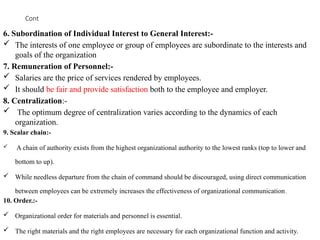
6. Subordination of Individual Interest to General Interest:-
 The interests of one employee or group of employees are subordinate to the interests and
goals of the organization
7. Remuneration of Personnel:-
 Salaries are the price of services rendered by employees.
 It should be fair and provide satisfaction both to the employee and employer.
8. Centralization:-
 The optimum degree of centralization varies according to the dynamics of each
organization.
9. Scalar chain:-
 A chain of authority exists from the highest organizational authority to the lowest ranks (top to lower and
bottom to up).
 While needless departure from the chain of command should be discouraged, using direct communication
between employees can be extremely increases the effectiveness of organizational communication.
10. Order.:-
 Organizational order for materials and personnel is essential.
 The right materials and the right employees are necessary for each organizational function and activity.
11. Equity:-
 In organizations equity is a combination of kindliness and justice.
 The desire for equity and equality of treatment are aspirations to be taken into account in
dealing with employees.
12. Stability of Tenure of Personnel.:-
 In order to attain the maximum productivity of personnel, it is essential to maintain a
stable work force.
13. Initiative:-
 Thinking out a plan and ensuring its success is an extremely strong motivator.
14. Esprit de Corps.:-
 Teamwork is fundamentally important to an organization.
 While subsequent organizational research has created controversy over many of Fayol’s
principles, they are still widely used in management theory.
Bureaucratic Theory
The bureaucratic theory is related to the structure and
administrative process of the organization and is given
by Max Weber, who is regarded as the father of
bureaucracy. What is Bureaucracy?.
The term bureaucracy means the rules and
regulations, processes, procedures, patterns, etc. that
are formulated to reduce the complexity of
organization’s functioning.
Neo-Classical theory
•The Neo-Classical Theory is the extended version
of the classical theory wherein the behavioral
sciences gets included into the management.
•According to this theory, the organization is the
social system, and its performance does get
affected by the human actions.
Modern Theory
•The Modern Theory is the integration of valuable
concepts of the classical models with the social
and behavioral sciences.
•This theory posits that an organization is a
system that changes with the change in its
environment, both internal and external.
Cont...
An organizational structure plays a vital
role in the success of any enterprise.
Thus, the organizational theories help in
identifying the suitable structure for an
organization, efficient enough to deal with
the specific problems.
Perspectives on organizations: open systems and
organizational configuration.
•Two important perspectives about organizations
are: Open systems Pays attention to the (open)
boundary between the organization and its context.
Developing a design that effectively manages the
exchanges across this boundary is in an open
systems perspective – considered to be key to
survival and prosperity.
Cont...
•Organizations are conceived as consumers of
resources (inputs) and exporters of resources
(outputs). In order to survive and prosper they
are motivated to adapt to, or try to control, a
changing environment. Subsystems have
specific functions for organizational survival,
such as: production, boundary across,
maintenance, adaption and management.
•Organizational configuration A framework by
Mintzberg suggest that every organization has 5
parts. These parts include:
1. Technical core(produce the product),
2. Top management(direction, strategy, goals and
policy),
3. Middle management(mediating between top
and technical core) ,
4. Technical support (engineers, researchers) and
5. Administrative support.
These 5 parts may vary in size and importance
depending on an organization’s particular
environment.
Dimensions of organization design: structural and
conceptual.
1. Structural; provide labels to recognize internal
characteristics of an organizations (formalization).
They provide a basis for comparing the structure of
organizations. (the environmental elements that
affect an organization the most are often other
organizations)
Structural dimensions
1.Formalization; refers to the dependence upon
written documentation in the organization
(procedures, job descriptions).
2.Specialization; the degree to which organization
tasks are subdivided into separate jobs. If
specialization is extensive narrow range of tasks.
Cont...
3.Hierarchy of authority; who reports to whom and the span of control
for each manager(vertical lines).High span of control. specialization is
high and hierarchy tends to be tall.
2. Contextual; characterize both the organization as a whole(size,
technology) and the broader organization setting.
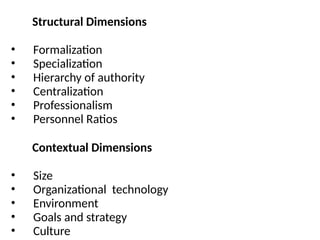
Structural Dimensions
• Formalization
• Specialization
• Hierarchy of authority
• Centralization
• Professionalism
• Personnel Ratios
Contextual Dimensions
• Size
• Organizational technology
• Environment
• Goals and strategy
• Culture
The end of chapter one

Organizational theory chapter 1. (1).pptx

  • 1.
    RIFT VAIIEY UNIVERSITY:Harar Campus Business management Organizational Theory and design chapter one Introduction .
  • 2.
    What is anOrganization? •The term organization refers to the group of individuals who come together to perform a set of tasks with the intent to accomplish the common objectives. •The organization is based on the concept of synergy, which means, a group can do more work than an individual working alone.
  • 3.
    Organization is…… Social entitiesthat are goal-directed Designed as deliberately structured and coordinated activity systems Linked to the external environment Includes large multinational corporations, family owned businesses as well as nonprofits
  • 4.
    Cont.…… •The key elementof an organization is not a building or a set of policies and procedures; organizations are made up of people and their relationships with one another. •An organization exists when people interact with one another to perform essential functions that help attain goals. An organization cannot exist without interacting with customers, suppliers, competitors, and other elements of the external environment.
  • 5.
    Importance of Organizations •Bring together resources to achieve desired goals and outcomes • Produce goods and services efficiently • Facilitate innovation • Use modern manufacturing and information technologies • Adapt to and influence a changing environment
  • 6.
    Organization theory inaction. •The Organizational Theory refers to the set of interrelated concepts, definitions that explain the behavior of individuals or groups or subgroups, who interacts with each other to perform the activities intended towards the accomplishment of a common goal.
  • 7.
    Cont... •In other words,the organizational theory studies the effect of social relationships between the individuals within the organization along with their actions on the organization as a whole. •Also, it studies the effects of internal and external business environment such as political, legal, cultural, etc. on the organization.
  • 8.
    •Thus, in orderto study the relationships between the individuals working together and their overall effect on the performance of the organization is well explained through the organizational theories. Organization theory is not a collection of facts; it is a way of thinking about organizations. Organization theory is a way to see and analyze organizations more accurately and deeply than one otherwise could.
  • 9.
    Organizational theories Classical Theory ScientificManagement Theory Administrative Theory Bureaucratic Theory Neo-Classical theory Modern Theory
  • 10.
    Classical Theory •The ClassicalTheory is the traditional theory, wherein more emphasis is on the organization rather than the employees working therein. •According to the classical theory, the organization is considered as a machine and the human beings as different components/parts of that machine.
  • 11.
    Scientific Management Theory •TheScientific Management Theory is well known for its application of engineering science at the production floor or the operating levels. •The major contributor of this theory is Fredrick Winslow Taylor, and that’s why the scientific management is often called as “Taylorism”.
  • 12.
    Administrative Theory •The AdministrativeTheory is based on the concept of departmentalization, which means the different activities to be performed for achieving the common purpose of the organization should be identified and be classified into different groups or departments, such that the task can be accomplished effectively.
  • 13.
    Adm.Mgt.Theory… Henri Fayol(1841-1925)  Fayol developed fourteen management principles:- 1. Division of Work. Division of work, specialization, produces more and better work with the same effort. It focuses effort while maximizing employee efforts. 2. Authority and responsibility. Authority is the right to give orders and the power to exact obedience. Authority creates responsibility. 3. Discipline:-  Obedience and respect between a firm and its employees based on clear and fair agreements is absolutely essential to the functioning of any organization. 4. Unity of command:-  An employee should receive orders from only one superior(one boss). Employees cannot adapt to dual command. 5. Unity of direction:-  Organizational activities must have one central authority and one plan of action.
  • 14.
    Cont 6. Subordination ofIndividual Interest to General Interest:-  The interests of one employee or group of employees are subordinate to the interests and goals of the organization 7. Remuneration of Personnel:-  Salaries are the price of services rendered by employees.  It should be fair and provide satisfaction both to the employee and employer. 8. Centralization:-  The optimum degree of centralization varies according to the dynamics of each organization. 9. Scalar chain:-  A chain of authority exists from the highest organizational authority to the lowest ranks (top to lower and bottom to up).  While needless departure from the chain of command should be discouraged, using direct communication between employees can be extremely increases the effectiveness of organizational communication. 10. Order.:-  Organizational order for materials and personnel is essential.  The right materials and the right employees are necessary for each organizational function and activity.
  • 15.
    11. Equity:-  Inorganizations equity is a combination of kindliness and justice.  The desire for equity and equality of treatment are aspirations to be taken into account in dealing with employees. 12. Stability of Tenure of Personnel.:-  In order to attain the maximum productivity of personnel, it is essential to maintain a stable work force. 13. Initiative:-  Thinking out a plan and ensuring its success is an extremely strong motivator. 14. Esprit de Corps.:-  Teamwork is fundamentally important to an organization.  While subsequent organizational research has created controversy over many of Fayol’s principles, they are still widely used in management theory.
  • 16.
    Bureaucratic Theory The bureaucratictheory is related to the structure and administrative process of the organization and is given by Max Weber, who is regarded as the father of bureaucracy. What is Bureaucracy?. The term bureaucracy means the rules and regulations, processes, procedures, patterns, etc. that are formulated to reduce the complexity of organization’s functioning.
  • 17.
    Neo-Classical theory •The Neo-ClassicalTheory is the extended version of the classical theory wherein the behavioral sciences gets included into the management. •According to this theory, the organization is the social system, and its performance does get affected by the human actions.
  • 18.
    Modern Theory •The ModernTheory is the integration of valuable concepts of the classical models with the social and behavioral sciences. •This theory posits that an organization is a system that changes with the change in its environment, both internal and external.
  • 19.
    Cont... An organizational structureplays a vital role in the success of any enterprise. Thus, the organizational theories help in identifying the suitable structure for an organization, efficient enough to deal with the specific problems.
  • 20.
    Perspectives on organizations:open systems and organizational configuration. •Two important perspectives about organizations are: Open systems Pays attention to the (open) boundary between the organization and its context. Developing a design that effectively manages the exchanges across this boundary is in an open systems perspective – considered to be key to survival and prosperity.
  • 21.
    Cont... •Organizations are conceivedas consumers of resources (inputs) and exporters of resources (outputs). In order to survive and prosper they are motivated to adapt to, or try to control, a changing environment. Subsystems have specific functions for organizational survival, such as: production, boundary across, maintenance, adaption and management.
  • 22.
    •Organizational configuration Aframework by Mintzberg suggest that every organization has 5 parts. These parts include: 1. Technical core(produce the product), 2. Top management(direction, strategy, goals and policy), 3. Middle management(mediating between top and technical core) , 4. Technical support (engineers, researchers) and 5. Administrative support. These 5 parts may vary in size and importance depending on an organization’s particular environment.
  • 23.
    Dimensions of organizationdesign: structural and conceptual. 1. Structural; provide labels to recognize internal characteristics of an organizations (formalization). They provide a basis for comparing the structure of organizations. (the environmental elements that affect an organization the most are often other organizations)
  • 24.
    Structural dimensions 1.Formalization; refersto the dependence upon written documentation in the organization (procedures, job descriptions). 2.Specialization; the degree to which organization tasks are subdivided into separate jobs. If specialization is extensive narrow range of tasks.
  • 25.
    Cont... 3.Hierarchy of authority;who reports to whom and the span of control for each manager(vertical lines).High span of control. specialization is high and hierarchy tends to be tall. 2. Contextual; characterize both the organization as a whole(size, technology) and the broader organization setting.
  • 26.
    Structural Dimensions • Formalization •Specialization • Hierarchy of authority • Centralization • Professionalism • Personnel Ratios Contextual Dimensions • Size • Organizational technology • Environment • Goals and strategy • Culture
  • 27.
    The end ofchapter one