ORGANISATION
It is an inescable part of our life.
Organizations are large, small, formal,
informal, religious, economic,
educational, social or political – affect us
enormously
An organization is made to run an
institution.
Nothing can be accomplished in a proper
way without organization.
The success of work rests upon the
quality of organization.
DEFINITION
Organization is a form of human
association for the attainment of common
purpose.
(According to J.B.MOOREY)
ORGANIZATIONAL BEHAVIOUR
Organizational behaviour is essential for
an organization to achieve effectiveness
in its activities
DEFINITIONS
1) Organizational behaviour is directly
concerned with the understanding,
prediction and control of human
behaviour.
-Fred Luthans
2) Organization behaviour is the study and
application of knowledge of how people
act or behave within an organization.
-Keith Davis and John Newstorm
CONCEPTS OF ORGANIZATIONAL
BEHAVIOUR
THEORIES OF ORGANIZATION
1) CLASSICAL DOCTRINE
Classical doctrine is the oldest theory in
the study of organizations.
• An institution organized under the
classical theory tends to treat wokers in
an objective way.
• Such an institution is very efficient in
accomplishing its goals.
I) FREDERICK TAYLOR
Taylor is considered as the father of
classical theory and the father of
scientific management.
 High production was his primary concern
in developing this theory.
 He believed that high production could be
achieved by paying high wages.
II) HENRI FAYOL
Fayol identified 14 principles of
management.
 His principles made it clear that
production, efficiency and profit were of
prime importance, while individuals or
worker were of comparatively less
importance.
His principles are as follows ;-
1) Division of work
- work is broken down into specialized
tasks.
2) Authority
- employers have the right to give
orders and expect them to be obeyed
3) Discipline
- the employee is expected to be
obedient to the institutions.
4) Unity Of Command
- an employee should receive orders
from only one superior.
5) Unity Of Direction
- there is only one person at the top of
the institution and he or she has only one
plan for the institution.
6) Subordination of individual interest
- institutional goal and activities always
come first.
7) Remuneration of personnel
- salary should be fair and satisfactory.
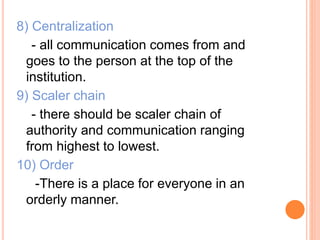
8) Centralization
- all communication comes from and
goes to the person at the top of the
institution.
9) Scaler chain
- there should be scaler chain of
authority and communication ranging
from highest to lowest.
10) Order
-There is a place for everyone in an
orderly manner.
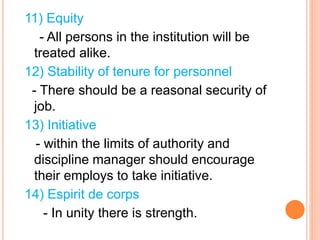
11) Equity
- All persons in the institution will be
treated alike.
12) Stability of tenure for personnel
- There should be a reasonal security of
job.
13) Initiative
- within the limits of authority and
discipline manager should encourage
their employs to take initiative.
14) Espirit de corps
- In unity there is strength.
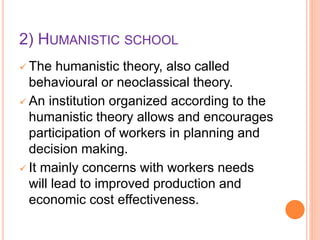
2) HUMANISTIC SCHOOL
 The humanistic theory, also called
behavioural or neoclassical theory.
 An institution organized according to the
humanistic theory allows and encourages
participation of workers in planning and
decision making.
 It mainly concerns with workers needs
will lead to improved production and
economic cost effectiveness.
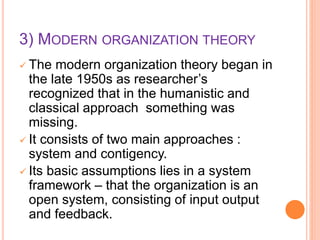
3) MODERN ORGANIZATION THEORY
 The modern organization theory began in
the late 1950s as researcher’s
recognized that in the humanistic and
classical approach something was
missing.
 It consists of two main approaches :
system and contigency.
 Its basic assumptions lies in a system
framework – that the organization is an
open system, consisting of input output
and feedback.

organisation.pptx

  • 2.
    ORGANISATION It is aninescable part of our life. Organizations are large, small, formal, informal, religious, economic, educational, social or political – affect us enormously An organization is made to run an institution. Nothing can be accomplished in a proper way without organization. The success of work rests upon the quality of organization.
  • 3.
    DEFINITION Organization is aform of human association for the attainment of common purpose. (According to J.B.MOOREY)
  • 4.
    ORGANIZATIONAL BEHAVIOUR Organizational behaviouris essential for an organization to achieve effectiveness in its activities
  • 5.
    DEFINITIONS 1) Organizational behaviouris directly concerned with the understanding, prediction and control of human behaviour. -Fred Luthans 2) Organization behaviour is the study and application of knowledge of how people act or behave within an organization. -Keith Davis and John Newstorm
  • 6.
  • 8.
  • 9.
    1) CLASSICAL DOCTRINE Classicaldoctrine is the oldest theory in the study of organizations. • An institution organized under the classical theory tends to treat wokers in an objective way. • Such an institution is very efficient in accomplishing its goals.
  • 10.
    I) FREDERICK TAYLOR Tayloris considered as the father of classical theory and the father of scientific management.  High production was his primary concern in developing this theory.  He believed that high production could be achieved by paying high wages.
  • 11.
    II) HENRI FAYOL Fayolidentified 14 principles of management.  His principles made it clear that production, efficiency and profit were of prime importance, while individuals or worker were of comparatively less importance.
  • 12.
    His principles areas follows ;- 1) Division of work - work is broken down into specialized tasks. 2) Authority - employers have the right to give orders and expect them to be obeyed
  • 13.
    3) Discipline - theemployee is expected to be obedient to the institutions. 4) Unity Of Command - an employee should receive orders from only one superior.
  • 14.
    5) Unity OfDirection - there is only one person at the top of the institution and he or she has only one plan for the institution. 6) Subordination of individual interest - institutional goal and activities always come first. 7) Remuneration of personnel - salary should be fair and satisfactory.
  • 15.
    8) Centralization - allcommunication comes from and goes to the person at the top of the institution. 9) Scaler chain - there should be scaler chain of authority and communication ranging from highest to lowest. 10) Order -There is a place for everyone in an orderly manner.
  • 16.
    11) Equity - Allpersons in the institution will be treated alike. 12) Stability of tenure for personnel - There should be a reasonal security of job. 13) Initiative - within the limits of authority and discipline manager should encourage their employs to take initiative. 14) Espirit de corps - In unity there is strength.
  • 17.
    2) HUMANISTIC SCHOOL The humanistic theory, also called behavioural or neoclassical theory.  An institution organized according to the humanistic theory allows and encourages participation of workers in planning and decision making.  It mainly concerns with workers needs will lead to improved production and economic cost effectiveness.
  • 18.
    3) MODERN ORGANIZATIONTHEORY  The modern organization theory began in the late 1950s as researcher’s recognized that in the humanistic and classical approach something was missing.  It consists of two main approaches : system and contigency.  Its basic assumptions lies in a system framework – that the organization is an open system, consisting of input output and feedback.