UNIT TWO
UNIT TWO
PEOPLES AND CULTURES IN
ETHIOPIAAND THE HORN
Introduction
2.1. Human Evolution
Human evolution had been formed
formed through
gradual natural process since about (circa/c.) 4. 5
billion years before present (B. P.)
The earliest life came into being between 3 and 1 billion
3 and 1 billion
years B. P
years B. P.
other small beings including the following emerged at c.
800 million years B. P.
Blue green algae
Blue green algae,
,
 small plants
small plants,
,
fishes, birds
fishes, birds
Primates branched of placental mammal stream as of 200-
170 million years B. P.
then some primates developed into Pongidae
Pongidae (such as
gorilla,
chimpanzee,
orangutan,
 gibbon etc)
while others evolved into Hominidae
Hominidae (human
ancestors)
Archeological evidences suggest that East African Rift
East African Rift
Valley
Valley is the cradle of humanity.
Evidences related to both biological and cultural evolution
have been discovered in the
 Lower Omo
Middle Awash River valleys
It discovered both by Ethiopian and foreign scholars.
A fossil named Chororapithecus dated 10 million B. P. was
unearthed in Anchar (in West Hararghe) in 2007.
 Ardipithicus ramidus kadabba (dated 5.8-5.2 million years
BP) was discovered in Middle Awash.
Ardipithicus ramidus (dated 4. 2 million B.P.) was
discovered at Aramis in Afar in 1994.
Ethiopia
Ethiopia in
in particular
particular and
and East Africa
East Africa in
in general
general have
have
been
been providing evidence
providing evidence on
on early Hominids
early Hominids
Other Australopithecines were uncovered at Belohdelie
(dated back 3.6 million years B. P.) in Middle Awash.
 A three years old child’s fossil named as
Australopithecus afarensis, Selam
Selam, dated to 3.3 million years
B.P was also discovered at Dikika, Mille, Afar in 2000.
another Australopithecus afarnesis (Lucy/Dinkinesh, dated
c. 3.18 million years B. P.
with 40%
40% complete body parts
complete body parts,
, weight 30kg
weight 30kg,
,
 height 1.07
height 1.07 meters
meters with a pelvis
pelvis looks like
bipedal female
bipedal female
It was discovered at Hadar in Afar in 1974 A. D
Australopithecus afarensis
Selam: Discovered By
Zeray_Alemseged
Australopithecus afarnesis
(Lucy/Dinkinesh Discovered
by Dr. Donald Johanson
Dr. Donald Johanson
Fossil named Australopithecus anamensis was discovered
around Lake Turkana.
An eco-fact named as Australopithecus garhi
 (means surprise in Afar language)
dated to 2.5 million years B.P was discovered at
Bouri, Middle Awash, between 1996 and 1999.
The development of the human brain was the main feature
of the next stage of human evolution
next stage of human evolution,
 which produced the genus Homo, believed to have
emerged 2-2.5 million years B.P.
Different evidences of the genus homo have been recovered
in different parts of Ethiopia and the Horn.
A partial skull of a fossil named as Homo
Homo habilis
habilis,
,
 which is derived from Latin terms "Homo" (human
being) and "Habilis" (skillful use of hands),
dated 1.9 million years B. P has been found in the
Lower Omo.
Lower Omo.
 A fossil named Homo erectus (walking upright, dated 1.
6 million years B. P.) was discovered
at Melka Kunture
Melka Kunture,
, Konso Gardula
Konso Gardula and Gadeb
with 900-1100 cc brain size.
Homo erectus seems to have originated in Africa
Africa
then spread out to the rest of the world
Skeleton of Archaic Homo sapiens
(knowledgeable human being, dated 400,000 years
B.P.)
named Bodo with brain size of 1300-1400cc was
discovered in Middle Awash
Fossils of Homo sapiens (100, 000 years B.P.) were
discovered at
Porc Epic near Dire Dawa, and Kibish around
Lower Omo (in 1967).
In 2004, Kibish fossils
Kibish fossils were re-dated to 195, 000 B. P
 the oldest date in the world for modern
modern
Homo
Homo sapiens.
sapiens.
Homo sapiens idaltu
Homo sapiens idaltu, found in Middle Awash in 1997, lived
Cultural evolution
Cultural evolution
Cultural evolution is related to technological changes that
brought socio-economic transformation on human life
It can be conventionally grouped in to
Stone Age, Bronze Age and Iron Age
Stone tools had been the first technologies to be developed
by human beings.
By taking their features, ways and period of production,
stone tools can be grouped in to
Mode I (Olduwan,
Mode I (Olduwan, which was named based on the
first report made at Olduvai Gorge,Tanzania),
Mode II (Acheulean,
Mode II (Acheulean, named after the first report at
St. Acheul, France)
Mode III (Sangoon)
Mode III (Sangoon)
Stone Age
Stone Age
The Mode I stone tools are mainly characterized by
crude and mono-facial styles,
This stone tools were produced by the direct percussion
Mode II stone tools were produced by
indirect percussion, by using hand-ax or hammer,
mainly characterized by bifacial, pointed and
convex features.
Mode III stone tools are characterized by
 flexible and fine form of production by the use
of obsidian
Oldowan stone tools
 unifacial tools
unifacial tools
simple pebble,
choppers
small stone
flakes
Acheulean stone tools
 tear drop-shaped bifacial flaked stone tools
sharp edges and a pointed end
Mode III stone tools
manufacture of a spear
Refined axes and choppers
, triangular drill
 doubled-edged knifes
Indirect percussion
Indirect percussion Pressure flaking
Pressure flaking
Examples of the above types of stone tools have been
found in Ethiopia and the Horn.
Fossilized animal bones (3. 4 million years B. P.) were
found with stone-tool-inflicted marks on them
(the oldest evidence of stone tool in the world) at Dikika
in 2010
artifact findings suggest that Olduwan tools made and
used by Homo
Homo habilis
habilis were discovered near Gona
(dated 2.52 million years B.P. in 1992) and at
Shungura in Afar
Homo erectus
erectus produced Acheulean tools dated back to
1.7.million years B.P,
invented fire and started burial practice.
Acheulian tools (over a million years old) were
found at Kella, Middle Awash in 1963.
Homo
Homo sapiens
sapiens produced Sangoon tools
Sangoon tools that trace back up
to 300,000 years B. P.
Gademotta site in central Ethiopian Rift Valley has
been dated back to 200, 000 B. P.
Other sites such as Gorgora, Ki’one and Yabello
in Ethiopia
Midhidhishi and Gudgud in Somalia have offered
notable information about Stone Age communities.
The period of usage of stone tools is divided into sub-
periods.
1. Paleolithic (Old Stone Age)
It was from 3.4 million to 11, 000 years B. P.
3.4 million to 11, 000 years B. P.) was
During this period human being
sheltered in caves,
developed language,
used
used stone , bone, wood, furs, and skin materials to
prepare food and clothing
food and clothing.
2. Mesolithic (Middle Stone Age )
It was from 11, 000-10,000 B. P.)
It was transition between Paleolithic and Neolithic (New
Stone Age
2.2. Neolithic Revolution
During the Neolithic period human beings transformed
from mobile to sedentary
mobile to sedentary way of life
life.
This was a radical shift involving changes from hunting
and gathering to the domestication of plants and animals
There were factors in the declining number of animals
declining number of animals and
availability of plants
availability of plants.
Climatic change
increased hunter-gatherers’ population
 food gatherers were already aware of growing cycle of
most grass types
most grass types,
So they began to grow
began to grow those,
The process of domestication took place independently in
the various parts of the world
various parts of the world.
In Ethiopia and the Horn chiefly in the more elevated and
wetter-parts, people cultivated plants including
Teff (Eragrotis Teff),
Teff (Eragrotis Teff),
Dagussa (Eleusine Coracana
Dagussa (Eleusine Coracana),
),
 Nug (Guzotia Abyssinica)
Nug (Guzotia Abyssinica)
Enset
Enset (
(Ensete Ventricosum
Ensete Ventricosum) etc
The domestication of enset plant
domestication of enset plant (Ensete edule) reduced
reduced
slowing down soil exhaustion
There are different evidence for the existence of Neolithic
material culture in Ethiopia and the horn .
 A case in a point evidence discovered from in sites like
Emba-Fakeda around Adigrat in Tigray
Aqordat and Barentu in Eritrea evinces
polished axes, ceramics,
 grinding stones, beads,
 stone figures and animal remains
The Gobodara rock shelter near Aksum
Aksum has
provided us agricultural stone tools.
from Lalibela Cave on the southeastern shore of
Lake Tana
 Remains domesticated cattle, chickpeas and
vegetables have been excavated.
From Laga Oda rock shelter near Charchar.
Stone tools used for cutting grass
rock paintings of domesticated animals were
discovered
Evidence for domesticated cattle also comes from
around Lake Basaqa near Matahara
Playa Napata and Kado in the Sudan,
Cyrenaica
Cyrenaica in Libya
Futajalon
Futajalon in West Africa were among known places
of domestication of animals
like Nidamawa and Zebu (
Nidamawa and Zebu (Bos indicus
Bos indicus)
cattle expanded to Ethiopia and the Horn
Gobedra rock shelter
2.3. The Peopling of the Region
2.3.1. Languages and Linguistic Processes
Ethiopia and the Horn marked by ethnic and linguistic
diversity.
There are about 90 languages with 200 dialect in
Ethiopia and the Horn
Beneath this apparent diversity, there is some degree of
unity
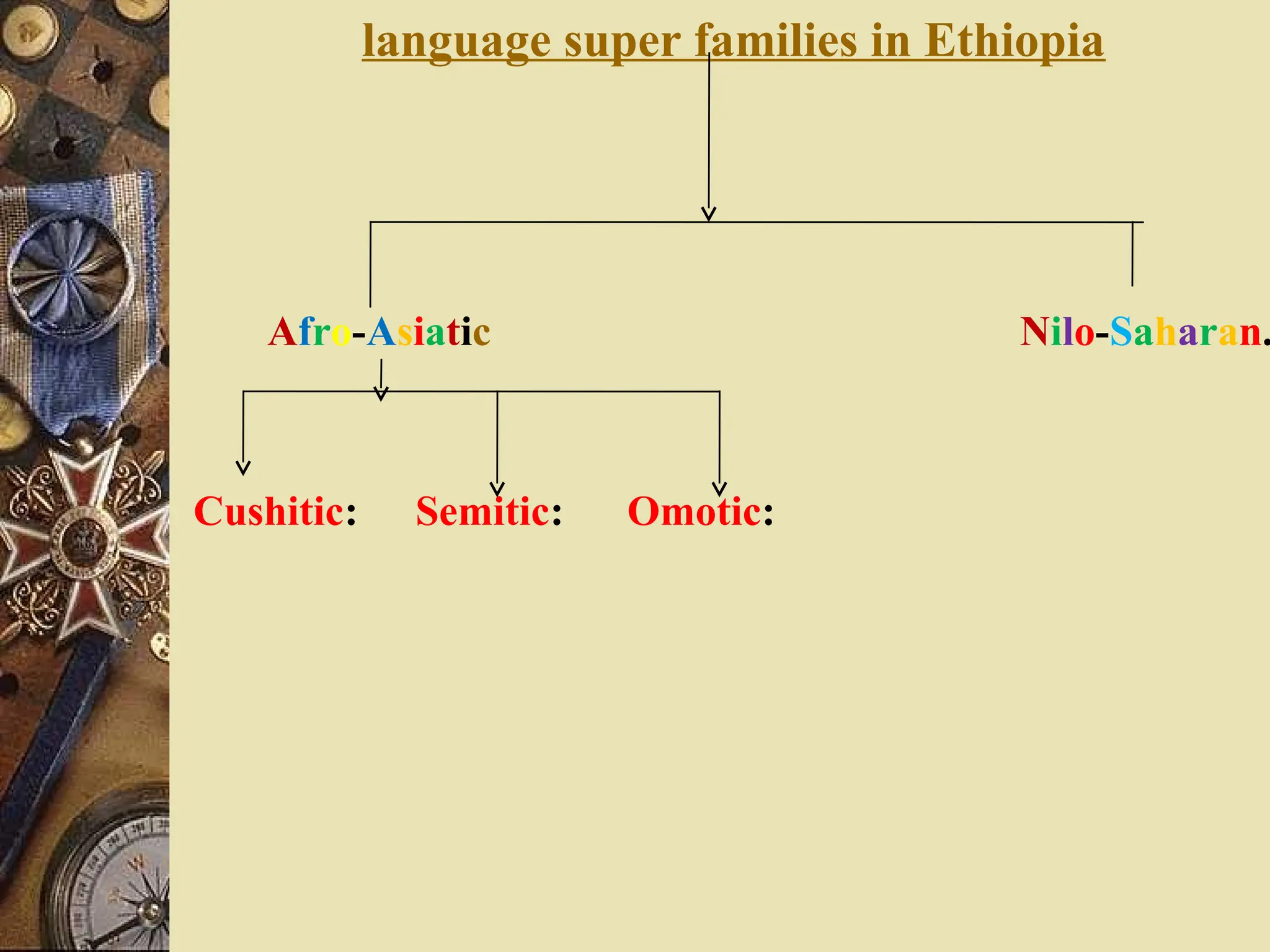
Linguists classify languages of Ethiopia and the Horn
into two
two major language super families.
1. Afro-Asiatic
2. Nilo-Saharan.
language super families in Ethiopia
Afro-Asiatic Nilo-Saharan.
Cushitic: Semitic: Omotic:
A. Afro-Asiatic
Afro-Asiatic:
1. Cushitic: linguists divided this language family into four
four
branches:
branches:
Northern
represented by Beja, spoken in northwestern Eritrea
bordering the Sudan.
Central:
Represent by Agaw includes Awign, Kunfel,
Qimant; Hamtanga and Bilen.
Eastern
this includes Afar, Ale, Arbore, Baiso, Burji,
Darashe, Dasanech, Gedeo, Hadiya, Halaba, Kambata,
Konso, Libido, Mosiye, Oromo, Saho, Sidama, Somali,
Tambaro, Tsemai, etc.
Southern:
 represented by Dhalo in Kenya and Nbugua in Tanzania
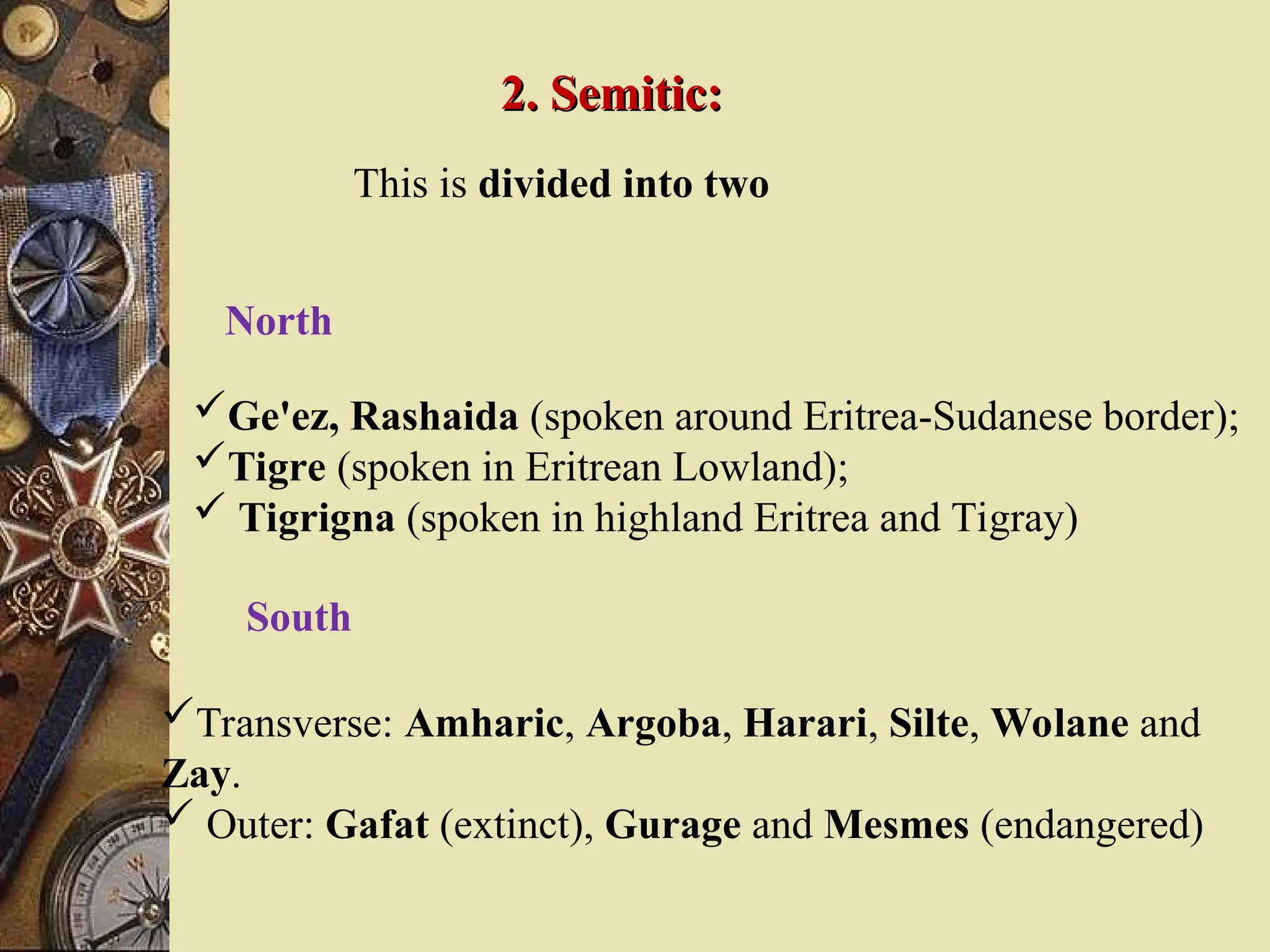
2. Semitic:
2. Semitic:
This is divided into two
North
Ge'ez, Rashaida (spoken around Eritrea-Sudanese border);
Tigre (spoken in Eritrean Lowland);
 Tigrigna (spoken in highland Eritrea and Tigray)
South
Transverse: Amharic, Argoba, Harari, Silte, Wolane and
Zay.
 Outer: Gafat (extinct), Gurage and Mesmes (endangered)
3. Omotic:
3. Omotic:
Anfillo, Ari, Banna, Basketo, Bench, Boro-Shinasha,
Chara, Dawuro, Dime, Dizi, Gamo, Gofa, Hamer, Karo,
Keficho, Konta, Korete, Male, Melo, Oyda, Sezo,
Shekkacho, Sheko, Wolayta, Yem, Zayse
B. Nilo-Saharan
B. Nilo-Saharan
Anywa, Berta, Gumuz, Kacipo-Balesi, Komo, Kunama,
Kwama, Kwegu, Majang, Mi'en, Murle, Mursi, Nara,
Nu’er, Nyangatom, Opo, Shabo, Suri and Uduk.
To sum up, Language classification did not remain static.
There are different factors resulted in intense linguistic
intense linguistic
processes
processes that forced languages to be affected.
Example, like population movements
population movements,
, warfare
warfare,
, trade
trade,
,
religious and territorial
territorial expansion
expansion, urbanization
urbanization etc
In this process, some languages died out or have been in
danger of extinction while others thrived over time
2.3.2. Settlement Patterns
A settlement pattern, the distribution of peoples across
the landscape, is
the results of long historical processes in
northeast Africa
northeast Africa
In some areas, settlement was dense and in other areas
sparse.
some people inhabited extensive highlands
highlands and others the
lowlands
lowlands
Based on historical linguistic and history of inter-peoples
relations, studies indicate that
environmental,
 socio-economic,
political processes
significantly shaped and reshaped the spatial
spatial
distribution
distribution of peoples in the region
peoples in the region
Since early times, the Cushitic and Semitic peoples had
inhabited the area between
the Red Sea in the east
Red Sea in the east and Blue Nile
Blue Nile in the west
from where they dispersed to different directions.
the Cushites have evolved to be the largest linguistic
group in Ethiopia and the Horn
have also spread over wide areas from Sudan to
Tanzania
Similarly, the Semitic peoples spread
Semitic peoples spread over large area
eventually settled the northern, north central,
north eastern, south central
eastern parts of Ethiopia and the Horn
The Semites are the second majority people next to
the Cushites.
The majority of Omotic peoples have inhabited
southwestern Ethiopia along the Omo River basin
Except the Shinasha
Except the Shinasha,
, who live in Benishangul-Gumuz
Benishangul-Gumuz
and the South Mao in Wallagga
South Mao in Wallagga
Yet, in the earlier times, they had extended much
further to the north
In the west, the Nilotes are largely settled along the
Ethiopia-Sudanese border
some of the Chari-Nile family
Chari-Nile family inhabited as far as
southern Omo
the latter are identified as the Karamojo cluster
Karamojo cluster
living
living around Turkana Lake
Turkana Lake along Ethio-Kenyan
Ethio-Kenyan
border.
border.
2.3.3. Economic Formations
The domestication of plants and animals gave humanity
two interdependent modes of life:
1.
1. Agriculture
Agriculture
2.
2. Pastoralism
Pastoralism
While there may be pure pastoralists, it is very rare to think
of a farmer without a head of cattle or two
Likewise, in Ethiopia and the Horn, these two forms of
livelihood have coexisted and quite often intermingled
Topographic features and climatic conditions largely
influenced economic activities in Ethiopia and the Horn.
A predominantly pastoral economy has characterized the
eastern lowland region since early periods.
Pastoral economy namely the production of camel, goat,
and cattle has been the most common economic practice
among the Afar, Saho and Somali as well as Karayu
and Borana Oromo.
While the Afar and Karrayu have depended on the
Awash River,
the Somali have owed a great deal to Wabi Shebelle
and Genale (Jubba) Rivers
The plateaus have sustained plough agriculture for
thousands of years supporting sizable populations.
Majority of the populations were engaged in mixed
farming
sedentary agriculture had been started and
advanced at least since 10, 000 years B. P. by
the Cushites, Semites and Omotic groups.
The major economic activity of the Omotic has been
mixed farming and trade in northern Omo
while southern Omo have predominantly practiced
pastoralism and fishing
Many of the Omotic groups have also been famous in
metallurgy, weaving and other crafts.
In the sparsely populated western lowland region, the
dominant economic formations were
pastoralism, shifting agriculture, fishing,
apiculture and hunting.
For instance,
sorghum, millet, cotton and other crops
have been largely cultivated in the lowlands
along Ethio Sudanese border since antiquity
The Nilotes
Nilotes along the Blue Nile and Baro-Akobo Rivers
have been shifting cultivators
where sorghum has been a staple food
Among majority Nilotic communities
Nilotic communities, cattle have high
economic and social values.
 Berta
Berta and other Nilotes
Nilotes had trade and other social
contacts with northern Sudan.
2.4. Religion and Religious Processes
2.4.1. Indigenous Religion
Indigenous Religion
Indigenous Religion includes a variety of religious beliefs
and practices,
which are native to the region
native to the region
followed by the local people
local people since ancient times
ancient times
distinctive mark of indigenous religion is belief in Supreme
Being,
but special powers are attributed to natural
phenomena, which are considered sacred
Spiritual functionaries officiate over rituals, propitiate
divinities,
are held in a lot of respect as intermediaries
between the society and spirits
Waqeffanna of the Oromo
It Based on the existence of one Supreme Being called Waqa.
Waqa's power is manifested through the spirits called Ayyana
The major spirits include
Abdar/Dache (soil fertility spirit),
Atete (women or human and animal fertility spirit),
Awayi/Tiyyana (sanctity spirit),
Balas (victory spirit),
Chato/Dora (wild animals defender),
Gijare/ Nabi (father and mother’s sprit),
Jaricha (peace spirit),
 Qasa (anti-disease spirit)
There is also a belief that the dead exist in the form of a
ghost called Ekera
In the surrounding of his/her abode after death, or
his/her cemetery (Hujuba)
There is thanks giving festival called Irrecha besides New
Year (Birbo) rite
Revered experts known as Qallu (male) and Qallitti
(female) have maintained link between
 the Ayyana and
Ayyana and the believers
the believers
Qallu's ritual house called galma is located on hilltop or in
the groves of large trees.
On Wednesday and Friday nights, there is Dalaga/ ecstasy
at which
Qallu or Qallitti
Qallu or Qallitti is possessed by Ayyana so that s/he
can interpret mysteries
Irrecha
festival
the Jila/ Makkala (delegated messengers) used to make
pilgrimage to get
consecration of senior Qallu (Abba Muda or
anointment father) until about 1900.
Abba Muda had turban surrirufa of tri-colors
tri-colors:
 Black at top,
 Red at center
white
white at bottom
representing those in
pre-active life,
active (Luba)
those in post-active life respectively.
Hadiya /Waa
Hadiya the Supreme Being is known as Waa
Waa
who is believed to exist before everything (hundam
issancho)
create world (qoccancho)
whose eyes are represented by elincho (sun) and agana
(moon).
Spirits like Jara (male’s protector), Idota (female’s
guard), Hausula, Qedane and Warriqa attracted prayers
sacrifices at Shonkolla and Kallalamo mountains
chosen by Anjancho and Jaramanjcho.
One of Hadiya's clans, Worqimene, is believed to have
the power to send rain in drought
Fandanano (sing.Fandancho) practice is believed to be
introduced by either spiritual leaders from
Itto and Albaja from Bimado clan,
 or Boyamo, father of five Hadiya clans,
largely followed by inhabitants of Boshana, Misha
other
other Indigenous religion
Indigenous religion
The Kambata have Negita or Aricho Magano/ Sky God
religious officials known as Magnancho
 The Gedeo called the Supreme Being, Mageno and had
thanks giving ceremony called Deraro.
The Konso religion is centered on worship of Waaq/Wakh.
The Gojjam Agaw used to call the Supreme Being Diban
(Sky God).
Among sections of the Gurage, there have been
Waq/Goita (Supreme Being),
Bozha (thunder deity)
Damwamwit (health goddess).
Yem worshipped Ha’o (Sky God)
So’ala clan was considered as the top in religious duties as
it was in charge of Shashokam
Shashokam (the most vital deity)
Religious functions were performed through
couriers in each village called Magos
the Konta’s spirit-cult was called Docho.
The Wolayta called God Tosa and spirit Ayyana
including
Tawa-Awa /Moytiliya
Tawa-Awa /Moytiliya (father’s spirit),
Sawuna
Sawuna (justice spirit),
Wombo
Wombo (rain spirit),
Micho
Micho (goat spirit),
 Nago
Nago (sheep spirit),
 Kuchuruwa
Kuchuruwa (emergency spirit),
Gomashera
Gomashera (war spirit),
 Talahiya
Talahiya (Beta Talaye or talheya, Omo spirit)
Annual worship of spirits
Annual worship of spirits was performed at a sacred place
called Mitta
 to offer sacrifice
sacrifice of the first fruits
first fruits called Teramo
or Pageta (Dubusha)
Dufuwa (grave
Dufuwa (grave)
) was believed to be abode of Moytiliya
People gathered around tree called Dongowa,
The Qesiga called their meeting place Kasha (Dabre).
the Wolayta also had the practice of Chaganna
(prohibited days to work) to protect produce from
disaster’
The Keficho called Supreme Being as Yero;
spirit as Eqo
a person who hosts Eqo is known as Alamo or eke-nayo.
Father of all spirits is dochi or dehe-tateno
Its host is called dochi-nayo or Ibedechino/Ibede-gudeno
(including Arito and Wudia Riti),
Harvest spirit is called Kollo and sacrifice to it is dejo
Earth and area spirits are known as Showe-kollo and
Dude-baro respectively.
There are also local spirits like
damochechi of Channa,
yaferochi of Sharada
wogidochi of Adio
as well as gepetato or king of hill identified by
Yetecho clan as landowner
Members of the Dugo clan led
led spiritual services.
Keficho
The Boro-Shinasha people believe in super natural power
called Iqa,
 Among various prayer rituals,
the first is Gure Shuka
 for preservation of their locality through
slaughtering animals by calling
the name of God being at the tip of the
mountains.
The second is Shode De’na,
praying and slaughtering when unexpected
disease happens.
The third is Marrowa Shuka; slaughtering for
children to
To grow without disease
to prevent children from evil spirits attack;
 for rehabilitation of wealth;
 to promote harmonious way of life and
productivities in the family
The Nuer
Nuer believe in Kuoth Nhial (God in Heaven),
but believe in the coming of God through rain,
lightning and thunder, and rainbow is necklace of God
There are also spirits associated with clan spears names
such as WiW (spirit of war
spirit of war) associated with thunder.
The Nuer believe that when a person dies,
flesh is committed to earth while breath or life
goes back to Kuoth
 soul that signifies human personality remains
alive as a shadow or a reflection,
 it departs together with ox sacrificed to place
of ghosts
An interesting feature of indigenous religion is the way
its practices and beliefs are fused
with Christianity and Islam.
This phenomenon of mixing of religions is
known as syncretism
syncretism.
2.4.2. Judaism
Judaism
Judaism is considered as the expression of the covenant that
Yahweh/Jehovah (God) established with the ancient
Hebrew community
Sources indicate that Judaism
Judaism has been followed in
Ethiopia and the Horn by peoples
before Christianity reached the region.
The Bete-Israel religious practices, which are generally
recognized as Israelite religion that differs from
Rabbinic Judaism
Universal Abrhamic religions
Advent of Judaism to Ethiopia
Many of the Bete-Israel accounts trace their religion
from
the very ancient migration of some portion of the
Tribe of Dan to Ethiopia, led it is said by sons of Moses
Other Bete-Israel take as their basis the account of return
of Menilek I to Ethiopia
 who is believed to be the son of King Solomon (r.
974-932 B.C.) of ancient Israel and Makeda, ancient
Queen of Saba (Sheba),
considered to be the first Solomonic Emperor of
Ethiopia
Another group of Jews is said to have been arrived in
Ethiopia led by Azonos and Phinhas in 6th
century A.D
There are also other stories that attribute the presence of
the Bete-Isreal in Ethiopia to
an intermarriage between Jewsh immigrants with
native Agaws
On the other hand, scholars such as Tadese Tamirat and
Kay Shelmay argue that
 the Bete-Israel are remnants of old testament
followers of orthodox Christianity
rather than Jews who migrated from abroad.
Whatever the case, the Jews appear to have been isolated
from mainstream Judiac practice for at least a millennium.
The Jews developed and lived for centuries in northern
and northwestern Ethiopia
2.4.3. Christianity
Christianity became state religion in 334 A.D. during the
reign of King Ezana
Who dropped pre-Christian gods like
 Ares (Hariman/Maharram/war god),
 Arwe (serpentpython god),
Bahir (sea god) and Midir (earth god)
Instrumental in conversion of the king were Syrian brothers
Aedesius
Aedesius and Frumentius
Frumentius (Fremnatos
Fremnatos).
When Fremnatos (Kasate Birhane or Abba Salama)
visited Alexandria, Patriarch Atnatewos
Alexandria, Patriarch Atnatewos (328-373)
appointed him as the first Bishop of Ethiopian
Orthodox Church (EOC).
Consecration of bishops from Coptic Church in
Egypt continued until 1959,
when Abune Baslios became the first
Ethiopian Patriarch
Christianity was further expanded to the mass of the
society the later part the fifth century,
during the reign of Ella Amida II
reign of Ella Amida II (478-86) by the
Nine Saints
The saints also translated
translated the Bible and other
religious books into Geez.
Abuna Aregawwi (Abba Za Mika’el) he comes from
Constantinopole established Debre Damo in Eastern Tigray
Abuna Isaq (Abba Gerima) he comes from Constantinopole
established Debre Gerima in Medera (East of Adwa )
Abba Pentelwon he comes from Constantinople established
Debre Pentelwon Asbo in (North East of Aksum)
Abba Afse he comes from Ladocia established Debre Afse
in Yeha (Northeast of Aksum)
Abba Alef he comes from Qa’esare’a established Debre
Haleluya Biheza in (Northeast of Aksum)
Abba Gubba , he comes from Cilicia established Debre
Gubba in West of Medera
Abba Liqanos he comes from Constantinople Debre Qonasel
North of Aksum
Abba Sehama he comes from Antioch established Tsedania
in Southeast of Adwa
Abba Yima’ata he comes from Qosa’iti established Debre
Yima’ata in Ger’alta
The expansion of Christianity continued in Zagwe period
(1150-1270) and chiefly gained
During the early Medieval Period (1270-1527), when
many churches and monasteries were constructed.
These include
Rock-hewn churches of
Rock-hewn churches of Lalibela
Lalibela,
Debra-Bizan of Hamasen in
Debra-Bizan of Hamasen in Eritrea
Eritrea;
;
Debra-Hayiq
Debra-Hayiq in Wollo
Wollo,
Debre-Dima
Debre-Dima and Debre-Werq in Gojjam
Gojjam;
Debra-Libanos
Debra-Libanos in Shewa
Shewa,
Birbir Mariam
Birbir Mariam in Gamo
Gamo
Debre-Asabot
Debre-Asabot on the way toHarar
Harar.
1.
1. Rock-hewn churches
Rock-hewn churches
of Lalibela
of Lalibela,
2.
2. Debra-Bizan of
Debra-Bizan of
Hamasen in Eritrea;
Hamasen in Eritrea;
3.
3. Debra-Hayiq
Debra-Hayiq
From mid-sixteenth to the early seventeenth centuries,
the Jesuit missionaries tried to convert
Monophysite EOC to Dyophysite Catholic.
Yet, this led to bloody conflicts that in turn led to
expulsion of the Jesuits
However, the Jesuits intervention triggered religious
controversies within the EOC
As of 1804, missionaries’ religious expansion also resulted
in the conclusion of treaties between
European diplomats
European diplomats and Ethiopian authorities
Ethiopian authorities
missionaries applied Systematic approach
applied Systematic approach of trained
trained
Protestants
Protestants enabled them to win confidence of local people.
The Catholic Giuseppe Sapeto (Lazarist mission
founder),
Giustino De Jacobis (Capuchin order founder),
 Cardinal Massaja, Antoine and Arnauld d'Abbadie
were active.
 Anglican Church Missionary Society (ACMS),
Church Missionary Society of London (CMSL)
Wesleyan Methodist Society led Protestant
missionaries under such leaders as
Samuel Gobat, C.W. Isenberg and J. L. Krapf.
They translated spiritual books into vernaculars.
They adopted old names for Supreme Being like
Waqayyo, Tosa etc and used them in new versions as
equivalent to God
Village schools were established as centers of preaching
the faith
These schools were open to all children of
chiefs and farmers.
 They also provided medical facilities.
All these attracted
attracted a large number of followers
followers
2.4.4. Islam
When Prophet Mohammed had preached Islam in Mecca
since 610 AD,
he faced opposition from the Quraysh rulers
Under this circumstance, the Prophet sent some of his
early followers to Aksum
including his daughter Rukiya and her husband
Uthman
Prophet's future wives Umm Habiba and Umm
Salma to Aksum .
The first group of refugees was led by Jafar Abu
Talib.
In his advice to his followers, the Prophet said of
Ethiopia,
"…a king under whom none are persecuted. It is a
land of righteousness, where God will give relief
from what you are suffering”.
The then Aksumite king, Armah Ella Seham (Ashama b.
Abjar or Ahmed al-Nejash in Arabic sources),
gave them asylum from 615-28
However, Leaders of the Quraysh asked Armah to
repatriate the refugees, but the king did not comply.
 Armah is said to have replied, "If you were to offer
me a mountain of gold I would not give up these
people who have taken refugees with me”
Subsequently, Islam spread to the Horn of Africa largely
through peaceful ways including trade
Islam was well established in Dahlak (Alalay) Islands on
the Red Sea by the beginning of the eighth century
Al Nejashi mosque
In the early tenth century, the Muslim community on the
islands developed a sultanate.
 In due course, Muslims settled other places on the Red Sea
coast.
 It was from these coastal areas
coastal areas that Islam gradually
spread predominantly in pastoral communities
largely through the agency of preachers and
merchants.
The Dahlak route played a minor role in the introduction
of Islam into the interior
interior
Due to Christianity
Due to Christianity was strongly entrenched as a state
religion in Aksum and later states of northern Ethiopia
As a result open proselytization of Islam was
prohibited
prohibited
Thus, the port of Zeila on western coast of the Gulf of
Aden served as an important gateway for
the introduction of Islam
introduction of Islam mainly into the present
present
day
day Shewa, Wollo
Shewa, Wollo and
and Hararghe
Hararghe.
.
 Islam firmly established itself in the coastal areas
by the eighth and ninth centuries
Islam expand to central, southern, and eastern Ethiopia
through the role of Muslim clerics
who followed in the footsteps of traders
In this regard, it should be noted that Sheikh Hussein of
Bale, a Muslim saint (Waliy) of medieval period,
played very important role in the expansion of Islam
into
Bale, Arsi and other southeastern parts of
Ethiopia and the Horn.
Another Islamic center in this region is Sof Umar cave
Bale Sheikh Hussein
Sof Umar cave
Served as mosque
by Muslim holy
man Sof Umar
Islam was introduced into Somali territories in the eight
century A. D.
through Benadir
Benadir coasts
coasts of Moqadishu, Brava and
Merca.
 Abu Bakr Ibn Fukura al Din Sahil
bu Bakr Ibn Fukura al Din Sahil set up Moqadishu
Minirate c.1269
The mosques, Islamic learning and pilgrimage centers
have been the depositories of
cultures, traditions and literature of local
Muslims.
History chapter Two for freshman students

  • 1.
    UNIT TWO UNIT TWO PEOPLESAND CULTURES IN PEOPLES AND CULTURES IN ETHIOPIAAND THE HORN ETHIOPIAAND THE HORN
  • 2.
    Introduction 2.1. Human Evolution 2.1.Human Evolution Human evolution had been formed formed through gradual natural process since about (circa/c.) 4. 5 billion years before present (B. P.) The earliest life came into being between 3 and 1 billion 3 and 1 billion years B. P years B. P. other small beings including the following emerged at c. 800 million years B. P. 800 million years B. P. Blue green algae Blue green algae, ,  small plants small plants, , fishes, birds fishes, birds
  • 3.
    Primates branched ofplacental mammal stream as of 200- 170 million years B. P. then some primates developed into Pongidae Pongidae (such as gorilla, chimpanzee, orangutan,  gibbon etc) while others evolved into Hominidae Hominidae (human ancestors)
  • 4.
    Archeological evidences suggestthat East African Rift East African Rift Valley Valley is the cradle of humanity. Evidences related to both biological and cultural evolution have been discovered in the  Lower Omo Middle Awash River valleys It discovered both by Ethiopian and foreign scholars.
  • 5.
    A fossil namedChororapithecus dated 10 million B. P. was unearthed in Anchar (in West Hararghe) in 2007.  Ardipithicus ramidus kadabba (dated 5.8-5.2 million years BP) was discovered in Middle Awash. Ardipithicus ramidus (dated 4. 2 million B.P.) was discovered at Aramis in Afar in 1994. Ethiopia Ethiopia in in particular particular and and East Africa East Africa in in general general have have been been providing evidence providing evidence on on early Hominids early Hominids
  • 7.
    Other Australopithecines wereuncovered at Belohdelie (dated back 3.6 million years B. P.) in Middle Awash.  A three years old child’s fossil named as Australopithecus afarensis, Selam Selam, dated to 3.3 million years B.P was also discovered at Dikika, Mille, Afar in 2000. another Australopithecus afarnesis (Lucy/Dinkinesh, dated c. 3.18 million years B. P. with 40% 40% complete body parts complete body parts, , weight 30kg weight 30kg, ,  height 1.07 height 1.07 meters meters with a pelvis pelvis looks like bipedal female bipedal female It was discovered at Hadar in Afar in 1974 A. D
  • 8.
    Australopithecus afarensis Selam: DiscoveredBy Zeray_Alemseged Australopithecus afarnesis (Lucy/Dinkinesh Discovered by Dr. Donald Johanson Dr. Donald Johanson
  • 9.
    Fossil named Australopithecusanamensis was discovered around Lake Turkana. An eco-fact named as Australopithecus garhi  (means surprise in Afar language) dated to 2.5 million years B.P was discovered at Bouri, Middle Awash, between 1996 and 1999. The development of the human brain was the main feature of the next stage of human evolution next stage of human evolution,  which produced the genus Homo, believed to have emerged 2-2.5 million years B.P.
  • 10.
    Different evidences ofthe genus homo have been recovered in different parts of Ethiopia and the Horn. A partial skull of a fossil named as Homo Homo habilis habilis, ,  which is derived from Latin terms "Homo" (human being) and "Habilis" (skillful use of hands), dated 1.9 million years B. P has been found in the Lower Omo. Lower Omo.  A fossil named Homo erectus (walking upright, dated 1. 6 million years B. P.) was discovered at Melka Kunture Melka Kunture, , Konso Gardula Konso Gardula and Gadeb with 900-1100 cc brain size.
  • 11.
    Homo erectus seemsto have originated in Africa Africa then spread out to the rest of the world Skeleton of Archaic Homo sapiens (knowledgeable human being, dated 400,000 years B.P.) named Bodo with brain size of 1300-1400cc was discovered in Middle Awash Fossils of Homo sapiens (100, 000 years B.P.) were discovered at Porc Epic near Dire Dawa, and Kibish around Lower Omo (in 1967). In 2004, Kibish fossils Kibish fossils were re-dated to 195, 000 B. P  the oldest date in the world for modern modern Homo Homo sapiens. sapiens. Homo sapiens idaltu Homo sapiens idaltu, found in Middle Awash in 1997, lived
  • 12.
    Cultural evolution Cultural evolution Culturalevolution is related to technological changes that brought socio-economic transformation on human life It can be conventionally grouped in to Stone Age, Bronze Age and Iron Age Stone tools had been the first technologies to be developed by human beings. By taking their features, ways and period of production, stone tools can be grouped in to Mode I (Olduwan, Mode I (Olduwan, which was named based on the first report made at Olduvai Gorge,Tanzania), Mode II (Acheulean, Mode II (Acheulean, named after the first report at St. Acheul, France) Mode III (Sangoon) Mode III (Sangoon) Stone Age Stone Age
  • 13.
    The Mode Istone tools are mainly characterized by crude and mono-facial styles, This stone tools were produced by the direct percussion Mode II stone tools were produced by indirect percussion, by using hand-ax or hammer, mainly characterized by bifacial, pointed and convex features. Mode III stone tools are characterized by  flexible and fine form of production by the use of obsidian
  • 14.
    Oldowan stone tools unifacial tools unifacial tools simple pebble, choppers small stone flakes
  • 15.
    Acheulean stone tools Acheuleanstone tools  tear drop-shaped bifacial flaked stone tools sharp edges and a pointed end
  • 16.
    Mode III stonetools Mode III stone tools manufacture of a spear Refined axes and choppers , triangular drill  doubled-edged knifes
  • 17.
    Indirect percussion Indirect percussionPressure flaking Pressure flaking
  • 18.
    Examples of theabove types of stone tools have been found in Ethiopia and the Horn. Fossilized animal bones (3. 4 million years B. P.) were found with stone-tool-inflicted marks on them (the oldest evidence of stone tool in the world) at Dikika in 2010 artifact findings suggest that Olduwan tools made and used by Homo Homo habilis habilis were discovered near Gona (dated 2.52 million years B.P. in 1992) and at Shungura in Afar Homo erectus erectus produced Acheulean tools dated back to 1.7.million years B.P, invented fire and started burial practice. Acheulian tools (over a million years old) were found at Kella, Middle Awash in 1963.
  • 19.
    Homo Homo sapiens sapiens producedSangoon tools Sangoon tools that trace back up to 300,000 years B. P. Gademotta site in central Ethiopian Rift Valley has been dated back to 200, 000 B. P. Other sites such as Gorgora, Ki’one and Yabello in Ethiopia Midhidhishi and Gudgud in Somalia have offered notable information about Stone Age communities.
  • 20.
    The period ofusage of stone tools is divided into sub- periods. 1. Paleolithic (Old Stone Age) It was from 3.4 million to 11, 000 years B. P. 3.4 million to 11, 000 years B. P.) was During this period human being sheltered in caves, developed language, used used stone , bone, wood, furs, and skin materials to prepare food and clothing food and clothing. 2. Mesolithic (Middle Stone Age ) It was from 11, 000-10,000 B. P.) It was transition between Paleolithic and Neolithic (New Stone Age
  • 21.
    2.2. Neolithic Revolution 2.2.Neolithic Revolution During the Neolithic period human beings transformed from mobile to sedentary mobile to sedentary way of life life. This was a radical shift involving changes from hunting and gathering to the domestication of plants and animals There were factors in the declining number of animals declining number of animals and availability of plants availability of plants. Climatic change increased hunter-gatherers’ population  food gatherers were already aware of growing cycle of most grass types most grass types, So they began to grow began to grow those,
  • 22.
    The process ofdomestication took place independently in the various parts of the world various parts of the world. In Ethiopia and the Horn chiefly in the more elevated and wetter-parts, people cultivated plants including Teff (Eragrotis Teff), Teff (Eragrotis Teff), Dagussa (Eleusine Coracana Dagussa (Eleusine Coracana), ),  Nug (Guzotia Abyssinica) Nug (Guzotia Abyssinica) Enset Enset ( (Ensete Ventricosum Ensete Ventricosum) etc The domestication of enset plant domestication of enset plant (Ensete edule) reduced reduced slowing down soil exhaustion
  • 23.
    There are differentevidence for the existence of Neolithic material culture in Ethiopia and the horn .  A case in a point evidence discovered from in sites like Emba-Fakeda around Adigrat in Tigray Aqordat and Barentu in Eritrea evinces polished axes, ceramics,  grinding stones, beads,  stone figures and animal remains The Gobodara rock shelter near Aksum Aksum has provided us agricultural stone tools. from Lalibela Cave on the southeastern shore of Lake Tana  Remains domesticated cattle, chickpeas and vegetables have been excavated. From Laga Oda rock shelter near Charchar. Stone tools used for cutting grass rock paintings of domesticated animals were discovered
  • 24.
    Evidence for domesticatedcattle also comes from around Lake Basaqa near Matahara Playa Napata and Kado in the Sudan, Cyrenaica Cyrenaica in Libya Futajalon Futajalon in West Africa were among known places of domestication of animals like Nidamawa and Zebu ( Nidamawa and Zebu (Bos indicus Bos indicus) cattle expanded to Ethiopia and the Horn
  • 25.
  • 26.
    2.3. The Peoplingof the Region 2.3.1. Languages and Linguistic Processes Ethiopia and the Horn marked by ethnic and linguistic diversity. There are about 90 languages with 200 dialect in Ethiopia and the Horn Beneath this apparent diversity, there is some degree of unity Linguists classify languages of Ethiopia and the Horn into two two major language super families. 1. Afro-Asiatic 2. Nilo-Saharan.
  • 27.
    language super familiesin Ethiopia Afro-Asiatic Nilo-Saharan. Cushitic: Semitic: Omotic:
  • 28.
    A. Afro-Asiatic Afro-Asiatic: 1. Cushitic:linguists divided this language family into four four branches: branches: Northern represented by Beja, spoken in northwestern Eritrea bordering the Sudan. Central: Represent by Agaw includes Awign, Kunfel, Qimant; Hamtanga and Bilen. Eastern this includes Afar, Ale, Arbore, Baiso, Burji, Darashe, Dasanech, Gedeo, Hadiya, Halaba, Kambata, Konso, Libido, Mosiye, Oromo, Saho, Sidama, Somali, Tambaro, Tsemai, etc. Southern:  represented by Dhalo in Kenya and Nbugua in Tanzania
  • 29.
    2. Semitic: 2. Semitic: Thisis divided into two North Ge'ez, Rashaida (spoken around Eritrea-Sudanese border); Tigre (spoken in Eritrean Lowland);  Tigrigna (spoken in highland Eritrea and Tigray) South Transverse: Amharic, Argoba, Harari, Silte, Wolane and Zay.  Outer: Gafat (extinct), Gurage and Mesmes (endangered)
  • 30.
    3. Omotic: 3. Omotic: Anfillo,Ari, Banna, Basketo, Bench, Boro-Shinasha, Chara, Dawuro, Dime, Dizi, Gamo, Gofa, Hamer, Karo, Keficho, Konta, Korete, Male, Melo, Oyda, Sezo, Shekkacho, Sheko, Wolayta, Yem, Zayse
  • 31.
    B. Nilo-Saharan B. Nilo-Saharan Anywa,Berta, Gumuz, Kacipo-Balesi, Komo, Kunama, Kwama, Kwegu, Majang, Mi'en, Murle, Mursi, Nara, Nu’er, Nyangatom, Opo, Shabo, Suri and Uduk. To sum up, Language classification did not remain static. There are different factors resulted in intense linguistic intense linguistic processes processes that forced languages to be affected. Example, like population movements population movements, , warfare warfare, , trade trade, , religious and territorial territorial expansion expansion, urbanization urbanization etc In this process, some languages died out or have been in danger of extinction while others thrived over time
  • 32.
    2.3.2. Settlement Patterns 2.3.2.Settlement Patterns A settlement pattern, the distribution of peoples across the landscape, is the results of long historical processes in northeast Africa northeast Africa In some areas, settlement was dense and in other areas sparse. some people inhabited extensive highlands highlands and others the lowlands lowlands Based on historical linguistic and history of inter-peoples relations, studies indicate that environmental,  socio-economic, political processes significantly shaped and reshaped the spatial spatial distribution distribution of peoples in the region peoples in the region
  • 33.
    Since early times,the Cushitic and Semitic peoples had inhabited the area between the Red Sea in the east Red Sea in the east and Blue Nile Blue Nile in the west from where they dispersed to different directions. the Cushites have evolved to be the largest linguistic group in Ethiopia and the Horn have also spread over wide areas from Sudan to Tanzania Similarly, the Semitic peoples spread Semitic peoples spread over large area eventually settled the northern, north central, north eastern, south central eastern parts of Ethiopia and the Horn The Semites are the second majority people next to the Cushites.
  • 34.
    The majority ofOmotic peoples have inhabited southwestern Ethiopia along the Omo River basin Except the Shinasha Except the Shinasha, , who live in Benishangul-Gumuz Benishangul-Gumuz and the South Mao in Wallagga South Mao in Wallagga Yet, in the earlier times, they had extended much further to the north In the west, the Nilotes are largely settled along the Ethiopia-Sudanese border some of the Chari-Nile family Chari-Nile family inhabited as far as southern Omo the latter are identified as the Karamojo cluster Karamojo cluster living living around Turkana Lake Turkana Lake along Ethio-Kenyan Ethio-Kenyan border. border.
  • 35.
    2.3.3. Economic Formations Thedomestication of plants and animals gave humanity two interdependent modes of life: 1. 1. Agriculture Agriculture 2. 2. Pastoralism Pastoralism While there may be pure pastoralists, it is very rare to think of a farmer without a head of cattle or two Likewise, in Ethiopia and the Horn, these two forms of livelihood have coexisted and quite often intermingled
  • 36.
    Topographic features andclimatic conditions largely influenced economic activities in Ethiopia and the Horn. A predominantly pastoral economy has characterized the eastern lowland region since early periods. Pastoral economy namely the production of camel, goat, and cattle has been the most common economic practice among the Afar, Saho and Somali as well as Karayu and Borana Oromo. While the Afar and Karrayu have depended on the Awash River, the Somali have owed a great deal to Wabi Shebelle and Genale (Jubba) Rivers
  • 37.
    The plateaus havesustained plough agriculture for thousands of years supporting sizable populations. Majority of the populations were engaged in mixed farming sedentary agriculture had been started and advanced at least since 10, 000 years B. P. by the Cushites, Semites and Omotic groups. The major economic activity of the Omotic has been mixed farming and trade in northern Omo while southern Omo have predominantly practiced pastoralism and fishing Many of the Omotic groups have also been famous in metallurgy, weaving and other crafts.
  • 38.
    In the sparselypopulated western lowland region, the dominant economic formations were pastoralism, shifting agriculture, fishing, apiculture and hunting. For instance, sorghum, millet, cotton and other crops have been largely cultivated in the lowlands along Ethio Sudanese border since antiquity The Nilotes Nilotes along the Blue Nile and Baro-Akobo Rivers have been shifting cultivators where sorghum has been a staple food Among majority Nilotic communities Nilotic communities, cattle have high economic and social values.  Berta Berta and other Nilotes Nilotes had trade and other social contacts with northern Sudan.
  • 39.
    2.4. Religion andReligious Processes 2.4. Religion and Religious Processes 2.4.1. Indigenous Religion 2.4.1. Indigenous Religion Indigenous Religion Indigenous Religion includes a variety of religious beliefs and practices, which are native to the region native to the region followed by the local people local people since ancient times ancient times distinctive mark of indigenous religion is belief in Supreme Being, but special powers are attributed to natural phenomena, which are considered sacred Spiritual functionaries officiate over rituals, propitiate divinities, are held in a lot of respect as intermediaries between the society and spirits
  • 40.
    Waqeffanna of theOromo Waqeffanna of the Oromo It Based on the existence of one Supreme Being called Waqa. Waqa's power is manifested through the spirits called Ayyana The major spirits include Abdar/Dache (soil fertility spirit), Atete (women or human and animal fertility spirit), Awayi/Tiyyana (sanctity spirit), Balas (victory spirit), Chato/Dora (wild animals defender), Gijare/ Nabi (father and mother’s sprit), Jaricha (peace spirit),  Qasa (anti-disease spirit) There is also a belief that the dead exist in the form of a ghost called Ekera In the surrounding of his/her abode after death, or his/her cemetery (Hujuba)
  • 41.
    There is thanksgiving festival called Irrecha besides New Year (Birbo) rite Revered experts known as Qallu (male) and Qallitti (female) have maintained link between  the Ayyana and Ayyana and the believers the believers Qallu's ritual house called galma is located on hilltop or in the groves of large trees. On Wednesday and Friday nights, there is Dalaga/ ecstasy at which Qallu or Qallitti Qallu or Qallitti is possessed by Ayyana so that s/he can interpret mysteries
  • 42.
  • 43.
    the Jila/ Makkala(delegated messengers) used to make pilgrimage to get consecration of senior Qallu (Abba Muda or anointment father) until about 1900. Abba Muda had turban surrirufa of tri-colors tri-colors:  Black at top,  Red at center white white at bottom representing those in pre-active life, active (Luba) those in post-active life respectively.
  • 44.
    Hadiya /Waa Hadiya theSupreme Being is known as Waa Waa who is believed to exist before everything (hundam issancho) create world (qoccancho) whose eyes are represented by elincho (sun) and agana (moon). Spirits like Jara (male’s protector), Idota (female’s guard), Hausula, Qedane and Warriqa attracted prayers sacrifices at Shonkolla and Kallalamo mountains chosen by Anjancho and Jaramanjcho. One of Hadiya's clans, Worqimene, is believed to have the power to send rain in drought Fandanano (sing.Fandancho) practice is believed to be introduced by either spiritual leaders from Itto and Albaja from Bimado clan,  or Boyamo, father of five Hadiya clans, largely followed by inhabitants of Boshana, Misha
  • 45.
    other other Indigenous religion Indigenousreligion The Kambata have Negita or Aricho Magano/ Sky God religious officials known as Magnancho  The Gedeo called the Supreme Being, Mageno and had thanks giving ceremony called Deraro. The Konso religion is centered on worship of Waaq/Wakh. The Gojjam Agaw used to call the Supreme Being Diban (Sky God). Among sections of the Gurage, there have been Waq/Goita (Supreme Being), Bozha (thunder deity) Damwamwit (health goddess). Yem worshipped Ha’o (Sky God) So’ala clan was considered as the top in religious duties as it was in charge of Shashokam Shashokam (the most vital deity) Religious functions were performed through couriers in each village called Magos
  • 46.
    the Konta’s spirit-cultwas called Docho. The Wolayta called God Tosa and spirit Ayyana including Tawa-Awa /Moytiliya Tawa-Awa /Moytiliya (father’s spirit), Sawuna Sawuna (justice spirit), Wombo Wombo (rain spirit), Micho Micho (goat spirit),  Nago Nago (sheep spirit),  Kuchuruwa Kuchuruwa (emergency spirit), Gomashera Gomashera (war spirit),  Talahiya Talahiya (Beta Talaye or talheya, Omo spirit) Annual worship of spirits Annual worship of spirits was performed at a sacred place called Mitta  to offer sacrifice sacrifice of the first fruits first fruits called Teramo or Pageta (Dubusha) Dufuwa (grave Dufuwa (grave) ) was believed to be abode of Moytiliya
  • 47.
    People gathered aroundtree called Dongowa, The Qesiga called their meeting place Kasha (Dabre). the Wolayta also had the practice of Chaganna (prohibited days to work) to protect produce from disaster’
  • 48.
    The Keficho calledSupreme Being as Yero; spirit as Eqo a person who hosts Eqo is known as Alamo or eke-nayo. Father of all spirits is dochi or dehe-tateno Its host is called dochi-nayo or Ibedechino/Ibede-gudeno (including Arito and Wudia Riti), Harvest spirit is called Kollo and sacrifice to it is dejo Earth and area spirits are known as Showe-kollo and Dude-baro respectively. There are also local spirits like damochechi of Channa, yaferochi of Sharada wogidochi of Adio as well as gepetato or king of hill identified by Yetecho clan as landowner Members of the Dugo clan led led spiritual services. Keficho
  • 49.
    The Boro-Shinasha peoplebelieve in super natural power called Iqa,  Among various prayer rituals, the first is Gure Shuka  for preservation of their locality through slaughtering animals by calling the name of God being at the tip of the mountains. The second is Shode De’na, praying and slaughtering when unexpected disease happens. The third is Marrowa Shuka; slaughtering for children to To grow without disease to prevent children from evil spirits attack;  for rehabilitation of wealth;  to promote harmonious way of life and productivities in the family
  • 50.
    The Nuer Nuer believein Kuoth Nhial (God in Heaven), but believe in the coming of God through rain, lightning and thunder, and rainbow is necklace of God There are also spirits associated with clan spears names such as WiW (spirit of war spirit of war) associated with thunder. The Nuer believe that when a person dies, flesh is committed to earth while breath or life goes back to Kuoth  soul that signifies human personality remains alive as a shadow or a reflection,  it departs together with ox sacrificed to place of ghosts
  • 51.
    An interesting featureof indigenous religion is the way its practices and beliefs are fused with Christianity and Islam. This phenomenon of mixing of religions is known as syncretism syncretism.
  • 52.
    2.4.2. Judaism Judaism Judaism isconsidered as the expression of the covenant that Yahweh/Jehovah (God) established with the ancient Hebrew community Sources indicate that Judaism Judaism has been followed in Ethiopia and the Horn by peoples before Christianity reached the region. The Bete-Israel religious practices, which are generally recognized as Israelite religion that differs from Rabbinic Judaism Universal Abrhamic religions
  • 53.
    Advent of Judaismto Ethiopia Many of the Bete-Israel accounts trace their religion from the very ancient migration of some portion of the Tribe of Dan to Ethiopia, led it is said by sons of Moses Other Bete-Israel take as their basis the account of return of Menilek I to Ethiopia  who is believed to be the son of King Solomon (r. 974-932 B.C.) of ancient Israel and Makeda, ancient Queen of Saba (Sheba), considered to be the first Solomonic Emperor of Ethiopia Another group of Jews is said to have been arrived in Ethiopia led by Azonos and Phinhas in 6th century A.D
  • 54.
    There are alsoother stories that attribute the presence of the Bete-Isreal in Ethiopia to an intermarriage between Jewsh immigrants with native Agaws On the other hand, scholars such as Tadese Tamirat and Kay Shelmay argue that  the Bete-Israel are remnants of old testament followers of orthodox Christianity rather than Jews who migrated from abroad. Whatever the case, the Jews appear to have been isolated from mainstream Judiac practice for at least a millennium. The Jews developed and lived for centuries in northern and northwestern Ethiopia
  • 55.
    2.4.3. Christianity Christianity becamestate religion in 334 A.D. during the reign of King Ezana Who dropped pre-Christian gods like  Ares (Hariman/Maharram/war god),  Arwe (serpentpython god), Bahir (sea god) and Midir (earth god) Instrumental in conversion of the king were Syrian brothers Aedesius Aedesius and Frumentius Frumentius (Fremnatos Fremnatos). When Fremnatos (Kasate Birhane or Abba Salama) visited Alexandria, Patriarch Atnatewos Alexandria, Patriarch Atnatewos (328-373) appointed him as the first Bishop of Ethiopian Orthodox Church (EOC). Consecration of bishops from Coptic Church in Egypt continued until 1959, when Abune Baslios became the first Ethiopian Patriarch
  • 56.
    Christianity was furtherexpanded to the mass of the society the later part the fifth century, during the reign of Ella Amida II reign of Ella Amida II (478-86) by the Nine Saints The saints also translated translated the Bible and other religious books into Geez.
  • 57.
    Abuna Aregawwi (AbbaZa Mika’el) he comes from Constantinopole established Debre Damo in Eastern Tigray Abuna Isaq (Abba Gerima) he comes from Constantinopole established Debre Gerima in Medera (East of Adwa ) Abba Pentelwon he comes from Constantinople established Debre Pentelwon Asbo in (North East of Aksum) Abba Afse he comes from Ladocia established Debre Afse in Yeha (Northeast of Aksum) Abba Alef he comes from Qa’esare’a established Debre Haleluya Biheza in (Northeast of Aksum) Abba Gubba , he comes from Cilicia established Debre Gubba in West of Medera Abba Liqanos he comes from Constantinople Debre Qonasel North of Aksum Abba Sehama he comes from Antioch established Tsedania in Southeast of Adwa Abba Yima’ata he comes from Qosa’iti established Debre Yima’ata in Ger’alta
  • 58.
    The expansion ofChristianity continued in Zagwe period (1150-1270) and chiefly gained During the early Medieval Period (1270-1527), when many churches and monasteries were constructed. These include Rock-hewn churches of Rock-hewn churches of Lalibela Lalibela, Debra-Bizan of Hamasen in Debra-Bizan of Hamasen in Eritrea Eritrea; ; Debra-Hayiq Debra-Hayiq in Wollo Wollo, Debre-Dima Debre-Dima and Debre-Werq in Gojjam Gojjam; Debra-Libanos Debra-Libanos in Shewa Shewa, Birbir Mariam Birbir Mariam in Gamo Gamo Debre-Asabot Debre-Asabot on the way toHarar Harar.
  • 59.
    1. 1. Rock-hewn churches Rock-hewnchurches of Lalibela of Lalibela, 2. 2. Debra-Bizan of Debra-Bizan of Hamasen in Eritrea; Hamasen in Eritrea; 3. 3. Debra-Hayiq Debra-Hayiq
  • 60.
    From mid-sixteenth tothe early seventeenth centuries, the Jesuit missionaries tried to convert Monophysite EOC to Dyophysite Catholic. Yet, this led to bloody conflicts that in turn led to expulsion of the Jesuits However, the Jesuits intervention triggered religious controversies within the EOC
  • 61.
    As of 1804,missionaries’ religious expansion also resulted in the conclusion of treaties between European diplomats European diplomats and Ethiopian authorities Ethiopian authorities missionaries applied Systematic approach applied Systematic approach of trained trained Protestants Protestants enabled them to win confidence of local people. The Catholic Giuseppe Sapeto (Lazarist mission founder), Giustino De Jacobis (Capuchin order founder),  Cardinal Massaja, Antoine and Arnauld d'Abbadie were active.  Anglican Church Missionary Society (ACMS), Church Missionary Society of London (CMSL) Wesleyan Methodist Society led Protestant missionaries under such leaders as Samuel Gobat, C.W. Isenberg and J. L. Krapf.
  • 62.
    They translated spiritualbooks into vernaculars. They adopted old names for Supreme Being like Waqayyo, Tosa etc and used them in new versions as equivalent to God Village schools were established as centers of preaching the faith These schools were open to all children of chiefs and farmers.  They also provided medical facilities. All these attracted attracted a large number of followers followers
  • 63.
    2.4.4. Islam When ProphetMohammed had preached Islam in Mecca since 610 AD, he faced opposition from the Quraysh rulers Under this circumstance, the Prophet sent some of his early followers to Aksum including his daughter Rukiya and her husband Uthman Prophet's future wives Umm Habiba and Umm Salma to Aksum . The first group of refugees was led by Jafar Abu Talib. In his advice to his followers, the Prophet said of Ethiopia, "…a king under whom none are persecuted. It is a land of righteousness, where God will give relief from what you are suffering”.
  • 64.
    The then Aksumiteking, Armah Ella Seham (Ashama b. Abjar or Ahmed al-Nejash in Arabic sources), gave them asylum from 615-28 However, Leaders of the Quraysh asked Armah to repatriate the refugees, but the king did not comply.  Armah is said to have replied, "If you were to offer me a mountain of gold I would not give up these people who have taken refugees with me” Subsequently, Islam spread to the Horn of Africa largely through peaceful ways including trade Islam was well established in Dahlak (Alalay) Islands on the Red Sea by the beginning of the eighth century
  • 65.
  • 66.
    In the earlytenth century, the Muslim community on the islands developed a sultanate.  In due course, Muslims settled other places on the Red Sea coast.  It was from these coastal areas coastal areas that Islam gradually spread predominantly in pastoral communities largely through the agency of preachers and merchants. The Dahlak route played a minor role in the introduction of Islam into the interior interior Due to Christianity Due to Christianity was strongly entrenched as a state religion in Aksum and later states of northern Ethiopia As a result open proselytization of Islam was prohibited prohibited
  • 67.
    Thus, the portof Zeila on western coast of the Gulf of Aden served as an important gateway for the introduction of Islam introduction of Islam mainly into the present present day day Shewa, Wollo Shewa, Wollo and and Hararghe Hararghe. .  Islam firmly established itself in the coastal areas by the eighth and ninth centuries Islam expand to central, southern, and eastern Ethiopia through the role of Muslim clerics who followed in the footsteps of traders In this regard, it should be noted that Sheikh Hussein of Bale, a Muslim saint (Waliy) of medieval period, played very important role in the expansion of Islam into Bale, Arsi and other southeastern parts of Ethiopia and the Horn. Another Islamic center in this region is Sof Umar cave
  • 68.
  • 69.
    Sof Umar cave Servedas mosque by Muslim holy man Sof Umar
  • 70.
    Islam was introducedinto Somali territories in the eight century A. D. through Benadir Benadir coasts coasts of Moqadishu, Brava and Merca.  Abu Bakr Ibn Fukura al Din Sahil bu Bakr Ibn Fukura al Din Sahil set up Moqadishu Minirate c.1269 The mosques, Islamic learning and pilgrimage centers have been the depositories of cultures, traditions and literature of local Muslims.