The Institute of Management Sciences
COURSE OUTLINE
Course Name Organizational Behaviour Prepared On 24-10-2022
Course Code
Credit Hours 03
Instructor Qurat ul ain Semester Fall-2022
Course Description
The course focuses on the behavior of individuals and groups in diverse organizations and on organizational
structure and processes. Besides, there is heavy emphasis on leadership, change management, team
development and continuous improvement. Managers need to know why people behave as they do in relation
to their jobs, their work groups and their organizations. This knowledge of individuals' perceptions,
motivational attitudes and behaviour will enable managers to not only understand themselves better, but also
to adopt appropriate managerial policies and leadership styles to increase their effectiveness.
The focus of instruction will move progressively through the individual, group and organizational levels of
behaviour and will examine the interrelationships of behavioural phenomena among these levels.
Additionally, concepts such as motivation, communication and leadership and their relevance to
organizational behaviour will be examined in detail. The course will also discuss the Islamic perspective of
understanding and directing human behaviour in a specific direction. Course comprises of didactic lectures,
classroom discussions, assignments, quizzes, case studies and a ‘project’.
Course Learning Outcomes
CLO # Description
1.
2.
3.
4.
This course develops following competencies in the students.
 An ability to use the fundamentals of organization behavior for achieving high
individual performance
 An ability to work efficiently and effectively within groups in business
organizations
 An ability to analyze and apply critical thinking and learning skills related to
real life problems and situations
 An aptitude to use knowledge gained from organizational behavior to
5.
successfully analyze complex organizational situations and resolve that
complex business problems
 An ability to Synthesize various theories of motivation and leadership and
understand their application to workplace.
Teaching & Learning Methodology
(case studies, role-plays, movie clips, exercises, presentations, homework, assignments, quizzes etc )
Textbook(s)
VII. REQUIRED TEXTBOOK(S)
1. Stephen P. Robbins ;Organizational Behavior; Pearson; New Jersey, 16th
Edition
2. Greenberg, Jerald; Behavior in organization; Pearson education Inc. Upper Saddle River; New Jersey,
10th
Edition
Reference Book(s)
Reference Books
1. Laurie J.Mullins; Management and Organizational Behavior; Prentice Hall Upper Saddle River; New
jersey; Latest Edition
2. David Bachanan and Andrzes Huczyhski ;Organizational Behavior Introductory text book; Prentice
Hall Upper Saddle River; New jersey; Latest Edition
VIII. JOURNALS
Journal of Organizational Behavior
Main Editor: Timothy D. Ludwig
ISSN: 0160-8061 (Print Version)
ISSN: 1540-8604 (Electronic Version)
Journal Volume: 30
Published By Routledge
Grading Policy
Assessment Instruments Percentage
Quizzes and assignments 15%
Presentations 05%
Class participation and attendance 10%
Mid Term Exam 30%
Final Exam 40%
Week-wise Course Outline
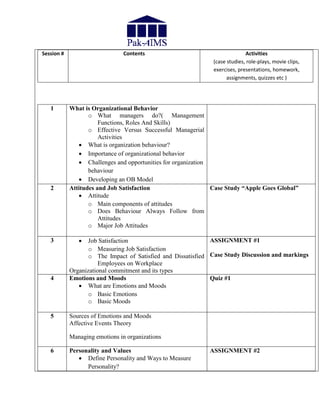
Session # Contents Activities
(case studies, role-plays, movie clips,
exercises, presentations, homework,
assignments, quizzes etc )
1 What is Organizational Behavior
o What managers do?( Management
Functions, Roles And Skills)
o Effective Versus Successful Managerial
Activities
 What is organization behaviour?
 Importance of organizational behavior
 Challenges and opportunities for organization
behaviour
 Developing an OB Model
2 Attitudes and Job Satisfaction
 Attitude
o Main components of attitudes
o Does Behaviour Always Follow from
Attitudes
o Major Job Attitudes
Case Study “Apple Goes Global”
3  Job Satisfaction
o Measuring Job Satisfaction
o The Impact of Satisfied and Dissatisfied
Employees on Workplace
Organizational commitment and its types
ASSIGNMENT #1
Case Study Discussion and markings
4 Emotions and Moods
 What are Emotions and Moods
o Basic Emotions
o Basic Moods
Quiz #1
5 Sources of Emotions and Moods
Affective Events Theory
Managing emotions in organizations
6 Personality and Values
 Define Personality and Ways to Measure
Personality?
ASSIGNMENT #2
 Approaches to Measure Personality Traits
o Myers-Briggs Type Indicator
o The Big Five Personality Model
o Other Personality Traits
 Values
 Linking an Individual’s Personality and
Values to Workplace
o Person job fit
o Person organization fit
o International Values
7 Personality and Values Quiz #2
Case Incident: “On the costs of being
nice”
8 Mid-term exam
9 Perception and Individual Decision Making
 What is Perception? Which Factors can
influence Perception
 Person Perception:
o Attribution Theory
o Frequently used Shortcuts in Judging
Others
 Decision making
 Biases and errors in decision making
10 Motivation in organizations
 Basic nature of Motivation
 Key elements of motivation
 Early Theories of Motivation
o Hierarchy of needs theory (Maslow)
o Theory X and theory Y (Douglas
McGregor)
o Two-factor theory (Frederick Herzberg)
o McClelland’s Theory of Needs
ASSIGNMENT # 3
11  Motivating by enhancing fit with an
organization
 Motivating by setting goals(goal setting
theory)
 Motivating by being equitable (equity theory)
 Motivating by altering
Case Incident: Equity and Executive
Pay
expectations(Expectancy theory)
 Motivating by structuring jobs to make them
interesting(job enlargement, job enrichment,
job redesign)
12 QUIZ #3 Quiz # 3 from 9,10 and 11 week.
Case study discussions and markings
13 THE GROUP
Group dynamics and work teams
 Defining and classifying groups
 Stages of group development
 Group properties
 Group decision making
 Difference between groups and teams
 Types of teams
 Developing successful teams
14 Leadership
 What is leadership?
 Trait Theories of leadership
 Behavioral theories of leadership
 Contingency Theories
ASSIGNMENT # 4
15 Power and Politics
 Definition of Power
 Contrasting Leadership and Power
 Bases of Power
o Formal Power
o Personal Power
 Power Tactics
 Organizational Politics: Power in Action
 Causes and Consequences of Political
Behaviour
Quiz #4
Case Incident: Delegate Power or
keep it close?
16 Presentations

course outline OB.docx

  • 1.
    The Institute ofManagement Sciences COURSE OUTLINE Course Name Organizational Behaviour Prepared On 24-10-2022 Course Code Credit Hours 03 Instructor Qurat ul ain Semester Fall-2022 Course Description The course focuses on the behavior of individuals and groups in diverse organizations and on organizational structure and processes. Besides, there is heavy emphasis on leadership, change management, team development and continuous improvement. Managers need to know why people behave as they do in relation to their jobs, their work groups and their organizations. This knowledge of individuals' perceptions, motivational attitudes and behaviour will enable managers to not only understand themselves better, but also to adopt appropriate managerial policies and leadership styles to increase their effectiveness. The focus of instruction will move progressively through the individual, group and organizational levels of behaviour and will examine the interrelationships of behavioural phenomena among these levels. Additionally, concepts such as motivation, communication and leadership and their relevance to organizational behaviour will be examined in detail. The course will also discuss the Islamic perspective of understanding and directing human behaviour in a specific direction. Course comprises of didactic lectures, classroom discussions, assignments, quizzes, case studies and a ‘project’. Course Learning Outcomes CLO # Description 1. 2. 3. 4. This course develops following competencies in the students.  An ability to use the fundamentals of organization behavior for achieving high individual performance  An ability to work efficiently and effectively within groups in business organizations  An ability to analyze and apply critical thinking and learning skills related to real life problems and situations  An aptitude to use knowledge gained from organizational behavior to
  • 2.
    5. successfully analyze complexorganizational situations and resolve that complex business problems  An ability to Synthesize various theories of motivation and leadership and understand their application to workplace. Teaching & Learning Methodology (case studies, role-plays, movie clips, exercises, presentations, homework, assignments, quizzes etc ) Textbook(s) VII. REQUIRED TEXTBOOK(S) 1. Stephen P. Robbins ;Organizational Behavior; Pearson; New Jersey, 16th Edition 2. Greenberg, Jerald; Behavior in organization; Pearson education Inc. Upper Saddle River; New Jersey, 10th Edition Reference Book(s) Reference Books 1. Laurie J.Mullins; Management and Organizational Behavior; Prentice Hall Upper Saddle River; New jersey; Latest Edition 2. David Bachanan and Andrzes Huczyhski ;Organizational Behavior Introductory text book; Prentice Hall Upper Saddle River; New jersey; Latest Edition VIII. JOURNALS Journal of Organizational Behavior Main Editor: Timothy D. Ludwig ISSN: 0160-8061 (Print Version) ISSN: 1540-8604 (Electronic Version) Journal Volume: 30 Published By Routledge Grading Policy Assessment Instruments Percentage Quizzes and assignments 15% Presentations 05% Class participation and attendance 10% Mid Term Exam 30% Final Exam 40% Week-wise Course Outline
  • 3.
    Session # ContentsActivities (case studies, role-plays, movie clips, exercises, presentations, homework, assignments, quizzes etc ) 1 What is Organizational Behavior o What managers do?( Management Functions, Roles And Skills) o Effective Versus Successful Managerial Activities  What is organization behaviour?  Importance of organizational behavior  Challenges and opportunities for organization behaviour  Developing an OB Model 2 Attitudes and Job Satisfaction  Attitude o Main components of attitudes o Does Behaviour Always Follow from Attitudes o Major Job Attitudes Case Study “Apple Goes Global” 3  Job Satisfaction o Measuring Job Satisfaction o The Impact of Satisfied and Dissatisfied Employees on Workplace Organizational commitment and its types ASSIGNMENT #1 Case Study Discussion and markings 4 Emotions and Moods  What are Emotions and Moods o Basic Emotions o Basic Moods Quiz #1 5 Sources of Emotions and Moods Affective Events Theory Managing emotions in organizations 6 Personality and Values  Define Personality and Ways to Measure Personality? ASSIGNMENT #2
  • 4.
     Approaches toMeasure Personality Traits o Myers-Briggs Type Indicator o The Big Five Personality Model o Other Personality Traits  Values  Linking an Individual’s Personality and Values to Workplace o Person job fit o Person organization fit o International Values 7 Personality and Values Quiz #2 Case Incident: “On the costs of being nice” 8 Mid-term exam 9 Perception and Individual Decision Making  What is Perception? Which Factors can influence Perception  Person Perception: o Attribution Theory o Frequently used Shortcuts in Judging Others  Decision making  Biases and errors in decision making 10 Motivation in organizations  Basic nature of Motivation  Key elements of motivation  Early Theories of Motivation o Hierarchy of needs theory (Maslow) o Theory X and theory Y (Douglas McGregor) o Two-factor theory (Frederick Herzberg) o McClelland’s Theory of Needs ASSIGNMENT # 3 11  Motivating by enhancing fit with an organization  Motivating by setting goals(goal setting theory)  Motivating by being equitable (equity theory)  Motivating by altering Case Incident: Equity and Executive Pay
  • 5.
    expectations(Expectancy theory)  Motivatingby structuring jobs to make them interesting(job enlargement, job enrichment, job redesign) 12 QUIZ #3 Quiz # 3 from 9,10 and 11 week. Case study discussions and markings 13 THE GROUP Group dynamics and work teams  Defining and classifying groups  Stages of group development  Group properties  Group decision making  Difference between groups and teams  Types of teams  Developing successful teams 14 Leadership  What is leadership?  Trait Theories of leadership  Behavioral theories of leadership  Contingency Theories ASSIGNMENT # 4 15 Power and Politics  Definition of Power  Contrasting Leadership and Power  Bases of Power o Formal Power o Personal Power  Power Tactics  Organizational Politics: Power in Action  Causes and Consequences of Political Behaviour Quiz #4 Case Incident: Delegate Power or keep it close? 16 Presentations