
5 Designing Around the Customer

organization @TC 2013
หัวข้อบรรยาย/กรณีศึกษา
1 แนวคิดทฤษฎีองค์การ   
2 โครงสร้างและการออกแบบองค์การ
Focus on task performance and structure
Focus on motivation
Focus on adjustments to the external environment
3 หลักการการออกแบบองค์กรที่มีประสิทธิภาพ
4 Fundamentals of Organization Designพื้นฐานแนวคิดการออกแบบโครงสร้างองค์การ  
C 1 : Harvard Business Case / NYPD New
5 Designing Around the Customer
C 2 : Harvard Business Case /Transformation at Ernst & Young United Kingdom
organization @TC 2013
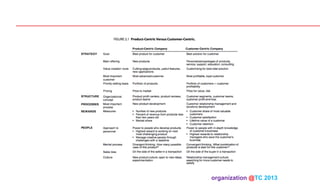
Customer-Centric Strategies
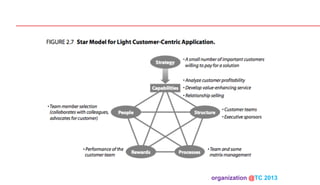
•  What Is Customer-Centric?
–  Strategy
–  Structure
–  Process
–  Rewards
–  People
•  The Drive Toward Customer-Centricity
•  Customer-Centric Strategies
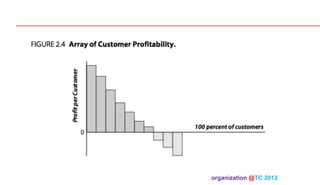
•  Customer Profitability and Segmentation

organization @TC 2013
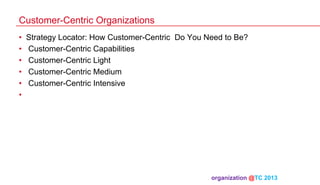
Customer-Centric Organizations
• 
• 
• 
• 
• 
• 

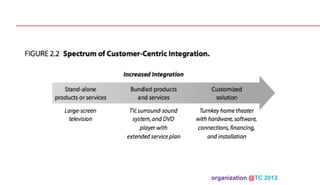
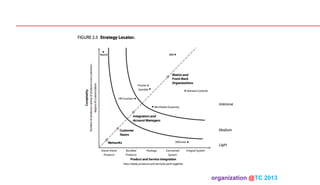
Strategy Locator: How Customer-Centric Do You Need to Be?
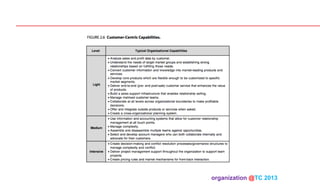
Customer-Centric Capabilities
Customer-Centric Light
Customer-Centric Medium
Customer-Centric Intensive

organization @TC 2013
organization @TC 2013 	

22
LEARNING FROM…
THE POWERFUL OFFICE
organization @TC 2013
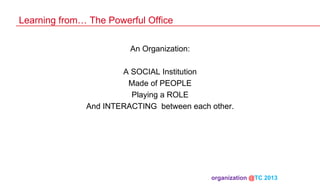
Learning from… The Powerful Office
An Organization:
A SOCIAL Institution
Made of PEOPLE
Playing a ROLE
And INTERACTING between each other.

organization @TC 2013
Learning from… The Powerful Office
•  Things evolve… New people comes in… and both can have some impact…
•  Beyond the formal line of authorities there are relationships, formal and
informal, between people…

organization @TC 2013
Learning from Toyota
•  Toyota's success: encourages every worker, no matter how far down the
production line, to consider himself a knowledge worker and to think
creatively about improving his particular corner of the organisation.

Source: The Economist “The new organisation: a survey of the company”

organization @TC 2013
Learning from…MUCH / MRH
Facing the growing complexity…

Matrix forms &
process organization

organization @TC 2013
Learning from… MUCH / MRH
•  CHANGING THE CULTURE…
… beyond the organization’s structure…

cultivate a
collective sense of responsabilitity
among employees

Source: Majchrzak, A. & Wang, Q. «Breaking the Functional Mind-set in Process Organizations» HBR

organization @TC 2013
Learning from…IBM
Either…
•  Splitting IBM businesses… or
•  Integrating into 1-activity
•  How to explain the two logics?

organization @TC 2013
Learning from… IBM
§  Splitting IBM businesses
§  In reaction to the new environment: new competitors providing narrow/
horizontal slice of the total package;
§  Customers’ support:
§  To break up IBM’s pricing umbrella (bundle prices)
§  Interest in getting computing power to the individual employees;
§  To bring more competition into the marketplace;
§  A financially-market driven strategy: IPO of many companies…
§  For many IBM executives, an organizational and cultural logic, where
each entity already first perform in its own turf.

organization @TC 2013
Learning from… IBM
§  Integrating into 1-activity
§  A client-driven logic: at the end of the day, the customer needs an
integrator, to create value
§  Problem solving
§  Ability to apply complex technologies to solve business challenges
§  integration
§  In this new environment (with tens of thousands small companies) IBM ‘s
scale and broad-based business capabilities were its competitive
advantage
§  A new organizational and cultural logic: performance is measured in
terms of contribution to the whole…

organization @TC 2013
Learning from… IBM
§  A new conception of IBM’s business model:
§  Based on two emerging forces:
§  Customers would increasingly value companies that could provide
solutions that integrated technology from various suppliers and integrated
technology into the processes of an enterprise.
§  Networked model of computing would replace the PC-dominated world of
1994.

organization @TC 2013
Learning from… IBM
•  A new conception of IBM’s business model
•  Creating a Global Enterprise:
–  Capitalizing on its ability to “integrate all the parts” for the customers.

organization @TC 2013
Learning from…IBM
§  A new conception of IBM’s business model:
§  A services-led model:
§  Designs, builds and delivers integrated technology solutions.
§  Build the largest and the most influential services business in the IT
industry.

organization @TC 2013
Learning from… IBM
§  A new conception of IBM’s business model:
§  Pulling together all of IBM’s software assets under a single executive… In a
world of open standards… focus on the “middleware”…working “cross
platform”
§  Acquiring Lotus to complete the middleware portfolio and enter in the world of
“collaborative computing”.
§  Leaving “application software”… and partnering with application software
developers
§  Enter the technology components marketplace.

organization @TC 2013
Learning from…IBM
•  A new conception of IBM’s business model
•  Integrating IBM:

–  Organization / Brand Image / Compensation

organization @TC 2013
Learning from…IBM
•  A new conception of IBM’s business model:
•  Organization:
–  Breaking up the fiefdoms: from geographical organization to a global,
customer-oriented organization.
•  Brand Image:
–  Global and unified brand
•  Compensation:
–  Pay for performance; stock-based compensation; bonus link to overall
IBM’s performance

organization @TC 2013
Learning from…IBM
•  Which activities should be kept, outsourced or abandoned.
To protect and develop
the “integrator" role,
to better-served the client:
stay on “focus”

organization @TC 2013
Learning from… IBM
•  Which activities should be kept, outsourced or abandoned.
•  Sell unproductive assets and not essential for the company, to raise cash:
(examples: Expensive training centers, Fine-art collection, Federal Systems
Company/national security and space programs…)
•  Leaving “application software”… and partnering with application software developers
(no longer competing against them)
•  Selling the IBM network ($5 billion) to AT&T… a part of the stack that was not
strategically vital… and avoid huge capital investment to maintain the network.
•  Exit the DRAM business… exit the hard-disk-drive business…
Selecting markets and competing on the basis
of a distinctive, sustainable competency.

organization @TC 2013
Learning from…IBM
•  IBM transformation of the management roles and organizational culture.
•  A culture of collaboration…
–  Organizational structure and processes that favour the collaboration…
the expression of a new culture.
•  Managing by principles…
•  Focus on the outside: the client.

organization @TC 2013
Learning from…IBM
•  IBM transformation of the management roles and organizational
culture.
•  For the Mature Business (H1)
–  Operators: deep functional expertise

•  For the rapidly Growing Business (H2)
–  Business Builders: entrepreneurial

•  For the Emerging Business (H3)
–  Visionaries: unconventional thinkers.

organization @TC 2013

Organization theory and design 05 2013

  • 1.
    5 Designing Aroundthe Customer organization @TC 2013
  • 2.
    หัวข้อบรรยาย/กรณีศึกษา 1 แนวคิดทฤษฎีองค์การ    2โครงสร้างและการออกแบบองค์การ Focus on task performance and structure Focus on motivation Focus on adjustments to the external environment 3 หลักการการออกแบบองค์กรที่มีประสิทธิภาพ 4 Fundamentals of Organization Designพื้นฐานแนวคิดการออกแบบโครงสร้างองค์การ   C 1 : Harvard Business Case / NYPD New 5 Designing Around the Customer C 2 : Harvard Business Case /Transformation at Ernst & Young United Kingdom organization @TC 2013
  • 3.
    Customer-Centric Strategies •  WhatIs Customer-Centric? –  Strategy –  Structure –  Process –  Rewards –  People •  The Drive Toward Customer-Centricity •  Customer-Centric Strategies •  Customer Profitability and Segmentation organization @TC 2013
  • 4.
  • 5.
  • 6.
  • 7.
  • 8.
  • 9.
  • 10.
  • 11.
  • 12.
  • 13.
  • 14.
  • 15.
  • 16.
  • 17.
  • 18.
  • 19.
  • 20.
  • 21.
    Customer-Centric Organizations •  •  •  •  •  •  Strategy Locator:How Customer-Centric Do You Need to Be? Customer-Centric Capabilities Customer-Centric Light Customer-Centric Medium Customer-Centric Intensive organization @TC 2013
  • 22.
  • 23.
    LEARNING FROM… THE POWERFULOFFICE organization @TC 2013
  • 24.
    Learning from… ThePowerful Office An Organization: A SOCIAL Institution Made of PEOPLE Playing a ROLE And INTERACTING between each other. organization @TC 2013
  • 25.
    Learning from… ThePowerful Office •  Things evolve… New people comes in… and both can have some impact… •  Beyond the formal line of authorities there are relationships, formal and informal, between people… organization @TC 2013
  • 26.
    Learning from Toyota • Toyota's success: encourages every worker, no matter how far down the production line, to consider himself a knowledge worker and to think creatively about improving his particular corner of the organisation. Source: The Economist “The new organisation: a survey of the company” organization @TC 2013
  • 27.
    Learning from…MUCH /MRH Facing the growing complexity… Matrix forms & process organization organization @TC 2013
  • 28.
    Learning from… MUCH/ MRH •  CHANGING THE CULTURE… … beyond the organization’s structure… cultivate a collective sense of responsabilitity among employees Source: Majchrzak, A. & Wang, Q. «Breaking the Functional Mind-set in Process Organizations» HBR organization @TC 2013
  • 29.
    Learning from…IBM Either… •  SplittingIBM businesses… or •  Integrating into 1-activity •  How to explain the two logics? organization @TC 2013
  • 30.
    Learning from… IBM § Splitting IBM businesses §  In reaction to the new environment: new competitors providing narrow/ horizontal slice of the total package; §  Customers’ support: §  To break up IBM’s pricing umbrella (bundle prices) §  Interest in getting computing power to the individual employees; §  To bring more competition into the marketplace; §  A financially-market driven strategy: IPO of many companies… §  For many IBM executives, an organizational and cultural logic, where each entity already first perform in its own turf. organization @TC 2013
  • 31.
    Learning from… IBM § Integrating into 1-activity §  A client-driven logic: at the end of the day, the customer needs an integrator, to create value §  Problem solving §  Ability to apply complex technologies to solve business challenges §  integration §  In this new environment (with tens of thousands small companies) IBM ‘s scale and broad-based business capabilities were its competitive advantage §  A new organizational and cultural logic: performance is measured in terms of contribution to the whole… organization @TC 2013
  • 32.
    Learning from… IBM § A new conception of IBM’s business model: §  Based on two emerging forces: §  Customers would increasingly value companies that could provide solutions that integrated technology from various suppliers and integrated technology into the processes of an enterprise. §  Networked model of computing would replace the PC-dominated world of 1994. organization @TC 2013
  • 33.
    Learning from… IBM • A new conception of IBM’s business model •  Creating a Global Enterprise: –  Capitalizing on its ability to “integrate all the parts” for the customers. organization @TC 2013
  • 34.
    Learning from…IBM §  Anew conception of IBM’s business model: §  A services-led model: §  Designs, builds and delivers integrated technology solutions. §  Build the largest and the most influential services business in the IT industry. organization @TC 2013
  • 35.
    Learning from… IBM § A new conception of IBM’s business model: §  Pulling together all of IBM’s software assets under a single executive… In a world of open standards… focus on the “middleware”…working “cross platform” §  Acquiring Lotus to complete the middleware portfolio and enter in the world of “collaborative computing”. §  Leaving “application software”… and partnering with application software developers §  Enter the technology components marketplace. organization @TC 2013
  • 36.
    Learning from…IBM •  Anew conception of IBM’s business model •  Integrating IBM: –  Organization / Brand Image / Compensation organization @TC 2013
  • 37.
    Learning from…IBM •  Anew conception of IBM’s business model: •  Organization: –  Breaking up the fiefdoms: from geographical organization to a global, customer-oriented organization. •  Brand Image: –  Global and unified brand •  Compensation: –  Pay for performance; stock-based compensation; bonus link to overall IBM’s performance organization @TC 2013
  • 38.
    Learning from…IBM •  Whichactivities should be kept, outsourced or abandoned. To protect and develop the “integrator" role, to better-served the client: stay on “focus” organization @TC 2013
  • 39.
    Learning from… IBM • Which activities should be kept, outsourced or abandoned. •  Sell unproductive assets and not essential for the company, to raise cash: (examples: Expensive training centers, Fine-art collection, Federal Systems Company/national security and space programs…) •  Leaving “application software”… and partnering with application software developers (no longer competing against them) •  Selling the IBM network ($5 billion) to AT&T… a part of the stack that was not strategically vital… and avoid huge capital investment to maintain the network. •  Exit the DRAM business… exit the hard-disk-drive business… Selecting markets and competing on the basis of a distinctive, sustainable competency. organization @TC 2013
  • 40.
    Learning from…IBM •  IBMtransformation of the management roles and organizational culture. •  A culture of collaboration… –  Organizational structure and processes that favour the collaboration… the expression of a new culture. •  Managing by principles… •  Focus on the outside: the client. organization @TC 2013
  • 41.
    Learning from…IBM •  IBMtransformation of the management roles and organizational culture. •  For the Mature Business (H1) –  Operators: deep functional expertise •  For the rapidly Growing Business (H2) –  Business Builders: entrepreneurial •  For the Emerging Business (H3) –  Visionaries: unconventional thinkers. organization @TC 2013