Thomson Learning
© 2004 9-1
Chapter Nine
Organization Size,
Life Cycle, and Decline
Thomson Learning
© 2004 9-2
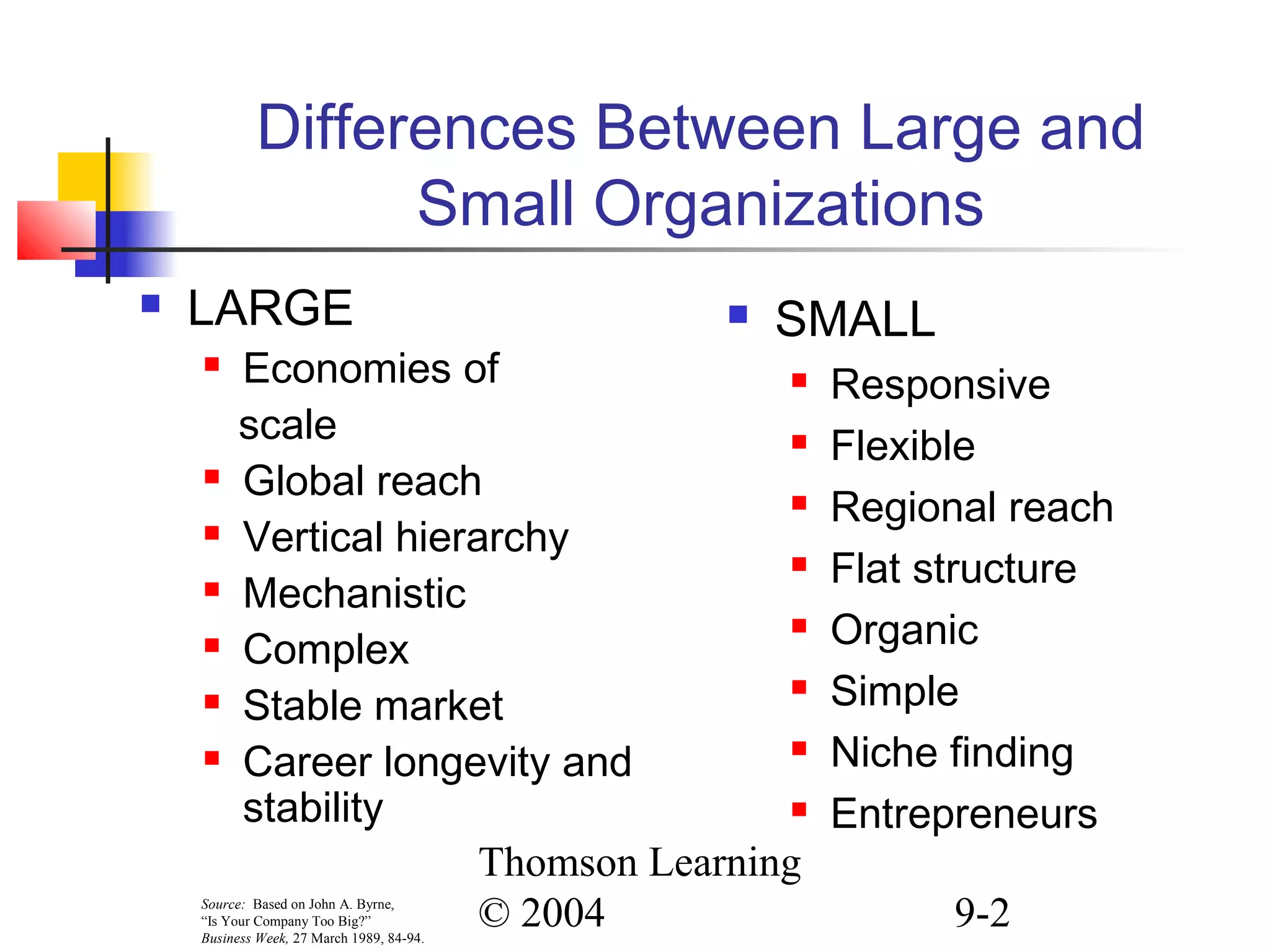
Differences Between Large and
Small Organizations
 LARGE
 Economies of
scale
 Global reach
 Vertical hierarchy
 Mechanistic
 Complex
 Stable market
 Career longevity and
stability
 SMALL
 Responsive
 Flexible
 Regional reach
 Flat structure
 Organic
 Simple
 Niche finding
 Entrepreneurs
Source: Based on John A. Byrne,
“Is Your Company Too Big?”
Business Week, 27 March 1989, 84-94.
Thomson Learning
© 2004 9-3
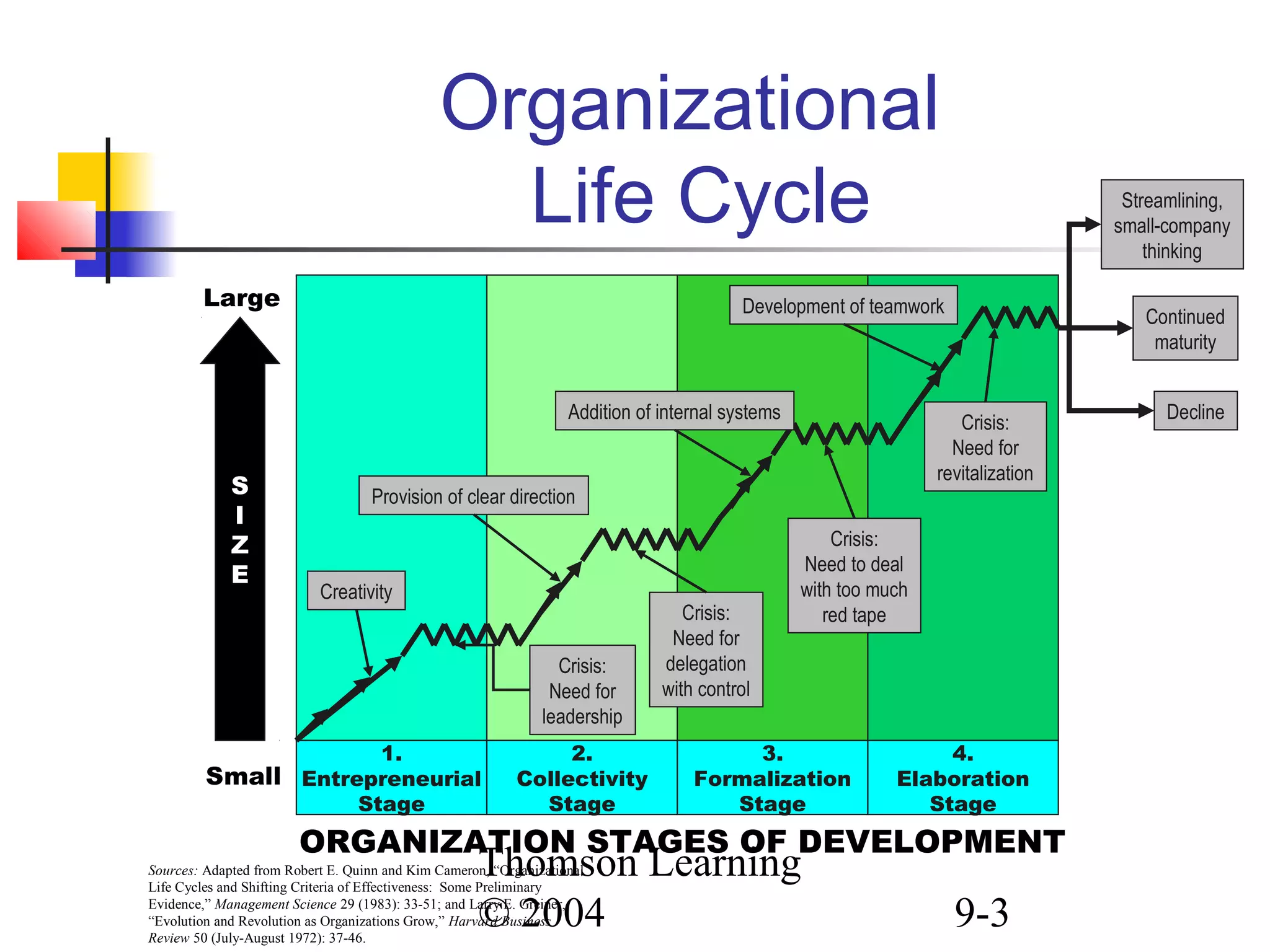
Organizational
Life Cycle
ORGANIZATION STAGES OF DEVELOPMENT
1.
Entrepreneurial
Stage
2.
Collectivity
Stage
3.
Formalization
Stage
4.
Elaboration
Stage
Crisis:
Need to deal
with too much
red tapeCrisis:
Need for
delegation
with control
Crisis:
Need for
leadership
Creativity
Provision of clear direction
Addition of internal systems
Development of teamwork
Crisis:
Need for
revitalization
Decline
Continued
maturity
Streamlining,
small-company
thinking
S
I
Z
E
Large
Small
Sources: Adapted from Robert E. Quinn and Kim Cameron, “Organizational
Life Cycles and Shifting Criteria of Effectiveness: Some Preliminary
Evidence,” Management Science 29 (1983): 33-51; and Larry E. Greiner,
“Evolution and Revolution as Organizations Grow,” Harvard Business
Review 50 (July-August 1972): 37-46.
Thomson Learning
© 2004 9-4
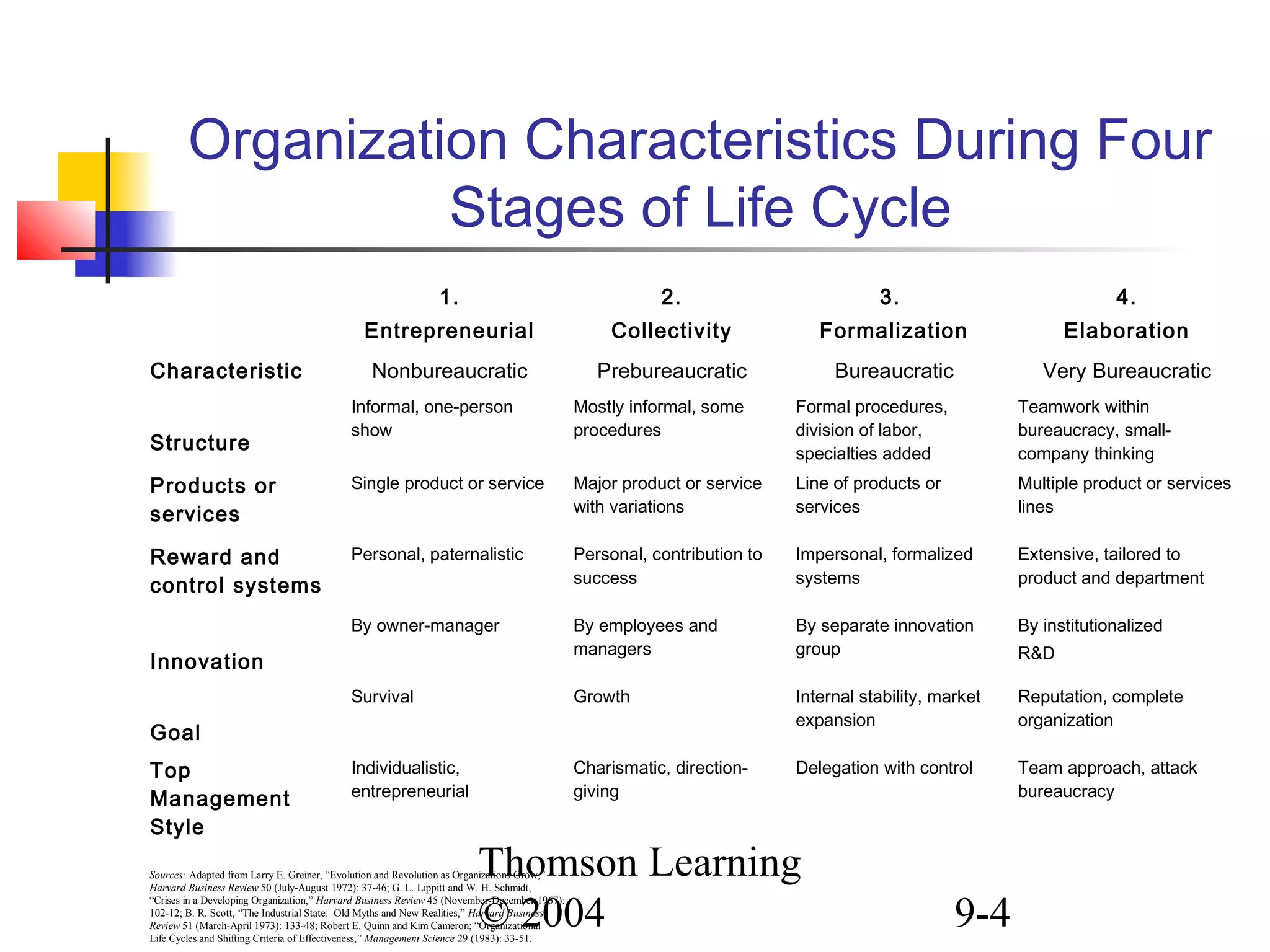
Organization Characteristics During Four
Stages of Life Cycle
1.
Entrepreneurial
2.
Collectivity
3.
Formalization
4.
Elaboration
Characteristic Nonbureaucratic Prebureaucratic Bureaucratic Very Bureaucratic
Structure
Informal, one-person
show
Mostly informal, some
procedures
Formal procedures,
division of labor,
specialties added
Teamwork within
bureaucracy, small-
company thinking
Products or
services
Single product or service Major product or service
with variations
Line of products or
services
Multiple product or services
lines
Reward and
control systems
Personal, paternalistic Personal, contribution to
success
Impersonal, formalized
systems
Extensive, tailored to
product and department
Innovation
By owner-manager By employees and
managers
By separate innovation
group
By institutionalized
R&D
Goal
Survival Growth Internal stability, market
expansion
Reputation, complete
organization
Top
Management
Style
Individualistic,
entrepreneurial
Charismatic, direction-
giving
Delegation with control Team approach, attack
bureaucracy
Sources: Adapted from Larry E. Greiner, “Evolution and Revolution as Organizations Grow,”
Harvard Business Review 50 (July-August 1972): 37-46; G. L. Lippitt and W. H. Schmidt,
“Crises in a Developing Organization,” Harvard Business Review 45 (November-December 1967):
102-12; B. R. Scott, “The Industrial State: Old Myths and New Realities,” Harvard Business
Review 51 (March-April 1973): 133-48; Robert E. Quinn and Kim Cameron; “Organizational
Life Cycles and Shifting Criteria of Effectiveness,” Management Science 29 (1983): 33-51.
Thomson Learning
© 2004 9-5
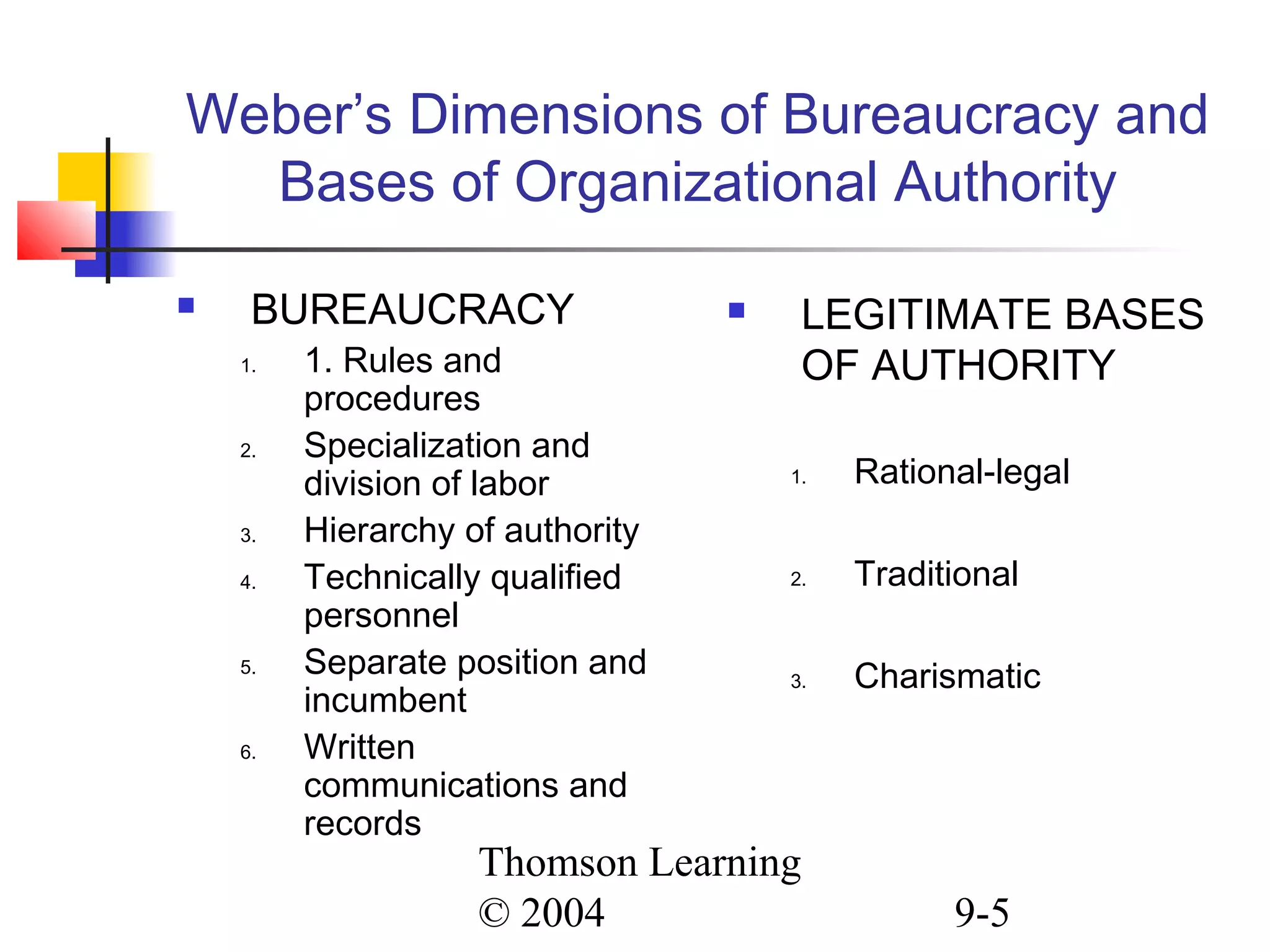
Weber’s Dimensions of Bureaucracy and
Bases of Organizational Authority
 BUREAUCRACY
1. 1. Rules and
procedures
2. Specialization and
division of labor
3. Hierarchy of authority
4. Technically qualified
personnel
5. Separate position and
incumbent
6. Written
communications and
records
 LEGITIMATE BASES
OF AUTHORITY
1. Rational-legal
2. Traditional
3. Charismatic
Thomson Learning
© 2004 9-6
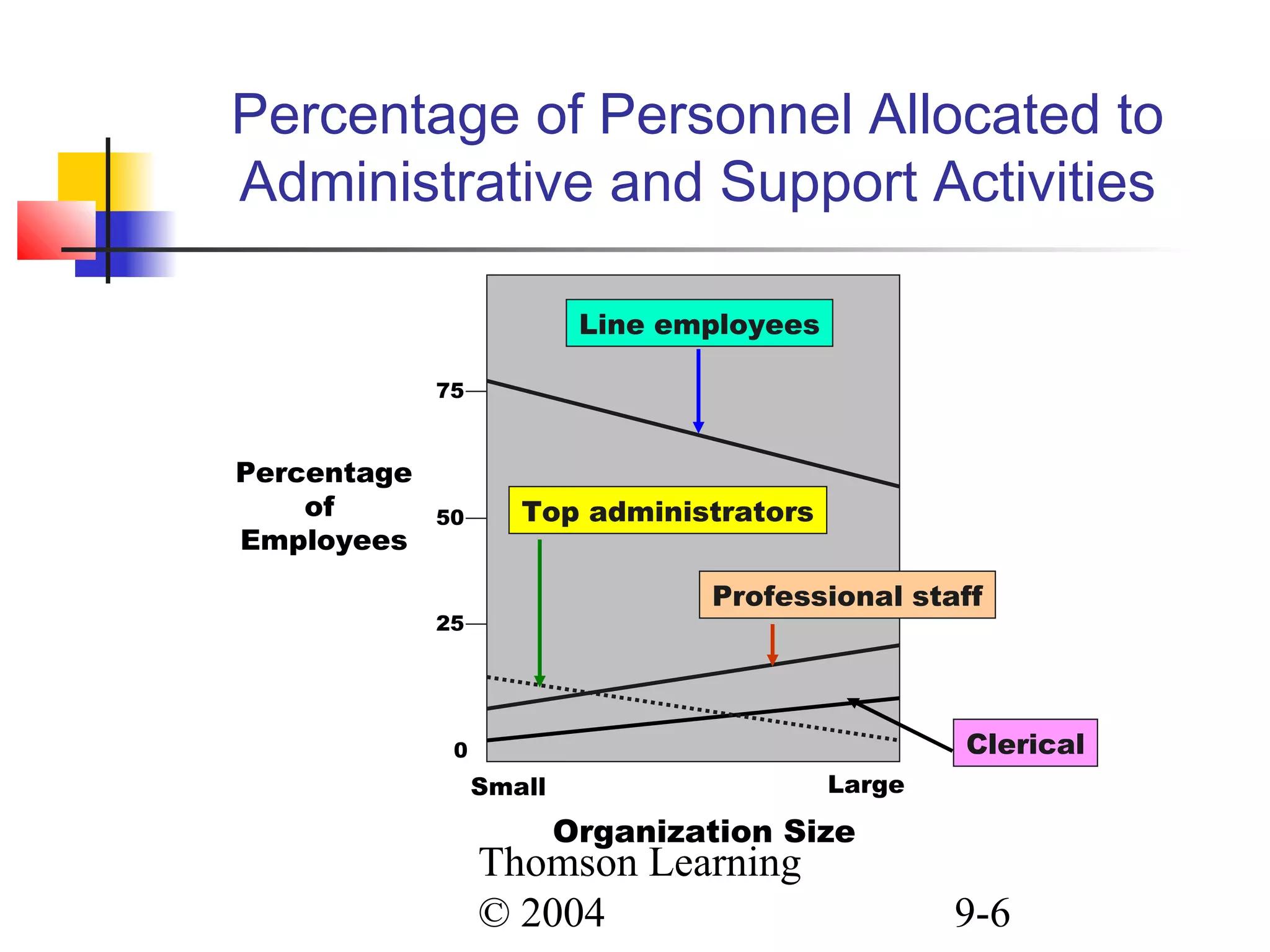
Percentage of Personnel Allocated to
Administrative and Support Activities
50
75
25
0
Organization Size
Small Large
Line employees
Top administrators
Clerical
Professional staff
Percentage
of
Employees
Thomson Learning
© 2004 9-7
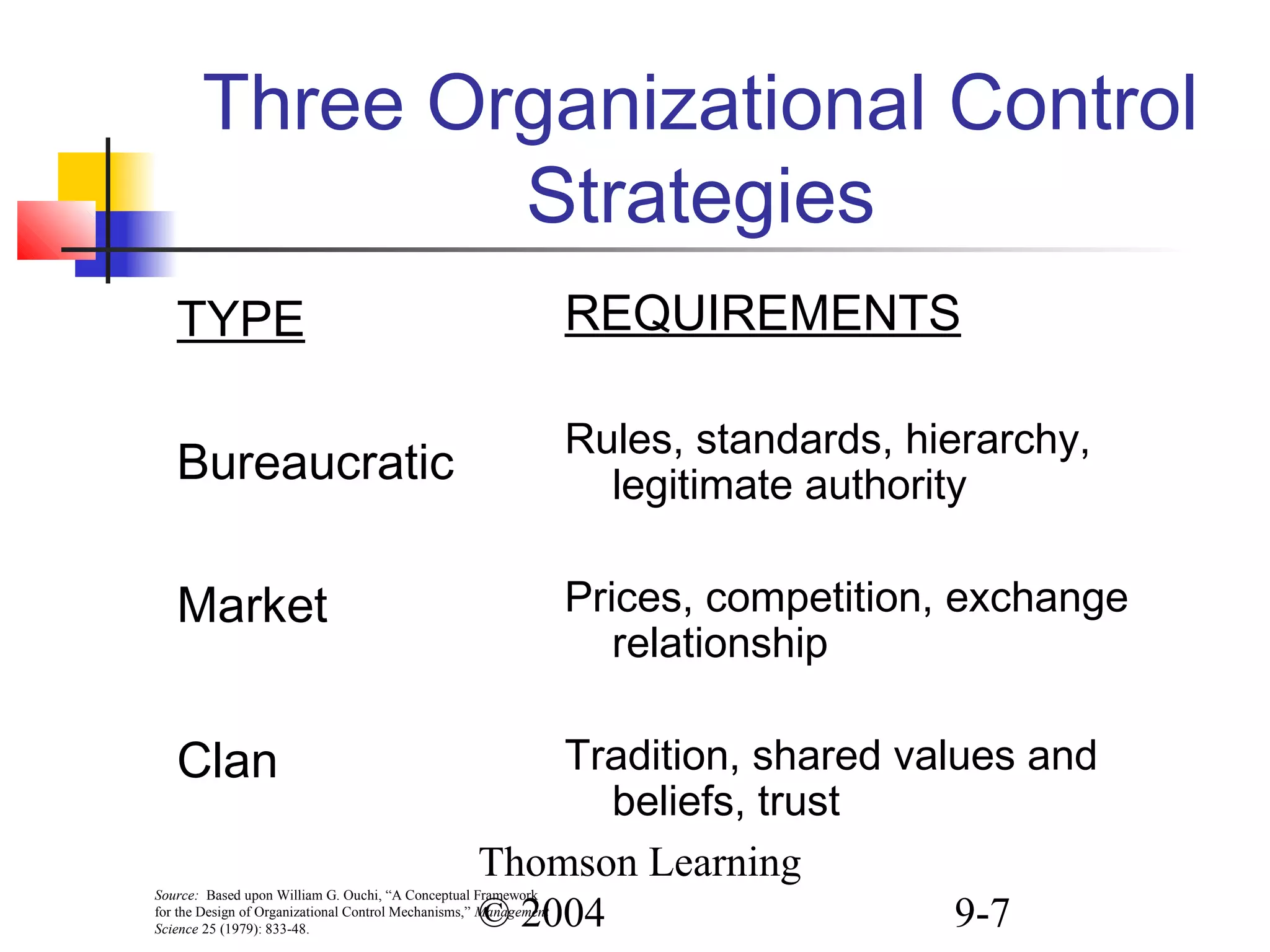
Three Organizational Control
Strategies
TYPE
Bureaucratic
Market
Clan
REQUIREMENTS
Rules, standards, hierarchy,
legitimate authority
Prices, competition, exchange
relationship
Tradition, shared values and
beliefs, trust
Source: Based upon William G. Ouchi, “A Conceptual Framework
for the Design of Organizational Control Mechanisms,” Management
Science 25 (1979): 833-48.
Thomson Learning
© 2004 9-8
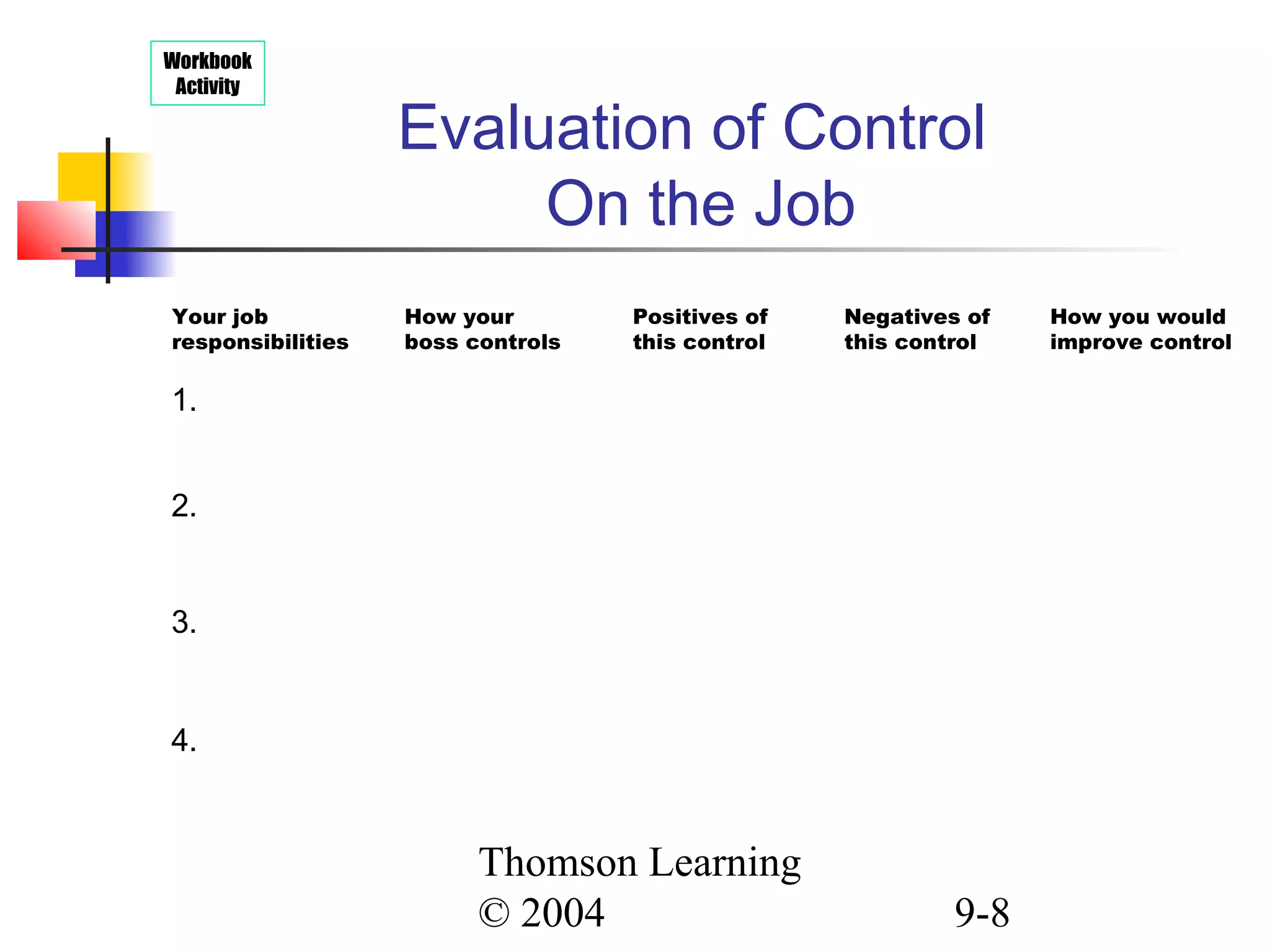
Evaluation of Control
On the Job
Workbook
Activity
1.
2.
3.
4.
Your job
responsibilities
How your
boss controls
Positives of
this control
Negatives of
this control
How you would
improve control
Thomson Learning
© 2004 9-9
Evaluation of Control
At the University
Workbook
Activity
1.
2.
3.
4.
Item
How Prof. A
(small class)
controls
How these
controls
influence you
What you think
is a better
control
How Prof. B
(large class)
controls
Thomson Learning
© 2004 9-9
Evaluation of Control
At the University
Workbook
Activity
1.
2.
3.
4.
Item
How Prof. A
(small class)
controls
How these
controls
influence you
What you think
is a better
control
How Prof. B
(large class)
controls

Ch09

  • 1.
    Thomson Learning © 20049-1 Chapter Nine Organization Size, Life Cycle, and Decline
  • 2.
    Thomson Learning © 20049-2 Differences Between Large and Small Organizations  LARGE  Economies of scale  Global reach  Vertical hierarchy  Mechanistic  Complex  Stable market  Career longevity and stability  SMALL  Responsive  Flexible  Regional reach  Flat structure  Organic  Simple  Niche finding  Entrepreneurs Source: Based on John A. Byrne, “Is Your Company Too Big?” Business Week, 27 March 1989, 84-94.
  • 3.
    Thomson Learning © 20049-3 Organizational Life Cycle ORGANIZATION STAGES OF DEVELOPMENT 1. Entrepreneurial Stage 2. Collectivity Stage 3. Formalization Stage 4. Elaboration Stage Crisis: Need to deal with too much red tapeCrisis: Need for delegation with control Crisis: Need for leadership Creativity Provision of clear direction Addition of internal systems Development of teamwork Crisis: Need for revitalization Decline Continued maturity Streamlining, small-company thinking S I Z E Large Small Sources: Adapted from Robert E. Quinn and Kim Cameron, “Organizational Life Cycles and Shifting Criteria of Effectiveness: Some Preliminary Evidence,” Management Science 29 (1983): 33-51; and Larry E. Greiner, “Evolution and Revolution as Organizations Grow,” Harvard Business Review 50 (July-August 1972): 37-46.
  • 4.
    Thomson Learning © 20049-4 Organization Characteristics During Four Stages of Life Cycle 1. Entrepreneurial 2. Collectivity 3. Formalization 4. Elaboration Characteristic Nonbureaucratic Prebureaucratic Bureaucratic Very Bureaucratic Structure Informal, one-person show Mostly informal, some procedures Formal procedures, division of labor, specialties added Teamwork within bureaucracy, small- company thinking Products or services Single product or service Major product or service with variations Line of products or services Multiple product or services lines Reward and control systems Personal, paternalistic Personal, contribution to success Impersonal, formalized systems Extensive, tailored to product and department Innovation By owner-manager By employees and managers By separate innovation group By institutionalized R&D Goal Survival Growth Internal stability, market expansion Reputation, complete organization Top Management Style Individualistic, entrepreneurial Charismatic, direction- giving Delegation with control Team approach, attack bureaucracy Sources: Adapted from Larry E. Greiner, “Evolution and Revolution as Organizations Grow,” Harvard Business Review 50 (July-August 1972): 37-46; G. L. Lippitt and W. H. Schmidt, “Crises in a Developing Organization,” Harvard Business Review 45 (November-December 1967): 102-12; B. R. Scott, “The Industrial State: Old Myths and New Realities,” Harvard Business Review 51 (March-April 1973): 133-48; Robert E. Quinn and Kim Cameron; “Organizational Life Cycles and Shifting Criteria of Effectiveness,” Management Science 29 (1983): 33-51.
  • 5.
    Thomson Learning © 20049-5 Weber’s Dimensions of Bureaucracy and Bases of Organizational Authority  BUREAUCRACY 1. 1. Rules and procedures 2. Specialization and division of labor 3. Hierarchy of authority 4. Technically qualified personnel 5. Separate position and incumbent 6. Written communications and records  LEGITIMATE BASES OF AUTHORITY 1. Rational-legal 2. Traditional 3. Charismatic
  • 6.
    Thomson Learning © 20049-6 Percentage of Personnel Allocated to Administrative and Support Activities 50 75 25 0 Organization Size Small Large Line employees Top administrators Clerical Professional staff Percentage of Employees
  • 7.
    Thomson Learning © 20049-7 Three Organizational Control Strategies TYPE Bureaucratic Market Clan REQUIREMENTS Rules, standards, hierarchy, legitimate authority Prices, competition, exchange relationship Tradition, shared values and beliefs, trust Source: Based upon William G. Ouchi, “A Conceptual Framework for the Design of Organizational Control Mechanisms,” Management Science 25 (1979): 833-48.
  • 8.
    Thomson Learning © 20049-8 Evaluation of Control On the Job Workbook Activity 1. 2. 3. 4. Your job responsibilities How your boss controls Positives of this control Negatives of this control How you would improve control
  • 9.
    Thomson Learning © 20049-9 Evaluation of Control At the University Workbook Activity 1. 2. 3. 4. Item How Prof. A (small class) controls How these controls influence you What you think is a better control How Prof. B (large class) controls
  • 10.
    Thomson Learning © 20049-9 Evaluation of Control At the University Workbook Activity 1. 2. 3. 4. Item How Prof. A (small class) controls How these controls influence you What you think is a better control How Prof. B (large class) controls