O R G A N I Z AT I O N A L
C H A N G E & D E S I G N
The Organization
and
its Environment
Ujjwal Aryal
Ujjwal.aryal@gmail.com
Organization is a social entity that is goal oriented.
Organization refers to a collection of people, who are
involved in pursuing defined objectives. It can be
understood as a social system which comprises all
formal human relationships. The organization
encompasses division of work among employees and
alignment of tasks towards the ultimate goal of the
company
All organizations have a management structure that
determines relationships between the different activities
and the members, and subdivides and assigns roles,
responsibilities, and authority to carry out different
tasks.
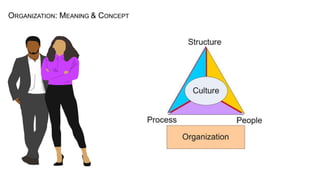
ORGANIZATION: MEANING & CONCEPT
An organization is a collection of people working
together in a coordinated and structured fashion to
achieve one or more goals.
Organizations exist to allow accomplishment of work
that could not be achieved by people alone.
As long as the goals of an organization are appropriate,
society will allow them to exist and they can contribute
to society.
ORGANIZATION: MEANING & CONCEPT
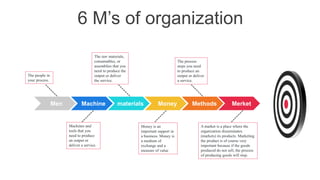
6 M’s of organization
Men Machine materials Money Methods Merket
The process
steps you need
to produce an
output or deliver
a service.
Machines and
tools that you
need to produce
an output or
deliver a service.
The raw materials,
consumables, or
assemblies that you
need to produce the
output or deliver
the service.
The people in
your process.
Money is an
important support in
a business. Money is
a medium of
exchange and a
measure of value
A market is a place where the
organization disseminates
(markets) its products. Marketing
the product is of course very
important because if the goods
produced do not sell, the process
of producing goods will stop.
ORGANIZATION: MEANING & CONCEPT
An organizational
structure is adopted
through
management, teams
and leadership.
It is composed of
people and works on
the principle of
division of work.
The word “organization”
is derived from the Greek
word “organon”.
As we know `organ` -it
means a compartment for
a particular job.
An organization is a
social group which is
tributes tasks for a
collective goal.
ORGANIZATION: MEANING & CONCEPT
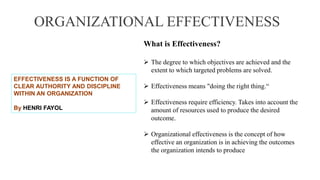
ORGANIZATIONAL EFFECTIVENESS
What is Effectiveness?
 The degree to which objectives are achieved and the
extent to which targeted problems are solved.
 Effectiveness means "doing the right thing.“
 Effectiveness require efficiency. Takes into account the
amount of resources used to produce the desired
outcome.
 Organizational effectiveness is the concept of how
effective an organization is in achieving the outcomes
the organization intends to produce
EFFECTIVENESS IS A FUNCTION OF
CLEAR AUTHORITY AND DISCIPLINE
WITHIN AN ORGANIZATION
By HENRI FAYOL
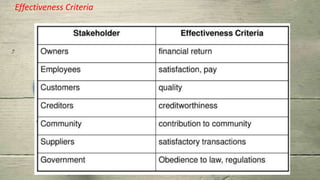
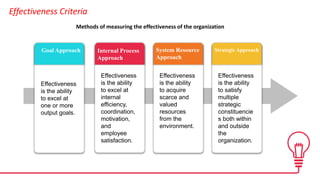
Effectiveness Criteria
Effectiveness
is the ability
to excel at
one or more
output goals.
Effectiveness
is the ability
to acquire
scarce and
valued
resources
from the
environment.
Effectiveness
is the ability
to satisfy
multiple
strategic
constituencie
s both within
and outside
the
organization.
Strategic Approach
System Resource
Approach
Internal Process
Approach
Goal Approach
Effectiveness
is the ability
to excel at
internal
efficiency,
coordination,
motivation,
and
employee
satisfaction.
Effectiveness Criteria
Methods of measuring the effectiveness of the organization
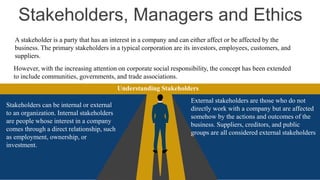
Stakeholders, Managers and Ethics
A stakeholder is a party that has an interest in a company and can either affect or be affected by the
business. The primary stakeholders in a typical corporation are its investors, employees, customers, and
suppliers.
However, with the increasing attention on corporate social responsibility, the concept has been extended
to include communities, governments, and trade associations.
Stakeholders can be internal or external
to an organization. Internal stakeholders
are people whose interest in a company
comes through a direct relationship, such
as employment, ownership, or
investment.
External stakeholders are those who do not
directly work with a company but are affected
somehow by the actions and outcomes of the
business. Suppliers, creditors, and public
groups are all considered external stakeholders
Understanding Stakeholders
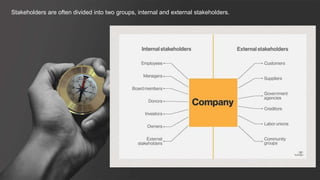
Stakeholders are often divided into two groups, internal and external stakeholders.
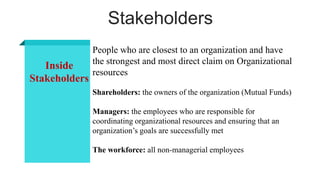
Stakeholders
People who are closest to an organization and have
the strongest and most direct claim on Organizational
resources
Shareholders: the owners of the organization (Mutual Funds)
Managers: the employees who are responsible for
coordinating organizational resources and ensuring that an
organization’s goals are successfully met
The workforce: all non-managerial employees
Inside
Stakeholders
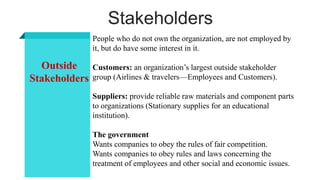
Stakeholders
People who do not own the organization, are not employed by
it, but do have some interest in it.
Customers: an organization’s largest outside stakeholder
group (Airlines & travelers—Employees and Customers).
Suppliers: provide reliable raw materials and component parts
to organizations (Stationary supplies for an educational
institution).
The government
Wants companies to obey the rules of fair competition.
Wants companies to obey rules and laws concerning the
treatment of employees and other social and economic issues.
Outside
Stakeholders
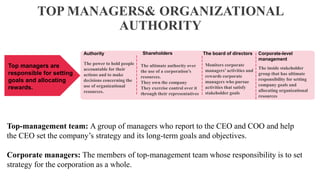
TOP MANAGERS& ORGANIZATIONAL
AUTHORITY
The power to hold people
accountable for their
actions and to make
decisions concerning the
use of organizational
resources.
Authority
The ultimate authority over
the use of a corporation’s
resources.
They own the company
They exercise control over it
through their representatives
Shareholders
Monitors corporate
managers’ activities and
rewards corporate
managers who pursue
activities that satisfy
stakeholder goals
The board of directors
The inside stakeholder
group that has ultimate
responsibility for setting
company goals and
allocating organizational
resources
Corporate-level
management
Top managers are
responsible for setting
goals and allocating
rewards.
Top-management team: A group of managers who report to the CEO and COO and help
the CEO set the company’s strategy and its long-term goals and objectives.
Corporate managers: The members of top-management team whose responsibility is to set
strategy for the corporation as a whole.
TOP
MANAGEMENT
TEAM ROLES
CEO
Often has primary responsibility for
managing the organization’s relationship
with external stakeholders
COO
Responsible for managing the
organization’s internal operations
Exec. Vice Presidents
Oversees and manages the company’s most
significant line and staff roles
Line-role
managers who have direct responsibility for the
production of goods and services
WHAT IS BUSINESS ETHICS
Ethics
Moral principles and beliefs about what is right or wrong
(rights & justice)
Ethical dilemma
Decisions that involve conflicting interests of parties
Laws specify what people and organizations can and
cannot do.
Ethics and laws are relative
MAJOR SOURCES OF
ORGANIZATIONAL ETHICS
Societal ethics: codified in a society’s legal
system, in its customs and practices, and in the
unwritten norms and values that people use to
interact with each other.
Professional ethics: the moral rules and values
that a group of people uses to control the way
they perform a task or use resources.
Individual ethics: the personal and moral
standards used by individuals to structure their
interactions with other people.
External Environment & Organizational Relationships
The term “Business environment” represents the sum of all the individuals,
institutions, competing organisations, government, courts, media, investors,
and other factors outside the power of the business organisations but affects
the business performance. Hence, changes in government economic policies,
rapid changes in technology, changes in consumer tastes and preferences,
increasing market competition, etc. are outside the business organisations'
power but affect the business performance immensely.
The external environment comprises forces that exist outside the boundaries
of an organization, but have potential and significant influence on its survival
and growth.
External environment of an organization can be classified into two broad
components:
The General Environment.
The Task (Specific) Environment.
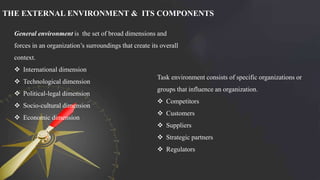
THE EXTERNAL ENVIRONMENT & ITS COMPONENTS
General environment is the set of broad dimensions and
forces in an organization’s surroundings that create its overall
context.
 International dimension
 Technological dimension
 Political-legal dimension
 Socio-cultural dimension
 Economic dimension
Task environment consists of specific organizations or
groups that influence an organization.
 Competitors
 Customers
 Suppliers
 Strategic partners
 Regulators
HOW ORGANIZATIONS ADOPT TO THEIR ENVIRONMENT
The components of the environment affect the functioning of a
business organization. The management should develop some
alternative strategies to adapt to environmental influence. The
following points for how organizations adapt to their
environments.
Information management- Organizations can adapt to their
environment through information management. They can apply
many techniques for information management. These consist of
boundary spanners, environmental scanning, and information
system. There must be a proper information system within the
organization.
Strategic response- Strategic response is the process of
applying existing plans and policies if successfully functioning,
or developing new plans and policies to cope with environmental
change. The common approaches of strategic response are at
least resistance; proceeding with caution and dynamic
response.
Mergers, takeover, acquisition and alliances- In a competitive
environment, a business organization may face threats and challenges
due to environmental changes. To adapt to environmental changes, a
business organization may implement different strategies consisting of
mergers, takeover, acquisition and alliances.
Organization design and flexibility- In a dynamic environment, it is
essential to choose a few standard operating procedures. The
management should consider the organic design and should be flexible in
decision making on the basis of time and situation.
The direct influence of the environment- When organizations are able
to anticipate or forecast environmental changes, they may influence the
environment directly in many ways like lobbying and bargaining and
assigning long term contracts.
HOW ORGANIZATIONS ADOPT TO THEIR ENVIRONMENT
MANAGING IN A CHANGING GLOBAL ENVIRONMENT
With fast development in business field, management
environments are becoming more diverse. Global
Organizations are those which operate and compete in
more than one country. These are uncertain and
unpredictable. The global environment of such
companies is a set of forces and conditions exterior of
the organization's boundaries that affects the way it
operates and shapes its behavior.
DOING BUSINESS GLOBALLY: DIFFERENT TYPES OF ORG
Multinational Corporations:
A broad team term that refers to any and all types of
international companies that maintain operations.
Multidomestic Corporation:
An international company that decentralized
management and other decisions to the local country.
Global Company:
An MNC that centralize management and other
decision in the home country.
CHALLENGES
Any manager who finds himself in a foreign country faces a lot of new
challenges. It is very difficult to manage an organization in a global
environment.
The legal political environment:
The Economical Environment
Cultural Environment
Thank you

organization change and design

  • 1.
    O R GA N I Z AT I O N A L C H A N G E & D E S I G N The Organization and its Environment Ujjwal Aryal Ujjwal.aryal@gmail.com
  • 2.
    Organization is asocial entity that is goal oriented. Organization refers to a collection of people, who are involved in pursuing defined objectives. It can be understood as a social system which comprises all formal human relationships. The organization encompasses division of work among employees and alignment of tasks towards the ultimate goal of the company All organizations have a management structure that determines relationships between the different activities and the members, and subdivides and assigns roles, responsibilities, and authority to carry out different tasks. ORGANIZATION: MEANING & CONCEPT
  • 3.
    An organization isa collection of people working together in a coordinated and structured fashion to achieve one or more goals. Organizations exist to allow accomplishment of work that could not be achieved by people alone. As long as the goals of an organization are appropriate, society will allow them to exist and they can contribute to society. ORGANIZATION: MEANING & CONCEPT
  • 4.
    6 M’s oforganization Men Machine materials Money Methods Merket The process steps you need to produce an output or deliver a service. Machines and tools that you need to produce an output or deliver a service. The raw materials, consumables, or assemblies that you need to produce the output or deliver the service. The people in your process. Money is an important support in a business. Money is a medium of exchange and a measure of value A market is a place where the organization disseminates (markets) its products. Marketing the product is of course very important because if the goods produced do not sell, the process of producing goods will stop.
  • 5.
    ORGANIZATION: MEANING &CONCEPT An organizational structure is adopted through management, teams and leadership. It is composed of people and works on the principle of division of work. The word “organization” is derived from the Greek word “organon”. As we know `organ` -it means a compartment for a particular job. An organization is a social group which is tributes tasks for a collective goal.
  • 6.
  • 7.
    ORGANIZATIONAL EFFECTIVENESS What isEffectiveness?  The degree to which objectives are achieved and the extent to which targeted problems are solved.  Effectiveness means "doing the right thing.“  Effectiveness require efficiency. Takes into account the amount of resources used to produce the desired outcome.  Organizational effectiveness is the concept of how effective an organization is in achieving the outcomes the organization intends to produce EFFECTIVENESS IS A FUNCTION OF CLEAR AUTHORITY AND DISCIPLINE WITHIN AN ORGANIZATION By HENRI FAYOL
  • 8.
  • 9.
    Effectiveness is the ability toexcel at one or more output goals. Effectiveness is the ability to acquire scarce and valued resources from the environment. Effectiveness is the ability to satisfy multiple strategic constituencie s both within and outside the organization. Strategic Approach System Resource Approach Internal Process Approach Goal Approach Effectiveness is the ability to excel at internal efficiency, coordination, motivation, and employee satisfaction. Effectiveness Criteria Methods of measuring the effectiveness of the organization
  • 10.
    Stakeholders, Managers andEthics A stakeholder is a party that has an interest in a company and can either affect or be affected by the business. The primary stakeholders in a typical corporation are its investors, employees, customers, and suppliers. However, with the increasing attention on corporate social responsibility, the concept has been extended to include communities, governments, and trade associations. Stakeholders can be internal or external to an organization. Internal stakeholders are people whose interest in a company comes through a direct relationship, such as employment, ownership, or investment. External stakeholders are those who do not directly work with a company but are affected somehow by the actions and outcomes of the business. Suppliers, creditors, and public groups are all considered external stakeholders Understanding Stakeholders
  • 11.
    Stakeholders are oftendivided into two groups, internal and external stakeholders.
  • 12.
    Stakeholders People who areclosest to an organization and have the strongest and most direct claim on Organizational resources Shareholders: the owners of the organization (Mutual Funds) Managers: the employees who are responsible for coordinating organizational resources and ensuring that an organization’s goals are successfully met The workforce: all non-managerial employees Inside Stakeholders
  • 13.
    Stakeholders People who donot own the organization, are not employed by it, but do have some interest in it. Customers: an organization’s largest outside stakeholder group (Airlines & travelers—Employees and Customers). Suppliers: provide reliable raw materials and component parts to organizations (Stationary supplies for an educational institution). The government Wants companies to obey the rules of fair competition. Wants companies to obey rules and laws concerning the treatment of employees and other social and economic issues. Outside Stakeholders
  • 14.
    TOP MANAGERS& ORGANIZATIONAL AUTHORITY Thepower to hold people accountable for their actions and to make decisions concerning the use of organizational resources. Authority The ultimate authority over the use of a corporation’s resources. They own the company They exercise control over it through their representatives Shareholders Monitors corporate managers’ activities and rewards corporate managers who pursue activities that satisfy stakeholder goals The board of directors The inside stakeholder group that has ultimate responsibility for setting company goals and allocating organizational resources Corporate-level management Top managers are responsible for setting goals and allocating rewards. Top-management team: A group of managers who report to the CEO and COO and help the CEO set the company’s strategy and its long-term goals and objectives. Corporate managers: The members of top-management team whose responsibility is to set strategy for the corporation as a whole.
  • 15.
    TOP MANAGEMENT TEAM ROLES CEO Often hasprimary responsibility for managing the organization’s relationship with external stakeholders COO Responsible for managing the organization’s internal operations Exec. Vice Presidents Oversees and manages the company’s most significant line and staff roles Line-role managers who have direct responsibility for the production of goods and services
  • 16.
    WHAT IS BUSINESSETHICS Ethics Moral principles and beliefs about what is right or wrong (rights & justice) Ethical dilemma Decisions that involve conflicting interests of parties Laws specify what people and organizations can and cannot do. Ethics and laws are relative
  • 17.
    MAJOR SOURCES OF ORGANIZATIONALETHICS Societal ethics: codified in a society’s legal system, in its customs and practices, and in the unwritten norms and values that people use to interact with each other. Professional ethics: the moral rules and values that a group of people uses to control the way they perform a task or use resources. Individual ethics: the personal and moral standards used by individuals to structure their interactions with other people.
  • 18.
    External Environment &Organizational Relationships The term “Business environment” represents the sum of all the individuals, institutions, competing organisations, government, courts, media, investors, and other factors outside the power of the business organisations but affects the business performance. Hence, changes in government economic policies, rapid changes in technology, changes in consumer tastes and preferences, increasing market competition, etc. are outside the business organisations' power but affect the business performance immensely. The external environment comprises forces that exist outside the boundaries of an organization, but have potential and significant influence on its survival and growth. External environment of an organization can be classified into two broad components: The General Environment. The Task (Specific) Environment.
  • 19.
    THE EXTERNAL ENVIRONMENT& ITS COMPONENTS General environment is the set of broad dimensions and forces in an organization’s surroundings that create its overall context.  International dimension  Technological dimension  Political-legal dimension  Socio-cultural dimension  Economic dimension Task environment consists of specific organizations or groups that influence an organization.  Competitors  Customers  Suppliers  Strategic partners  Regulators
  • 20.
    HOW ORGANIZATIONS ADOPTTO THEIR ENVIRONMENT The components of the environment affect the functioning of a business organization. The management should develop some alternative strategies to adapt to environmental influence. The following points for how organizations adapt to their environments. Information management- Organizations can adapt to their environment through information management. They can apply many techniques for information management. These consist of boundary spanners, environmental scanning, and information system. There must be a proper information system within the organization. Strategic response- Strategic response is the process of applying existing plans and policies if successfully functioning, or developing new plans and policies to cope with environmental change. The common approaches of strategic response are at least resistance; proceeding with caution and dynamic response.
  • 21.
    Mergers, takeover, acquisitionand alliances- In a competitive environment, a business organization may face threats and challenges due to environmental changes. To adapt to environmental changes, a business organization may implement different strategies consisting of mergers, takeover, acquisition and alliances. Organization design and flexibility- In a dynamic environment, it is essential to choose a few standard operating procedures. The management should consider the organic design and should be flexible in decision making on the basis of time and situation. The direct influence of the environment- When organizations are able to anticipate or forecast environmental changes, they may influence the environment directly in many ways like lobbying and bargaining and assigning long term contracts. HOW ORGANIZATIONS ADOPT TO THEIR ENVIRONMENT
  • 22.
    MANAGING IN ACHANGING GLOBAL ENVIRONMENT With fast development in business field, management environments are becoming more diverse. Global Organizations are those which operate and compete in more than one country. These are uncertain and unpredictable. The global environment of such companies is a set of forces and conditions exterior of the organization's boundaries that affects the way it operates and shapes its behavior.
  • 23.
    DOING BUSINESS GLOBALLY:DIFFERENT TYPES OF ORG Multinational Corporations: A broad team term that refers to any and all types of international companies that maintain operations. Multidomestic Corporation: An international company that decentralized management and other decisions to the local country. Global Company: An MNC that centralize management and other decision in the home country.
  • 24.
    CHALLENGES Any manager whofinds himself in a foreign country faces a lot of new challenges. It is very difficult to manage an organization in a global environment. The legal political environment: The Economical Environment Cultural Environment
  • 25.