Welcome to
Organic Chemistry:
Some Basic Principles
and Techniques
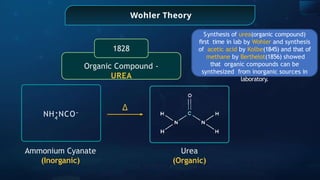
Δ
Ammonium Cyanate
(Inorganic)
Urea
(Organic)
4
1828
Organic Compound -
UREA
Wohler Theory
NH+
NCO−
Synthesis of urea(organic compound)
first time in lab by Wohler and synthesis
of acetic acid by Kolbe(1845) and that of
methane by Berthelot(1856) showed
that organic compounds can be
synthesized from inorganic sources in
laboratory.
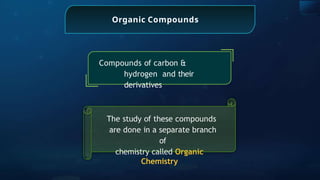
Organic Compounds
Compounds of carbon &
hydrogen and their
derivatives
The study of these compounds
are done in a separate branch
of
chemistry called Organic
Chemistry
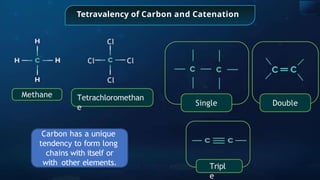
Tetravalency of Carbon and Catenation
Methane
Cl
Cl
Cl Cl
Tetrachloromethan
e
Single Double
Tripl
e
Carbon has a unique
tendency to form long
chains with itself or
with other elements.
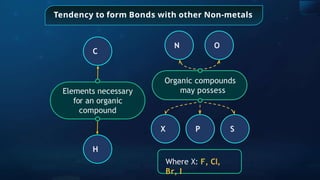
Elements necessary
for an organic
compound
Tendency to form Bonds with other Non-metals
P S
X
Where X: F, Cl,
Br, I
Organic compounds
may possess
N O
C
H
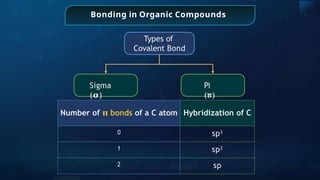
Bonding in Organic Compounds
Types of
Covalent Bond
Sigma
(𝛔)
Pi
(π)
Number of 𝛑 bonds of a C atom Hybridization of C
0 sp3
1 sp2
2 sp
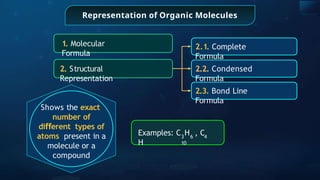
Representation of Organic Molecules
1. Molecular
Formula
2. Structural
Representation
2.2. Condensed
Formula
2.1. Complete
Formula
2.3. Bond Line
Formula
Shows the exact
number of
di erent
ff types of
atoms present in a
molecule or a
compound
Examples: C H , C
H
3 6 4
10
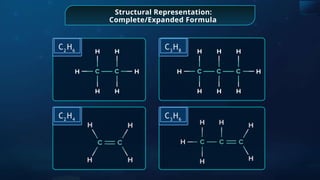
Structural Representation:
Complete/Expanded Formula
C2
H6
C3
H8
C3
H6
C2
H4
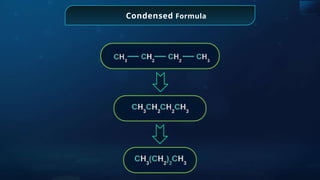
Condensed Formula
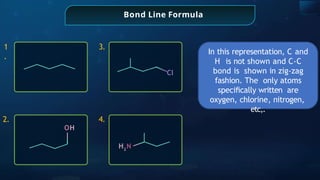
Bond Line Formula
1
.
2.
3.
4.
Cl
OH
H2
N
In this representation, C and
H is not shown and C-C
bond is shown in zig-zag
fashion. The only atoms
specifically written are
oxygen, chlorine, nitrogen,
etc,.
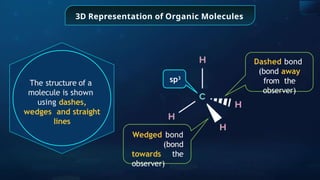
3D Representation of Organic Molecules
Wedged bond
(bond
towards the
observer)
sp3
Dashed bond
(bond away
from the
observer)
The structure of a
molecule is shown
using dashes,
wedges and straight
lines
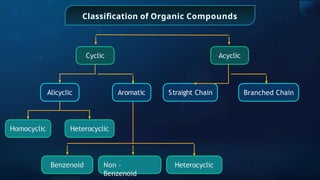
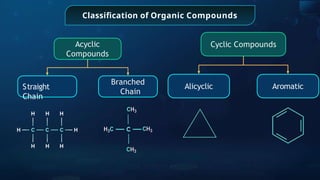
Acyclic
Straight Chain Branched Chain
Cyclic
Alicyclic Aromatic
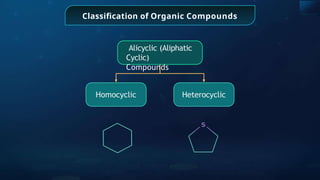
Homocyclic Heterocyclic
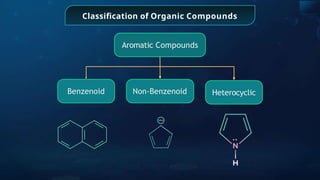
Benzenoid Non -
Benzenoid
Heterocyclic
Classification of Organic Compounds
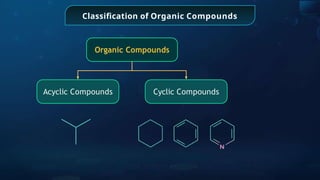
Organic Compounds
Acyclic Compounds Cyclic Compounds
Classification of Organic Compounds
Acyclic
Compounds
Straight
Chain
Branched
Chain
Classification of Organic Compounds
Cyclic Compounds
Alicyclic Aromatic
Classification of Organic Compounds
Alicyclic (Aliphatic
Cyclic)
Compounds
Homocyclic Heterocyclic
Classification of Organic Compounds
..
Aromatic Compounds
Benzenoid Heterocyclic
Non-Benzenoid
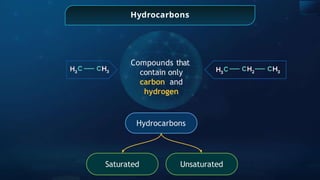
Hydrocarbons
Compounds that
contain only
carbon and
hydrogen
Hydrocarbons
Saturated Unsaturated
Saturated and Unsaturated Hydrocarbons
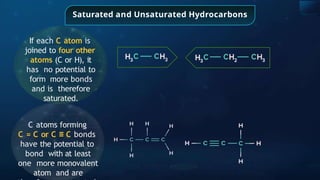
If each C atom is
joined to four other
atoms (C or H), it
has no potential to
form more bonds
and is therefore
saturated.
C atoms forming
C = C or C ≡ C bonds
have the potential to
bond with at least
one more monovalent
atom and are
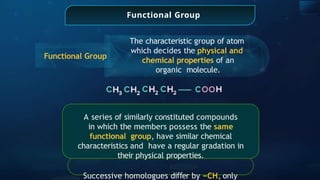
Functional Group
The characteristic group of atom
which decides the physical and
chemical properties of an
organic molecule.
Functional Group
A series of similarly constituted compounds
in which the members possess the same
functional group, have similar chemical
characteristics and have a regular gradation in
their physical properties.
Successive homologues di er
ff by −CH only
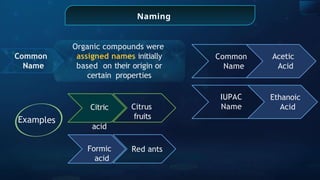
Citric
acid
Citrus
fruits
Formic
acid
Red ants
Naming
Common
Name
Organic compounds were
assigned names initially
based on their origin or
certain properties
Examples
Acetic
Acid
Common
Name
Ethanoic
Acid
IUPAC
Name
IUPAC
Standard rules
set by
International Union
of Pure and
Applied Chemistry
(IUPAC)
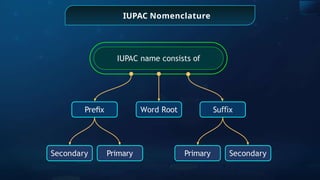
IUPAC Nomenclature
IUPAC name consists of
Secondary Primary Secondary
Primary
Prefix Word Root Su x
ffi
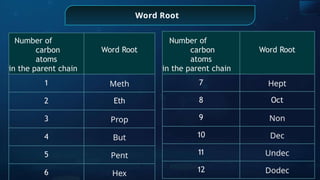
Word Root
Number of
carbon
atoms
in the parent chain
Word Root
1 Meth
2 Eth
3 Prop
4 But
5 Pent
6 Hex
Number of
carbon
atoms
in the parent chain
Word Root
7 Hept
8 Oct
9 Non
10 Dec
11 Undec
12 Dodec
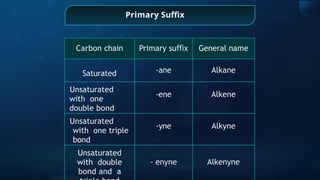
Primary Suffix
Carbon chain Primary su x
ffi General name
Saturated -ane Alkane
Unsaturated
with one
double bond
-ene Alkene
Unsaturated
with one triple
bond
-yne Alkyne
Unsaturated
with double
bond and a
- enyne Alkenyne
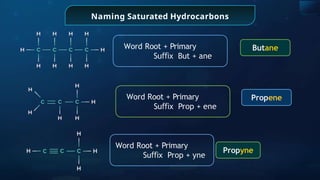
Naming Saturated Hydrocarbons
Word Root + Primary
Su x
ffi But + ane
Butane
Propene
Word Root + Primary
Su x
ffi Prop + ene
Word Root + Primary
Su x
ffi Prop + yne
Propyne
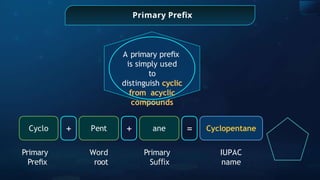
Primary Prefix
A primary prefix
is simply used
to
distinguish cyclic
from acyclic
compounds
Cyclo + Pent + ane = Cyclopentane
Primary
Prefix
Word
root
Primary
Su x
ffi
IUPAC
name
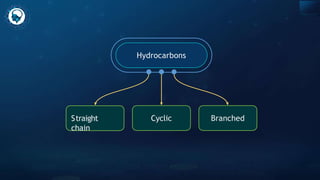
Hydrocarbons
Straight
chain
Cyclic Branched
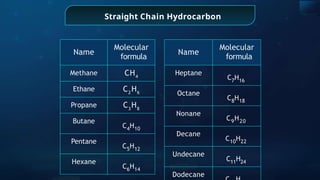
Straight Chain Hydrocarbon
Name
Molecular
formula
Methane CH4
Ethane C2
H6
Propane C3
H8
Butane
C4H10
Pentane
C5H12
Hexane
C6H14
Name
Molecular
formula
Heptane
C7H16
Octane
C8H18
Nonane
C9H20
Decane
C10H22
Undecane
C11H24
Dodecane
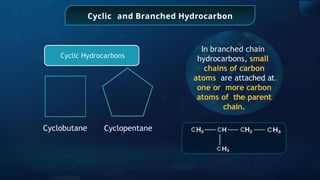
Cyclic and Branched Hydrocarbon
Cyclopentane
Cyclobutane
In branched chain
hydrocarbons, small
chains of carbon
atoms are attached at
one or more carbon
atoms of the parent
chain.
Cyclic Hydrocarbons
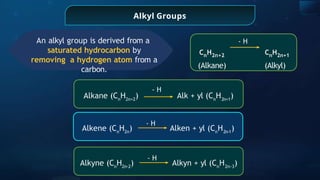
Alkyl Groups
An alkyl group is derived from a
saturated hydrocarbon by
removing a hydrogen atom from a
carbon.
- H
CnH2n+2
(Alkane)
CnH2n+1
(Alkyl)
Alkane (Cn
H2n+2
) Alk + yl (Cn
H2n+1
)
- H
Alkene (Cn
H2n
) Alken + yl (Cn
H2n-1
)
- H
Alkyne (Cn
H2n-2
) Alkyn + yl (Cn
H2n-3
)
- H
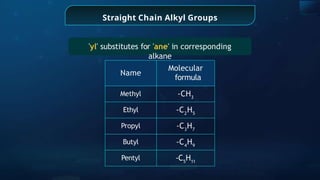
Name
Molecular
formula
Methyl -CH3
Ethyl -C2
H5
Propyl -C3
H7
Butyl -C4
H9
Pentyl -C5
H11
Straight Chain Alkyl Groups
'yl' substitutes for 'ane' in corresponding
alkane
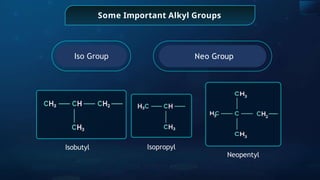
Some Important Alkyl Groups
Iso Group
Isobutyl Isopropyl
Neo Group
Neopentyl
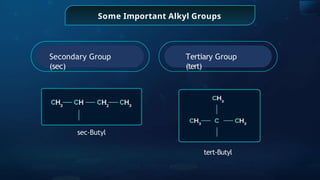
Some Important Alkyl Groups
Secondary Group
(sec)
sec-Butyl
Tertiary Group
(tert)
tert-Butyl
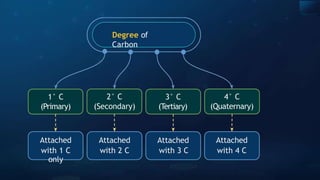
Degree of
Carbon
1° C 2° C 3° C 4° C
(Primary) (Secondary) (Tertiary) (Quaternary)
Attached Attached Attached Attached
with 1 C
only
with 2 C with 3 C with 4 C
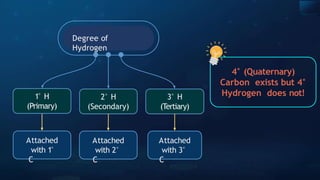
Degree of
Hydrogen
1
° H
(Primary)
3° H
(Tertiary)
2° H
(Secondary)
Attached
with 1
°
C
Attached
with 2°
C
Attached
with 3°
C
4° (Quaternary)
Carbon exists but 4°
Hydrogen does not!
NomenclaĨure of
SaĨuraĨed
Hydrocarbons (Alkanes)
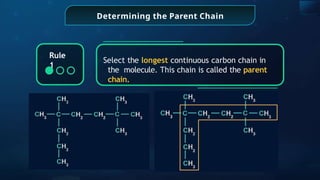
Determining the Parent Chain
Select the longest continuous carbon chain in
the molecule. This chain is called the parent
chain.
Rule
1
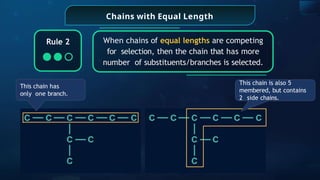
Chains with Equal Length
When chains of equal lengths are competing
for selection, then the chain that has more
number of substituents/branches is selected.
Rule 2
This chain has
only one branch.
This chain is also 5
membered, but contains
2 side chains.
Chains with Equal Number of Substituents
When the number of substituents are the same,
then the substituents at the nearest positions
from either end is preferred for parent chain
selection.
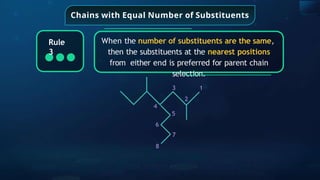
Rule
3
3
2
4
5
6
7
8
1
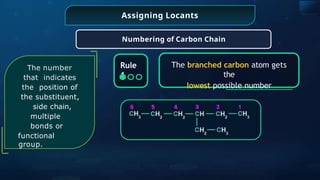
Assigning Locants
The branched carbon atom gets
the
lowest possible number
Rule
1
Numbering of Carbon Chain
The number
that indicates
the position of
the substituent,
side chain,
multiple
bonds or
functional
group.
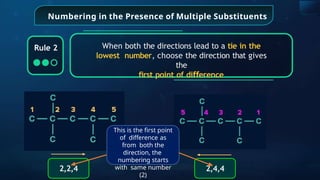
When both the directions lead to a tie in the
lowest number, choose the direction that gives
the
first point of di erence
ff
Rule 2
Numbering in the Presence of Multiple Substituents
2,2,4 2,4,4
This is the first point
of difference as
from both the
direction, the
numbering starts
with same number
(2)
Substituents in Alphabetical Order
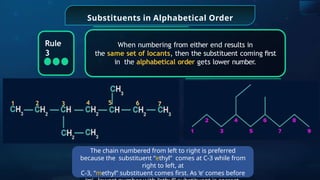
When numbering from either end results in
the same set of locants, then the substituent coming first
in the alphabetical order gets lower number.
Rule
3
1 3
2 5
4 6 7
The chain numbered from left to right is preferred
because the substituent “ethyl” comes at C-3 while from
right to left, at
C-3, “methyl” substituent comes first. As ‘e’ comes before
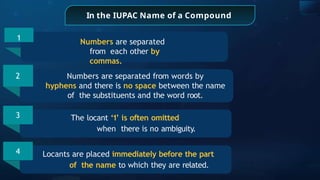
In the IUPAC Name of a Compound
1 Numbers are separated
from each other by
commas.
2 Numbers are separated from words by
hyphens and there is no space between the name
of the substituents and the word root.
3
4 Locants are placed immediately before the part
of the name to which they are related.
The locant ‘1’ is often omitted
when there is no ambiguity.
Secondary Prefix
Substituen
t group
Secondary
prefix
- R Alkyl
Secondary prefixes are added immediately
before the primary prefix with their appropriate
locations in alphabetical order to denote
the side chains or substituent groups.
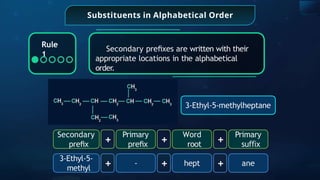
Substituents in Alphabetical Order
Secondary prefixes are written with their
appropriate locations in the alphabetical
order.
Rule
1
Primary
prefix
Word
root
Primary
su x
ffi
Secondary
prefix
3-Ethyl-5-
methyl
- hept ane
+
+
+
+
+
+
3-Ethyl-5-methylheptane
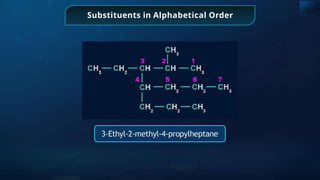
3-Ethyl-2-methyl-4-propylheptane
Substituents in Alphabetical Order
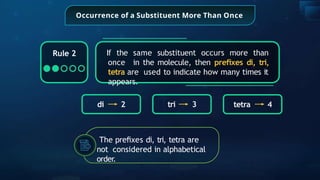
Occurrence of a Substituent More Than Once
If the same substituent occurs more than
once in the molecule, then prefixes di, tri,
tetra are used to indicate how many times it
appears.
di 2 tri 3 tetra 4
Rule 2
The prefixes di, tri, tetra are
not considered in alphabetical
order.
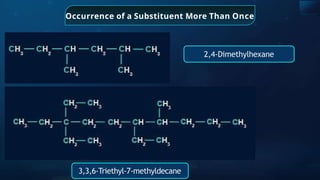
2,4-Dimethylhexane
Occurrence of a Substituent More Than Once
3,3,6-Triethyl-7-methyldecane
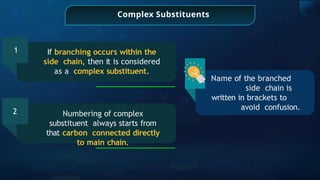
1 If branching occurs within the
side chain, then it is considered
as a complex substituent.
2 Numbering of complex
substituent always starts from
that carbon connected directly
to main chain.
Complex Substituents
Name of the branched
side chain is
written in brackets to
avoid confusion.
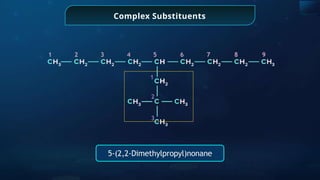
Complex Substituents
1 3
2 5
4 6 7 9
8
1
2
3
5-(2,2-Dimethylpropyl)nonane
Deciding the Alphabetical Order
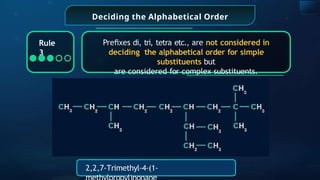
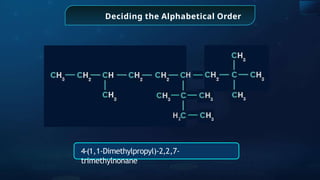
Prefixes di, tri, tetra etc., are not considered in
deciding the alphabetical order for simple
substituents but
are considered for complex substituents.
Rule
3
2,2,7-Trimethyl-4-(1-
Deciding the Alphabetical Order
4-(1,1-Dimethylpropyl)-2,2,7-
trimethylnonane
H
H2
Presence of Similar Complex Substituents
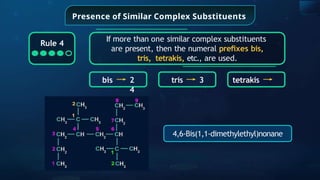
Rule 4
If more than one similar complex substituents
are present, then the numeral prefixes bis,
tris, tetrakis, etc., are used.
bis 2 tris 3 tetrakis
4
4,6-Bis(1,1-dimethylethyl)nonane
Deciding the Alphabetical Order
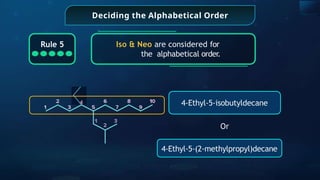
Iso & Neo are considered for
the alphabetical order.
Rule 5
4 4-Ethyl-5-isobutyldecane
Or
4-Ethyl-5-(2-methylpropyl)decane
Point to Remember!!
Names such as isopropyl, sec-butyl and
tert-butyl are acceptable substituent names
in the IUPAC system. But systematic
substituent
names are preferable.
Nomenclature of
Unsaturated
Hydrocarbons
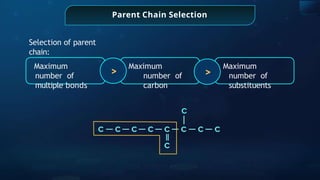
Parent Chain Selection
Maximum
number of
multiple bonds
Maximum
number of
carbon
Maximum
number of
substituents
> >
Selection of parent
chain:
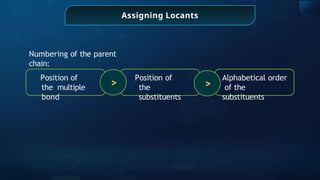
Assigning Locants
Position of
the multiple
bond
Position of
the
substituents
Alphabetical order
of the
substituents
> >
Numbering of the parent
chain:
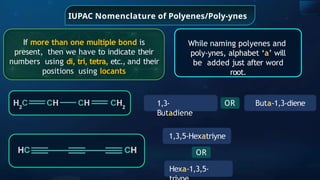
IUPAC Nomenclature of Polyenes/Poly-ynes
While naming polyenes and
poly-ynes, alphabet ‘a’ will
be added just after word
root.
If more than one multiple bond is
present, then we have to indicate their
numbers using di, tri, tetra, etc., and their
positions using locants
1,3-
Butadiene
Buta-1,3-diene
OR
1,3,5-Hexatriyne
OR
Hexa-1,3,5-
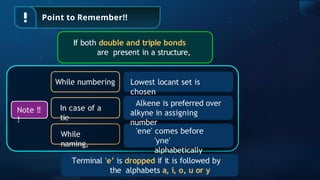
Point to Remember!!
If both double and triple bonds
are present in a structure,
Note !!
!
While
naming,
'ene' comes before
'yne'
alphabetically
While numbering Lowest locant set is
chosen
In case of a
tie
Alkene is preferred over
alkyne in assigning
number
Terminal 'e’ is dropped if it is followed by
the alphabets a, i, o, u or y
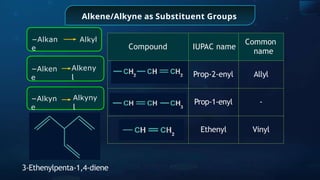
Alkene/Alkyne as Substituent Groups
3-Ethenylpenta-1,4-diene
−Alkan
e
Alkyl
−Alken
e
Alkeny
l
−Alkyn
e
Alkyny
l
Compound IUPAC name
Common
name
Prop-2-enyl Allyl
Prop-1-enyl -
Ethenyl Vinyl
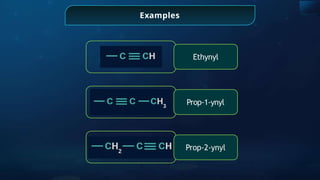
Examples
Ethynyl
Prop-1-ynyl
Prop-2-ynyl
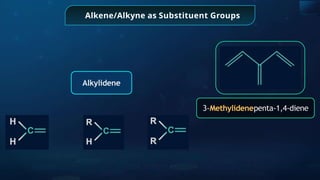
Alkene/Alkyne as Substituent Groups
3-Methylidenepenta-1,4-diene
Alkylidene
Nomenclature of Cyclic
Hydrocarbons
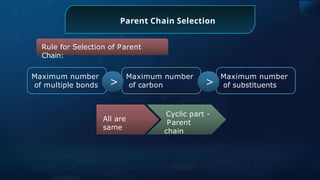
Parent Chain Selection
All are
same
Cyclic part -
Parent
chain
Maximum number
of multiple bonds
Maximum number
of carbon
Maximum number
of substituents
>
>
Rule for Selection of Parent
Chain:
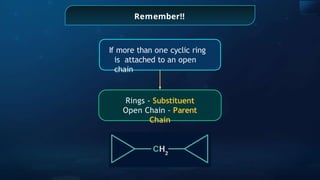
Remember!!
Rings - Substituent
Open Chain - Parent
Chain
If more than one cyclic ring
is attached to an open
chain
Assigning Locants
Numbering of the parent
chain:
If cyclic part
is present as
a
substituent
Cyclo is considered
in alphabetical
order
Position of
the multiple
bond
Position of
the
substituent
Alphabetical order
of the
substituents
> >
1
2
3 1
2
3
6
5
4
5
4
Nomenclature of
Organic Compounds
with Functional Groups
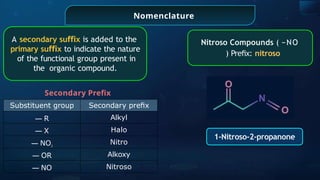
Nomenclature
1-Nitroso-2-propanone
Nitroso Compounds ( −NO
) Prefix: nitroso
A secondary su x
ffi is added to the
primary su x
ffi to indicate the nature
of the functional group present in
the organic compound.
Substituent group Secondary prefix
— R Alkyl
— X Halo
— NO2
Nitro
— OR Alkoxy
— NO Nitroso
Secondary Prefix
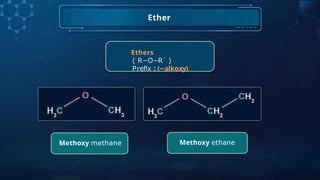
Methoxy methane
Ethers
( R−O−R΄ )
Prefix : ( al
− koxy)
Methoxy ethane
Ether
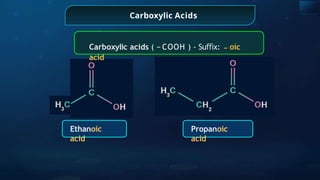
Ethanoic
acid
Propanoic
acid
Carboxylic Acids
Carboxylic acids ( − COOH ) - Su x:
ffi − oic
acid
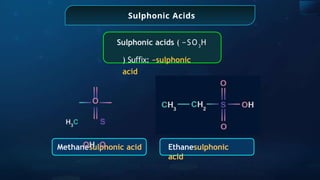
Sulphonic Acids
Methanesulphonic acid Ethanesulphonic
acid
Sulphonic acids ( −SO3
H
) Su x:
ffi −sulphonic
acid
O
H3
C S
OH O
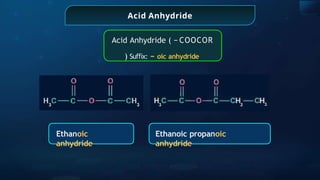
Acid Anhydride
Ethanoic
anhydride
Ethanoic propanoic
anhydride
Acid Anhydride ( − COOCOR
) Su x:
ffi − oic anhydride
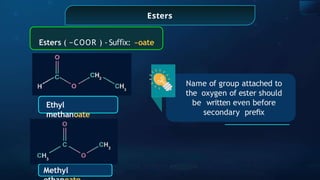
Esters
Ethyl
methanoate
Methyl
Esters ( −COOR ) - Su x:
ffi −oate
Name of group attached to
the oxygen of ester should
be written even before
secondary prefix
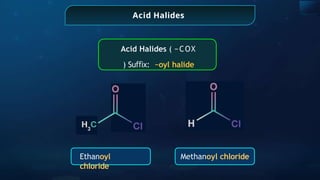
Ethanoyl
chloride
Methanoyl chloride
Acid Halides
Acid Halides ( −COX
) Su x:
ffi −oyl halide
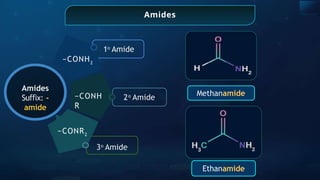
Amides
2o
Amide
1o
Amide
−CONH2
Amides
Su x:
ffi -
amide
−CONH
R
−CONR2
3o
Amide
Methanamide
Ethanamide
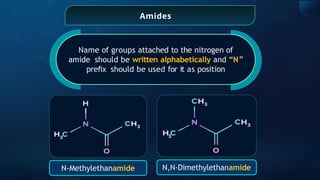
N,N-Dimethylethanamide
N-Methylethanamide
Amides
Name of groups attached to the nitrogen of
amide should be written alphabetically and “N”
prefix should be used for it as position
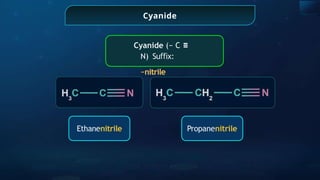
Ethanenitrile Propanenitrile
Cyanide
Cyanide (− C ≡
N) Su x:
ffi
−nitrile
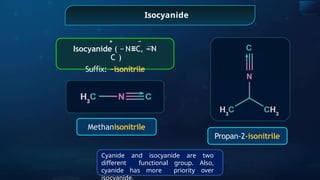
Isocyanide
Methanisonitrile
+ −
Isocyanide ( − N≡C, − N
C )
Su x:
ffi −isonitrile
Propan-2-isonitrile
Cyanide and isocyanide are two
different functional group. Also,
cyanide has more priority over
isocyanide.
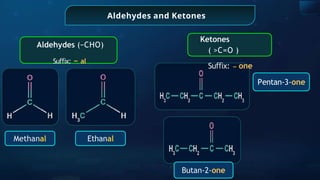
Aldehydes and Ketones
Methanal Ethanal
Aldehydes (−CHO)
Su x:
ffi − al
Pentan-3-one
Butan-2-one
Ketones
( >C=O )
Su x:
ffi − one
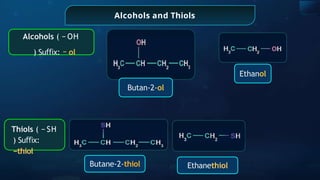
Alcohols and Thiols
Butan-2-ol
Ethanol
Alcohols ( − OH
) Su x:
ffi − ol
Butane-2-thiol Ethanethiol
Thiols ( − SH
) Su x:
ffi
−thiol
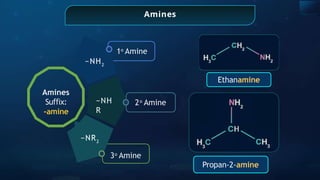
Amines
2o
Amine
1o
Amine
−NH2
Amines
Su x:
ffi
-amine
−NH
R
−NR2
3o
Amine
Ethanamine
Propan-2-amine
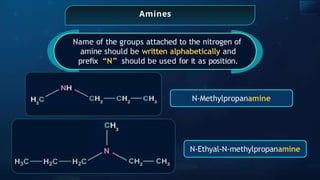
Amines
Name of the groups attached to the nitrogen of
amine should be written alphabetically and
prefix “N” should be used for it as position.
N-Methylpropanamine
N-Ethyal-N-methylpropanamine
IUPAC Nomenclature of
Compounds
Containing Functional
Groups
>
>
>
>
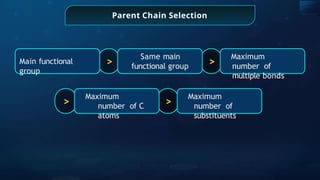
Parent Chain Selection
Maximum
number of
substituents
Maximum
number of C
atoms
Maximum
number of
multiple bonds
Same main
functional group
Main functional
group
> >
> >
Assigning Locants
When all things are
identical, then
alphabetical order
Maximum
number of
side chains
Multiple bonds
(ene > yne)
Same main
functional group
Main functional
group
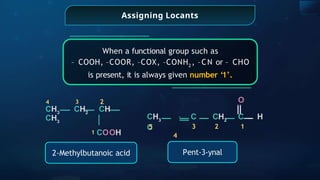
Assigning Locants
When a functional group such as
– COOH, –COOR, –COX, –CONH2
, –CN or – CHO
is present, it is always given number ‘1’.
2-Methylbutanoic acid Pent-3-ynal
O
1 COOH
4 3 2
CH3
CH2
CH
CH3
C CH2
C H
3 2 1
CH3
C
4
5
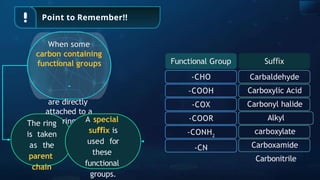
Point to Remember!!
The ring
is taken
as the
parent
chain
When some
carbon containing
functional groups
are directly
attached to a
ring A special
su x
ffi is
used for
these
functional
groups.
Functional Group
-CHO
-COOH
-COX
-COOR
-CONH2
-CN
Su x
ffi
Carbaldehyde
Carboxylic Acid
Carbonyl halide
Alkyl
carboxylate
Carboxamide
Carbonitrile
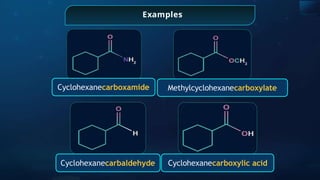
Examples
Cyclohexanecarboxamide Methylcyclohexanecarboxylate
Cyclohexanecarbaldehyde Cyclohexanecarboxylic acid
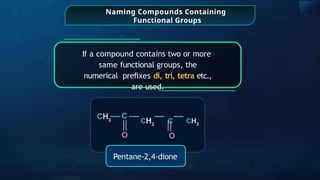
Naming Compounds Containing
Functional Groups
If a compound contains two or more
same functional groups, the
numerical prefixes di, tri, tetra etc.,
are used.
C
CH3
O
Pentane-2,4-dione
O
CH2
C CH3
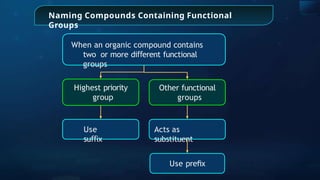
When an organic compound contains
two or more di erent
ff functional
groups
Other functional
groups
Highest priority
group
Acts as
substituent
Use
su x
ffi
Use prefix
Naming Compounds Containing Functional
Groups
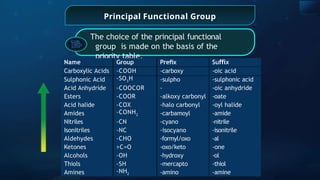
Principal Functional Group
The choice of the principal functional
group is made on the basis of the
priority table.
Name Group Prefix Su x
ffi
Carboxylic Acids -COOH -carboxy -oic acid
Sulphonic Acid -SO3
H -sulpho -sulphonic acid
Acid Anhydride -COOCOR - -oic anhydride
Esters -COOR -alkoxy carbonyl -oate
Acid halide -COX -halo carbonyl -oyl halide
Amides -CONH2 -carbamoyl -amide
Nitriles -CN -cyano -nitrile
Isonitriles -NC -isocyano -isonitrile
Aldehydes -CHO -formyl/oxo -al
Ketones >C=O -oxo/keto -one
Alcohols -OH -hydroxy -ol
Thiols -SH -mercapto -thiol
Amines -NH2 -amino -amine
Some Important Points
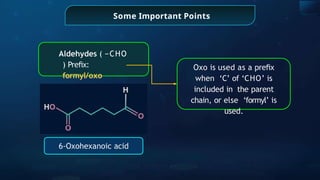
6-Oxohexanoic acid
Aldehydes ( −CHO
) Prefix:
formyl/oxo
Oxo is used as a prefix
when ‘C’ of ‘CHO’ is
included in the parent
chain, or else ‘formyl’ is
used.
Some Important Points
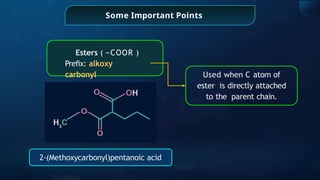
2-(Methoxycarbonyl)pentanoic acid
Esters ( −COOR )
Prefix: alkoxy
carbonyl Used when C atom of
ester is directly attached
to the parent chain.
Some Important Points
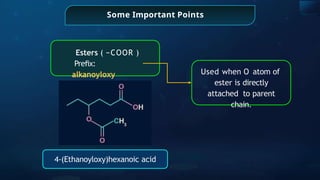
Used when O atom of
ester is directly
attached to parent
chain.
Esters ( −COOR )
Prefix:
alkanoyloxy
4-(Ethanoyloxy)hexanoic acid
Nomenclature of
Aromatic
Compounds
Aromatic Compounds
Benzene is the
simplest
aromatic
hydrocarbon
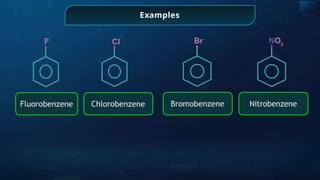
In many simple compounds, benzene is the parent
name
and the substituent is simply indicated by a prefix.
Examples
Fluorobenzene Chlorobenzene
F Cl
Bromobenzene Nitrobenzene
Br NO2
Nomenclature of Benzene Derivatives
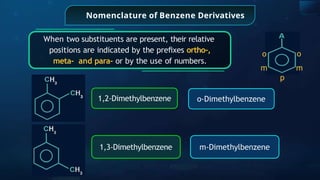
When two substituents are present, their relative
positions are indicated by the prefixes ortho-,
meta- and para- or by the use of numbers.
o
m
p
o
m
1,2-Dimethylbenzene o-Dimethylbenzene
1,3-Dimethylbenzene m-Dimethylbenzene
Nomenclature of Benzene Derivatives
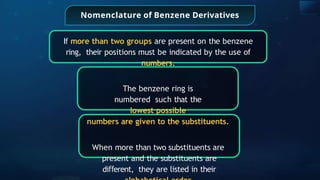
If more than two groups are present on the benzene
ring, their positions must be indicated by the use of
numbers.
The benzene ring is
numbered such that the
lowest possible
numbers are given to the substituents.
When more than two substituents are
present and the substituents are
di erent,
ff they are listed in their
Nomenclature of Benzene Derivatives
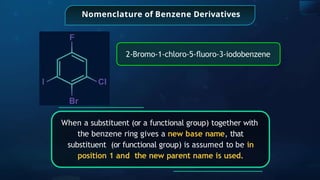
2-Bromo-1-chloro-5-fluoro-3-iodobenzene
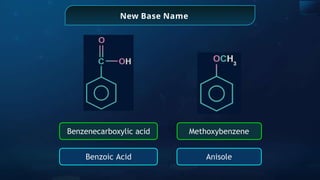
When a substituent (or a functional group) together with
the benzene ring gives a new base name, that
substituent (or functional group) is assumed to be in
position 1 and the new parent name is used.
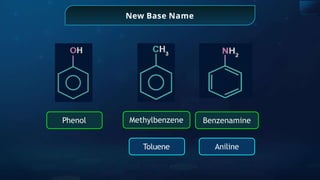
New Base Name
Toluene Aniline
Methylbenzene Benzenamine
Phenol
New Base Name
Methoxybenzene
Benzoic Acid
Benzenecarboxylic acid
Anisole
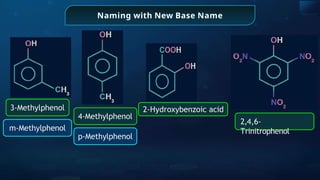
Naming with New Base Name
3-Methylphenol
4-Methylphenol
m-Methylphenol
p-Methylphenol
2-Hydroxybenzoic acid
2,4,6-
Trinitrophenol
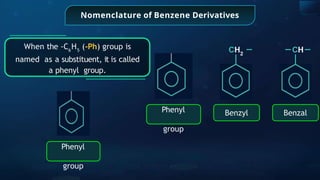
Nomenclature of Benzene Derivatives
When the -C6
H5
(-Ph) group is
named as a substituent, it is called
a phenyl group.
Phenyl
group
Phenyl
group
Benzyl
CH2
Benzal
CH
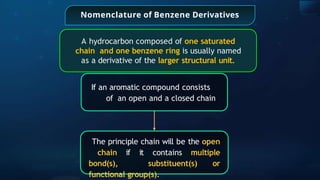
Nomenclature of Benzene Derivatives
A hydrocarbon composed of one saturated
chain and one benzene ring is usually named
as a derivative of the larger structural unit.
If an aromatic compound consists
of an open and a closed chain
The principle chain will be the open
chain if it contains multiple
bond(s), substituent(s) or
functional group(s).
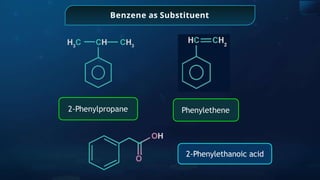
Benzene as Substituent
2-Phenylpropane Phenylethene
CH CH3
H3
C
2-Phenylethanoic acid
OH
O
Isomerism
The phenomenon
of existence of two or
more compounds
possessing the same
molecular formula but
different properties is
known as isomerism.
Such compounds
are known as
isomers.
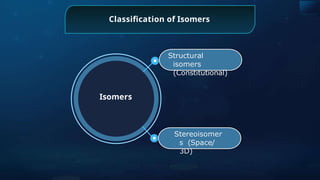
Isomerism
Structural
isomers
(Constitutional)
Stereoisomer
s (Space/
3D)
Isomers
Classification of Isomers
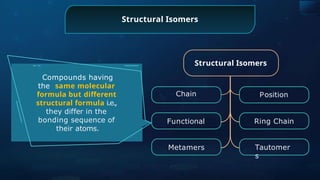
Compounds having
the same molecular
formula but different
structural formula i.e.,
they differ in the
bonding sequence of
their atoms.
Structural Isomers
Structural Isomers
Chain Position
Tautomer
s
Functional Ring Chain
Metamers
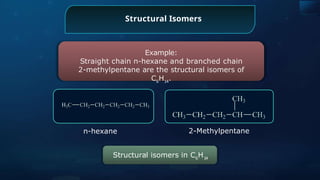
n-hexane 2-Methylpentane
Structural isomers in C6
H1
4
Example:
Straight chain n-hexane and branched chain
2-methylpentane are the structural isomers of
C6
H14
.
Structural Isomers
Stereo Isomers
Isomers that have
the same bonding
sequence of atoms
& groups but differ
from each other
only in the way
their atoms are
oriented in space
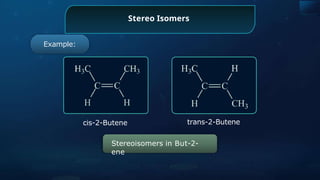
cis-2-Butene trans-2-Butene
Example:
Stereo Isomers
Stereoisomers in But-2-
ene
Chain Isomers
Di erent
ff number of
carbon atoms in the main
chain or in the side
chains or both
Compounds having the
same molecular formula
but di erent
ff carbon
skeletons
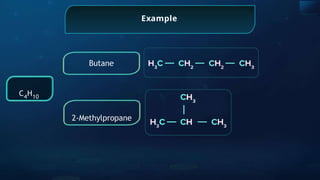
Example
Butane
C4H10
2-Methylpropane
C5H12
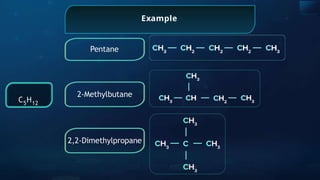
Example
Pentane
2-Methylbutane
2,2-Dimethylpropane
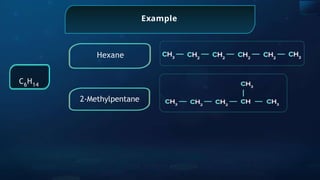
Example
Hexane
2-Methylpentane
C6H14
Position Isomers
Compounds having the same
size of the main chain & the
side chain along with the
same nature of functional
group
But di er
ff in the position
of multiple bond/
functional group/
substituent
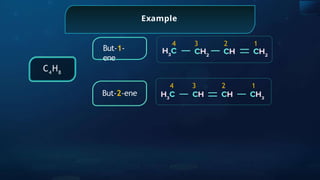
Example
But-1-
ene
But-2-ene
4 3 2 1
C4
H8
4 3 2 1
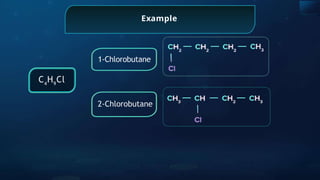
Example
1-Chlorobutane
2-Chlorobutane
C4
H9
Cl
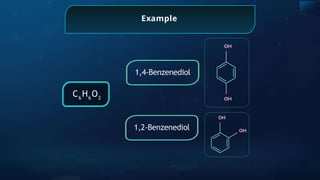
Example
1,2-Benzenediol
1,4-Benzenediol
C6
H6
O2
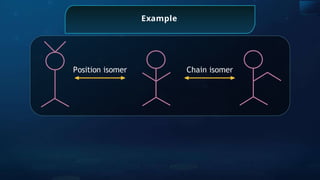
Example
Chain isomer
Position isomer
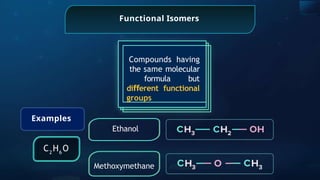
Functional Isomers
Compounds having
the same molecular
formula but
di erent
ff functional
groups
Examples
Ethanol
C2
H6
O
Methoxymethane
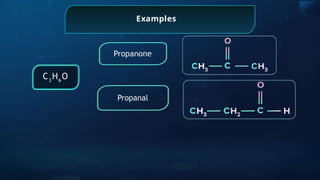
Examples
Propanone
Propanal
C3
H6
O
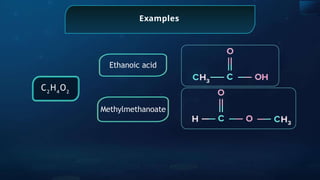
Examples
Ethanoic acid
Methylmethanoate
C2
H4
O2
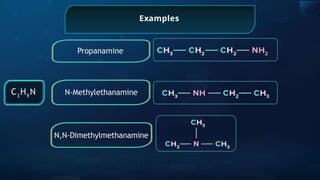
Examples
Propanamine
N-Methylethanamine
N,N-Dimethylmethanamine
C3
H9
N
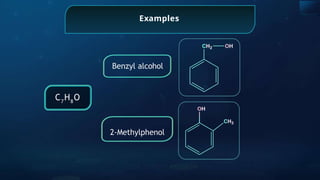
Examples
Benzyl alcohol
C7
H8
O
2-Methylphenol
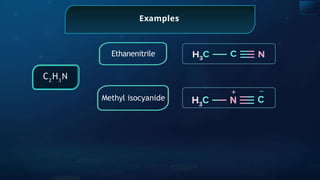
Examples
+ _
Ethanenitrile
Methyl isocyanide
C2
H3
N
One isomer has a ring &
the other has an aliphatic
chain.
Ring-Chain isomers are
also functional
isomers.
Ring-Chain Isomers
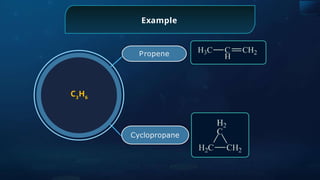
Propene
C3
H6
Cyclopropane
Example
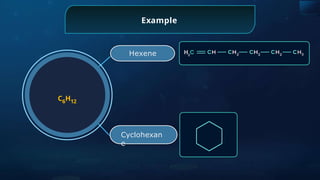
Example
H2
C
Hexene
C6H12
Cyclohexan
e
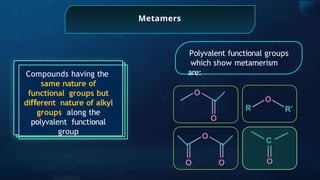
Metamers
Compounds having the
same nature of
functional groups but
di erent
ff nature of alkyl
groups along the
polyvalent functional
group
Polyvalent functional groups
which show metamerism
are:
O
O
O
O
O
O
C
O
R’
R
N
O
C
NH
H
N
O
C
N S
Thioether
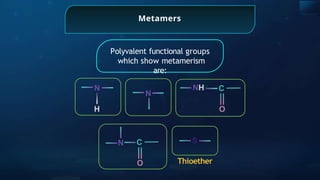
Metamers
Polyvalent functional groups
which show metamerism
are:
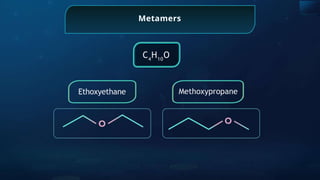
Metamers
Ethoxyethane Methoxypropane
C4
H10
O
Metamers
C4
H11
N
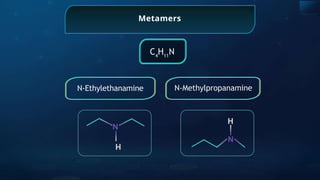
N-Ethylethanamine N-Methylpropanamine
N
H
N
H
Metamers
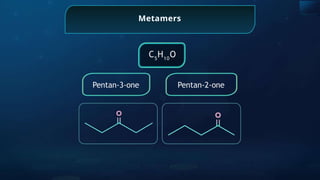
C5
H10
O
Pentan-3-one Pentan-2-one
Tautomerism
Phenomenon by which a single
compound exists in two or more
readily interconvertible
structures that di er
ff in the
relative positions of at least one
atomic nucleus, generally
hydrogen.
Isomers exhibiting
tautomerism are called
tautomers.
Tautomerism
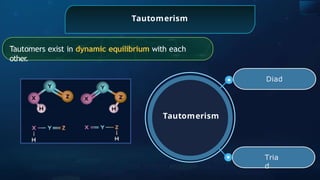
Tautomers exist in dynamic equilibrium with each
other.
Diad
Tria
d
Tautomerism
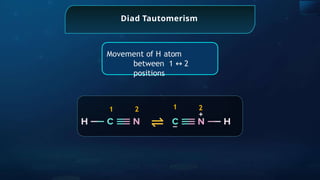
Diad Tautomerism
+
1
_
2
Movement of H atom
between 1 ↔ 2
positions
⇌
1 2
Diad Tautomerism
HNC
HCN &
Tautomer
s
RNC
RCN &
Functional
group isomers
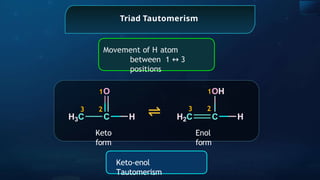
Triad Tautomerism
Movement of H atom
between 1 ↔ 3
positions
1
2
1
3
3 2
Keto
form
Enol
form
⇌
Keto-enol
Tautomerism
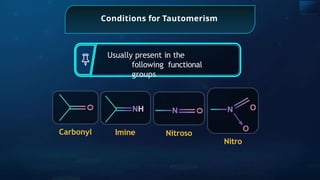
Conditions for Tautomerism
O
NH N
O
N
Usually present in the
following functional
groups
O
Carbonyl Imine Nitroso
O
Nitro
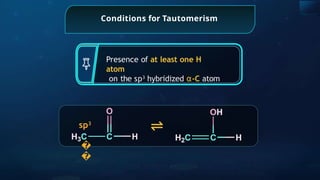
Conditions for Tautomerism
Presence of at least one H
atom
on the sp3
hybridized ⍺-C atom
�
�
sp3
⇌
Conditions for Tautomerism
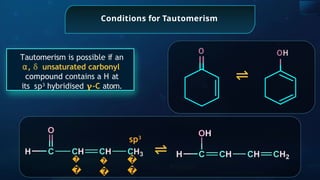
Tautomerism is possible if an
⍺, ẟ unsaturated carbonyl
compound contains a H at
its sp3
hybridised 𝛄-C atom.
⇌
OH
O
�
�
�
�
�
�
⇌
sp3
Keto-Enol Tautomerism
Keto
form
Enol
form
.
.
.
.
.
.
..
⇌
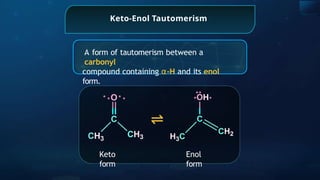
A form of tautomerism between a
carbonyl
compound containing ⍺-H and its enol
form.
Keto-Enol Tautomerism
↽
⇀
> 99 %
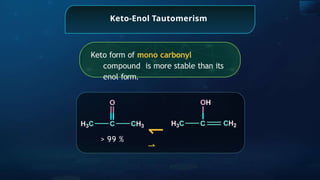
Keto form of mono carbonyl
compound is more stable than its
enol form.
Keto-Enol Tautomerism
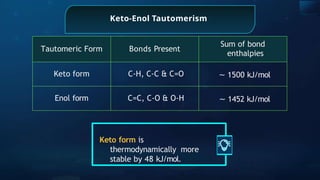
Tautomeric Form Bonds Present
Sum of bond
enthalpies
Keto form C-H, C-C & C=O ∼ 1500 kJ/mol
Enol form C=C, C-O & O-H ∼ 1452 kJ/mol
Keto form is
thermodynamically more
stable by 48 kJ/mol.
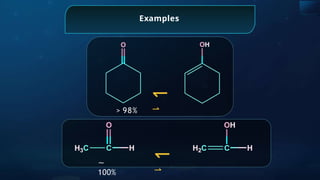
Examples
↽
⇀
> 98%
↽
⇀
∼
100%
Keto-Enol Tautomerism
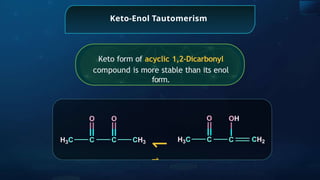
Keto form of acyclic 1,2-Dicarbonyl
compound is more stable than its enol
form.
↽
⇀
Keto-Enol Tautomerism
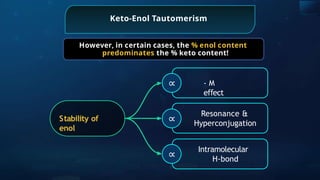
However, in certain cases, the % enol content
predominates the % keto content!
Stability of
enol
Intramolecular
H-bond
Resonance &
Hyperconjugation
- M
e ect
ff
∝
∝
∝
Keto-Enol Tautomerism
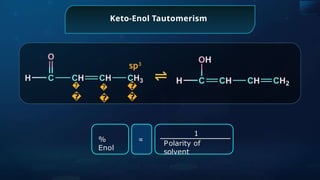
�
�
�
�
�
�
⇌
sp3
%
Enol
∝
1
Polarity of
solvent
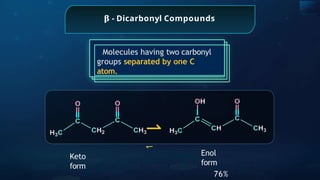
𝛃 - Dicarbonyl Compounds
Keto
form
⇀
↽
Molecules having two carbonyl
groups separated by one C
atom.
Enol
form
76%
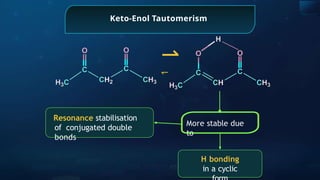
Keto-Enol Tautomerism
Resonance stabilisation
of conjugated double
bonds
⇀
↽
More stable due
to
H bonding
in a cyclic
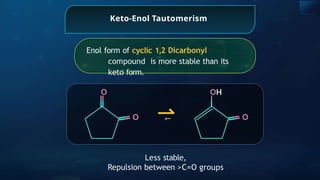
Keto-Enol Tautomerism
Enol form of cyclic 1,2 Dicarbonyl
compound is more stable than its
keto form.
O
O
O
HO
Less stable,
Repulsion between >C=O groups
⇀
⇀
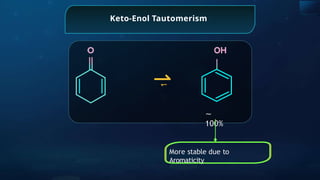
Keto-Enol Tautomerism
∼
100%
More stable due to
Aromaticity
⇀
⇀
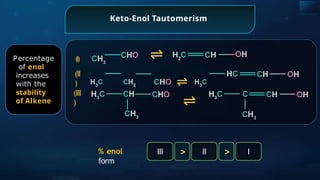
Keto-Enol Tautomerism
H3
C CH CHO
CH3
OH
H3
C C CH
CH3
⇌
III II
> I
>
% enol
form
H2
C CH OH
HC CH OH
CHO ⇌
H3
C CH2 CHO ⇌ H3
C
(I) CH3
(II
)
(III
)
Percentage
of enol
increases
with the
stability
of Alkene
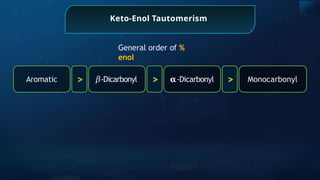
Keto-Enol Tautomerism
Aromatic 𝛽-Dicarbonyl
> 𝛂-Dicarbonyl
> Monocarbonyl
>
General order of %
enol
How to decide the type of
isomerism if multiple types are
possible?
F
M
C
P
Functional
Metamers
Chain
Position
R
T
Ring chain
Tautomer
s
Follow
RTFMCP!!
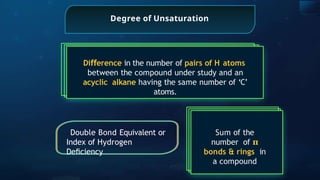
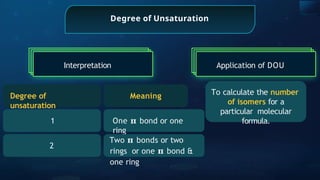
Degree of Unsaturation
Di erence
ff in the number of pairs of H atoms
between the compound under study and an
acyclic alkane having the same number of ‘C’
atoms.
Double Bond Equivalent or
Index of Hydrogen
Deficiency
Sum of the
number of 𝛑
bonds & rings in
a compound
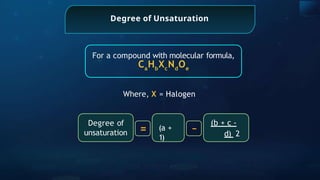
(a +
1)
(b + c -
d) 2
−
=
Degree of
unsaturation
For a compound with molecular formula,
Ca
Hb
Xc
Nd
Oe
Where, X = Halogen
Degree of Unsaturation
Degree of
unsaturation
Meaning
1
2
One 𝛑 bond or one
ring
Two 𝛑 bonds or two
rings or one 𝛑 bond &
one ring
Interpretation
Degree of Unsaturation
Application of DOU
To calculate the number
of isomers for a
particular molecular
formula.
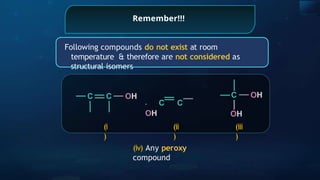
Remember!!!
Following compounds do not exist at room
temperature & therefore are not considered as
structural isomers
C C OH
C C
OH
(iv) Any peroxy
compound
(i
)
(ii
)
C OH
OH
(iii
)
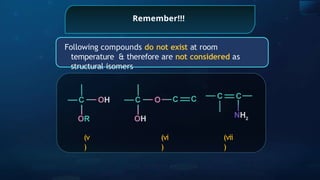
Remember!!!
(v
)
(vi
)
(vii
)
C
C O
OH
C C C
NH2
C OH
OR
Following compounds do not exist at room
temperature & therefore are not considered as
structural isomers
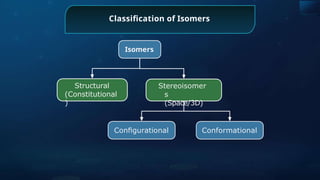
Classification of Isomers
Configurational Conformational
Isomers
Structural
(Constitutional
)
Stereoisomer
s
(Space/3D)
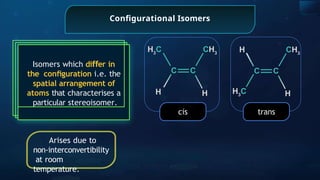
Configurational Isomers
Isomers which di er
ff in
the configuration i.e. the
spatial arrangement of
atoms that characterises a
particular stereoisomer.
Arises due to
non-interconvertibility
at room
temperature.
CH3
H3
C
H H
C C
CH3
H
H3
C H
C C
cis trans
Conformational Isomers
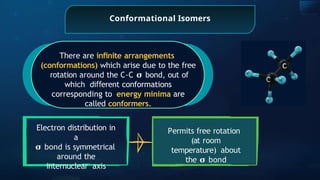
There are infinite arrangements
(conformations) which arise due to the free
rotation around the C-C 𝛔 bond, out of
which di erent
ff conformations
corresponding to energy minima are
called conformers.
Permits free rotation
(at room
temperature) about
the 𝛔 bond
Electron distribution in
a
𝛔 bond is symmetrical
around the
internuclear axis
Conformational Isomers
Basic structure of the molecule,
bond lengths and bond angles
remain the same in all the
conformations.
Conformational isomers are not to
be considered while evaluating the
number of isomers of any molecule.
Less
energy
di erence
ff
Interconverts
rapidly.
Not
true
isomers.
General
Organic
Chemistry
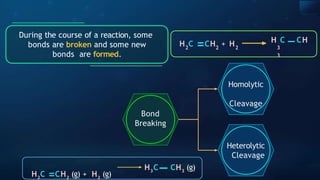
During the course of a reaction, some
bonds are broken and some new
bonds are formed.
2
H C CH + H
2 2
= H C _ CH
3
3
H3
C CH3
(g)
H2
C =CH2
(g) + H2
(g)
_
Homolytic
Cleavage
Bond
Breaking
Heterolytic
Cleavage
Bond Cleavage
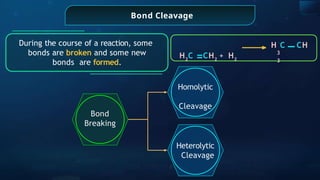
During the course of a reaction, some
bonds are broken and some new
bonds are formed.
H2
C =CH2
+ H2
H C _ CH
3
3
Homolytic
Cleavage
Bond
Breaking
Heterolytic
Cleavage
Bond Cleavage
Represented
by
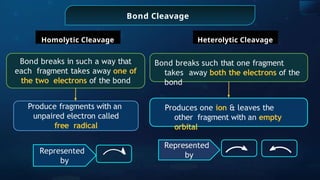
Bond breaks in such a way that
each fragment takes away one of
the two electrons of the bond
Produce fragments with an
unpaired electron called
free radical
Bond breaks such that one fragment
takes away both the electrons of the
bond
Produces one ion & leaves the
other fragment with an empty
orbital
Represented
by
Homolytic Cleavage Heterolytic Cleavage
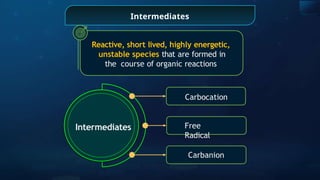
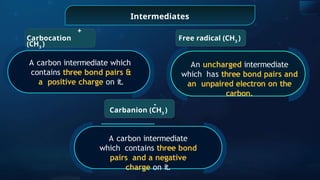
Intermediates
Reactive, short lived, highly energetic,
unstable species that are formed in
the course of organic reactions
Carbocation
Free
Radical
Carbanion
Intermediates
Intermediates
+
Carbocation
(CH3
)
A carbon intermediate which
contains three bond pairs &
a positive charge on it.
An uncharged intermediate
which has three bond pairs and
an unpaired electron on the
carbon.
A carbon intermediate
which contains three bond
pairs and a negative
charge on it.
Carbanion (CH3
)
-
Free radical (CH3
)
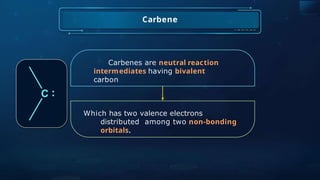
Carbene
Which has two valence electrons
distributed among two non-bonding
orbitals.
Carbenes are neutral reaction
intermediates having bivalent
carbon
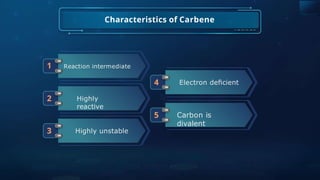
Characteristics of Carbene
1 Reaction intermediate
2 Highly
reactive
3 Highly unstable
4 Electron deficient
5 Carbon is
divalent
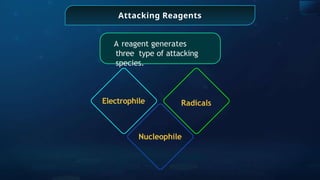
Electrophile
Nucleophile
Radicals
A reagent generates
three type of attacking
species.
Attacking Reagents
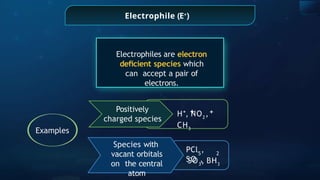
Electrophile (E+
)
Electrophiles are electron
deficient species which
can accept a pair of
electrons.
Positively
charged species
5 2
PCl ,
SO ,
SO3
, BH3
+
H , NO2
,
CH3
Species with
vacant orbitals
on the central
atom
Examples
+ +
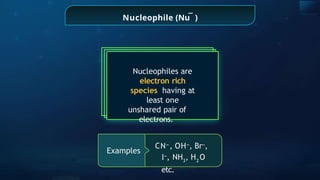
Nucleophile (Nu )
Nucleophiles are
electron rich
species having at
least one
unshared pair of
electrons.
Examples
CN‒
, OH‒
, Br‒
,
I‒
, NH3
, H2
O
etc.
_
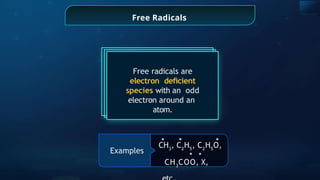
Free Radicals
Free radicals are
electron deficient
species with an odd
electron around an
atom.
Examples
CH3
, C2
H5
, C2
H5
O,
CH3
COO, X,
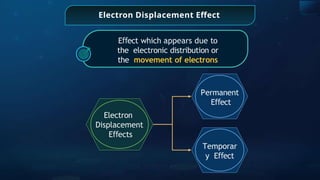
Electron Displacement Effect
E ect
ff which appears due to
the electronic distribution or
the movement of electrons
Permanent
E ect
ff
Electron
Displacement
E ects
ff
Temporar
y E ect
ff
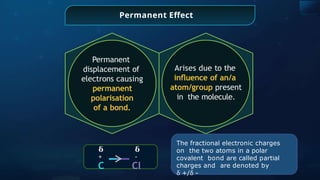
Permanent Effect
Arises due to the
influence of an/a
atom/group present
in the molecule.
Permanent
displacement of
electrons causing
permanent
polarisation
of a bond.
𝛅
+
C
𝛅
-
Cl
The fractional electronic charges
on the two atoms in a polar
covalent bond are called partial
charges and are denoted by
ẟ +/ẟ -
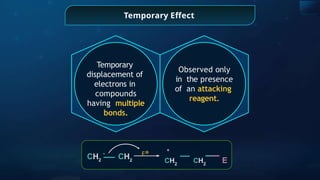
Temporary Effect
Observed only
in the presence
of an attacking
reagent.
Temporary
displacement of
electrons in
compounds
having multiple
bonds.
CH2
CH2
E⊕
CH2
CH2
E
+
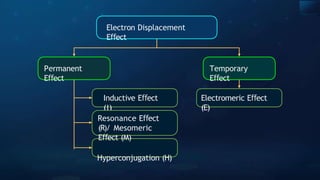
Electron Displacement
E ect
ff
Permanent
E ect
ff
Temporary
E ect
ff
Inductive E ect
ff
(I)
Resonance E ect
ff
(R)/ Mesomeric
E ect
ff (M)
Hyperconjugation (H)
Electromeric E ect
ff
(E)
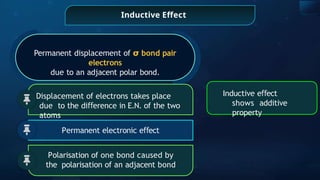
Inductive Effect
Inductive e ect
ff
shows additive
property
Permanent displacement of 𝞂 bond pair
electrons
due to an adjacent polar bond.
Displacement of electrons takes place
due to the di erence
ff in E.N. of the two
atoms
Permanent electronic e ect
ff
Polarisation of one bond caused by
the polarisation of an adjacent bond
Characteristics of Inductive Effect
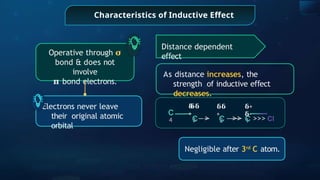
Operative through 𝛔
bond & does not
involve
𝛑 bond electrons.
Electrons never leave
their original atomic
orbital
Negligible after 3rd
C atom.
As distance increases, the
strength of inductive e ect
ff
decreases.
1
2
3
C
4 C > C >> C >>> Cl
𝛅
𝛅𝛅
+
𝛅𝛅
+
𝛅+
𝛅-
Distance dependent
e ect
ff
Inductive Effect
+I E ect
ff
Inductive
E ect
ff
−I
E ect
ff
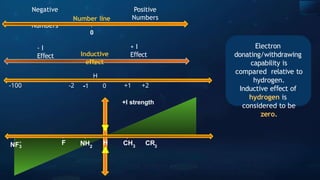
Positive
Numbers
Negative
Numbers
+ I
E ect
ff
- I
E ect
ff
Number line
0
Inductive
e ect
ff
H
0
-1
-2
-100 +1 +2
+I strength
H 3
CH CR3
NH2
F
3
NF+
Electron
donating/withdrawing
capability is
compared relative to
hydrogen.
Inductive e ect
ff of
hydrogen is
considered to be
zero.
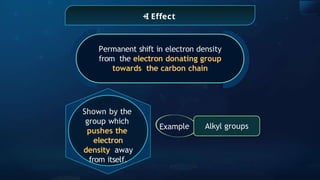
+I Effect
Permanent shift in electron density
from the electron donating group
towards the carbon chain
Shown by the
group which
pushes the
electron
density away
from itself.
Example Alkyl groups
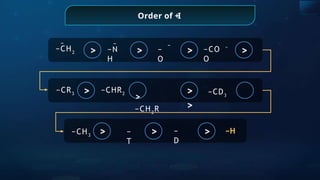
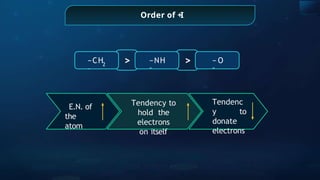
Order of +I
−CH2 −N
H
−
O
−CO
O
−
−CR3
−CHR2
− −
> > > >
> >
−CH2
R
> −CD3
>
>
−CH3
−
T
−
D
−H
> >
−
Order of +I
E.N. of
the
atom
Tendency to
hold the
electrons
on itself
Tendenc
y to
donate
electrons
>
>
2
−CH
−
−NH
−
− O
−
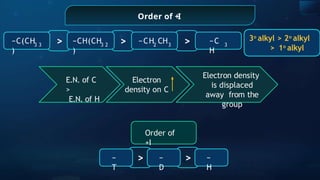
Order of +I
>
>
>
−C(CH
)
3 3
−CH(CH
)
3 2
−CH CH
2 3
−C
H
3
3o
alkyl > 2o
alkyl
> 1o
alkyl
E.N. of C
>
E.N. of H
Electron
density on C
Electron density
is displaced
away from the
group
>
>
−
T
−
D
−
H
Order of
+I
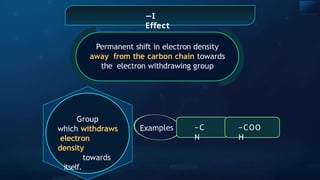
−I
Effect
Permanent shift in electron density
away from the carbon chain towards
the electron withdrawing group
Group
which withdraws
electron
density
towards
itself.
Examples −C
N
−COO
H
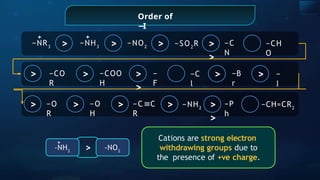
>
−NR3
+
−NH3
+
> −NO2 −SO2
R −C
N
> >
>
−CH
O
> −COO
H
−
F
−C
l
−B
r
>
>
> > −
I
> −CO
R
> −O
H
> −C≡C
R
−NH2
−P
h
> >
>
−CH=CR2
> −O
R
Order of
I
−
>
-NH3
-NO2
+
Cations are strong electron
withdrawing groups due to
the presence of +ve charge.
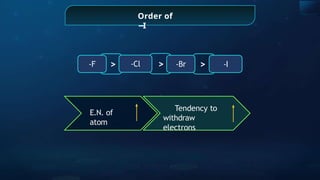
Order of
I
−
E.N. of
atom
Tendency to
withdraw
electrons
>
> -Br -I
> -Cl
-F
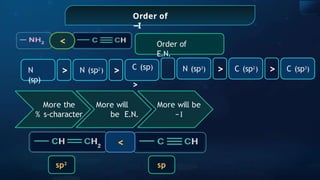
Order of
I
−
< Order of
E.N.
N
(sp)
N (sp2
)
> > C (sp)
>
N (sp3
) C (sp2
) C (sp3
)
> >
More the
% s-character
More will
be E.N.
sp
sp2
<
More will be
−I
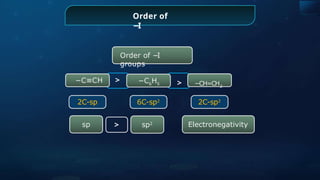
Order of
I
−
Electronegativity
2C-sp
sp sp2
>
Order of −I
groups
−C6
H5
6C-sp2
2C-sp2
−C≡CH > > −CH=CH2
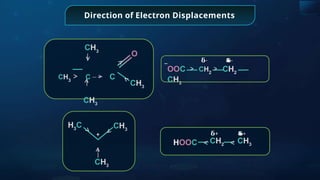
Direction of Electron Displacements
CH3
O
>
>
>
>
CH3
CH3
> C > C
CH3
_ 𝛅- 𝛅
𝛅-
OOC > CH2
> CH2
CH3
HOOC
𝛅+ 𝛅
𝛅+
CH2
CH3
> >
H3
C CH3
CH3
>
>
>
+
Applications of Inductive Effect
Relative stability of
intermediates
Acidic/Basic Strength
1
.
2.
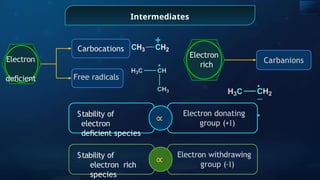
Intermediates
Electron
deficient
Carbocations
Free radicals
Electron
rich
Carbanions
+
.
.
−
.
∝
Stability of
electron
deficient species
Electron donating
group (+I)
∝
Stability of
electron rich
species
Electron withdrawing
group (-I)
Acid Dissociation Constant for HA
[HA]
a
K
=
_ [H+
] [A
_
]
+ pKa
-log Ka
=
HA ⇌ H + A
Acidic
strength
Stability of the
conjugate
base
∝
∝
∝
1
Presence of E.D.G.
(+I)
Presence of E.W.G. (-
I)
For a Base ‘B’
2
B + H O ⇌
pKb
– log Kb
Kb
[ B
]
=
=
BH+
+ OH
_
_
[BH+
] [OH
]
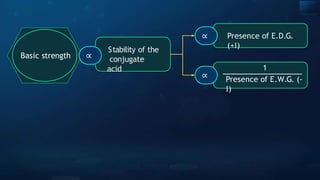
Basic
strength
Stability of the
conjugate
acid
∝
∝
∝
1
Presence of E.W.G. (-
I)
Presence of E.D.G.
(+I)
Basic strength
Stability of the
conjugate
acid
∝
∝
∝
1
Presence of E.W.G. (-
I)
Presence of E.D.G.
(+I)
Resonance
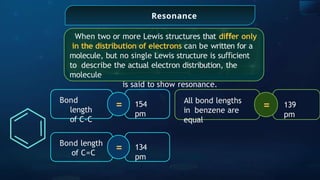
Resonance
When two or more Lewis structures that di er
ff only
in the distribution of electrons can be written for a
molecule, but no single Lewis structure is su cient
ffi
to describe the actual electron distribution, the
molecule
is said to show resonance.
=
Bond
length
of C-C
154
pm
=
Bond length
of C=C
134
pm
=
All bond lengths
in benzene are
equal
139
pm
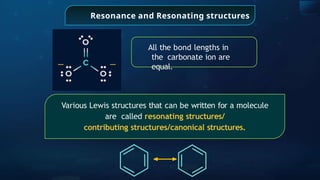
Resonance and Resonating structures
All the bond lengths in
the carbonate ion are
equal.
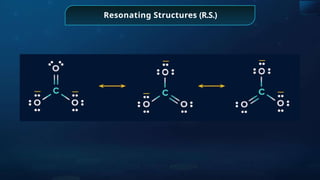
Various Lewis structures that can be written for a molecule
are called resonating structures/
contributing structures/canonical structures.
Resonating Structures (R.S.)
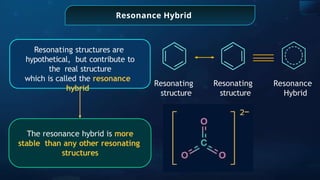
Resonance Hybrid
The resonance hybrid is more
stable than any other resonating
structures
Resonating structures are
hypothetical, but contribute to
the real structure
which is called the resonance
hybrid
Resonating
structure
Resonating
structure
Resonance
Hybrid
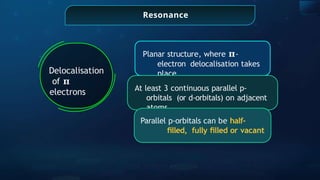
Resonance
Delocalisation
of 𝛑
electrons
Planar structure, where 𝛑-
electron delocalisation takes
place
At least 3 continuous parallel p-
orbitals (or d-orbitals) on adjacent
atoms
Parallel p-orbitals can be half-
filled, fully filled or vacant
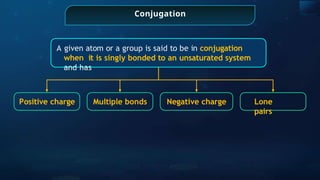
Conjugation
A given atom or a group is said to be in conjugation
when it is singly bonded to an unsaturated system
and has
Multiple bonds
Positive charge Negative charge Lone
pairs
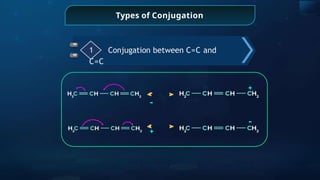
Types of Conjugation
1 Conjugation between C=C and
C=C
-
+
-
+
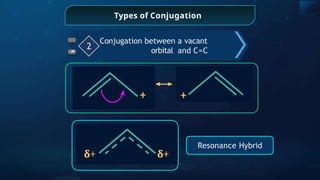
Conjugation between a vacant
orbital and C=C
2
Types of Conjugation
Resonance Hybrid
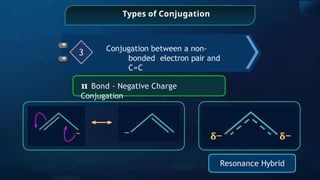
Types of Conjugation
Conjugation between a non-
bonded electron pair and
C=C
3
𝛑 Bond - Negative Charge
Conjugation
Resonance Hybrid
A B
NH2
H H
+
NH2
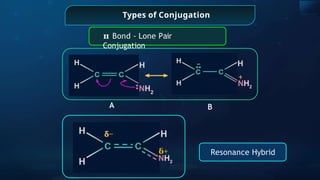
Types of Conjugation
𝛑 Bond - Lone Pair
Conjugation
Resonance Hybrid
H
𝛅+
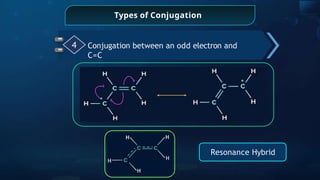
NH2
Conjugation between an odd electron and
C=C
4
Types of Conjugation
Resonance Hybrid
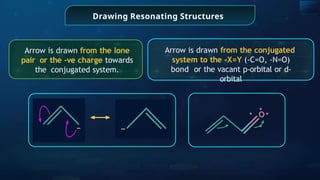
Drawing Resonating Structures
Arrow is drawn from the lone
pair or the -ve charge towards
the conjugated system.
Arrow is drawn from the conjugated
system to the -X=Y (-C=O, -N=O)
bond or the vacant p-orbital or d-
orbital
O
.
.
.
.
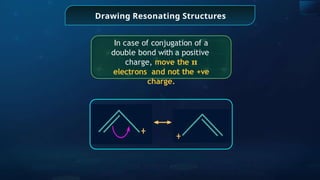
Drawing Resonating Structures
In case of conjugation of a
double bond with a positive
charge, move the 𝛑
electrons and not the +ve
charge.
Rules for Resonating Structures
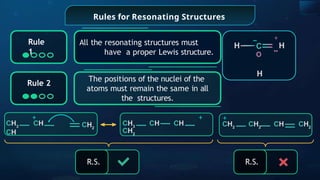
All the resonating structures must
have a proper Lewis structure.
H
H
_
C
O
+
H
Rule
1
Rule 2
The positions of the nuclei of the
atoms must remain the same in all
the structures.
R.S. R.S.
+
CH3
CH CH
CH2
+
CH2
CH2
CH CH2
CH2
+
CH3
CH
CH
Rules for Resonating Structures
All atoms taking part in delocalisation
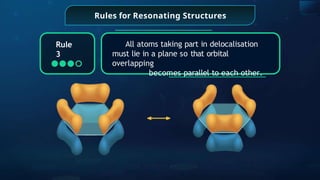
must lie in a plane so that orbital
overlapping
becomes parallel to each other.
Rule
3
Rules for Resonating Structures
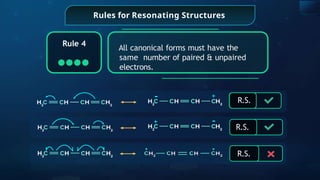
All canonical forms must have the
same number of paired & unpaired
electrons.
Rule 4
- +
-
+
R.S.
R.S.
R.S.
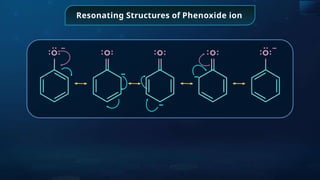
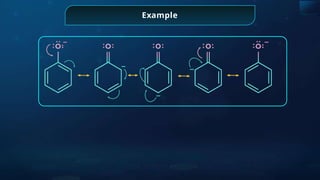
Resonating Structures of Phenoxide ion
−
−
−
−
−
Resonating Structures
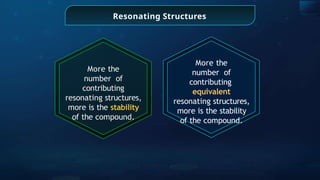
More the
number of
contributing
resonating structures,
more is the stability
of the compound.
More the
number of
contributing
equivalent
resonating structures,
more is the stability
of the compound.
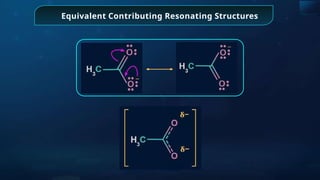
Equivalent Contributing Resonating Structures
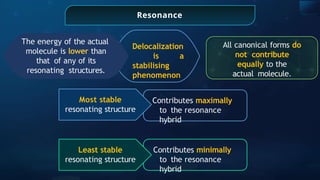
Resonance
The energy of the actual
molecule is lower than
that of any of its
resonating structures.
Delocalization
is a
stabilising
phenomenon
All canonical forms do
not contribute
equally to the
actual molecule.
Most stable
resonating structure
Contributes maximally
to the resonance
hybrid
Least stable
resonating structure
Contributes minimally
to the resonance
hybrid
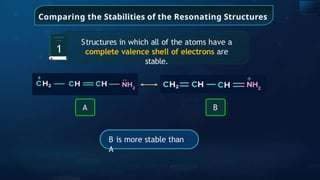
Comparing the Stabilities of the Resonating Structures
Structures in which all of the atoms have a
complete valence shell of electrons are
stable.
1
A B
B is more stable than
A
Comparing the Stabilities of the Resonating Structures
A is more stable than
B
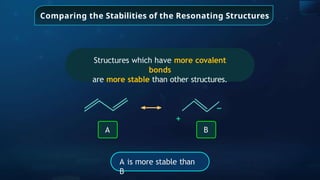
Structures which have more covalent
bonds
are more stable than other structures.
−
+
A B
Comparing the Stabilities of the Resonating Structures
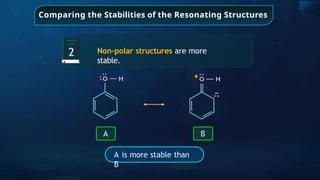
A is more stable than
B
A B
Non-polar structures are more
stable.
2
+
Comparing the Stabilities of the Resonating Structures
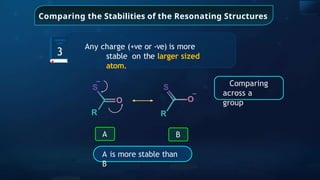
A is more stable than
B
A B
Any charge (+ve or -ve) is more
stable on the larger sized
atom.
3
O
R
S
R
_
S _
O
Comparing
across a
group
Comparing the Stabilities of the Resonating Structures
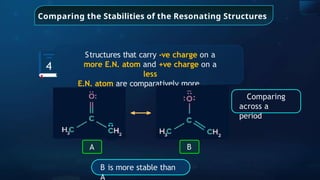
Structures that carry -ve charge on a
more E.N. atom and +ve charge on a
less
E.N. atom are comparatively more
stable.
B is more stable than
A
4
A B
Comparing
across a
period
Point to Remember!!
Distance between
similar charges
Distance between
opposite
charges
Stability
Stability
Number of
Benzenoid rings in
the structure
Stability
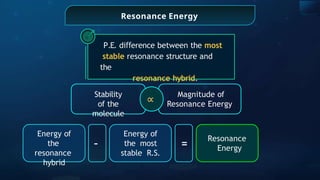
Resonance Energy
P.E. di erence
ff between the most
stable resonance structure and
the
resonance hybrid.
∝
Stability
of the
molecule
Magnitude of
Resonance Energy
Energy of
the
resonance
hybrid
–
Energy of
the most
stable R.S.
=
Resonance
Energy
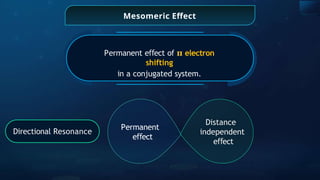
Permanent e ect
ff of 𝛑 electron
shifting
in a conjugated system.
Mesomeric Effect
Distance
independent
e ect
ff
Permanent
e ect
ff
Directional Resonance
Types of Mesomeric Effects
+M
E ect
ff
Mesomeric
E ect
ff
−M
E ect
ff
When the group
donates electron
to the conjugated
system, it shows
+ M e ect.
ff
+M Effect
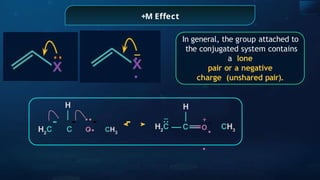
In general, the group attached to
the conjugated system contains
a lone
pair or a negative
charge (unshared pair).
.
.
H2
C C CH3
H
– +
O.
.
H
H2
C C O CH3
..
..
Example
−
−
−
−
−
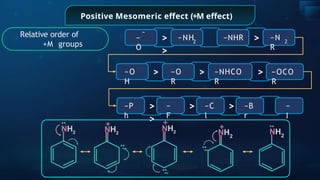
Positive Mesomeric effect (+M effect)
>
>
>
−
O
2
−NH −NHR −N
R
2
>
>
>
−O
H
−O
R
−NHCO
R
−OCO
R
> > >
>
−P
h
−
F
−C
l
−
−B
r
−
I
Relative order of
+M groups
NH2 NH2
NH2
−
+ NH2
−
+
−
NH2
+
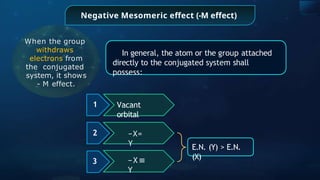
Negative Mesomeric effect (-M effect)
When the group
withdraws
electrons from
the conjugated
system, it shows
- M effect.
−X≡
Y
3
E.N. (Y) > E.N.
(X)
−X=
Y
2
Vacant
orbital
1
In general, the atom or the group attached
directly to the conjugated system shall
possess:
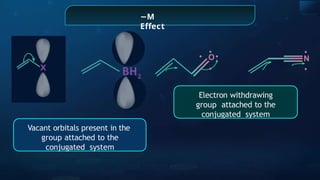
−M
Effect
BH2
Electron withdrawing
group attached to the
conjugated system
Vacant orbitals present in the
group attached to the
conjugated system
O
.
.
.
.
N
.
.
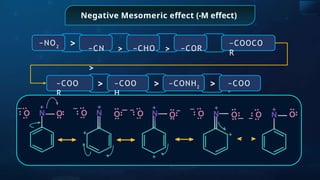
Negative Mesomeric effect (-M effect)
>
>
>
−NO2
>
−COO
H
−CONH2
−CN > −CHO > −COR
>
−COOCO
R
−COO
R
−COO
−
N O N O N O
+ + +
+
N O
+
+
N O
+
O
O
O
O
O +
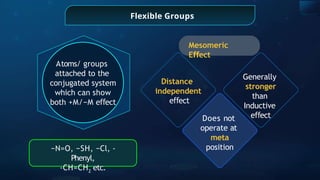
Flexible Groups
Atoms/ groups
attached to the
conjugated system
which can show
both +M/−M e ect
ff
−N=O, −SH, −Cl, -
Phenyl,
-CH=CH2
etc.
Distance
independent
e ect
ff
Does not
operate at
meta
position
Generally
stronger
than
Inductive
e ect
ff
Mesomeric
E ect
ff
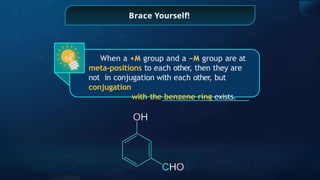
Brace Yourself!
When a +M group and a −M group are at
meta-positions to each other, then they are
not in conjugation with each other, but
conjugation
with the benzene ring exists.
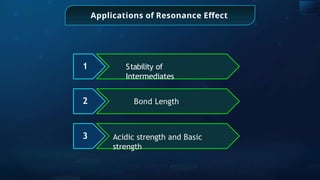
Applications of Resonance Effect
Acidic strength and Basic
strength
2
Stability of
Intermediates
1
Bond Length
3
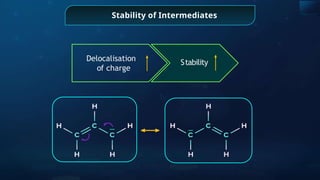
Stability of Intermediates
Delocalisation
of charge
Stability
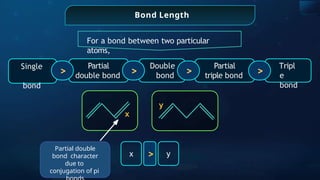
Bond Length
For a bond between two particular
atoms,
>
Single
bond
Partial
double bond >
Double
bond >
Partial
triple bond >
Tripl
e
bond
y
x
x > y
Partial double
bond character
due to
conjugation of pi
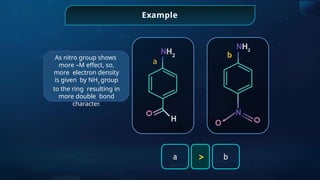
Example
NH2
a
a > b
H
O
NH2
N
O
O
b
As nitro group shows
more –M effect, so,
more electron density
is given by NH2
group
to the ring resulting in
more double bond
character.
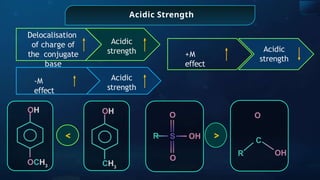
Acidic Strength
Delocalisation
of charge of
the conjugate
base
Acidic
strength
-M
e ect
ff
Acidic
strength
+M
e ect
ff
Acidic
strength
OH
CH3
OCH3
OH
< >
R OH
O
C
R S OH
O
O
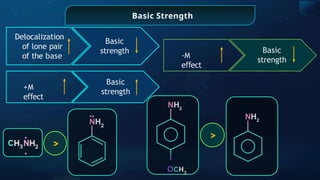
Basic Strength
Delocalization
of lone pair
of the base
Basic
strength
+M
e ect
ff
Basic
strength
-M
e ect
ff
Basic
strength
>
NH2
.
.
NH2
OCH3
>
NH2
Hyperconjugatio
n
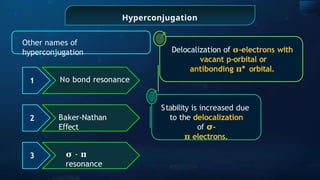
Hyperconjugation
Delocalization of 𝛔-electrons with
vacant p-orbital or
antibonding 𝛑* orbital.
Other names of
hyperconjugation
No bond resonance
1
2
3 𝛔 - 𝛑
resonance
Baker-Nathan
E ect
ff
Stability is increased due
to the delocalization
of 𝞂-
𝛑 electrons.
Alkene
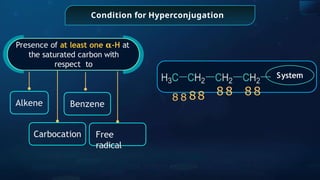
Condition for Hyperconjugation
Presence of at least one 𝛂-H at
the saturated carbon with
respect to
Benzene
Carbocation Free
radical
8 8 8 8
8 8 88
System
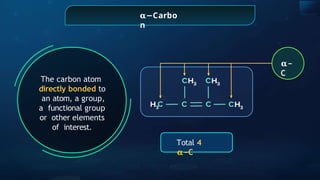
𝛂−Carbo
n
The carbon atom
directly bonded to
an atom, a group,
a functional group
or other elements
of interest.
Total 4
𝛂−C
𝛂−
C
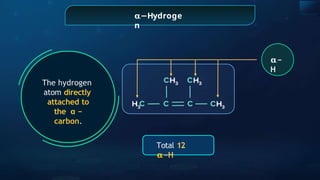
𝛂−Hydroge
n
The hydrogen
atom directly
attached to
the α −
carbon.
Total 12
𝛂−H
𝛂−
H
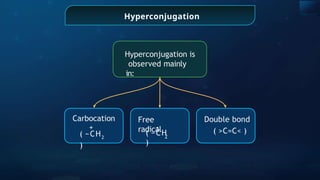
Hyperconjugation
Hyperconjugation is
observed mainly
in:
( −CH2
)
Carbocation
+
Free
radical
2
( −CH
)
Double bond
( >C=C< )
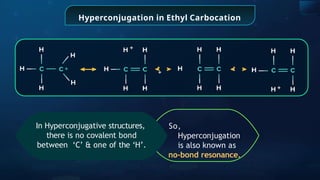
Hyperconjugation in Ethyl Carbocation
+
+
+
+
So,
Hyperconjugation
is also known as
no-bond resonance.
In Hyperconjugative structures,
there is no covalent bond
between ‘C’ & one of the ‘H’.
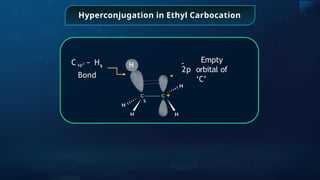
Hyperconjugation in Ethyl Carbocation
Empty
2p orbital of
‘C’
C sp3 − H1
s
Bond
+
H
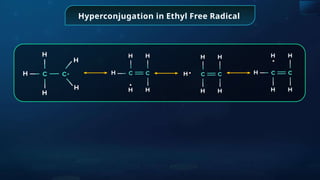
Hyperconjugation in Ethyl Free Radical
Similarly, six more structures can
be drawn using other two
hydrogens.
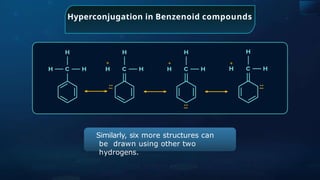
Hyperconjugation in Benzenoid compounds
─
─ ─
+ + +
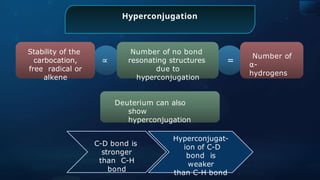
=
∝
Hyperconjugation
Number of no bond
resonating structures
due to
hyperconjugation
Number of
⍺-
hydrogens
Stability of the
carbocation,
free radical or
alkene
Deuterium can also
show
hyperconjugation
Hyperconjugat-
ion of C-D
bond is
weaker
than C-H bond
C-D bond is
stronger
than C-H
bond
Comparisons of
Electronic Effects
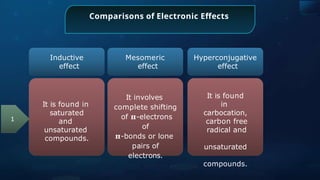
Comparisons of Electronic Effects
Inductive
effect
Mesomeric
effect
It is found in
saturated
and
unsaturated
compounds.
It involves
complete shifting
of 𝛑-electrons
of
𝛑-bonds or lone
pairs of
electrons.
It is found
in
carbocation,
carbon free
radical and
unsaturated
compounds.
1
Hyperconjugative
effect
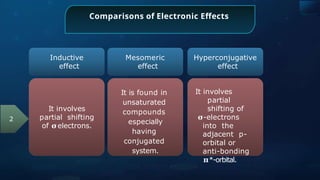
Comparisons of Electronic Effects
Inductive
effect
Mesomeric
effect
2
Hyperconjugative
effect
It involves
partial shifting
of 𝛔electrons.
It is found in
unsaturated
compounds
especially
having
conjugated
system.
It involves
partial
shifting of
𝛔-electrons
into the
adjacent p-
orbital or
anti-bonding
𝛑*-orbital.
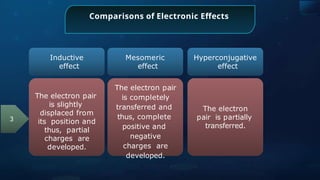
Comparisons of Electronic Effects
Inductive
effect
Mesomeric
effect
The electron pair
is slightly
displaced from
its position and
thus, partial
charges are
developed.
The electron pair
is completely
transferred and
thus, complete
positive and
negative
charges are
developed.
The electron
pair is partially
transferred.
3
Hyperconjugative
effect
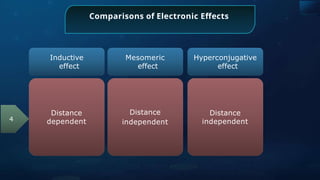
Comparisons of Electronic Effects
Inductive
effect
Mesomeric
effect
Distance
dependent
Distance
independent
Distance
independent
4
Hyperconjugative
effect
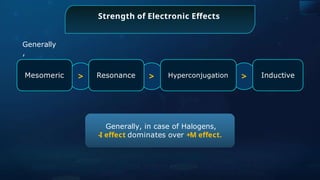
> > >
Strength of Electronic Effects
Generally
,
Resonance
Mesomeric Hyperconjugation Inductive
Generally, in case of Halogens,
-I effect dominates over +M effect.
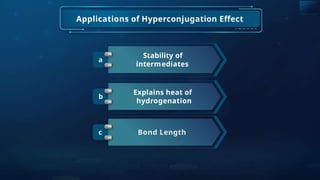
Applications of Hyperconjugation Effect
a
Stability of
intermediates
b
Explains heat of
hydrogenation
c Bond Length
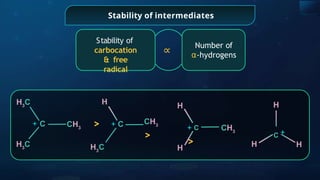
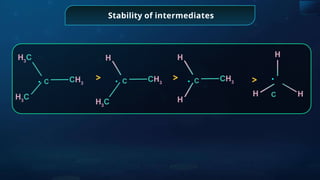
Stability of intermediates
∝
Number of
⍺-hydrogens
Stability of
carbocation
& free
radical
H
H
H
C +
H
H
H
H3
C
+ C
CH3
H3
C
H3
C
+ C > CH3
>
+ C CH3
>
Stability of intermediates
H
H
H
.
C
H
H
CH3
. C
H
CH3
H3
C
. C
CH3
H3
C
H3
C
. C > > >
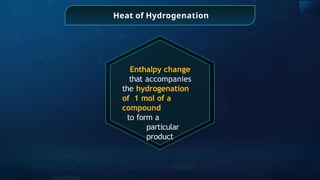
Heat of Hydrogenation
Enthalpy change
that accompanies
the hydrogenation
of 1 mol of a
compound
to form a
particular
product
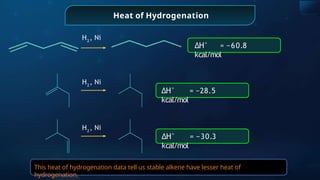
Heat of Hydrogenation
ΔH° = −60.8
kcal/mol
ΔH° = −28.5
kcal/mol
ΔH° = −30.3
kcal/mol
H2
, Ni
H2
, Ni
H2
, Ni
This heat of hydrogenation data tell us stable alkene have lesser heat of
hydrogenation.
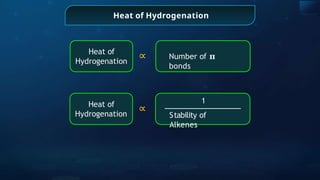
Heat of Hydrogenation
Heat of
Hydrogenation
∝
1
Stability of
Alkenes
Heat of
Hydrogenation
∝ Number of 𝛑
bonds
>
>
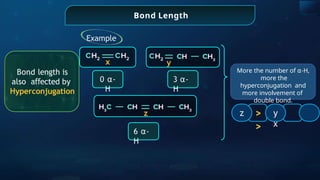
y
x
0 ⍺-
H
3 ⍺-
H
z
6 ⍺-
H
z y
x
Bond Length
Example
Bond length is
also a ected
ff by
Hyperconjugation
More the number of ⍺-H,
more the
hyperconjugation and
more involvement of
double bond.
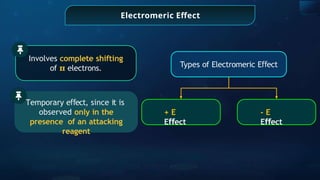
Electromeric Effect
Involves complete shifting
of 𝛑 electrons.
Temporary e ect,
ff since it is
observed only in the
presence of an attacking
reagent
Types of Electromeric E ect
ff
+ E
E ect
ff
- E
E ect
ff
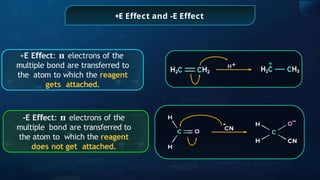
+E Effect and -E Effect
H+ +
+E E ect
ff : 𝛑 electrons of the
multiple bond are transferred to
the atom to which the reagent
gets attached.
-E E ect
ff : 𝛑 electrons of the
multiple bond are transferred to
the atom to which the reagent
does not get attached.
-
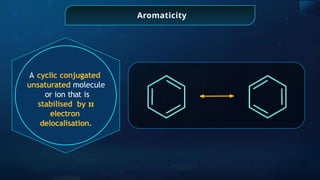
Aromaticity
A cyclic conjugated
unsaturated molecule
or ion that is
stabilised by 𝛑
electron
delocalisation.
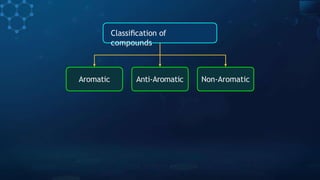
Classification of
compounds
Aromatic Anti-Aromatic Non-Aromatic
Aromatic Compounds
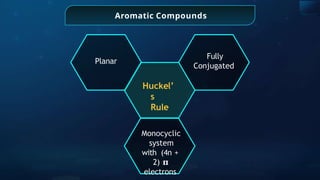
Huckel’
s
Rule
Planar
Monocyclic
system
with (4n +
2) 𝛑
electrons
Fully
Conjugated
Characteristics of Aromaticity
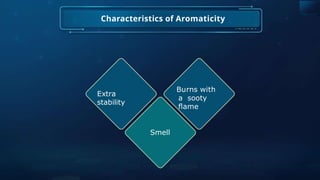
Extra
stability
Burns with
a sooty
flame
Smell
Benzene as an Aromatic Compound
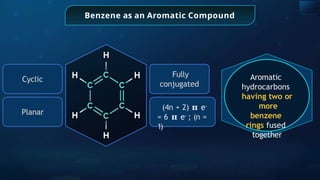
Cyclic
Planar
Fully
conjugated
(4n + 2) 𝛑 e-
= 6 𝛑 e-
; (n =
1)
Aromatic
hydrocarbons
having two or
more
benzene
rings fused
together
Benzenoid Polycyclic Aromatic Hydrocarbons
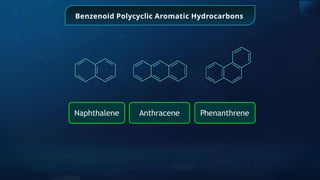
Naphthalene Anthracene Phenanthrene
Anti-Aromatic Compounds
Anti-
Aromatic
Compounds
Planar
Monocyclic
system
with (4n) 𝛑
electrons
Fully
Conjugated
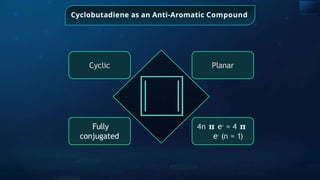
Cyclobutadiene as an Anti-Aromatic Compound
Cyclic Planar
Fully
conjugated
4n 𝛑 e-
= 4 𝛑
e-
(n = 1)
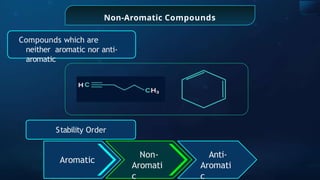
Non-Aromatic Compounds
Compounds which are
neither aromatic nor anti-
aromatic
Stability Order
Aromatic
Non-
Aromati
c
Anti-
Aromati
c
Annulene
It is the general name of
monocyclic systems
having conjugated
polyenes
[8] -
Annulene
Ring size of annulene is
indicated by number in
bracket
Example:
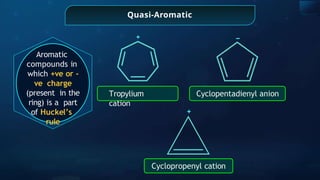
Quasi-Aromatic
Aromatic
compounds in
which +ve or -
ve charge
(present in the
ring) is a part
of Huckel’s
rule
+
Tropylium
cation
Cyclopentadienyl anion
−
+
Cyclopropenyl cation
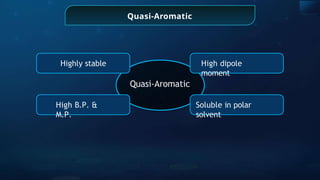
Quasi-Aromatic
Highly stable
Soluble in polar
solvent
High B.P. &
M.P.
High dipole
moment
Quasi-Aromatic
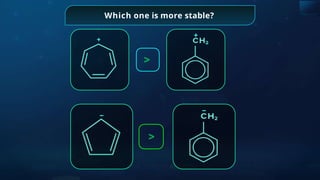
Which one is more stable?
+
+
>
>
−
−
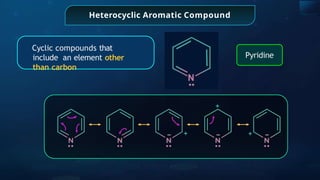
Heterocyclic Aromatic Compound
Pyridine
Cyclic compounds that
include an element other
than carbon
+
+
+
− − −
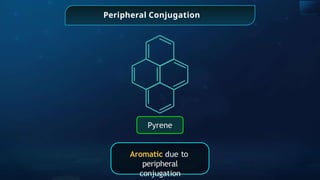
Peripheral Conjugation
Pyrene
Aromatic due to
peripheral
conjugation
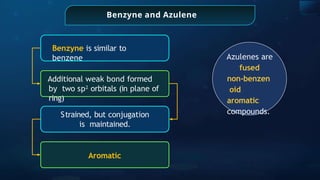
Benzyne and Azulene
Benzyne is similar to
benzene
Additional weak bond formed
by two sp2
orbitals (in plane of
ring)
Strained, but conjugation
is maintained.
Aromatic
Azulenes are
fused
non-benzen
oid
aromatic
compounds.
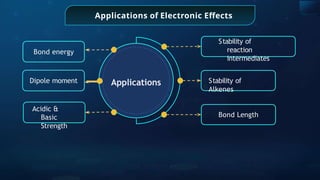
Applications of Electronic Effects
Stability of
reaction
intermediates
Stability of
Alkenes
Bond Length
Applications
Bond energy
Dipole moment
Acidic &
Basic
Strength
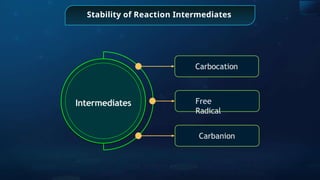
Stability of Reaction Intermediates
Carbocation
Free
Radical
Carbanion
Intermediates
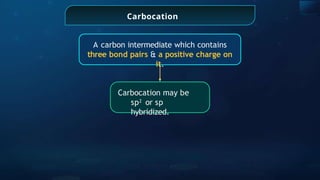
Carbocation
Carbocation may be
sp2
or sp
hybridized.
A carbon intermediate which contains
three bond pairs & a positive charge on
it.
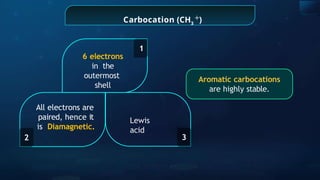
6 electrons
in the
outermost
shell
All electrons are
paired, hence it
is Diamagnetic.
Lewis
acid
Carbocation (CH3
+)
1
2 3
Aromatic carbocations
are highly stable.
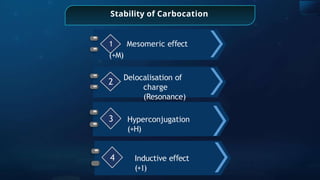
Stability of Carbocation
1 Mesomeric e ect
ff
(+M)
Delocalisation of
charge
(Resonance)
2
Hyperconjugation
(+H)
3
Inductive e ect
ff
(+I)
4
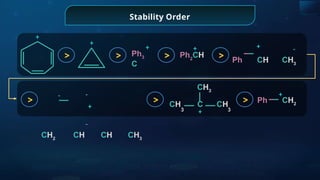
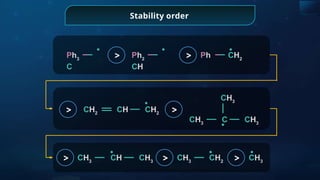
Stability Order
+
+
Ph3
C
Ph2
CH
+ +
Ph CH CH3
3
CH3
3
CH C CH
+
Ph CH2
+
+
CH2
CH CH CH3
+
> > > >
> > >
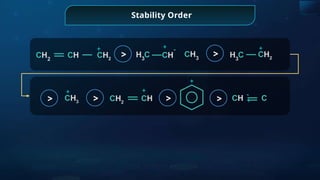
Stability Order
CH CH2
CH2
+
3
3
H C CH
+
CH CH2
3
H C
+
CH3
+
CH2
+
CH
+
C
CH +
> >
> > > >
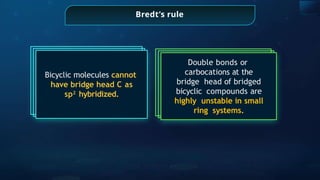
Bredt’s rule
Bicyclic molecules cannot
have bridge head C as
sp2
hybridized.
Double bonds or
carbocations at the
bridge head of bridged
bicyclic compounds are
highly unstable in small
ring systems.
Stability of Alicyclic Cations
Stability
1
Strain
∝
+ + + +
>
>
>
Point to Remember!!
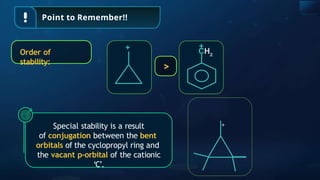
CH2
+
+
>
Order of
stability:
Special stability is a result
of conjugation between the bent
orbitals of the cyclopropyl ring and
the vacant p-orbital of the cationic
‘C’.
+
Rearrangement of Carbocations
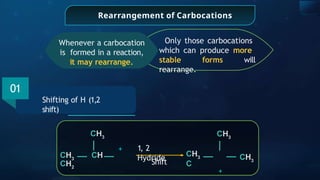
Whenever a carbocation
is formed in a reaction,
it may rearrange.
Only those carbocations
which can produce more
stable forms will
rearrange.
01
Shifting of H (1,2
shift)
CH3
CH3
CH3
C
+
CH3
+
CH3
CH
CH2
1, 2
Hydride
Shift
1, 2-
Methyl
Shift
CH3
+
CH3
C
CH2
CH3
CH3
CH3
C CH2
CH3
+
Rearrangement of Carbocations
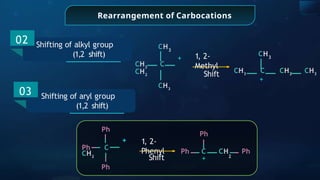
02 Shifting of alkyl group
(1,2 shift)
1, 2-
Phenyl
Shift
Ph
+
Ph C
CH2
Ph
2
Ph
Ph C CH Ph
+
03 Shifting of aryl group
(1,2 shift)
04
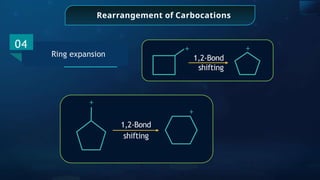
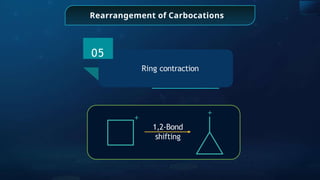
Ring expansion
Rearrangement of Carbocations
+ +
1,2-Bond
shifting
shifting
+
+
1,2-Bond
05
Ring contraction
Rearrangement of Carbocations
+
+
1,2-Bond
shifting
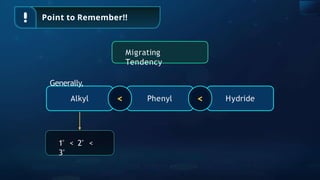
Point to Remember!!
Alkyl Phenyl
< Hydride
<
1° < 2° <
3°
Migrating
Tendency
Generally,
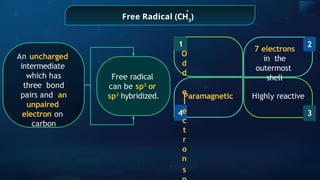
Free Radical (CH3
)
.
An uncharged
intermediate
which has
three bond
pairs and an
unpaired
electron on
carbon
Free radical
can be sp2
or
sp3
hybridized.
2
4 3
1
O
d
d
e
l
e
c
t
r
o
n
s
7 electrons
in the
outermost
shell
Paramagnetic Highly reactive
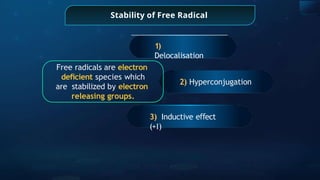
Stability of Free Radical
1)
Delocalisation
3) Inductive e ect
ff
(+I)
2) Hyperconjugation
Free radicals are electron
deficient species which
are stabilized by electron
releasing groups.
Stability order
CH3
CH3
C CH3
CH3
CH CH3
CH3
CH2
CH3
CH2
CH CH2
CH2
Ph
Ph2
CH
Ph3
C
> >
>
> >
>
>
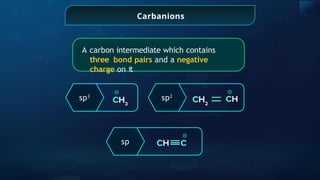
Carbanions
A carbon intermediate which contains
three bond pairs and a negative
charge on it
sp3
sp2
sp
⊝ ⊝
⊝
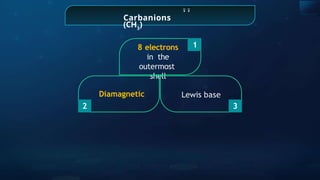
8 electrons
in the
outermost
shell
Diamagnetic Lewis base
1
2 3
. .
Carbanions
(CH3
)
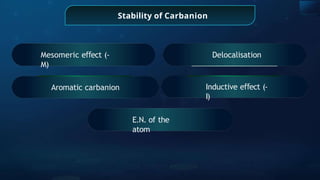
Stability of Carbanion
Mesomeric e ect
ff (-
M)
Delocalisation
Inductive e ect
ff (-
I)
E.N. of the
atom
Aromatic carbanion
Stability order
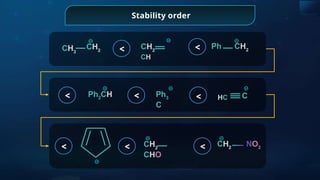
CH3 < <
< < < HC
<
<
<
⊝
CH2
⊝
CH2
CH
⊝
Ph CH2
⊝
C
⊝
Ph3
C
⊝
Ph2
CH
⊝
CH2
NO2
⊝
CH2
CHO
⊝
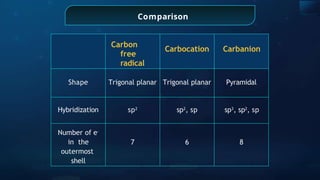
Comparison
Carbon
free
radical
Carbocation Carbanion
Shape Trigonal planar Trigonal planar Pyramidal
Hybridization sp2
sp2
, sp sp3
, sp2
, sp
Number of e-
in the
outermost
shell
7 6 8
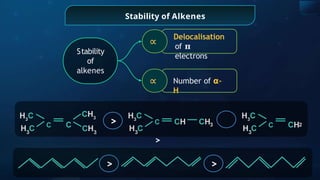
Stability of Alkenes
Stability
of
alkenes
Delocalisation
of 𝛑
electrons
∝
Number of 𝝰-
H
∝
C C
H3
C
3
H C
CH3
CH3
H3
C
3
H C
3 C CH2
H3
C
3
H C
> C CH CH
>
> >
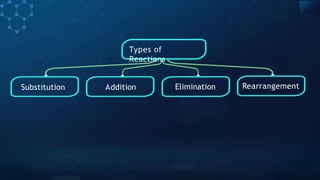
Types of
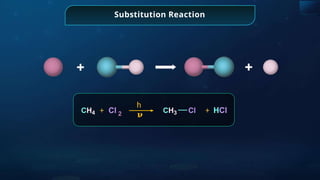
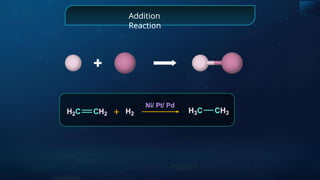
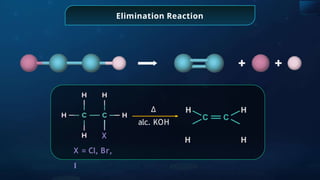
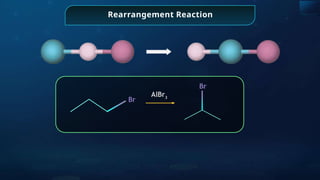
Reactions
Substitution Addition Rearrangement
Elimination
Substitution Reaction
h
𝛎
2
+ +
Addition
Reaction
+
Elimination Reaction
X
X = Cl, Br,
I
alc. KOH
Δ
C C
H
H
H
H
Rearrangement Reaction
AlBr3
Br
Br
Purification
Purification
Removal of undesirable impurities
associated with a particular organic
compound i.e., to obtain the organic
compound in pure state.
Crystallisation
Based on the principle of
solubility of compounds
(solutes), solutes tend to be
more soluble in hot liquids
(solvent) than in cold liquids.
If a saturated hot solution is allowed to
cool, the solute is no longer soluble in the
solvent and it forms crystals of the pure
compound.
The solid is filtered and dried.
Crystallisation
Sugar mixed with common
salt
can be purified using ethanol.
Examples
Phthalic acid mixed
with naphthalene can
be purified using hot
water.
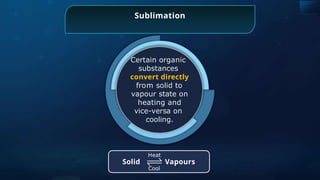
Sublimation
Certain organic
substances
convert directly
from solid to
vapour state on
heating and
vice-versa on
cooling.
Solid Vapours
Heat
Cool
This process is very useful in
the separation of a substance
which sublimes on heating
from a
non-volatile substance.
Ex: Benzoic acid, naphthalene,
anthracene, camphor,
indigo, anthraquinone
Sublimation
Distillation
Used to purify
liquids based on
their difference
in boiling points.
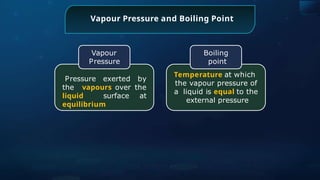
Vapour Pressure and Boiling Point
Vapour
Pressure
Pressure exerted by
the vapours over the
liquid surface at
equilibrium
Boiling
point
Temperature at which
the vapour pressure of
a liquid is equal to the
external pressure
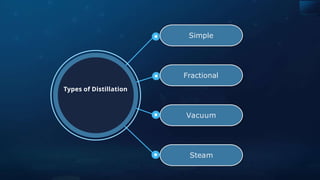
Types of Distillation
Simple
Vacuum
Fractional
Steam
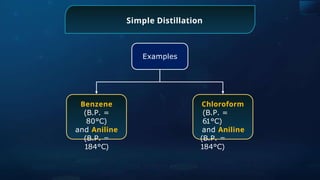
Simple Distillation
It is applied only for volatile liquids
which boil without decomposing at
atmospheric pressure and contains non-
volatile impurities.
It can also be used for separating liquids
having sufficient difference in their
boiling points.
Simple Distillation
Examples
Benzene
(B.P. =
80°C)
and Aniline
(B.P. =
184°C)
Chloroform
(B.P. =
61°C)
and Aniline
(B.P. =
184°C)
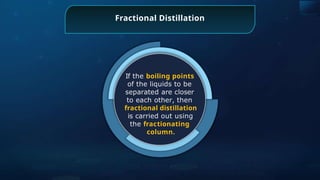
Fractional Distillation
If the boiling points
of the liquids to be
separated are closer
to each other, then
fractional distillation
is carried out using
the fractionating
column.
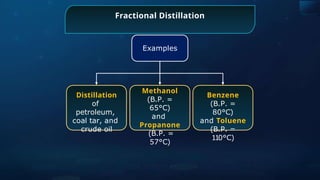
Examples
Distillation
of
petroleum,
coal tar, and
crude oil
Methanol
(B.P. =
65°C)
and
Propanone
(B.P. =
57°C)
Benzene
(B.P. =
80°C)
and Toluene
(B.P. =
110°C)
Fractional Distillation
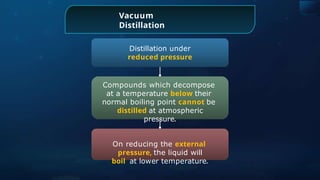
Vacuum
Distillation
Distillation under
reduced pressure
Compounds which decompose
at a temperature below their
normal boiling point cannot be
distilled at atmospheric
pressure.
On reducing the external
pressure, the liquid will
boil at lower temperature.
Examples
Glycerine can be
distilled at
180°C (B.P. =
280°C) at
lower pressure
Separation of
glycerol from
spent-lye in soap
industries.
Vacuum Distillation
Steam Distillation
The liquid boils when the sum of vapour
pressures due to the organic liquid (P1
)
and that due to water (P2
) becomes equal
to the atmospheric pressure.
Ex: 0-, m-, p-
Chlorotoluenes, o-, p-
Nitrobenzene
Differential Extraction
The process of
separation of an
organic compound
from its aqueous
solution by
shaking it with a
suitable organic
solvent.
The solvent should be immiscible
with water and the organic
compound to be separated
should be highly soluble in it.
Ex: Benzoic acid can be extracted
from water solution using
benzene.
Differential Extraction
Chromatography
Used for the separation, isolation,
purification, and identification of
components of mixtures
because of the distribution of
components between a liquid
phase (mobile phase) and a
solid phase (stationary phase).
Chromatography
Separation of components of a
mixture takes place as a result of
di erential
ff adsorption on the
adsorption column.
After the separation, the substances
are extracted from the adsorbent
using a suitable solvent, which is
called eluent.
Adsorption and Adsorbent
Adsorption
Phenomenon of attracting and retaining
the molecules of a substance on the
surface of a liquid or a solid resulting in a
higher
concentration of the molecules on the
surface
Adsorbent
Substance on the surface
of which adsorption
occurs
Principle
Based upon the di erential
ff
adsorption of various components
of a mixture on a suitable
adsorbent
Some components are more
strongly adsorbed thus, travel at
di erent
ff rates and get
separated
Types of Chromatography
hy
Adsorption
Chromatograph
y
Partition
Chromatograph
y
CC
C
hh
h
rror
o
o
mm
m
aata
too
t
gg
o
rr
g
a
ar
ppa
hhp
yy
Thin Layer
Chromatograph
y
Column
Chromatograph
y
Paper
Chromatograph
y
Column Chromatography
Separation of components takes
place.
Mixture is placed on the top of the
adsorbent column packed in a glass
tube.
An appropriate eluant, which is a
liquid or a mixture of liquids is
allowed to flow down the column
slowly.
Thin Layer Chromatography (TLC)
Involves the separation
of components of a
mixture over a thin layer
of an adsorbent coated
on a glass plate.
A thin layer of an adsorbent (silica gel
or alumina) is spread over the glass
plate.
The glass plate is known as thin layer
chromatography plate or
chromaplate.
Thin Layer Chromatography (TLC)
Relative adsorption of each component
of the mixture is expressed in terms of
its retardation factor i.e. Rf
value
Rf
=
Distance moved by the component from
baseline
Distance moved by the solvent from
baseline
Partition Chromatography
It is based on the
continuous differential
partitioning of components
of a mixture between the
stationary
and the mobile phases.
Paper
Chromatography
Principle of paper
chromatography is
partition chromatography,
wherein, the substances
are distributed or
partitioned between the
liquid phase and the
stationary phase.
Qualitative
Quantitative
Analysis of an
Organic
Compound
Qualitative
Analysis
Identification of the
elements present in
an organic
compound.
Detection of
Elements
Sulphur
Carbon
and
Hydrogen
Nitrogen
Halogens
Phosphorous
Detection of Carbon
Precipitate
Milky/
Turbid
C +
2CuO
2
CO +
2Cu
Δ
CO2
+
Ca(OH)2
CaCO3
+
H2
O
Lime water
Carbon is detected by
heating the compound with
copper(II) oxide.
Carbon present in the
compound is oxidised
to carbon dioxide.
Carbon dioxide is tested
with lime-water, which
develops turbidity.
Detection of Hydrogen
Blue
White
2H +
CuO
2
H O +
Cu
Δ
CuSO4
+
5H2
O
CuSO4
.5H2
O
(Anhydrous)
Hydrogen is detected by
heating the compound with
copper(II) oxide.
Hydrogen present in the
compound is oxidised to
water.
Water is tested with anhydrous
copper sulphate, which turns
blue.
Δ
CO2
H2
O
Organic Compound
CaCO3
(Milky)
CuSO4
.5H2
O
(Blue)
CuO
Ca(OH)2
CuSO4
(white)
Sodium Fusion Extract
Na + X
Δ
2Na + S Na2
S
NaX
Δ
Na + C + N NaCN
Δ
Na + C + N + S NaSCN
Δ
Elements present in the compound
are converted from their covalent
form
to their ionic form by fusing the
organic compound with sodium
metal.
Organic compounds
are reacted with sodium
to
convert them into their ionic
form, which is more
reactive.
Lassaigne’s Test
Cyanide, sulphide, and halide of
sodium so formed on sodium
fusion are extracted from the
fused mass by boiling it with
distilled water. This extract is
known as Sodium Fusion Extract.
Detection of Nitrogen
FeSO4
+ 6NaCN Na4
[Fe(CN)6
]+ Na2
SO4
Sodium hexacyanoferrate
(II)
Δ
0
1
Sodium Fusion Extract is boiled with Iron(II)
sulphate
to form Sodium hexacyanoferrate (II).
02
On heating with sulphuric acid, some
Fe2+
ions are oxidised to Fe3+
ions.
Detection of Nitrogen
6 4 6 3 2
Fe [Fe(CN) ] .xH O
3[Fe(CN )]
4-
+ 4Fe3+
xH2
O
Prussian blue
03
Fe3
reacts with Sodium hexacyanoferrate (II) to
give Prussian blue colour of Ferric ferrocyanide,
which confirms the presence of nitrogen.
Test For Sulphur
Lead acetate
test
Sodium
nitroprusside test
Detection of
Sulphur
Lead Acetate Test
Na2
S +
(CH3
COO)2
Pb
PbS +
2CH3
COONa
Black precipitate
Indicates
presence of
S
Sodium Fusion Extract
is acidified with acetic
acid
and lead acetate is added
to it.
Lead Acetate Test
Na2
S +
(CH3
COO)2
Pb
PbS +
2CH3
COONa
Black precipitate
Indicates
presence of
S
Sodium Fusion Extract
is acidified with acetic
acid
and lead acetate is added
to it.
Sodium Nitroprusside Test
Sodium Fusion Extract is treated
with sodium nitroprusside.
Na2
S +
Na2
[Fe(CN)5
NO]
Na4
[Fe(CN)5
NOS]
Violet
Indicates
presence of
S
Point to Remember!!
Na + C + N
+ S
NaSCN
Neutral FeCl3
+
NaSCN
Fe(SCN)3
Blood red
If both nitrogen and sulphur are
present in an organic compound, then
sodium thiocyanate is formed, which
gives blood red color with neutral FeCl3
.
Test for Halogens
Cyanide or sulphide of sodium
formed during Lassaigne’s test can
interfere with silver nitrate test for
halogens.
Sodium fusion extract is first
boiled with concentrated
nitric acid to decompose
them.
Test for Halogens
NaCl + AgNO3
NaBr + AgNO3
AgBr + NaNO3
NaI + AgNO3
AgI + NaNO3
Pale yellow
ppt
AgCl + NaNO3
White ppt
Yellow
ppt
AgCl is
soluble in
NH4
OH
AgBr is sparingly
soluble in
NH4
OH
AgI is
insoluble in
NH4
OH
Test for Phosphorous
Compound is heated with an oxidising
agent (sodium peroxide). Phosphorus
present in it gets oxidised to phosphate.
The solution is boiled with nitric acid and
then treated with ammonium molybdate.
A yellow coloration or precipitate
indicates the presence of
phosphorus.
Test for Phosphorous
Na3
PO4
+ 3 HNO3
H3
PO4
+ 3 NaNO3
H3
PO4
+ 12 (NH4
)2
MoO4
+ 21 HNO3
(NH4
)3
PO4
.12MoO3
+ 21 NH4
NO3
+ 12 H2
O
yellow
Quantitativ
e Analysis
Estimation of
Elements
Carbon
and
Hydrogen
Sulphur
Nitrogen
Phosphorous
Halogens
Estimation of Carbon and Hydrogen
A known mass of the organic
compound is heated with dry copper
oxide in an atmosphere of air or
oxygen free from moisture and carbon
dioxide.
C +
2CuO
2H +
CuO
CO2
+ 2Cu
H2
O + Cu
Estimation of Carbon and Hydrogen
CO2
produced is collected in potash bulb
(containing KOH), whereas H2
O is
absorbed in calcium chloride tube
(containing CaCI2
).
Estimation of Carbon and Hydrogen
Excess O2
CuO
pallets
Combustion tube
Pure dry O2
Sample in platinum
boat
Anhydrous CaCl2
KOH
solution
Estimation of Nitrogen
Estimation of
nitrogen
Duma’s
method
Kjeldahl’
s
method
Duma’s Method
A known mass of the organic compound
is heated strongly with excess of
copper oxide in an atmosphere of
carbon dioxide.
The carbon
and hydrogen
are converted
to CO2
and
H2
O.
Nitrogen is set
free as N2
.
Duma’s Method
3CuO CO2
+ H2
O + 3Cu
C + 2H
+
Organic compound
N2
+ Oxides of nitrogen
2N
+
Cu
Organic compound
Oxides of nitrogen +
Cu
N2
+ CuO
Duma’s Method
N2
is collected over the
concentrated solution of KOH and
its volume is measured at room
temperature
and atmospheric pressure.
Kjeldahl’s Method
Organic compound + conc. H2
SO4
(NH4
)2
SO4
A known mass of the organic compound
containing nitrogen is heated with
concentrated sulphuric acid. Nitrogen in the
compound gets converted into ammonium
sulphate.
Kjeldahl’s Method
Organic compound + H2
SO4
(NH4
)2
SO4
2NaOH
Na2
SO4
+ 2NH3
+ 2H2
O
The resulting acid mixture
is then heated with an
excess of sodium
hydroxide.
Kjeldahl’s Method
The amount of ammonia produced is
determined by estimating the amount of
sulphuric acid consumed in the
reaction.
The acid left unused is estimated
by
titration with some standard alkali.
This method is not applicable to
compounds containing nitrogen
in:
Nitro groups (-NO2
)
Azo groups (- N = N -)
Nitrogen present in
the ring (E.g: Pyridine)
Limitations of Kjeldahl’s Method
Estimation of Sulphur
Sulphur is estimated as barium sulphate.
The organic compound containing sulphur
is taken in a Carius tube containing HNO3
,
where sulphur is finally converted
into sulphuric acid.
This sulphuric acid is passed
through excess BaCl2
to get
BaSO4
, which is then washed, dried
& weighed.
Fuming HNO3
AgNO3
Organic compound
50
cm
2 cm
Carius Method
Sealed capillary
Halogens are estimated as silver
halides
Organic halide is treated with acidified
silver nitrate solution to form silver
halide, which is washed, dried &
weighed.
Carius Method
A known mass of the organic
compound is heated with fuming
HNO3
.
The phosphorus present in the organic
compound is oxidised to H3
PO4
. The
phosphoric acid thus formed is treated with
magnesia mixture to get MgNH4
PO4
precipitate.
The precipitate is separated,
Estimation of Phosphorus
H3
PO4
P + 3H +
4O
From
organic
compound
H3
PO4
+ Magnesia mixture MgNH4
PO4
2MgNH4
PO4
Mg2
P2
O7
+ 2NH3
+ H2
O
From
HNO3
Estimation of Phosphorus
The percentage of oxygen in an organic compound
is usually found by difference between the total
percentage composition (100) and the sum of the
percentages of all other elements.
Estimation of Oxygen
FOR COMPLETE PPT SLIDES
AT OFFEER PRICE CONTACT
9163681973

Organic chemistry some basic principles and techniques GOC.pptx