Pandit Jawaharlal Nehru College of Agriculture And Research
Institute
COURSE TITLE : MICRO ECONOMIC THEORY AND APPLICATIONS
COURSE TEACHER : Dr. A. POUCHEPPARADJOU
ORDINAL UTILITY APPROCAH
• Definition: The Ordinal Utility approach is based on the fact that the
utility of a commodity cannot be measured in absolute quantity, but
however, it will be possible for a consumer to tell subjectively whether
the commodity derives more or less or equal satisfaction when compared to
another.
• It is the satisfaction a consumer gets after consuming a good or service
cannot be scaled in numbers, whereas, these things can be arranged in
the order of preference.
Also known as
 Indifference curve analysis
 Hicksian analysis
 The real elaboration of indifference curve analysis was made by J.R.HICKS
and R.G.D.ALLEN.
 Modern economist disregarded the concept of cardinal measure of utility.
Hick introduced a tool of analysis called “Indifference Curve” to analyze
the consumer behavior
EXAMPLES OF ORDINAL UTILITY
EXAMPLE 1 EXAMPLE 2
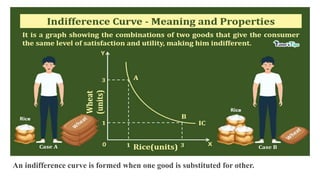
An indifference curve is formed when one good is substituted for other.
INDIFFERENCE MAP
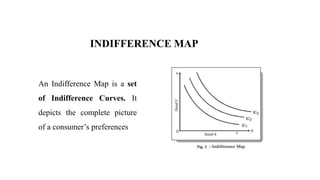
An Indifference Map is a set
of Indifference Curves. It
depicts the complete picture
of a consumer’s preferences
MARGINAL RATE OF SUBSTITUTION
• Marginal Rate of Substitution (MRS) refers to a rate at which one good is
substituted for other, while keeping the level of satisfaction of a consumer
constant. In other words, MRS between two goods X and Y is defined as the
quantity of X which is required to replace Y or quantity of Y required to replace X,
so that the total utility remains same.
• It is expressed as: MRS x,y = ∆Y/∆X
• MRS is called the slope of indifference curve.
ASSUMPTION OF ORDINAL UTILITY
Rationality: It is assumed that the consumer is rational who aims at maximizing
his level of satisfaction for given income and prices of goods and services, which
he wish to consume. He is expected to take decisions consistent with this objective.
Ordinal Utility: The indifference curve assumes that the utility can only be
expressed ordinally. This means the consumer can only tell his order of preference
for the given goods and services.
Transitivity and Consistency of Choice: The consumer’s choice is expected to be
either transitive or consistent. The transitivity of choice means, if the consumer
prefers commodity X to Y and Y to Z, then he must prefer commodity X to Z. In
other words, if X= Y, Y = Z, then he must treat X=Z. The consistency of choice
means that if a consumer prefers commodity X to Y at one point of time, he will not
prefer commodity Y to X in another period or even will not consider them as equal
Nonsatiety: It is assumed that the consumer has not reached the saturation point of
any commodity and hence, he prefers larger quantities of all commodities
Diminishing Marginal Rate of Substitution (MRS): The marginal rate of
substitution refers to the rate at which the consumer is ready to substitute one
commodity (A) for another commodity (B) in such a way that his total
satisfaction remains unchanged. The MRS is denoted as DB/DA. The ordinal
approach assumes that DB/DA goes on diminishing if the consumer continues
to substitute A for B.
References
 Ahuja, H.L.(1970). Advanced Economic Theory. Delhi: S Chand and
Company Limited
 Dwibedi, D.N. (2003). Microeconomics Theory and Applications.
Delhi: Vikas Publishing House Pvt. Ltd.
 Kanel, N.R. and et.al (2016). Microeconomics. Kathmandu: Buddha
Publications
ordinal utility(karishma).pptx

ordinal utility(karishma).pptx

  • 1.
    Pandit Jawaharlal NehruCollege of Agriculture And Research Institute COURSE TITLE : MICRO ECONOMIC THEORY AND APPLICATIONS COURSE TEACHER : Dr. A. POUCHEPPARADJOU
  • 3.
    ORDINAL UTILITY APPROCAH •Definition: The Ordinal Utility approach is based on the fact that the utility of a commodity cannot be measured in absolute quantity, but however, it will be possible for a consumer to tell subjectively whether the commodity derives more or less or equal satisfaction when compared to another. • It is the satisfaction a consumer gets after consuming a good or service cannot be scaled in numbers, whereas, these things can be arranged in the order of preference.
  • 4.
    Also known as Indifference curve analysis  Hicksian analysis  The real elaboration of indifference curve analysis was made by J.R.HICKS and R.G.D.ALLEN.  Modern economist disregarded the concept of cardinal measure of utility. Hick introduced a tool of analysis called “Indifference Curve” to analyze the consumer behavior
  • 5.
    EXAMPLES OF ORDINALUTILITY EXAMPLE 1 EXAMPLE 2
  • 7.
    An indifference curveis formed when one good is substituted for other.
  • 8.
    INDIFFERENCE MAP An IndifferenceMap is a set of Indifference Curves. It depicts the complete picture of a consumer’s preferences
  • 9.
    MARGINAL RATE OFSUBSTITUTION • Marginal Rate of Substitution (MRS) refers to a rate at which one good is substituted for other, while keeping the level of satisfaction of a consumer constant. In other words, MRS between two goods X and Y is defined as the quantity of X which is required to replace Y or quantity of Y required to replace X, so that the total utility remains same. • It is expressed as: MRS x,y = ∆Y/∆X • MRS is called the slope of indifference curve.
  • 11.
    ASSUMPTION OF ORDINALUTILITY Rationality: It is assumed that the consumer is rational who aims at maximizing his level of satisfaction for given income and prices of goods and services, which he wish to consume. He is expected to take decisions consistent with this objective. Ordinal Utility: The indifference curve assumes that the utility can only be expressed ordinally. This means the consumer can only tell his order of preference for the given goods and services.
  • 12.
    Transitivity and Consistencyof Choice: The consumer’s choice is expected to be either transitive or consistent. The transitivity of choice means, if the consumer prefers commodity X to Y and Y to Z, then he must prefer commodity X to Z. In other words, if X= Y, Y = Z, then he must treat X=Z. The consistency of choice means that if a consumer prefers commodity X to Y at one point of time, he will not prefer commodity Y to X in another period or even will not consider them as equal Nonsatiety: It is assumed that the consumer has not reached the saturation point of any commodity and hence, he prefers larger quantities of all commodities
  • 13.
    Diminishing Marginal Rateof Substitution (MRS): The marginal rate of substitution refers to the rate at which the consumer is ready to substitute one commodity (A) for another commodity (B) in such a way that his total satisfaction remains unchanged. The MRS is denoted as DB/DA. The ordinal approach assumes that DB/DA goes on diminishing if the consumer continues to substitute A for B.
  • 14.
    References  Ahuja, H.L.(1970).Advanced Economic Theory. Delhi: S Chand and Company Limited  Dwibedi, D.N. (2003). Microeconomics Theory and Applications. Delhi: Vikas Publishing House Pvt. Ltd.  Kanel, N.R. and et.al (2016). Microeconomics. Kathmandu: Buddha Publications