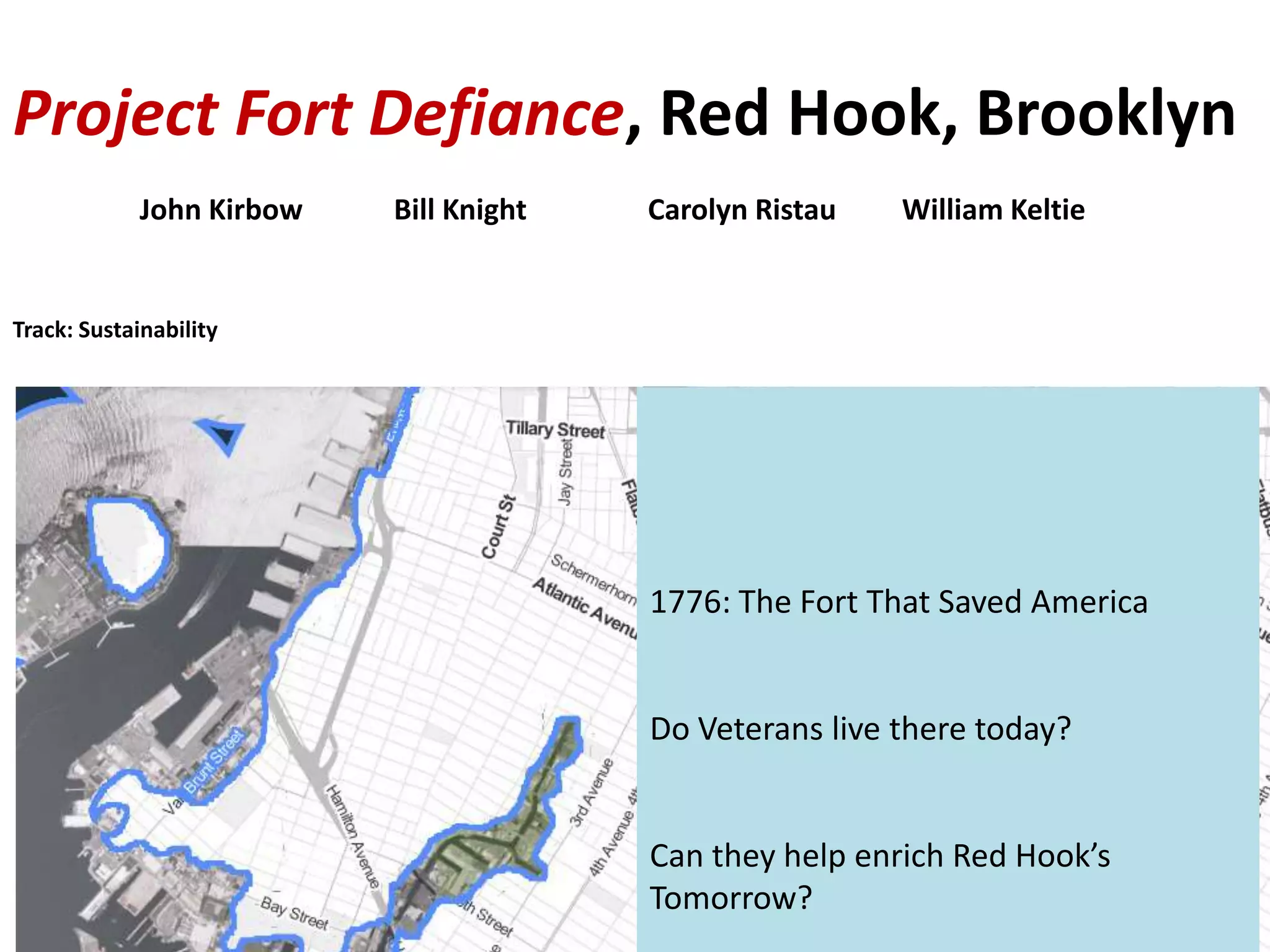
1776: The Fort That Saved America
Do Veterans live there today?
Can they help enrich Red Hook’s
Tomorrow?
Project Fort Defiance, Red Hook, Brooklyn
John Kirbow Bill Knight Carolyn Ristau William Keltie
Track: Sustainability
• We know that Veterans with motivation, knowledge, & skills live in Red
Hook.
• We also know that an abundance of “human capital” – of skills and
knowledge – exists across residents within this community.
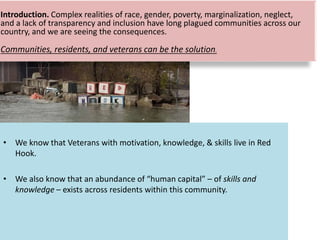
Introduction. Complex realities of race, gender, poverty, marginalization, neglect,
and a lack of transparency and inclusion have long plagued communities across our
country, and we are seeing the consequences.
Communities, residents, and veterans can be the solution.
• As we know from Iraq and Afghanistan,
many can adapt to local cultures. This is
especially true in their own
neighborhood.
• From there, we ‘branch out’ and identify
the skills and knowledge of residents,
from seniors and community leaders, to
musicians, artists, and young
entrepreneurs…linking their local
knowledge and skills to the needs of the
community.
• Veterans can drive the process from the
ground up!
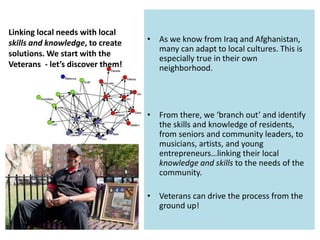
Linking local needs with local
skills and knowledge, to create
solutions. We start with the
Veterans - let’s discover them!
Our Process and its Approach
1. Using tried and tested Participatory Appraisal tools, our team identifies,
engages with, and listens to Veterans. They come together to help
themselves, in response to their own perceived needs and priorities, by
starting to build on their own skills and knowledge capital.
2. Veterans extend this process to include other community groups and
individuals in Red Hook – youth, seniors and all in between!
3. Outsiders with a stake in Red Hook respond by providing top-down
support for this local, bottom-up development.
4. The Community itself owns and drives the Development Process, which
becomes sustainable.
A Process That Works!
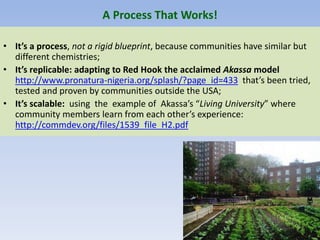
• It’s a process, not a rigid blueprint, because communities have similar but
different chemistries;
• It’s replicable: adapting to Red Hook the acclaimed Akassa model
http://www.pronatura-nigeria.org/splash/?page_id=433 that’s been tried,
tested and proven by communities outside the USA;
• It’s scalable: using the example of Akassa’s “Living University” where
community members learn from each other’s experience:
http://commdev.org/files/1539_file_H2.pdf
Target Audiences and Markets
• Traditional funders (especially foundations and local donors) as well
as Venture Philanthropists, who wish to see innovative, bold and
replicable ideas done to scale across the US
• Veterans advocates (people and organizations). With untapped
motivation, skill and abilities, veterans are one of the most
underutilized, underemployed groups in our country – this is
therefore one of our main audiences and markets.
• Nonprofits and Community-Based Organizations -mainly for
partnering to serve the needs of their area
• Local and city-wide businesses who wish to conduct respectable CSR
and invest in good ideas
• The general public, through long-term Crowdsourcing
What We Are Asking
• Stakeholders in the Red Hook community to invest time
and energy (human capital) in a participatory appraisal of
Red hook’s assets that looks first at Veterans
• We are asking secondary stakeholders and angel investors
to partner in this appraisal exercise
• We need to raise $5000 to take our first steps along this
path to sustainable development.
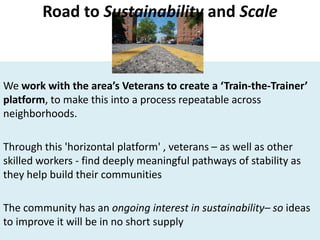
We work with the area’s Veterans to create a ‘Train-the-Trainer’
platform, to make this into a process repeatable across
neighborhoods.
Through this 'horizontal platform' , veterans – as well as other
skilled workers - find deeply meaningful pathways of stability as
they help build their communities
The community has an ongoing interest in sustainability– so ideas
to improve it will be in no short supply
Road to Sustainability and Scale

PFD PPT

  • 1.
    1776: The FortThat Saved America Do Veterans live there today? Can they help enrich Red Hook’s Tomorrow? Project Fort Defiance, Red Hook, Brooklyn John Kirbow Bill Knight Carolyn Ristau William Keltie Track: Sustainability
  • 2.
    • We knowthat Veterans with motivation, knowledge, & skills live in Red Hook. • We also know that an abundance of “human capital” – of skills and knowledge – exists across residents within this community. Introduction. Complex realities of race, gender, poverty, marginalization, neglect, and a lack of transparency and inclusion have long plagued communities across our country, and we are seeing the consequences. Communities, residents, and veterans can be the solution.
  • 3.
    • As weknow from Iraq and Afghanistan, many can adapt to local cultures. This is especially true in their own neighborhood. • From there, we ‘branch out’ and identify the skills and knowledge of residents, from seniors and community leaders, to musicians, artists, and young entrepreneurs…linking their local knowledge and skills to the needs of the community. • Veterans can drive the process from the ground up! Linking local needs with local skills and knowledge, to create solutions. We start with the Veterans - let’s discover them!
  • 4.
    Our Process andits Approach 1. Using tried and tested Participatory Appraisal tools, our team identifies, engages with, and listens to Veterans. They come together to help themselves, in response to their own perceived needs and priorities, by starting to build on their own skills and knowledge capital. 2. Veterans extend this process to include other community groups and individuals in Red Hook – youth, seniors and all in between! 3. Outsiders with a stake in Red Hook respond by providing top-down support for this local, bottom-up development. 4. The Community itself owns and drives the Development Process, which becomes sustainable.
  • 5.
    A Process ThatWorks! • It’s a process, not a rigid blueprint, because communities have similar but different chemistries; • It’s replicable: adapting to Red Hook the acclaimed Akassa model http://www.pronatura-nigeria.org/splash/?page_id=433 that’s been tried, tested and proven by communities outside the USA; • It’s scalable: using the example of Akassa’s “Living University” where community members learn from each other’s experience: http://commdev.org/files/1539_file_H2.pdf
  • 6.
    Target Audiences andMarkets • Traditional funders (especially foundations and local donors) as well as Venture Philanthropists, who wish to see innovative, bold and replicable ideas done to scale across the US • Veterans advocates (people and organizations). With untapped motivation, skill and abilities, veterans are one of the most underutilized, underemployed groups in our country – this is therefore one of our main audiences and markets. • Nonprofits and Community-Based Organizations -mainly for partnering to serve the needs of their area • Local and city-wide businesses who wish to conduct respectable CSR and invest in good ideas • The general public, through long-term Crowdsourcing
  • 7.
    What We AreAsking • Stakeholders in the Red Hook community to invest time and energy (human capital) in a participatory appraisal of Red hook’s assets that looks first at Veterans • We are asking secondary stakeholders and angel investors to partner in this appraisal exercise • We need to raise $5000 to take our first steps along this path to sustainable development.
  • 8.
    We work withthe area’s Veterans to create a ‘Train-the-Trainer’ platform, to make this into a process repeatable across neighborhoods. Through this 'horizontal platform' , veterans – as well as other skilled workers - find deeply meaningful pathways of stability as they help build their communities The community has an ongoing interest in sustainability– so ideas to improve it will be in no short supply Road to Sustainability and Scale

Editor's Notes

  • #2  Image courtesy of: http://content.stamen.com/files/red-hook.png Link to Behavioral Terrain and ‘Innovation on the Homefront’: http://www.behavioralterrain.org/innovation-on-the-homefront-veterans-communities--the-build-america-incubator.html
  • #4 Photos courtesy of ‘Brooklyn War Stories’, the Brooklyner. http://bklynr.com/red-hook-war-stories/ , and my website, http://www.behavioralterrain.org/
  • #7 Describe your target audience and market.
  • #8 Describe your target audience and market.
  • #9 Describe your target audience and market.