Oral Hypoglycaemic Agents
Classification
• Sulfonyl ureas: Tolbutamide, Chlorpropamide, Glipizide, Glimepiride.
• Biguanides: Metformin.
• Thiazolidinediones: Pioglitazone, Rosiglitazone.
• Meglitinides: Repaglinide, Nateglinide.
• Glucosidase inhibitors: Acrabose, Voglibos
Sulfonyl ureas
• These oral hypoglycemic medications are the first class used to treat
diabetes.
• Mechanism of action?
These drugs bind to the sulfonyl urea receptors present in pancreatic β-
cells. It leads to closure of ATP-sensitive K+ channels. Then it opens
voltage gated Ca+2 channels and stimulates β-cells to secrete more
insulin.
• 1 st generation- Chlorpropamide, Tolbutamide
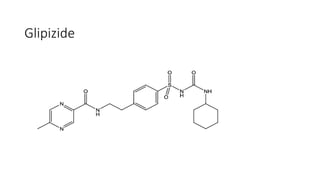
• 2 nd generation- Glipizide
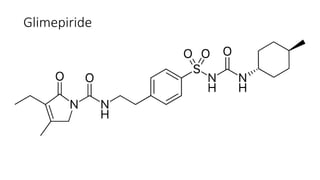
• 3 rd generation- Glimepiride
Chlorpropamide
Tolbutamide
Glipizide
Glimepiride
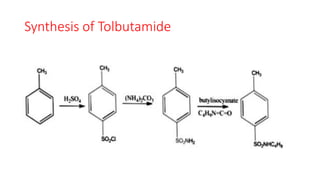
Synthesis of Tolbutamide
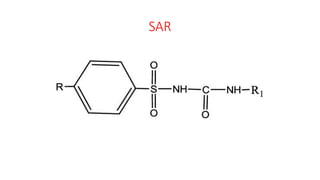
SAR
• A substitutent, ideally in the para position, must be present in the
benzene ring. The antihyperglycaemic efficacy was found to be
enhanced by substituents such as methyl, acetyl, amino, chloro,
bromo, trifluoromethyl.
• It was discovered that the activity is further increased when the para
position of benzene is substituted with an aryl carboxamidoalkyl group
(second-generation sulphonylureas, such as glibenclamide).
•
• For activity, the size of the group linked to the terminal nitrogen is
essential. The N-propyl and higher homologues were found to be
active, and the activity is lost when the N-substituent comprises 12 or
more carbons. The group should also confer lipophilicity to the
compound's N-methyl and ethyl substituents, which show no activity.
Oral hypoglycemic agent.pdf

Oral hypoglycemic agent.pdf

  • 1.
  • 2.
    Classification • Sulfonyl ureas:Tolbutamide, Chlorpropamide, Glipizide, Glimepiride. • Biguanides: Metformin. • Thiazolidinediones: Pioglitazone, Rosiglitazone. • Meglitinides: Repaglinide, Nateglinide. • Glucosidase inhibitors: Acrabose, Voglibos
  • 3.
    Sulfonyl ureas • Theseoral hypoglycemic medications are the first class used to treat diabetes. • Mechanism of action? These drugs bind to the sulfonyl urea receptors present in pancreatic β- cells. It leads to closure of ATP-sensitive K+ channels. Then it opens voltage gated Ca+2 channels and stimulates β-cells to secrete more insulin.
  • 4.
    • 1 stgeneration- Chlorpropamide, Tolbutamide • 2 nd generation- Glipizide • 3 rd generation- Glimepiride
  • 5.
  • 6.
  • 7.
  • 8.
  • 9.
  • 10.
    • A substitutent,ideally in the para position, must be present in the benzene ring. The antihyperglycaemic efficacy was found to be enhanced by substituents such as methyl, acetyl, amino, chloro, bromo, trifluoromethyl. • It was discovered that the activity is further increased when the para position of benzene is substituted with an aryl carboxamidoalkyl group (second-generation sulphonylureas, such as glibenclamide). •
  • 11.
    • For activity,the size of the group linked to the terminal nitrogen is essential. The N-propyl and higher homologues were found to be active, and the activity is lost when the N-substituent comprises 12 or more carbons. The group should also confer lipophilicity to the compound's N-methyl and ethyl substituents, which show no activity.