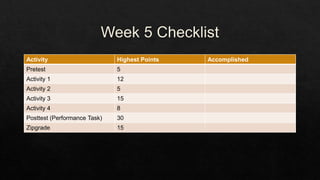


Activity Highest Points Accomplished
Pretest 5
Activity 1 12
Activity 2 5
Activity 3 15
Activity 4 8
Posttest (Performance Task) 30
Zipgrade 15
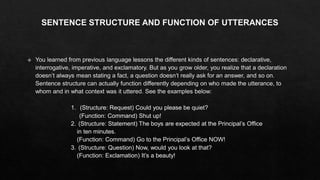
1. (Structure: Request) Could you please be quiet?
(Function: Command) Shut up!
2. (Structure: Statement) The boys are expected at the Principal’s Office
in ten minutes.
(Function: Command) Go to the Principal’s Office NOW!
3. (Structure: Question) Now, would you look at that?
(Function: Exclamation) It’s a beauty!
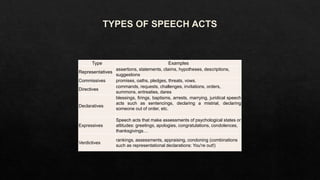
Type Examples
Representatives
assertions, statements, claims, hypotheses, descriptions,
suggestions
Commissives promises, oaths, pledges, threats, vows.
Directives
commands, requests, challenges, invitations, orders,
summons, entreaties, dares
Declaratives
blessings, firings, baptisms, arrests, marrying, juridical speech
acts such as sentencings, declaring a mistrial, declaring
someone out of order, etc.
Expressives
Speech acts that make assessments of psychological states or
attitudes: greetings, apologies, congratulations, condolences,
thanksgivings…
Verdictives
rankings, assessments, appraising, condoning (combinations
such as representational declarations: You're out!)
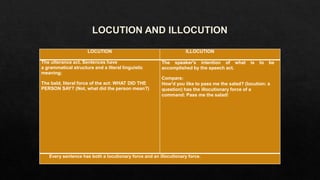
LOCUTION ILLOCUTION
The utterance act. Sentences have
a grammatical structure and a literal linguistic
meaning;
The bald, literal force of the act: WHAT DID THE
PERSON SAY? (Not, what did the person mean?)
The speaker's intention of what is to be
accomplished by the speech act.
Compare:
How'd you like to pass me the salad? (locution: a
question) has the illocutionary force of a
command: Pass me the salad!
Every sentence has both a locutionary force and an illocutionary force.
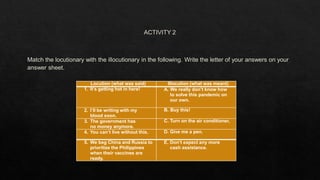
Locution (what was said) Illocution (what was meant)
1. It’s getting hot in here! A. We really don’t know how
to solve this pandemic on
our own.
2. I’ll be writing with my
blood soon.
B. Buy this!
3. The government has
no money anymore.
C. Turn on the air conditioner,
4. You can’t live without this. D. Give me a pen.
5. We beg China and Russia to
prioritize the Philippines
when their vaccines are
ready.
E. Don’t expect any more
cash assistance.
Oral communication 7 8

Oral communication 7 8

  • 2.
    Activity Highest PointsAccomplished Pretest 5 Activity 1 12 Activity 2 5 Activity 3 15 Activity 4 8 Posttest (Performance Task) 30 Zipgrade 15
  • 5.
    1. (Structure: Request)Could you please be quiet? (Function: Command) Shut up! 2. (Structure: Statement) The boys are expected at the Principal’s Office in ten minutes. (Function: Command) Go to the Principal’s Office NOW! 3. (Structure: Question) Now, would you look at that? (Function: Exclamation) It’s a beauty!
  • 7.
    Type Examples Representatives assertions, statements,claims, hypotheses, descriptions, suggestions Commissives promises, oaths, pledges, threats, vows. Directives commands, requests, challenges, invitations, orders, summons, entreaties, dares Declaratives blessings, firings, baptisms, arrests, marrying, juridical speech acts such as sentencings, declaring a mistrial, declaring someone out of order, etc. Expressives Speech acts that make assessments of psychological states or attitudes: greetings, apologies, congratulations, condolences, thanksgivings… Verdictives rankings, assessments, appraising, condoning (combinations such as representational declarations: You're out!)
  • 9.
    LOCUTION ILLOCUTION The utteranceact. Sentences have a grammatical structure and a literal linguistic meaning; The bald, literal force of the act: WHAT DID THE PERSON SAY? (Not, what did the person mean?) The speaker's intention of what is to be accomplished by the speech act. Compare: How'd you like to pass me the salad? (locution: a question) has the illocutionary force of a command: Pass me the salad! Every sentence has both a locutionary force and an illocutionary force.
  • 10.
    Locution (what wassaid) Illocution (what was meant) 1. It’s getting hot in here! A. We really don’t know how to solve this pandemic on our own. 2. I’ll be writing with my blood soon. B. Buy this! 3. The government has no money anymore. C. Turn on the air conditioner, 4. You can’t live without this. D. Give me a pen. 5. We beg China and Russia to prioritize the Philippines when their vaccines are ready. E. Don’t expect any more cash assistance.