ORAL COMMUNICATION
Presented By :-
Ravi Garg
MBA 1st
M 1212
MEANING
Any thing said from the mouth is refer to oral
communication . It includes individuals
conversation with each other . It is a direct
conversation . Speeches , Presentation ,
Discussion are all forms of oral
communication . It is generally
recommended where a direct interaction is
required .
DEFINITION
“ The man who think and does
not know how to express
what he think, he is at the
same level, who as the
person cannot think .”
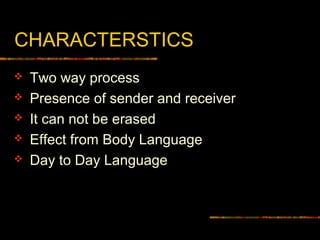
CHARACTERSTICS
 Two way process
 Presence of sender and receiver
 It can not be erased
 Effect from Body Language
 Day to Day Language
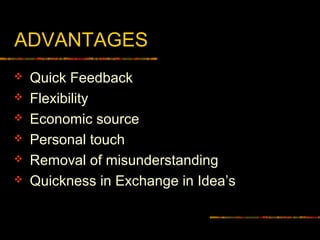
ADVANTAGES
 Quick Feedback
 Flexibility
 Economic source
 Personal touch
 Removal of misunderstanding
 Quickness in Exchange in Idea’s
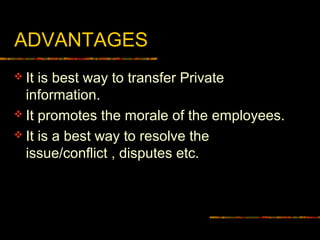
ADVANTAGES
 It is best way to transfer Private
information.
 It promotes the morale of the employees.
 It is a best way to resolve the
issue/conflict , disputes etc.
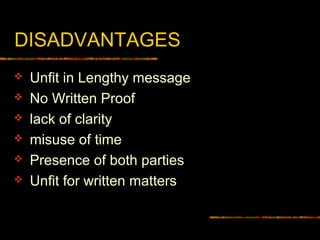
DISADVANTAGES
 Unfit in Lengthy message
 No Written Proof
 lack of clarity
 misuse of time
 Presence of both parties
 Unfit for written matters
DISADVANTAGES
 It is not consider as a legal record .
 it requires full attentiveness of both parties
.
 It is not sufficient at formal level .
Tips
 Be Confident
 Give Full Facts
 Avoid use of Extra words
 Maintain Eye Contact
 Use Simple and famlier Words
 Consider the Objective
 Allow time to Respond
MURPHY MODEL
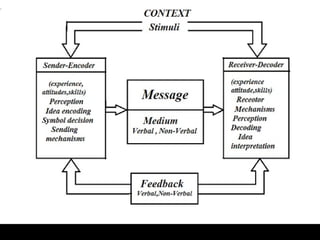
 Murphy’s model propounded by three
writers H.A.MURPHY , H.W.HILDBRANT
and J.P.THOMAS . According to this
model , there are six components of
communication process .
COMPONENT OF THE MODEL
(1) CONTEXT :- It is a broad field that includes
country , culture , organization and external
and internal cause of action . This action is
based on encoding idea .
(2) SENDER-ENCODER :-The sender-encoder
uses symbols , usually words, that express the
message.
(3) MESSAGE :- It is the core idea . It
consists of both verbal symbols and non-verbal
symbols.
COMPONENT OF THE MODEL
(4) MEDIUM :- The medium is the through which
a message is communicated . It can be printed
word , e-mail , sound etc.
(5) RECEIVER-DECODER :- The receiver or
listener or reader is the person who receives
the message and decodes .
(6) FEEDBACK :- It can be oral and written .
Sender needs feedback to determine success
and failure of the communication .
SUMMARY OF THE MODEL
In short , the model described above what
happens in communication . A context in
which a sender choose a message to
communicate . The sender must also
choose the medium for the message .
The receiver decodes the message and
provides feedback.
`QUERIES
Oral communication

Oral communication

  • 1.
    ORAL COMMUNICATION Presented By:- Ravi Garg MBA 1st M 1212
  • 2.
    MEANING Any thing saidfrom the mouth is refer to oral communication . It includes individuals conversation with each other . It is a direct conversation . Speeches , Presentation , Discussion are all forms of oral communication . It is generally recommended where a direct interaction is required .
  • 3.
    DEFINITION “ The manwho think and does not know how to express what he think, he is at the same level, who as the person cannot think .”
  • 4.
    CHARACTERSTICS  Two wayprocess  Presence of sender and receiver  It can not be erased  Effect from Body Language  Day to Day Language
  • 5.
    ADVANTAGES  Quick Feedback Flexibility  Economic source  Personal touch  Removal of misunderstanding  Quickness in Exchange in Idea’s
  • 6.
    ADVANTAGES  It isbest way to transfer Private information.  It promotes the morale of the employees.  It is a best way to resolve the issue/conflict , disputes etc.
  • 7.
    DISADVANTAGES  Unfit inLengthy message  No Written Proof  lack of clarity  misuse of time  Presence of both parties  Unfit for written matters
  • 8.
    DISADVANTAGES  It isnot consider as a legal record .  it requires full attentiveness of both parties .  It is not sufficient at formal level .
  • 9.
    Tips  Be Confident Give Full Facts  Avoid use of Extra words  Maintain Eye Contact  Use Simple and famlier Words  Consider the Objective  Allow time to Respond
  • 10.
    MURPHY MODEL  Murphy’smodel propounded by three writers H.A.MURPHY , H.W.HILDBRANT and J.P.THOMAS . According to this model , there are six components of communication process .
  • 11.
    COMPONENT OF THEMODEL (1) CONTEXT :- It is a broad field that includes country , culture , organization and external and internal cause of action . This action is based on encoding idea . (2) SENDER-ENCODER :-The sender-encoder uses symbols , usually words, that express the message. (3) MESSAGE :- It is the core idea . It consists of both verbal symbols and non-verbal symbols.
  • 12.
    COMPONENT OF THEMODEL (4) MEDIUM :- The medium is the through which a message is communicated . It can be printed word , e-mail , sound etc. (5) RECEIVER-DECODER :- The receiver or listener or reader is the person who receives the message and decodes . (6) FEEDBACK :- It can be oral and written . Sender needs feedback to determine success and failure of the communication .
  • 14.
    SUMMARY OF THEMODEL In short , the model described above what happens in communication . A context in which a sender choose a message to communicate . The sender must also choose the medium for the message . The receiver decodes the message and provides feedback.
  • 15.