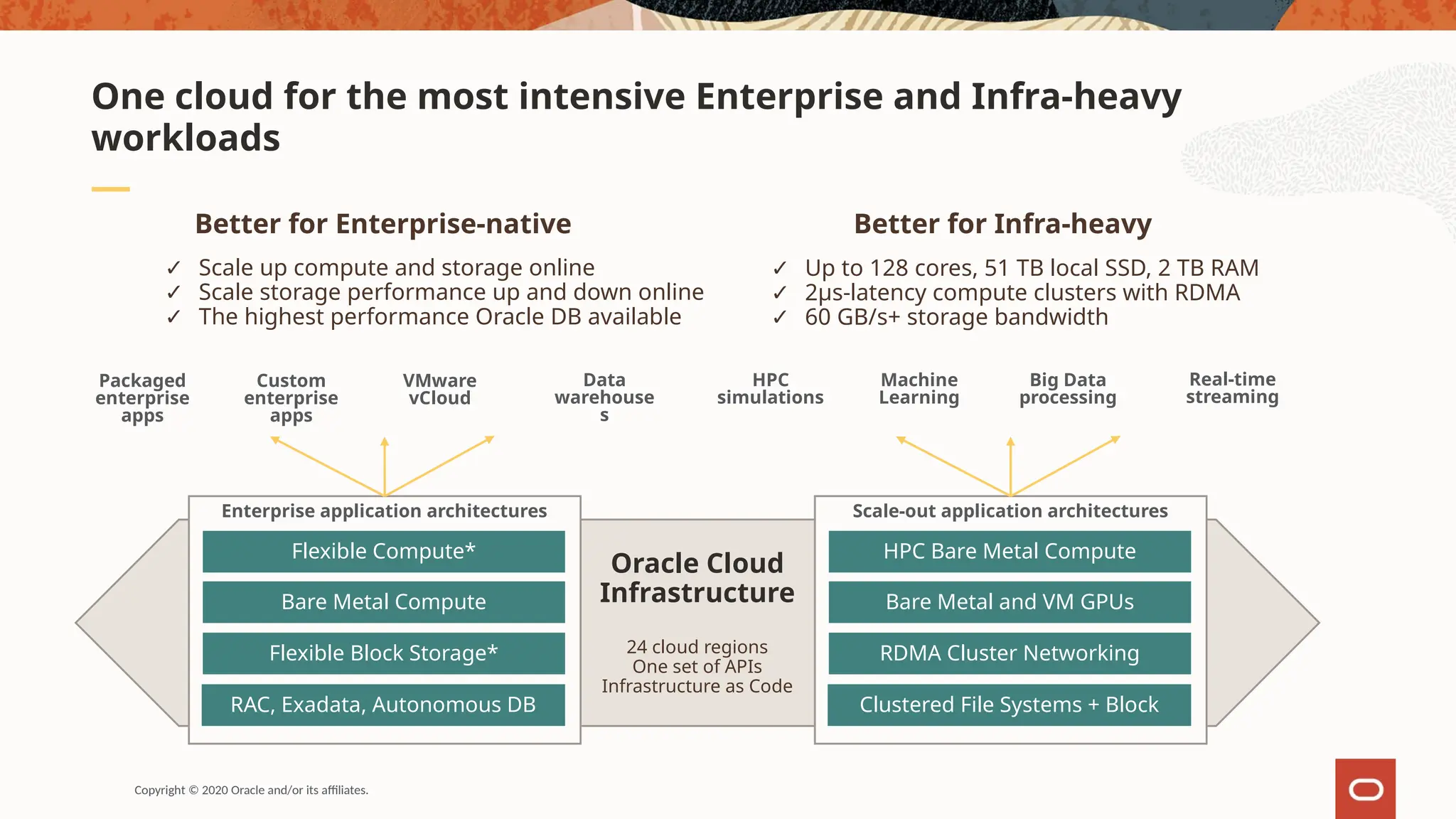
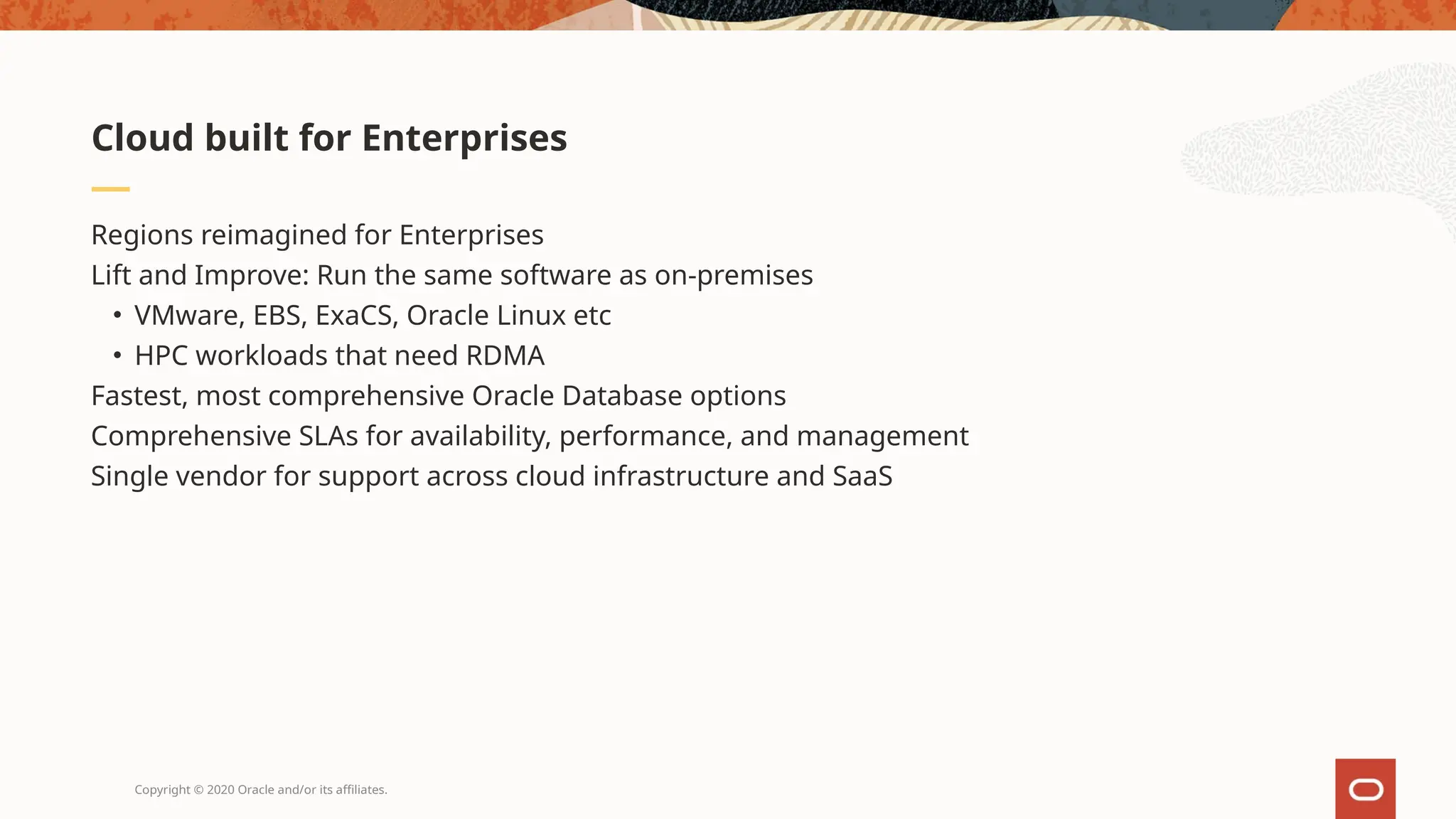
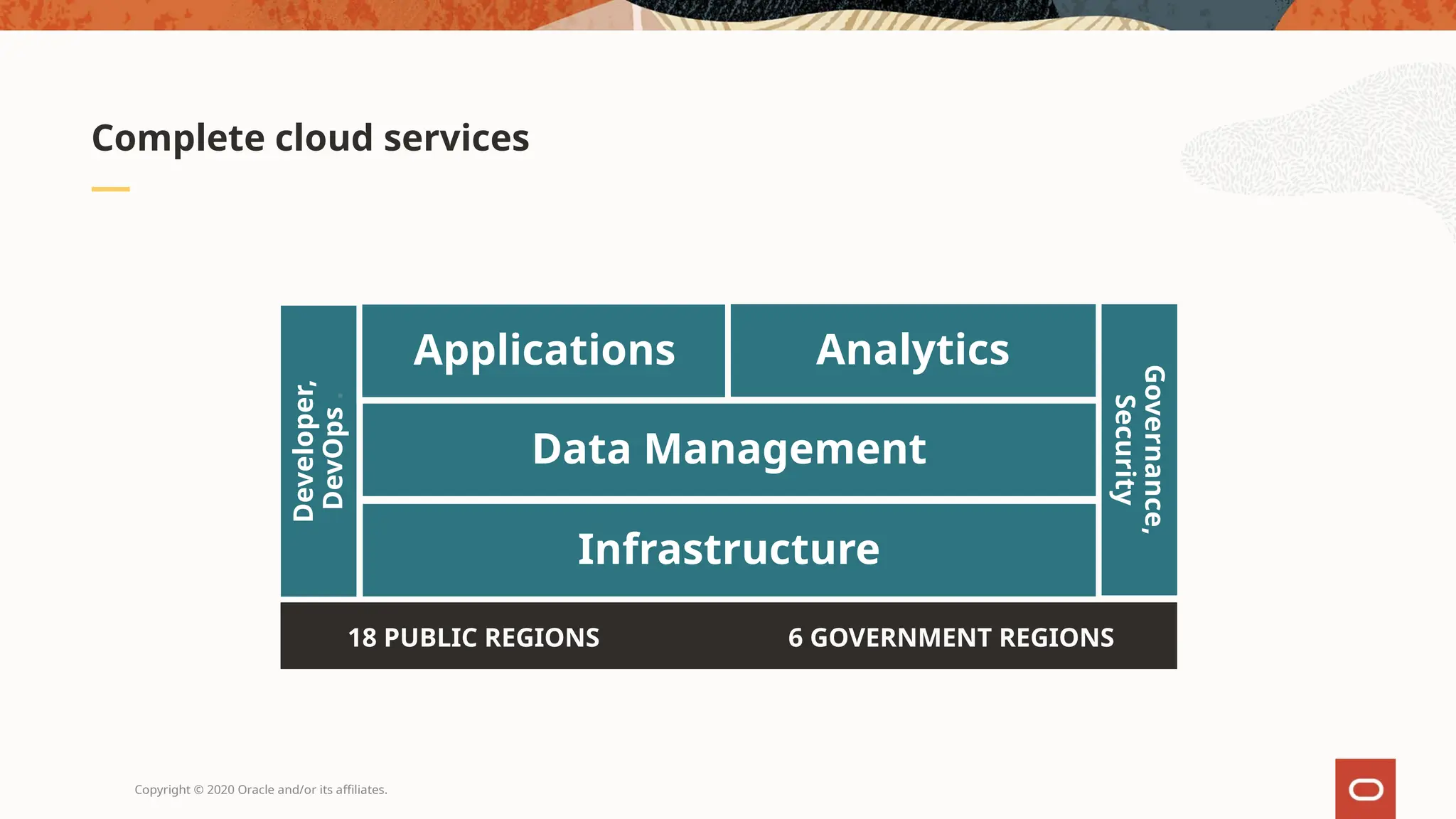
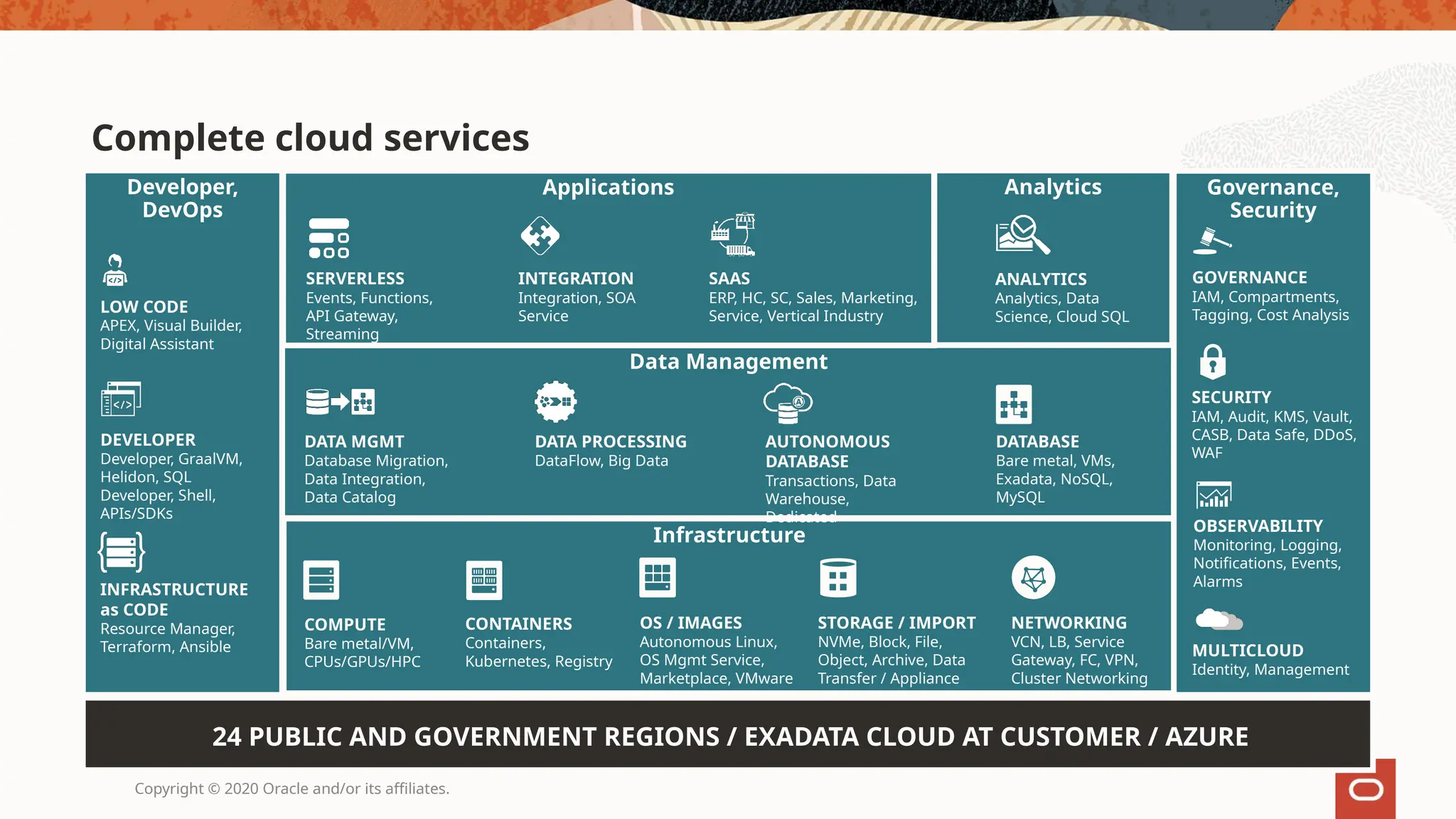
#9 And what do our customers typically do on our cloud? We made it compatible with the key workload categories that our internal and external customers use, and there are four main workload categories our customers and partners run on our cloud.
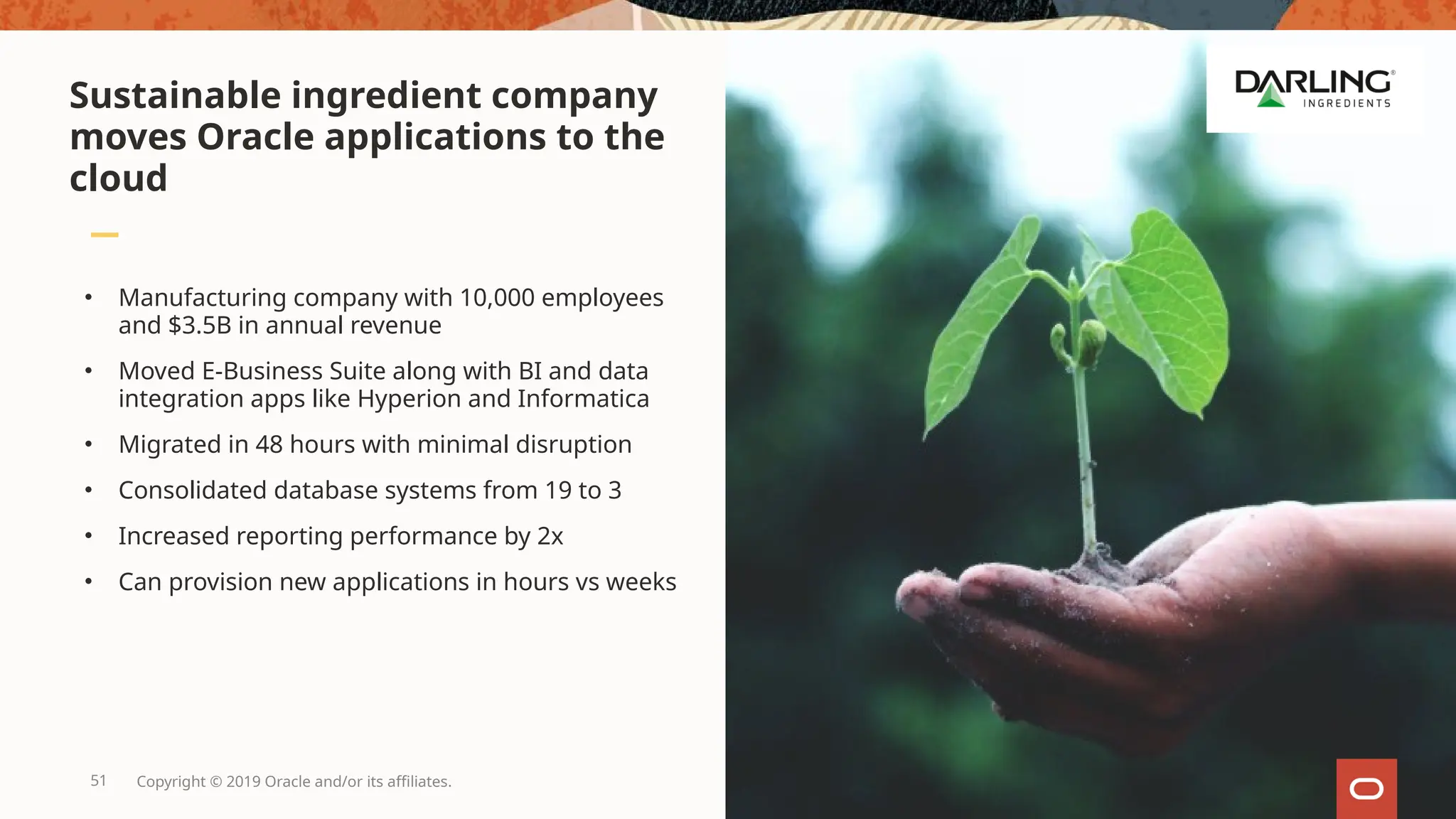
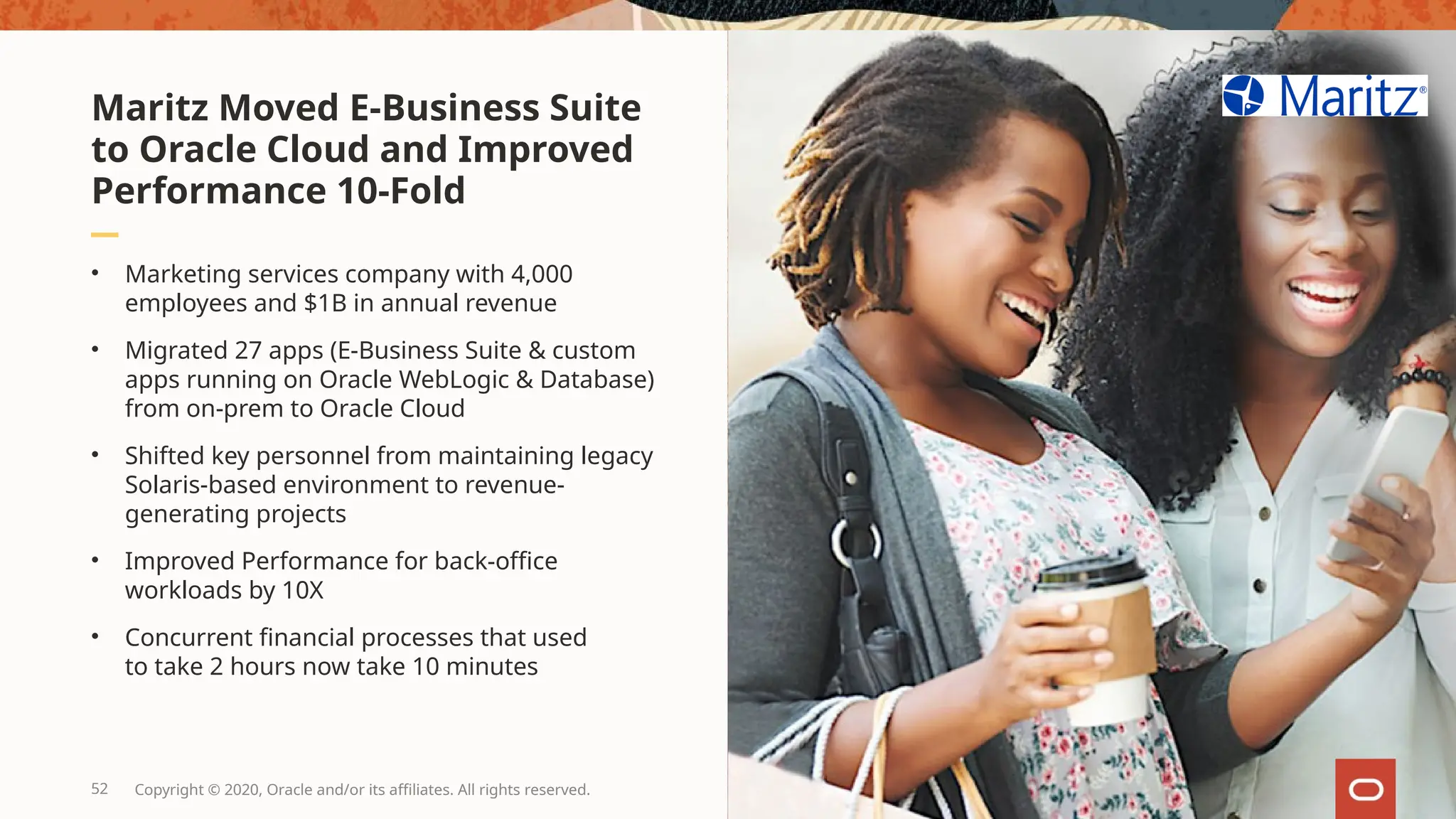
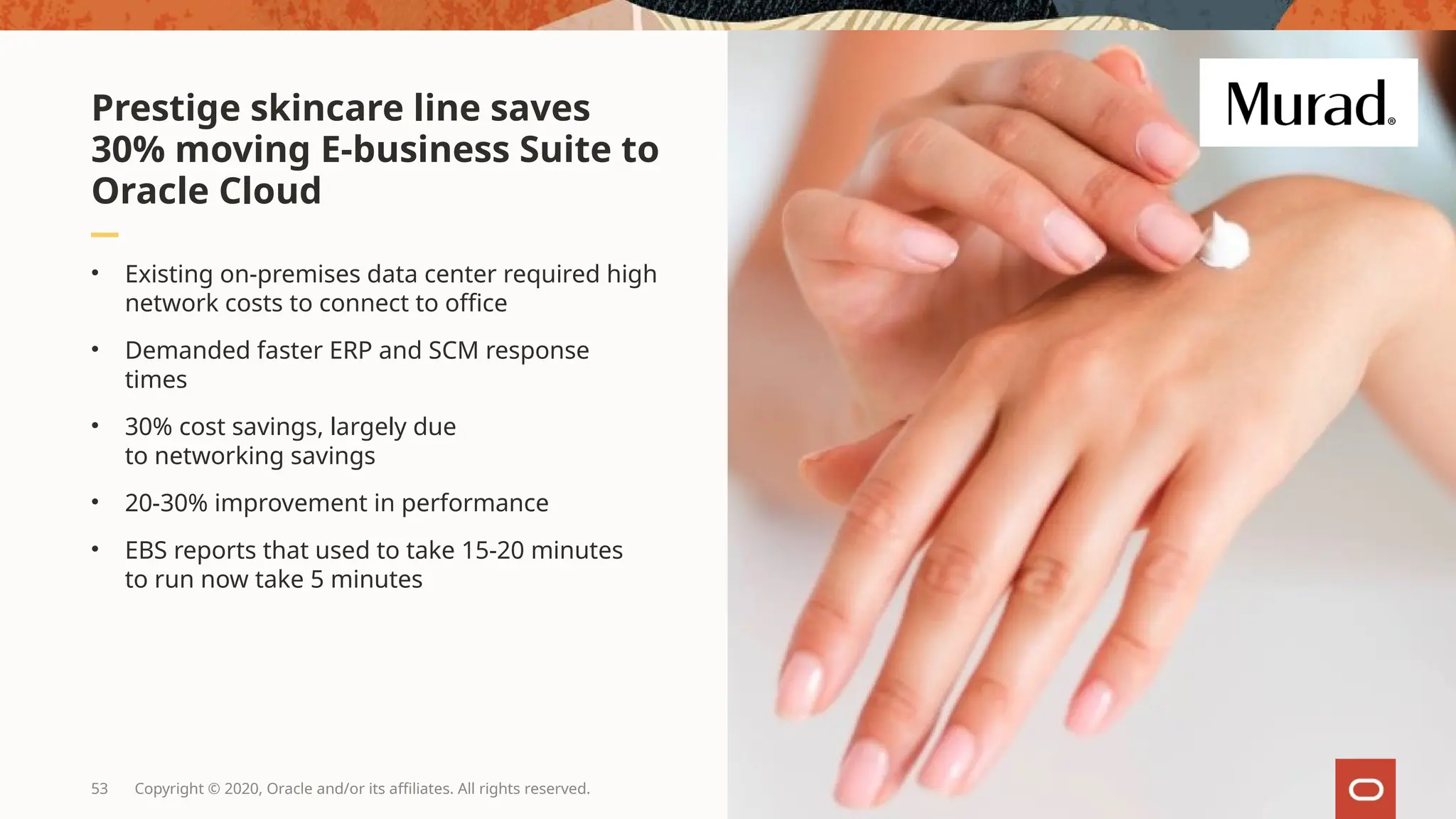
First is to move their implementations of Oracle Applications to cloud. These are often complex customized environments that can’t easily move to a vanilla SaaS environment. We give these customers an easy path to move apps as they run in their own data centers to cloud, where they get the same performance or better than on-premises while no longer wasting time on hardware refreshes, system upgrades or other mundane tasks, and they often save significant money as well. They get to bring all their customizations and easily integrate with other applications that also run in our cloud.
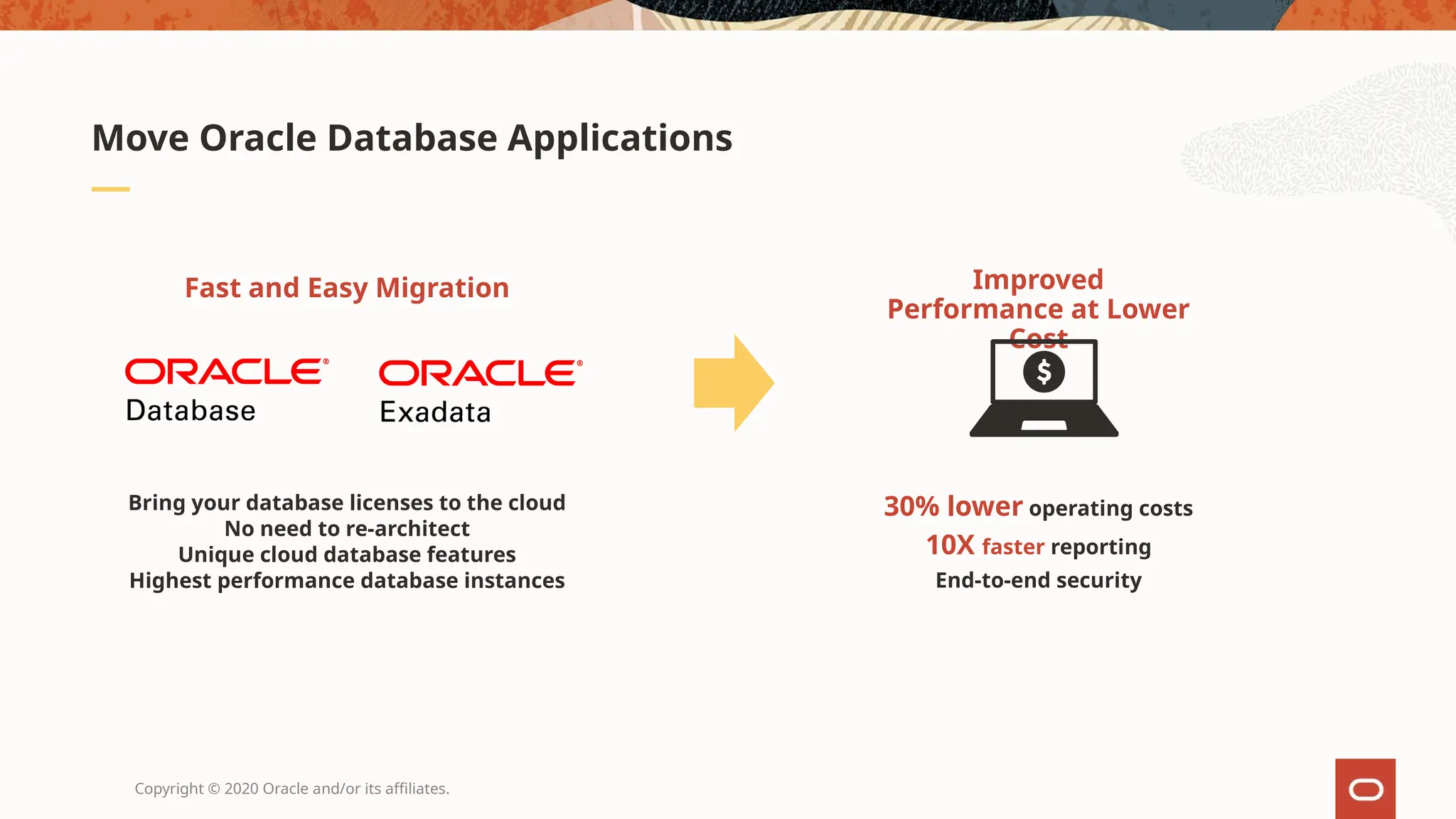
The next category is custom and ISV applications that run on the Oracle Database. There are thousands of enterprise organizations and software companies that use Oracle Database as a key foundation for applications they build. Oracle has made it easier for these organizations to build services that take advantage of our managed cloud database service as well as the infrastructure optimized around this stack to reduce the level of effort they undertake in deploying these applications in our cloud. We can eliminate many of the mundane tasks of standing up and maintaining the database and the underlying hardware and let these organizations keep their focus completely on the application itself, freeing them up to make more rapid and more effective functionality expansions, helping them reach more customers and be more nimble in conducting their business.
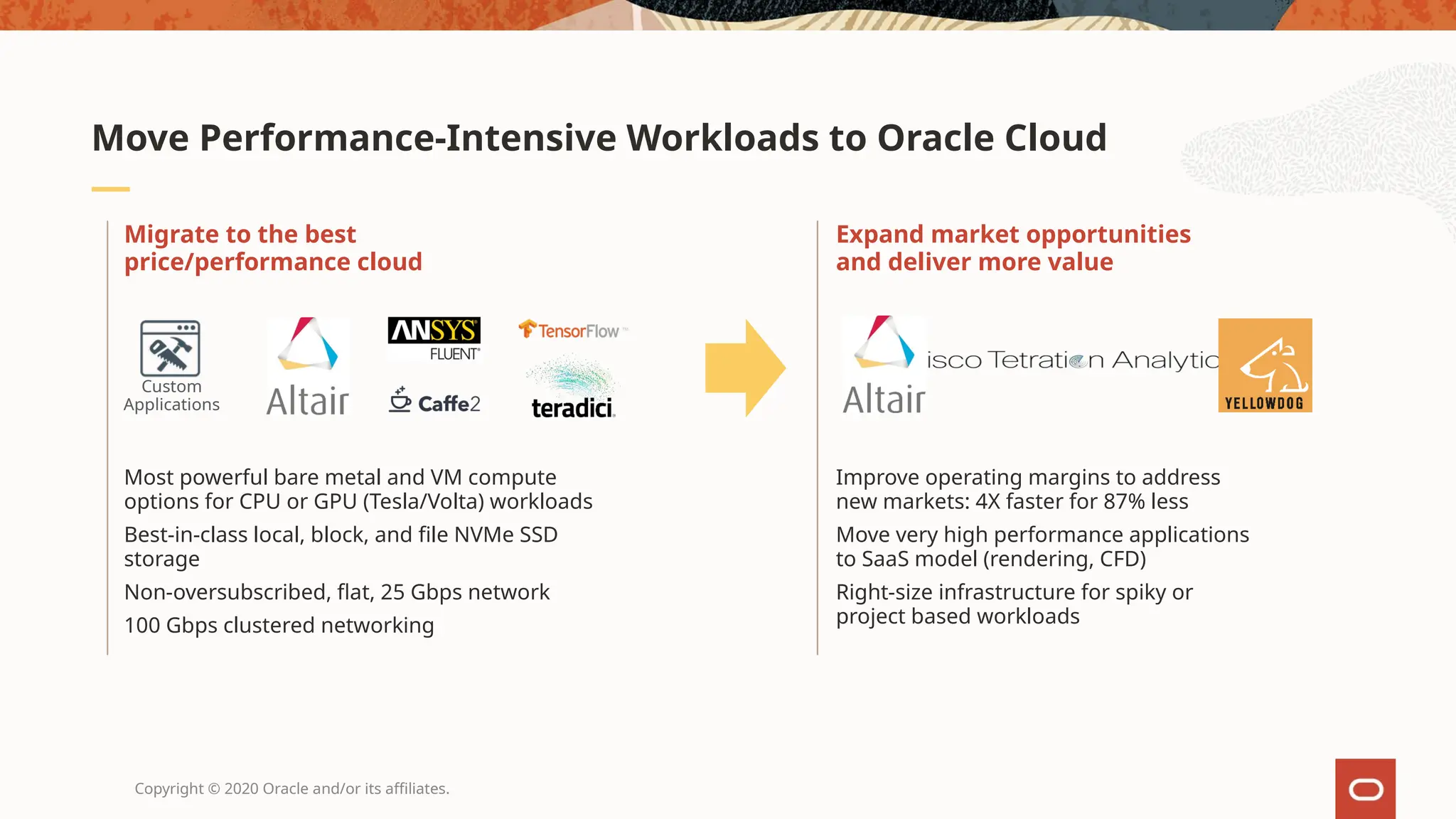
Our platform is also a great fit for performance and data intensive workloads. This includes true high performance compute workloads of multiple varieties as well as data lake and other compute or storage intensive workloads where data access and consistent performance at a reasonable price are key success criteria. Our consistent and blazing fast network connectivity combined with industry leading compute and storage performance makes an ideal platform for users that care about performance.
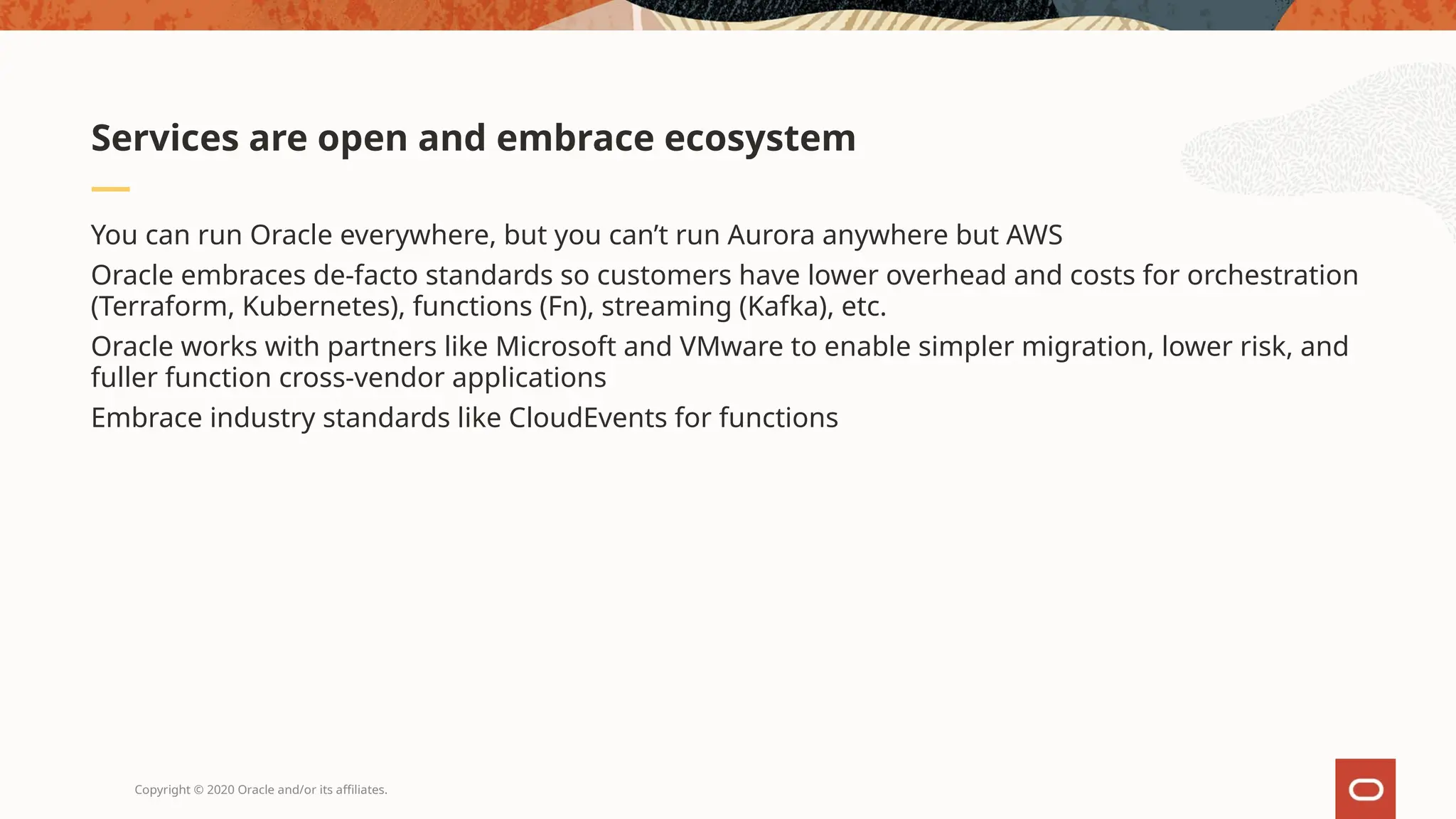
Finally, we’re doing a great deal of innovation in the cloud native space and customers that want to build on the cutting edge of cloud application architectures are finding a good home for innovation on the Oracle Cloud. Our design principle here is to focus on leveraging the industry leading development streams in open source and elsewhere, making our cloud compatible with what customers are already using with success, rather than locking customers in to proprietary services. We’ve recently launched our Oracle Kubernetes Engine and Registry for containers where customers can get deploy the industry standard in container deployment and management on top of our predictable and performant bare metal infrastructure that avoids the conflict and performance degradation of hypervisors and server agents. We’ve built and open-sourced our .FN project for serverless architectures which can be downloaded and run anywhere, and will soon be available as a highly flexible and reliable cloud service. For management, we are heavily supporting Terraform from Hashicorp, a widely used infrastructure automation framework that can be used to program infrastructure deployment in our cloud, as well as on premises and in competitor’s cloud, bringing tremendous capabilities while at the same time avoiding lock in for our customers.
---
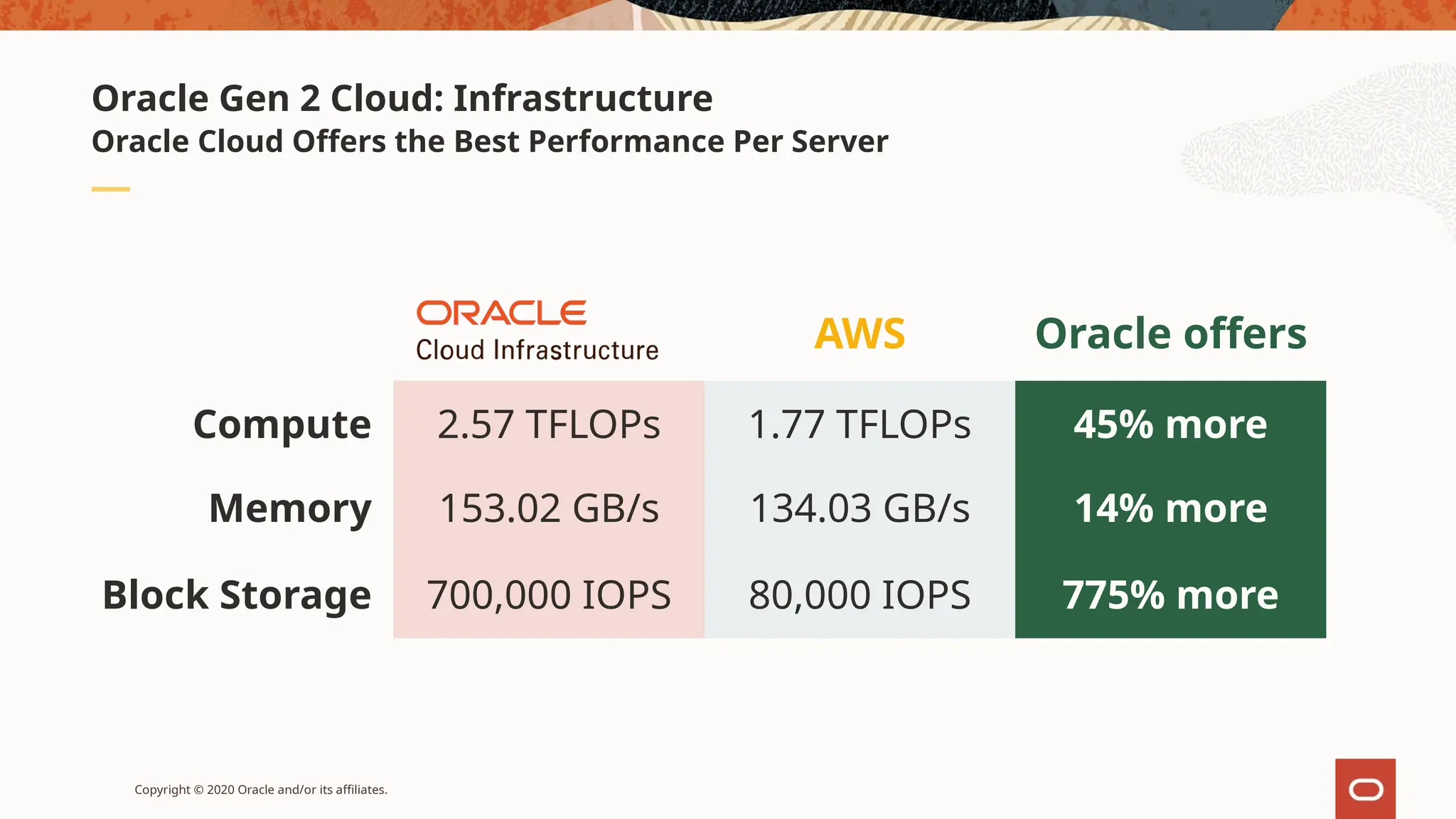
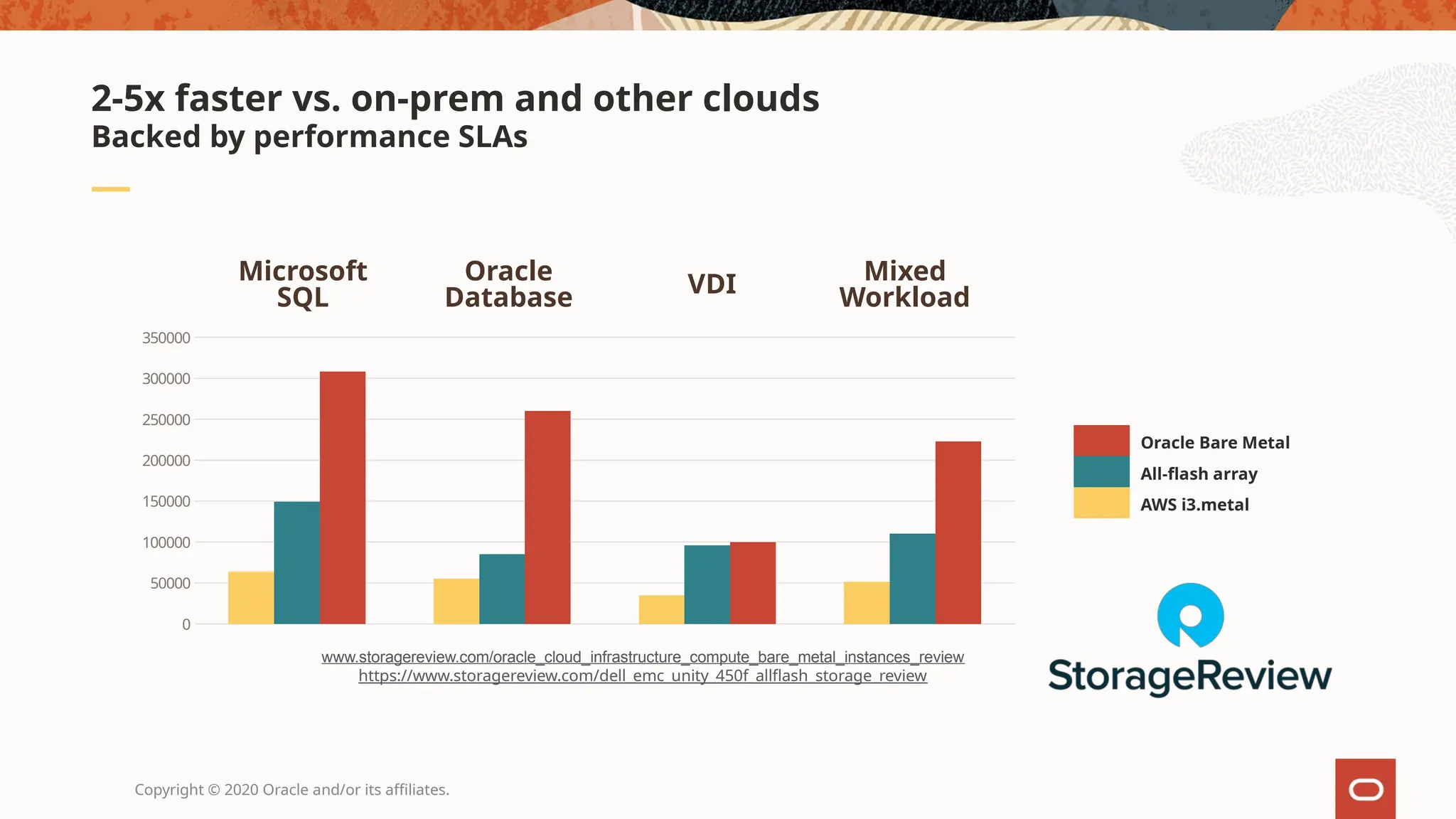
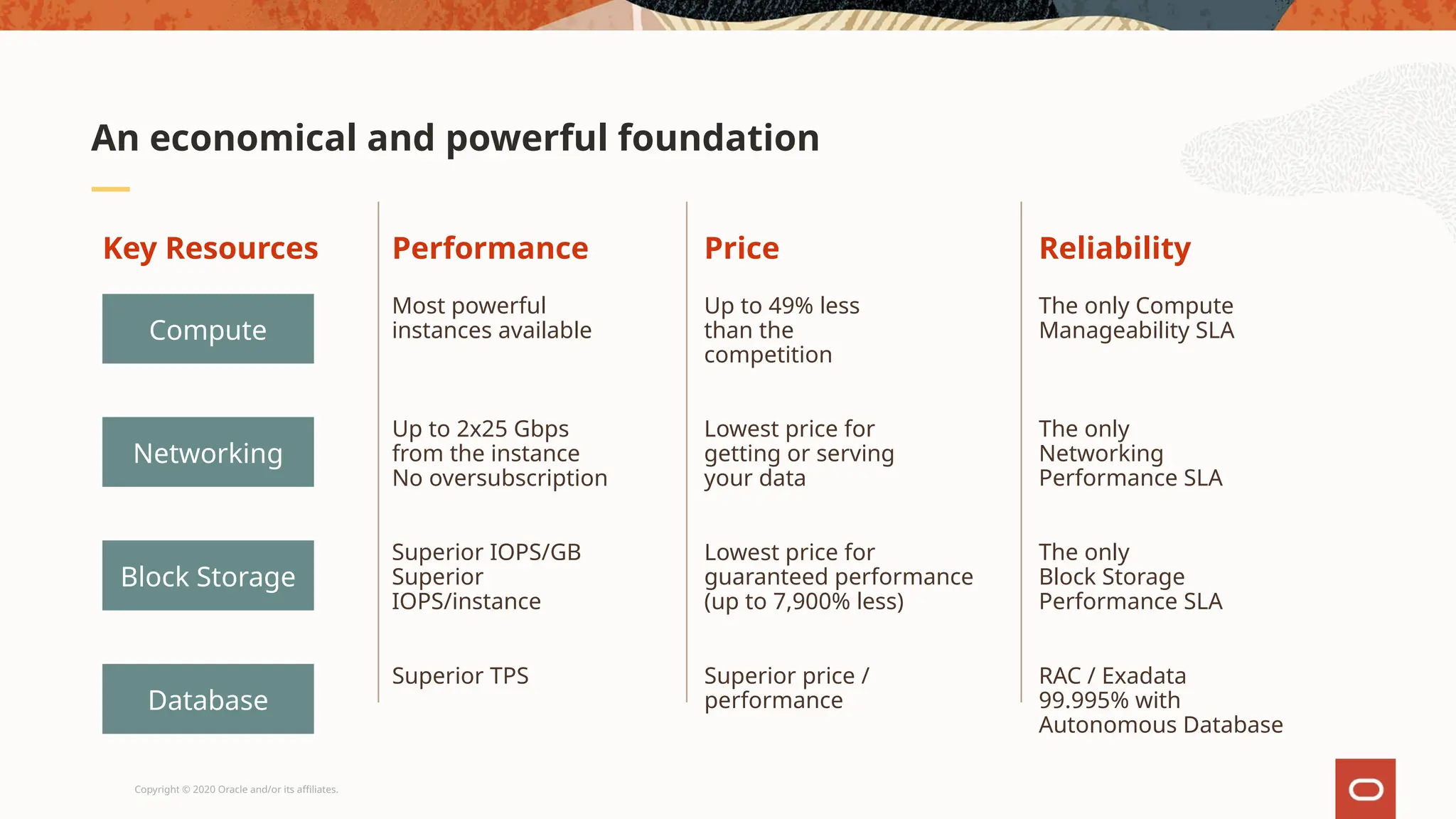
We’ve also put our storage performance to the test. Not only has this been validated by 3rd party analysis, but our storage performance is backed by SLAs, the only performance SLAs in the industry.
StorageReview found that Oracle bare metal with attached block volumes offer 2-5x better performance over AWS EC2 i3.metal for Oracle Database, Microsoft SQL, VDI and mixed workloads. We offer 5.5X more usable IOPS for Microsoft SQL workloads than AWS.
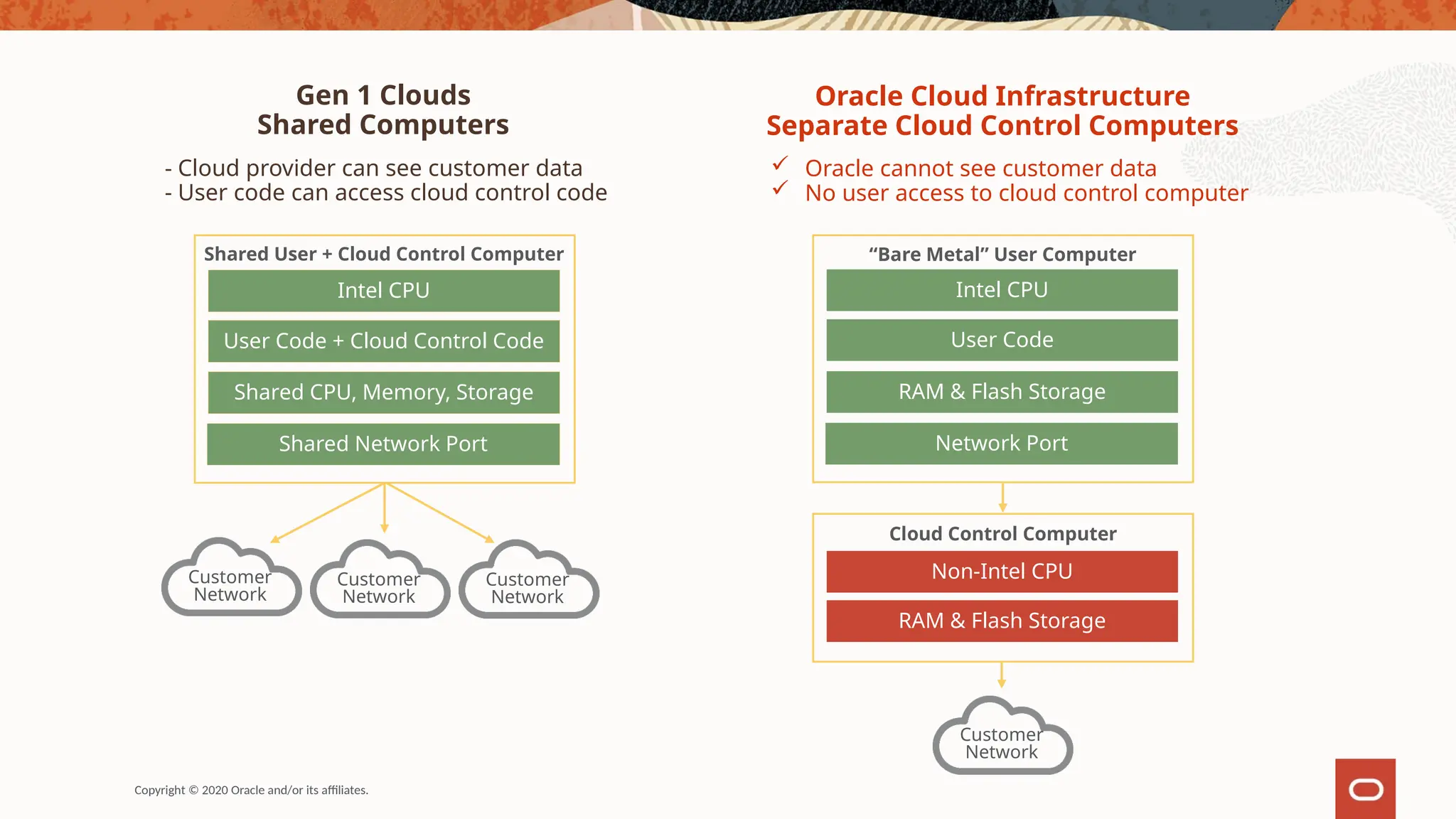
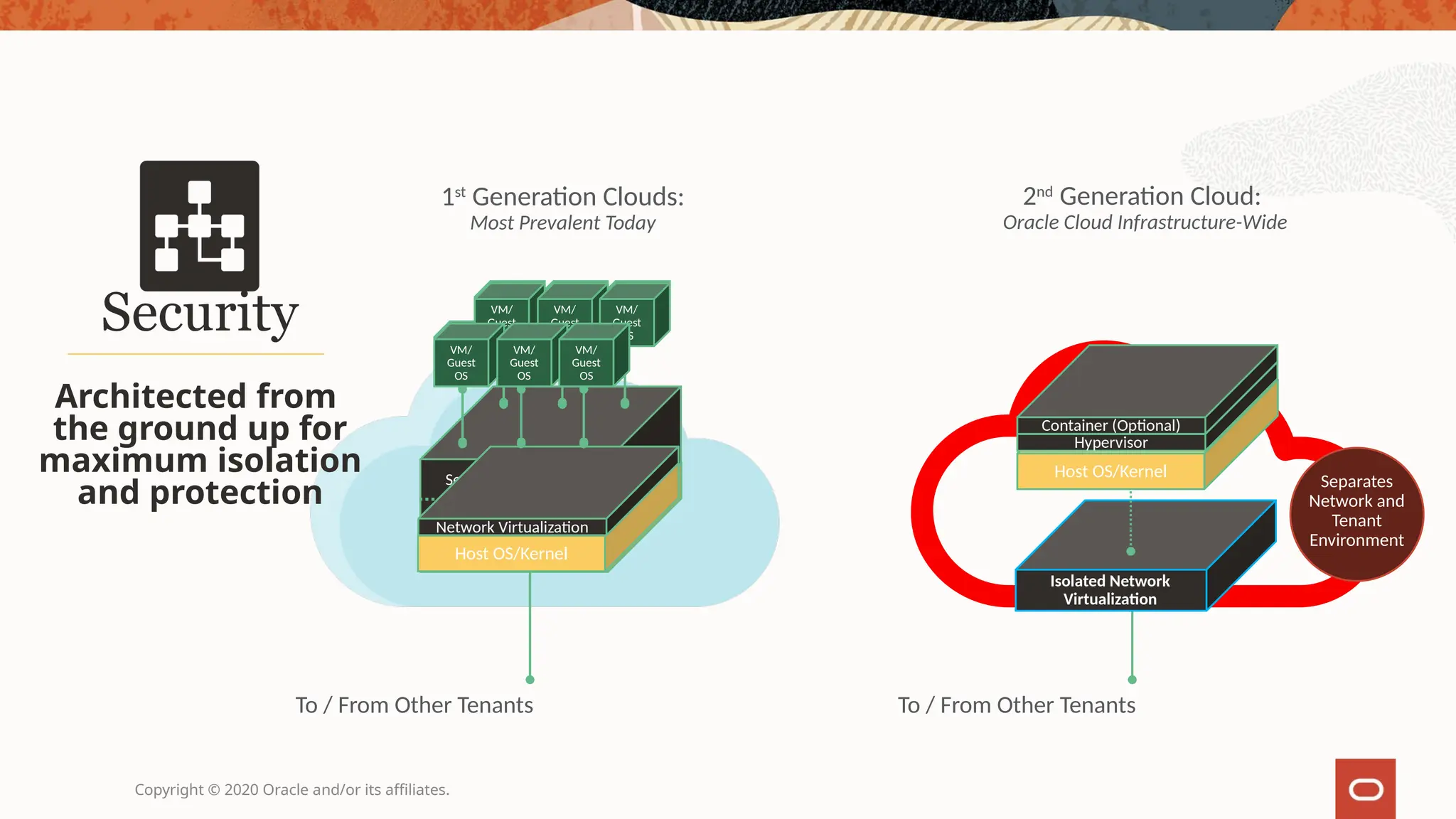
#10 Ground up security; This is the foundation in which we build the cloud.
Most clouds – network and IO virtualization in the hypervisors. This is not only performance impacting but is not secure.
Off box virtualization – Meaning Networking and IO – outside the box. Provides maximum isolation and protection,
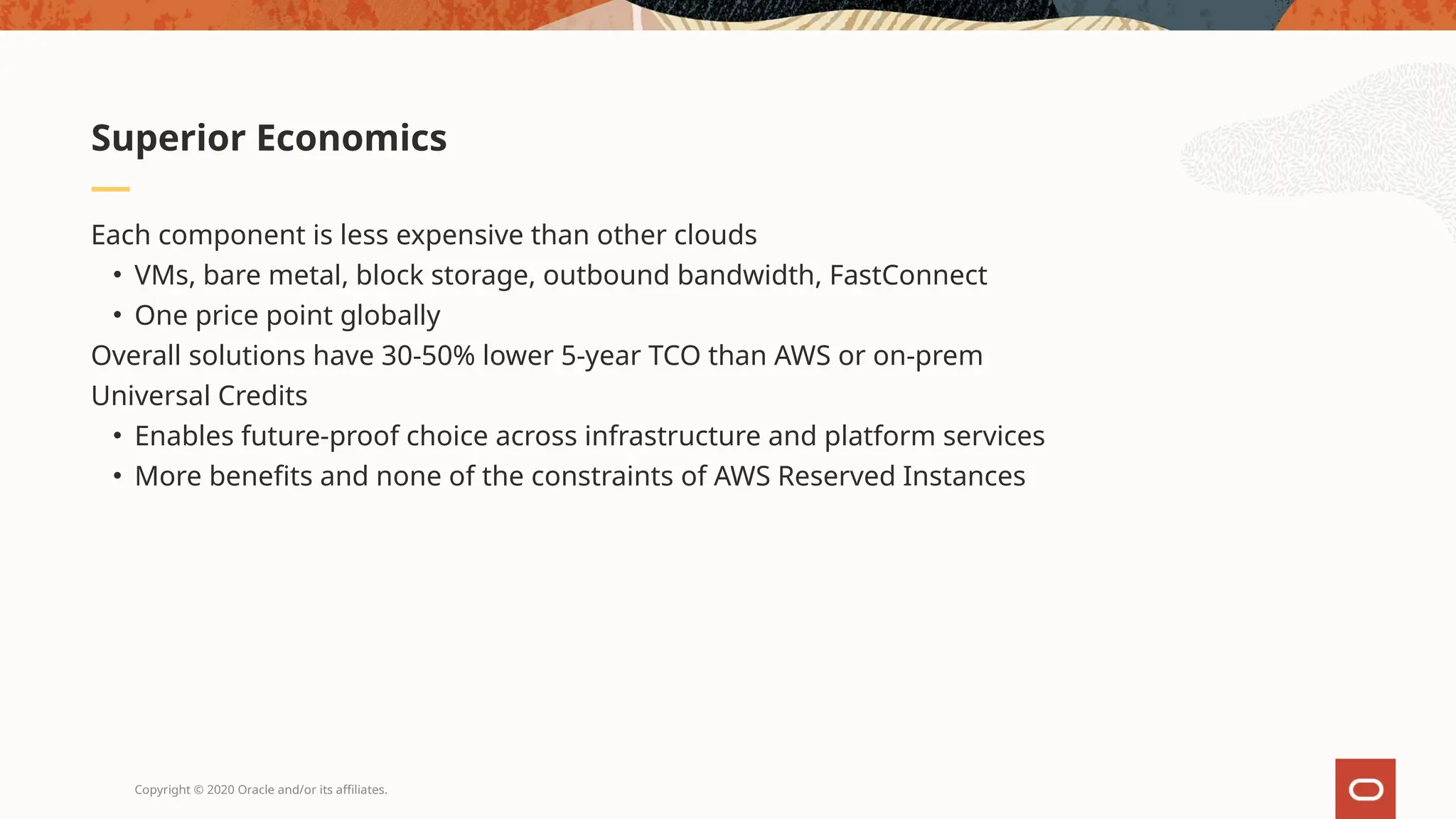
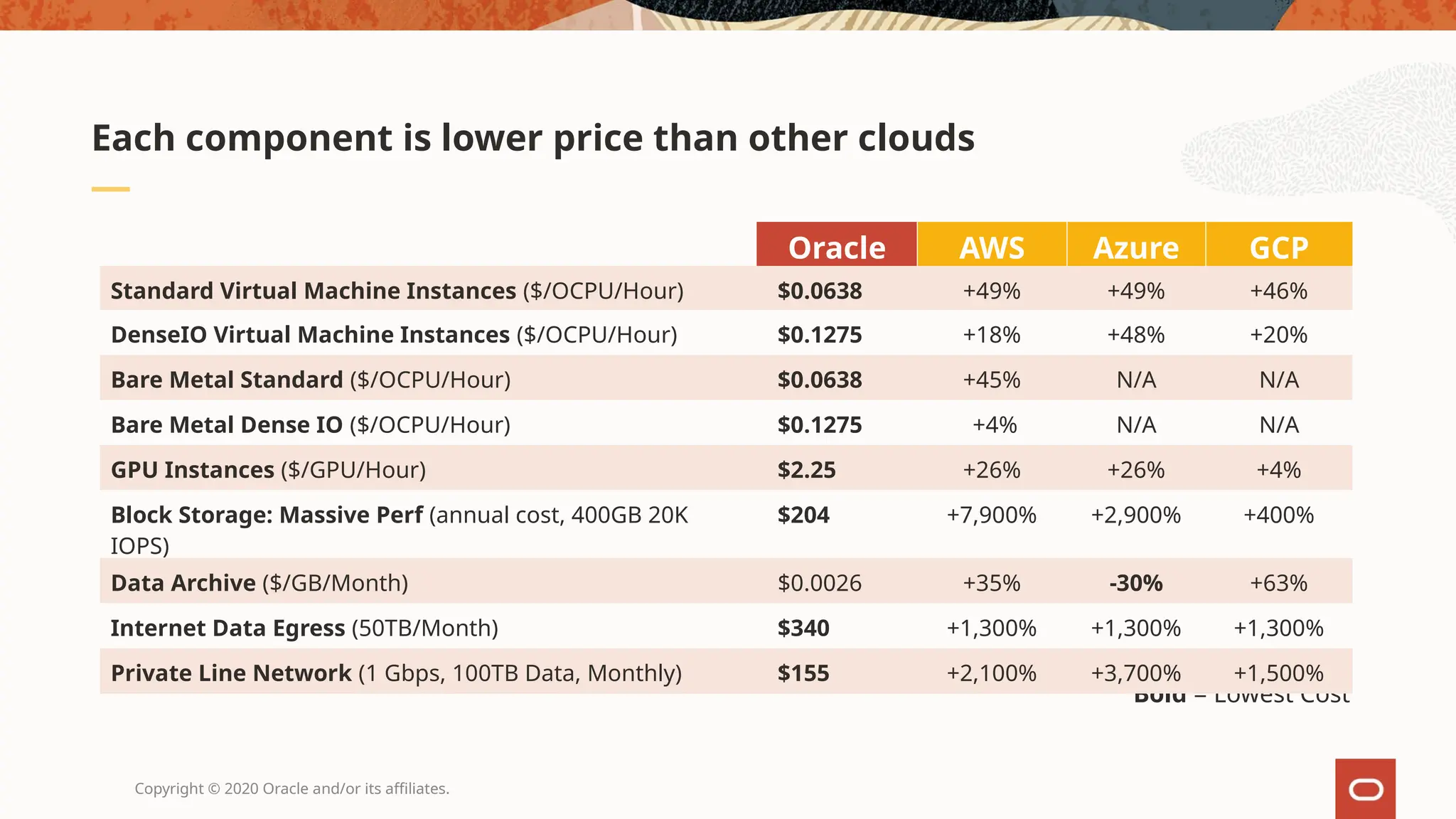
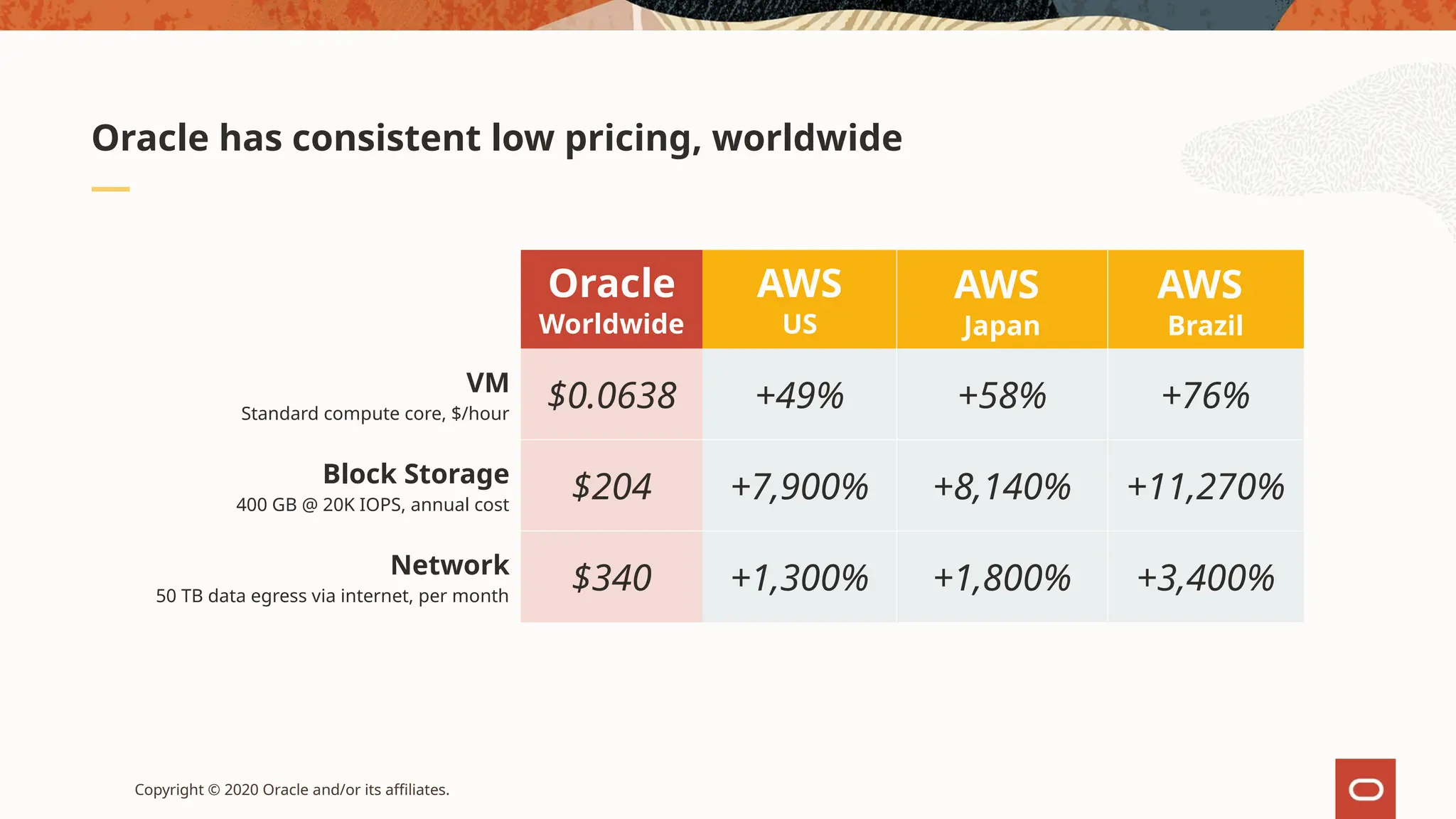
#12 In addition to our aggressive pricing, we offer an easy-to-understand discount structure and won't confuse you with complicated pricing models tied to individual services. All comparisons are made to the most equivalent available service from competitors, using the lowest priced region and most equivalent configuration
Oracle 2.X standard virtual machine instances compared to:
AWS R4 instances of equivalent core count (1 Oracle OCPU – 2 AWS vCPU)
Microsoft Azure E v3 instances of equivalent core count (1 Oracle OCPU – 2 Azure vCPU)
Google n1-highmem instances of equivalent core count (1 Oracle OCPU – 2 GCP vCPU), not including sustained usage discount
Oracle 2.X DenseIO virtual machine instances compared to:
AWS I3 instances of equivalent core count (1 Oracle OCPU – 2 AWS vCPU)- Oracle offers 68% more local SSD for equivalent core count and memory
Microsoft Azure G series instances of equivalent core count (1 Oracle OCPU – 1 Azure CPU) Oracle offers 4X the local SSD capacity for equivalent core count and memory; Azure does not use NVMe SSD
Google n1-highmem instances with added SSD up to 3TB with equivalent core count (1 Oracle OCPU – 2 GCP vCPU)- GCP max local SSD is 3 TB- this means that the smallest Oracle DenseIO shape has 2X memory and larger ones get to 4X and 8X avantages for similar core count and memory; not including sustained usage discount
Oracle bare metal standard instances compared to:
AWS I3.metal bare metal instances- fewer cores (36 AWS vs 52 Oracle) but AWS includes 15TB NVMe Local SSD vs none on OCI standard bare metal
Microsoft L32 instances- These are shared tenancy virtual instances as opposed to bare metal, but are similar in core count and memory. Compared to Oracle X5 bare metal standard instances, Microsoft L32 is 16% more expensive, but has 5.6TB SSD; compared to Oracle X7 bare metal standard instances Microsoft L32 is 25% less expensive but has less cores (36 vs 52), less memory (256GB vs 768GB) but more SSD (5.6TB vs 0)
GCP Custom instances- These are shared tenancy virtual instances as opposed to bare metal, but can be configured with similar core count and memory. The closest comparison to Oracle X7 bare metal instances is a 96 VCPU (48 CPU equivalent) instance with 624GB of memory- slightly lower cores and significantly less memory (versus OCI X7 bare metal with 52 CPU, 768GB memory); not including sustained usage discount
Oracle bare metal DenseIO instances compared to:
AWS I3.metal bare metal instances- fewer cores (36 AWS vs 52 Oracle) 15TB NVMe Local SSD vs 51.2TB on OCI X7 DenseIO bare metal
Microsoft’s closest option to OCI bare metal DenseIO instances are G5 instances, but the gap in local SSD capacity, 6TB for Microsoft versus 51.2TB for Oracle, along with the fact that the Microsoft instances are not bare metal but shared tenancy virtual instances makes this an unviable comparison
GCP Custom instances have a maximum of 3TB local SSD, which makes a comparison to OCI DenseIO bare metal instances with 51.2TB of local SSD storage unviable
Oracle Data Archive is compared to:
AWS Glacier base storage rate of $0.004 per GB per month, excluding data retrieval and operations charges
Microsoft Archive Storage base storage rate of $0.002 per GB per month, excluding data retrieval and operations charges
Google Cloud Coldline Storage lowest available rate of $0.007 per GB per month, excluding data retrieval and operations charges
Oracle File Storage is compared to:
AWS EFS base storage rate of $0.30 per GB per month, lowest region and class of service, excluding data retrieval and operations charges
Microsoft General Purpose v2 File Storage LRS base storage rate of $0.06 per GB per month, excluding data retrieval and operations charges
Google Cloud Filestore Standard (in Beta currently) base rate of $0.20 per GB per month, excluding data retrieval and operations charges
Oracle Block Storage (400 GB @ $0.0425 per GB per month including all performance = $204 per year) is compared to:
AWS EBS IO1 Provisioned IOPS with 400GB charged at $0.125 per GB per month = $600 per year for capacity plus 20K IOPS @ $0.065 per IOPS per month = $15,600 per year = $16,200 per year total
Microsoft 4 X P30 premium disks with LRS configuration- overprovisioned capacity to get to 20K IOPS capabilities- 4X $122.88 per month = $5,898 per year
Google Cloud Persistent Disk SSD @ $0.17 per GB per month including all performance
Oracle Data Egress cost- 10TB per month free, $0.0085 per GB per month, compared to:
AWS Data Transfer Out to Internet stepped rates from $0.09 to $0.05 per GB after 1GB free threshold
Microsoft Outbound Data Transfer, stepped rates from $0.087 to $0.05 per GB after 5GB free threshold
Google Cloud Data Egress, stepped rates from $0.12 to $0.08 per GB, no free threshold
Oracle Fast Connect Dedicated Private Line Service, 1Gbps link with 100TB data monthly compared to:
AWS Direct Connect 1Gbps link @ $0.30 per hour plus data egress charges assuming lowest available rate of $0.020 per GB per month
Microsoft Express Route 1Gbps link with unlimited data plan, without premium add-on = $5,700 per month
Google Cloud Partner Interconnect, 1Gbps @ $200 per month per attachment plus $0.02 per GB per month data egress
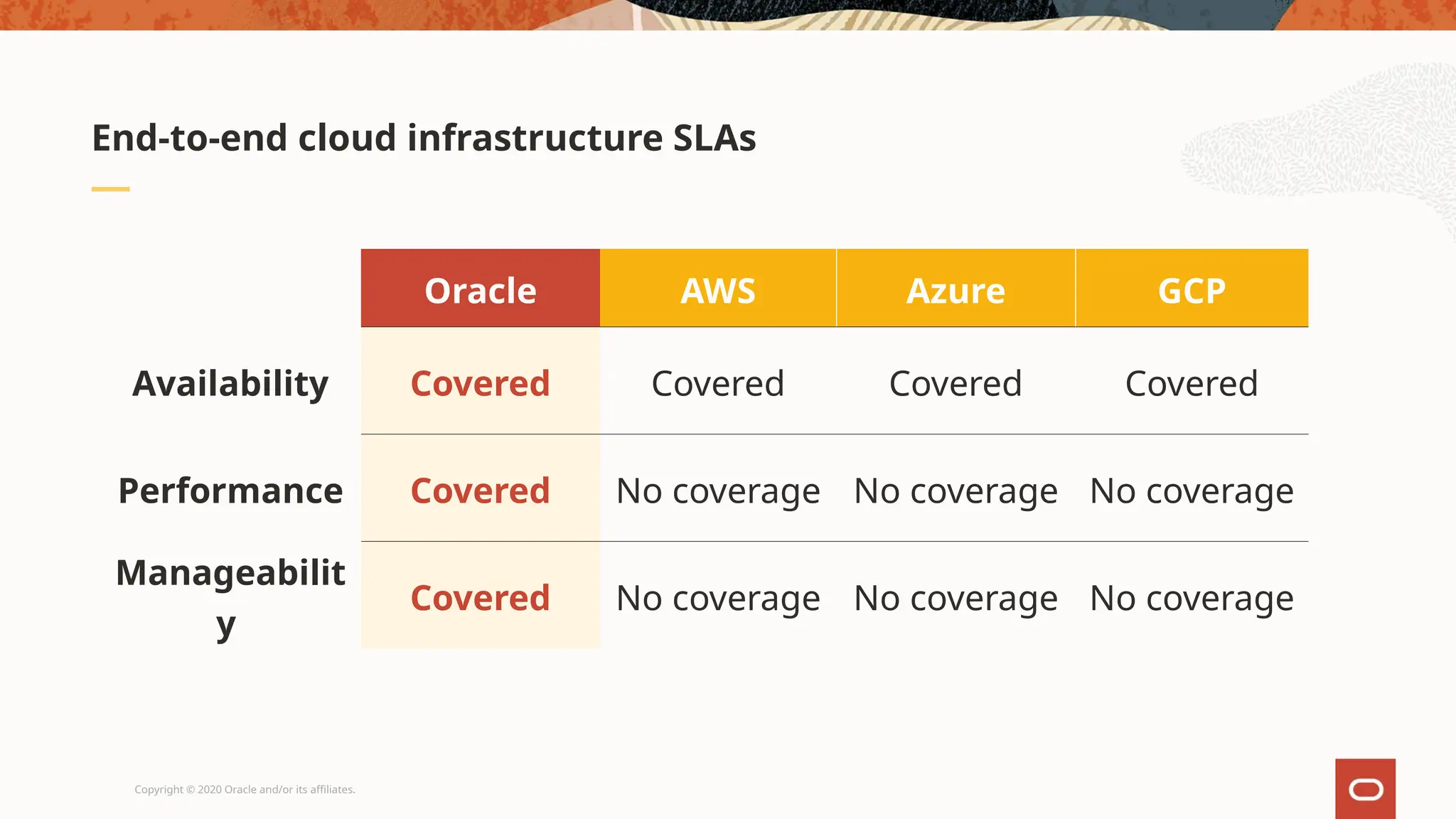
#17 Oracle has set a new standard for SLAs in the cloud.
While every other cloud offers just availability – your resources will have SLA when they are launched.
We are the only cloud that offers manageably and performance.
Manageability SLAs are important because – What’s the use of building modern application when you can’t autoscale.
Similarly, we guarantee performance for our core services and DB; you can migrate services confidently on to our cloud.
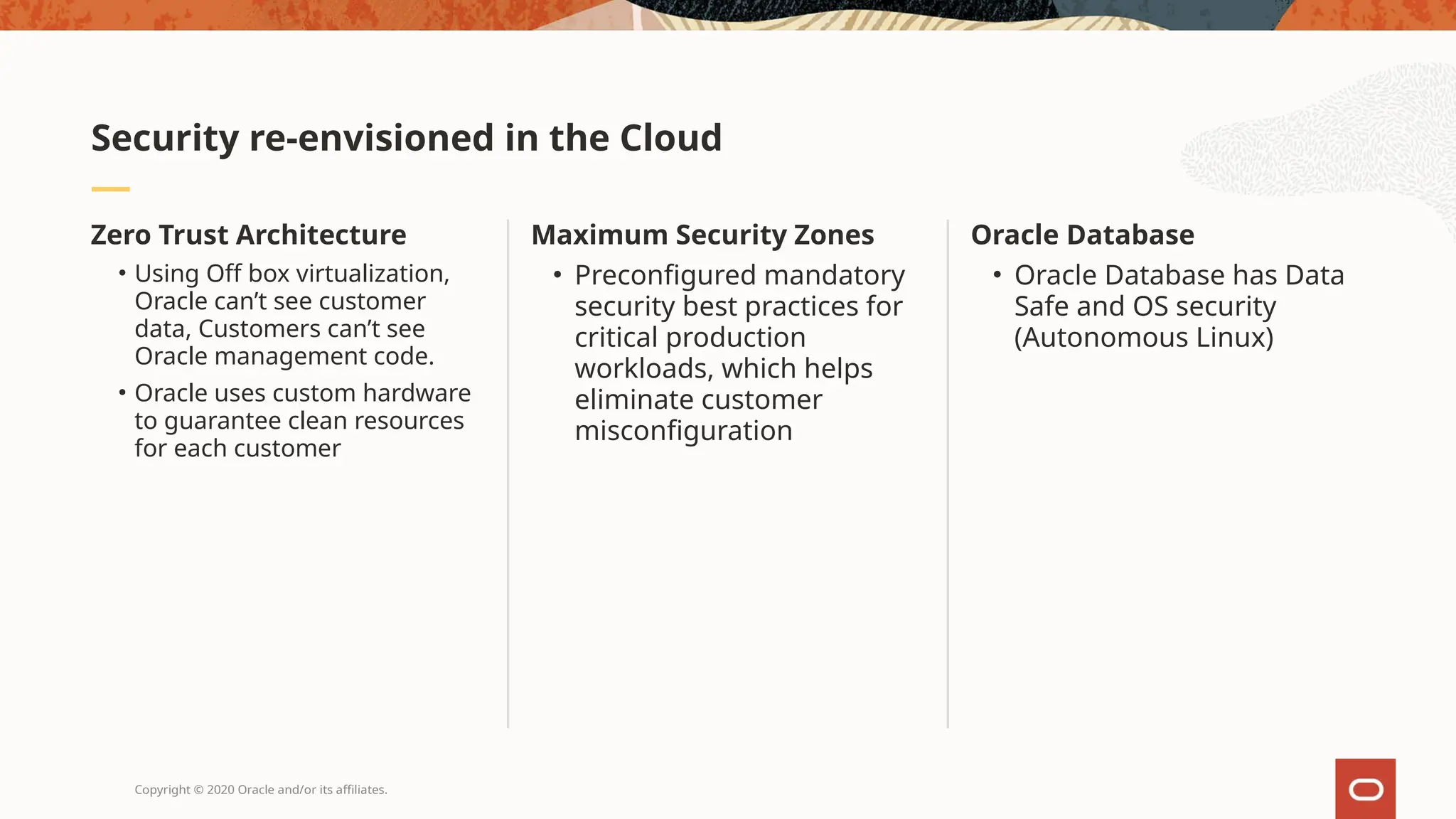
#19 Ground up security; This is the foundation in which we build the cloud.
Most clouds – network and IO virtualization in the hypervisors. This is not only performance impacting, but is not secure.
Off box virtualization – Meaning Networking and IO – outside the box. Provides maximum isolation and protection,
#25 Thanks for your time, and I hope you learned more about how you can partner with us to transform your business.
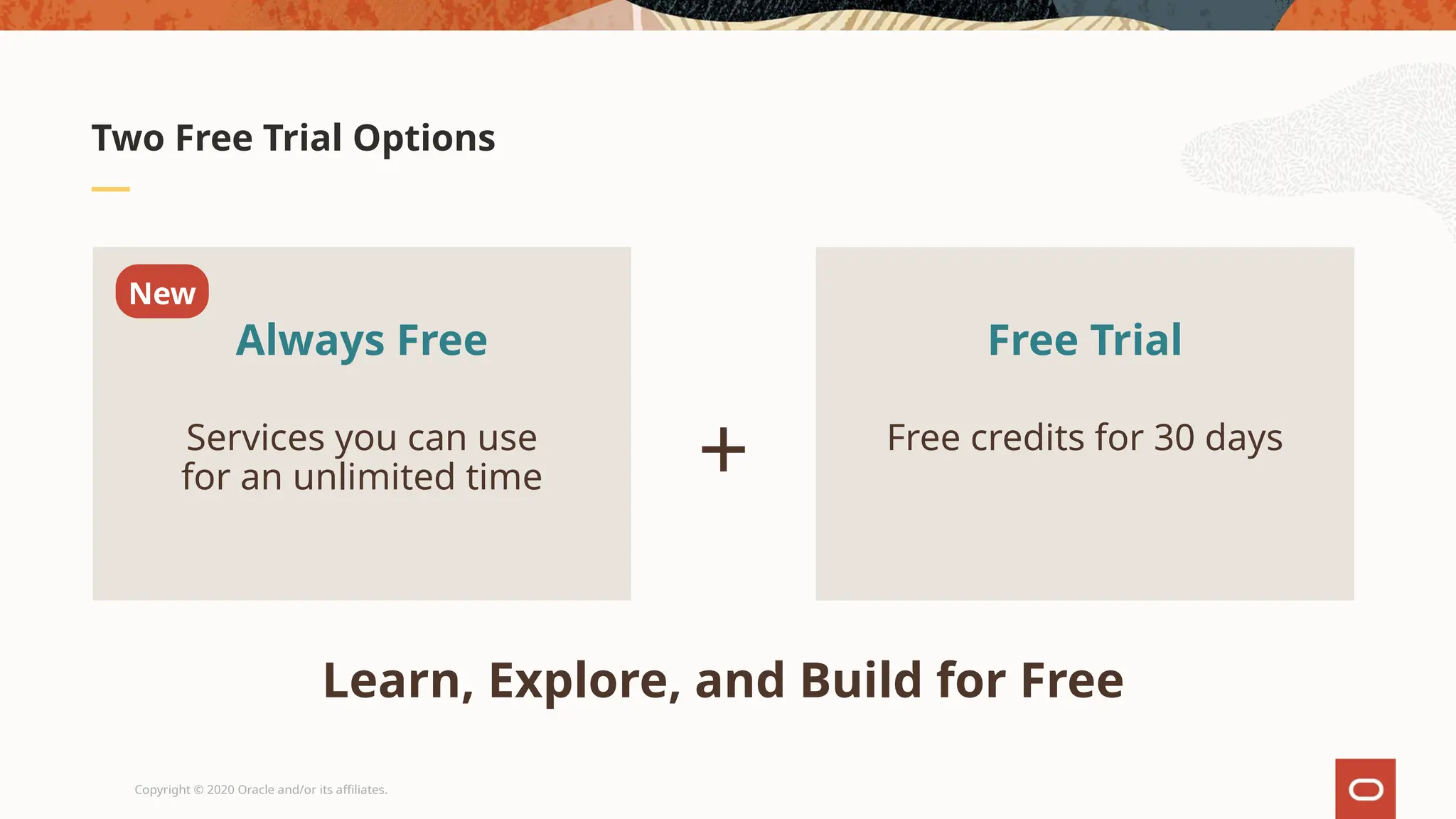
If you want to get hands on, please try one of our hour-long hands on labs or start a free trial!
We’re also happy to answer any questions in the innovation showcase
Thank you again!
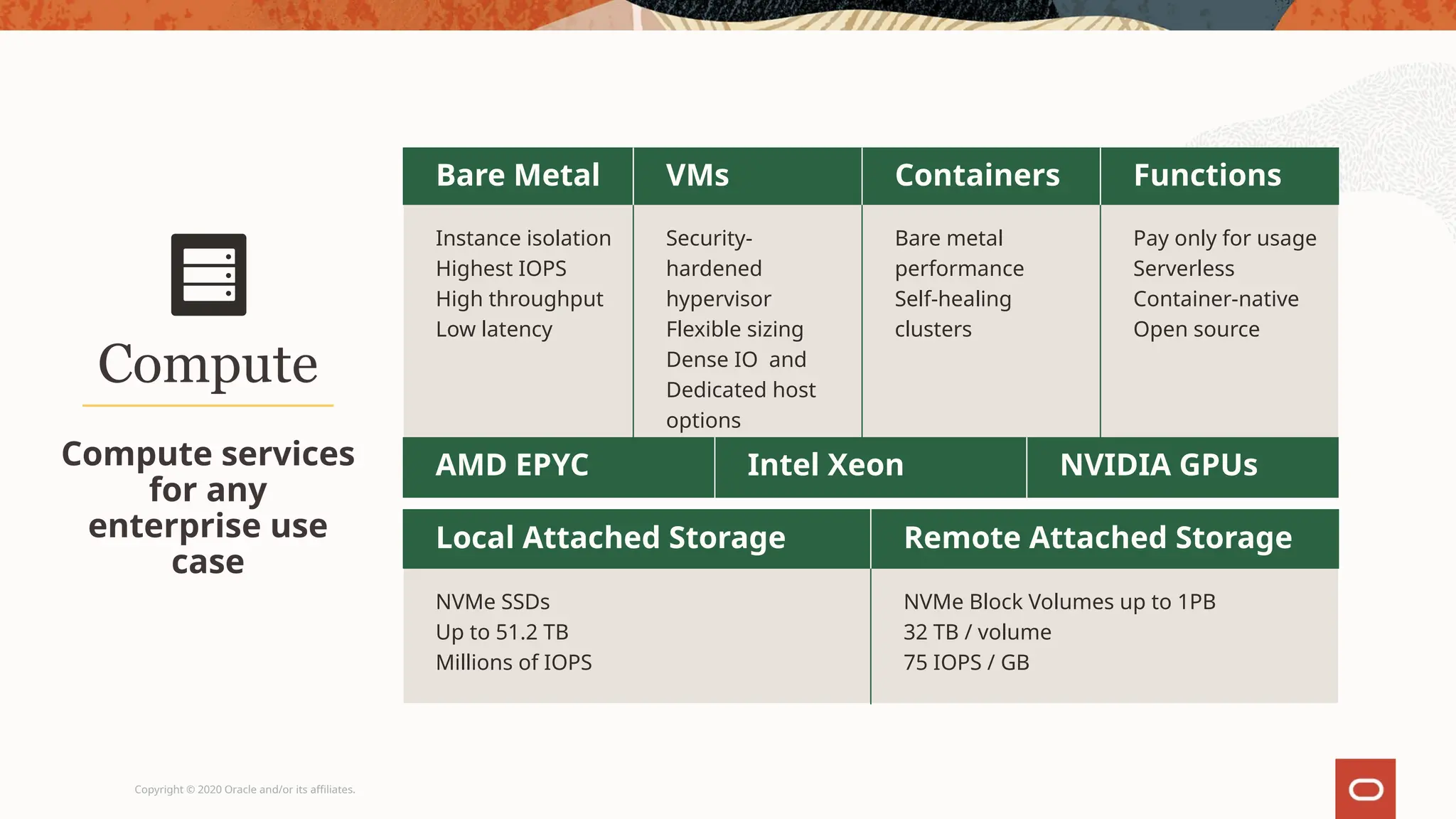
#31 Compute services are the foundation and the most important cloud service.
Most customers on average spend 70% of their cloud bill on Compute.
Oracle was the first to offer Bare Metal as a compute “flavor.” Oracle’s bare metal instances support applications requiring high core counts, large amounts of memory, and high memory bandwidth. Users can build cloud environments with significant performance improvements over other public clouds and on-premise data centers. Bare metal compute instances provide customers with exceptional isolation, visibility, and control.
Of course we offer traditional VMs as well. You can use managed K8x clusters on the bare metal servers
Or use event driven computing using functions.
Like on-premises, we support multiple HW vendors. For different price/performance reasons - Whether you need AMD, Intel, or GPUs
It’s not just the compute flavors and the vendors
A) We support industries unique features – Bring your own image (10 year old image that can run in emulated mode) or
B) Bring your own hypervisor - KVM, Xen, or Hyper-V,
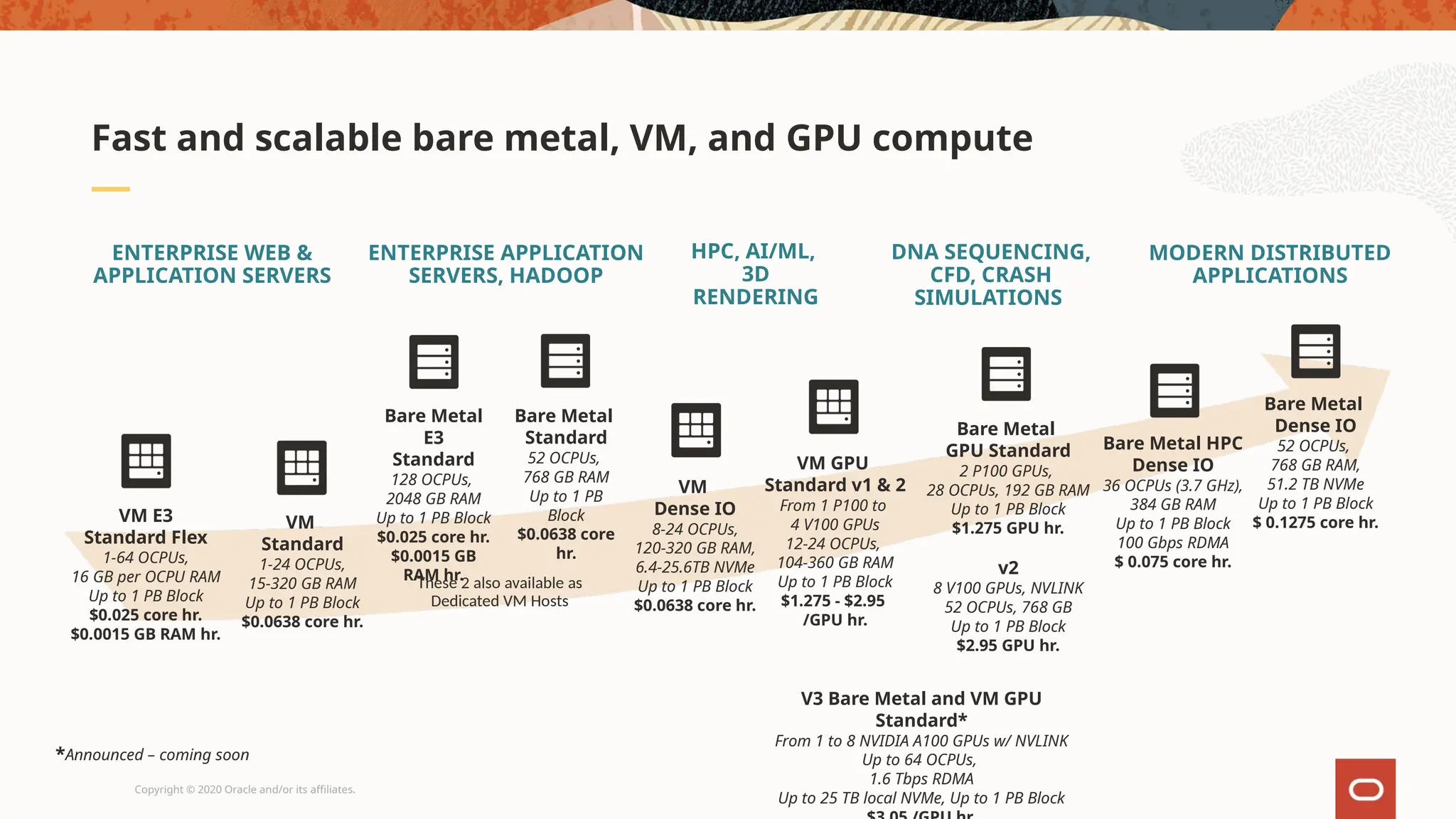
#32 A broad set of compute offerings means you can either bring
A simple Enterprise web application – use VMs, or containers
Or a large scale Hadoop cluster – use bare metal services; With standard and locally attached, up to 52TB per server
Massive simulations or 3D rendering workloads- Use GPUs and HPC instances
0r build a modern distributed applications – Using containers or serverless
All of this starts from 0.03/core-hours.
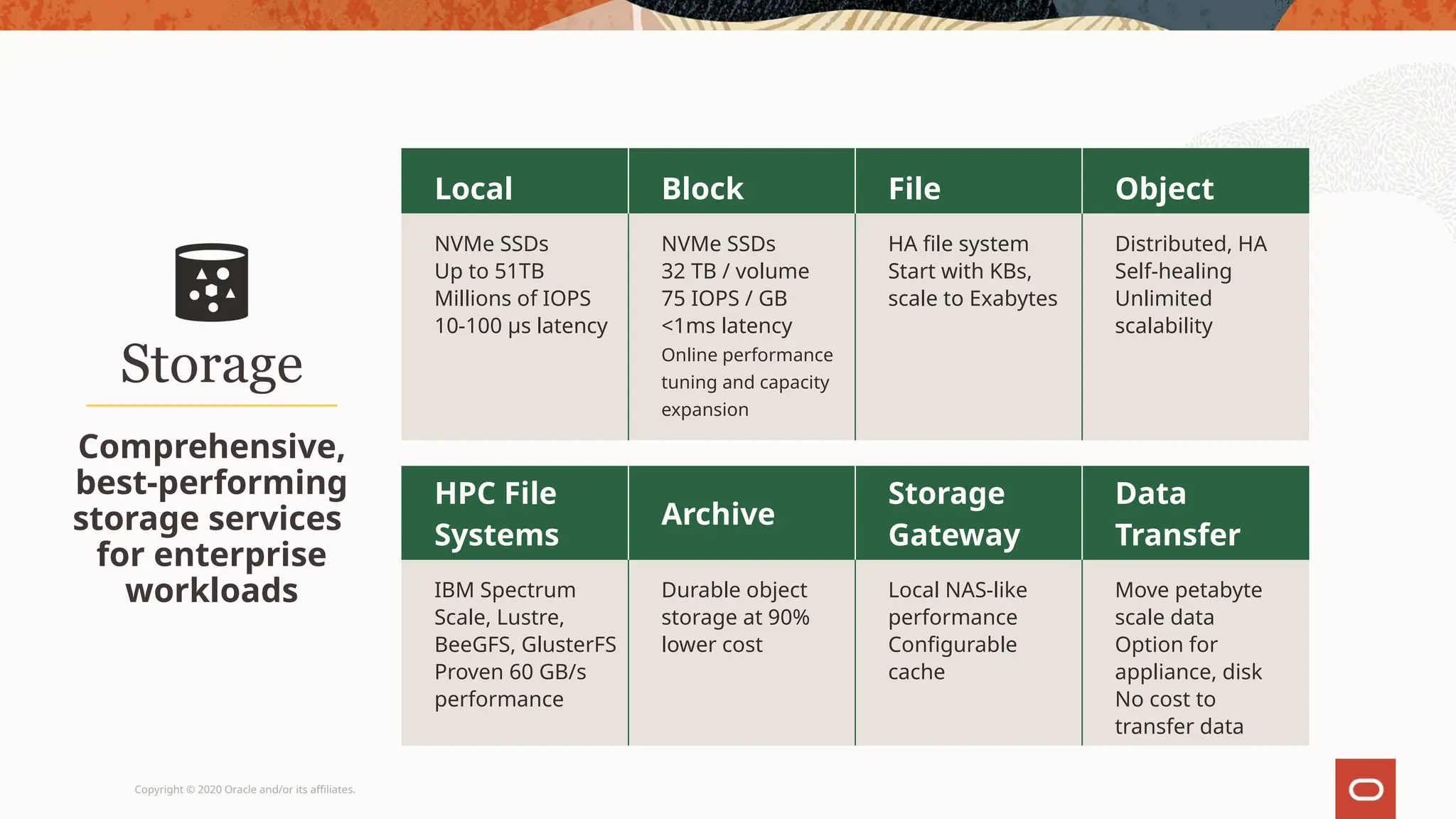
#33 Oracle being a DB company, we understand the importance of high performance, reliable, and scalable storage.
We have all the storage services that you commonly use in the Enterprises. Block, File, Object, and archive.
However, all our performance centric storage services are built using NVM3. Our capabilities include built-in redundancy, such as snapshots, backups and clones
Block storage is Network NVMe SSD block storage with 60 IOPS/GB; Max 25K IOPS, 320 MB/s per volume;
We only use Spinning disk on Object service. We recognize that S3 is the industry ..and we provide compatibility.
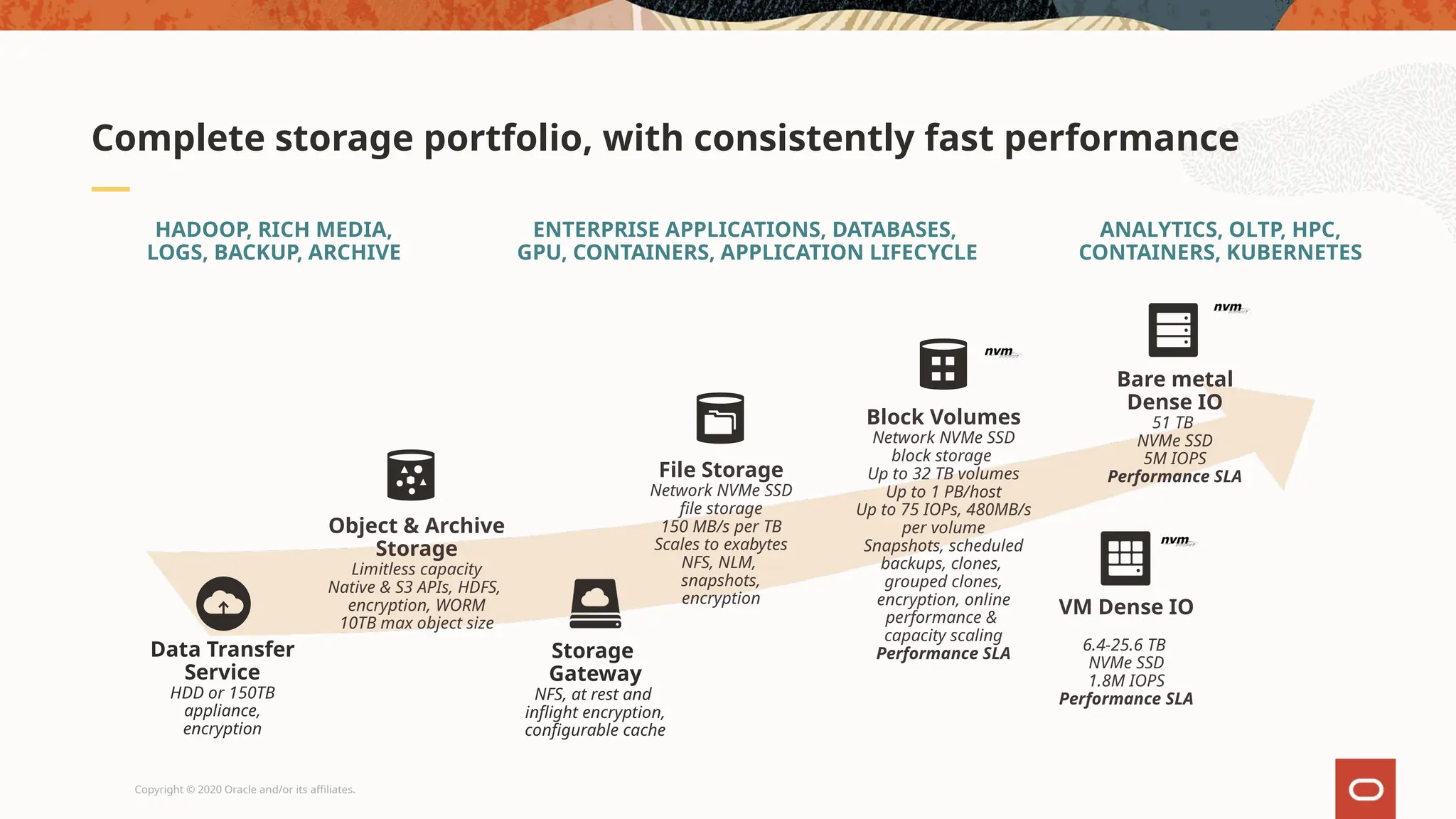
#34 A broad set of storage offerings means you can either bring any application –
Data analytics Datalake on Object storage. Or use it as a backup/archive
Enterprise DB applications on Block storage. Clones to keep your workflows consistent when you move.
And HPC and simulation workloads using NFSV3 as a service.
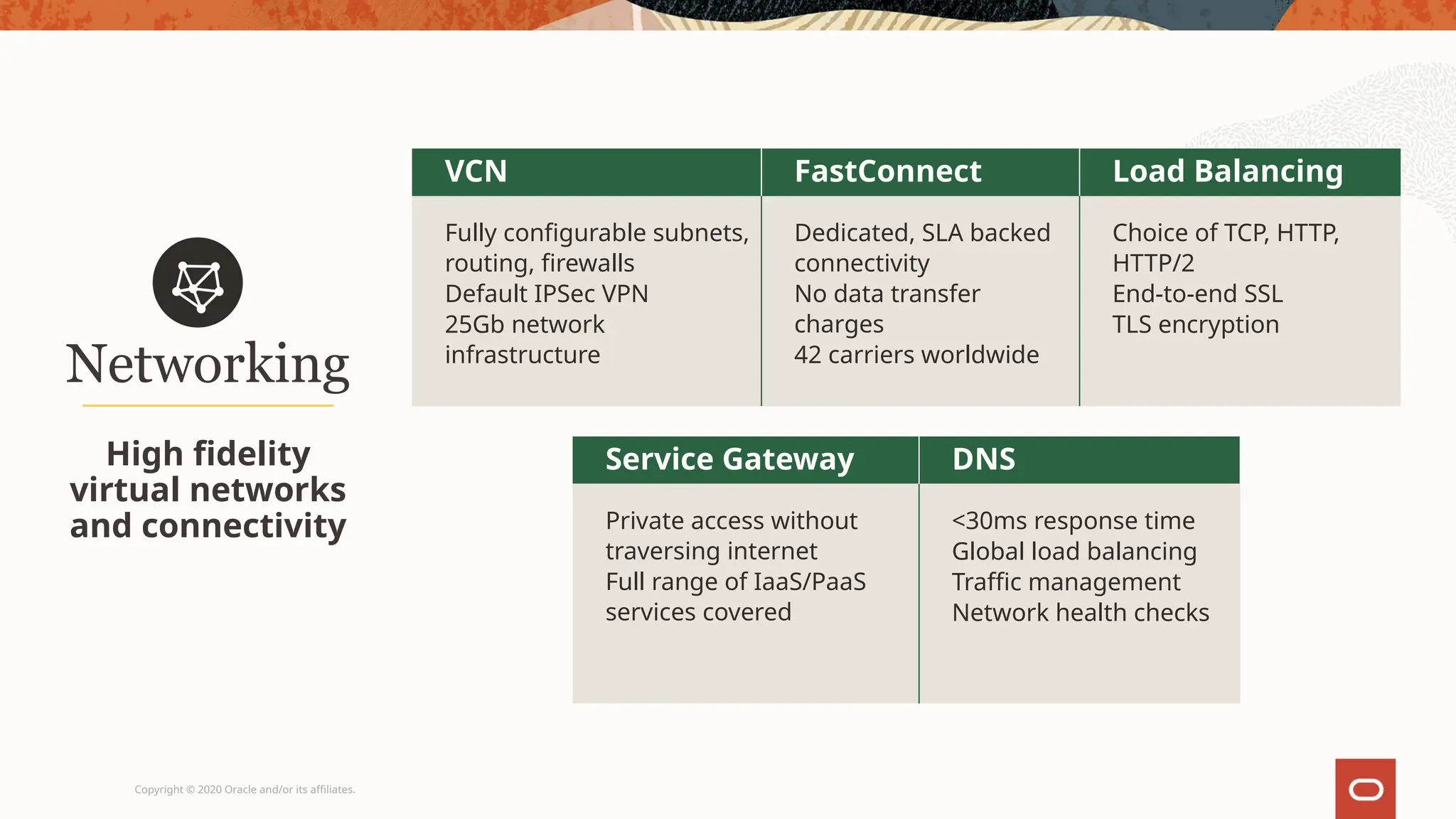
#35 Networking is the backbone of our cloud.
a) Physical network - CLOS, non oversubscribed network. 100Gb/s network
<100 µs one-way latency within AD
<500 µs one-way latency bet. ADs
B) VCN – You can programmatically configure subnets, Internet gateway, routing tables. And firewalls; Click of a button or an API call away.
c) Load balancer – All the features that’ll expect – end to end SSL, SSL termination or session persistence.
c) DNS service. < 30ms response time
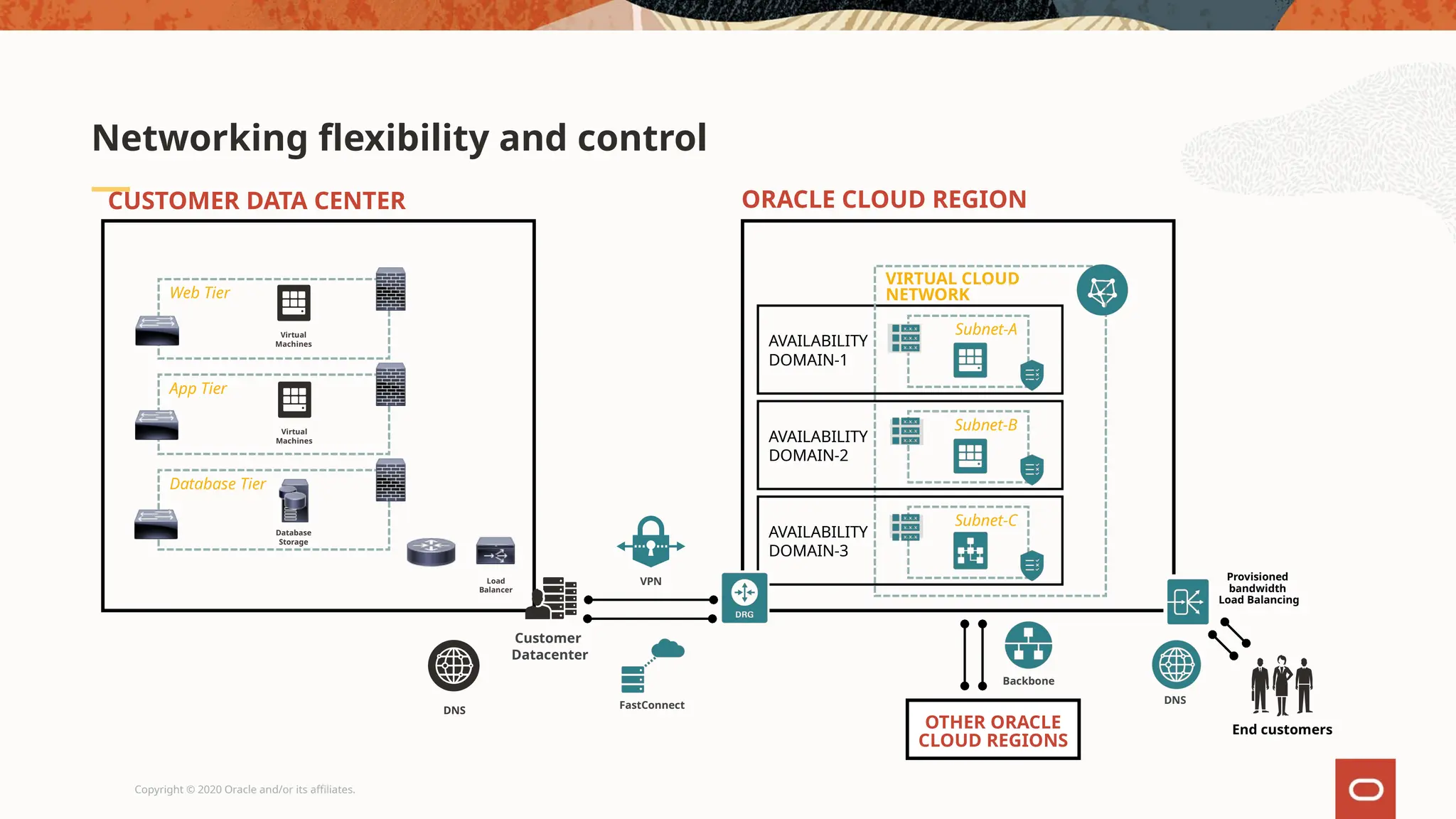
#36 Complete set of network services you need in the cloud with the same network flexibility you have today on-prem.
Comprehensive connectivity option –
Your datacenters: Fast content, IPsec VPN
Connecting to other datacenters – Via private and secure backbone
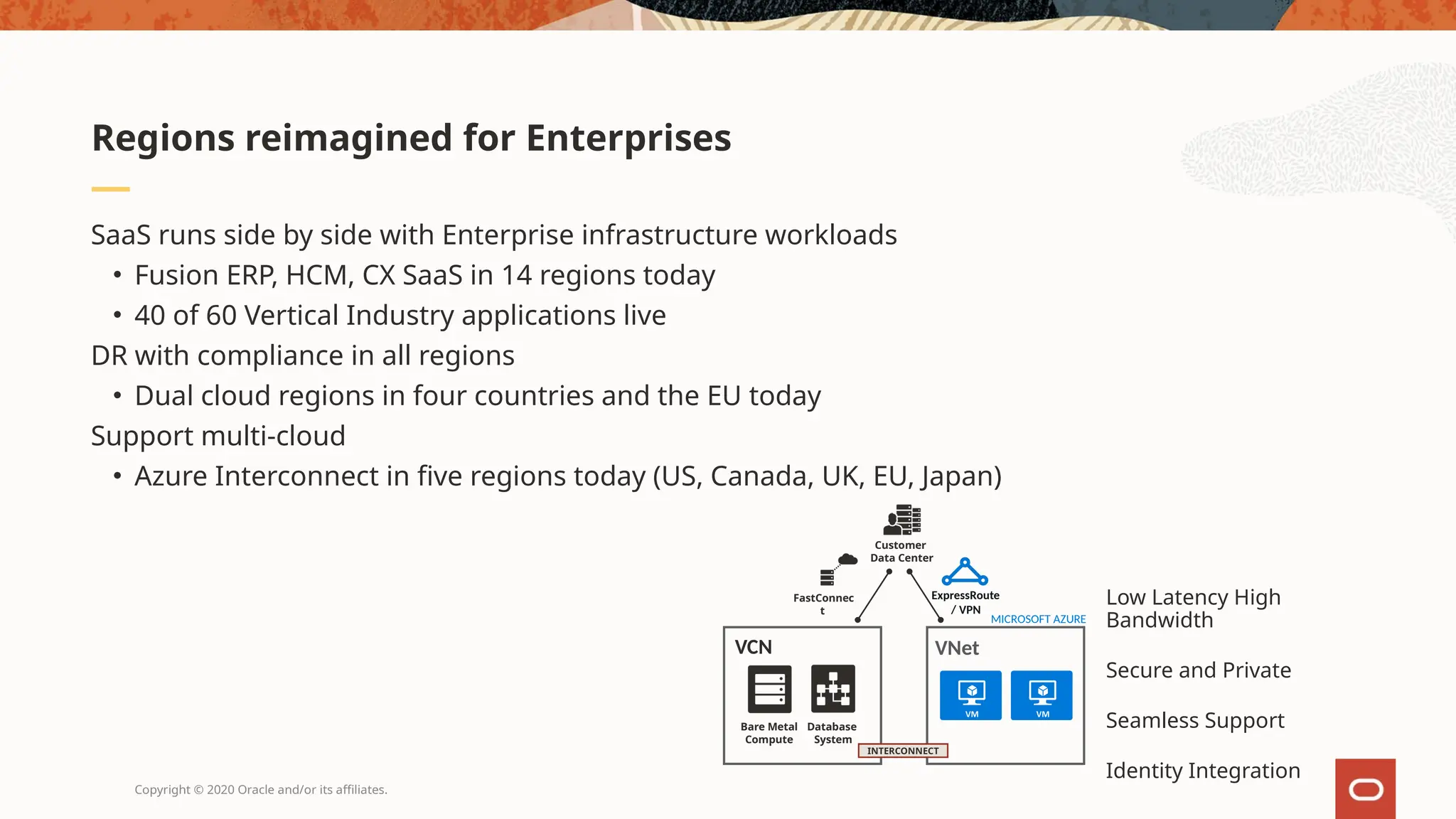
Connecting to other clouds – Azure
Connecting to the internet – DNS, WAF, IG
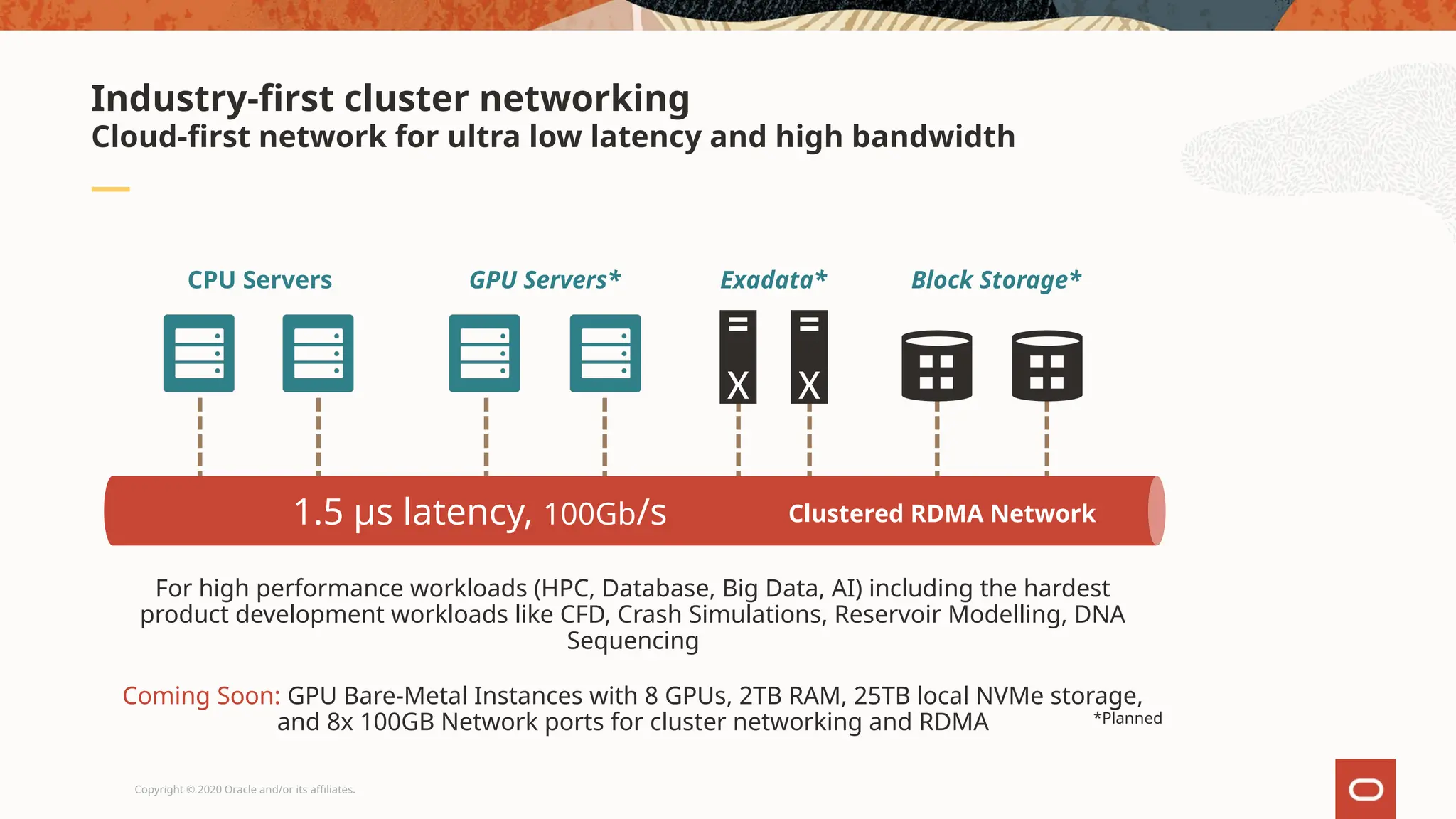
#37 Announcing industry first, production ready RDMA network in the cloud - enabling us to serve tightly-coupled HPC workloads, as well as the easily parallelizeable ones
The Cluster Network is an RDMA-based network that lets you form clusters (compute, storage, GPU, hybrid) that use secure ultra low-latency networks between cluster nodes.
1.5 Micros seconds all on a 100Gb/s network
Complex CFD or simulation workloads on us.
C Fluid dynamics – Airflow, designing a car for crash simulation, or DNS sequencing.
Offers ISVs that you need, Price point, and more importantly – RDMA over Ethernet.
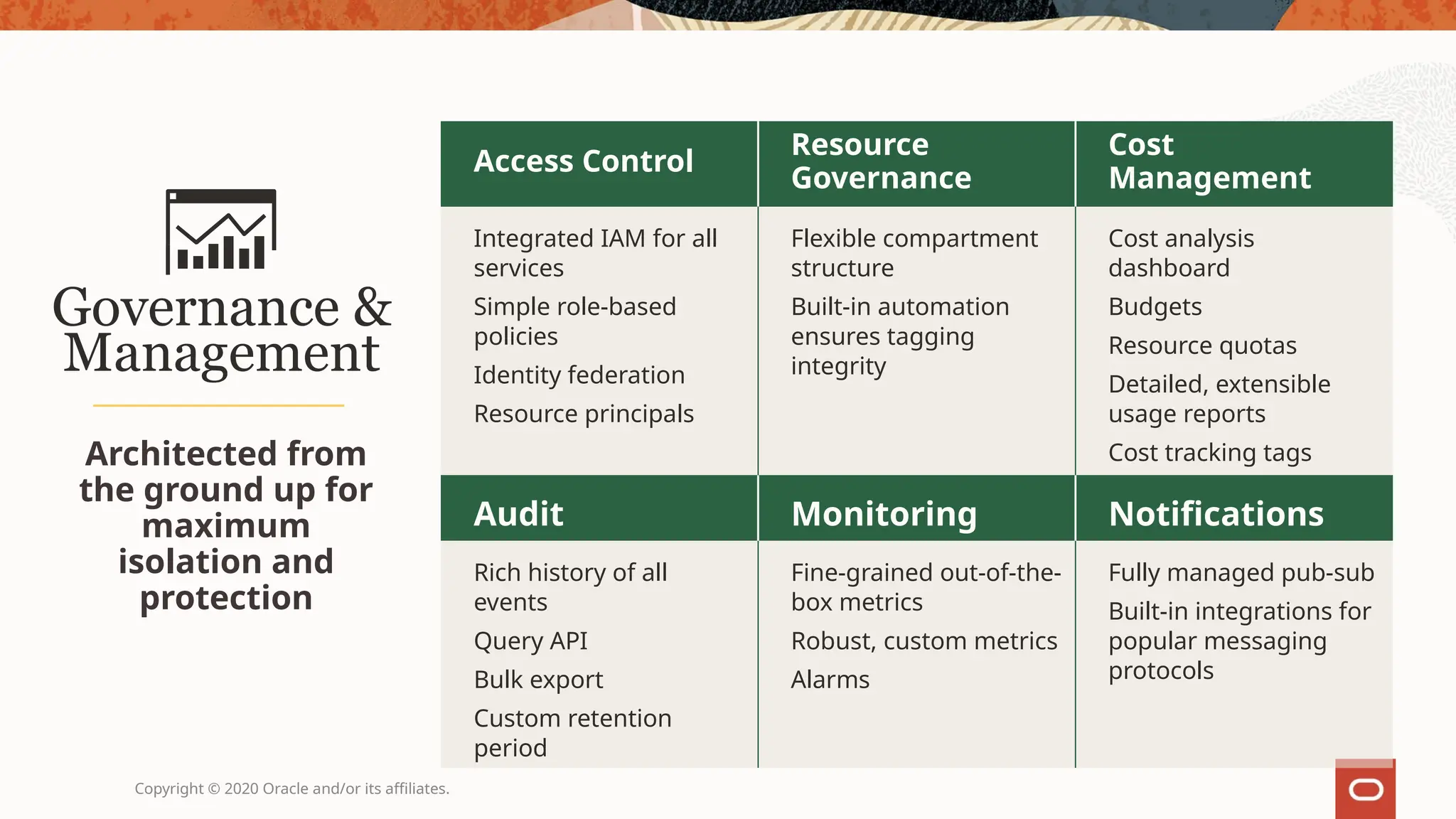
#38 Access Control
Full identity provider built in.
User and group management.
Use your existing SSO with Federation support.
Default integration with Oracle Identity Cloud.
Support for Multi-factor authentication.
API signing key support for programmatic access.
Rich policy language for access control.
In addition, OCI IAM was designed with a vision to avoid legacy credential management problems and allow resources from different layers of the stack to have their own identities. Traditionally, when customers wanted to provision a compute instance or a function to act on their behalf, they had to set up dummy user accounts with credentials and then carefully manage those credentials.
We started delivering on that vision at the compute layer in January 2018 where we delivered Instance Principals (a type of Infrastructure Resource Principal). By putting a compute instance in a dynamic group, a customer can write policy to grant permissions to that compute instance.
The next step was to help OCI partner teams deliver principals for arbitrary resources across the tenant. Earlier this year, we delivered Stacked Resource Principals which then allowed DBaaS instances to also have an identity and be governed by policy.
And we also have Ephemeral Resource Principals. Oracle Functions are Serverless Functions as a Service, designed to run for a limited amount of time, explicitly without the identity of an underlying compute instance (GA announcement inline below). Oracle Functions use Ephemeral Resource Principals to auto-provision credentials for the lifetime of a function and then expire automatically. As shown below, Customers will be able to put their Oracle Functions into Dynamic Groups and write policy to allow them access across the tenant.
Resource Governance
Organize resources using compartments and tags.
Compartments are a logical container for resources on which you can impose access policies to restrict usage to specific users in the tenancy.
Tags allow resources to be categorized with metadata like project name, cost center and team.
Support for searching / filtering by compartment and tag.
Cost Management
“Billing” section in console for business users to track and analyze costs.
Report costs by compartment, tag or service.
Budgets support to allocate budget for the tenancy or per compartment. Get email alerts if spending is forecasted to exceed spending.
Usage report with per-resource per-hour data to reconcile the bill and for extensibility.
Audit
Rich history of all events in Oracle Cloud Infrastructure.
Events include metadata that can be understand which user took which action when.
Query API.
Bulk export of audit logs for extensibility .
Custom retention period.
Monitoring
Oracle Cloud Infrastructure Monitoring service delivers the insight needed to understand the health of your resources, optimize the performance of your applications, and respond to anomalies in real time.
Fine-grained, out-of-the-box metrics and dashboards are provided for your Oracle Cloud Infrastructure resources such as compute instances, block volumes, virtual NICs, load balancers, object storage buckets, and more.
Alarms alert you in real time to important changes across your cloud infrastructure and services, giving you the confidence and peace of mind that fluctuations in performance or health will be quickly detected and notified on.
Have your applications emit their own custom metrics, enabling you to visualize, monitor and alarm on all critical time-series data in one place.
A robust metrics engine, combined with a powerful query language, enables flexible aggregation and complex queries across multiple metric streams and dimensions in real time.
Monitoring pricing is intuitive, simple and elastic; customers pay only for what they use, which makes it attractive for workloads with large spikes. No incremental costs for alarms, data stored, etc.
Notifications
Notifications is a fully managed publish-subscribe service that allows for messages to be pushed with massive scale and reliability
Purpose-built to support massive Fanout with built-in integrations for popular messaging protocols, third-party applications, and Oracle Cloud Services.
Notifications supports at least once delivery with continual retries up to a max of two hours from the time the message is published to a topic. With complex logic built in to handle endpoint outages and latency, Notifications is built for any scale.
Integration with the Oracle Cloud Infrastructure Identity and Access Management (IAM) provide support to set access control policies keeping messages secured.
Pricing is intuitive, simple and elastic; customers pay only for what they use with pay per message delivery.
Manage subscriptions through the Oracle Console or programmatically via the SDK or API to allow for greater control and flexibility.
The service is designed to handle burst in traffic, be highly available, and provides performance guarantees in case of domain failures.
#39 Ground up security; This is the foundation in which we build the cloud.
Most clouds – network and IO virtualization in the hypervisors. This is not only performance impacting, but is not secure.
Off box virtualization – Meaning Networking and IO – outside the box. Provides maximum isolation and protection,
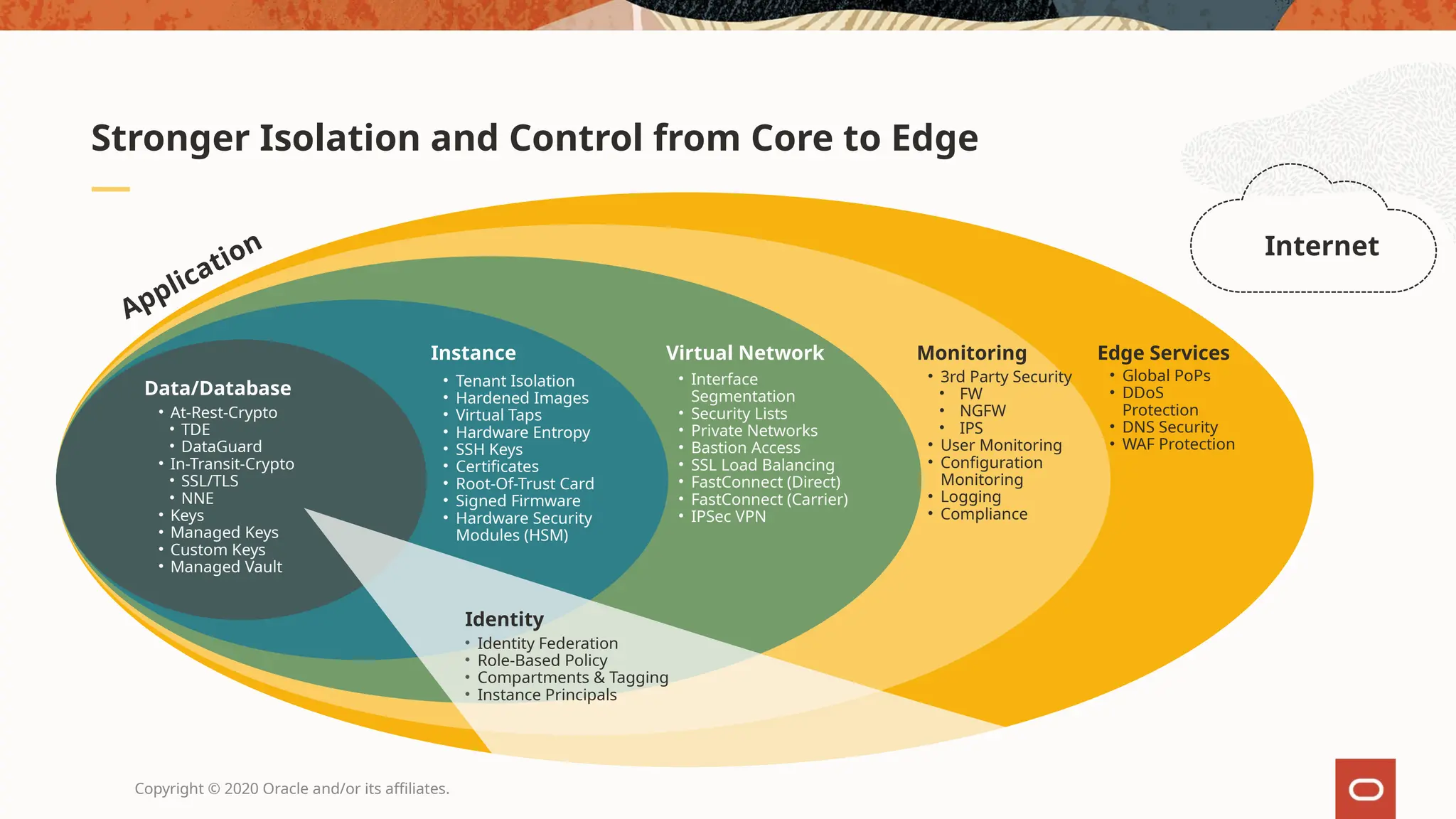
#40 We expand on that foundation and build many cloud services. We called this as core to edge services.
Core – Compute and Storage. Separate out encryption and key management.
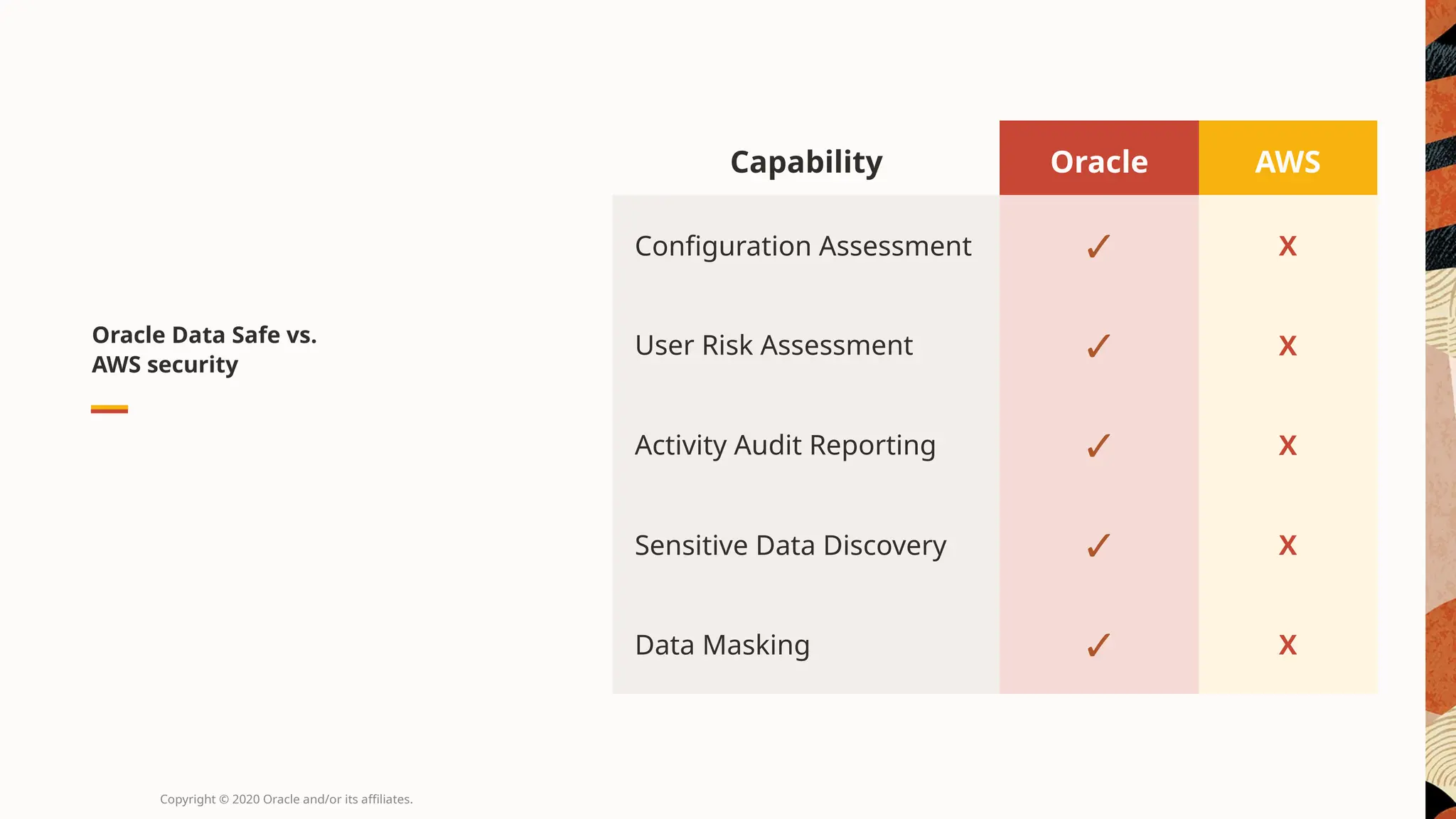
Database – Database TDE, Masking.
Networking – No Internet gateway; use service gateways to route everything within your VCN security including attaching to fast connect.
Stringent monitoring - Helps identify and reach - alerts, audit and logging
When you add it all, you’ll get the best security experience in the cloud.
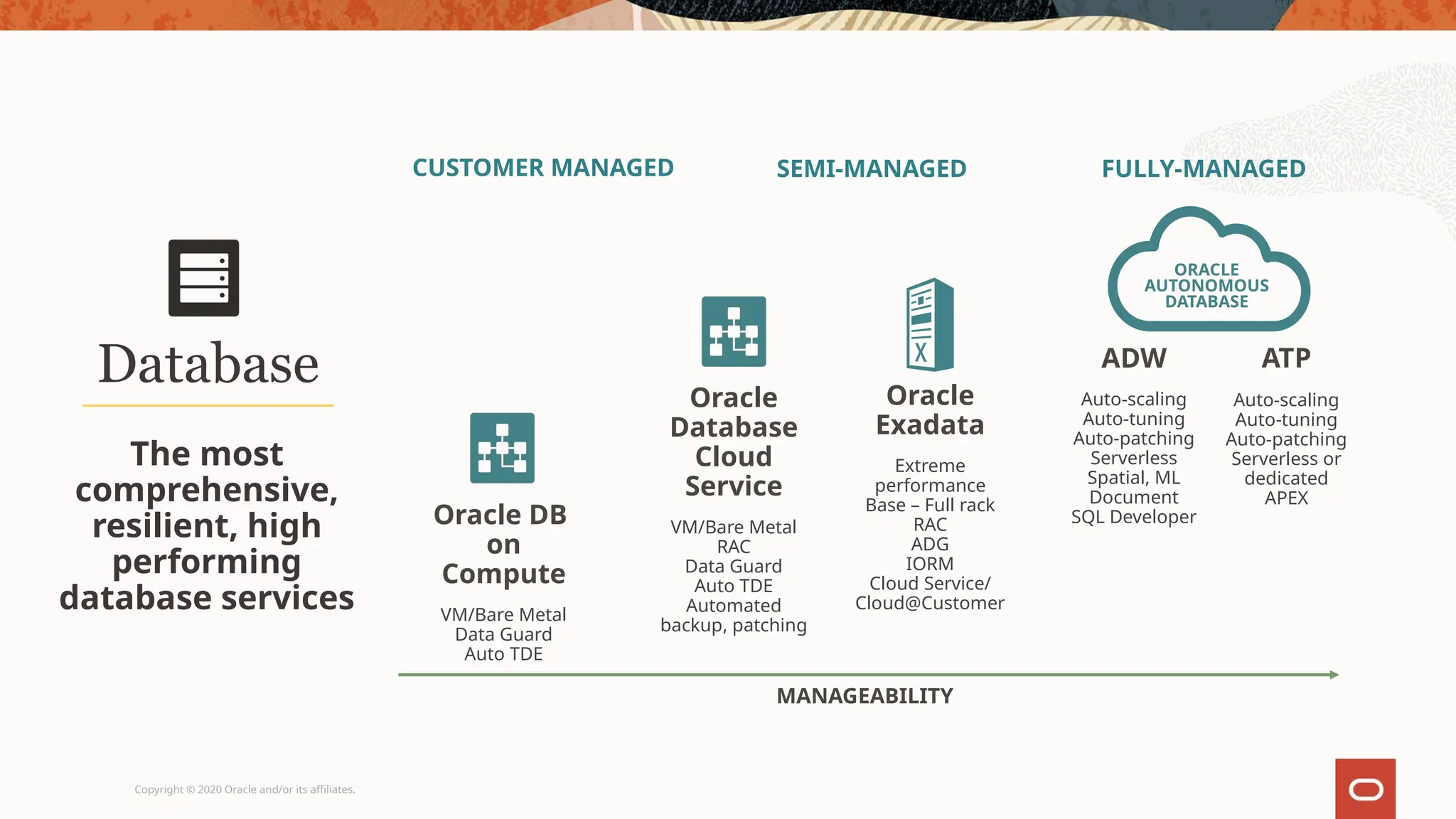
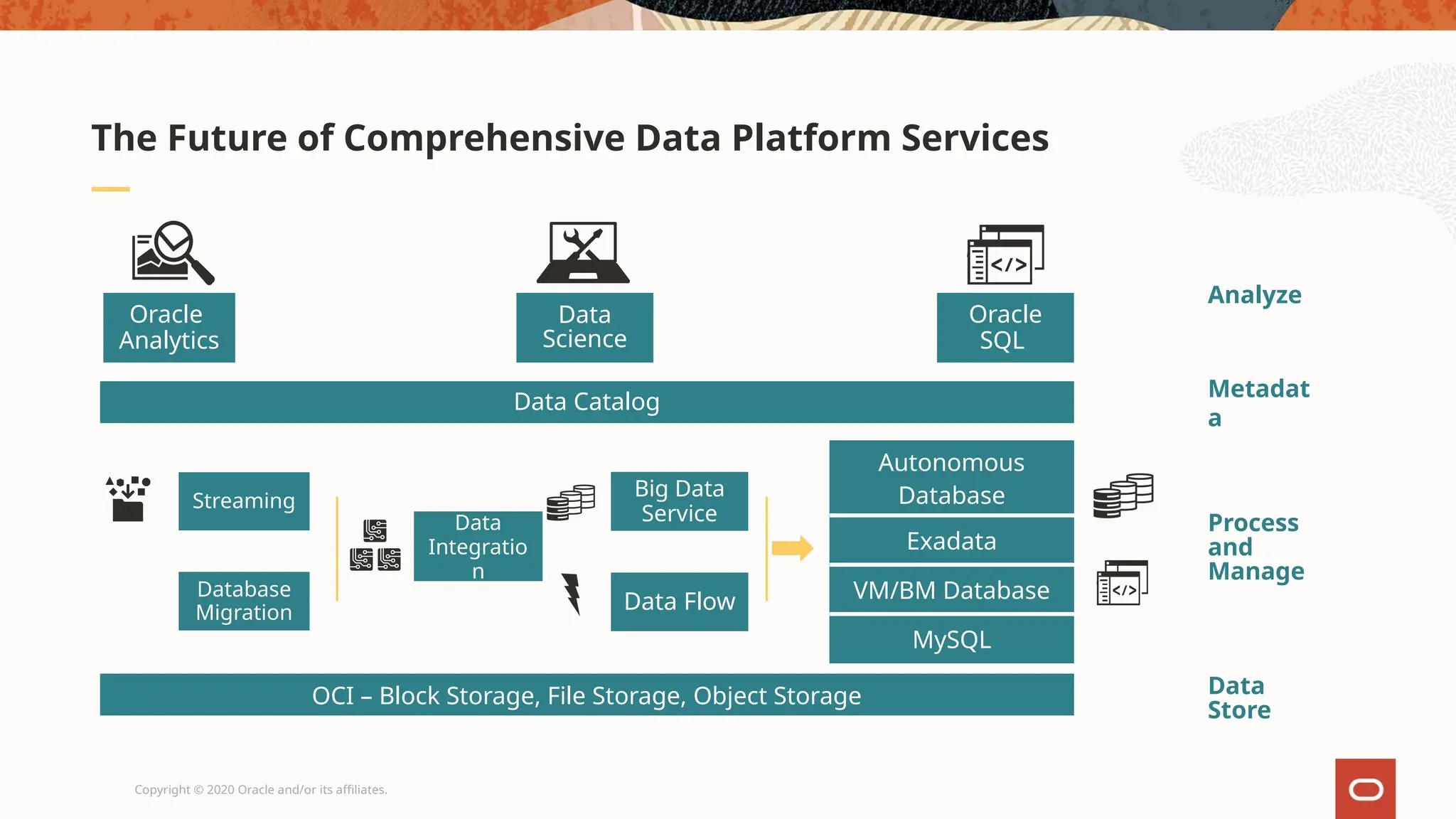
#41 We are Oracle. Customers expect the best Database services from us.
We offer the the diverse set of Oracle DB services on OCI.
Customer managed – VM/Bare metal;
Semi-managed: Customer still
Fully managed and automated
Support NoSQL, OLTP, Batch, Data Warehouse, Data Mart you name it
On other clouds – You can do it on one DB; and you can run Oracle DB on there but you can’t run DynamoDB or RedShift on any other clouds.
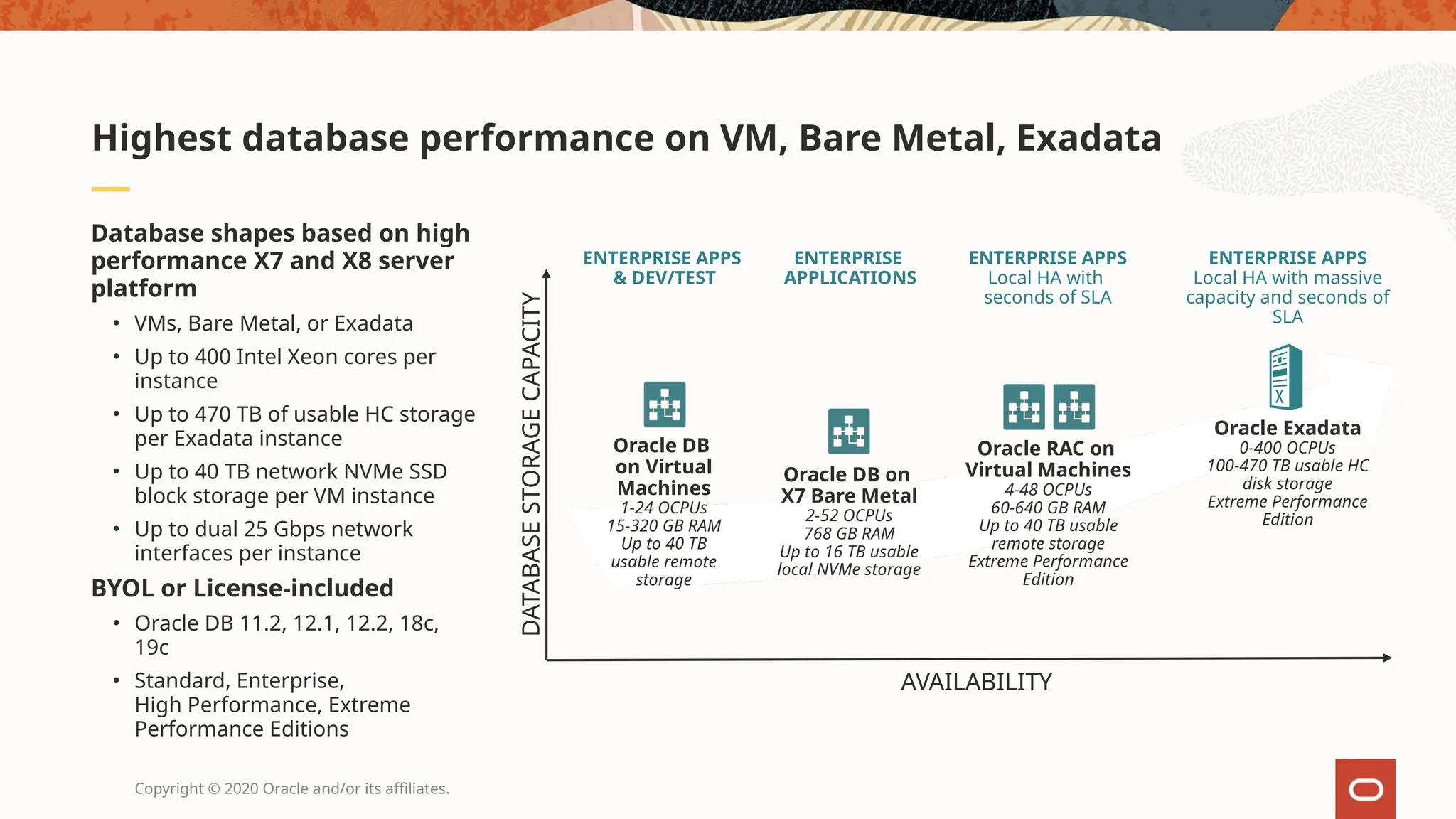
#42 Oracle offers all the flexibility of hosting your database on-premises, with the benefits of powerful infrastructure options and simplified administration, all available by the hour.
Depending on your database needs, Oracle supports all of your enterprise applications with the highest availability and massive scalability.
Basic Oracle database with up to 52 OCPUs. This gives you the full performance and scale of todays high CPU, high memory, and amazing NVMe SSDs
You can leverage Oracle RAC to provide local high availability and reduce your SLA to seconds
Finally, you can use Exadata to give you the highest performance and availability in the cloud
#44 There is a misnomer that Oracle Cloud is good for Enterprise applications in general, and Oracle DB in particular. But that is far from the truth.
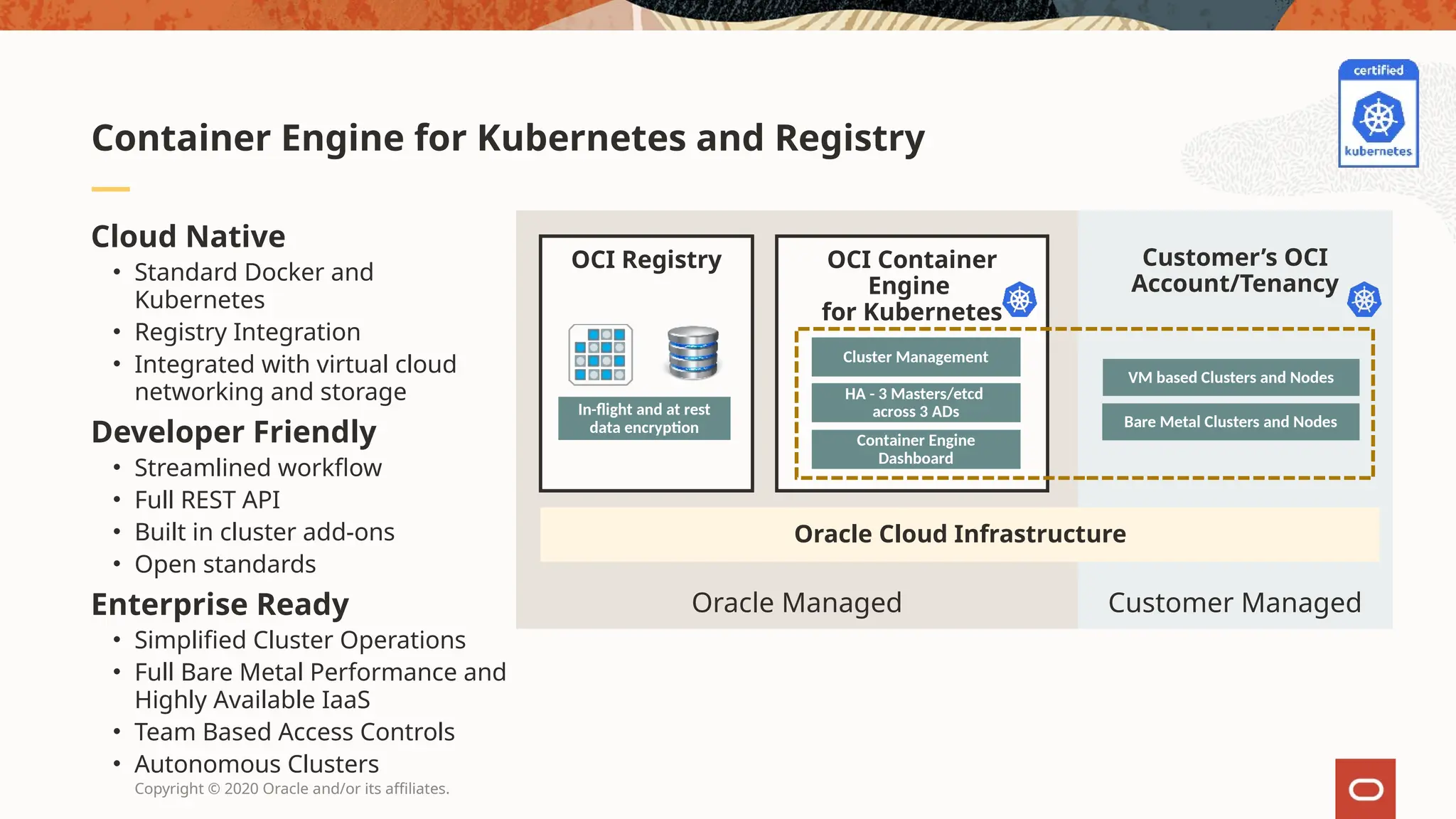
Oracle offers a full set of services to deploy, manage, and operate container based applications on OCI. Managed K8s, Container registry would make it seamless.
Developers get to focus on building container-native microservices and serverless applications, and don't need to worry about deploying and managing the Kubernetes cluster.
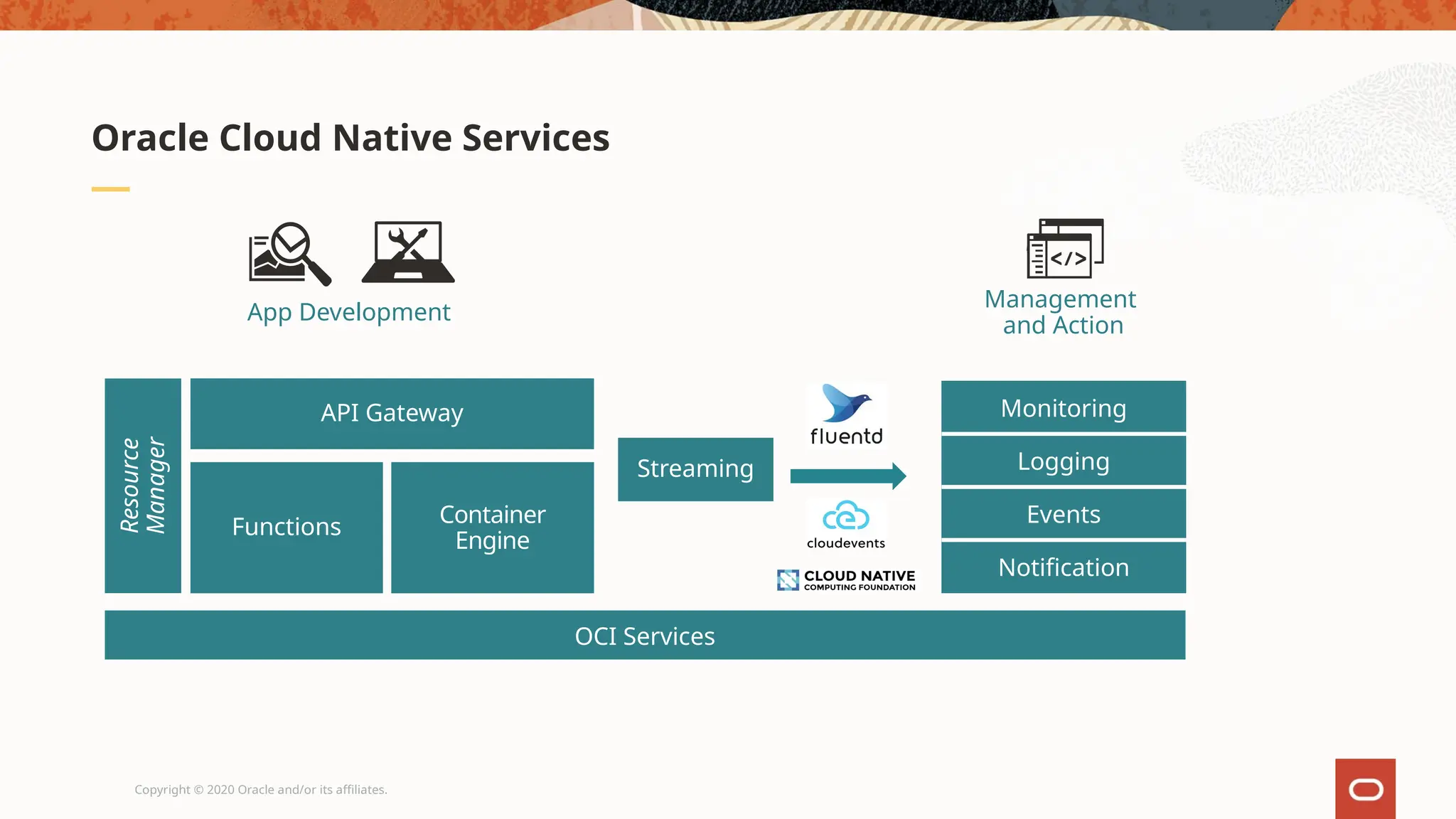
Customers can also build serverless applications on OCI, powered by events, API gateway, and Functions service. With Oracle Functions, you simply write, deploy, and call your function by deeply integrating with Oracle events. There are no servers to provision, monitor, or upgrade—it’s serverless!
These can be used for existing application – to make it more modern -
Database trigger – can generate an event – and you can write a function to update a metric in the OAC dashboard.
#45 The grey shaded area designates the functions that Oracle Manages for the customers, including an integrated Registry and image storage and the Container Engine / Managed Kubernetes.
Oracle will manage the etcd and Master nodes of the Kubernetes instance, in a High Availability setup for the customer. Upgrades to new versions of Kubernetes will also be supported in the Container Engine dashboard.
The customer will manage the Clusters/Worker Nodes that are setup by the Managed Service for that instance, in their own OCI account/tenancy, shaded in blue above.
Note: The customer will need to bring their own OCI account to create clusters for the managed Kubernetes cloud service and pay for any infrastructure usage incurred with their clusters of worker nodes.
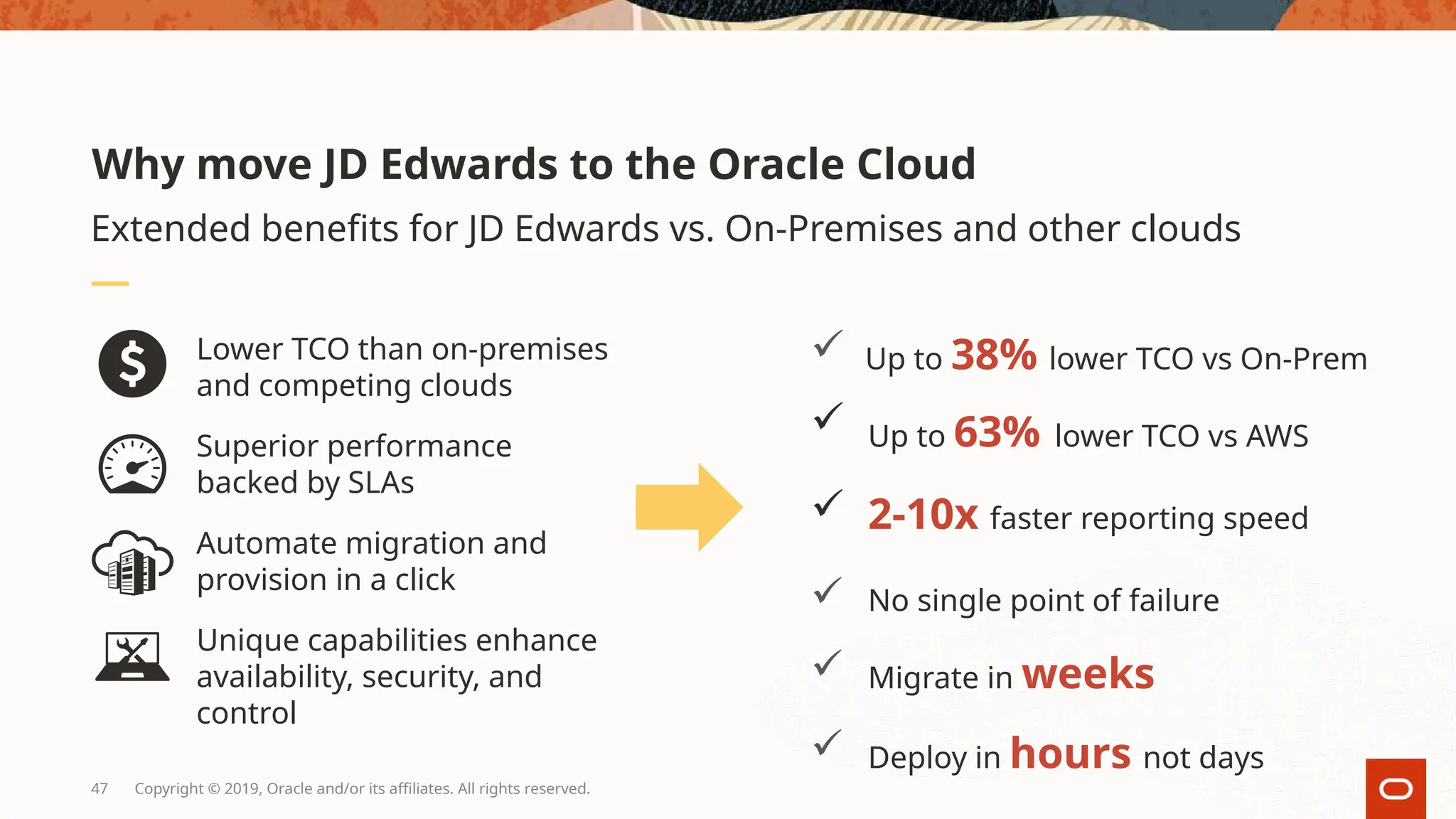
#47 Of course, we think there is a better way for you to keep the JD Edwards you know, and at the same time realizing cost savings, performance gains and operational improvements that the cloud can provide.
In addition, not only can you take advantage of the benefits of infrastructure as a service as a whole, but there are UNIQUE benefits that you can only get from the Oracle Cloud and not from any other cloud vendor.
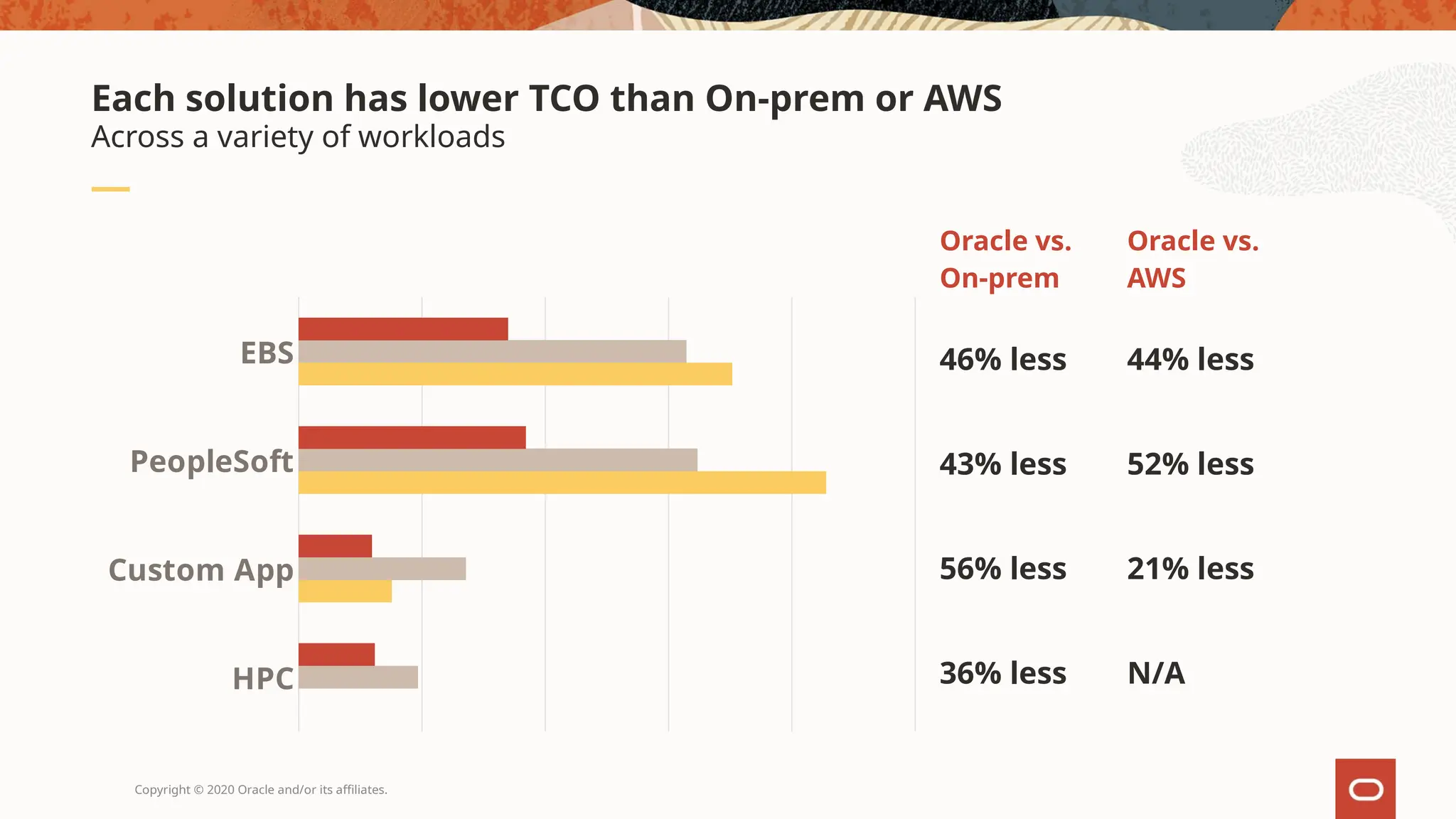
JD Edwards customers consistently realize lower TCO than on-prem and vs competing clouds. Many have cited superior performance improvements such as more than double the reporting speed during month end. And you may not know that Oracle is the only cloud to back up performance of core infrastructure services with service level guarantees.
Most on-premises JD Edwards deployments can be migrated to Oracle Cloud Infrastructure without requiring significant re-architecture, re-integration nor business process changes. You can leverage the JD Edwards One-Click Provisioning tool which is only available on Oracle Cloud Infrastructure to automate migration, provision environments in a click and simplify your upgrade processes.
Finally, our unique Gen2 cloud infrastructure has been ideal for enterprise customers who need the highest levels of availability so there’s no single point of failure. At the same time our security and governance offerings allow you to maintain control using familiar tools and techniques.
#48 Professional Services
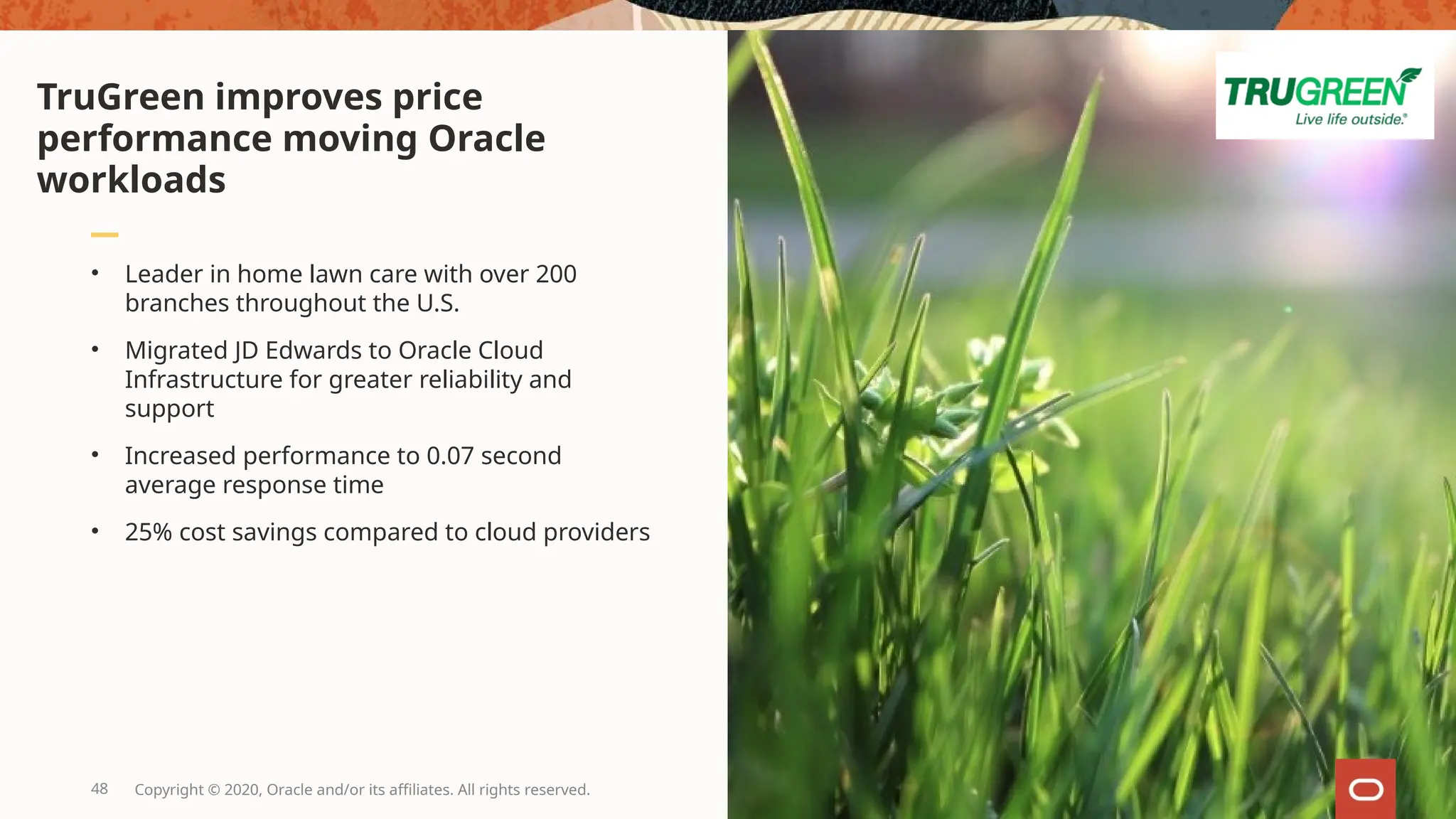
TruGreen is the leader in home lawn care with over 200 branches throughout the U.S.
Migrated JD Edwards and Database to OCI for greater reliability and support
Increased transaction performance to 0.07 second average response time
25% cost savings compared to other cloud providers and less risk
https://youtu.be/ijCh1Q8msSY
CUSTOMER PERSPECTIVE
Our finance and branch teams that use JD Edwards are just ecstatic over the performance. They can run financial reports and manage distribution tasks faster than ever.
– Clif Lee, Director of Corporate Systems, TruGreen
#49 Key OCI value props are bolded
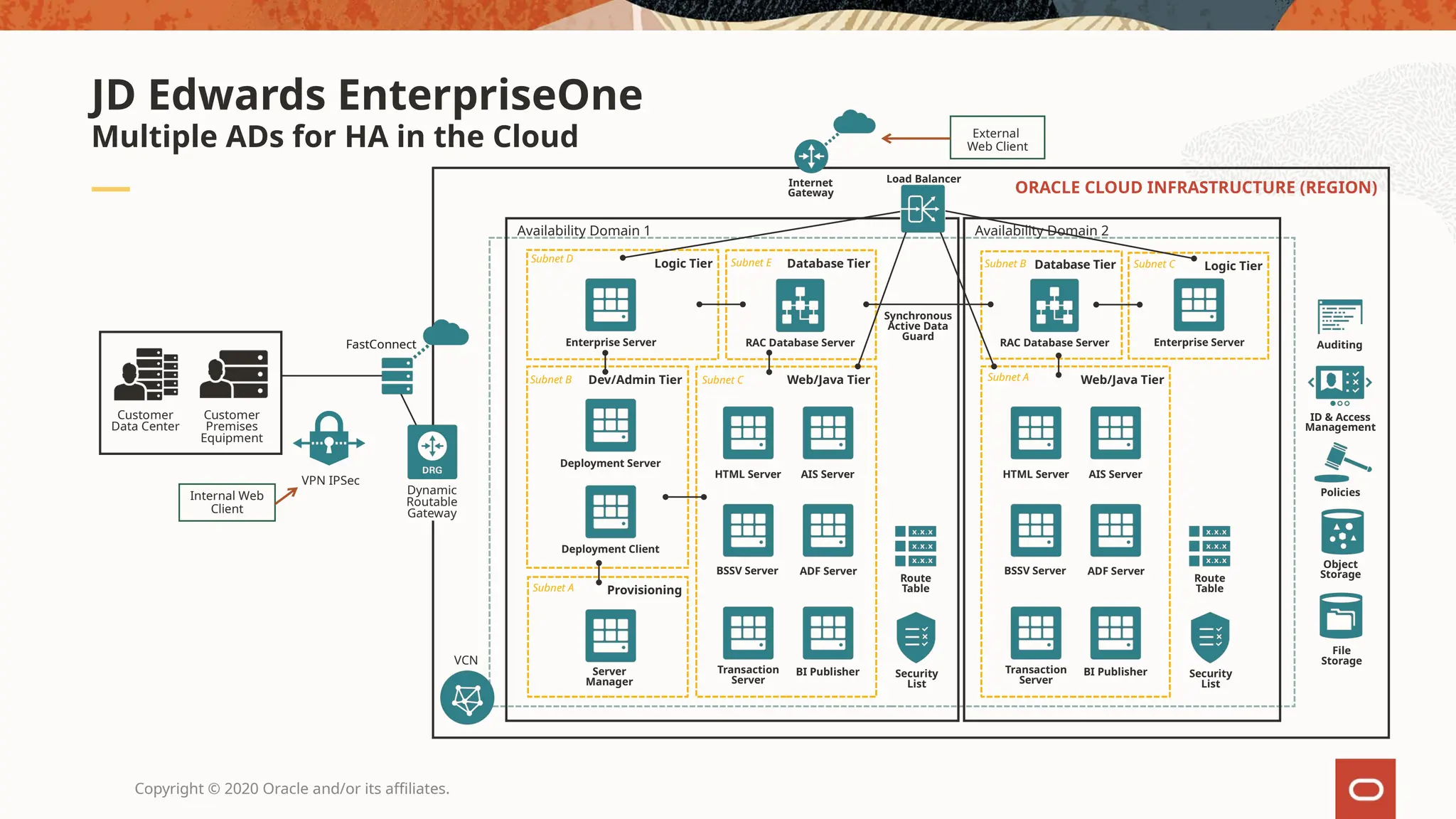
For DR in the cloud, dev/test and even production use cases across multiple ADs, we add load balancer as a service to distribute traffic amongst your different app and web tier nodes.
In addition to private access via a VPN connection, we also offer direct connection from your premises to the Oracle Cloud Infrastructure network through FastConnect
Also, we recommend leveraging our managed File Storage Service to optimize capacity consumption and to facilitate your deployment. File Storage Service is certified to run as a shared disk resource for a JD Edwards shared app tier file system. It can be accessed concurrently by thousands of compute instances across your app and web tier nodes, and can easily scale from KB of data to exabytes.
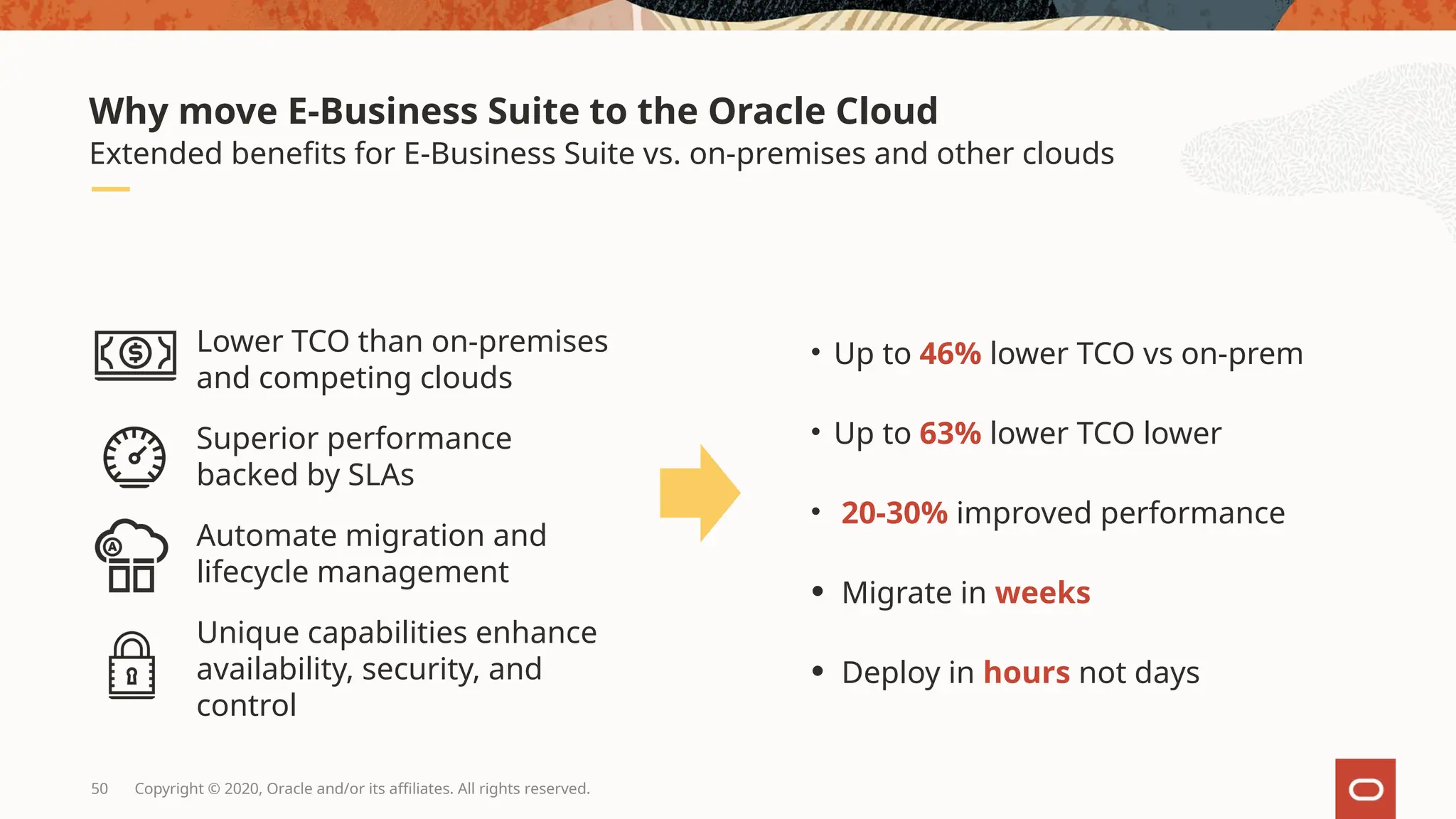
#50 You can migrate your current deployment to Oracle Cloud Infrastructure and gain access to better elasticity to support peak seasons, agility to add new capabilities, streamlined infrastructure management, and lower total cost of ownership (TCO). With Oracle Cloud Infrastructure you have granular control over your environment all while taking advantage of the same software, the same licenses, and the same training your staff and end-users currently have. In addition, only Oracle offers consistent high performance at guaranteed service levels.
Most on-premises deployments can be migrated to Oracle Cloud Infrastructure without requiring significant re-architecture, re-integration nor business process changes, and will result in a solution that is more flexible, more reliable, and delivers higher performance at a lower cost than deployments running on-premises or with other cloud providers.
Additional benefits
Rapid in-place technology refresh & patching
Proactive costs and usage monitoring
Near instant scaling
Ability to retain control over security and governance using familiar tools
Federated identity with your existing systems
#54 Of course, we think there is a better way for you to keep the PeopleSoft you know, the PeopleSoft you own, have integrated and customized, and at the same time realizing cost savings, performance gains and operational improvements that the cloud can provide.
We already have many PeopleSoft customers who have been to move PeopleSoft to Oracle Cloud Infrastructure so that they can take advantage of not only the benefits of the infrastructure as a service as a whole, but also the unique benefits that you can only get from the Oracle Cloud and not another cloud vendor out there.
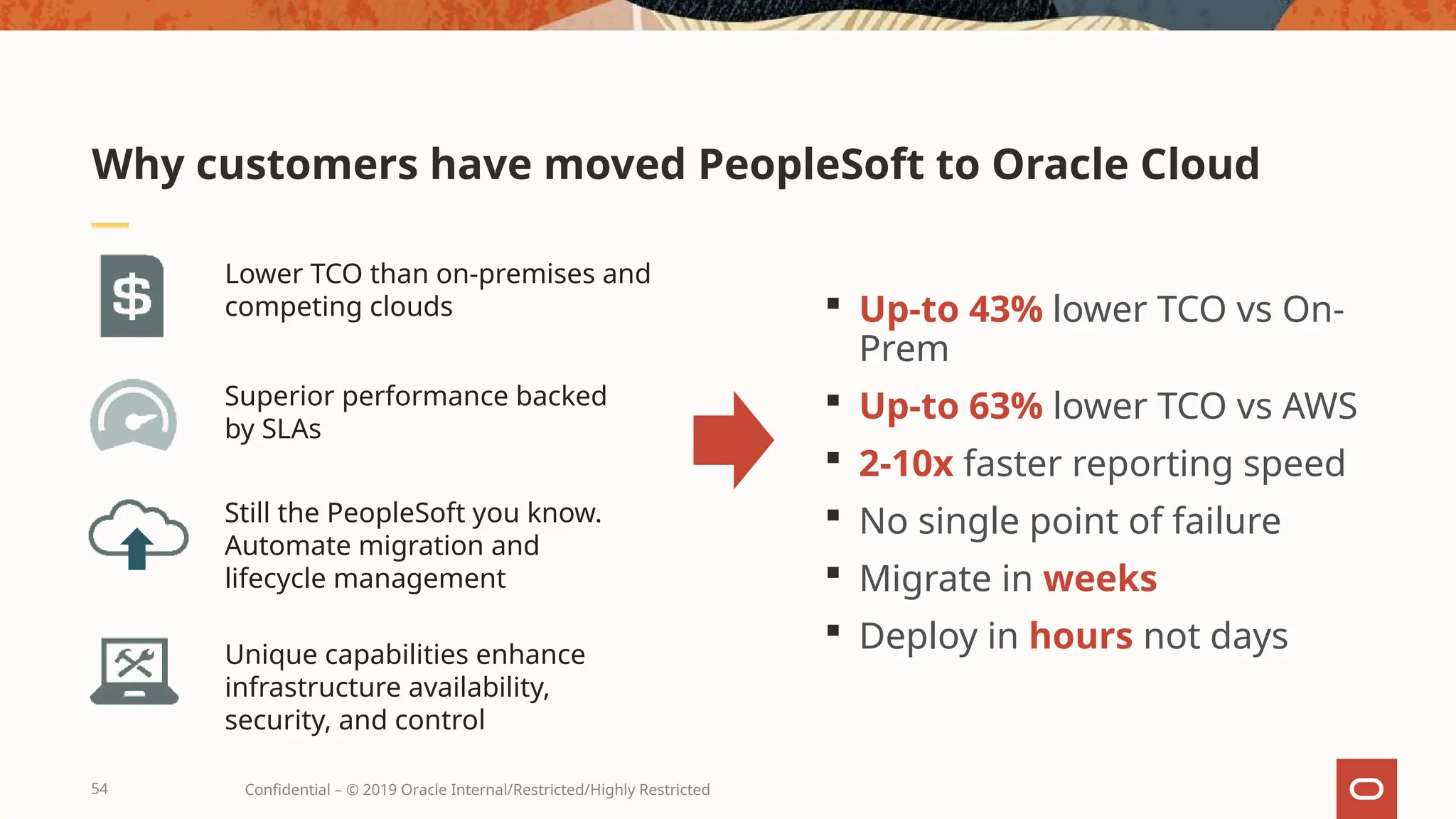
PeopleSoft customers have see lower TCO than on-prem and on competing clouds. Many have cited superior performance improvements such as more than double the reporting speed during month end, quarter-end. You may not know that Oracle is the only cloud to back up performance of core infrastructure services with service level guarantees.
And with Oracle Cloud, you can keep the PeopleSoft you know and move to the cloud easily with PeopleSoft Cloud Manager, an automated lift & shift and lifecycle management tool that you can only get with Oracle Cloud Infrastructure. This has allowed customers to migrate in weeks versus months and deploy in hours versus days. Finally, our unique Gen2 cloud infrastructure has been ideal for enterprise customers who need the highest levels of availability, security and control.
Next we’ll look at each of these 4 key value propositions more closely.
#56 Professional Services
Alliance Data is the engine behind loyalty and marketing campaigns for more than 1,000 consumer-facing companies worldwide across all industries: retail, travel, pharmaceutical, financial services, auto, and more.
They already use our Exadata Systems for industry leading performance
They wanted to move PeopleSoft, EPM, 6TB data in Exadata, and non-Oracle workloads
This gave them the ability to run bare metal or virtual machines on the same network provides us flexibility and capacity on demand
They are also saving $1M per year in Oracle software licensing and support
https://www.youtube.com/watch?v=qotqBjF8eSQ
https://www.youtube.com/watch?v=jE-RMxYRi8A
Migrates PeopleSoft, Hyperion, and OBIEE
2 Exadata quarter racks down from 3, leading to savings
6 environments in cloud.
Easy to monitor, manage
6 months to complete entire enterprise application lift and shift to Oracle Cloud
CUSTOMER PERSPECTIVE
We moved all of our environments to the cloud from dev/test to production, and our end-users didn’t even realize it. I consider that a successful migration.
– Mike Rosello, SVP and CIO, Alliance Data Systems
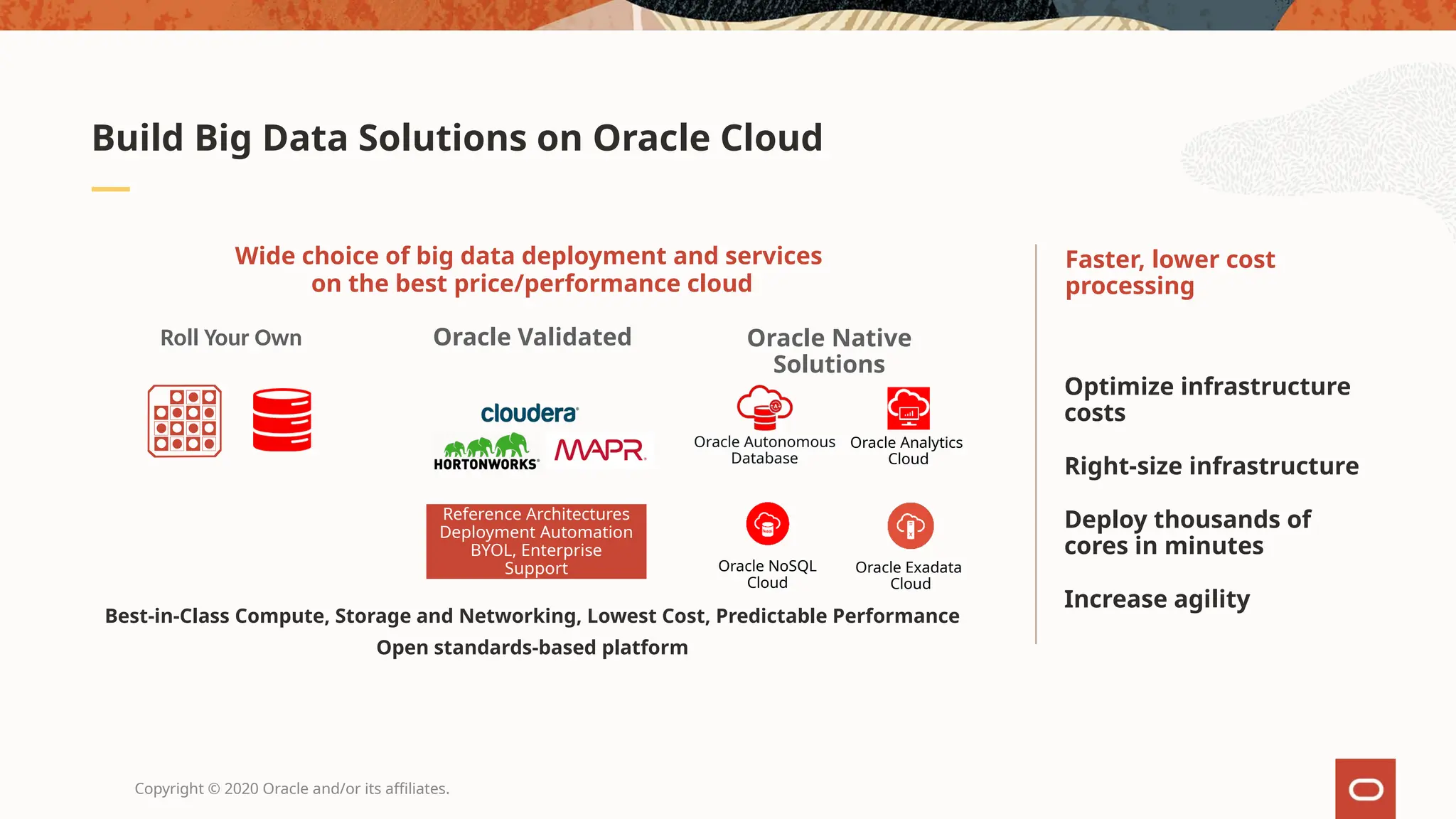
#57 Big Data:
- Performance, Price, Open
Support for same range of hardware that you run on-premises
From small VMs up to bare metal servers (Industry first)
Up to 400K IOPS of attached Block Storage, line-rate throughput, with SLAs & 2x cheaper than AWS
Run your Big Data Environments next to Exadata Engineered Systems
Non-oversubscribed Network, Predictable Performance with low Latency and high throughput
Bandwidth egress costs cheaper than AWS bandwidth by 85%
The best cloud environment to run your big data/analytics workloads
Stream data from any of your Oracle Applications easily
Oracle Database Services – with all the features: Oracle RAC, Oracle Exadata including Autonomous Services
BYOL – Lowest cost
Industry Leading Offerings that powers Cloudera’s Data Management platform
SAN like Block Storage
End-to-End SLAs in-place HW repair
RAC, Exadata
Best price/performance
Simple & Intuitive Pricing (For Example: No Egress Bandwidth Pricing on Fast Connect)
Open Cloud Strategy: Terraform as a Service for deploying your templates
Enterprise Grade Governance and Management
Compartments, Audit, Policies
Security Services – KMS, Secrets .,
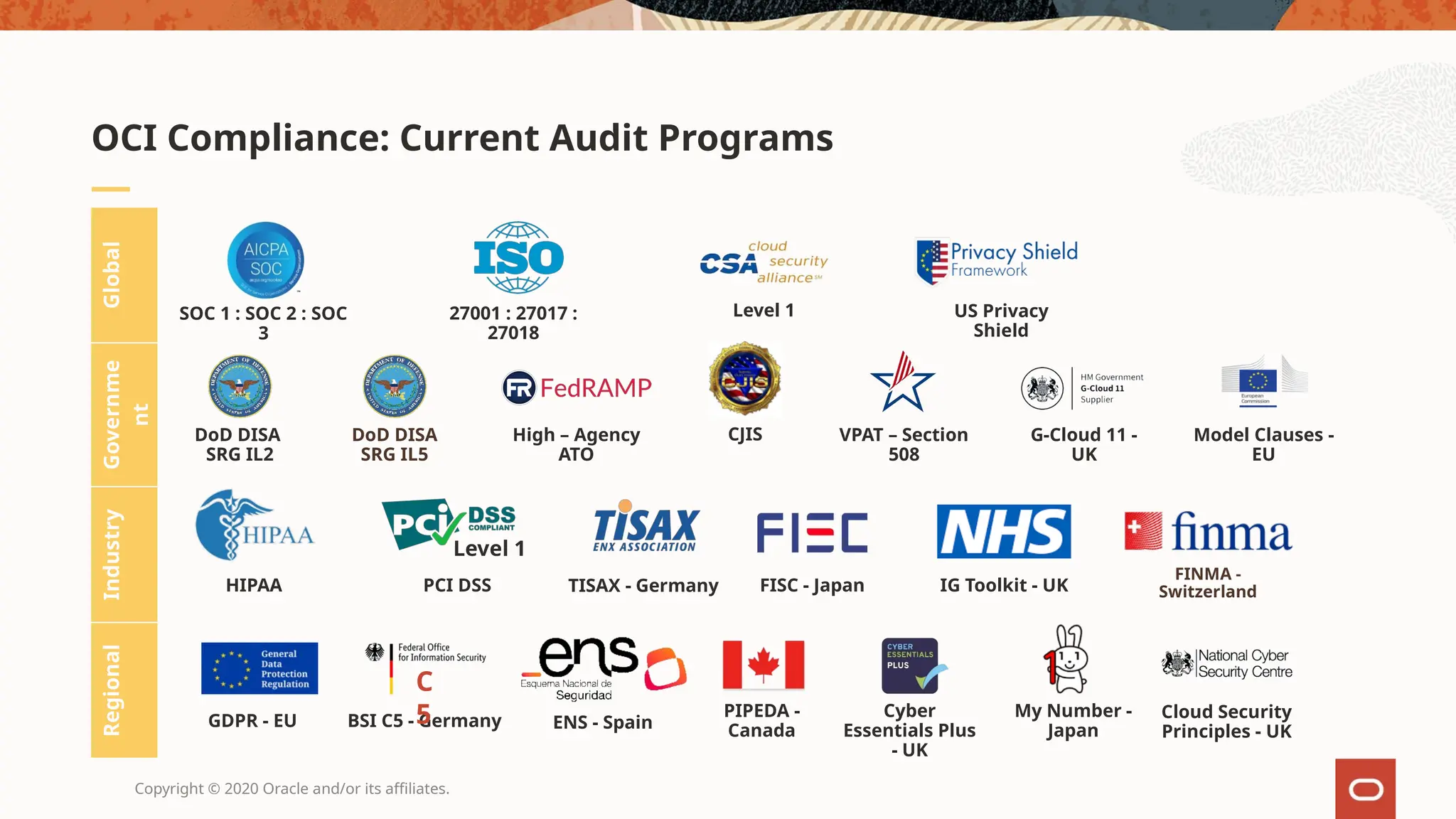
Compliance – GDPR.,
#58 Professional Services
OceanX connects brands and retailers with consumers through a fully integrated subscription commerce platform for physical goods.
They needed to migrate four BI systems (Cognos, Tableau, Informatica, Data Migrator) from AWS
They used Oracle Cloud Infrastructure to migrate Oracle and non-Oracle workloads
This resulted in greater flexibility to expand more workloads and disaster recovery
https://www.youtube.com/watch?v=aluz4JTk-9A
#59 Big Data:
- Performance, Price, Open
Support for same range of hardware that you run on-premises
From small VMs up to bare metal servers (Industry first)
Up to 400K IOPS of attached Block Storage, line-rate throughput, with SLAs & 2x cheaper than AWS
Run your Big Data Environments next to Exadata Engineered Systems
Non-oversubscribed Network, Predictable Performance with low Latency and high throughput
Bandwidth egress costs cheaper than AWS bandwidth by 85%
The best cloud environment to run your big data/analytics workloads
Stream data from any of your Oracle Applications easily
Oracle Database Services – with all the features: Oracle RAC, Oracle Exadata including Autonomous Services
BYOL – Lowest cost
Industry Leading Offerings that powers Cloudera’s Data Management platform
SAN like Block Storage
End-to-End SLAs in-place HW repair
RAC, Exadata
Best price/performance
Simple & Intuitive Pricing (For Example: No Egress Bandwidth Pricing on Fast Connect)
Open Cloud Strategy: Terraform as a Service for deploying your templates
Enterprise Grade Governance and Management
Compartments, Audit, Policies
Security Services – KMS, Secrets .,
Compliance – GDPR.,
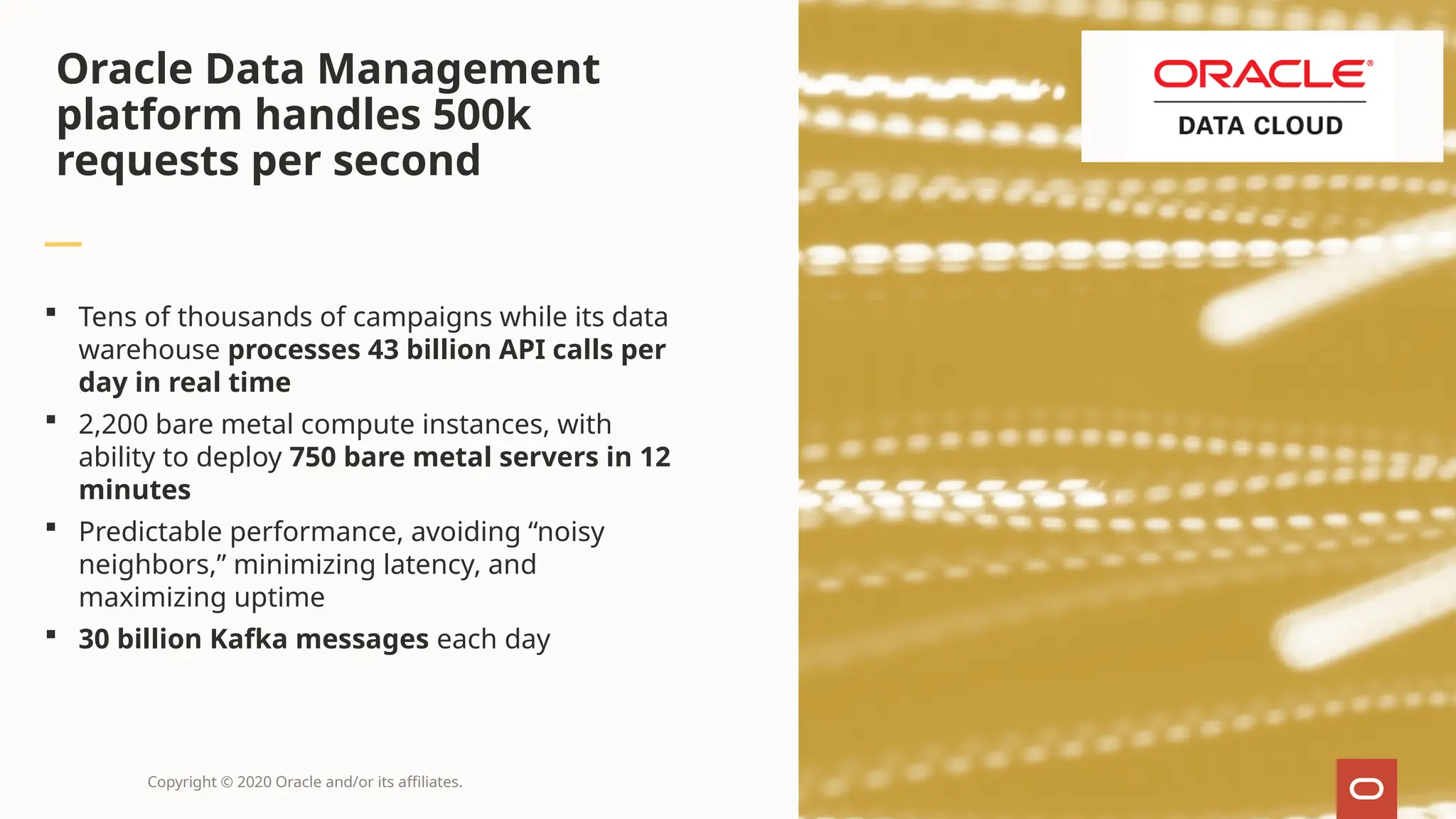
#60 Deployed 750 servers in 12 minutes
7.5 trillion data points collected monthly
200 data providers with 15 million worldwide domains
Tens of thousands of campaigns
Data warehouse processes 43 billion API calls per day in real time
Achieving predictable performance
Avoiding “noisy neighbors”
Using multiple Availability Domains in multiple regions to minimize latency and maximize uptime
<<summary>>
Oracle Data Cloud
Data management platform handles 500,000 requests per second on Oracle Cloud Infrastructure
Oracle Data Cloud (ODC) provides the world’s largest cloud-based data management platform for marketing, which helps enterprises personalize online, offline, and mobile marketing campaigns with richer and more actionable information about targeted audiences. The platform is used by top retailers, consumer packaged goods, and automotive industry, and has moved its sizable infrastructure to Oracle Cloud Infrastructure.
Unifying infrastructure with Oracle
The web front-end “Targeting Servers” are custom Linux-based applications that process billions of requests per day. Because the application includes support for businesses serving web pages to customers in real time, the workload is very sensitive to latency. A customer delayed could be a customer lost.
More than 200 data providers and a network of over 15 million worldwide domains aggregate more than 50,000 categories for more than 5 billion global IDs. That results in 7.5 trillion data points collected monthly. The infrastructure handles 43 billion API calls per day, each of which is evaluated against tens of thousands of campaigns. This involves thousands of servers and petabytes of data
The back-end includes a Hadoop cluster that reads & stores 30 Billion Kafka messages each day, while the pipeline aggregates & summarizes logs, with 300 TB read and 150TB written per day, with 11 petabytes of total back-end storage.
ODC includes several acquisitions, based on various technologies. Accordingly, part of the integration process involved replatforming from several other leading cloud providers to improve performance and control costs.
The benefits of a new platform – both planned and unforeseen
A portion of ODC was previously deployed on a bare metal solution from another vendor, with thousands of physical servers across three regions in North America. Server deployments and network configurations required submitting a ticket, and waiting 24 hours or longer. The new deployment consists of 2,200 bare metal compute instances.
During the replatforming, the team discovered they could improve the architecture of the product to leverage the performance of NVMe SSD local storage, available to them for the first time on Oracle Cloud Infrastructure.
The new infrastructure handles over 500,000 requests per second at an average latency of under 50 milliseconds. Oracle’s breadth of compute options – from small VMs to very large bare metal servers, 25 Gbps networking infrastructure, Load Balancer, DNS, and Availability Domains enabled the ODC team to seamlessly migrate and operate one of the largest data platforms in the ad-tech industry.
“When you’re processing 500,000 requests per second, any downtime impacts a lot of customers. Our former environment didn’t provide availability domains to help us improve availability at the time. On Oracle Cloud Infrastructure we’re using availability domains within each region to run highly reliable workloads with the availability our customers demand,” said Matt Abrams, VP Engineering, Oracle Data Cloud.
Security was also a concern. Running directly on bare metal servers avoids “noisy neighbor” problems that might impact performance, and ensures no one else’s code is running on the hardware. The procedures Oracle uses to securely erase NVMe drives and other storage helps ensure data security.
“Oracle Cloud Infrastructure hardware is simply on another level. From the bare metal servers with NVMe SSD drives to the network backbone. We obtain fabulous performance with very low latency for our end customers. Dense I/O compute instances with 25GBps bandwidth and millions of both read and write IOPS is a game changer for big data workloads like ours,” said Matt Abrams.
Speed of deployment also saw a big improvement. The team often spins up and tears down compute instances. At one point during the project, the team was able to deploy 750 servers in less than 12 minutes on Oracle Cloud Infrastructure. They now do development, test, and production in the cloud utilizing a high velocity development approach style with continuous integration.
About Oracle Data Cloud
Oracle Data Cloud helps the world’s leading marketers and publishers deliver better results by reaching the right audiences, measuring the impact of their campaigns, and improving their digital strategies. By leveraging $5 trillion in consumer purchasing data, we help marketers connect their ads with sales. Oracle Data Cloud also operates the world’s largest data marketplace, powered by more than 15 million websites in our global network and more than 1,500 online and offline data providers. The Oracle ID Graph connects more than two billion consumers around the world across their devices each month. Our brands include AddThis, BlueKai, Crosswise, Datalogix and Moat.
“Thousands of servers with over 20 petabytes of data handing 43 billion request per day –our deployment is a large one. Oracle Cloud Infrastructure handles it all with aplomb.”
- Matt Abrams,
VP Engineering, Oracle Data
Cloud
why Oracle?
Consolidated from 3 datacenters down to 2 Oracle Cloud regions
Three Availability Domains in each region help ensure uptime
Rapid deployments – up to 750 servers in less than 12 minutes
Solution
Oracle Database Cloud Service
Oracle Cloud Infrastructure Compute - bare metal and virtual machine compute instances
Oracle Cloud Infrastructure Load Balancing
Oracle Cloud Infrastructure FastConnect
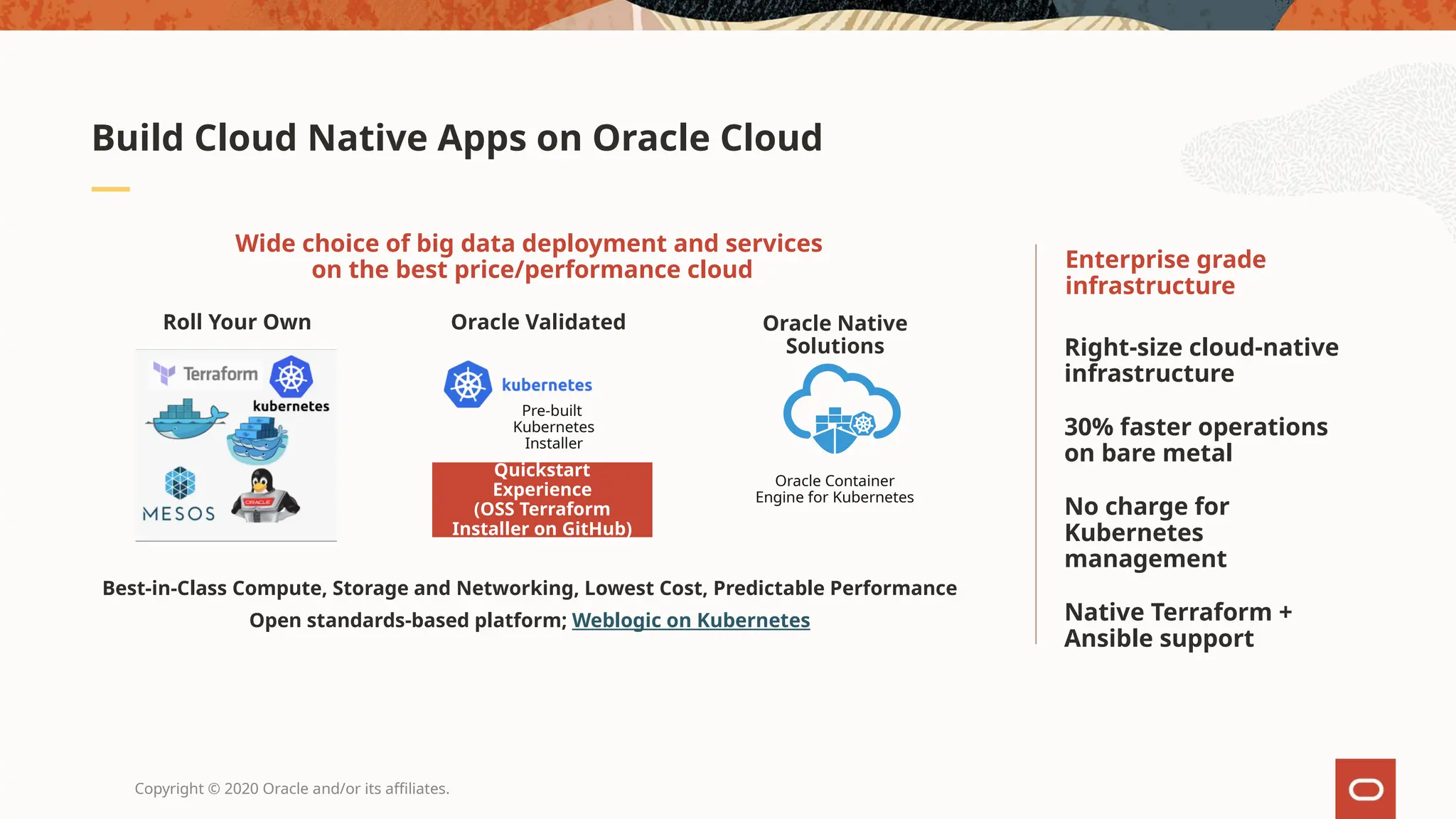
#61 Roll Your Own, Pre-Built Installer, Managed Service, Tools for Cloud@Customer
Performance (Kubernetes 30% faster compared to VM-based)
#63 HPC (legacy connotation: simulation): (or drop HPC and say performance-intensive or data-intensive apps)
Performance
Price
Openness
The highest performing IaaS among public clouds
NVIDIA Tesla and Volta GPU compute instances
Bare metal compute with 44% more CPU cores,
50% more memory, and 237% more local SSD storage
than the largest AWS option
Best-in-class local NVMe SSD storage, up to 1 PB
on bare metal compute instances
A non-oversubscribed, flat, high bandwidth 25
Gbps network that connects servers to each
other, and to high performance block,
object, and file storage
Most HPC workloads are compute intensive, often using NVIDIA GPUs which are a huge CAPEX for on-premises datacenters and have a short lifespan since each GPU generation doubles performance. Hence running these workloads in the cloud is a great fit as they get the benefit of running on the latest and greatest hardware along with only paying for what they use.
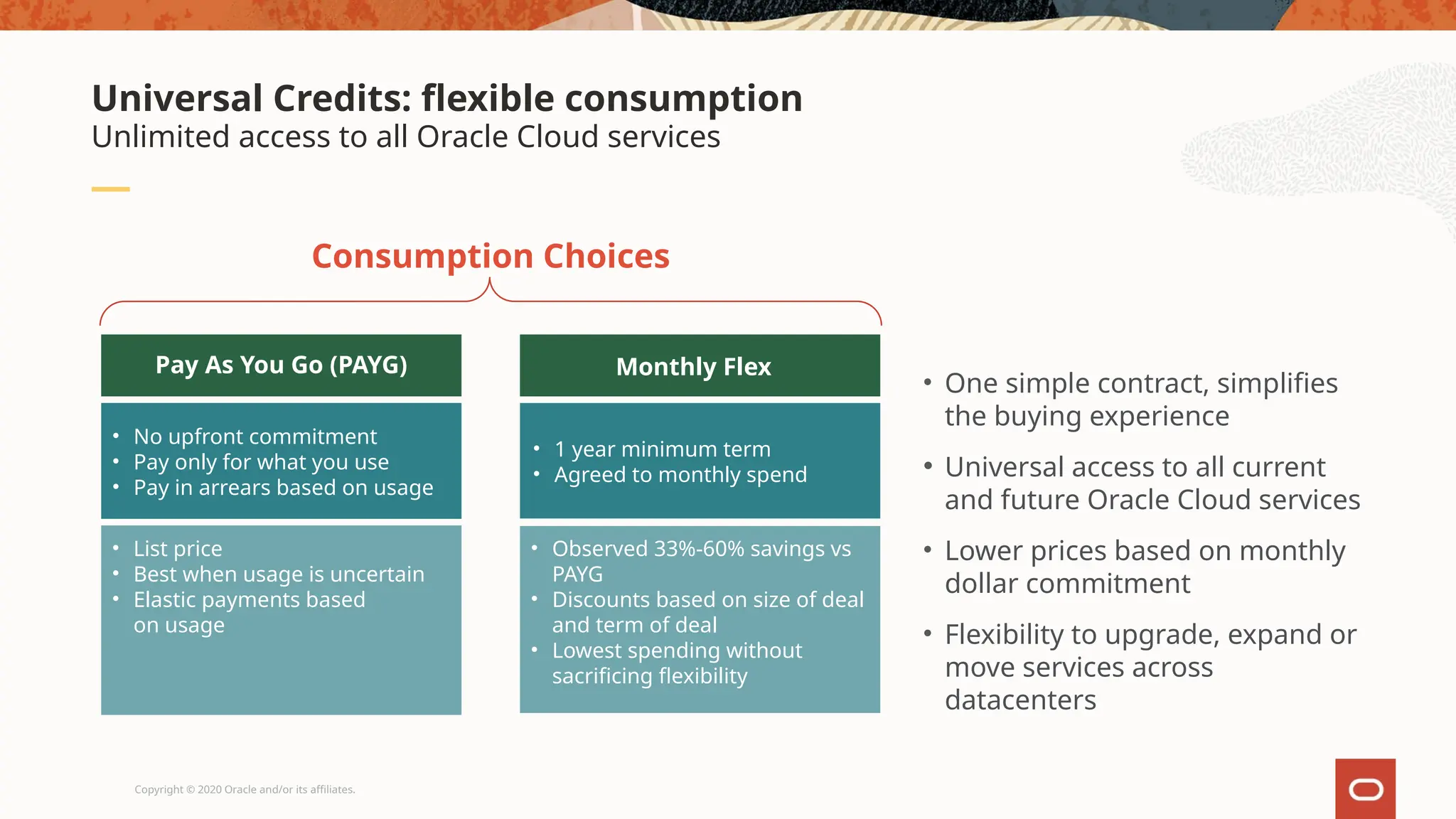
Oracle also provides a flexible buying and usage model for Oracle Cloud Services, called Universal Credits, the industry’s most flexible buying and consumption model for cloud services. With Universal Credits, you have one simple contract that provides access to all current and future Oracle PaaS and IaaS services. This provides the lower costs of a longer-term commitment, but, unlike other public cloud providers, gives you the flexibility to apply your committed spend wherever you need it. Need more, fewer, or different sized compute instances? Less database, but more storage? No problem.
With Universal Credits, you can change the PaaS or IaaS services you use, at any time, without the need to notify Oracle, and your credits still apply.
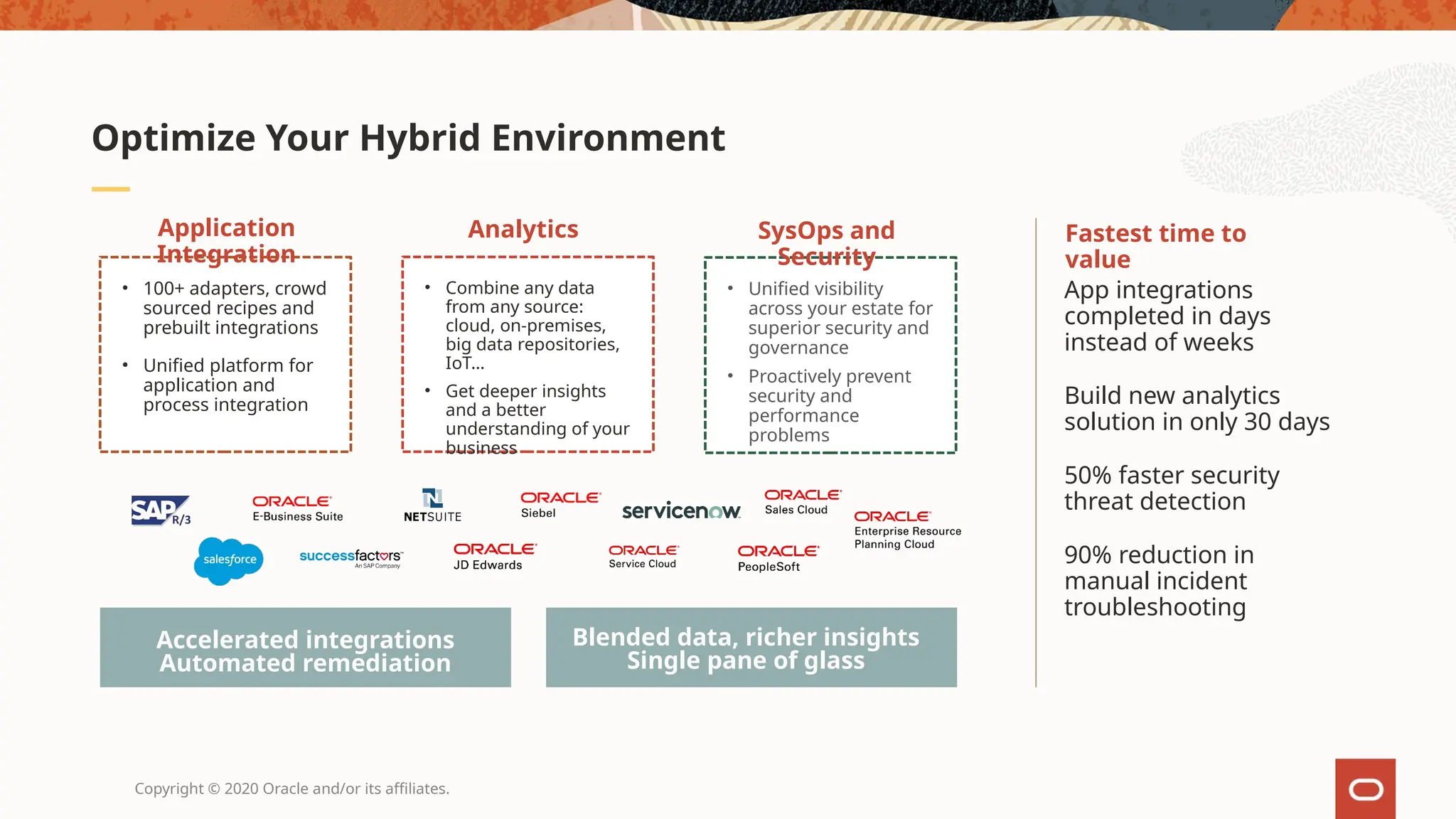
#65 App Integ (hybrid, 3rd party, etc.),
Optimize (app int, security, sysops)
Integration for Applications – to allow you to integrate applications together faster, more easily
Integration for Analytics: quickly integrate data for better insights
Integration across clouds: designed for hybrid cloud environments, allowing you to tie together business processes that span on prem and all your multi-cloud deployments
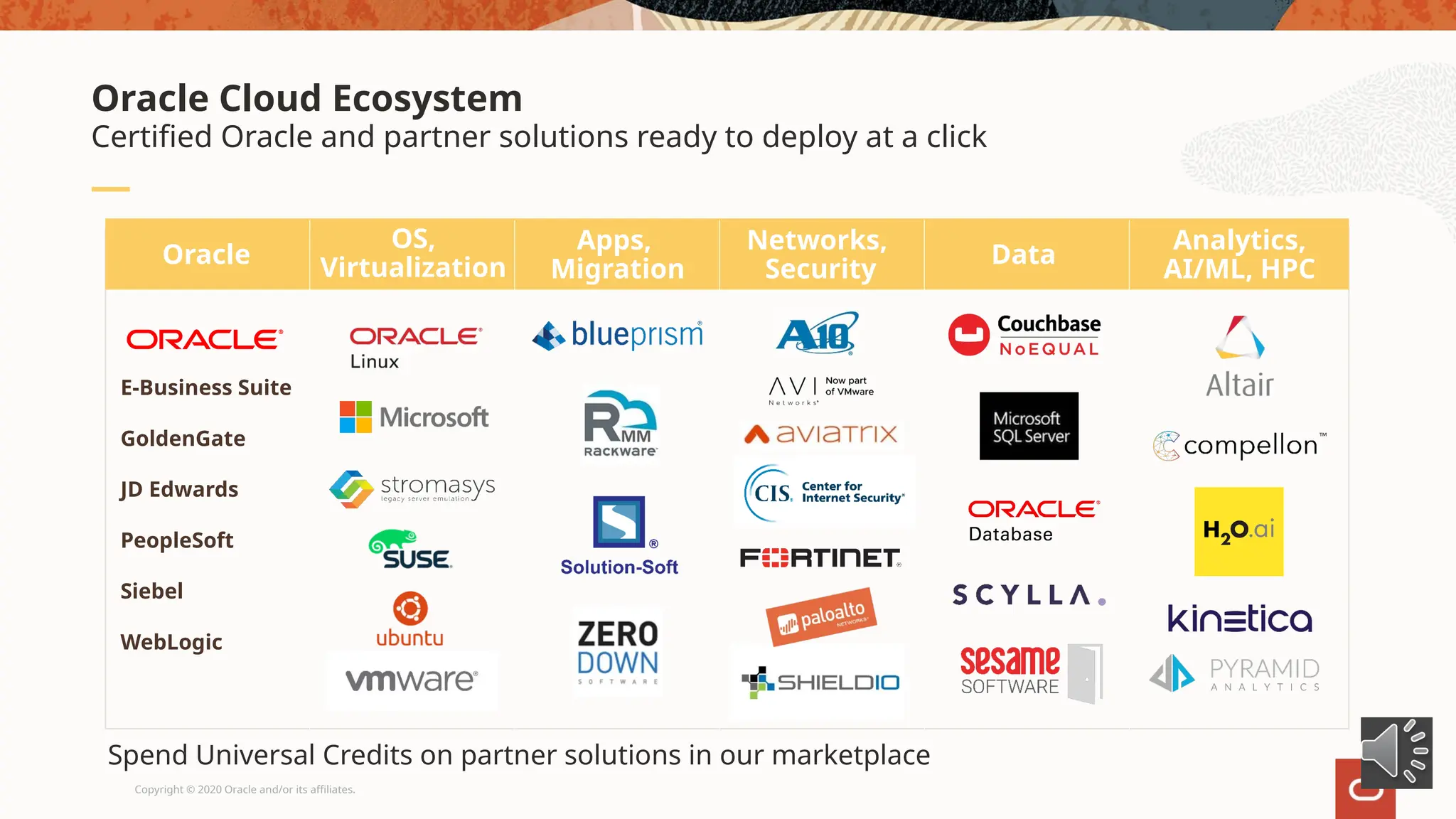
#66 Oracle Cloud Marketplace provides access to a broad ecosystem of solutions which span several categories, including but not limited to: Operating Systems, Networking, Database, Cloud Migration, Security, Big Data, DevOps and HPC. Some of these solutions are provided by Oracle and some by our ISV partners. Many customers are already using these solutions in their IT ecosystem today, so they expect it when they move to the Oracle Cloud. For other customers, these solutions can also help extend and augment Oracle Cloud Infrastructure services.
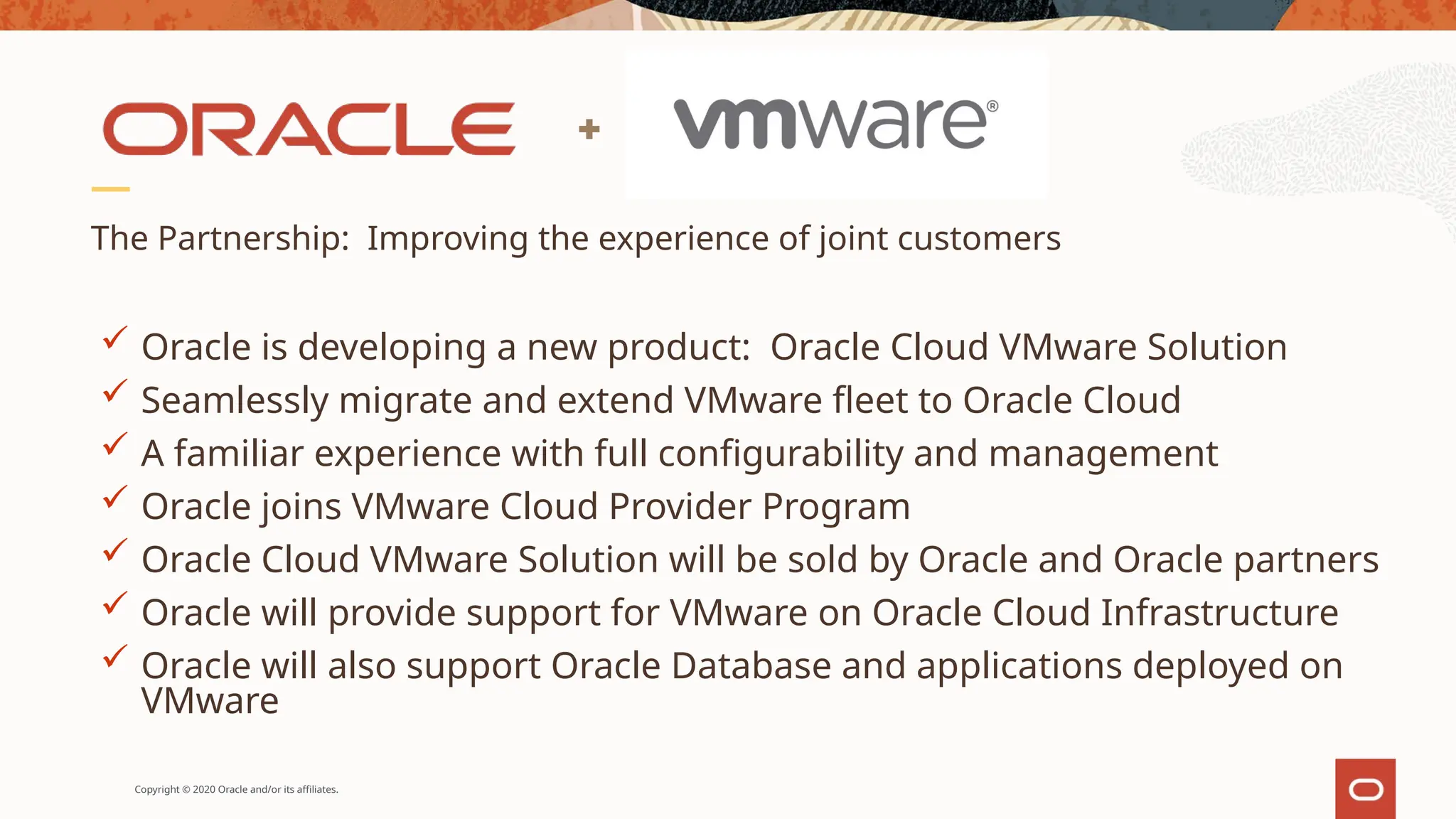
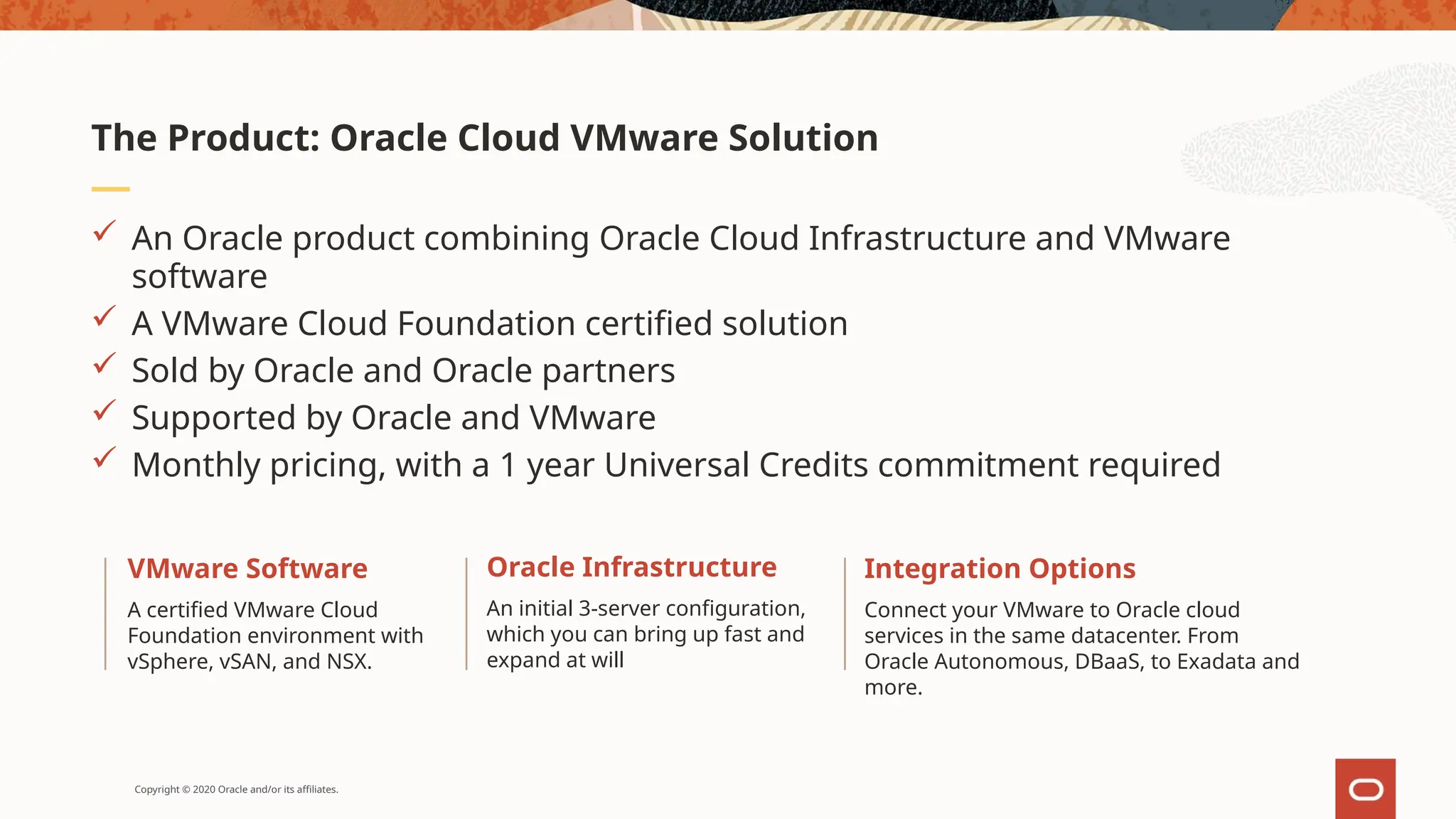
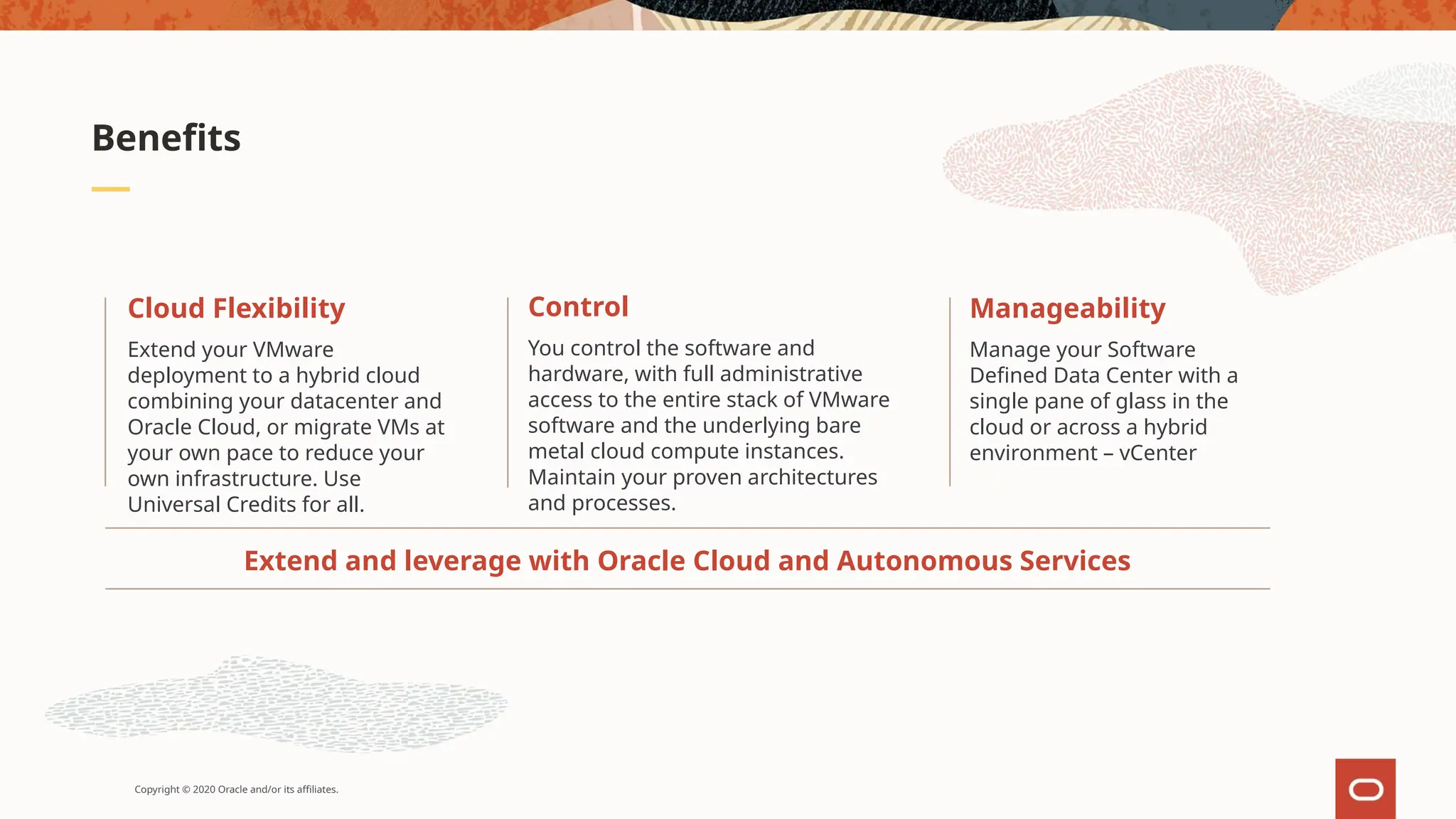
#68 Strategic partnership to help customers leverage the companies’ industry-leading enterprise software and cloud services to drive digital transformation.
Customers want seamless lift and shift experience . Continue to leverage VMware heavy workloads. Enterprise first offering. As we have talked to Enterprises, we need full control. We need to bring my operator.
Seamless lift ands shift first step with same management.
Partnership opens up a solution to the customers challenges.
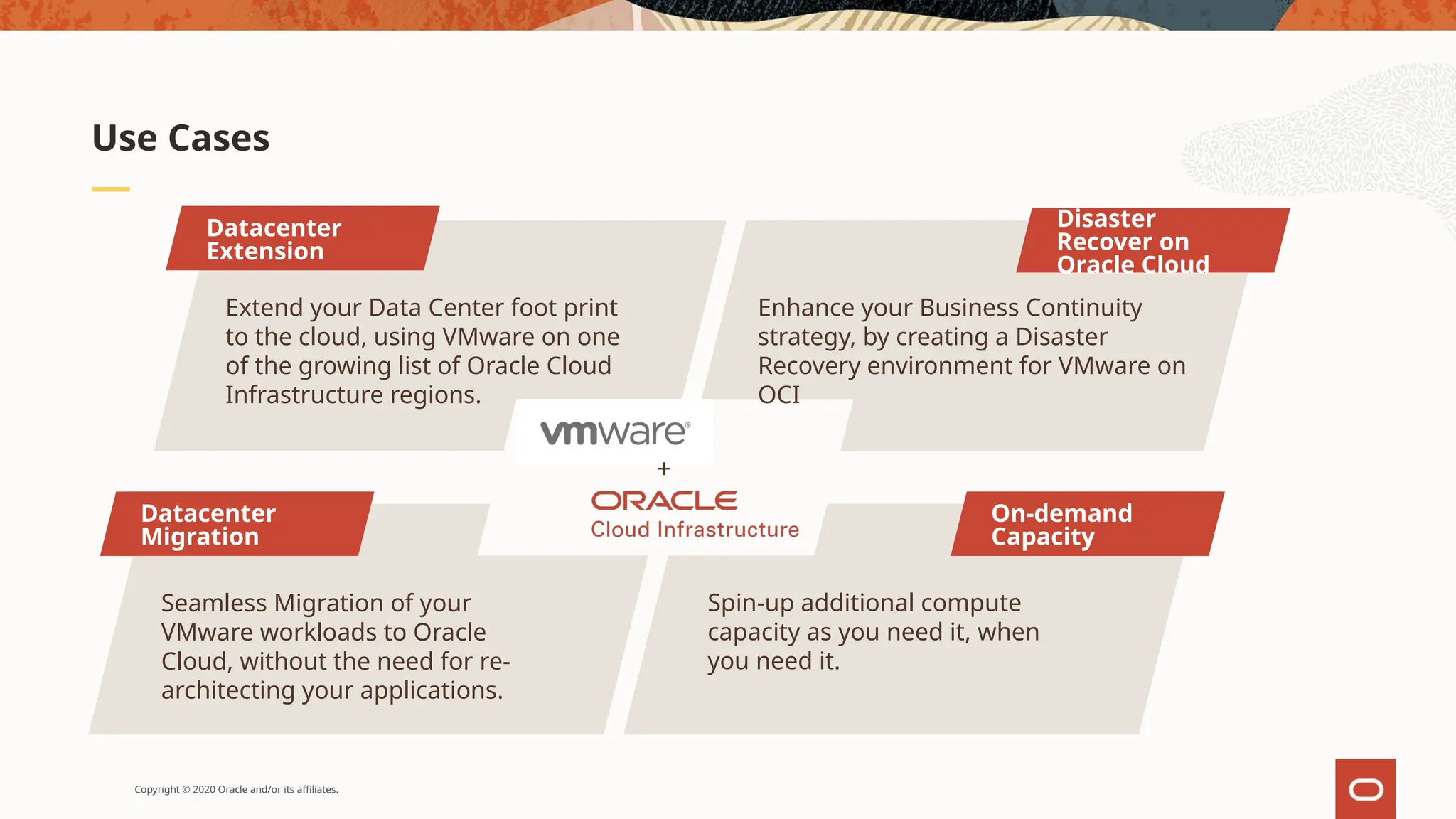
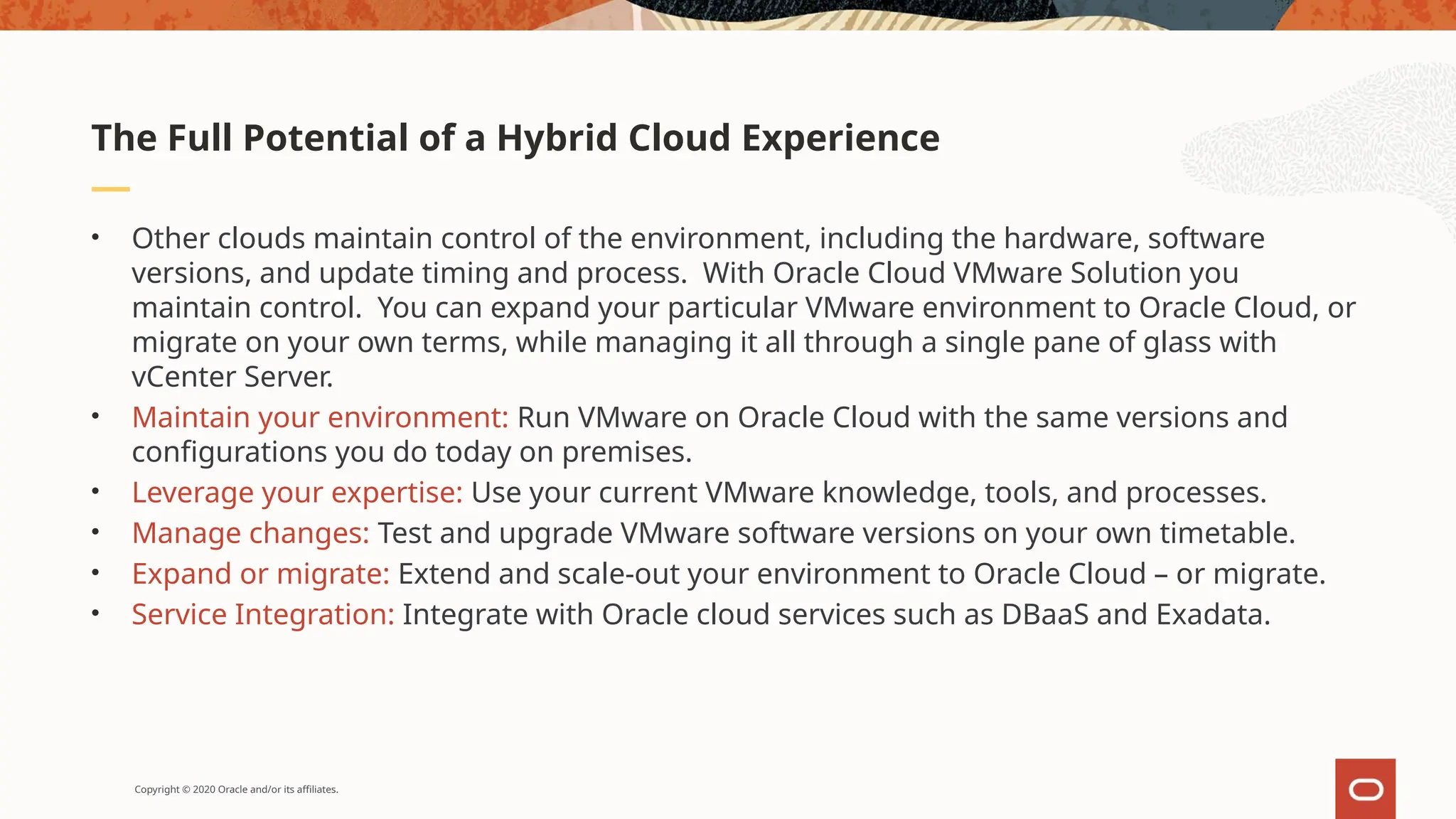
#71 Update and patch on your own schedule. Fully test environment upgrades and deploy them at your own pace.
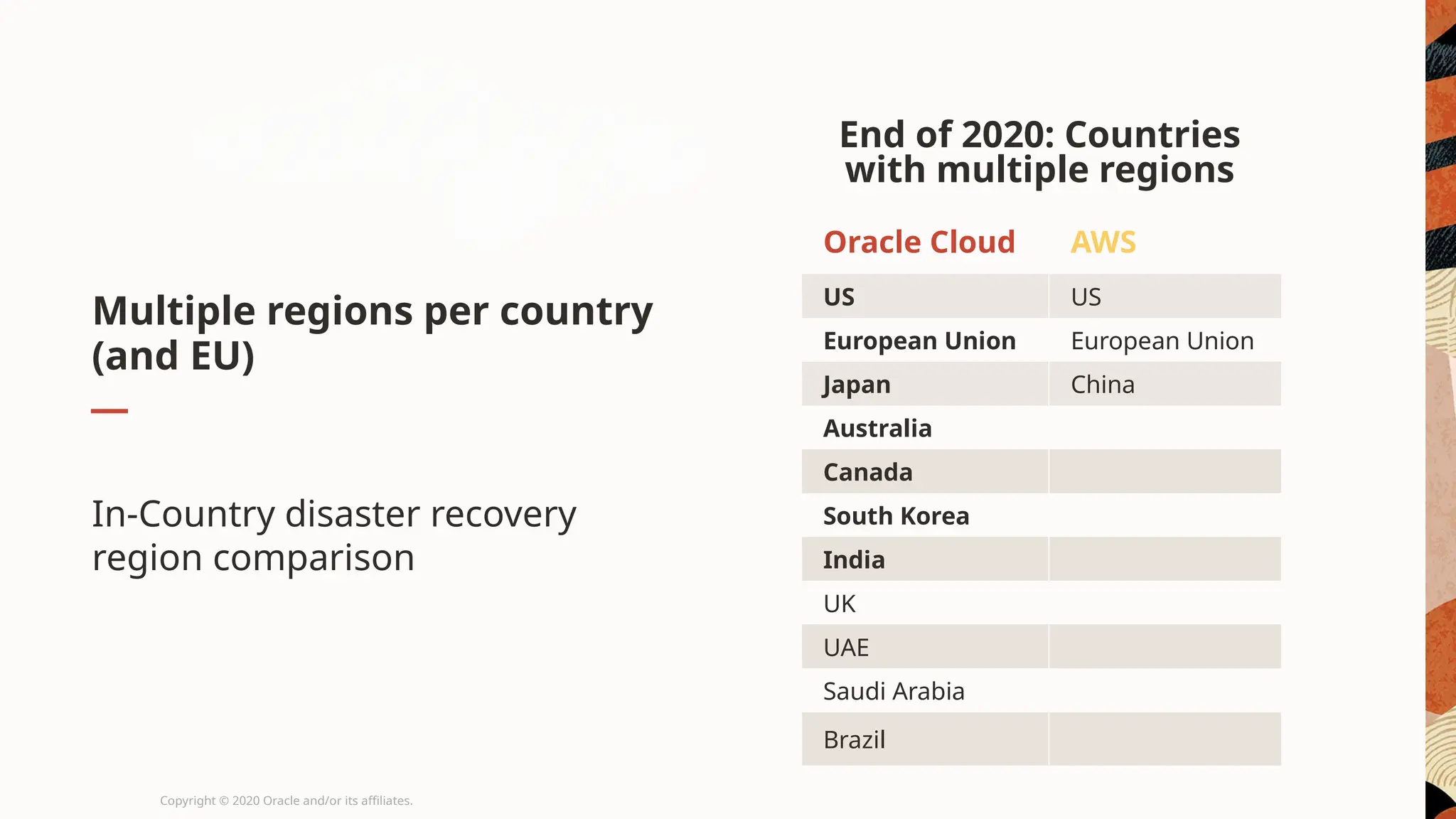
Leverage Oracle’s rapidly expanding footprint of global regions to scale globally without establishing your own datacenters
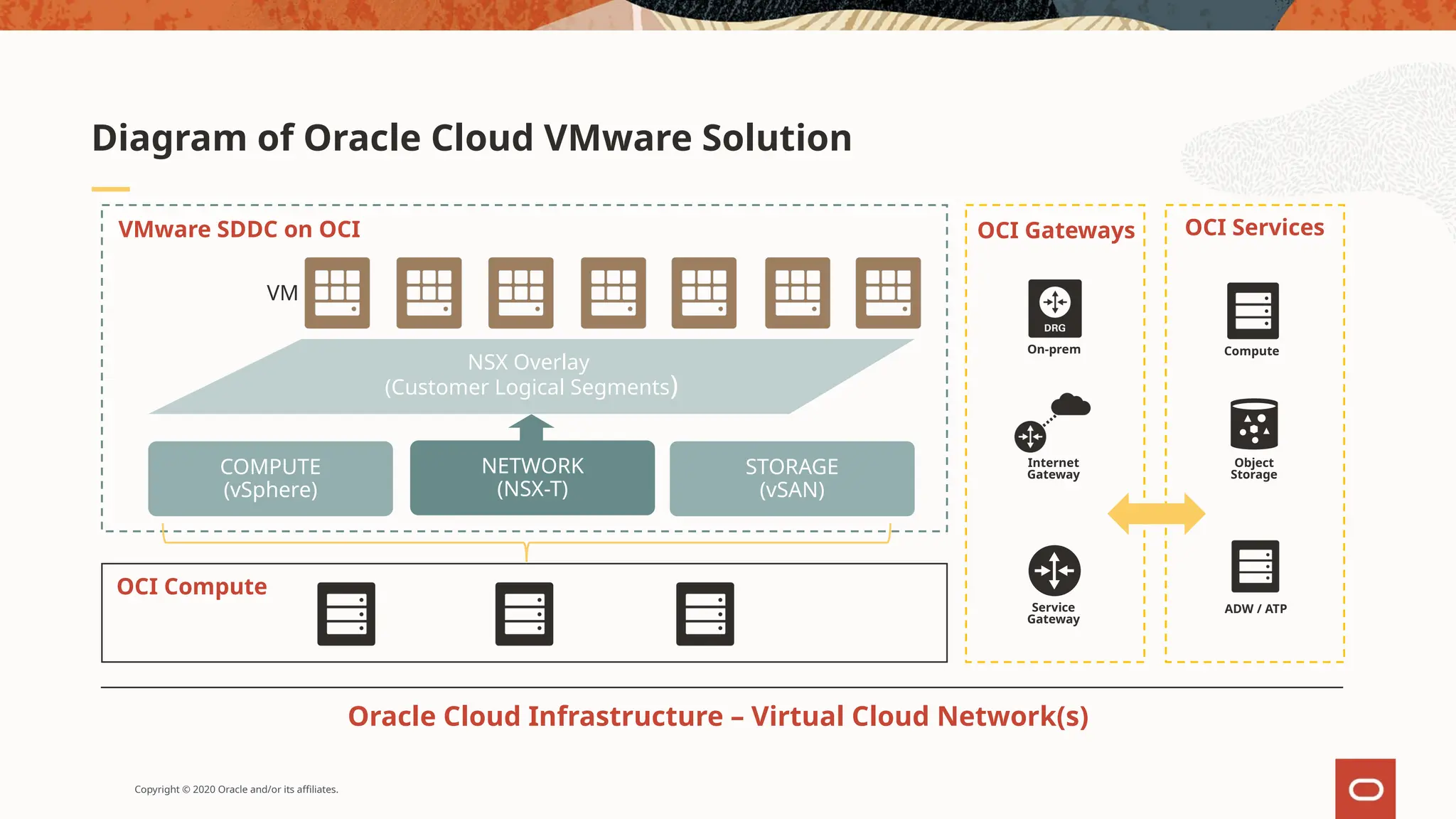
What Are the Advantages? This partnership presents the opportunity for enterprises to easily move applications to the cloud that were previously confined to on-premises environments. Now, enterprises can leverage the security, performance, and on-demand, pay-as-you-go model of Oracle Cloud Infrastructure to extend existing on-premises VMware infrastructure and investments without re-architecting applications or retooling operations.
Oracle is the only hyper-scale cloud offering that empowers enterprises to migrate VMware vSphere environments to the cloud, while retaining total control over updates, patches, and validation for all VMware components.
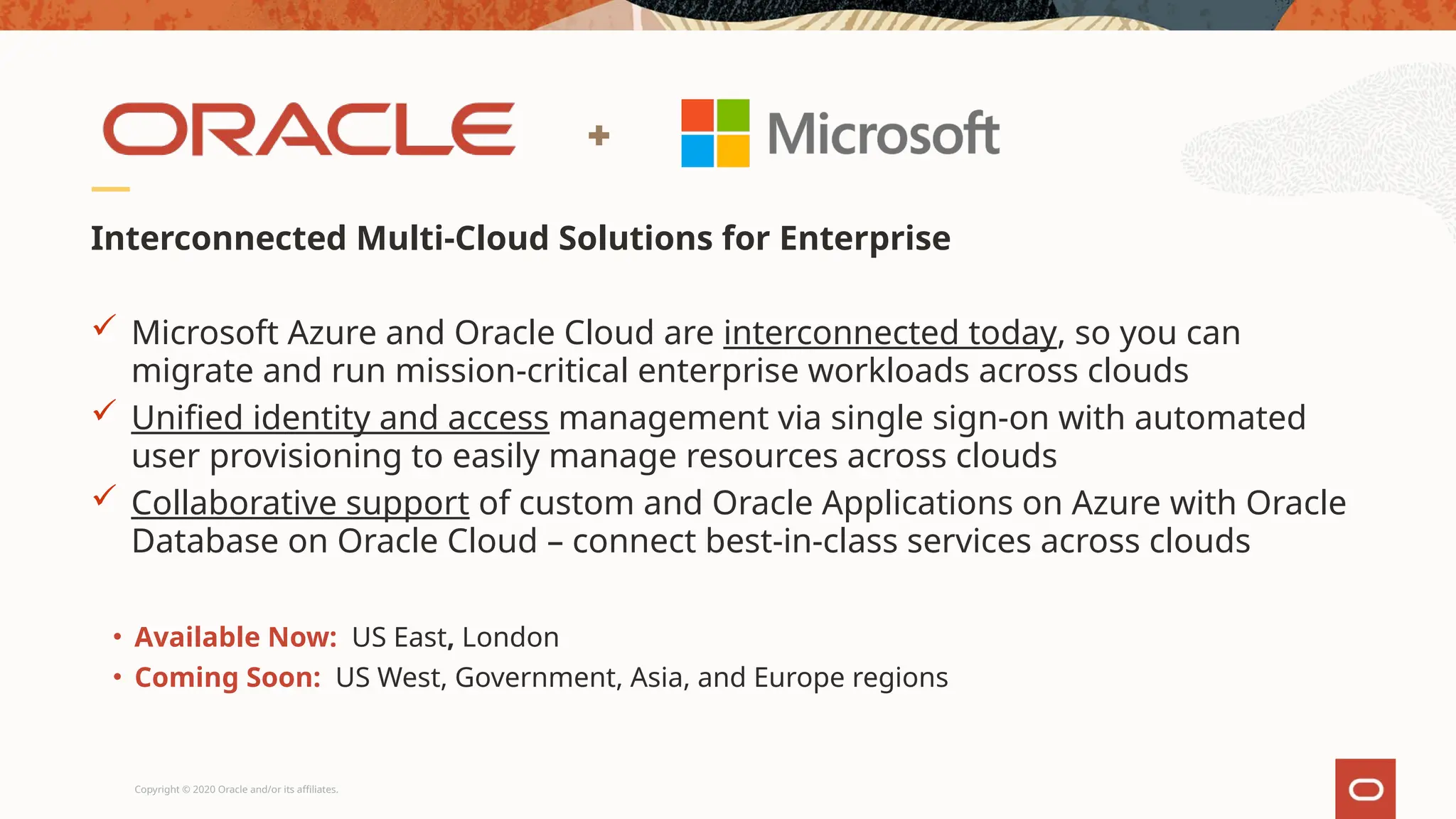
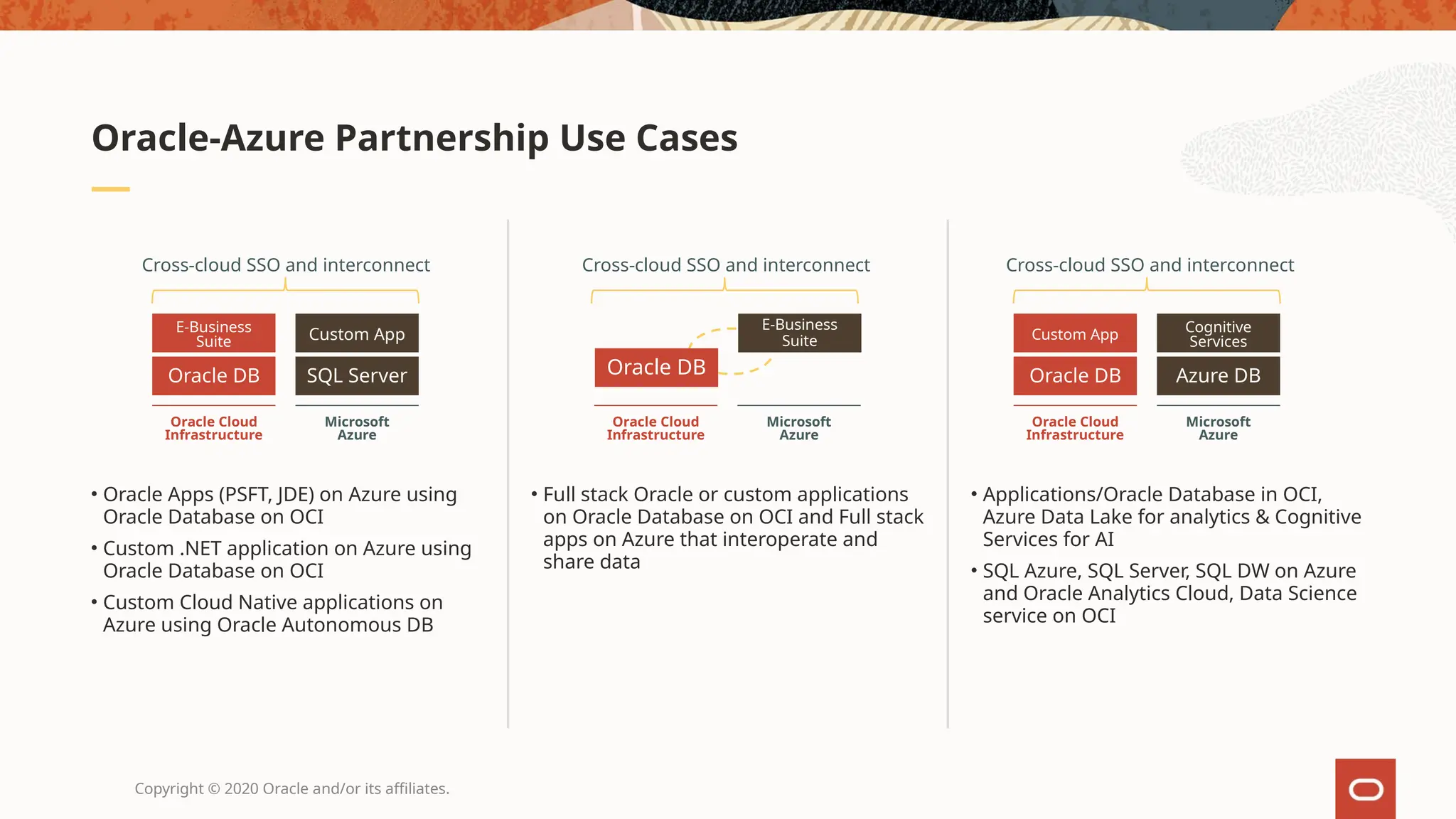
#78 Oracle and Microsoft will now collaboratively support select workloads to interconnect directly between specific local OCI & Azure cloud regions.
What does this mean?
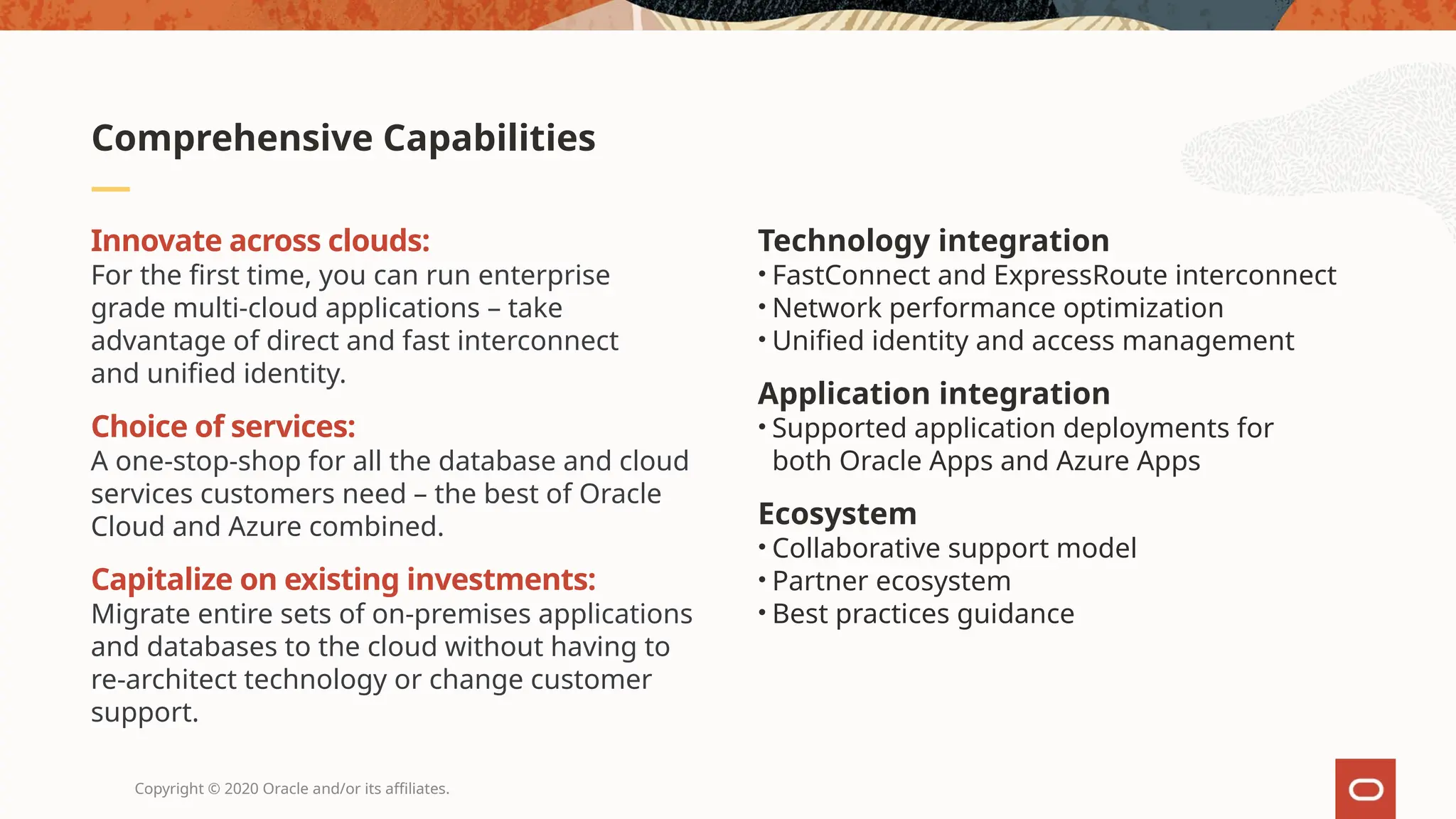
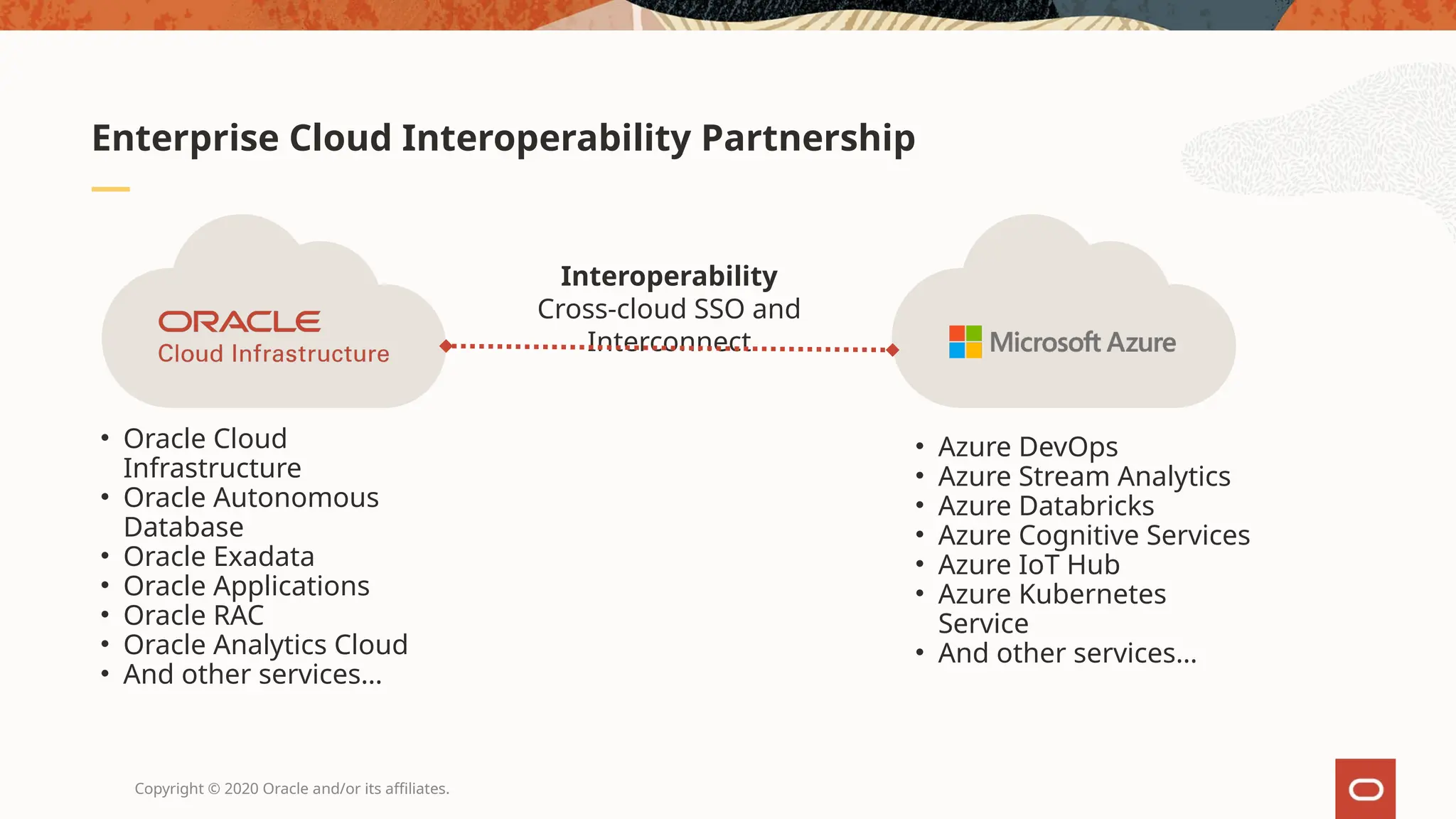
Oracle Cloud Infrastructure and Microsoft Azure will enable customers to run their enterprise solutions seamlessly across OCI and Azure with integrated technologies including networking, unified access management, security, and monitoring.
Each provider offers SLAs to back up these services.
How does this work?
Supported deployment of Microsoft and Oracle applications on Azure with Oracle databases deployed on OCI.
Simplified cross-cloud implementation, via interconnect with network optimization and extremely low latency among select Azure Regions and OCI datacenters.
Unified identity and access management, via a unified Single Sign On experience to manage resources across OCI and Azure.
What are the requirements?
Oracle will only be certifying specific Oracle Applications running on Azure if the customer’s Oracle Database is also on OCI.
Customers will be able to utilize the complete suite of Oracle Database offerings on OCI including Autonomous, Exadata, RAC, DBCS, & DBaaS.
Where will this alliance be available?
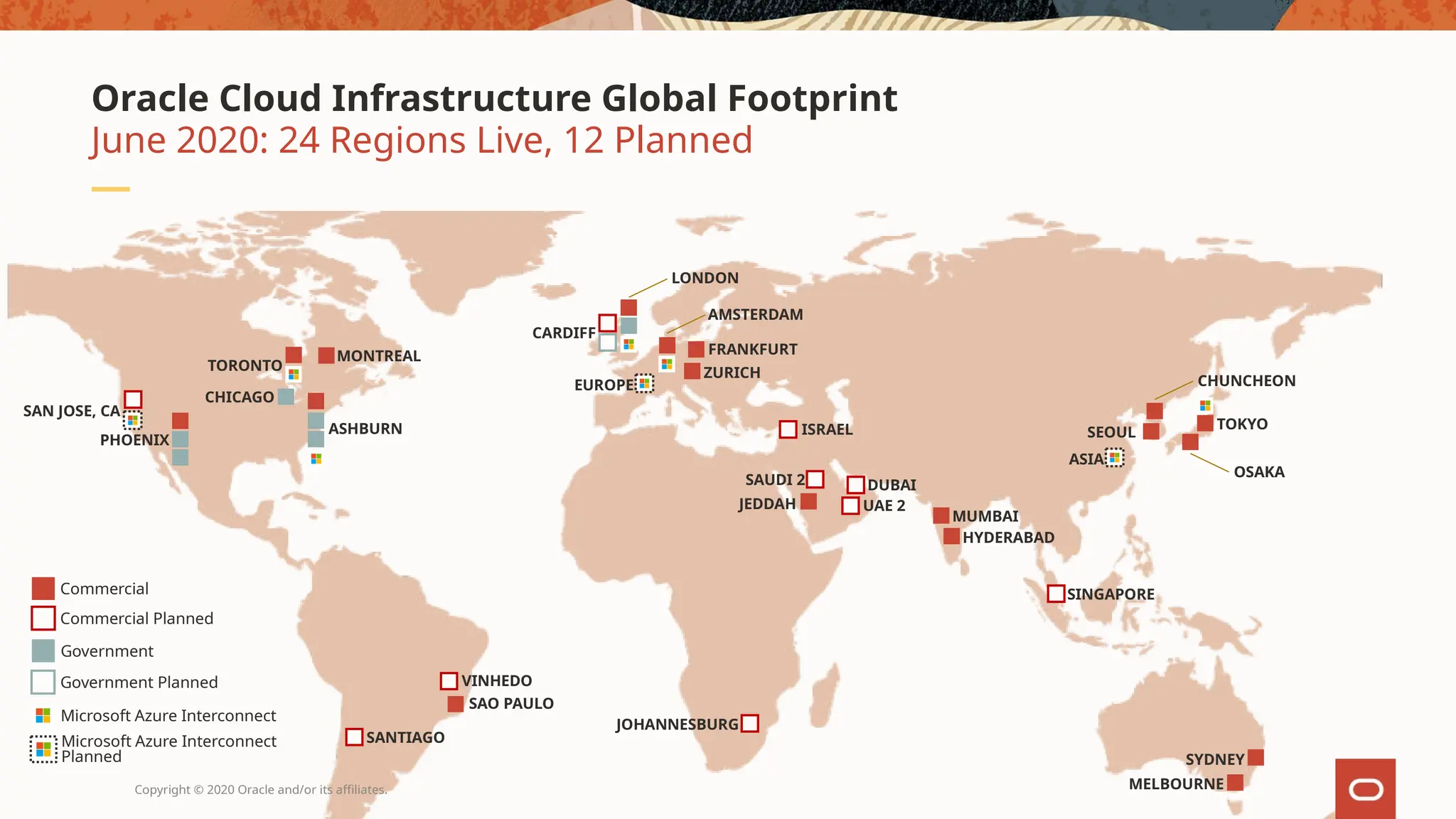
The OCI & Azure Global Alliance will only be allowed in select regions where both vendors have agreed availability.
At launch, this is only relevant to these specific customer workloads that can run within Ashburn, VA, USA. Additional availability will be announced in the future.
How will this be supported?
Customers can use existing Oracle and Microsoft customer support relationships and processes. Both teams have been cross-trained on the portfolio of integrated technologies.