OptoGaN Enabling bulb-like brightness for LEDs OptoGaN is a developer of product- and process technology for white HB-LEDs for applications that request LEDs with bulb-like brightness such as Illumination, Automotive and LCD-Backlighting
Now Incorporated in 2004, OptoGaN operates Research center in Helsinki, Finland: State-of-the-art cleanroom environment Research 3x2” MOCVD reactor Manual LED processing tools   Set of characterization tools Pilotline in Dortmund, Germany: State-of-the-art cleanroom environment Volume 19x2” MOCVD reactor Full chip processing line   Analytical lab
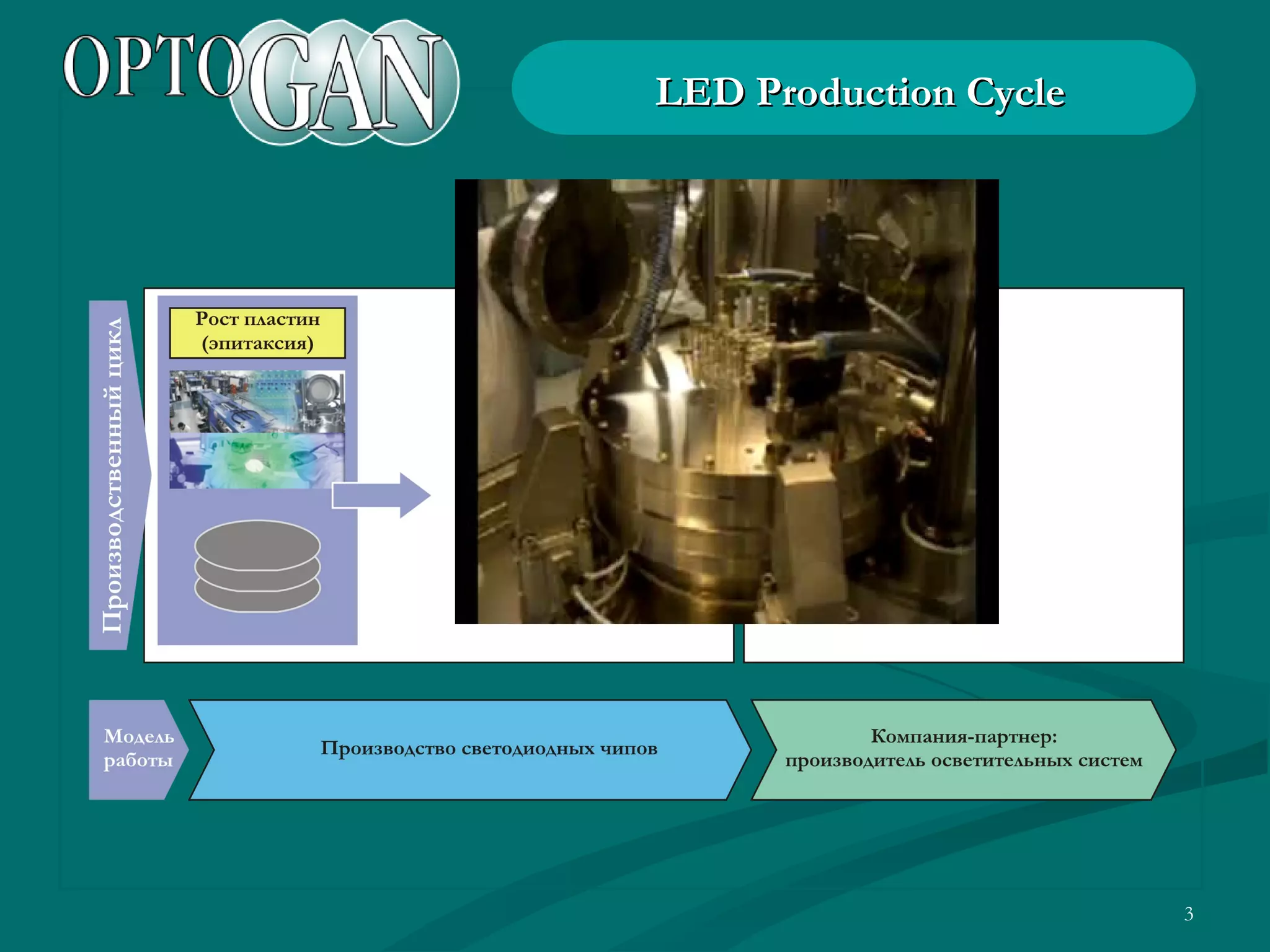
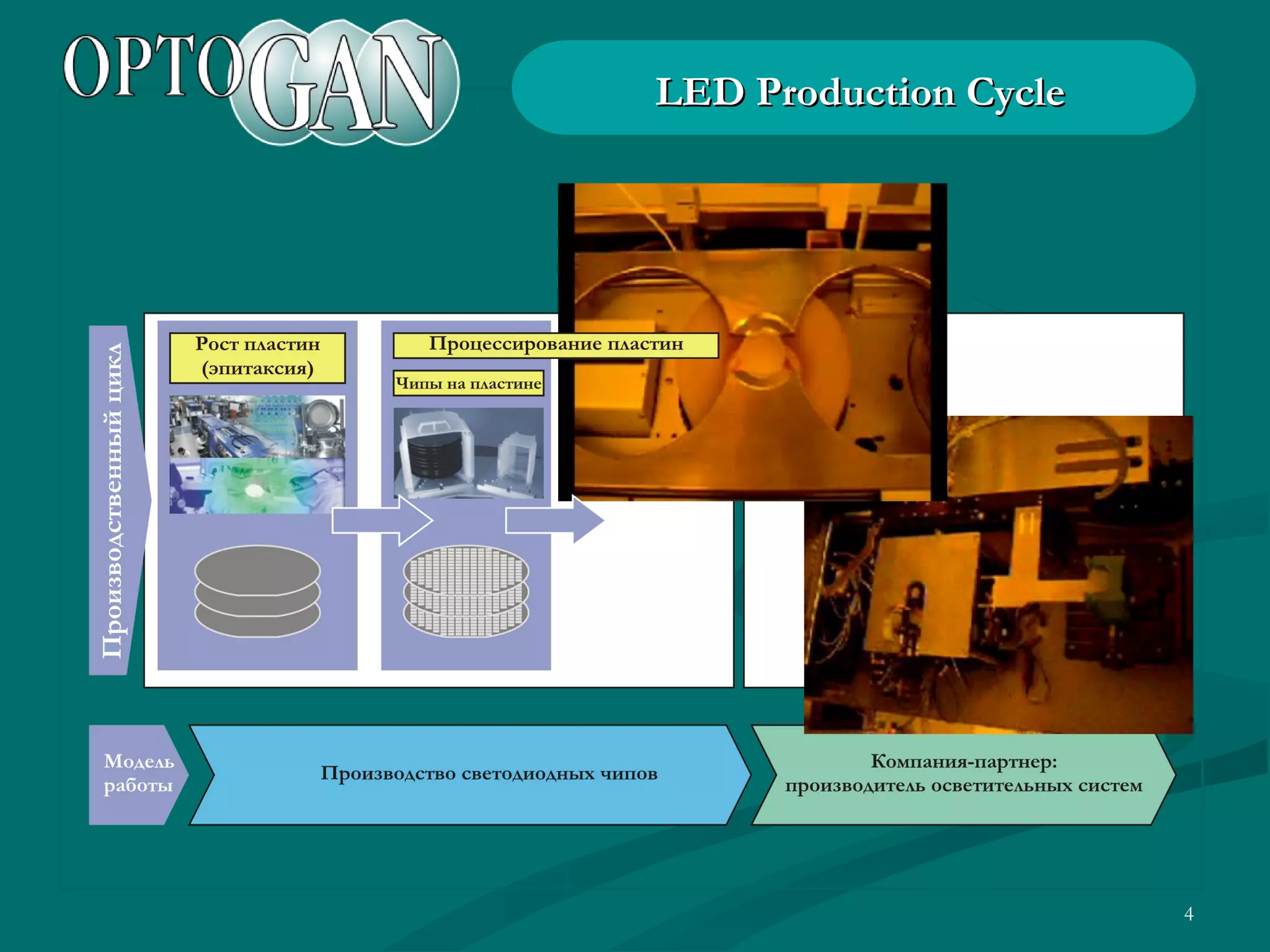
LED Production Cycle
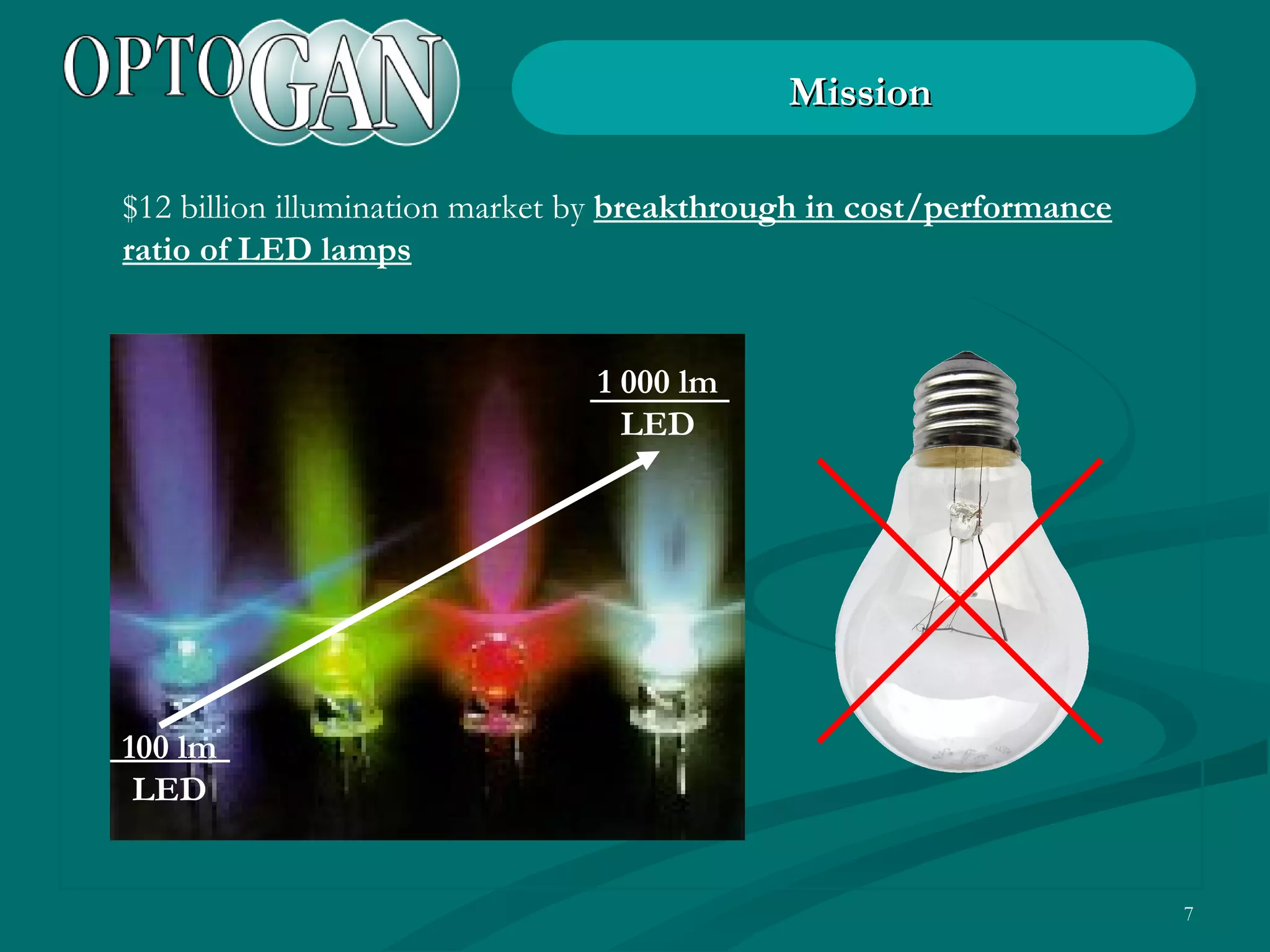
Mission $12 billion illumination market by  breakthrough in cost/performance ratio of LED lamps 100 lm LED 1 000 lm LED
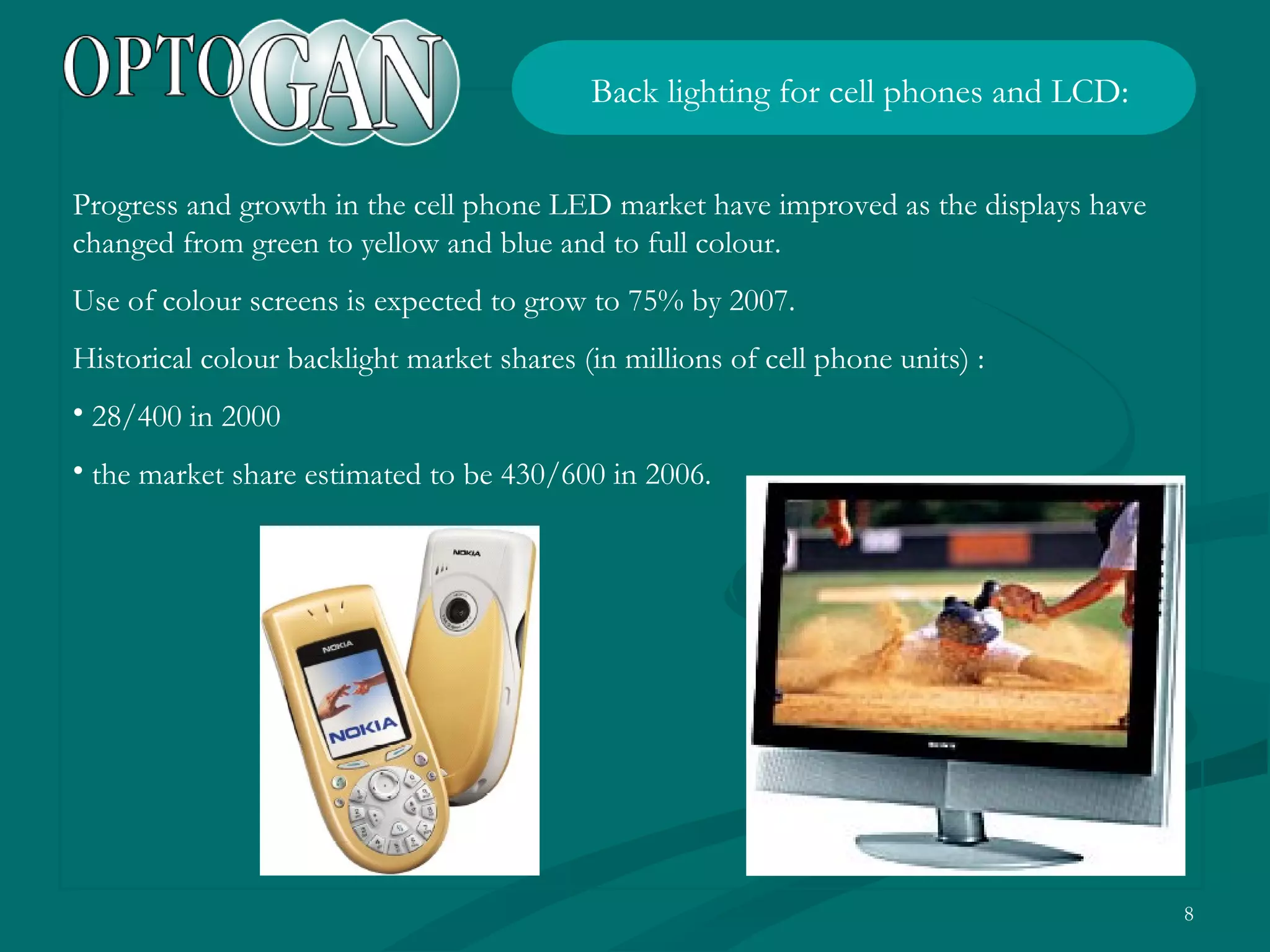
Progress and growth in the cell phone LED market have improved as the displays have changed from green to yellow and blue and to full colour. Use of colour screens is expected to grow to 75% by 2007. Historical colour backlight market shares (in millions of cell phone units) : 28/400 in 2000 the market share estimated to be 430/600 in 2006. Back lighting for cell phones and LCD :
The LED advantages are: improved safety power savings styling opportunities reduced dimensions multicolour interior lighting options system cost savings Annual market growth rates in this segment are expected to be in the 10 to 15% range.   Interior and exterior automotive lighting:
outdoor video signs sports stadia advertising mono-colour terminal traffic signals indoors for arenas and racetracks other video displays exit signs   Large signs and displays:
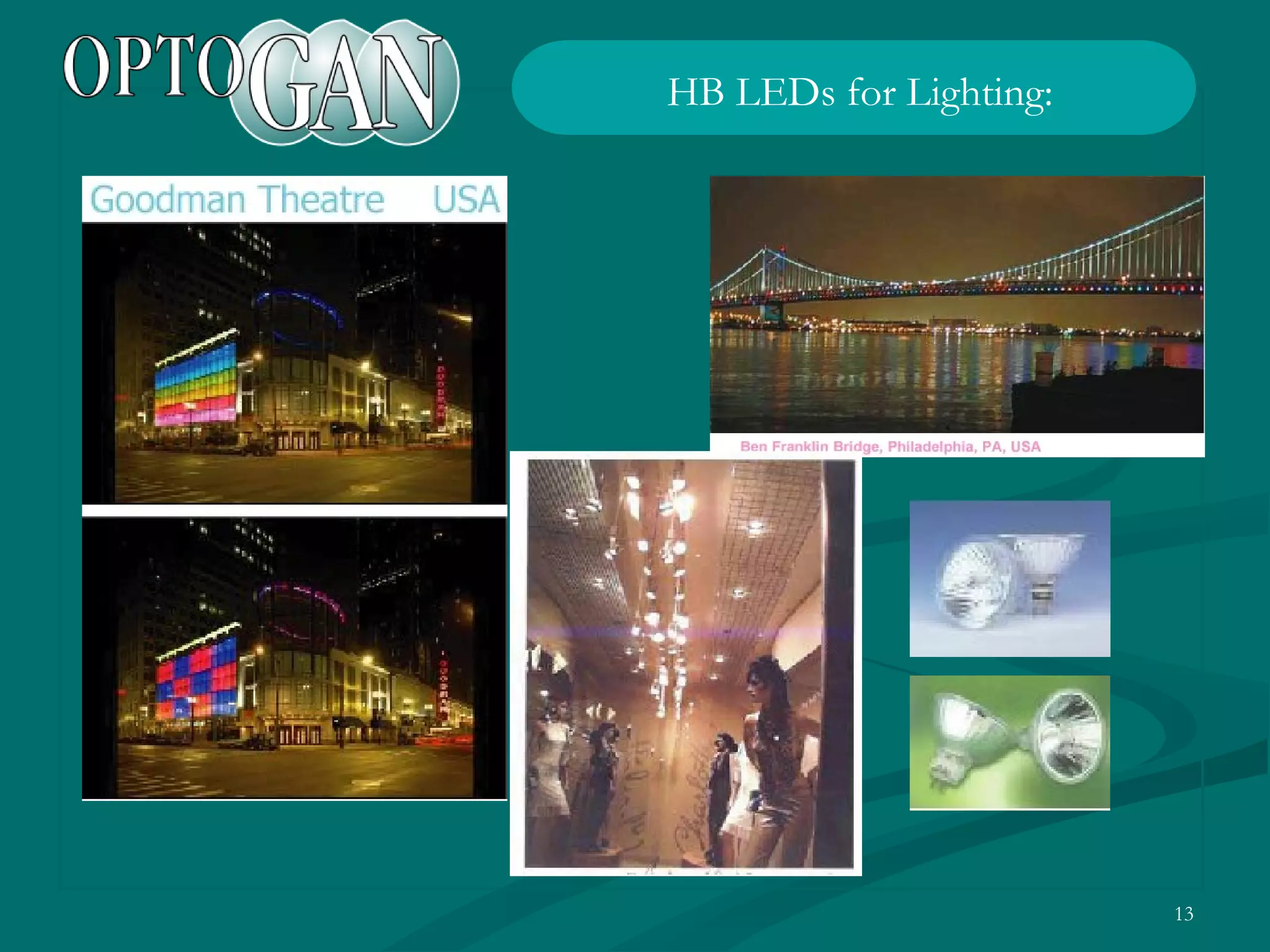
Apart from these, GaN LEDs target the general illumination market worth of $12 billion. The HB LEDs will compete with incandescent lamps by 2007 and majority of fluorescent lamps by 2012. LEDs offer the wide range of advantages:   high efficiency,  low power consumption  lower operating temperatures the non-use of mercury  extended lifetime (about 10 years) new design utilities   HB LEDs for Lighting :
Energy Savings: Development of GaN technology is accepted as a strategic direction in many countries including USA, Canada, Japan, and Germany. One of the reasons is the potential advantages that can be derived from LED-based lighting from the point of energy saving.  In United States, the financial support for the Next Generation Lighting Initiative (NGLI) has been included in a Senate Energy Bill, and this technology was declared as vital for National Security interests. The national project named ‘‘The Light for the 21st Century’’ has been also organized and funded by government in Japan. Energy savings in USA due to penetration of HB LEDs in everyday life: 2002 – 9.6 TWh per year (1TWh = 1,000,000,000 kWh) 2015 -  970 TWh per year – equivalent to ~ 100 large power plants
HB LEDs for Lighting :
Upon developing, GaN technology targets also new high volume markets: Violet Lasers for next generation DVD high density data storage systems    and high resolution printing/copying   High power and low noise transistors for radars, cellular networks,    satellite TV and communication, environment-monitoring systems;   Ultraviolet Light Emitting Diodes and detectors for displays UV lamps  spectro-fluorometry  high-resolution optics  counterfeit detection  chemical detection  UV air purifier photo-catalytic reactions medical applications Emerging applications :
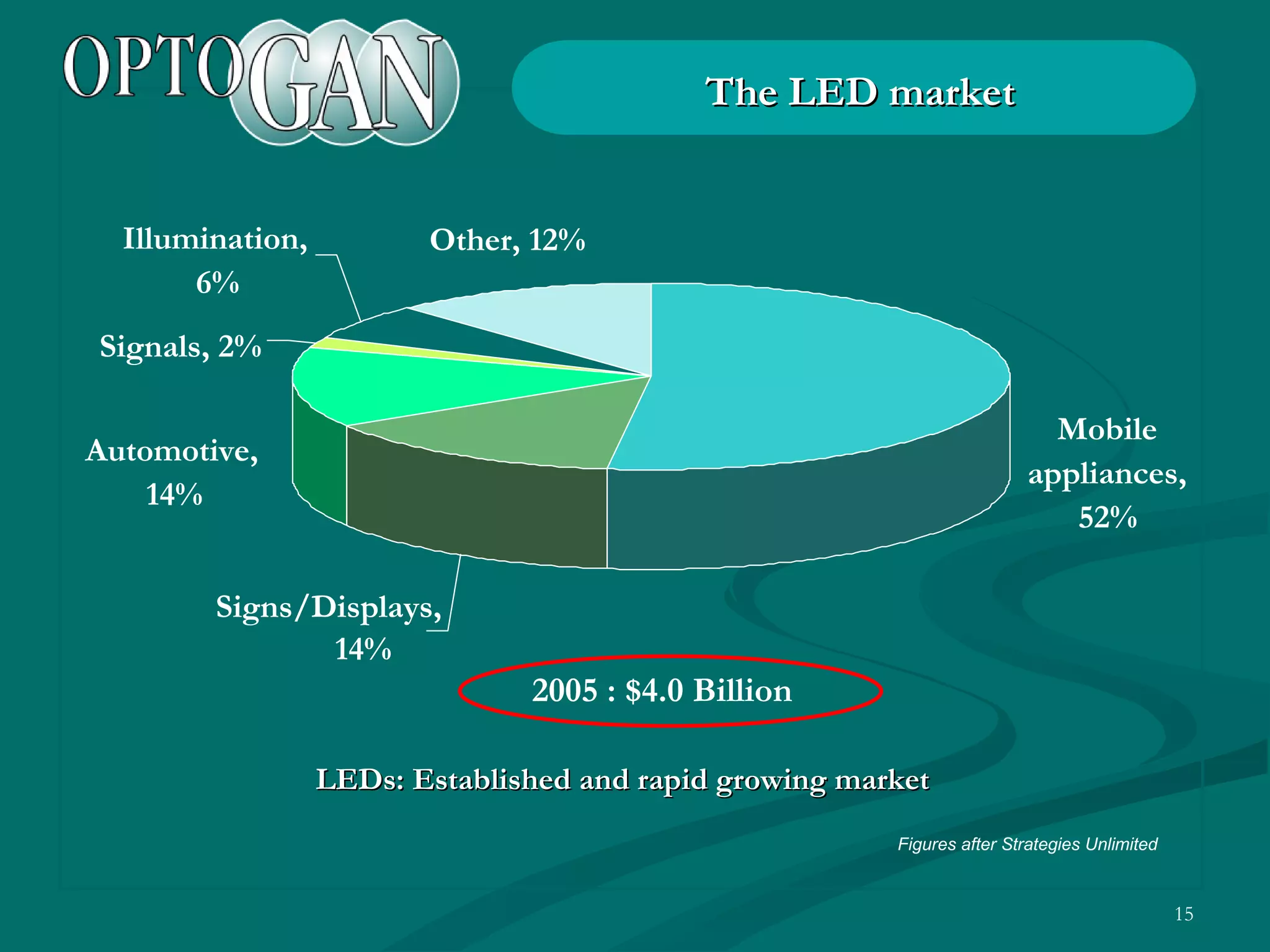
The LED market LEDs: Established and rapid growing market Figures after Strategies Unlimited 2005 : $4.0 Billion Automotive,  14% Mobile  appliances,  52% Signs/Display s, 14% Illumination,  6% Other, 12% Signals, 2%
Next driving products Market forecast: $8 billion by 2010 Figures after Strategies Unlimited Short-term driving product (2007-2008): 1. Backlights for large LCD displays and LCD monitors Technology target: at least 3-4 times less lumen cost (higher brightness and/or less cost) 2. Auto headlamps: growth forecast 8% in 2006, compared to 3.7% in 2004 Technology target: Reliability (temperature, humidity) is of major importance Long-term driving products: Lighting will reach $1 billion in 2010 Technology target: ~ 10 times less lumen cost (higher brightness and/or less cost)
LED problems
History Founders: Vladislav Bougrov Maxim Odnoblyudov 1996:  Graduated from St. Petersburg Electrical Engineering University (LETI) Optoelectronics Department at A.F. Ioffe Physico-Technical Institute 1998:  PhD in Physics from A.F.Ioffe Physico-Technical Institute Working for Cree EED, TDI Inc. 1999:  joint to European Research center (St. Petersburg and Bath (UK)) of    Arima Optoelectronics Corporation (Taiwan)   Development of industrial technology for GaN LEDs.
Founding OptoGaN OptoGaN was founded in 2004 as Finnish limited Company together with a group   of Finnish entrepreneurs claiming specialization in fund raising for technology start-   ups. Start up capital was 8,000 Euro. Basis for OptoGaN :  understanding of the problems limiting LED performance and existing of ideas how to overcome them Main questions during fund raising with VCs  (Критерии венчурных фондов) : -  Team  (Команда) -  Market  (Рынок) Requirements for proof of technology ( Подтверждение технологии ) Requirements for IP protection  (Патенты) Competitive advantage  (Преимущества перед конкурентами) Customers  (Потребители) Main problem for high-tech start-up:  expensive facilities are required for technology proof  (наличие дорогостоящего оборудования)
Standard way to set up a company for researchers: to do development at University basis  (разработка на базе университета) “+”: access to the facilities required, proof of basic technology, patents; “-”:  sharing of IP rights with University  (в Финляндии права      принадлежат изобретателю) ; to get funding and rent facilities from service providers  (аренда оборудования) “ +”: fabrication of IP clean product prototype; “ -”:  very costly; - to build own production line  (собственное производство)
OptoGaN’s approach Established contact with Helsinki University of Technology, which has necessary facility ( Установление контактов с Университетом Техн. ) Joint application to Finnish Technology Agency (TEKES) to finance industrial oriented research  (Получение финансирования совместного   проекта от ТЕКЕС) -  win-win situation: University gets substantial funding, Company access to facility  ( Университет получает финансирование,   Компания  –  доступ   к оборудованию ) -  proof of basic technology was achieved  (ОптоГаН получил   возможность   начального экспериментального подтверждения   базовых идей) Approach taken by OptoGaN (utilization of Finnish innovation system):
Role of business angels At early stage role of business angels is very important: “ -”:  risk is high, especially for VCs ( большой риск ) “ +”: possibility to get substantial ownership at low valuation   (возможность получить значительную долю в компании по   низкой стоимости) Professional assessment of technology potential and market value is extremely important ( Чрезвычайно важна профессиональная оценка потенциала и реализуемости технологии, а также ее возможное место на рынке )
Seed Funding OptoGaN was funded by VC with technologically skilled management (VNT Management). Investment was shared with TeSi (Finnish Industrial Technology Investment Fund)  –  governmental fund whose main task is to share risks with private investors .  Company also received substantial grant from TEKES. ОптоГаН получил финансирование от частного венчурного фонда, менеджмент которого имел значительный технический и индустриальный опыт. Со-инвесторам выступил Финский Индустриальный Технологический Фонд ( TeSi ) – государственная венчурная компания, задача которой разделять риски с частными инвесторами и содействовать развитию технологических компаний.   Компания также получила значительный грант от ТЕКЕСа (40-50% общих затрат).

OptoGan presentation LED Technology

  • 1.
    OptoGaN Enabling bulb-likebrightness for LEDs OptoGaN is a developer of product- and process technology for white HB-LEDs for applications that request LEDs with bulb-like brightness such as Illumination, Automotive and LCD-Backlighting
  • 2.
    Now Incorporated in2004, OptoGaN operates Research center in Helsinki, Finland: State-of-the-art cleanroom environment Research 3x2” MOCVD reactor Manual LED processing tools Set of characterization tools Pilotline in Dortmund, Germany: State-of-the-art cleanroom environment Volume 19x2” MOCVD reactor Full chip processing line Analytical lab
  • 3.
  • 4.
  • 5.
  • 6.
  • 7.
    Mission $12 billionillumination market by breakthrough in cost/performance ratio of LED lamps 100 lm LED 1 000 lm LED
  • 8.
    Progress and growthin the cell phone LED market have improved as the displays have changed from green to yellow and blue and to full colour. Use of colour screens is expected to grow to 75% by 2007. Historical colour backlight market shares (in millions of cell phone units) : 28/400 in 2000 the market share estimated to be 430/600 in 2006. Back lighting for cell phones and LCD :
  • 9.
    The LED advantagesare: improved safety power savings styling opportunities reduced dimensions multicolour interior lighting options system cost savings Annual market growth rates in this segment are expected to be in the 10 to 15% range. Interior and exterior automotive lighting:
  • 10.
    outdoor video signssports stadia advertising mono-colour terminal traffic signals indoors for arenas and racetracks other video displays exit signs Large signs and displays:
  • 11.
    Apart from these,GaN LEDs target the general illumination market worth of $12 billion. The HB LEDs will compete with incandescent lamps by 2007 and majority of fluorescent lamps by 2012. LEDs offer the wide range of advantages: high efficiency, low power consumption lower operating temperatures the non-use of mercury extended lifetime (about 10 years) new design utilities HB LEDs for Lighting :
  • 12.
    Energy Savings: Developmentof GaN technology is accepted as a strategic direction in many countries including USA, Canada, Japan, and Germany. One of the reasons is the potential advantages that can be derived from LED-based lighting from the point of energy saving. In United States, the financial support for the Next Generation Lighting Initiative (NGLI) has been included in a Senate Energy Bill, and this technology was declared as vital for National Security interests. The national project named ‘‘The Light for the 21st Century’’ has been also organized and funded by government in Japan. Energy savings in USA due to penetration of HB LEDs in everyday life: 2002 – 9.6 TWh per year (1TWh = 1,000,000,000 kWh) 2015 - 970 TWh per year – equivalent to ~ 100 large power plants
  • 13.
    HB LEDs forLighting :
  • 14.
    Upon developing, GaNtechnology targets also new high volume markets: Violet Lasers for next generation DVD high density data storage systems and high resolution printing/copying High power and low noise transistors for radars, cellular networks, satellite TV and communication, environment-monitoring systems; Ultraviolet Light Emitting Diodes and detectors for displays UV lamps spectro-fluorometry high-resolution optics counterfeit detection chemical detection UV air purifier photo-catalytic reactions medical applications Emerging applications :
  • 15.
    The LED marketLEDs: Established and rapid growing market Figures after Strategies Unlimited 2005 : $4.0 Billion Automotive, 14% Mobile appliances, 52% Signs/Display s, 14% Illumination, 6% Other, 12% Signals, 2%
  • 16.
    Next driving productsMarket forecast: $8 billion by 2010 Figures after Strategies Unlimited Short-term driving product (2007-2008): 1. Backlights for large LCD displays and LCD monitors Technology target: at least 3-4 times less lumen cost (higher brightness and/or less cost) 2. Auto headlamps: growth forecast 8% in 2006, compared to 3.7% in 2004 Technology target: Reliability (temperature, humidity) is of major importance Long-term driving products: Lighting will reach $1 billion in 2010 Technology target: ~ 10 times less lumen cost (higher brightness and/or less cost)
  • 17.
  • 18.
    History Founders: VladislavBougrov Maxim Odnoblyudov 1996: Graduated from St. Petersburg Electrical Engineering University (LETI) Optoelectronics Department at A.F. Ioffe Physico-Technical Institute 1998: PhD in Physics from A.F.Ioffe Physico-Technical Institute Working for Cree EED, TDI Inc. 1999: joint to European Research center (St. Petersburg and Bath (UK)) of Arima Optoelectronics Corporation (Taiwan) Development of industrial technology for GaN LEDs.
  • 19.
    Founding OptoGaN OptoGaNwas founded in 2004 as Finnish limited Company together with a group of Finnish entrepreneurs claiming specialization in fund raising for technology start- ups. Start up capital was 8,000 Euro. Basis for OptoGaN : understanding of the problems limiting LED performance and existing of ideas how to overcome them Main questions during fund raising with VCs (Критерии венчурных фондов) : - Team (Команда) - Market (Рынок) Requirements for proof of technology ( Подтверждение технологии ) Requirements for IP protection (Патенты) Competitive advantage (Преимущества перед конкурентами) Customers (Потребители) Main problem for high-tech start-up: expensive facilities are required for technology proof (наличие дорогостоящего оборудования)
  • 20.
    Standard way toset up a company for researchers: to do development at University basis (разработка на базе университета) “+”: access to the facilities required, proof of basic technology, patents; “-”: sharing of IP rights with University (в Финляндии права принадлежат изобретателю) ; to get funding and rent facilities from service providers (аренда оборудования) “ +”: fabrication of IP clean product prototype; “ -”: very costly; - to build own production line (собственное производство)
  • 21.
    OptoGaN’s approach Establishedcontact with Helsinki University of Technology, which has necessary facility ( Установление контактов с Университетом Техн. ) Joint application to Finnish Technology Agency (TEKES) to finance industrial oriented research (Получение финансирования совместного проекта от ТЕКЕС) - win-win situation: University gets substantial funding, Company access to facility ( Университет получает финансирование, Компания – доступ к оборудованию ) - proof of basic technology was achieved (ОптоГаН получил возможность начального экспериментального подтверждения базовых идей) Approach taken by OptoGaN (utilization of Finnish innovation system):
  • 22.
    Role of businessangels At early stage role of business angels is very important: “ -”: risk is high, especially for VCs ( большой риск ) “ +”: possibility to get substantial ownership at low valuation (возможность получить значительную долю в компании по низкой стоимости) Professional assessment of technology potential and market value is extremely important ( Чрезвычайно важна профессиональная оценка потенциала и реализуемости технологии, а также ее возможное место на рынке )
  • 23.
    Seed Funding OptoGaNwas funded by VC with technologically skilled management (VNT Management). Investment was shared with TeSi (Finnish Industrial Technology Investment Fund) – governmental fund whose main task is to share risks with private investors . Company also received substantial grant from TEKES. ОптоГаН получил финансирование от частного венчурного фонда, менеджмент которого имел значительный технический и индустриальный опыт. Со-инвесторам выступил Финский Индустриальный Технологический Фонд ( TeSi ) – государственная венчурная компания, задача которой разделять риски с частными инвесторами и содействовать развитию технологических компаний. Компания также получила значительный грант от ТЕКЕСа (40-50% общих затрат).