National Aeronautics and Space Administration
Commercial Crew Program
Status Update
Jan. 9, 2013
2
Program Status Update
Provide update on Commercial Crew Program Progress
Partnership Accomplishments and Plans 2012-2013
• Blue Origin
• The Boeing Company
• Sierra Nevada Corp. (SNC) Space Systems
• Space Exploration Technologies (SpaceX)
Initiation of the CCP Certification Products Contracts
Planning for the final development and certification effort
National Aeronautics and Space Administration
Commercial Crew Program
A Multifaceted Partnership
Jan. 9, 2013
Philip McAlister
NASA Headquarters
Overview
• The goal of the Commercial Crew
Program is to facilitate the
development of a U.S. commercial
crew space transportation capability
with the goal of achieving safe,
reliable and cost-effective access to
and from low-Earth orbit and the
International Space Station.
4
The Gherkin, London. Credit: Ed Trayes Photo Archive at Temple University; www.edtrayes.com
• In order to accomplish this goal, NASA has created a multifaceted
partnership between the government and industry, featuring:
1. Financial Investments
2. Milestones and Quarterly Reviews
3. NASA Partner Integration Teams
4. Technical Interchange Meetings
5. Reimbursable Space Act Agreements
6. Data Sharing
7. Requirements Application
Financial Investments To Date
• Commercial Crew Development Round 1 (CCDev1) – $50M total
– Partners (5): Blue Origin, Boeing, Paragon, SNC, ULA
– Scope: Crew Transportation System Technologies and Concepts
• Commercial Crew Development Round 2 (CCDev2) – $315M total
– Partners (4): Blue Origin, Boeing, SNC, SpaceX
– Scope: Elements of a Crew Transportation System
• Commercial Crew Integrated Capability (CCiCap) – $1.1B total
– Partners (3): Boeing, SNC, SpaceX
– Scope: Integrated Crew Transportation Systems
• Certification Products Contract (CPC) – $29.6M total
– Partners (3): Boeing, SNC, SpaceX
– Scope: Early Certification Products
5
Milestones and Quarterly Reviews
• Milestones are the formal items
associated with the Space Act
Agreements that allow NASA to
assess partner progress and
accomplishment of the milestone
entrance and exit criteria.
• Payments are made only after
partner demonstrates that the
milestone criteria have been
successfully met.
6
• Quarterly Reviews cover technical progress made; milestone
expectations for upcoming quarter; current risk assessment; any
life cycle cost changes; plans forward; and any difficulties
encountered and the corrective actions necessary to recover.
CCP Milestone and Quarterly Review Schedule
NASA Partner Integration Teams
• NASA’s Partner
Integration Teams consist
of technical experts in a
variety of subject matters
from across the agency.
• These technical experts:
– Assist in milestone evaluation
– Provide industry partners with
human spaceflight technical
expertise and experience
– Provide NASA with a
working-level understanding
of industry’s designs
7
Partner Manager
Deputy PM (x2)
Technical Integrators
Engineering*
Health and Medical
Safety and Mission
Assurance
Mission Operations
Ground Systems
Launch Services
Crew Office
Office of Primary
Responsibility
Spacecraft
Launch Vehicle
Mission Planning and
Integration
Launch and
Recovery Systems
Systems Engineering
and Requirements
ISS
Engineering*
Fluids
Propulsion
Flight Mechanics
Avionics and Electrical
Flight Software
Entry, Descent and Landing
Test and Verification
Structures
Mechanical Systems
Technical Interchange Meetings
• Technical Interchange Meetings
(TIMs) are informal forums where
NASA and industry experts meet to
discuss detailed topics in a
collaborative fashion where a free
exchange of ideas is encouraged.
• TIMs allow quick identification and
resolution of technical issues at an
engineer-to-engineer level.
8
• NASA and its commercial crew industry partners have conducted
dozens of TIMs. Example topics include:
– Propulsion
– Launch vehicle structures
– Docking systems
– Thermal protection systems
Reimbursable Space Act Agreements (RSAAs)
CCP Sponsored
9
• RSAAs permit partners to use underutilized NASA facilities, personnel or
equipment. NASA’s costs are reimbursed by the partner.
• NASA undertakes reimbursable SAAs when it has unique goods, services or
facilities that can be made available to another party in a manner which does not
interfere with NASA mission requirements.
Ames
SNC (2)
Boeing (1)
SpaceX (2)
Blue Origin (1)
JPL
Dryden
SNC (2)
JSC
Boeing (4)
Boeing (1 WSTF)
SNC (1)
SpaceX (2 WSTF)
SSC
Blue Origin (1)
MSFC
SpaceX (1) KSC
SpaceX (1)
SNC (1)
GSFC
HQ
LaRC
Boeing (1)
SNC (4)
SpaceX (2)
GRC
SNC (1)
Note: The data on this chart
shows current RSAAs for the
four CCP partners, as of
November 2012.
28 RSAAs total.
Data Sharing
• Another way NASA transfers
knowledge is through the
distribution of current and
historical technical products.
• To date, NASA has received
nearly 1,000 requests for
NASA products from its
commercial crew partners,
including documents,
drawings, test plans and test
results.
10
• NASA’s partners can leverage these data products to accelerate
their crew transportation system development efforts and to avoid
“reinventing the wheel.”
Breakdown of Partner Data Requests by Program
Requirements Application
• With the recently awarded
Certification Products
Contracts, NASA has a
mechanism to engage industry
in the application of key safety
and performance requirements
associated with the ISS crew
transportation mission.
11
• The Certification Products Contracts will 1) reduce the uncertainty
associated with interpretation of NASA’s certification requirements,
2) reduce the risk of accepting technical/safety risk later in
development and 3) reduce the risk of potential schedule delays
and/or cost increases.
NASA and Industry Partner Roles in Certification
NASA
Grants
Certification
Partner asserts
its system
meets NASA’s
safety and
technical
requirements
NASA validates
the Partner’s
Assertion of
Certification
12
Deep Space
Exploration
Low-Earth Orbit and ISS
Research & Development
NASA’s Complementary Strategy
BLUE ORIGIN
Blue Origin
NASA Commercial Crew Program
Kennedy Space Center
Jan. 9, 2013
Rob Meyerson
President and Program Manager
Blue Origin LLC
13
BLUE ORIGIN
Blue Origin Overview
• Blue Origin has a long-term vision of increasing
the number of people who can fly to space
• Founded in 2000 by Jeff Bezos, founder and
CEO of Amazon.com
• Blue is focused on developing vehicles and
technologies to lower the cost and increase the
safety of human spaceflight
• Blue’s incremental development plan includes:
– Reusable systems to increase reliability and
lower operating costs
– Vertical landing for recovery and reuse
– Beginning with suborbital systems that prove out
technologies for orbital flight
• Significant private investment to date:
– Design and development
– Engine testing
– Vehicle manufacturing
– Flight testing
14
Design, Development and Assembly Facility (Kent, WA)
West Texas Launch Site (Van Horn, TX)
BLUE ORIGIN
Incremental Development
• Suborbital program in flight testing stage
– Goddard subscale demonstrator flown 2006-2007
– New Shepard system in development
• Propulsion Module
– 2011 testing demonstrated boost, landing and flight to
45,000 feet/Mach 1.2
– Development of next vehicle underway
• Crew Capsule – successful pad escape test October 2012
• Orbital Transportation System
– Reusable orbital Space Vehicle (SV)
• Transport to LEO or ISS for up to seven people
• ~22,000 lbm with crew at launch
– Two-stage Orbital Launch Vehicle (OLV)
• Expendable upper stage
• Reusable first stage
15
Reusable
First
Stage
Expendable
Upper
Stage
Space
Vehicle
Orbital
Transportation
System
2006 2011 2012 Suborbital
New Shepard
System
Crew
Capsule
Propulsion
Module
BLUE ORIGIN
Commercial Crew Development (CCDev)
• CCDev1 ($3.7M)
– Composite Pressure Vessel Testing
– Pusher Escape Development
• CCDev2 ($22.0M)
– Space Vehicle Design Maturation Project
– Pusher Escape Risk Reduction Project
– RBS Engine Risk Reduction Project
16
Composite Pressure Vessel Assembly
Thrust Vector Control Testing
Hydrogen Engine Testing at NASA Stennis
Pad Escape Test
Space Vehicle Design Maturation
BLUE ORIGIN
BE-3 Engine Risk Reduction Testing
• BE-3 Liquid Oxygen, Liquid Hydrogen (LOX/LH2) Engine
– 100,000-lbf thrust
– Deep throttle
– Restartable
– Reusable
• Thrust Chamber Assembly (TCA) Testing in 2012
– At NASA Stennis Space Center’s E-1 Complex
– Multiple tests over full throttle range
– Accelerated BE-3 development by more than a year
• LOX and LH2 Turbopump Testing in 2012
– At Blue’s West Texas test facility
• Full Engine Testing is underway
– At Blue’s West Texas test facility
• In-house Development
– Analysis
– Design
– Fabrication
– Component testing
– Engine testing
17
BE-3 Hydrogen Thrust Chamber Testing
at NASA Stennis Space Center
BLUE ORIGIN
Crew Capsule Pad Escape Test
• Integrated end-to-end test of Crew Capsule Escape System
– Escape motor firing
– Thrust vector control
– Guidance and control
– Parachute deployment
– Landing
– Recovery
• Fully successful test conducted Oct. 19, 2012, at Blue’s West Texas Launch Site
– Co-funded by NASA under CCDev2 initiative
– Only powered flight test under CCDev2
NASA CCP - 2013-01-09 18
Pusher Escape Motor Firing Descent Under Parachutes Landing and Recovery
BLUE ORIGIN
Points of Contact
Media inquiries:
Griffin Communications Group
281-335-0200 phone
media@blueorigin.com
Business inquiries:
Bretton Alexander
Director, Business Development & Strategy
703-627-1692 cell & office
balexander@blueorigin.com
www.blueorigin.com
19
Boeing 2012 CCTS Progress and 2013 Plan
January 2013
Structures & Mechanisms Testing
 CM Pressurized Structure Producibility & Material Properties
Testing for Lighter Weight Alloy (Al 7475)
 BMI Composite Material Property Development
 CM/SM Umbilical Pyrotechnic Guillotine Cutter Test
 MMOD Hypervelocity Impact Testing
Landing System Testing
 Airbag Drop Testing
 Rotation Handle Testing
 Parachute Drop Testing
 Inflation System Development
 FHS Separation Testing
Propulsion Systems Testing
 Launch Abort Engine Hot Fire Tests
 SM Propulsion Tank Tests
 Orbital Maneuvering and Attitude Control Engine
Hot Fire Test
 SM Propulsion Cold Flow Test
 SM Propulsion Helium Pressurization Flow Test
Wind Tunnel Testing
 Launch Abort Wind Tunnel Testing at
NASA Ames Research Center
CCTS Design Maturation
Under CCDev2
21
CCTS Design Maturation
Under CCDev2
Avionics Testing
 Launch Vehicle EDS Testing with
CST-100 Avionics
 ASIF/VENUS Closed-Loop Ascent/Rendezvous
Flight Simulation
 ASIL Deployment
Production and Ground Systems
Development
 AI&T Site Selection (refurbished KSC OPF3)
 DELMIA Design for Manufacture and
Assembly Assessments
Crew and Cargo Systems
Development
 Crew Ingress/Egress Assessment
 Cargo Capability Assessment
 Crew Reach Assessment
 Crew Control Panels Layout Development
 Crew Seat Prototype Development
22
23
CCiCap Base Period
Major Milestones 2013-2014
CCTS Design Maturation
Under CCiCap
August through December 2012
Integrated System Review
 Established and demonstrated CCTS Vehicle and operations that
meet system requirements
Production Design Review
 Established the baseline plan, equipment and infrastructure for
performing the manufacture, assembly and acceptance testing of
the CST-100
 Leveraged successful and extensive Boeing commercial
production practices
Phase 1 Safety Review Board
 Conducted a comprehensive safety review to access conformance
with NASA’s Crew Transportation System certification process
 Focused on hazard reports, cause descriptions and controls
 CST-100 Interior Layout Evaluation
 Completed three-day evaluation with NASA astronauts on reach
and visibility of controls/displays
 Received feedback on the design of the crew seats, interior
lighting and optimum layout for Crew Resource Management
24
CCTS Design Maturation
Under CCiCap 2013 Milestones
25
Boeing’s CCTS 2013 Plan
 Continue system design maturation – multiple demonstrations
 CST-100, Atlas V integration and Launch Pad modifications
 Mission Control demonstrations
 Continued development of the ULA Dual Engine Centaur
 Launch Vehicle Adapter CDR
 Continued development of KSC OPF-3
Sierra Nevada Corporation
Jan. 9, 2013
Kennedy Space Center
Dream Chaser Space System
2012 highlights include:
Completed 10 Major Milestones
Engineering Test Article Structure Delivery
Separation System Test
Main Landing Gear Drop Test 
Captive Carry Flight Test Readiness Review
Captive Carry Interface Test
Captive Carry Flight Test
Preliminary Design Review
Nose Landing Gear Test
CCiCap Program Implementation Plan Review
Integrated System Baseline Review
Completed ECLSS Human in the Loop testing
Completed wind tunnel testing at NASA Langley’s Research Center, 
Marshall Space Flight Center, and Texas A&M University
Completed Preliminary Design 
Awarded CCiCap contract in August
Held career fairs in Colorado, Texas and Florida 
Awarded Certification Products Contract (CPC) in December
Conducted multiple STEM outreach, education activities and speaking 
opportunities including participating the space shuttle Atlantis’ retirement 
event
Added more than 40 new employees to the Dream Chaser Team
2012 Dream Chaser Highlights
To date, SNC has completed a total of 20 milestones under NASA’s Commercial Crew Program.
28
Wind Tunnel Testing
Slow Speed Wind Tunnel Test
Integrated 
Stack 
Wind 
Tunnel 
Test
Integrated Stack Wind Tunnel Test
29
ETA Assembly
The Engineering Test Article (ETA) was assembled and tested in Colorado
30
ETA Structure Complete
The Engineering Test Article completed a captive‐carry test in May 2012
Test conducted in Colorado
31
ETA Captive‐Carry Test
Captive‐carry completed in 
preparation for the upcoming 
2013 free‐flight test
32
Other 2012 Highlights
ECLSS Subsystem Testing
Landing 
Gear 
Testing
Dream Chaser Docking to ISS simulator
Buffet Test Model
33
Thank you, 
Space Shuttle Atlantis!
34
2013 Dream Chaser Growth
In early 2013, SNC will expand its operations with the opening of a new facilities for personnel 
and additional manufacturing space for the Dream Chaser Space System
New design, engineering  and assembly building
Adding  50 to 100 new staff to the Dream Chaser Team
SNC will continue to grow partnerships with industry leaders to advance the Dream 
Chaser Space System. SNC currently is teamed with: 
Seven NASA Centers
Multiple universities
Multiple world‐class industry partners
35
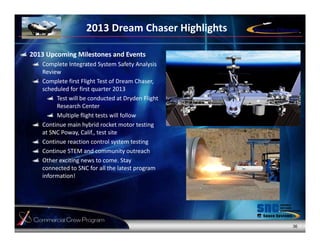
2013 Upcoming Milestones and Events
Complete Integrated System Safety Analysis 
Review 
Complete first Flight Test of Dream Chaser, 
scheduled for first quarter 2013
Test will be conducted at Dryden Flight 
Research Center
Multiple flight tests will follow
Continue main hybrid rocket motor testing 
at SNC Poway, Calif., test site
Continue reaction control system testing 
Continue STEM and community outreach
Other exciting news to come. Stay 
connected to SNC for all the latest program 
information!
2013 Dream Chaser Highlights
36
Sierra Nevada Corporation
www.SNCspace.com | www.facebook.com/SNCspacesystems | www.youtube.com/SNCspacesystems
Commercial
Crew
Program
Update
CCDev2
SpaceX was founded to advance the cause of human spaceflightSpaceX was founded to advance the cause of human spaceflight
39
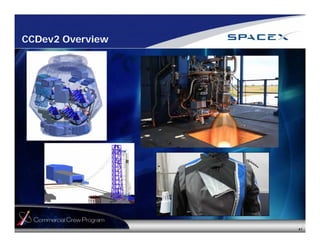
Summary of Work Completed During
CCDev2
 Launch Abort System Design, Development and Test
 SuperDraco Engine (Demonstration Engine and Development Engine)
 SuperDraco Test Stand
 Propellant Tank
 System Components
 Crew Systems Initial Design and Development
 Structures including seats and cabin layout
 Environmental Control and Life Support
 Spacesuits
 Launch Pad Modifications
 Mission Operations and Recovery
 Crew Displays and Controls
 Concept of Operations
 Abort and Other Analyses
 Guidance, Navigation and Control
 Aerodynamics
 Environments
 Safety and Mission Assurance
 Human Certification Plan
 Technical Budgets and Key Performance Parameters
 Requirements Compliance
 Crew Trials
Final CCDev2
Milestone
Completed in
June 2012
40
CCDev2 Overview
 Page 41
41
CCiCap
 In the CCiCap base period, SpaceX will focus on these
four tasks:
1. Complete the integrated design
2. Hardware testing to reduce risk
3. Ensure crew safety
4. Prepare for NASA certification
42
Base Period Milestones
43
SpaceX’s plan culminates in a flight to the ISS with non-NASA crew in 2015SpaceX’s plan culminates in a flight to the ISS with non-NASA crew in 2015
CCiCap Milestones
Completed in 2012
1. CCiCap Technical Baseline Review – Aug. 29
2. Financial and Business Review – Aug. 30
3. Integrated System Requirements Review – Oct. 29
4. Ground Systems & Ascent Preliminary Design Review – Dec. 13
44
CCiCap Milestones
Planned for 2013
 Pad Abort Test Review – March
 Delivery of detailed Pad Abort Test Plan
 Human Certification Plan Review – May
 Delivery of Human Certification Plan
 Delivery of Master Verification Plan
 On-Orbit and Entry Preliminary Design Review – July
 Preliminary design of automatic approach and docking systems
 Preliminary design of entry, descent and landing systems
 In-Flight Abort Test Review – September
 Delivery of detailed In-Flight Abort Test Plan
 Safety Review - October
 Hazard Analysis
 Probabilistic Safety Assessment
 Failure Modes and Effects Analysis
 Flight Review of Upgraded Falcon 9 - November
 Pad Abort Test - December
45
CCiCap Milestones
Planned for 2014
 Dragon Primary Structure Qualification – January
 Integrated Critical Design Review – March
 Final Design Presented prior to manufacturing orbital test vehicle
 In-Flight Abort Test – April
46
National Aeronautics and Space Administration
Commercial Crew Program
Status Update
Ed Mango
Jan. 9, 2013
Commercial Crew Program Life Cycle
48
FY13 FY14 FY15 FY16 FY17FY12 FY18
Certification Contract
49
Acquisition Strategy (2012)
RFP Certification Products Contract
RFP
Certification to
include at least
one crewed ISS
mission
ISS Services Contract …
Certification for ISS Crew Transportation
RFP
Phase 1 Phase 2
Alignment with NASA
certification requirements
AFP Integrated Capability SAA (iCap)
ISS Crew Transportation Services
Verification, validation, test and
final certification
Optional Milestones
Commercial Crew Transportation System Development
CCP Certification Products Contract
Certification Products Contract is a part of a phased acquisition
process to get NASA certified systems for the crewed ISS missions
Contract Objective - Begin early, critical certification work to meet
NASA Crew Transportation System (CTS) requirements
• Maturing key certification products in Phase 1 to enable both NASA and
industry readiness with level of maturity required for Phase 2
Three Contracts Awarded Dec. 10, 2012
• Boeing, SNC, SpaceX
• All fixed price, each valued at $10M or less
• Initial and final versions of four products required and associated technical
interchange
• Payment is 40% for initial products and 60% for final products
• Initial products in late spring 2013 and final products in spring 2014
50
Four Product Scope
– Alternate Standards
– Hazard Analyses/Reports
– Verification and Validation Plan
– Certification Plan
• Begin the process of ISS visiting vehicle integration
• No design/development work funded through CPC
Requirement Variance Process
• Both CCP and industry want to be as innovative and cost effective
as possible
• CCP encouraging industry partners to propose variances to
NASA’s technical requirements where an acceptable level of risk
is maintained and ISS mission objectives are satisfied
Phase 1 – Certification Products Contract (CPC)
51
52
Next Phase Planning Steps
 NASA Certification (Phase 2) will cover all aspects of final development and certification
of a crew transportation system, including design, manufacturing, testing, qualification,
production and operation
 NASA/CCP intends to engage industry to help evolve and finalize plans for Phase 2
• Request for Information (RFI) - Mid-January 2013
– Seeking industry input on contract type and structure, approach to ISS missions and
FAA licensing
• Industry touch point with more detail discussion - March 2013
• Draft Request for Proposal (RFP) - Summer of 2013
• RFP Release for Phase 2 - Early Fall 2013
 Contract Award - May 2014
Commercial Crew Program National Involvement
53
Legend:
Green—CCP Partner/subcontractor involvement
There are 73 aerospace
providers in 26 states working
to get American astronauts
back into space on U.S. led
spacecraft and rockets.
54
Questions?

NASA_CCO_status-2013 update