Maximize Your Solar Investment
by Adding Battery Energy Storage
Host: Tim Montague, M.S. Speaker: Travis Simpkins, PhD
Continental Electrical muGrid Analytics
www.cecco.com/solarwebinarOct 30, 2018
Solar Works for Illinois!
Free monthly solar & storage webinar brought to you by:
Maximize Your Solar Investment by
Adding Battery Energy Storage
October 30, 2018 Travis Simpkins, PhD
travis@mugrid.com
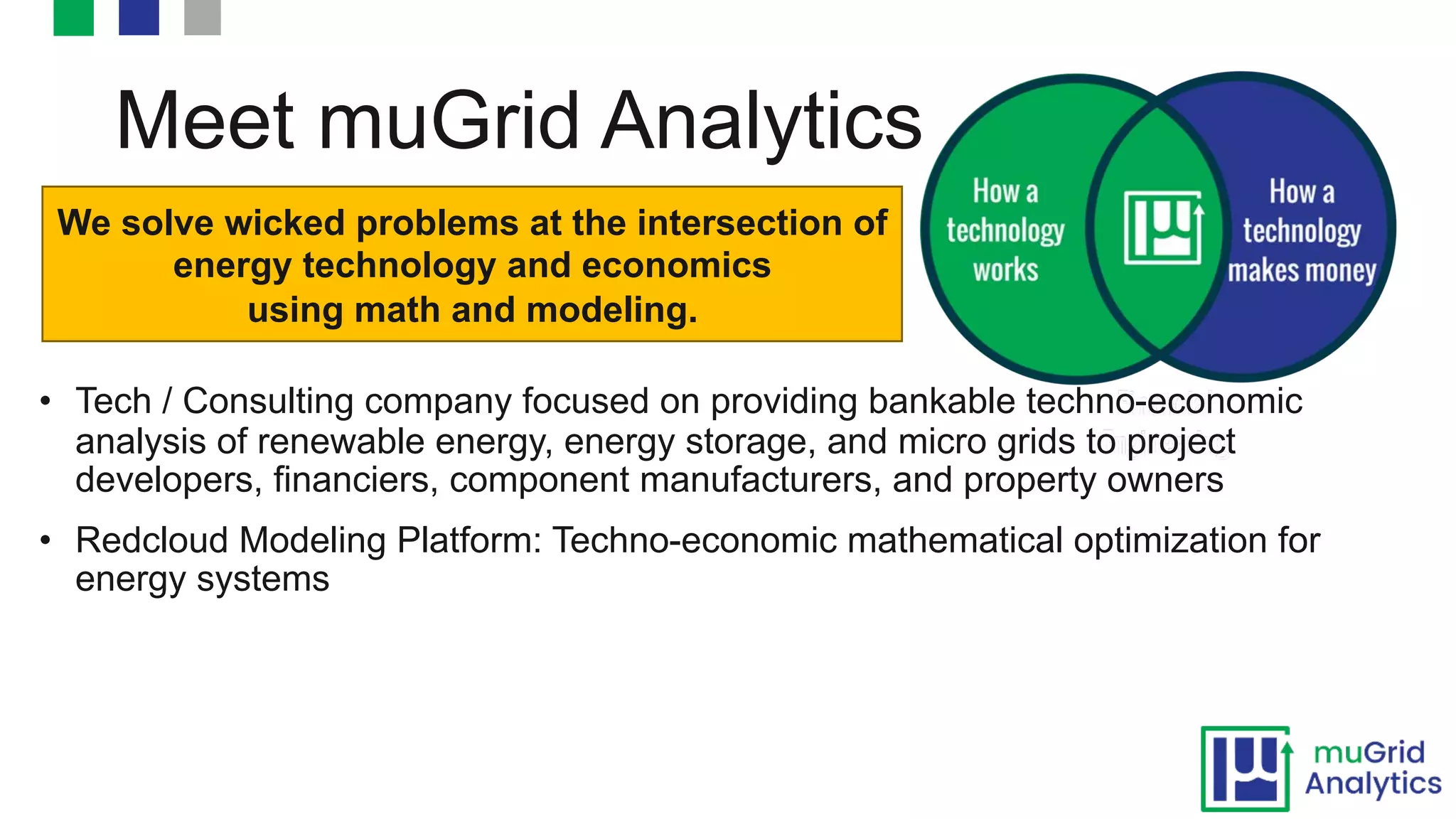
Meet muGrid Analytics
• Tech / Consulting company focused on providing bankable techno-economic
analysis of renewable energy, energy storage, and micro grids to project
developers, financiers, component manufacturers, and property owners
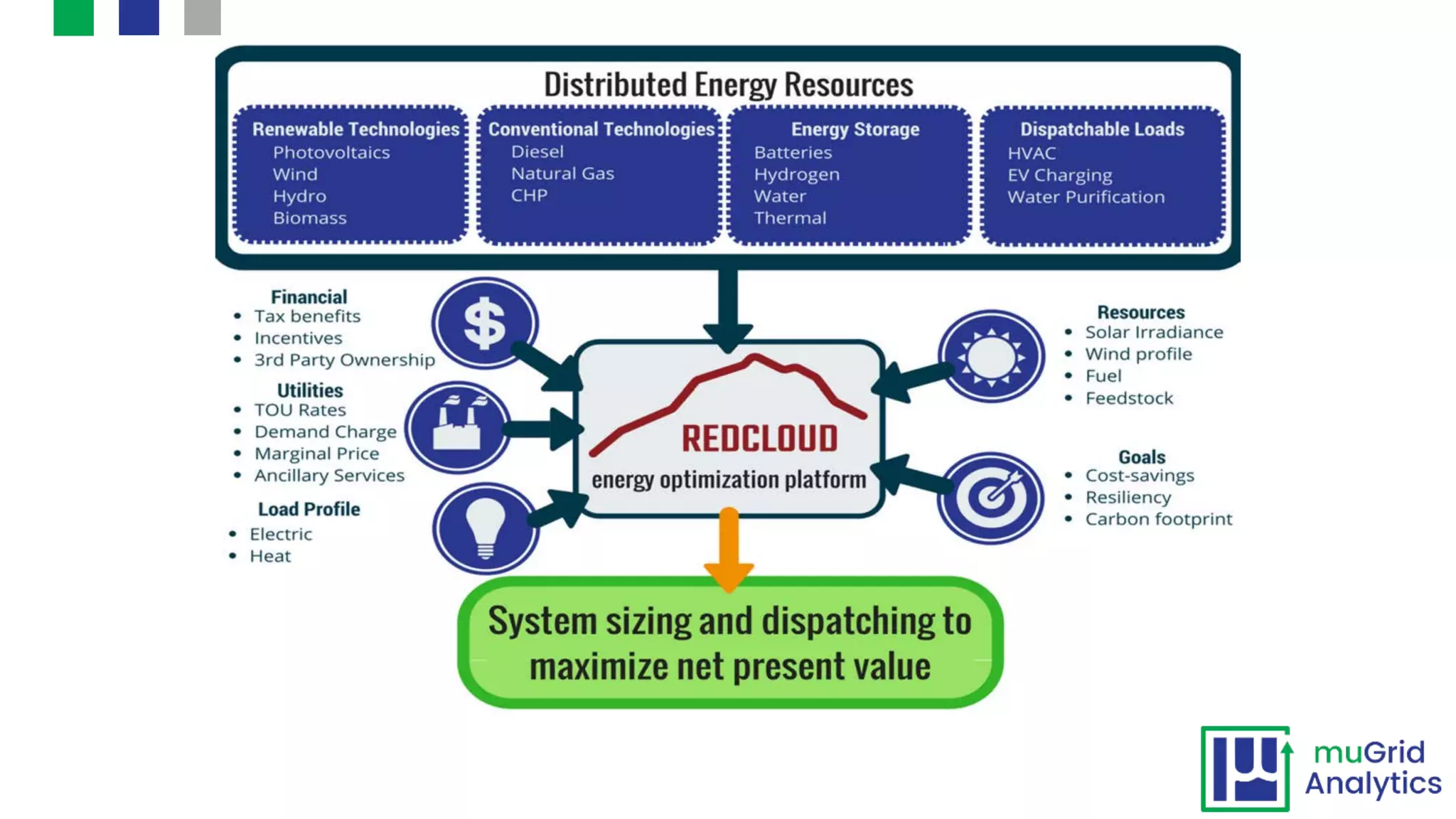
• Redcloud Modeling Platform: Techno-economic mathematical optimization for
energy systems
We solve wicked problems at the intersection of
energy technology and economics
using math and modeling.
Bottom Line Up Front
• Batteries can enhance the economics of a
solar project with multiple revenue streams
• Multiple revenue streams make optimal battery
dispatching a hard problem to solve
• The key to economic solar-plus-storage is
effective dispatching
Mindset shift: solar vs. storage
• Solar is straightforward
o Sun shines – electrons flow
• Batteries require decisions
o When to charge, discharge, idle
• How do we solve with that complexity?
Mathematical optimization
o Every time there was a decision to make, there was
something optimal that should have been done.
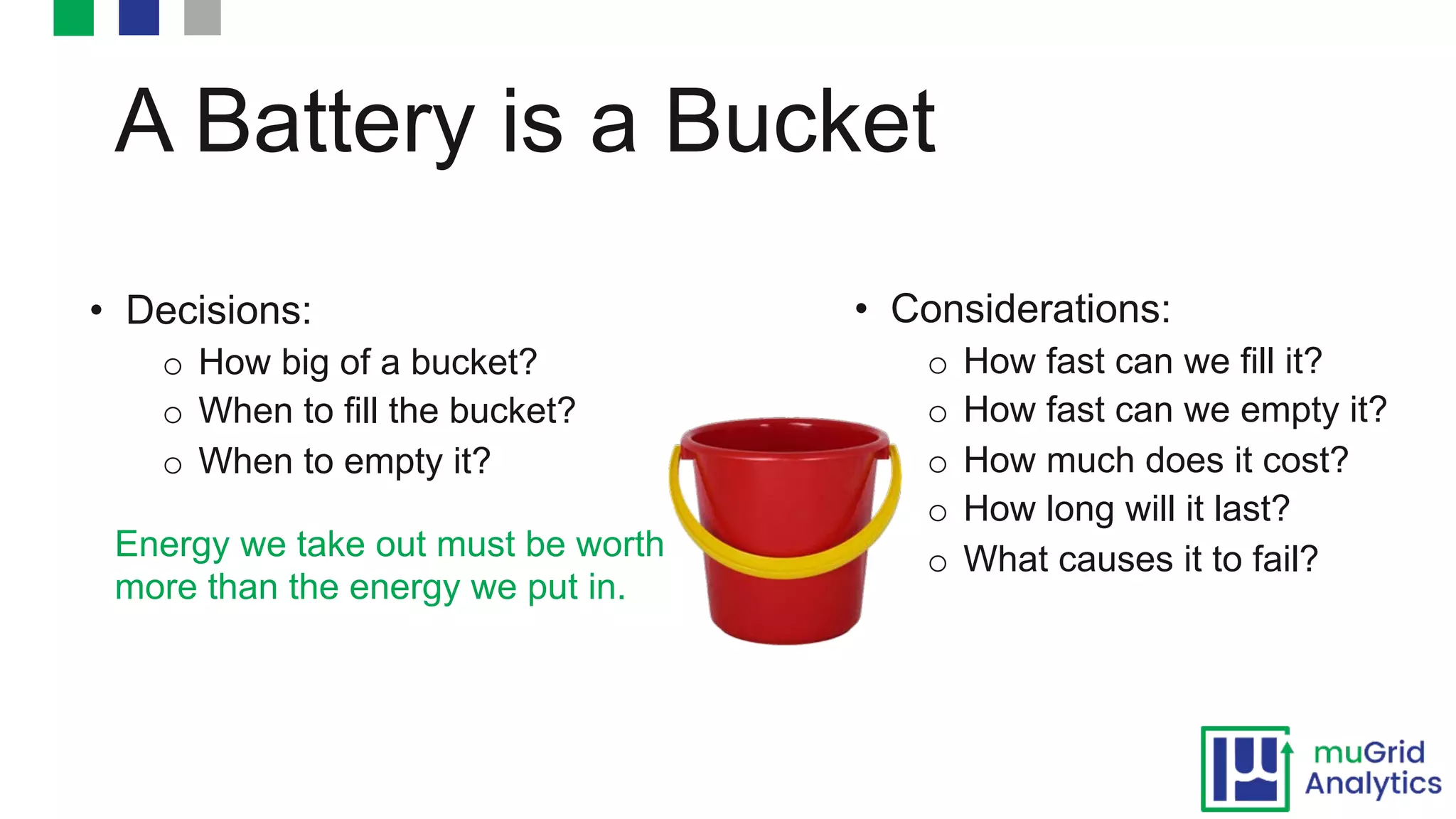
A Battery is a Bucket
• Considerations:
o How fast can we fill it?
o How fast can we empty it?
o How much does it cost?
o How long will it last?
o What causes it to fail?
• Decisions:
o How big of a bucket?
o When to fill the bucket?
o When to empty it?
Energy we take out must be worth
more than the energy we put in.
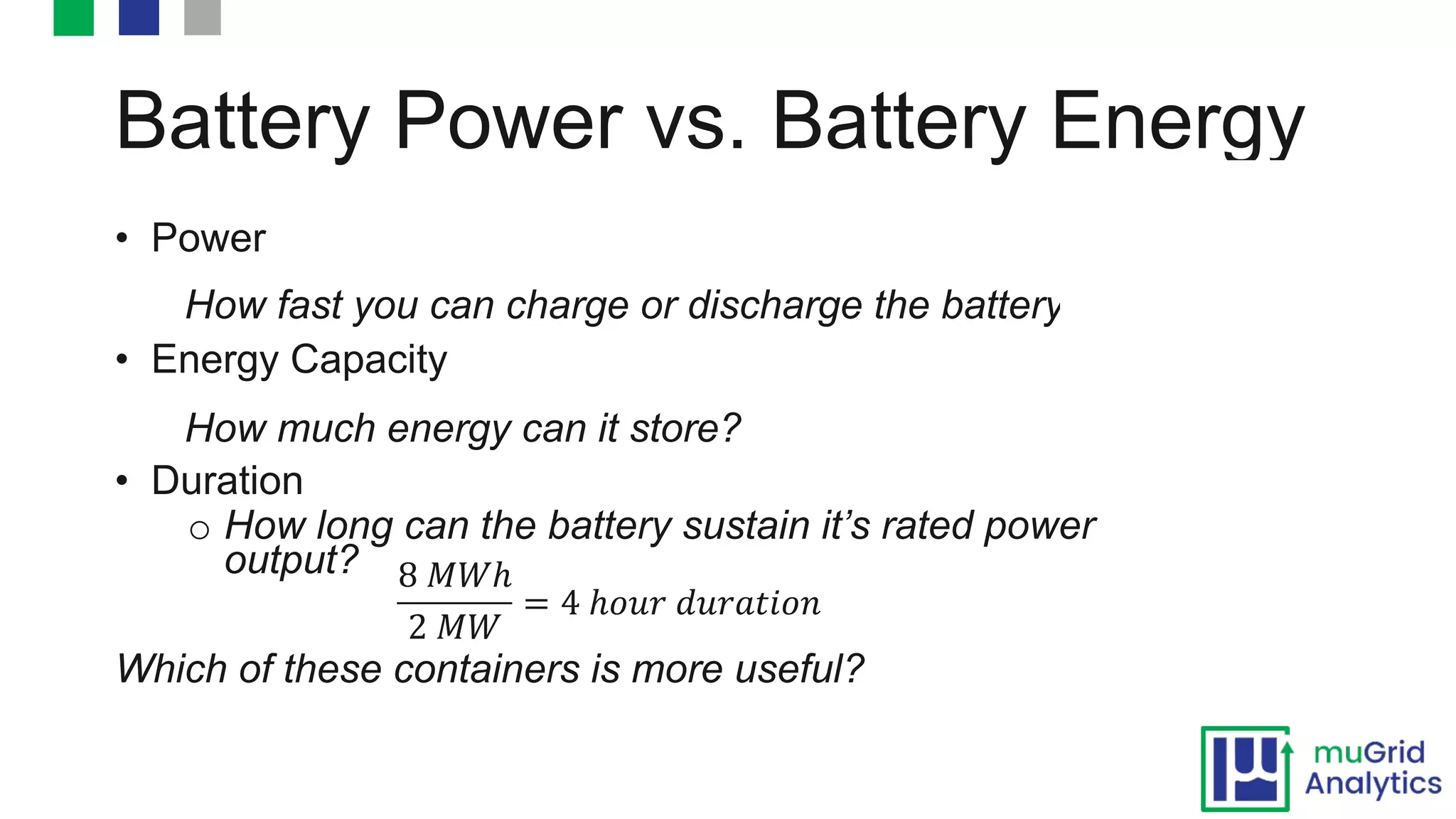
Battery Power vs. Battery Energy
• Power
How fast you can charge or discharge the battery?
• Energy Capacity
How much energy can it store?
• Duration
o How long can the battery sustain it’s rated power
output?
Which of these containers is more useful?
8 "#ℎ
2 "#
= 4 ℎ()* +)*,-.(/
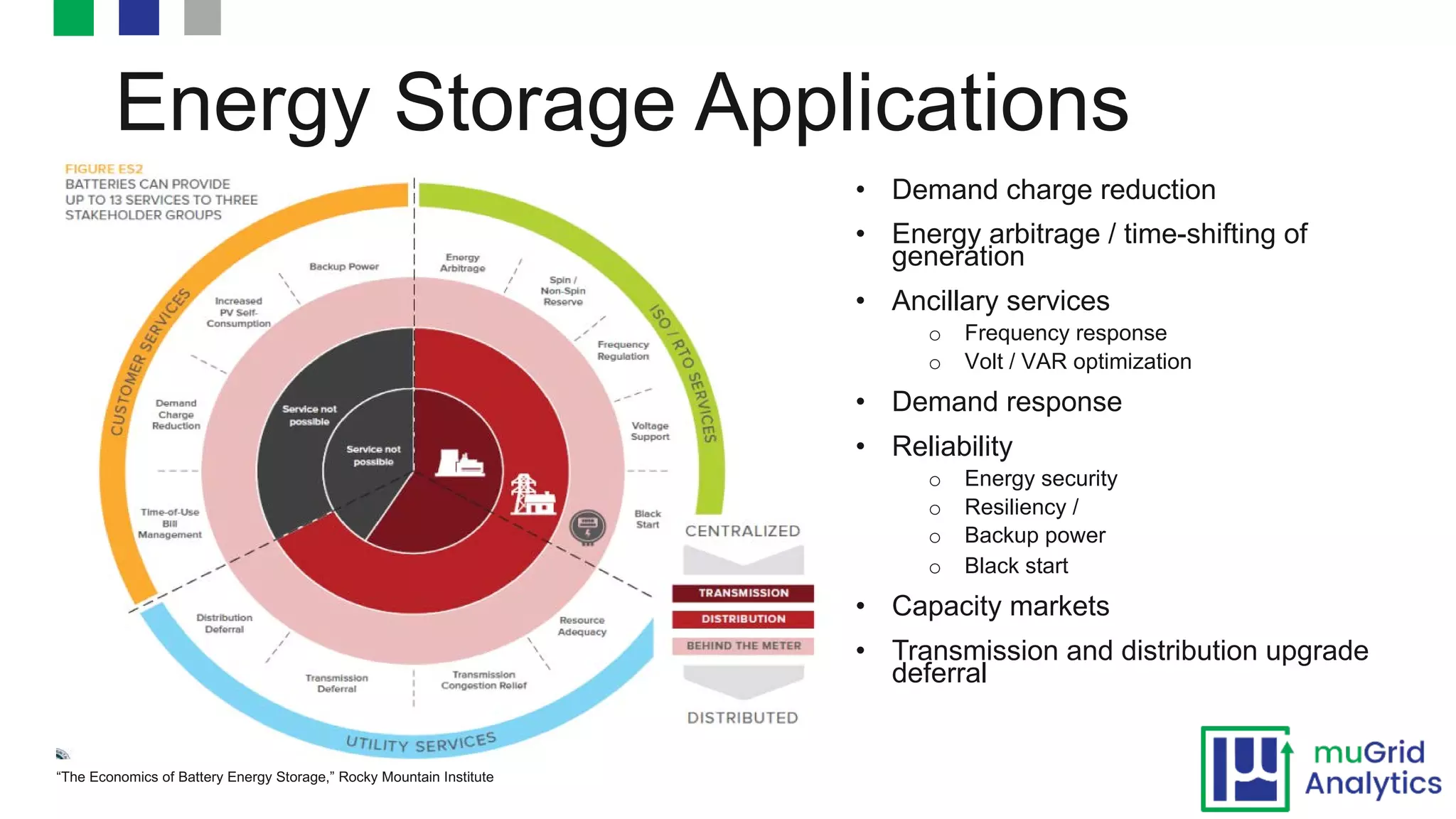
Energy Storage Applications
• Demand charge reduction
• Energy arbitrage / time-shifting of
generation
• Ancillary services
o Frequency response
o Volt / VAR optimization
• Demand response
• Reliability
o Energy security
o Resiliency /
o Backup power
o Black start
• Capacity markets
• Transmission and distribution upgrade
deferral
“The Economics of Battery Energy Storage,” Rocky Mountain Institute
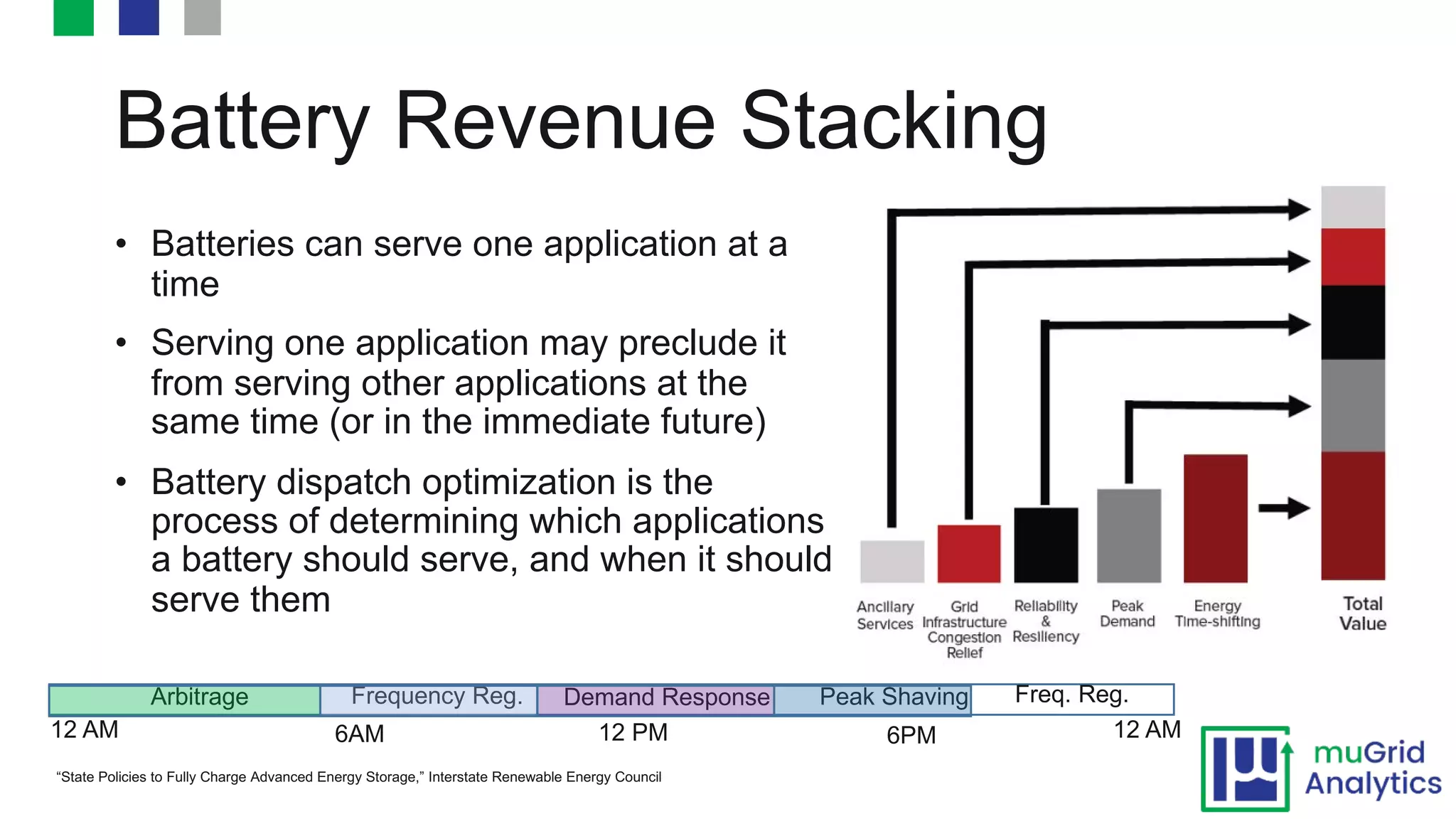
Battery Revenue Stacking
• Batteries can serve one application at a
time
• Serving one application may preclude it
from serving other applications at the
same time (or in the immediate future)
• Battery dispatch optimization is the
process of determining which applications
a battery should serve, and when it should
serve them
6PM6AM12 AM 12 PM
Arbitrage Peak ShavingFrequency Reg.
12 AM
Freq. Reg.Demand Response
“State Policies to Fully Charge Advanced Energy Storage,” Interstate Renewable Energy Council
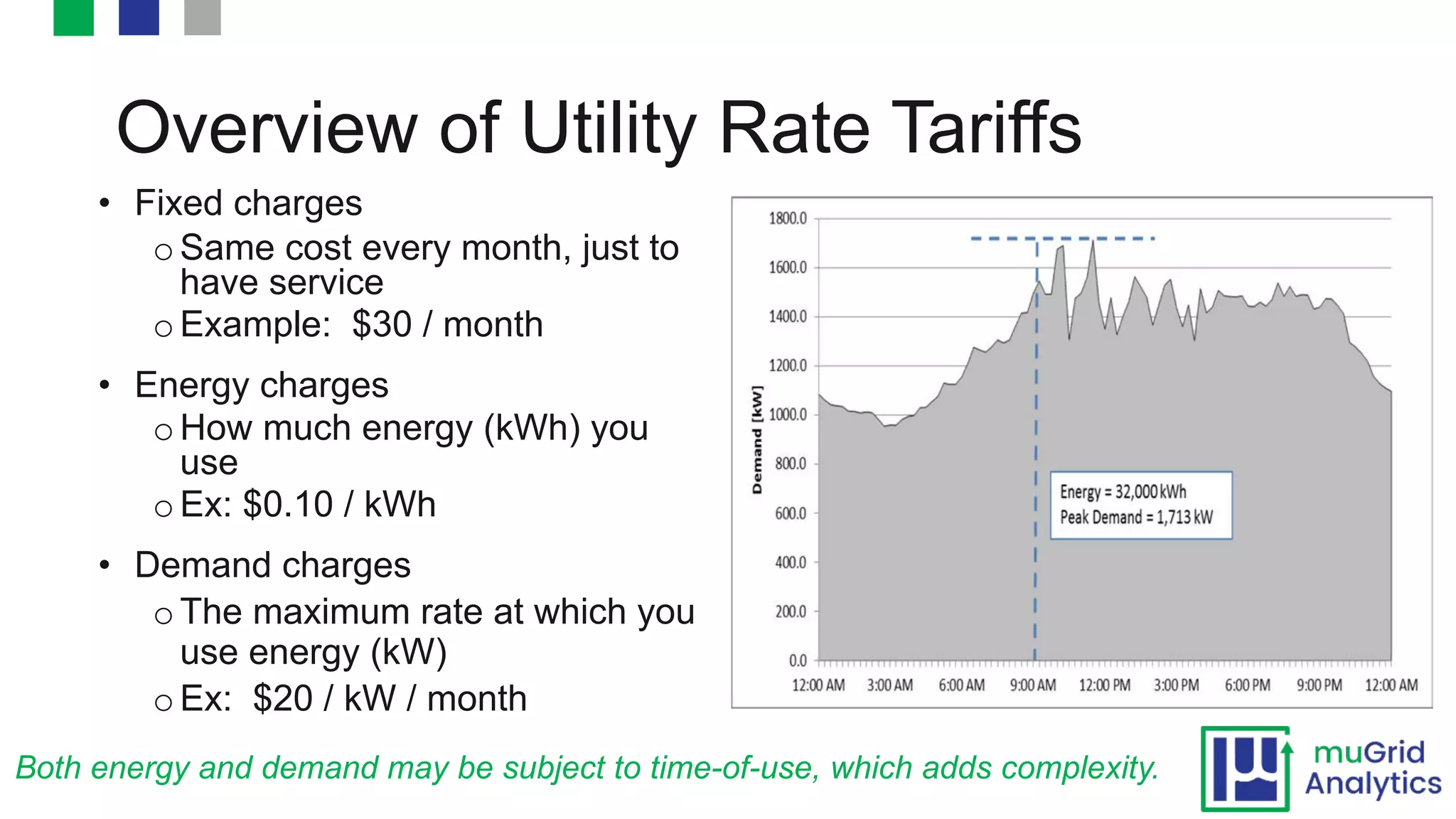
Overview of Utility Rate Tariffs
• Fixed charges
oSame cost every month, just to
have service
oExample: $30 / month
• Energy charges
oHow much energy (kWh) you
use
oEx: $0.10 / kWh
• Demand charges
oThe maximum rate at which you
use energy (kW)
oEx: $20 / kW / month
Both energy and demand may be subject to time-of-use, which adds complexity.
How Prevalent Are Demand Tariffs?
©2016 Renewable Energy Analytics
“Identifying Potential Markets for Behind-the-Meter Battery Energy Storage: A Survey of U.S. Demand Charges”, NREL
Mt. Princeton 14,196
Mt. Yale 14,199’
How does peak shaving work?
Case Study
Office Building in Los Angeles
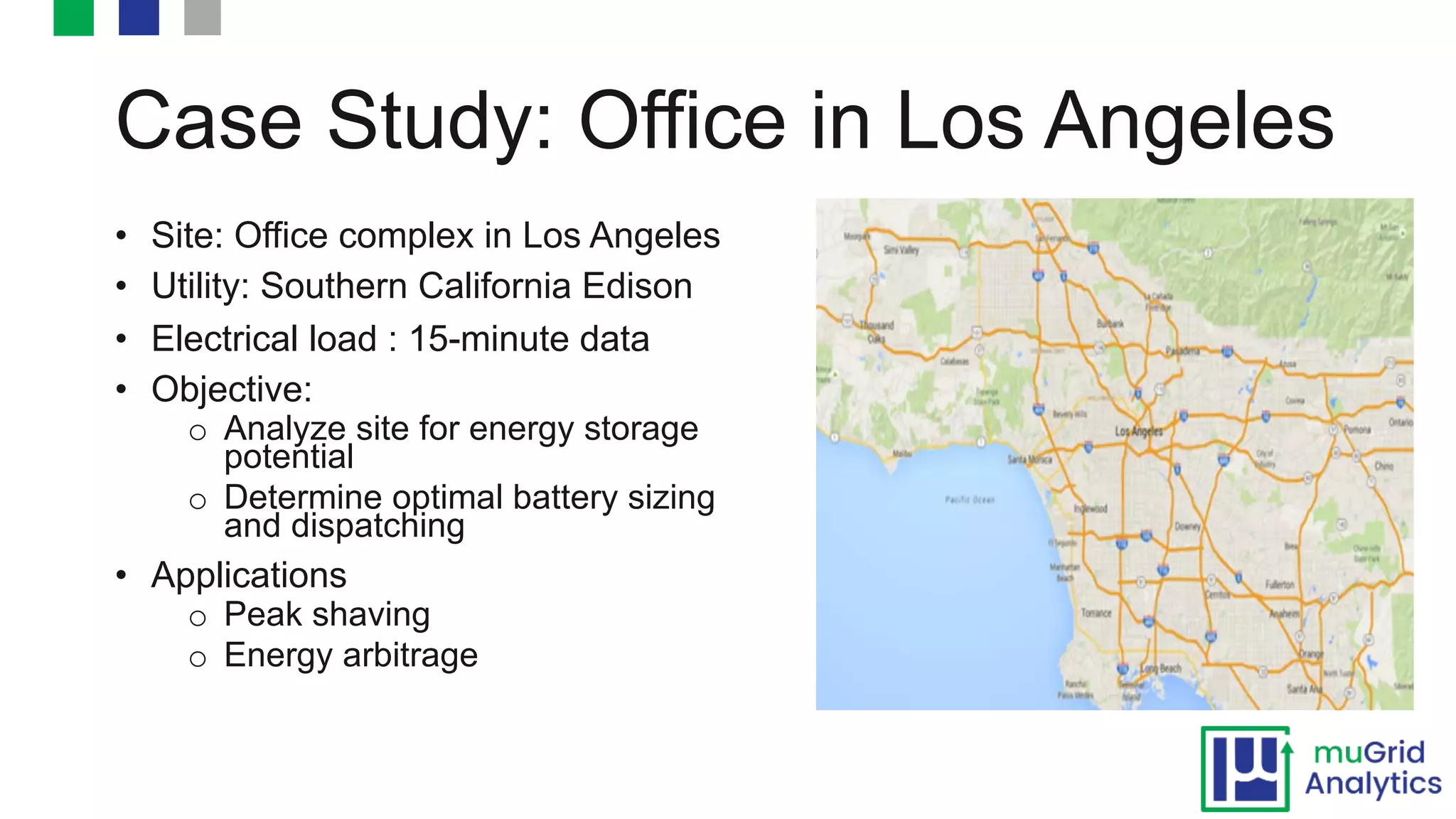
Case Study: Office in Los Angeles
• Site: Office complex in Los Angeles
• Utility: Southern California Edison
• Electrical load : 15-minute data
• Objective:
o Analyze site for energy storage
potential
o Determine optimal battery sizing
and dispatching
• Applications
o Peak shaving
o Energy arbitrage
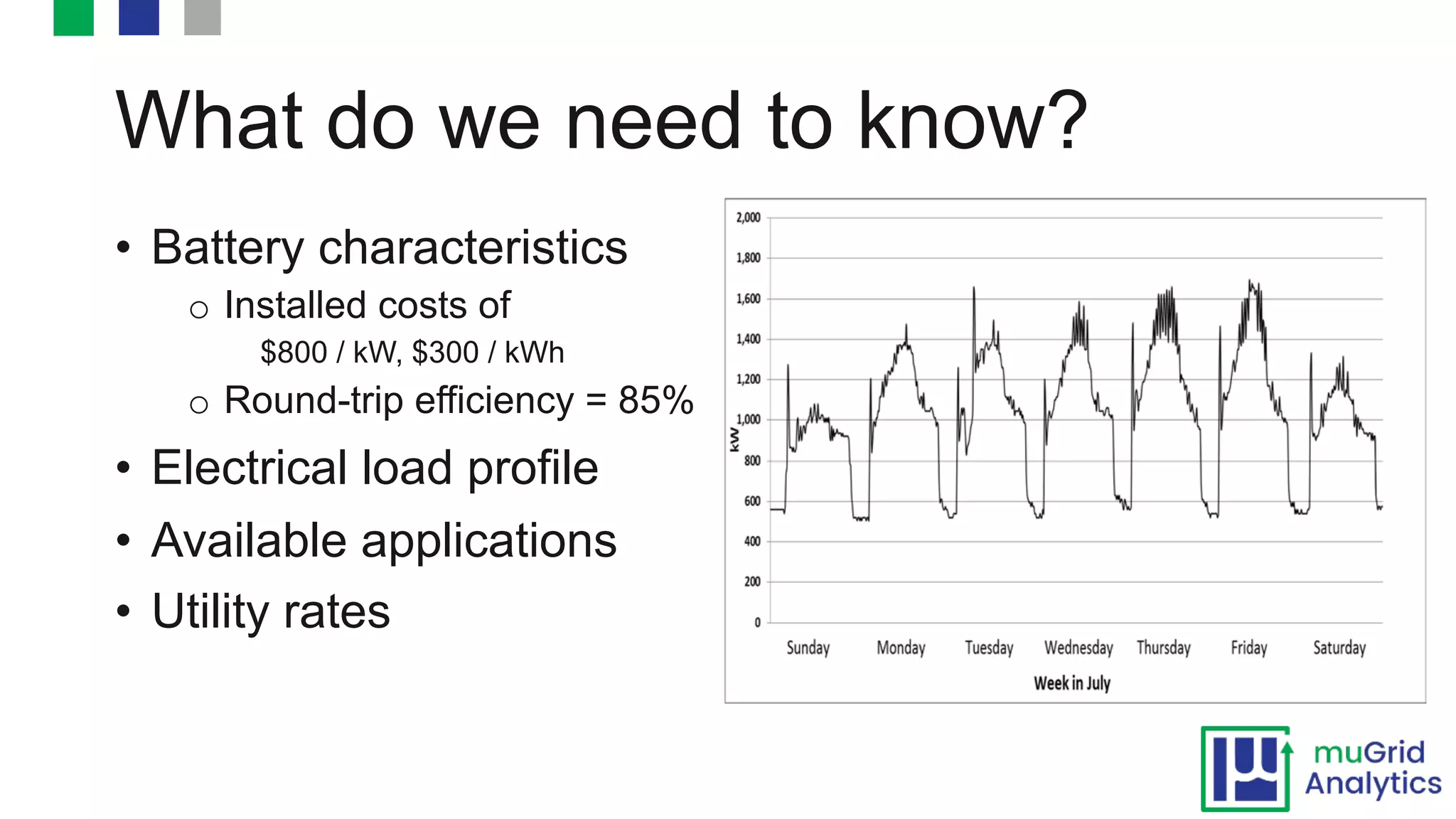
What do we need to know?
• Battery characteristics
o Installed costs of
$800 / kW, $300 / kWh
o Round-trip efficiency = 85%
• Electrical load profile
• Available applications
• Utility rates
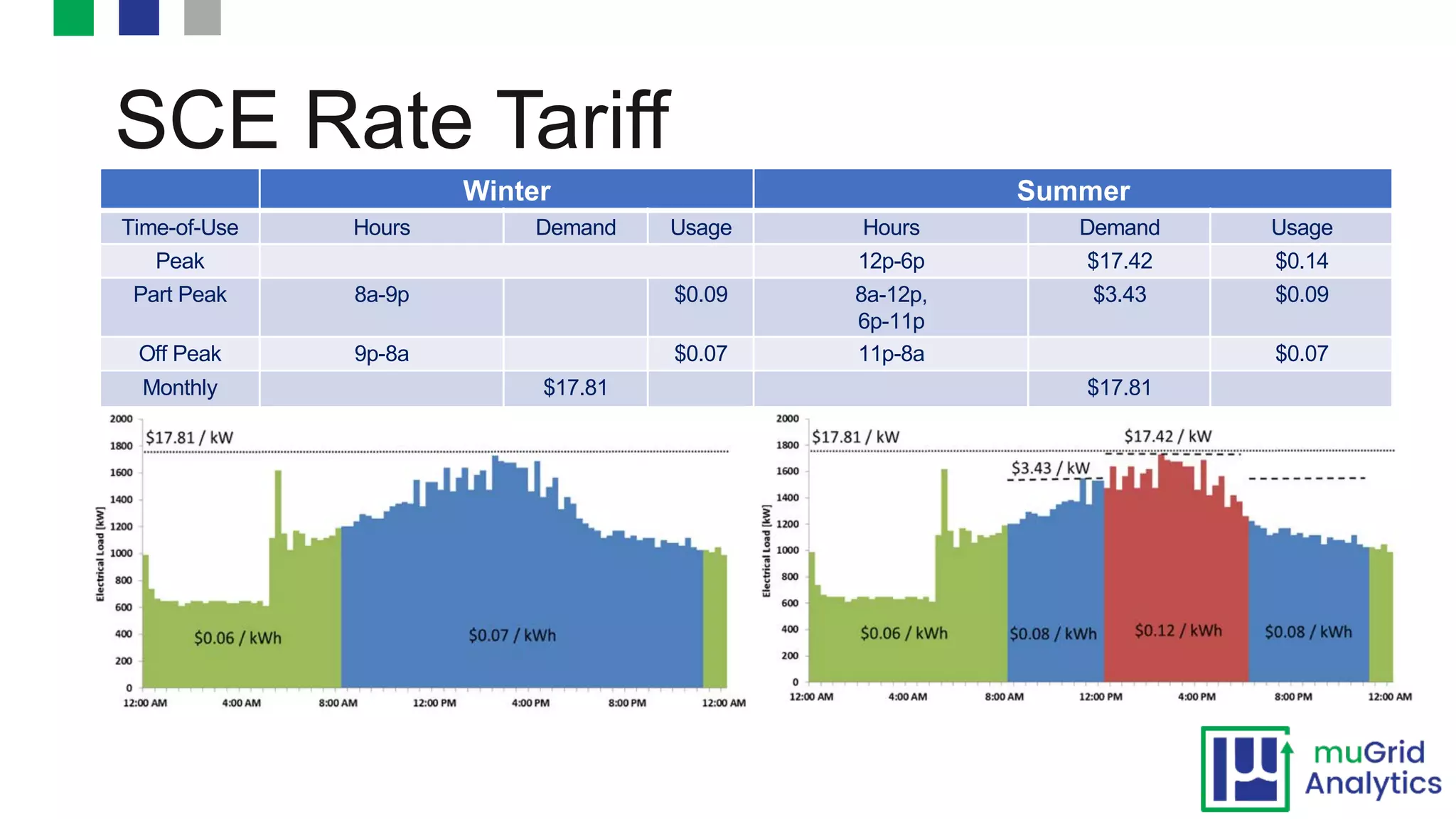
SCE Rate Tariff
Winter Summer
Time-of-Use Hours Demand Usage Hours Demand Usage
Peak 12p-6p $17.42 $0.14
Part Peak 8a-9p $0.09 8a-12p,
6p-11p
$3.43 $0.09
Off Peak 9p-8a $0.07 11p-8a $0.07
Monthly $17.81 $17.81
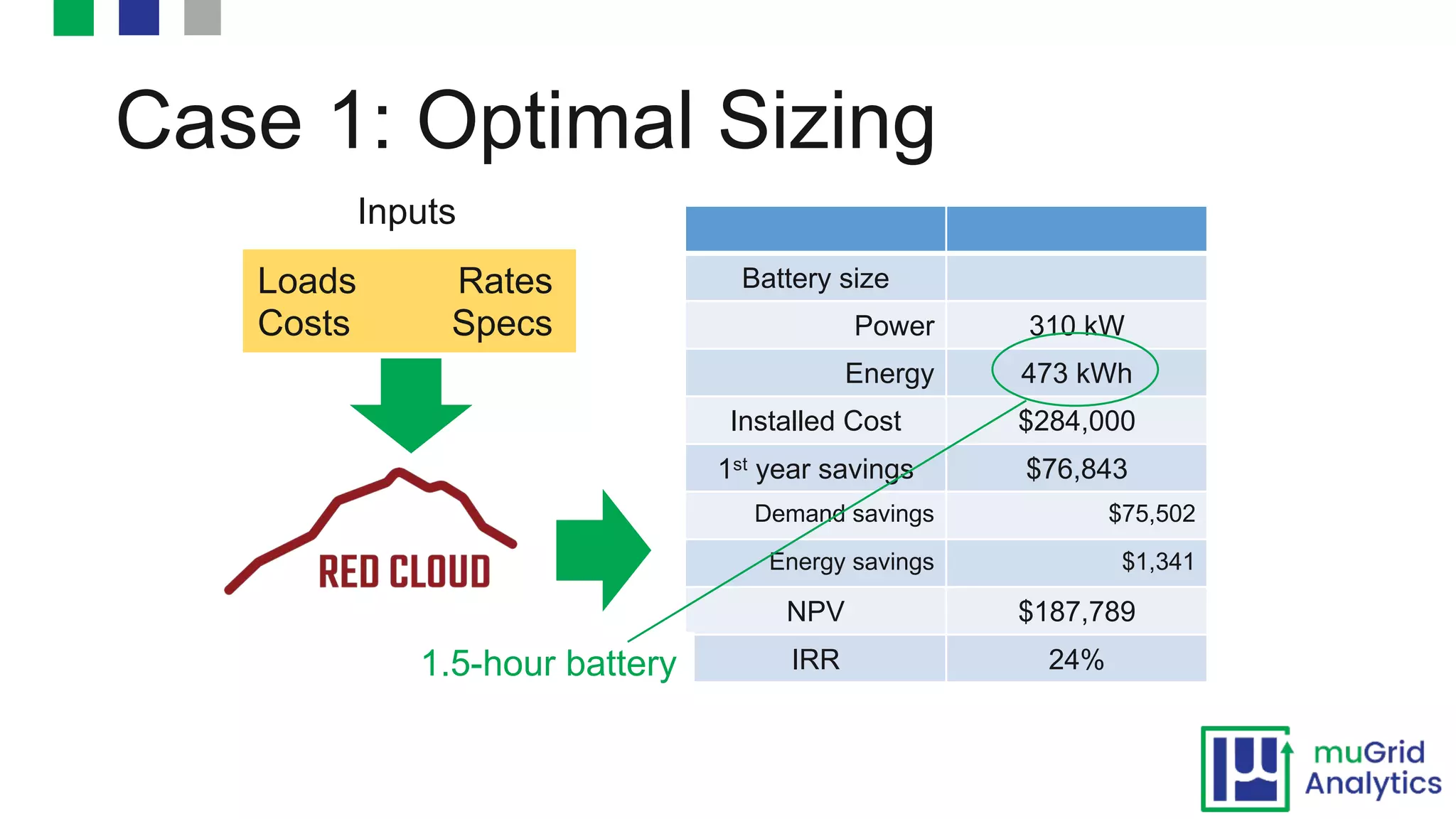
Case 1: Optimal Sizing
Battery size
Power 310 kW
Energy 473 kWh
Installed Cost $284,000
1st year savings $76,843
Demand savings $75,502
Energy savings $1,341
NPV $187,789
IRR 24%1.5-hour battery
Loads Rates
Costs Specs
Inputs
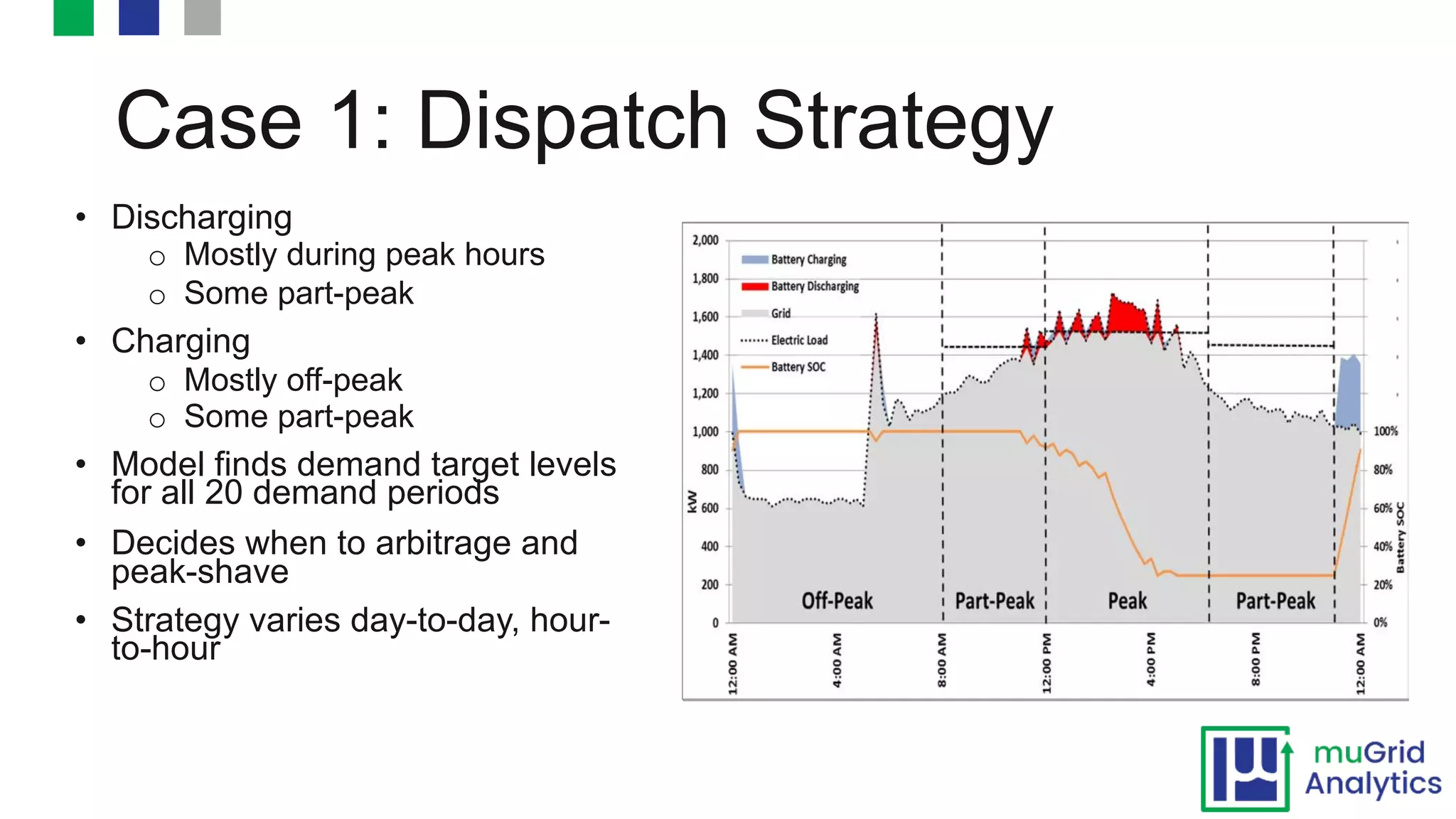
Case 1: Dispatch Strategy
• Discharging
o Mostly during peak hours
o Some part-peak
• Charging
o Mostly off-peak
o Some part-peak
• Model finds demand target levels
for all 20 demand periods
• Decides when to arbitrage and
peak-shave
• Strategy varies day-to-day, hour-
to-hour
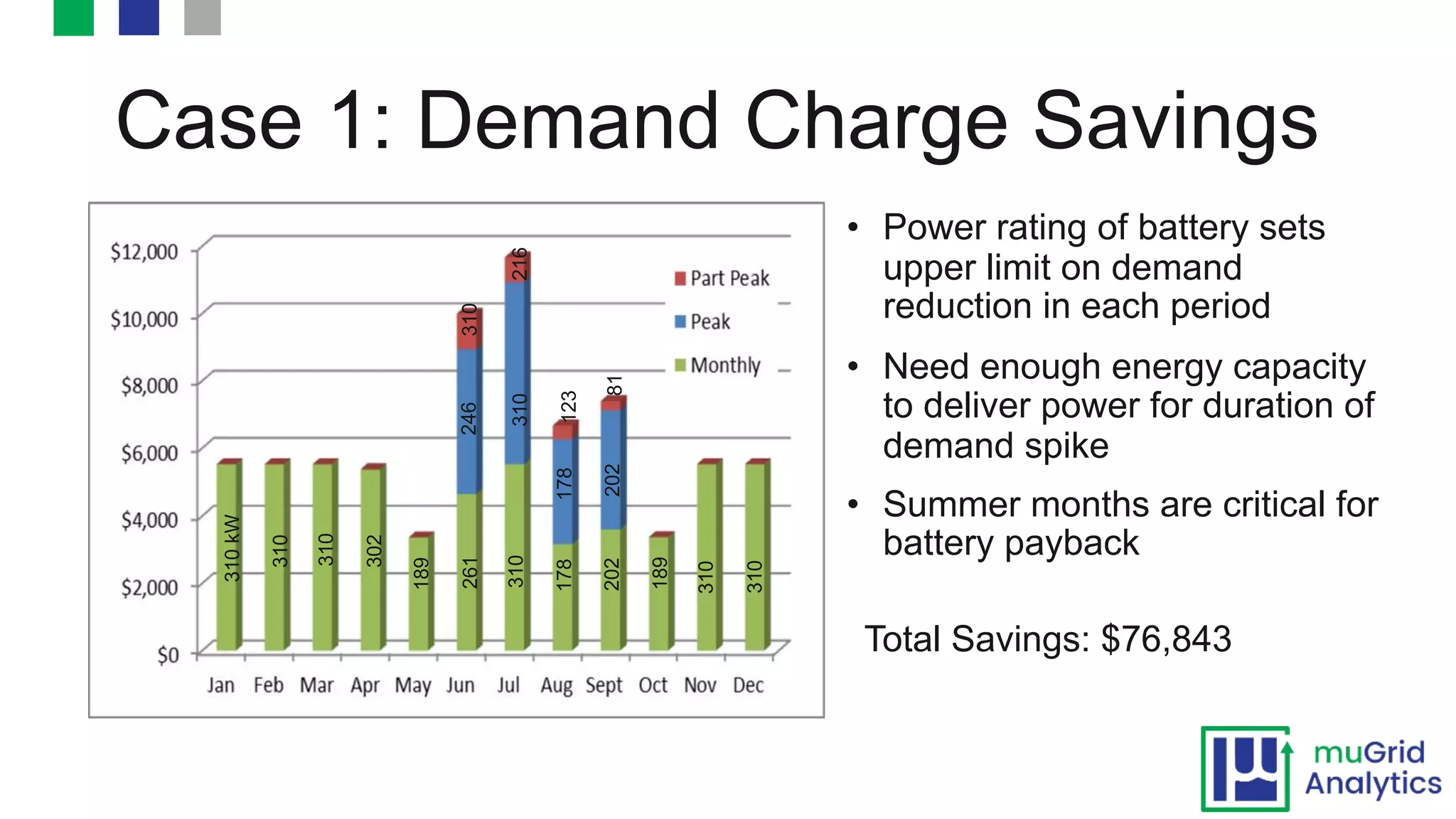
Case 1: Demand Charge Savings
• Power rating of battery sets
upper limit on demand
reduction in each period
• Need enough energy capacity
to deliver power for duration of
demand spike
• Summer months are critical for
battery payback
310kW
310
246
310
302
189
261
310
178
202
189
310
310
310
178
202
310
216
123
81
Total Savings: $76,843
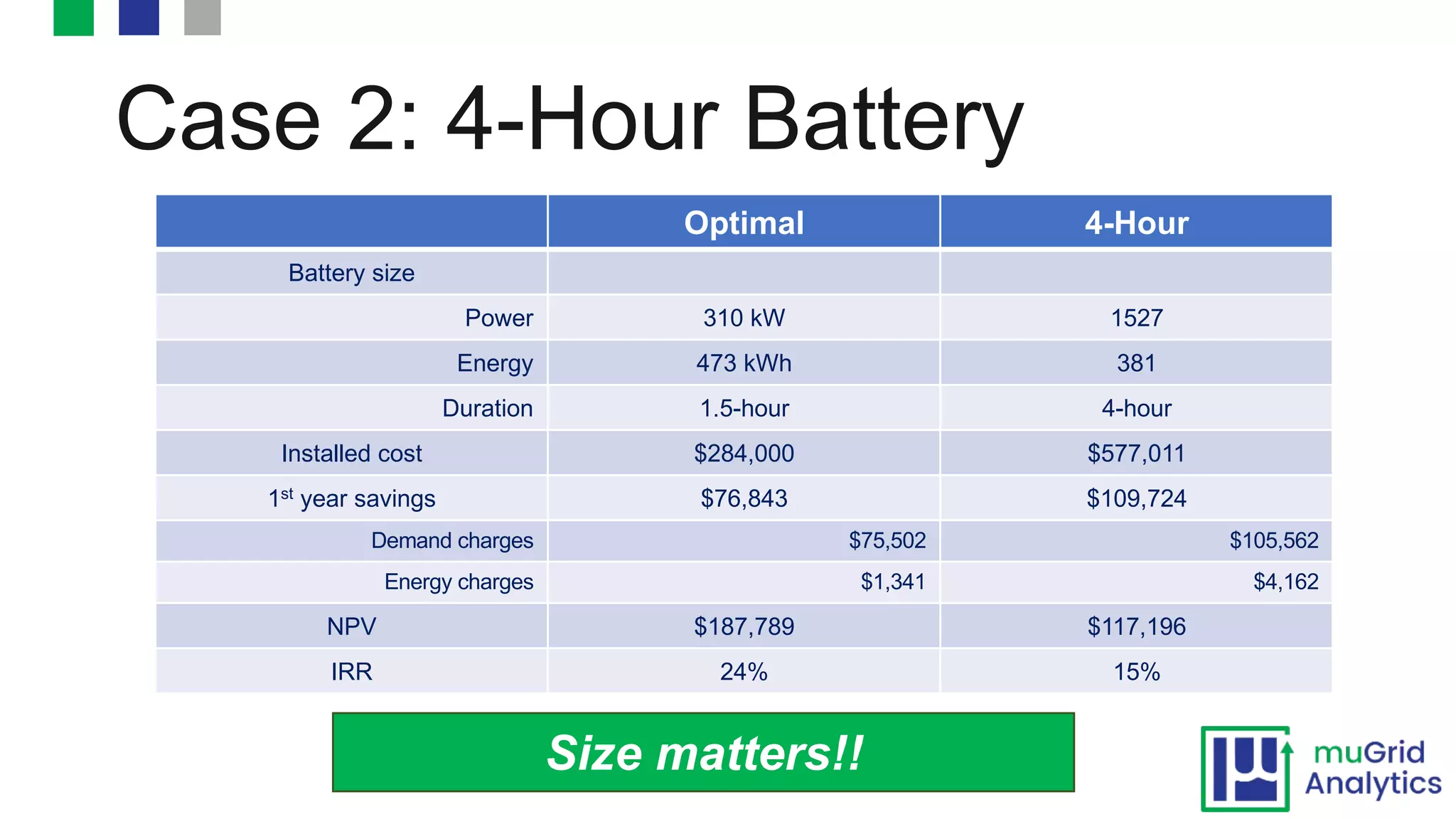
Case 2: 4-Hour Battery
Optimal 4-Hour
Battery size
Power 310 kW 1527
Energy 473 kWh 381
Duration 1.5-hour 4-hour
Installed cost $284,000 $577,011
1st year savings $76,843 $109,724
Demand charges $75,502 $105,562
Energy charges $1,341 $4,162
NPV $187,789 $117,196
IRR 24% 15%
Size matters!!
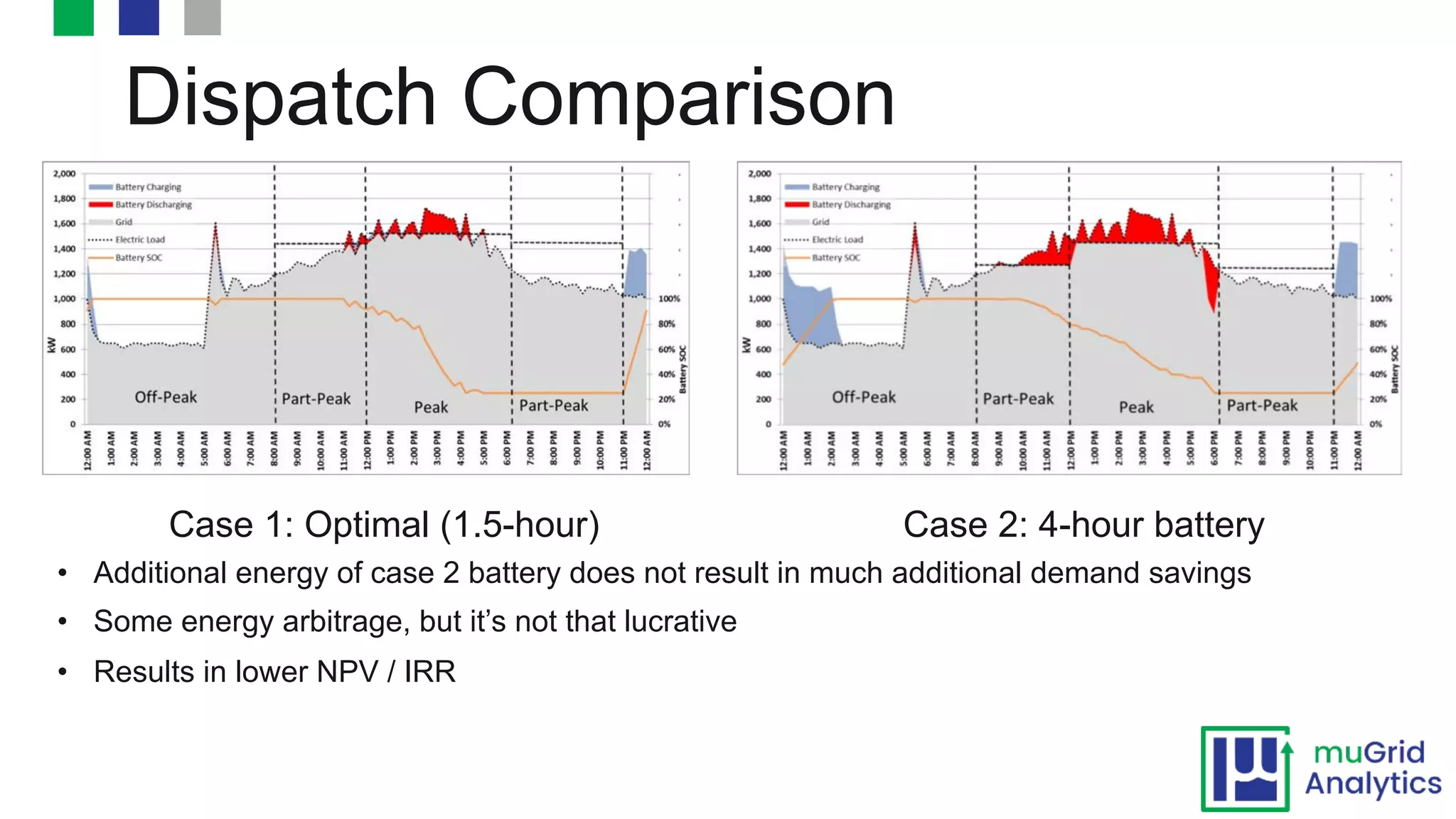
Dispatch Comparison
Case 1: Optimal (1.5-hour) Case 2: 4-hour battery
• Additional energy of case 2 battery does not result in much additional demand savings
• Some energy arbitrage, but it’s not that lucrative
• Results in lower NPV / IRR
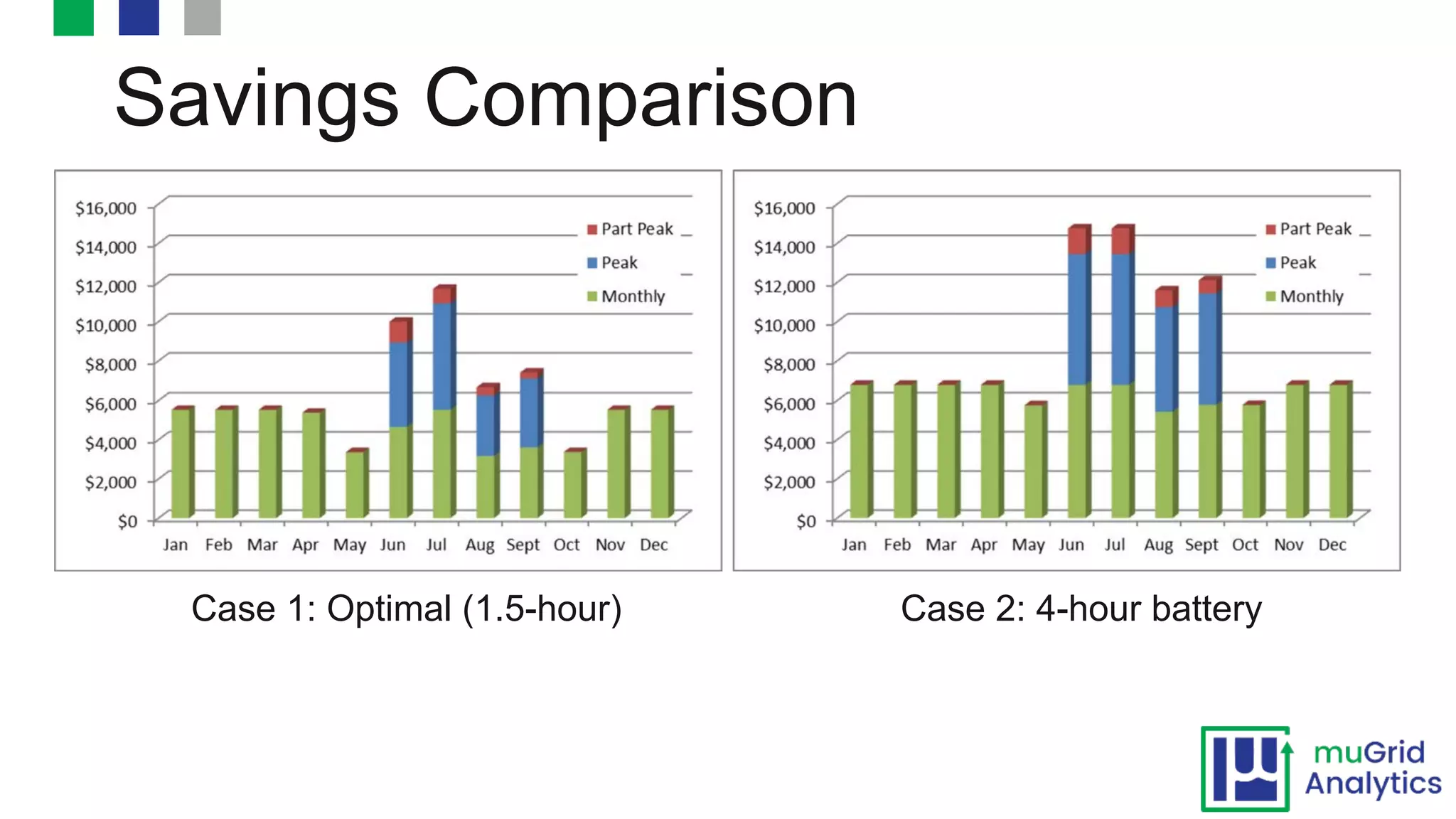
Savings Comparison
Case 1: Optimal (1.5-hour) Case 2: 4-hour battery
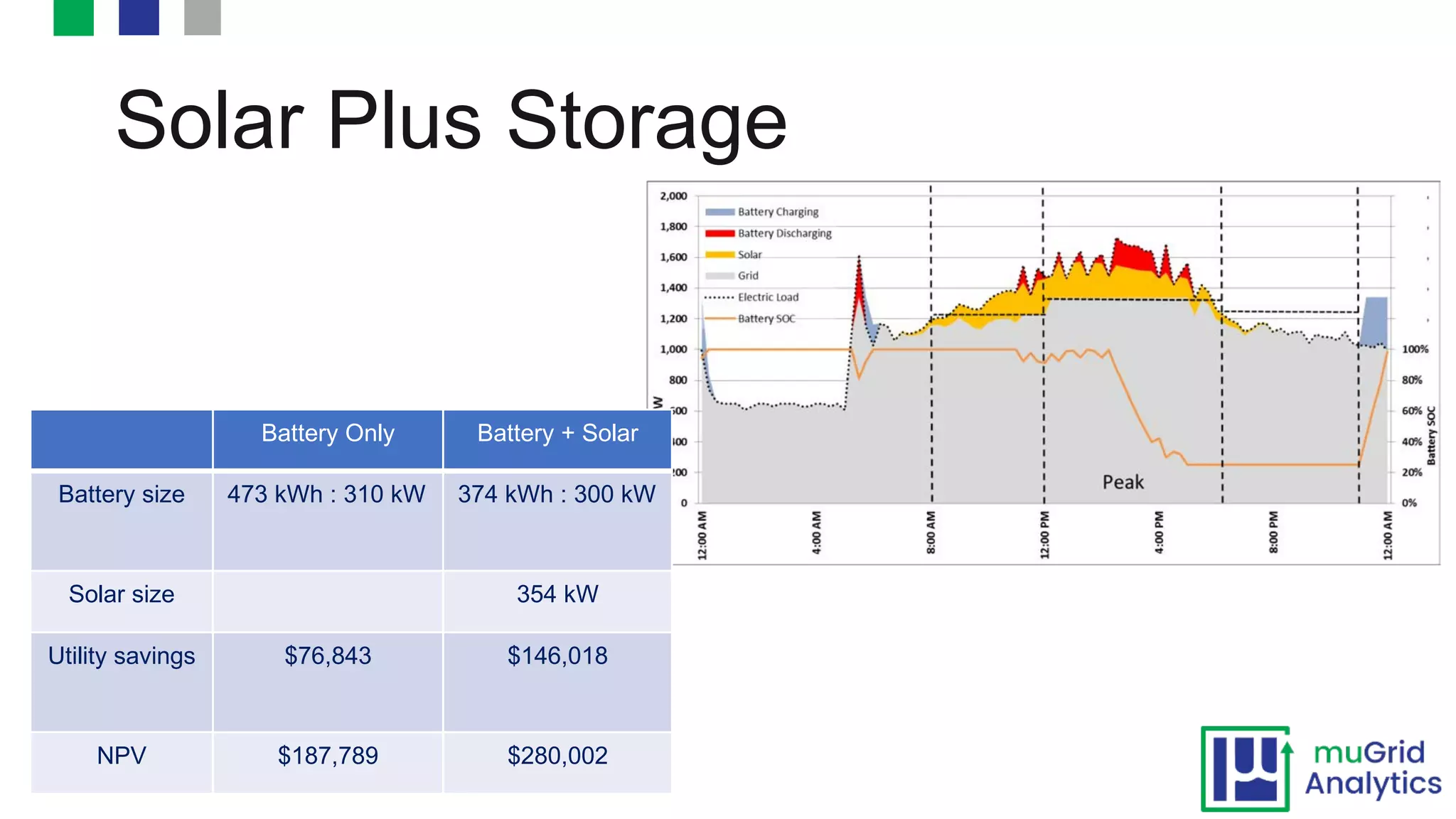
Solar Plus Storage
©2016 Renewable Energy Analytics
Battery Only Battery + Solar
Battery size 473 kWh : 310 kW 374 kWh : 300 kW
Solar size 354 kW
Utility savings $76,843 $146,018
NPV $187,789 $280,002
• Remember to think about power
and energy when talking about
batteries
• Batteries like high demand
charges and peaky load profiles
• Battery sizing and dispatch
optimization can make or break a
project
• It’s a fascinating time in the field of
energy!
Conclusions
©2016 Renewable Energy Analytics
www.CECCo.com
Upcoming Events
Nov. 1, 2018 | Chicago Solar & Storage Meetup @CECCOEnergy
(first Thursdays in Oak Brook, IL)
Nov. 13-15, 2018 | Solar Power Midwest – McCormick Place, Chicago IL
Contact tmontague@cecco.com for a free pass to the tradeshow #SolarMidwest
Solar Works for Illinois! – Free Monthly Webinar
Nov. 27, 2018 | Intelligent Monitoring Systems for Solar Projects and
Portfolios with Anson Moran, CEO Meteocontrol North America Register
Tim Montague, M.S. Travis Simpkins, PhD
tmontague@cecco.com travis@mugrid.com
Thank You!
www.cecco.com/solarwebinarOct 30, 2018
Solar Works for Illinois!
Maximize Your Solar Investment
by Adding Battery Energy Storage

Optimizing battery sizing and dispatching - mugrid analytics fina-lsfs

  • 1.
    Maximize Your SolarInvestment by Adding Battery Energy Storage Host: Tim Montague, M.S. Speaker: Travis Simpkins, PhD Continental Electrical muGrid Analytics www.cecco.com/solarwebinarOct 30, 2018 Solar Works for Illinois! Free monthly solar & storage webinar brought to you by:
  • 2.
    Maximize Your SolarInvestment by Adding Battery Energy Storage October 30, 2018 Travis Simpkins, PhD travis@mugrid.com
  • 3.
    Meet muGrid Analytics •Tech / Consulting company focused on providing bankable techno-economic analysis of renewable energy, energy storage, and micro grids to project developers, financiers, component manufacturers, and property owners • Redcloud Modeling Platform: Techno-economic mathematical optimization for energy systems We solve wicked problems at the intersection of energy technology and economics using math and modeling.
  • 4.
    Bottom Line UpFront • Batteries can enhance the economics of a solar project with multiple revenue streams • Multiple revenue streams make optimal battery dispatching a hard problem to solve • The key to economic solar-plus-storage is effective dispatching
  • 5.
    Mindset shift: solarvs. storage • Solar is straightforward o Sun shines – electrons flow • Batteries require decisions o When to charge, discharge, idle • How do we solve with that complexity? Mathematical optimization o Every time there was a decision to make, there was something optimal that should have been done.
  • 6.
    A Battery isa Bucket • Considerations: o How fast can we fill it? o How fast can we empty it? o How much does it cost? o How long will it last? o What causes it to fail? • Decisions: o How big of a bucket? o When to fill the bucket? o When to empty it? Energy we take out must be worth more than the energy we put in.
  • 7.
    Battery Power vs.Battery Energy • Power How fast you can charge or discharge the battery? • Energy Capacity How much energy can it store? • Duration o How long can the battery sustain it’s rated power output? Which of these containers is more useful? 8 "#ℎ 2 "# = 4 ℎ()* +)*,-.(/
  • 8.
    Energy Storage Applications •Demand charge reduction • Energy arbitrage / time-shifting of generation • Ancillary services o Frequency response o Volt / VAR optimization • Demand response • Reliability o Energy security o Resiliency / o Backup power o Black start • Capacity markets • Transmission and distribution upgrade deferral “The Economics of Battery Energy Storage,” Rocky Mountain Institute
  • 9.
    Battery Revenue Stacking •Batteries can serve one application at a time • Serving one application may preclude it from serving other applications at the same time (or in the immediate future) • Battery dispatch optimization is the process of determining which applications a battery should serve, and when it should serve them 6PM6AM12 AM 12 PM Arbitrage Peak ShavingFrequency Reg. 12 AM Freq. Reg.Demand Response “State Policies to Fully Charge Advanced Energy Storage,” Interstate Renewable Energy Council
  • 10.
    Overview of UtilityRate Tariffs • Fixed charges oSame cost every month, just to have service oExample: $30 / month • Energy charges oHow much energy (kWh) you use oEx: $0.10 / kWh • Demand charges oThe maximum rate at which you use energy (kW) oEx: $20 / kW / month Both energy and demand may be subject to time-of-use, which adds complexity.
  • 11.
    How Prevalent AreDemand Tariffs? ©2016 Renewable Energy Analytics “Identifying Potential Markets for Behind-the-Meter Battery Energy Storage: A Survey of U.S. Demand Charges”, NREL
  • 12.
    Mt. Princeton 14,196 Mt.Yale 14,199’ How does peak shaving work?
  • 14.
  • 15.
    Case Study: Officein Los Angeles • Site: Office complex in Los Angeles • Utility: Southern California Edison • Electrical load : 15-minute data • Objective: o Analyze site for energy storage potential o Determine optimal battery sizing and dispatching • Applications o Peak shaving o Energy arbitrage
  • 16.
    What do weneed to know? • Battery characteristics o Installed costs of $800 / kW, $300 / kWh o Round-trip efficiency = 85% • Electrical load profile • Available applications • Utility rates
  • 17.
    SCE Rate Tariff WinterSummer Time-of-Use Hours Demand Usage Hours Demand Usage Peak 12p-6p $17.42 $0.14 Part Peak 8a-9p $0.09 8a-12p, 6p-11p $3.43 $0.09 Off Peak 9p-8a $0.07 11p-8a $0.07 Monthly $17.81 $17.81
  • 18.
    Case 1: OptimalSizing Battery size Power 310 kW Energy 473 kWh Installed Cost $284,000 1st year savings $76,843 Demand savings $75,502 Energy savings $1,341 NPV $187,789 IRR 24%1.5-hour battery Loads Rates Costs Specs Inputs
  • 19.
    Case 1: DispatchStrategy • Discharging o Mostly during peak hours o Some part-peak • Charging o Mostly off-peak o Some part-peak • Model finds demand target levels for all 20 demand periods • Decides when to arbitrage and peak-shave • Strategy varies day-to-day, hour- to-hour
  • 20.
    Case 1: DemandCharge Savings • Power rating of battery sets upper limit on demand reduction in each period • Need enough energy capacity to deliver power for duration of demand spike • Summer months are critical for battery payback 310kW 310 246 310 302 189 261 310 178 202 189 310 310 310 178 202 310 216 123 81 Total Savings: $76,843
  • 21.
    Case 2: 4-HourBattery Optimal 4-Hour Battery size Power 310 kW 1527 Energy 473 kWh 381 Duration 1.5-hour 4-hour Installed cost $284,000 $577,011 1st year savings $76,843 $109,724 Demand charges $75,502 $105,562 Energy charges $1,341 $4,162 NPV $187,789 $117,196 IRR 24% 15% Size matters!!
  • 22.
    Dispatch Comparison Case 1:Optimal (1.5-hour) Case 2: 4-hour battery • Additional energy of case 2 battery does not result in much additional demand savings • Some energy arbitrage, but it’s not that lucrative • Results in lower NPV / IRR
  • 23.
    Savings Comparison Case 1:Optimal (1.5-hour) Case 2: 4-hour battery
  • 24.
    Solar Plus Storage ©2016Renewable Energy Analytics Battery Only Battery + Solar Battery size 473 kWh : 310 kW 374 kWh : 300 kW Solar size 354 kW Utility savings $76,843 $146,018 NPV $187,789 $280,002
  • 25.
    • Remember tothink about power and energy when talking about batteries • Batteries like high demand charges and peaky load profiles • Battery sizing and dispatch optimization can make or break a project • It’s a fascinating time in the field of energy! Conclusions ©2016 Renewable Energy Analytics
  • 26.
    www.CECCo.com Upcoming Events Nov. 1,2018 | Chicago Solar & Storage Meetup @CECCOEnergy (first Thursdays in Oak Brook, IL) Nov. 13-15, 2018 | Solar Power Midwest – McCormick Place, Chicago IL Contact tmontague@cecco.com for a free pass to the tradeshow #SolarMidwest Solar Works for Illinois! – Free Monthly Webinar Nov. 27, 2018 | Intelligent Monitoring Systems for Solar Projects and Portfolios with Anson Moran, CEO Meteocontrol North America Register
  • 27.
    Tim Montague, M.S.Travis Simpkins, PhD tmontague@cecco.com travis@mugrid.com Thank You! www.cecco.com/solarwebinarOct 30, 2018 Solar Works for Illinois! Maximize Your Solar Investment by Adding Battery Energy Storage