Optimization Techniques in
pharmaceutical Formulation and
Processing
PRESENTED BY,
PRATIKSHA C CHANDRAGIRIVAR
M PHARMA 1ST SEM
DEPT, OF PHARMACEUTICS
HSK COP BAGALKOT
FACILITATED BY,
AVINASH.S.G.
ASSO.PROFESSOR
DEPT.OF PHARMACEUTICS
HSK COP BAGALKOT
Optimization Techniques in pharmaceutical
Formulation and Processing
CONTENTS:
1. Concept of optimization
2. Parameters of optimization
3. Optimization techniques in pharmaceutical
formulation and processing.
Optimization Techniques in pharmaceutical
Formulation and Processing
1. CONCEPT OF OPTIMIZATION:
 The term optimize is defined as “ to make perfect”.
 In terms of sentence it is defined as choosing the best element
from some set of available alternatives.
 According to Merriam Webster dictionary, optimization
means, “ An act, process or methodology of making something
(as a design, system or a decision) as a fully perfect, functional
or effective as possible; specially the mathematical procedures.
 Optimization is also defined as “The process of finding the
best values for the variables of a particular problem to
minimize or maximize an objective function.”
Optimization Techniques in pharmaceutical
Formulation and Processing
 It is used in pharmacy relative formulation and processing.
 It is involved in formulating drug products in various forms.
 Final product not only meets the requirements from the bio-
availability but also from the practical mass production
criteria.
 It helps the pharmaceutical scientist to understand theoretical
formulation and the target processing parameters which ranges
for each excipients & processing factors.
 In development projects, one generally experiments by a series
of logical steps, carefully controlling the variables & changing
one at a time, until a satisfactory system is obtained
Optimization Techniques in pharmaceutical
Formulation and Processing
 “It is not a screening technique.”
 Optimization is necessary because,
1. It reduces the cost.
2. It provides safety and reduces the error.
3. It provides innovation and efficacy.
4. It saves the time.
Optimization Techniques in pharmaceutical
Formulation and Processing
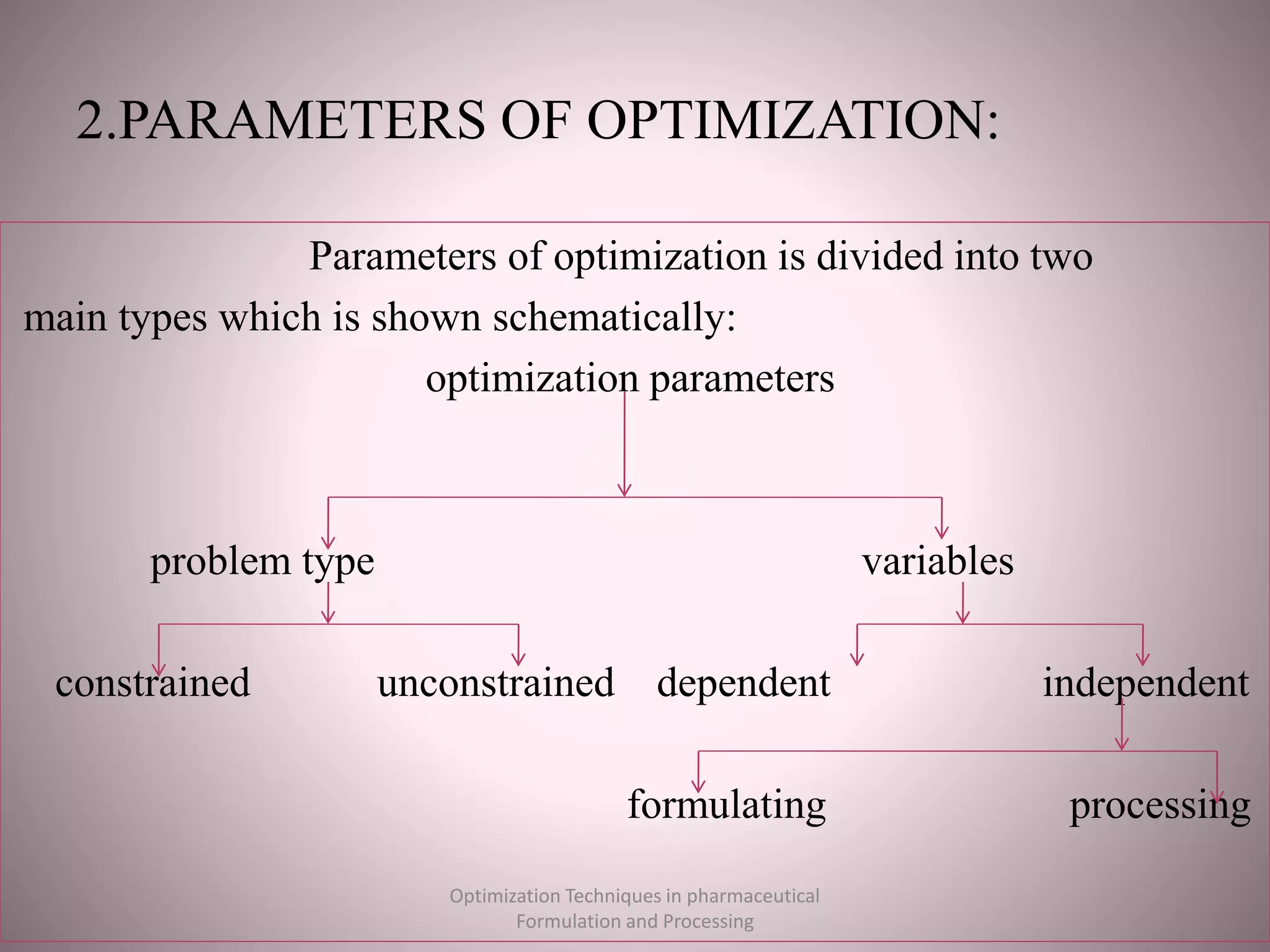
2.PARAMETERS OF OPTIMIZATION:
Parameters of optimization is divided into two
main types which is shown schematically:
optimization parameters
problem type variables
constrained unconstrained dependent independent
formulating processing
Optimization Techniques in pharmaceutical
Formulation and Processing
a. Problem type:
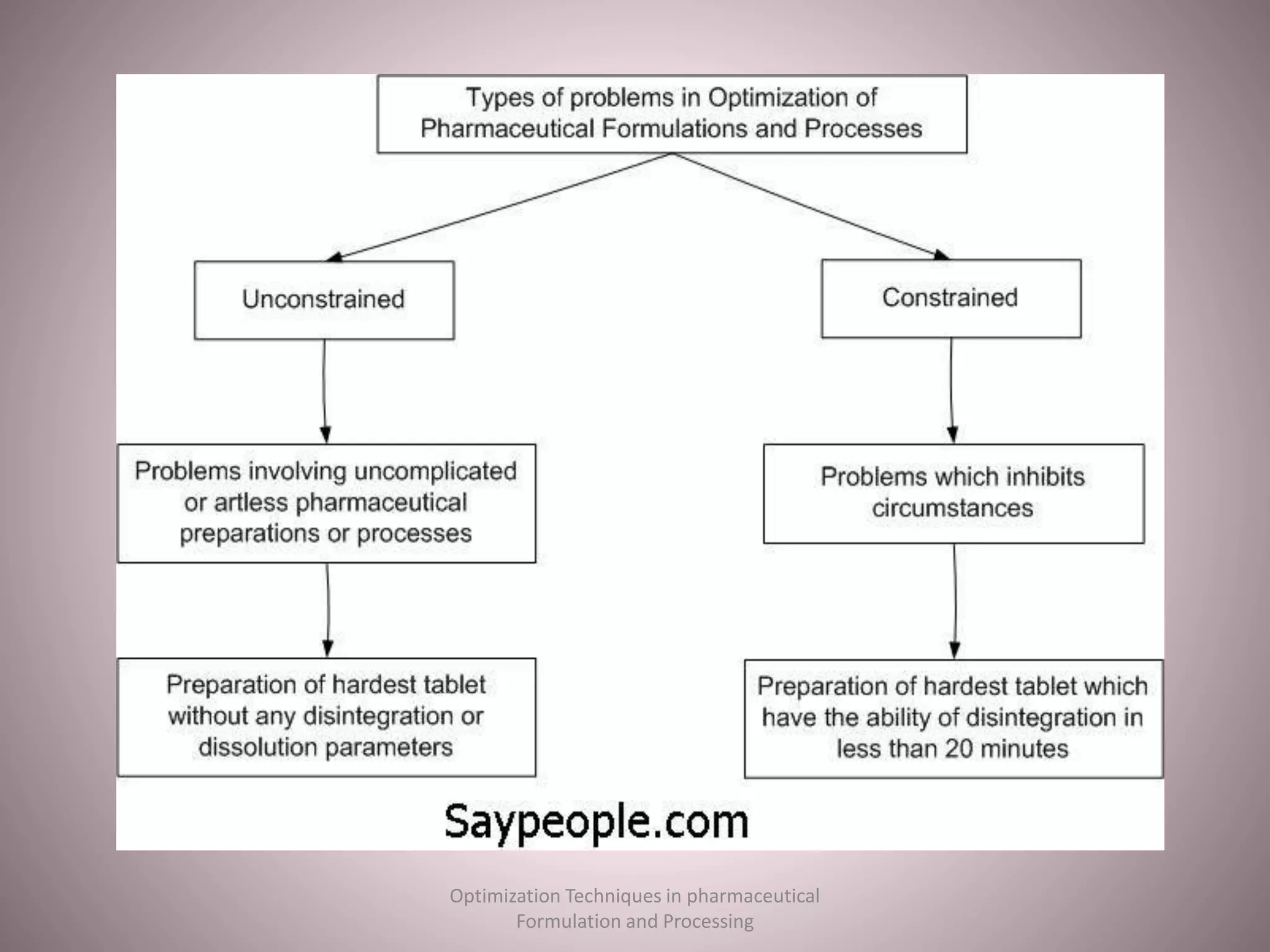
There are two general type are there in the problem type of
optimization technique:
1. Constrained
2. Un constrained
1. Constrained :
These are the restrictions placed on the system by physical
limitations or perhaps by simple practicality.
Example : Economical considerations
2. Un constrained:
Here there are no restrictions.
With the help of flow chart we can predict these two
problem type very easily viz.,
Optimization Techniques in pharmaceutical
Formulation and Processing
Optimization Techniques in pharmaceutical
Formulation and Processing
b. Variables:
Mathematically, they can be divided into two groups
a. Independent or primary variables
b. Dependent or secondary variables
a. Independent or primary variables:
Formulations and process variables directly under control of the
formulator.
Example: Ingredients
Mixing time for given process step.
Optimization Techniques in pharmaceutical
Formulation and Processing
B. Dependent or secondary variables:
These are the responses or the characteristics of
the in-progress material or the resulting drug delivery system.
Example: Direct result of any change in the formulation or
process.
Optimization Techniques in pharmaceutical
Formulation and Processing
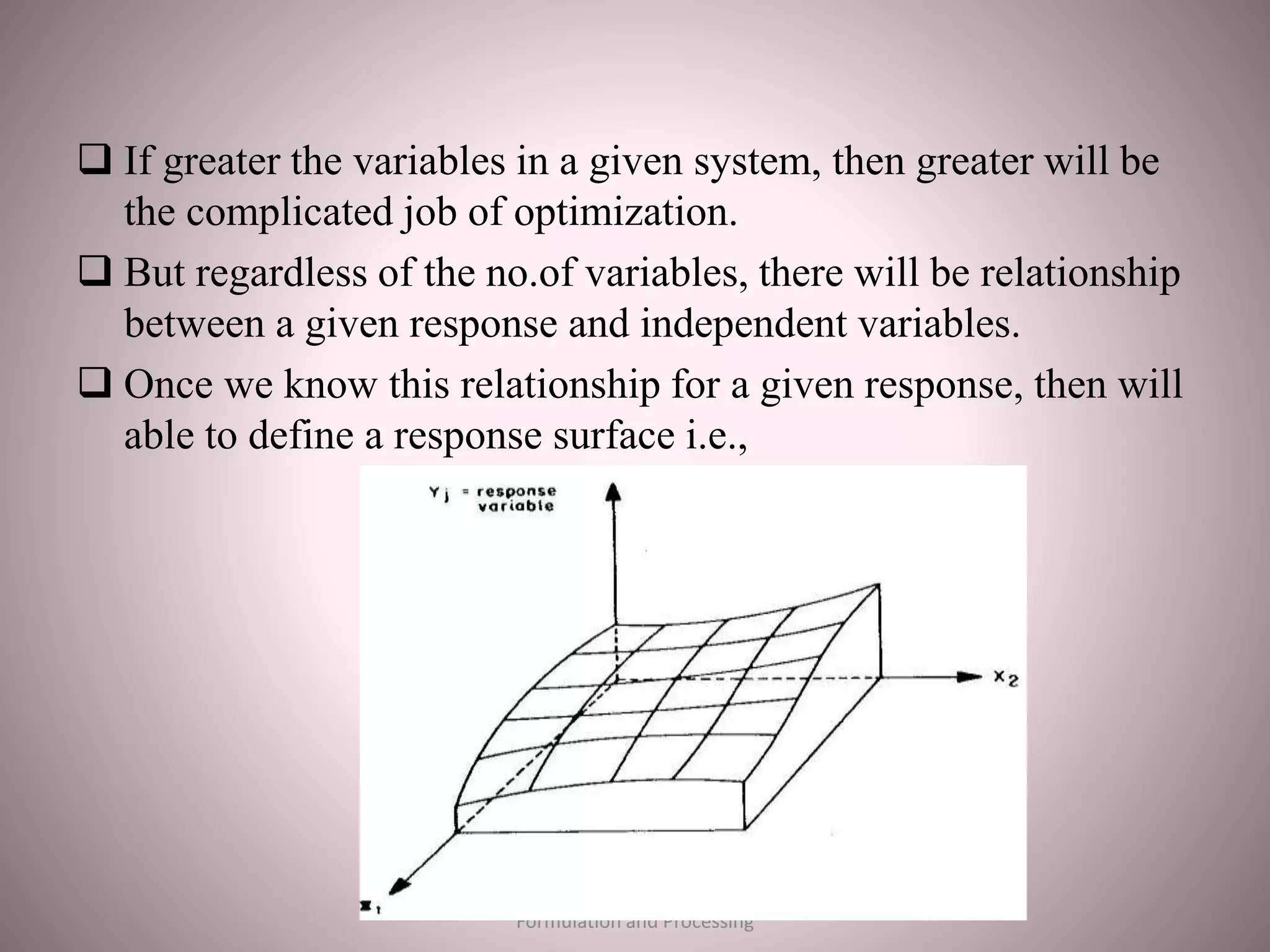
 If greater the variables in a given system, then greater will be
the complicated job of optimization.
 But regardless of the no.of variables, there will be relationship
between a given response and independent variables.
 Once we know this relationship for a given response, then will
able to define a response surface i.e.,
Optimization Techniques in pharmaceutical
Formulation and Processing
 It involves application of calculus to basic problem for
maximum/minimum function.
 Limited applications
i. Problems those are not too complex.
ii. They do not involve more than two variables.
 For more than two variables, graphical representation is
impossible, but it is possible mathematically.
Optimization Techniques in pharmaceutical
Formulation and Processing
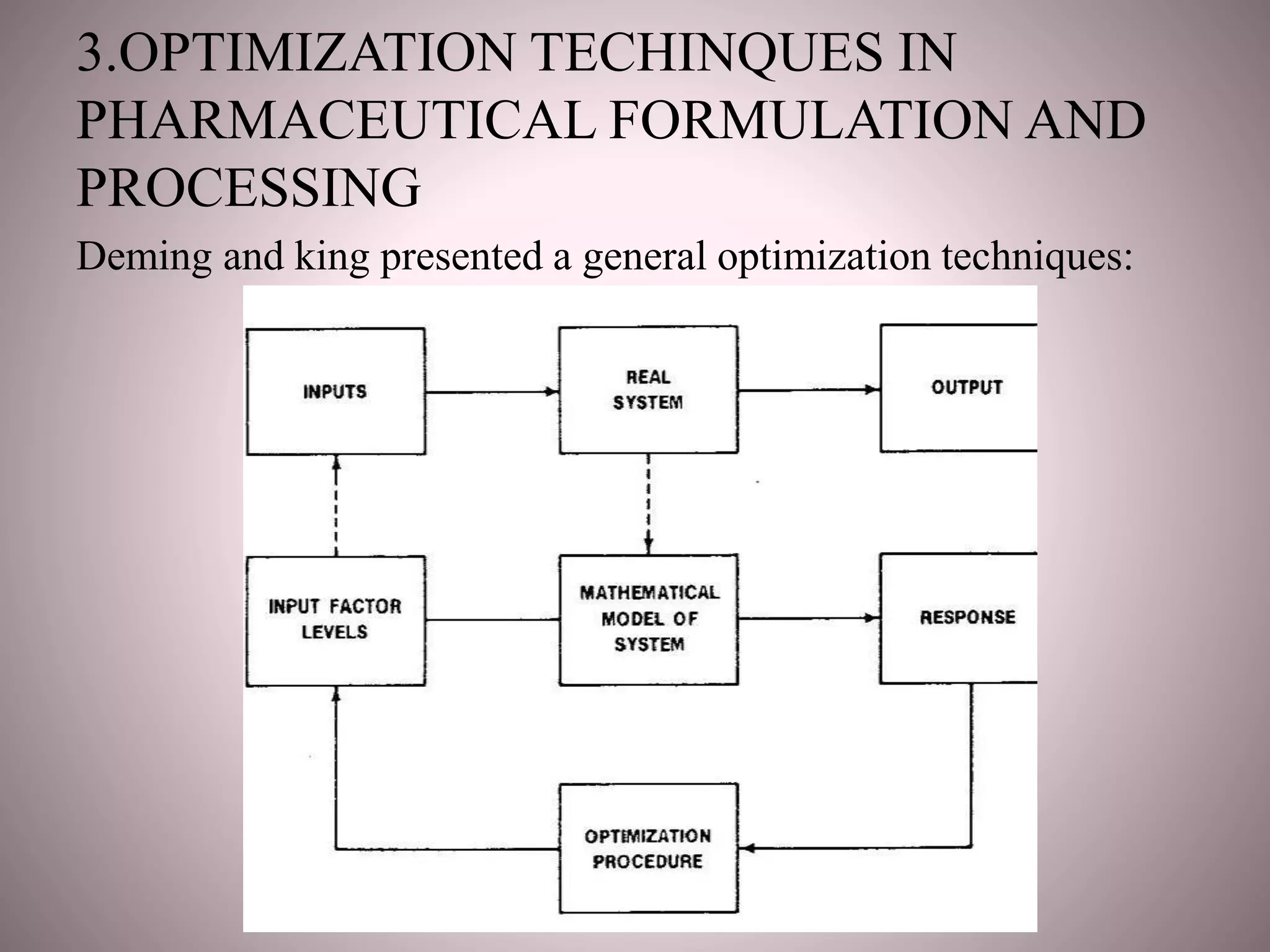
3.OPTIMIZATION TECHINQUES IN
PHARMACEUTICAL FORMULATION AND
PROCESSING
Deming and king presented a general optimization techniques:
Optimization Techniques in pharmaceutical
Formulation and Processing
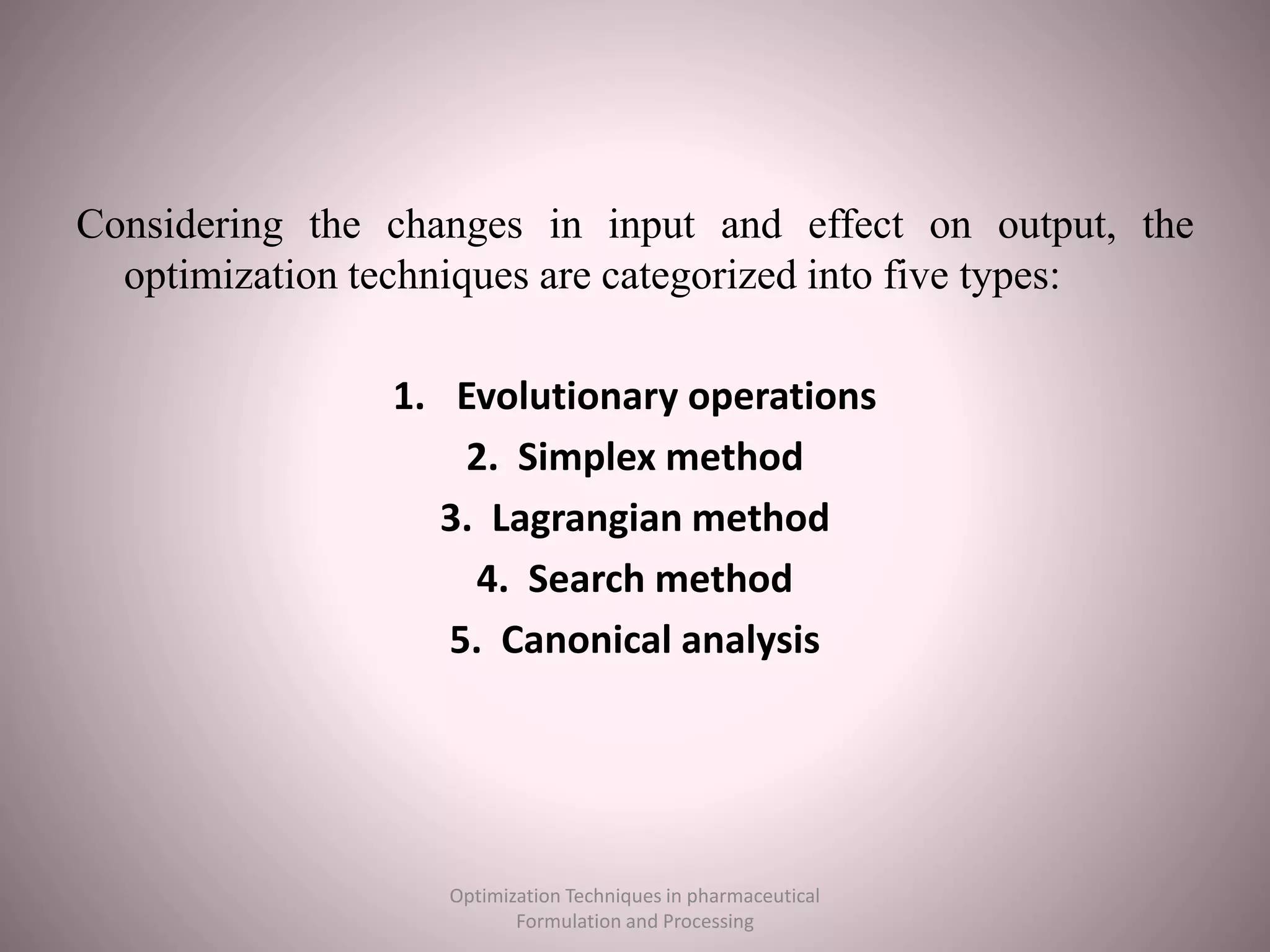
Considering the changes in input and effect on output, the
optimization techniques are categorized into five types:
1. Evolutionary operations
2. Simplex method
3. Lagrangian method
4. Search method
5. Canonical analysis
Optimization Techniques in pharmaceutical
Formulation and Processing
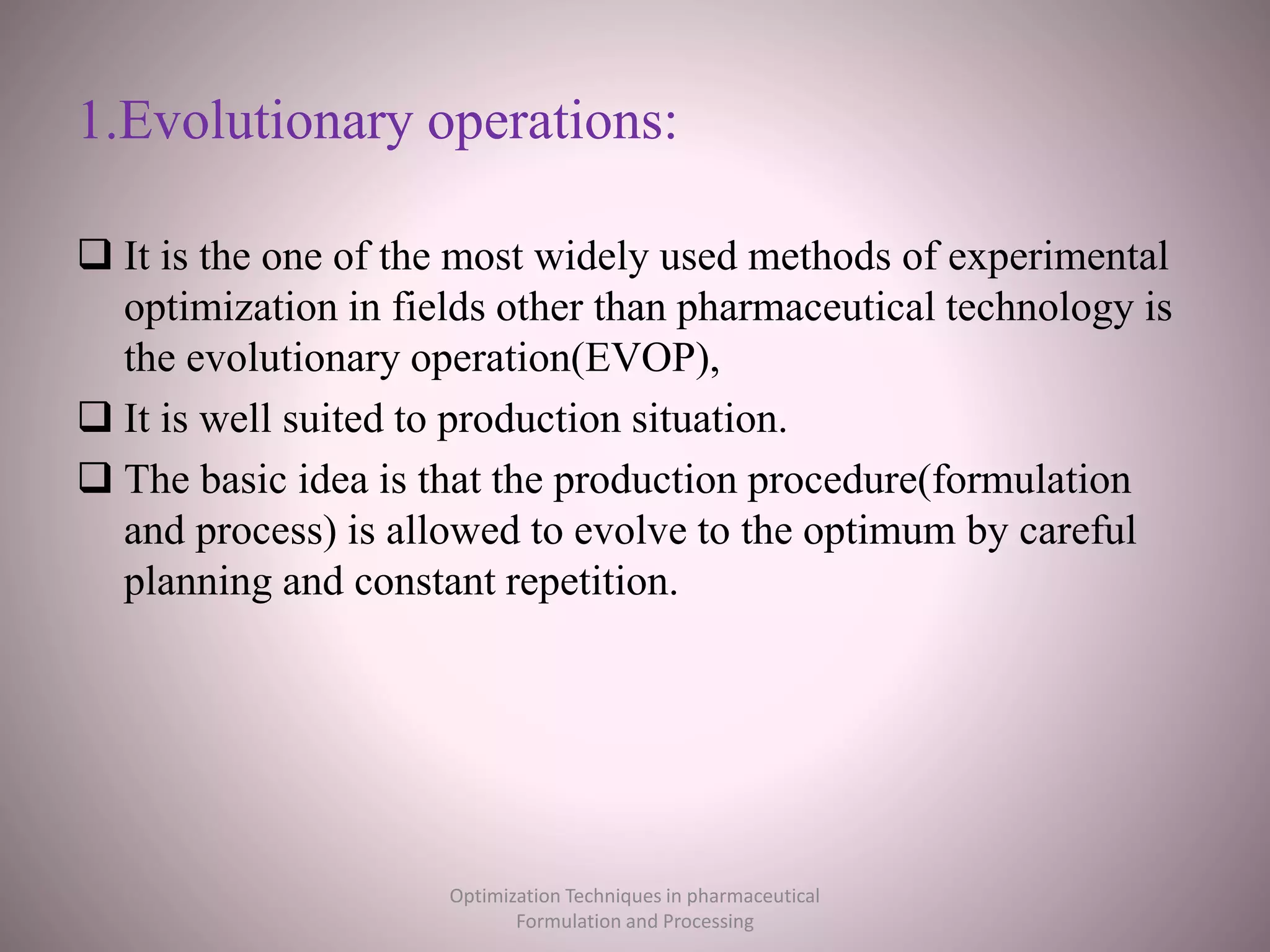
1.Evolutionary operations:
 It is the one of the most widely used methods of experimental
optimization in fields other than pharmaceutical technology is
the evolutionary operation(EVOP),
 It is well suited to production situation.
 The basic idea is that the production procedure(formulation
and process) is allowed to evolve to the optimum by careful
planning and constant repetition.
Optimization Techniques in pharmaceutical
Formulation and Processing
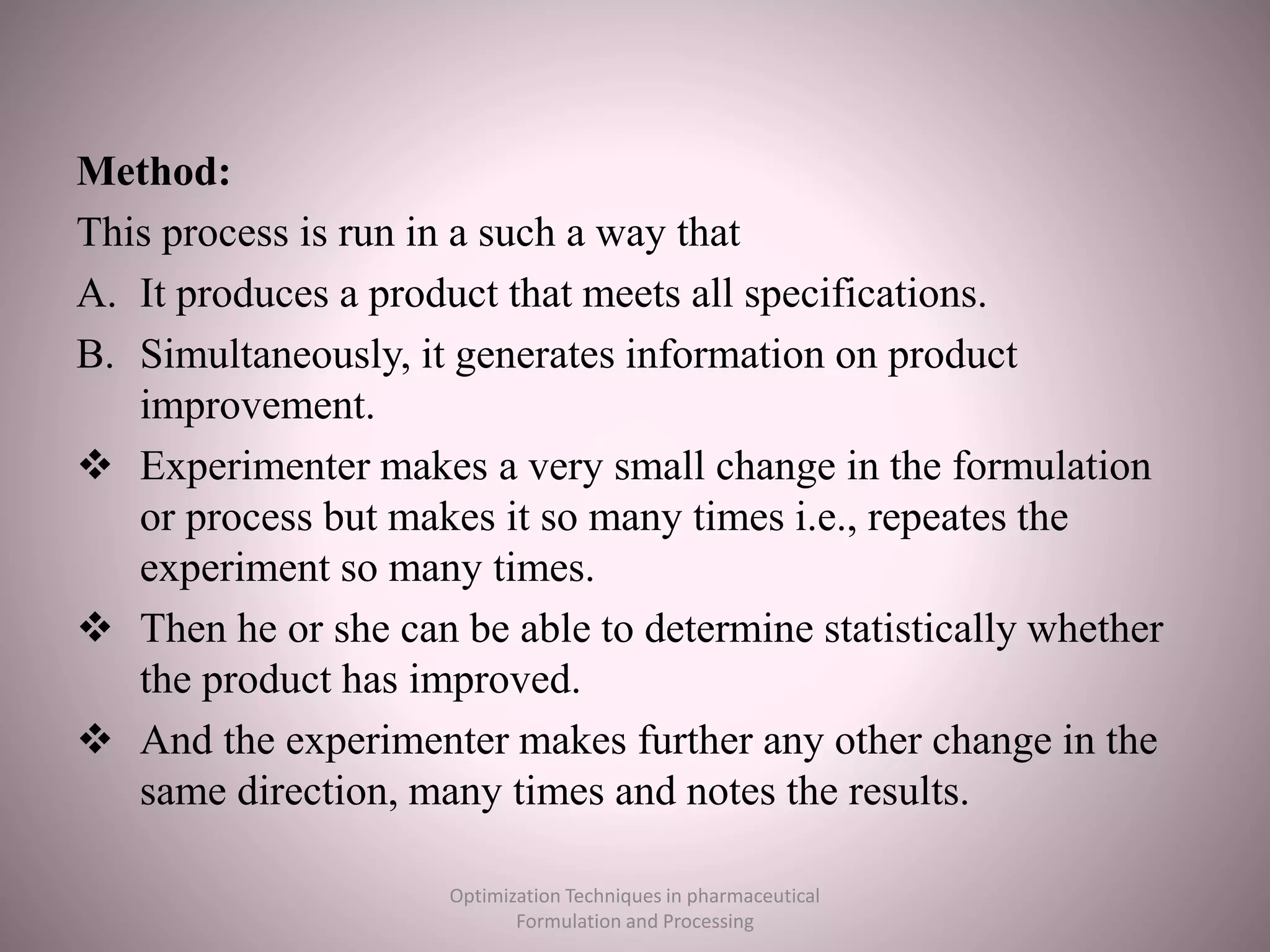
Method:
This process is run in a such a way that
A. It produces a product that meets all specifications.
B. Simultaneously, it generates information on product
improvement.
 Experimenter makes a very small change in the formulation
or process but makes it so many times i.e., repeates the
experiment so many times.
 Then he or she can be able to determine statistically whether
the product has improved.
 And the experimenter makes further any other change in the
same direction, many times and notes the results.
Optimization Techniques in pharmaceutical
Formulation and Processing
 This continues until further changes do not improve the
product or perhaps become detrimental.
Applications:
1. It was applied to tablets by Rubinstein.
2. It has also been applied to an inspection system for parenteral
products.
Drawbacks:
1. It is impractical and expensive to use.
2. It is not a substitute for good laboratory scale investigation.
Optimization Techniques in pharmaceutical
Formulation and Processing
2.Simplex method:
 It is most widely applied technique.
 It was proposed by Spendley et.al.
 This technique has even wider appeal in areas other than
formulation and processing.
 A good example to explain its principle is the application to
the development of an analytical method i.e., a continuous
flow anlayzer, it was predicted by Deming and king.
 Simplex method is a geometric figure that has one or more
point than the number of factors.
 If two factors or any independent variables are there, then
simplex is represented triangle.
 Once the shape of a simplex has been determined, the method
can employ a simplex of fixed size or of variable sizes that are
determined by comparing the magnitude of the responses after
each successive calculation.
Optimization Techniques in pharmaceutical
Formulation and Processing
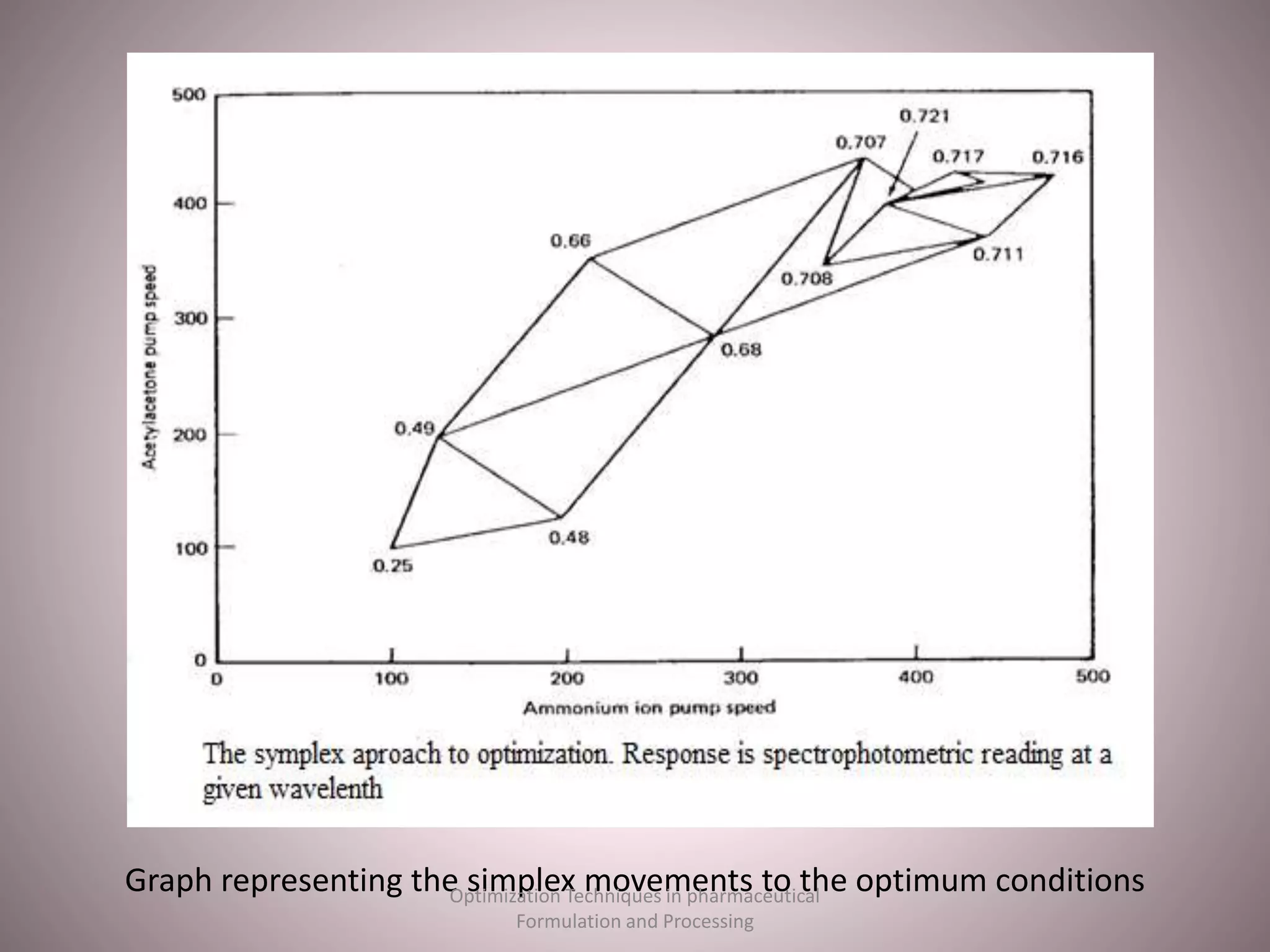
Graph representing the simplex movements to the optimum conditions
Optimization Techniques in pharmaceutical
Formulation and Processing
Explaination:
 The two axes in the figure are nothing but two independent
variables show the pump speeds for the two reagents required
in the analysis reaction.
 The initial simplex is represented by the lowest triangle.
 The vertices represent the spectrophotometric response.
 The strategy is moves towards a better response.
 The worst response is 0.25, conditions are selected at the
vertex, 0.6 and indeed improvement is obtained.
 Then the experiment path is followed to obtain optimum,
0.721.
Optimization Techniques in pharmaceutical
Formulation and Processing
Applications of method:
1. This method was used by Shek.et.al. to search for an capsule
formula.
2. This was applied to study the solubility problem involving
butaconazolenitrate in a multicomponent system.
3. Bindschaeder and Gurny published an adaptation of the
simplex technique to a TI-59 calculator and applied
successfully to a direct compression tablet of acetaminophen.
4. Janeczeck applied the approach to a liquid system i.e., a
pharmaceutical solution and was able to optimize physical
stability.
Optimization Techniques in pharmaceutical
Formulation and Processing
3. The Lagragian method:
 This optimization method represents the mathematical
technique, is an extension of the classic method.
 Fonner.et.al gave ideas of understanding this technique by
applying it to a tablet formulation and by considering two
independent variables.
Optimization Techniques in pharmaceutical
Formulation and Processing
Explaination :
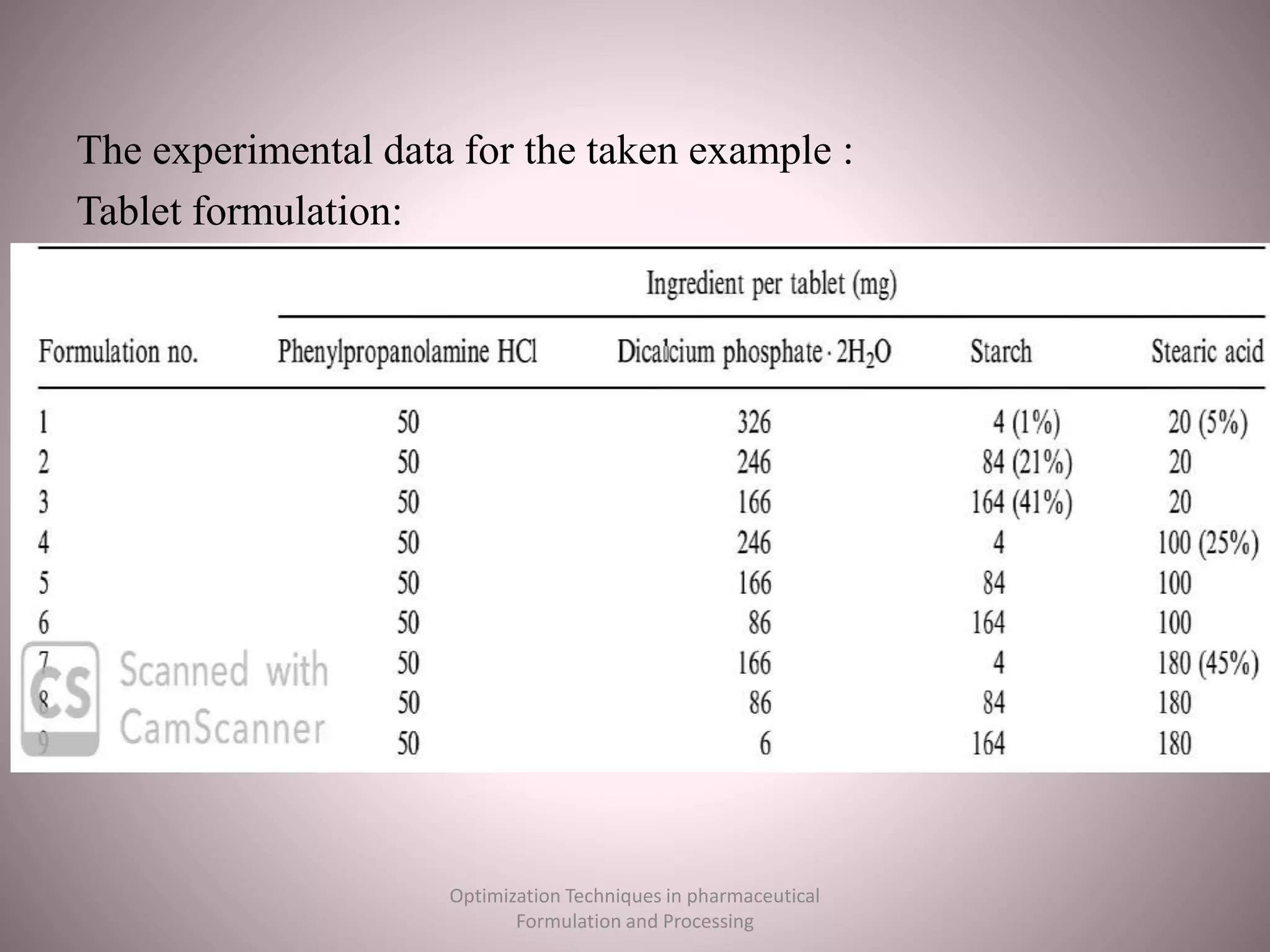
 The active ingredient, phenylpropanolamine HCl , was kept at
a constant level, and the levels of disintegrant (corn starch)
and lubricant (stearic acid) were selected as the independent
variables x1 and x2 .
 The dependent variables include tablet hardness, friability,
volume, in vitro release rate and urinary excretion rate in
human subjects.
 This techniques requires that the experimentation to be
completed before optimization so that mathematical models
can be generated.
Optimization Techniques in pharmaceutical
Formulation and Processing
The experimental data for the taken example :
Tablet formulation:
Optimization Techniques in pharmaceutical
Formulation and Processing
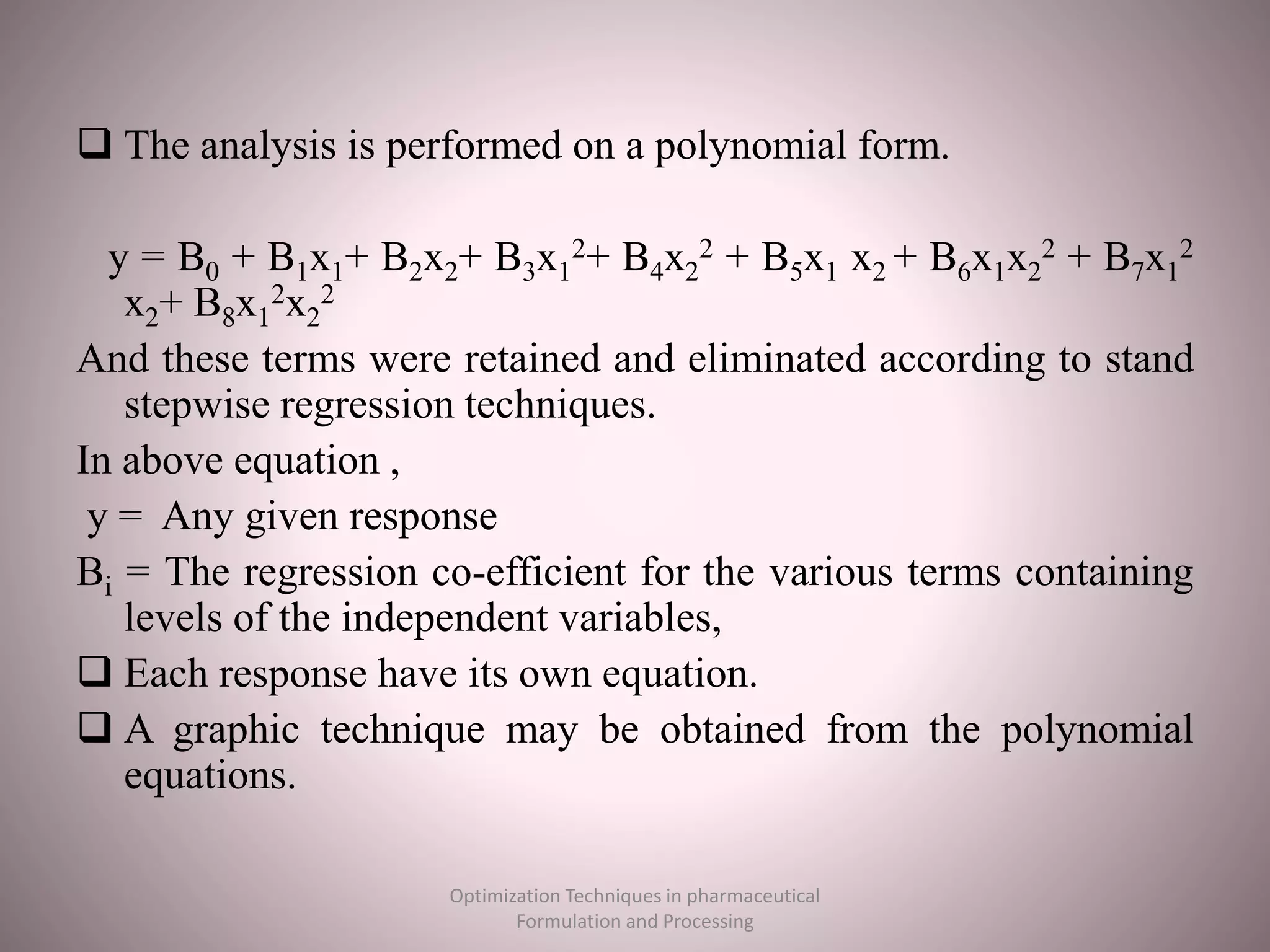
 The analysis is performed on a polynomial form.
y = B0 + B1x1+ B2x2+ B3x1
2+ B4x2
2 + B5x1 x2 + B6x1x2
2 + B7x1
2
x2+ B8x1
2x2
2
And these terms were retained and eliminated according to stand
stepwise regression techniques.
In above equation ,
y = Any given response
Bi = The regression co-efficient for the various terms containing
levels of the independent variables,
 Each response have its own equation.
 A graphic technique may be obtained from the polynomial
equations.
Optimization Techniques in pharmaceutical
Formulation and Processing
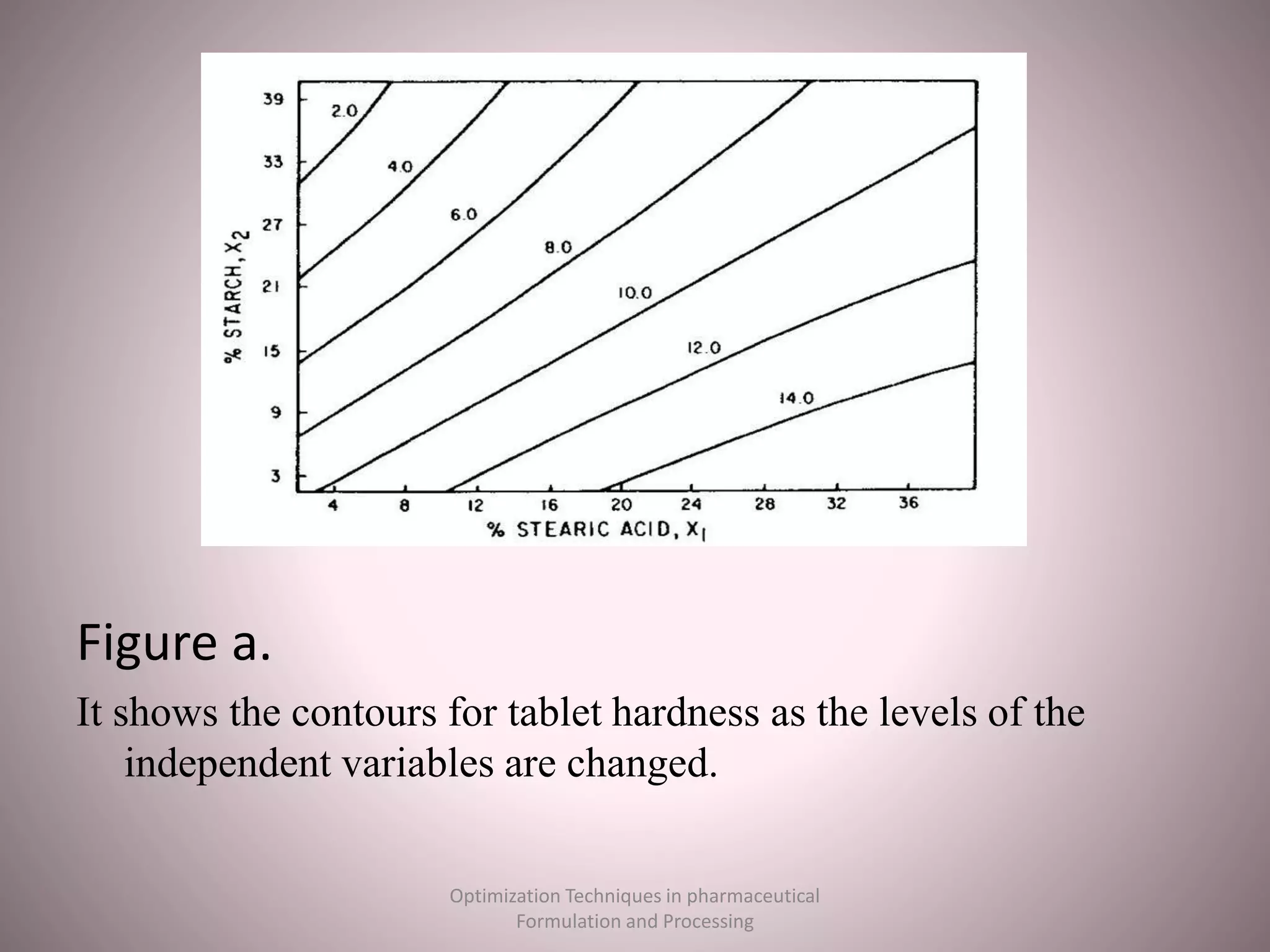
Figure a.
It shows the contours for tablet hardness as the levels of the
independent variables are changed.
Optimization Techniques in pharmaceutical
Formulation and Processing
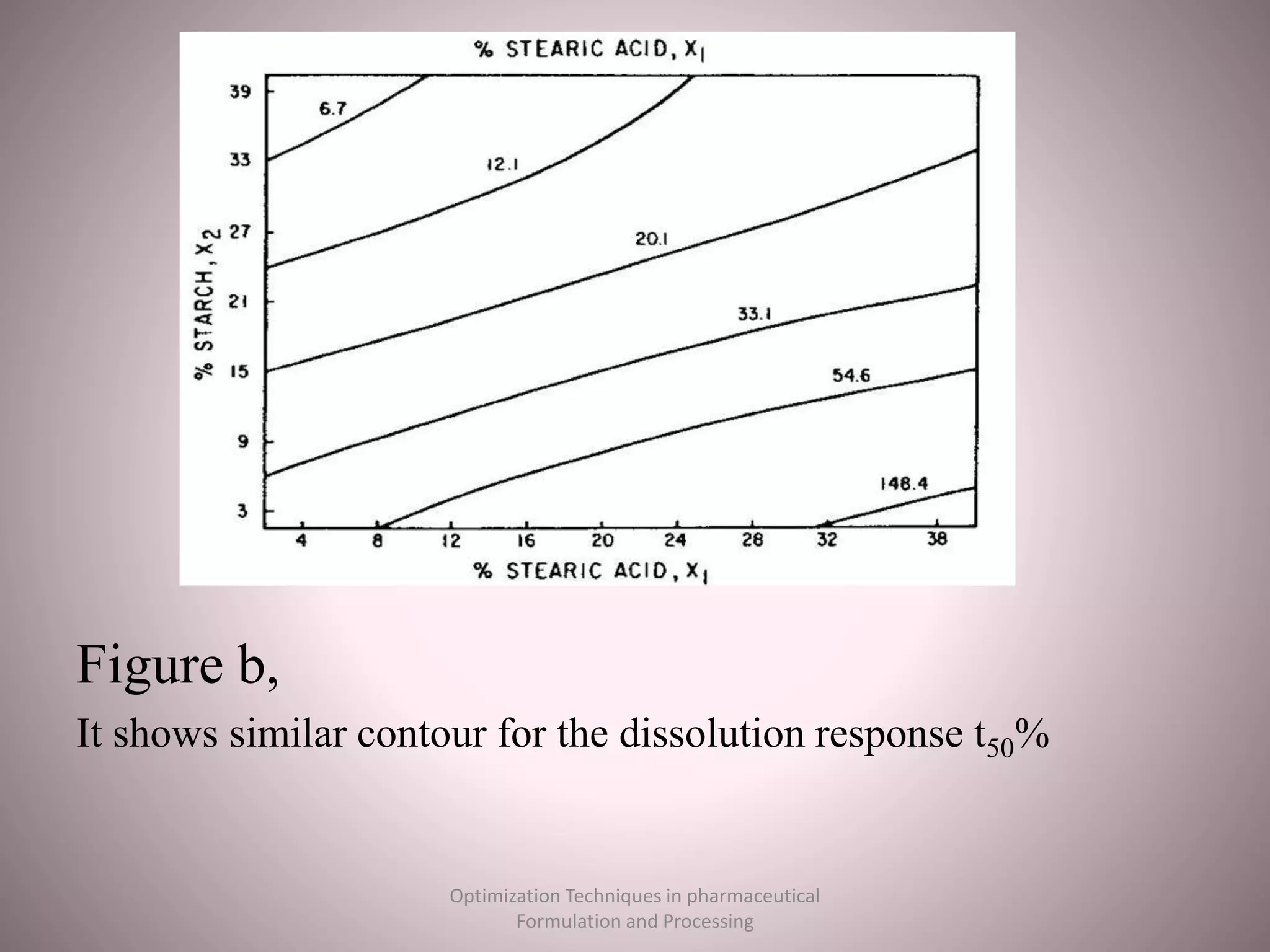
Figure b,
It shows similar contour for the dissolution response t50%
Optimization Techniques in pharmaceutical
Formulation and Processing
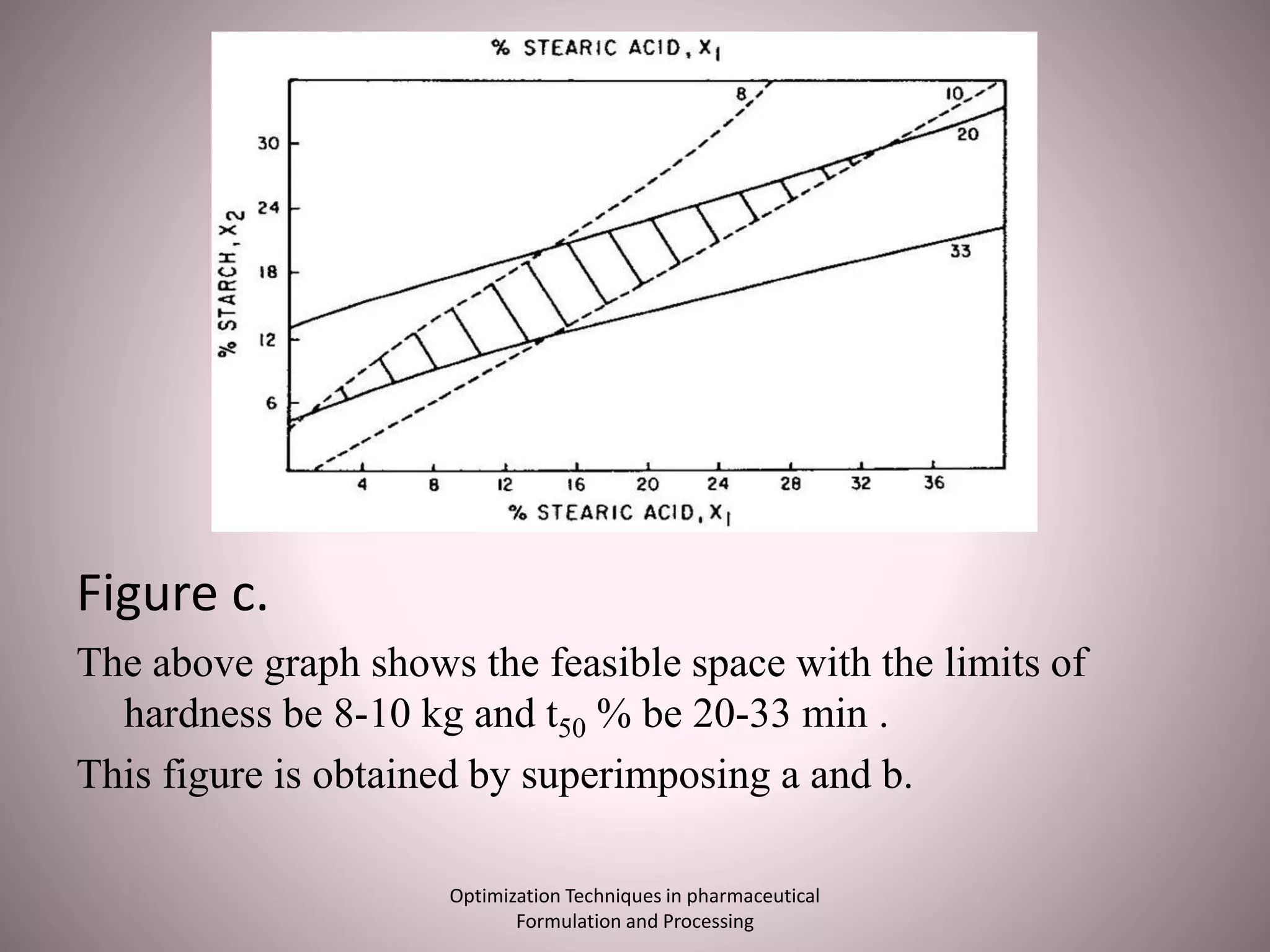
Figure c.
The above graph shows the feasible space with the limits of
hardness be 8-10 kg and t50 % be 20-33 min .
This figure is obtained by superimposing a and b.
Optimization Techniques in pharmaceutical
Formulation and Processing
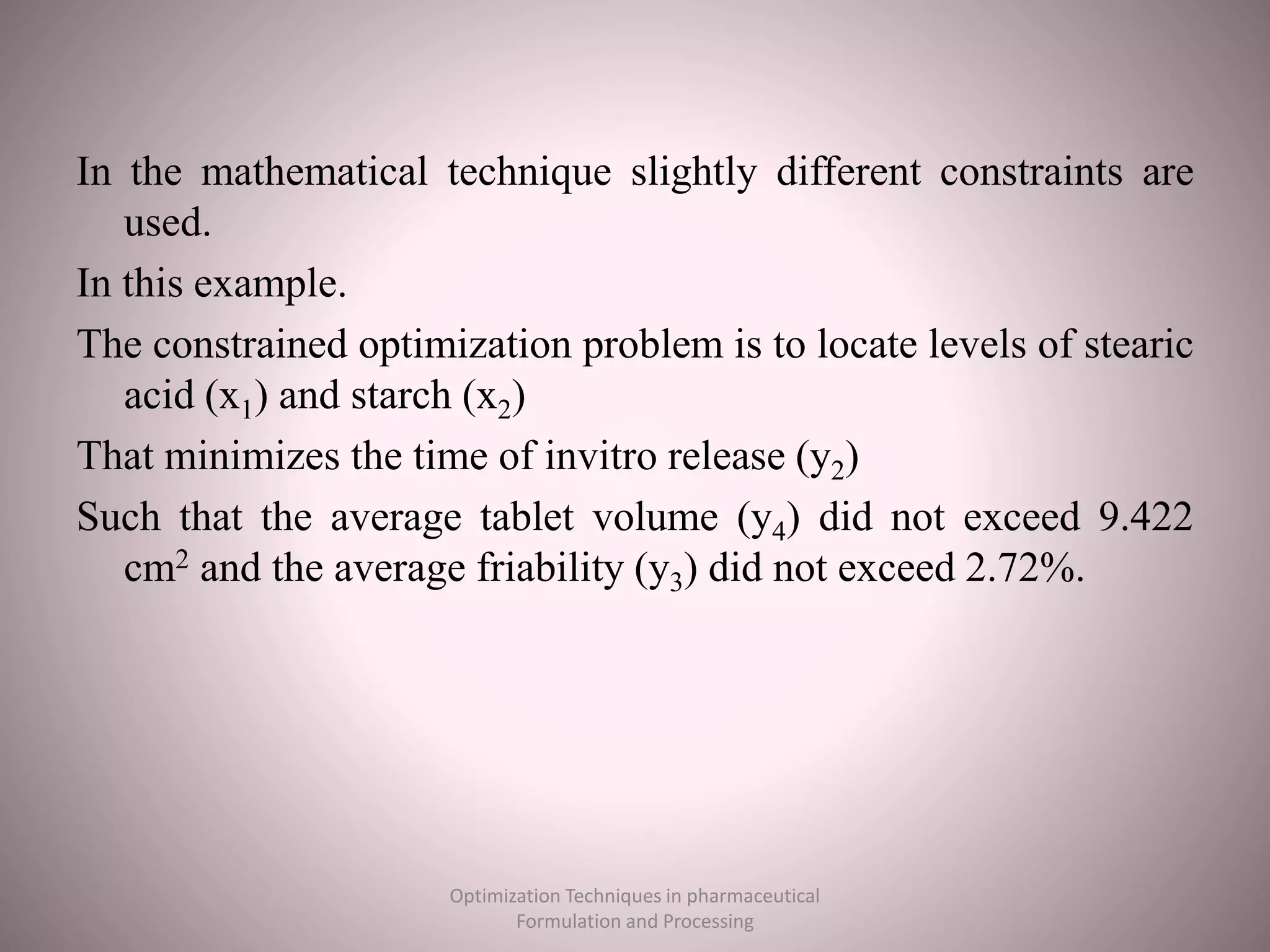
In the mathematical technique slightly different constraints are
used.
In this example.
The constrained optimization problem is to locate levels of stearic
acid (x1) and starch (x2)
That minimizes the time of invitro release (y2)
Such that the average tablet volume (y4) did not exceed 9.422
cm2 and the average friability (y3) did not exceed 2.72%.
Optimization Techniques in pharmaceutical
Formulation and Processing
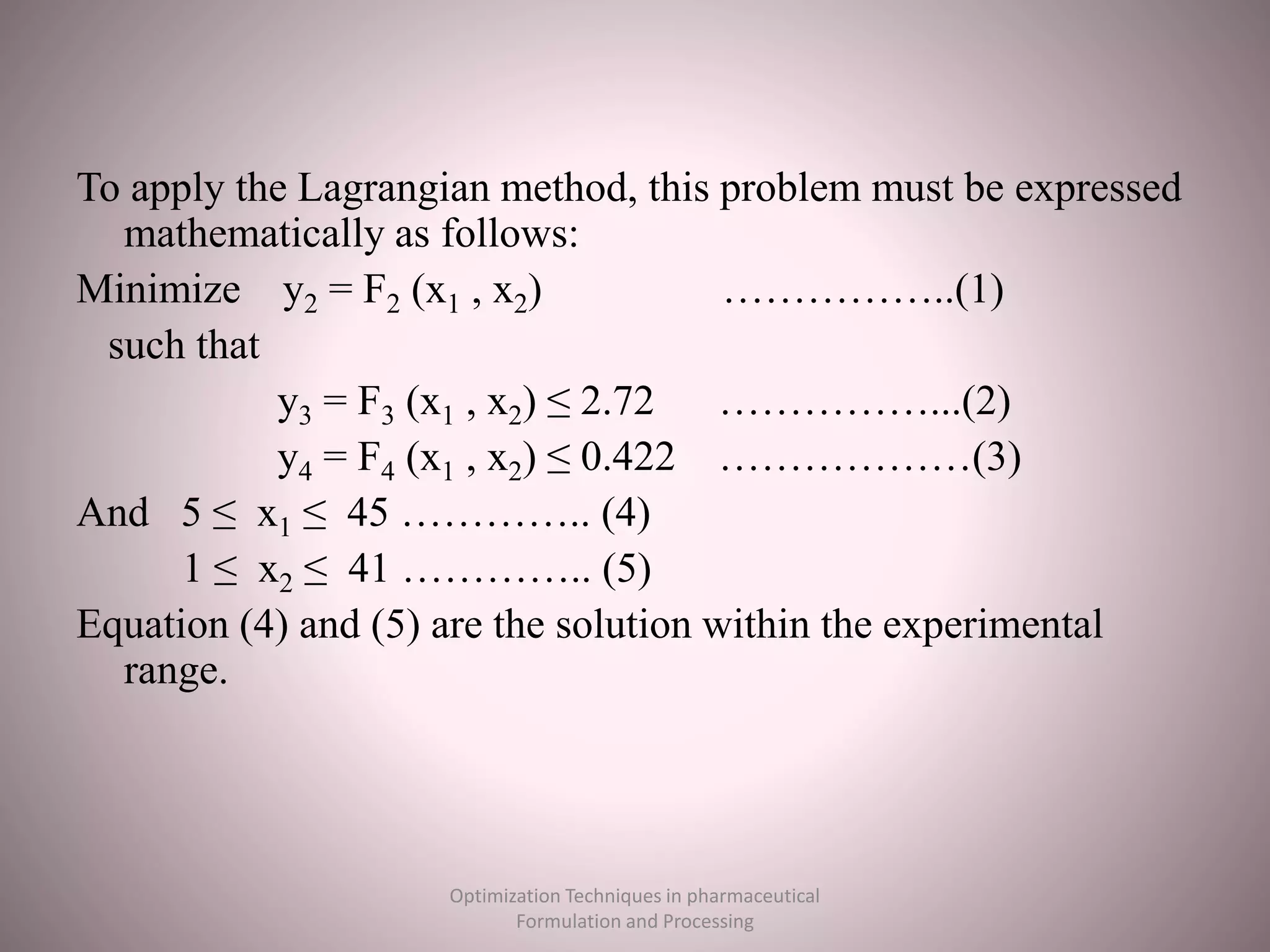
To apply the Lagrangian method, this problem must be expressed
mathematically as follows:
Minimize y2 = F2 (x1 , x2) ……………..(1)
such that
y3 = F3 (x1 , x2) ≤ 2.72 ……………...(2)
y4 = F4 (x1 , x2) ≤ 0.422 ………………(3)
And 5 ≤ x1 ≤ 45 ………….. (4)
1 ≤ x2 ≤ 41 ………….. (5)
Equation (4) and (5) are the solution within the experimental
range.
Optimization Techniques in pharmaceutical
Formulation and Processing
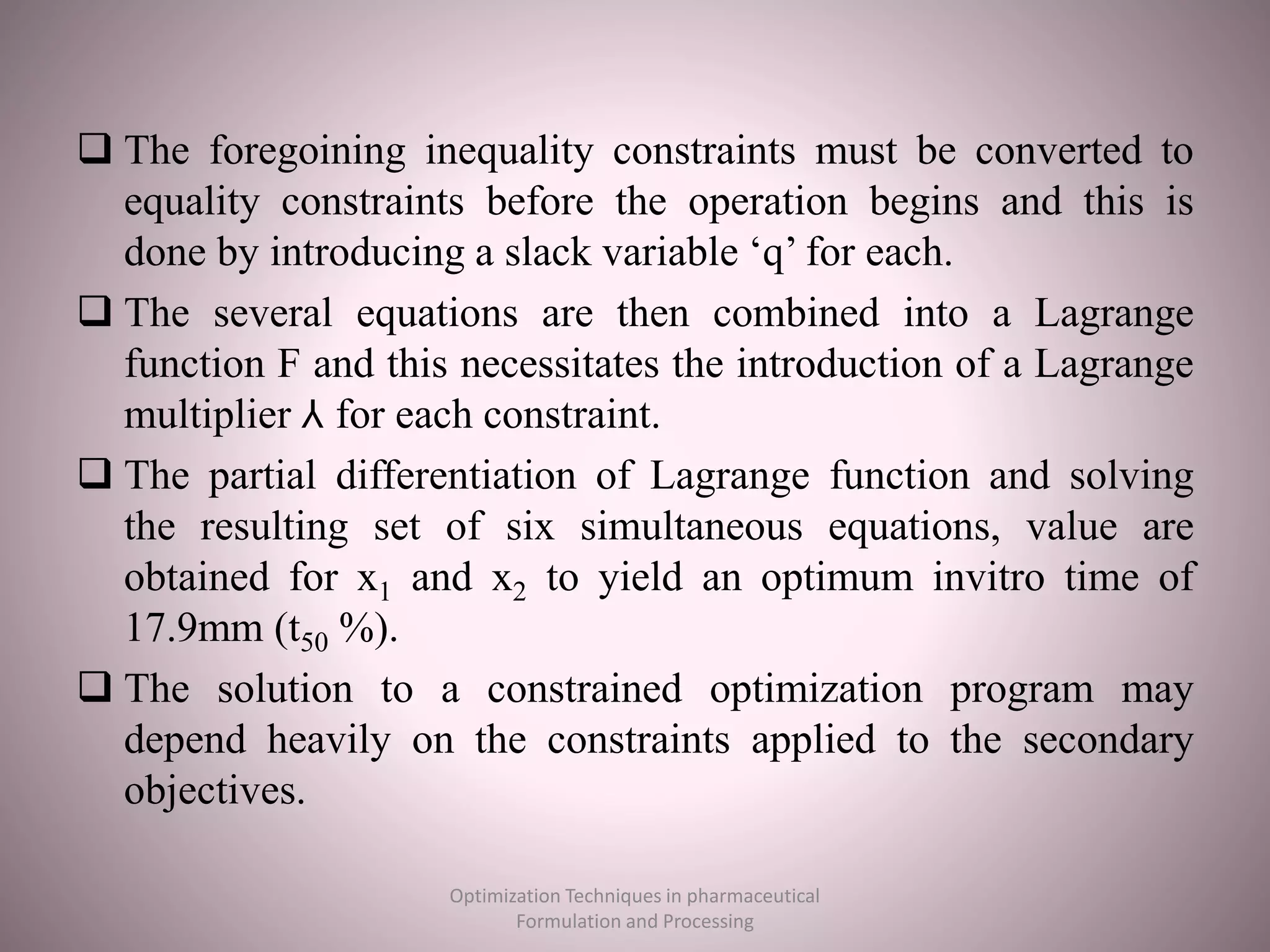
 The foregoining inequality constraints must be converted to
equality constraints before the operation begins and this is
done by introducing a slack variable ‘q’ for each.
 The several equations are then combined into a Lagrange
function F and this necessitates the introduction of a Lagrange
multiplier ⅄ for each constraint.
 The partial differentiation of Lagrange function and solving
the resulting set of six simultaneous equations, value are
obtained for x1 and x2 to yield an optimum invitro time of
17.9mm (t50 %).
 The solution to a constrained optimization program may
depend heavily on the constraints applied to the secondary
objectives.
Optimization Techniques in pharmaceutical
Formulation and Processing
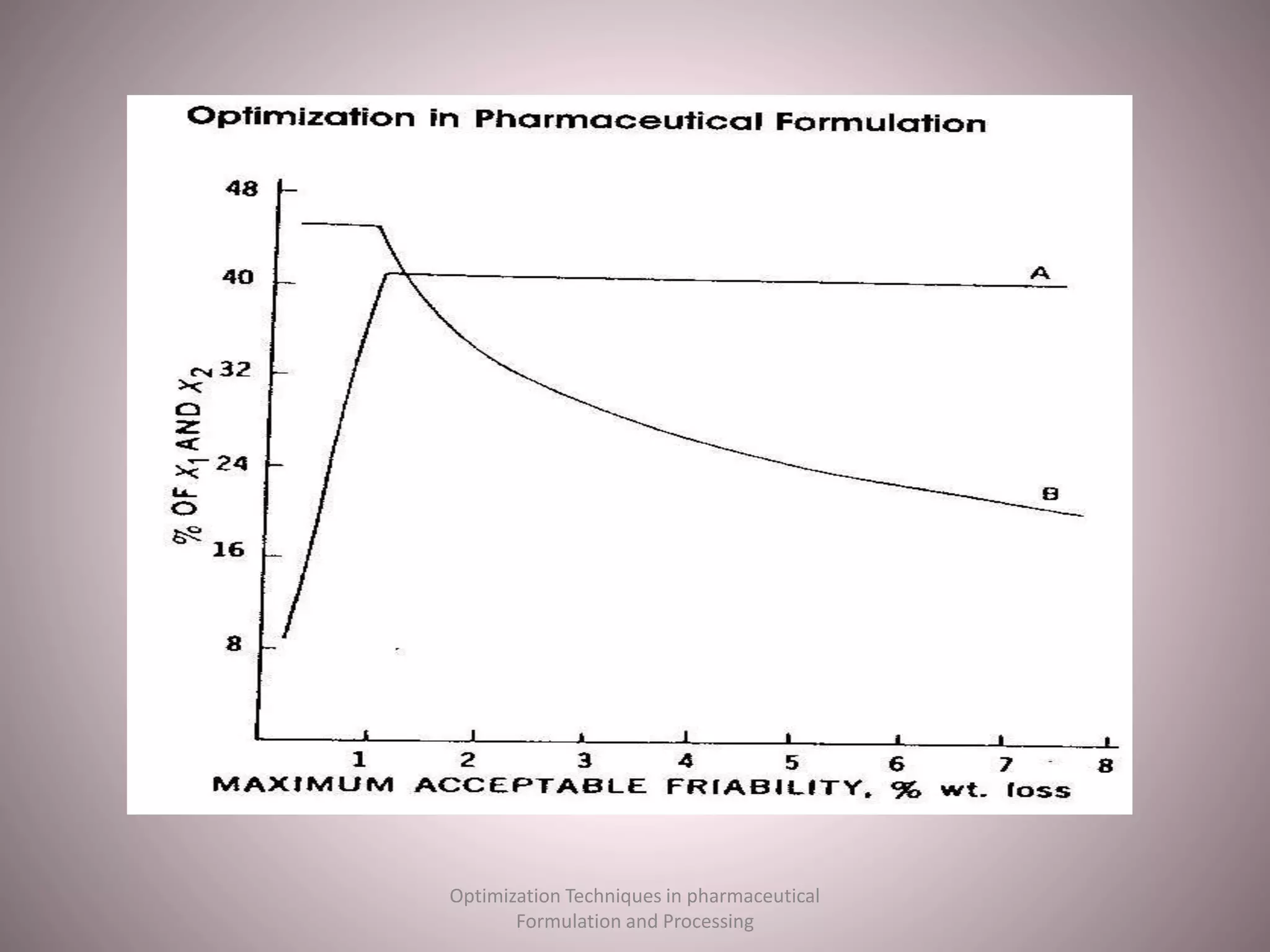
 A technique called “sensitive analysis” can provide
information so that the formulator can further trade off one
property for another.
 For sensitivity analysis the formulator solves the constrained
optimization problem for systemic changes in the secondary
objectives.
Example :
Optimization Techniques in pharmaceutical
Formulation and Processing
Optimization Techniques in pharmaceutical
Formulation and Processing
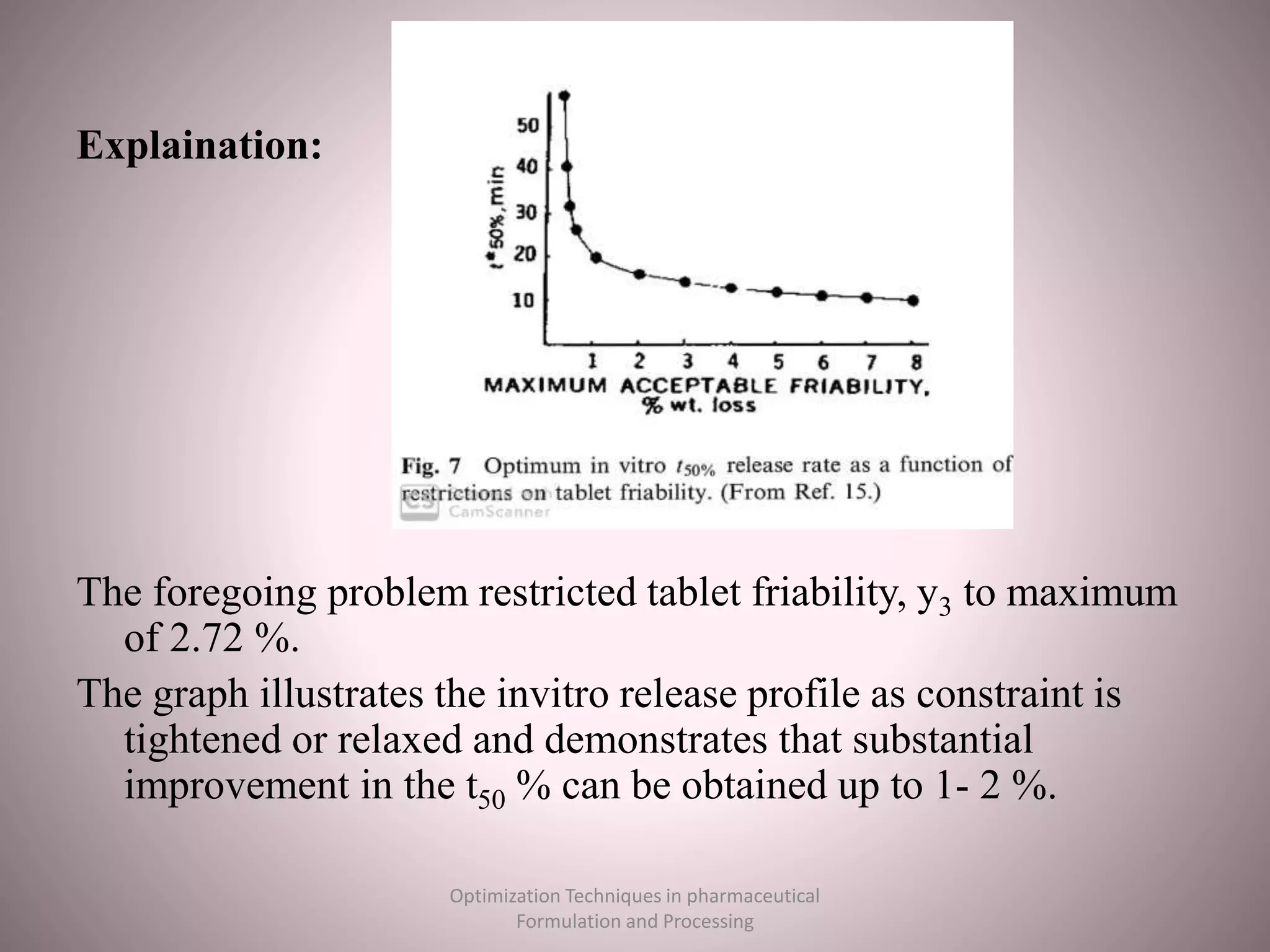
Explaination:
The foregoing problem restricted tablet friability, y3 to maximum
of 2.72 %.
The graph illustrates the invitro release profile as constraint is
tightened or relaxed and demonstrates that substantial
improvement in the t50 % can be obtained up to 1- 2 %.
Optimization Techniques in pharmaceutical
Formulation and Processing
The several steps in the Lagrangian method can be written as
follows:
Step-1 : Determine objective function.
Step-2 : Determine constraints.
Step-3 : Change inequality constraints to equality constraints.
Step-4 : Form the Lagrange function, F
a. One Lagrange multiplier ⅄ for each constraint.
b. One slack variable q for each inequality constraint.
Step-5 : Partially differentiate the Lagrange function for each
variable and set derivatives equal to zero.
Step-6 : Solve the set of simultaneous equations.
Step-7 : Substitute the resulting values into the objective
functions.
Optimization Techniques in pharmaceutical
Formulation and Processing
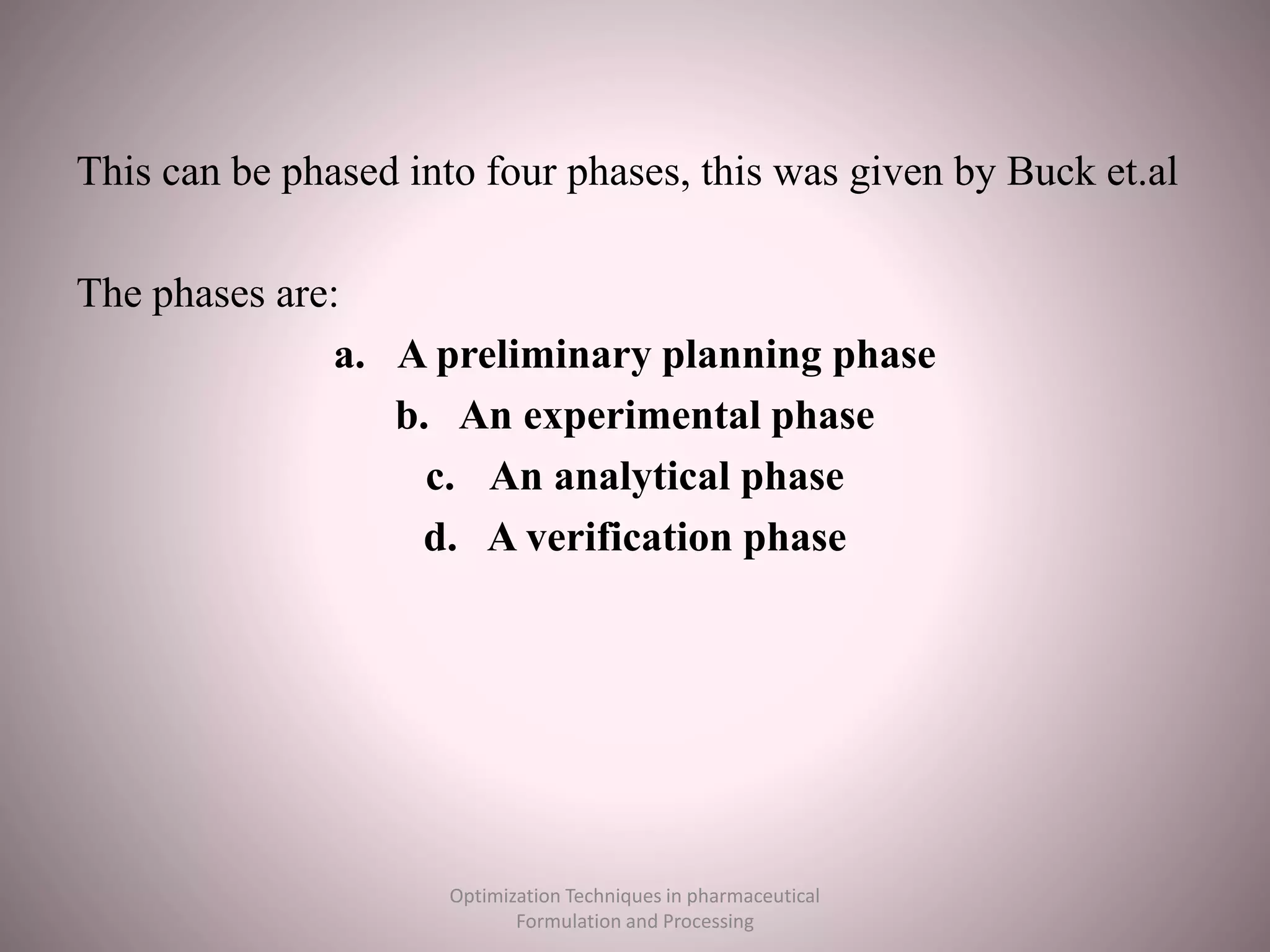
This can be phased into four phases, this was given by Buck et.al
The phases are:
a. A preliminary planning phase
b. An experimental phase
c. An analytical phase
d. A verification phase
Optimization Techniques in pharmaceutical
Formulation and Processing
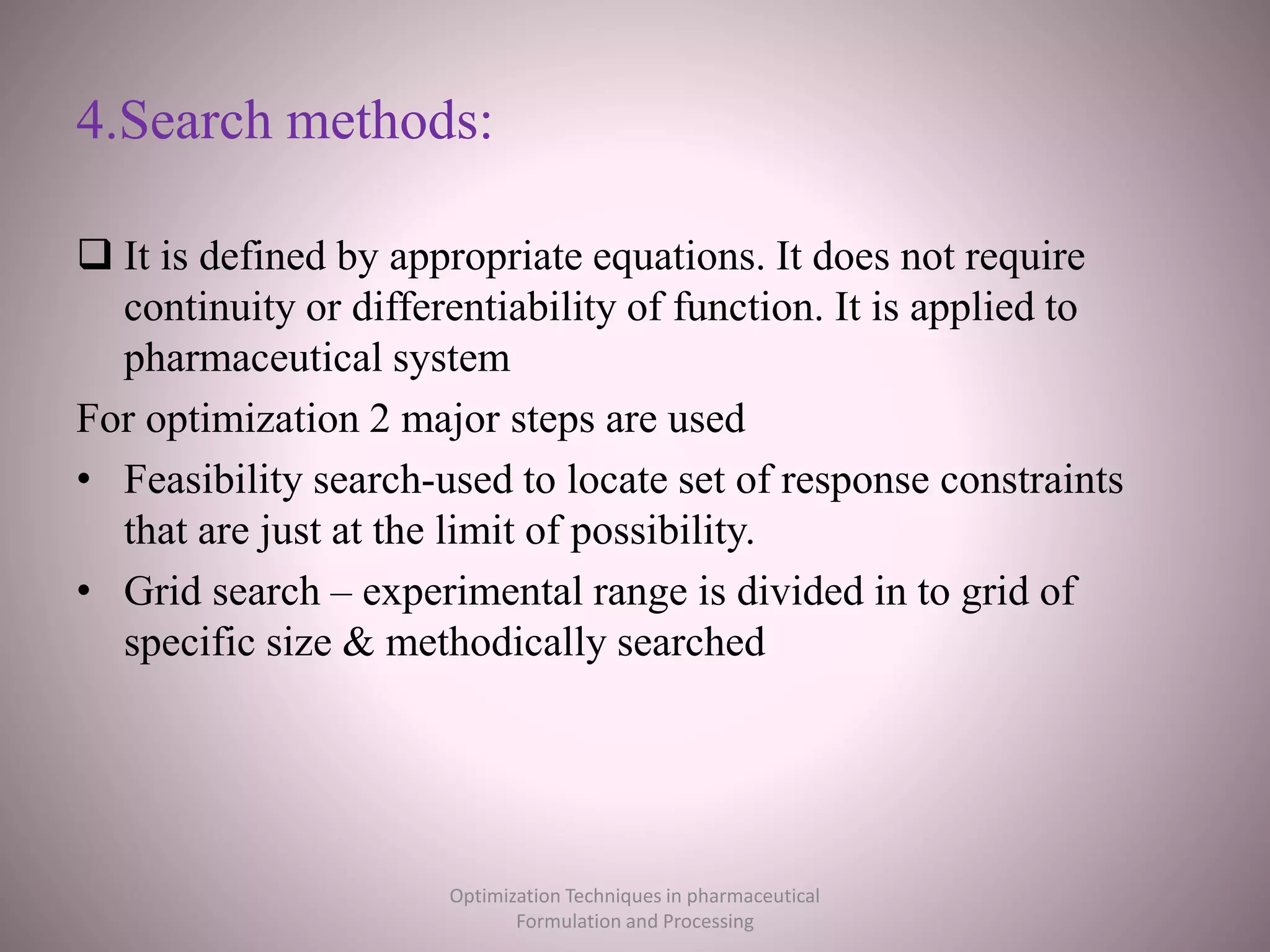
4.Search methods:
 It is defined by appropriate equations. It does not require
continuity or differentiability of function. It is applied to
pharmaceutical system
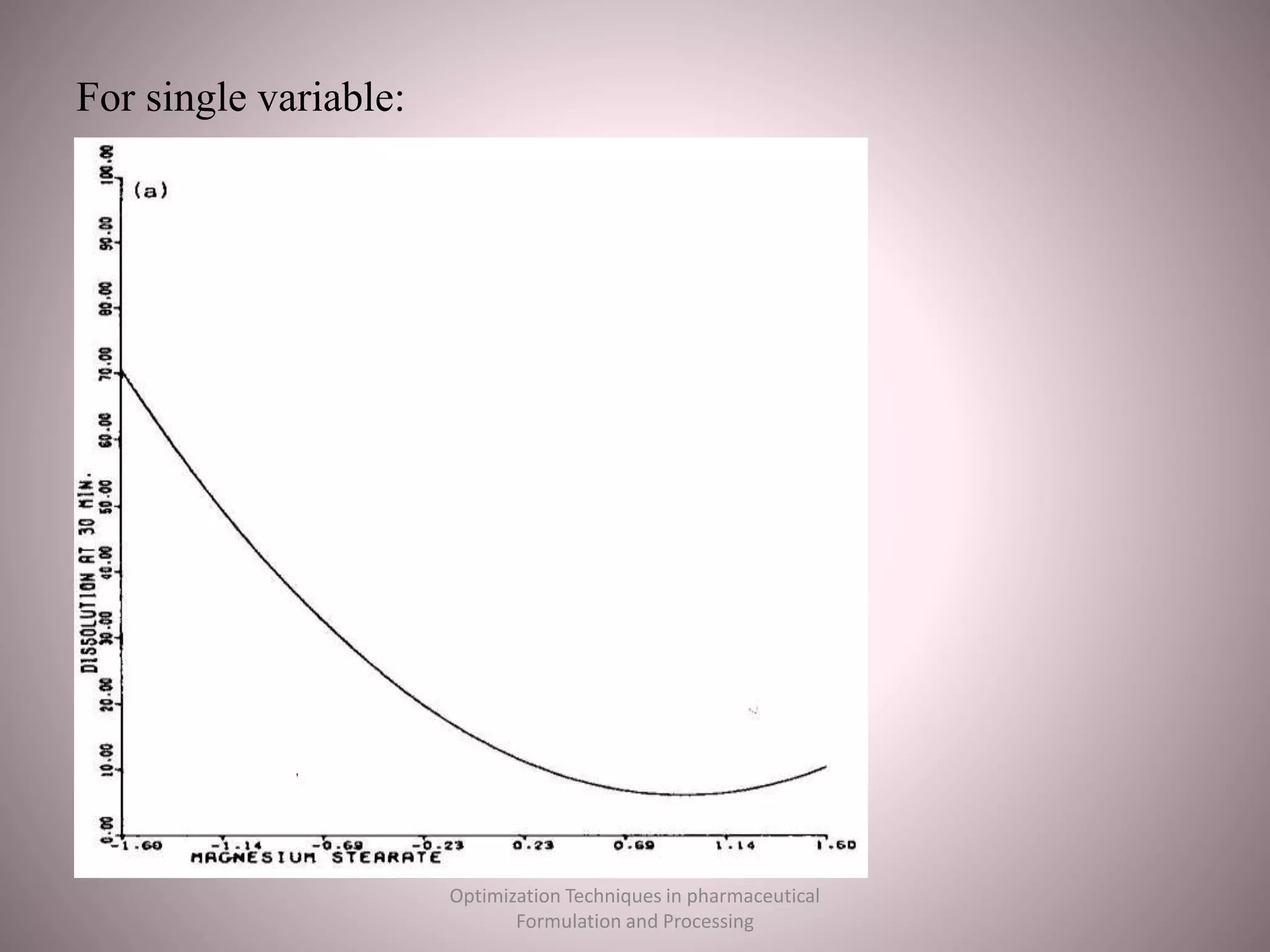
For optimization 2 major steps are used
• Feasibility search-used to locate set of response constraints
that are just at the limit of possibility.
• Grid search – experimental range is divided in to grid of
specific size & methodically searched
Optimization Techniques in pharmaceutical
Formulation and Processing
Steps involved in search method
 Select a system
 Select variables
 Perform experiments and test product
 Submit data for statistical and regression analysis
 Set specifications for feasibility program
 Select constraints for grid search
 Evaluate grid search printout
Optimization Techniques in pharmaceutical
Formulation and Processing
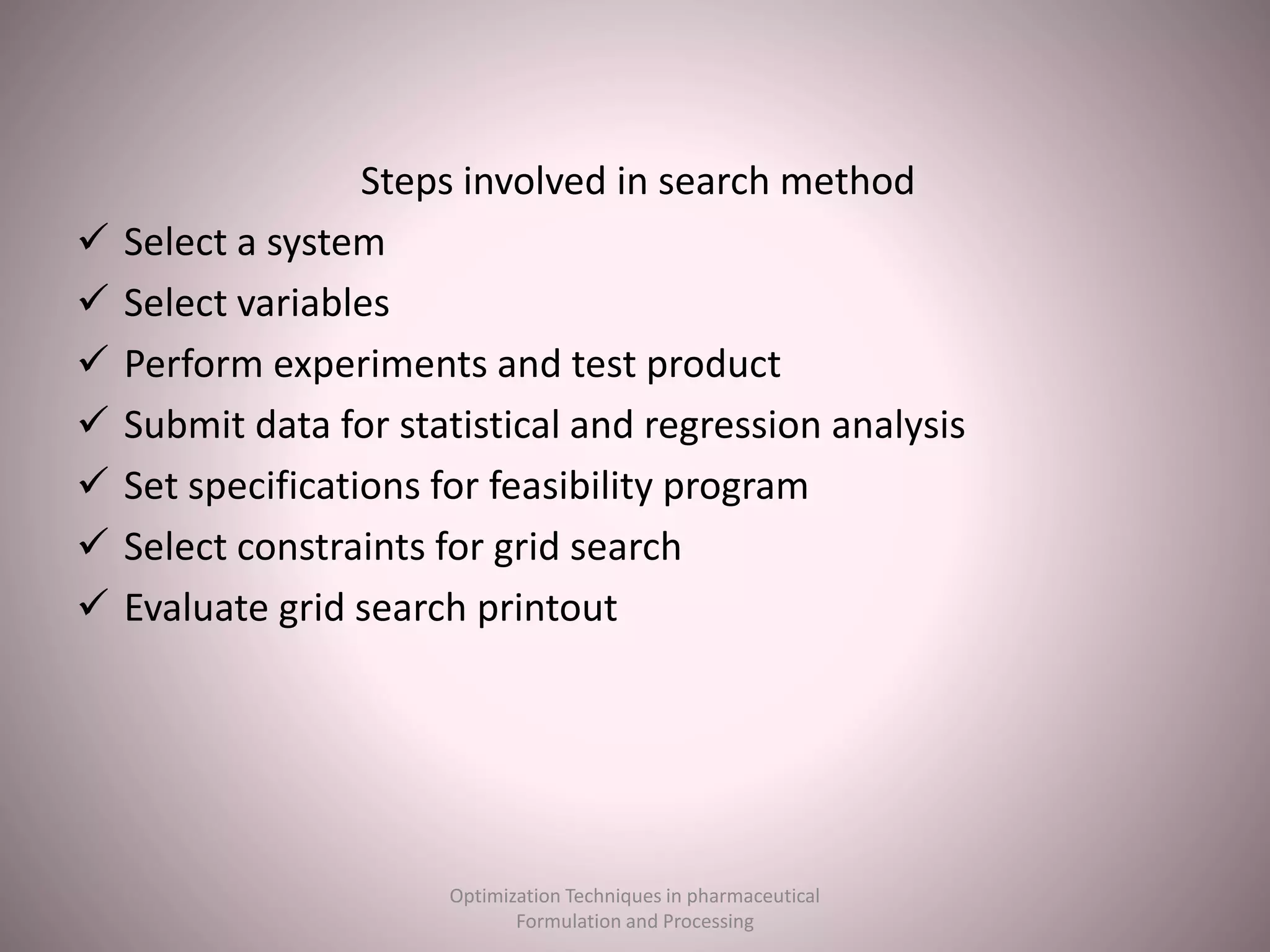
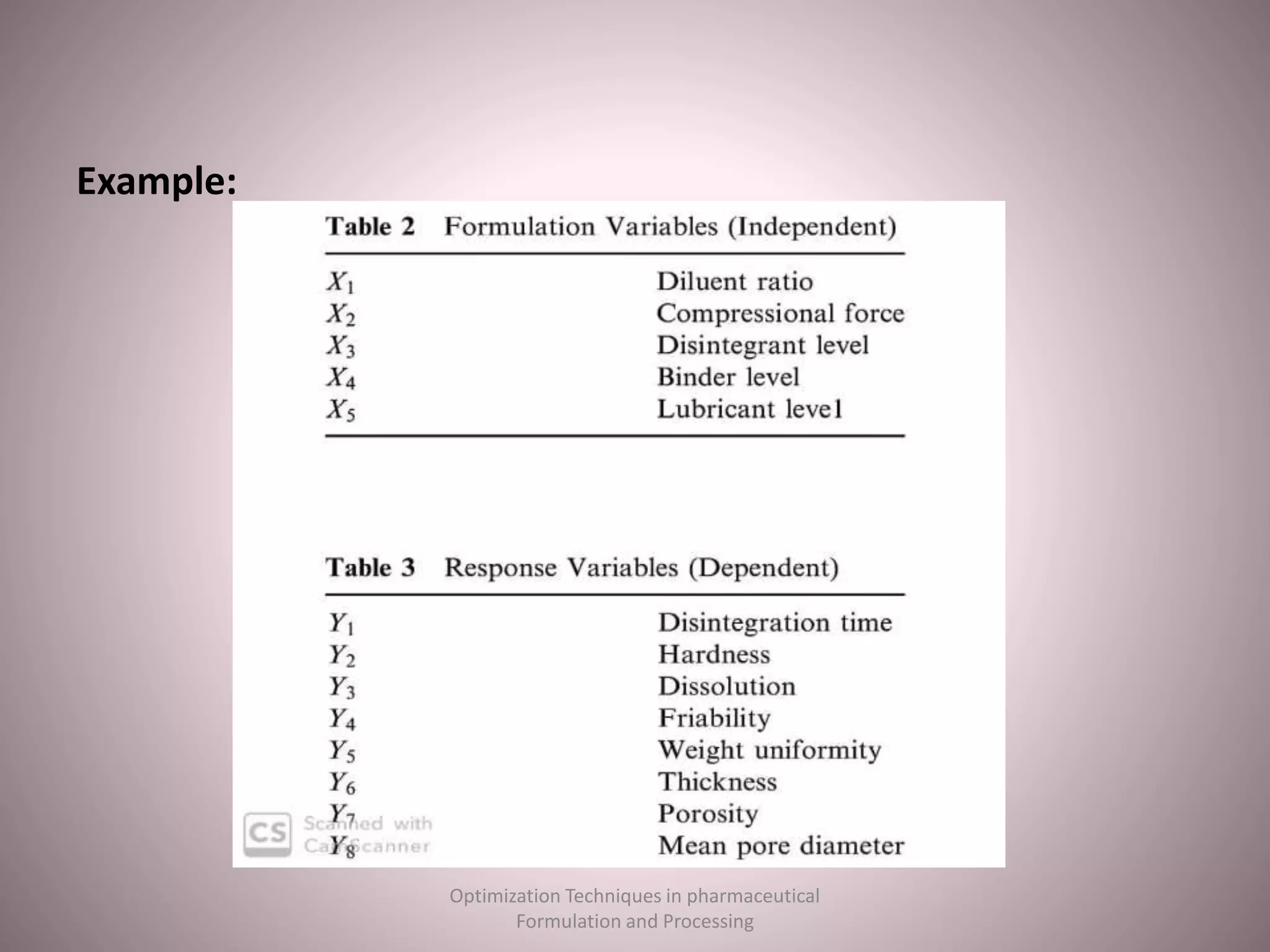
Example:
Optimization Techniques in pharmaceutical
Formulation and Processing
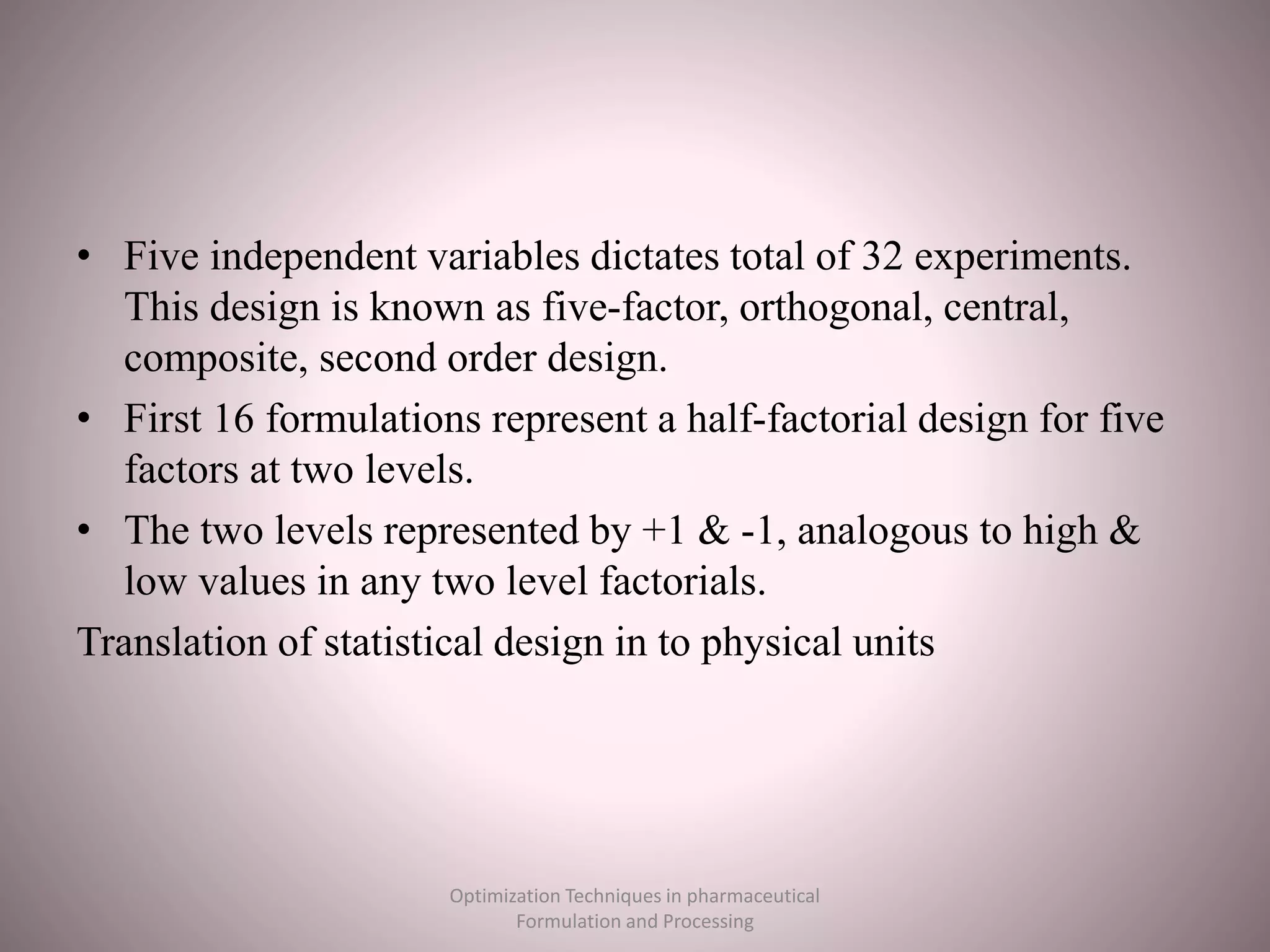
• Five independent variables dictates total of 32 experiments.
This design is known as five-factor, orthogonal, central,
composite, second order design.
• First 16 formulations represent a half-factorial design for five
factors at two levels.
• The two levels represented by +1 & -1, analogous to high &
low values in any two level factorials.
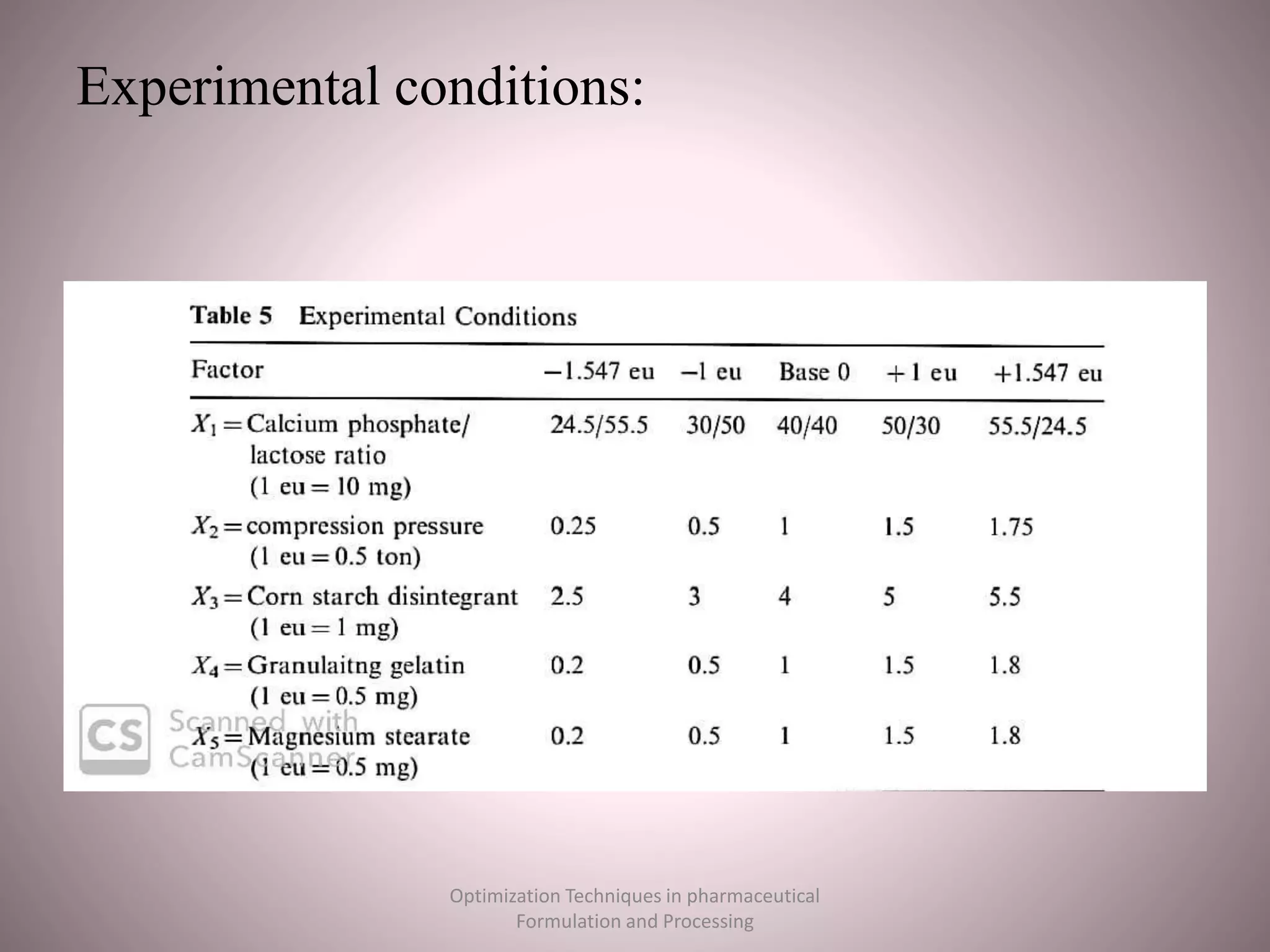
Translation of statistical design in to physical units
Optimization Techniques in pharmaceutical
Formulation and Processing
Experimental conditions:
Optimization Techniques in pharmaceutical
Formulation and Processing
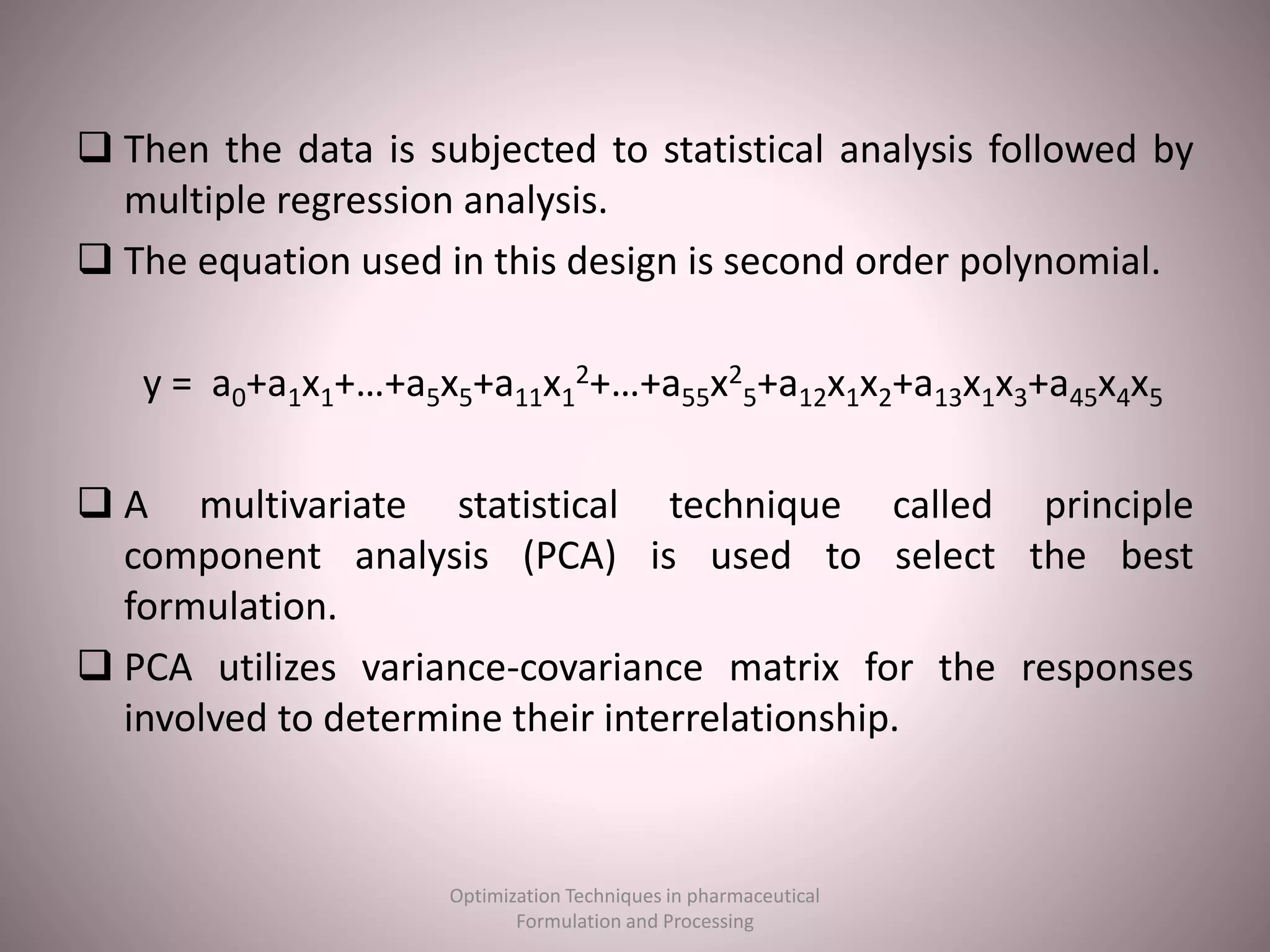
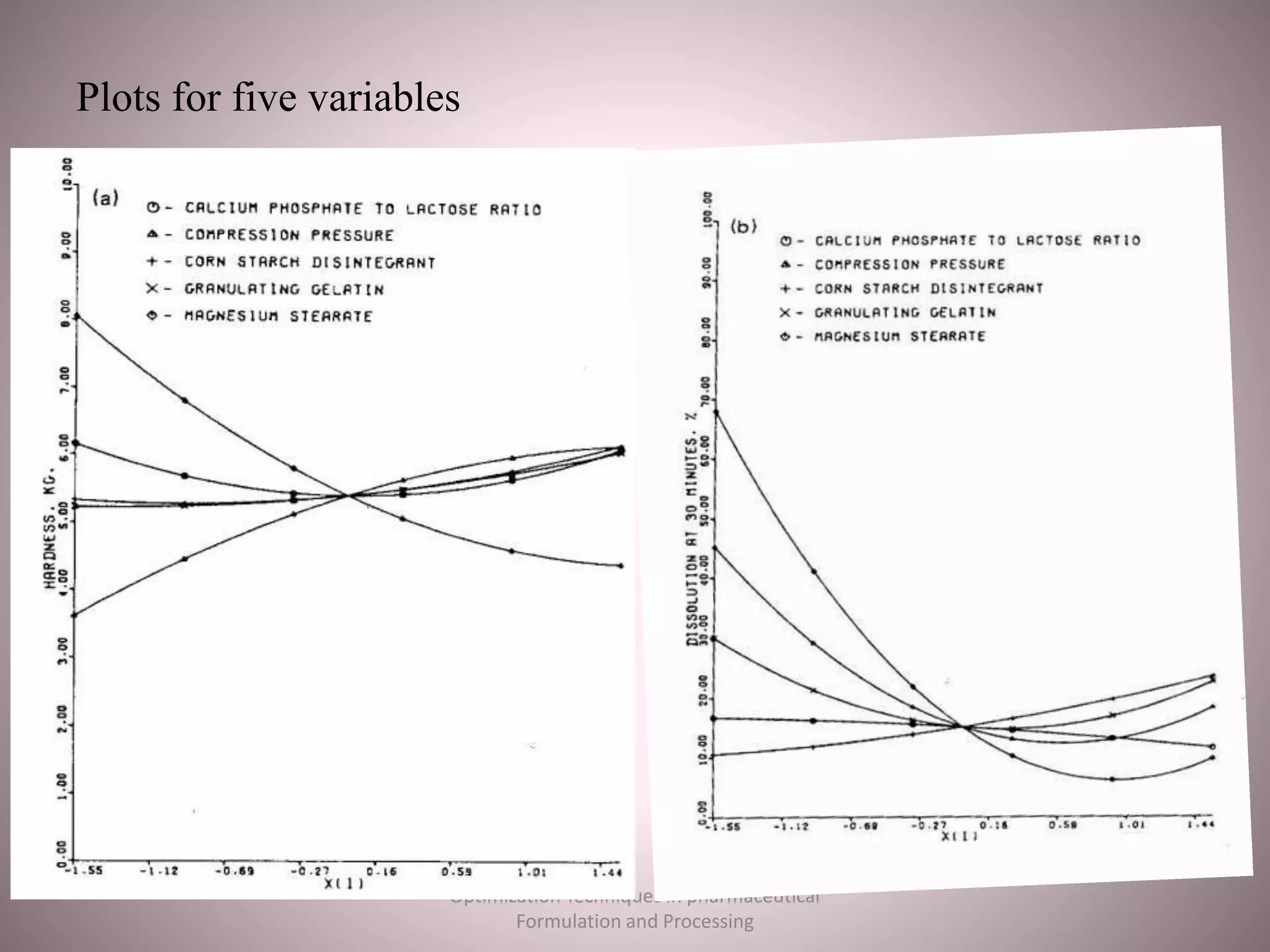
 Then the data is subjected to statistical analysis followed by
multiple regression analysis.
 The equation used in this design is second order polynomial.
y = a0+a1x1+…+a5x5+a11x1
2+…+a55x2
5+a12x1x2+a13x1x3+a45x4x5
 A multivariate statistical technique called principle
component analysis (PCA) is used to select the best
formulation.
 PCA utilizes variance-covariance matrix for the responses
involved to determine their interrelationship.
Optimization Techniques in pharmaceutical
Formulation and Processing
For single variable:
Optimization Techniques in pharmaceutical
Formulation and Processing
Plots for five variables
Optimization Techniques in pharmaceutical
Formulation and Processing
Advantages of search method:
 It takes five independent variables in to account.
 Persons unfamiliar with mathematics of optimization & with
no previous computer experience could carry out an
optimization study.
Optimization Techniques in pharmaceutical
Formulation and Processing
5. Canonical analysis
 It is a technique used to reduce a second order regression
equation. This allows immediate interpretation of the
regression equation by including the linear and interaction
terms in constant term.
 This was firstly adopted by Box and Wilson,
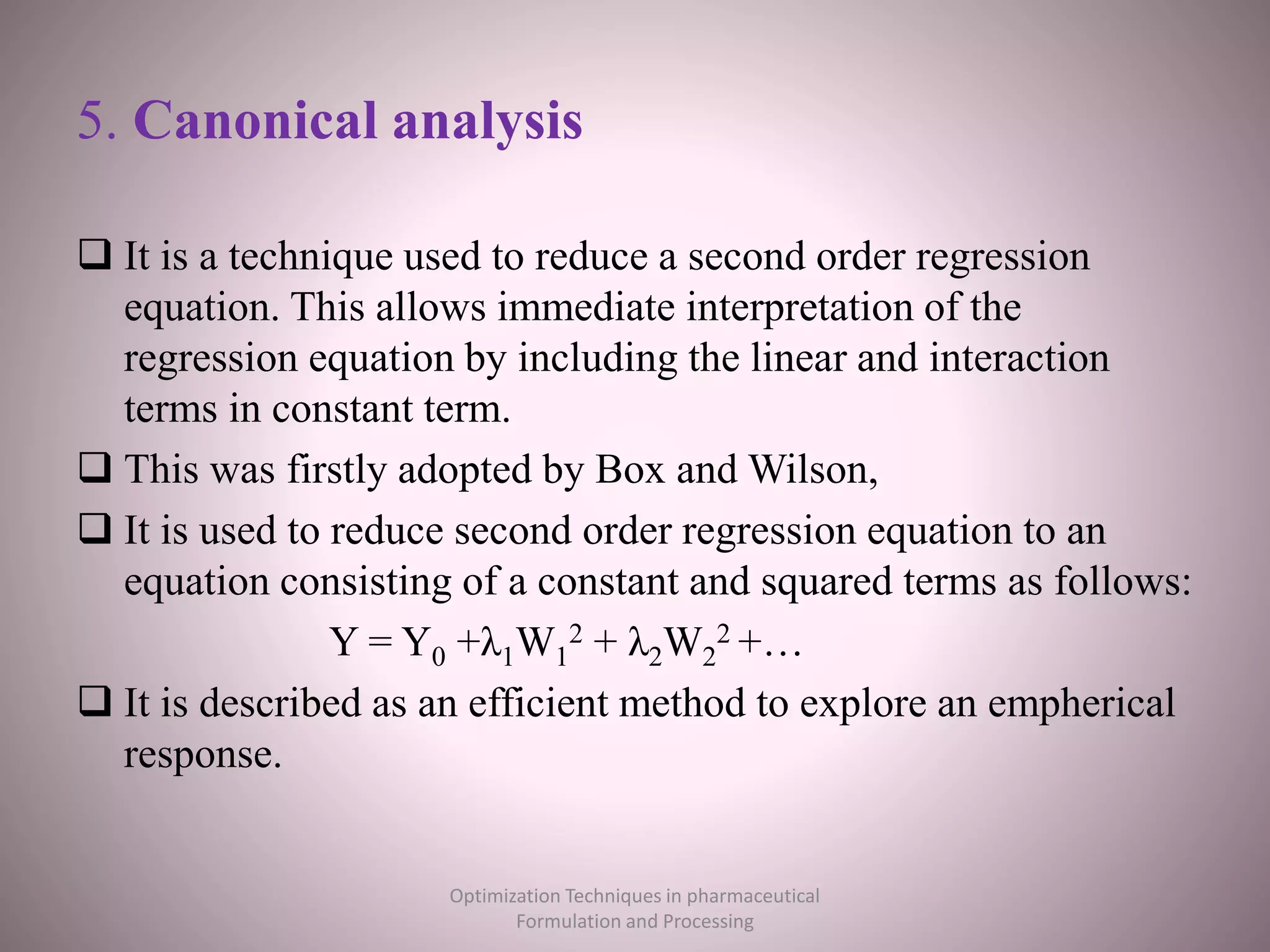
 It is used to reduce second order regression equation to an
equation consisting of a constant and squared terms as follows:
Y = Y0 +λ1W1
2 + λ2W2
2 +…
 It is described as an efficient method to explore an empherical
response.
Optimization Techniques in pharmaceutical
Formulation and Processing
References:
1. Modern Pharmaceutics; By Gillbert and S.
Banker – edited in 2002.
2. www.google.com
Optimization Techniques in pharmaceutical
Formulation and Processing
Optimization Techniques in pharmaceutical
Formulation and Processing

optimizationtechniquesinpharmaceuticalformulationandprocessing-190925130149 (1).pdf

  • 1.
    Optimization Techniques in pharmaceuticalFormulation and Processing PRESENTED BY, PRATIKSHA C CHANDRAGIRIVAR M PHARMA 1ST SEM DEPT, OF PHARMACEUTICS HSK COP BAGALKOT FACILITATED BY, AVINASH.S.G. ASSO.PROFESSOR DEPT.OF PHARMACEUTICS HSK COP BAGALKOT Optimization Techniques in pharmaceutical Formulation and Processing
  • 2.
    CONTENTS: 1. Concept ofoptimization 2. Parameters of optimization 3. Optimization techniques in pharmaceutical formulation and processing. Optimization Techniques in pharmaceutical Formulation and Processing
  • 3.
    1. CONCEPT OFOPTIMIZATION:  The term optimize is defined as “ to make perfect”.  In terms of sentence it is defined as choosing the best element from some set of available alternatives.  According to Merriam Webster dictionary, optimization means, “ An act, process or methodology of making something (as a design, system or a decision) as a fully perfect, functional or effective as possible; specially the mathematical procedures.  Optimization is also defined as “The process of finding the best values for the variables of a particular problem to minimize or maximize an objective function.” Optimization Techniques in pharmaceutical Formulation and Processing
  • 4.
     It isused in pharmacy relative formulation and processing.  It is involved in formulating drug products in various forms.  Final product not only meets the requirements from the bio- availability but also from the practical mass production criteria.  It helps the pharmaceutical scientist to understand theoretical formulation and the target processing parameters which ranges for each excipients & processing factors.  In development projects, one generally experiments by a series of logical steps, carefully controlling the variables & changing one at a time, until a satisfactory system is obtained Optimization Techniques in pharmaceutical Formulation and Processing
  • 5.
     “It isnot a screening technique.”  Optimization is necessary because, 1. It reduces the cost. 2. It provides safety and reduces the error. 3. It provides innovation and efficacy. 4. It saves the time. Optimization Techniques in pharmaceutical Formulation and Processing
  • 6.
    2.PARAMETERS OF OPTIMIZATION: Parametersof optimization is divided into two main types which is shown schematically: optimization parameters problem type variables constrained unconstrained dependent independent formulating processing Optimization Techniques in pharmaceutical Formulation and Processing
  • 7.
    a. Problem type: Thereare two general type are there in the problem type of optimization technique: 1. Constrained 2. Un constrained 1. Constrained : These are the restrictions placed on the system by physical limitations or perhaps by simple practicality. Example : Economical considerations 2. Un constrained: Here there are no restrictions. With the help of flow chart we can predict these two problem type very easily viz., Optimization Techniques in pharmaceutical Formulation and Processing
  • 8.
    Optimization Techniques inpharmaceutical Formulation and Processing
  • 9.
    b. Variables: Mathematically, theycan be divided into two groups a. Independent or primary variables b. Dependent or secondary variables a. Independent or primary variables: Formulations and process variables directly under control of the formulator. Example: Ingredients Mixing time for given process step. Optimization Techniques in pharmaceutical Formulation and Processing
  • 10.
    B. Dependent orsecondary variables: These are the responses or the characteristics of the in-progress material or the resulting drug delivery system. Example: Direct result of any change in the formulation or process. Optimization Techniques in pharmaceutical Formulation and Processing
  • 11.
     If greaterthe variables in a given system, then greater will be the complicated job of optimization.  But regardless of the no.of variables, there will be relationship between a given response and independent variables.  Once we know this relationship for a given response, then will able to define a response surface i.e., Optimization Techniques in pharmaceutical Formulation and Processing
  • 12.
     It involvesapplication of calculus to basic problem for maximum/minimum function.  Limited applications i. Problems those are not too complex. ii. They do not involve more than two variables.  For more than two variables, graphical representation is impossible, but it is possible mathematically. Optimization Techniques in pharmaceutical Formulation and Processing
  • 13.
    3.OPTIMIZATION TECHINQUES IN PHARMACEUTICALFORMULATION AND PROCESSING Deming and king presented a general optimization techniques: Optimization Techniques in pharmaceutical Formulation and Processing
  • 14.
    Considering the changesin input and effect on output, the optimization techniques are categorized into five types: 1. Evolutionary operations 2. Simplex method 3. Lagrangian method 4. Search method 5. Canonical analysis Optimization Techniques in pharmaceutical Formulation and Processing
  • 15.
    1.Evolutionary operations:  Itis the one of the most widely used methods of experimental optimization in fields other than pharmaceutical technology is the evolutionary operation(EVOP),  It is well suited to production situation.  The basic idea is that the production procedure(formulation and process) is allowed to evolve to the optimum by careful planning and constant repetition. Optimization Techniques in pharmaceutical Formulation and Processing
  • 16.
    Method: This process isrun in a such a way that A. It produces a product that meets all specifications. B. Simultaneously, it generates information on product improvement.  Experimenter makes a very small change in the formulation or process but makes it so many times i.e., repeates the experiment so many times.  Then he or she can be able to determine statistically whether the product has improved.  And the experimenter makes further any other change in the same direction, many times and notes the results. Optimization Techniques in pharmaceutical Formulation and Processing
  • 17.
     This continuesuntil further changes do not improve the product or perhaps become detrimental. Applications: 1. It was applied to tablets by Rubinstein. 2. It has also been applied to an inspection system for parenteral products. Drawbacks: 1. It is impractical and expensive to use. 2. It is not a substitute for good laboratory scale investigation. Optimization Techniques in pharmaceutical Formulation and Processing
  • 18.
    2.Simplex method:  Itis most widely applied technique.  It was proposed by Spendley et.al.  This technique has even wider appeal in areas other than formulation and processing.  A good example to explain its principle is the application to the development of an analytical method i.e., a continuous flow anlayzer, it was predicted by Deming and king.  Simplex method is a geometric figure that has one or more point than the number of factors.  If two factors or any independent variables are there, then simplex is represented triangle.  Once the shape of a simplex has been determined, the method can employ a simplex of fixed size or of variable sizes that are determined by comparing the magnitude of the responses after each successive calculation. Optimization Techniques in pharmaceutical Formulation and Processing
  • 19.
    Graph representing thesimplex movements to the optimum conditions Optimization Techniques in pharmaceutical Formulation and Processing
  • 20.
    Explaination:  The twoaxes in the figure are nothing but two independent variables show the pump speeds for the two reagents required in the analysis reaction.  The initial simplex is represented by the lowest triangle.  The vertices represent the spectrophotometric response.  The strategy is moves towards a better response.  The worst response is 0.25, conditions are selected at the vertex, 0.6 and indeed improvement is obtained.  Then the experiment path is followed to obtain optimum, 0.721. Optimization Techniques in pharmaceutical Formulation and Processing
  • 21.
    Applications of method: 1.This method was used by Shek.et.al. to search for an capsule formula. 2. This was applied to study the solubility problem involving butaconazolenitrate in a multicomponent system. 3. Bindschaeder and Gurny published an adaptation of the simplex technique to a TI-59 calculator and applied successfully to a direct compression tablet of acetaminophen. 4. Janeczeck applied the approach to a liquid system i.e., a pharmaceutical solution and was able to optimize physical stability. Optimization Techniques in pharmaceutical Formulation and Processing
  • 22.
    3. The Lagragianmethod:  This optimization method represents the mathematical technique, is an extension of the classic method.  Fonner.et.al gave ideas of understanding this technique by applying it to a tablet formulation and by considering two independent variables. Optimization Techniques in pharmaceutical Formulation and Processing
  • 23.
    Explaination :  Theactive ingredient, phenylpropanolamine HCl , was kept at a constant level, and the levels of disintegrant (corn starch) and lubricant (stearic acid) were selected as the independent variables x1 and x2 .  The dependent variables include tablet hardness, friability, volume, in vitro release rate and urinary excretion rate in human subjects.  This techniques requires that the experimentation to be completed before optimization so that mathematical models can be generated. Optimization Techniques in pharmaceutical Formulation and Processing
  • 24.
    The experimental datafor the taken example : Tablet formulation: Optimization Techniques in pharmaceutical Formulation and Processing
  • 25.
     The analysisis performed on a polynomial form. y = B0 + B1x1+ B2x2+ B3x1 2+ B4x2 2 + B5x1 x2 + B6x1x2 2 + B7x1 2 x2+ B8x1 2x2 2 And these terms were retained and eliminated according to stand stepwise regression techniques. In above equation , y = Any given response Bi = The regression co-efficient for the various terms containing levels of the independent variables,  Each response have its own equation.  A graphic technique may be obtained from the polynomial equations. Optimization Techniques in pharmaceutical Formulation and Processing
  • 26.
    Figure a. It showsthe contours for tablet hardness as the levels of the independent variables are changed. Optimization Techniques in pharmaceutical Formulation and Processing
  • 27.
    Figure b, It showssimilar contour for the dissolution response t50% Optimization Techniques in pharmaceutical Formulation and Processing
  • 28.
    Figure c. The abovegraph shows the feasible space with the limits of hardness be 8-10 kg and t50 % be 20-33 min . This figure is obtained by superimposing a and b. Optimization Techniques in pharmaceutical Formulation and Processing
  • 29.
    In the mathematicaltechnique slightly different constraints are used. In this example. The constrained optimization problem is to locate levels of stearic acid (x1) and starch (x2) That minimizes the time of invitro release (y2) Such that the average tablet volume (y4) did not exceed 9.422 cm2 and the average friability (y3) did not exceed 2.72%. Optimization Techniques in pharmaceutical Formulation and Processing
  • 30.
    To apply theLagrangian method, this problem must be expressed mathematically as follows: Minimize y2 = F2 (x1 , x2) ……………..(1) such that y3 = F3 (x1 , x2) ≤ 2.72 ……………...(2) y4 = F4 (x1 , x2) ≤ 0.422 ………………(3) And 5 ≤ x1 ≤ 45 ………….. (4) 1 ≤ x2 ≤ 41 ………….. (5) Equation (4) and (5) are the solution within the experimental range. Optimization Techniques in pharmaceutical Formulation and Processing
  • 31.
     The foregoininginequality constraints must be converted to equality constraints before the operation begins and this is done by introducing a slack variable ‘q’ for each.  The several equations are then combined into a Lagrange function F and this necessitates the introduction of a Lagrange multiplier ⅄ for each constraint.  The partial differentiation of Lagrange function and solving the resulting set of six simultaneous equations, value are obtained for x1 and x2 to yield an optimum invitro time of 17.9mm (t50 %).  The solution to a constrained optimization program may depend heavily on the constraints applied to the secondary objectives. Optimization Techniques in pharmaceutical Formulation and Processing
  • 32.
     A techniquecalled “sensitive analysis” can provide information so that the formulator can further trade off one property for another.  For sensitivity analysis the formulator solves the constrained optimization problem for systemic changes in the secondary objectives. Example : Optimization Techniques in pharmaceutical Formulation and Processing
  • 33.
    Optimization Techniques inpharmaceutical Formulation and Processing
  • 34.
    Explaination: The foregoing problemrestricted tablet friability, y3 to maximum of 2.72 %. The graph illustrates the invitro release profile as constraint is tightened or relaxed and demonstrates that substantial improvement in the t50 % can be obtained up to 1- 2 %. Optimization Techniques in pharmaceutical Formulation and Processing
  • 35.
    The several stepsin the Lagrangian method can be written as follows: Step-1 : Determine objective function. Step-2 : Determine constraints. Step-3 : Change inequality constraints to equality constraints. Step-4 : Form the Lagrange function, F a. One Lagrange multiplier ⅄ for each constraint. b. One slack variable q for each inequality constraint. Step-5 : Partially differentiate the Lagrange function for each variable and set derivatives equal to zero. Step-6 : Solve the set of simultaneous equations. Step-7 : Substitute the resulting values into the objective functions. Optimization Techniques in pharmaceutical Formulation and Processing
  • 36.
    This can bephased into four phases, this was given by Buck et.al The phases are: a. A preliminary planning phase b. An experimental phase c. An analytical phase d. A verification phase Optimization Techniques in pharmaceutical Formulation and Processing
  • 37.
    4.Search methods:  Itis defined by appropriate equations. It does not require continuity or differentiability of function. It is applied to pharmaceutical system For optimization 2 major steps are used • Feasibility search-used to locate set of response constraints that are just at the limit of possibility. • Grid search – experimental range is divided in to grid of specific size & methodically searched Optimization Techniques in pharmaceutical Formulation and Processing
  • 38.
    Steps involved insearch method  Select a system  Select variables  Perform experiments and test product  Submit data for statistical and regression analysis  Set specifications for feasibility program  Select constraints for grid search  Evaluate grid search printout Optimization Techniques in pharmaceutical Formulation and Processing
  • 39.
    Example: Optimization Techniques inpharmaceutical Formulation and Processing
  • 40.
    • Five independentvariables dictates total of 32 experiments. This design is known as five-factor, orthogonal, central, composite, second order design. • First 16 formulations represent a half-factorial design for five factors at two levels. • The two levels represented by +1 & -1, analogous to high & low values in any two level factorials. Translation of statistical design in to physical units Optimization Techniques in pharmaceutical Formulation and Processing
  • 41.
    Experimental conditions: Optimization Techniquesin pharmaceutical Formulation and Processing
  • 42.
     Then thedata is subjected to statistical analysis followed by multiple regression analysis.  The equation used in this design is second order polynomial. y = a0+a1x1+…+a5x5+a11x1 2+…+a55x2 5+a12x1x2+a13x1x3+a45x4x5  A multivariate statistical technique called principle component analysis (PCA) is used to select the best formulation.  PCA utilizes variance-covariance matrix for the responses involved to determine their interrelationship. Optimization Techniques in pharmaceutical Formulation and Processing
  • 43.
    For single variable: OptimizationTechniques in pharmaceutical Formulation and Processing
  • 44.
    Plots for fivevariables Optimization Techniques in pharmaceutical Formulation and Processing
  • 45.
    Advantages of searchmethod:  It takes five independent variables in to account.  Persons unfamiliar with mathematics of optimization & with no previous computer experience could carry out an optimization study. Optimization Techniques in pharmaceutical Formulation and Processing
  • 46.
    5. Canonical analysis It is a technique used to reduce a second order regression equation. This allows immediate interpretation of the regression equation by including the linear and interaction terms in constant term.  This was firstly adopted by Box and Wilson,  It is used to reduce second order regression equation to an equation consisting of a constant and squared terms as follows: Y = Y0 +λ1W1 2 + λ2W2 2 +…  It is described as an efficient method to explore an empherical response. Optimization Techniques in pharmaceutical Formulation and Processing
  • 47.
    References: 1. Modern Pharmaceutics;By Gillbert and S. Banker – edited in 2002. 2. www.google.com Optimization Techniques in pharmaceutical Formulation and Processing
  • 48.
    Optimization Techniques inpharmaceutical Formulation and Processing