18-03-2022 © R R INSTITUTIONS , BANGALORE 1
MODERN PHARMACEUTICS
Optimization techniques in Pharmaceutical Formulation:
RR COLLEGE OF PHARMACY
SUBMITTED BY: SUBMITTED TO:
PAWAN DHAMALA ASSOCIATE PROF. SUJATHA P M
1st Sem M.Pharm DEPARTMENT OF PHARMACEUTICS
Contents:
1. Concept of Optimization
2. Parameters of Optimization
3. Optimization Techniques
4. Statistical Design
26-03-2022 © R R INSTITUTIONS , BANGALORE 2
18-03-2022 © R R INSTITUTIONS , BANGALORE
3
CONCEPT OF OPTIMIZATION:
 The word “Optimize” is defined as follows : to make as perfect, effective, or functional as possible.
 In pharmacy word “optimization” is found in the literature referring to any study of formula.
 The term “optimization” is often used in pharmacy relative to formulation and to processing.
 Optimization is not a screening techniques.
 Optimization can become a useful tool to quantitate a formulation that has been qualitatively
determined.
 It is the process of finding the best way of using the existing resources.
 Optimization techniques provide both a depth of understanding and an ability to explore and defend
ranges for formulation and processing factors.
 In optimization process final product not only meets the requirements from the bio-availability but
also from the practical mass production criteria.
18-03-2022 © R R INSTITUTIONS , BANGALORE
4
PARAMETERS OF OPTIMIZATION:
Optimization
Parameters
Variable types Problem types
Independent variables,
Dependent variables
Constrained type,
Unconstrained type
1. Problem type:
There are two general types of optimization problem:
oConstrained:
Restrictions are placed on the system by the physical limitations . E.g: preparation
of hardest tablet which has the ability of disintegrate in less than 15 min.
oUnconstrained:
No restrictions are placed on the system.
E.g: For a given pharmaceutical system one might wish to make the hardest tablet
possible. This making of the hardest tablet is the unconstrained optimization
problem. The constrained problem involved in it is to make the hardest tablet
possible, but it must disintegrate in less than 15 minutes.
18-03-2022
© R R INSTITUTIONS , BANGALORE 5
18-03-2022 © R R INSTITUTIONS , BANGALORE 7
2. Variable type:
The development procedure of the pharmaceutical formulation involves several variables. Mathematically these
variables are divided into two groups.
1.Independent variables
2.Dependent variables
The independent variables are under the control of the formulator. These might include the compression force or
the die cavity filling or the mixing time.
The dependent variables are the responses or the characteristics that are developed due to the independent
variables.
The more the variables that are present in the system the more the complications that are involved in the
optimization.
o Independent variable:
• These are the formulation and process & process that directly under the control of
formulator.
Classification:
1. Quantitative: Measurable factors, time, temperature, concentration, etc.
2. Qualitative: Type of solvent, type of catalyst, brands of materials etc. These are
not amendable for measurement.
• Independent variables are designed as X1,X2,X3,……..
• Initially the number of potential factors will be large and subsequently drop to a
vital few factors, as per Paratoe’s law.
• These vital factors governs the process, rather than the trivial many.
• E.g: disintegration level, mixing time for given process steps,binder level,
uniformity, lubrication level.
18-03-2022 © R R INSTITUTIONS , BANGALORE 8
• From the point of view of product development,
independent variables can be categorised as follows:
9
Formulation variables Process variables
Drug Granulation time
Diluent Drying inlet temperature
Binder Mill Speed
Disintegrating agent Blending time
Glidant Compression force
Lubricant Machine speed
(compression)
o Dependent variables:
• These are the responses that are developed due to the independent variables. These
are a direct result of any change in the formulation or process.
• These responses are resulted from Independent variables and obtained from the
experimentation.
• Responses are classified into 2 main types according to measurement scale.
• Quantitative: yield, purity
• Qualitative : appearance, luster, lumpiness, odour, taste, etc. These are evaluated
on a numerical scale (5-10 values) & thus can be converted into semi – continuous
variable.
• Eg: Hardness, thickness, weight, etc.
18-03-2022 © R R INSTITUTIONS , BANGALORE 10
• Dependent variables are designed as y1,y2,y3…. Any change in the
formulation or process alters the responses.
• The responses useful in the production of tablets are content
uniformity, weight variation, hardness, disintergeration time,
dissolution rate.
• The hardest tablet(first response) will adversly affect the
disintegeration time (second response).
18-03-2022 © R R INSTITUTIONS , BANGALORE 11
18-03-2022
© R R INSTITUTIONS , BANGALORE 13
OPTIMIZATION TECHNIQUES
The techniques for optimization are broadly divided into two categories:
1. Simultaneous method: Experimentation continues as optimization study
proceeds.
E.g : Evolutionary Operations Method, Simplex method
2. Sequential method : Experimentation is completed before optimization takes
place.
E.g: Mathematical Method, Search Method
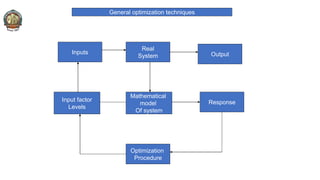
Optimization
Procedure
Output
Real
System
Inputs
Input factor
Levels
Mathematical
model
Of system
Response
General optimization techniques
Applied optimization methods
Optimization based on output from the real system;
1. Evolutionary Operations (Non-mathematical modelling)
It is an Experimental optimization - Most widely used in all the area except Pharm. Technology. This
technique well suited to a production situation.
Production procedure (Formulation and Process) is allowed to evolve to the optimum by careful planning
and constant repetition.
The process run based on both produces a product that meets all specifications and (at the same time)
generates information on product improvement.
In this technique, formulator makes a very small changes in the formulation or process but makes it many
times and they determine statistically whether the product has improved.
Pharm. Industry is subject to regulatory constraints that makes EVOP impossible to employ in validated
production process, therefore impractical and expensive to use.
Moreover, it is not a substitute for good laboratory scale investigation, bcs small changes utilized, not
particularly suitable to laboratory. © R R INSTITUTIONS , BANGALORE 15
Simplex method
• The simplex approach to the optimum is also an experimental method and has
been applied more widely to pharmaceutical systems.
• A simplex is a geometric figure that has one more point than the number of
factors. So, for two factors or independent variables, the simplex is represented
by a triangle. Once the shape of a simplex has been determined, the method
can employ a simplex of fixed size or of variable sizes that are determined by
comparing the magnitudes of the responses after each successive calculation.
• The initial simplex is represented by the lowest triangle; the vertices represent
the spectrophotometric response. The strategy is to move toward a better
response by moving away from the worst response.
18-03-2022 © R R INSTITUTIONS , BANGALORE 16
18-03-2022 © R R INSTITUTIONS , BANGALORE 17
Lagrangian Method:
Represents mathematical techniques, mostly applied to a pharmaceutical
formulation and processing problem.
The several steps in the Lagrangian method can be summarized as follows:
1. Determine objective function
2. Determine constraints
3. Change inequality constraints to equality constraints.
4. Form the Lagrange function, F:
a. One Lagrange multiplier λ for each constraint
b. One slack variable q for each inequality constraint
5. Partially differentiate the Lagrange function for each variable and Set
derivatives equal to zero.
6. Solve the set of simultaneous equations.
7. Substitute the resulting values into the objective functions.
Search Method:
Although the Lagrangian method was able to handle several responses or
dependent variable, it was generally limited to two independent variables.
A search method of optimization was also applied to a pharmaceutical
system. It takes five independent variables into account and is computer-
assisted. It was proposed that the procedure described could be set up
such that persons unfamiliar with the mathematics of optimization and
with no previous computer experience could carry out an optimization
study.
18-03-2022 © R R INSTITUTIONS , BANGALORE 18
1. Select a system
2. Select variables:
a. Independent
b. Dependent
3. Perform experimens and test product.
4. Submit data for statistical and regression analysis
5. Set specifications for feasibility program
6. Select constraints for grid search
7. Evaluate grid search print
8. Request and evaluate:.
a. “Partial derivative” plots, single or composite
b. Contour plots
18-03-2022 © R R INSTITUTIONS , BANGALORE 19
STATISTICAL DESIGN:
The techniques most widely used for optimization and may be divided into two general categories:
• One in which experimentation continues as the optimization study proceeds and
• Another in which the experimentation is completed before the optimization takes place.
• The first type is represented by evolutionary operations and the simplex method & the second by
the more classic mathematical & search method.
• For the techniques of the second type, it is necessary that the relation between any dependent
variable and the one or more independent variables be known.
To get necessary relationships, there are two possible approaches – Theoretical and the empirical.
If the formulator knows a prior the theoretical equation for the formulation properties of interest,
no experimentation is necessary. Therefore, it remains the task of the formulator to generate the
relationships between the variables for the particular formulation and process.
18-03-2022
© R R INSTITUTIONS , BANGALORE 20
18-03-2022 © R R INSTITUTIONS , BANGALORE 21
For emprical or experimental approach for a system with a single independent
variable, the formulator experiments at several levels, measures the property of
interest, and obtains a relationship, by
1. Simple regression analysis
2. Least squares method.
In general, there is more than one important variable, so the experimenter must enter
into the realm of “Statistical design of experiments and multiple regression
analysis”. Both are separate and large field.
Most widely used experimental plan is ‘Factorial Design’. By multiple regression
techniques, the relationships between variables, than are generated from
experimental data, and the resulting equations are the basis of the optimization.
These equations define the response surface for the system under investigation.
References:
1) Modern Pharmaceutics , Fourth Edition by Gilbert S. Banker and Chistopher T.
Rhodes
2) Biostatistics and Research Methodology by Prof. Chandrakant Kokare
3) Optimization Techniques in Pharmacetical Formulation and Processing by Prof.
Dr. Basavaraj K. Nanjwade
4) Optimization Techniques in Pharmacetical Formulation and Processing by P Raja
Abhilash
5) www.goggle.com
6) http://en.wikipedia.org/wiki/Optimization_(mathematics)
© R R INSTITUTIONS , BANGALORE 22
18-03-2022
18-03-2022
© R R INSTITUTIONS , BANGALORE 23

Optimization Seminar.pptx

  • 1.
    18-03-2022 © RR INSTITUTIONS , BANGALORE 1 MODERN PHARMACEUTICS Optimization techniques in Pharmaceutical Formulation: RR COLLEGE OF PHARMACY SUBMITTED BY: SUBMITTED TO: PAWAN DHAMALA ASSOCIATE PROF. SUJATHA P M 1st Sem M.Pharm DEPARTMENT OF PHARMACEUTICS
  • 2.
    Contents: 1. Concept ofOptimization 2. Parameters of Optimization 3. Optimization Techniques 4. Statistical Design 26-03-2022 © R R INSTITUTIONS , BANGALORE 2
  • 3.
    18-03-2022 © RR INSTITUTIONS , BANGALORE 3 CONCEPT OF OPTIMIZATION:  The word “Optimize” is defined as follows : to make as perfect, effective, or functional as possible.  In pharmacy word “optimization” is found in the literature referring to any study of formula.  The term “optimization” is often used in pharmacy relative to formulation and to processing.  Optimization is not a screening techniques.  Optimization can become a useful tool to quantitate a formulation that has been qualitatively determined.  It is the process of finding the best way of using the existing resources.  Optimization techniques provide both a depth of understanding and an ability to explore and defend ranges for formulation and processing factors.  In optimization process final product not only meets the requirements from the bio-availability but also from the practical mass production criteria.
  • 4.
    18-03-2022 © RR INSTITUTIONS , BANGALORE 4 PARAMETERS OF OPTIMIZATION: Optimization Parameters Variable types Problem types Independent variables, Dependent variables Constrained type, Unconstrained type
  • 5.
    1. Problem type: Thereare two general types of optimization problem: oConstrained: Restrictions are placed on the system by the physical limitations . E.g: preparation of hardest tablet which has the ability of disintegrate in less than 15 min. oUnconstrained: No restrictions are placed on the system. E.g: For a given pharmaceutical system one might wish to make the hardest tablet possible. This making of the hardest tablet is the unconstrained optimization problem. The constrained problem involved in it is to make the hardest tablet possible, but it must disintegrate in less than 15 minutes. 18-03-2022 © R R INSTITUTIONS , BANGALORE 5
  • 7.
    18-03-2022 © RR INSTITUTIONS , BANGALORE 7 2. Variable type: The development procedure of the pharmaceutical formulation involves several variables. Mathematically these variables are divided into two groups. 1.Independent variables 2.Dependent variables The independent variables are under the control of the formulator. These might include the compression force or the die cavity filling or the mixing time. The dependent variables are the responses or the characteristics that are developed due to the independent variables. The more the variables that are present in the system the more the complications that are involved in the optimization.
  • 8.
    o Independent variable: •These are the formulation and process & process that directly under the control of formulator. Classification: 1. Quantitative: Measurable factors, time, temperature, concentration, etc. 2. Qualitative: Type of solvent, type of catalyst, brands of materials etc. These are not amendable for measurement. • Independent variables are designed as X1,X2,X3,…….. • Initially the number of potential factors will be large and subsequently drop to a vital few factors, as per Paratoe’s law. • These vital factors governs the process, rather than the trivial many. • E.g: disintegration level, mixing time for given process steps,binder level, uniformity, lubrication level. 18-03-2022 © R R INSTITUTIONS , BANGALORE 8
  • 9.
    • From thepoint of view of product development, independent variables can be categorised as follows: 9 Formulation variables Process variables Drug Granulation time Diluent Drying inlet temperature Binder Mill Speed Disintegrating agent Blending time Glidant Compression force Lubricant Machine speed (compression)
  • 10.
    o Dependent variables: •These are the responses that are developed due to the independent variables. These are a direct result of any change in the formulation or process. • These responses are resulted from Independent variables and obtained from the experimentation. • Responses are classified into 2 main types according to measurement scale. • Quantitative: yield, purity • Qualitative : appearance, luster, lumpiness, odour, taste, etc. These are evaluated on a numerical scale (5-10 values) & thus can be converted into semi – continuous variable. • Eg: Hardness, thickness, weight, etc. 18-03-2022 © R R INSTITUTIONS , BANGALORE 10
  • 11.
    • Dependent variablesare designed as y1,y2,y3…. Any change in the formulation or process alters the responses. • The responses useful in the production of tablets are content uniformity, weight variation, hardness, disintergeration time, dissolution rate. • The hardest tablet(first response) will adversly affect the disintegeration time (second response). 18-03-2022 © R R INSTITUTIONS , BANGALORE 11
  • 13.
    18-03-2022 © R RINSTITUTIONS , BANGALORE 13 OPTIMIZATION TECHNIQUES The techniques for optimization are broadly divided into two categories: 1. Simultaneous method: Experimentation continues as optimization study proceeds. E.g : Evolutionary Operations Method, Simplex method 2. Sequential method : Experimentation is completed before optimization takes place. E.g: Mathematical Method, Search Method
  • 14.
  • 15.
    Applied optimization methods Optimizationbased on output from the real system; 1. Evolutionary Operations (Non-mathematical modelling) It is an Experimental optimization - Most widely used in all the area except Pharm. Technology. This technique well suited to a production situation. Production procedure (Formulation and Process) is allowed to evolve to the optimum by careful planning and constant repetition. The process run based on both produces a product that meets all specifications and (at the same time) generates information on product improvement. In this technique, formulator makes a very small changes in the formulation or process but makes it many times and they determine statistically whether the product has improved. Pharm. Industry is subject to regulatory constraints that makes EVOP impossible to employ in validated production process, therefore impractical and expensive to use. Moreover, it is not a substitute for good laboratory scale investigation, bcs small changes utilized, not particularly suitable to laboratory. © R R INSTITUTIONS , BANGALORE 15
  • 16.
    Simplex method • Thesimplex approach to the optimum is also an experimental method and has been applied more widely to pharmaceutical systems. • A simplex is a geometric figure that has one more point than the number of factors. So, for two factors or independent variables, the simplex is represented by a triangle. Once the shape of a simplex has been determined, the method can employ a simplex of fixed size or of variable sizes that are determined by comparing the magnitudes of the responses after each successive calculation. • The initial simplex is represented by the lowest triangle; the vertices represent the spectrophotometric response. The strategy is to move toward a better response by moving away from the worst response. 18-03-2022 © R R INSTITUTIONS , BANGALORE 16
  • 17.
    18-03-2022 © RR INSTITUTIONS , BANGALORE 17 Lagrangian Method: Represents mathematical techniques, mostly applied to a pharmaceutical formulation and processing problem. The several steps in the Lagrangian method can be summarized as follows: 1. Determine objective function 2. Determine constraints 3. Change inequality constraints to equality constraints. 4. Form the Lagrange function, F: a. One Lagrange multiplier λ for each constraint b. One slack variable q for each inequality constraint 5. Partially differentiate the Lagrange function for each variable and Set derivatives equal to zero. 6. Solve the set of simultaneous equations. 7. Substitute the resulting values into the objective functions.
  • 18.
    Search Method: Although theLagrangian method was able to handle several responses or dependent variable, it was generally limited to two independent variables. A search method of optimization was also applied to a pharmaceutical system. It takes five independent variables into account and is computer- assisted. It was proposed that the procedure described could be set up such that persons unfamiliar with the mathematics of optimization and with no previous computer experience could carry out an optimization study. 18-03-2022 © R R INSTITUTIONS , BANGALORE 18
  • 19.
    1. Select asystem 2. Select variables: a. Independent b. Dependent 3. Perform experimens and test product. 4. Submit data for statistical and regression analysis 5. Set specifications for feasibility program 6. Select constraints for grid search 7. Evaluate grid search print 8. Request and evaluate:. a. “Partial derivative” plots, single or composite b. Contour plots 18-03-2022 © R R INSTITUTIONS , BANGALORE 19
  • 20.
    STATISTICAL DESIGN: The techniquesmost widely used for optimization and may be divided into two general categories: • One in which experimentation continues as the optimization study proceeds and • Another in which the experimentation is completed before the optimization takes place. • The first type is represented by evolutionary operations and the simplex method & the second by the more classic mathematical & search method. • For the techniques of the second type, it is necessary that the relation between any dependent variable and the one or more independent variables be known. To get necessary relationships, there are two possible approaches – Theoretical and the empirical. If the formulator knows a prior the theoretical equation for the formulation properties of interest, no experimentation is necessary. Therefore, it remains the task of the formulator to generate the relationships between the variables for the particular formulation and process. 18-03-2022 © R R INSTITUTIONS , BANGALORE 20
  • 21.
    18-03-2022 © RR INSTITUTIONS , BANGALORE 21 For emprical or experimental approach for a system with a single independent variable, the formulator experiments at several levels, measures the property of interest, and obtains a relationship, by 1. Simple regression analysis 2. Least squares method. In general, there is more than one important variable, so the experimenter must enter into the realm of “Statistical design of experiments and multiple regression analysis”. Both are separate and large field. Most widely used experimental plan is ‘Factorial Design’. By multiple regression techniques, the relationships between variables, than are generated from experimental data, and the resulting equations are the basis of the optimization. These equations define the response surface for the system under investigation.
  • 22.
    References: 1) Modern Pharmaceutics, Fourth Edition by Gilbert S. Banker and Chistopher T. Rhodes 2) Biostatistics and Research Methodology by Prof. Chandrakant Kokare 3) Optimization Techniques in Pharmacetical Formulation and Processing by Prof. Dr. Basavaraj K. Nanjwade 4) Optimization Techniques in Pharmacetical Formulation and Processing by P Raja Abhilash 5) www.goggle.com 6) http://en.wikipedia.org/wiki/Optimization_(mathematics) © R R INSTITUTIONS , BANGALORE 22 18-03-2022
  • 23.
    18-03-2022 © R RINSTITUTIONS , BANGALORE 23