Cylindrical Dielectric Waveguide:
Optical Fibre
 Two types of fibre
1. Step index fibre
2. Graded index fibre (GRIN)
STEP INDEX FIBRE
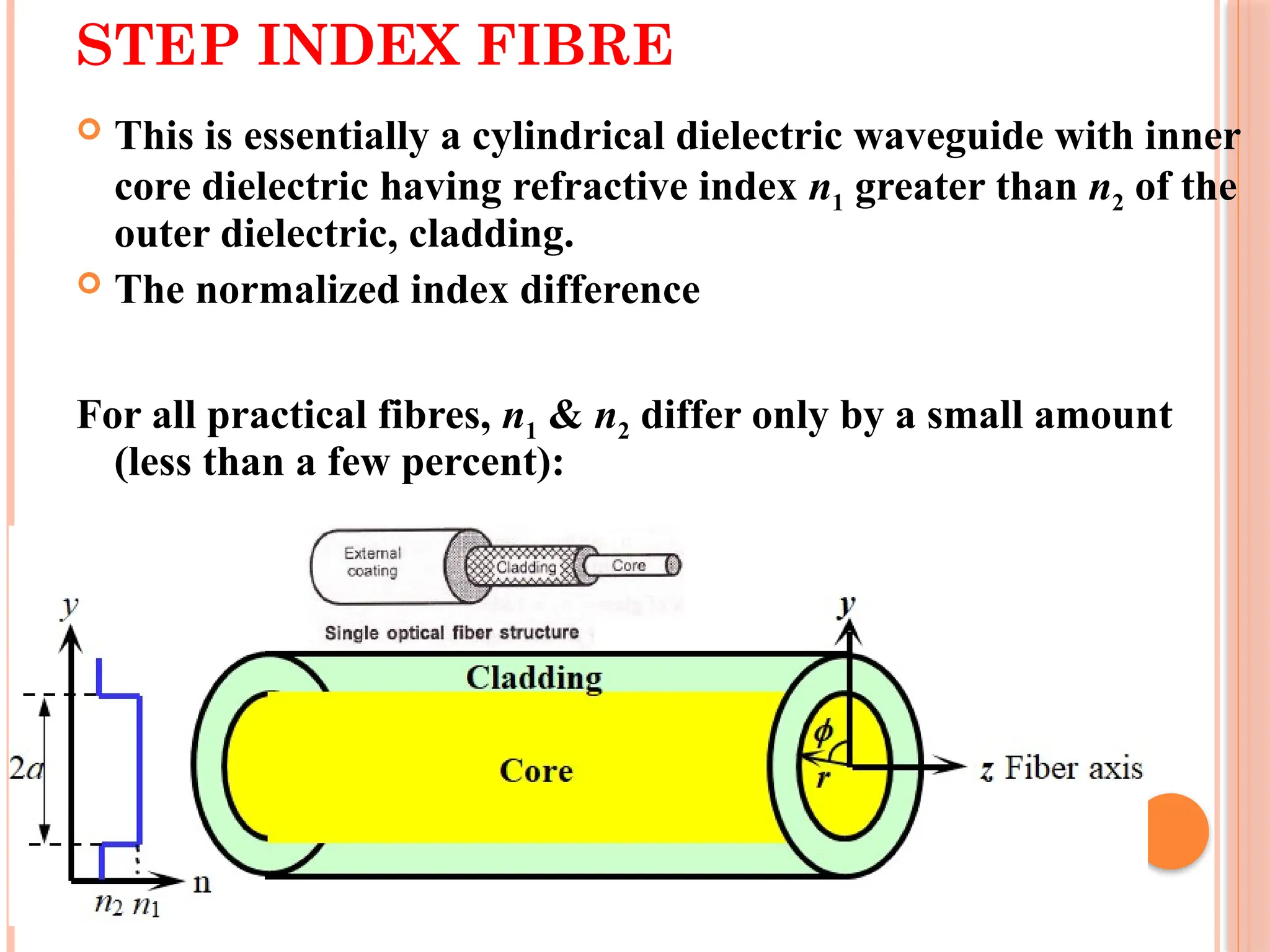
 This is essentially a cylindrical dielectric waveguide with inner
core dielectric having refractive index n1 greater than n2 of the
outer dielectric, cladding.
 The normalized index difference
For all practical fibres, n1 & n2 differ only by a small amount
(less than a few percent):
CONT. OF STEP INDEX
FIBRE
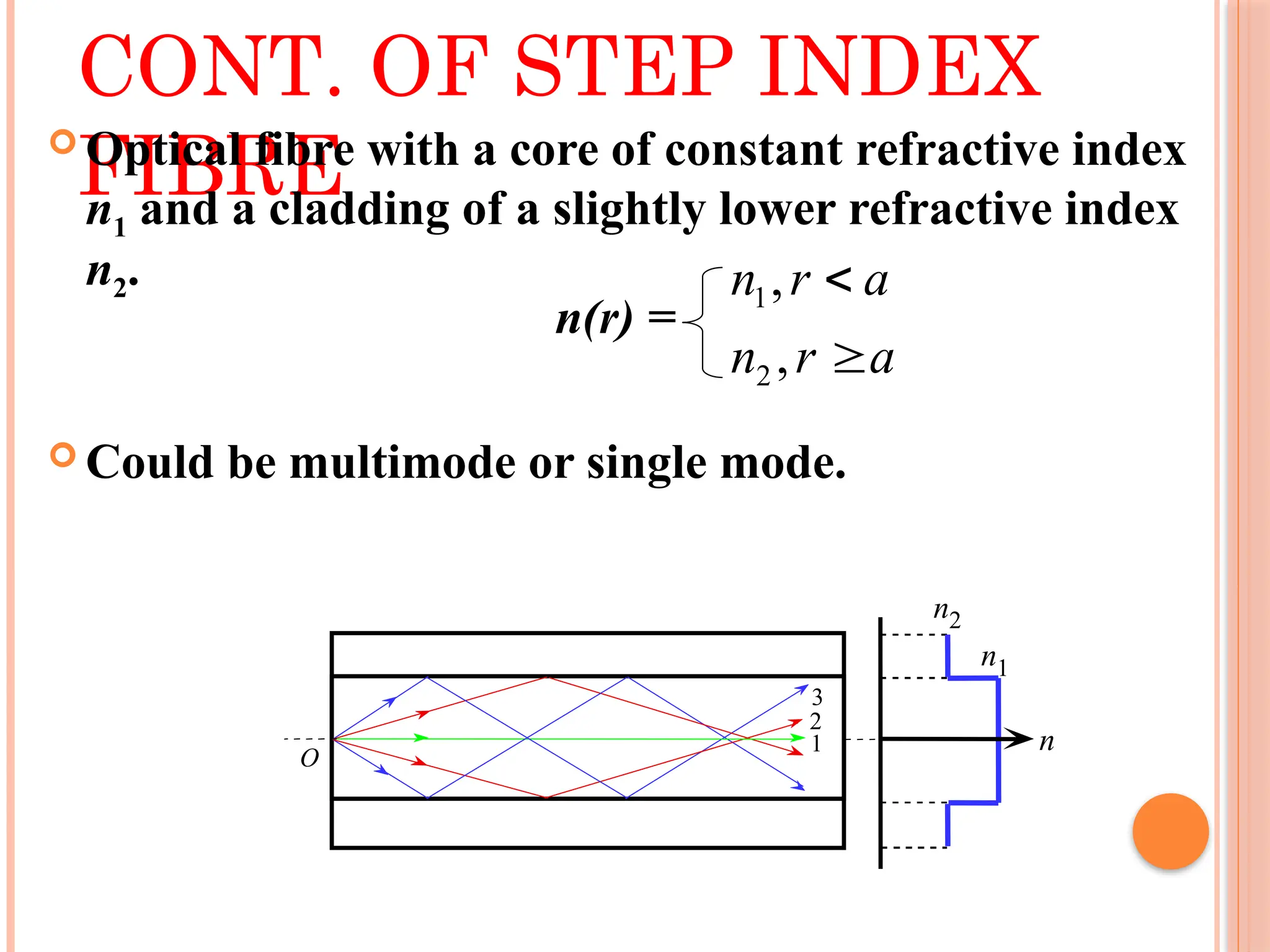
 Optical fibre with a core of constant refractive index
n1 and a cladding of a slightly lower refractive index
n2.
 Could be multimode or single mode.
a
r
n
a
r
n


,
,
2
1
n(r) =
n1
n2
2
1
3
n
O
Propagation in Optical Fiber
• To understand the general nature of light wave
propagation in optical fiber. We first consider
the construction of optical fiber. The innermost
is the glass core of very thin diameter with a
slight lower refractive index n2. The light wave can
propagate along such an optical fiber. A single mode
propagation is illustrated in Figure along with
standard size of fiber.
• Single mode fibers are capable of carrying only one
signal of a specific wavelength.
• In multimode propagation the light propagates
along the fiber in zigzag fashion, provided it can
undergo total internal reflection (TIR) at the core
cladding boundaries.
• Total internal reflection at the fiber wall can occur
only if two conditions are satisfied
Condition 1:
The n1 of glass fiber must be slightly greater than the
n2 of material surrounding the fiber (cladding).
If refractive index of glass fiber = n1
and refractive index of cladding = n2
then n1 > n2.
Condition 2 :
The angle of incidence > .
• A light beam is focused at one end of cable. The light
enters the fibers at different angles.
Figure shows the conditions exist at the launching
end of optic fiber. The light source is surrounded by
air and the refractive index of air is n0 = 1. Let the
incident ray makes an angle with fiber axis. The
ray enters into glass fiber at point P making
refracted angle to the fiber axis, the ray is then
propagated diagonally down the core and reflect
from the core wall at point Q.
Multimode step Index Fiber
• Multimode step index fiber is more widely used type. It is easy to
manufacture. Its core diameter is 50 to 1000 µm i.e. large
aperture and allows more light to enter the cable. The light rays
are propagated down the core in zig-zag manner. There are many
many paths that a light ray may follow during the propagation.
• The light ray is propagated using the principle of total internal
reflection (TIR). Since the core index of refraction is higher than the
cladding index of refraction, the light enters at less than critical angle
is guided along the fiber.
• Light rays passing through the fiber are continuously reflected off
the glass cladding towards the centre of the core at different angles
and lengths, limiting overall bandwidth.
• The disadvantage of multimode step index fibers is that the different
optical lengths caused by various angles at which light is
propagated relative to the core, causes the transmission
bandwidth to be fairly small. Because of these limitations, multimode
step index fiber is typically only used in applications requiring
distances of less than 1 km.
Multimode Graded Index Fiber
• The core size of multimode graded index fiber cable is varying
from 50 to 100 µm range. The light ray is propagated through the
refraction. The light ray enters the fiber at many different angles.
As the light propagates across the core toward the center it
is intersecting a less dense to more dense medium. Therefore
the light rays are being constantly being refracted and ray is
bending continuously. This cable is mostly used for long distance
communication.
• The light rays no longer follow straight lines, they follow a
serpentine path being gradually bent back towards the center
by the continuously declining refractive index. The modes
travelling in a straight line are in a higher refractive index
so they travel slower than the serpentine modes. This reduces
the arrival time disparity because all modes arrive at about the
same time.
• In GR, light rays running close to the fiber axis with shorter
path length, will have a lower velocity because they pass
through a region with a high refractive index.
Cont. of Multimode Graded Index Fiber
• Rays on core edges offers reduced refractive index, hence travel
more faster than axial rays and cause the light components to take
same amount of time to travel the length of fiber, thus
minimizing dispersion losses. Each path at a different angle
is termed as ‘transmission mode’ and the NA of graded index
fiber is defined as the maximum value of acceptance angle at the
fiber axis.
• Typical attenuation coefficients of graded index fibers at 850 nm
are 2.5 to 3 dB/km, while at 1300 nm they are 1.0 to 1.5 dB/km.
• The main advantages of graded index fiber are:
1. Reduced refractive index at the centre of core.
2. Comparatively cheap to produce.
Figure P32.
2.7 Mode Theory for Cylindrical Waveguide
• To analyze the optical fiber propagation mechanism
within a fiber, Maxwell equations are to solve subject
to the cylindrical boundary conditions at core-
cladding interface. The core-cladding boundary
conditions lead to coupling of electric and
magnetic field components resulting in hybrid modes.
Hence the analysis of optical waveguide is more
complex than metallic hollow waveguide analysis.
• Depending on the large E-field, the hybrid modes
are HE or EH modes. The two lowest order does
are HE11 and TE01.
Overview of Modes
• The order states the number of field zeros across the guide. The
electric fields are not completely confined within the core i.e. they
do not go to zero at core-cladding interface and extends into the
cladding. The low order mode confines the electric field near the
axis of the fiber core and there is less penetration into the
cladding. While the high order mode distribute the field
towards the edge of the core fiber and penetrations into the
cladding. Therefore cladding modes also appear resulting in power
loss.
• In leaky modes the fields are confined partially in the fiber
core attenuated as they propagate along the fiber length due to
radiation and tunnel effect.
• Therefore in order to mode remain guided, the propagation factor
β must satisfy the condition.
• k = Propagation constant = 2π / λ
• The cladding is used to prevent scattering loss that results
from core material discontinuities. Cladding also improves the
mechanical strength of fiber core and reduces surface
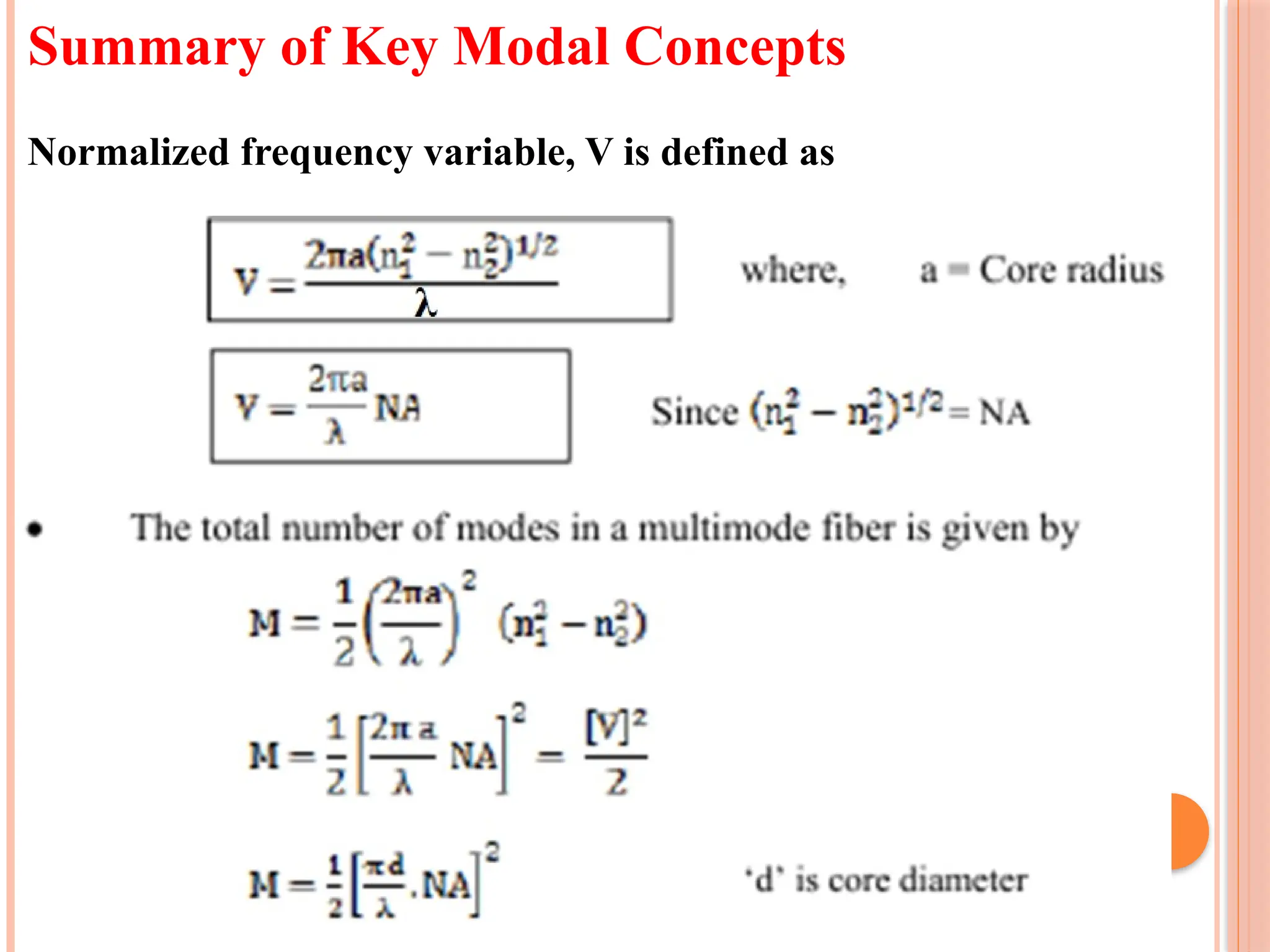
Summary of Key Modal Concepts
Normalized frequency variable, V is defined as
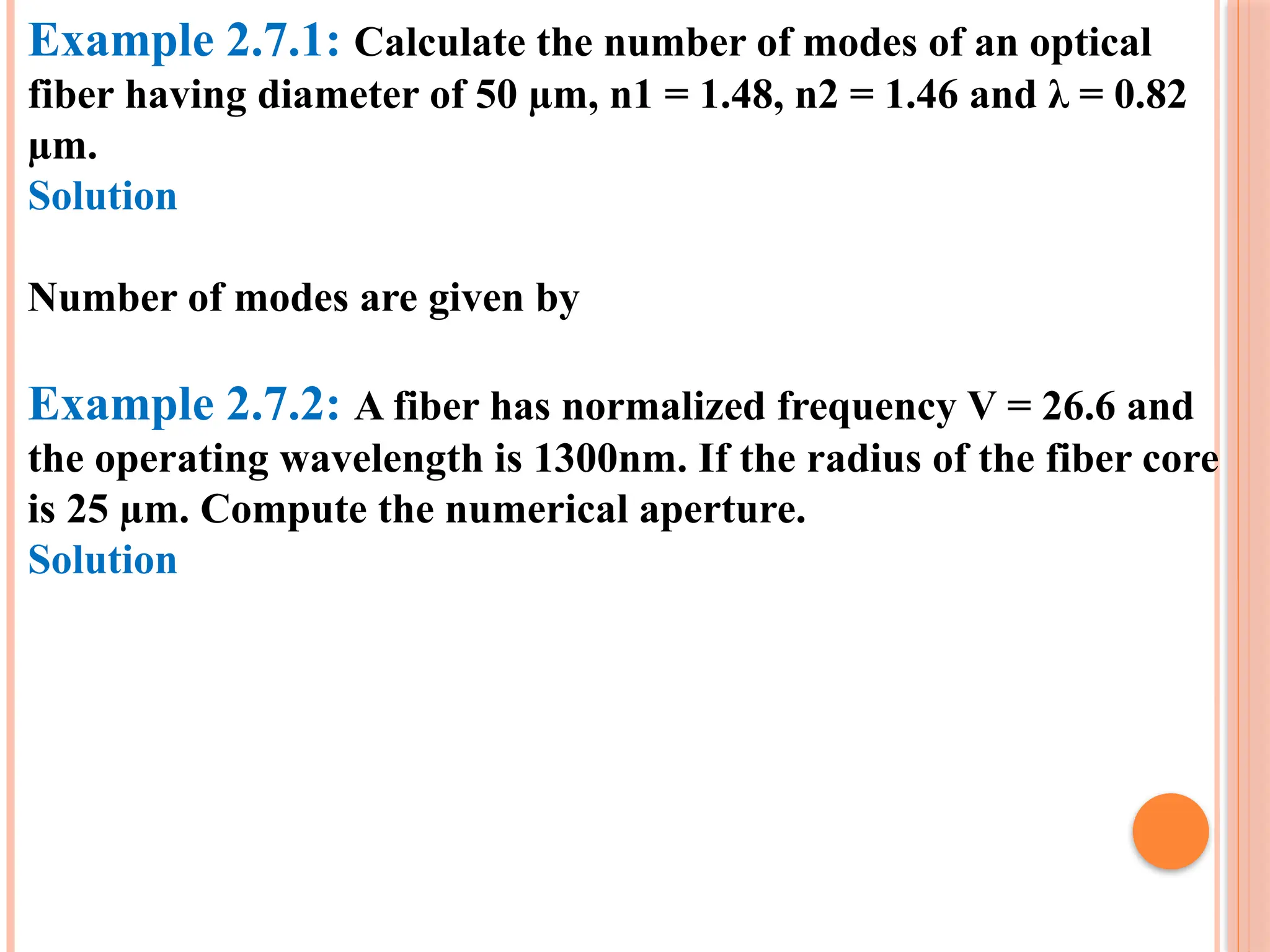
Example 2.7.1: Calculate the number of modes of an optical
fiber having diameter of 50 µm, n1 = 1.48, n2 = 1.46 and λ = 0.82
µm.
Solution
Number of modes are given by
Example 2.7.2: A fiber has normalized frequency V = 26.6 and
the operating wavelength is 1300nm. If the radius of the fiber core
is 25 µm. Compute the numerical aperture.
Solution
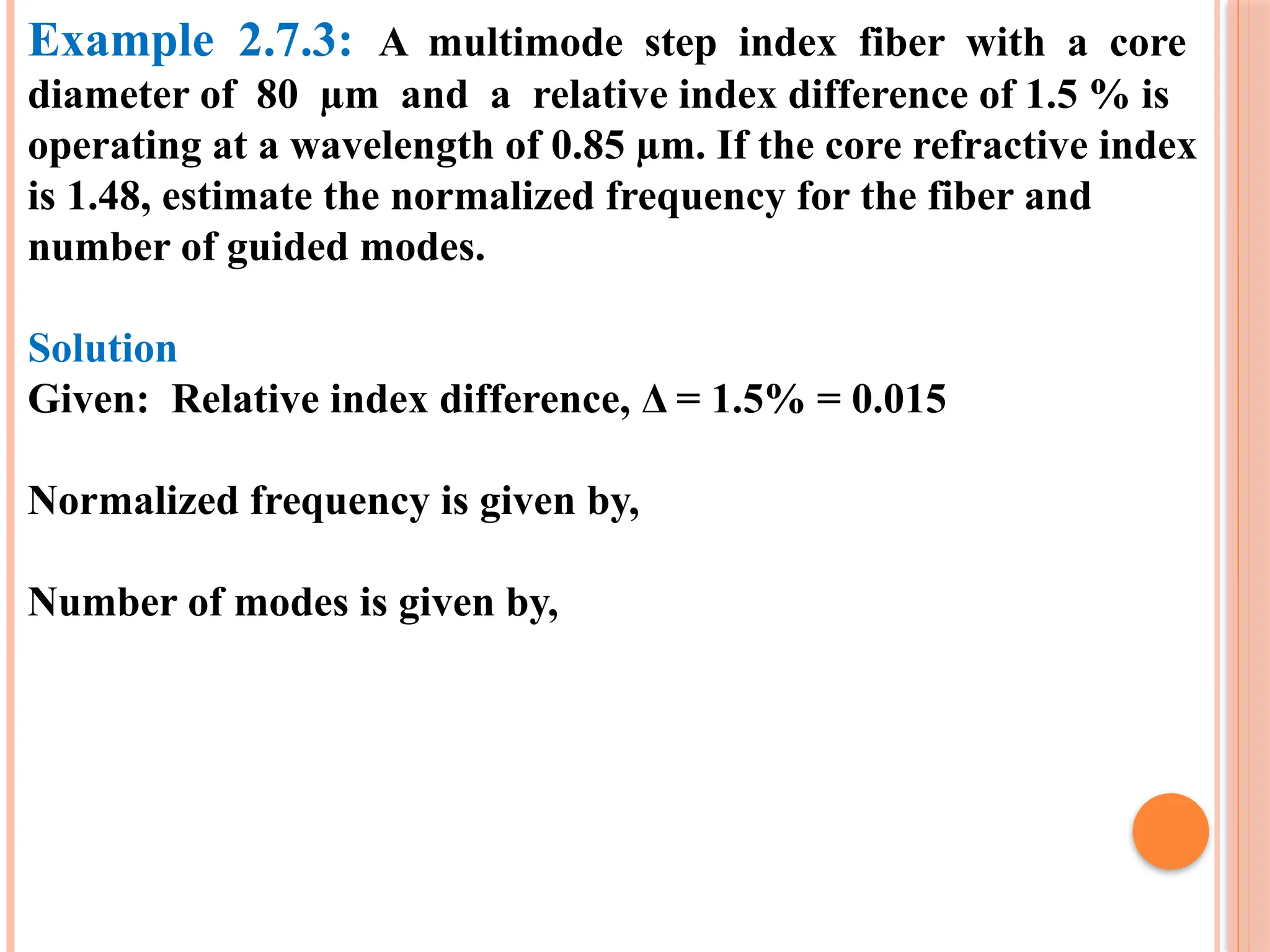
Example 2.7.3: A multimode step index fiber with a core
diameter of 80 µm and a relative index difference of 1.5 % is
operating at a wavelength of 0.85 µm. If the core refractive index
is 1.48, estimate the normalized frequency for the fiber and
number of guided modes.
Solution
Given: Relative index difference, Δ = 1.5% = 0.015
Normalized frequency is given by,
Number of modes is given by,
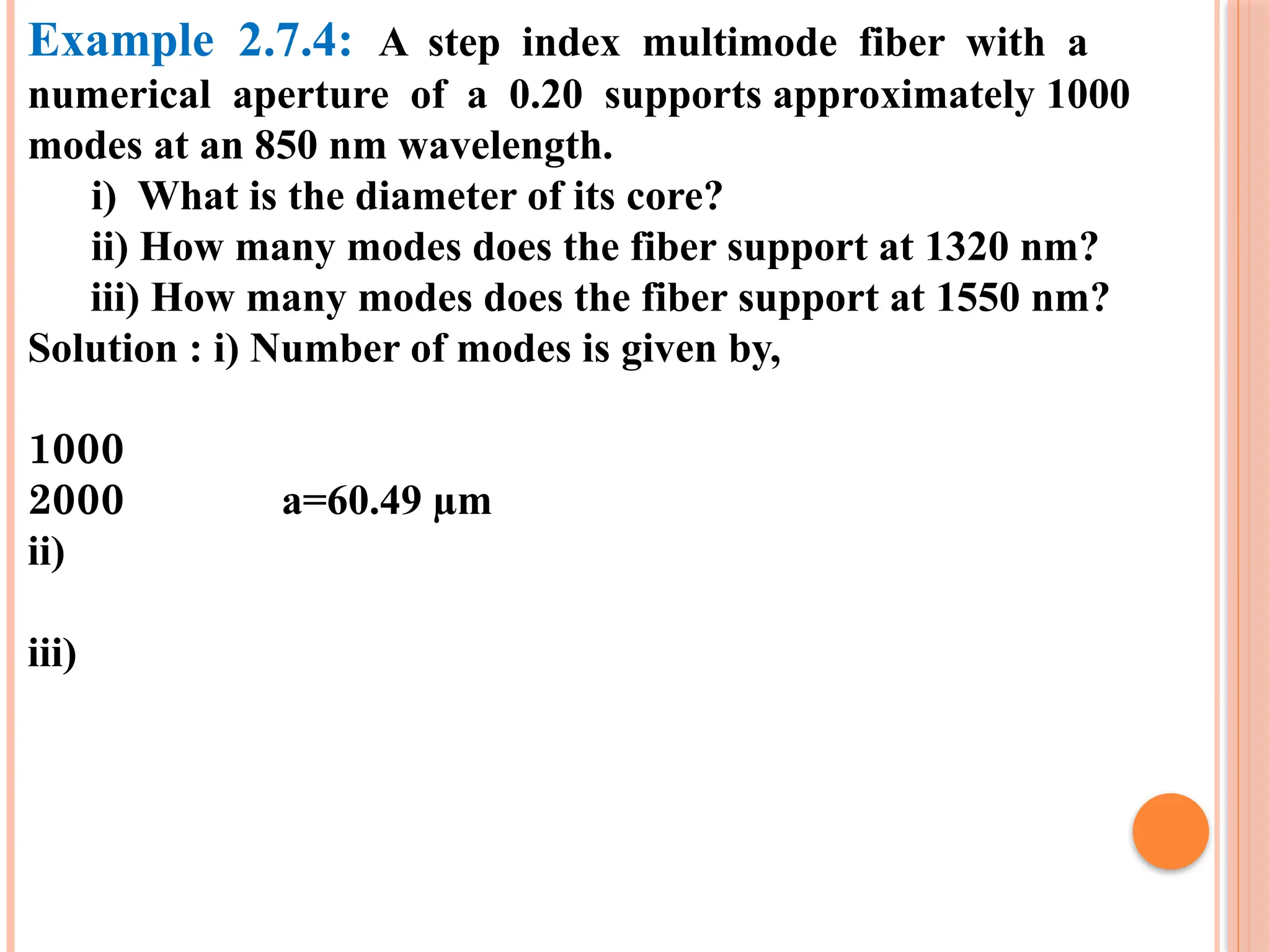
Example 2.7.4: A step index multimode fiber with a
numerical aperture of a 0.20 supports approximately 1000
modes at an 850 nm wavelength.
i) What is the diameter of its core?
ii) How many modes does the fiber support at 1320 nm?
iii) How many modes does the fiber support at 1550 nm?
Solution : i) Number of modes is given by,
1000
2000 a=60.49 µm
ii)
iii)

Optical_Fiber - Waveguides communication

  • 1.
    Cylindrical Dielectric Waveguide: OpticalFibre  Two types of fibre 1. Step index fibre 2. Graded index fibre (GRIN)
  • 2.
    STEP INDEX FIBRE This is essentially a cylindrical dielectric waveguide with inner core dielectric having refractive index n1 greater than n2 of the outer dielectric, cladding.  The normalized index difference For all practical fibres, n1 & n2 differ only by a small amount (less than a few percent):
  • 3.
    CONT. OF STEPINDEX FIBRE  Optical fibre with a core of constant refractive index n1 and a cladding of a slightly lower refractive index n2.  Could be multimode or single mode. a r n a r n   , , 2 1 n(r) = n1 n2 2 1 3 n O
  • 4.
    Propagation in OpticalFiber • To understand the general nature of light wave propagation in optical fiber. We first consider the construction of optical fiber. The innermost is the glass core of very thin diameter with a slight lower refractive index n2. The light wave can propagate along such an optical fiber. A single mode propagation is illustrated in Figure along with standard size of fiber. • Single mode fibers are capable of carrying only one signal of a specific wavelength. • In multimode propagation the light propagates along the fiber in zigzag fashion, provided it can undergo total internal reflection (TIR) at the core cladding boundaries. • Total internal reflection at the fiber wall can occur only if two conditions are satisfied
  • 5.
    Condition 1: The n1of glass fiber must be slightly greater than the n2 of material surrounding the fiber (cladding). If refractive index of glass fiber = n1 and refractive index of cladding = n2 then n1 > n2. Condition 2 : The angle of incidence > . • A light beam is focused at one end of cable. The light enters the fibers at different angles. Figure shows the conditions exist at the launching end of optic fiber. The light source is surrounded by air and the refractive index of air is n0 = 1. Let the incident ray makes an angle with fiber axis. The ray enters into glass fiber at point P making refracted angle to the fiber axis, the ray is then propagated diagonally down the core and reflect from the core wall at point Q.
  • 6.
    Multimode step IndexFiber • Multimode step index fiber is more widely used type. It is easy to manufacture. Its core diameter is 50 to 1000 µm i.e. large aperture and allows more light to enter the cable. The light rays are propagated down the core in zig-zag manner. There are many many paths that a light ray may follow during the propagation. • The light ray is propagated using the principle of total internal reflection (TIR). Since the core index of refraction is higher than the cladding index of refraction, the light enters at less than critical angle is guided along the fiber. • Light rays passing through the fiber are continuously reflected off the glass cladding towards the centre of the core at different angles and lengths, limiting overall bandwidth. • The disadvantage of multimode step index fibers is that the different optical lengths caused by various angles at which light is propagated relative to the core, causes the transmission bandwidth to be fairly small. Because of these limitations, multimode step index fiber is typically only used in applications requiring distances of less than 1 km.
  • 7.
    Multimode Graded IndexFiber • The core size of multimode graded index fiber cable is varying from 50 to 100 µm range. The light ray is propagated through the refraction. The light ray enters the fiber at many different angles. As the light propagates across the core toward the center it is intersecting a less dense to more dense medium. Therefore the light rays are being constantly being refracted and ray is bending continuously. This cable is mostly used for long distance communication. • The light rays no longer follow straight lines, they follow a serpentine path being gradually bent back towards the center by the continuously declining refractive index. The modes travelling in a straight line are in a higher refractive index so they travel slower than the serpentine modes. This reduces the arrival time disparity because all modes arrive at about the same time. • In GR, light rays running close to the fiber axis with shorter path length, will have a lower velocity because they pass through a region with a high refractive index.
  • 8.
    Cont. of MultimodeGraded Index Fiber • Rays on core edges offers reduced refractive index, hence travel more faster than axial rays and cause the light components to take same amount of time to travel the length of fiber, thus minimizing dispersion losses. Each path at a different angle is termed as ‘transmission mode’ and the NA of graded index fiber is defined as the maximum value of acceptance angle at the fiber axis. • Typical attenuation coefficients of graded index fibers at 850 nm are 2.5 to 3 dB/km, while at 1300 nm they are 1.0 to 1.5 dB/km. • The main advantages of graded index fiber are: 1. Reduced refractive index at the centre of core. 2. Comparatively cheap to produce. Figure P32.
  • 9.
    2.7 Mode Theoryfor Cylindrical Waveguide • To analyze the optical fiber propagation mechanism within a fiber, Maxwell equations are to solve subject to the cylindrical boundary conditions at core- cladding interface. The core-cladding boundary conditions lead to coupling of electric and magnetic field components resulting in hybrid modes. Hence the analysis of optical waveguide is more complex than metallic hollow waveguide analysis. • Depending on the large E-field, the hybrid modes are HE or EH modes. The two lowest order does are HE11 and TE01.
  • 10.
    Overview of Modes •The order states the number of field zeros across the guide. The electric fields are not completely confined within the core i.e. they do not go to zero at core-cladding interface and extends into the cladding. The low order mode confines the electric field near the axis of the fiber core and there is less penetration into the cladding. While the high order mode distribute the field towards the edge of the core fiber and penetrations into the cladding. Therefore cladding modes also appear resulting in power loss. • In leaky modes the fields are confined partially in the fiber core attenuated as they propagate along the fiber length due to radiation and tunnel effect. • Therefore in order to mode remain guided, the propagation factor β must satisfy the condition. • k = Propagation constant = 2π / λ • The cladding is used to prevent scattering loss that results from core material discontinuities. Cladding also improves the mechanical strength of fiber core and reduces surface
  • 11.
    Summary of KeyModal Concepts Normalized frequency variable, V is defined as
  • 12.
    Example 2.7.1: Calculatethe number of modes of an optical fiber having diameter of 50 µm, n1 = 1.48, n2 = 1.46 and λ = 0.82 µm. Solution Number of modes are given by Example 2.7.2: A fiber has normalized frequency V = 26.6 and the operating wavelength is 1300nm. If the radius of the fiber core is 25 µm. Compute the numerical aperture. Solution
  • 13.
    Example 2.7.3: Amultimode step index fiber with a core diameter of 80 µm and a relative index difference of 1.5 % is operating at a wavelength of 0.85 µm. If the core refractive index is 1.48, estimate the normalized frequency for the fiber and number of guided modes. Solution Given: Relative index difference, Δ = 1.5% = 0.015 Normalized frequency is given by, Number of modes is given by,
  • 14.
    Example 2.7.4: Astep index multimode fiber with a numerical aperture of a 0.20 supports approximately 1000 modes at an 850 nm wavelength. i) What is the diameter of its core? ii) How many modes does the fiber support at 1320 nm? iii) How many modes does the fiber support at 1550 nm? Solution : i) Number of modes is given by, 1000 2000 a=60.49 µm ii) iii)