OPTHALMOLOGY OSCE
Msemo,R.S
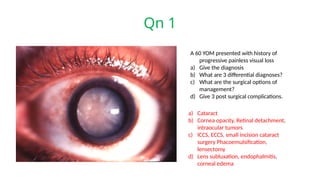
Qn 1
A 60 YOM presented with history of
progressive painless visual loss
a) Give the diagnosis
b) What are 3 differential diagnoses?
c) What are the surgical options of
management?
d) Give 3 post surgical complications.
a) Cataract
b) Cornea opacity, Retinal detachment,
intraocular tumors
c) ICCS, ECCS, small incision cataract
surgery Phacoemulsification,
lensectomy
d) Lens subluxation, endophalmitis,
corneal edema
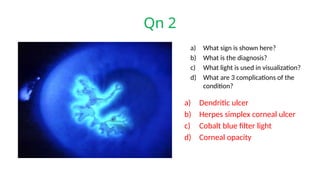
Qn 2
a) What sign is shown here?
b) What is the diagnosis?
c) What light is used in visualization?
d) What are 3 complications of the
condition?
a) Dendritic ulcer
b) Herpes simplex corneal ulcer
c) Cobalt blue filter light
d) Corneal opacity
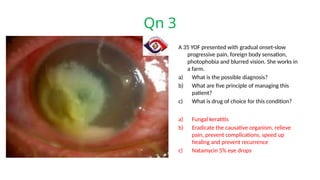
Qn 3
A 35 YOF presented with gradual onset-slow
progressive pain, foreign body sensation,
photophobia and blurred vision. She works in
a farm.
a) What is the possible diagnosis?
b) What are five principle of managing this
patient?
c) What is drug of choice for this condition?
a) Fungal keratitis
b) Eradicate the causative organism, relieve
pain, prevent complications, speed up
healing and prevent recurrence
c) Natamycin 5% eye drops
Qn 4
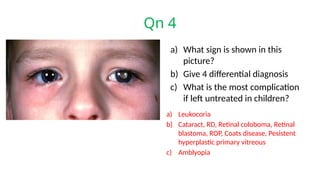
a) What sign is shown in this
picture?
b) Give 4 differential diagnosis
c) What is the most complication
if left untreated in children?
a) Leukocoria
b) Cataract, RD, Retinal coloboma, Retinal
blastoma, ROP, Coats disease, Pesistent
hyperplastic primary vitreous
c) Amblyopia
Qn 5
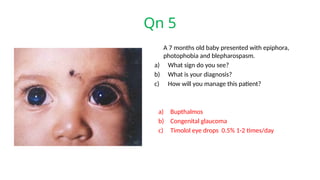
A 7 months old baby presented with epiphora,
photophobia and blepharospasm.
a) What sign do you see?
b) What is your diagnosis?
c) How will you manage this patient?
a) Bupthalmos
b) Congenital glaucoma
c) Timolol eye drops 0.5% 1-2 times/day
Qn 6
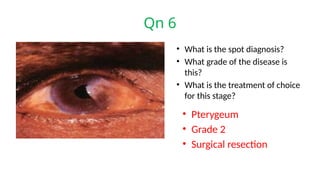
• What is the spot diagnosis?
• What grade of the disease is
this?
• What is the treatment of choice
for this stage?
• Pterygeum
• Grade 2
• Surgical resection
Qn 7
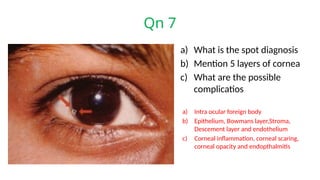
a) What is the spot diagnosis
b) Mention 5 layers of cornea
c) What are the possible
complicatios
a) Intra ocular foreign body
b) Epithelium, Bowmans layer,Stroma,
Descement layer and endothelium
c) Corneal inflammation, corneal scaring,
corneal opacity and endopthalmitis
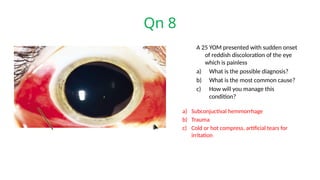
Qn 8
A 25 YOM presented with sudden onset
of reddish discoloration of the eye
which is painless
a) What is the possible diagnosis?
b) What is the most common cause?
c) How will you manage this
condition?
a) Subconjuctival hemmorrhage
b) Trauma
c) Cold or hot compress, artificial tears for
irritation
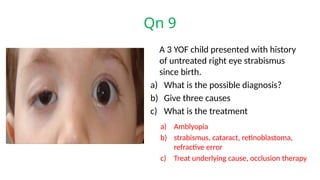
Qn 9
A 3 YOF child presented with history
of untreated right eye strabismus
since birth.
a) What is the possible diagnosis?
b) Give three causes
c) What is the treatment
a) Amblyopia
b) strabismus, cataract, retinoblastoma,
refractive error
c) Treat underlying cause, occlusion therapy
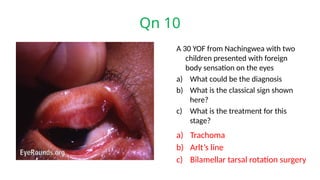
Qn 10
A 30 YOF from Nachingwea with two
children presented with foreign
body sensation on the eyes
a) What could be the diagnosis
b) What is the classical sign shown
here?
c) What is the treatment for this
stage?
a) Trachoma
b) Arlt’s line
c) Bilamellar tarsal rotation surgery
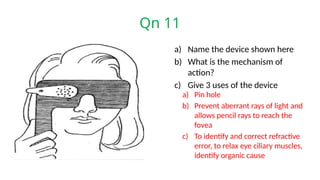
Qn 11
a) Name the device shown here
b) What is the mechanism of
action?
c) Give 3 uses of the device
a) Pin hole
b) Prevent aberrant rays of light and
allows pencil rays to reach the
fovea
c) To identify and correct refractive
error, to relax eye ciliary muscles,
identify organic cause
Qn 12
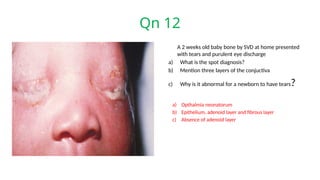
A 2 weeks old baby bone by SVD at home presented
with tears and purulent eye discharge
a) What is the spot diagnosis?
b) Mention three layers of the conjuctiva
c) Why is it abnormal for a newborn to have tears?
a) Opthalmia neonatorum
b) Epithelium, adenoid layer and fibrous layer
c) Absence of adenoid layer
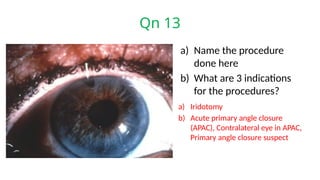
Qn 13
a) Name the procedure
done here
b) What are 3 indications
for the procedures?
a) Iridotomy
b) Acute primary angle closure
(APAC), Contralateral eye in APAC,
Primary angle closure suspect
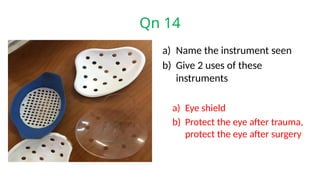
Qn 14
a) Name the instrument seen
b) Give 2 uses of these
instruments
a) Eye shield
b) Protect the eye after trauma,
protect the eye after surgery
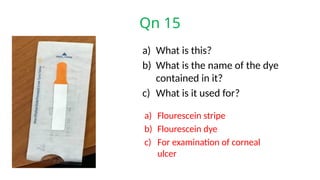
Qn 15
a) What is this?
b) What is the name of the dye
contained in it?
c) What is it used for?
a) Flourescein stripe
b) Flourescein dye
c) For examination of corneal
ulcer
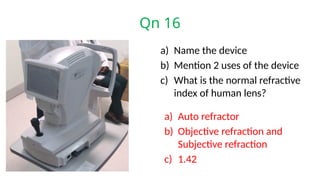
Qn 16
a) Name the device
b) Mention 2 uses of the device
c) What is the normal refractive
index of human lens?
a) Auto refractor
b) Objective refraction and
Subjective refraction
c) 1.42
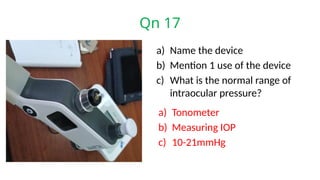
Qn 17
a) Name the device
b) Mention 1 use of the device
c) What is the normal range of
intraocular pressure?
a) Tonometer
b) Measuring IOP
c) 10-21mmHg
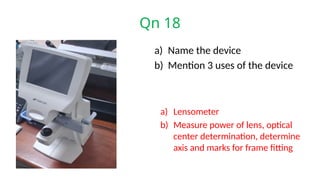
Qn 18
a) Name the device
b) Mention 3 uses of the device
a) Lensometer
b) Measure power of lens, optical
center determination, determine
axis and marks for frame fitting
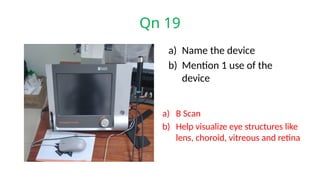
Qn 19
a) Name the device
b) Mention 1 use of the
device
a) B Scan
b) Help visualize eye structures like
lens, choroid, vitreous and retina
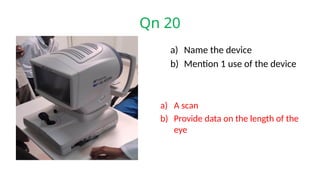
Qn 20
a) Name the device
b) Mention 1 use of the device
a) A scan
b) Provide data on the length of the
eye
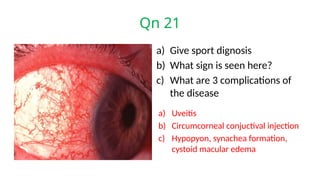
Qn 21
a) Give sport dignosis
b) What sign is seen here?
c) What are 3 complications of
the disease
a) Uveitis
b) Circumcorneal conjuctival injection
c) Hypopyon, synachea formation,
cystoid macular edema
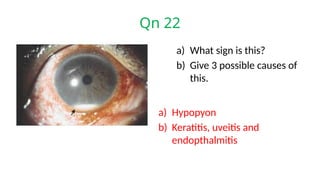
Qn 22
a) What sign is this?
b) Give 3 possible causes of
this.
a) Hypopyon
b) Keratitis, uveitis and
endopthalmitis
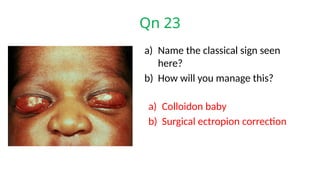
Qn 23
a) Name the classical sign seen
here?
b) How will you manage this?
a) Colloidon baby
b) Surgical ectropion correction
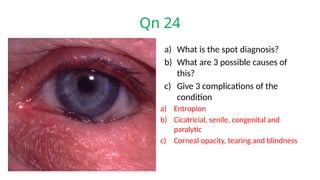
Qn 24
a) What is the spot diagnosis?
b) What are 3 possible causes of
this?
c) Give 3 complications of the
condition
a) Entropion
b) Cicatricial, senile, congenital and
paralytic
c) Corneal opacity, tearing and blindness
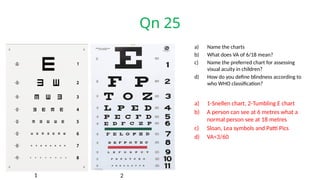
Qn 25
a) Name the charts
b) What does VA of 6/18 mean?
c) Name the preferred chart for assessing
visual acuity in children?
d) How do you define blindness according to
who WHO classification?
1 2
a) 1-Snellen chart, 2-Tumbling E chart
b) A person can see at 6 metres what a
normal person see at 18 metres
c) Sloan, Lea symbols and Patti Pics
d) VA<3/60
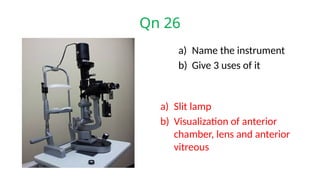
Qn 26
a) Name the instrument
b) Give 3 uses of it
a) Slit lamp
b) Visualization of anterior
chamber, lens and anterior
vitreous
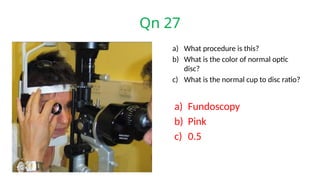
Qn 27
a) What procedure is this?
b) What is the color of normal optic
disc?
c) What is the normal cup to disc ratio?
a) Fundoscopy
b) Pink
c) 0.5
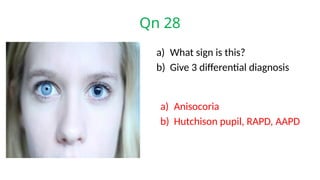
Qn 28
a) What sign is this?
b) Give 3 differential diagnosis
a) Anisocoria
b) Hutchison pupil, RAPD, AAPD
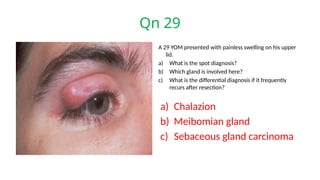
Qn 29
A 29 YOM presented with painless swelling on his upper
lid.
a) What is the spot diagnosis?
b) Which gland is involved here?
c) What is the differential diagnosis if it frequently
recurs after resection?
a) Chalazion
b) Meibomian gland
c) Sebaceous gland carcinoma
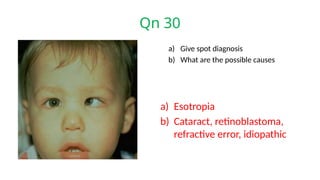
Qn 30
a) Give spot diagnosis
b) What are the possible causes
a) Esotropia
b) Cataract, retinoblastoma,
refractive error, idiopathic
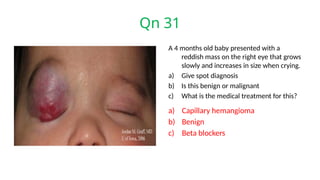
Qn 31
A 4 months old baby presented with a
reddish mass on the right eye that grows
slowly and increases in size when crying.
a) Give spot diagnosis
b) Is this benign or malignant
c) What is the medical treatment for this?
a) Capillary hemangioma
b) Benign
c) Beta blockers
END

OPHTHALMOLOGY OSCE.pptx babaBhBNhBBBbFbC

  • 1.
  • 2.
    Qn 1 A 60YOM presented with history of progressive painless visual loss a) Give the diagnosis b) What are 3 differential diagnoses? c) What are the surgical options of management? d) Give 3 post surgical complications. a) Cataract b) Cornea opacity, Retinal detachment, intraocular tumors c) ICCS, ECCS, small incision cataract surgery Phacoemulsification, lensectomy d) Lens subluxation, endophalmitis, corneal edema
  • 3.
    Qn 2 a) Whatsign is shown here? b) What is the diagnosis? c) What light is used in visualization? d) What are 3 complications of the condition? a) Dendritic ulcer b) Herpes simplex corneal ulcer c) Cobalt blue filter light d) Corneal opacity
  • 4.
    Qn 3 A 35YOF presented with gradual onset-slow progressive pain, foreign body sensation, photophobia and blurred vision. She works in a farm. a) What is the possible diagnosis? b) What are five principle of managing this patient? c) What is drug of choice for this condition? a) Fungal keratitis b) Eradicate the causative organism, relieve pain, prevent complications, speed up healing and prevent recurrence c) Natamycin 5% eye drops
  • 5.
    Qn 4 a) Whatsign is shown in this picture? b) Give 4 differential diagnosis c) What is the most complication if left untreated in children? a) Leukocoria b) Cataract, RD, Retinal coloboma, Retinal blastoma, ROP, Coats disease, Pesistent hyperplastic primary vitreous c) Amblyopia
  • 6.
    Qn 5 A 7months old baby presented with epiphora, photophobia and blepharospasm. a) What sign do you see? b) What is your diagnosis? c) How will you manage this patient? a) Bupthalmos b) Congenital glaucoma c) Timolol eye drops 0.5% 1-2 times/day
  • 7.
    Qn 6 • Whatis the spot diagnosis? • What grade of the disease is this? • What is the treatment of choice for this stage? • Pterygeum • Grade 2 • Surgical resection
  • 8.
    Qn 7 a) Whatis the spot diagnosis b) Mention 5 layers of cornea c) What are the possible complicatios a) Intra ocular foreign body b) Epithelium, Bowmans layer,Stroma, Descement layer and endothelium c) Corneal inflammation, corneal scaring, corneal opacity and endopthalmitis
  • 9.
    Qn 8 A 25YOM presented with sudden onset of reddish discoloration of the eye which is painless a) What is the possible diagnosis? b) What is the most common cause? c) How will you manage this condition? a) Subconjuctival hemmorrhage b) Trauma c) Cold or hot compress, artificial tears for irritation
  • 10.
    Qn 9 A 3YOF child presented with history of untreated right eye strabismus since birth. a) What is the possible diagnosis? b) Give three causes c) What is the treatment a) Amblyopia b) strabismus, cataract, retinoblastoma, refractive error c) Treat underlying cause, occlusion therapy
  • 11.
    Qn 10 A 30YOF from Nachingwea with two children presented with foreign body sensation on the eyes a) What could be the diagnosis b) What is the classical sign shown here? c) What is the treatment for this stage? a) Trachoma b) Arlt’s line c) Bilamellar tarsal rotation surgery
  • 12.
    Qn 11 a) Namethe device shown here b) What is the mechanism of action? c) Give 3 uses of the device a) Pin hole b) Prevent aberrant rays of light and allows pencil rays to reach the fovea c) To identify and correct refractive error, to relax eye ciliary muscles, identify organic cause
  • 13.
    Qn 12 A 2weeks old baby bone by SVD at home presented with tears and purulent eye discharge a) What is the spot diagnosis? b) Mention three layers of the conjuctiva c) Why is it abnormal for a newborn to have tears? a) Opthalmia neonatorum b) Epithelium, adenoid layer and fibrous layer c) Absence of adenoid layer
  • 14.
    Qn 13 a) Namethe procedure done here b) What are 3 indications for the procedures? a) Iridotomy b) Acute primary angle closure (APAC), Contralateral eye in APAC, Primary angle closure suspect
  • 15.
    Qn 14 a) Namethe instrument seen b) Give 2 uses of these instruments a) Eye shield b) Protect the eye after trauma, protect the eye after surgery
  • 16.
    Qn 15 a) Whatis this? b) What is the name of the dye contained in it? c) What is it used for? a) Flourescein stripe b) Flourescein dye c) For examination of corneal ulcer
  • 17.
    Qn 16 a) Namethe device b) Mention 2 uses of the device c) What is the normal refractive index of human lens? a) Auto refractor b) Objective refraction and Subjective refraction c) 1.42
  • 18.
    Qn 17 a) Namethe device b) Mention 1 use of the device c) What is the normal range of intraocular pressure? a) Tonometer b) Measuring IOP c) 10-21mmHg
  • 19.
    Qn 18 a) Namethe device b) Mention 3 uses of the device a) Lensometer b) Measure power of lens, optical center determination, determine axis and marks for frame fitting
  • 20.
    Qn 19 a) Namethe device b) Mention 1 use of the device a) B Scan b) Help visualize eye structures like lens, choroid, vitreous and retina
  • 21.
    Qn 20 a) Namethe device b) Mention 1 use of the device a) A scan b) Provide data on the length of the eye
  • 22.
    Qn 21 a) Givesport dignosis b) What sign is seen here? c) What are 3 complications of the disease a) Uveitis b) Circumcorneal conjuctival injection c) Hypopyon, synachea formation, cystoid macular edema
  • 23.
    Qn 22 a) Whatsign is this? b) Give 3 possible causes of this. a) Hypopyon b) Keratitis, uveitis and endopthalmitis
  • 24.
    Qn 23 a) Namethe classical sign seen here? b) How will you manage this? a) Colloidon baby b) Surgical ectropion correction
  • 25.
    Qn 24 a) Whatis the spot diagnosis? b) What are 3 possible causes of this? c) Give 3 complications of the condition a) Entropion b) Cicatricial, senile, congenital and paralytic c) Corneal opacity, tearing and blindness
  • 26.
    Qn 25 a) Namethe charts b) What does VA of 6/18 mean? c) Name the preferred chart for assessing visual acuity in children? d) How do you define blindness according to who WHO classification? 1 2 a) 1-Snellen chart, 2-Tumbling E chart b) A person can see at 6 metres what a normal person see at 18 metres c) Sloan, Lea symbols and Patti Pics d) VA<3/60
  • 27.
    Qn 26 a) Namethe instrument b) Give 3 uses of it a) Slit lamp b) Visualization of anterior chamber, lens and anterior vitreous
  • 28.
    Qn 27 a) Whatprocedure is this? b) What is the color of normal optic disc? c) What is the normal cup to disc ratio? a) Fundoscopy b) Pink c) 0.5
  • 29.
    Qn 28 a) Whatsign is this? b) Give 3 differential diagnosis a) Anisocoria b) Hutchison pupil, RAPD, AAPD
  • 30.
    Qn 29 A 29YOM presented with painless swelling on his upper lid. a) What is the spot diagnosis? b) Which gland is involved here? c) What is the differential diagnosis if it frequently recurs after resection? a) Chalazion b) Meibomian gland c) Sebaceous gland carcinoma
  • 31.
    Qn 30 a) Givespot diagnosis b) What are the possible causes a) Esotropia b) Cataract, retinoblastoma, refractive error, idiopathic
  • 32.
    Qn 31 A 4months old baby presented with a reddish mass on the right eye that grows slowly and increases in size when crying. a) Give spot diagnosis b) Is this benign or malignant c) What is the medical treatment for this? a) Capillary hemangioma b) Benign c) Beta blockers
  • 33.