Title : Java Programming Language
Muhammad Atif Noori
noorithemes@gmail.com
www.facebook.com/pakcoders
1
Java Basic Operators
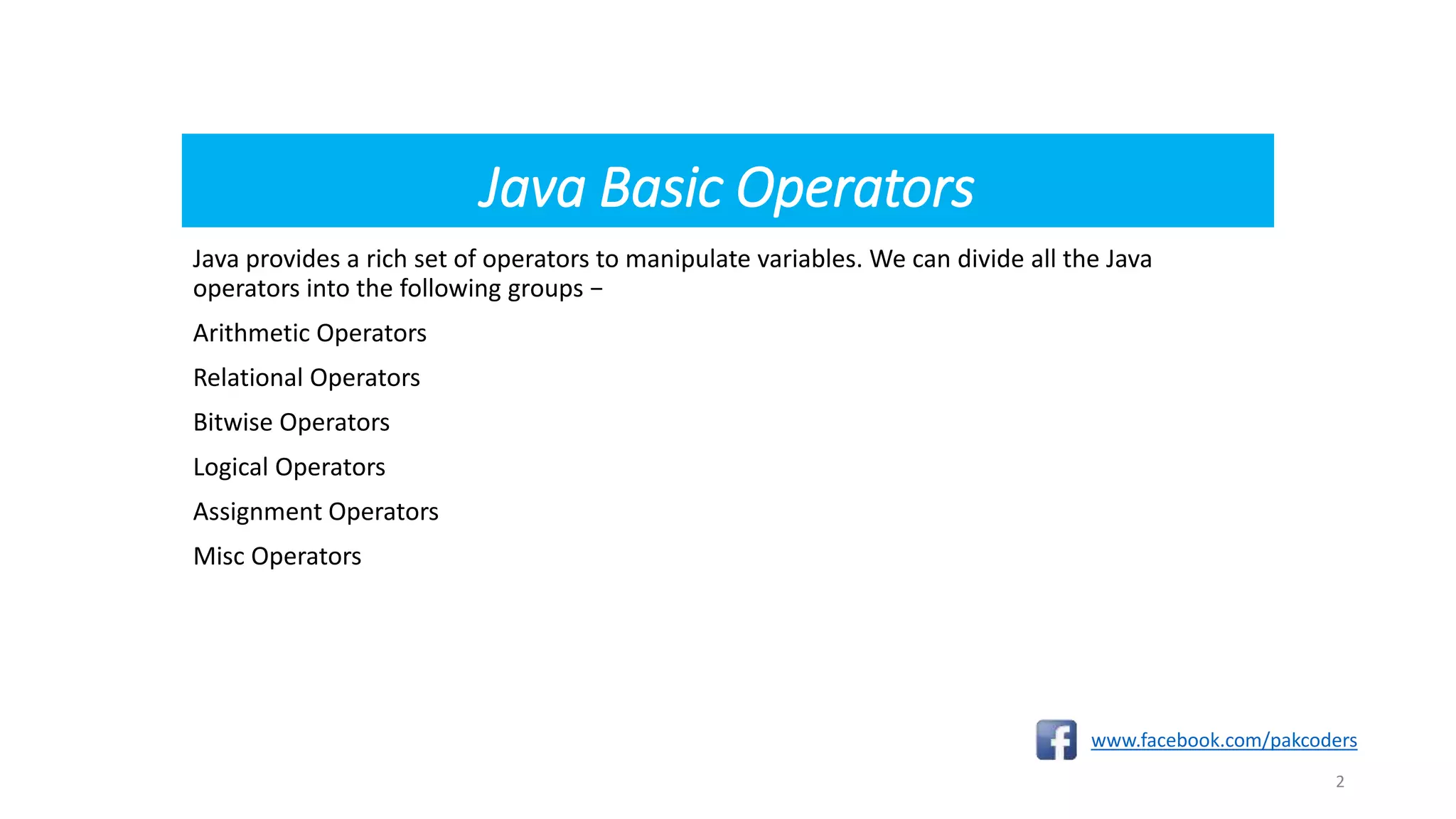
Java provides a rich set of operators to manipulate variables. We can divide all the Java
operators into the following groups −
Arithmetic Operators
Relational Operators
Bitwise Operators
Logical Operators
Assignment Operators
Misc Operators
www.facebook.com/pakcoders
2
Java Arithmetic Operators
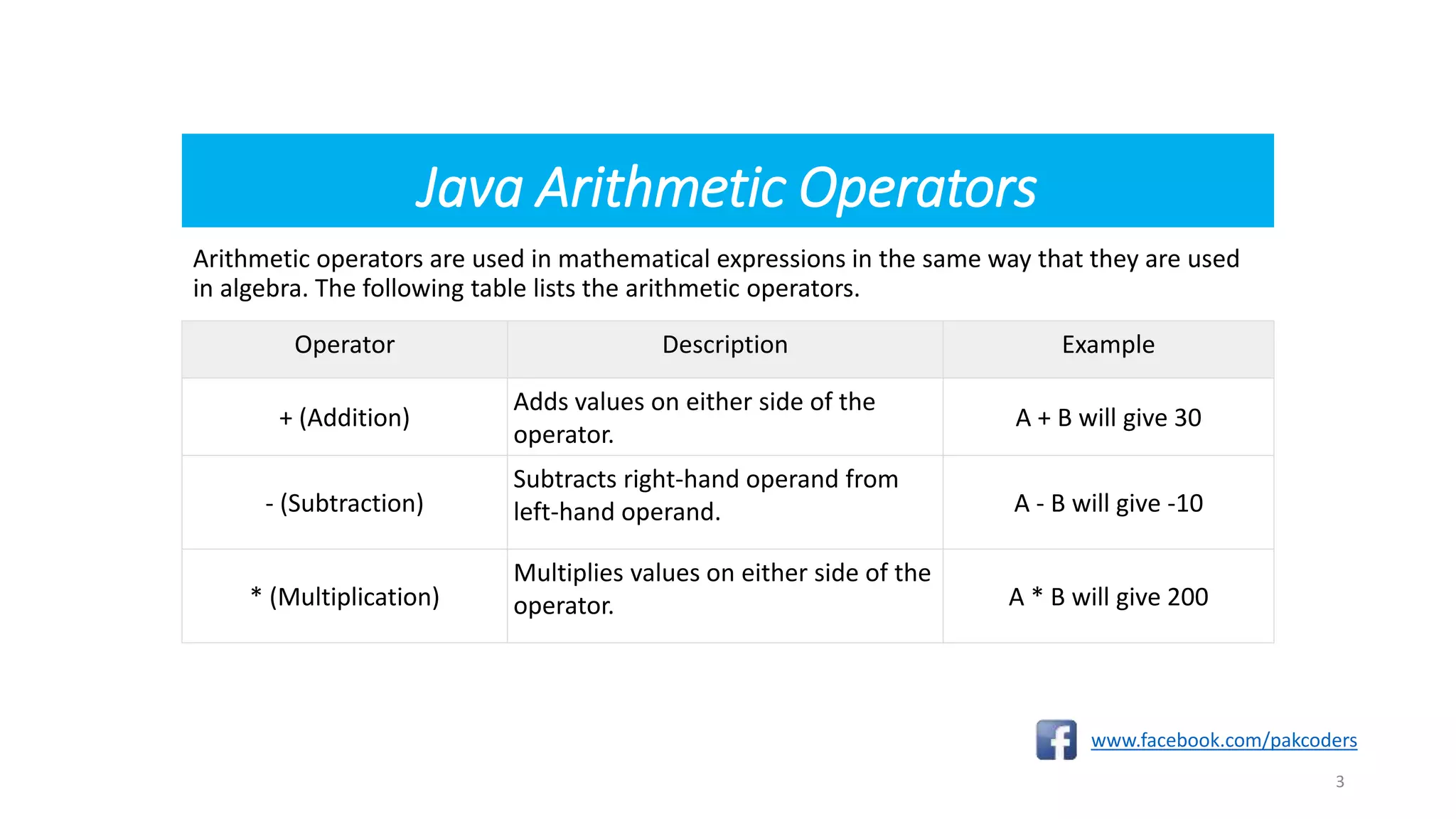
Arithmetic operators are used in mathematical expressions in the same way that they are used
in algebra. The following table lists the arithmetic operators.
www.facebook.com/pakcoders
3
Operator Description Example
+ (Addition)
Adds values on either side of the
operator.
A + B will give 30
- (Subtraction)
Subtracts right-hand operand from
left-hand operand. A - B will give -10
* (Multiplication)
Multiplies values on either side of the
operator. A * B will give 200
Java Arithmetic Operators
www.facebook.com/pakcoders
4
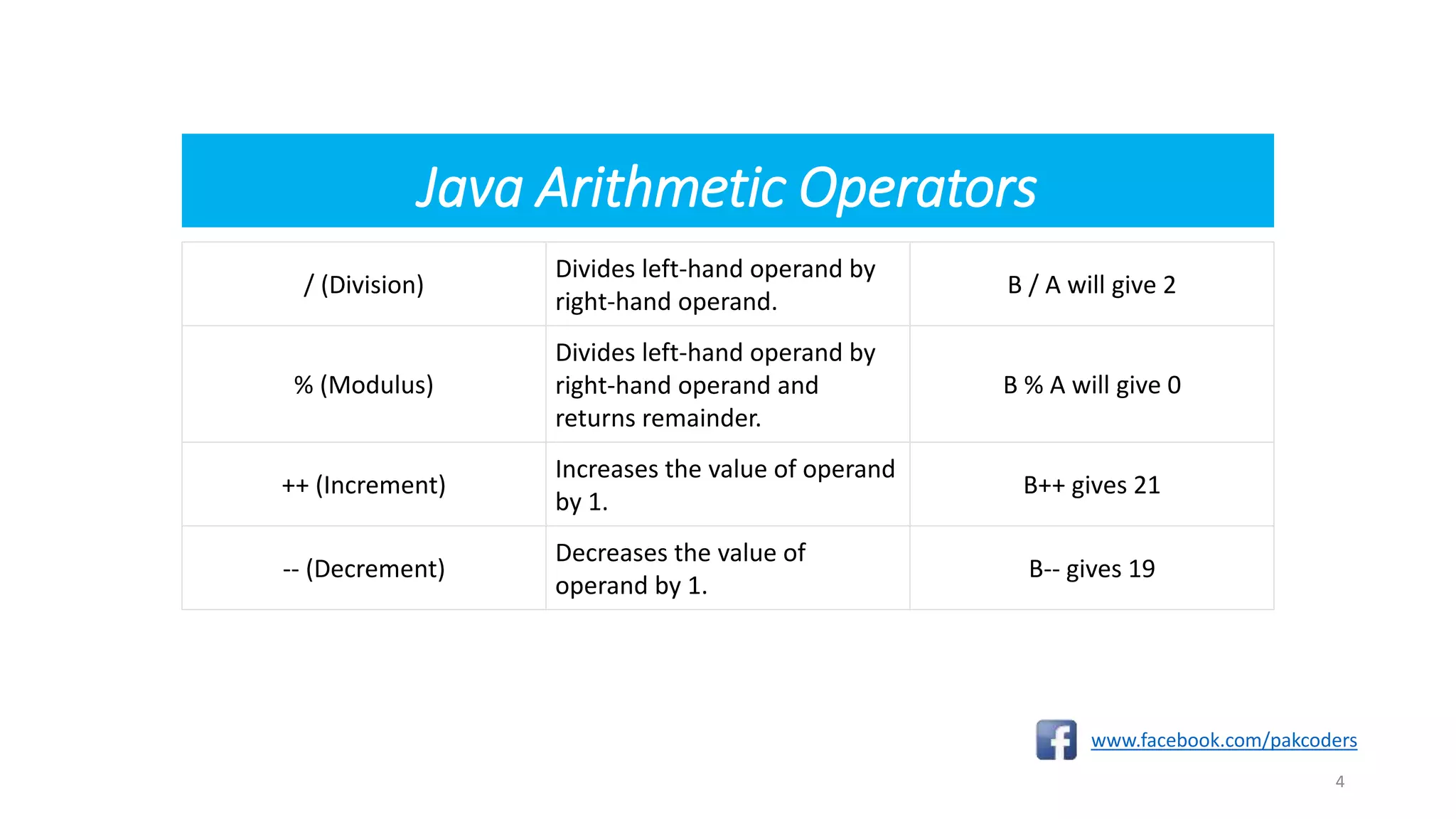
/ (Division)
Divides left-hand operand by
right-hand operand.
B / A will give 2
% (Modulus)
Divides left-hand operand by
right-hand operand and
returns remainder.
B % A will give 0
++ (Increment)
Increases the value of operand
by 1.
B++ gives 21
-- (Decrement)
Decreases the value of
operand by 1.
B-- gives 19
Example
www.facebook.com/pakcoders
5
class Test{
Public static void main(String[] args) {
int a = 10;
int b = 20;
int c = 25;
int d = 25;
System.out.println("a + b = " + (a + b) );
System.out.println("a - b = " + (a - b) );
System.out.println("a * b = " + (a * b) );
Part 1 of 3
Example
www.facebook.com/pakcoders
6
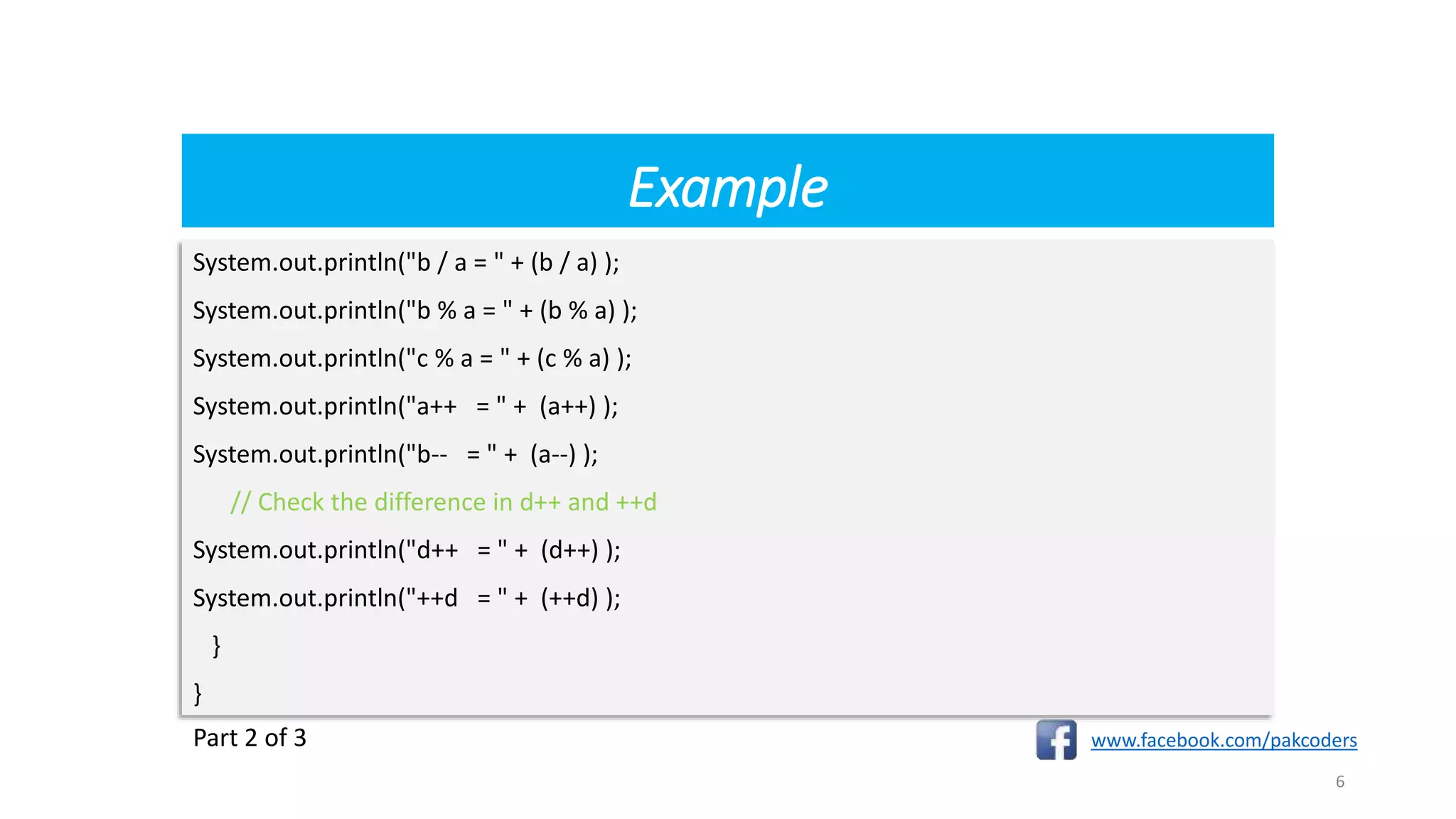
System.out.println("b / a = " + (b / a) );
System.out.println("b % a = " + (b % a) );
System.out.println("c % a = " + (c % a) );
System.out.println("a++ = " + (a++) );
System.out.println("b-- = " + (a--) );
// Check the difference in d++ and ++d
System.out.println("d++ = " + (d++) );
System.out.println("++d = " + (++d) );
}
}
Part 2 of 3
Output
www.facebook.com/pakcoders
7
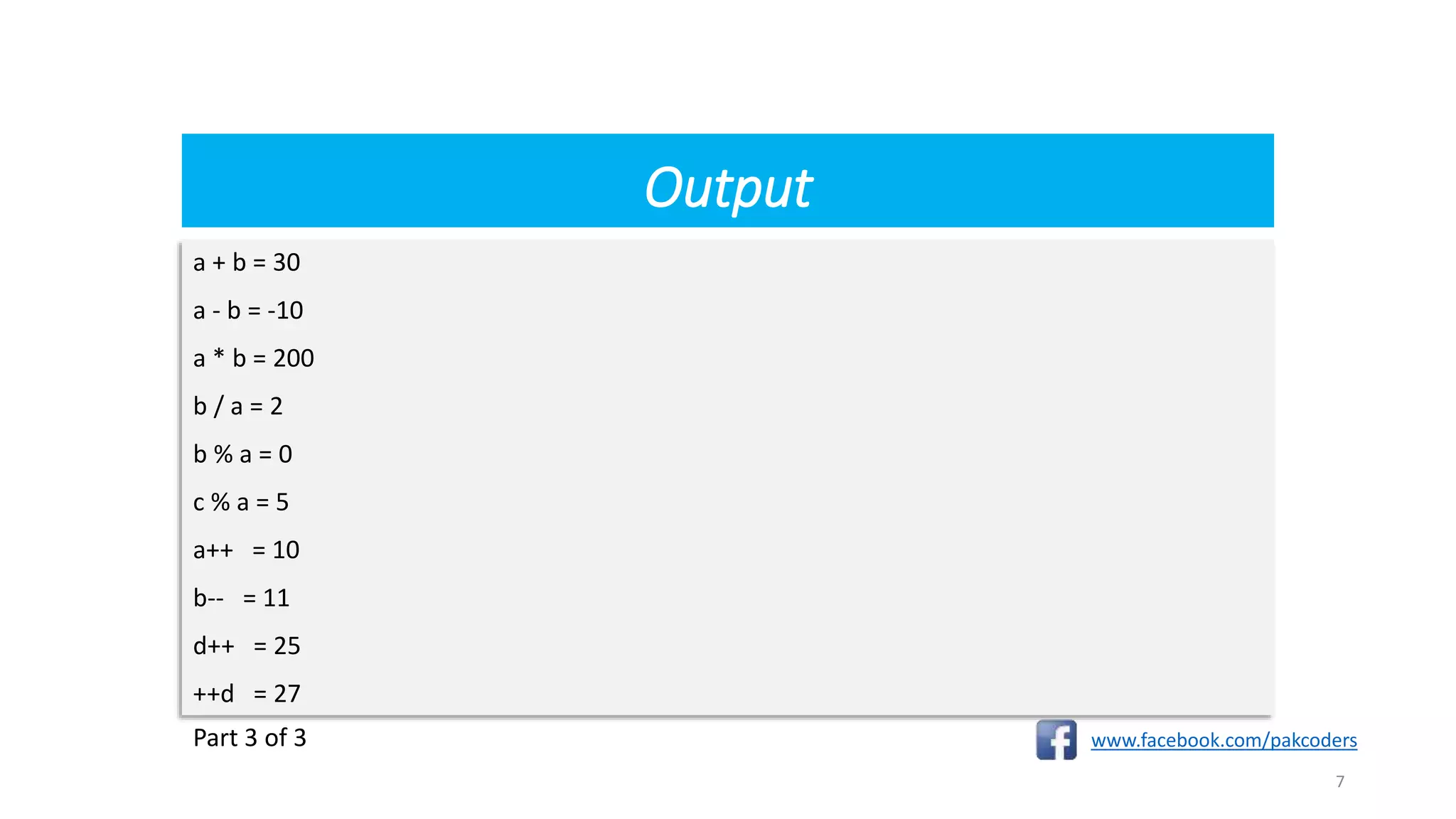
a + b = 30
a - b = -10
a * b = 200
b / a = 2
b % a = 0
c % a = 5
a++ = 10
b-- = 11
d++ = 25
++d = 27
Part 3 of 3
Java Relational Operators
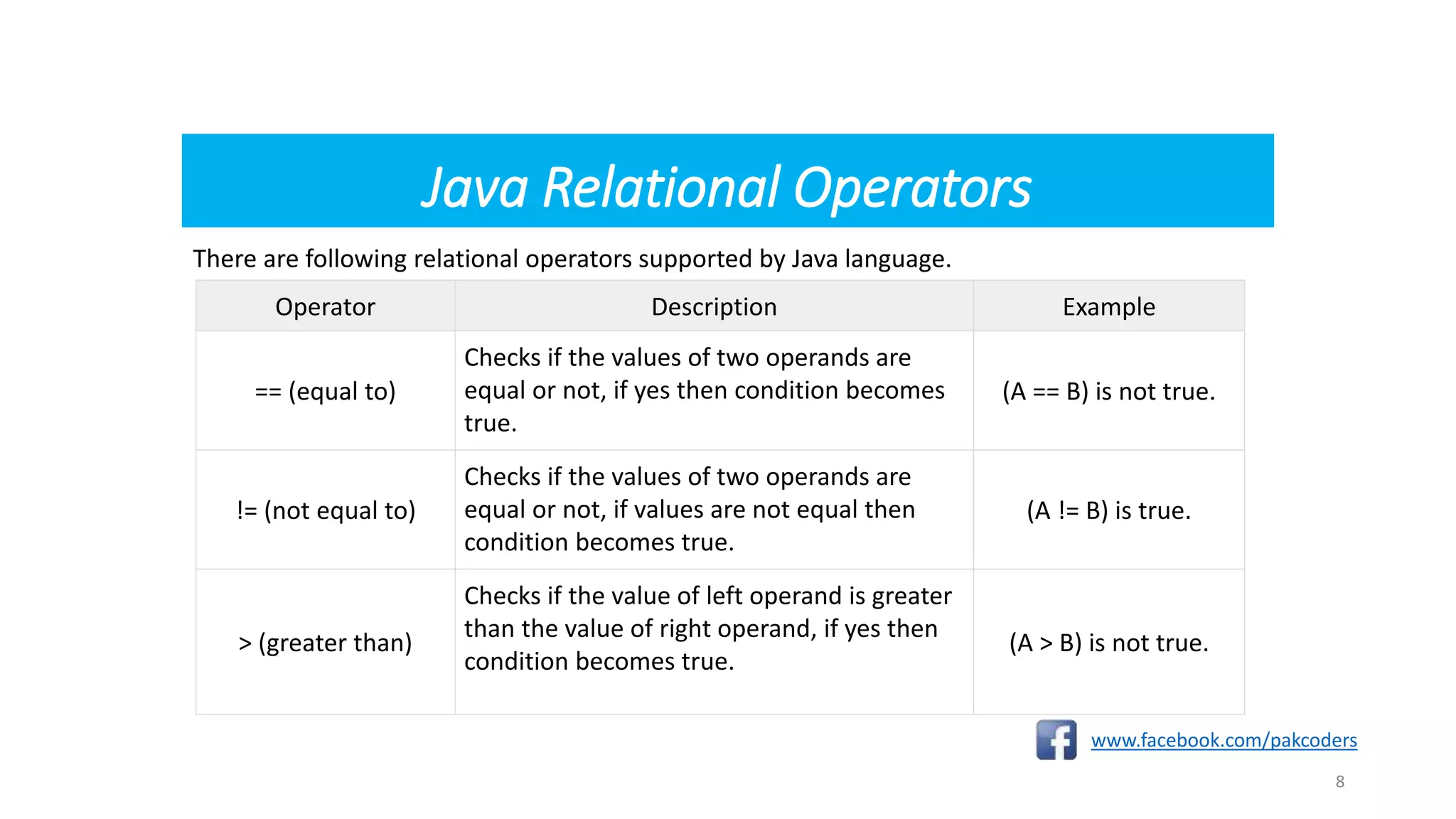
There are following relational operators supported by Java language.
www.facebook.com/pakcoders
8
Operator Description Example
== (equal to)
Checks if the values of two operands are
equal or not, if yes then condition becomes
true.
(A == B) is not true.
!= (not equal to)
Checks if the values of two operands are
equal or not, if values are not equal then
condition becomes true.
(A != B) is true.
> (greater than)
Checks if the value of left operand is greater
than the value of right operand, if yes then
condition becomes true.
(A > B) is not true.
Java Relational Operators
www.facebook.com/pakcoders
9
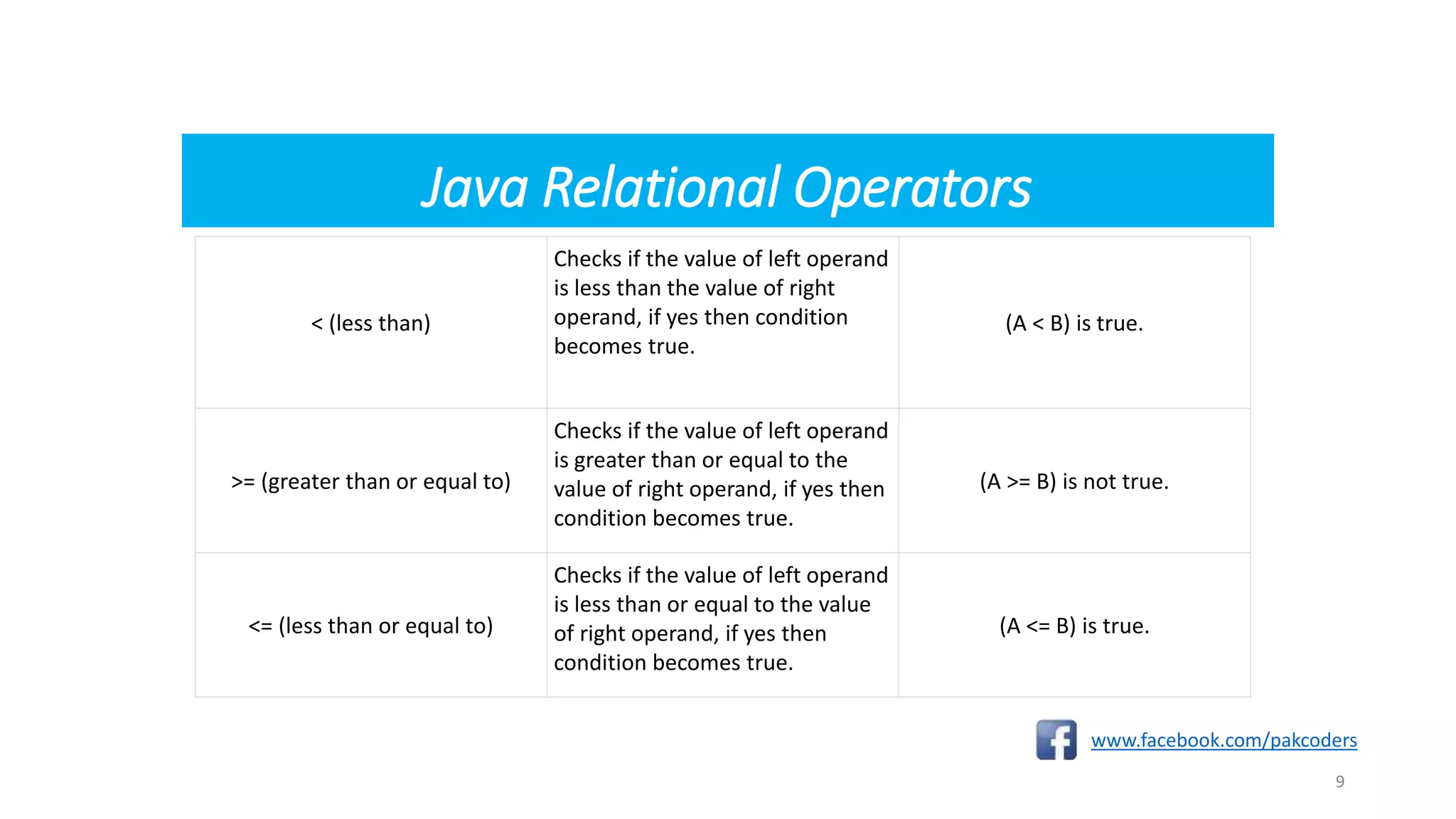
< (less than)
Checks if the value of left operand
is less than the value of right
operand, if yes then condition
becomes true.
(A < B) is true.
>= (greater than or equal to)
Checks if the value of left operand
is greater than or equal to the
value of right operand, if yes then
condition becomes true.
(A >= B) is not true.
<= (less than or equal to)
Checks if the value of left operand
is less than or equal to the value
of right operand, if yes then
condition becomes true.
(A <= B) is true.
Example
www.facebook.com/pakcoders
10
class Test{
Public static void main(String[] args) {
int a = 10;
int b = 20;
System.out.println("a == b = " + (a == b) );
System.out.println("a != b = " + (a != b) );
System.out.println("a > b = " + (a > b) );
System.out.println("a < b = " + (a < b) );
System.out.println("b >= a = " + (b >= a) );
Part 1 of 3
Example
www.facebook.com/pakcoders
11
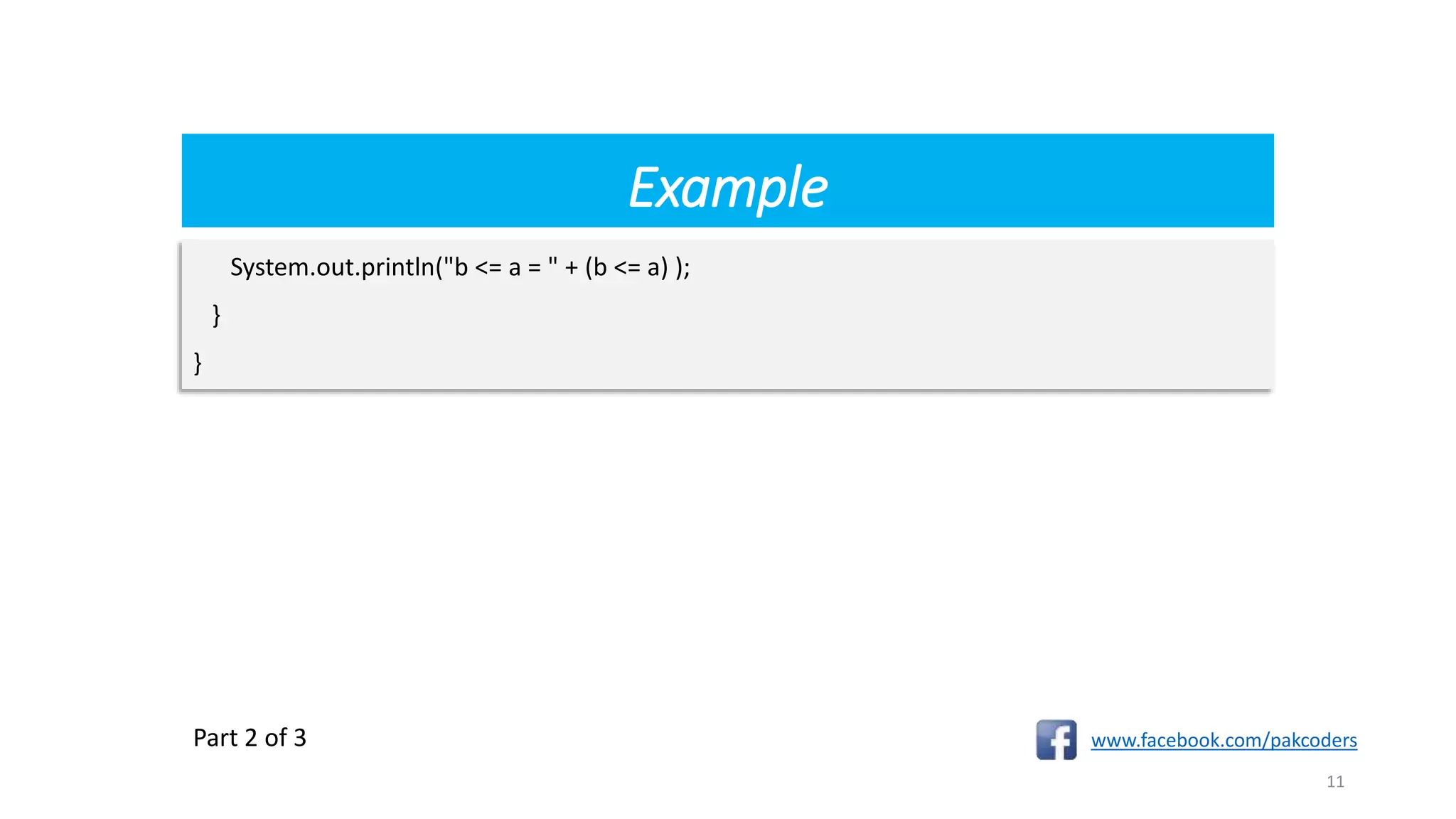
System.out.println("b <= a = " + (b <= a) );
}
}
Part 2 of 3
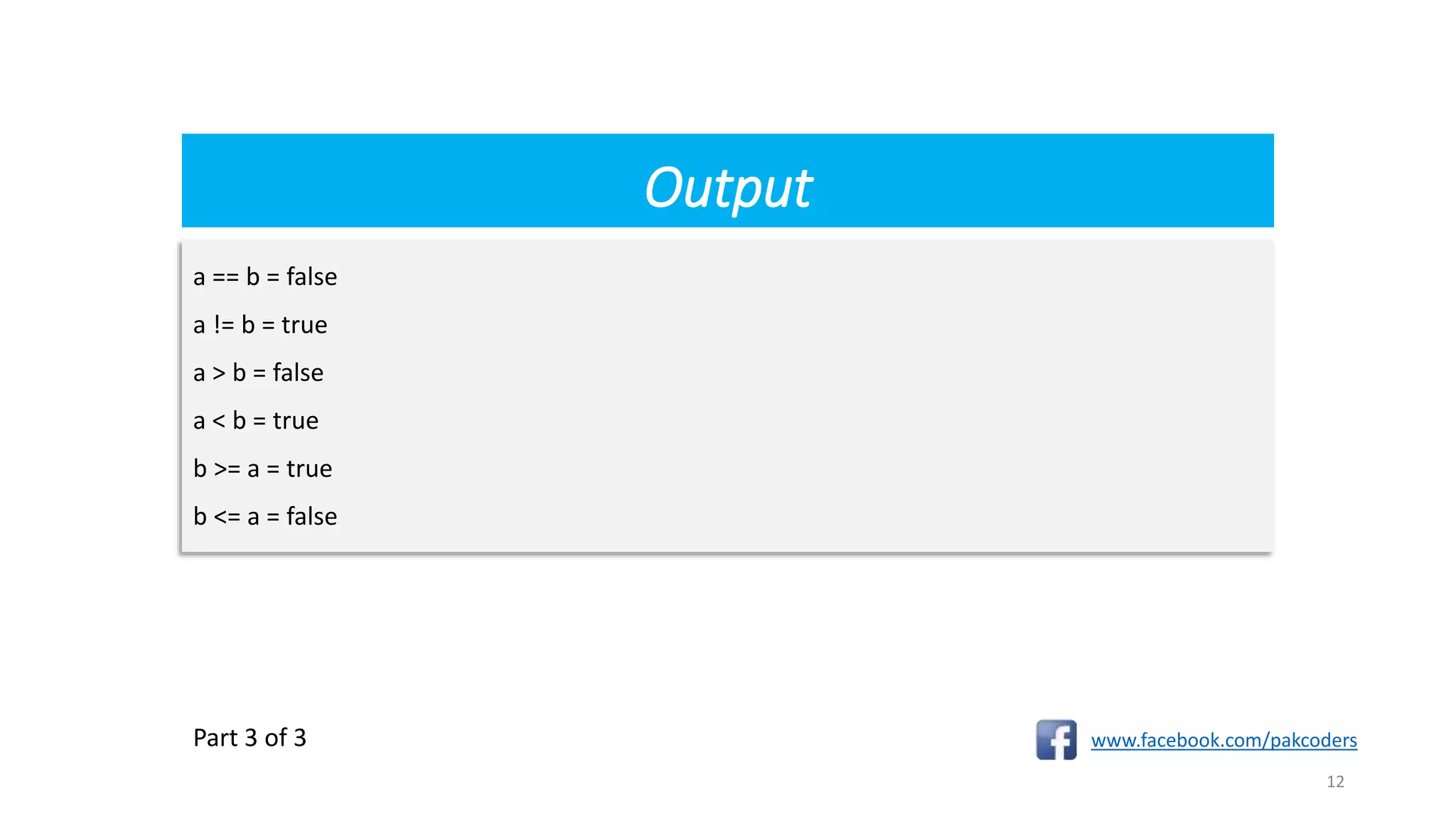
Output
www.facebook.com/pakcoders
12
a == b = false
a != b = true
a > b = false
a < b = true
b >= a = true
b <= a = false
Part 3 of 3
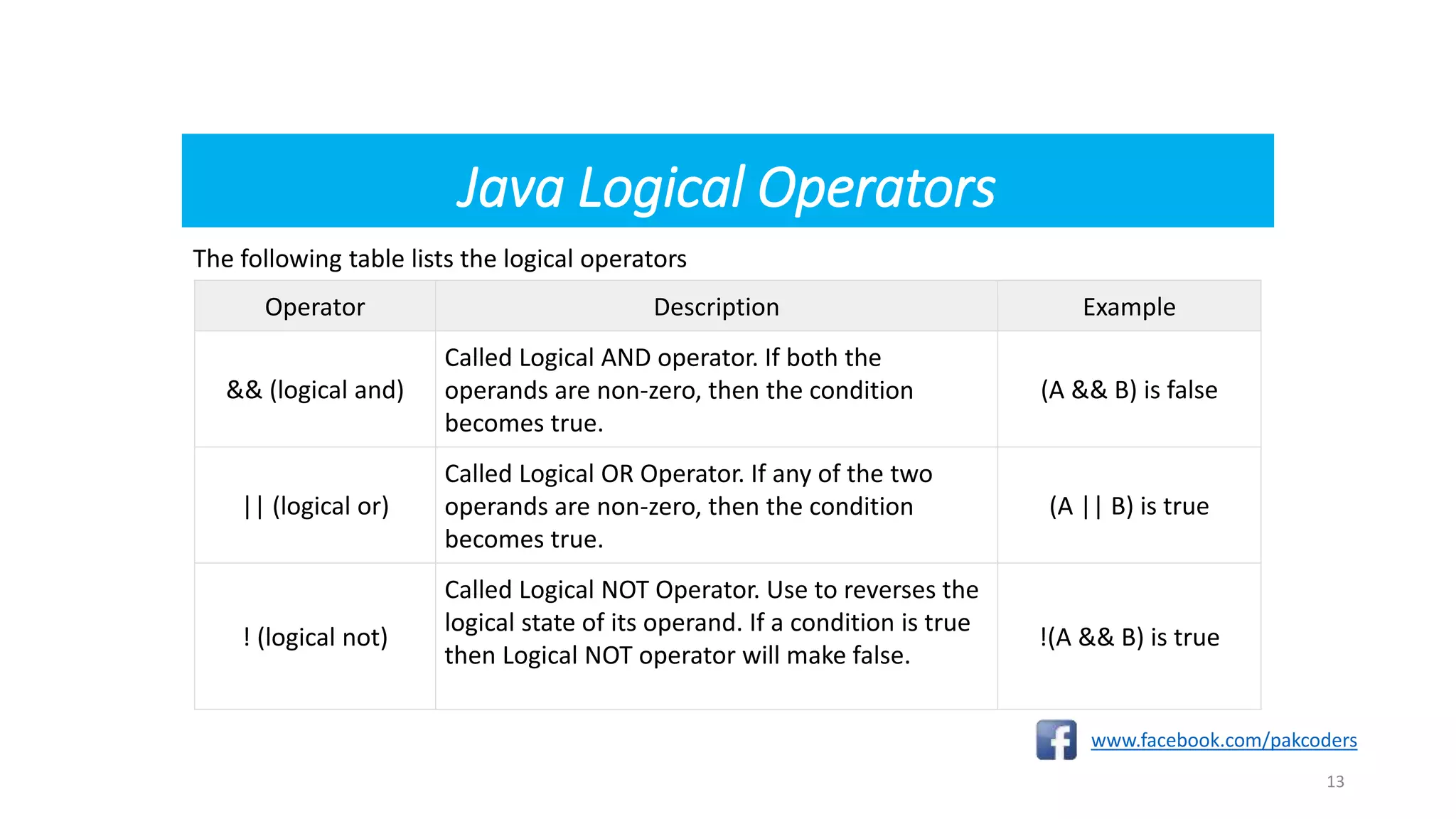
Java Logical Operators
The following table lists the logical operators
www.facebook.com/pakcoders
13
Operator Description Example
&& (logical and)
Called Logical AND operator. If both the
operands are non-zero, then the condition
becomes true.
(A && B) is false
|| (logical or)
Called Logical OR Operator. If any of the two
operands are non-zero, then the condition
becomes true.
(A || B) is true
! (logical not)
Called Logical NOT Operator. Use to reverses the
logical state of its operand. If a condition is true
then Logical NOT operator will make false.
!(A && B) is true
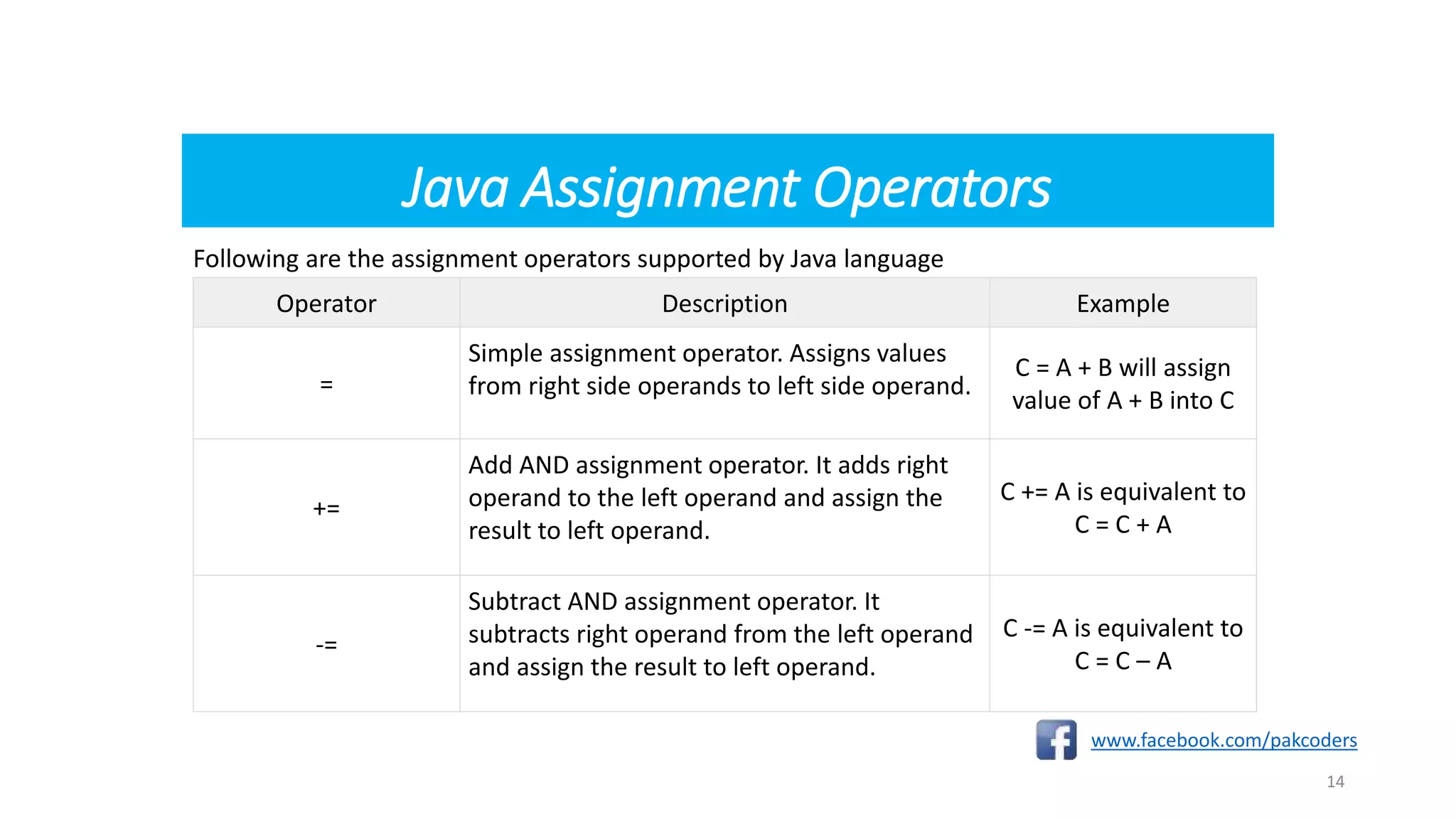
Java Assignment Operators
Following are the assignment operators supported by Java language
www.facebook.com/pakcoders
14
Operator Description Example
=
Simple assignment operator. Assigns values
from right side operands to left side operand.
C = A + B will assign
value of A + B into C
+=
Add AND assignment operator. It adds right
operand to the left operand and assign the
result to left operand.
C += A is equivalent to
C = C + A
-=
Subtract AND assignment operator. It
subtracts right operand from the left operand
and assign the result to left operand.
C -= A is equivalent to
C = C – A
Java Assignment Operators
www.facebook.com/pakcoders
15
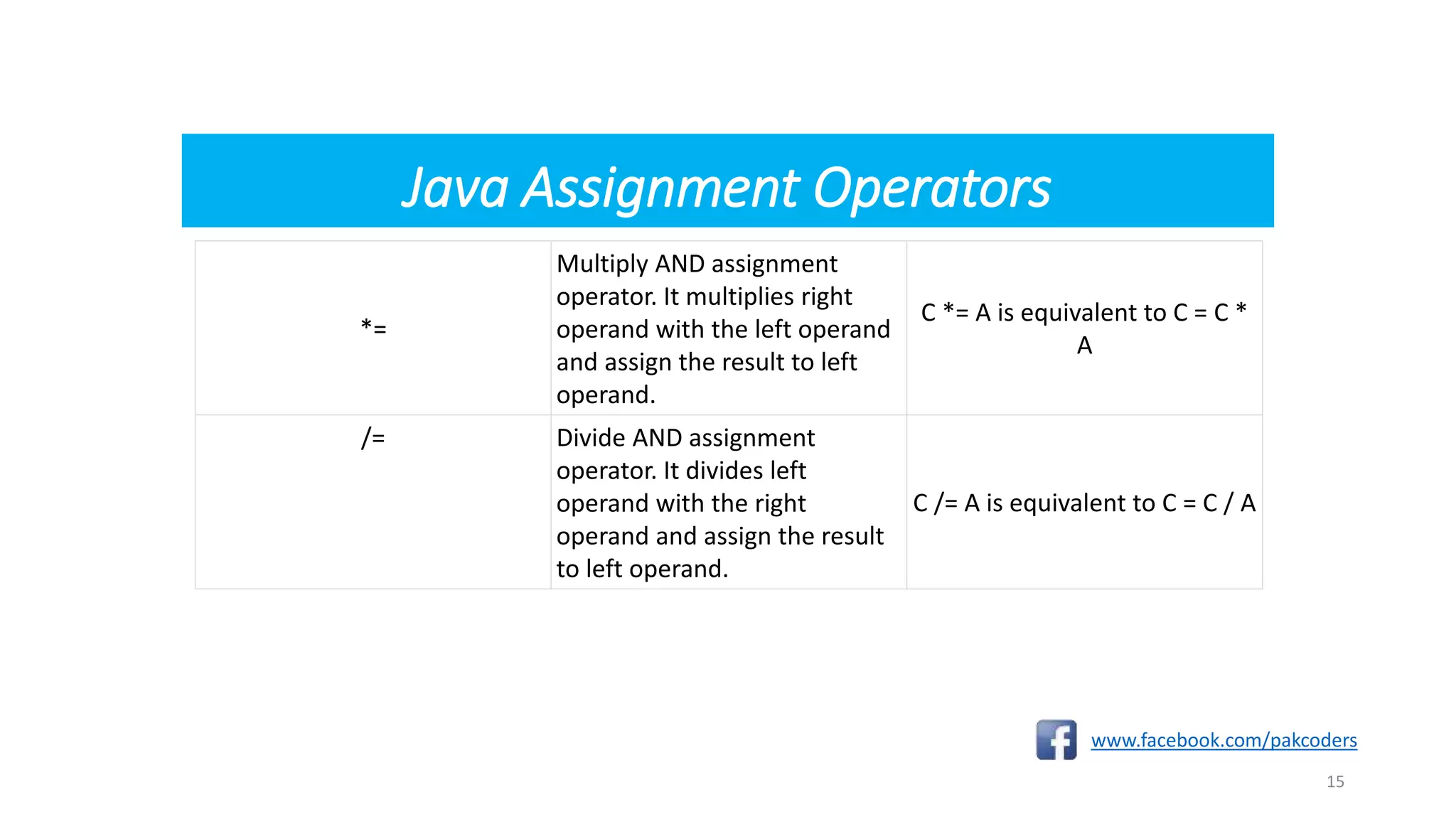
*=
Multiply AND assignment
operator. It multiplies right
operand with the left operand
and assign the result to left
operand.
C *= A is equivalent to C = C *
A
/= Divide AND assignment
operator. It divides left
operand with the right
operand and assign the result
to left operand.
C /= A is equivalent to C = C / A
Java Assignment Operators
www.facebook.com/pakcoders
16
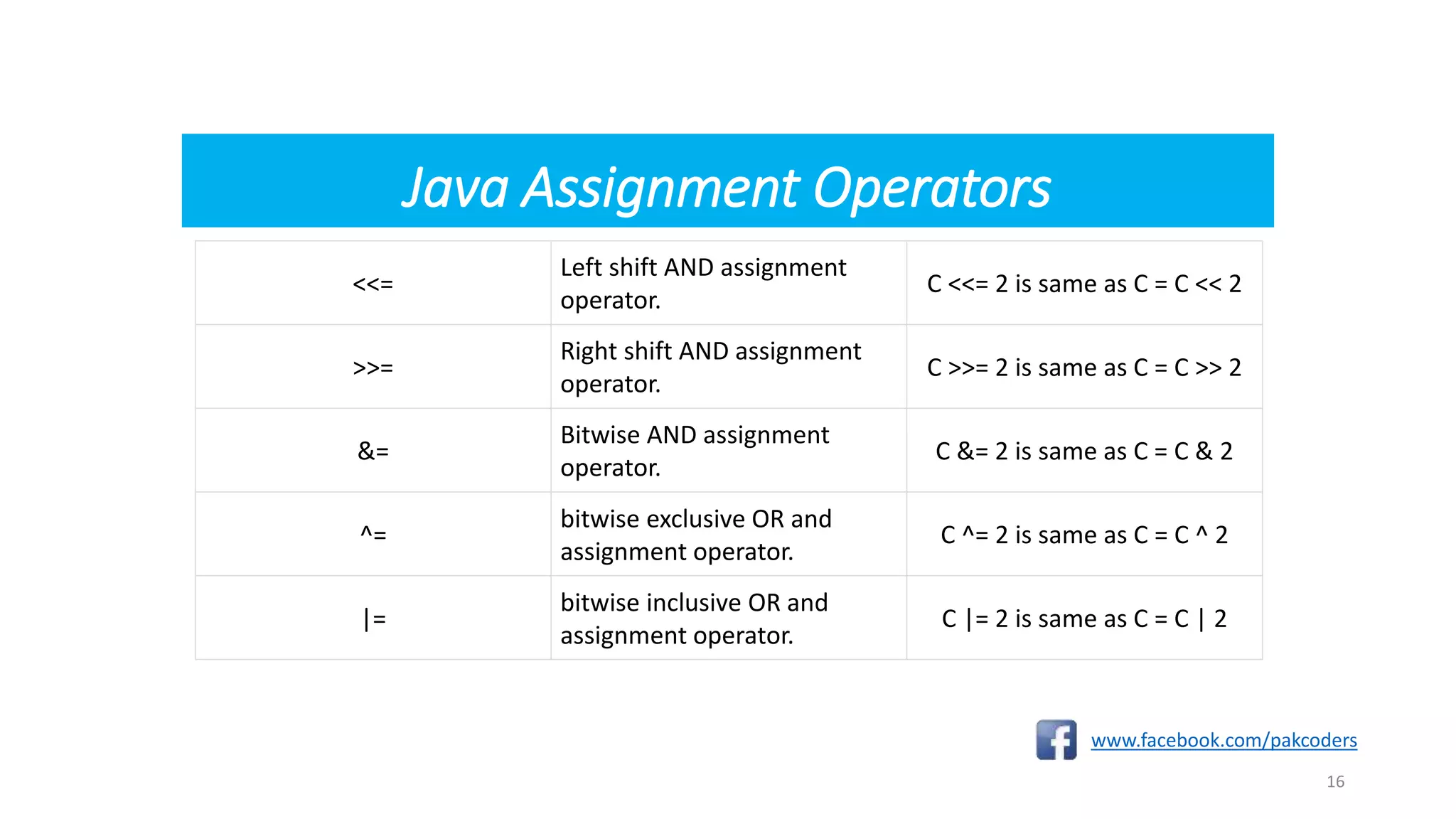
<<=
Left shift AND assignment
operator.
C <<= 2 is same as C = C << 2
>>=
Right shift AND assignment
operator.
C >>= 2 is same as C = C >> 2
&=
Bitwise AND assignment
operator.
C &= 2 is same as C = C & 2
^=
bitwise exclusive OR and
assignment operator.
C ^= 2 is same as C = C ^ 2
|=
bitwise inclusive OR and
assignment operator.
C |= 2 is same as C = C | 2
Java Miscellaneous Operators
There are few other operators supported by Java Language.
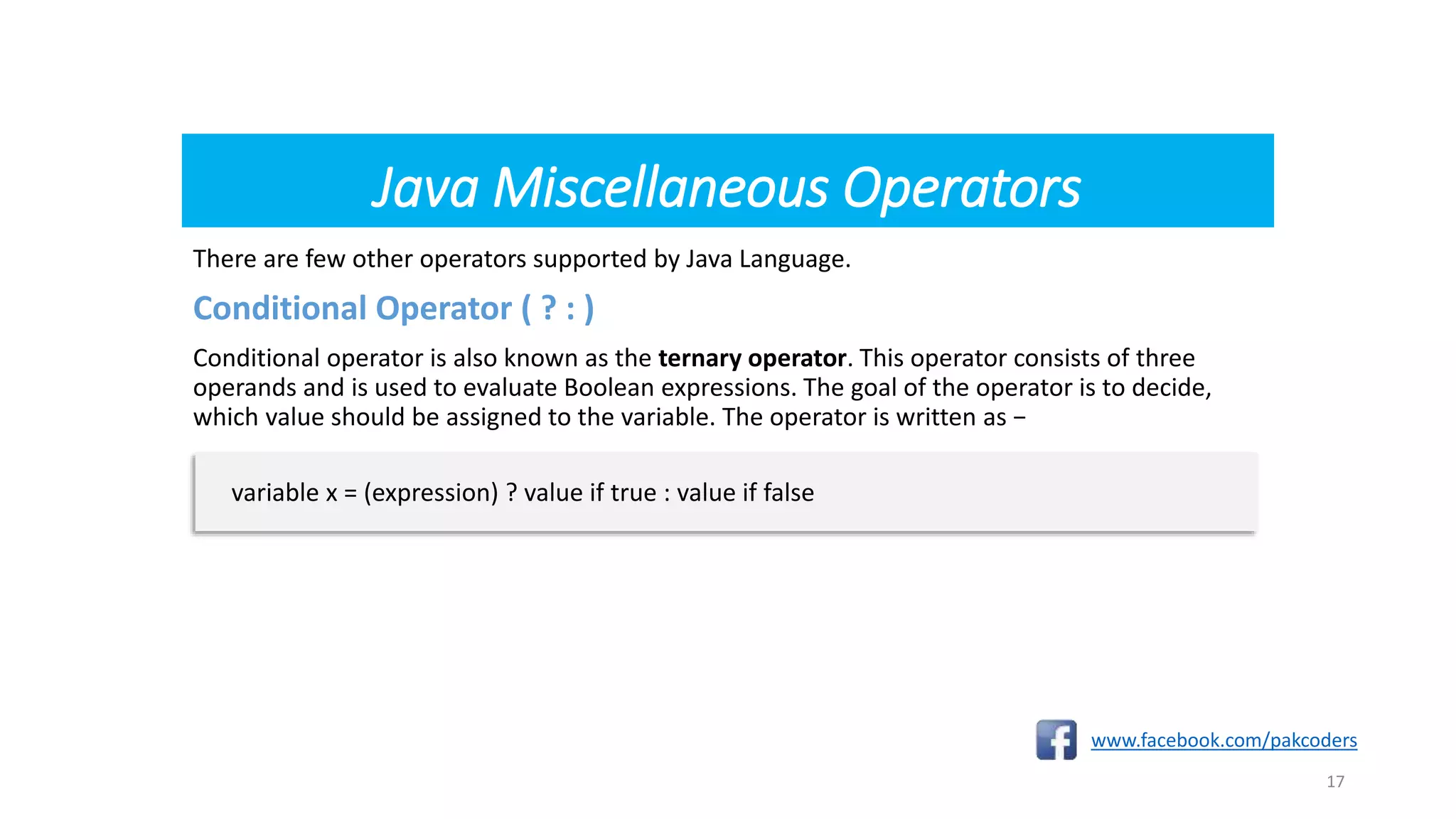
Conditional Operator ( ? : )
Conditional operator is also known as the ternary operator. This operator consists of three
operands and is used to evaluate Boolean expressions. The goal of the operator is to decide,
which value should be assigned to the variable. The operator is written as −
www.facebook.com/pakcoders
17
variable x = (expression) ? value if true : value if false
Example
www.facebook.com/pakcoders
18
class Test{
Public static void main(String[] args) {
int a = 10;
int b = (a == 1) ? 20 : 30;
System.out.println( "Value of b is : " + b );
b = (a == 10) ? 20 : 30;
System.out.println( "Value of b is : " + b );
Part 1 of 2
Output
www.facebook.com/pakcoders
19
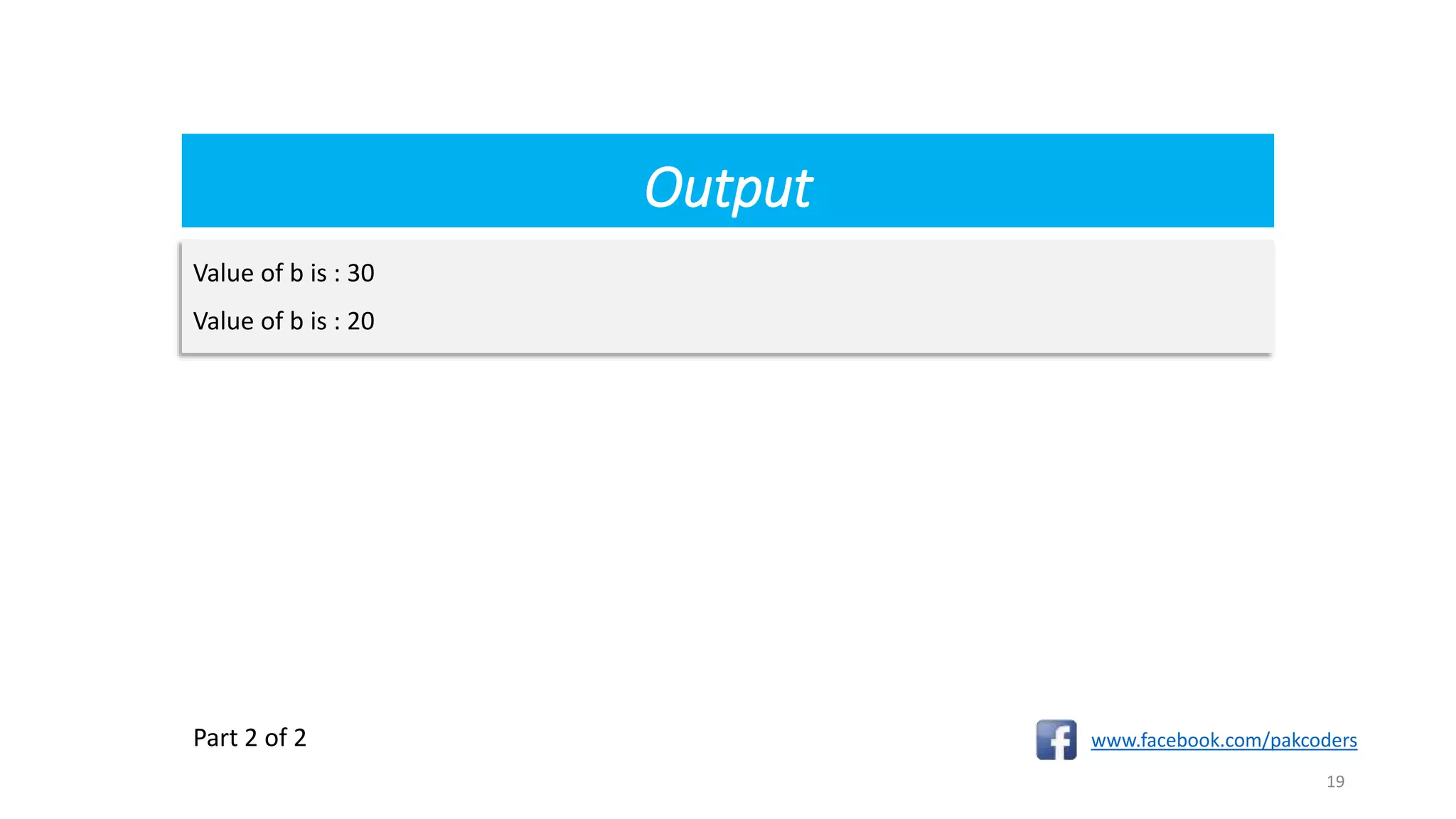
Value of b is : 30
Value of b is : 20
Part 2 of 2

Operators In Java Part - 8

  • 1.
    Title : JavaProgramming Language Muhammad Atif Noori noorithemes@gmail.com www.facebook.com/pakcoders www.facebook.com/pakcoders 1
  • 2.
    Java Basic Operators Javaprovides a rich set of operators to manipulate variables. We can divide all the Java operators into the following groups − Arithmetic Operators Relational Operators Bitwise Operators Logical Operators Assignment Operators Misc Operators www.facebook.com/pakcoders 2
  • 3.
    Java Arithmetic Operators Arithmeticoperators are used in mathematical expressions in the same way that they are used in algebra. The following table lists the arithmetic operators. www.facebook.com/pakcoders 3 Operator Description Example + (Addition) Adds values on either side of the operator. A + B will give 30 - (Subtraction) Subtracts right-hand operand from left-hand operand. A - B will give -10 * (Multiplication) Multiplies values on either side of the operator. A * B will give 200
  • 4.
    Java Arithmetic Operators www.facebook.com/pakcoders 4 /(Division) Divides left-hand operand by right-hand operand. B / A will give 2 % (Modulus) Divides left-hand operand by right-hand operand and returns remainder. B % A will give 0 ++ (Increment) Increases the value of operand by 1. B++ gives 21 -- (Decrement) Decreases the value of operand by 1. B-- gives 19
  • 5.
    Example www.facebook.com/pakcoders 5 class Test{ Public staticvoid main(String[] args) { int a = 10; int b = 20; int c = 25; int d = 25; System.out.println("a + b = " + (a + b) ); System.out.println("a - b = " + (a - b) ); System.out.println("a * b = " + (a * b) ); Part 1 of 3
  • 6.
    Example www.facebook.com/pakcoders 6 System.out.println("b / a= " + (b / a) ); System.out.println("b % a = " + (b % a) ); System.out.println("c % a = " + (c % a) ); System.out.println("a++ = " + (a++) ); System.out.println("b-- = " + (a--) ); // Check the difference in d++ and ++d System.out.println("d++ = " + (d++) ); System.out.println("++d = " + (++d) ); } } Part 2 of 3
  • 7.
    Output www.facebook.com/pakcoders 7 a + b= 30 a - b = -10 a * b = 200 b / a = 2 b % a = 0 c % a = 5 a++ = 10 b-- = 11 d++ = 25 ++d = 27 Part 3 of 3
  • 8.
    Java Relational Operators Thereare following relational operators supported by Java language. www.facebook.com/pakcoders 8 Operator Description Example == (equal to) Checks if the values of two operands are equal or not, if yes then condition becomes true. (A == B) is not true. != (not equal to) Checks if the values of two operands are equal or not, if values are not equal then condition becomes true. (A != B) is true. > (greater than) Checks if the value of left operand is greater than the value of right operand, if yes then condition becomes true. (A > B) is not true.
  • 9.
    Java Relational Operators www.facebook.com/pakcoders 9 <(less than) Checks if the value of left operand is less than the value of right operand, if yes then condition becomes true. (A < B) is true. >= (greater than or equal to) Checks if the value of left operand is greater than or equal to the value of right operand, if yes then condition becomes true. (A >= B) is not true. <= (less than or equal to) Checks if the value of left operand is less than or equal to the value of right operand, if yes then condition becomes true. (A <= B) is true.
  • 10.
    Example www.facebook.com/pakcoders 10 class Test{ Public staticvoid main(String[] args) { int a = 10; int b = 20; System.out.println("a == b = " + (a == b) ); System.out.println("a != b = " + (a != b) ); System.out.println("a > b = " + (a > b) ); System.out.println("a < b = " + (a < b) ); System.out.println("b >= a = " + (b >= a) ); Part 1 of 3
  • 11.
  • 12.
    Output www.facebook.com/pakcoders 12 a == b= false a != b = true a > b = false a < b = true b >= a = true b <= a = false Part 3 of 3
  • 13.
    Java Logical Operators Thefollowing table lists the logical operators www.facebook.com/pakcoders 13 Operator Description Example && (logical and) Called Logical AND operator. If both the operands are non-zero, then the condition becomes true. (A && B) is false || (logical or) Called Logical OR Operator. If any of the two operands are non-zero, then the condition becomes true. (A || B) is true ! (logical not) Called Logical NOT Operator. Use to reverses the logical state of its operand. If a condition is true then Logical NOT operator will make false. !(A && B) is true
  • 14.
    Java Assignment Operators Followingare the assignment operators supported by Java language www.facebook.com/pakcoders 14 Operator Description Example = Simple assignment operator. Assigns values from right side operands to left side operand. C = A + B will assign value of A + B into C += Add AND assignment operator. It adds right operand to the left operand and assign the result to left operand. C += A is equivalent to C = C + A -= Subtract AND assignment operator. It subtracts right operand from the left operand and assign the result to left operand. C -= A is equivalent to C = C – A
  • 15.
    Java Assignment Operators www.facebook.com/pakcoders 15 *= MultiplyAND assignment operator. It multiplies right operand with the left operand and assign the result to left operand. C *= A is equivalent to C = C * A /= Divide AND assignment operator. It divides left operand with the right operand and assign the result to left operand. C /= A is equivalent to C = C / A
  • 16.
    Java Assignment Operators www.facebook.com/pakcoders 16 <<= Leftshift AND assignment operator. C <<= 2 is same as C = C << 2 >>= Right shift AND assignment operator. C >>= 2 is same as C = C >> 2 &= Bitwise AND assignment operator. C &= 2 is same as C = C & 2 ^= bitwise exclusive OR and assignment operator. C ^= 2 is same as C = C ^ 2 |= bitwise inclusive OR and assignment operator. C |= 2 is same as C = C | 2
  • 17.
    Java Miscellaneous Operators Thereare few other operators supported by Java Language. Conditional Operator ( ? : ) Conditional operator is also known as the ternary operator. This operator consists of three operands and is used to evaluate Boolean expressions. The goal of the operator is to decide, which value should be assigned to the variable. The operator is written as − www.facebook.com/pakcoders 17 variable x = (expression) ? value if true : value if false
  • 18.
    Example www.facebook.com/pakcoders 18 class Test{ Public staticvoid main(String[] args) { int a = 10; int b = (a == 1) ? 20 : 30; System.out.println( "Value of b is : " + b ); b = (a == 10) ? 20 : 30; System.out.println( "Value of b is : " + b ); Part 1 of 2
  • 19.
    Output www.facebook.com/pakcoders 19 Value of bis : 30 Value of b is : 20 Part 2 of 2